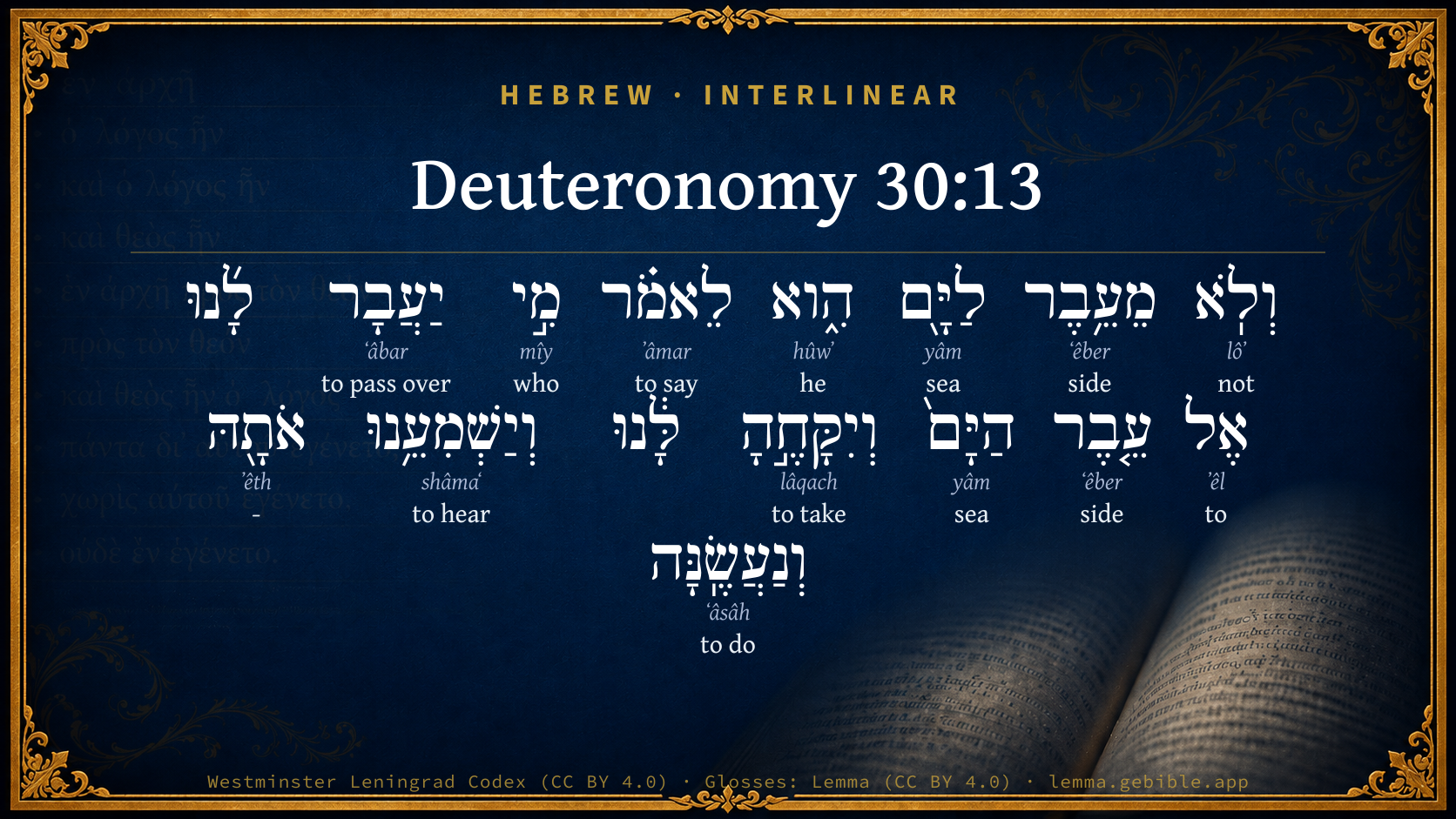
Deuteronomy 30:13

Hebrew (Westminster Leningrad Codex) Deuteronomy 30:13 appears in the Hebrew Old Testament. The text above is from the Westminster Leningrad Codex. Each word links to its Strong’s number, a concise gloss, and parsing drawn from the Open Scriptures Hebrew Bible morphology. Click any word for its full Brown-Driver-Briggs (BDB) entry.
Download image
Cite this verse

Deuteronomy 30:13 (World English Bible). Public Domain. Lemma interlinear Bible study tool, https://lemma.gebible.app/v/deuteronomy/30/13.

Show BibTeX & RIS
BibTeX
RIS
English Translation
Neither is it beyond the sea, that you should say, Who shall go over the sea for us, and bring it to us, and make us to hear it, that we may do it?
World English Bible · Public Domain
Download a study sheet

One document with this verse’s original text, its word-by-word gloss line, the meaning frame, cross-references with their text, attributed commentary, and full source and license credits — printable, and it pastes into notes with its structure intact.

This verse Autodidact and up

Study sheet (.html) Plain text (.txt)

A passage Seminary Student

Up to 50 verses in one chapter. A passage sheet keeps up to 6 commentary sources and 12 cross-references per verse, in the order this page ranks them, and says so on the sheet whenever that leaves anything out. Ask for a single verse and you get the Autodidact verse sheet above.

Everything on this page stays free to read, with no account — the sheet is a download of what is already on screen, not access to it.

Want to remove ads? Support Godless Engineer
Compare translations 3

The same verse in 3 English versions, stacked beneath the original-language interlinear above. Click any original word for its lexicon entry.

Each is an independent rendering of the whole verse — the interlinear is not word-aligned to these translations.

Highlighted words mark where these versions differ — a whole-verse word diff, not a word-by-word alignment.

  • World English Bible Public Domain
    Neither is it beyond the sea, that you should say, Who shall go over the sea for us, and bring it to us, and make us to hear it, that we may do it?
  • King James Version Public Domain
    Neither is it beyond the sea, that thou shouldest say, Who shall go over the sea for us, and bring it unto us, that we may hear it, and do it?
  • unfoldingWord Literal Text CC BY-SA 4.0
    And it not beyond the sea, saying, ‘Who will go over to beyond the sea for us and take it to us and cause us to hear it and let us do it?’

unfoldingWord Literal Text — © unfoldingWord, licensed CC BY-SA 4.0. Word-aligned USFM3 via Door43 (git.door43.org/unfoldingWord/en_ult).

Versions to compare (up to 4)

3 of 4 selected

Show all 18 translations

Every available English version of this verse, each an independent rendering of the whole verse.

  • World English Bible Public Domain
    Neither is it beyond the sea, that you should say, Who shall go over the sea for us, and bring it to us, and make us to hear it, that we may do it?
  • Berean Standard Bible Public Domain
    And it is not beyond the sea, that you should need to ask, ‘Who will cross the sea to get it for us and proclaim it, that we may obey it?’
  • Majority Standard Bible Public Domain
    And it is not beyond the sea, that you should need to ask, ‘Who will cross the sea to get it for us and proclaim it, that we may obey it?’
  • King James Version Public Domain
    Neither is it beyond the sea, that thou shouldest say, Who shall go over the sea for us, and bring it unto us, that we may hear it, and do it?
  • American Standard Version (1901) Public Domain
    Neither is it beyond the sea, that thou shouldest say, Who shall go over the sea for us, and bring it unto us, and make us to hear it, that we may do it?
  • Revised Version (1885) Public Domain
    Neither is it beyond the sea, that thou shouldest say, Who shall go over the sea for us, and bring it unto us, and make us to hear it, that we may do it?
  • Geneva Bible (1599) Public Domain
    Neither is it beyonde the sea, that thou shouldest say, Who shall go ouer the sea for vs, and bring it vs, and cause vs to heare it, that we may do it?
  • Douay-Rheims (1899) Public Domain
    Nor is it beyond the sea: that thou mayst excuse thyself, and say: Which of us can cross the sea, and bring it unto us: that we may hear, and do that which is commanded?
  • Young's Literal Translation Public Domain
    And it `is' not beyond the sea, -- saying, Who doth pass over for us beyond the sea, and doth take it for us, and doth cause us to hear it -- that we may do it?
  • Literal Standard Version CC BY-SA 4.0
    And it [is] not beyond the sea, saying, Who passes over beyond the sea for us, and takes it for us, and causes us to hear it, that we may do it?
  • Unlocked Literal Bible CC BY-SA 4.0
    Neither is it beyond the sea, so that you should have to say, 'Who will go over the sea for us and bring it to us and make us to hear it, so that we may do it?'
  • unfoldingWord Literal Text CC BY-SA 4.0
    And it not beyond the sea, saying, ‘Who will go over to beyond the sea for us and take it to us and cause us to hear it and let us do it?’
  • Darby Bible Public Domain
    And it is not beyond the sea, that thou shouldest say, Who shall go over the sea for us, and bring it to us, that we should hear it and do it?
  • World Messianic Bible Public Domain
    Neither is it beyond the sea, that you should say, “Who will go over the sea for us, bring it to us, and proclaim it to us, that we may do it?”
  • Webster's Bible Public Domain
    Neither is it beyond the sea, that thou shouldst say, Who shall go over the sea for us, and bring it to us, that we may hear it, and do it?
  • Free Bible Version CC BY-SA 4.0
    It's not across the ocean so you have to ask, “Who is going to cross the ocean to get it for us and let us know what it says so we can obey it?”
  • Bible in Basic English Public Domain
    And they are not across the sea, for you to say, Who will go over the sea for us and give us news of them so that we may do them?
  • JPS Tanakh (1917) Public Domain
    Neither is it beyond the sea, that thou shouldest say: 'Who shall go over the sea for us, and bring it unto us, and make us to hear it, that we may do it?'

Literal Standard Version (2020), Covenant Press — licensed CC BY-SA 4.0. Text via the HelloAO Bible API (eBible.org). Unlocked Literal Bible (unfoldingWord) — licensed CC BY-SA 4.0. Text via the HelloAO Bible API (eBible.org). unfoldingWord Literal Text — © unfoldingWord, licensed CC BY-SA 4.0. Word-aligned USFM3 via Door43 (git.door43.org/unfoldingWord/en_ult). Free Bible Version, Dr. Jonathan Gallagher — licensed CC BY-SA 4.0. Text via the HelloAO Bible API (eBible.org).

Word by word

More ways to search: Search by grammar → Find every occurrence → Compare this word →

Practice this passage: Drill this verse → Learn its vocabulary →

מֵעֵ֥בֶר
ʻêber
H5676
“from · side”
Preposition + Noun, Common, Masculine, Singular, Absolute
Part of Speech
Preposition + Noun
Type
Common
Gender
Masculine
Number
Singular
State
Absolute
Full BDB Definition

Origin: from H5674

TWOT: 1556a

region beyond or across, side - region across or beyond - side, opposite side
  1. וְלֹֽא lôʼ H3808 “and · not” Conjunction + Particle, Negative
  2. לַיָּ֖ם yâm H3220 “to/for the · sea” Preposition, Determined + Noun, Common, Masculine, Singular, Absolute
  3. הִ֑וא hûwʼ H1931 “he” Pronoun, Personal, 3rd Person, Feminine, Singular
  4. לֵאמֹ֗ר ʼâmar H559 “to say” Preposition + Verb, Qal, Infinitive Construct
  5. מִ֣י mîy H4310 “who” Particle, Interrogative
  6. יַעֲבָר ʻâbar H5674 “to pass over” Verb, Qal, Imperfect, 3rd Person, Masculine, Singular
  7. אֶל ʼêl H413 “to” Preposition
  8. עֵ֤בֶר ʻêber H5676 “side of” Noun, Common, Masculine, Singular, Construct
  9. הַיָּם֙ yâm H3220 “the · sea” Particle, Definite Article + Noun, Common, Masculine, Singular, Absolute
  10. וְיִקָּחֶ֣הָ lâqach H3947 “and · to take · her” Conjunction + Verb, Qal, Imperfect, 3rd Person, Masculine, Singular + Suffix, Personal, 3rd Person, Feminine, Singular
  11. וְיַשְׁמִעֵ֥נוּ shâmaʻ H8085 “and · to hear · us” Conjunction + Verb, Hiphil, Imperfect, 3rd Person, Masculine, Singular + Suffix, Personal, 1st Person, Common, Plural
  12. אֹתָ֖הּ ʼêth H853 “- · her” Particle, Direct Object + Suffix, Personal, 3rd Person, Feminine, Singular
  13. וְנַעֲשֶֽׂנָּה ʻâsâh H6213 “and · to do · her” Conjunction + Verb, Qal, Imperfect, 1st Person, Common, Plural + Suffix, Personal, 3rd Person, Feminine, Singular

About this verse

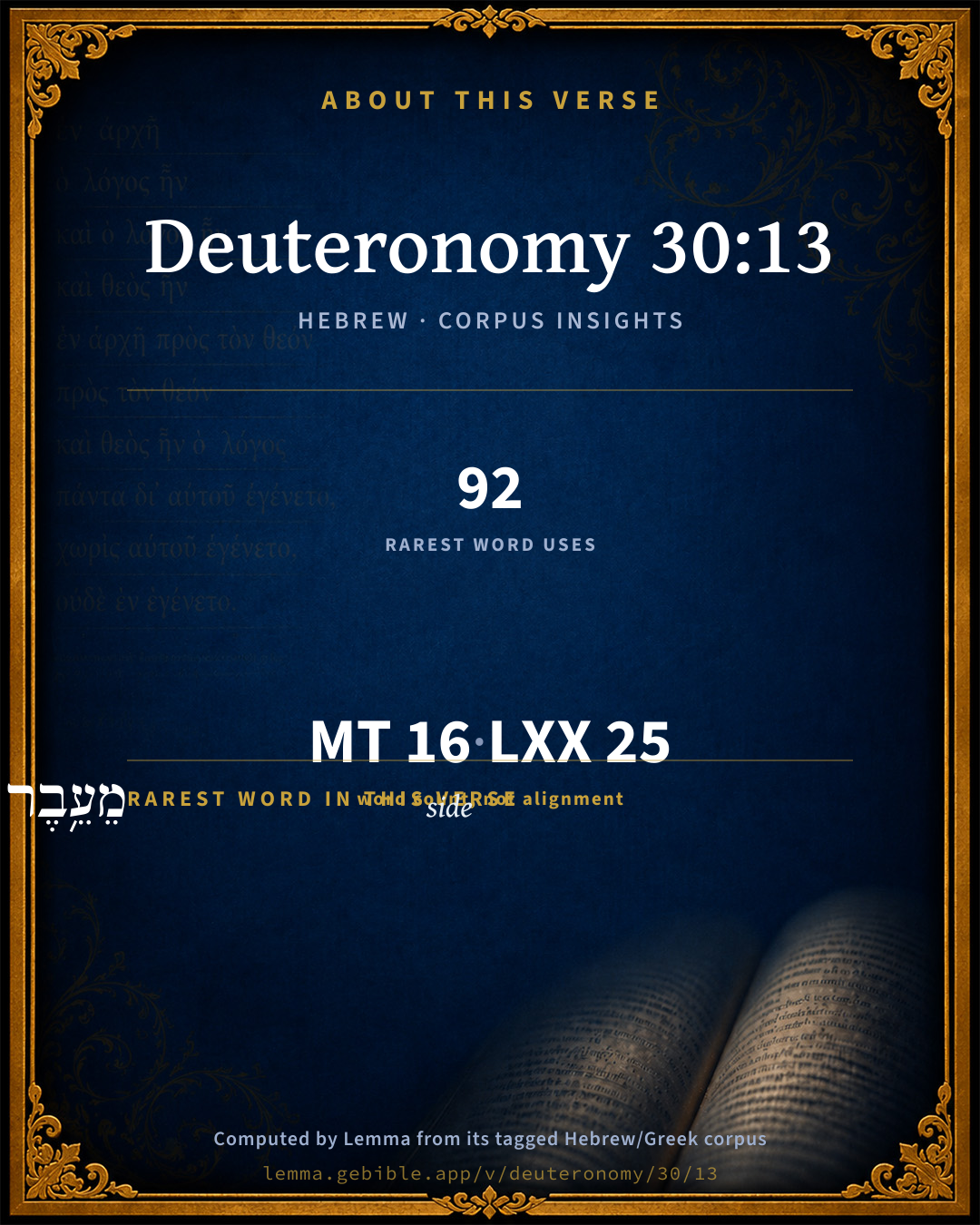
These counts appear in no published source. They are computed here, from the morphology-tagged text and Lemma’s own curated glosses. What Lemma adds →

16
words
12
distinct lemmas
Pentateuch
section

Grammatical profile

  • 5 verbs
  • 4 nouns
  • 1 pronoun
  • 3 prepositions
  • 3 particles

Verb forms

  • לֵאמֹ֗ר Qal · Infinitive Construct
  • יַעֲבָר Qal · Imperfect
  • וְיִקָּחֶ֣הָ Qal · Imperfect
  • וְיַשְׁמִעֵ֥נוּ Hiphil · Imperfect
  • וְנַעֲשֶֽׂנָּה Qal · Imperfect

Repetition

Words recur within this verse — often emphatic in Hebrew:

  • מֵעֵ֥בֶר side H5676 ×2
  • לַיָּ֖ם sea H3220 ×2

Hebrew & Septuagint length

In English translation the verse runs 34 words from the Hebrew and 36 from the Septuagint (LXX English) — closely comparable.

A rough comparison of the two English renderings, which tokenize alike — not a word-level alignment.

Word counts can differ between the Hebrew and the Greek without any difference in meaning — e.g. the Hebrew direct-object marker אֵת has no separate Greek word, and Greek often adds the article ὁ.

In the original languages it is 16 Hebrew tokens and 25 Greek tokens — but the two are counted differently (Hebrew bundles its prefixes and suffixes into one token; the Greek is in lemma form), so that isn’t a like-for-like length.

Cross-references

11

Topical passages linked to Deuteronomy 30:13 in the Treasury of Scripture Knowledge — connected by theme and wording, ordered by reader-vote popularity; previews shown in the World English Bible.

  • Proverbs 2:1–5 My son, if you will receive my words, And store up my commandments within you;
  • Proverbs 3:13–18 Happy is the man who finds wisdom, The man who gets understanding.
  • Proverbs 8:11 For wisdom is better than rubies. All the things that may be desired can't be compared to it.
  • Proverbs 16:6 By mercy and truth iniquity is atoned for. By the fear of Yahweh men depart from evil.
  • Matthew 12:42 The queen of the south will rise up in the judgment with this generation, and will condemn it, for she came from the ends of the earth to hear the wisdom of Solomon; and behold, someone greater than Solomon is here.
  • John 6:27 Don't work for the food which perishes, but for the food which remains to eternal life, which the Son of Man will give to you. For God the Father has sealed him."
  • Acts 8:27–40 He arose and went; and behold, there was a man of Ethiopia, a eunuch of great authority under Candace, queen of the Ethiopians, who was over all her treasure, who had come to Jerusalem to worship.
  • Acts 10:22 They said, "Cornelius, a centurion, a righteous man and one who fears God, and well spoken of by all the nation of the Jews, was directed by a holy angel to invite you to his house, and to listen to what you say."
  • Acts 10:33 Therefore I sent to you at once, and it was good of you to come. Now therefore we are all here present in the sight of God to hear all things that have been commanded you by God."
  • Acts 16:9 A vision appeared to Paul in the night. There was a man of Macedonia standing, begging him, and saying, "Come over into Macedonia and help us."
  • Romans 10:14–15 How then will they call on him in whom they have not believed? How will they believe in him whom they have not heard? How will they hear without a preacher?

Cross-references courtesy of OpenBible.info (CC BY 4.0).

Hebrew and Greek witnesses Masoretic Hebrew ↔ Greek Septuagint

The same verse in the two great witnesses to the Old Testament, shown verse-for-verse.

These are two independent witnesses, not word-aligned to each other, and the Septuagint is shown in lemma (dictionary) form.

Hebrew Deuteronomy 30:13 Masoretic · Westminster Leningrad Codex

וְלֹֽא מֵעֵ֥בֶר לַיָּ֖ם הִ֑וא לֵאמֹ֗ר מִ֣י יַעֲבָר לָ֜נוּ אֶל עֵ֤בֶר הַיָּם֙ וְיִקָּחֶ֣הָ לָּ֔נוּ וְיַשְׁמִעֵ֥נוּ אֹתָ֖הּ וְנַעֲשֶֽׂנָּה

Neither is it beyond the sea, that you should say, Who shall go over the sea for us, and bring it to us, and make us to hear it, that we may do it?

World English Bible · Public Domain

Greek LXX Deuteronomy 30:13 Septuagint · lemma form

οὐδέ πέραν ὁ θάλασσα εἰμί λέγω τίς διαπεράω ἐγώ εἰς ὁ πέραν ὁ θάλασσα καί λαμβάνω ἐγώ αὐτός καί ἀκουστός ἐγώ ποιέω αὐτός καί ποιέω

Neither is it beyond the sea, saying, Who will go over for us to the other side of the sea, and take it for us, and make it audible to us, and we will do it?

LXX2012 (modern English Septuagint) · Public Domain

Hebrew: Westminster Leningrad Codex (CC BY 4.0). Greek: Septuagint (public domain); English from LXX2012 (modern English Septuagint) (Public Domain). How the Septuagint differs from the Hebrew →

Targum (Aramaic paraphrase)

2

The Targum is the ancient Jewish Aramaic paraphrase of the Hebrew Scriptures — an interpretive translation, not the Hebrew text itself. Onkelos (literal) and Pseudo-Jonathan (expansive) render the Torah, and Jonathan the Prophets. Coverage is partial: where no permissively-licensed English translation exists for a verse, only the Aramaic is shown. This is verse-level text, not a word-by-word alignment to the Hebrew.

  1. Targum Onkelos Torah (Genesis–Deuteronomy)
    וְלָא מֵעִבְרָא לְיַמָא הִיא לְמֵימַר מָן יֵעִבַר לָנָא לְעִבְרָא דְיַמָא וְיִסְבַהּ לָנָא וְיַשְׁמְעִנָנָא יָתַהּ וְנַעְבְּדִנַהּ

    (no public-domain English translation for this verse)

    Targum Onkelos — Aramaic: “Onkelos Genesis” (public domain); “Onkelos Exodus” (public domain); “Onkelos Leviticus” (public domain); “Onkelos Numbers” (public domain); “Onkelos Deuteronomy” (public domain). English: “Sefaria Community Translation” (CC0 1.0 (public-domain dedication)); “J.W. Etheridge. The Targums of Onkelos and Jonathan Ben Uzziel on the Pentateuch. London: Longmans, Green, 1862” (public domain). Text via Sefaria.

  2. Targum Pseudo-Jonathan Torah (Genesis–Deuteronomy)
    וְלָא מִן הַאָל לְעִיבַר יַמָא רַבָּא הִיא לְמֵימָר מַאן יְעִיבַר בְּדִילָנָא לְעִיבַר יַמָא רַבָּא וְיִסְבִינָהּ לָנָא וְיַשְׁמַע יָתָהּ לָן וְנַעַבְדִינָהּ

    Neither is it beyond the great sea, that thou shouldst say, Who will go beyond the sea for us, and fetch it for us to make us hear, that we may do it?

    Targum Pseudo-Jonathan — Aramaic: “Targum Jonathan on Genesis” (public domain); “Targum Jonathan on Exodus” (public domain); “Targum Jonathan on Leviticus” (public domain); “Targum Jonathan on Numbers” (public domain); “Targum Jonathan on Deuteronomy” (public domain). English: “The Targum of Jonathan ben Uzziel, trans. J. W. Etheridge, London, 1862” (public domain). Text via Sefaria.

Commentary

Notes on Deuteronomy 30:13 from classic Christian and Jewish commentators (each source and its license shown beneath its notes). The classic Christian expositions comment on the surrounding passage and are grouped to its opening verse, so a note may address several verses; the Jewish commentaries on the Tanakh (Rashi and others) are per-verse, so they appear only where the commentator wrote on this verse.

Lemma curates 59 commentaries, every one of them public domain or Creative Commons licensed, each selected and text-cleaned for this edition rather than reprinted as found. About our sources →

Trapp's Complete Commentary

John Trapp

Deu 30:13 Neither [is] it beyond the sea, that thou shouldest say, Who shall go over the sea for us, and bring it unto us, that we may hear it, and do it?

Ver. 13. Neither is it beyond the sea.] Beyond the sea it was to us, till blessed Luther’s books were brought hither, together with Tyndale’s translation and other good men’s writings. Some Papists jeer us, and say that turkeys, hops, and heresy came into this kingdom in one bottom. Howbeit, long before this the Lady Anne, wife to king Richard II, sister to Winceslaus king of Bohemia, by living here was made acquainted with the gospel; whence also many Bohemians coming hither conveyed Wycliffe’s books into Bohemia, whereby a good foundation was laid for the ensuing Reformation, A.D. 1417, by the help of another good queen there, called Sophia. The writings also of John Huss, brought thence, wrought much good in this kingdom, a hundred years before Luther’s time.

John Trapp, A Commentary or Exposition upon All the Books of the Old and New Testament (1647–1656) — public domain. Text from a community e-Sword module.

Tyndale Open Study Notes

Tyndale Open Resources

30:13 not kept beyond the sea: God’s purposes are not in the custody of faraway nations but are available to his people (see Rom 10:6-8).

Tyndale Open Study Notes — © Tyndale Open Resources, licensed CC BY-SA 4.0. Text via the HelloAO Bible API.

Geneva Bible (1599)

Geneva Bible translators

By heaven and the sea he meaneth places most far distant.

Geneva Bible (1599) marginal notes — public domain. Text via Bolls.life.

Adam Clarke's Commentary

Verse 13. Neither is it beyond the sea] Ye shall not be obliged to travel for it to distant nations, because salvation is of the JEWS.

Adam Clarke's Commentary on the Bible (1810–1826) — public domain. Text from a community e-Sword/MySword module.

The Cambridge Bible for Schools and Colleges

gen. ed. J. J. S. Perowne

13. Neither … beyond the sea] Nor has Israel to search for it among other peoples.

The Cambridge Bible for Schools and Colleges (gen. ed. J. J. S. Perowne; Cambridge University Press, 1878–1918) — public domain. Text from a community e-Sword module.

John Gill's Exposition

Neither is it beyond the sea,.... There is no need to travel into foreign parts, into transmarine countries for it, as the Heathen philosophers did to get knowledge; for the Gospel is ordered to be preached to all the world, and sent into all nations; and at the time of the conversion of the Jews the earth will be filled with the knowledge of it, as the waters cover the sea; so that there will be no need to go into distant countries for it; nor any occasion

that thou shouldest say, who shall go over the sea for us, and bring it unto us, that we may hear it, and do it? which would be all one as to desire "to bring up Christ again from the dead"; when he is already risen, and is gone to heaven, where he ever lives to make intercession for us; is thereby declared to be the Son of God with power, and is discharged as the surety of his people, having done completely what he engaged to do; and is risen for their justification, and become the firstfruits of the resurrection of the dead; wherefore whoever confesses with his mouth, and believes with his heart, that God has raised him from the dead, that is enough, he shall be saved: what a sublime sense of the words is this the apostle gives and how puerile is that of the Chaldee paraphrast in comparison of it! See Gill on Rom 10:6.

John Gill's Exposition of the Whole Bible (1746–1763) — public domain (CC PDM 1.0). Text via the HelloAO Bible API.

Matthew Poole's English Annotations

Neither is it beyond the sea: the knowledge of this commandment is not to be fetched from far distant places, to which divers of the wise heathens travelled for their wisdom, but it was brought to thy very doors and ears, and declared to thee in this wilderness.

Matthew Poole's English Annotations on the Holy Bible (1683–1685) — public domain. Text from a community e-Sword/MySword module.

John Wesley's Explanatory Notes

Neither beyond the sea - The knowledge of this commandment is not to be fetched from far distant places, to which divers of the wise Heathens travelled for their wisdom; but it was brought to thy very doors and ears, and declared to thee in this wilderness.

John Wesley, Explanatory Notes Upon the Whole Bible (1754–1765) — public domain. Text via the GEBible commentary corpus.

unfoldingWord translationNotes

Door43 World Missions Community

General Information:

Moses speaks to the Israelites as if they were one man, so the words "you" and "your" here are singular. (See: Forms of You)

Who will go over the sea for us and bring it to us and make us to hear it, so that we may do it?

This rhetorical question continues the idea that the people of Israel think Yahweh's commands are too difficult to know. This question can be translated as a statement. AT: "Someone must travel across the sea to learn God's commands and then return and tell us what they are." (See: Rhetorical Question)

in your mouth and your heart

This means that the people already know God's commands and can tell them to others. (See: Metonymy)

translationWords

word

heart

unfoldingWord translationNotes — © Distant Shores Media and the Door43 World Missions Community, licensed CC BY-SA 4.0. Source: git.door43.org/Door43/en_tn.

Lesson kit

Teaching starters — assembled from the data on this page, not authored interpretation. Every prompt links to the verse data it draws on. Edit before teaching.

Deuteronomy, in the Pentateuch, opens this verse with 16 words (12 distinct Hebrew lemmas). Its most distinctive word is ʻêber (“side”). A historical commentator’s framing appears above. Read the whole chapter for the surrounding context.

Discussion questions

  1. The word ʻêber carries the sense “side.” How does it shape the verse?
  2. Proverbs 2:1–5 shares this passage’s theme. How do the two illuminate each other?
  3. “side” occurs 2× in this one verse. What is the effect of the repetition?
  4. These translations render this verse differently; the difference is in the English rendering, not the original. What questions does that raise?
  5. The verb «לֵאמֹ֗ר» is Qal Infinitive Construct. How does its form color the action?
  6. Reading how Trapp's Complete Commentary and Tyndale Open Study Notes read this verse, where do the two commentators agree and where do they part?

Things to notice

Reading settings

Reading text

Shown beneath each verse's original-language words.

Old Testament
Old Testament edition

Read the OT as the Masoretic Hebrew (MT) or the Greek Septuagint (LXX).

English shown for the Greek Septuagint (in the Hebrew ↔ Greek comparison).

Comparing translations? Open the Compare panel on any verse page to stack up to four side by side.