
Psalms 78:13

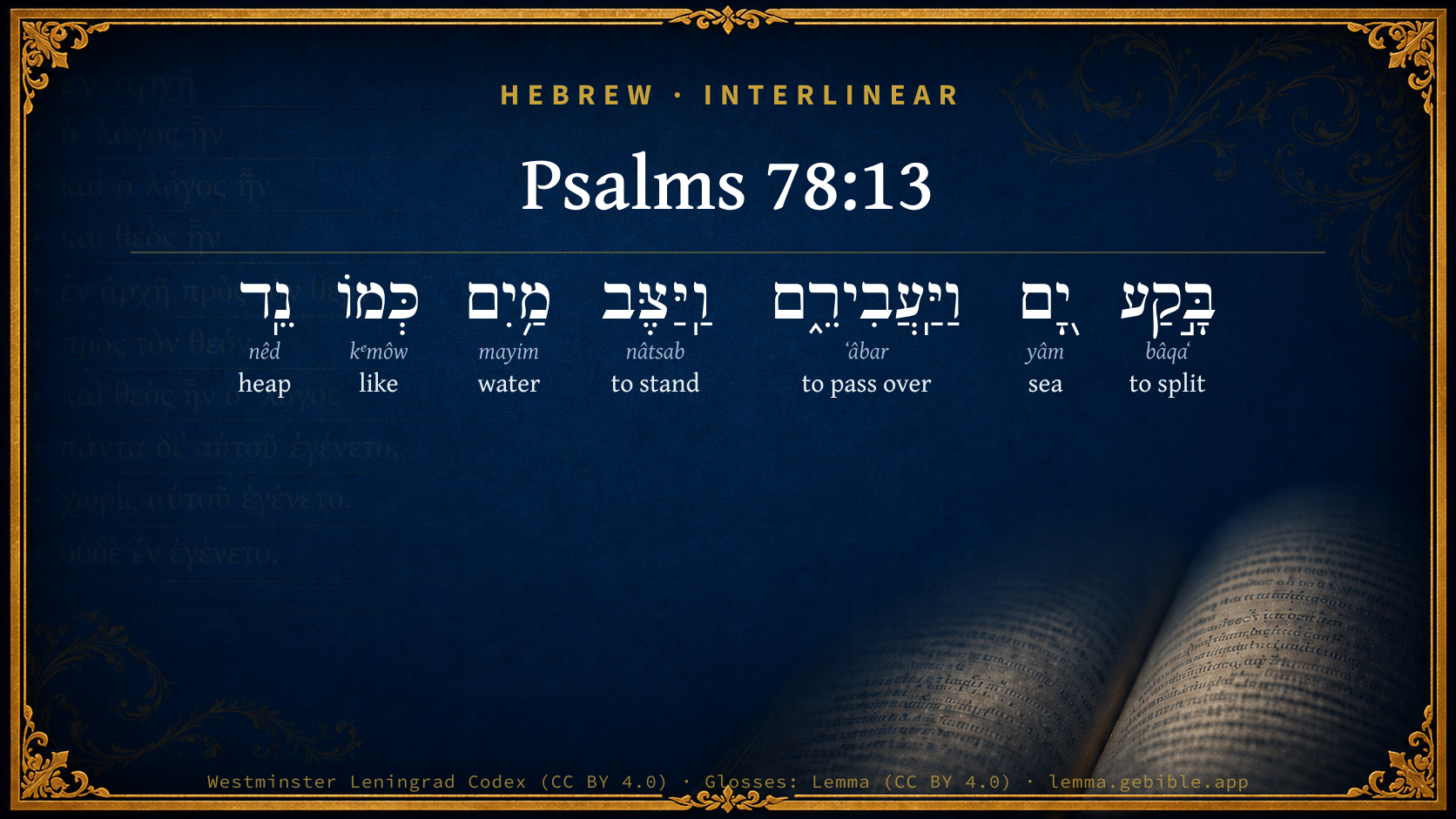
Hebrew (Westminster Leningrad Codex) Psalms 78:13 appears in the Hebrew Old Testament. The text above is from the Westminster Leningrad Codex. Each word links to its Strong’s number, a concise gloss, and parsing drawn from the Open Scriptures Hebrew Bible morphology. Click any word for its full Brown-Driver-Briggs (BDB) entry.
Download image
Cite this verse

Psalms 78:13 (World English Bible). Public Domain. Lemma interlinear Bible study tool, https://lemma.gebible.app/v/psalms/78/13.

Show BibTeX & RIS
BibTeX
RIS
English Translation
He split the sea, and caused them to pass through; He made the waters stand as a heap.
World English Bible · Public Domain
Download a study sheet

One document with this verse’s original text, its word-by-word gloss line, the meaning frame, cross-references with their text, attributed commentary, and full source and license credits — printable, and it pastes into notes with its structure intact.

This verse Autodidact and up

Study sheet (.html) Plain text (.txt)

A passage Seminary Student

Up to 50 verses in one chapter. A passage sheet keeps up to 6 commentary sources and 12 cross-references per verse, in the order this page ranks them, and says so on the sheet whenever that leaves anything out. Ask for a single verse and you get the Autodidact verse sheet above.

Everything on this page stays free to read, with no account — the sheet is a download of what is already on screen, not access to it.

Want to remove ads? Support Godless Engineer
Compare translations 3

The same verse in 3 English versions, stacked beneath the original-language interlinear above. Click any original word for its lexicon entry.

Each is an independent rendering of the whole verse — the interlinear is not word-aligned to these translations.

Highlighted words mark where these versions differ — a whole-verse word diff, not a word-by-word alignment.

  • World English Bible Public Domain
    He split the sea, and caused them to pass through; He made the waters stand as a heap.
  • King James Version Public Domain
    He divided the sea, and caused them to pass through; and he made the waters to stand as an heap.
  • unfoldingWord Literal Text CC BY-SA 4.0
    He divided the sea and led them across it, and he made the waters to stand like a heap.

unfoldingWord Literal Text — © unfoldingWord, licensed CC BY-SA 4.0. Word-aligned USFM3 via Door43 (git.door43.org/unfoldingWord/en_ult).

Versions to compare (up to 4)

3 of 4 selected

Show all 18 translations

Every available English version of this verse, each an independent rendering of the whole verse.

  • World English Bible Public Domain
    He split the sea, and caused them to pass through; He made the waters stand as a heap.
  • Berean Standard Bible Public Domain
    He split the sea and brought them through; He set the waters upright like a wall.
  • Majority Standard Bible Public Domain
    He split the sea and brought them through; He set the waters upright like a wall.
  • King James Version Public Domain
    He divided the sea, and caused them to pass through; and he made the waters to stand as an heap.
  • American Standard Version (1901) Public Domain
    He clave the sea, and caused them to pass through; And he made the waters to stand as a heap.
  • Revised Version (1885) Public Domain
    He clave the sea, and caused them to pass through; and he made the waters to stand as an heap.
  • Geneva Bible (1599) Public Domain
    He deuided the Sea, and led them through: he made also the waters to stand as an heape.
  • Douay-Rheims (1899) Public Domain
    He divided the sea and brought them through: and he made the waters to stand as in a vessel.
  • Young's Literal Translation Public Domain
    He cleft a sea, and causeth them to pass over, Yea, He causeth waters to stand as a heap.
  • Literal Standard Version CC BY-SA 4.0
    He cleft a sea, and causes them to pass over, || Indeed, He causes waters to stand as a heap.
  • Unlocked Literal Bible CC BY-SA 4.0
    He divided the sea and led them across it; he made the waters to stand like walls.
  • unfoldingWord Literal Text CC BY-SA 4.0
    He divided the sea and led them across it, and he made the waters to stand like a heap.
  • Darby Bible Public Domain
    He clave the sea, and caused them to pass through; and made the waters to stand as a heap;
  • World Messianic Bible Public Domain
    He split the sea, and caused them to pass through. He made the waters stand as a heap.
  • Webster's Bible Public Domain
    He divided the sea, and caused them to pass through; and he made the waters to stand as a heap.
  • Free Bible Version CC BY-SA 4.0
    He split the sea in two and led them through, making the water stand like walls on either side.
  • Bible in Basic English Public Domain
    The sea was cut in two so that they might go through; the waters were massed together on this side and on that.
  • JPS Tanakh (1917) Public Domain
    He cleaved the sea, and caused them to pass through; and He made the waters to stand as a heap.

Literal Standard Version (2020), Covenant Press — licensed CC BY-SA 4.0. Text via the HelloAO Bible API (eBible.org). Unlocked Literal Bible (unfoldingWord) — licensed CC BY-SA 4.0. Text via the HelloAO Bible API (eBible.org). unfoldingWord Literal Text — © unfoldingWord, licensed CC BY-SA 4.0. Word-aligned USFM3 via Door43 (git.door43.org/unfoldingWord/en_ult). Free Bible Version, Dr. Jonathan Gallagher — licensed CC BY-SA 4.0. Text via the HelloAO Bible API (eBible.org).

Word by word

More ways to search: Search by grammar → Find every occurrence → Compare this word →

Practice this passage: Drill this verse → Learn its vocabulary →

About this verse

These counts appear in no published source. They are computed here, from the morphology-tagged text and Lemma’s own curated glosses. What Lemma adds →

7
words
7
distinct lemmas
Wisdom
section

Notable vocabulary

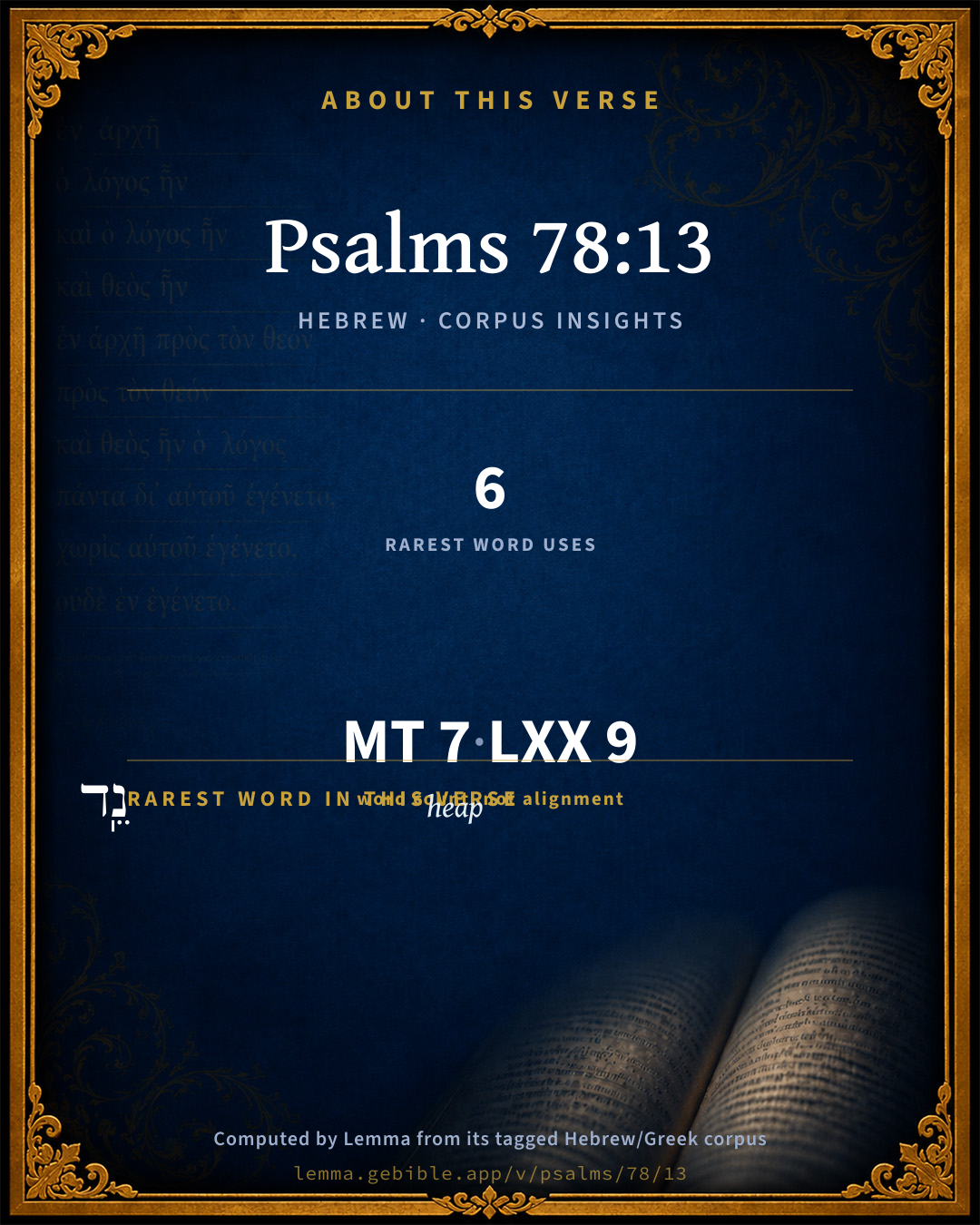
The rarest word here is נֵֽד heap H5067 — appearing just 6 times in the whole Hebrew Bible.

Shared distinctive vocabulary

נֵֽד heap H5067 occurs in 6 verses of the Hebrew Bible. Also found in:

Grammatical profile

  • 3 verbs
  • 3 nouns
  • 1 preposition

Verb forms

  • בָּ֣קַע Qal · Perfect
  • וַיַּֽעֲבִירֵ֑ם Hiphil · Sequential Imperfect
  • וַֽיַּצֶּב Hiphil · Sequential Imperfect

Hebrew & Septuagint length

In English translation the verse runs 18 words from the Hebrew and 18 from the Septuagint (LXX English) — the same length.

A rough comparison of the two English renderings, which tokenize alike — not a word-level alignment.

Word counts can differ between the Hebrew and the Greek without any difference in meaning — e.g. the Hebrew direct-object marker אֵת has no separate Greek word, and Greek often adds the article ὁ.

In the original languages it is 7 Hebrew tokens and 9 Greek tokens — but the two are counted differently (Hebrew bundles its prefixes and suffixes into one token; the Greek is in lemma form), so that isn’t a like-for-like length.

Cross-references

11

Topical passages linked to Psalms 78:13 in the Treasury of Scripture Knowledge — connected by theme and wording, ordered by reader-vote popularity; previews shown in the World English Bible.

  • Exodus 14:21 Moses stretched out his hand over the sea, and Yahweh caused the sea to go back by a strong east wind all the night, and made the sea dry land, and the waters were divided.
  • Exodus 15:8 With the blast of your nostrils the waters were piled up. The floods stood upright as a heap. The deeps were congealed in the heart of the sea.
  • Joshua 3:16 that the waters which came down from above stood, and rose up in one heap, a great way off, at Adam, the city that is beside Zarethan; and those that went down toward the sea of the Arabah, even the Salt Sea, were wholly cut off: and the people passed over right against Jericho.
  • Psalms 66:6 He turned the sea into dry land. They went through the river on foot. There, we rejoiced in him.
  • Psalms 106:9–10 He rebuked the Red Sea also, and it was dried up; So he led them through the depths, as through a desert.
  • Psalms 136:13–15 To him who divided the Red Sea apart; For his loving kindness endures forever;
  • Psalms 38:7 For my loins are filled with burning. There is no soundness in my flesh.
  • Isaiah 63:13 who led them through the depths, as a horse in the wilderness, so that they didn't stumble?

Cross-references courtesy of OpenBible.info (CC BY 4.0).

Hebrew and Greek witnesses Masoretic Hebrew ↔ Greek Septuagint

The same verse in the two great witnesses to the Old Testament, shown verse-for-verse.

You’re reading Greek Psalm 77 (Hebrew Psalm 78). The Septuagint counts the superscription, so verse numbers can differ from the Hebrew — chapter-level alignment, not verse-by-verse. Numbering follows Rahlfs.

These are two independent witnesses, not word-aligned to each other, and the Septuagint is shown in lemma (dictionary) form.

Hebrew Psalms 78:13 Masoretic · Westminster Leningrad Codex

בָּ֣קַע יָ֭ם וַיַּֽעֲבִירֵ֑ם וַֽיַּצֶּב מַ֥יִם כְּמוֹ נֵֽד

He split the sea, and caused them to pass through; He made the waters stand as a heap.

World English Bible · Public Domain

Greek LXX Greek Psalm 77:13 Septuagint · lemma form

διαῥήγνυμι θάλασσα καί διαἄγω αὐτός ἵστημι ὕδωρ ὡσεί ἀσκός

He clave the sea, and led them through: he made the waters to stand as in a bottle.

LXX2012 (modern English Septuagint) · Public Domain

Hebrew: Westminster Leningrad Codex (CC BY 4.0). Greek: Septuagint (public domain); English from LXX2012 (modern English Septuagint) (Public Domain). How the Septuagint differs from the Hebrew →

Commentary

Notes on Psalms 78:13 from classic Christian and Jewish commentators (each source and its license shown beneath its notes). The classic Christian expositions comment on the surrounding passage and are grouped to its opening verse, so a note may address several verses; the Jewish commentaries on the Tanakh (Rashi and others) are per-verse, so they appear only where the commentator wrote on this verse.

Lemma curates 59 commentaries, every one of them public domain or Creative Commons licensed, each selected and text-cleaned for this edition rather than reprinted as found. About our sources →

Trapp's Complete Commentary

John Trapp

Psa 78:13 He divided the sea, and caused them to pass through; and he made the waters to stand as an heap.

Ver. 13. He divided the sea] Making it fordable for them, and fixing those fluid waters, like stone walls, on each hand of them, while they passed through with ease and safety. Every main affliction is our Red Sea; which, while it threatens to swallow, preserveth us.

John Trapp, A Commentary or Exposition upon All the Books of the Old and New Testament (1647–1656) — public domain. Text from a community e-Sword module.

The Treasury of David

Charles H. Spurgeon

Ver. 13. He divided the sea, and caused them to pass through. A double wonder, for when the waters were divided the bottom of the sea would naturally be in a very unfit state for the passage of so vast a host as that of Israel; it would in fact have been impassable, had not the Lord made the road for his people. Who else has ever led a nation through a sea? Yet the Lord has done this full often for his saints in providential deliverances, making a highway for them where nothing short of an almighty arm could have done so.

And he made the waters to stand as an heap. He forbade a drop to fall upon his chosen, they felt no spray from the crystal walls on either hand. Fire will descend and water stand upright at the bidding of the Lord of all. The nature of creatures is not their own intrinsically, but is retained or altered at the will of him who first created them. The Lord can cause those evils which threaten to overwhelm us to suspend their ordinary actions, and become innocuous to us.

Ver. 13. He made the waters to stand as an heap. The original word imports, those great heaps which are made use of as dykes or banks to restrain the waters. But the Jews have not only understood these expressions literally, but have likewise taken upon them to add particular circumstances, as if the history had been so concise, that it wanted to be supplied therewith. They say, that the sea had formed, as it were, twelve roads or causeways, according to the number of the tribes of the Israelites. James Saurin.

Ver. 13. He made the waters to stand as an heap. God did not wish altogether to take the sea from the gaze of the Hebrews, but to interrupt and divide it, that like a wall it might stand firm on either side of the way. This was done, first, that the miracle might be evident, for in that sea there is no tidal rise or fall of the waters. Secondly, that the people might have greater joy at the sight of so great a miracle. Thirdly, that in their whole passage they might depend more upon the providence of God, who, in a single moment, could allow the sea to return to its bed and drown all of them. It is God's will than we should flee to him the more ardently as the aspect of present danger. Fourthly and lastly, that the people might pass over the more rapidly, since they knew not how long God wished the miracle to last. Thomas Le Blanc.

Ver. 12-16. God revealed in his deeds. The wonder working God --Ps 78:12-16. The avenging God--Ps 78:12. The interposing God--Ps 78:13. The guiding God--Ps 78:14. The Father God--Ps 78:14-16. C. D.

Ver. 12-17. Obstinacy of unbelief. It makes head against God's majesty--Ps 78:17; his gracious providence--Ps 78:14-16; his interposing care--Ps 78:13; his avenging justice-- Ps 78:12; his distinguishing grace--Ps 78:12-16. C. D.

Charles H. Spurgeon's The Treasury of David (1869–1885) — public domain. Psalms only. Text from a community e-Sword/MySword module.

J. A. Alexander on Psalms

Joseph Addison Alexander

13. (Psa 78:13) He slave the sea, and let them pass, and made the waters stand as a heap. This last expression is derived from Exo 15:8. See above, on Psa 33:7.

Joseph Addison Alexander, The Psalms Translated and Explained (1850) — public domain. Text from a community e-Sword module.

Tyndale Open Study Notes

Tyndale Open Resources

78:13 God divided the sea when Israel crossed through the Red Sea (see Exod 14–15).

Tyndale Open Study Notes — © Tyndale Open Resources, licensed CC BY-SA 4.0. Text via the HelloAO Bible API.

Adam Clarke's Commentary

Verse 13. He divided the sea, and caused them to pass through] The reader is requested to consult the notes on the parallel passages marked in the margin on this verse and Ps 78:14-17, &c., where all these miracles are largely explained.

Adam Clarke's Commentary on the Bible (1810–1826) — public domain. Text from a community e-Sword/MySword module.

Ellicott's Commentary for English Readers

(13) As an heap.—See Note, Psa_33:7.

A Bible Commentary for English Readers, edited by Charles John Ellicott (1878–1897) — public domain. Text from a community e-Sword module.

The Cambridge Bible for Schools and Colleges

gen. ed. J. J. S. Perowne

13. He divided the sea] Lit. clave, as in Psa_78:15; the word which is used in Exo_14:16; Isa_63:12; Neh_9:11.

as an heap] Cp. Exo_15:8; Psa_33:7.

The Cambridge Bible for Schools and Colleges (gen. ed. J. J. S. Perowne; Cambridge University Press, 1878–1918) — public domain. Text from a community e-Sword module.

John Gill's Exposition

In the daytime also he led them with a cloud,.... Which was in the form of a pillar, and went before them, and the Lord in it, and directed their way, and protected them from heat; see Exo 13:21, Neh 9:12 this was typical of Christ, who is a shadow and security from the heat of a fiery law, the flaming sword of justice, the wrath of God, which is poured forth like fire, the fiery darts of Satan, and from hurt by any enemy whatever; see Isa 4:5, and who leads his people through the wilderness of this world by his Spirit, by his word, and by his own example; and who is the best and safest guide to follow:

and all the night with a light of fire; which also was in the form of a pillar, and went before them, and gave light in the night, and the Lord was in it; and this also was typical of Christ, who is the light of his people amidst all their darkness in this world.

John Gill's Exposition of the Whole Bible (1746–1763) — public domain (CC PDM 1.0). Text via the HelloAO Bible API.

Albert Barnes' Notes on the Bible

He divided the sea ... - The Red Sea. Exo 14:21-22.

And he made the waters to stand as an heap - The word rendered “heap” means anything piled up, or a mound; and the idea is, that the waters were piled up on each side of them as a “mound.” See the notes at Psa 33:7. Compare Jos 3:13, Jos 3:16; Exo 15:8.

Albert Barnes' Notes on the Bible (1834–1885) — public domain. Text from a community e-Sword/MySword module.

Whedon's Commentary on the Bible

Daniel D. Whedon

13. Waters to stand as a heap—Or, as a mound, a piled up mass; or, as in Exo_14:22; Exo_14:29, as a wall, which implies also, as the history states, a defence. Compare Hab_3:10. It is impossible, despite modern rationalism, to construe the Bible account into any thing less than a stupendous miracle. We must admit the miracle or abandon the history.

Daniel D. Whedon (gen. ed.), Commentary on the Old and New Testaments (1874–1909) — public domain. Text from a community e-Sword module.

The Pulpit Commentary

He divided the sea, and caused them to pass through. (see Exo_14:21, Exo_14:22) And he made the waters to stand as a heap. The expression is taken from the Song of Moses. (Exo_15:8) It must be understood poetically.

The Pulpit Commentary (1880–1919), ed. H.D.M. Spence-Jones & Joseph S. Exell — public domain. Text from a community e-Sword module.

Rashi

Rabbi Shlomo Yitzchaki (Rashi)

as a heap Heb. נד, a tall heap, as Onkelos renders (Exod. 15:8): “the flowing water stood up like a נֵד,” stood up like a wall.

Rashi on the Tanakh — English translations: “The Judaica Press complete Tanach with Rashi, translated by A. J. Rosenberg” (CC BY 4.0); “Pentateuch with Rashi's commentary by M. Rosenbaum and A.M. Silbermann, 1929-1934” (public domain); “The Metsudah Tanach series, Lakewood, N.J” (CC BY 4.0); and “The Book of Joshua, Metsudah Publications, 1997” (CC BY 4.0). Text via Sefaria.

Lesson kit

Teaching starters — assembled from the data on this page, not authored interpretation. Every prompt links to the verse data it draws on. Edit before teaching.

Psalms, in the Wisdom, opens this verse with 7 words (7 distinct Hebrew lemmas). Its most distinctive word is nêd (“heap”). A historical commentator’s framing appears above. Read the whole chapter for the surrounding context.

Discussion questions

  1. How does “heap” (nêd) shape what this verse is saying?
  2. How does Exodus 15:8, which shares the word «heap», read alongside this verse?
  3. The translations on this page render this verse differently — a whole-verse word diff, not a word-by-word alignment. What might account for the different wordings?
  4. «בָּ֣קַע» is a Qal Perfect verb. How does that grammatical form shape the action described?
  5. Compare how Trapp's Complete Commentary and The Treasury of David read this verse. Where do they agree or differ?

Things to notice

Reading settings

Reading text

Shown beneath each verse's original-language words.

Old Testament
Old Testament edition

Read the OT as the Masoretic Hebrew (MT) or the Greek Septuagint (LXX).

English shown for the Greek Septuagint (in the Hebrew ↔ Greek comparison).

Comparing translations? Open the Compare panel on any verse page to stack up to four side by side.