Genesis 32:12

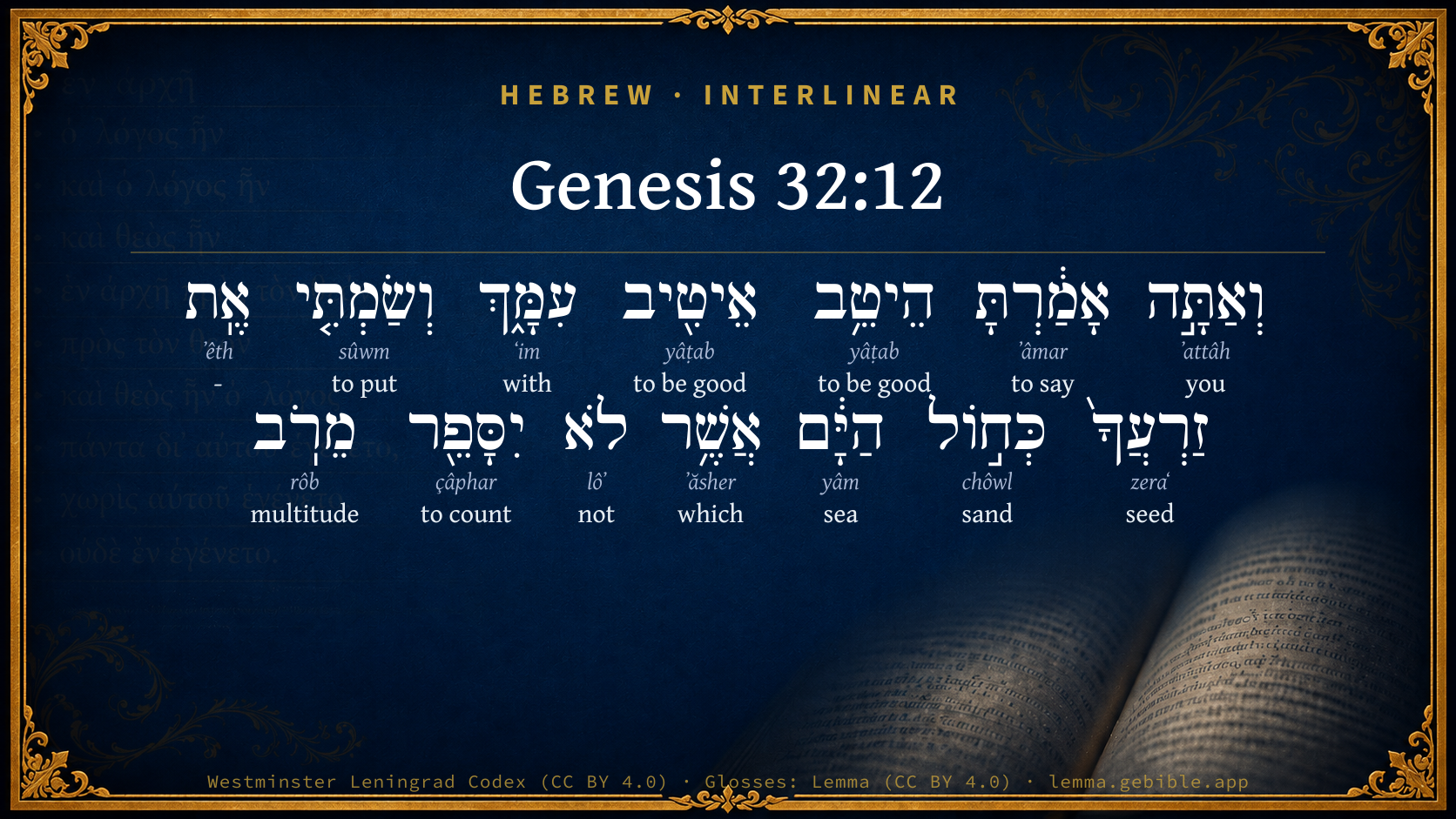
Hebrew (Westminster Leningrad Codex) Genesis 32:12 appears in the Hebrew Old Testament. The text above is from the Westminster Leningrad Codex. Each word links to its Strong’s number, a concise gloss, and parsing drawn from the Open Scriptures Hebrew Bible morphology. Click any word for its full Brown-Driver-Briggs (BDB) entry.
Download image
Cite this verse

Genesis 32:12 (World English Bible). Public Domain. Lemma interlinear Bible study tool, https://lemma.gebible.app/v/genesis/32/12.

Show BibTeX & RIS
BibTeX
RIS
English Translation
You said, 'I will surely do you good, and make your seed as the sand of the sea, which can't be numbered because there are so many.'"
World English Bible · Public Domain
Download a study sheet

One document with this verse’s original text, its word-by-word gloss line, the meaning frame, cross-references with their text, attributed commentary, and full source and license credits — printable, and it pastes into notes with its structure intact.

This verse Autodidact and up

Study sheet (.html) Plain text (.txt)

A passage Seminary Student

Up to 50 verses in one chapter. A passage sheet keeps up to 6 commentary sources and 12 cross-references per verse, in the order this page ranks them, and says so on the sheet whenever that leaves anything out. Ask for a single verse and you get the Autodidact verse sheet above.

Everything on this page stays free to read, with no account — the sheet is a download of what is already on screen, not access to it.

Want to remove ads? Support Godless Engineer
Compare translations 3

The same verse in 3 English versions, stacked beneath the original-language interlinear above. Click any original word for its lexicon entry.

Each is an independent rendering of the whole verse — the interlinear is not word-aligned to these translations.

Highlighted words mark where these versions differ — a whole-verse word diff, not a word-by-word alignment.

  • World English Bible Public Domain
    You said, 'I will surely do you good, and make your seed as the sand of the sea, which can't be numbered because there are so many.'"
  • King James Version Public Domain
    And thou saidst, I will surely do thee good, and make thy seed as the sand of the sea, which cannot be numbered for multitude.
  • unfoldingWord Literal Text CC BY-SA 4.0
    But you said, ‘I will surely cause things to prosper with you, and I will make your descendants as the sand of the sea, which cannot be counted from abundance.’”

unfoldingWord Literal Text — © unfoldingWord, licensed CC BY-SA 4.0. Word-aligned USFM3 via Door43 (git.door43.org/unfoldingWord/en_ult).

Versions to compare (up to 4)

3 of 4 selected

Show all 18 translations

Every available English version of this verse, each an independent rendering of the whole verse.

  • World English Bible Public Domain
    You said, 'I will surely do you good, and make your seed as the sand of the sea, which can't be numbered because there are so many.'"
  • Berean Standard Bible Public Domain
    But You have said, ‘I will surely make you prosper, and I will make your offspring like the sand of the sea, too numerous to count.’”
  • Majority Standard Bible Public Domain
    But You have said, ‘I will surely make you prosper, and I will make your offspring like the sand of the sea, too numerous to count.’”
  • King James Version Public Domain
    And thou saidst, I will surely do thee good, and make thy seed as the sand of the sea, which cannot be numbered for multitude.
  • American Standard Version (1901) Public Domain
    And thou saidst, I will surely do thee good, and make thy seed as the sand of the sea, which cannot be numbered for multitude.
  • Revised Version (1885) Public Domain
    And thou saidst, I will surely do thee good, and make thy seed as the sand of the sea, which cannot be numbered for multitude.
  • Geneva Bible (1599) Public Domain
    For thou saydest; I will surely doe thee good, and make thy seede as the sande of the sea, which can not be nombred for multitude.
  • Douay-Rheims (1899) Public Domain
    Thou didst say that thou wouldst do well by me, and multiply my seed like the sand of the sea, which cannot be numbered for the multitude.
  • Young's Literal Translation Public Domain
    and Thou -- Thou hast said, I certainly do good with thee, and have set thy seed as the sand of the sea, which is not numbered because of the multitude.'
  • Literal Standard Version CC BY-SA 4.0
    and You have said, I certainly do good with you, and have set your seed as the sand of the sea, which is not numbered because of the multitude.”
  • Unlocked Literal Bible CC BY-SA 4.0
    But you said, 'I will certainly make you prosper. I will make your descendants like the sand of the sea, which cannot be numbered for their number.'”
  • unfoldingWord Literal Text CC BY-SA 4.0
    But you said, ‘I will surely cause things to prosper with you, and I will make your descendants as the sand of the sea, which cannot be counted from abundance.’”
  • Darby Bible Public Domain
    And thou saidst, I will certainly deal well with thee, and make thy seed as the sand of the sea, which cannot be numbered for multitude.
  • World Messianic Bible Public Domain
    You said, ‘I will surely do you good, and make your offspring as the sand of the sea, which can’t be counted because there are so many.’”
  • Webster's Bible Public Domain
    And thou saidst, I will surely do thee good, and make thy seed as the sand of the sea, which cannot be numbered for multitude.
  • Free Bible Version CC BY-SA 4.0
    You yourself told me, ‘I will definitely treat you well. I will make your descendants as numerous as the sand of the seashore—too many to count.’”
  • Bible in Basic English Public Domain
    And you said, Truly, I will be good to you, and make your seed like the sand of the sea which may not be numbered.
  • JPS Tanakh (1917) Public Domain
    (32-13) And Thou saidst: I will surely do thee good, and make thy seed as the sand of the sea, which cannot be numbered for multitude.'

Literal Standard Version (2020), Covenant Press — licensed CC BY-SA 4.0. Text via the HelloAO Bible API (eBible.org). Unlocked Literal Bible (unfoldingWord) — licensed CC BY-SA 4.0. Text via the HelloAO Bible API (eBible.org). unfoldingWord Literal Text — © unfoldingWord, licensed CC BY-SA 4.0. Word-aligned USFM3 via Door43 (git.door43.org/unfoldingWord/en_ult). Free Bible Version, Dr. Jonathan Gallagher — licensed CC BY-SA 4.0. Text via the HelloAO Bible API (eBible.org).

Word by word

More ways to search: Search by grammar → Find every occurrence → Compare this word →

Practice this passage: Drill this verse → Learn its vocabulary →

כְּח֣וֹל
chôwl
H2344
“like/as · sand of”
Preposition + Noun, Common, Masculine, Singular, Construct
Part of Speech
Preposition + Noun
Type
Common
Gender
Masculine
Number
Singular
State
Construct
Full BDB Definition

Origin: from H2342

TWOT: 623a

sand
  1. וְאַתָּ֣ה ʼattâh H859 “and · you” Conjunction + Pronoun, Personal, 2nd Person, Masculine, Singular
  2. אָמַ֔רְתָּ ʼâmar H559 “to say” Verb, Qal, Perfect, 2nd Person, Masculine, Singular
  3. הֵיטֵ֥ב yâṭab H3190 “to be good” Verb, Hiphil, Infinitive Absolute
  4. אֵיטִ֖יב yâṭab H3190 “to be good” Verb, Hiphil, Imperfect, 1st Person, Common, Singular
  5. עִמָּ֑ךְ ʻim H5973 “with · you” Preposition + Suffix, Personal, 2nd Person, Feminine, Singular
  6. וְשַׂמְתִּ֤י sûwm H7760 “and · to put” Conjunction + Verb, Qal, Sequential Perfect, 1st Person, Common, Singular
  7. אֶֽת ʼêth H853 “-” Particle, Direct Object
  8. זַרְעֲךָ֙ zeraʻ H2233 “seed · your” Noun, Common, Masculine, Singular, Construct + Suffix, Personal, 2nd Person, Masculine, Singular
  9. הַיָּ֔ם yâm H3220 “the · sea” Particle, Definite Article + Noun, Common, Masculine, Singular, Absolute
  10. אֲשֶׁ֥ר ʼăsher H834 “which” Particle, Relative
  11. לֹא lôʼ H3808 “not” Particle, Negative
  12. יִסָּפֵ֖ר çâphar H5608 “to count” Verb, Niphal, Imperfect, 3rd Person, Masculine, Singular
  13. מֵרֹֽב rôb H7230 “from · multitude” Preposition + Noun, Common, Both, Singular, Absolute

About this verse

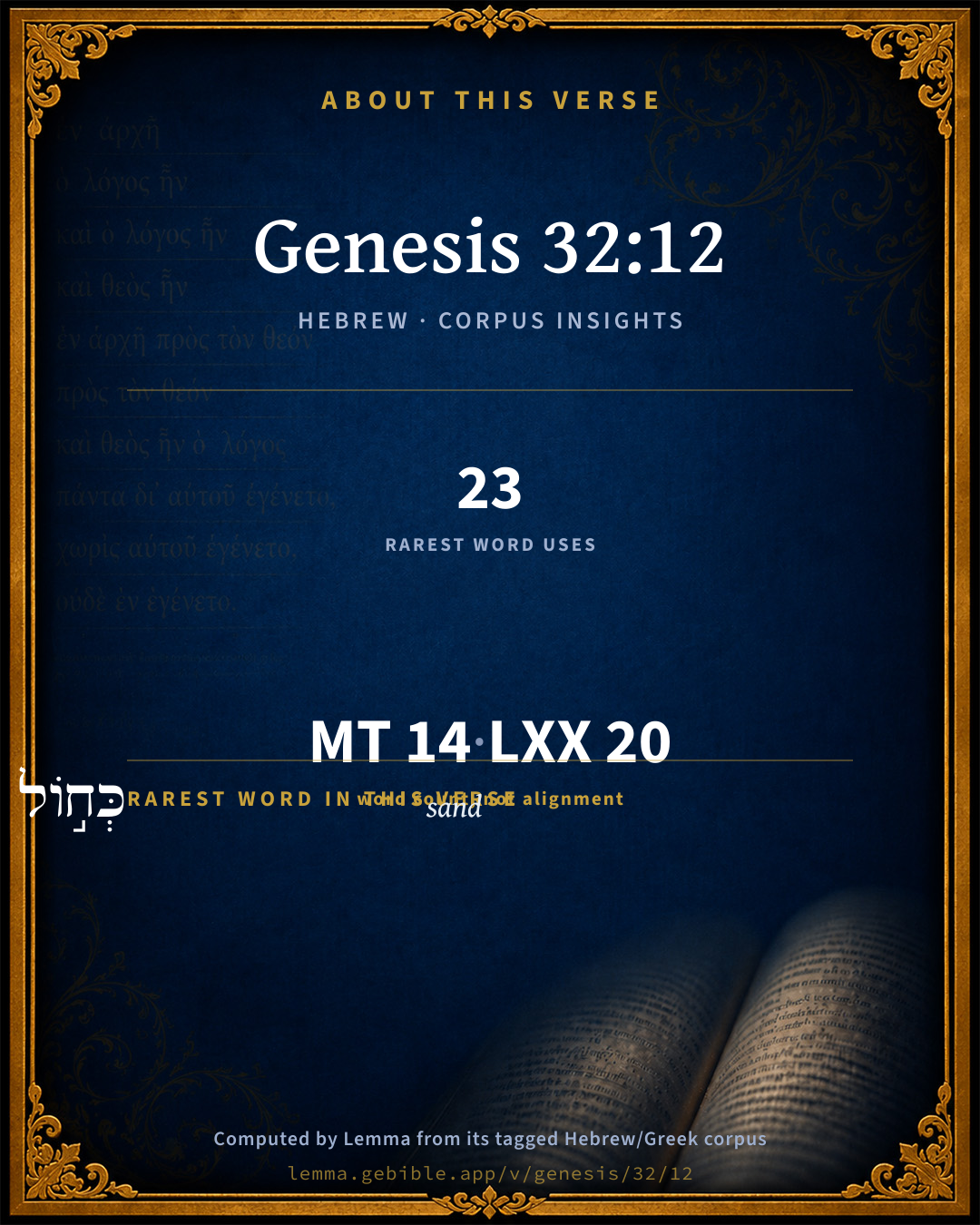
These counts appear in no published source. They are computed here, from the morphology-tagged text and Lemma’s own curated glosses. What Lemma adds →

14
words
13
distinct lemmas
Pentateuch
section

Notable vocabulary

The rarest word here is כְּח֣וֹל sand H2344 — appearing just 23 times in the whole Hebrew Bible.

Shared distinctive vocabulary

כְּח֣וֹל sand H2344 occurs in 23 verses of the Hebrew Bible. Also found in:

Grammatical profile

  • 5 verbs
  • 4 nouns
  • 1 pronoun
  • 1 preposition
  • 3 particles

Verb forms

  • אָמַ֔רְתָּ Qal · Perfect
  • הֵיטֵ֥ב Hiphil · Infinitive Absolute
  • אֵיטִ֖יב Hiphil · Imperfect
  • וְשַׂמְתִּ֤י Qal · Sequential Perfect
  • יִסָּפֵ֖ר Niphal · Imperfect

Repetition

A word recurs within this verse — often emphatic in Hebrew:

  • הֵיטֵ֥ב to be good H3190 ×2

Hebrew & Septuagint length

In English translation the verse runs 27 words from the Hebrew and 26 from the Septuagint (LXX English) — closely comparable.

A rough comparison of the two English renderings, which tokenize alike — not a word-level alignment.

Word counts can differ between the Hebrew and the Greek without any difference in meaning — e.g. the Hebrew direct-object marker אֵת has no separate Greek word, and Greek often adds the article ὁ.

In the original languages it is 14 Hebrew tokens and 20 Greek tokens — but the two are counted differently (Hebrew bundles its prefixes and suffixes into one token; the Greek is in lemma form), so that isn’t a like-for-like length.

Cross-references

11

Topical passages linked to Genesis 32:12 in the Treasury of Scripture Knowledge — connected by theme and wording, ordered by reader-vote popularity; previews shown in the World English Bible.

  • Genesis 28:13–15 Behold, Yahweh stood above it, and said, "I am Yahweh, the God of Abraham your father, and the God of Isaac. The land whereon you lie, to you will I give it, and to your seed.
  • Hebrews 6:17 In this way God, being determined to show more abundantly to the heirs of the promise the immutability of his counsel, interposed with an oath;
  • Genesis 22:17 that in blessing I will bless you, and in multiplying I will multiply your seed as the stars of the heavens, and as the sand which is on the seashore. Your seed will possess the gate of his enemies.
  • Genesis 46:3–4 He said, "I am God, the God of your father. Don't be afraid to go down into Egypt; for there I will make of you a great nation.
  • Matthew 24:35 Heaven and earth will pass away, but my words will not pass away.
  • 2 Timothy 2:13 If we are faithless, He remains faithful. He can't deny himself.
  • Titus 1:2 in hope of eternal life, which God, who can't lie, promised before eternal times;
  • Genesis 32:6 The messengers returned to Jacob, saying, "We came to your brother Esau. Not only that, but he comes to meet you, and four hundred men with him."
  • Exodus 32:13 Remember Abraham, Isaac, and Israel, your servants, to whom you swore by your own self, and said to them, 'I will multiply your seed as the stars of the sky, and all this land that I have spoken of I will give to your seed, and they shall inherit it forever.'"
  • Numbers 23:19 God is not a man, that he should lie, Neither the son of man, that he should repent: Has he said, and will he not do it? Or has he spoken, and will he not make it good?
  • 1 Samuel 15:29 Also the Strength of Israel will not lie nor repent; for he is not a man, that he should repent.

Cross-references courtesy of OpenBible.info (CC BY 4.0).

Hebrew and Greek witnesses Masoretic Hebrew ↔ Greek Septuagint

The same verse in the two great witnesses to the Old Testament, shown verse-for-verse.

These are two independent witnesses, not word-aligned to each other, and the Septuagint is shown in lemma (dictionary) form.

Hebrew Genesis 32:12 Masoretic · Westminster Leningrad Codex

וְאַתָּ֣ה אָמַ֔רְתָּ הֵיטֵ֥ב אֵיטִ֖יב עִמָּ֑ךְ וְשַׂמְתִּ֤י אֶֽת זַרְעֲךָ֙ כְּח֣וֹל הַיָּ֔ם אֲשֶׁ֥ר לֹא יִסָּפֵ֖ר מֵרֹֽב

You said, 'I will surely do you good, and make your seed as the sand of the sea, which can't be numbered because there are so many.'"

World English Bible · Public Domain

Greek LXX Genesis 32:12 Septuagint · lemma form

ἐκαἱρέω ἐγώ ἐκ χείρ ὁ ἀδελφός ἐγώ ησαυ ὅτι φοβέω ἐγώ αὐτός μήποτε ἔρχομαι πατάσσω ἐγώ καί μήτηρ ἐπί τέκνον

But you said, I will do you good, and will make your seed as the sand of the sea, which shall not be numbered for multitude.

LXX2012 (modern English Septuagint) · Public Domain

Hebrew: Westminster Leningrad Codex (CC BY 4.0). Greek: Septuagint (public domain); English from LXX2012 (modern English Septuagint) (Public Domain). How the Septuagint differs from the Hebrew →

Targum (Aramaic paraphrase)

2

The Targum is the ancient Jewish Aramaic paraphrase of the Hebrew Scriptures — an interpretive translation, not the Hebrew text itself. Onkelos (literal) and Pseudo-Jonathan (expansive) render the Torah, and Jonathan the Prophets. Coverage is partial: where no permissively-licensed English translation exists for a verse, only the Aramaic is shown. This is verse-level text, not a word-by-word alignment to the Hebrew.

  1. Targum Onkelos Torah (Genesis–Deuteronomy)
    שֵׁזַבְנִי כְעַן מִידָא דְאָחִי מִידָא דְעֵשָׁו אֲרֵי דַחֵל אֲנָא מִנֵּהּ דִּילְמָא יֵיתֵי וְיִמְחִנַּנִי אִמָּא עַל בְּנַיָּא

    (no public-domain English translation for this verse)

    Targum Onkelos — Aramaic: “Onkelos Genesis” (public domain); “Onkelos Exodus” (public domain); “Onkelos Leviticus” (public domain); “Onkelos Numbers” (public domain); “Onkelos Deuteronomy” (public domain). English: “Sefaria Community Translation” (CC0 1.0 (public-domain dedication)); “J.W. Etheridge. The Targums of Onkelos and Jonathan Ben Uzziel on the Pentateuch. London: Longmans, Green, 1862” (public domain). Text via Sefaria.

  2. Targum Pseudo-Jonathan Torah (Genesis–Deuteronomy)
    שֵׁיזְבַנִי כְדוֹן מִן יַד אֲחִי רַבָּא מִן יַד עֵשָו אֲרוּם מִסְתְּפֵי אֲנָא מִנֵיהּ דְהוּא עָסַק בְּאִיקְרָא דְאָבוּי דִילְמָא יֵיתֵי וְיִמְחִינַנִי אִימָא עַל בְּנַיָא

    Deliver me I pray, from the hand of my elder brother, from the hand of Esau, for I fear him: for he hath been mindful of the glory of his father; lest he come and smite the mother with the children.

    Targum Pseudo-Jonathan — Aramaic: “Targum Jonathan on Genesis” (public domain); “Targum Jonathan on Exodus” (public domain); “Targum Jonathan on Leviticus” (public domain); “Targum Jonathan on Numbers” (public domain); “Targum Jonathan on Deuteronomy” (public domain). English: “The Targum of Jonathan ben Uzziel, trans. J. W. Etheridge, London, 1862” (public domain). Text via Sefaria.

Commentary

Notes on Genesis 32:12 from classic Christian and Jewish commentators (each source and its license shown beneath its notes). The classic Christian expositions comment on the surrounding passage and are grouped to its opening verse, so a note may address several verses; the Jewish commentaries on the Tanakh (Rashi and others) are per-verse, so they appear only where the commentator wrote on this verse.

Lemma curates 59 commentaries, every one of them public domain or Creative Commons licensed, each selected and text-cleaned for this edition rather than reprinted as found. About our sources →

Trapp's Complete Commentary

John Trapp

Gen 32:12 And thou saidst, I will surely do thee good, and make thy seed as the sand of the sea, which cannot be numbered for multitude.

Ver. 12. And thou saidst, I will surely do thee good.] So Jacob interprets that promise, "I will be with thee": {Gen 28:15} which, indeed, hath in it whatsoever heart can wish, or need require. This promise was so sweet to the patriarch, that he repeats and ruminates it, rolling it as sugar in his mouth, and hiding it under his tongue. God "spake it once, he heard it twice"; as David, {Psa 62:11} in another case. "He sucks, and is satisfied with these breasts of consolation"; he presseth and oppresseth them - such a metaphor there is in that text, {Isa 66:11} - as a rich man doth the poor man, till he hath gotten out of him all that he hath. A fly can make little of a flower; but a bee will not off till he hath the sweet thyme out of it. The promises are precious spices, which, being beaten to the smell, by the preaching of the Word, yield a heavenly and supernatural scent in the souls of God’s people. Oh! it is a sweet time with them, when Christ "brings them into his banqueting house" of the Holy Scriptures, and there "stays them with flagons" of divine consolations, and bolsters them up "with apples" of heavenly doctrines. When these, by the Spirit, are applied to the love sick soul, then is Christ’s left hand under their head, and his right hand - which "teacheth him terrible things" - doth {Psa 14:5} embrace them. All in Christ, is for their support and succour: his love also is displayed over them, as a banner. And this doth so fully satisfy their souls, and transport them with joy, that now they are content to wait God’s leisure for deliverance; and would not have their "Beloved wakened, until he please." See all this, Son 2:4-7.

John Trapp, A Commentary or Exposition upon All the Books of the Old and New Testament (1647–1656) — public domain. Text from a community e-Sword module.

Adam Clarke's Commentary

Verse 12. Make thy seed as the sand] Having come to the promise by which the covenant was ratified both to Abraham and Isaac, he ceased, his faith having gained strong confirmation in a promise which he knew could not fail, and which he found was made over to him, as it had been to his father and grandfather.

Adam Clarke's Commentary on the Bible (1810–1826) — public domain. Text from a community e-Sword/MySword module.

The Cambridge Bible for Schools and Colleges

gen. ed. J. J. S. Perowne

12. thou saidst] See Gen_28:14.

as the sand of the sea] See Gen_13:16, Gen_22:17, and cf. Gen_16:10.

The Cambridge Bible for Schools and Colleges (gen. ed. J. J. S. Perowne; Cambridge University Press, 1878–1918) — public domain. Text from a community e-Sword module.

John Gill's Exposition

And thou saidst, I will surely do thee good,.... All kind of good, most certainly and constantly; so Jacob rightly interpreted the promise, "I will be with thee", Gen 31:3; for the promise of God's presence includes and secures all needful good to his people; and from this general promise Jacob draws an argument for a special and particular good, the preservation of him and his family, he was now pleading for; and the rather he might hope to succeed, since the following promise was also made him:

and make thy seed as the sand of the sea, which cannot be numbered for multitude; which could not be fulfilled, if he and his family were cut off at once, as he feared; but God is faithful who has promised.

John Gill's Exposition of the Whole Bible (1746–1763) — public domain (CC PDM 1.0). Text via the HelloAO Bible API.

John Wesley's Explanatory Notes

Thou saidst, I will surely do thee good - The best we can say to God in prayer is, what he hath said to us. God's promises as they are the surest guide of our desires in prayer, and furnish us with the best petitions, so they are the firmest ground of our hopes, and furnish us with the best pleas. Thou saidst, I will do thee good - Lord, do me good in this matter. He pleads also a particular promise, that of the multiplying of his seed. Lord, what will become of that promise, if they be all cut off?

John Wesley, Explanatory Notes Upon the Whole Bible (1754–1765) — public domain. Text via the GEBible commentary corpus.

Keil & Delitzsch

C. F. Keil & F. Delitzsch

"For I am in fear of him, that (פּן ne) he come and smite me, mother with children." בּנים על אם is a proverbial expression for unsparing cruelty, taken from the bird which covers its young to protect them (Deu 22:6, cf. Hos 10:14). על super, una cum, as in Exo 35:22.

Keil & Delitzsch — Biblical Commentary on the Old Testament (1861–1891) — public domain (CC PDM 1.0). Text via the HelloAO Bible API. (Old Testament only.)

Rashi

Rabbi Shlomo Yitzchaki (Rashi)

מיד אחי מיד עשו FROM THE HAND OF MY BROTHER, FROM THE HAND OF ESAU — from the hand of my brother who does not treat me as a brother should, but as Esau, the wicked.

Rashi on the Tanakh — English translations: “The Judaica Press complete Tanach with Rashi, translated by A. J. Rosenberg” (CC BY 4.0); “Pentateuch with Rashi's commentary by M. Rosenbaum and A.M. Silbermann, 1929-1934” (public domain); “The Metsudah Tanach series, Lakewood, N.J” (CC BY 4.0); and “The Book of Joshua, Metsudah Publications, 1997” (CC BY 4.0). Text via Sefaria.

Ramban (Nachmanides)

Rabbi Moshe ben Nachman (Ramban / Nachmanides)

AND HE SMITE ME, THE MOTHER WITH THE CHILDREN. Commentators have explained it as meaning. “And he smite me and smite the mother with the children.” There are many similar verses.

Ramban (Nachmanides) on the Tanakh — English translation: “Commentary on the Torah by Ramban (Nachmanides). Translated and annotated by Charles B. Chavel. New York, Shilo Pub. House, 1971-1976” (CC BY 4.0). Text via Sefaria.

Sforno

Rabbi Ovadia Sforno

Mother and children alike. Literally, “he will strike me, mother with sons” — i.e. he would deal Yaakov a devastating blow by killing his family, even if he himself escaped.

Sforno on the Tanakh — English translation: “Yalkut, Sifsei Chachomim Chumash, Metsudah Publications, 2009” (CC BY 4.0). Text via Sefaria.

Radak

Rabbi David Kimhi (Radak)

הצילני...אם על בנים. The word על in this line substitutes for the word עם, “with.” It is used in a similar sense in Hoseah 10,14 אם על בנים רטשה, “mothers and children were dashed to pieces.”

Radak on the Tanakh — English translations: “Sefaria Community Translation” (CC0 1.0 (public-domain dedication)); “Eliyahu Munk, HaChut Hameshulash” (CC BY 4.0); “Rabbi Mike Feuer, Jerusalem Anthology” (CC BY 4.0); and “R. David Kimhi on the first book of Psalms, Translated by R.G. Finch, London, 1919” (public domain). Text via Sefaria.

Lesson kit

Teaching starters — assembled from the data on this page, not authored interpretation. Every prompt links to the verse data it draws on. Edit before teaching.

Genesis, in the Pentateuch, opens this verse with 14 words (13 distinct Hebrew lemmas). Its most distinctive word is chôwl (“sand”). A historical commentator’s framing appears above. Read the whole chapter for the surrounding context.

Discussion questions

  1. What does “sand” (chôwl) contribute to the verse as a whole?
  2. Genesis 22:17 shares the word «sand» with this verse. How do the two illuminate each other?
  3. “to be good” occurs 2× in this one verse. What is the effect of the repetition?
  4. These translations render this verse differently; the difference is in the English rendering, not the original. What questions does that raise?
  5. The verb «אָמַ֔רְתָּ» is Qal Perfect. How does its form color the action?
  6. Reading how Trapp's Complete Commentary and Adam Clarke's Commentary read this verse, where do the two commentators agree and where do they part?

Things to notice

Reading settings

Reading text

Shown beneath each verse's original-language words.

Old Testament
Old Testament edition

Read the OT as the Masoretic Hebrew (MT) or the Greek Septuagint (LXX).

English shown for the Greek Septuagint (in the Hebrew ↔ Greek comparison).

Comparing translations? Open the Compare panel on any verse page to stack up to four side by side.