
Joshua 16:6

Hebrew (Westminster Leningrad Codex) Joshua 16:6 appears in the Hebrew Old Testament. The text above is from the Westminster Leningrad Codex. Each word links to its Strong’s number, a concise gloss, and parsing drawn from the Open Scriptures Hebrew Bible morphology. Click any word for its full Brown-Driver-Briggs (BDB) entry.
Download image
Cite this verse

Joshua 16:6 (World English Bible). Public Domain. Lemma interlinear Bible study tool, https://lemma.gebible.app/v/joshua/16/6.

Show BibTeX & RIS
BibTeX
RIS
English Translation
and the border went out westward at Michmethath on the north; and the border turned about eastward to Taanath Shiloh, and passed along it on the east of Janoah;
World English Bible · Public Domain
Highlights
  • 3 first appearances in the Hebrew Bible
Full analysis ↓
Download a study sheet

One document with this verse’s original text, its word-by-word gloss line, the meaning frame, cross-references with their text, attributed commentary, and full source and license credits — printable, and it pastes into notes with its structure intact.

This verse Autodidact and up

Study sheet (.html) Plain text (.txt)

A passage Seminary Student

Up to 50 verses in one chapter. A passage sheet keeps up to 6 commentary sources and 12 cross-references per verse, in the order this page ranks them, and says so on the sheet whenever that leaves anything out. Ask for a single verse and you get the Autodidact verse sheet above.

Everything on this page stays free to read, with no account — the sheet is a download of what is already on screen, not access to it.

Want to remove ads? Support Godless Engineer
Compare translations 3

The same verse in 3 English versions, stacked beneath the original-language interlinear above. Click any original word for its lexicon entry.

Each is an independent rendering of the whole verse — the interlinear is not word-aligned to these translations.

Highlighted words mark where these versions differ — a whole-verse word diff, not a word-by-word alignment.

  • World English Bible Public Domain
    and the border went out westward at Michmethath on the north; and the border turned about eastward to Taanath Shiloh, and passed along it on the east of Janoah;
  • King James Version Public Domain
    And the border went out toward the sea to Michmethah on the north side; and the border went about eastward unto Taanathshiloh, and passed by it on the east to Janohah;
  • unfoldingWord Literal Text CC BY-SA 4.0
    And the border went out toward the sea Mikmethath from the north, and the border curved from the sunrise Taanath Shiloh and passed it from the sunrise to Janoah.

unfoldingWord Literal Text — © unfoldingWord, licensed CC BY-SA 4.0. Word-aligned USFM3 via Door43 (git.door43.org/unfoldingWord/en_ult).

Versions to compare (up to 4)

3 of 4 selected

Show all 18 translations

Every available English version of this verse, each an independent rendering of the whole verse.

  • World English Bible Public Domain
    and the border went out westward at Michmethath on the north; and the border turned about eastward to Taanath Shiloh, and passed along it on the east of Janoah;
  • Berean Standard Bible Public Domain
    and out toward the Sea. From Michmethath on the north it turned eastward toward Taanath-shiloh and passed by it to Janoah on the east.
  • Majority Standard Bible Public Domain
    and out toward the Sea. From Michmethath on the north it turned eastward toward Taanath-shiloh and passed by it to Janoah on the east.
  • King James Version Public Domain
    And the border went out toward the sea to Michmethah on the north side; and the border went about eastward unto Taanathshiloh, and passed by it on the east to Janohah;
  • American Standard Version (1901) Public Domain
    and the border went out westward at Michmethath on the north; and the border turned about eastward unto Taanath-shiloh, and passed along it on the east of Janoah;
  • Revised Version (1885) Public Domain
    and the border went out westward at Michmethath on the north; and the border turned about eastward unto Taanath-shiloh, and passed along it on the east of Janoah;
  • Geneva Bible (1599) Public Domain
    And this border goeth out to the Sea vnto Michmethah on the Northside, and this border returneth Eastward vnto Taanathshiloh, and passeth it on the Eastside vnto Ianohah,
  • Douay-Rheims (1899) Public Domain
    And the confines go out unto the sea: but Machmethath looketh to the north, and it goeth round the borders eastward into Thanath-selo: and passeth along on the east side to Janoe.
  • Young's Literal Translation Public Domain
    and the border hath gone out at the sea, to Michmethah on the north, and the border hath gone round eastward `to' Taanath-Shiloh, and passed over it eastward to Janohah,
  • Literal Standard Version CC BY-SA 4.0
    and the border has gone out at the sea, to Michmethah on the north, and the border has gone around eastward [to] Taanath-Shiloh, and passed over it eastward to Janohah,
  • Unlocked Literal Bible CC BY-SA 4.0
    and from there it continued to the sea. From Mikmethath on the north it turned eastward toward Taanath Shiloh and passed beyond it on the east to Janoah.
  • unfoldingWord Literal Text CC BY-SA 4.0
    And the border went out toward the sea Mikmethath from the north, and the border curved from the sunrise Taanath Shiloh and passed it from the sunrise to Janoah.
  • Darby Bible Public Domain
    and the border went forth westwards to Micmethath on the north; and the border turned eastwards to Taanath-Shiloh, and passed by it eastwards to Janohah,
  • World Messianic Bible Public Domain
    The border went out westward at Michmethath on the north. The border turned about eastward to Taanath Shiloh, and passed along it on the east of Janoah.
  • Webster's Bible Public Domain
    And the border went out towards the sea to Michmethah on the north side; and the border went about eastward to Taanath-shiloh, and passed by it on the east to Janohah;
  • Free Bible Version CC BY-SA 4.0
    and then on to the sea. From Michmethath in the north the boundary turned east passing Taanath-shiloh to the east of Janoah.
  • Bible in Basic English Public Domain
    The line goes out to the west at Michmethath on the north; then turning to the east to Taanath-shiloh, going past it on the east of Janoah;
  • JPS Tanakh (1917) Public Domain
    And the border went out westward, Mich-methath being on the north; and the border turned about eastward unto Taanath-shiloh, and passed along it on the east of Janoah.

Literal Standard Version (2020), Covenant Press — licensed CC BY-SA 4.0. Text via the HelloAO Bible API (eBible.org). Unlocked Literal Bible (unfoldingWord) — licensed CC BY-SA 4.0. Text via the HelloAO Bible API (eBible.org). unfoldingWord Literal Text — © unfoldingWord, licensed CC BY-SA 4.0. Word-aligned USFM3 via Door43 (git.door43.org/unfoldingWord/en_ult). Free Bible Version, Dr. Jonathan Gallagher — licensed CC BY-SA 4.0. Text via the HelloAO Bible API (eBible.org).

Word by word

More ways to search: Search by grammar → Find every occurrence → Compare this word →

Practice this passage: Drill this verse → Learn its vocabulary →

הַֽמִּכְמְתָת֙
Mikmᵉthâth
H4366
“the · Michmethah”
Particle, Definite Article + Noun, Proper
Part of Speech
Particle + Noun
Type
Proper
Full BDB Definition

Origin: apparently from an unused root meaning to hide

TWOT: None

Michmethah = "hiding place" - a place in northeast Ephraim near the border of Manasseh between Shechem and Taanath-shilo
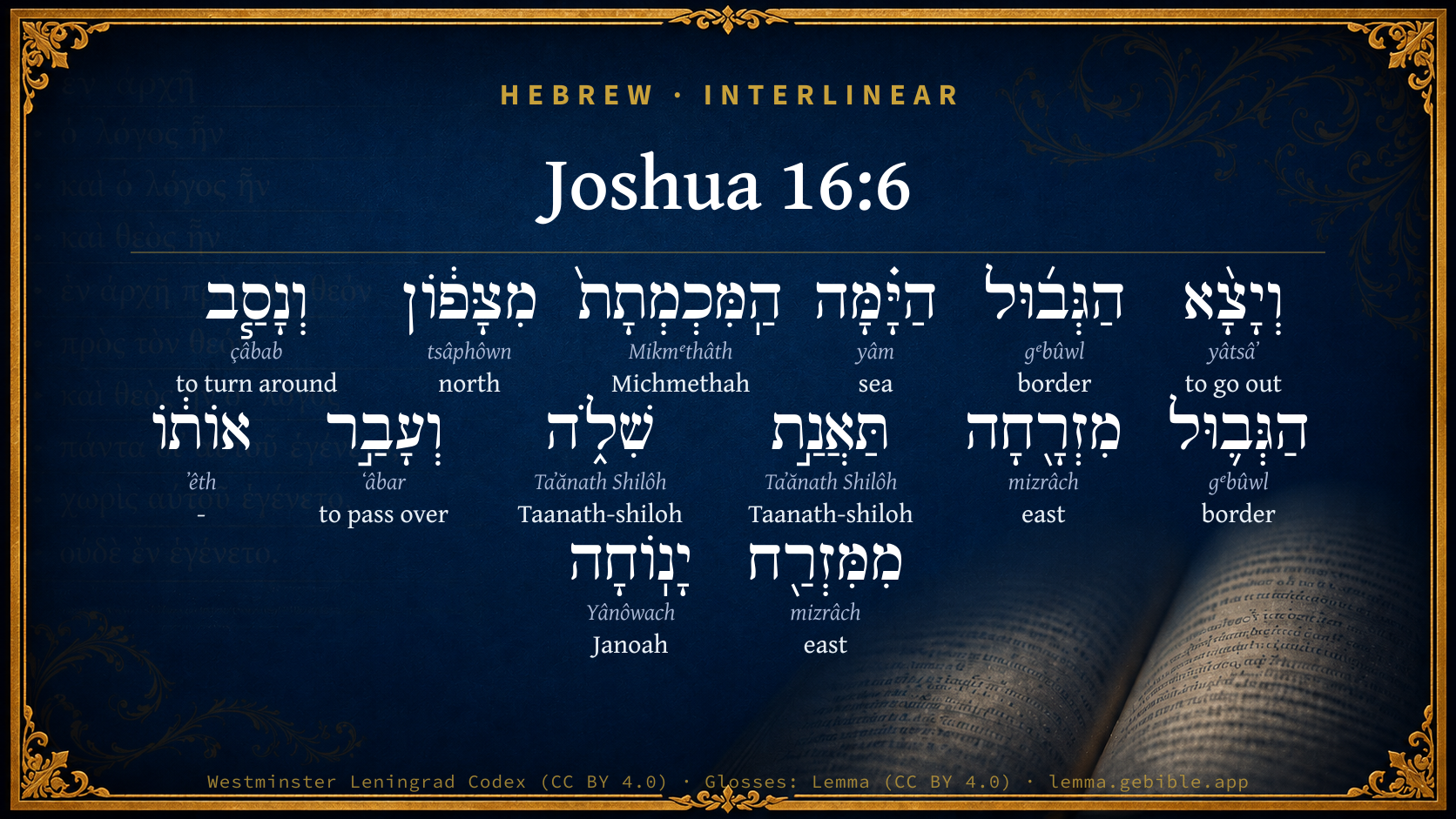
  1. וְיָצָ֨א yâtsâʼ H3318 “and · to go out” Conjunction + Verb, Qal, Sequential Perfect, 3rd Person, Masculine, Singular
  2. הַגְּב֜וּל gᵉbûwl H1366 “the · border” Particle, Definite Article + Noun, Common, Masculine, Singular, Absolute
  3. הַיָּ֗מָּה yâm H3220 “the · sea · toward” Particle, Definite Article + Noun, Common, Masculine, Singular, Absolute + Suffix, Demonstrative
  4. מִצָּפ֔וֹן tsâphôwn H6828 “from · north” Preposition + Noun, Common, Feminine, Singular, Absolute
  5. וְנָסַ֧ב çâbab H5437 “and · to turn around” Conjunction + Verb, Niphal, Sequential Perfect, 3rd Person, Masculine, Singular
  6. הַגְּב֛וּל gᵉbûwl H1366 “the · border” Particle, Definite Article + Noun, Common, Masculine, Singular, Absolute
  7. מִזְרָ֖חָה mizrâch H4217 “east · toward” Noun, Common, Masculine, Singular, Absolute + Suffix, Demonstrative
  8. תַּאֲנַ֣ת Taʼănath Shilôh H8387 “Taanath-shiloh” Noun, Proper
  9. שִׁלֹ֑ה Taʼănath Shilôh H8387 “Taanath-shiloh” Noun, Proper
  10. וְעָבַ֣ר ʻâbar H5674 “and · to pass over” Conjunction + Verb, Qal, Sequential Perfect, 3rd Person, Masculine, Singular
  11. אוֹת֔וֹ ʼêth H853 “- · him” Particle, Direct Object + Suffix, Personal, 3rd Person, Masculine, Singular
  12. מִמִּזְרַ֖ח mizrâch H4217 “from · east of” Preposition + Noun, Common, Masculine, Singular, Construct
  13. יָנֽוֹחָה Yânôwach H3239 “Janoah · toward” Noun, Proper + Suffix, Demonstrative

About this verse

These counts appear in no published source. They are computed here, from the morphology-tagged text and Lemma’s own curated glosses. What Lemma adds →

14
words
11
distinct lemmas
Historical
section

Notable vocabulary

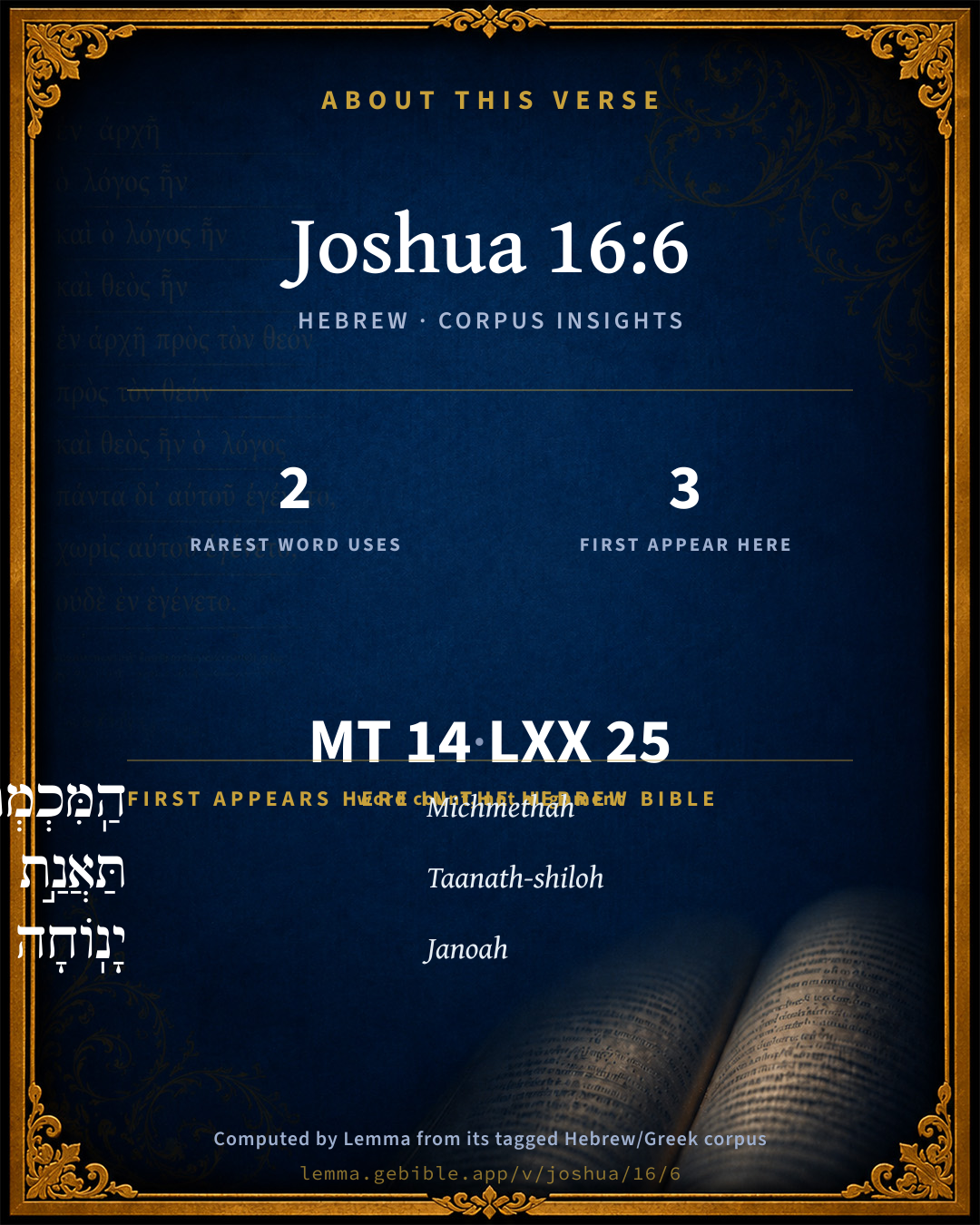
The rarest word here is הַֽמִּכְמְתָת֙ Michmethah H4366 — appearing just 2 times in the whole Hebrew Bible.

First appearance in Scripture

These words make their first canonical appearance in the Hebrew Bible here:

  • הַֽמִּכְמְתָת֙ Michmethah H4366
  • תַּאֲנַ֣ת Taanath-shiloh H8387
  • יָנֽוֹחָה Janoah H3239

Shared distinctive vocabulary

הַֽמִּכְמְתָת֙ Michmethah H4366 occurs in 2 verses of the Hebrew Bible. Also found in:

Grammatical profile

  • 3 verbs
  • 10 nouns
  • 1 particle

Verb forms

  • וְיָצָ֨א Qal · Sequential Perfect
  • וְנָסַ֧ב Niphal · Sequential Perfect
  • וְעָבַ֣ר Qal · Sequential Perfect

Repetition

Words recur within this verse — often emphatic in Hebrew:

  • הַגְּב֜וּל border H1366 ×2
  • מִזְרָ֖חָה east H4217 ×2
  • תַּאֲנַ֣ת Taanath-shiloh H8387 ×2

Hebrew & Septuagint length

In English translation the verse runs 29 words from the Hebrew and 29 from the Septuagint (LXX English) — the same length.

A rough comparison of the two English renderings, which tokenize alike — not a word-level alignment.

Word counts can differ between the Hebrew and the Greek without any difference in meaning — e.g. the Hebrew direct-object marker אֵת has no separate Greek word, and Greek often adds the article ὁ.

In the original languages it is 14 Hebrew tokens and 25 Greek tokens — but the two are counted differently (Hebrew bundles its prefixes and suffixes into one token; the Greek is in lemma form), so that isn’t a like-for-like length.

Cross-references

2

Topical passages linked to Joshua 16:6 in the Treasury of Scripture Knowledge — connected by theme and wording, ordered by reader-vote popularity; previews shown in the World English Bible.

  • Joshua 17:7 The border of Manasseh was from Asher to Michmethath, which is before Shechem; and the border went along to the right hand, to the inhabitants of En Tappuah.
  • Joshua 18:1 The whole congregation of the children of Israel assembled themselves together at Shiloh, and set up the tent of meeting there: and the land was subdued before them.

Cross-references courtesy of OpenBible.info (CC BY 4.0).

Hebrew and Greek witnesses Masoretic Hebrew ↔ Greek Septuagint

The same verse in the two great witnesses to the Old Testament, shown verse-for-verse.

These are two independent witnesses, not word-aligned to each other, and the Septuagint is shown in lemma (dictionary) form.

Hebrew Joshua 16:6 Masoretic · Westminster Leningrad Codex

וְיָצָ֨א הַגְּב֜וּל הַיָּ֗מָּה הַֽמִּכְמְתָת֙ מִצָּפ֔וֹן וְנָסַ֧ב הַגְּב֛וּל מִזְרָ֖חָה תַּאֲנַ֣ת שִׁלֹ֑ה וְעָבַ֣ר אוֹת֔וֹ מִמִּזְרַ֖ח יָנֽוֹחָה

and the border went out westward at Michmethath on the north; and the border turned about eastward to Taanath Shiloh, and passed along it on the east of Janoah;

World English Bible · Public Domain

Greek LXX Joshua 16:6 Septuagint · lemma form

καί διαἔρχομαι ὁ ὅριον ἐπί ὁ θάλασσα εἰς ικασμων ἀπό βορέας θερμα περιἔρχομαι ἐπί ἀνατολή εἰς θηνασα καί σελλησα καί παραἔρχομαι ἀπό ἀνατολή εἰς ιανωκα

And the borders will proceed to the sea to Icasmon north of Therma; they will go round eastward to Thenasa, and Selles, and will pass on eastward to Janoca,

LXX2012 (modern English Septuagint) · Public Domain

On this verse, Haydock's Catholic Bible Commentary discusses the Septuagint’s reading. Read the note in Commentary ↓

Hebrew: Westminster Leningrad Codex (CC BY 4.0). Greek: Septuagint (public domain); English from LXX2012 (modern English Septuagint) (Public Domain). How the Septuagint differs from the Hebrew →

Targum (Aramaic paraphrase)

1

The Targum is the ancient Jewish Aramaic paraphrase of the Hebrew Scriptures — an interpretive translation, not the Hebrew text itself. Onkelos (literal) and Pseudo-Jonathan (expansive) render the Torah, and Jonathan the Prophets. Coverage is partial: where no permissively-licensed English translation exists for a verse, only the Aramaic is shown. This is verse-level text, not a word-by-word alignment to the Hebrew.

  1. Targum Jonathan Prophets (Joshua–Malachi)
    וּנְפַק תְּחוּמָא לְיַמָא לְמִכְמְתָת מִצִפּוּנָא וּמִסְתְּחַר תְּחוּמָא מִמַדִינְחָא לְתַאֲנַת שִׁלֹה וְעָבַר לֵיהּ מִמַדְנַח לְיָנוֹחַ:

    (no public-domain English translation for this verse)

    Targum Jonathan — Aramaic: “Mikraot Gedolot” (public domain). English: “Sefaria Community Translation” (CC0 1.0 (public-domain dedication)); “London "Chaldee Paraphrase," 1871” (public domain). Text via Sefaria.

Commentary

Notes on Joshua 16:6 from classic Christian and Jewish commentators (each source and its license shown beneath its notes). The classic Christian expositions comment on the surrounding passage and are grouped to its opening verse, so a note may address several verses; the Jewish commentaries on the Tanakh (Rashi and others) are per-verse, so they appear only where the commentator wrote on this verse.

Lemma curates 59 commentaries, every one of them public domain or Creative Commons licensed, each selected and text-cleaned for this edition rather than reprinted as found. About our sources →

Trapp's Complete Commentary

John Trapp

Jos 16:6 And the border went out toward the sea to Michmethah on the north side; and the border went about eastward unto Taanathshiloh, and passed by it on the east to Janohah;

Ver. 6. Toward the sea.] Or, Westward by Michmethah, and then eastward by several towns here mentioned. These are ancient things, and to us hard to be understood.

John Trapp, A Commentary or Exposition upon All the Books of the Old and New Testament (1647–1656) — public domain. Text from a community e-Sword module.

Joseph Benson's Commentary

Jos 16:6-7. Toward the sea — The midland sea, toward the west. To Jericho — Not to the city of Jericho, which belonged to Benjamin’s lot, (Jos 18:21,) but to its territory.

Joseph Benson's Commentary on the Old and New Testaments (1811–1818) — public domain. Text from a community e-Sword module.

Jamieson, Fausset & Brown

Robert Jamieson, A. R. Fausset & David Brown

Michmethah on the north side--The northern boundary is traced from this point eastward to the Jordan.

Jamieson, Fausset & Brown — Commentary Critical and Explanatory on the Whole Bible (1871) — public domain (CC PDM 1.0). Text via the HelloAO Bible API.

The Cambridge Bible for Schools and Colleges

gen. ed. J. J. S. Perowne

6. and the border went out] The line appears to run north towards the Beth-horons, where it meets the southern boundary common to both tribes. Then it went north-westward (or toward the sea) to Michmethah, which lay “facing Shechem” (Jos_17:7), but which has not been discovered by any travellers.

Taanath-shiloh] identified by some with Ain Tâna, which lay between Shechem and the Jordan.

Janohah] Doubtless identical with the modern Yanûn, about 10 miles south-east of Shechem, where extensive ruins of great antiquity exist.

The Cambridge Bible for Schools and Colleges (gen. ed. J. J. S. Perowne; Cambridge University Press, 1878–1918) — public domain. Text from a community e-Sword module.

John Gill's Exposition

And it went down from Johanan to Ataroth,.... This is different from Ataroth before mentioned, Jos 16:2; there were several places of this name, as before observed; this seems to be that which Jerom places four miles from Sebaste or Samaria; see Gill on Jos 16:2,

and to Naarath; Jerom (g) says, that Naarath was in his time called Naorath, a village of the Jews, five miles from Jericho; and is the village Josephus (h) calls Neara, where was a water, half of which Archelaus turned, and led to the field planted with palm trees, near Jericho; and, according to the Jewish writers (i): there was a place called Noaran near to Jericho, which seems to be this:

and came to Jericho, and went out at Jordan; where it ended this way, which was eastward.

(g) De loc. Heb. fol. 93. I. (h) Antiqu. l. 17. c. 15. sect. 1. (i) Vajikra Rabba, sect. 23. fol. 164. 3. Shirhashirim Rabba, fol. 9. 3. Echa Rabbati, fol. 50. 4.

John Gill's Exposition of the Whole Bible (1746–1763) — public domain (CC PDM 1.0). Text via the HelloAO Bible API.

Haydock's Catholic Bible Commentary

Looketh to the north, &c. The meaning is, that the border went towards the north, by Machmethath; and then turned eastward to Thanathselo. (Challoner) --- Borders. It should be terminus. "The border turneth eastward," Septuagint. (Bonfrere) --- Janoe, twelve miles east of Sichem. (Eusebius) (4 Kings xv. 29.)

George Leo Haydock (1774–1849), Haydock's Catholic Family Bible and Commentary, 1859 edition — public domain. Excludes Psalms (Douay-Rheims chapter numbering differs from Protestant) and Deuterocanonical books (Catholic canon only).

Matthew Poole's English Annotations

Toward the sea; the midland sea, towards the west.

Matthew Poole's English Annotations on the Holy Bible (1683–1685) — public domain. Text from a community e-Sword/MySword module.

Whedon's Commentary on the Bible

Daniel D. Whedon

6. And the border went out toward the sea — The Mediterranean. Here the sentence should end, for to Michmethah evidently belongs to the northern boundary, and to another sentence. Toward the sea, then, completes the account of the boundary in the southwest. We would commence a new sentence with the word Michmethah, and render, Michmethah was on the north side. Or perhaps it would be better to emend the reading by means of the parallel in Jos_17:7, and read, The border was from Asher to Michmethah on the north. Michmethah is there said to lie before Shechem, but that is indefinite. It is generally supposed to have been northeast of Shechem, but the exact site is unknown.

Went about — That is, fetched a circuit, or slightly turned its course, eastward unto Taanath-shiloh. This is not improbably identical with Ain Tana, about eight miles southeast of Shechem. Janohah is still preserved in the village of Yanun, about two miles south of Ain Tana. Van de Velde says that “entire houses and walls of the ancient city are still existing, but covered with immense heaps of earth and rubbish.”

Daniel D. Whedon (gen. ed.), Commentary on the Old and New Testaments (1874–1909) — public domain. Text from a community e-Sword module.

The Pulpit Commentary

And the border went out towards the sea. Or, "and the western border." On the north side. Or, "northward." Apparently a line is drawn from the sea, which (ver. 3) is given as the termination of the southern boundary to Michmethah, near Shechem. (Jos_17:7) Knobel thinks that Michmethah (the signification of which is perhaps hiding place) was upon the watershed, and thus served as a dividing point. Went about. Rather, deflected. The border ran m a northeasterly direction to Michmethah. It then bent back and ran in a southeasterly direction to Jericho.

The Pulpit Commentary (1880–1919), ed. H.D.M. Spence-Jones & Joseph S. Exell — public domain. Text from a community e-Sword module.

John Wesley's Explanatory Notes

Toward the sun - The midland sea, towards the west.

John Wesley, Explanatory Notes Upon the Whole Bible (1754–1765) — public domain. Text via the GEBible commentary corpus.

Rashi

Rabbi Shlomo Yitzchaki (Rashi)

The boundary then went out westward. Its length was westward to Michmesos; the boundary line continued north of Michmesos.

The boundary turned. The width of the border spread northward, and the border-line bulged outward to the east of Taanis-Shiloh.

And passed by it. The boundary passed by Taanis-shiloh, were permitted to be sacrificed and eaten in Shiloh, such as: Shelamin, (peace-offerings) Todah, (thanksgiving-offerings) the korban Pesach, (the paschal lamb) and the first-born offerings. Various tithes (maasir) could also be brought to the Mishkan at Shiloh. After the Mishkan at Shiloh was destroyed, the people mourned as they would at the destruction of the Beis Hamikdosh in Yerushalayim. Whenever they passed by its ruins they wood weep and mourn. It was therefore known as Taanis-Shiloh, which implies the mourning of Shiloh. and the boundary line passed east of Yonoach. This was all included in the bulge of the width, which terminated at the Jordan, and there was a city named Tapuach. From there the boundary line turned to the measure of the length of the westward boundary to the brook of Konnoh

Rashi on the Tanakh — English translations: “The Judaica Press complete Tanach with Rashi, translated by A. J. Rosenberg” (CC BY 4.0); “Pentateuch with Rashi's commentary by M. Rosenbaum and A.M. Silbermann, 1929-1934” (public domain); “The Metsudah Tanach series, Lakewood, N.J” (CC BY 4.0); and “The Book of Joshua, Metsudah Publications, 1997” (CC BY 4.0). Text via Sefaria.

Lesson kit

Teaching starters — assembled from the data on this page, not authored interpretation. Every prompt links to the verse data it draws on. Edit before teaching.

Joshua, in the Historical, opens this verse with 14 words (11 distinct Hebrew lemmas). Its most distinctive word is Mikmᵉthâth (“Michmethah”). A historical commentator’s framing appears above. Read the whole chapter for the surrounding context.

Discussion questions

  1. The word Mikmᵉthâth carries the sense “Michmethah.” How does it shape the verse?
  2. 3 words make their first appearance in Scripture here. What does this debut establish?
  3. How does Joshua 17:7, which shares the word «Michmethah», read alongside this verse?
  4. What does the repetition of “border” (2× in this one verse) do in this verse?
  5. The translations on this page render this verse differently — a whole-verse word diff, not a word-by-word alignment. What might account for the different wordings?
  6. «וְיָצָ֨א» is a Qal Sequential Perfect verb. How does that grammatical form shape the action described?
  7. Compare how Trapp's Complete Commentary and Joseph Benson's Commentary read this verse. Where do they agree or differ?

Things to notice

Reading settings

Reading text

Shown beneath each verse's original-language words.

Old Testament
Old Testament edition

Read the OT as the Masoretic Hebrew (MT) or the Greek Septuagint (LXX).

English shown for the Greek Septuagint (in the Hebrew ↔ Greek comparison).

Comparing translations? Open the Compare panel on any verse page to stack up to four side by side.