
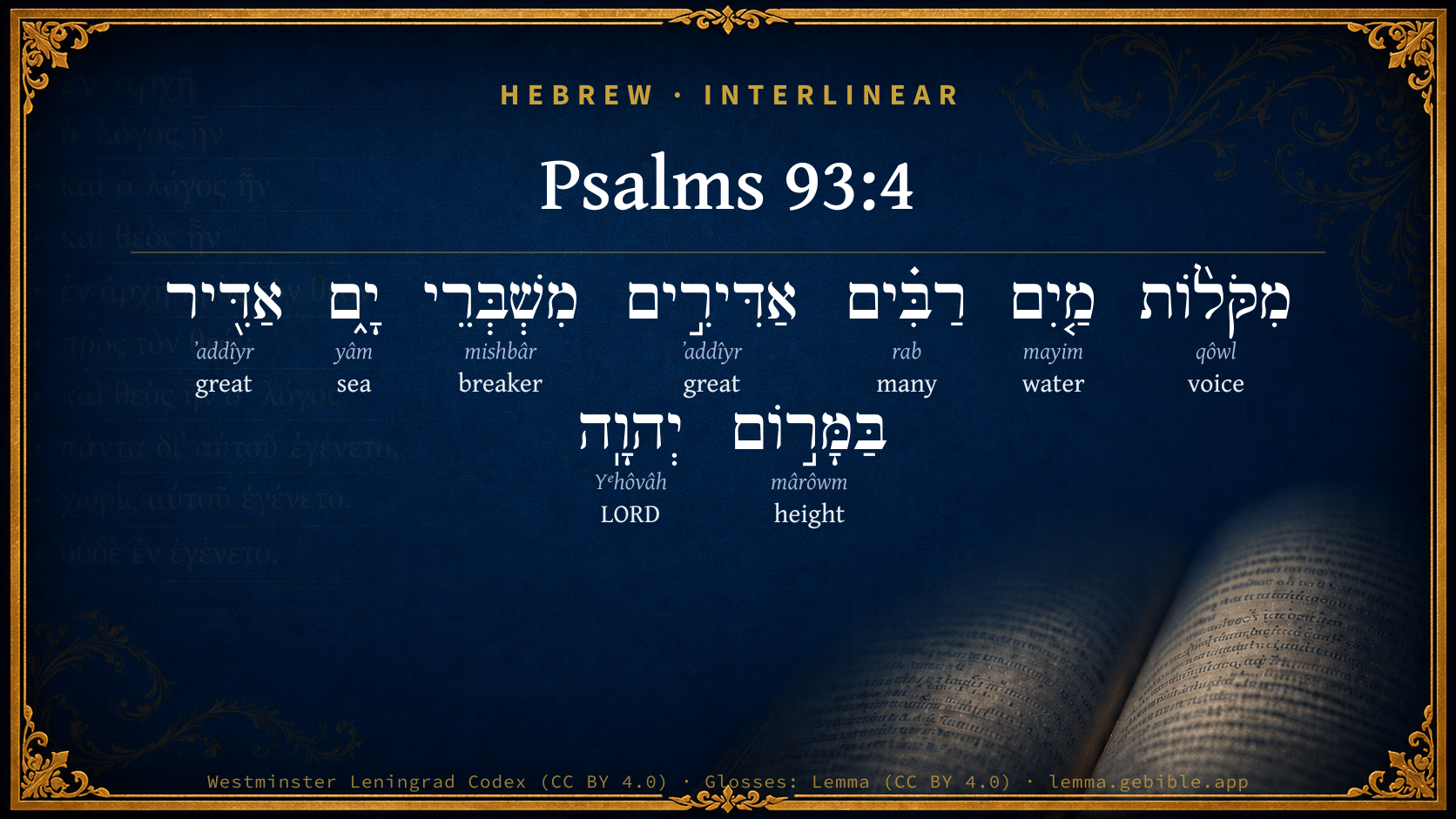
Psalms 93:4

Hebrew (Westminster Leningrad Codex) Psalms 93:4 appears in the Hebrew Old Testament. The text above is from the Westminster Leningrad Codex. Each word links to its Strong’s number, a concise gloss, and parsing drawn from the Open Scriptures Hebrew Bible morphology. Click any word for its full Brown-Driver-Briggs (BDB) entry.
Download image
Cite this verse

Psalms 93:4 (World English Bible). Public Domain. Lemma interlinear Bible study tool, https://lemma.gebible.app/v/psalms/93/4.

Show BibTeX & RIS
BibTeX
RIS
English Translation
Above the voices of many waters, The mighty breakers of the sea, Yahweh on high is mighty.
World English Bible · Public Domain
Download a study sheet

One document with this verse’s original text, its word-by-word gloss line, the meaning frame, cross-references with their text, attributed commentary, and full source and license credits — printable, and it pastes into notes with its structure intact.

This verse Autodidact and up

Study sheet (.html) Plain text (.txt)

A passage Seminary Student

Up to 50 verses in one chapter. A passage sheet keeps up to 6 commentary sources and 12 cross-references per verse, in the order this page ranks them, and says so on the sheet whenever that leaves anything out. Ask for a single verse and you get the Autodidact verse sheet above.

Everything on this page stays free to read, with no account — the sheet is a download of what is already on screen, not access to it.

Want to remove ads? Support Godless Engineer
Compare translations 3

The same verse in 3 English versions, stacked beneath the original-language interlinear above. Click any original word for its lexicon entry.

Each is an independent rendering of the whole verse — the interlinear is not word-aligned to these translations.

Highlighted words mark where these versions differ — a whole-verse word diff, not a word-by-word alignment.

  • World English Bible Public Domain
    Above the voices of many waters, The mighty breakers of the sea, Yahweh on high is mighty.
  • King James Version Public Domain
    The LORD on high is mightier than the noise of many waters, yea, than the mighty waves of the sea.
  • unfoldingWord Literal Text CC BY-SA 4.0
    More than the sounds of many waters, than the mighty breakers of the sea, Yahweh on high is mighty.

unfoldingWord Literal Text — © unfoldingWord, licensed CC BY-SA 4.0. Word-aligned USFM3 via Door43 (git.door43.org/unfoldingWord/en_ult).

Versions to compare (up to 4)

3 of 4 selected

Show all 18 translations

Every available English version of this verse, each an independent rendering of the whole verse.

  • World English Bible Public Domain
    Above the voices of many waters, The mighty breakers of the sea, Yahweh on high is mighty.
  • Berean Standard Bible Public Domain
    Above the roar of many waters—the mighty breakers of the sea—the LORD on high is majestic.
  • Majority Standard Bible Public Domain
    Above the roar of many waters—the mighty breakers of the sea—the LORD on high is majestic.
  • King James Version Public Domain
    The LORD on high is mightier than the noise of many waters, yea, than the mighty waves of the sea.
  • American Standard Version (1901) Public Domain
    Above the voices of many waters, The mighty breakers of the sea, Jehovah on high is mighty.
  • Revised Version (1885) Public Domain
    Above the voices of many waters, the mighty breakers of the sea, the LORD on high is mighty.
  • Geneva Bible (1599) Public Domain
    The waues of ye sea are marueilous through the noyse of many waters, yet the Lord on High is more mightie.
  • Douay-Rheims (1899) Public Domain
    with the noise of many waters. Wonderful are the surges of the sea: wonderful is the Lord on high.
  • Young's Literal Translation Public Domain
    Than the voices of many mighty waters, Breakers of a sea, mighty on high `is' Jehovah,
  • Literal Standard Version CC BY-SA 4.0
    Mightier than the voices of many mighty waters, breakers of a sea, || [Is] YHWH on high,
  • Unlocked Literal Bible CC BY-SA 4.0
    Above the crashing of many waves, the mighty breakers of the sea, Yahweh on high is mighty.
  • unfoldingWord Literal Text CC BY-SA 4.0
    More than the sounds of many waters, than the mighty breakers of the sea, Yahweh on high is mighty.
  • Darby Bible Public Domain
    Jehovah on high is mightier than the voices of many waters, than the mighty breakers of the sea.
  • World Messianic Bible Public Domain
    Above the voices of many waters, the mighty breakers of the sea, the LORD on high is mighty.
  • Webster's Bible Public Domain
    The LORD on high is mightier than the noise of many waters, yes, than the mighty waves of the sea.
  • Free Bible Version CC BY-SA 4.0
    But greater than the most violent ocean, greater than the largest waves of the sea, the greatest is the Lord above.
  • Bible in Basic English Public Domain
    The Lord in heaven is stronger than the noise of great waters, yes, he is stronger than the great waves of the sea.
  • JPS Tanakh (1917) Public Domain
    Above the voices of many waters, the mighty breakers of the sea, the LORD on high is mighty.

Literal Standard Version (2020), Covenant Press — licensed CC BY-SA 4.0. Text via the HelloAO Bible API (eBible.org). Unlocked Literal Bible (unfoldingWord) — licensed CC BY-SA 4.0. Text via the HelloAO Bible API (eBible.org). unfoldingWord Literal Text — © unfoldingWord, licensed CC BY-SA 4.0. Word-aligned USFM3 via Door43 (git.door43.org/unfoldingWord/en_ult). Free Bible Version, Dr. Jonathan Gallagher — licensed CC BY-SA 4.0. Text via the HelloAO Bible API (eBible.org).

Word by word

More ways to search: Search by grammar → Find every occurrence → Compare this word →

Practice this passage: Drill this verse → Learn its vocabulary →

About this verse

These counts appear in no published source. They are computed here, from the morphology-tagged text and Lemma’s own curated glosses. What Lemma adds →

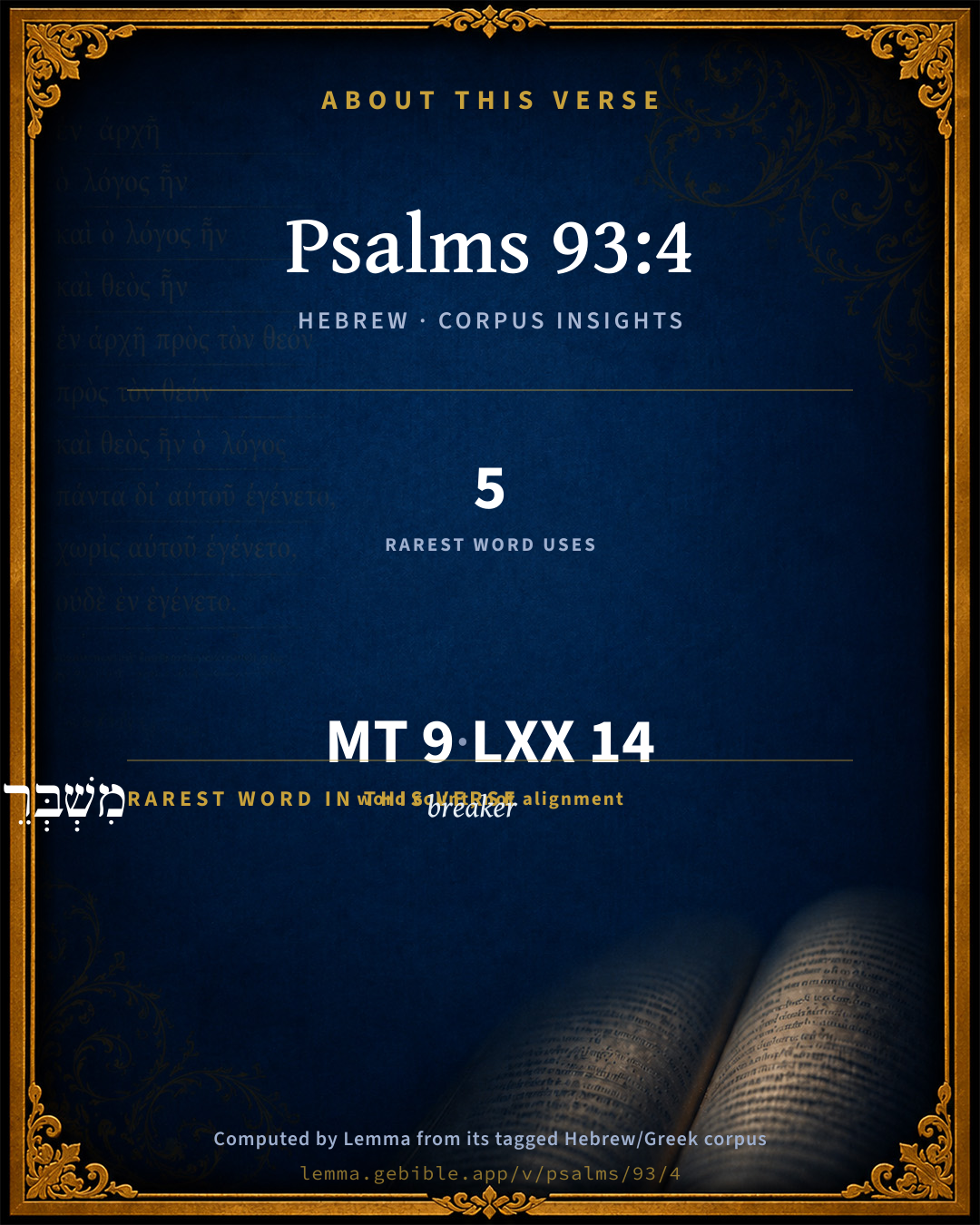
9
words
8
distinct lemmas
Wisdom
section

Notable vocabulary

The rarest word here is מִשְׁבְּרֵי breaker H4867 — appearing just 5 times in the whole Hebrew Bible.

Shared distinctive vocabulary

מִשְׁבְּרֵי breaker H4867 occurs in 5 verses of the Hebrew Bible. Also found in:

Grammatical profile

  • 6 nouns
  • 3 adjectives

Repetition

A word recurs within this verse — often emphatic in Hebrew:

  • אַדִּירִ֣ים great H117 ×2

Hebrew & Septuagint length

In English translation the verse runs 17 words from the Hebrew and 20 from the Septuagint (LXX English) — closely comparable.

A rough comparison of the two English renderings, which tokenize alike — not a word-level alignment.

Word counts can differ between the Hebrew and the Greek without any difference in meaning — e.g. the Hebrew direct-object marker אֵת has no separate Greek word, and Greek often adds the article ὁ.

In the original languages it is 9 Hebrew tokens and 14 Greek tokens — but the two are counted differently (Hebrew bundles its prefixes and suffixes into one token; the Greek is in lemma form), so that isn’t a like-for-like length.

Cross-references

8

Topical passages linked to Psalms 93:4 in the Treasury of Scripture Knowledge — connected by theme and wording, ordered by reader-vote popularity; previews shown in the World English Bible.

  • Psalms 65:7 Who stills the roaring of the seas, The roaring of their waves, And the turmoil of the nations.
  • Psalms 89:9 You rule the pride of the sea. When its waves rise up, you calm them.
  • Job 38:11 And said, 'Here you may come, but no further; Here shall your proud waves be stayed?'
  • Psalms 114:3–5 The sea saw it, and fled. The Jordan was driven back.
  • Jeremiah 5:22 Don't you fear me? says Yahweh: won't you tremble at my presence, who have placed the sand for the bound of the sea, by a perpetual decree, that it can't pass it? and though the waves of it toss themselves, yet they can't prevail; though they roar, yet they can't pass over it.
  • Mark 4:37–39 There arose a great wind storm, and the waves beat into the boat, so much that the boat was already filled.
  • Psalms 89:6 For who in the skies can be compared to Yahweh? Who among the sons of the heavenly beings is like Yahweh,
  • Psalms 92:8 But you, Yahweh, are on high forevermore.

Cross-references courtesy of OpenBible.info (CC BY 4.0).

Hebrew and Greek witnesses Masoretic Hebrew ↔ Greek Septuagint

The same verse in the two great witnesses to the Old Testament, shown verse-for-verse.

You’re reading Greek Psalm 92 (Hebrew Psalm 93). The Septuagint counts the superscription, so verse numbers can differ from the Hebrew — chapter-level alignment, not verse-by-verse. Numbering follows Rahlfs.

These are two independent witnesses, not word-aligned to each other, and the Septuagint is shown in lemma (dictionary) form.

Hebrew Psalms 93:4 Masoretic · Westminster Leningrad Codex

מִקֹּל֨וֹת מַ֤יִם רַבִּ֗ים אַדִּירִ֣ים מִשְׁבְּרֵי יָ֑ם אַדִּ֖יר בַּמָּר֣וֹם יְהוָֽה

Above the voices of many waters, The mighty breakers of the sea, Yahweh on high is mighty.

World English Bible · Public Domain

Greek LXX Greek Psalm 92:4 Septuagint · lemma form

ἀπό φωνή ὕδωρ πολύς θαυμαστός ὁ μετεωρισμός ὁ θάλασσα θαυμαστός ἐν ὑψηλός ὁ κύριος

at the voices of many waters: the billows of the sea are wonderful: the Lord is wonderful in high places.

LXX2012 (modern English Septuagint) · Public Domain

Hebrew: Westminster Leningrad Codex (CC BY 4.0). Greek: Septuagint (public domain); English from LXX2012 (modern English Septuagint) (Public Domain). How the Septuagint differs from the Hebrew →

Commentary

Notes on Psalms 93:4 from classic Christian and Jewish commentators (each source and its license shown beneath its notes). The classic Christian expositions comment on the surrounding passage and are grouped to its opening verse, so a note may address several verses; the Jewish commentaries on the Tanakh (Rashi and others) are per-verse, so they appear only where the commentator wrote on this verse.

Lemma curates 59 commentaries, every one of them public domain or Creative Commons licensed, each selected and text-cleaned for this edition rather than reprinted as found. About our sources →

Trapp's Complete Commentary

John Trapp

Psa 93:4 The LORD on high [is] mightier than the noise of many waters, [yea, than] the mighty waves of the sea.

Ver. 4. The Lord on high is mightier] He defeats tyrants and persecutors, be they never so terrible for noise and number. If he but thunder they are hushed, and glad to wriggle, as worms, into their holes.

John Trapp, A Commentary or Exposition upon All the Books of the Old and New Testament (1647–1656) — public domain. Text from a community e-Sword module.

J. A. Alexander on Psalms

Joseph Addison Alexander

4. (Psa 93:4) More than the voices of waters—many—mighty—sea-billows—mighty in the high-place (is) Jehovah. More than, literally from, away from, the particle by which comparison is commonly expressed in Hebrew. The common version of the next clause, mighty waves of the sea, is scarcely grammatical, as the adjective, according to analogy and usage, cannot agree with the noun following, but must be in apposition with the adjective before it, and agree with the same object. The word translated mighty corresponds, in part, to our epithets, sublime and grand. See above, on Psa 8:1. Sea-billows, literally breakers of the sea. Compare Psa 42:7; Psa 88:7, Jon 2:3. That the comparison was meant to be between the noise of the sea and that of thunder considered as the voice of God, is an admissible but not a necessary supposition. See above, on Psa 29:5.

Joseph Addison Alexander, The Psalms Translated and Explained (1850) — public domain. Text from a community e-Sword module.

Adam Clarke's Commentary

Verse 4. The Lord - is mightier than the noise of many waters] Greater in strength than all the peoples and nations that can rise up against him.

Mighty waves of the sea.] Even the most powerful empires can prevail nothing against him; therefore those who trust in him have nothing to fear.

Adam Clarke's Commentary on the Bible (1810–1826) — public domain. Text from a community e-Sword/MySword module.

Ellicott's Commentary for English Readers

(4) Sea.—Whether this description of a raging sea is to be taken literally, or as emblematic of war and its horrors, is doubtful.

A Bible Commentary for English Readers, edited by Charles John Ellicott (1878–1897) — public domain. Text from a community e-Sword module.

The Cambridge Bible for Schools and Colleges

gen. ed. J. J. S. Perowne

4. The A.V. obliterates the structure of the verse. If the received text is retained we may render,

Above the thundering of many waters,

The mighty (waters), the breakers of the sea,

Jehovah on high is mighty.

But the grammatical construction is anomalous, and an easy emendation gives the sense,

Above the thundering of many waters,

Majestic above the breakers of the sea,

Majestic on high is Jehovah.

The repetition is in harmony with the style of the Psalm. The word for noise, lit. voices, may best be rendered thundering, for the plural is only used of thunder. ’Addîr is inadequately rendered by mighty. It suggests the idea of grandeur and magnificence as well as power. Cp. Exo_15:6; Exo_15:11 (a cognate word); Psa_8:1 (A.V. excellent); Isa_33:21.

The Cambridge Bible for Schools and Colleges (gen. ed. J. J. S. Perowne; Cambridge University Press, 1878–1918) — public domain. Text from a community e-Sword module.

John Gill's Exposition

The Lord on high is mightier than the noise of many waters,.... Christ is the most High; he is God over all, higher than the highest; he is, as King, higher than the kings of the earth; he is in the highest heavens, and higher than they; he is highly exalted, as Mediator, at the right hand of God: he is the mighty God, and mighty Saviour; yea, he is Almighty, and therefore mightier than all his enemies, and the noise they make, and the force they use; he is stronger than the strong man armed; than Satan, and all his principalities and powers; than all the persecuting princes and potentates of this world; than antichrist, and all the antichristian states: yea, than "the mighty waves of the sea"; the same are intended as before (c).

(c) Vide Homer. Iliad. 21. v. 190, 91. where the same is said of Jove, almost in the same words, and repeated as here.

John Gill's Exposition of the Whole Bible (1746–1763) — public domain (CC PDM 1.0). Text via the HelloAO Bible API.

Albert Barnes' Notes on the Bible

The Lord on high is mightier than the noise of many waters - That is, he is more powerful than those waters; he is able to control them. See Psa 65:7, note; Job 38:11, note. The original here is more rapid in the course of the thought; more emphatic and forcible: “More than the voice of waters - many - mighty - the breakers of the sea - in the high place is Jehovah.” He is over all those billows and breakers; more mighty than they all. They can proceed no further than he permits; they will be stayed when and where he commands. We can conceive of few things which more illustrate the power and the majesty of God than the fact that he thus presides over, and controls, the waves of the ocean.

Yea, than the mighty waves of the sea - The original word here corresponds precisely with our word “breakers” - the mighty waves that “break” on the beach.

Albert Barnes' Notes on the Bible (1834–1885) — public domain. Text from a community e-Sword/MySword module.

Matthew Poole's English Annotations

The King of heaven is too strong for all earthly potentates, and will subdue them under his feet.

Matthew Poole's English Annotations on the Holy Bible (1683–1685) — public domain. Text from a community e-Sword/MySword module.

The Treasury of David

Charles H. Spurgeon

Ver. 4. The LORD on high is mightier than the noise of many waters. The utmost of their power is to him but a sound and he can readily master it, therefore he calls it a noise by way of contempt. When men combine to overthrow the kingdom of Jesus, plot secretly, and by and by rage openly, the Lord thinks no more of it than of so much noise upon the sea beach. Jehovah, the self existent and omnipotent, cares not for the opposition of dying men, however many or mighty they may be.

"Loud the stormy billows spoke,

Loud the billows raised their cry;

Fierce the stormy billows broke,

Sounding to the echoing sky.

Strong the breakers tossing high,

Stronger is Jehovah's might.

True thy words; and sanctity

Well becomes thy temple bright."

Yea, than the mighty waves of the sea. When the storm raises Atlantic billows, and drives them on with terrific force, the Lord is still able to restrain them, and so also when impious men are haughty and full of rage the Lord is able to subdue them and overrule their malice. Kings or mobs, emperors or savages, all are in the Lord's hands, and he can forbid their touching a hair of the heads of his saints.

Ver. 4. The LORD on high. "On high" is not to be regarded in the sense of locality, as none compete with God in that, but in reference to dominion and glory. Martin Geier.

Ver. 4. The LORD on high is mightier, etc. Therefore consider not so much thy distress, as thy Deliverer; and when men's malicious combination may affright thee, let Divine association support thee. The danger may exceed thy resistance, but not God's assistance; the enemies' power may surpass thy strength, their subtlety outwit thy prudence, but neither can excel the wisdom and might of God that is with thee. O learn therefore to try God in his strength, to trust him in difficulties; and when the merciless waves are ready to swallow thee; commit thyself to his custody. The mariner in straits looks up to heaven, do thou so; and remember that when the waters of affliction are never so high, yet "the Lord on high is mightier than they." Abraham Wright.

Ver. 4.

1. God is mighty in creation.

2. He is mightier in providence.

3. He is mightiest in redemption. G. R.

Psalms 93:5*

Charles H. Spurgeon's The Treasury of David (1869–1885) — public domain. Psalms only. Text from a community e-Sword/MySword module.

Whedon's Commentary on the Bible

Daniel D. Whedon

4. The Lord on high is mightier—This surely celebrates a sudden victory by the hand of God over a most formidable combination of haughty nations, rushing upon Israel like noisy breakers or cataracts. The imagery naturally refers us to the Assyrian invasion and catastrophe, already mentioned.

Many waters—Many nations or peoples, such as always made up the armies of the eastern conquerors.

Daniel D. Whedon (gen. ed.), Commentary on the Old and New Testaments (1874–1909) — public domain. Text from a community e-Sword module.

The Pulpit Commentary

The Lord on high (comp. Psa_92:8) is mightier than the noise of many waters; literally, than the voices of many waters (comp. ver. 3). As the waters represent angry nations, the poet speaks not only of their "noise," but of their "voices." Yea, than the mighty waves of the sea; or, "the glorious breakers of ocean". (so Kay; and comp. Exo_15:10)

The Pulpit Commentary (1880–1919), ed. H.D.M. Spence-Jones & Joseph S. Exell — public domain. Text from a community e-Sword module.

Rashi

Rabbi Shlomo Yitzchaki (Rashi)

More than the voices of great waters, etc. I know that more than the voices of great waters, which roar over us, and more than the mightiest breakers of this sea, You are mighty, O Lord, and Your hand is powerful over them.

Rashi on the Tanakh — English translations: “The Judaica Press complete Tanach with Rashi, translated by A. J. Rosenberg” (CC BY 4.0); “Pentateuch with Rashi's commentary by M. Rosenbaum and A.M. Silbermann, 1929-1934” (public domain); “The Metsudah Tanach series, Lakewood, N.J” (CC BY 4.0); and “The Book of Joshua, Metsudah Publications, 1997” (CC BY 4.0). Text via Sefaria.

Lesson kit

Teaching starters — assembled from the data on this page, not authored interpretation. Every prompt links to the verse data it draws on. Edit before teaching.

Psalms, in the Wisdom, opens this verse with 9 words (8 distinct Hebrew lemmas). Its most distinctive word is mishbâr (“breaker”). A historical commentator’s framing appears above. Read the whole chapter for the surrounding context.

Discussion questions

  1. What does “breaker” (mishbâr) contribute to the verse as a whole?
  2. 2 Samuel 22:5 shares the word «breaker» with this verse. How do the two illuminate each other?
  3. “great” occurs 2× in this one verse. What is the effect of the repetition?
  4. The translations on this page render this verse differently — a whole-verse word diff, not a word-by-word alignment. What might account for the different wordings?
  5. Reading how Trapp's Complete Commentary and J. A. Alexander on Psalms read this verse, where do the two commentators agree and where do they part?

Things to notice

Reading settings

Reading text

Shown beneath each verse's original-language words.

Old Testament
Old Testament edition

Read the OT as the Masoretic Hebrew (MT) or the Greek Septuagint (LXX).

English shown for the Greek Septuagint (in the Hebrew ↔ Greek comparison).

Comparing translations? Open the Compare panel on any verse page to stack up to four side by side.