
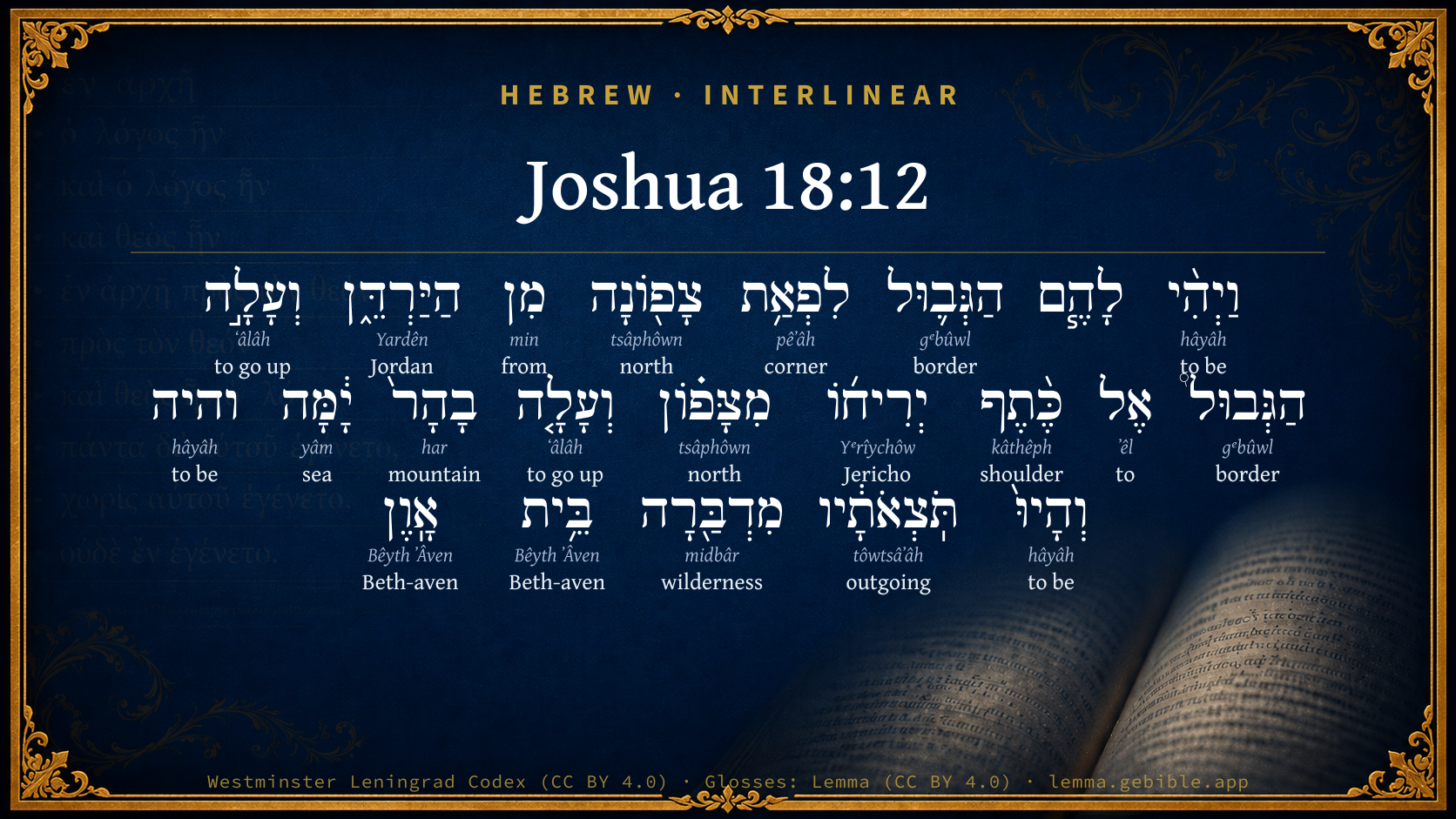
Joshua 18:12

Hebrew (Westminster Leningrad Codex) Joshua 18:12 appears in the Hebrew Old Testament. The text above is from the Westminster Leningrad Codex. Each word links to its Strong’s number, a concise gloss, and parsing drawn from the Open Scriptures Hebrew Bible morphology. Click any word for its full Brown-Driver-Briggs (BDB) entry.
Download image
Cite this verse

Joshua 18:12 (World English Bible). Public Domain. Lemma interlinear Bible study tool, https://lemma.gebible.app/v/joshua/18/12.

Show BibTeX & RIS
BibTeX
RIS
English Translation
Their border on the north quarter was from the Jordan; and the border went up to the side of Jericho on the north, and went up through the hill-country westward; and the goings out of it were at the wilderness of Beth Aven.
World English Bible · Public Domain
Download a study sheet

One document with this verse’s original text, its word-by-word gloss line, the meaning frame, cross-references with their text, attributed commentary, and full source and license credits — printable, and it pastes into notes with its structure intact.

This verse Autodidact and up

Study sheet (.html) Plain text (.txt)

A passage Seminary Student

Up to 50 verses in one chapter. A passage sheet keeps up to 6 commentary sources and 12 cross-references per verse, in the order this page ranks them, and says so on the sheet whenever that leaves anything out. Ask for a single verse and you get the Autodidact verse sheet above.

Everything on this page stays free to read, with no account — the sheet is a download of what is already on screen, not access to it.

Want to remove ads? Support Godless Engineer
Compare translations 3

The same verse in 3 English versions, stacked beneath the original-language interlinear above. Click any original word for its lexicon entry.

Each is an independent rendering of the whole verse — the interlinear is not word-aligned to these translations.

Highlighted words mark where these versions differ — a whole-verse word diff, not a word-by-word alignment.

  • World English Bible Public Domain
    Their border on the north quarter was from the Jordan; and the border went up to the side of Jericho on the north, and went up through the hill-country westward; and the goings out of it were at the wilderness of Beth Aven.
  • King James Version Public Domain
    And their border on the north side was from Jordan; and the border went up to the side of Jericho on the north side, and went up through the mountains westward; and the goings out thereof were at the wilderness of Bethaven.
  • unfoldingWord Literal Text CC BY-SA 4.0
    And the border for them to the mouth northward was from the Jordan. And the border went up to the shoulder of Jericho from the north, then it went up in the hill country seaward. And its goings out were from the wilderness Beth Aven.

unfoldingWord Literal Text — © unfoldingWord, licensed CC BY-SA 4.0. Word-aligned USFM3 via Door43 (git.door43.org/unfoldingWord/en_ult).

Versions to compare (up to 4)

3 of 4 selected

Show all 18 translations

Every available English version of this verse, each an independent rendering of the whole verse.

  • World English Bible Public Domain
    Their border on the north quarter was from the Jordan; and the border went up to the side of Jericho on the north, and went up through the hill-country westward; and the goings out of it were at the wilderness of Beth Aven.
  • Berean Standard Bible Public Domain
    On the north side their border began at the Jordan, went up past the northern slope of Jericho, headed west through the hill country, and came out at the wilderness of Beth-aven.
  • Majority Standard Bible Public Domain
    On the north side their border began at the Jordan, went up past the northern slope of Jericho, headed west through the hill country, and came out at the wilderness of Beth-aven.
  • King James Version Public Domain
    And their border on the north side was from Jordan; and the border went up to the side of Jericho on the north side, and went up through the mountains westward; and the goings out thereof were at the wilderness of Bethaven.
  • American Standard Version (1901) Public Domain
    And their border on the north quarter was from the Jordan; and the border went up to the side of Jericho on the north, and went up through the hill-country westward; and the goings out thereof were at the wilderness of Beth-aven.
  • Revised Version (1885) Public Domain
    And their border on the north quarter was from Jordan; and the border went up to the side of Jericho on the north, and went up through the hill country westward; and the goings out thereof were at the wilderness of Beth-aven.
  • Geneva Bible (1599) Public Domain
    And their coast on the Northside was from Iorden, and the border went vp to the side of Iericho on the Northpart, and went vp through the mountaines Westward, and the endes thereof are in the wildernesse of Beth-auen:
  • Douay-Rheims (1899) Public Domain
    And first came up the lot of the children of Benjamin by their families, to possess the land between the children of Juda, and the children of Joseph.
  • Young's Literal Translation Public Domain
    And the border is to them at the north side from the Jordan, and the border hath gone up unto the side of Jericho on the north, and gone up through the hill-country westward, and its outgoings have been at the wilderness of Beth-Aven;
  • Literal Standard Version CC BY-SA 4.0
    And the border is for them at the north side from the Jordan, and the border has gone up to the side of Jericho on the north, and gone up through the hill-country westward, and its outgoings have been at the wilderness of Beth-Aven;
  • Unlocked Literal Bible CC BY-SA 4.0
    On the north side, their border began at the Jordan. The border went up to the ridge north of Jericho, and then up through the hill country westward. There it reached the wilderness of Beth Aven.
  • unfoldingWord Literal Text CC BY-SA 4.0
    And the border for them to the mouth northward was from the Jordan. And the border went up to the shoulder of Jericho from the north, then it went up in the hill country seaward. And its goings out were from the wilderness Beth Aven.
  • Darby Bible Public Domain
    And their border on the north side was from the Jordan; and the border went up to the side of Jericho on the north, and went up to the mountain westward; and ended at the wilderness of Beth-Aven;
  • World Messianic Bible Public Domain
    Their border on the north quarter was from the Jordan. The border went up to the side of Jericho on the north, and went up through the hill country westward. It ended at the wilderness of Beth Aven.
  • Webster's Bible Public Domain
    And their border on the north side was from Jordan; and the border went up to the side of Jericho on the north side, and went up through the mountains westward; and the limits of it were at the wilderness of Beth-aven.
  • Free Bible Version CC BY-SA 4.0
    Their boundary began at the Jordan, and went north of the slope of Jericho, west through the hill country, coming out at the wilderness of Beth-aven.
  • Bible in Basic English Public Domain
    And their limit on the north was from the Jordan, and the line goes up to the side of Jericho on the north and through the hill-country to the west, ending at the waste land of Beth-aven.
  • JPS Tanakh (1917) Public Domain
    And their border on the north side was from the Jordan; and the border went up to the side of Jericho on the north, and went up through the hill-country westward; and the goings out thereof were at the wilderness of Beth-aven.

Literal Standard Version (2020), Covenant Press — licensed CC BY-SA 4.0. Text via the HelloAO Bible API (eBible.org). Unlocked Literal Bible (unfoldingWord) — licensed CC BY-SA 4.0. Text via the HelloAO Bible API (eBible.org). unfoldingWord Literal Text — © unfoldingWord, licensed CC BY-SA 4.0. Word-aligned USFM3 via Door43 (git.door43.org/unfoldingWord/en_ult). Free Bible Version, Dr. Jonathan Gallagher — licensed CC BY-SA 4.0. Text via the HelloAO Bible API (eBible.org).

Word by word

More ways to search: Search by grammar → Find every occurrence → Compare this word →

Practice this passage: Drill this verse → Learn its vocabulary →

בֵּ֥ית
Bêyth ʼÂven
H1007
“Beth-aven”
Noun, Proper
Part of Speech
Noun
Type
Proper
Full BDB Definition

Origin: from H1004 and H205

TWOT: None

Beth-aven = "house of vanity" - a city east of Bethel, site unknown
  1. וַיְהִ֨י hâyâh H1961 “and · to be” Conjunction + Verb, Qal, Sequential Imperfect, 3rd Person, Masculine, Singular
  2. הַגְּב֛וּל gᵉbûwl H1366 “the · border” Particle, Definite Article + Noun, Common, Masculine, Singular, Absolute
  3. לִפְאַ֥ת pêʼâh H6285 “to/for · corner of” Preposition + Noun, Common, Feminine, Singular, Construct
  4. צָפ֖וֹנָה tsâphôwn H6828 “north · toward” Noun, Common, Feminine, Singular, Absolute + Suffix, Demonstrative
  5. מִן min H4480 “from” Preposition
  6. הַיַּרְדֵּ֑ן Yardên H3383 “the · Jordan” Particle, Definite Article + Noun, Proper
  7. וְעָלָ֣ה ʻâlâh H5927 “and · to go up” Conjunction + Verb, Qal, Sequential Perfect, 3rd Person, Masculine, Singular
  8. הַגְּבוּל֩ gᵉbûwl H1366 “the · border” Particle, Definite Article + Noun, Common, Masculine, Singular, Absolute
  9. אֶל ʼêl H413 “to” Preposition
  10. כֶּ֨תֶף kâthêph H3802 “shoulder of” Noun, Common, Feminine, Singular, Construct
  11. יְרִיח֜וֹ Yᵉrîychôw H3405 “Jericho” Noun, Proper
  12. מִצָּפ֗וֹן tsâphôwn H6828 “from · north” Preposition + Noun, Common, Feminine, Singular, Absolute
  13. וְעָלָ֤ה ʻâlâh H5927 “and · to go up” Conjunction + Verb, Qal, Sequential Perfect, 3rd Person, Masculine, Singular
  14. בָהָר֙ har H2022 “in/at the · mountain” Preposition, Determined + Noun, Common, Masculine, Singular, Absolute
  15. יָ֔מָּה yâm H3220 “sea · toward” Noun, Common, Masculine, Singular, Absolute + Suffix, Demonstrative
  16. והיה hâyâh H1961 “and · to be” Conjunction + Verb, Qal, Sequential Perfect, 3rd Person, Masculine, Singular
  17. וְהָיוּ֙ hâyâh H1961 “and · to be” Conjunction + Verb, Qal, Sequential Perfect, 3rd Person, Common, Plural
  18. תֹּֽצְאֹתָ֔יו tôwtsâʼâh H8444 “outgoings · his” Noun, Common, Feminine, Plural, Construct + Suffix, Personal, 3rd Person, Masculine, Singular
  19. מִדְבַּ֖רָה midbâr H4057 “wilderness · toward” Noun, Common, Masculine, Singular, Construct + Suffix, Demonstrative
  20. אָֽוֶן Bêyth ʼÂven H1007 “Beth-aven” Noun, Proper

About this verse

These counts appear in no published source. They are computed here, from the morphology-tagged text and Lemma’s own curated glosses. What Lemma adds →

22
words
15
distinct lemmas
Historical
section

Notable vocabulary

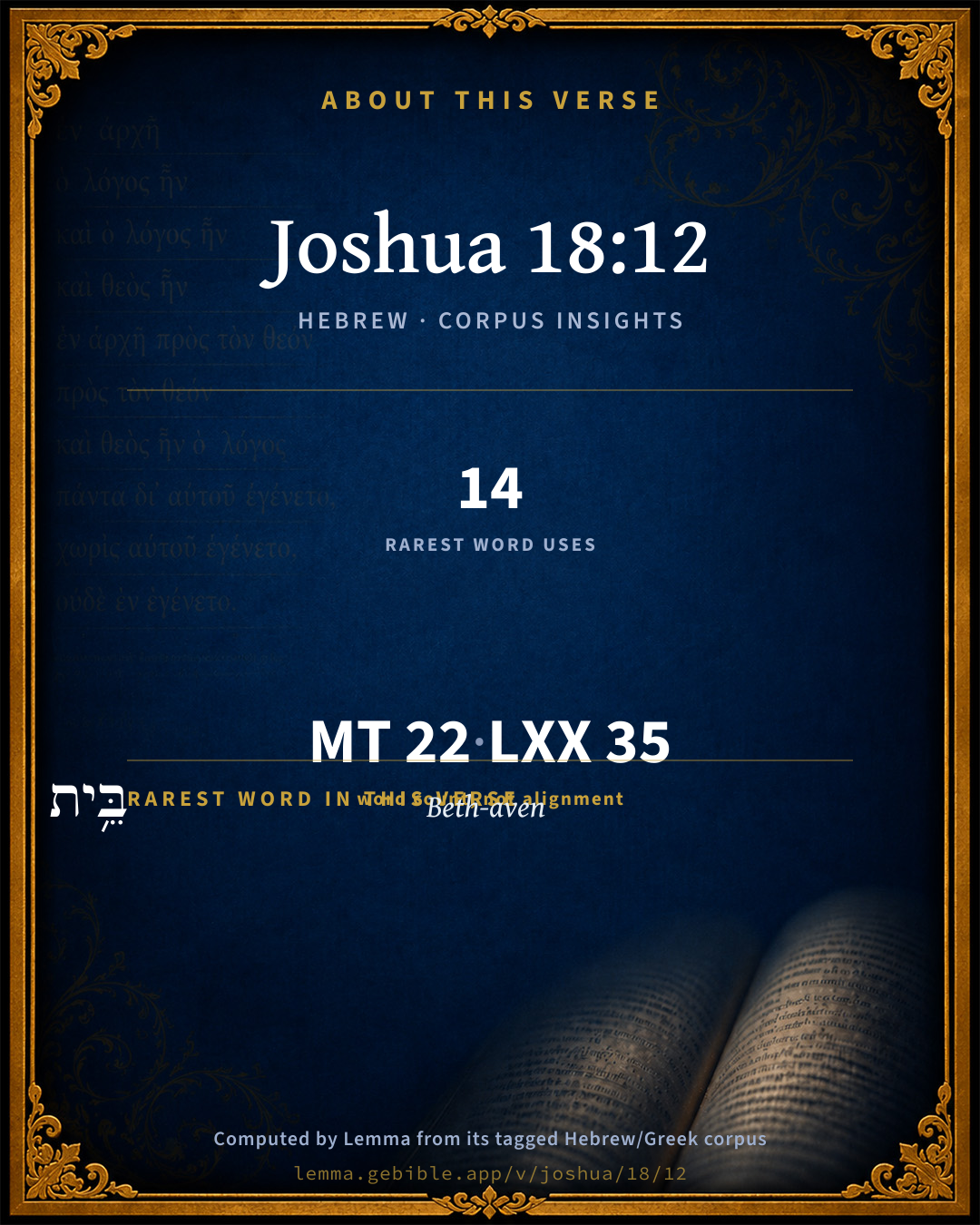
The rarest word here is בֵּ֥ית Beth-aven H1007 — appearing just 14 times in the whole Hebrew Bible.

Shared distinctive vocabulary

בֵּ֥ית Beth-aven H1007 occurs in 7 verses of the Hebrew Bible. Also found in:

Grammatical profile

  • 5 verbs
  • 14 nouns
  • 3 prepositions

Verb forms

  • וַיְהִ֨י Qal · Sequential Imperfect
  • וְעָלָ֣ה Qal · Sequential Perfect
  • וְעָלָ֤ה Qal · Sequential Perfect
  • והיה Qal · Sequential Perfect
  • וְהָיוּ֙ Qal · Sequential Perfect

Repetition

Words recur within this verse — often emphatic in Hebrew:

  • וַיְהִ֨י to be H1961 ×3
  • הַגְּב֛וּל border H1366 ×2
  • צָפ֖וֹנָה north H6828 ×2
  • וְעָלָ֣ה to go up H5927 ×2
  • בֵּ֥ית Beth-aven H1007 ×2

Hebrew & Septuagint length

In English translation the verse runs 43 words from the Hebrew and 33 from the Septuagint (LXX English) — closely comparable.

A rough comparison of the two English renderings, which tokenize alike — not a word-level alignment.

Word counts can differ between the Hebrew and the Greek without any difference in meaning — e.g. the Hebrew direct-object marker אֵת has no separate Greek word, and Greek often adds the article ὁ.

In the original languages it is 22 Hebrew tokens and 35 Greek tokens — but the two are counted differently (Hebrew bundles its prefixes and suffixes into one token; the Greek is in lemma form), so that isn’t a like-for-like length.

Cross-references

8

Topical passages linked to Joshua 18:12 in the Treasury of Scripture Knowledge — connected by theme and wording, ordered by reader-vote popularity; previews shown in the World English Bible.

  • Joshua 16:1 The lot came out for the children of Joseph from the Jordan at Jericho, at the waters of Jericho on the east, even the wilderness, going up from Jericho through the hill-country to Bethel;
  • Joshua 7:2 Joshua sent men from Jericho to Ai, which is beside Beth Aven, on the east side of Bethel, and spoke to them, saying, Go up and spy out the land. The men went up and spied out Ai.
  • Joshua 2:1 Joshua the son of Nun sent out of Shittim two men as spies secretly, saying, Go, view the land, and Jericho. They went and came into the house of a prostitute whose name was Rahab, and lay there.
  • Joshua 3:16 that the waters which came down from above stood, and rose up in one heap, a great way off, at Adam, the city that is beside Zarethan; and those that went down toward the sea of the Arabah, even the Salt Sea, were wholly cut off: and the people passed over right against Jericho.
  • Joshua 6:1 Now Jericho was tightly shut up because of the children of Israel: none went out, and none came in.
  • Hosea 4:15 "Though you, Israel, play the prostitute, Yet don't let Judah offend; And don't come to Gilgal, Neither go up to Beth Aven, Nor swear, 'As Yahweh lives.'
  • Hosea 5:8 "Blow the cornet in Gibeah, And the trumpet in Ramah! Sound a battle cry at Beth Aven, behind you, Benjamin!
  • Hosea 10:5 The inhabitants of Samaria will be in terror for the calves of Beth Aven; For its people will mourn over it, Along with its priests who rejoiced over it, For its glory, because it has departed from it.

Cross-references courtesy of OpenBible.info (CC BY 4.0).

Hebrew and Greek witnesses Masoretic Hebrew ↔ Greek Septuagint

The same verse in the two great witnesses to the Old Testament, shown verse-for-verse.

These are two independent witnesses, not word-aligned to each other, and the Septuagint is shown in lemma (dictionary) form.

Hebrew Joshua 18:12 Masoretic · Westminster Leningrad Codex

וַיְהִ֨י לָהֶ֧ם הַגְּב֛וּל לִפְאַ֥ת צָפ֖וֹנָה מִן הַיַּרְדֵּ֑ן וְעָלָ֣ה הַגְּבוּל֩ אֶל כֶּ֨תֶף יְרִיח֜וֹ מִצָּפ֗וֹן וְעָלָ֤ה בָהָר֙ יָ֔מָּה והיה וְהָיוּ֙ תֹּֽצְאֹתָ֔יו מִדְבַּ֖רָה בֵּ֥ית אָֽוֶן

Their border on the north quarter was from the Jordan; and the border went up to the side of Jericho on the north, and went up through the hill-country westward; and the goings out of it were at the wilderness of Beth Aven.

World English Bible · Public Domain

Greek LXX Joshua 18:12 Septuagint · lemma form

καί γίγνομαι αὐτός ὁ ὅριον ἀπό βορέας ἀπό ὁ ἰορδάνης προσ ἀναβαίνω ὁ ὅριον κατά νῶτον ιεριχω ἀπό βορέας καί ἀναβαίνω ἐπί ὁ ὄρος ἐπί ὁ θάλασσα καί εἰμί αὐτός ὁ διέξοδος ὁ μαδβαρῖτις βαιθων

And their borders were northward: the borders shall go up from Jordan behind Jericho northward, and shall go up to the mountain westward, and the issue of it shall be Baethon of Mabdara.

LXX2012 (modern English Septuagint) · Public Domain

Hebrew: Westminster Leningrad Codex (CC BY 4.0). Greek: Septuagint (public domain); English from LXX2012 (modern English Septuagint) (Public Domain). How the Septuagint differs from the Hebrew →

Targum (Aramaic paraphrase)

1

The Targum is the ancient Jewish Aramaic paraphrase of the Hebrew Scriptures — an interpretive translation, not the Hebrew text itself. Onkelos (literal) and Pseudo-Jonathan (expansive) render the Torah, and Jonathan the Prophets. Coverage is partial: where no permissively-licensed English translation exists for a verse, only the Aramaic is shown. This is verse-level text, not a word-by-word alignment to the Hebrew.

  1. Targum Jonathan Prophets (Joshua–Malachi)
    וַהֲוָה לְהוֹן תְּחוּמָא לְרוּחַ צִפּוּנָא מִן יַרְדְנָא וְסָלִיק תְּחוּמָא לְעִיבַר יְרִיחוֹ מִצִפּוּנָא וְסָלֵיק בְּטוּרָא לְיַמָא וַהֲוָן מַפְקָנוֹהִי לְמַדְבַּר בֵּית אָוֶן:

    (no public-domain English translation for this verse)

    Targum Jonathan — Aramaic: “Mikraot Gedolot” (public domain). English: “Sefaria Community Translation” (CC0 1.0 (public-domain dedication)); “London "Chaldee Paraphrase," 1871” (public domain). Text via Sefaria.

Commentary

Notes on Joshua 18:12 from classic Christian and Jewish commentators (each source and its license shown beneath its notes). The classic Christian expositions comment on the surrounding passage and are grouped to its opening verse, so a note may address several verses; the Jewish commentaries on the Tanakh (Rashi and others) are per-verse, so they appear only where the commentator wrote on this verse.

Lemma curates 59 commentaries, every one of them public domain or Creative Commons licensed, each selected and text-cleaned for this edition rather than reprinted as found. About our sources →

Trapp's Complete Commentary

John Trapp

Jos 18:12 And their border on the north side was from Jordan; and the border went up to the side of Jericho on the north side, and went up through the mountains westward; and the goings out thereof were at the wilderness of Bethaven.

Jos 18:13 And the border went over from thence toward Luz, to the side of Luz, which [is] Bethel, southward; and the border descended to Atarothadar, near the hill that [lieth] on the south side of the nether Bethhoron.

Jos 18:14 And the border was drawn [thence], and compassed the corner of the sea southward, from the hill that [lieth] before Bethhoron southward; and the goings out thereof were at Kirjathbaal, which [is] Kirjathjearim, a city of the children of Judah: this [was] the west quarter.

Ver. 12-14. See the notes above on chap. 15,16.

John Trapp, A Commentary or Exposition upon All the Books of the Old and New Testament (1647–1656) — public domain. Text from a community e-Sword module.

Adam Clarke's Commentary

Verse 12. The wilderness of Beth-aven.] This was the same as Beth-el; but this name was not given to it till Jeroboam had fixed one of his golden calves there. Its first name signifies the house of God; its second, the house of iniquity.

Adam Clarke's Commentary on the Bible (1810–1826) — public domain. Text from a community e-Sword/MySword module.

The Cambridge Bible for Schools and Colleges

gen. ed. J. J. S. Perowne

12. And their border on the north side] The northern boundary of Benjamin mainly coincided with the southern boundary of Ephraim.

from Jordan] Commencing from the Jordan on the east, their boundary ascended to the mountains west and north-west of Jericho as far as “the wilderness of Beth-aven,” i.e. the bare and rocky heights to the east and north of Michmash. The situation of Beth-aven has been already described, above, ch. Jos_7:2.

The Cambridge Bible for Schools and Colleges (gen. ed. J. J. S. Perowne; Cambridge University Press, 1878–1918) — public domain. Text from a community e-Sword module.

John Gill's Exposition

And their border on the north side was from Jordan,.... Which was the eastern boundary of the tribe, and hence proceeded from east to west, and formed its northern border, which is described in like manner as the lot of the children of Joseph, Jos 16:1,

and the border went up to the side of Jericho on the north side; from Jordan it went to the north of Jericho, and so took in that place, which was within the tribe of Benjamin, Jos 18:21,

and went up through the mountains westward; the mountains that were on the north of Jericho; for, as Strabo says (i), Jericho was surrounded with mountains, see Jos 2:16; through these mountains the coast went on towards the western border of the tribe:

and the goings out thereof were at the wilderness of Bethaven: a place near Bethel and Ai, to which there was a wilderness adjoining, see Jos 7:2; here ended the northern border.

(i) Geograph. l. 16. p. 525.

John Gill's Exposition of the Whole Bible (1746–1763) — public domain (CC PDM 1.0). Text via the HelloAO Bible API.

Haydock's Catholic Bible Commentary

Bethaven, or Bethel. Josephus says, (Antiquities v. 3,) that the territory of Benjamin extended as far as the Mediterranean: but it only went to Ataroth, ver. 13. (Menochius)

George Leo Haydock (1774–1849), Haydock's Catholic Family Bible and Commentary, 1859 edition — public domain. Excludes Psalms (Douay-Rheims chapter numbering differs from Protestant) and Deuterocanonical books (Catholic canon only).

Matthew Poole's English Annotations

A place distinct from, but near unto Beth-el, as may be gathered from Jos 16:1.

Matthew Poole's English Annotations on the Holy Bible (1683–1685) — public domain. Text from a community e-Sword/MySword module.

Whedon's Commentary on the Bible

Daniel D. Whedon

12. Their border on the north side was identical with the south border of Ephraim, (Jos_16:1-10,) as far as Lower Beth-boron.

Daniel D. Whedon (gen. ed.), Commentary on the Old and New Testaments (1874–1909) — public domain. Text from a community e-Sword module.

Rashi

Rabbi Shlomo Yitzchaki (Rashi)

Their northern boundary. Their northern boundary was the Jordan, since the border started from the east and went up alongside Yericho from the north. It went from there westward alongside Yericho and the border line is drawn on the northside of Yericho. Thus Yericho is within the border line in the portion of Binyomin.

To the wilderness of Beis-Oven. To the wilderness of Beis-Oven.

Rashi on the Tanakh — English translations: “The Judaica Press complete Tanach with Rashi, translated by A. J. Rosenberg” (CC BY 4.0); “Pentateuch with Rashi's commentary by M. Rosenbaum and A.M. Silbermann, 1929-1934” (public domain); “The Metsudah Tanach series, Lakewood, N.J” (CC BY 4.0); and “The Book of Joshua, Metsudah Publications, 1997” (CC BY 4.0). Text via Sefaria.

Lesson kit

Teaching starters — assembled from the data on this page, not authored interpretation. Every prompt links to the verse data it draws on. Edit before teaching.

Joshua, in the Historical, opens this verse with 22 words (15 distinct Hebrew lemmas). Its most distinctive word is Bêyth ʼÂven (“Beth-aven”). A historical commentator’s framing appears above. Read the whole chapter for the surrounding context.

Discussion questions

  1. What does “Beth-aven” (Bêyth ʼÂven) contribute to the verse as a whole?
  2. Joshua 7:2 shares the word «Beth-aven» with this verse. How do the two illuminate each other?
  3. “to be” occurs 3× in this one verse. What is the effect of the repetition?
  4. The translations on this page render this verse differently — a whole-verse word diff, not a word-by-word alignment. What might account for the different wordings?
  5. The verb «וַיְהִ֨י» is Qal Sequential Imperfect. How does its form color the action?
  6. Reading how Trapp's Complete Commentary and Adam Clarke's Commentary read this verse, where do the two commentators agree and where do they part?

Things to notice

Reading settings

Reading text

Shown beneath each verse's original-language words.

Old Testament
Old Testament edition

Read the OT as the Masoretic Hebrew (MT) or the Greek Septuagint (LXX).

English shown for the Greek Septuagint (in the Hebrew ↔ Greek comparison).

Comparing translations? Open the Compare panel on any verse page to stack up to four side by side.