
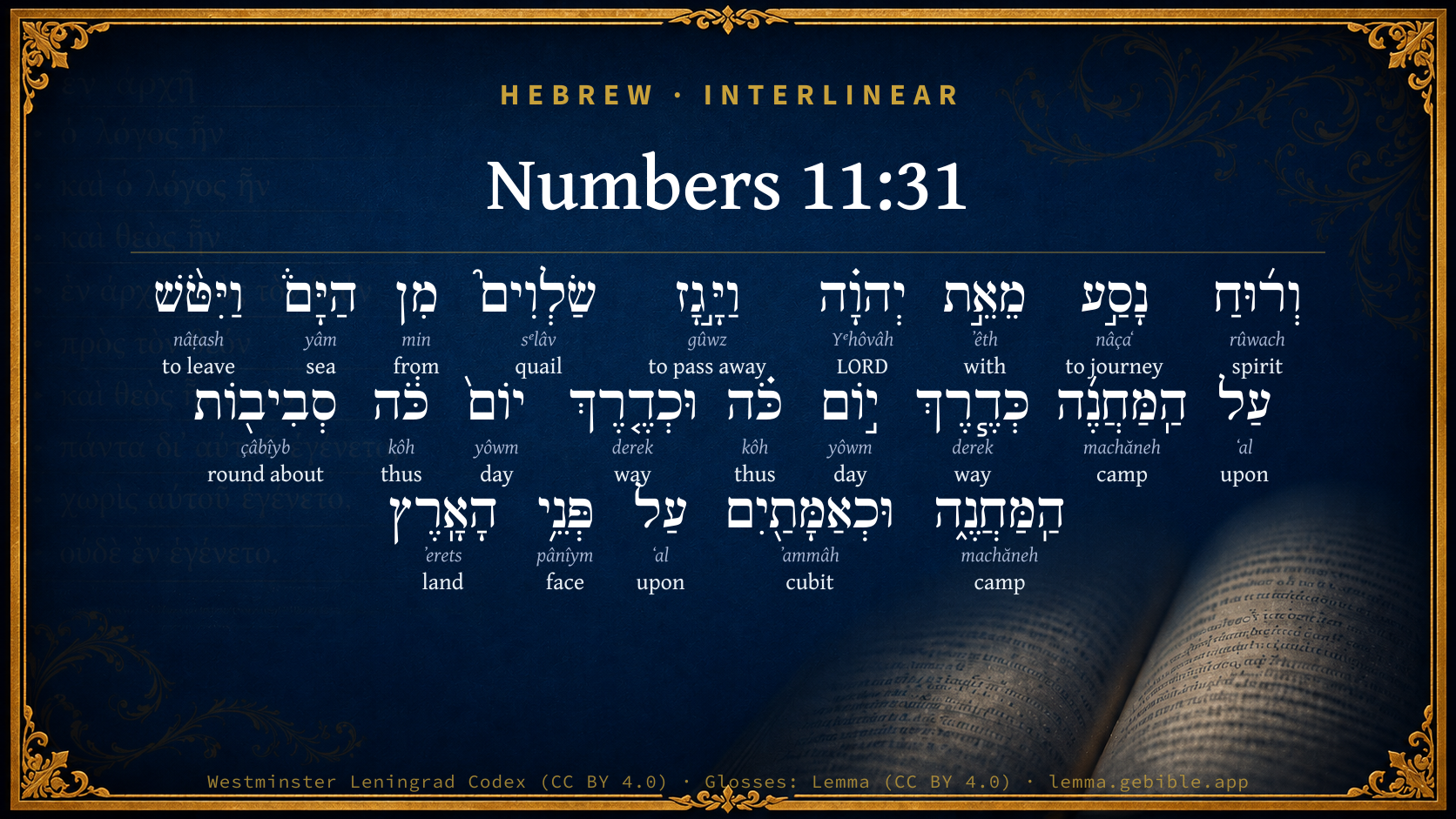
Numbers 11:31

Hebrew (Westminster Leningrad Codex) Numbers 11:31 appears in the Hebrew Old Testament. The text above is from the Westminster Leningrad Codex. Each word links to its Strong’s number, a concise gloss, and parsing drawn from the Open Scriptures Hebrew Bible morphology. Click any word for its full Brown-Driver-Briggs (BDB) entry.
Download image
Cite this verse

Numbers 11:31 (World English Bible). Public Domain. Lemma interlinear Bible study tool, https://lemma.gebible.app/v/numbers/11/31.

Show BibTeX & RIS
BibTeX
RIS
English Translation
There went forth a wind from Yahweh, and brought quails from the sea, and let them fall by the camp, about a day's journey on this side, and a day's journey on the other side, round about the camp, and about two cubits above the surface of the earth.
World English Bible · Public Domain
Highlights
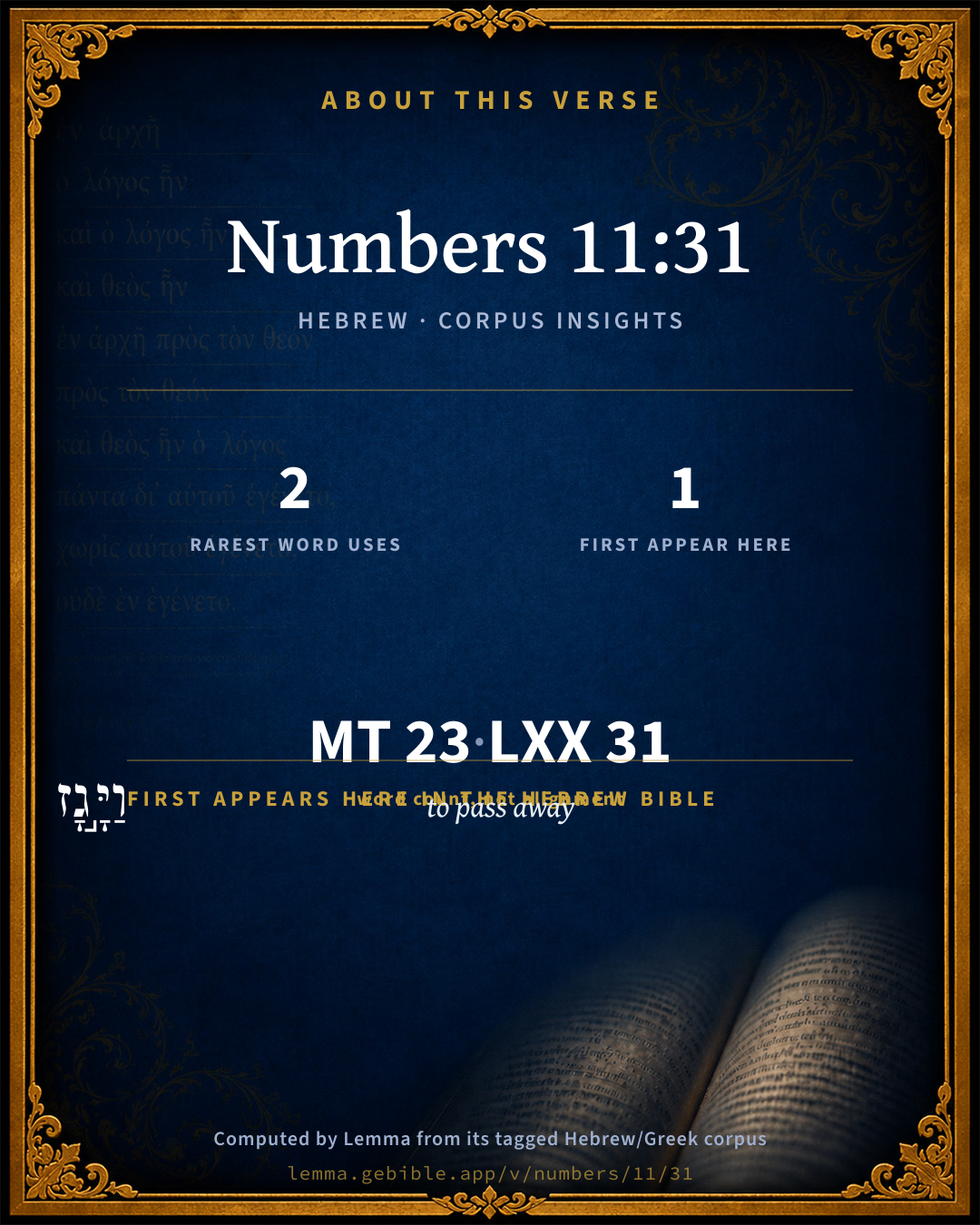
  • 1 first appearance in the Hebrew Bible
Full analysis ↓
Download a study sheet

One document with this verse’s original text, its word-by-word gloss line, the meaning frame, cross-references with their text, attributed commentary, and full source and license credits — printable, and it pastes into notes with its structure intact.

This verse Autodidact and up

Study sheet (.html) Plain text (.txt)

A passage Seminary Student

Up to 50 verses in one chapter. A passage sheet keeps up to 6 commentary sources and 12 cross-references per verse, in the order this page ranks them, and says so on the sheet whenever that leaves anything out. Ask for a single verse and you get the Autodidact verse sheet above.

Everything on this page stays free to read, with no account — the sheet is a download of what is already on screen, not access to it.

Want to remove ads? Support Godless Engineer
Compare translations 3

The same verse in 3 English versions, stacked beneath the original-language interlinear above. Click any original word for its lexicon entry.

Each is an independent rendering of the whole verse — the interlinear is not word-aligned to these translations.

Highlighted words mark where these versions differ — a whole-verse word diff, not a word-by-word alignment.

  • World English Bible Public Domain
    There went forth a wind from Yahweh, and brought quails from the sea, and let them fall by the camp, about a day's journey on this side, and a day's journey on the other side, round about the camp, and about two cubits above the surface of the earth.
  • King James Version Public Domain
    And there went forth a wind from the LORD, and brought quails from the sea, and let them fall by the camp, as it were a day's journey on this side, and as it were a day's journey on the other side, round about the camp, and as it were two cubits high upon the face of the earth.
  • unfoldingWord Literal Text CC BY-SA 4.0
    And a wind set out from with Yahweh, and it brought quails from the sea, and it left upon the camp as a way of a day this way and as a way of a day that way around the camp and about two cubits on the face of the land.

unfoldingWord Literal Text — © unfoldingWord, licensed CC BY-SA 4.0. Word-aligned USFM3 via Door43 (git.door43.org/unfoldingWord/en_ult).

Versions to compare (up to 4)

3 of 4 selected

Show all 18 translations

Every available English version of this verse, each an independent rendering of the whole verse.

  • World English Bible Public Domain
    There went forth a wind from Yahweh, and brought quails from the sea, and let them fall by the camp, about a day's journey on this side, and a day's journey on the other side, round about the camp, and about two cubits above the surface of the earth.
  • Berean Standard Bible Public Domain
    Now a wind sent by the LORD came up, drove in quail from the sea, and brought them near the camp, about two cubits above the surface of the ground, for a day’s journey in every direction around the camp.
  • Majority Standard Bible Public Domain
    Now a wind sent by the LORD came up, drove in quail from the sea, and brought them near the camp, about two cubits above the surface of the ground, for a day’s journey in every direction around the camp.
  • King James Version Public Domain
    And there went forth a wind from the LORD, and brought quails from the sea, and let them fall by the camp, as it were a day's journey on this side, and as it were a day's journey on the other side, round about the camp, and as it were two cubits high upon the face of the earth.
  • American Standard Version (1901) Public Domain
    And there went forth a wind from Jehovah, and brought quails from the sea, and let them fall by the camp, about a day's journey on this side, and a day's journey on the other side, round about the camp, and about two cubits above the face of the earth.
  • Revised Version (1885) Public Domain
    And there went forth a wind from the LORD, and brought quails from the sea, and let them fall by the camp, about a day’s journey on this side, and a day’s journey on the other side, round about the camp, and about two cubits above the face of the earth.
  • Geneva Bible (1599) Public Domain
    Then there went foorth a winde from the Lord, and brought quailes from the Sea, and let them fall vpon the campe, a dayes iourney on this side, and a dayes iourney on the other side, round about the hoste, and they were about two cubites aboue the earth.
  • Douay-Rheims (1899) Public Domain
    And a wind going out from the Lord, taking quails up beyond the sea brought them, and cast them into the camp for the space of one day's journey, on every side of the camp round about, and they flew in the air two cubits high above the ground.
  • Young's Literal Translation Public Domain
    And a spirit hath journeyed from Jehovah, and cutteth off quails from the sea, and leaveth by the camp, as a day's journey here, and as a day's journey there, round about the camp, and about two cubits, on the face of the land.
  • Literal Standard Version CC BY-SA 4.0
    And a spirit has journeyed from YHWH, and cuts off quails from the sea, and leaves [them] by the camp, as a day’s journey here and as a day’s journey there, around the camp, and about two cubits above the face of the land.
  • Unlocked Literal Bible CC BY-SA 4.0
    Then a wind came from Yahweh and brought quail from the sea. They fell near the camp, about a day's journey on one side and a day's journey on the other side. The quail surrounded the camp about two cubits above the ground.
  • unfoldingWord Literal Text CC BY-SA 4.0
    And a wind set out from with Yahweh, and it brought quails from the sea, and it left upon the camp as a way of a day this way and as a way of a day that way around the camp and about two cubits on the face of the land.
  • Darby Bible Public Domain
    And there went forth a wind from Jehovah, and drove quails from the sea, and cast them about the camp, about a day's journey on this side, and about a day's journey on the other side, round about the camp, and about two cubits above the earth.
  • World Messianic Bible Public Domain
    A wind from the LORD went out and brought quails from the sea, and let them fall by the camp, about a day’s journey on this side, and a day’s journey on the other side, around the camp, and about two cubits above the surface of the earth.
  • Webster's Bible Public Domain
    And there went forth a wind from the LORD, and brought quails from the sea, and let them fall by the camp, as it were a day's journey on this side, and as it were a day's journey on the other side, around the camp, and as it were two cubits high upon the face of the earth.
  • Free Bible Version CC BY-SA 4.0
    The Lord sent a wind that blew quail in from the sea and deposited them near the camp. They covered the ground to a depth of about two cubits and extended for a day's journey in every direction from the camp.
  • Bible in Basic English Public Domain
    Then the Lord sent a wind, driving little birds from the sea, so that they came down on the tents, and all round the tent-circle, about a day's journey on this side and on that, in masses about two cubits high over the face of the earth.
  • JPS Tanakh (1917) Public Domain
    And there went forth a wind from the LORD, and brought across quails from the sea, and let them fall by the camp, about a day's journey on this side, and a day's journey on the other side, round about the camp, and about two cubits above the face of the earth.

Literal Standard Version (2020), Covenant Press — licensed CC BY-SA 4.0. Text via the HelloAO Bible API (eBible.org). Unlocked Literal Bible (unfoldingWord) — licensed CC BY-SA 4.0. Text via the HelloAO Bible API (eBible.org). unfoldingWord Literal Text — © unfoldingWord, licensed CC BY-SA 4.0. Word-aligned USFM3 via Door43 (git.door43.org/unfoldingWord/en_ult). Free Bible Version, Dr. Jonathan Gallagher — licensed CC BY-SA 4.0. Text via the HelloAO Bible API (eBible.org).

Word by word

More ways to search: Search by grammar → Find every occurrence → Compare this word →

Practice this passage: Drill this verse → Learn its vocabulary →

וַיָּ֣גָז
gûwz
H1468
“and · to pass away”
Conjunction + Verb, Qal, Sequential Imperfect, 3rd Person, Masculine, Singular
Part of Speech
Conjunction + Verb
Stem
Qal
Form
Sequential Imperfect
Person
3rd Person
Gender
Masculine
Number
Singular
Full BDB Definition

Origin: a primitive root [compare H1494 ]

TWOT: 327

to pass over, pass away - (Qal) to pass away (of life) - (TWOT) to bring, cut off
  1. וְר֜וּחַ rûwach H7307 “and · spirit” Conjunction + Noun, Common, Both, Singular, Absolute
  2. נָסַ֣ע nâçaʻ H5265 “to journey” Verb, Qal, Perfect, 3rd Person, Masculine, Singular
  3. מֵאֵ֣ת ʼêth H854 “from · with” Preposition + Preposition
  4. יְהוָ֗ה Yᵉhôvâh H3068 “LORD” Noun, Proper
  5. שַׂלְוִים֮ sᵉlâv H7958 “quails” Noun, Common, Feminine, Plural, Absolute
  6. מִן min H4480 “from” Preposition
  7. הַיָּם֒ yâm H3220 “the · sea” Particle, Definite Article + Noun, Common, Masculine, Singular, Absolute
  8. וַיִּטֹּ֨שׁ nâṭash H5203 “and · to leave” Conjunction + Verb, Qal, Sequential Imperfect, 3rd Person, Masculine, Singular
  9. עַל ʻal H5921 “upon” Preposition
  10. הַֽמַּחֲנֶ֜ה machăneh H4264 “the · camp” Particle, Definite Article + Noun, Common, Both, Singular, Absolute
  11. כְּדֶ֧רֶךְ derek H1870 “like/as · way of” Preposition + Noun, Common, Both, Singular, Construct
  12. י֣וֹם yôwm H3117 “day” Noun, Common, Masculine, Singular, Absolute
  13. כֹּ֗ה kôh H3541 “thus” Adverb
  14. וּכְדֶ֤רֶךְ derek H1870 “and · like/as · way of” Conjunction + Preposition + Noun, Common, Both, Singular, Construct
  15. יוֹם֙ yôwm H3117 “day” Noun, Common, Masculine, Singular, Absolute
  16. כֹּ֔ה kôh H3541 “thus” Adverb
  17. סְבִיב֖וֹת çâbîyb H5439 “surroundings of” Noun, Common, Both, Plural, Construct
  18. הַֽמַּחֲנֶ֑ה machăneh H4264 “the · camp” Particle, Definite Article + Noun, Common, Both, Singular, Absolute
  19. וּכְאַמָּתַ֖יִם ʼammâh H520 “and · like/as · cubits” Conjunction + Preposition + Noun, Common, Feminine, Dual, Absolute
  20. עַל ʻal H5921 “upon” Preposition
  21. פְּנֵ֥י pânîym H6440 “face(s) of” Noun, Common, Both, Plural, Construct
  22. הָאָֽרֶץ ʼerets H776 “the · land” Particle, Definite Article + Noun, Common, Both, Singular, Absolute

About this verse

These counts appear in no published source. They are computed here, from the morphology-tagged text and Lemma’s own curated glosses. What Lemma adds →

23
words
18
distinct lemmas
Pentateuch
section

Notable vocabulary

The rarest word here is וַיָּ֣גָז to pass away H1468 — appearing just 2 times in the whole Hebrew Bible.

First appearance in Scripture

This word makes its first canonical appearance in the Hebrew Bible here:

  • וַיָּ֣גָז to pass away H1468

Shared distinctive vocabulary

וַיָּ֣גָז to pass away H1468 occurs in 2 verses of the Hebrew Bible. Also found in:

Grammatical profile

  • 3 verbs
  • 14 nouns
  • 4 prepositions
  • 2 adverbs

Verb forms

  • נָסַ֣ע Qal · Perfect
  • וַיָּ֣גָז Qal · Sequential Imperfect
  • וַיִּטֹּ֨שׁ Qal · Sequential Imperfect

Repetition

Words recur within this verse — often emphatic in Hebrew:

  • עַל upon H5921 ×2
  • הַֽמַּחֲנֶ֜ה camp H4264 ×2
  • כְּדֶ֧רֶךְ way H1870 ×2
  • י֣וֹם day H3117 ×2
  • כֹּ֗ה thus H3541 ×2

Hebrew & Septuagint length

In English translation the verse runs 49 words from the Hebrew and 49 from the Septuagint (LXX English) — the same length.

A rough comparison of the two English renderings, which tokenize alike — not a word-level alignment.

Word counts can differ between the Hebrew and the Greek without any difference in meaning — e.g. the Hebrew direct-object marker אֵת has no separate Greek word, and Greek often adds the article ὁ.

In the original languages it is 23 Hebrew tokens and 31 Greek tokens — but the two are counted differently (Hebrew bundles its prefixes and suffixes into one token; the Greek is in lemma form), so that isn’t a like-for-like length.

Cross-references

7

Topical passages linked to Numbers 11:31 in the Treasury of Scripture Knowledge — connected by theme and wording, ordered by reader-vote popularity; previews shown in the World English Bible.

  • Exodus 16:13 It happened at evening that quail came up and covered the camp; and in the morning the dew lay around the camp.
  • Psalms 105:40 They asked, and he brought quails, And satisfied them with the bread of the sky.
  • Psalms 78:26–29 He caused the east wind to blow in the sky. By his power he guided the south wind.
  • Exodus 10:13 Moses stretched forth his rod over the land of Egypt, and Yahweh brought an east wind on the land all that day, and all the night; and when it was morning, the east wind brought the locusts.
  • Exodus 10:19 Yahweh turned an exceeding strong west wind, which took up the locusts, and drove them into the Red Sea. There remained not one locust in all the borders of Egypt.
  • Exodus 15:10 You blew with your wind. The sea covered them. They sank like lead in the mighty waters.
  • Psalms 135:7 Who causes the clouds to rise from the ends of the earth; Who makes lightnings with the rain; Who brings forth the wind out of his treasuries;

Cross-references courtesy of OpenBible.info (CC BY 4.0).

Hebrew and Greek witnesses Masoretic Hebrew ↔ Greek Septuagint

The same verse in the two great witnesses to the Old Testament, shown verse-for-verse.

These are two independent witnesses, not word-aligned to each other, and the Septuagint is shown in lemma (dictionary) form.

Hebrew Numbers 11:31 Masoretic · Westminster Leningrad Codex

וְר֜וּחַ נָסַ֣ע מֵאֵ֣ת יְהוָ֗ה וַיָּ֣גָז שַׂלְוִים֮ מִן הַיָּם֒ וַיִּטֹּ֨שׁ עַל הַֽמַּחֲנֶ֜ה כְּדֶ֧רֶךְ י֣וֹם כֹּ֗ה וּכְדֶ֤רֶךְ יוֹם֙ כֹּ֔ה סְבִיב֖וֹת הַֽמַּחֲנֶ֑ה וּכְאַמָּתַ֖יִם עַל פְּנֵ֥י הָאָֽרֶץ

There went forth a wind from Yahweh, and brought quails from the sea, and let them fall by the camp, about a day's journey on this side, and a day's journey on the other side, round about the camp, and about two cubits above the surface of the earth.

World English Bible · Public Domain

Greek LXX Numbers 11:31 Septuagint · lemma form

καί πνεῦμα ἐκἔρχομαι παρά κύριος καί ἐκπεράω ὀρτυγομήτρα ἀπό ὁ θάλασσα καί ἐπιβάλλω ἐπί ὁ παρεμβολή ὁδός ἡμέρα ἐντεῦθεν καί ὁδός ἡμέρα ἐντεῦθεν κύκλος ὁ παρεμβολή ὡσεί δίπηχυς ἀπό ὁ γῆ

And there went forth a wind from the Lord, and brought quails over from the sea; and it brought them down upon the camp a day's journey on this side, and a day's journey on that side, round about the camp, as it were two cubits from the earth.

LXX2012 (modern English Septuagint) · Public Domain

On this verse, Haydock's Catholic Bible Commentary discusses the Septuagint’s reading. Read the note in Commentary ↓

Hebrew: Westminster Leningrad Codex (CC BY 4.0). Greek: Septuagint (public domain); English from LXX2012 (modern English Septuagint) (Public Domain). How the Septuagint differs from the Hebrew →

Targum (Aramaic paraphrase)

2

The Targum is the ancient Jewish Aramaic paraphrase of the Hebrew Scriptures — an interpretive translation, not the Hebrew text itself. Onkelos (literal) and Pseudo-Jonathan (expansive) render the Torah, and Jonathan the Prophets. Coverage is partial: where no permissively-licensed English translation exists for a verse, only the Aramaic is shown. This is verse-level text, not a word-by-word alignment to the Hebrew.

  1. Targum Onkelos Torah (Genesis–Deuteronomy)
    וְרוּחָא נְטַל מִן קֳדָם יְיָ וְאַפְרַח שְׂלָיו מִן יַמָא וּרְמָא עַל מַשְׁרִיתָא כְּמַהֲלַךְ יוֹמָא לְכָא וּכְמַהֲלַךְ יוֹמָא לְכָא סְחוֹר סְחוֹר לְמַשְׁרִיתָא וּכְרוּם תַּרְתֵּין אַמִין עַל אַפֵּי אַרְעָא

    (no public-domain English translation for this verse)

    Targum Onkelos — Aramaic: “Onkelos Genesis” (public domain); “Onkelos Exodus” (public domain); “Onkelos Leviticus” (public domain); “Onkelos Numbers” (public domain); “Onkelos Deuteronomy” (public domain). English: “Sefaria Community Translation” (CC0 1.0 (public-domain dedication)); “J.W. Etheridge. The Targums of Onkelos and Jonathan Ben Uzziel on the Pentateuch. London: Longmans, Green, 1862” (public domain). Text via Sefaria.

  2. Targum Pseudo-Jonathan Torah (Genesis–Deuteronomy)
    וְרוּחָא דְעַלְעוּלָא נְפָקַת וּנְטָלַת בְּרוּגְזָא מִן קֳדָם יְיָ וּבְעָא לְמִשְׁטְפֵיהּ לְעַלְמָא אִילוּלֵי זְכוּתָא דְמשֶׁה וְאַהֲרן וּנְתֵיב בְּיַמָא רַבָּא וְאַפְרַח שַלְוֵי מִן יַמָא רַבָּא וּשְׁרָא עַל דֵין דִזְעֵיר בְּמַשְׁרִיָתָא כְּמַהֲלַךְ יוֹמָא לְצִיפּוּנָא וּכְמַהֲלַךְ יוֹמָא לְדָרוֹמָא וּכְרוּם תַּרְתֵּין אַמִין הֲוָה פָּרַח עַל אַנְפֵּי אַרְעָא וַהֲווֹ מְהַלְכִין בְּהוֹן עַד פְּרַתְהוֹן מְטוּל דְלָא יִלְעוּן בִּזְמַן מְכַנְשְׁהוֹן יַתְהוֹן

    And the wind of a tempest went forth, and came violently from before the Lord, so as to have swept the world away, but for the righteousness of Mosheh and Aharon: and it blew over the Great Sea, and made the quails fly from the Great Sea, and settle wherever there was place in the camp, as a day's journey northward and southward, and at the height as of two cubits; they flew upon the face of the ground, and went upon their bellies, so that (the people) were not wearied while they collected them.

    Targum Pseudo-Jonathan — Aramaic: “Targum Jonathan on Genesis” (public domain); “Targum Jonathan on Exodus” (public domain); “Targum Jonathan on Leviticus” (public domain); “Targum Jonathan on Numbers” (public domain); “Targum Jonathan on Deuteronomy” (public domain). English: “The Targum of Jonathan ben Uzziel, trans. J. W. Etheridge, London, 1862” (public domain). Text via Sefaria.

Commentary

Notes on Numbers 11:31 from classic Christian and Jewish commentators (each source and its license shown beneath its notes). The classic Christian expositions comment on the surrounding passage and are grouped to its opening verse, so a note may address several verses; the Jewish commentaries on the Tanakh (Rashi and others) are per-verse, so they appear only where the commentator wrote on this verse.

Lemma curates 59 commentaries, every one of them public domain or Creative Commons licensed, each selected and text-cleaned for this edition rather than reprinted as found. About our sources →

Matthew Henry's Commentary

God, having performed his promise to Moses by giving him assessors in the government, thereby proving the power he has over the spirits of men by his Spirit, he here performs his promise to the people by giving them flesh, proving thereby his power over the inferior creatures and his dominion in the kingdom of nature. Observe, 1. How the people were gratified with flesh in abundance: A wind (a south-east wind, as appears, Psa 78:26) brought quails, Num 11:31. It is uncertain what sort of animals they were; the psalmist calls them feathered fowl, or fowl of wing. The learned bishop Patrick inclines to agree with some modern writers, who think they were locusts, a delicious sort of food well known in those parts, the rather because they were brought with a wind, lay in heaps, and were dried in the sun for use. Whatever they were, they answered the intention, they served for a month's feast for Israel, such an indulgent Father was God to his froward family. Locusts, that had been a plague to fruitful Egypt, feeding upon the fruits, were a blessing to a barren wilderness, being themselves fed upon. 2. How greedy they were of this flesh that God sent them. They flew upon the spoil with an unsatiable appetite, not regarding what Moses had told them from God, that they would surfeit upon it, Num 11:32. Two days and a night they were at it, gathering flesh, till every master of a family had brought home ten homers (that is, ten ass-loads) at least. David longed for the water of the well of Bethlehem, but would not drink it when he had it, because it was obtained by venturing; much more reason these Israelites had to refuse this flesh, which was obtained by murmuring, and which, they might easily perceive, by what Moses said, was given them in anger; but those that are under the power of a carnal mind will have their lusts fulfilled, though it be to the certain damage and ruin of their precious souls. 3. How dearly they paid for their feasts, when it came into the reckoning: The Lord smote them with a very great plague (Num 11:33), some bodily disease, which probably was the effect of their surfeit, and was the death of many of them, and those, it is likely, the ringleaders in the mutiny. Note, God often grants the desires of his own people in love. He gave them their request, but sent leanness into their soul, Psa 106:15. By all that was said to them they were not estranged from their lusts, and therefore, while the meat was in their mouths, the wrath of God came upon them, Psa 78:30, Psa 78:31. What we inordinately desire, if we obtain it (we have reason to fear), will be some way or other a grief and cross to us. God satiated them first, and then plagued them, (1.) To save the reputation of his own power, that it might not be said, "He would not have cut them off had he been able to supply them." And, (2.) To show us the meaning of the prosperity of sinners; it is their preparation for ruin, they are fed as an ox for the slaughter. Lastly, The remembrance of this is preserved in the name given to the place, Num 11:34. Moses called it Kibroth-hattaavah, the graves of lusters or of lust. And well it had been if these graves of Israel's lusters had proved the graves of Israel's lust: the warning was designed to be so, but it had not its due effect, for it follows (Psa 78:32), For all this, they sinned still.

Matthew Henry's Commentary on the Whole Bible (1708–1710) — public domain (CC PDM 1.0). Text via the HelloAO Bible API.

The Biblical Illustrator

Joseph S. Exell

Num_11:31-35

They gathered the quails.

The quails

I. Israels complaint.

1. Its object was food.

2. Its nature was intense. Fell a lusting.

3. It was general.

4. It was accompanied with tears. A faint, weary, disappointed people. Tears, chiefly, of discontent.

5. It was associated with the retrospections of memory. We remember, &c. (Num_11:5). They should also have remembered some other things of that past. Their bondage, &c.

6. It made present things distasteful. There is nothing at all. There was a time when they did not call the manna nothing. Longing for what we have not tends to cause disparagement of things possessed.

II. Moses perplexity. Great popular leaders have often been perplexed by the unreasonable clamours of their followers. Have often been urged farther than their greater prudence and wisdom would have chosen. People have often damaged their own cause by exorbitant demands.

1. Moses displeased at the position in which he found himself. My wretchedness (Num_11:15). His faith faltered (Num_11:11-12). Especially displeased with the people (Num_11:10).

2. In his perplexity cried to the Lord. A good example. God a present help in trouble.

3. He acknowledges his own weakness (Num_11:21-22). He could not feed the people. It would be suicidal to kill the flocks and herds, even if they were enough. Needed for sacrifice; and the religious well-being of the people of most importance.

4. He receives comfort, and direction (Num_11:23).

III. Gods providence. Nature is His storehouse, in which He has garnered food for man and beast. He made all living things. Endowed them with habits and instincts. Made the quails. Ordained their migratory habits. Made and ruled the winds. When the quails came, the wind was ready. It fulfilled the word of God. The wonderful flight of birds. The scene in the camp. What was sent so abundantly seems to have been thanklessly received. Divine anger went with the gift. Many of the people died. Learn--

1. To pray for the blessing of contentment.

2. To seek the moderation of our desires.

3. To pray for grateful hearts.

4. To acknowledge the hand of God in the supply of our wants.

5. To be chiefly anxious for the supply of spiritual need. (J. C. Gray.)

The graves of lust

I. There are perpetual resurrections of easily besetting sins.

1. The side from which the temptation came to them (Num_11:4-6). This mixed multitude corresponds precisely to the troop of disorderly passions and appetites, with which we suffer ourselves to march through the desert of life. Passions, desires, ever mad for indulgence, and reckless, scornful of Divine law.

2. The special season when the easily besetting sin rose up and again made them its slave. It is a fact which all close students of human character must have observed, that there is a back-water of temptation, if I may so speak, which is more deadly than its direct assaults. You may fight hard against a temptation, and fight victoriously. You may beat it off, and then, when, weary with the conflict, you suffer the strain of vigilance to relax, it shall steal in and easily master the citadel, which lately it spent all its force in vain to win. Beware of your best moments, as well as of your worst; or rather the moments which succeed the best. They are the most perilous of all.

II. There comes a point in the history of the indulgence of besetting sins, when god ceases to strive with us and for us against them, and lets them. Have their way.

1. God has great patience with the weaknesses and sins of the flesh. But it is a dreadful mistake to suppose that therefore He thinks lightly of them. He regards them as sins that must be conquered, and, no matter by what sharp discipline, extirpated and killed. He knows that, if tolerated, they become the most deadly of spiritual evils, and rot body and spirit together in hell.

2. Hence all the severer discipline by which the Lord seeks to purge them, the various agencies by which He fights with us and for us against their tyrannous power. What is life but one long discipline of God for the cleansing of the flesh? Are not the after-pains of departed sensual joys among its chief stings and thorns?

3. Left alone by God. God does not curse us; He leaves us to ourselves; that is curse enough, and from that curse what arm can save us! We will have it, and we shall have it. We leap through all the barriers which He has raised around us to limit us, yea, though they be rings of blazing fire, we will through them and indulge our lust; and in a moment He sweeps them all out of our path--perhaps roses spring to beguile, where flames so lately blazed to warn.

III. The end of that way is, inevitably and speedily, a grave. The grave of lust is one of the most awful of the inscriptions on the headstones of the great cemetery, the world. In how many do we now search in vain for fruits whose flowers once bloomed there; for generous emotions, swift responses to the appeals of sorrow, unselfish ministries, and stern integrity? How many have learnt now to laugh at emotions which once had a holy beauty in their sight; to fence skilfully with appeals which once would have thrilled to the very core of their hearts; to grasp at advantages which once they would have passed with a scornful anathema, and to clutch at the gold which was once the glad instrument of diffusing benefits around! Yes! there are graves enough around us--graves of passion, graves of self-will, graves of lust. Beware, young men; young women, beware! Beware! for the dead things buried in these graves will not lie quiet; they stir and start, and ever and anon come forth in their ghastly shrouds and scare you at your feasts. No ghosts so sure to haunt their graves as the ghosts of immolated faculties and violated vows. The memories which haunt the worn-out worldlings bed of impotence or lust are the true avengers of Heaven. The brain loses power to repel them, but retains power to fashion them. Once it could drive away thoughts and memories; now it can only retain them, and fix them in a horrid permanent session on their thrones. (J. B. Brown, B. A.)

The Israelites sin and punishment

I. Their sin many consider a trifle. Certainly it was not of that character which the judgment inflicted on them would lead us to anticipate. We read here of no enormous transgression, or daring violation of Gods law. All they were guilty of, was a strong desire for something which God had not given them. Something evil, you will say perhaps, but not so; it was one of the most harmless things they could have desired. The Lord had provided them with manna for their support; they were weary of manna and wanted flesh. The children of Israel, we read, wept again, and said, Who shall give us flesh to eat?

1. You see, then, the nature of the sin we have before us. It is a sin of the heart--coveting, desiring; and that not slightly, but very eagerly, with the full bent of the mind. It is not spiritual idolatry, though it is like it. That is making too much of what we have; this is making too much of what we want.

2. Look at the cause or spring of Israels sin. Their desire for flesh was a desire springing up amidst abundance. It had its origin, not in their necessities, but m their vile affections, their own unsubdued, carnal minds.

3. Observe next the occasion of Israels sin. Oh, dread the mixed multitude. Stand in fear of worldly-minded professors of Christs gospel. They will teach you to lust for the things you now despise. They will drive, if not the fear, yet the peace of God from your hearts, and all they will give you in exchange for it will be a craving, aching soul, a share in their own restlessness and discontent.

4. Mark the effect of their sin, its immediate effect, I mean, on their own minds. It made them completely wretched. The truth is, the mind of man cannot long bear a strong and unchecked desire. It must be gratified or have a prospect of being gratified, or it consumes the soul. Perhaps we may say, this is one main ingredient in the misery of hell--a longing, and a longing, and a longing still, for something that can be never had.

5. Notice one thing more in this craving of the Israelites--its sinfulness or guilt. Wherein, then, did its sinfulness lie? In the twentieth verse, God tells us. He pronounces it a contempt of Himself. Moses is commanded to go to the weeping people, and say to them, Ye have despised the Lord which is among you. And how had they despised Him?

In three respects.

1. They had low thoughts of His power. Who, they asked, shall give us flesh to eat? Who can give it?

2. And their conduct involved in it a making light of His goodness. They had evidently lost sight at this time of all He had done for them, or if not so, they lightly esteemed what He had done.

3. And then there was also here a despising of Gods authority.

II. Look at the conduct of them insulted God towards them in consequence of their sin.

1. He granted their desire. We are told again and again that it displeased Him, that His anger was kindled greatly against the people on account of it; but how does He show His displeasure? He begins with giving them the very thing they wish for; He works a miracle to give it them; He gives it them to the utmost extent of their desires, and beyond them. But what was God really doing all this while? He was only vindicating His aspersed honour.

2. The Lord took vengeance on these Israelites, and this in a fearful manner and at a very remarkable time. It is often the will of God to make our sin our punishment. We eagerly crave something; He gives us what we crave, and when we have it, He either takes away from us all our delight in it, and so bitterly disappoints us, or else He causes it to prove to us a source of misery. (C. Bradley, M. A.)

The judgments of God sometimes come very suddenly

In the midst of their lusts and pleasures, behold how Gods judgments come upon them. They had feasted a long time, and had glutted themselves with their flesh; now their sweet meat had sour sauce. The doctrine arising from hence is this, that the judgments of God do oftentimes fail upon men and women very suddenly before they be aware, when they least of all think or imagine of the day of wrath (Job_20:5-7; Job_21:17; Psa_73:19; Isa_30:13; Exo_12:29; Dan_5:30; Luk_12:20). The destruction of the wicked shall come as a whirlwind (Amo_1:14).

1. This is plain, because they have through Gods long-suffering increased the number, weight, and measure of their sins, and thereby compel the Lord to bring His judgments suddenly upon them.

2. God respecteth herein the benefit of others toward whom He hath not used as yet so long patience, to the end that they, seeing others fall into sudden destruction, may learn thereby not to abuse His patience, lest they also be suddenly destroyed (Dan_5:22).

The uses follow.

1. See from hence the happy estate of all such as think of the day of their reckoning betimes, and prepare their garments that they be not taken naked. Such are out of danger, and have no cause to fear wrath and judgment.

2. It serveth to teach us that we should not envy at the peace and prosperity of the wicked, neither fret at the flourishing estate of the ungodly that live in their sins, for howsoever they be for a time forborne, yet thereby they are the more hardened in their sins, till a far greater judgment come upon them. Therefore envy not at them though they grow great, for suddenly shall the judgments of God tulle hold upon them, and arrest them as guilty of death, and then they shall perish speedily; so that there is no reason to grieve or grudge at their prosperity.

3. From hence ariseth comfort to the faithful.

4. It is our duty to watch and attend with all care for the time of judgment. (W. Attersoll.)

The graves of lust

I. It is the tendency of lust to shorten life and to bring men to an untimely grave. Our animal desires are good servants; but, when they gain the mastery, they are fearful tyrants, loading the conscience with guilt and the body with disease, ruining life, and making eternity a hell. The Romans, it is said, held their funerals at the Gate of Venus, to teach that lust shortens life. The pleasures of sin are dearly bought.

II. Let us record some of our feelings as we contemplate the graves of lust.

1. The one is of intense pity, that man should be so foolish as to live in sin when he knew how it would end; that life should be so wasted, and opportunities lost, &c.

2. The other is of awful solemnity. He is gone; but whither? He has given up the ghost; but where is he?

Let us all--

1. Ascertain whether or no we are on the way to this grave.

2. Resolve through the help of God that we will not be there. Seek Jesus Christ. He, and He only, can rescue us from the power, the curse, and the consequences of sin. (David Lloyd.)

Inordinate desires

What we inordinately desire, if we obtain it, we have reason to fear that it will be some way or other a grief and cross to us. God sufficed them first, and then plagued them.

1. To save the reputation of His own power, that it might not be said, He had cut them off because He was not able to suffice them. And--

2. To show us the meaning of the prosperity of sinners; it is their preparation for ruin. They are fed as an ox for the slaughter. (Matthew Hearty, D. D.)

Graves of desire

The last thing that most people would desire is a grave, and yet how often does desire conduct to death! We will notice several manifestations of irregular and destructive desire, and, in conclusion, show how desire may be directed and chastened.

I. There is unseasonable desire. The desire of the people for flesh was not unnatural, not illegal in itself, but it was unseasonable. This is a common fault of ours, to desire legitimate things in times and places which are not convenient.

1. There is the impatience of youth. The course of life with many in these times reminds us of the days when we were lads, and when in the early morning we went a distance to school, taking our dinner with us; then appetite was keen, and it was no unusual thing to devour our dinner on the way to school, starving for the rest of the day. It is thus with thousands of infatuated ones a little later on; in the greediness of their heart they devour and waste their portion in the morning of life, and then starve through the long tedious day, or else go down to a premature grave. I say to my young brethren, wait, rein in your desires, move slowly, and every joy of life shall be yours in turn. Haste is of the devil, is a saying in the East popularly ascribed to Mahomet himself. We may accept the saying in the matter before us; let youth be moderate, deliberate, avoiding all feverishness, drawing slowly on the resources of life.

2. There is the eagerness, of manhood. We should do little in life without intensity, but there are times when we may with advantage take in sail, and give ourselves time for rest and reflection. It is certainly unseasonable to bring our business life in any shape into the Lords Day. It is also unseasonable to allow worldly cares and ambitions to invade those spaces which are so necessary for our domestic and intellectual life. God grants us spaces for rest and thought in the home, in the chamber; and it is exhaustive, indeed, when our overweening worldliness excludes the possibilities of solitary and social life. Some men fill their annual holidays with anxieties until they are no holidays at all. And there are days of personal affliction, of domestic sorrows, of national calamity, when it is our solemn duty to pause in the race for riches and think of lifes larger meaning.

3. There is the greed of age. Old men often come to the grave sooner than they need because they will not let the world go. They cling to ambition, although it wastes their strength and peace; they cling to business, they are pushing, grasping, hoarding as ever, although such application fast saps a life already tottering; they cling to pleasure, they will still wear the wreath of roses on their white hair, although to them it is the most fatal wreath of all.

II. There is immoderate desire. We may pursue a right object with inordinate appetite. The Israelites were not content with the simple, pearly, wholesome food God gave them--they wanted something more piquant. They got what they wanted--and a grave. In all generations how many fall the same way.

1. There is the immoderateness of our literature. We must feast on the romantic, the sensational, the morbid, the exaggerated. Out of this excess of imaginative literature come great evils. The reading public live in a world of fancy, sentiment, passion; and this feverish unreality in the hours of retirement gives birth to much of that practical immoderation which is the curse of our age. I do not say abandon this literature of romance; but I do say restrain and chasten your imagination, for be sure this habit of wild dreaming is at the root of much of that general intemperance of life which hurries many to the grave.

2. There is the immoderation of our style of living. A writer was finding fault the other day with the present style of gardening. He complained that we have rooted up the old fragrant flowers--lavender, pinks, marigolds, mignonette, and gone in for crude patches of red and blue and yellow; that we have swept away sweet shrubs and bits of lawn for the sake of violet ribbon-borders and vulgar carpet-bedding. But does not our Italian gardening largely reflect our social life? Are we not often found renouncing sweet, simple methods of living for a showy, ostentatious style which brings with it little joy?

3. There is the immoderateness of our appetite. Thousands are digging their grave with their teeth, and scooping it out with their glass.

4. There is the immoderateness of business. Immoderation in other directions often drives men to unnatural eagerness in business. In haste to be rich they pierce themselves through with many sorrows.

(1) How fatal all this immoderation is to health! We fret for money, drinking blood out of a golden basin; we are anxious to be great, and the path of glory leads to the grave; we are mad to seize the flowers of pleasure, and find the flowers of the churchyard.

(2) How fatal is all this immoderation to happiness I There are thousands of successful merchants who after immense toil and sacrifice have secured wealth and position, and now they are distressed to find they have no power to eat what cost so much to get together. They have whatsoever their soul desireth, but they cannot taste any sweetness in it. Moderation is the secret of all life. Our health, our happiness, our character, our destiny, are bound up with self-restraint. Live with circumspection, live slowly, live by line and square, and you shall realise life at its best here, and then the life everlasting.

III. There is illegal desire. Fixing our eye on forbidden things and lusting after them. How beautiful they seem, how desirable! and yet they eat as doth a canker. They lead to a premature grave. The wicked do not live out half their days. They lead to a dishonoured grave (Ecc_8:10). They lead to a hopeless grave. Such awake to shame and everlasting contempt. Do not hide it from yourselves for an hour that death is the price of touching forbidden things. Are you tempted by unlawful pleasure? see the skeleton behind the flowers. By unlawful gain? see the field of blood behind the pieces of silver. By unlawful greatness? see the shroud wrapped up in the purple. By unlawful indulgence? see that at the devils banquet the sexton is head waiter. Lust when it hath conceived bringeth forth sin, and sin when it is finished will have finished you. This is the dismal eternal order; and no secrecy, no strength, no skill on your part can disturb the programme or avert the penalty. Wherein, then, lies our safety? In reducing all desire to a minimum? Some of our sceptical writers counsel this but it is not the philosophy of Christianity. The infinity of desire is a grand characteristic of our nature which it is no part of our duty to destroy. Christianity leaves intact our boundless desire, whilst it teaches us moderation in all worldly things. It does this by fixing our attention on our inner life. It assures us that the deep, final satisfaction is not in our senses, but in our spirit; that we find the full and ultimate delight of life as our inner self grows in truth anal goodness and love. It does this by fixing our hope on the heavenly life. The pilgrim is not likely to be too deeply engrossed about the tent curtains, tent pegs, tent cords. Think much of that greater life, and you shall not think overmuch about things which perish in the using. (W. L. Watkinson.)

The true nursing-father

It was but three days march from Sinai, and the people encamped on a site which was ever memorable in their history, as recalling one of the gravest, saddest scenes in the experiences of the wilderness journey. We are only, however, now concerned in the incident so far as it affects the character of Moses.

I. The test beneath which Moses broke down, But in the case of Moses there was surely an outbreak of impatience which was hardly justifiable. He loved the people, but his love was not strong enough to sustain the terrific test to which it was exposed. He pitied them, but beneath the scorching sun of their repeated provocations that pity dried up like waters which are absorbed in the desert heat.

II. The parallel in Christian experience.

1. We also have need to beware of the influence of the mixed multitude. Had it not been for these, Israel had walked with God, and been satisfied with His provision on their behalf. It was from them that the discontent proceeded. There are many professing Christians who have the form of godliness, but deny its power, and who pass freely in and out among the children of God. It is among these that we may expect to hear complaints that religion is dry and irksome, or rapturous descriptions of the food of Egypt, or special pleadings that there should be a mingling of the delights of the Egyptian world, which should have been left behind for ever, with the manna which God lays on the dew of the desert floor. Their influence is all the stronger in that they appeal to tendencies within us, which are so susceptible to their call.

2. We must distinguish between appetite and lust. The appetites have been implanted within us to maintain the machinery of life. If it were not for their action, we should neglect food and rest and exercise, and many other things necessary to our well-being. But in us all appetite is apt to run up into lust. In other words, we seek satisfaction, not for the necessary supply of our physical needs, but for the momentary pleasure which accompanies the gratification of appetite itself. Our motive is not the obtaining of some lawful and necessary end, but the titillation of taste and sense. Appetite has, therefore, to be curbed with a strong hand, lest it become inordinate passion, for the moment we take pleasure in the indulgence of appetite for its own sake, and apart from the legitimate end for which it was intended by the Almighty, we begin to tread a path that leads swiftly down to the bottomless pit.

3. Let us guard against the resurrection of easily besetting sins. We say to ourselves that certain forms of sin have died down within us, anal will never trouble us more. We have grown out of them. But at that very moment the ghastly shape of that temptation is at hand, to assert perhaps even more than its olden force. You can never be sure of yourself. The suggestion that a certain form of temptation can have no further power over you is of the devil, and should excite you to greater watchfulness. Inordinate desire, murmuring and mistrust, are linked in the closest association. When one of these enters the window of the heart, it goes round to open the door to the other two. Oh, how often have we grieved our heavenly Father! Have we not had days of provocation and temptation in the wilderness?

III. The contrast between the servant and the father. Moses repudiated the office of the nursing-father. He could not sustain its responsibilities. But his failure only serves to bring out into distincter relief a touching conception of the Fatherhood of God. Forty years afterwards, as the aged lawgiver, at the foot of Pisgah, was summing up the results of his experience, he said, Thou hast seen how that the Lord thy God bare thee, as a man doth bare his son, in all the way that ye went, until ye came unto this place (Deu_1:31; Isa_63:9; Act_13:18, R.V. marg.). Moses patience gave out in a twelvemonth, Gods lasted till His work was done, and the people were safely deposited in the land of promise. If only the true story of our lives were written, it would be the most astounding record of Gods forbearing and pitying love. Truly, He hath not dealt with us after our sins, nor rewarded us according to our iniquities. But let us beware: there comes a time in the history of besetting sin when God ceases to strive against it. He gave them the quails they asked, flesh to the full. You may be mad for gold, and gold may pour in; mad for pleasure, and the golden barges wait to waft you on the swelling current; mad for applause, and it is yours till you are surfeited. God does not curse you, He leaves you to yourself, and that is curse enough. It is best to let our Father choose. His choice as to route and manna and length of daily journey must be the best. And when our yearnings are in opposition to His wise provision, let us quench them and yield our will about them. (F. B. Meyer, B. A.)

Uncontrolled desires

In what a solemn manner does this teach us the danger of uncontrolled desires! We have often thought what a beautiful prayer that is, Grant thee according to thine own heart, and fulfil all thy counsel (Psa_20:4), when offered for one whose heart is subdued, and whose desires are concentrated on the fulfilment of Gods promises. But would it not be an awful prayer for one whose heart is full of unhallowed desires, who longs, like Israel of old, only for earthly things? Oh, we should take heed what we desire, and for what we pray. You may ask for some earthly gift--it may be worldly prosperity, it may be wealth, or it may be for some other gift--some far higher, but still earthly gift--and because you are very intent upon it, God may give it you: and then the fulfilment of that desire may become a most terrible snare to you. The gift, whatsoever it be, may become your idol, may let down your affections to earth; and thus, whilst your prayers have been granted, God has sent leanness withal into your soul. Oh, it is exalted mercy, that God does not grant all our desires--that He so often sets aside some desires, and greatly disappoints others. We are prone to fret at this, but it is a part of a merciful plan, whereby He would bring us to rest in Himself. Oh, then, through grace, I will turn away from earth, with all its treasures, and from the creature, whatever its attractions be. I will turn to Jesus. In Him I cannot be disappointed. His love is altogether pure, altogether satisfying. (G. Wagner.)

The punishment of a gratified desire

Among the passengers on the St. Louis express was a woman very much overdressed, accompanied by a bright looking nurse-girl and a self-willed, tyrannical boy of about three years. The boy aroused the indignation of the passengers by his continued shrieks and kicks and, screams, and his viciousness towards the patient nurse. He tore her bonnet, scratched her hands, and finally spat in her face, without a word of remonstrance from the mother. Whenever the nurse manifested any firmness, the mother chided her sharply. Presently, the mother composed herself for a nap; and about the time the boy had slapped the nurse for the fiftieth time, a wasp came sailing in, and flew on the window of the nurses seat. The boy at once tried to catch it. The nurse caught his hand, and said coaxingly, Harry mustnt touch. Wasp will bite Harry. Harry screamed savagely, and began to kick and pound the nurse. The mother, without opening her eyes or lifting her head, cried out sharply, Why will you tease that child so, Mary? Let him have what he wants at once. But, maam, its a-- Let him have it, I say. Thus encouraged, Harry clutched at the wasp and caught it. The scream that followed brought tears of joy to the passengers eyes. The mother woke again. Mary, she cried, let him have it! Mary turned in her seat, and said confusedly, Hes got it, maam! (S. S. Times.)

.

The Biblical Illustrator, edited by Joseph S. Exell (c. 1880s–1900s) — public domain. Text from a community e-Sword module.

Joseph Benson's Commentary

Num 11:31. There went forth a wind from the Lord — An extraordinary and miraculous wind, both for its vehemency and for its effects. And brought quails — So the Hebrew word, שׂלוים, salvim, is interpreted by Josephus, and all the ancient versions; nor does there appear to be any sufficient authority for translating it locusts; notwithstanding what Ludolphus, in his History of Ethiopia, 50:1, c. 13; and after him Bishop Patrick, and the late bishop of Clogher, have said on the subject. This is the second time that God gave them these quails. He sent them the former year, and much about the same season, Exo 16:13; but neither in the same quantity nor with the same design as now. From the sea — Principally from the Arabian gulf, or Red sea, and both sides of it, where, according to ancient heathen writers, they were then in great numbers, and no doubt were wonderfully increased by God’s special providence for this very occasion. This sea lies south of that part of Arabia where the Israelites were now encamped. It was therefore a south wind that brought these quails, and is said to have come forth from the Lord, because it was ordered and directed by his special power and providence. Two cubits high — Not as if the quails did cover all the ground two cubits high for a day’s journey on each side of the camp, for then there had been no place left where they could spread them all abroad round about the camp; but the meaning is, that the quails came and fell down round about the camp for a whole day’s journey on each side of it, and that in all that space they lay here and there in great heaps, which were often two cubits high.

Joseph Benson's Commentary on the Old and New Testaments (1811–1818) — public domain. Text from a community e-Sword module.

Whedon's Commentary on the Bible

Daniel D. Whedon

THE QUAILS, AND THE GRAVES OF LUST, Num_11:31-34.

The remarkable promise of God that all Israel should surfeit upon flesh, a promise at which even Moses had staggered, is now to be fulfilled.

31, 32. A wind from the Lord — All winds are produced by the power of Jehovah, (Psa_135:7,) since neither the laws of nature nor the qualities of matter produce motion. The Greek philosopher Anaxagoras taught that all force emanates from νους, mind, a power distinct from nature, and presiding over it. This is the best Christian philosophy. The wind was either a southwest wind, from the region of the upper Nile, or a southeast one, from the Arabian Gulf.

Brought quails — Some have contended that the salvim were not quails but locusts; but modern Hebraists reject this interpretation, and insist that the common quail is the bird. This is corroborated by the striking similarity of the modern Arabic salwa, quail, to the Hebrew, selav. See Exo_16:13, note. The theory that they were wild fowls about three feet high, such as wild geese or storks, or Stanley’s “large red-legged cranes,” is a gratuitous assumption without the least scriptural foundation.

A day’s journey — On both sides of the camp, for the space of eight or ten miles, the ground was thickly strewn with exhausted quails, none of them able to fly more than two cubits from the ground. “It is a not uncommon occurrence, that, when wearied, these birds droop and settle down for rest, so as to be easily clubbed with sticks, and even caught by the hand. The miraculous provision chiefly lay in the extraordinary number, the seasonable arrival, and the peculiar circumstances under which those quails came.” — Edersheim. See Concluding Notes.

Ten homers — About fifty-five bushels, according to Josephus, or half this quantity, according to the rabbins. This was the accumulation of the least industrious person. “By this enormous quantity, which so immensely surpassed the natural size of the flocks of quails, God purposed to show the people his power to give them flesh not for a day or several days, but for a whole month, both to put to shame their unbelief, and to punish their greediness.” — Keil.

They spread them all abroad — For the purpose of drying them in the sun. Our earliest history of Egypt describes the people as salting and drying great quantities of fish and fowl. Calmet thinks that the Hebrews salted their quails, and then dried them, in imitation of the Egyptians.

Daniel D. Whedon (gen. ed.), Commentary on the Old and New Testaments (1874–1909) — public domain. Text from a community e-Sword module.

Tyndale Open Study Notes

Tyndale Open Resources

11:31-35 God responded to the people’s complaints by sending a storm of quail and a plague. God had provided quail along with manna in Exod 16:13, but here they expressed God’s judgment in their sickeningly overabundant supply.

Tyndale Open Study Notes — © Tyndale Open Resources, licensed CC BY-SA 4.0. Text via the HelloAO Bible API.

Jamieson, Fausset & Brown

Robert Jamieson, A. R. Fausset & David Brown

There went forth a wind from the Lord, and brought quails from the sea, &c.--These migratory birds (see on Exo 16:13) were on their journey from Egypt, when "the wind from the Lord," an east wind (Psa 78:26) forcing them to change their course, wafted them over the Red Sea to the camp of Israel.

let them fall a day's journey--If the journey of an individual is meant, this space might be thirty miles; if the inspired historian referred to the whole host, ten miles would be as far as they could march in one day in the sandy desert under a vertical sun. Assuming it to be twenty miles this immense cloud of quails (Psa 78:27) covered a space of forty miles in diameter. Others reduce it to sixteen. But it is doubtful whether the measurement be from the center or the extremities of the camp. It is evident, however, that the language describes the countless number of these quails.

as it were two cubits high--Some have supposed that they fell on the ground above each other to that height--a supposition which would leave a vast quantity useless as food to the Israelites, who were forbidden to eat any animal that died of itself or from which the blood was not poured out. Others think that, being exhausted with a long flight, they could not fly more than three feet above the earth, and so were easily felled or caught. A more recent explanation applies the phrase, "two cubits high," not to the accumulation of the mass, but to the size of the individual birds. Flocks of large red-legged cranes, three feet high, measuring seven feet from tip to tip, have been frequently seen on the western shores of the Gulf of Akaba, or eastern arm of the Red Sea [STANLEY; SHUBERT].

Jamieson, Fausset & Brown — Commentary Critical and Explanatory on the Whole Bible (1871) — public domain (CC PDM 1.0). Text via the HelloAO Bible API.

Adam Clarke's Commentary

Verse 31. A wind from the Lord] An extraordinary one, not the effect of a natural cause. And brought quails, a bird which in great companies visits Egypt about the time of the year, March or April, at which the circumstance marked here took place. Mr. Hasselquist, the friend and pupil of the famous Linnaeus, saw many of them about this time of the year, when he was in Egypt. See his Travels, p. 209.

Two cubits high upon the face of the earth.] We may consider the quails as flying within two cubits of the ground; so that the Israelites could easily take as many of them as they wished, while flying within the reach of their hands or their clubs. The common notion is, that the quails were brought round about the camp, and fell there in such multitudes as to lie two feet thick upon the ground; but the Hebrew will not bear this version. The Vulgate has expressed the sense, Volabantque in aere duobus cubitis altitudine super terram. "And they flew in the air, two cubits high above the ground."

Adam Clarke's Commentary on the Bible (1810–1826) — public domain. Text from a community e-Sword/MySword module.

Ellicott's Commentary for English Readers

(31) And there went forth a wind.—In Psa_78:26 we read thus: “He caused an east wind to blow in the heaven: and by his power he brought in the south wind.” A south-east wind would bring the quails from the neighbourhood of the Red Sea, where they abound.

And let them fall.—Better, and scattered them (or, spread them out). Comp. 1Sa_30:16 : “They were spread abroad upon all the earth,” or, over all the ground.

Round about.—See Note on Num_11:24.

As it were two cubits high upon the face of the earth.—Or, about two cubits over (or, above) the ground. Had the quails lain upon the earth in a heap for any considerable time, life could only have been preserved by miraculous interference with the ordinary laws of nature, and the Israelites were not allowed to eat of that which had died of itself. Quails commonly fly low, and when wearied with a long flight might fly only about breast-high. On the other hand, the more obvious interpretation of the words is that the quails were spread over the ground, and covered it in some places to the height of two cubits. They were probably taken and killed immediately on their descent, as the following verse seems to indicate, and then spread out and dried and hardened in the sun. Some think that the word which is here rendered quails denotes cranes.

A Bible Commentary for English Readers, edited by Charles John Ellicott (1878–1897) — public domain. Text from a community e-Sword module.

The Cambridge Bible for Schools and Colleges

gen. ed. J. J. S. Perowne

31. a wind from Jehovah] He employed a wind to reduce the deluge (Genesis 8:1 P ), to bring and remove the locusts (Exo_10:13; Exo_10:19 J ), and to drive back the Red Sea (Exo_14:21 J ).

brought quails across from the sea] Probably from the Gulf of Akaba. It is so understood by the writer of Psa_78:26 who speaks of the east and the south wind.

let them fall] left them. The wind suddenly lessened, and the quails came down tired with their long flight. Some of them may have fallen to the ground exhausted, as was frequently the case in quail swarms; but the main body of them were hovering above the ground at a height of about two cubits (c. one yard), and were easily netted. Quails fly northwards to Europe in large numbers in March, returning towards the end of September (see art. ‘Quails’ in Hastings’ DB. iv.).

The Cambridge Bible for Schools and Colleges (gen. ed. J. J. S. Perowne; Cambridge University Press, 1878–1918) — public domain. Text from a community e-Sword module.

John Gill's Exposition

And there went forth a wind from the Lord,.... Both an east wind and a south wind, according to Psa 78:26; either first one wind, and then another; one to bring the quails, or whatever are meant, to a certain point, and then the other to bring them to the camp of Israel; or a southeast wind, as the Jewish writers interpret it: however, it was not a common wind, but what was immediately raised by the Lord for the following purpose:

and brought quails from the sea; the Red sea, from the coasts of it, not out of it. Josephus (t) says, there were great numbers of this sort of fowl about the gulf of Arabia; and Diodorus Siculus (u) says, near Rhinocalura, a place not far from those parts, quails in flocks were brought from the sea, which the people caught and lived upon. After Job Ludolphus, who has wrote a learned dissertation on locusts, many are of opinion with him, that locusts are intended here, and think that what is hereafter related best agrees with them; it is pretty difficult to determine which is most correct; there are learned advocates, and much to be said, for both (w):

and let them fall by the camp: the camp of Israel, and round about it on all sides, as follows; which agrees well enough with locusts, which are usually brought by a wind, as the locusts of Egypt were by an east wind, which fall, rest, and settle on the earth, and sometimes in heaps, one upon another; and these, whatever they were, fell as thick as rain, and were as dust, and as the sand of the sea. The Jewish writers, who understand them of quails, interpret this not of their falling to the ground, but of their flying low, two cubits from the earth, about the breast of a man, so that they had no trouble in taking them; so the Targum of Jonathan, Jarchi, Ben Gersom, and Abendana; but this seems to be without any foundation:

as it were a day's journey on this side, and as it were a day's journey on the other side, round about the camp; on the north side, and on the south side, as the Targum of Jonathan explains it; but it doubtless means on all sides, since they fell round about the camp; and from thence they lay thick upon the ground, a day's journey every way; which some compute at sixteen, others at twenty miles on which space there must be a prodigious number of quails or locusts; and it is certain the latter do come in great numbers, so as to darken the air, and to cover a country, as they did Egypt; and the quails also, in some countries, have been taken in great numbers; in Italy, on the coast of Antium, within a month, in the space of five miles, 100,000 quails were taken every day (x):

and as it were two cubits high upon the face of the earth; as they fell they lay one upon another, the height of two cubits; which it is thought better agrees with locusts than with quails, since the quails, by lying one upon another such a depth, must be suffocated; whereas the locusts, through the length of their feet, and the thinness of their wings, would not.

(t) Antiqu. l. 3. c. 1. sect. 5. (u) Bibliothec. l. 1. p. 55. (w) Vid. Calmet's Dictionary in the word "Quails", & Scheuchzer. Physica Sacr. in loc. Bishop of Clogher's Chronology, p. 375, 376. Shaw's Travels, p. 189. (x) Blond. ltal. Illustrat. p. 314. apud Huet. Alnetan. Quaest. l. 2. c. 12. sect. 17.

John Gill's Exposition of the Whole Bible (1746–1763) — public domain (CC PDM 1.0). Text via the HelloAO Bible API.

Haydock's Catholic Bible Commentary

Sea; the Mediterranean and the Red Sea. The wind blew from the south-west to the west with respect to Moses, or from the south with respect to Jerusalem, Psalm lxxvii. 26. Many quails are found about Rinocorura, and some have imagined that these had continued during winter at the bottom of the waters, as they say swallows do. (Bochart, i. 15.) God had sent the Hebrews a similar provision for one day, about the same season of the year, Exodus xvi. 13. --- Flew. The Hebrew says simply, "as it were two cubits upon the earth;" whether they were heaped one upon the other to that height, or, as it is more probable, (Calmet) they flew only so much above the ground, an might easily be killed. (Haydock) --- The Septuagint call them ortygometra, the leader, or the largest sort of quails. Suppose twenty of them filled a bushel, or the thirtieth part of a corus, each person would have at least 6,000 quails; and if there were three million people, they must have had 18,000 million such birds. (Menochius) --- Philo takes notice, that the Jews were very fond of this food; and Aristotle (Anim., viii. 12,) says, their flesh is as good as that of woodcocks. (Tirinus)

George Leo Haydock (1774–1849), Haydock's Catholic Family Bible and Commentary, 1859 edition — public domain. Excludes Psalms (Douay-Rheims chapter numbering differs from Protestant) and Deuterocanonical books (Catholic canon only).

Matthew Poole's English Annotations

A wind from the Lord, i.e. an extraordinary and miraculous wind, both for its vehemency and for its effect

Quails; a delicious and very nourishing food, which, considering their greedy appetite, and the newness and plenty of it, disposed them to surfeits and other distemper of body, and prepared the way for the following plague. God gave them quails once before, Exo 16:13, but neither in the same quantity, nor with the same design and effect as now.

From the sea; principally from the Red Sea, and both sides of it; where, by the report of ancient heathen writers, they were then in great numbers, and, no doubt, were wonderfully increased by God’s special providence for this very occasion.

Two cubits high; not as if the quails did cover all the ground two cubits high for a day’s journey on each side of the camp, for then there had been no place left where they could spread them all abroad round about the camp, as it is said they did, Num 11:32; but the meaning is, that the quails came and fell down round about the camp for a whole day’s journey on each side of it, and that in all that space they lay here and there in great heaps, which were ofttimes two cubits high.

Matthew Poole's English Annotations on the Holy Bible (1683–1685) — public domain. Text from a community e-Sword/MySword module.

The Pulpit Commentary

A wind from the Lord. A wind Divinely sent for this purpose. In Psa_78:26 it is said to have been a wind from the east and south, i.e., a wind blowing up the Red Sea and across the Gulf of Akabah. And brought quails from the sea. On the "quails" (Hebrew, salvim probably the common quail) see Exo_16:13. The Septuagint has in both places h ortugomhtra , "the quail-mother," the sense of which is uncertain. These birds, which migrate in spring in vast numbers, came from the sea, but it does not follow that the camp was near the sea. They may have been following up the Gulf of Akabah, and been swept far inland by the violence of the gale. Let them fall by the comp. Rather, "threw them down on the comp." hgjMh l vfYi. Septuagint, epebalen epi th parembolhn . Either the sudden cessation of the gale, or a violent eddying of the wind, threw the exhausted birds in myriads upon the comp. (cf. Psa_78:21, Psa_78:28) Two cubits high upon the face of the earth. The word "high" is not in the original, but it probably gives the true meaning. The Septuagint, wsei diphcu apo thv ghv , is somewhat uncertain. The Targums assert that the quails "flew upon the face of the ground, at a height of two cubits;" and this is followed by the Vulgate (volabant in acre duobus cubitis altiludine super terram) and by many commentators. This idea, however, although suggested by the actual habits of the bird, and adopted in order to avoid the obvious difficulty of the statement, is inconsistent with the expressions used here and in Ps 78. If the birds were "thrown" upon the camp, or "rained" upon it like sand, they could not have been flying steadily forward a few feet above the ground. It is certainly impossible to take the statement literally, for such a mass of birds would have been perfectly unmanageable; but if we suppose that they were drifted by the wind into heaps, which in places reached the height of two cubits, that will satisfy the exigencies of the text: anything like a uniform depth would be the last thing to be expected under the circumstances.

The Pulpit Commentary (1880–1919), ed. H.D.M. Spence-Jones & Joseph S. Exell — public domain. Text from a community e-Sword module.

John Wesley's Explanatory Notes

A wind from the Lord - An extraordinary and miraculous wind both for its vehemency and for its effects. Quails - God gave them quails once before, Exod. xvi, 13, but neither in the same quantity, nor with the same design and effect as now. From the sea - Principally from the Red-sea, and both sides of it where, by the reports of ancient Heathen writers, they were then in great numbers, and, no doubt, were wonderfully increased by God's special providence for this very occasion. Two cubits high - Not as if the quails did cover all the ground two cubits high for a day's journey on each side of the camp, for then there had been no place left where they could spread them all abroad round about the camp; but the meaning is, that the quails came and fell down round about the camp for a whole day's journey on each side of it, and that in all that space they lay here and there in great heaps, which were often two cubits high.

John Wesley, Explanatory Notes Upon the Whole Bible (1754–1765) — public domain. Text via the GEBible commentary corpus.

Keil & Delitzsch

C. F. Keil & F. Delitzsch

As soon as Moses had returned with the elders into the camp, God fulfilled His second promise. "A wind arose from Jehovah, and brought quails (salvim, see Exo 16:13) over from the sea, and threw them over the camp about a day's journey wide from here and there (i.e., on both sides), in the neighbourhood of the camp, and about two cubits above the surface." The wind was a south-east wind (Psa 78:26), which blew from the Arabian Gulf and brought the quails - which fly northwards in the spring from the interior of Africa in very great numbers - from the sea to the Israelites. גּוּז, which only occurs here and in the Psalm of Moses (Psa 90:10), signifies to drive over, in Arabic and Syriac to pass over, not "to cut off," as the Rabbins suppose: the wind cut off the quails from the sea. נטשׁ, to throw them scattered about (Exo 29:5; Exo 31:12; Exo 32:4). The idea is not that the wind caused the flock of quails to spread itself out as much as two days' journey over the camp, and to fly about two cubits above the surface of the ground; so that, being exhausted with their flight across the sea, they fell partly into the hands of the Israelites and partly upon the ground, as Knobel follows the Vulgate (volabant in are duobus cubitis altitudine super terram) and many of the Rabbins in supposing: for המּחנה על נטשׁ does not mean to cause to fly or spread out over the camp, but to throw over or upon the camp. The words cannot therefore be understood in any other way than they are in Psa 78:27-28, viz., that the wind threw them about over the camp, so that they fell upon the ground a day's journey on either side of it, and that in such numbers that they lay, of course not for the whole distance mentioned, but in places about the camp, as much as two cubits deep. It is only in this sense of the words, that the people could possibly gather quails the whole of that day, the whole night, and the whole of the next day, in such quantities that he who had gathered but little had collected ten homers. A homer, the largest measure of capacity among the Hebrews, which contained ten ephahs, held, according to the lower reckoning of Thenius, 10,143 Parisian inches, or about two bushels Dresden measure. By this enormous quantity, which so immensely surpassed the natural size of the flocks of quails, God purposed to show the people His power, to give them flesh not for one day or several days, but for a whole month, both to put to shame their unbelief, and also to punish their greediness. As they could not eat this quantity all at once, they spread them round the camp to dry in the sun, in the same manner in which the Egyptians are in the habit of drying fish (Herod. ii. 77).

Keil & Delitzsch — Biblical Commentary on the Old Testament (1861–1891) — public domain (CC PDM 1.0). Text via the HelloAO Bible API. (Old Testament only.)

Scofield Reference Notes

C. I. Scofield

two cubits high upon the face of all the earth

The correct rendering is, "about two cubits above the face of the earth," that is, within reach of the people that they might slay them for food. The statement is not that the quails were piled up from the face of the earth two cubits deep. The level of their flight was two cubits above the earth.

The Scofield Reference Bible (1917 edition), notes by C. I. Scofield — public domain. Text from a community e-Sword module.

Kretzmann's Popular Commentary

Paul E. Kretzmann

Quails are sent

v. 31. And there went forth a wind from the Lord, a miraculous wind from the southeast, Psa 78:26, and brought quails from the sea, from the Elanitic Gulf, the eastern branch of the Red Sea, and let them fall by the camp, caused them to alight in helpless confusion, as it were a day’s journey on this side, and as it were a day’s journey on the other side, in an area which was about a day’s journey square, round about the camp, and as it were two cubits high (about 42 inches) upon the face of the earth. This, of course, exceeded any amount which an ordinary spring migration might have brought up from the south; it was a miracle of the Lord.

v. 32. And the people stood up all that day and all that night and all the next day, and they gathered the quails; he that gathered least gathered ten homers (more than eighty bushels). And they spread them all abroad for themselves round about the camp, namely, to dry them in the sun and thus to get their fill of flesh food for which they had been longing.

v. 33. And while the flesh was yet between their teeth, ere it was chewed, before the meal was finished, the wrath of the Lord was kindled against the people, and the Lord smote the people with a very great plague, by an unusual and very severe judgment, which struck down a great multitude.

v. 34. And he (Moses) called the name of that place, not only of one section, but of the entire encampment, Kibroth-hattaavah (graves of lust); because there they buried the people that lusted.

v. 35. And the people journeyed from Kibroth-hattaavah unto Hazeroth; and abode at Hazeroth, spent some time at this station. To this day it arouses the anger of God if men abuse His gifts merely for the purpose of gratifying their sensual lusts. We should not lust as the Israelites lusted, for the same punishment may come upon us, 1Co 10:6.

Paul E. Kretzmann, Popular Commentary of the Bible (1921–1924) — public domain. Text from a community e-Sword module.

unfoldingWord translationNotes

Door43 World Missions Community

quail

a small bird (See: Translate Unknowns)

about a day's journey on one side and a day's journey on the other side

"in each direction for as far as a person could walk in one day"

about two cubits

A cubit is a unit of measurement equal to about 46 centimeters. AT: "about 92 centimeters" or "about 1 meter" (See: Biblical Distance and Numbers)

No one gathered less than ten homers of quail

This is a double negative which can be expressed as a positive statement. AT: "Everyone gathered at least ten homers of quail" (See: Double Negatives)

ten homers

A homer is a unit of volume equal to about 220 liters. AT: "2,200 liters" (See: Biblical Volume)

translationWords

Yahweh

unfoldingWord translationNotes — © Distant Shores Media and the Door43 World Missions Community, licensed CC BY-SA 4.0. Source: git.door43.org/Door43/en_tn.

Rashi

Rabbi Shlomo Yitzchaki (Rashi)

ויגז means “and he caused to fly”; similar is, (Psalms 90:10) “for it flies away (גז)”; so, also, (Nahum 1:12) “they shall fly off (נגוזו) and it shall pass away”.

ויטש means “and he spread them abroad” (while flying), as (I Samuel 30:16) “and behold, they were spread abroad (נטושים) upon all the earth”; (Ezekiel 29:5) “and I have spread thee about (ונטשתיך) the wilderness”.

וכאמתים AND ABOUT TWO CUBITS [HIGH UPON THE FACE OF THE EARTH] — This means that they were flying at a height (of two cubits from the ground) so that they reached just up to a man’s breast, in order that there should be no trouble in gathering them, either to stretch upwards or to bend down to pick them up (Sifrei Bamidbar 97).

Rashi on the Tanakh — English translations: “The Judaica Press complete Tanach with Rashi, translated by A. J. Rosenberg” (CC BY 4.0); “Pentateuch with Rashi's commentary by M. Rosenbaum and A.M. Silbermann, 1929-1934” (public domain); “The Metsudah Tanach series, Lakewood, N.J” (CC BY 4.0); and “The Book of Joshua, Metsudah Publications, 1997” (CC BY 4.0). Text via Sefaria.

Lesson kit

Teaching starters — assembled from the data on this page, not authored interpretation. Every prompt links to the verse data it draws on. Edit before teaching.

Numbers, in the Pentateuch, opens this verse with 23 words (18 distinct Hebrew lemmas). Its most distinctive word is gûwz (“to pass away”). A historical commentator’s framing appears above. Read the whole chapter for the surrounding context.

Discussion questions

  1. How does “to pass away” (gûwz) shape what this verse is saying?
  2. The word “to pass away” first appears here in Scripture. What is being introduced at this debut?
  3. Psalms 90:10 shares the word «to pass away» with this verse. How do the two illuminate each other?
  4. “upon” occurs 2× in this one verse. What is the effect of the repetition?
  5. These translations render this verse differently; the difference is in the English rendering, not the original. What questions does that raise?
  6. The verb «נָסַ֣ע» is Qal Perfect. How does its form color the action?
  7. Reading how Matthew Henry's Commentary and The Biblical Illustrator read this verse, where do the two commentators agree and where do they part?

Things to notice

Reading settings

Reading text

Shown beneath each verse's original-language words.

Old Testament
Old Testament edition

Read the OT as the Masoretic Hebrew (MT) or the Greek Septuagint (LXX).

English shown for the Greek Septuagint (in the Hebrew ↔ Greek comparison).

Comparing translations? Open the Compare panel on any verse page to stack up to four side by side.