
Genesis 12:8

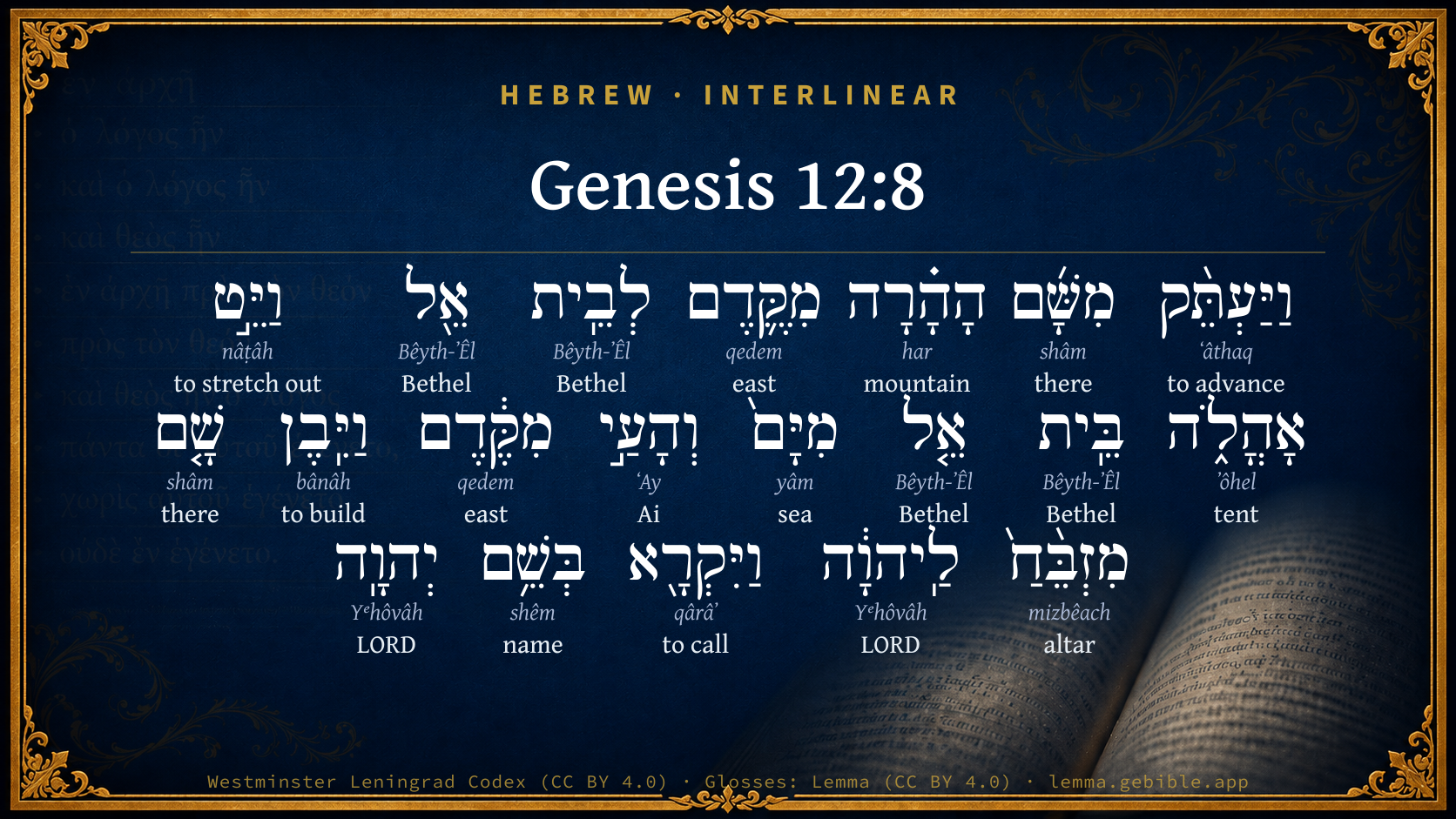
Hebrew (Westminster Leningrad Codex) Genesis 12:8 appears in the Hebrew Old Testament. The text above is from the Westminster Leningrad Codex. Each word links to its Strong’s number, a concise gloss, and parsing drawn from the Open Scriptures Hebrew Bible morphology. Click any word for its full Brown-Driver-Briggs (BDB) entry.
Download image
Cite this verse

Genesis 12:8 (World English Bible). Public Domain. Lemma interlinear Bible study tool, https://lemma.gebible.app/v/genesis/12/8.

Show BibTeX & RIS
BibTeX
RIS
English Translation
He left from there to the mountain on the east of Bethel, and pitched his tent, having Bethel on the west, and Ai on the east. There he built an altar to Yahweh, and called on the name of Yahweh.
World English Bible · Public Domain
Highlights
  • 4 first appearances in the Hebrew Bible
Full analysis ↓
Download a study sheet

One document with this verse’s original text, its word-by-word gloss line, the meaning frame, cross-references with their text, attributed commentary, and full source and license credits — printable, and it pastes into notes with its structure intact.

This verse Autodidact and up

Study sheet (.html) Plain text (.txt)

A passage Seminary Student

Up to 50 verses in one chapter. A passage sheet keeps up to 6 commentary sources and 12 cross-references per verse, in the order this page ranks them, and says so on the sheet whenever that leaves anything out. Ask for a single verse and you get the Autodidact verse sheet above.

Everything on this page stays free to read, with no account — the sheet is a download of what is already on screen, not access to it.

Want to remove ads? Support Godless Engineer
Compare translations 3

The same verse in 3 English versions, stacked beneath the original-language interlinear above. Click any original word for its lexicon entry.

Each is an independent rendering of the whole verse — the interlinear is not word-aligned to these translations.

Highlighted words mark where these versions differ — a whole-verse word diff, not a word-by-word alignment.

  • World English Bible Public Domain
    He left from there to the mountain on the east of Bethel, and pitched his tent, having Bethel on the west, and Ai on the east. There he built an altar to Yahweh, and called on the name of Yahweh.
  • King James Version Public Domain
    And he removed from thence unto a mountain on the east of Bethel, and pitched his tent, having Bethel on the west, and Hai on the east: and there he builded an altar unto the LORD, and called upon the name of the LORD.
  • unfoldingWord Literal Text CC BY-SA 4.0
    Then from there he went on to the mountains to the east of Bethel and pitched his tents, Bethel on the west and Ai on the east. And there he built an altar to Yahweh, and he called on the name of Yahweh.

unfoldingWord Literal Text — © unfoldingWord, licensed CC BY-SA 4.0. Word-aligned USFM3 via Door43 (git.door43.org/unfoldingWord/en_ult).

Versions to compare (up to 4)

3 of 4 selected

Show all 18 translations

Every available English version of this verse, each an independent rendering of the whole verse.

  • World English Bible Public Domain
    He left from there to the mountain on the east of Bethel, and pitched his tent, having Bethel on the west, and Ai on the east. There he built an altar to Yahweh, and called on the name of Yahweh.
  • Berean Standard Bible Public Domain
    From there Abram moved on to the hill country east of Bethel and pitched his tent, with Bethel to the west and Ai to the east. There he built an altar to the LORD, and he called on the name of the LORD.
  • Majority Standard Bible Public Domain
    From there Abram moved on to the hill country east of Bethel and pitched his tent, with Bethel to the west and Ai to the east. There he built an altar to the LORD, and he called on the name of the LORD.
  • King James Version Public Domain
    And he removed from thence unto a mountain on the east of Bethel, and pitched his tent, having Bethel on the west, and Hai on the east: and there he builded an altar unto the LORD, and called upon the name of the LORD.
  • American Standard Version (1901) Public Domain
    And he removed from thence unto the mountain on the east of Beth-el, and pitched his tent, having Beth-el on the west, and Ai on the east: and there he builded an altar unto Jehovah, and called upon the name of Jehovah.
  • Revised Version (1885) Public Domain
    And he removed from thence unto the mountain on the east of Beth-el, and pitched his tent, having Beth-el on the west, and Ai on the east: and there he builded an altar unto the LORD, and called upon the name of the LORD.
  • Geneva Bible (1599) Public Domain
    Afterward remouing thence vnto a moutaine Eastward from Beth-el, he pitched his tent hauing Beth-el on the Westside, and Haai on the East: and there he built an altar vnto the Lord, and called on the Name of the Lord.
  • Douay-Rheims (1899) Public Domain
    And passing on from thence to a mountain, that was on the east side of Bethel, he there pitched his tent, having Bethel on the west, and Hai on the east; he built there also an altar to the Lord, and called upon his name.
  • Young's Literal Translation Public Domain
    And he removeth from thence towards a mountain at the east of Beth-El, and stretcheth out the tent (Beth-El at the west, and Hai at the east), and he buildeth there an altar to Jehovah, and preacheth in the name of Jehovah.
  • Literal Standard Version CC BY-SA 4.0
    And he removes from there toward a mountain at the east of Beth-El, and stretches out the tent (Beth-El at the west, and Hai at the east), and he builds an altar to YHWH there, and preaches in the Name of YHWH.
  • Unlocked Literal Bible CC BY-SA 4.0
    From there he moved to the hill country to the east of Bethel, where he pitched his tent, with Bethel to the west and Ai to the east. There he built an altar to Yahweh and called on the name of Yahweh.
  • unfoldingWord Literal Text CC BY-SA 4.0
    Then from there he went on to the mountains to the east of Bethel and pitched his tents, Bethel on the west and Ai on the east. And there he built an altar to Yahweh, and he called on the name of Yahweh.
  • Darby Bible Public Domain
    And he removed thence towards the mountain on the east of Bethel, and pitched his tent, [having] Bethel toward the west, and Ai toward the east; and there he built an altar to Jehovah, and called on the name of Jehovah.
  • World Messianic Bible Public Domain
    He left from there to go to the mountain on the east of Bethel and pitched his tent, having Bethel on the west, and Ai on the east. There he built an altar to the LORD and called on the LORD’s name.
  • Webster's Bible Public Domain
    And he removed from thence to a mountain on the east of Beth-el, and pitched his tent, having Beth-el on the west, and Hai on the east: and there he erected an altar to the LORD, and called upon the name of the LORD.
  • Free Bible Version CC BY-SA 4.0
    Then he moved on to the hill country east of Bethel and set up camp there. Bethel was to the west and Ai to the east. He built an altar to the Lord there and worshiped him.
  • Bible in Basic English Public Domain
    And moving on from there to the mountain on the east of Beth-el, he put up his tent, having Beth-el on the west and Ai on the east: and there he made an altar and gave worship to the name of the Lord.
  • JPS Tanakh (1917) Public Domain
    And he removed from thence unto the mountain on the east of Beth-el, and pitched his tent, having Beth-el on the west, and Ai on the east; and he builded there an altar unto the LORD, and called upon the name of the LORD.

Literal Standard Version (2020), Covenant Press — licensed CC BY-SA 4.0. Text via the HelloAO Bible API (eBible.org). Unlocked Literal Bible (unfoldingWord) — licensed CC BY-SA 4.0. Text via the HelloAO Bible API (eBible.org). unfoldingWord Literal Text — © unfoldingWord, licensed CC BY-SA 4.0. Word-aligned USFM3 via Door43 (git.door43.org/unfoldingWord/en_ult). Free Bible Version, Dr. Jonathan Gallagher — licensed CC BY-SA 4.0. Text via the HelloAO Bible API (eBible.org).

Word by word

More ways to search: Search by grammar → Find every occurrence → Compare this word →

Practice this passage: Drill this verse → Learn its vocabulary →

וַיַּעְתֵּ֨ק
ʻâthaq
H6275
“and · to advance”
Conjunction + Verb, Hiphil, Sequential Imperfect, 3rd Person, Masculine, Singular
Part of Speech
Conjunction + Verb
Stem
Hiphil
Form
Sequential Imperfect
Person
3rd Person
Gender
Masculine
Number
Singular
Full BDB Definition

Origin: a primitive root

TWOT: 1721

to move, proceed, advance, move on, become old, be removed - (Qal) - to move - to advance (in years), grow old and weak - (Hiphil) - to move forward, proceed, move on - to remove - to transcribe
  1. מִשָּׁ֜ם shâm H8033 “from · there” Preposition + Adverb
  2. הָהָ֗רָה har H2022 “the · mountain · toward” Particle, Definite Article + Noun, Common, Masculine, Singular, Absolute + Suffix, Demonstrative
  3. מִקֶּ֛דֶם qedem H6924 “from · east” Preposition + Noun, Common, Masculine, Singular, Absolute
  4. לְבֵֽית Bêyth-ʼÊl H1008 “to/for · Bethel” Preposition + Noun, Proper
  5. אֵ֖ל Bêyth-ʼÊl H1008 “Bethel” Noun, Proper
  6. וַיֵּ֣ט nâṭâh H5186 “and · to stretch out” Conjunction + Verb, Qal, Sequential Imperfect, 3rd Person, Masculine, Singular
  7. אָהֳלֹ֑ה ʼôhel H168 “tent · his” Noun, Common, Masculine, Singular, Construct + Suffix, Personal, 3rd Person, Masculine, Singular
  8. בֵּֽית Bêyth-ʼÊl H1008 “Bethel” Noun, Proper
  9. אֵ֤ל Bêyth-ʼÊl H1008 “Bethel” Noun, Proper
  10. מִיָּם֙ yâm H3220 “from · sea” Preposition + Noun, Common, Masculine, Singular, Absolute
  11. וְהָעַ֣י ʻAy H5857 “and · the · Ai” Conjunction + Particle, Definite Article + Noun, Proper
  12. מִקֶּ֔דֶם qedem H6924 “from · east” Preposition + Noun, Common, Masculine, Singular, Absolute
  13. וַיִּֽבֶן bânâh H1129 “and · to build” Conjunction + Verb, Qal, Sequential Imperfect, 3rd Person, Masculine, Singular
  14. שָׁ֤ם shâm H8033 “there” Adverb
  15. מִזְבֵּ֨חַ֙ mizbêach H4196 “altar” Noun, Common, Masculine, Singular, Absolute
  16. לַֽיהוָ֔ה Yᵉhôvâh H3068 “to/for · LORD” Preposition + Noun, Proper
  17. וַיִּקְרָ֖א qârâʼ H7121 “and · to call” Conjunction + Verb, Qal, Sequential Imperfect, 3rd Person, Masculine, Singular
  18. בְּשֵׁ֥ם shêm H8034 “in/at · name of” Preposition + Noun, Common, Masculine, Singular, Construct
  19. יְהוָֽה Yᵉhôvâh H3068 “LORD” Noun, Proper

About this verse

These counts appear in no published source. They are computed here, from the morphology-tagged text and Lemma’s own curated glosses. What Lemma adds →

20
words
14
distinct lemmas
Pentateuch
section

Notable vocabulary

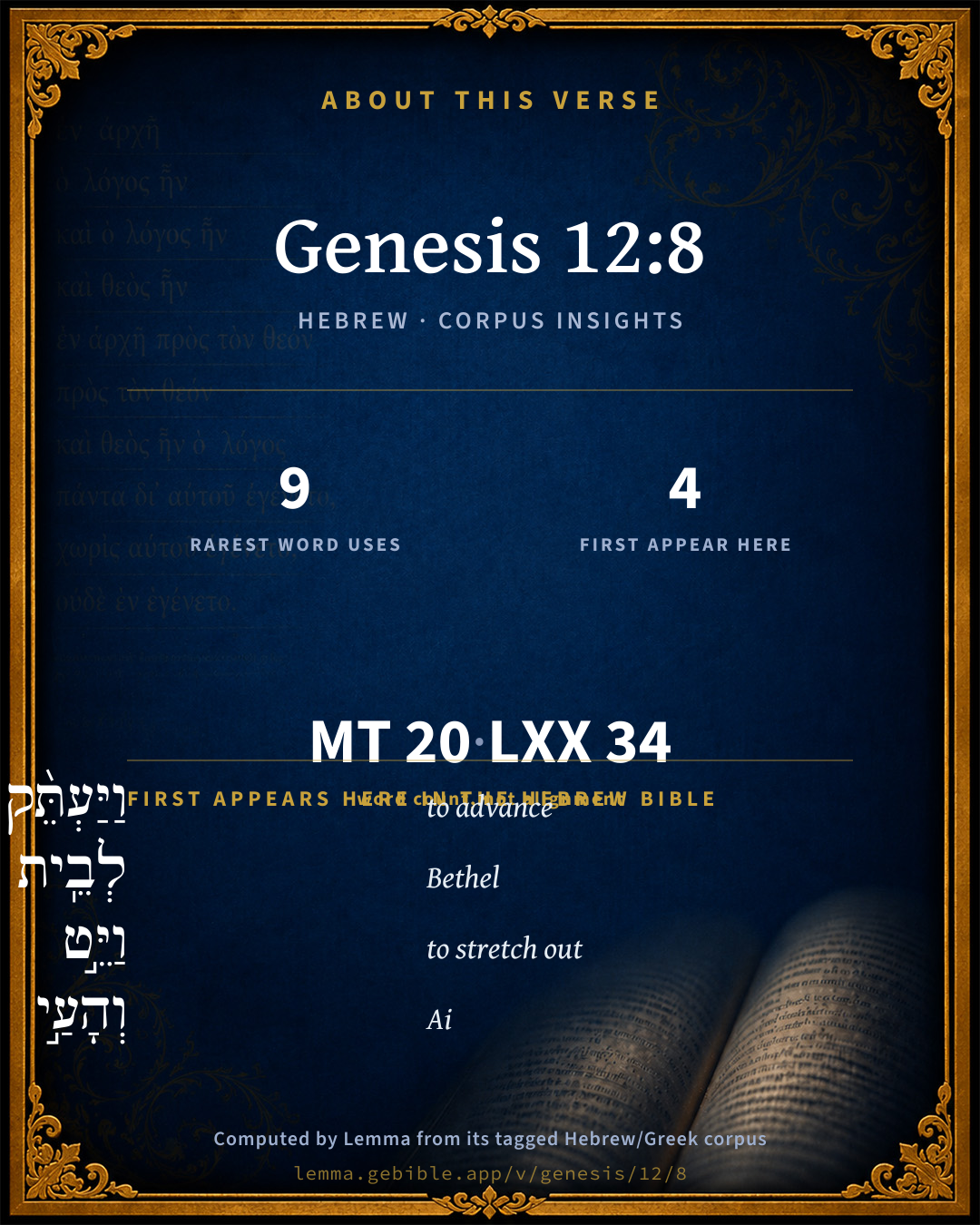
The rarest word here is וַיַּעְתֵּ֨ק to advance H6275 — appearing just 9 times in the whole Hebrew Bible.

First appearance in Scripture

These words make their first canonical appearance in the Hebrew Bible here:

  • וַיַּעְתֵּ֨ק to advance H6275
  • לְבֵֽית Bethel H1008
  • וַיֵּ֣ט to stretch out H5186
  • וְהָעַ֣י Ai H5857

Shared distinctive vocabulary

וַיַּעְתֵּ֨ק to advance H6275 occurs in 9 verses of the Hebrew Bible. Also found in:

Grammatical profile

  • 4 verbs
  • 14 nouns
  • 2 adverbs

Verb forms

  • וַיַּעְתֵּ֨ק Hiphil · Sequential Imperfect
  • וַיֵּ֣ט Qal · Sequential Imperfect
  • וַיִּֽבֶן Qal · Sequential Imperfect
  • וַיִּקְרָ֖א Qal · Sequential Imperfect

Repetition

Words recur within this verse — often emphatic in Hebrew:

  • לְבֵֽית Bethel H1008 ×4
  • מִשָּׁ֜ם there H8033 ×2
  • מִקֶּ֛דֶם east H6924 ×2
  • לַֽיהוָ֔ה LORD H3068 ×2

Hebrew & Septuagint length

In English translation the verse runs 40 words from the Hebrew and 43 from the Septuagint (LXX English) — closely comparable.

A rough comparison of the two English renderings, which tokenize alike — not a word-level alignment.

Word counts can differ between the Hebrew and the Greek without any difference in meaning — e.g. the Hebrew direct-object marker אֵת has no separate Greek word, and Greek often adds the article ὁ.

In the original languages it is 20 Hebrew tokens and 34 Greek tokens — but the two are counted differently (Hebrew bundles its prefixes and suffixes into one token; the Greek is in lemma form), so that isn’t a like-for-like length.

Cross-references

17

Topical passages linked to Genesis 12:8 in the Treasury of Scripture Knowledge — connected by theme and wording, ordered by reader-vote popularity; previews shown in the World English Bible.

  • Genesis 4:26 There was also born a son to Seth, and he named him Enosh. Then men began to call on Yahweh's name.
  • Nehemiah 11:31 The children of Benjamin also [lived] from Geba [onward], at Michmash and Aija, and at Bethel and the towns of it,
  • Genesis 21:33 Abraham planted a tamarisk tree in Beersheba, and called there on the name of Yahweh, the Everlasting God.
  • Genesis 13:4 to the place of the altar, which he had made there at the first. There Abram called on the name of Yahweh.
  • Genesis 28:19 He called the name of that place Bethel, but the name of the city was Luz at the first.
  • 1 Corinthians 1:2 to the assembly of God which is at Corinth; those who are sanctified in Christ Jesus, called to be saints, with all who call on the name of our Lord Jesus Christ in every place, both theirs and ours:
  • Genesis 35:3 Let us arise, and go up to Bethel. I will make there an altar to God, who answered me in the day of my distress, and was with me in the way which I went."
  • Genesis 35:15–16 Jacob called the name of the place where God spoke with him "Bethel."
  • Joshua 7:2 Joshua sent men from Jericho to Ai, which is beside Beth Aven, on the east side of Bethel, and spoke to them, saying, Go up and spy out the land. The men went up and spied out Ai.
  • Joshua 8:3 So Joshua arose, and all the people of war, to go up to Ai: and Joshua chose out thirty thousand men, the mighty men of valor, and sent them forth by night.
  • Joshua 8:17 There was not a man left in Ai or Beth El, who didn't go out after Israel: and they left the city open, and pursued after Israel.
  • Joshua 18:22 and Beth Arabah, and Zemaraim, and Bethel,
  • Psalms 116:4 Then called I on the name of Yahweh: "Yahweh, I beg you, deliver my soul."
  • Isaiah 10:28 He is come to Aiath, he is passed through Migron; at Michmash he lays up his baggage;
  • Joel 2:32 It will happen that whoever will call on the name of Yahweh shall be saved; For in Mount Zion and in Jerusalem there will be those who escape, As Yahweh has said, And among the remnant, those whom Yahweh calls.
  • Acts 2:21 It will be, that whoever will call on the name of the Lord will be saved.'
  • Romans 10:12–14 For there is no distinction between Jew and Greek; for the same Lord is Lord of all, and is rich to all who call on him.

Cross-references courtesy of OpenBible.info (CC BY 4.0).

Hebrew and Greek witnesses Masoretic Hebrew ↔ Greek Septuagint

The same verse in the two great witnesses to the Old Testament, shown verse-for-verse.

These are two independent witnesses, not word-aligned to each other, and the Septuagint is shown in lemma (dictionary) form.

Hebrew Genesis 12:8 Masoretic · Westminster Leningrad Codex

וַיַּעְתֵּ֨ק מִשָּׁ֜ם הָהָ֗רָה מִקֶּ֛דֶם לְבֵֽית אֵ֖ל וַיֵּ֣ט אָהֳלֹ֑ה בֵּֽית אֵ֤ל מִיָּם֙ וְהָעַ֣י מִקֶּ֔דֶם וַיִּֽבֶן שָׁ֤ם מִזְבֵּ֨חַ֙ לַֽיהוָ֔ה וַיִּקְרָ֖א בְּשֵׁ֥ם יְהוָֽה

He left from there to the mountain on the east of Bethel, and pitched his tent, having Bethel on the west, and Ai on the east. There he built an altar to Yahweh, and called on the name of Yahweh.

World English Bible · Public Domain

Greek LXX Genesis 12:8 Septuagint · lemma form

καί ἀποἵστημι ἐκεῖθεν εἰς ὁ ὄρος κατά ἀνατολή βαιθηλ καί ἵστημι ἐκεῖ ὁ σκηνή αὐτός βαιθηλ κατά θάλασσα καί αγγαι κατά ἀνατολή καί οἰκοδομέω ἐκεῖ θυσιαστήριον ὁ κύριος καί ἐπικαλέω ἐπί ὁ ὄνομα κύριος

And he departed thence to the mountain eastward of Baethel, and there he pitched his tent in Baethel near the sea, and Aggai toward the east, and there he built an altar to the Lord, and called on the name of the Lord.

LXX2012 (modern English Septuagint) · Public Domain

Hebrew: Westminster Leningrad Codex (CC BY 4.0). Greek: Septuagint (public domain); English from LXX2012 (modern English Septuagint) (Public Domain). How the Septuagint differs from the Hebrew →

Targum (Aramaic paraphrase)

2

The Targum is the ancient Jewish Aramaic paraphrase of the Hebrew Scriptures — an interpretive translation, not the Hebrew text itself. Onkelos (literal) and Pseudo-Jonathan (expansive) render the Torah, and Jonathan the Prophets. Coverage is partial: where no permissively-licensed English translation exists for a verse, only the Aramaic is shown. This is verse-level text, not a word-by-word alignment to the Hebrew.

  1. Targum Onkelos Torah (Genesis–Deuteronomy)
    וְאִסְתַּלַּק מִתַּמָּן לְטוּרָא מִמַדְנַח לְבֵית אֵל וּפְרַס מַשְׁכְּנֵהּ בֵּית אֵל מִמַּעַרְבָא וְעַי מִמָּדִינְחָא וּבְנָא תַמָּן מִדְבְּחָא קֳדָם יְיָ וְצַלִּי בִּשְׁמָא דַּיְיָ

    And he ascended from thence to the mountain east of Beth El, and spread out his tabernacle, having Beth El on the west and Ai on the east; and he builded there an altar before the Lord, and prayed in the name of the Lord.

    Targum Onkelos — Aramaic: “Onkelos Genesis” (public domain); “Onkelos Exodus” (public domain); “Onkelos Leviticus” (public domain); “Onkelos Numbers” (public domain); “Onkelos Deuteronomy” (public domain). English: “Sefaria Community Translation” (CC0 1.0 (public-domain dedication)); “J.W. Etheridge. The Targums of Onkelos and Jonathan Ben Uzziel on the Pentateuch. London: Longmans, Green, 1862” (public domain). Text via Sefaria.

  2. Targum Pseudo-Jonathan Torah (Genesis–Deuteronomy)
    וְאִסְתַּלֵק מִתַּמָן לְטוּרָא דְמִמַדְנַח לְבֵית אֵל וּפַרְסֵיהּ מַשְׁכְּנָא בֵּית אֵל מִן מַעֲרָבָא וְעַי מִמַדִינְחָא וּבְנָא תַּמָן מַדְבְּחָא קֳּדָם יְיָ וְצַלִי בִּשְׁמָא דַיְיָ

    And he went up from thence to a mountain which was eastward of Bethel, and outspread his tent, having Bethel on the west and Ai on the east; and he builded there an altar before the Lord, and prayed in the Name of the Lord.

    Targum Pseudo-Jonathan — Aramaic: “Targum Jonathan on Genesis” (public domain); “Targum Jonathan on Exodus” (public domain); “Targum Jonathan on Leviticus” (public domain); “Targum Jonathan on Numbers” (public domain); “Targum Jonathan on Deuteronomy” (public domain). English: “The Targum of Jonathan ben Uzziel, trans. J. W. Etheridge, London, 1862” (public domain). Text via Sefaria.

Commentary

Notes on Genesis 12:8 from classic Christian and Jewish commentators (each source and its license shown beneath its notes). The classic Christian expositions comment on the surrounding passage and are grouped to its opening verse, so a note may address several verses; the Jewish commentaries on the Tanakh (Rashi and others) are per-verse, so they appear only where the commentator wrote on this verse.

Lemma curates 59 commentaries, every one of them public domain or Creative Commons licensed, each selected and text-cleaned for this edition rather than reprinted as found. About our sources →

John Gill's Exposition

And he removed from thence unto a mountain on the east of Bethel,.... As it was afterwards called by Jacob, which before and at this time had the name of Luz, Gen 28:19 now to the east of this place was a mountain, whither Abram removed his tent from Sichem, which was about twenty miles from it, as Sir Walter Raleigh (f) observes, some say twenty eight (g):

and pitched his tent; that is, upon the mountain, as before upon the plain, fitly representing the state of the people of God, as sojourners in this world, living like Abram in tents and tabernacles, having no abiding place:

having Bethel on the west, or "on the sea" (h), the Mediterranean sea, which Aben Ezra calls the Spanish sea, and lay to the west of the land of Canaan:

and Hai on the east; the same which is called "Ai", and said to be on the east side of Bethel, Jos 7:2 hard by this place, Rauwolff (i) says, you shall still find some old ruins of old stones, where first Abraham the patriarch did build a tent, as you read in Gen 12:8 and he says that Bethel is still called to this day Bethisella, and is situated half a league further towards the west, at the foot of the hill, in a very fruitful country:

and there he builded an altar unto the Lord: as he had done at Sichem; for wherever he went he worshipped God, and offered sacrifice unto him:

and called upon the name of the Lord: prayed unto him for fresh mercies, as well as gave thanks for past ones; or, "he called in the name of the Lord" (k), he called upon Jehovah the Father, in the name of his Son, the glorious Mediator, who had appeared unto him, and whose day he saw and was glad.

(f) History of the World, par. 1. b. 2. sect. 3. p. 132. (g) Bunting's Travels, p. 56. (h) "a mari", Montanus, Piscater, Schmidt. (i) Travels, part 3. ch. 21. p. 317. Ed. Ray. (k) "et invocavit in nomine Domini", Montanus, Tigurine version.

John Gill's Exposition of the Whole Bible (1746–1763) — public domain (CC PDM 1.0). Text via the HelloAO Bible API.

Trapp's Complete Commentary

John Trapp

Gen 12:8 And he removed from thence unto a mountain on the east of Bethel, and pitched his tent, [having] Bethel on the west, and Hai on the east: and there he builded an altar unto the LORD, and called upon the name of the LORD.

Ver. 8. And he removed from thence.] Because his building altars to Jehovah was offensive to the Canaanites. Indeed, it was a wonder they stoned him not; but God restrained them.

And there he builded an altar to the Lord.] This was still his first care wherever he came, and should be ours. We are a kingdom of priests, and have an altar, {Heb 13:10} which is Christ, who sanctifies the offering. {Mat 23:19} "By him, therefore, let us offer the sacrifice of praise to God continually". {Heb 13:15} Imo altare extruamus non lapideum, sed carneum in cordibus .

John Trapp, A Commentary or Exposition upon All the Books of the Old and New Testament (1647–1656) — public domain. Text from a community e-Sword module.

The Biblical Illustrator

Joseph S. Exell

Gen_12:8-9

He removed from thence

Lessons

1.

Faith moves a man from place to place in the world, upon Gods word or intimation.

2. The bad entertainment of believers in the world maketh them remove their stages.

3. In the wanderings of believers, God sends abroad the discoveries of His will to several places.

4. Faith maketh souls dwell in tents here below, and be still movable for heaven.

5. Faith causeth souls to adhere unto and make profession of the true religion of God in all places; faith is never ashamed of God, truth, worship, or way.

6. Believing souls cannot be without communion with God in offering to Him and hearing from Him.

7. Supplication to God and speaking in His name are special ways of worship suiting believers (Gen_12:8).

8. Faith maketh saints true sojourners below, to be still taking up their stakes at Gods beck.

9. To all points, east and west and south, God orders the motions of the saints to leave some savour of His truth everywhere (Gen_12:9). (G. Hughes, B. D.)

Mountain devotions

In a meeting to pray for the presidents recovery, one of his classmates rose and said, Twenty-six years ago tonight, and at this very hour, our class were on the top of Graylock to spend the night of the fourth of July. As we were about to lie down to sleep, Garfield took out his pocket Testament and said, I am in the habit of reading a chapter every night at this time with my mother. Shall I read aloud? All assented; and when he had read, he asked the oldest member of the class to pray. And there, in the night, on the mountain top, we prayed with him for whom we have now assembled to pray. (Dr. Prime.)

The Biblical Illustrator, edited by Joseph S. Exell (c. 1880s–1900s) — public domain. Text from a community e-Sword module.

Joseph Benson's Commentary

Gen 12:8. And there he built an altar, and called on the name of the Lord — Such, it appears, was his constant practice, whithersoever he removed. As soon as he came into Canaan, though he was but a stranger and sojourner there, yet he set up, and kept up the worship of God in his family; and wherever he had a tent, God had an altar, and that sanctified by prayer.

Joseph Benson's Commentary on the Old and New Testaments (1811–1818) — public domain. Text from a community e-Sword module.

Tyndale Open Study Notes

Tyndale Open Resources

12:8-9 Abram had to keep moving camp because the Canaanites had the fertile land.

12:8 he worshiped the Lord (literally he made proclamation of the Lord by name): Proclaiming the name (identity and character) of the Lord is central to worship and witness (cp. 4:26; see Exod 34:5-7). Abram had to distinguish his sacrificial worship from that of the pagan Canaanites.

Tyndale Open Study Notes — © Tyndale Open Resources, licensed CC BY-SA 4.0. Text via the HelloAO Bible API.

Geneva Bible (1599)

Geneva Bible translators

Because of the troubles that he had among that wicked people.

And so served the true God, and renounced all idolatry.

Geneva Bible (1599) marginal notes — public domain. Text via Bolls.life.

Adam Clarke's Commentary

Verse 8. Beth-el] The place which was afterwards called Beth-el by Jacob, for its first name was Luz. See Ge 28:19. בית אל beith El literally signifies the house of God.

And pitched his tent - and - builded an altar unto the Lord] Where Abram has a tent, there God must have an ALTAR, as he well knows there is no safety but under the Divine protection. How few who build houses ever think on the propriety and necessity of building an altar to their Maker! The house in which the worship of God is not established cannot be considered as under the Divine protection.

And called upon the name of the Lord.] Dr. Shuckford strongly contends that קרא בשם kara beshem does not signify to call ON the name, but to invoke IN the name. So Abram invoked Jehovah in or by the name of Jehovah, who had appeared to him. He was taught even in these early times to approach God through a Mediator; and that Mediator, since manifested in the flesh, was known by the name Jehovah. Does not our Lord allude to such a discovery as this when he says, Abraham rejoiced to see my day; and he saw it, and was glad? Joh 8:56. Hence it is evident that he was informed that the Christ should be born of his seed, that the nations of the world should be blessed through him; and is it then to be wondered at if he invoked God in the name of this great Mediator?

Adam Clarke's Commentary on the Bible (1810–1826) — public domain. Text from a community e-Sword/MySword module.

John Calvin's Commentaries

8. And he removed from thence. When we hear that Abram moved from the place where he had built an altar to God, we ought not to doubt that he was, by some necessity, compelled to do so. He there found the inhabitants unpropitious; and therefore transfers his tabernacle elsewhere. But if Abram bore his continual wanderings patiently, our fastidiousness is utterly inexcusable, when we murmur against God, if he does not grant us a quiet nest. Certainly, when Christ has opened heaven to us, and daily invites us thither to dwell with himself; we should not take it amiss, if he chooses that we should be strangers in the world. The sum of the passage is this, that Abram was without a settled residence: which title Paul assigns to Christians, (1Corinthians 4:11.) Moreover, there is a manifest prolepsis in the word Bethel; for Moses gives the place this name, to accommodate his discourse to the men of his own age.

And there he builded an altar. Moses commends in Abram his unwearied devotedness to piety: for by these words, he intimates, that whatever place he visited, he there exercised himself in the external worship of God; both that he might have no religious rites in common with the wicked, and that he might retain his family in sincere piety. And it is probable, that, from this cause, he would be the object of no little enmity; because there is nothing which more enrages the wicked, than religion different from their own, in which they conceive themselves to be not only despised, but altogether condemned as blind. And we know that the Canaanites were cruel and proud, and too ready to avenge insults. This was perhaps the reason of Abram’s frequent removals: that his neighbors regarded the altars which he built, as a reproach to themselves. It ought indeed to be referred to the wonderful favor of God, that he was not often stoned. Nevertheless, since the holy man knows that he is justly required to bear testimony that he has a God peculiarly his own, whom he must not, by dissimulation, virtually deny, he therefore does not hesitate to prefer the glory of God to his own life.

John Calvin's Commentaries (1540-1563) — public domain. Text from the Calvin Translation Society English edition (1840s-50s) via the Christian Classics Ethereal Library (ccel.org). Calvin's coverage is partial (roughly two-thirds of the Bible); uncommented books and verses are honest gaps, never fabricated. The 19th-century editor's footnotes and remarks are omitted so the notes are faithfully Calvin's own voice.

Ellicott's Commentary for English Readers

(8) He removed.—Broke up his encampment. No special reason for this need be sought; it was the usual condition of the nomad life, and Abram’s wealth in cattle would make frequent changes necessary. His first long halt was in the hill country between Beth-el and Hai, or rather Ai, as in Jos_8:1-3. The numerous almond-trees, whence the former town took its early name of Luz, the remains of aqueducts and other works for irrigation, and the strength of the town of Ai in Joshua’s days bear witness to the ancient fertility of the district, though said now to be uninviting. Here, too, Abram made open profession of his faith, and worshipped with his household at an altar dedicated to Jehovah.

A Bible Commentary for English Readers, edited by Charles John Ellicott (1878–1897) — public domain. Text from a community e-Sword module.

The Cambridge Bible for Schools and Colleges

gen. ed. J. J. S. Perowne

8. Beth-el on the west, and Ai on the east] For Bethel, see note on Gen_28:12. For Ai, see Jos_7:2-5. The situation of Abram’s tent between Bethel and Ai must have commanded a view of the valley of the Jordan and of the Dead Sea, with the mountains of Moab. “Beth-el,” or “House of God,” was probably also an ancient shrine, the modern Bêtîn, 9½ miles N. of Jerusalem.

on the west] The Heb. word for “the west” means literally “the sea,” i.e. the Mediterranean Sea. Such an expression for a point of the compass could only have been used by a people who had long been resident in the country.

called upon the name] See note on Gen_4:26, i.e. he worshipped, using in his invocation the name “Jehovah.” The Name is the symbol of the Divine attributes.

The Cambridge Bible for Schools and Colleges (gen. ed. J. J. S. Perowne; Cambridge University Press, 1878–1918) — public domain. Text from a community e-Sword module.

Haydock's Catholic Bible Commentary

Bethel, as it was called in the days of Moses, being the ancient Luza, chap. 28. On the west, Hebrew, towards the sea or Mediterranean, which lay west of Palestine. Bethel signifies the house of God, being honoured with two altars. (Haydock)

George Leo Haydock (1774–1849), Haydock's Catholic Family Bible and Commentary, 1859 edition — public domain. Excludes Psalms (Douay-Rheims chapter numbering differs from Protestant) and Deuterocanonical books (Catholic canon only).

Matthew Poole's English Annotations

Beth-el, a known place, which afterwards was called Beth-el, but now Luz, Gen 28:19; a usual prolepsis, or anticipation, as before, Gen 12:6.

On the west; or, on the sea; which is all one, because the sea was on the west part of the land: see Gen 13:14; 28:14; Num 3:23; Deu 3:27.

Hai, or Ai, as it is called, Jos 7:2; Jer 49:3; Isa 10:28.

Matthew Poole's English Annotations on the Holy Bible (1683–1685) — public domain. Text from a community e-Sword/MySword module.

Whedon's Commentary on the Bible

Daniel D. Whedon

8. Removed from thence — Abram moved southward from Shechem and pitched his tent on the little round mount now seen strewn with stones, as if for the building of an altar, south-east of Bethel — now called Beitin by the Arabs — a little spot covered with foundation stones and half-standing walls, while east of this mount, and at about the same distance, may be seen a hill covered with the gray ruins of Ai, the modern Et-Tel. See Jos_7:2, note. The name Beth-el (house of God) is said to have been given to this spot by Jacob on two different occasions, (Gen_28:19; Gen_35:15,) so that here the historian may mean that Abram pitched his tent at the place afterwards called Beth-el; or it may have borne this name already in Abram’s day, an interesting relic of ancient piety, such as we meet with in the name Melchizedek, and the name may have again been applied to it in a new sense by Jacob after his wondrous vision there.

Daniel D. Whedon (gen. ed.), Commentary on the Old and New Testaments (1874–1909) — public domain. Text from a community e-Sword module.

The Pulpit Commentary

And he removed literally, caused (i.e. his tent) to be broken up (cf. Gen_26:22) from thence no cause for which being assigned, the hostility of his neighbors (Luther, Calvin) and the commencement of the famine (Alford, Keil) have been conjectured as the probable reasonsunto a (literally, the) mountain east of Bethel. Here proleptically named "house of God," being called in the time of Abram Luz. (Gen_28:19) Its present name is Beitin. And pitched his tent, (of Gen_9:21) having Bethel on the west literally, sea-ward, the Mediterranean being the western boundary of Palestine (cf. Exo_10:19 Exo_26:22; Eze_48:1, Eze_48:2) and Hai Aiy aY (Neh_11:31; tY (Isa_10:28) with the article, because signifying "the heap of ruins," near which it was no doubt built; the scene of the first Israelitish defeat under Joshua: (Gen_7:2) its ruins still exist under the name of Medinet Gai on the east (about five miles from Bethel): and there he builded an altar unto the Lord (vide supra), and called upon the name of the Lord (vide Gen_4:26)

HOMILIES BY J.F. MONTGOMERY

Ver. 8.

Abraham"s altar.

there he builded an altar unto the Lord, and called upon the name of the Lord." There is a solemn word. (Mat_10:32, Mat_10:33) The distinction is not between Christians and heathen; it is within the visible Church. To confess Christ is more than professing Christianity. It must be in the life, not merely in religious services. No doubt these have their use; without them spiritual life would wither and die, like a light under a vessel. They are as food; but "the life is more than meat." The world acquiesces in such services as respectable and proper. But it is a poor Christianity that raises no opposition. A Christian life may constrain respect, but it must differ from worldly

(1) as to its object first the kingdom of God;

(2) as to its means God"s promises and help trusted to as real. Mark Abraham"s example: dwelt among Canaanites on sufferance; they idolaters. Prudence would suggest keeping his religion secret. Many try to keep their faith secret; afraid to confess it, but unwilling to give it up. In vain; faith ashamed of brings no comfort or strength. Abram did not hide his faith. Wherever he sojourned he built an altar; confessed whom he trusted. We are told

1. He built an altar, i.e. made open confession of his faith.

2. "Called on the name," &c., ;i.e. spoke to God as a living person, a real helper.

I WHAT IS IT TO CONFESS GOD?

1. In the heart; firmly to believe what he has revealed. His promises were given to be trusted. The fool puts away belief. (Psa_14:1) It may be from dislike of truth; (cf. Rom_1:28) it may be despondingly (cf., Gen_42:36) afraid to take God at his word. The voice of true wisdom, Psa_62:1, Psa_62:2.

2. In the life; acting upon "ye are not your own." We cannot go far without being tried: in business, in companionship, in bearing what we do not like, in resisting self-will and self-seeking, in standing firm against the world"s scorn or well-meant persuasions. Passing events constantly put the question whom we serve (cf. Dan_3:15; Act_5:28, Act_5:29) And not merely in matters that seem great. Little things show whom we have first in our hearts.

II CLOSELY CONNECTED WITH THIS IS CALLING ON THE NAME OF THE LORD. We must look below the surface. Among professing Christians some prayer is a matter of course; but is it used as a real means to obtain? It is one thing to believe the doctrine of God"s providence, and of the use of prayer, and another to pray as a practical power and to feel our Father"s care. Yet St. Paul connects prayer and. (Php_4:6, 7) When Hannah had prayed she was no more. (1Sa_1:18) The Bible has many encouragements to pray, but not one warning against asking too much.

III EFFECT OF THIS OR THE CHARACTER. Abraham"s character as eminently faithful was built up by exercising faith. He walked with God not by any constraining power, nor by reason of special manifestations; then he would be no example for us. Each acknowledgment of God increased his communion. Each altar marked a step in his own life, and a work in the world. He who is faithful in little gains more power M. (cf. Mat_13:12)

The Pulpit Commentary (1880–1919), ed. H.D.M. Spence-Jones & Joseph S. Exell — public domain. Text from a community e-Sword module.

John Wesley's Explanatory Notes

And there he built an altar unto the Lord who appeared to him, and called on the name of the Lord - Now consider this, (1.) As done upon a special occasion when God appeared to him, then and there he built an altar, with an eye to the God that appeared to him: thus he acknowledged with thankfulness God's kindness to him in making him that gracious visit and promise: and thus he testified his confidence in, and dependence upon the word which God had spoken. (2.) As his constant practice, whithersoever he removed. As soon as Abram was got to Canaan, though he was but a stranger and sojourner there, yet he set up, and kept up, the worship of God in his family; and wherever he had a tent, God had an altar and that an altar sanctified by prayer.

John Wesley, Explanatory Notes Upon the Whole Bible (1754–1765) — public domain. Text via the GEBible commentary corpus.

Keil & Delitzsch

C. F. Keil & F. Delitzsch

He did this also in the mountains, to which he probably removed to secure the necessary pasture for his flocks, after he had pitched his tent there. "Bethel westwards and Ai eastwards," i.e., in a spot with Ai to the east and Bethel to the west. The name Bethel occurs here proleptically: at the time referred to, it was still called Luz (Gen 28:19); its present name if Beitin (Robinson's Palestine). At a distance of about five miles to the east was Ai, ruins of which are still to be seen, bearing the name of Medinet Gai (Ritter's Erdkunde). On the words "called upon the name of the Lord," see Gen 4:26. From this point Abram proceeded slowly to the Negeb, i.e., to the southern district of Canaan towards the Arabian desert (vid., Gen 20:1).

Keil & Delitzsch — Biblical Commentary on the Old Testament (1861–1891) — public domain (CC PDM 1.0). Text via the HelloAO Bible API. (Old Testament only.)

MacLaren's Expositions of Holy Scripture

Alexander MacLaren

Genesis

ABRAM AND THE LIFE OF FAITH

Gen 12:1 - Gen 12:9.

II

Part I - A great act of renunciation at the divine call lies at the foundation of Israel’s history, as it does at the foundation of every life that blesses the world or is worth living. The divine Word to Abram first gives the command in all its authoritativeness and plain setting forth of how much had to be surrendered, and then in its exuberant setting forth of how much was to be won by obedience. God does not hide the sacrifices that have to be made if we will be true to His command. He will enlist no recruits on false pretences. All ties of country, kindred, and father’s house have to be loosened, and, if need be, to be cut, for His command is to be supreme, and clinging hands that would hold back the pilgrim have to be disengaged. If a man realises God’s hold on him, he feels all others relaxed. The magnetism of the divine command overcomes gravitation, and lifts him high above earth. The life of faith ever begins as that of ‘the Father of the Faithful’ began, with the solemn recognition of a divine will which separates. Further, Abram saw plainly what he had to leave, but not what he was to win. He had to make a venture of faith, for ‘the land that I will shew thee’ was undefined. Certainly it was somewhere, but where was it? He had to fling away substance for what seemed shadow to all but the eye of faith, as we all have to do. The familiar, undeniable good of the present has to be waived in favour of what ‘common sense’ calls a misty possibility in the future. To part with solid acres and get nothing but hopes of an inheritance in the skies looks like insanity, and is the only true wisdom. ‘Get thee out’ is plain; ‘the land that I will shew thee’ looks like the doubtful outlines seen from afar at sea, which may be but clouds.

But Abram had a great hope blazing in front, none the less bright or guiding because it all rested on the bare promise of God. It is the prerogative of faith to give solidity and reality to what the world thinks has neither. The wanderer who had left his country was to receive a land for his own; the solitary who had left his kindred was to become the founder of a nation; the unknown stranger was to win a great name,-and how wonderfully that has come true! Not only was he to be blessed, but also to be a blessing, for from him was to flow that which should bless all the earth,-and how transcendently that has come true! The attitude of men to him {and to the universal blessing that should descend from him} was to determine their position in reference to God and ‘blessings’ or ‘cursings’ from him. So the migration of Abram was a turning-point in universal history.

Obedience followed the command, immediate as the thunder on the flash, and complete. ‘So Abram went, as the Lord had spoken unto him,’-blessed they of whose lives that may be the summing-up! Happy the life which has God’s command at the back of every deed, and no command of His unobeyed! If our acts are closely parallel with God’s speech to us, they will prosper, and we shall be peaceful wherever we may have to wander. Success followed obedience in Abram’s case, as in deepest truth it always does. That is a pregnant expression: ‘They went forth to go into the land of Canaan; and into the land of Canaan they came.’ A strange itinerary of a journey, which omits all but the start and the finish! And yet are these not the most important points in any journey or life,-whither it was directed and where it arrived? How little will the weary tramps in the desert be remembered when the goal has been reached! Dangers and privations soon pass from memory, and we shall think little of sorrows, cares, and pains, when we arrive at home. The life of faith is the only one which is always sure of getting to the place to which it seeks to journey. Others miss their aim, or drop dead on the road, like the early emigrants out West; Christian lives get to the city.

Once in the land, Abram was still a stranger and pilgrim. He first planted himself in its heart by Sichem, but outside the city, under the terebinth tree of Moreh. The reason for his position is given in the significant statement that ‘the Canaanite was then in the land.’ So he had to live in the midst of an alien civilisation, and yet keep apart from it. As Hebrews says, he was ‘dwelling in tabernacles,’ because he ‘looked for a city.’ The hope of the permanent future made him keep clear of the passing present; and we are to feel ourselves pilgrims and sojourners, not so much because earth is fleeting and we are mortal, as because our true affinities are with the unseen and eternal. But the presence of ‘the Canaanite’ is connected also with the following words, which tell that ‘the Lord appeared unto Abram,’ and now after his obedience told him that this was the land that was to be his. He unfolds His purposes to those who keep His commandments; obedience is the mother of insight. The revelation put a further strain on faith, for the present occupiers of the land were many and strong; but it matters not how formidably and firmly rooted the Canaanite is, God’s children can be sure that the promise will be fulfilled. We can calmly look on his power and reckon on its decay, if the Lord appears to us, as to Abram-and He surely will if we have followed His separating voice, and dwell as strangers here, because our hearts are with Him.

After the appearance of God and the promise, we have an outline of the pilgrim’s life, as seen in Abram. He signalised God’s further opening of His purposes, by building an altar on the place where He had been seen by him. Thankful recognition and commemoration of the times in our lives when He has most plainly drawn near and shown us glimpses of His will, are no less blessed than due, and they who thus rear altars to Him will wonder, when they come to count up how many they have had to build. But the life of faith is ever a pilgrim life, and Bethel has soon to be the home instead of Shechem. There, too, Abram keeps outside the city, and pitches his tent. There, too, the altar rises by the side of the tent. The transitory provision for housing the pilgrim contrasts with the solid structure for offering sacrifices. The tent is ‘pitched,’ and may be struck and carried away to-morrow, but the altar is ‘builded.’ That part of our lives which is concerned with the material and corporeal is, after all, short in duration and small in importance; that which has to do with God, His revelations, and His worship and service, lasts. What is left in ancient historic lands, like Egypt or Greece, is the temples of the gods, while the huts of the people have perished long centuries ago. What we build for God lasts; what we pitch for ourselves is transient as we are.

Alexander MacLaren, Expositions of Holy Scripture (1904–1910) — public domain. Text from a community e-Sword module.

Scofield Reference Notes

C. I. Scofield

Beth-el

One of the sacred places of Canaan, meaning, house of God Gen 28:1-22, (See Scofield "Gen 35:7").

It is characteristic of all apostasy that Jeroboam chose this sacred place in which to erect an idol 1Ki 12:28; 1Ki 12:32. (Cf) 1Ki 13:1-5 and of divine judgment upon apostasy that God should decree the destruction of Bethel, despite its sacred memories; 1Ki 13:1-5; 2Ki 23:15-17; Amo 3:14; Amo 3:15.

God never hesitates to cast aside that which no longer serves His purpose Rev 2:5; Rev 3:16.

The Scofield Reference Bible (1917 edition), notes by C. I. Scofield — public domain. Text from a community e-Sword module.

unfoldingWord translationNotes

Door43 World Missions Community

he pitched his tent

Abram had many people with him as he traveled. People who moved from place to place lived in tents. AT: "they set up their tents"

called on the name of Yahweh

"prayed in the name of Yahweh" or "worshiped Yahweh"

Then Abram continued journeying

You may need to make explicit that he took his tent with him. "Then Abram took his tent and continued journeying." (See: Assumed Knowledge and Implicit Information)

toward the Negev

"toward the Negev region" or "toward the south" or "south to the Negev desert"

translationWords

Bethel

tent

Ai

altar

Yahweh

Abraham

Negev

unfoldingWord translationNotes — © Distant Shores Media and the Door43 World Missions Community, licensed CC BY-SA 4.0. Source: git.door43.org/Door43/en_tn.

Rashi

Rabbi Shlomo Yitzchaki (Rashi)

ויעתק משם AND HE REMOVED FROM THERE — supply the word אהלו “his tent”.

מקדם לבית אל means ON THE EAST OF BETHEL. Consequently Bethel lay to his west, and that is what it states בית אל מים BETHEL ON THE WEST.

אהלה HIS TENT — This word is written with a ה suffixed instead of the usual ו so that it may read אָהֳלָהּ “her tent” to intimate that first he pitched a tent for his wife and afterwards one for himself (Genesis Rabbah 39:15).

ויבן שם מזבח AND HE BUILDED THERE AN ALTAR — He perceived by the gift of prophecy that his descendants would once stumble (fall into sin) there through Achan’s transgression (see, Joshua 7): therefore he prayed there for them (Genesis Rabbah 39:15).

Rashi on the Tanakh — English translations: “The Judaica Press complete Tanach with Rashi, translated by A. J. Rosenberg” (CC BY 4.0); “Pentateuch with Rashi's commentary by M. Rosenbaum and A.M. Silbermann, 1929-1934” (public domain); “The Metsudah Tanach series, Lakewood, N.J” (CC BY 4.0); and “The Book of Joshua, Metsudah Publications, 1997” (CC BY 4.0). Text via Sefaria.

Ramban (Nachmanides)

Rabbi Moshe ben Nachman (Ramban / Nachmanides)

AND HE CALLED UPON THE NAME OF THE ETERNAL. Onkelos explained it as meaning that he prayed there, just as in the verse, I called upon Thy name, O Eternal, out of the lowest dungeon. The correct interpretation is that Abraham loudly proclaimed the name of the Eternal there before the altar, informing people of Him and of His Divine essence. In Ur of the Chaldees he taught people but they refused to listen. Now, however, that he had come to the land concerning which he had been promised, And I will bless them that bless thee, he became accustomed to teach and to proclaim the Deity. Scripture likewise tells of Isaac — when he went to the valley of Gerar where he was promised, Fear not, for I am with thee — that he built an altar there and invoked the name of the Eternal, Verse 25. since he had come to a new place where they had not heard of His fame or seen His glory, and he proclaimed His glory among these nations. Now a similar statement is not made concerning Jacob, [i.e., that he proclaimed the name of the Eternal before the peoples of the land of Canaan], for since he begot many children — all of whom were worshippers of G-d — and he had a great community, which was called “the congregation of Israel,” it was through them that the Faith was proclaimed and became known to all people. Besides, the Faith had been proclaimed throughout the entire land of Canaan since the days of his ancestors. In Bereshith Rabbah the Rabbis similarly say, “And he called upon the name of the Eternal. This teaches us that he caused the name of the Holy One, blessed be He, to be in the mouth of all people.”

Ramban (Nachmanides) on the Tanakh — English translation: “Commentary on the Torah by Ramban (Nachmanides). Translated and annotated by Charles B. Chavel. New York, Shilo Pub. House, 1971-1976” (CC BY 4.0). Text via Sefaria.

Radak

Rabbi David Kimhi (Radak)

ויעתק משם ההרה, he folded his tent to set out to go to the more mountainous regions east of Bet El, to examine that part of the land, and pitching his tent anew in the area between Bet El and Ai. When arriving there he again built an altar proclaiming the supremacy and uniqueness of the Lord G’d. The ending ה in the word אהלה means the same as the ending ו, i.e. as if the Torah had written אהלו. Avram in “proclaiming” the name of the Lord, issued invitations to the local population to visit this altar, pointing out that this altar was exclusively for serving the Lord and sacrificing to Him. Perhaps the repetition of the words בשם ה' indicates that the people whom Avram invited to his altar were already very close to becoming monotheists. According to Bereshit Rabbah 39,16, quoted by Rashi, he prophesied that at that site or near it, some of his descendants would fall in battle, due to the sin of Achan and members of his family. (Joshua 7,5).

Radak on the Tanakh — English translations: “Sefaria Community Translation” (CC0 1.0 (public-domain dedication)); “Eliyahu Munk, HaChut Hameshulash” (CC BY 4.0); “Rabbi Mike Feuer, Jerusalem Anthology” (CC BY 4.0); and “R. David Kimhi on the first book of Psalms, Translated by R.G. Finch, London, 1919” (public domain). Text via Sefaria.

Lesson kit

Teaching starters — assembled from the data on this page, not authored interpretation. Every prompt links to the verse data it draws on. Edit before teaching.

Genesis, in the Pentateuch, opens this verse with 20 words (14 distinct Hebrew lemmas). Its most distinctive word is ʻâthaq (“to advance”). A historical commentator’s framing appears above. Read the whole chapter for the surrounding context.

Discussion questions

  1. The word ʻâthaq carries the sense “to advance.” How does it shape the verse?
  2. 4 words make their first appearance in Scripture here. What does this debut establish?
  3. How does Genesis 26:22, which shares the word «to advance», read alongside this verse?
  4. What does the repetition of “Bethel” (4× in this one verse) do in this verse?
  5. These translations render this verse differently; the difference is in the English rendering, not the original. What questions does that raise?
  6. «וַיַּעְתֵּ֨ק» is a Hiphil Sequential Imperfect verb. How does that grammatical form shape the action described?
  7. Compare how John Gill's Exposition and Trapp's Complete Commentary read this verse. Where do they agree or differ?

Things to notice

Reading settings

Reading text

Shown beneath each verse's original-language words.

Old Testament
Old Testament edition

Read the OT as the Masoretic Hebrew (MT) or the Greek Septuagint (LXX).

English shown for the Greek Septuagint (in the Hebrew ↔ Greek comparison).

Comparing translations? Open the Compare panel on any verse page to stack up to four side by side.