Joshua 15:5

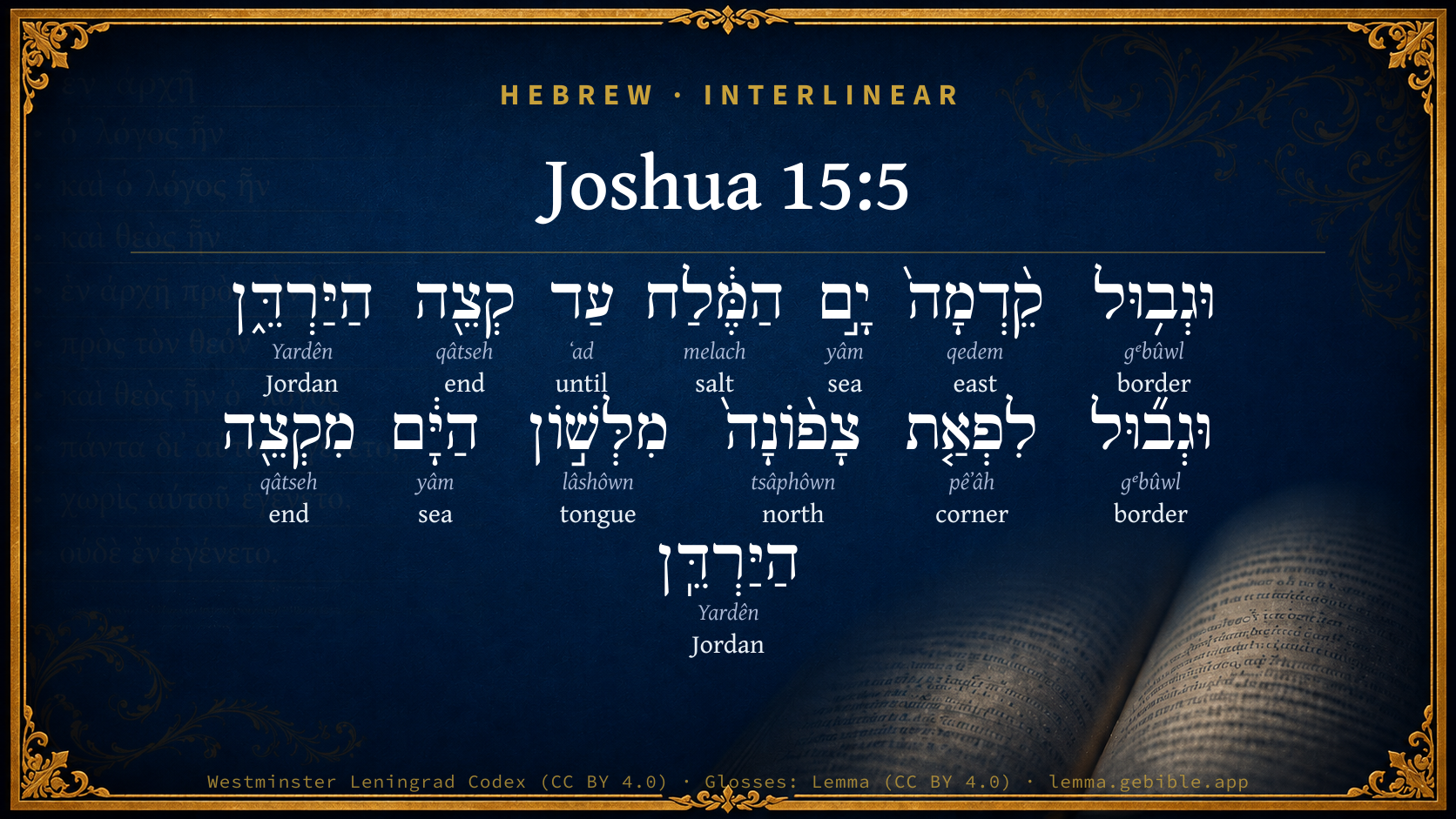
Hebrew (Westminster Leningrad Codex) Joshua 15:5 appears in the Hebrew Old Testament. The text above is from the Westminster Leningrad Codex. Each word links to its Strong’s number, a concise gloss, and parsing drawn from the Open Scriptures Hebrew Bible morphology. Click any word for its full Brown-Driver-Briggs (BDB) entry.
Download image
Cite this verse

Joshua 15:5 (World English Bible). Public Domain. Lemma interlinear Bible study tool, https://lemma.gebible.app/v/joshua/15/5.

Show BibTeX & RIS
BibTeX
RIS
English Translation
The east border was the Salt Sea, even to the end of the Jordan. The border of the north quarter was from the bay of the sea at the end of the Jordan;
World English Bible · Public Domain
Download a study sheet

One document with this verse’s original text, its word-by-word gloss line, the meaning frame, cross-references with their text, attributed commentary, and full source and license credits — printable, and it pastes into notes with its structure intact.

This verse Autodidact and up

Study sheet (.html) Plain text (.txt)

A passage Seminary Student

Up to 50 verses in one chapter. A passage sheet keeps up to 6 commentary sources and 12 cross-references per verse, in the order this page ranks them, and says so on the sheet whenever that leaves anything out. Ask for a single verse and you get the Autodidact verse sheet above.

Everything on this page stays free to read, with no account — the sheet is a download of what is already on screen, not access to it.

Want to remove ads? Support Godless Engineer
Compare translations 3

The same verse in 3 English versions, stacked beneath the original-language interlinear above. Click any original word for its lexicon entry.

Each is an independent rendering of the whole verse — the interlinear is not word-aligned to these translations.

Highlighted words mark where these versions differ — a whole-verse word diff, not a word-by-word alignment.

  • World English Bible Public Domain
    The east border was the Salt Sea, even to the end of the Jordan. The border of the north quarter was from the bay of the sea at the end of the Jordan;
  • King James Version Public Domain
    And the east border was the salt sea, even unto the end of Jordan. And their border in the north quarter was from the bay of the sea at the uttermost part of Jordan:
  • unfoldingWord Literal Text CC BY-SA 4.0
    And the border eastward the Sea of Salt unto the end of the Jordan. And the border to the side of northward from the tongue of the sea at the end of the Jordan.

unfoldingWord Literal Text — © unfoldingWord, licensed CC BY-SA 4.0. Word-aligned USFM3 via Door43 (git.door43.org/unfoldingWord/en_ult).

Versions to compare (up to 4)

3 of 4 selected

Show all 18 translations

Every available English version of this verse, each an independent rendering of the whole verse.

  • World English Bible Public Domain
    The east border was the Salt Sea, even to the end of the Jordan. The border of the north quarter was from the bay of the sea at the end of the Jordan;
  • Berean Standard Bible Public Domain
    The eastern border was the Salt Sea as far as the mouth of the Jordan. The northern border started from the bay of the sea at the mouth of the Jordan,
  • Majority Standard Bible Public Domain
    The eastern border was the Salt Sea as far as the mouth of the Jordan. The northern border started from the bay of the sea at the mouth of the Jordan,
  • King James Version Public Domain
    And the east border was the salt sea, even unto the end of Jordan. And their border in the north quarter was from the bay of the sea at the uttermost part of Jordan:
  • American Standard Version (1901) Public Domain
    And the east border was the Salt Sea, even unto the end of the Jordan. And the border of the north quarter was from the bay of the sea at the end of the Jordan;
  • Revised Version (1885) Public Domain
    And the east border was the Salt Sea, even unto the end of Jordan. And the border of the north quarter was from the bay of the sea at the end of Jordan:
  • Geneva Bible (1599) Public Domain
    Also the Eastborder shalbe the salt Sea, vnto the end of Iorden: and the border on the North quarter from the point of the Sea, and from the end of Iorden.
  • Douay-Rheims (1899) Public Domain
    But on the east side the beginning shall be the most salt sea even to the end of the Jordan: and towards the north, from the bay of the sea unto the same river Jordan.
  • Young's Literal Translation Public Domain
    And the east border `is' the salt sea, unto the extremity of the Jordan, and the border at the north quarter `is' from the bay of the sea, at the extremity of the Jordan;
  • Literal Standard Version CC BY-SA 4.0
    And the east border [is] the Salt Sea, to the extremity of the Jordan, and the border at the north quarter [is] from the bay of the sea, at the extremity of the Jordan;
  • Unlocked Literal Bible CC BY-SA 4.0
    The eastern boundary was the Salt Sea, at the mouth of the Jordan. The border on the north ran from the bay of the sea at the mouth of the Jordan.
  • unfoldingWord Literal Text CC BY-SA 4.0
    And the border eastward the Sea of Salt unto the end of the Jordan. And the border to the side of northward from the tongue of the sea at the end of the Jordan.
  • Darby Bible Public Domain
    -- And the eastern border was the salt sea as far as the end of the Jordan. -- And the border on the north side was from the tongue of the salt sea, at the end of the Jordan;
  • World Messianic Bible Public Domain
    The east border was the Salt Sea, even to the end of the Jordan. The border of the north quarter was from the bay of the sea at the end of the Jordan.
  • Webster's Bible Public Domain
    And the east border was the salt-sea, even to the end of Jordan: and their border in the north quarter was from the bay of the sea, at the uttermost part of Jordan:
  • Free Bible Version CC BY-SA 4.0
    The eastern border of Judah was the Salt Sea, up to where the Jordan River ends. The northern boundary ran from the northern bay of the sea where the Jordan ends
  • Bible in Basic English Public Domain
    And the east limit is the Salt Sea as far as the end of Jordan. And the limit of the north part of the land is from the inlet of the sea at the end of Jordan:
  • JPS Tanakh (1917) Public Domain
    And the east border was the Salt Sea, even unto the end of the Jordan. And the border of the north side was from the bay of the sea at the end of the Jordan.

Literal Standard Version (2020), Covenant Press — licensed CC BY-SA 4.0. Text via the HelloAO Bible API (eBible.org). Unlocked Literal Bible (unfoldingWord) — licensed CC BY-SA 4.0. Text via the HelloAO Bible API (eBible.org). unfoldingWord Literal Text — © unfoldingWord, licensed CC BY-SA 4.0. Word-aligned USFM3 via Door43 (git.door43.org/unfoldingWord/en_ult). Free Bible Version, Dr. Jonathan Gallagher — licensed CC BY-SA 4.0. Text via the HelloAO Bible API (eBible.org).

Word by word

More ways to search: Search by grammar → Find every occurrence → Compare this word →

Practice this passage: Drill this verse → Learn its vocabulary →

הַמֶּ֔לַח
melach
H4417
“the · salt”
Particle, Definite Article + Noun, Common, Masculine, Singular, Absolute
Part of Speech
Particle + Noun
Type
Common
Gender
Masculine
Number
Singular
State
Absolute
Full BDB Definition

Origin: from H4414

TWOT: 1197a

salt
  1. וּגְב֥וּל gᵉbûwl H1366 “and · border” Conjunction + Noun, Common, Masculine, Singular, Absolute
  2. קֵ֨דְמָה֙ qedem H6924 “east · toward” Noun, Common, Masculine, Singular, Absolute + Suffix, Demonstrative
  3. יָ֣ם yâm H3220 “sea of” Noun, Common, Masculine, Singular, Construct
  4. עַד ʻad H5704 “until” Preposition
  5. קְצֵ֖ה qâtseh H7097 “end of” Noun, Common, Both, Singular, Construct
  6. הַיַּרְדֵּ֑ן Yardên H3383 “the · Jordan” Particle, Definite Article + Noun, Proper
  7. וּגְב֞וּל gᵉbûwl H1366 “and · border” Conjunction + Noun, Common, Masculine, Singular, Absolute
  8. לִפְאַ֤ת pêʼâh H6285 “to/for · corner of” Preposition + Noun, Common, Feminine, Singular, Construct
  9. צָפ֨וֹנָה֙ tsâphôwn H6828 “north · toward” Noun, Common, Feminine, Singular, Absolute + Suffix, Demonstrative
  10. מִלְּשׁ֣וֹן lâshôwn H3956 “from · tongue of” Preposition + Noun, Common, Both, Singular, Construct
  11. הַיָּ֔ם yâm H3220 “the · sea” Particle, Definite Article + Noun, Common, Masculine, Singular, Absolute
  12. מִקְצֵ֖ה qâtseh H7097 “from · end of” Preposition + Noun, Common, Both, Singular, Construct
  13. הַיַּרְדֵּֽן Yardên H3383 “the · Jordan” Particle, Definite Article + Noun, Proper

About this verse

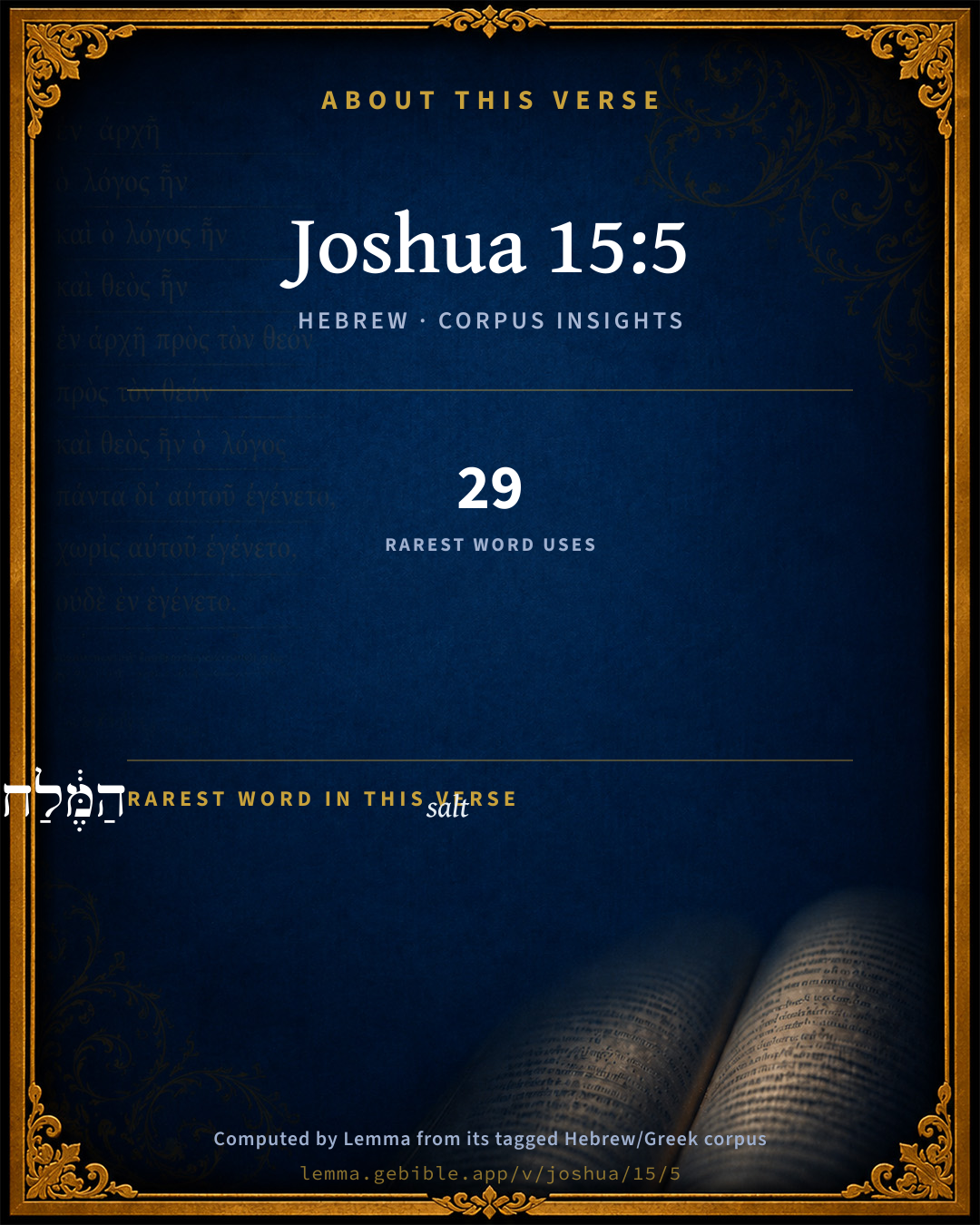
These counts appear in no published source. They are computed here, from the morphology-tagged text and Lemma’s own curated glosses. What Lemma adds →

14
words
10
distinct lemmas
Historical
section

Shared distinctive vocabulary

הַמֶּ֔לַח salt H4417 occurs in 26 verses of the Hebrew Bible. Also found in:

Grammatical profile

  • 13 nouns
  • 1 preposition

Repetition

Words recur within this verse — often emphatic in Hebrew:

  • וּגְב֥וּל border H1366 ×2
  • יָ֣ם sea H3220 ×2
  • קְצֵ֖ה end H7097 ×2
  • הַיַּרְדֵּ֑ן Jordan H3383 ×2

Hebrew & Septuagint length

In English translation the verse runs 33 words from the Hebrew and 31 from the Septuagint (LXX English) — closely comparable.

A rough comparison of the two English renderings, which tokenize alike — not a word-level alignment.

Word counts can differ between the Hebrew and the Greek without any difference in meaning — e.g. the Hebrew direct-object marker אֵת has no separate Greek word, and Greek often adds the article ὁ.

Cross-references

3

Topical passages linked to Joshua 15:5 in the Treasury of Scripture Knowledge — connected by theme and wording, ordered by reader-vote popularity; previews shown in the World English Bible.

  • Numbers 34:12 and the border shall go down to the Jordan, and the goings out of it shall be at the Salt Sea. This shall be your land according to the borders of it round about.
  • Numbers 34:10 You shall mark out your east border from Hazar Enan to Shepham;
  • Joshua 18:15–19 The south quarter was from the uttermost part of Kiriath Jearim; and the border went out westward, and went out to the spring of the waters of Nephtoah;

Cross-references courtesy of OpenBible.info (CC BY 4.0).

Hebrew and Greek witnesses Masoretic Hebrew ↔ Greek Septuagint

The same verse in the two great witnesses to the Old Testament, shown verse-for-verse.

These are two independent witnesses, not word-aligned to each other, and the Septuagint is shown in lemma (dictionary) form.

Hebrew Joshua 15:5 Masoretic · Westminster Leningrad Codex

וּגְב֥וּל קֵ֨דְמָה֙ יָ֣ם הַמֶּ֔לַח עַד קְצֵ֖ה הַיַּרְדֵּ֑ן וּגְב֞וּל לִפְאַ֤ת צָפ֨וֹנָה֙ מִלְּשׁ֣וֹן הַיָּ֔ם מִקְצֵ֖ה הַיַּרְדֵּֽן

The east border was the Salt Sea, even to the end of the Jordan. The border of the north quarter was from the bay of the sea at the end of the Jordan;

World English Bible · Public Domain

Greek LXX Joshua 15:5 Septuagint · lemma form

καί ὁ ὅριον ἀπό ἀνατολή πᾶς ὁ θάλασσα ὁ ἁλυκός ἕως ὁ ἰορδάνης καί ὁ ὅριον αὐτός ἀπό βορέας καί ἀπό ὁ λοφιά ὁ θάλασσα καί ἀπό ὁ μέρος ὁ ἰορδάνης

And their boundaries eastward are all the salt sea as far as Jordan; and their borders from the north, and from the border of the sea, and from part of Jordan—

LXX2012 (modern English Septuagint) · Public Domain

Hebrew: Westminster Leningrad Codex (CC BY 4.0). Greek: Septuagint (public domain); English from LXX2012 (modern English Septuagint) (Public Domain). How the Septuagint differs from the Hebrew →

Targum (Aramaic paraphrase)

1

The Targum is the ancient Jewish Aramaic paraphrase of the Hebrew Scriptures — an interpretive translation, not the Hebrew text itself. Onkelos (literal) and Pseudo-Jonathan (expansive) render the Torah, and Jonathan the Prophets. Coverage is partial: where no permissively-licensed English translation exists for a verse, only the Aramaic is shown. This is verse-level text, not a word-by-word alignment to the Hebrew.

  1. Targum Jonathan Prophets (Joshua–Malachi)
    וּתְחוּם קִידוּמָא יַמָא דְמִלְחָא עַד סְיָפֵי יַרְדְנָא וּתְחוּמָא לְרוּחַ צִפּוּנָא מִכֵּיף יַמָא מִסְיָפֵי יַרְדְנָא:

    (no public-domain English translation for this verse)

    Targum Jonathan — Aramaic: “Mikraot Gedolot” (public domain). English: “Sefaria Community Translation” (CC0 1.0 (public-domain dedication)); “London "Chaldee Paraphrase," 1871” (public domain). Text via Sefaria.

Commentary

Notes on Joshua 15:5 from classic Christian and Jewish commentators (each source and its license shown beneath its notes). The classic Christian expositions comment on the surrounding passage and are grouped to its opening verse, so a note may address several verses; the Jewish commentaries on the Tanakh (Rashi and others) are per-verse, so they appear only where the commentator wrote on this verse.

Lemma curates 59 commentaries, every one of them public domain or Creative Commons licensed, each selected and text-cleaned for this edition rather than reprinted as found. About our sources →

Trapp's Complete Commentary

John Trapp

Jos 15:5 And the east border [was] the salt sea, [even] unto the end of Jordan. And [their] border in the north quarter [was] from the bay of the sea at the uttermost part of Jordan:

Ver. 5. The salt sea.] The lake of Sodom, into which the river Jordan runneth, and there endeth.

John Trapp, A Commentary or Exposition upon All the Books of the Old and New Testament (1647–1656) — public domain. Text from a community e-Sword module.

Joseph Benson's Commentary

Jos 15:5-6. The end of Jordan — The place where Jordan runs into the salt sea. The stone of Bohan — A place so called, not from Bohan’s dwelling there, (for the Reubenites had no portion on this side Jordan,) but from some notable exploit which he did there, though it is not recorded in Scripture.

Joseph Benson's Commentary on the Old and New Testaments (1811–1818) — public domain. Text from a community e-Sword module.

Tyndale Open Study Notes

Tyndale Open Resources

15:5-11 Although Judah’s northern boundary is described in great detail, some sections of this border cannot be determined with certainty.

Tyndale Open Study Notes — © Tyndale Open Resources, licensed CC BY-SA 4.0. Text via the HelloAO Bible API.

Geneva Bible (1599)

Geneva Bible translators

Meaning the mouth of the river where it runneth into the salt Sea.

Geneva Bible (1599) marginal notes — public domain. Text via Bolls.life.

Jamieson, Fausset & Brown

Robert Jamieson, A. R. Fausset & David Brown

the end--that is, the mouth of the Jordan.

Jamieson, Fausset & Brown — Commentary Critical and Explanatory on the Whole Bible (1871) — public domain (CC PDM 1.0). Text via the HelloAO Bible API.

Adam Clarke's Commentary

Verse 5. The east border was the Salt Sea] The Salt Sea is the same as the Dead Sea, lake Asphaltites, &c. And here it is intimated that the eastern border of the tribe of Judah extended along the Dead Sea, from its lowest extremity to the end of Jordan, i.e., to the place where Jordan falls into this sea.

Adam Clarke's Commentary on the Bible (1810–1826) — public domain. Text from a community e-Sword/MySword module.

Ellicott's Commentary for English Readers

(5) Their border in the north quarter.—This can be followed with the Ordnance Survey of Palestine, and is described by Conder in the following way:—“It started from the Jordan mouth, but did not apparently follow the river, as Beth Arabah (unknown) and Beth Hogla (’Ain Hajlah, about two miles west of Jordan—sheet 18) belonged to Benjamin. Passing along the valley of Achor (Wâdy Kelt), it left Gilgal on the north, and ascended the pass to the going up of Adummim (Tal’at-ed-Dumm), the ancient and modern name ‘bloody’ being apparently derived from the brick-red marls here found amid a district of white chalk.” (It is easy to conjecture other reasons.) A line of Roman road on the map is a very fair guide to the boundary here described, and thus far it lies on sheet 18 En Rogel, the next known point (on sheet 17), close to Zoheleth (Zahweileh, 1Ki_1:9), was evidently the present spring ‘Ain Umm-ed-Deraj, in the Kedron Valley (this may be sought in the separate survey of Jerusalem, which is upon a larger scale). Thence the border ran across the slope (Cataph, Jos_15:8, “side”), beside the valley of Ben Hinnom (Wâdy Rabâby), south of Jebus, and thus reached the watershed. (Here the boundary-line takes a turn to the northward.) It then apparently passed along the broad vale (Emek, Jos_15:8) of Rephaim (“valley of the giants”), which Josephus makes to extend towards Bethlehem. This valley is identified with El-Bukeia (sheet 17). The waters of Nephtoah are apparently identical with ‘Ain ’Atân, south-west of Bethlehem.

A Bible Commentary for English Readers, edited by Charles John Ellicott (1878–1897) — public domain. Text from a community e-Sword module.

The Cambridge Bible for Schools and Colleges

gen. ed. J. J. S. Perowne

5. And the east border] “Till to the laste partis of Jordan,” Wyclif. This was the Salt Sea in all its extent from south to north, even “unto the end of Jordan,” i. e. to the point where it enters the Dead Sea.

their border in the north quarter was from the bay of the sea] i. e. from the embouchure of the Jordan. “The tonge of the see vnto the same flood of Jordan,” Wyclif.

The Cambridge Bible for Schools and Colleges (gen. ed. J. J. S. Perowne; Cambridge University Press, 1878–1918) — public domain. Text from a community e-Sword module.

John Gill's Exposition

And the east border was the salt sea, even unto the end of Jordan,.... To the place where Jordan fell into it; so that this border was the whole length of the salt sea, which Josephus says (y) was five hundred eighty furlongs; and, according to Pliny (z), an hundred miles:

and their border in the north quarter was from the bay of the sea,

at the uttermost part of Jordan; this northern border began where the eastern ended, at the bay or creek of the sea, where Jordan fell into it.

(y) De Bello Jud. l. 4. c. 8. sect. 4. (z) Nat. Hist. l. 5. c. 16.

John Gill's Exposition of the Whole Bible (1746–1763) — public domain (CC PDM 1.0). Text via the HelloAO Bible API.

Haydock's Catholic Bible Commentary

Jordan, where it discharges itself into the Dead Sea, or mixes its waters with the latter; which, as we observe, (chap. v. 16,) does not take place for three miles. (Haydock) --- the north-western part of this sea belonged to Benjamin.

George Leo Haydock (1774–1849), Haydock's Catholic Family Bible and Commentary, 1859 edition — public domain. Excludes Psalms (Douay-Rheims chapter numbering differs from Protestant) and Deuterocanonical books (Catholic canon only).

Matthew Poole's English Annotations

The end of Jordan, i.e. the place where Jordan runs into the Salt Sea.

Matthew Poole's English Annotations on the Holy Bible (1683–1685) — public domain. Text from a community e-Sword/MySword module.

Whedon's Commentary on the Bible

Daniel D. Whedon

5. East border was the salt sea — Which formed a boundary line for nearly fifty miles.

End of Jordan — That is, the month of the Jordan; called also in this same verse the uttermost part of Jordan.

Bay of the sea — The northern tongue or extremity of the Dead Sea, at the point where it receives the waters of the Jordan.

Daniel D. Whedon (gen. ed.), Commentary on the Old and New Testaments (1874–1909) — public domain. Text from a community e-Sword module.

The Pulpit Commentary

To the end of Jordan. The spot where it emptied itself into the Dead Sea. The bay of the sea at the uttermost part of Jordan. As in ver. 3, the word here translated bay is tongue in the original. What is meant is that the northern boundary started from the point where the Jordan entered the Dead Sea.

The Pulpit Commentary (1880–1919), ed. H.D.M. Spence-Jones & Joseph S. Exell — public domain. Text from a community e-Sword module.

John Wesley's Explanatory Notes

The end of Jordan - That is, the place where Jordan runs into the salt-sea.

John Wesley, Explanatory Notes Upon the Whole Bible (1754–1765) — public domain. Text via the GEBible commentary corpus.

unfoldingWord translationNotes

Door43 World Missions Community

at the mouth of the Jordan

The point at which the river empties into the sea is spoken of as if it were the mouth of the river. (See: Metaphor)

border ... ran

"border ... was"

Beth Hoglah ... Beth Arabah

These are the names of places. (See: How to Translate Names)

the Stone of Bohan

This was likely a large stone that someone set up as a landmark and named after the man, Bohan. (See: How to Translate Names)

translationWords

Salt Sea

Jordan River

Reuben

unfoldingWord translationNotes — © Distant Shores Media and the Door43 World Missions Community, licensed CC BY-SA 4.0. Source: git.door43.org/Door43/en_tn.

Rashi

Rabbi Shlomo Yitzchaki (Rashi)

The eastern boundary. Referring to the boundary line that stretches along the eastern border of Yehudah.

The Salt (Dead) Sea. It is located at the south eastern corner of the land, as stated in Parshas אֵלֶה מַסְעֵי

To the end of the Jordan. The width of the boundary of Yehudah is only that which is opposite the Dead Sea to the place where the Jordan empties into the Dead Sea, for the Jordan itself is also on the eastern border of the land of Canaan, as stated in Parshas אֵלֶה מַסְעֵי regarding the eastern border. The boundary descended to the Jordan and it extended to the Dead Sea, which is at the corner.

And the boundary of the north side. The border line stretching along the northern border from east to west goes from the bay of the Dead Sea, from the place where the Jordan empties into it, as we have said that the width of the eastern boundary ends there; and it goes up westward to Beis Chogloh, and then the boundary line passes to the north of Beis HaArovoh which is the south of Eretz Yisroel. Beis HaArovo therefore is included in the boundary of Yehudah within the boundary line.

Rashi on the Tanakh — English translations: “The Judaica Press complete Tanach with Rashi, translated by A. J. Rosenberg” (CC BY 4.0); “Pentateuch with Rashi's commentary by M. Rosenbaum and A.M. Silbermann, 1929-1934” (public domain); “The Metsudah Tanach series, Lakewood, N.J” (CC BY 4.0); and “The Book of Joshua, Metsudah Publications, 1997” (CC BY 4.0). Text via Sefaria.

Lesson kit

Teaching starters — assembled from the data on this page, not authored interpretation. Every prompt links to the verse data it draws on. Edit before teaching.

Joshua, in the Historical, opens this verse with 14 words (10 distinct Hebrew lemmas). Its most distinctive word is melach (“salt”). A historical commentator’s framing appears above. Read the whole chapter for the surrounding context.

Discussion questions

  1. The word melach carries the sense “salt.” How does it shape the verse?
  2. How does Genesis 14:3, which shares the word «salt», read alongside this verse?
  3. What does the repetition of “border” (2× in this one verse) do in this verse?
  4. The translations on this page render this verse differently — a whole-verse word diff, not a word-by-word alignment. What might account for the different wordings?
  5. Compare how Trapp's Complete Commentary and Joseph Benson's Commentary read this verse. Where do they agree or differ?

Things to notice

Reading settings

Reading text

Shown beneath each verse's original-language words.

Old Testament
Old Testament edition

Read the OT as the Masoretic Hebrew (MT) or the Greek Septuagint (LXX).

English shown for the Greek Septuagint (in the Hebrew ↔ Greek comparison).

Comparing translations? Open the Compare panel on any verse page to stack up to four side by side.