
Ezekiel 45:7

Hebrew (Westminster Leningrad Codex) Ezekiel 45:7 appears in the Hebrew Old Testament. The text above is from the Westminster Leningrad Codex. Each word links to its Strong’s number, a concise gloss, and parsing drawn from the Open Scriptures Hebrew Bible morphology. Click any word for its full Brown-Driver-Briggs (BDB) entry.
Download image
Cite this verse

Ezekiel 45:7 (World English Bible). Public Domain. Lemma interlinear Bible study tool, https://lemma.gebible.app/v/ezekiel/45/7.

Show BibTeX & RIS
BibTeX
RIS
English Translation
[Whatever is] for the prince [shall be] on the one side and on the other side of the holy offering and of the possession of the city, in front of the holy offering and in front of the possession of the city, on the west side westward, and on the east side eastward; and in length answerable to one of the portions, from the west border to the east border.
World English Bible · Public Domain
Download a study sheet

One document with this verse’s original text, its word-by-word gloss line, the meaning frame, cross-references with their text, attributed commentary, and full source and license credits — printable, and it pastes into notes with its structure intact.

This verse Autodidact and up

Study sheet (.html) Plain text (.txt)

A passage Seminary Student

Up to 50 verses in one chapter. A passage sheet keeps up to 6 commentary sources and 12 cross-references per verse, in the order this page ranks them, and says so on the sheet whenever that leaves anything out. Ask for a single verse and you get the Autodidact verse sheet above.

Everything on this page stays free to read, with no account — the sheet is a download of what is already on screen, not access to it.

Want to remove ads? Support Godless Engineer
Compare translations 3

The same verse in 3 English versions, stacked beneath the original-language interlinear above. Click any original word for its lexicon entry.

Each is an independent rendering of the whole verse — the interlinear is not word-aligned to these translations.

Highlighted words mark where these versions differ — a whole-verse word diff, not a word-by-word alignment.

  • World English Bible Public Domain
    [Whatever is] for the prince [shall be] on the one side and on the other side of the holy offering and of the possession of the city, in front of the holy offering and in front of the possession of the city, on the west side westward, and on the east side eastward; and in length answerable to one of the portions, from the west border to the east border.
  • King James Version Public Domain
    And a portion shall be for the prince on the one side and on the other side of the oblation of the holy portion, and of the possession of the city, before the oblation of the holy portion, and before the possession of the city, from the west side westward, and from the east side eastward: and the length shall be over against one of the portions, from the west border unto the east border.
  • unfoldingWord Literal Text CC BY-SA 4.0
    The prince’s land will be on both sides of the area reserved for the holy place and the city. It will be to their west and to their east. The length will correspond to the length of one of those portions, from the west to the east.

unfoldingWord Literal Text — © unfoldingWord, licensed CC BY-SA 4.0. Word-aligned USFM3 via Door43 (git.door43.org/unfoldingWord/en_ult).

Versions to compare (up to 4)

3 of 4 selected

Show all 18 translations

Every available English version of this verse, each an independent rendering of the whole verse.

  • World English Bible Public Domain
    [Whatever is] for the prince [shall be] on the one side and on the other side of the holy offering and of the possession of the city, in front of the holy offering and in front of the possession of the city, on the west side westward, and on the east side eastward; and in length answerable to one of the portions, from the west border to the east border.
  • Berean Standard Bible Public Domain
    Now the prince will have the area bordering each side of the area formed by the holy district and the property of the city, extending westward from the western side and eastward from the eastern side, running lengthwise from the western boundary to the eastern boundary and parallel to one of the tribal portions.
  • Majority Standard Bible Public Domain
    Now the prince will have the area bordering each side of the area formed by the holy district and the property of the city, extending westward from the western side and eastward from the eastern side, running lengthwise from the western boundary to the eastern boundary and parallel to one of the tribal portions.
  • King James Version Public Domain
    And a portion shall be for the prince on the one side and on the other side of the oblation of the holy portion, and of the possession of the city, before the oblation of the holy portion, and before the possession of the city, from the west side westward, and from the east side eastward: and the length shall be over against one of the portions, from the west border unto the east border.
  • American Standard Version (1901) Public Domain
    And `whatsoever is' for the prince `shall be' on the one side and on the other side of the holy oblation and of the possession of the city, in front of the holy oblation and in front of the possession of the city, on the west side westward, and on the east side eastward; and in length answerable unto one of the portions, from the west border unto the east border.
  • Revised Version (1885) Public Domain
    And whatsoever is for the prince shall be on the one side and on the other side of the holy oblation and of the possession of the city, in front of the holy oblation and in front of the possession of the city, on the west side westward, and on the east side eastward: and in length answerable unto one of the portions, from the west border unto the east border.
  • Geneva Bible (1599) Public Domain
    And a portion shalbe for the prince on ye one side, and on that side of the oblation of the holy portion, and of the possession of the citie, euen before the oblation of the holy portion, and before the possession of the citie from the West corner Westward, and from the East corner Eastward, and the length shalbe by one of the portions from the West border vnto the East border.
  • Douay-Rheims (1899) Public Domain
    For the prince also on the one side and on the other side, according to the separation of the sanctuary, and according to the possession of the city, over against the separation of the sanctuary, and over against the possession of the city: from the side of the sea even to the sea, and from the side of the east; even to the east. And the length according to every part from the west border to the east border.
  • Young's Literal Translation Public Domain
    As to the prince, on this side, and on that side, of the heave-offering of the holy place, and of the possession of the city, at the front of the heave-offering of the holy place, and at the front of the possession of the city, from the west corner westward, and from the east corner eastward -- and the length `is' over-against one of the portions from the west border unto the east border --
  • Literal Standard Version CC BY-SA 4.0
    And for the prince: on this side and on that side of the raised-offering of the holy place, and of the possession of the city, at the front of the raised-offering of the holy place, and at the front of the possession of the city, from the west corner westward, and from the east corner eastward—and the length [is] corresponding to one of the portions from the west border to the east border—
  • Unlocked Literal Bible CC BY-SA 4.0
    The prince's land will be on both sides of the area reserved for the holy place and the city. It will be to their west and to their east. The length will correspond to the length of one of those portions, from the west to the east.
  • unfoldingWord Literal Text CC BY-SA 4.0
    The prince’s land will be on both sides of the area reserved for the holy place and the city. It will be to their west and to their east. The length will correspond to the length of one of those portions, from the west to the east.
  • Darby Bible Public Domain
    And the prince shall have [his portion] on the one side and on the other side of the holy heave-offering and of the possession of the city, over against the holy heave-offering, and over against the possession of the city, from the west side westward, and from the east side eastward; and in length answering to one of the portions [of the tribes] from the west border unto the east border.
  • World Messianic Bible Public Domain
    “‘“What is for the prince shall be on the one side and on the other side of the holy allotment and of the possession of the city, in front of the holy allotment and in front of the possession of the city, on the west side westward, and on the east side eastward, and in length corresponding to one of the portions, from the west border to the east border.
  • Webster's Bible Public Domain
    And a portion shall be for the prince on the one side and on the other side of the oblation of the holy portion, and of the possession of the city, before the oblation of the holy portion, and before the possession of the city, from the west side westward, and from the east side eastward: and the length shall be over against one of the portions, from the west border to the east border.
  • Free Bible Version CC BY-SA 4.0
    The prince will be assigned the territory on both sides of the area that includes the holy section and that of the city. It will extend to the western border of the country from the west side and to the eastern border from the east side, in the same way as the allocation to the tribes.
  • Bible in Basic English Public Domain
    And for the ruler there is to be a part on one side and on the other side of the holy offering and of the property of the town, in front of the holy offering and in front of the property of the town on the west of it and on the east: measured in the same line as one of the parts of the land, from its limit on the west to its limit on the east of the land.
  • JPS Tanakh (1917) Public Domain
    And for the prince, on the one side and on the other side of the holy offering and of the possession of the city, in front of the holy offering and in front of the possession of the city, on the west side westward, and on the east side eastward; and in length answerable unto one of the portions, from the west border unto the east border

Literal Standard Version (2020), Covenant Press — licensed CC BY-SA 4.0. Text via the HelloAO Bible API (eBible.org). Unlocked Literal Bible (unfoldingWord) — licensed CC BY-SA 4.0. Text via the HelloAO Bible API (eBible.org). unfoldingWord Literal Text — © unfoldingWord, licensed CC BY-SA 4.0. Word-aligned USFM3 via Door43 (git.door43.org/unfoldingWord/en_ult). Free Bible Version, Dr. Jonathan Gallagher — licensed CC BY-SA 4.0. Text via the HelloAO Bible API (eBible.org).

Word by word

More ways to search: Search by grammar → Find every occurrence → Compare this word →

Practice this passage: Drill this verse → Learn its vocabulary →

לְעֻמּוֹת֙
ʻummâh
H5980
“to/for · beside of”
Preposition + Noun, Common, Feminine, Plural, Construct
Part of Speech
Preposition + Noun
Type
Common
Gender
Feminine
Number
Plural
State
Construct
Full BDB Definition

Origin: from H6004

TWOT: 1640f

juxtaposition - used only as a preposition - close by, side by side with, alongside of, parallel with - agreeing with, corresponding to, exactly as, close beside - correspondingly to
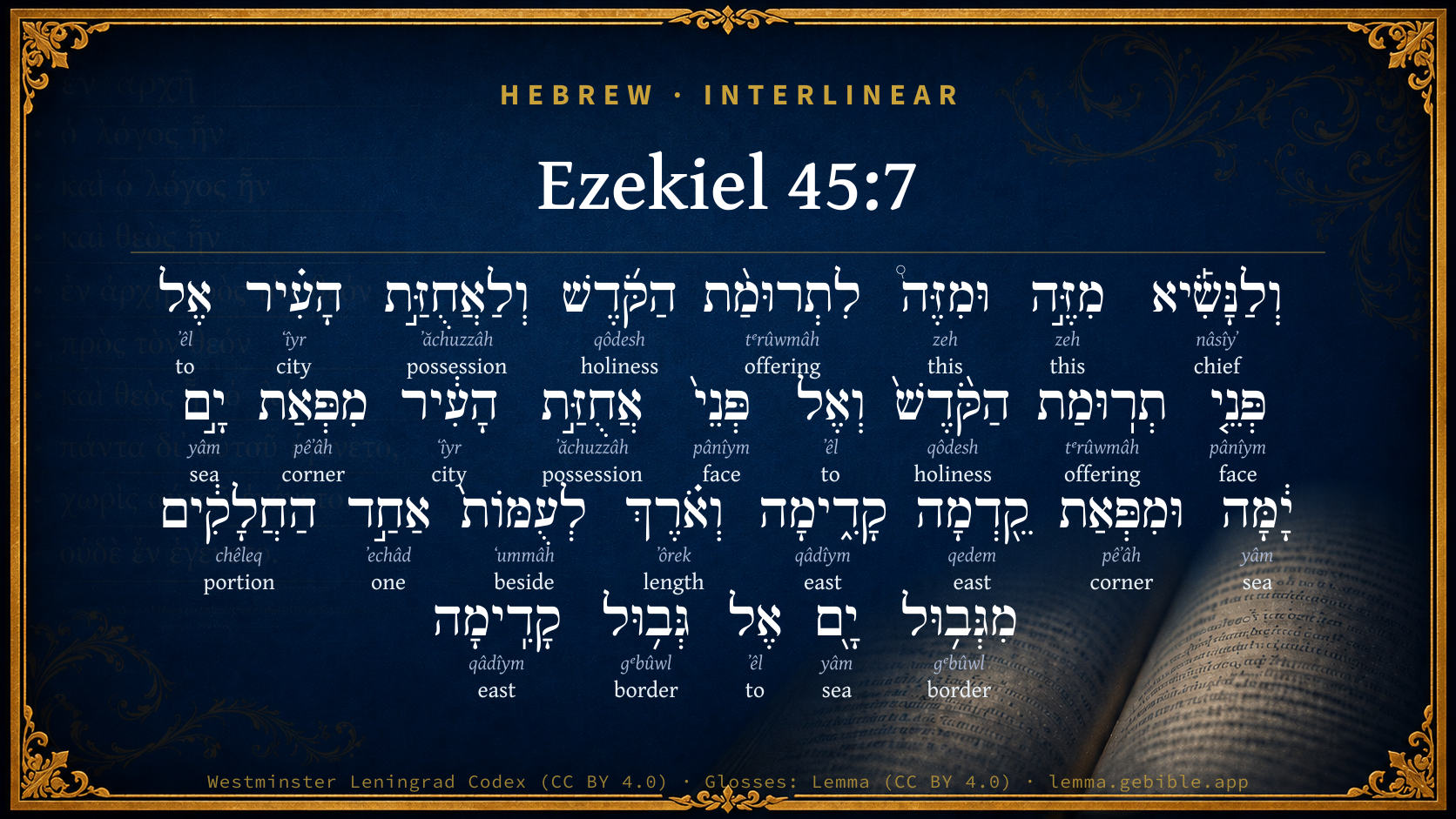
  1. וְלַנָּשִׂ֡יא nâsîyʼ H5387 “and · to/for the · chief” Conjunction + Preposition, Determined + Noun, Common, Masculine, Singular, Absolute
  2. מִזֶּ֣ה zeh H2088 “from · this” Preposition + Pronoun, Demonstrative, Masculine, Singular
  3. וּמִזֶּה֩ zeh H2088 “and · from · this” Conjunction + Preposition + Pronoun, Demonstrative, Masculine, Singular
  4. לִתְרוּמַ֨ת tᵉrûwmâh H8641 “to/for · offering of” Preposition + Noun, Common, Feminine, Singular, Construct
  5. הַקֹּ֜דֶשׁ qôdesh H6944 “the · holiness” Particle, Definite Article + Noun, Common, Masculine, Singular, Absolute
  6. וְלַאֲחֻזַּ֣ת ʼăchuzzâh H272 “and · to/for · possession of” Conjunction + Preposition + Noun, Common, Feminine, Singular, Construct
  7. הָעִ֗יר ʻîyr H5892 “the · city” Particle, Definite Article + Noun, Common, Feminine, Singular, Absolute
  8. אֶל ʼêl H413 “to” Preposition
  9. פְּנֵ֤י pânîym H6440 “face(s) of” Noun, Common, Both, Plural, Construct
  10. תְרֽוּמַת tᵉrûwmâh H8641 “offering of” Noun, Common, Feminine, Singular, Construct
  11. הַקֹּ֨דֶשׁ֙ qôdesh H6944 “the · holiness” Particle, Definite Article + Noun, Common, Masculine, Singular, Absolute
  12. וְאֶל ʼêl H413 “and · to” Conjunction + Preposition
  13. פְּנֵי֙ pânîym H6440 “face(s) of” Noun, Common, Both, Plural, Construct
  14. אֲחֻזַּ֣ת ʼăchuzzâh H272 “possession of” Noun, Common, Feminine, Singular, Construct
  15. הָעִ֔יר ʻîyr H5892 “the · city” Particle, Definite Article + Noun, Common, Feminine, Singular, Absolute
  16. מִפְּאַת pêʼâh H6285 “from · corner of” Preposition + Noun, Common, Feminine, Singular, Construct
  17. יָ֣ם yâm H3220 “sea” Noun, Common, Masculine, Singular, Absolute
  18. יָ֔מָּה yâm H3220 “sea · toward” Noun, Common, Masculine, Singular, Absolute + Suffix, Demonstrative
  19. וּמִפְּאַת pêʼâh H6285 “and · from · corner of” Conjunction + Preposition + Noun, Common, Feminine, Singular, Construct
  20. קֵ֖דְמָה qedem H6924 “east · toward” Noun, Common, Masculine, Singular, Absolute + Suffix, Demonstrative
  21. קָדִ֑ימָה qâdîym H6921 “east · toward” Noun, Common, Masculine, Singular, Absolute + Suffix, Demonstrative
  22. וְאֹ֗רֶךְ ʼôrek H753 “and · length” Conjunction + Noun, Common, Masculine, Singular, Absolute
  23. אַחַ֣ד ʼechâd H259 “one” Adjective, Cardinal number, Masculine, Singular, Absolute
  24. הַחֲלָקִ֔ים chêleq H2506 “the · portions” Particle, Definite Article + Noun, Common, Masculine, Plural, Absolute
  25. מִגְּב֥וּל gᵉbûwl H1366 “from · border of” Preposition + Noun, Common, Masculine, Singular, Construct
  26. יָ֖ם yâm H3220 “sea” Noun, Common, Masculine, Singular, Absolute
  27. אֶל ʼêl H413 “to” Preposition
  28. גְּב֥וּל gᵉbûwl H1366 “border of” Noun, Common, Masculine, Singular, Construct
  29. קָדִֽימָה qâdîym H6921 “east · toward” Noun, Common, Masculine, Singular, Absolute + Suffix, Demonstrative

About this verse

These counts appear in no published source. They are computed here, from the morphology-tagged text and Lemma’s own curated glosses. What Lemma adds →

30
words
17
distinct lemmas
Prophets
section

Shared distinctive vocabulary

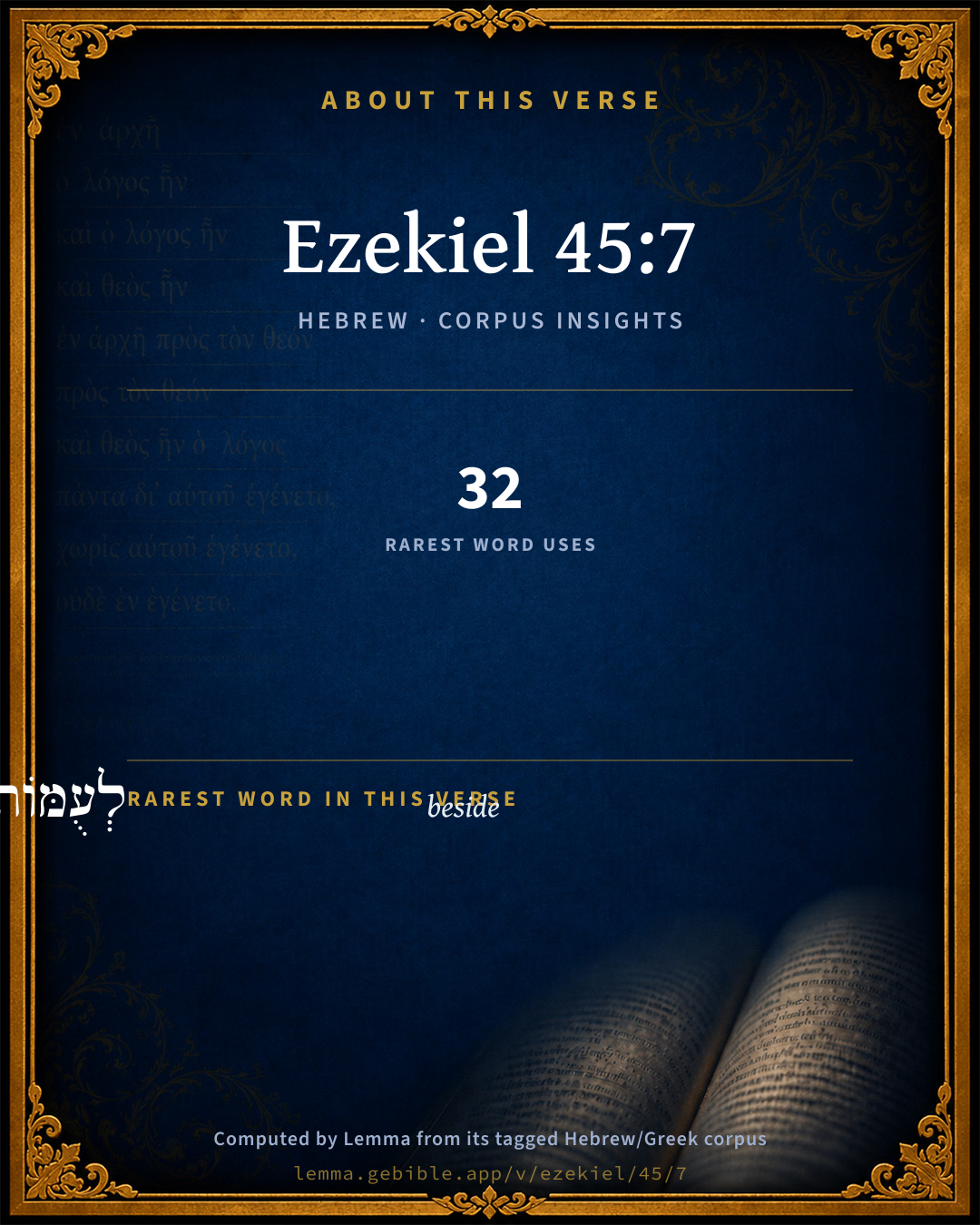
לְעֻמּוֹת֙ beside H5980 occurs in 28 verses of the Hebrew Bible. Also found in:

Grammatical profile

  • 24 nouns
  • 1 adjective
  • 2 pronouns
  • 3 prepositions

Repetition

Words recur within this verse — often emphatic in Hebrew:

  • יָ֣ם sea H3220 ×3
  • לִתְרוּמַ֨ת offering H8641 ×2
  • הַקֹּ֜דֶשׁ holiness H6944 ×2
  • וְלַאֲחֻזַּ֣ת possession H272 ×2
  • הָעִ֗יר city H5892 ×2
  • פְּנֵ֤י face H6440 ×2
  • מִפְּאַת corner H6285 ×2
  • קָדִ֑ימָה east H6921 ×2
  • מִגְּב֥וּל border H1366 ×2
  • אֶל to H413 ×3
  • מִזֶּ֣ה this H2088 ×2

Hebrew & Septuagint length

In English translation the verse runs 70 words from the Hebrew and 85 from the Septuagint (LXX English) — closely comparable.

A rough comparison of the two English renderings, which tokenize alike — not a word-level alignment.

Word counts can differ between the Hebrew and the Greek without any difference in meaning — e.g. the Hebrew direct-object marker אֵת has no separate Greek word, and Greek often adds the article ὁ.

Cross-references

7

Topical passages linked to Ezekiel 45:7 in the Treasury of Scripture Knowledge — connected by theme and wording, ordered by reader-vote popularity; previews shown in the World English Bible.

  • Ezekiel 48:21 The residue shall be for the prince, on the one side and on the other of the holy offering and of the possession of the city; in front of the twenty-five thousand of the offering toward the east border, and westward in front of the twenty-five thousand toward the west border, answerable to the portions, it shall be for the prince: and the holy offering and the sanctuary of the house shall be in the midst of it.
  • Ezekiel 34:24 I, Yahweh, will be their God, and my servant David prince among them; I, Yahweh, have spoken it.
  • Ezekiel 37:24 My servant David shall be king over them; and they all shall have one shepherd: they shall also walk in my ordinances, and observe my statutes, and do them.
  • Ezekiel 46:16–18 Thus says the Lord Yahweh: If the prince give a gift to any of his sons, it is his inheritance, it shall belong to his sons; it is their possession by inheritance.
  • Psalms 2:8–9 Ask of me, and I will give the nations for your inheritance, The uttermost parts of the earth for your possession.
  • Isaiah 9:5–6 For all the armor of the armed man in the tumult, and the garments rolled in blood, shall be for burning, for fuel of fire.
  • Luke 1:32–33 He will be great, and will be called the Son of the Most High. The Lord God will give him the throne of his father, David,

Cross-references courtesy of OpenBible.info (CC BY 4.0).

Hebrew and Greek witnesses Masoretic Hebrew ↔ Greek Septuagint

The same verse in the two great witnesses to the Old Testament, shown verse-for-verse.

These are two independent witnesses, not word-aligned to each other, and the Septuagint is shown in lemma (dictionary) form.

Hebrew Ezekiel 45:7 Masoretic · Westminster Leningrad Codex

וְלַנָּשִׂ֡יא מִזֶּ֣ה וּמִזֶּה֩ לִתְרוּמַ֨ת הַקֹּ֜דֶשׁ וְלַאֲחֻזַּ֣ת הָעִ֗יר אֶל פְּנֵ֤י תְרֽוּמַת הַקֹּ֨דֶשׁ֙ וְאֶל פְּנֵי֙ אֲחֻזַּ֣ת הָעִ֔יר מִפְּאַת יָ֣ם יָ֔מָּה וּמִפְּאַת קֵ֖דְמָה קָדִ֑ימָה וְאֹ֗רֶךְ לְעֻמּוֹת֙ אַחַ֣ד הַחֲלָקִ֔ים מִגְּב֥וּל יָ֖ם אֶל גְּב֥וּל קָדִֽימָה

[Whatever is] for the prince [shall be] on the one side and on the other side of the holy offering and of the possession of the city, in front of the holy offering and in front of the possession of the city, on the west side westward, and on the east side eastward; and in length answerable to one of the portions, from the west border to the east border.

World English Bible · Public Domain

Greek LXX Ezekiel 45:7 Septuagint · lemma form

καί ὁ ἡγέομαι ἐκ οὗτος καί ἀπό οὗτος εἰς ὁ ἀπαρχή ὁ ἅγιος εἰς κατάσχεσις ὁ πόλις κατά πρόσωπον ὁ ἀπαρχή ὁ ἅγιος καί κατά πρόσωπον ὁ κατάσχεσις ὁ πόλις ὁ πρός θάλασσα καί ἀπό ὁ πρός θάλασσα πρός ἀνατολή καί ὁ μῆκος ὡς εἷς ὁ μερίς ἀπό ὁ ὅριον ὁ πρός θάλασσα καί ὁ μῆκος ἐπί ὁ ὅριον ὁ πρός ἀνατολή ὁ γῆ

And the prince shall have a portion out of this, and out of this there shall be a portion for the first fruits of the sanctuary, and for the possession of the city, in front of the first fruits of the sanctuary, and in front of the possession of the city westward, and from the western parts eastward: and the length shall be equal to one of the parts of the western borders, and the length shall be to the eastern borders of the land.

LXX2012 (modern English Septuagint) · Public Domain

Hebrew: Westminster Leningrad Codex (CC BY 4.0). Greek: Septuagint (public domain); English from LXX2012 (modern English Septuagint) (Public Domain). How the Septuagint differs from the Hebrew →

Targum (Aramaic paraphrase)

1

The Targum is the ancient Jewish Aramaic paraphrase of the Hebrew Scriptures — an interpretive translation, not the Hebrew text itself. Onkelos (literal) and Pseudo-Jonathan (expansive) render the Torah, and Jonathan the Prophets. Coverage is partial: where no permissively-licensed English translation exists for a verse, only the Aramaic is shown. This is verse-level text, not a word-by-word alignment to the Hebrew.

  1. Targum Jonathan Prophets (Joshua–Malachi)
    וּלְרַבָּא מִכָּא וּמִכָּא לְאַפְרָשׁוּת קוּדְשָׁא וּלְאַחְסָנַת קַרְתָּא לָקֳבֵיל אַפְרָשׁוּת קוּדְשָׁא וְלִקֳבֵיל אַחְסָנַת קַרְתָּא מֵרוּחַ מַעַרְבָא מַעַרְבָא וּמֵרוּחַ מַדִינְחָא מַדִינְחָא וְאוּרְכָּא לָקֳבֵיל חַד מִן חוּלְקַיָא מִתְּחוּם מֵעַרְבָא עַד תְּחוּם מַדִינְחָא:

    (no public-domain English translation for this verse)

    Targum Jonathan — Aramaic: “Mikraot Gedolot” (public domain). English: “Sefaria Community Translation” (CC0 1.0 (public-domain dedication)); “London "Chaldee Paraphrase," 1871” (public domain). Text via Sefaria.

Commentary

Notes on Ezekiel 45:7 from classic Christian and Jewish commentators (each source and its license shown beneath its notes). The classic Christian expositions comment on the surrounding passage and are grouped to its opening verse, so a note may address several verses; the Jewish commentaries on the Tanakh (Rashi and others) are per-verse, so they appear only where the commentator wrote on this verse.

Lemma curates 59 commentaries, every one of them public domain or Creative Commons licensed, each selected and text-cleaned for this edition rather than reprinted as found. About our sources →

Trapp's Complete Commentary

John Trapp

Eze 45:7 And a [portion shall be] for the prince on the one side and on the other side of the oblation of the holy [portion], and of the possession of the city, before the oblation of the holy [portion], and before the possession of the city, from the west side westward, and from the east side eastward: and the length [shall be] over against one of the portions, from the west border unto the east border.

Ver. 7. And a portion shall be for the prince.] See on Eze 44:3. Understand it of the civil magistrate, who is lord keeper of both tables of the law, and ought to have a special care of the Church’s welfare. Here his portion is said to lie on both sides of the oblation of the holy portion; and {Son 8:9} magistrates are required to hem ministers in with boards of cedar, i.e., to provide for their security, that they may be "without fear among them," as Timothy. {1Co 16:10}

John Trapp, A Commentary or Exposition upon All the Books of the Old and New Testament (1647–1656) — public domain. Text from a community e-Sword module.

Albert Barnes' Notes on the Bible

On either side of the 25,000 reeds a strip of land, running westward to the sea, eastward to the Jordan, formed the possession of the prince (see Eze 46:18 note). For the other tribes the limits from west to east are the Mediterranean Sea and the Jordan Eze 48:8.

Eze 45:7

And the length shall be over against - Or, “and” in length “over against.”

The definition of the prince’s territory was to prevent the oppressions foretold (1Sa 8:14 ff), described 2Ki 23:35, and reproved Jer. 22.

Albert Barnes' Notes on the Bible (1834–1885) — public domain. Text from a community e-Sword/MySword module.

Joseph Benson's Commentary

Eze 45:7-8. And a portion shall be for the prince on the one side, &c. — One-half of the prince’s portion was to lie on the west side of the three portions laid out for the priests and sanctuary, the Levites and city; and the other half to be on the east side of it, and to run parallel to them in breadth from north to south. And the length shall be over against one of the portions — Or, as the words may be more intelligibly rendered, And the length shall be answerable to every one of these portions, both on the west border and on the east; that is, it shall run parallel with them, both on the east and west side. In the land shall be his possession in Israel — Or, this shall be his possession of land in Israel. And my princes shall no more oppress my people — As they formerly did: for which they are severely reproved: see the margin.

Joseph Benson's Commentary on the Old and New Testaments (1811–1818) — public domain. Text from a community e-Sword module.

Tyndale Open Study Notes

Tyndale Open Resources

45:7 On both sides of the larger sacred area (45:1-6), the remainder of the holy portion was assigned to the prince. The same principle of graded access that operated in the Temple was applied more broadly to the surrounding land. The Temple would be the geographical and spiritual heart of the new Israel. The land would be divided into strips running east to west, orienting the whole nation along the sacred east–west axis of the Temple. The city and the prince would still be important in the new economy, but they would no longer be at the center. The Lord was Israel’s King, and his dwelling place would be the hub of their existence.

Tyndale Open Study Notes — © Tyndale Open Resources, licensed CC BY-SA 4.0. Text via the HelloAO Bible API.

Jamieson, Fausset & Brown

Robert Jamieson, A. R. Fausset & David Brown

The prince's possession is to consist of two halves, one on the west, the other on the east, of the sacred territory. The prince, as head of the holy community, stands in closest connection with the sanctuary; his possession, therefore, on both sides must adjoin that which was peculiarly the Lord's [FAIRBAIRN].

Jamieson, Fausset & Brown — Commentary Critical and Explanatory on the Whole Bible (1871) — public domain (CC PDM 1.0). Text via the HelloAO Bible API.

Adam Clarke's Commentary

Verse 7. A portion shall be for the prince] נשיא nasi, he who had the authority of chief magistrate; for there was neither king nor prince among the Jews after the Babylonish captivity. For these allotments and divisions, see the plan, EE, FF, GG. See Clarke on Eze 48:35.

Adam Clarke's Commentary on the Bible (1810–1826) — public domain. Text from a community e-Sword/MySword module.

Ellicott's Commentary for English Readers

(7) For the prince.—The portion here assigned to the prince included all the land between the northern and southern bounding lines of the “oblation” continued to the Jordan on the east, and the Mediterranean on the west, not already included within the “oblation” itself. Two pieces of land are thus given to him, separated from each other by the whole width (47⅓ miles) of the “oblation.” (See the map under Ezekiel 48)

From the west side westward.—The prince’s position is to adjoin the “oblation” in its entire width of 25,000 reeds, stretching westward from its western side, and eastward from its eastern side.

The length.—Throughout the measurements of the land, length is from east to west; breadth from north to south. The east and west measurement of the prince’s portion was to be “over against “—i.e., parallel to—one of the portions of the tribes.

A Bible Commentary for English Readers, edited by Charles John Ellicott (1878–1897) — public domain. Text from a community e-Sword module.

The Cambridge Bible for Schools and Colleges

gen. ed. J. J. S. Perowne

7. The domain of the prince. A portion of land shall fall to the prince equal in breadth (N. to S.) to the whole square assigned to the priests, Levites and city (viz. 25,000), and extending on both sides of this square to the borders of the country, to the Jordan on the E., and the sea on the W.

and the length … portions] and in length answerable to one of the portions, as R.V. The “portions” here are the tracts of land assigned to the tribes respectively (ch. 48). These stretched across the country from the Jordan to the sea. The portion of the prince in like manner stretches across the whole country, only it is interrupted in the middle by the 25,000 square tract assigned to priests, Levites and city. Cf. Eze_48:21.

The Cambridge Bible for Schools and Colleges (gen. ed. J. J. S. Perowne; Cambridge University Press, 1878–1918) — public domain. Text from a community e-Sword module.

John Gill's Exposition

And a portion shall be for the prince,.... Meaning not the civil magistrate; though he ought to be supported in his dignity and authority, and in such manner that he may be under no temptation to oppress his subjects; and who ought to be, and at this time will be, the protector of the Lord's people, both in their civil and church state; but the Prince Messiah, of whom see Eze 44:3, to whom God will divide a portion with the great; Jacob shall be his portion, the Heathen his inheritance, and the uttermost parts of the earth his possession, Isa 53:12,

on the one side and on the other side of the oblation of the holy portion, and of the possession of the city; on each side, both of the holy portion, in which are the sanctuary, the houses of the priests, and the chambers of the Levites, and also of the city for the house of Israel; so that his portion will lie, or he be placed, on each side both of the church state and civil state of the Lord's people, and so be the protector of both; he will be a wall of fire round about them, a covert and a hiding place for them; he will be near them, and they to him; he will be on every side of them, and preserve them from persecuting enemies, and false teachers; they shall enjoy his word, his ordinances, and Gospel ministers, and be kept in the utmost peace and prosperity of all kinds; he will protect and defend them, both in their civil and religious liberties, and none shall make them afraid.

Before the oblation of the holy portion, and before the possession of the city; or rather, "over against" them (w), as it is rendered, Eze 41:15 so, as the possession of the city was over against the holy portion, the portion of the prince was to be over against them both:

from the west side westward, and from the east side eastward; which explains on which sides of them it lay:

and the length shall be over against one of the portions; that is, against everyone of the portions:

from the west border unto the east border; now as there is no measure given to the portion of the prince, but the whole space eastward and westward is left for it, it shows the large extent of Christ's kingdom; that his dominion shall be from sea to sea, and from the river to the ends of the earth; his Gospel shall be preached everywhere; the Spirit shall be poured down upon all flesh to make it successful; multitudes shall be everywhere converted, and churches set up in all places; the kingdoms of the world will become Christ's, even all the Pagan, Papal, and Mahometan nations; Christ will be King over all the earth, and his name shall be one; there will be but one religion everywhere, Psa 72:8. Some of the Jewish writers interpret this of the King Messiah, to whom they suppose is here allotted the thirteenth part of the land: so Kimchi says,

"to Israel belong twelve parts or portions, and to the prince the thirteenth part; the portion of the prince is as the portion of one of the tribes in length and in breadth, excepting that within the inheritance of the prince should be an oblation,''

as in Eze 45:13, and Maimonides (x) says,

"the King Messiah takes out of all lands, subdued by the Israelites, one part out of thirteen; and this thing is a statute for him and his sons for ever;''

which seems plainly to refer to this passage in Ezekiel; though there are some who understand him of any anointed king of Israel, as being his right: but the learned Selden (y) is of opinion that he is speaking of the King Messiah, and has respect to this distribution; and rightly observes, from the same author (z), that all that was subdued by him was his own, and he could dispose of it at his pleasure to his servants and soldiers.

(w) "contra faciem", V. L. (x) Hilchot Melachim, c. 4. sect, 8. (y) De Jure Naturae & Gentium, l. 6. c. 16. (z) Maimon Hilchot Melachim, c. 4. sect. 10.

John Gill's Exposition of the Whole Bible (1746–1763) — public domain (CC PDM 1.0). Text via the HelloAO Bible API.

Haydock's Catholic Bible Commentary

Border. Two equal lots, one on the east and the other on the west, were assigned the prince, each 20,000 cubits broad, and 12,500 long, chap. xlviii. 21. (Calmet) --- He dwelt near the priests, for their protection; as the people were on both sides of him, that he might sustain no injury. (Worthington)

George Leo Haydock (1774–1849), Haydock's Catholic Family Bible and Commentary, 1859 edition — public domain. Excludes Psalms (Douay-Rheims chapter numbering differs from Protestant) and Deuterocanonical books (Catholic canon only).

Matthew Poole's English Annotations

A portion; though not said how much, it is likely it was near fourfold to that of the city, sanctuary, or the priests and Levites.

For the prince; the king, or supreme ruler. One half of the prince’s portion lay on the west side of those three already set out; the other half lay on the east side thereof; so the portion of city, Levites, and priests lay in the middle of it.

Of the holy portion; of priests, and Levites, and sanctuary.

Before; it lay parallel, as broad as these three were broad, and so run on both sides in its breadth from north to south, and had its length as the other from east to west, as in this diagram.

The tribe of Judah’s portion from west to east.

The tribe of Benjamin’s portion from west to east.

Over against; what called now over against, or parallel, or by the side all along, is called before three times together. So now you have an exact square of 25,000 cubits laid out for God, the Levites, and city, which appears thus in the breadth:

10,000 for the priests. 10,000 for the Levites. 5,000 for the city.

And the length of each 25,000, that is, some twelve miles and half square.

And the prince’s portion embracing or bounding all at each end, as a guard and defence both of church and state, of religion and the civil rights, which may fairly be intimated by this assigning him his portion on each end of the other three.

Matthew Poole's English Annotations on the Holy Bible (1683–1685) — public domain. Text from a community e-Sword/MySword module.

The Pulpit Commentary

And a portion shall be (or, ye shall appoint) for the prince. As to situation, his portion should lie on both sides of the holy portion, (or portions, i.e. of the priests and of the Levites; see Eze_48:20-22) and of the possession, or portion, of the city; should stretch exactly in front or alongside of these, i.e. from north to south; and should extend on the one side westward (to the Mediterranean), and on the other side eastward (to the Jordan). The concluding clause, And the length shall be over against (twOmul, a plural form, occurring only here) one of the portions, from the west border unto the east border, though somewhat obscure, obviously imports that the prince"s portion, on both sides of the holy terumah, should extend lengthwise, i.e. from east to west, along the side of one of the portions assigned to the tribes; in other words, should be bounded on the north and south by the tribal territories of Judah and Benjamin. (see Eze_48:22)

Ver. 7. The Prince"s portion.

In the division of the land and its produce, while care was taken for the maintenance of the priesthood by means of the sacrifices, arrangements were also made for the support of the government by assigning a certain portion to "the prince." Christ, as "Prince of Peace," the Head of the spiritual kingdom, has a right to claim his portion in all that we possess.

I A PORTION SHOULD BE RESERVED FOR OUR HEAVENLY PRINCE. All that we have should be devoted to Christ, and nothing used except as he may be pleased with the purpose to which it is directed. In all our daily pursuits, if we are true Christians, we should not forget that Christ owns us, and therefore owns all our property. But it is not enough to allow this truth and even endeavor to act upon it. As the idea of the sacredness of all days is sometimes pleaded in excuse for the misuse of Sunday, so the notion that all we have belongs to Christ may be used as a plea for escaping from all direct acts of sacrifice on behalf of his cause. But we have to remember that our Master claims a portion for his immediate use. Some of our time should be devoted to Christ"s work, some of our money to the furtherance of his kingdom among men. What we give to a missionary society should be considered as especially a part of the Prince"s portion. Does the Prince have all that is due to him in this way?

II THE PRINCE REQUIRES AND WILL USE HIS PORTION. What we give wisely to the cause of Christ is not wasted as a merely ceremonial oblation. It is not like a sacred libation which is spilt for no practical purpose. The money and labor spent in the cause of Christ should bear fruit in advancing his cause. By the economy of Providence this great work is left to Christ"s people. If they do not give their Prince his portion, the rights of the kingdom will be crippled, and its progress among men will be hindered. Great and rich as he is, Christ has graciously condescended to make the spread of his kingdom on earth depend on the gifts and labors of Christian men and women. Thus we may say the Prince needs his portion.

III THE PRINCE HAS EARNED HIS PORTION. Democratic people grow impatient at the claims of princes, whom they consider to be idle and useless. But some princes have their missions in the world. Christ came to do a great work. He was no indolent Prince, only eager to clutch at his dues, and giving his people nothing in return. The account lies just the other way. He who was rich, for our sakes became poor, that we through his poverty might be rich. (2Co_8:9) Christ has given himself for his people. He has now ascended up on high, to give gifts to men. (Eph_4:8) When we give him anything, we are only returning some portion of what we first received from him, only rendering to him what is his own. If we would measure Christ"s claim upon us, we must be able to tell how great was his condescension in coming to this world, how tremendous was his sacrifice in his death on the cross, and how glorious are the blessings which he bestows on his people.

The Pulpit Commentary (1880–1919), ed. H.D.M. Spence-Jones & Joseph S. Exell — public domain. Text from a community e-Sword module.

John Wesley's Explanatory Notes

The prince - The king. Our side - One half of the prince's portion lay on the west side of those three already set out. The other side - The other half lay on the east-side thereof, so the portion of the city, Levites and priests, lay in the middle. The holy portion - Of priests, and Levites, and sanctuary. Before - It lay parallel as broad as these three were broad, and so run on both sides in its breadth from north to south, and had its length as the other, from east to west. Over against - What is called now over- against, or by the side, is called before three times together. So now you have an exact square of twenty-five thousand cubits laid out for God, the Levites and city, which appears thus in the breadth. 10000 For the priests. 10000 For the Levites. 5000 For the city. And the length of each, twenty-five thousand, that is twelve miles and half square.

John Wesley, Explanatory Notes Upon the Whole Bible (1754–1765) — public domain. Text via the GEBible commentary corpus.

Rashi

Rabbi Shlomo Yitzchaki (Rashi)

And for the prince, on either side of the offering of the holy portion and of the possession of the city At the end of the section, he divides the land of Israel from east to west into thirteen strips: twelve as the number of the tribes each one twenty-five thousand rods wide, and its length equaling the length of all the land of Israel and one strip as an offering whose length is from the eastern border to the western border, and whose width is twenty-five thousand rods, just as each of the other portions. And from that strip he separated in its center the three strips stated above, which [all together] are twenty- five thousand by twenty-five thousand. And the remainder to the east until the end of the border of the land, and to the west, as well, shall be for the prince from either side to the east and to the west.

alongside the offering of the holy portion and alongside the possession of the city opposite the entire breadth of the three strips separated for the offering of the holy portion of the strips of the priests, the Levites, and the property of the city.

from the western side, westward from the west of the offering of the holy portion and the city until the west of the boundary.

and from the eastern side, east ward And from the east of the offering to the eastern boundary, opposite one of the portions of the tribes delineated at the end of the Book, which are from the western boundary of the land of Israel, until the eastern boundary.

Rashi on the Tanakh — English translations: “The Judaica Press complete Tanach with Rashi, translated by A. J. Rosenberg” (CC BY 4.0); “Pentateuch with Rashi's commentary by M. Rosenbaum and A.M. Silbermann, 1929-1934” (public domain); “The Metsudah Tanach series, Lakewood, N.J” (CC BY 4.0); and “The Book of Joshua, Metsudah Publications, 1997” (CC BY 4.0). Text via Sefaria.

Lesson kit

Teaching starters — assembled from the data on this page, not authored interpretation. Every prompt links to the verse data it draws on. Edit before teaching.

Ezekiel, in the Prophets, opens this verse with 30 words (17 distinct Hebrew lemmas). Its most distinctive word is ʻummâh (“beside”). A historical commentator’s framing appears above. Read the whole chapter for the surrounding context.

Discussion questions

  1. What does “beside” (ʻummâh) contribute to the verse as a whole?
  2. How does Exodus 25:27, which shares the word «beside», read alongside this verse?
  3. What does the repetition of “sea” (3× in this one verse) do in this verse?
  4. The translations on this page render this verse differently — a whole-verse word diff, not a word-by-word alignment. What might account for the different wordings?
  5. Compare how Trapp's Complete Commentary and Albert Barnes' Notes on the Bible read this verse. Where do they agree or differ?

Things to notice

Reading settings

Reading text

Shown beneath each verse's original-language words.

Old Testament
Old Testament edition

Read the OT as the Masoretic Hebrew (MT) or the Greek Septuagint (LXX).

English shown for the Greek Septuagint (in the Hebrew ↔ Greek comparison).

Comparing translations? Open the Compare panel on any verse page to stack up to four side by side.