
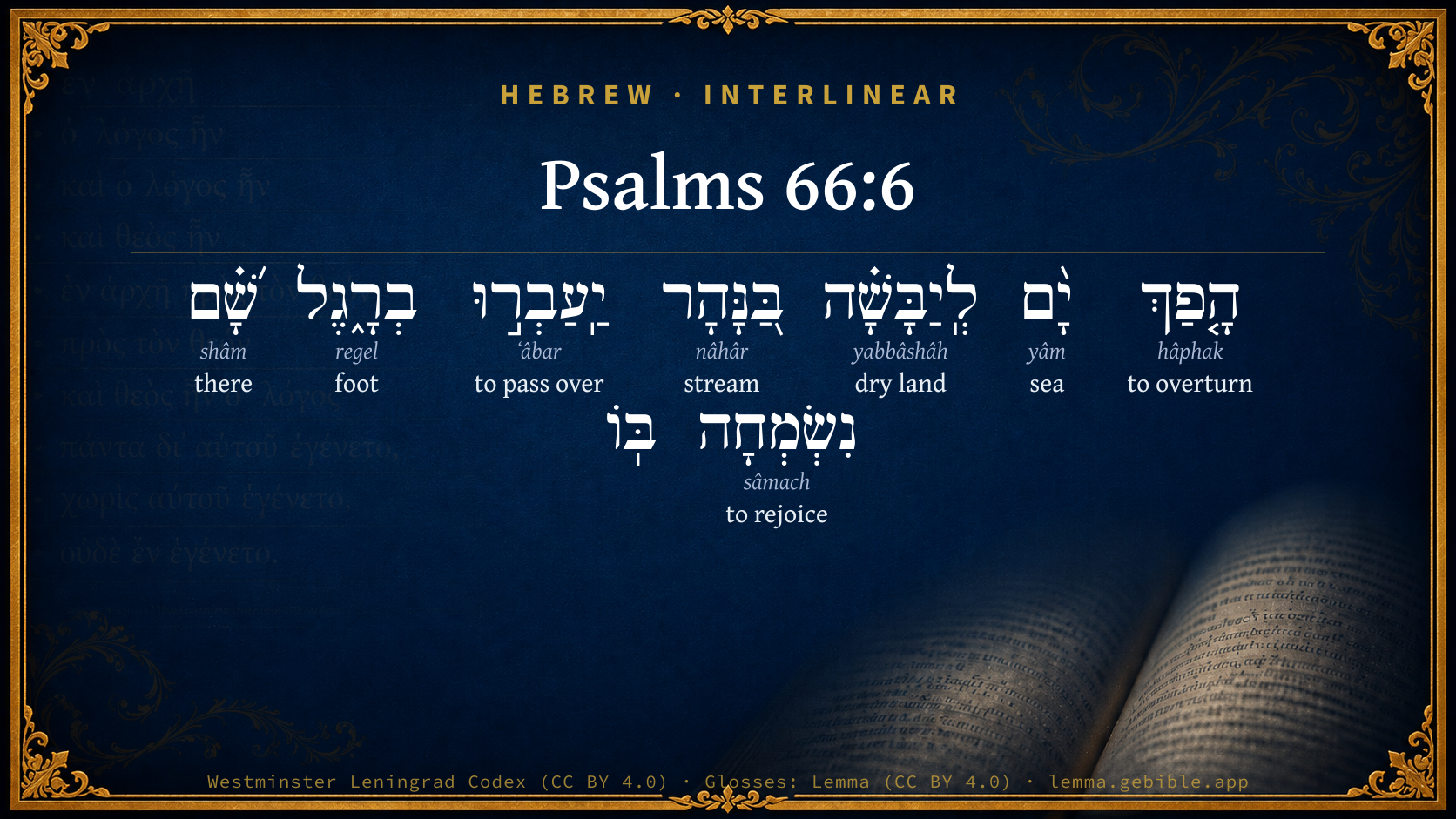
Psalms 66:6

Hebrew (Westminster Leningrad Codex) Psalms 66:6 appears in the Hebrew Old Testament. The text above is from the Westminster Leningrad Codex. Each word links to its Strong’s number, a concise gloss, and parsing drawn from the Open Scriptures Hebrew Bible morphology. Click any word for its full Brown-Driver-Briggs (BDB) entry.
Download image
Cite this verse

Psalms 66:6 (World English Bible). Public Domain. Lemma interlinear Bible study tool, https://lemma.gebible.app/v/psalms/66/6.

Show BibTeX & RIS
BibTeX
RIS
English Translation
He turned the sea into dry land. They went through the river on foot. There, we rejoiced in him.
World English Bible · Public Domain
Download a study sheet

One document with this verse’s original text, its word-by-word gloss line, the meaning frame, cross-references with their text, attributed commentary, and full source and license credits — printable, and it pastes into notes with its structure intact.

This verse Autodidact and up

Study sheet (.html) Plain text (.txt)

A passage Seminary Student

Up to 50 verses in one chapter. A passage sheet keeps up to 6 commentary sources and 12 cross-references per verse, in the order this page ranks them, and says so on the sheet whenever that leaves anything out. Ask for a single verse and you get the Autodidact verse sheet above.

Everything on this page stays free to read, with no account — the sheet is a download of what is already on screen, not access to it.

Want to remove ads? Support Godless Engineer
Compare translations 3

The same verse in 3 English versions, stacked beneath the original-language interlinear above. Click any original word for its lexicon entry.

Each is an independent rendering of the whole verse — the interlinear is not word-aligned to these translations.

Highlighted words mark where these versions differ — a whole-verse word diff, not a word-by-word alignment.

  • World English Bible Public Domain
    He turned the sea into dry land. They went through the river on foot. There, we rejoiced in him.
  • King James Version Public Domain
    He turned the sea into dry land: they went through the flood on foot: there did we rejoice in him.
  • unfoldingWord Literal Text CC BY-SA 4.0
    He turned the sea into dry land; they passed through the river on foot. There let us rejoice in him!

unfoldingWord Literal Text — © unfoldingWord, licensed CC BY-SA 4.0. Word-aligned USFM3 via Door43 (git.door43.org/unfoldingWord/en_ult).

Versions to compare (up to 4)

3 of 4 selected

Show all 18 translations

Every available English version of this verse, each an independent rendering of the whole verse.

  • World English Bible Public Domain
    He turned the sea into dry land. They went through the river on foot. There, we rejoiced in him.
  • Berean Standard Bible Public Domain
    He turned the sea into dry land; they passed through the waters on foot; there we rejoiced in Him.
  • Majority Standard Bible Public Domain
    He turned the sea into dry land; they passed through the waters on foot; there we rejoiced in Him.
  • King James Version Public Domain
    He turned the sea into dry land: they went through the flood on foot: there did we rejoice in him.
  • American Standard Version (1901) Public Domain
    He turned the sea into dry land; They went through the river on foot: There did we rejoice in him.
  • Revised Version (1885) Public Domain
    He turned the sea into dry land: they went through the river on foot: there did we rejoice in him.
  • Geneva Bible (1599) Public Domain
    He hath turned the Sea into drie land: they passe through the riuer on foote: there did we reioyce in him.
  • Douay-Rheims (1899) Public Domain
    Who turneth the sea into dry land, in the river they shall pass on foot: there shall we rejoice in him.
  • Young's Literal Translation Public Domain
    He hath turned a sea to dry land, Through a river they pass over on foot, There do we rejoice in Him.
  • Literal Standard Version CC BY-SA 4.0
    He has turned a sea to dry land, || Through a river they pass over on foot, || There we rejoice in Him.
  • Unlocked Literal Bible CC BY-SA 4.0
    He turned the sea into dry land; they went through the river on foot; there we rejoiced in him.
  • unfoldingWord Literal Text CC BY-SA 4.0
    He turned the sea into dry land; they passed through the river on foot. There let us rejoice in him!
  • Darby Bible Public Domain
    He turned the sea into dry [land]; they went through the river on foot: there did we rejoice in him.
  • World Messianic Bible Public Domain
    He turned the sea into dry land. They went through the river on foot. There, we rejoiced in him.
  • Webster's Bible Public Domain
    He turned the sea into dry land: they went through the flood on foot: there we rejoiced in him.
  • Free Bible Version CC BY-SA 4.0
    He turned the Red Sea into dry land, and his people walked across through the waters. We celebrated there because of what he did.
  • Bible in Basic English Public Domain
    The sea was turned into dry land: they went through the river on foot: there did we have joy in him.
  • JPS Tanakh (1917) Public Domain
    He turned the sea into dry land; they went through the river on foot; there let us rejoice in Him!

Literal Standard Version (2020), Covenant Press — licensed CC BY-SA 4.0. Text via the HelloAO Bible API (eBible.org). Unlocked Literal Bible (unfoldingWord) — licensed CC BY-SA 4.0. Text via the HelloAO Bible API (eBible.org). unfoldingWord Literal Text — © unfoldingWord, licensed CC BY-SA 4.0. Word-aligned USFM3 via Door43 (git.door43.org/unfoldingWord/en_ult). Free Bible Version, Dr. Jonathan Gallagher — licensed CC BY-SA 4.0. Text via the HelloAO Bible API (eBible.org).

Word by word

More ways to search: Search by grammar → Find every occurrence → Compare this word →

Practice this passage: Drill this verse → Learn its vocabulary →

About this verse

These counts appear in no published source. They are computed here, from the morphology-tagged text and Lemma’s own curated glosses. What Lemma adds →

9
words
8
distinct lemmas
Wisdom
section

Notable vocabulary

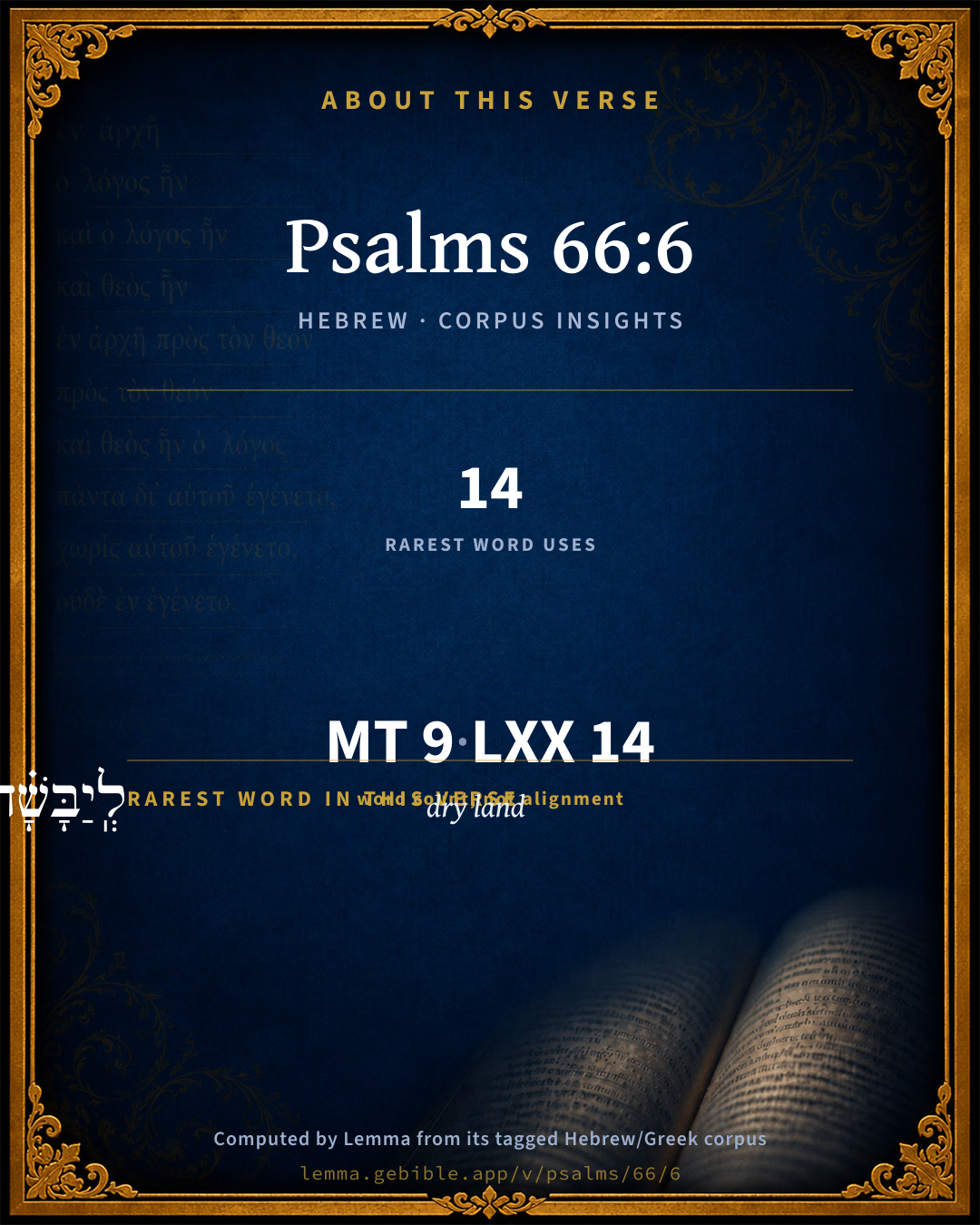
The rarest word here is לְֽיַבָּשָׁ֗ה dry land H3004 — appearing just 14 times in the whole Hebrew Bible.

Shared distinctive vocabulary

לְֽיַבָּשָׁ֗ה dry land H3004 occurs in 14 verses of the Hebrew Bible. Also found in:

Grammatical profile

  • 3 verbs
  • 4 nouns
  • 1 preposition
  • 1 adverb

Verb forms

  • הָ֤פַךְ Qal · Perfect
  • יַֽעַבְר֣וּ Qal · Imperfect
  • נִשְׂמְחָה Qal · Cohortative

Hebrew & Septuagint length

In English translation the verse runs 19 words from the Hebrew and 21 from the Septuagint (LXX English) — closely comparable.

A rough comparison of the two English renderings, which tokenize alike — not a word-level alignment.

Word counts can differ between the Hebrew and the Greek without any difference in meaning — e.g. the Hebrew direct-object marker אֵת has no separate Greek word, and Greek often adds the article ὁ.

In the original languages it is 9 Hebrew tokens and 14 Greek tokens — but the two are counted differently (Hebrew bundles its prefixes and suffixes into one token; the Greek is in lemma form), so that isn’t a like-for-like length.

Cross-references

10

Topical passages linked to Psalms 66:6 in the Treasury of Scripture Knowledge — connected by theme and wording, ordered by reader-vote popularity; previews shown in the World English Bible.

  • Joshua 3:16 that the waters which came down from above stood, and rose up in one heap, a great way off, at Adam, the city that is beside Zarethan; and those that went down toward the sea of the Arabah, even the Salt Sea, were wholly cut off: and the people passed over right against Jericho.
  • Exodus 14:21–22 Moses stretched out his hand over the sea, and Yahweh caused the sea to go back by a strong east wind all the night, and made the sea dry land, and the waters were divided.
  • Exodus 15:1–21 Then Moses and the children of Israel sang this song to Yahweh, and said, "I will sing to Yahweh, for he has triumphed gloriously: The horse and his rider he has thrown into the sea.
  • Joshua 3:14 It happened, when the people removed from their tents, to pass over the Jordan, the priests who bore the ark of the covenant being before the people;
  • Psalms 78:13 He split the sea, and caused them to pass through; He made the waters stand as a heap.
  • Psalms 106:8–12 Nevertheless he saved them for his name's sake, That he might make his mighty power known.
  • Psalms 136:13–14 To him who divided the Red Sea apart; For his loving kindness endures forever;
  • Psalms 104:5–7 He laid the foundations of the earth, That it should not be moved forever.
  • Isaiah 63:13–14 who led them through the depths, as a horse in the wilderness, so that they didn't stumble?
  • Revelation 15:2–3 I saw something like a sea of glass mixed with fire, and those who overcame the beast, his image, and the number of his name, standing on the sea of glass, having harps of God.

Cross-references courtesy of OpenBible.info (CC BY 4.0).

Hebrew and Greek witnesses Masoretic Hebrew ↔ Greek Septuagint

The same verse in the two great witnesses to the Old Testament, shown verse-for-verse.

You’re reading Greek Psalm 65 (Hebrew Psalm 66). The Septuagint counts the superscription, so verse numbers can differ from the Hebrew — chapter-level alignment, not verse-by-verse. Numbering follows Rahlfs.

These are two independent witnesses, not word-aligned to each other, and the Septuagint is shown in lemma (dictionary) form.

Hebrew Psalms 66:6 Masoretic · Westminster Leningrad Codex

הָ֤פַךְ יָ֨ם לְֽיַבָּשָׁ֗ה בַּ֭נָּהָר יַֽעַבְר֣וּ בְרָ֑גֶל שָׁ֝֗ם נִשְׂמְחָה בּֽוֹ

He turned the sea into dry land. They went through the river on foot. There, we rejoiced in him.

World English Bible · Public Domain

Greek LXX Greek Psalm 65:6 Septuagint · lemma form

ὁ μεταστρέφω ὁ θάλασσα εἰς ξηρός ἐν ποταμός διαἔρχομαι πούς ἐκεῖ εὐφραίνω ἐπί αὐτός

Who turns the sea into dry land; they shall go through the river on foot; there shall we rejoice in him,

LXX2012 (modern English Septuagint) · Public Domain

On this verse, Ellicott's Commentary for English Readers discusses the Septuagint’s reading. Read the note in Commentary ↓

Hebrew: Westminster Leningrad Codex (CC BY 4.0). Greek: Septuagint (public domain); English from LXX2012 (modern English Septuagint) (Public Domain). How the Septuagint differs from the Hebrew →

Commentary

Notes on Psalms 66:6 from classic Christian and Jewish commentators (each source and its license shown beneath its notes). The classic Christian expositions comment on the surrounding passage and are grouped to its opening verse, so a note may address several verses; the Jewish commentaries on the Tanakh (Rashi and others) are per-verse, so they appear only where the commentator wrote on this verse.

Lemma curates 59 commentaries, every one of them public domain or Creative Commons licensed, each selected and text-cleaned for this edition rather than reprinted as found. About our sources →

Trapp's Complete Commentary

John Trapp

Psa 66:6 He turned the sea into dry [land]: they went through the flood on foot: there did we rejoice in him.

Ver. 6. He turned the sea into dry land] A mercy much celebrated, and not without cause, in all later ages.

They went through the flood on foot] That is, through the river Jordan, when it had overflowed the banks; and met with no enemy on the other side to forbid their landing.

There did we rejoice in him] We who were then in the loins of our forefathers, and so shared in their joy. See Hos 12:4. {See Trapp on "Hos 12:4"}

John Trapp, A Commentary or Exposition upon All the Books of the Old and New Testament (1647–1656) — public domain. Text from a community e-Sword module.

J. A. Alexander on Psalms

Joseph Addison Alexander

6. (Psa 66:6) He turned the sea into the dry land ; through the river they shall pass on foot; there will we rejoice in him. There is an obvious allusion to the crossing of the Red Sea and the Jordan, not as mere historical events, but as types or samples of God's extraordinary interpositions on behalf of Israel, such as might be realized again in their experience. Hence the promiscuous use of preterite and future forms, as if to say, the God of Israel will again turn the Red Sea into dry land for the passage of his people; if need be, they shall again cross the Jordan dry shod; there, on the scene of these miraculous events, shall we again rejoice in him. The combination of sea and river seems to show that by the latter we must understand Jordan, and not, as some interpreters suppose, the Euphrates, which is commonly so called. But see Isa 11:15-16, Zec 10:11.

Joseph Addison Alexander, The Psalms Translated and Explained (1850) — public domain. Text from a community e-Sword module.

Adam Clarke's Commentary

Verse 6. He turned the sea into dry land] This was a plain miracle: no human art or contrivance could do this. Even in the bed of the waters THEY did rejoice in him. WE have not less cause to praise and be thankful.

Adam Clarke's Commentary on the Bible (1810–1826) — public domain. Text from a community e-Sword/MySword module.

Ellicott's Commentary for English Readers

(6) Flood.—Hebrew, nâhar, which generally stands for the Euphrates, but here, as in Psa_74:15, for either the Jordan or the Red Sea.

There did we rejoice.—The verb is properly optative—there (i.e., in those works) let us rejoice, and thus rendered is more in keeping with the first verses of the psalm. The LXX. and Vulg. have the future, “There we will rejoice in him.”

A Bible Commentary for English Readers, edited by Charles John Ellicott (1878–1897) — public domain. Text from a community e-Sword module.

The Cambridge Bible for Schools and Colleges

gen. ed. J. J. S. Perowne

6. The passage of the Red Sea and the crossing of the Jordan are referred to as the most notable of His terrible acts (Psa_65:5). Cp. Psa_74:13; Psa_78:13; &c. Flood, as in Jos_24:2-3; Jos_24:14-15, is an archaism for river (R.V.).

there did we rejoice in him] At the Red Sea and the Jordan. The Psalmist can thus identify himself and his contemporaries with the Israelites of ancient time, for he regards the nation as possessing an unbroken continuity of life. This rendering is grammatically justifiable, and it suits the context better than the alternative of R.V. marg., there let us rejoice in him, whether this is understood to mean, “There—on the spot where those old historical events occurred,—there let us take our stand, and renew our praise to Him, our wondrous Benefactor” (Kay); or, “There, pointing as it were to the field in which God had made bare His arm, and where the past history had been repeated in the present, there let us rejoice in Him” (Perowne). For the Psalmist is addressing the nations, not his countrymen, and a historical reference to the rejoicing which took place after the passage of the Red Sea is more natural than an invitation to join in celebrating either that or the recent deliverance. Moreover mention of the recent deliverance appears to be reserved for the next stanza, to which Psa_66:7 forms the appropriate transition. Bp. Perowne’s explanation would at any rate require the adoption of the LXX reading, ‘who turneth the sea into dry land, they go through the river on foot’; i.e. He is ever doing as He did at the Red Sea and the Jordan, opening ways of escape for His people.

The Cambridge Bible for Schools and Colleges (gen. ed. J. J. S. Perowne; Cambridge University Press, 1878–1918) — public domain. Text from a community e-Sword module.

John Gill's Exposition

He turned the sea into dry land,.... The Red sea, or sea of Zuph, as the Targum; by causing a strong east wind to blow, which made it dry, so that the children of Israel passed through it on dry ground, Exo 14:21. Or, "he turneth" (y); for though the allusion is to the making the Red sea dry land, when the Israelites passed through it; yet it refers to something to be done in the times of Christ and the Gospel dispensation. So Christ might be said to do this literally, when he walked upon the sea of Galilee as on dry land, and enabled Peter to do so likewise, Mat 14:25; and figuratively, when he makes his people walk through the sea of this world, and the waters of afflictions in it, without overflowing them. He with them, bears them up, and upholds them with his right hand; so that they pass on, as on dry land, till they come safe to the shores of bliss and happiness;

they went through the flood on foot; or "river" (z); the river Jordan, as the Targum: for this alludes not to the passage of the Israelites through the sea, but through Jordan, when they entered into the land, of Canaan, Jos 3:17. The words may be rendered, according to Kimchi,

"they shall pass through the river on foot;''

the Targum adds,

"the children of Israel;''

so the Septuagint, Vulgate Latin, Ethiopic, and Arabic versions. Such things are said in prophecy concerning the people of God in future times; see Isa 11:15. So the river Euphrates shall be dried up, to make way for the kings of the east, Rev 16:12;

there did we rejoice in him; still alluding to the above cases, when Israel passed through the Red sea, and sung praise to God; and went through Jordan, and set up stones of memorial, Exo 15:1. Or "there shall we rejoice in him": so the Septuagint, Vulgate Latin, Ethiopic, Syriac, and Arabic versions; only the latter reads in the singular, "he shall rejoice." The Targum is,

"I will lead them to the mountain of his holiness, there shall we rejoice in his word:''

in the essential Word, the Messiah, as the saints do rejoice in him in his house, under his word and ordinances; when they see the salvation wrought out by him, and their interest in it; the righteousness he has brought in, and themselves clothed with it; pardon procured by him, and that applied to them; and when they are favoured with a sight of him, and communion with him; so will they rejoice in him when the marriage of the Lamb is come, and the bride is ready; when antichrist shall be destroyed, and they shall have got the victory over him; then they shall stand on the sea of glass, and there shall they sing the song of Moses and of the Lamb, Rev 19:7; and when they shall have come through all their difficulties safely to heaven; there shall they rejoice in Christ, and with him to all eternity.

(y) "convertit", V. L. Pagninus, Montanus, &c. (z) "per fluvium", Gejerus.

John Gill's Exposition of the Whole Bible (1746–1763) — public domain (CC PDM 1.0). Text via the HelloAO Bible API.

Albert Barnes' Notes on the Bible

He turned the sea into dry land - The Red Sea, when he brought his people out of Egypt, Exo 14:21. This was an illustration of his power, and of his ability to defend and deliver his people. The terror in that case, or that which was “terrible,” was the overthrow of their enemies the destruction of the Egyptians in the Red Sea - thus showing that he had power to destroy all the enemies of his people.

They went through the flood on foot - literally, “through the river.” It is probable that the reference here is to the passage of the river Jordan, when the Israelites were about to pass into the promised land Jos 3:14-17; thus combining the two great acts of divine interposition in favor of his people, and showing his power over streams and floods.

There did we rejoice in him - We, as a nation - our fathers - thus rejoiced in God. See Exo. 15.

Albert Barnes' Notes on the Bible (1834–1885) — public domain. Text from a community e-Sword/MySword module.

Matthew Poole's English Annotations

The flood, or river, to wit, Jordan. We, i.e. our nation, or our ancestors, in whose loins we then were, and the benefit of which ancient deliverance we at this day enjoy. See the like expressions Psa 81:5; Hos 12:4. The whole people of Israel are oft considered as one body, continued through all succeeding generations, united in the bond of the same covenant and worship, and in the possession of the same promises, and privileges, and blessings, and acted by one and the same spirit; and therefore several and contrary things may reasonably be ascribed to them, in regard of their several parts and ages, and what was done in one age may be imputed to another by virtue of their strict conjunction with the same body.

Matthew Poole's English Annotations on the Holy Bible (1683–1685) — public domain. Text from a community e-Sword/MySword module.

The Treasury of David

Charles H. Spurgeon

Ver. 6. He turned the sea into dry land. It was no slight miracle to divide a pathway through such a sea, and to make it fit for the traffic of a whole nation. He who did this can do anything, and must be God, the worthy object of adoration. The Christian's inference is that no obstacle in his journey heavenward need hinder him, for the sea could not hinder Israel, and even death itself shall be as life; the sea shall be dry land when God's presence is felt.

They went through the flood on foot. Through the river the tribes passed dry shod, Jordan was afraid because of them.

"What ailed thee, O thou mighty sea?

Why rolled thy waves in dread?

What bade thy tide, O Jordan, flee

And bare its deepest bed?"

"O earth, before the Lord, the God

Of Jacob, tremble still;

Who makes the waste a watered sod,

The flint a gushing rill."

There did we rejoice in him. We participate this day in that ancient joy. The scene is so vividly before us that it seems as if we were there personally, singing unto the Lord because he hath triumphed gloriously. Faith casts herself bodily into the past joys of the saints, and realises them for herself in much the same fashion in which she projects herself into the bliss of the future, and becomes the substance of things hoped for. It is to be remarked that Israel's joy was in her God, and there let ours be. It is not so much what he has done, as what he is, that should excite in us a sacred rejoicing. "He is my God, and I will prepare him an habitation; my father's God, and I will exalt him."

Ver. 6. He turned the sea into dry land. The psalmist refers to the passage through the Red Sea and the Jordan, not as to transactions which took place and were concluded at a given period of time, but as happening really in every age. God's guidance of his people is a constant drying up of the sea and of the Jordan, and the joy over his mighty deeds is always receiving new materials. E. W. Hengstenberg.

Ver. 6. There did we rejoice in him; where those things have been done, there have we rejoiced in him, not taking any credit to ourselves as if they were our acts, but rejoicing and glorying in God, and have praised him, as may be seen in Exodus 15 and Joshua 3. The prophet uses the future for the past, unless, perhaps, he meant to insinuate that these miracles would be succeeded by much greater ones, of which they were only the types and figures. A much greater miracle is that men should pass over the bitter sea of this life, and cross the river of mortality, that never ceases to run, and which swallows up and drowns so many, and still come safe and alive to the land of eternal promise, and there rejoice in God himself, beholding him face to face; and yet this greater miracle is so accomplished by God, that many pass through this sea as if it were dry land, and cross this river with dry feet; that is to say, having no difficulty in despising all things temporal, be they good or be they bad; that is to say, being neither attached to the good things, nor fearing the evil things, of this world, that they may arrive in security at the heavenly Jerusalem, where we will rejoice in him, not in hope, but in complete possession for eternity. Robert Bellarmine.

Ver. 6. Great difficulties, unexpectedly overcome, made the theme of joy.

Ver. 6. (last clause). Our share in the past deliverances of the church.

Psalms 66:7*

Charles H. Spurgeon's The Treasury of David (1869–1885) — public domain. Psalms only. Text from a community e-Sword/MySword module.

Whedon's Commentary on the Bible

Daniel D. Whedon

6. He turned the sea… the flood—That is, the sea and the river. The allusion is to the crossing the Red Sea and the river Jordan by the Israelites.

There did we rejoice in him—There let us rejoice, or, there will we rejoice in him. The address now is to the congregation, to rejoice that the God of ancient Israel is the same to his people in all ages, as he has reassured them by his recent acts. The adverb “there” should here take the sense of therein, as in Hos_6:7, and read, Therein will “we rejoice in him.”

Daniel D. Whedon (gen. ed.), Commentary on the Old and New Testaments (1874–1909) — public domain. Text from a community e-Sword module.

The Pulpit Commentary

He turned the sea into dry land: they went through the flood on foot; there did we rejoice in him. The passage of the Red Sea at the time of the Exodus was one of the most wonderful of God"s works. To the Israelites it was altogether a matter of joy and rejoicing. (see Exo_15:1-21) But how terrible a thing was it to the Egyptians! "The waters returned, and covered the chariots, and the horsemen, and all the host of Pharaoh that came into the sea after them; there remained not so much as one of them". (Exo_14:28)

The Pulpit Commentary (1880–1919), ed. H.D.M. Spence-Jones & Joseph S. Exell — public domain. Text from a community e-Sword module.

John Wesley's Explanatory Notes

We - Our nation, or our ancestors, in whose loins we then were.

John Wesley, Explanatory Notes Upon the Whole Bible (1754–1765) — public domain. Text via the GEBible commentary corpus.

Rashi

Rabbi Shlomo Yitzchaki (Rashi)

He turned the sea into dry land The Sea of Reeds.

there it rejoiced with it I found: There was a thing with which the sea rejoiced, i.e., that the sea saw the Holy One, blessed be He.

Rashi on the Tanakh — English translations: “The Judaica Press complete Tanach with Rashi, translated by A. J. Rosenberg” (CC BY 4.0); “Pentateuch with Rashi's commentary by M. Rosenbaum and A.M. Silbermann, 1929-1934” (public domain); “The Metsudah Tanach series, Lakewood, N.J” (CC BY 4.0); and “The Book of Joshua, Metsudah Publications, 1997” (CC BY 4.0). Text via Sefaria.

Lesson kit

Teaching starters — assembled from the data on this page, not authored interpretation. Every prompt links to the verse data it draws on. Edit before teaching.

Psalms, in the Wisdom, opens this verse with 9 words (8 distinct Hebrew lemmas). Its most distinctive word is yabbâshâh (“dry land”). A historical commentator’s framing appears above. Read the whole chapter for the surrounding context.

Discussion questions

  1. How does “dry land” (yabbâshâh) shape what this verse is saying?
  2. Genesis 1:9 shares the word «dry land» with this verse. How do the two illuminate each other?
  3. These translations render this verse differently. What is at stake in choosing one wording over another?
  4. The verb «הָ֤פַךְ» is Qal Perfect. How does its form color the action?
  5. Reading how Trapp's Complete Commentary and J. A. Alexander on Psalms read this verse, where do the two commentators agree and where do they part?

Things to notice

Reading settings

Reading text

Shown beneath each verse's original-language words.

Old Testament
Old Testament edition

Read the OT as the Masoretic Hebrew (MT) or the Greek Septuagint (LXX).

English shown for the Greek Septuagint (in the Hebrew ↔ Greek comparison).

Comparing translations? Open the Compare panel on any verse page to stack up to four side by side.