Deuteronomy 34:2

Hebrew (Westminster Leningrad Codex) Deuteronomy 34:2 appears in the Hebrew Old Testament. The text above is from the Westminster Leningrad Codex. Each word links to its Strong’s number, a concise gloss, and parsing drawn from the Open Scriptures Hebrew Bible morphology. Click any word for its full Brown-Driver-Briggs (BDB) entry.
Download image
Cite this verse

Deuteronomy 34:2 (World English Bible). Public Domain. Lemma interlinear Bible study tool, https://lemma.gebible.app/v/deuteronomy/34/2.

Show BibTeX & RIS
BibTeX
RIS
English Translation
and all Naphtali, and the land of Ephraim and Manasseh, and all the land of Judah, to the hinder sea,
World English Bible · Public Domain
Download a study sheet

One document with this verse’s original text, its word-by-word gloss line, the meaning frame, cross-references with their text, attributed commentary, and full source and license credits — printable, and it pastes into notes with its structure intact.

This verse Autodidact and up

Study sheet (.html) Plain text (.txt)

A passage Seminary Student

Up to 50 verses in one chapter. A passage sheet keeps up to 6 commentary sources and 12 cross-references per verse, in the order this page ranks them, and says so on the sheet whenever that leaves anything out. Ask for a single verse and you get the Autodidact verse sheet above.

Everything on this page stays free to read, with no account — the sheet is a download of what is already on screen, not access to it.

Want to remove ads? Support Godless Engineer
Compare translations 3

The same verse in 3 English versions, stacked beneath the original-language interlinear above. Click any original word for its lexicon entry.

Each is an independent rendering of the whole verse — the interlinear is not word-aligned to these translations.

Highlighted words mark where these versions differ — a whole-verse word diff, not a word-by-word alignment.

  • World English Bible Public Domain
    and all Naphtali, and the land of Ephraim and Manasseh, and all the land of Judah, to the hinder sea,
  • King James Version Public Domain
    And all Naphtali, and the land of Ephraim, and Manasseh, and all the land of Judah, unto the utmost sea,
  • unfoldingWord Literal Text CC BY-SA 4.0
    and all Naphtali, and the land of Ephraim and Manasseh, and all the land of Judah, to the western sea,

unfoldingWord Literal Text — © unfoldingWord, licensed CC BY-SA 4.0. Word-aligned USFM3 via Door43 (git.door43.org/unfoldingWord/en_ult).

Versions to compare (up to 4)

3 of 4 selected

Show all 18 translations

Every available English version of this verse, each an independent rendering of the whole verse.

  • World English Bible Public Domain
    and all Naphtali, and the land of Ephraim and Manasseh, and all the land of Judah, to the hinder sea,
  • Berean Standard Bible Public Domain
    all of Naphtali, the land of Ephraim and Manasseh, all the land of Judah as far as the Western Sea,
  • Majority Standard Bible Public Domain
    all of Naphtali, the land of Ephraim and Manasseh, all the land of Judah as far as the Western Sea,
  • King James Version Public Domain
    And all Naphtali, and the land of Ephraim, and Manasseh, and all the land of Judah, unto the utmost sea,
  • American Standard Version (1901) Public Domain
    and all Naphtali, and the land of Ephraim and Manasseh, and all the land of Judah, unto the hinder sea,
  • Revised Version (1885) Public Domain
    and all Naphtali, and the land of Ephraim and Manasseh, and all the land of Judah, unto the hinder sea;
  • Geneva Bible (1599) Public Domain
    And all Naphtali and the land of Ephraim and Manasseh, and all the land of Iudah, vnto the vtmost sea:
  • Douay-Rheims (1899) Public Domain
    And all Nephtali, and the land of Ephraim and Manasses, and all the land of Juda unto the furthermost sea,
  • Young's Literal Translation Public Domain
    and all Naphtali, and the land of Ephraim, and Manasseh, and all the land of Judah unto the further sea,
  • Literal Standard Version CC BY-SA 4.0
    and all Naphtali, and the land of Ephraim, and Manasseh, and all the land of Judah to the Western Sea,
  • Unlocked Literal Bible CC BY-SA 4.0
    and all Naphtali, and the land of Ephraim and Manasseh, and all the land of Judah, to the western sea,
  • unfoldingWord Literal Text CC BY-SA 4.0
    and all Naphtali, and the land of Ephraim and Manasseh, and all the land of Judah, to the western sea,
  • Darby Bible Public Domain
    and all Naphtali, and the land of Ephraim, and Manasseh, and all the land of Judah, unto the hindmost sea,
  • World Messianic Bible Public Domain
    and all Naphtali, and the land of Ephraim and Manasseh, and all the land of Judah, to the Western Sea,
  • Webster's Bible Public Domain
    And all Naphtali, and the land of Ephraim, and Manasseh, and all the land of Judah, to the utmost sea,
  • Free Bible Version CC BY-SA 4.0
    This included all the territories of Naphtali, Ephraim and Manasseh, Judah as far as the Mediterranean Sea,
  • Bible in Basic English Public Domain
    And all Naphtali and the land of Ephraim and Manasseh, and all the land of Judah, as far as the Great Sea of the west;
  • JPS Tanakh (1917) Public Domain
    and all Naphtali, and the land of Ephraim and Manasseh, and all the land of Judah as far as the hinder sea;

Literal Standard Version (2020), Covenant Press — licensed CC BY-SA 4.0. Text via the HelloAO Bible API (eBible.org). Unlocked Literal Bible (unfoldingWord) — licensed CC BY-SA 4.0. Text via the HelloAO Bible API (eBible.org). unfoldingWord Literal Text — © unfoldingWord, licensed CC BY-SA 4.0. Word-aligned USFM3 via Door43 (git.door43.org/unfoldingWord/en_ult). Free Bible Version, Dr. Jonathan Gallagher — licensed CC BY-SA 4.0. Text via the HelloAO Bible API (eBible.org).

Word by word

More ways to search: Search by grammar → Find every occurrence → Compare this word →

Practice this passage: Drill this verse → Learn its vocabulary →

נַפְתָּלִ֔י
Naphtâlîy
H5321
“Naphtali”
Noun, Proper
Part of Speech
Noun
Type
Proper
Full BDB Definition

Origin: from H6617

TWOT: None

Naphtali = "wrestling" - the 5th son of Jacob and the 2nd by Bilhah the handmaid of Rachel (noun proper masculine) - the tribe descended from Naphtali the son of Jacob (noun proper masculine) - the territory assigned to the tribe of Naphtali (noun proper locative)
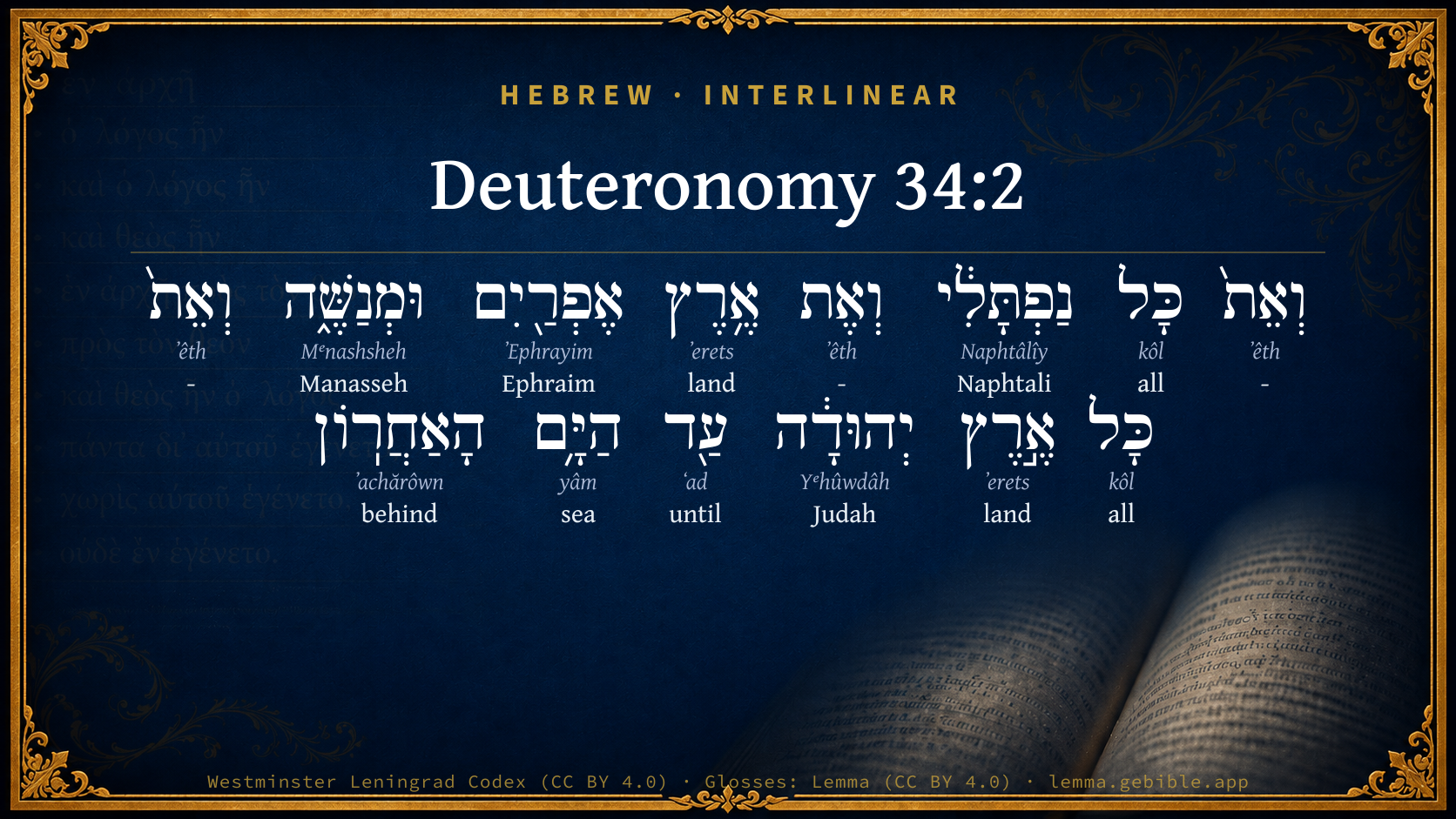
  1. וְאֵת֙ ʼêth H853 “and · -” Conjunction + Particle, Direct Object
  2. כָּל kôl H3605 “all of” Noun, Common, Masculine, Singular, Construct
  3. וְאֶת ʼêth H853 “and · -” Conjunction + Particle, Direct Object
  4. אֶ֥רֶץ ʼerets H776 “land of” Noun, Common, Both, Singular, Construct
  5. אֶפְרַ֖יִם ʼEphrayim H669 “Ephraim” Noun, Proper
  6. וּמְנַשֶּׁ֑ה Mᵉnashsheh H4519 “and · Manasseh” Conjunction + Noun, Proper
  7. וְאֵת֙ ʼêth H853 “and · -” Conjunction + Particle, Direct Object
  8. כָּל kôl H3605 “all of” Noun, Common, Masculine, Singular, Construct
  9. אֶ֣רֶץ ʼerets H776 “land of” Noun, Common, Both, Singular, Construct
  10. יְהוּדָ֔ה Yᵉhûwdâh H3063 “Judah” Noun, Proper
  11. עַ֖ד ʻad H5704 “until” Preposition
  12. הַיָּ֥ם yâm H3220 “the · sea” Particle, Definite Article + Noun, Common, Masculine, Singular, Absolute
  13. הָאַחֲרֽוֹן ʼachărôwn H314 “the · behind” Particle, Definite Article + Adjective, Adjective, Masculine, Singular, Absolute

About this verse

These counts appear in no published source. They are computed here, from the morphology-tagged text and Lemma’s own curated glosses. What Lemma adds →

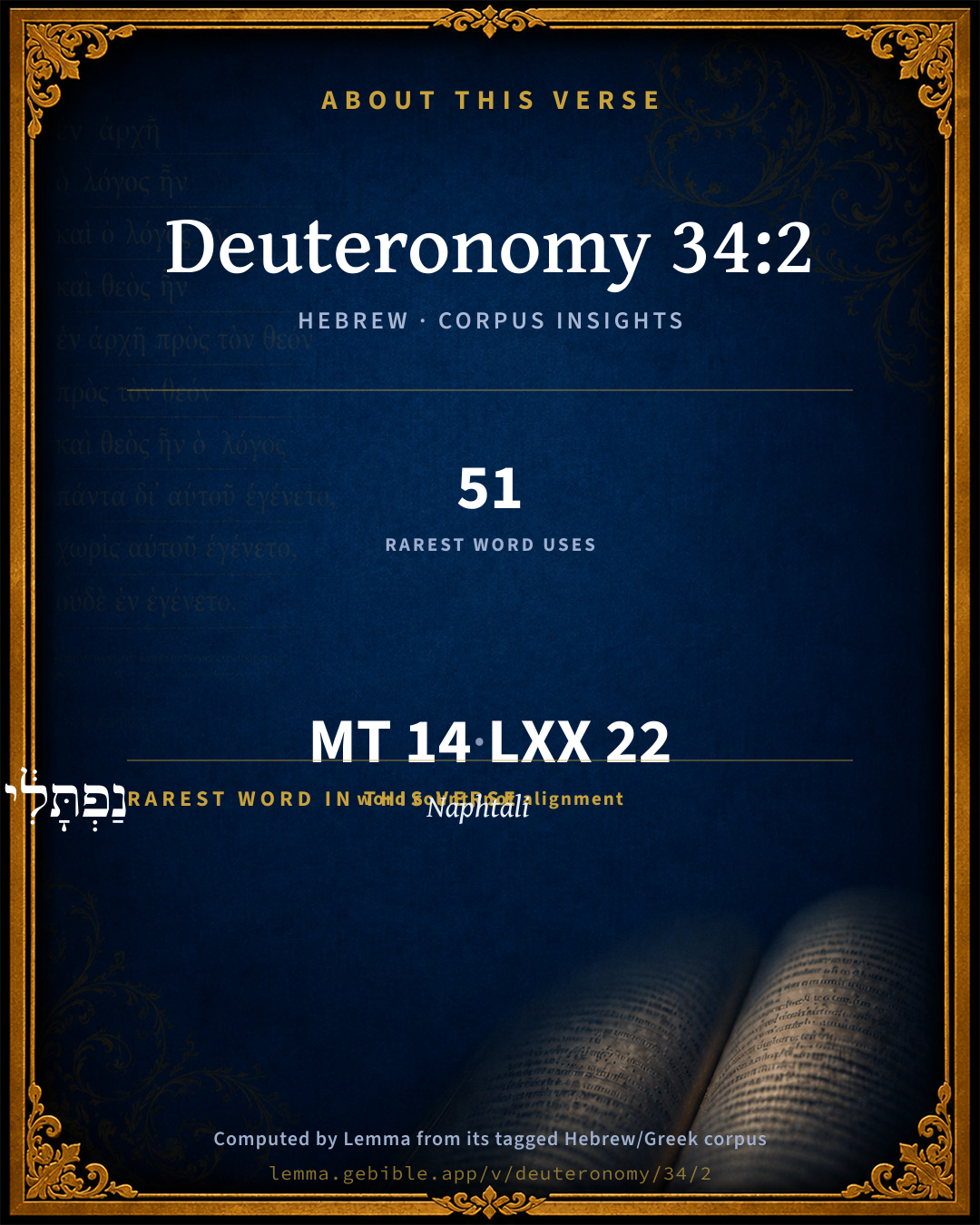
14
words
10
distinct lemmas
Pentateuch
section

Shared distinctive vocabulary

נַפְתָּלִ֔י Naphtali H5321 occurs in 47 verses of the Hebrew Bible. Also found in:

Grammatical profile

  • 9 nouns
  • 1 adjective
  • 1 preposition
  • 3 particles

Repetition

Words recur within this verse — often emphatic in Hebrew:

  • כָּל all H3605 ×2
  • אֶ֥רֶץ land H776 ×2

Hebrew & Septuagint length

In English translation the verse runs 20 words from the Hebrew and 18 from the Septuagint (LXX English) — closely comparable.

A rough comparison of the two English renderings, which tokenize alike — not a word-level alignment.

Word counts can differ between the Hebrew and the Greek without any difference in meaning — e.g. the Hebrew direct-object marker אֵת has no separate Greek word, and Greek often adds the article ὁ.

In the original languages it is 14 Hebrew tokens and 22 Greek tokens — but the two are counted differently (Hebrew bundles its prefixes and suffixes into one token; the Greek is in lemma form), so that isn’t a like-for-like length.

Cross-references

4

Topical passages linked to Deuteronomy 34:2 in the Treasury of Scripture Knowledge — connected by theme and wording, ordered by reader-vote popularity; previews shown in the World English Bible.

  • Deuteronomy 11:24 Every place whereon the sole of your foot shall tread shall be yours: from the wilderness, and Lebanon, from the river, the river Euphrates, even to the hinder sea shall be your border.
  • Exodus 23:31 I will set your border from the Red Sea even to the sea of the Philistines, and from the wilderness to the River; for I will deliver the inhabitants of the land into your hand, and you shall drive them out before you.
  • Numbers 34:6 For the western border, you shall have the great sea and the border [of it]: this shall be your west border.
  • Joshua 15:12 The west border was to the great sea, and the border [of it]. This is the border of the children of Judah round about according to their families.

Cross-references courtesy of OpenBible.info (CC BY 4.0).

Hebrew and Greek witnesses Masoretic Hebrew ↔ Greek Septuagint

The same verse in the two great witnesses to the Old Testament, shown verse-for-verse.

These are two independent witnesses, not word-aligned to each other, and the Septuagint is shown in lemma (dictionary) form.

Hebrew Deuteronomy 34:2 Masoretic · Westminster Leningrad Codex

וְאֵת֙ כָּל נַפְתָּלִ֔י וְאֶת אֶ֥רֶץ אֶפְרַ֖יִם וּמְנַשֶּׁ֑ה וְאֵת֙ כָּל אֶ֣רֶץ יְהוּדָ֔ה עַ֖ד הַיָּ֥ם הָאַחֲרֽוֹן

and all Naphtali, and the land of Ephraim and Manasseh, and all the land of Judah, to the hinder sea,

World English Bible · Public Domain

Greek LXX Deuteronomy 34:2 Septuagint · lemma form

καί πᾶς ὁ γῆ νεφθαλι καί πᾶς ὁ γῆ ἐφράιμ καί μανασσή καί πᾶς ὁ γῆ ιουδα ἕως ὁ θάλασσα ὁ ἔσχατος

and all the land of Ephraim and Manasse, and all the land of Juda to the farthest sea;

LXX2012 (modern English Septuagint) · Public Domain

On this verse, The Cambridge Bible for Schools and Colleges discusses the Septuagint’s reading. Read the note in Commentary ↓

Hebrew: Westminster Leningrad Codex (CC BY 4.0). Greek: Septuagint (public domain); English from LXX2012 (modern English Septuagint) (Public Domain). How the Septuagint differs from the Hebrew →

Targum (Aramaic paraphrase)

2

The Targum is the ancient Jewish Aramaic paraphrase of the Hebrew Scriptures — an interpretive translation, not the Hebrew text itself. Onkelos (literal) and Pseudo-Jonathan (expansive) render the Torah, and Jonathan the Prophets. Coverage is partial: where no permissively-licensed English translation exists for a verse, only the Aramaic is shown. This is verse-level text, not a word-by-word alignment to the Hebrew.

  1. Targum Onkelos Torah (Genesis–Deuteronomy)
    וְיָת כָּל נַפְתָּלִי וְיָת אַרְעָא דְאֶפְרַיִם וּמְנַשֶׁה וְיָת כָּל אַרְעָא דִיהוּדָה עַד יַמָא מַעַרְבָא

    (no public-domain English translation for this verse)

    Targum Onkelos — Aramaic: “Onkelos Genesis” (public domain); “Onkelos Exodus” (public domain); “Onkelos Leviticus” (public domain); “Onkelos Numbers” (public domain); “Onkelos Deuteronomy” (public domain). English: “Sefaria Community Translation” (CC0 1.0 (public-domain dedication)); “J.W. Etheridge. The Targums of Onkelos and Jonathan Ben Uzziel on the Pentateuch. London: Longmans, Green, 1862” (public domain). Text via Sefaria.

  2. Targum Pseudo-Jonathan Torah (Genesis–Deuteronomy)
    וְיַת אַלַּוּף סַרְכוּן מִדְּבֵית נַפְתָּלִי דְּמִתְחַבְּרִין עִם בָּרָק וְיַת מַלְכַיָא דְעָתִיד לְמִקְטַל יְהוֹשֻׁעַ בַּר נוּן דְמִן שֵׁיבַט אֶפְרַיִם וּגְבוּרָן דְגִדְעוֹן בַּר יוֹאָשׁ דְמִן שֵׁבַט מְנַשֶׁה וְיַת כָּל מַלְכַיָּא דְיִשְרָאֵל וּמַלְכוּתָא דְּבֵית יְהוּדָה דִשְׁלִיטוּ בְּאַרְעָא עַד דְאִצְתַּדֵי בֵּית מוּקְדְשָׁא בַּתְרָאָה

    and the thousand princes of Beth Naphtali who would gather with Barak, and the kings who would be slain by Jehoshua bar Nun of the tribe of Ephraim, and the deeds of strength to be wrought by Gideon bar Yoash of the tribe of Menasheh, and all the kings of Israel, and of the kingdom of Beth Jehudah, who would have dominion in the land until the latter sanctuary should be destroyed.

    Targum Pseudo-Jonathan — Aramaic: “Targum Jonathan on Genesis” (public domain); “Targum Jonathan on Exodus” (public domain); “Targum Jonathan on Leviticus” (public domain); “Targum Jonathan on Numbers” (public domain); “Targum Jonathan on Deuteronomy” (public domain). English: “The Targum of Jonathan ben Uzziel, trans. J. W. Etheridge, London, 1862” (public domain). Text via Sefaria.

Commentary

Notes on Deuteronomy 34:2 from classic Christian and Jewish commentators (each source and its license shown beneath its notes). The classic Christian expositions comment on the surrounding passage and are grouped to its opening verse, so a note may address several verses; the Jewish commentaries on the Tanakh (Rashi and others) are per-verse, so they appear only where the commentator wrote on this verse.

Lemma curates 59 commentaries, every one of them public domain or Creative Commons licensed, each selected and text-cleaned for this edition rather than reprinted as found. About our sources →

Trapp's Complete Commentary

John Trapp

Deu 34:2 And all Naphtali, and the land of Ephraim, and Manasseh, and all the land of Judah, unto the utmost sea,

Ver. 2. Unto the utmost sea.] The Mediterranean.

John Trapp, A Commentary or Exposition upon All the Books of the Old and New Testament (1647–1656) — public domain. Text from a community e-Sword module.

Joseph Benson's Commentary

Deu 34:2-3. All Naphtali — The land of Naphtali, which, together with Dan, was in the north of Canaan, as Ephraim and Manasseh were in the midland parts, and Judah on the south, and the sea on the west. So these parts, lying in the several quarters, are put for all the rest. He stood in the east, and saw also Gilead, which was in the eastern part of the land, and thence he saw the north, and south, and west. The utmost sea — The midland sea, which was the utmost bound of the land of promise on the west. The south — The south quarter of the land of Judah, which is toward the salt sea. The city of palm-trees — Jericho, so called from the multitude of palm-trees which were in those parts, as Josephus and Strabo write. From whence, and the balm there growing, it was called Jericho, which signifies, odoriferous or sweet smelling.

Joseph Benson's Commentary on the Old and New Testaments (1811–1818) — public domain. Text from a community e-Sword module.

Tyndale Open Study Notes

Tyndale Open Resources

34:2 The land of Naphtali was northwest of Nebo and west of the Sea of Galilee. • The land of Ephraim and Manasseh was a large area to the west-northwest of Nebo, the present West Bank area of Palestine. • The land of Judah lay to the immediate west-southwest of Nebo, from the Jordan River to the Mediterranean Sea.

Tyndale Open Study Notes — © Tyndale Open Resources, licensed CC BY-SA 4.0. Text via the HelloAO Bible API.

Geneva Bible (1599)

Geneva Bible translators

Called, Mediterranean.

Geneva Bible (1599) marginal notes — public domain. Text via Bolls.life.

The Cambridge Bible for Schools and Colleges

gen. ed. J. J. S. Perowne

2. all Naphtali] The lofty country N. and N.W. of the Lake of Galilee, some of whose hills, over 2,500 feet, may (as Dri. says) be visible from Nebo, as the lower Mt Tabor to the S. of them is.

and all the land of Ephraim and Manasseh] So LXX. These certainly are in sight with Ebal and Gerizim and the intervening valley particularly distinct.

all the land of Judah, unto the hinder sea] A natural hyperbole; the hinder or Western Sea (Deu_11:24). The Mediterranean is hidden by the hills of Judah. But again the bulk of Judah is in sight, and the Sea is mentioned as its W. boundary.

The Cambridge Bible for Schools and Colleges (gen. ed. J. J. S. Perowne; Cambridge University Press, 1878–1918) — public domain. Text from a community e-Sword module.

John Gill's Exposition

And all Naphtali,.... Which lay in the northern part of the land, and where was Galilee of the Gentiles, and so he had a sight of all that country most frequented by the Messiah when come, see Mat 4:13,

and the land of Ephraim and Manasseh: which lay in the midland part of the country:

and all the land of Judah; which lay to the south:

unto the utmost sea; the Mediterranean sea, which was the western boundary of the land, called the "hinder sea", Zac 14:8; and might as well be so rendered here, for the same word is used: Jarchi would have it read, not the "hinder sea", but the "latter day": for, he says, the Lord showed to Moses all that should happen to Israel until the resurrection of the dead; and so the Targum of Jonathan paraphrases the above passages, and observes that the Lord showed Moses the mighty deeds of Jephthah of Gilead, and the victories of Samson, who was of the tribe of Dan; the idolatries of that tribe, and Samson the saviour that should spring from them; Deborah and Barak, and the princes of the house of Naphtali; Joshua the son of Nun, of the tribe of Ephraim, that should fight with and slay the kings of Canaan; and Gideon the son of Joash, of the tribe of Manasseh, that should fight with Midian and Amalek, and all the kings of Israel, and the kingdom of the house of Judah; the king of the south, that should join the king of the north to destroy the inhabitants of the earth; and even the destruction of Armiilus or antichrist, and the war of Gog and Magog, and the great affliction Michael shall save from.

John Gill's Exposition of the Whole Bible (1746–1763) — public domain (CC PDM 1.0). Text via the HelloAO Bible API.

Haydock's Catholic Bible Commentary

Nephtali, from Libanus to the lake of Genesareth. (Calmet) --- The other three tribes occupied the greatest part of the country southward, as far as Idumea. (Haydock) --- Sea. Hebrew, "the sea behind," or to the west; as, in determining the situation of places, the Jews looked towards the east. Moses took a view of all the countries which the people should possess, as far as the Mediterranean.

George Leo Haydock (1774–1849), Haydock's Catholic Family Bible and Commentary, 1859 edition — public domain. Excludes Psalms (Douay-Rheims chapter numbering differs from Protestant) and Deuterocanonical books (Catholic canon only).

Matthew Poole's English Annotations

All Naphtali, i.e. the land of Naphtali, which, together with Dan, was in the north of Canaan, as Ephraim and Manasseh were in the midland parts, and Judah on the south, and the sea on the west. So these parts lying in the several quarters are put for all the rest. He stood in the cast, and saw also Gilead, which was in the eastern part of the land, and thence he saw the north, and south, and west.

The utmost sea, i.e. the midland sea, which was the utmost bound of the Land of Promise on the west.

Matthew Poole's English Annotations on the Holy Bible (1683–1685) — public domain. Text from a community e-Sword/MySword module.

Whedon's Commentary on the Bible

Daniel D. Whedon

2. And all Naphtali, and the land of Ephraim, and Manasseh, and all the land of Judah — The region west of the Jordan. The northern part in the time of Christ was called Galilee, the central part Samaria, and the southern Judea.

Unto the utmost sea — To the western sea, the Mediterranean.

Daniel D. Whedon (gen. ed.), Commentary on the Old and New Testaments (1874–1909) — public domain. Text from a community e-Sword module.

The Pulpit Commentary

Vers. 2-4. Unto the utmost sea; rather, the hinder sea, viz. the Mediterranean (cf. Deu_11:24) The south; the Negeb, the pasture-land in the south, towards the Arabian desert. The plain of the valley of Jericho; the extensive plain through which the Jordan flows, extending from Jericho to Zoar, at the south end of the Dead Sea. This wide prospect could not be surveyed by any ordinary power of vision; so that Moses must for the occasion have had his power of vision miraculously increased. There is no ground for supposing that he saw the scene in an ecstatic vision, and not with his bodily eyes.

The Pulpit Commentary (1880–1919), ed. H.D.M. Spence-Jones & Joseph S. Exell — public domain. Text from a community e-Sword module.

John Wesley's Explanatory Notes

All Naphtali - The land of Naphtali, which together with Daniel, was in the north of Canaan, as Ephraim and Manasseh were in the midland parts, and Judah on the south, and the sea, on the west. So these parts lying in the several quarters are put for all the rest. He stood in the east and saw also Gilead, which was in the eastern part of the land, and thence he saw the north and south and west. The utmost sea - The midland sea, which was the utmost bound of the land of promise on the west.

John Wesley, Explanatory Notes Upon the Whole Bible (1754–1765) — public domain. Text via the GEBible commentary corpus.

Rashi

Rabbi Shlomo Yitzchaki (Rashi)

ואת כל נפתלי AND ALL NAPHTALI — He showed him his land both in its prosperity and in its ruin; and He showed him also Deborah and Barak of kadesh-Naphtali warring with Sisera and his armies (Sifrei Devarim 357:8-9).

ואת ארץ אפרים ומנשה AND THE LAND OF EPHRAIM AND MANASSEH — He showed him their land in its prosperity and in its ruin; and He showed him also Joshua who descended from Ephraim warring with the kings of Canaan, and Gideon who descended from Manasseh warring with Midian and Amalek (Sifrei Devarim 357:10-13).

ואת כל ארץ יהודה AND ALL THE LAND OF JUDAH, in its prosperity and in its ruin; and He showed him also the kings of the house of David and their victories (Sifrei Devarim 357:15-16).

ועד הים האחרון UNTO THE UTTERMOST SEA — i.e., the west country, in its prosperity and its ruin. — Another explanation: Read this as though it did not state הים האחרון but היום האחרון [UNTO] THE LAST DAY — The Holy One, blessed be He, showed him all that would in future happen to Israel unto the last day when the dead will again live (Sifrei Devarim 357:18).

Rashi on the Tanakh — English translations: “The Judaica Press complete Tanach with Rashi, translated by A. J. Rosenberg” (CC BY 4.0); “Pentateuch with Rashi's commentary by M. Rosenbaum and A.M. Silbermann, 1929-1934” (public domain); “The Metsudah Tanach series, Lakewood, N.J” (CC BY 4.0); and “The Book of Joshua, Metsudah Publications, 1997” (CC BY 4.0). Text via Sefaria.

Lesson kit

Teaching starters — assembled from the data on this page, not authored interpretation. Every prompt links to the verse data it draws on. Edit before teaching.

Deuteronomy, in the Pentateuch, opens this verse with 14 words (10 distinct Hebrew lemmas). Its most distinctive word is Naphtâlîy (“Naphtali”). A historical commentator’s framing appears above. Read the whole chapter for the surrounding context.

Discussion questions

  1. How does “Naphtali” (Naphtâlîy) shape what this verse is saying?
  2. Genesis 30:8 shares the word «Naphtali» with this verse. How do the two illuminate each other?
  3. “all” occurs 2× in this one verse. What is the effect of the repetition?
  4. These translations render this verse differently; the difference is in the English rendering, not the original. What questions does that raise?
  5. Reading how Trapp's Complete Commentary and Joseph Benson's Commentary read this verse, where do the two commentators agree and where do they part?

Things to notice

Reading settings

Reading text

Shown beneath each verse's original-language words.

Old Testament
Old Testament edition

Read the OT as the Masoretic Hebrew (MT) or the Greek Septuagint (LXX).

English shown for the Greek Septuagint (in the Hebrew ↔ Greek comparison).

Comparing translations? Open the Compare panel on any verse page to stack up to four side by side.