
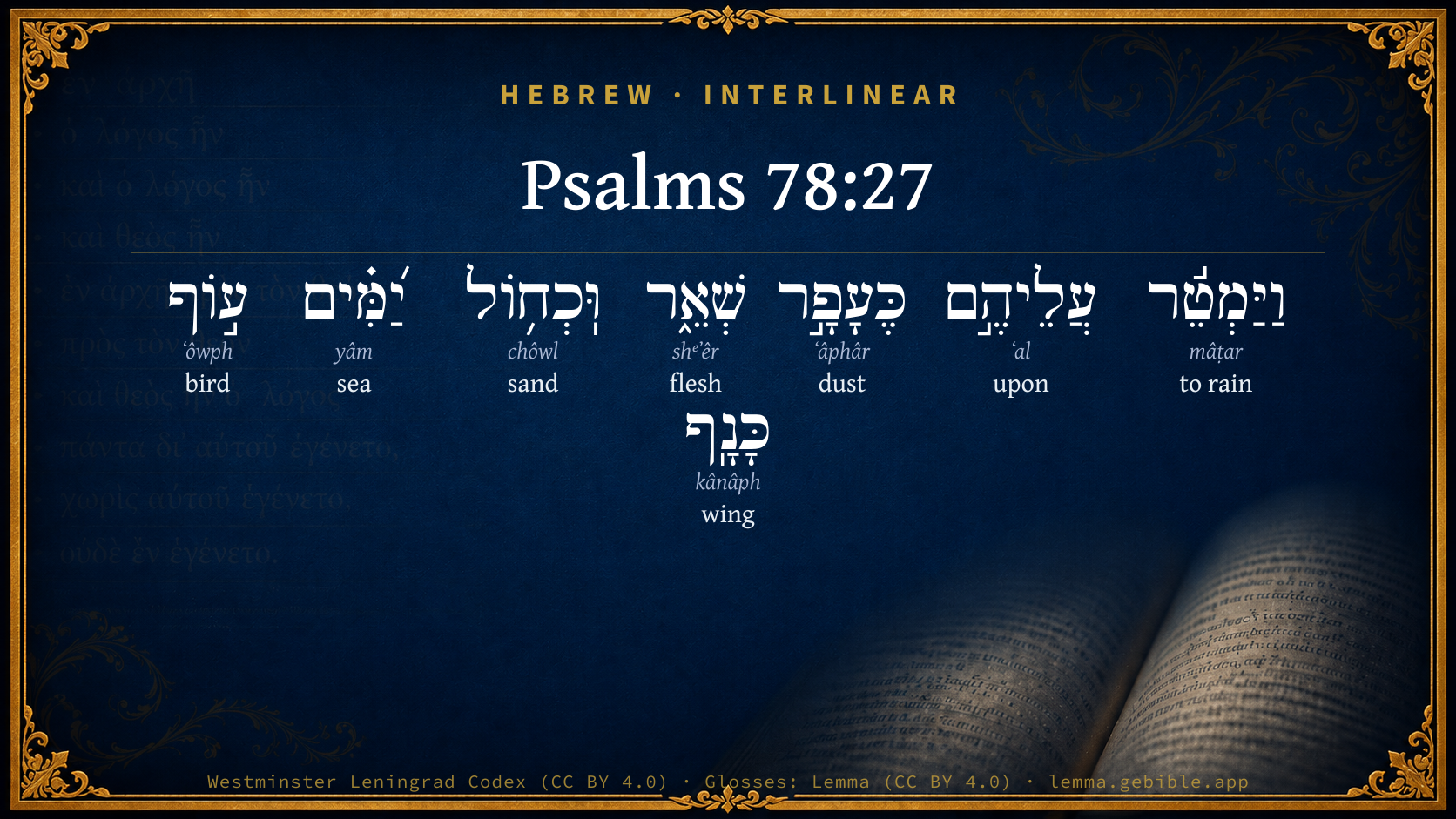
Psalms 78:27

Hebrew (Westminster Leningrad Codex) Psalms 78:27 appears in the Hebrew Old Testament. The text above is from the Westminster Leningrad Codex. Each word links to its Strong’s number, a concise gloss, and parsing drawn from the Open Scriptures Hebrew Bible morphology. Click any word for its full Brown-Driver-Briggs (BDB) entry.
Download image
Cite this verse

Psalms 78:27 (World English Bible). Public Domain. Lemma interlinear Bible study tool, https://lemma.gebible.app/v/psalms/78/27.

Show BibTeX & RIS
BibTeX
RIS
English Translation
He rained also flesh on them as the dust; Winged birds as the sand of the seas.
World English Bible · Public Domain
Download a study sheet

One document with this verse’s original text, its word-by-word gloss line, the meaning frame, cross-references with their text, attributed commentary, and full source and license credits — printable, and it pastes into notes with its structure intact.

This verse Autodidact and up

Study sheet (.html) Plain text (.txt)

A passage Seminary Student

Up to 50 verses in one chapter. A passage sheet keeps up to 6 commentary sources and 12 cross-references per verse, in the order this page ranks them, and says so on the sheet whenever that leaves anything out. Ask for a single verse and you get the Autodidact verse sheet above.

Everything on this page stays free to read, with no account — the sheet is a download of what is already on screen, not access to it.

Want to remove ads? Support Godless Engineer
Compare translations 3

The same verse in 3 English versions, stacked beneath the original-language interlinear above. Click any original word for its lexicon entry.

Each is an independent rendering of the whole verse — the interlinear is not word-aligned to these translations.

Highlighted words mark where these versions differ — a whole-verse word diff, not a word-by-word alignment.

  • World English Bible Public Domain
    He rained also flesh on them as the dust; Winged birds as the sand of the seas.
  • King James Version Public Domain
    He rained flesh also upon them as dust, and feathered fowls like as the sand of the sea:
  • unfoldingWord Literal Text CC BY-SA 4.0
    And he rained down meat on them like dust, and birds of wing as the sands of the sea.

unfoldingWord Literal Text — © unfoldingWord, licensed CC BY-SA 4.0. Word-aligned USFM3 via Door43 (git.door43.org/unfoldingWord/en_ult).

Versions to compare (up to 4)

3 of 4 selected

Show all 18 translations

Every available English version of this verse, each an independent rendering of the whole verse.

  • World English Bible Public Domain
    He rained also flesh on them as the dust; Winged birds as the sand of the seas.
  • Berean Standard Bible Public Domain
    He rained meat on them like dust, and winged birds like the sand of the sea.
  • Majority Standard Bible Public Domain
    He rained meat on them like dust, and winged birds like the sand of the sea.
  • King James Version Public Domain
    He rained flesh also upon them as dust, and feathered fowls like as the sand of the sea:
  • American Standard Version (1901) Public Domain
    He rained flesh also upon them as the dust, And winged birds as the sand of the seas:
  • Revised Version (1885) Public Domain
    He rained flesh also upon them as the dust, and winged fowl as the sand of the seas:
  • Geneva Bible (1599) Public Domain
    Hee rained flesh also vpon them as dust, and feathered foule as the sand of the sea.
  • Douay-Rheims (1899) Public Domain
    And he rained upon them flesh as dust: and feathered fowls like as the sand of the sea.
  • Young's Literal Translation Public Domain
    And He raineth on them flesh as dust, And as sand of the seas -- winged fowl,
  • Literal Standard Version CC BY-SA 4.0
    And He rains on them flesh as dust, || And as sand of the seas—winged bird,
  • Unlocked Literal Bible CC BY-SA 4.0
    He rained down meat on them like dust, birds as numerous as the sands of the sea.
  • unfoldingWord Literal Text CC BY-SA 4.0
    And he rained down meat on them like dust, and birds of wing as the sands of the sea.
  • Darby Bible Public Domain
    And he rained flesh upon them as dust, and feathered fowl as the sand of the seas,
  • World Messianic Bible Public Domain
    He also rained meat on them as the dust, winged birds as the sand of the seas.
  • Webster's Bible Public Domain
    He rained flesh also upon them as dust, and feathered fowls like as the sand of the sea:
  • Free Bible Version CC BY-SA 4.0
    He rained down meat on them as plentiful as dust; birds as numerous as sand on a beach.
  • Bible in Basic English Public Domain
    He sent down meat on them like dust, and feathered birds like the sand of the sea,
  • JPS Tanakh (1917) Public Domain
    He caused flesh also to rain upon them as the dust, and winged fowl as the sand of the seas;

Literal Standard Version (2020), Covenant Press — licensed CC BY-SA 4.0. Text via the HelloAO Bible API (eBible.org). Unlocked Literal Bible (unfoldingWord) — licensed CC BY-SA 4.0. Text via the HelloAO Bible API (eBible.org). unfoldingWord Literal Text — © unfoldingWord, licensed CC BY-SA 4.0. Word-aligned USFM3 via Door43 (git.door43.org/unfoldingWord/en_ult). Free Bible Version, Dr. Jonathan Gallagher — licensed CC BY-SA 4.0. Text via the HelloAO Bible API (eBible.org).

Word by word

More ways to search: Search by grammar → Find every occurrence → Compare this word →

Practice this passage: Drill this verse → Learn its vocabulary →

About this verse

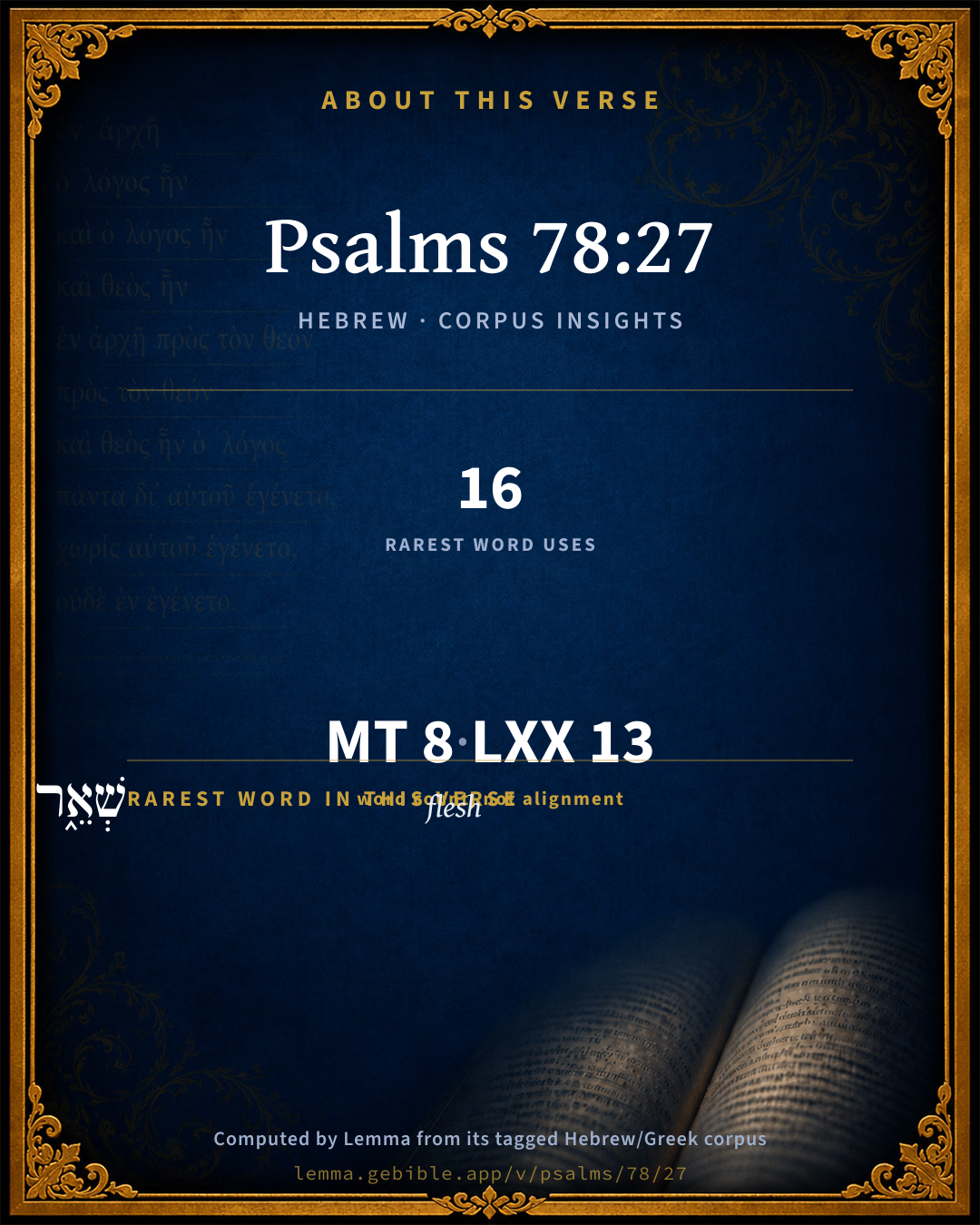
These counts appear in no published source. They are computed here, from the morphology-tagged text and Lemma’s own curated glosses. What Lemma adds →

8
words
8
distinct lemmas
Wisdom
section

Notable vocabulary

The rarest word here is שְׁאֵ֑ר flesh H7607 — appearing just 16 times in the whole Hebrew Bible.

Shared distinctive vocabulary

שְׁאֵ֑ר flesh H7607 occurs in 16 verses of the Hebrew Bible. Also found in:

Grammatical profile

  • 1 verb
  • 6 nouns
  • 1 preposition

Verb forms

  • וַיַּמְטֵ֬ר Hiphil · Sequential Imperfect

Hebrew & Septuagint length

In English translation the verse runs 17 words from the Hebrew and 17 from the Septuagint (LXX English) — the same length.

A rough comparison of the two English renderings, which tokenize alike — not a word-level alignment.

Word counts can differ between the Hebrew and the Greek without any difference in meaning — e.g. the Hebrew direct-object marker אֵת has no separate Greek word, and Greek often adds the article ὁ.

In the original languages it is 8 Hebrew tokens and 13 Greek tokens — but the two are counted differently (Hebrew bundles its prefixes and suffixes into one token; the Greek is in lemma form), so that isn’t a like-for-like length.

Cross-references

3

Topical passages linked to Psalms 78:27 in the Treasury of Scripture Knowledge — connected by theme and wording, ordered by reader-vote popularity; previews shown in the World English Bible.

  • Exodus 16:12–13 "I have heard the murmurings of the children of Israel. Speak to them, saying, 'At evening you shall eat meat, and in the morning you shall be filled with bread: and you shall know that I am Yahweh your God.'"
  • Numbers 11:18–19 Say you to the people, Sanctify yourselves against tomorrow, and you shall eat flesh; for you have wept in the ears of Yahweh, saying, Who shall give us flesh to eat? for it was well with us in Egypt: therefore Yahweh will give you flesh, and you shall eat.
  • Numbers 11:32 The people rose up all that day, and all the night, and all the next day, and gathered the quails: he who gathered least gathered ten homers: and they spread them all abroad for themselves round about the camp.

Cross-references courtesy of OpenBible.info (CC BY 4.0).

Hebrew and Greek witnesses Masoretic Hebrew ↔ Greek Septuagint

The same verse in the two great witnesses to the Old Testament, shown verse-for-verse.

You’re reading Greek Psalm 77 (Hebrew Psalm 78). The Septuagint counts the superscription, so verse numbers can differ from the Hebrew — chapter-level alignment, not verse-by-verse. Numbering follows Rahlfs.

These are two independent witnesses, not word-aligned to each other, and the Septuagint is shown in lemma (dictionary) form.

Hebrew Psalms 78:27 Masoretic · Westminster Leningrad Codex

וַיַּמְטֵ֬ר עֲלֵיהֶ֣ם כֶּעָפָ֣ר שְׁאֵ֑ר וּֽכְח֥וֹל יַ֝מִּ֗ים ע֣וֹף כָּנָֽף

He rained also flesh on them as the dust; Winged birds as the sand of the seas.

World English Bible · Public Domain

Greek LXX Greek Psalm 77:27 Septuagint · lemma form

καί βρέχω ἐπί αὐτός ὡσεί χοῦς σάρξ καί ὡσεί ἄμμος θάλασσα πετεινόν πτερωτός

And he rained upon them flesh like dust, and feathered birds like the sand of the seas.

LXX2012 (modern English Septuagint) · Public Domain

Hebrew: Westminster Leningrad Codex (CC BY 4.0). Greek: Septuagint (public domain); English from LXX2012 (modern English Septuagint) (Public Domain). How the Septuagint differs from the Hebrew →

Commentary

Notes on Psalms 78:27 from classic Christian and Jewish commentators (each source and its license shown beneath its notes). The classic Christian expositions comment on the surrounding passage and are grouped to its opening verse, so a note may address several verses; the Jewish commentaries on the Tanakh (Rashi and others) are per-verse, so they appear only where the commentator wrote on this verse.

Lemma curates 59 commentaries, every one of them public domain or Creative Commons licensed, each selected and text-cleaned for this edition rather than reprinted as found. About our sources →

Trapp's Complete Commentary

John Trapp

Psa 78:27 He rained flesh also upon them as dust, and feathered fowls like as the sand of the sea:

Ver. 27. He rained flesh also upon them as dust] Dapibus illos compluit. This he had done once before for them; see Exo 16:12-13, with Num 11:18-21; Num 11:31-33; their unbelief, therefore, and impatience this second time was the more heinous.

John Trapp, A Commentary or Exposition upon All the Books of the Old and New Testament (1647–1656) — public domain. Text from a community e-Sword module.

The Treasury of David

Charles H. Spurgeon

Ver. 27. He rained flesh also upon them as dust. First he rained bread and then flesh, when he might have rained fire and brimstone. The words indicate the speed, and the abundance of the descending quails.

And feathered fowls like as the sand of the sea; there was no counting them. By a remarkable providence, if not by miracle, enormous numbers of migratory birds were caused to alight around the tents of the tribes. It was, however, a doubtful blessing, as easily acquired and super abounding riches generally are. The Lord save us from meat which is seasoned with divine wrath.

Ver. 27. As dust. The amazing clouds of fine dust or sand, which a violent wind raises in the deserts of the East, constitute the point of comparison. William Keatinge Clay.

Ver. 27. Feathered fowls. Hebrew, "fowl of wing; "i.e., flying fowls, in distinction from domestic poultry. Williams, in Notes to Calvin in loc.

Ver. 27, 31. If the cemetery on Sarbut el Khadem be, what all the antecedent evidences combine to indicate, the workmanship of the Israelites, (a chief burial ground of their fatal encampment at Kibroth Hattaayah), it may most reasonably be expected that its monuments shall contain symbolic representations of the miracle of the "feathered fowls, "and of the awful plague which followed it. Now Niebuhr happily enables us to meet this just expectation, by his copies of the hieroglyphics on three of those tombstones, published in the 45th and 46th plates of his first volume, and prefaced plate 44, by a plan of the cemetery itself, which is of more value than any or all subsequent descriptions. It was discovered by the present writer (as stated in a former work), ("The Voice of Israel") on the evidence of no less than four Sinaitic inscriptions, that the birds of the miracle, named by Moses, generically, wlv, salu, and by the psalmist, still more generally, Pgk Pwe, winged fowls, or more correctly, "long winged fowls, "were not (as rendered by all our versions, ancient and modern) quails, but a crane like red bird resembling a goose, named in the Arabic nuham. The discovery received subsequently a singular and signal corroboration from the further discovery, by Dean Stanley, and previously by Schubert, of immense flocks of these very nuhams on the reputed scene of the miracle at Kibroth Hattaavah. With these antecedents in his mind, the reader will now turn to the three monuments copied by Niebuhr in the cemetery of Sarbut el Khadem. He will at once see that a crane like bird resembling a goose, with slender body and long legs, is the leading hieroglyphic symbol in all three tablets. No fewer than twenty-five of these symbolic birds occur in the first, ten in the second, and fifteen in the third tablet. The goose appears occasionally, but the principal specimens have the air of the goose, but the form of the crane. In a word, they are the very species of birds seen by Dean Stanley, both at this point of Sinai, and at the first cataract of the Nile; and which constantly occur also in Egyptian monuments: as though the very food of Egypt, after which the Israelites lusted, was sent to be at once their prey and their plague. "And the children of Israel said unto them, Would to God we had died by the hand of the Lord in the land of Egypt, when we sat by the flesh pots." Ex 16:3. The reader has here before him the irrefragable fact that the very birds which by every kind of evidence stand identified with the salus, or long legged and long winged fowls of the miracle, are the very birds depicted on the tombstones of Sarbut el Khadem, both standing, flying, and apparently even trussed and cooked... The inevitable inference is... that these tombstones record the miracle of the "feathered fowls, "and stand over the graves of the gluttons who consumed them. Charles Forster, in "Israel in the Wilderness." 1865. Mr. Forster thus deciphers by his alphabet some of the mixed legends and devices: --

"From the sea the cranes congregate to one spot;

The archers shoot at the cranes passing over the plain.

Evil stomached they rush after the prey--

The sepulchre their doom--their marrow corrupted by God,

The sleepy owl, emblem of death, God sends destruction

among them."

"The mother of sepulchres--the black and white geese,

A sudden death, greedily lusting after flesh, die the

gluttons.

The mountain top ascend the Hebrews,

They eat, devour, consume, till nothing is left, exceeding

all bounds,

Their bodies corrupted, by gluttony they die."

None.

Psalms 78:28*

Ver. 27,31. See Psalms on "Ps 78:27" for further information.

Charles H. Spurgeon's The Treasury of David (1869–1885) — public domain. Psalms only. Text from a community e-Sword/MySword module.

J. A. Alexander on Psalms

Joseph Addison Alexander

27. (Psa 78:27) And he rained upon them, like dust, flesh, and like the sand of seas, winged fowl (or birds of wing). Here, as in the miracle of water, two miraculous supplies of flesh are brought together. See Exo 16:13, Num 11:31-32. To these two is transferred the figure of rain, which, in the history, is applied only to the manna.

Joseph Addison Alexander, The Psalms Translated and Explained (1850) — public domain. Text from a community e-Sword module.

Ellicott's Commentary for English Readers

(27) No doubt there is poetical hyperbole here, but for the enormous numbers of quails that are now caught, see the article quoted above.

A Bible Commentary for English Readers, edited by Charles John Ellicott (1878–1897) — public domain. Text from a community e-Sword module.

The Cambridge Bible for Schools and Colleges

gen. ed. J. J. S. Perowne

27. And he rained flesh upon them as the dust,

And winged fowl as the sand of the seas.

The sending of quails is connected, as in Exodus 16, with the sending of the manna; but the language of the Psalm follows the description of the second sending of quails in Numbers 11.

The verbs in Psa_78:26 are the same as those in Psa_78:52. Cp. Exo_10:13; Num_11:31. East and South are separated for the sake of rhythm. A S.E. wind brought up the quails from ‘the sea,’ i.e. the Red Sea. “The period when they were brought to the camp of Israel was in spring, when on their northward migration from Africa. According to their well-known instinct, they would follow up the coast of the Red Sea until they came to its bifurcation by the Sinaitic Peninsula, and then would cross at the narrow part.” Tristram, Nat. Hist. of Bible, p. 231.

The Cambridge Bible for Schools and Colleges (gen. ed. J. J. S. Perowne; Cambridge University Press, 1878–1918) — public domain. Text from a community e-Sword module.

John Gill's Exposition

And he let it fall in the midst of their camp,.... Or, "his camps" (l); the four camps of Israel; for so many there were, Num 2:1 or the camp of God, where he dwelt, and before which he went as the General, Leader, and Commander of them; in the midst of this, or by it, by the side of it, Num 11:31, the flesh or feathered fowl fell, so that they had no trouble to fetch it in; and here it fell by the order and direction of the Lord himself; he caused it to fall, without whose knowledge and will a sparrow does not fall to the ground, Mat 10:29. These creatures fell either, as some think, being wearied with their flight over the Red sea; or through their wings being broken by the vehemency of the wind that brought them, as others; or by the moistness of the south wind, which wetted their wings, and made them flag and fall; but, by whatever means this was done, it was so ordered by the Lord that they should fall, and fall just in the place where they did:

round about their habitations; for the space of a day's journey on every side, where they lay in heaps, here and there, two cubits high, Num 11:31, so that they could gather them with great ease, and had no need of arrows to shoot at them, nor nets to spread for them; they were ready at hand, and in great plenty.

(l) "castrorum ejus", Pagninus, Vatablus, Gejerus.

John Gill's Exposition of the Whole Bible (1746–1763) — public domain (CC PDM 1.0). Text via the HelloAO Bible API.

Albert Barnes' Notes on the Bible

He rained flesh also upon them as dust - The flesh of quails, Num 11:31. The word “rained” means that they seemed to come upon them like a copious shower. The word dust denotes their great abundance.

And feathered fowls - Margin, as in Hebrew, “fowl of wing.” This is a poetic expression, designed to give beauty to the description by the image of their fluttering wings.

Like as the sand of the sea - An expression also designed to denote their great numbers, Gen 22:17; Gen 32:12; Gen 41:49; Jos 11:4; 1Sa 13:5; Rev 20:8.

Albert Barnes' Notes on the Bible (1834–1885) — public domain. Text from a community e-Sword/MySword module.

Matthew Poole's English Annotations

Feathered fowls, Heb. winged fowl; which is noted to show that it was a supernatural work, whereby God took away from them the use of their wings, and made them to fall into the hands of the Israelites.

Matthew Poole's English Annotations on the Holy Bible (1683–1685) — public domain. Text from a community e-Sword/MySword module.

Whedon's Commentary on the Bible

Daniel D. Whedon

27. He rained flesh… as dust—That is, in profusion. The allusion is to the “dust” of the sirocco. In this same desert, further north, Dr. Robinson says: “At eleven o’clock the wind changed to the south, and blew a perfect tempest. The atmosphere was filled with fine particles of sand, forming a bluish haze; the sun was scarcely visible, his disk exhibiting only a dim and sickly hue. Often we could not see ten rods around us, and our eyes, ears, mouth, and nose were filled with sand.”

Feathered fowls—Hebrew, Birds of wing; which refutes the theory that locusts, not quails, are intended.

Daniel D. Whedon (gen. ed.), Commentary on the Old and New Testaments (1874–1909) — public domain. Text from a community e-Sword module.

The Pulpit Commentary

He rained flesh also upon them. With the expression, "rained flesh," comp. Exo_16:4, "Behold, I will rain bread from heaven;" and see also Gen_19:24 and Exo_9:23. As dust; i.e. "as thick as dust" (Prayer book Version). The quails lay "as it were two cubits high" for the distance of a day"s journey round about each encampment. (see Num_11:31) And feathered fowls like as the sand of the sea. The commonest image of multiplicity. (Gen_22:17 Deu_33:19 Jos_11:4 Jud_1:7:12, etc.)

The Pulpit Commentary (1880–1919), ed. H.D.M. Spence-Jones & Joseph S. Exell — public domain. Text from a community e-Sword module.

John Wesley's Explanatory Notes

Fowl - But God took away from them the use of their wings, and made them to fall into the hands of the Israelites.

John Wesley, Explanatory Notes Upon the Whole Bible (1754–1765) — public domain. Text via the GEBible commentary corpus.

Lesson kit

Teaching starters — assembled from the data on this page, not authored interpretation. Every prompt links to the verse data it draws on. Edit before teaching.

Psalms, in the Wisdom, opens this verse with 8 words (8 distinct Hebrew lemmas). Its most distinctive word is shᵉʼêr (“flesh”). A historical commentator’s framing appears above. Read the whole chapter for the surrounding context.

Discussion questions

  1. The word shᵉʼêr carries the sense “flesh.” How does it shape the verse?
  2. Exodus 21:10 shares the word «flesh» with this verse. How do the two illuminate each other?
  3. These translations render this verse differently; the difference is in the English rendering, not the original. What questions does that raise?
  4. The verb «וַיַּמְטֵ֬ר» is Hiphil Sequential Imperfect. How does its form color the action?
  5. Reading how Trapp's Complete Commentary and The Treasury of David read this verse, where do the two commentators agree and where do they part?

Things to notice

Reading settings

Reading text

Shown beneath each verse's original-language words.

Old Testament
Old Testament edition

Read the OT as the Masoretic Hebrew (MT) or the Greek Septuagint (LXX).

English shown for the Greek Septuagint (in the Hebrew ↔ Greek comparison).

Comparing translations? Open the Compare panel on any verse page to stack up to four side by side.