
Deuteronomy 11:24

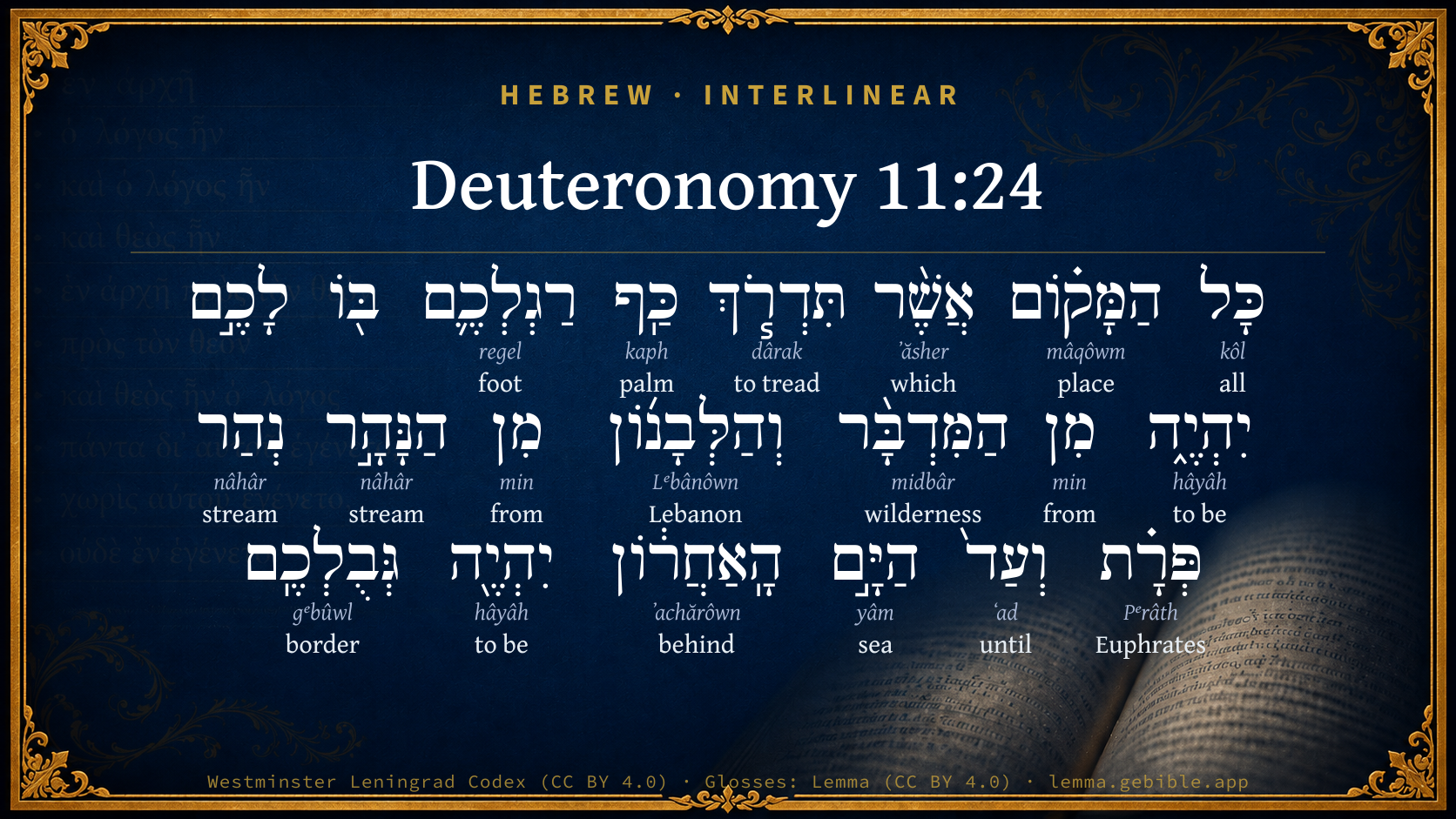
Hebrew (Westminster Leningrad Codex) Deuteronomy 11:24 appears in the Hebrew Old Testament. The text above is from the Westminster Leningrad Codex. Each word links to its Strong’s number, a concise gloss, and parsing drawn from the Open Scriptures Hebrew Bible morphology. Click any word for its full Brown-Driver-Briggs (BDB) entry.
Download image
Cite this verse

Deuteronomy 11:24 (World English Bible). Public Domain. Lemma interlinear Bible study tool, https://lemma.gebible.app/v/deuteronomy/11/24.

Show BibTeX & RIS
BibTeX
RIS
English Translation
Every place whereon the sole of your foot shall tread shall be yours: from the wilderness, and Lebanon, from the river, the river Euphrates, even to the hinder sea shall be your border.
World English Bible · Public Domain
Download a study sheet

One document with this verse’s original text, its word-by-word gloss line, the meaning frame, cross-references with their text, attributed commentary, and full source and license credits — printable, and it pastes into notes with its structure intact.

This verse Autodidact and up

Study sheet (.html) Plain text (.txt)

A passage Seminary Student

Up to 50 verses in one chapter. A passage sheet keeps up to 6 commentary sources and 12 cross-references per verse, in the order this page ranks them, and says so on the sheet whenever that leaves anything out. Ask for a single verse and you get the Autodidact verse sheet above.

Everything on this page stays free to read, with no account — the sheet is a download of what is already on screen, not access to it.

Want to remove ads? Support Godless Engineer
Compare translations 3

The same verse in 3 English versions, stacked beneath the original-language interlinear above. Click any original word for its lexicon entry.

Each is an independent rendering of the whole verse — the interlinear is not word-aligned to these translations.

Highlighted words mark where these versions differ — a whole-verse word diff, not a word-by-word alignment.

  • World English Bible Public Domain
    Every place whereon the sole of your foot shall tread shall be yours: from the wilderness, and Lebanon, from the river, the river Euphrates, even to the hinder sea shall be your border.
  • King James Version Public Domain
    Every place whereon the soles of your feet shall tread shall be yours: from the wilderness and Lebanon, from the river, the river Euphrates, even unto the uttermost sea shall your coast be.
  • unfoldingWord Literal Text CC BY-SA 4.0
    Every place where the sole of your foot will tread upon will be yours; from the wilderness to Lebanon, from the river, the Euphrates River, and to the western sea will be your border.

unfoldingWord Literal Text — © unfoldingWord, licensed CC BY-SA 4.0. Word-aligned USFM3 via Door43 (git.door43.org/unfoldingWord/en_ult).

Versions to compare (up to 4)

3 of 4 selected

Show all 18 translations

Every available English version of this verse, each an independent rendering of the whole verse.

  • World English Bible Public Domain
    Every place whereon the sole of your foot shall tread shall be yours: from the wilderness, and Lebanon, from the river, the river Euphrates, even to the hinder sea shall be your border.
  • Berean Standard Bible Public Domain
    Every place where the sole of your foot treads will be yours. Your territory will extend from the wilderness to Lebanon, and from the Euphrates River to the Western Sea.
  • Majority Standard Bible Public Domain
    Every place where the sole of your foot treads will be yours. Your territory will extend from the wilderness to Lebanon, and from the Euphrates River to the Western Sea.
  • King James Version Public Domain
    Every place whereon the soles of your feet shall tread shall be yours: from the wilderness and Lebanon, from the river, the river Euphrates, even unto the uttermost sea shall your coast be.
  • American Standard Version (1901) Public Domain
    Every place whereon the sole of your foot shall tread shall be yours: from the wilderness, and Lebanon, from the river, the river Euphrates, even unto the hinder sea shall be your border.
  • Revised Version (1885) Public Domain
    Every place whereon the sole of your foot shall tread shall be yours: from the wilderness, and Lebanon, from the river, the river Euphrates, even unto the hinder sea shall be your border.
  • Geneva Bible (1599) Public Domain
    All the places whereon the soles of your feete shall tread, shalbe yours: your coast shalbe from the wildernes and from Lebanon, and from the Riuer, euen the riuer Perath, vnto ye vttermost Sea.
  • Douay-Rheims (1899) Public Domain
    The Lord will destroy all these nations before your face, and you shall possess them, which are greater and stronger than you.
  • Young's Literal Translation Public Domain
    every place on which the sole of your foot treadeth is yours; from the wilderness, and Lebanon, from the river, the river Phrat, even unto the farther sea is your border;
  • Literal Standard Version CC BY-SA 4.0
    Every place on which the sole of your foot treads is yours: from the wilderness and Lebanon, from the river, the Euphrates River, even to the Western Sea, is your border.
  • Unlocked Literal Bible CC BY-SA 4.0
    Every place where the sole of your foot will tread will be yours; from the wilderness to Lebanon, from the river, the Euphrates River, to the western sea will be your border.
  • unfoldingWord Literal Text CC BY-SA 4.0
    Every place where the sole of your foot will tread upon will be yours; from the wilderness to Lebanon, from the river, the Euphrates River, and to the western sea will be your border.
  • Darby Bible Public Domain
    Every place whereon the sole of your foot shall tread shall be yours; from the wilderness and Lebanon, from the river, the river Euphrates, even unto the hinder sea shall your border be.
  • World Messianic Bible Public Domain
    Every place on which the sole of your foot treads shall be yours: from the wilderness and Lebanon, from the river, the river Euphrates, even to the western sea shall be your border.
  • Webster's Bible Public Domain
    Every place on which the soles of your feet shall tread shall be yours: from the wilderness, and Lebanon, from the river, the river Euphrates, even to the uttermost sea shall your limit be.
  • Free Bible Version CC BY-SA 4.0
    Everywhere you walk will belong to you. Your territory will extend from the desert all the way to Lebanon, and from the Euphrates River to the Mediterranean Sea.
  • Bible in Basic English Public Domain
    Every place where you put your foot will be yours: from the waste land and Lebanon, from the river, the river Euphrates as far as the Great Sea, will be the limits of your land.
  • JPS Tanakh (1917) Public Domain
    Every place whereon the sole of your foot shall tread shall be yours: from the wilderness, and Lebanon, from the river, the river Euphrates, even unto the hinder sea shall be your border.

Literal Standard Version (2020), Covenant Press — licensed CC BY-SA 4.0. Text via the HelloAO Bible API (eBible.org). Unlocked Literal Bible (unfoldingWord) — licensed CC BY-SA 4.0. Text via the HelloAO Bible API (eBible.org). unfoldingWord Literal Text — © unfoldingWord, licensed CC BY-SA 4.0. Word-aligned USFM3 via Door43 (git.door43.org/unfoldingWord/en_ult). Free Bible Version, Dr. Jonathan Gallagher — licensed CC BY-SA 4.0. Text via the HelloAO Bible API (eBible.org).

Word by word

More ways to search: Search by grammar → Find every occurrence → Compare this word →

Practice this passage: Drill this verse → Learn its vocabulary →

פְּרָ֗ת
Pᵉrâth
H6578
“Euphrates”
Noun, Proper
Part of Speech
Noun
Type
Proper
Full BDB Definition

Origin: from an unused root meaning to break forth

TWOT: None

Euphrates = "fruitfulness" - the largest and longest river of western Asia; rises from two chief sources in the Armenian mountains and flows into the Persian Gulf
  1. כָּל kôl H3605 “all of” Noun, Common, Masculine, Singular, Construct
  2. הַמָּק֗וֹם mâqôwm H4725 “the · place” Particle, Definite Article + Noun, Common, Masculine, Singular, Absolute
  3. אֲשֶׁ֨ר ʼăsher H834 “which” Particle, Relative
  4. תִּדְרֹ֧ךְ dârak H1869 “to tread” Verb, Qal, Imperfect, 3rd Person, Feminine, Singular
  5. כַּֽף kaph H3709 “palm of” Noun, Common, Feminine, Singular, Construct
  6. רַגְלְכֶ֛ם regel H7272 “foot · your” Noun, Common, Feminine, Singular, Construct + Suffix, Personal, 2nd Person, Masculine, Plural
  7. יִהְיֶ֑ה hâyâh H1961 “to be” Verb, Qal, Imperfect, 3rd Person, Masculine, Singular
  8. מִן min H4480 “from” Preposition
  9. הַמִּדְבָּ֨ר midbâr H4057 “the · wilderness” Particle, Definite Article + Noun, Common, Masculine, Singular, Absolute
  10. וְהַלְּבָנ֜וֹן Lᵉbânôwn H3844 “and · the · Lebanon” Conjunction + Particle, Definite Article + Noun, Proper
  11. מִן min H4480 “from” Preposition
  12. הַנָּהָ֣ר nâhâr H5104 “the · stream” Particle, Definite Article + Noun, Common, Masculine, Singular, Absolute
  13. נְהַר nâhâr H5104 “stream of” Noun, Common, Masculine, Singular, Construct
  14. וְעַד֙ ʻad H5704 “and · until” Conjunction + Preposition
  15. הַיָּ֣ם yâm H3220 “the · sea” Particle, Definite Article + Noun, Common, Masculine, Singular, Absolute
  16. הָֽאַחֲר֔וֹן ʼachărôwn H314 “the · behind” Particle, Definite Article + Adjective, Adjective, Masculine, Singular, Absolute
  17. יִהְיֶ֖ה hâyâh H1961 “to be” Verb, Qal, Imperfect, 3rd Person, Masculine, Singular
  18. גְּבֻלְכֶֽם gᵉbûwl H1366 “border · your” Noun, Common, Masculine, Singular, Construct + Suffix, Personal, 2nd Person, Masculine, Plural

About this verse

These counts appear in no published source. They are computed here, from the morphology-tagged text and Lemma’s own curated glosses. What Lemma adds →

21
words
16
distinct lemmas
Pentateuch
section

Notable vocabulary

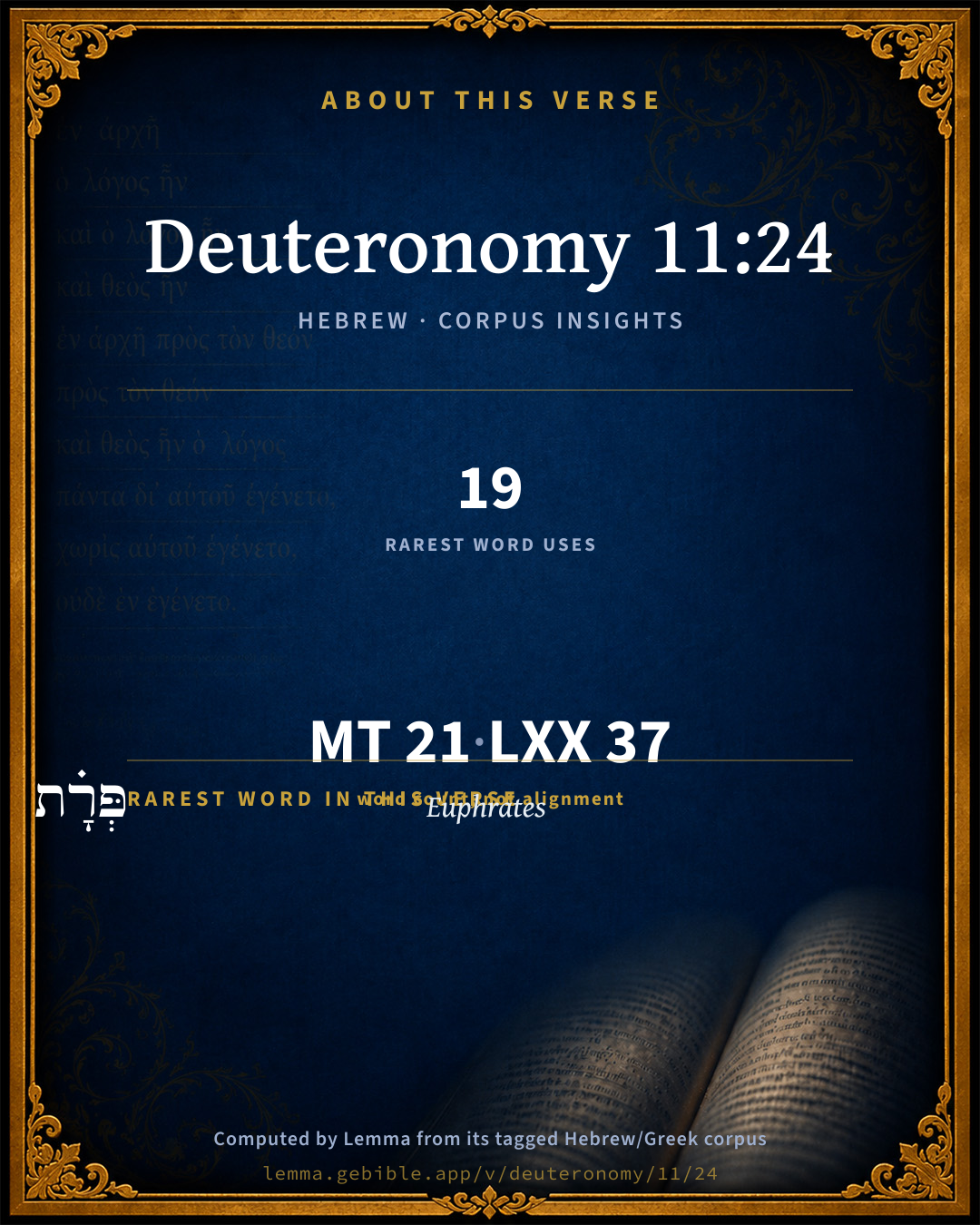
The rarest word here is פְּרָ֗ת Euphrates H6578 — appearing just 19 times in the whole Hebrew Bible.

Shared distinctive vocabulary

פְּרָ֗ת Euphrates H6578 occurs in 19 verses of the Hebrew Bible. Also found in:

Grammatical profile

  • 3 verbs
  • 11 nouns
  • 1 adjective
  • 5 prepositions
  • 1 particle

Verb forms

  • תִּדְרֹ֧ךְ Qal · Imperfect
  • יִהְיֶ֑ה Qal · Imperfect
  • יִהְיֶ֖ה Qal · Imperfect

Repetition

Words recur within this verse — often emphatic in Hebrew:

  • יִהְיֶ֑ה to be H1961 ×2
  • הַנָּהָ֣ר stream H5104 ×2
  • מִן from H4480 ×2

Hebrew & Septuagint length

In English translation the verse runs 33 words from the Hebrew and 37 from the Septuagint (LXX English) — closely comparable.

A rough comparison of the two English renderings, which tokenize alike — not a word-level alignment.

Word counts can differ between the Hebrew and the Greek without any difference in meaning — e.g. the Hebrew direct-object marker אֵת has no separate Greek word, and Greek often adds the article ὁ.

In the original languages it is 21 Hebrew tokens and 37 Greek tokens — but the two are counted differently (Hebrew bundles its prefixes and suffixes into one token; the Greek is in lemma form), so that isn’t a like-for-like length.

Cross-references

8

Topical passages linked to Deuteronomy 11:24 in the Treasury of Scripture Knowledge — connected by theme and wording, ordered by reader-vote popularity; previews shown in the World English Bible.

  • Joshua 14:9 Moses swore on that day, saying, Surely the land whereon your foot has trodden shall be an inheritance to you and to your children forever, because you have wholly followed Yahweh my God.
  • Genesis 15:18–21 In that day Yahweh made a covenant with Abram, saying, "To your seed have I given this land, from the river of Egypt to the great river, the river Euphrates:
  • Exodus 23:31 I will set your border from the Red Sea even to the sea of the Philistines, and from the wilderness to the River; for I will deliver the inhabitants of the land into your hand, and you shall drive them out before you.
  • 1 Kings 4:21 Solomon ruled over all the kingdoms from the River to the land of the Philistines, and to the border of Egypt: they brought tribute, and served Solomon all the days of his life.
  • 2 Chronicles 9:26 He ruled over all the kings from the River even to the land of the Philistines, and to the border of Egypt.
  • Joshua 1:3–4 Every place that the sole of your foot shall tread on, to you have I given it, as I spoke to Moses.
  • 1 Kings 4:24 For he had dominion over all [the region] on this side the River, from Tiphsah even to Gaza, over all the kings on this side the River: and he had peace on all sides round about him.
  • Numbers 34:3–15 then your south quarter shall be from the wilderness of Zin along by the side of Edom, and your south border shall be from the end of the Salt Sea eastward;

Cross-references courtesy of OpenBible.info (CC BY 4.0).

Hebrew and Greek witnesses Masoretic Hebrew ↔ Greek Septuagint

The same verse in the two great witnesses to the Old Testament, shown verse-for-verse.

These are two independent witnesses, not word-aligned to each other, and the Septuagint is shown in lemma (dictionary) form.

Hebrew Deuteronomy 11:24 Masoretic · Westminster Leningrad Codex

כָּל הַמָּק֗וֹם אֲשֶׁ֨ר תִּדְרֹ֧ךְ כַּֽף רַגְלְכֶ֛ם בּ֖וֹ לָכֶ֣ם יִהְיֶ֑ה מִן הַמִּדְבָּ֨ר וְהַלְּבָנ֜וֹן מִן הַנָּהָ֣ר נְהַר פְּרָ֗ת וְעַד֙ הַיָּ֣ם הָֽאַחֲר֔וֹן יִהְיֶ֖ה גְּבֻלְכֶֽם

Every place whereon the sole of your foot shall tread shall be yours: from the wilderness, and Lebanon, from the river, the river Euphrates, even to the hinder sea shall be your border.

World English Bible · Public Domain

Greek LXX Deuteronomy 11:24 Septuagint · lemma form

πᾶς ὁ τόπος οὗ ἐάν πατέω ὁ ἴχνος ὁ πούς σύ σύ εἰμί ἀπό ὁ ἔρημος καί ἀντιλίβανος καί ἀπό ὁ ποταμός ὁ μέγας ποταμός εὐφράτης καί ἕως ὁ θάλασσα ὁ ἐπί δυσμή εἰμί ὁ ὅριον σύ

Every place whereon the sole of your foot shall tread shall be yours; from the wilderness and Antilibanus, and from the great river, the river Euphrates, even as far as the west sea shall be your coasts.

LXX2012 (modern English Septuagint) · Public Domain

Hebrew: Westminster Leningrad Codex (CC BY 4.0). Greek: Septuagint (public domain); English from LXX2012 (modern English Septuagint) (Public Domain). How the Septuagint differs from the Hebrew →

Targum (Aramaic paraphrase)

2

The Targum is the ancient Jewish Aramaic paraphrase of the Hebrew Scriptures — an interpretive translation, not the Hebrew text itself. Onkelos (literal) and Pseudo-Jonathan (expansive) render the Torah, and Jonathan the Prophets. Coverage is partial: where no permissively-licensed English translation exists for a verse, only the Aramaic is shown. This is verse-level text, not a word-by-word alignment to the Hebrew.

  1. Targum Onkelos Torah (Genesis–Deuteronomy)
    כָּל אַתְרָא דִי תִדְרוֹךְ פַּרְסַת רַגְלְכוֹן בֵּהּ דִלְכוֹן יְהֵי מִן מַדְבְּרָא וְלִבְנָן מִן נַהֲרָא נְהַר פְּרָת וְעַד יַמָא מַעַרְבָא יְהֵי תְחוּמְכוֹן

    (no public-domain English translation for this verse)

    Targum Onkelos — Aramaic: “Onkelos Genesis” (public domain); “Onkelos Exodus” (public domain); “Onkelos Leviticus” (public domain); “Onkelos Numbers” (public domain); “Onkelos Deuteronomy” (public domain). English: “Sefaria Community Translation” (CC0 1.0 (public-domain dedication)); “J.W. Etheridge. The Targums of Onkelos and Jonathan Ben Uzziel on the Pentateuch. London: Longmans, Green, 1862” (public domain). Text via Sefaria.

  2. Targum Pseudo-Jonathan Torah (Genesis–Deuteronomy)
    כָּל אַתְרָא דִי תִדְרוֹךְ פַּרְסַת רִגְלֵיכוֹן בֵּיהּ דִּילְכוֹן יְהֵי מִן מַדְבְּרָא וְטַוַור לְכוֹן הִינוּן טַוְורֵי בֵּית מַקְדְּשָׁא מִן נַהֲרָא רַבָּא נַהֲרָא פְּרָת עַד יַמָא דְאוֹקְיָנוּס הִינוּן מֵי בְרֵאשִׁית סְטַר מַעַרְבָא יְהֵי תְחוּמֵיכוֹן

    Every place where the sole of your foot shall tread will be yours, from the wilderness and the mountain; (among) your mountains shall be the house of the sanctuary, and from the great river, the River Phrat, unto the ocean sea, whose waters are (old as) the creation, on the western side shall be your limit.

    Targum Pseudo-Jonathan — Aramaic: “Targum Jonathan on Genesis” (public domain); “Targum Jonathan on Exodus” (public domain); “Targum Jonathan on Leviticus” (public domain); “Targum Jonathan on Numbers” (public domain); “Targum Jonathan on Deuteronomy” (public domain). English: “The Targum of Jonathan ben Uzziel, trans. J. W. Etheridge, London, 1862” (public domain). Text via Sefaria.

Commentary

Notes on Deuteronomy 11:24 from classic Christian and Jewish commentators (each source and its license shown beneath its notes). The classic Christian expositions comment on the surrounding passage and are grouped to its opening verse, so a note may address several verses; the Jewish commentaries on the Tanakh (Rashi and others) are per-verse, so they appear only where the commentator wrote on this verse.

Lemma curates 59 commentaries, every one of them public domain or Creative Commons licensed, each selected and text-cleaned for this edition rather than reprinted as found. About our sources →

Joseph Benson's Commentary

Deu 11:24. Every place — Not absolutely, as the Jewish rabbis fondly imagine, but in the promised land, as the sense is restrained in the following words; either by possession or by dominion, namely, upon condition of your obedience. From the wilderness — Of Sin, on the south of Canaan, and Lebanon — On the north. From Euphrates — On the east. So far the right of dominion extruded, but that their sins cut them short; so far, however, Solomon extended his dominion. Unto the uttermost sea — The Mediterranean, on the west.

Joseph Benson's Commentary on the Old and New Testaments (1811–1818) — public domain. Text from a community e-Sword module.

Tyndale Open Study Notes

Tyndale Open Resources

11:24 you set foot (literally you tread the sole of your foot): This idea suggests claiming a territory by placing a foot on it or walking through it (see Gen 13:17; Josh 1:3; 14:9).

Tyndale Open Study Notes — © Tyndale Open Resources, licensed CC BY-SA 4.0. Text via the HelloAO Bible API.

Geneva Bible (1599)

Geneva Bible translators

This was accomplished in David’s and Solomon’s time.

Called Mediterranean.

Geneva Bible (1599) marginal notes — public domain. Text via Bolls.life.

Jamieson, Fausset & Brown

Robert Jamieson, A. R. Fausset & David Brown

Every place whereon the soles of your feet shall tread shall be yours--not as if the Jews should be lords of the world, but of every place within the promised land. It should be granted to them and possessed by them, on conditions of obedience:

from the wilderness--the Arabah on the south;

Lebanon--the northern limit;

Euphrates--their boundary on the east. Their grant of dominion extended so far, and the right was fulfilled to Solomon.

even unto the uttermost sea--the Mediterranean.

Jamieson, Fausset & Brown — Commentary Critical and Explanatory on the Whole Bible (1871) — public domain (CC PDM 1.0). Text via the HelloAO Bible API.

Adam Clarke's Commentary

Verse 24. From the river] Euphrates, which was on the east, to the uttermost sea - the Mediterranean, which lay westward of the promised land. This promise, notwithstanding the many provocations of the Israelites, was fulfilled in the time of Solomon, for "he reigned over all the kings from the river (Euphrates) even unto the land of the Philistines, and to the border of Egypt." See 2Ch 9:26, and the note, See Clarke on Nu 34:12.

Adam Clarke's Commentary on the Bible (1810–1826) — public domain. Text from a community e-Sword/MySword module.

Ellicott's Commentary for English Readers

(24) Every place.—Repeated in Jos_1:3-4, where see Note.

A Bible Commentary for English Readers, edited by Charles John Ellicott (1878–1897) — public domain. Text from a community e-Sword module.

John Gill's Exposition

And a curse, if ye will not obey the commandments of the Lord your God,.... Accursed in body and estate, in basket and store; in their families, flocks, and herds; within doors and without; in city, and country; going out, or coming in; in this world, and that to come, if divine goodness prevent not; see Deu 28:15.

but turn aside out of the way which I command you this day; which the law he gave them, and repeated to them, directed them to walk in:

to go after other gods, which ye have not known; to serve and worship the gods of other nations, strange gods, which neither they nor their fathers knew anything of, or ever received any good thing from; and which indeed are no gods, and nothing in the world, as an idol is.

John Gill's Exposition of the Whole Bible (1746–1763) — public domain (CC PDM 1.0). Text via the HelloAO Bible API.

Haydock's Catholic Bible Commentary

Yours. The nations of Chanaan, how strong soever, should fall, and their country be lawfully possessed by the Hebrews. --- Western sea. Hebrew, "the sea of the back." The Jews speak of the different parts of the world, with respect to a man who has his face turned towards the east, Genesis xiii. 9. The countries, from the desert of Zin to the Euphrates, were never entirely occupied by the Israelites, except under the reigns of David and Solomon. (Calmet) --- God never intended to subject the whole world to their dominion, as the Rabbins would hence infer. (Menochius)

George Leo Haydock (1774–1849), Haydock's Catholic Family Bible and Commentary, 1859 edition — public domain. Excludes Psalms (Douay-Rheims chapter numbering differs from Protestant) and Deuterocanonical books (Catholic canon only).

Matthew Poole's English Annotations

Every place; not absolutely, as if the Jews should be lords of all the world, as the rabbins fondly conceit; but in the Promised Land, as it is restrained in the following words.

Shall be yours, either by possession, or by dominion, to wit, upon condition of your obedience.

From the wilderness, to wit, of Sin, on the south side.

And Lebanon; and from Lebanon; or, and to Lebanon, which was the northern border.

The river Euphrates on the east. So far their right of dominion extended, but that their sins cut them short; and so far Solomon extended his dominion.

Unto the uttermost sea; the western or midland sea; Heb.

the hindermost sea; for the eastern part of the world being generally esteemed the foremost, and the southern on the right hand, Psa 89:12, and consequently the northern on the left hand, the western part must needs be behind. Of these bounds of the land see Gen 10:19; 15:18; Exo 23:31; Jos 1:3,4.

Matthew Poole's English Annotations on the Holy Bible (1683–1685) — public domain. Text from a community e-Sword/MySword module.

Whedon's Commentary on the Bible

Daniel D. Whedon

24. Every place… shall be yours — The boundaries of the land are here briefly stated: from Arabia on the south to Lebanon on the north; from the Euphrates on the east to the Mediterranean on the west. For other statements of the boundaries comp. Gen_15:18-21; Exo_23:31; Num_34:6.

Daniel D. Whedon (gen. ed.), Commentary on the Old and New Testaments (1874–1909) — public domain. Text from a community e-Sword module.

John Wesley's Explanatory Notes

Every place - Not absolutely, as the Rabbins fondly conceit, but in the promised land, as it is restrained in the following words; either by possession, or by dominion, namely, upon condition of your obedience. The wilderness - Of Sin, on the south-side. To Lebanon - Which was on the north border. Euphrates - On the east. So far the right of dominion extended, but that their sins cut them short: and so far Solomon extended his dominion. The uttermost sea - The western or midland sea.

John Wesley, Explanatory Notes Upon the Whole Bible (1754–1765) — public domain. Text via the GEBible commentary corpus.

unfoldingWord translationNotes

Door43 World Missions Community

General Information:

Moses continues speaking to the people of Israel.

Every place where the sole of your foot will tread

Here "the sole of your foot" represents the whole person. AT: "Every place you go" (See: Synecdoche)

from the river, the Euphrates River

"from the Euphrates River"

No man will be able to stand before you

The phrase "stand before you" is an idiom. AT: "No one will be able to stop you" or "No one will be able to oppose you"

Yahweh your God will lay the fear of you and the terror of you upon all the land that you tread on

Yahweh causing the people to be very afraid is spoken of as if fear and terror were an object that he will place on the people. AT: "Yahweh your God will cause the people in every place you go to be very afraid of you" (See: Metaphor)

the fear of you and the terror of you

The words "fear" and "terror" mean the same thing and emphasize the intensity of fear. AT: "a terrible fear of you" (See: Doublet)

upon all the land that you tread on

Here "the land" is a metonym for all the people in the land. AT: "upon all the people in every place you go" (See: Metonymy and Idiom)

translationWords

desert

Lebanon

Euphrates River

the sea

fear

terror

unfoldingWord translationNotes — © Distant Shores Media and the Door43 World Missions Community, licensed CC BY-SA 4.0. Source: git.door43.org/Door43/en_tn.

Ramban (Nachmanides)

Rabbi Moshe ben Nachman (Ramban / Nachmanides)

EVERY PLACE WHEREON THE SOLE OF YOUR FOOT SHALL TREAD SHALL BE YOURS: FROM THE WILDERNESS etc. In the opinion of our Rabbis 51. they constitute two assurances: [First,] that whatever place in the land of Shinar and the land of Assyria and elsewhere they want to conquer, shall be theirs; and that all the commandments are applicable there, because they all are [part of] the Land of Israel [as Scripture says], from the wilderness and Lebanon etc. even unto the Back Sea shall be your border, meaning that you are obligated to conquer it and to extirpate the peoples from it, just as he said here, and ye shall dispossess nations greater and mightier than yourselves, and to uproot the idols and their appurtenance, as he mentioned above. And [secondly] he assured them that there shall no man be able to stand against you whether in the land mentioned or in every place whereon the sole of your foot shall tread.It is from here that there originated a division of opinion among our Rabbis regarding Syria which they called “the conquest of an individual” [and not a national conquest]. The reason is that David conquered it of his own will, not asking [authorization] of the Urim and Thummim and not consulting the Sanhedrin. For he was obligated to dispossess all the seven nations first, and afterwards if he wished, he could go to another land as G-d promised here. And because that conquest [of Syria] was not done in accordance with the commandment of the Torah, some of the Rabbis said that it is not considered “a [legal] conquest” [in the sense that it is annexed to the Land], and regarding the commandments [applicable exclusively to the Land], it has the legal status of outside of the Land of Israel. So it is taught in the Sifre. 51. But some Rabbis say in the Talmud that it is termed “a [legal] conquest,” because, although it was not carried out properly, since David went there and conquered it, the Divine assurance it shall be yours was fulfilled and it is [part of] the Land of Israel.R’eih

Ramban (Nachmanides) on the Tanakh — English translation: “Commentary on the Torah by Ramban (Nachmanides). Translated and annotated by Charles B. Chavel. New York, Shilo Pub. House, 1971-1976” (CC BY 4.0). Text via Sefaria.

Lesson kit

Teaching starters — assembled from the data on this page, not authored interpretation. Every prompt links to the verse data it draws on. Edit before teaching.

Deuteronomy, in the Pentateuch, opens this verse with 21 words (16 distinct Hebrew lemmas). Its most distinctive word is Pᵉrâth (“Euphrates”). A historical commentator’s framing appears above. Read the whole chapter for the surrounding context.

Discussion questions

  1. What does “Euphrates” (Pᵉrâth) contribute to the verse as a whole?
  2. How does Genesis 2:14, which shares the word «Euphrates», read alongside this verse?
  3. What does the repetition of “to be” (2× in this one verse) do in this verse?
  4. These translations render this verse differently; the difference is in the English rendering, not the original. What questions does that raise?
  5. «תִּדְרֹ֧ךְ» is a Qal Imperfect verb. How does that grammatical form shape the action described?
  6. Compare how Joseph Benson's Commentary and Tyndale Open Study Notes read this verse. Where do they agree or differ?

Things to notice

Reading settings

Reading text

Shown beneath each verse's original-language words.

Old Testament
Old Testament edition

Read the OT as the Masoretic Hebrew (MT) or the Greek Septuagint (LXX).

English shown for the Greek Septuagint (in the Hebrew ↔ Greek comparison).

Comparing translations? Open the Compare panel on any verse page to stack up to four side by side.