
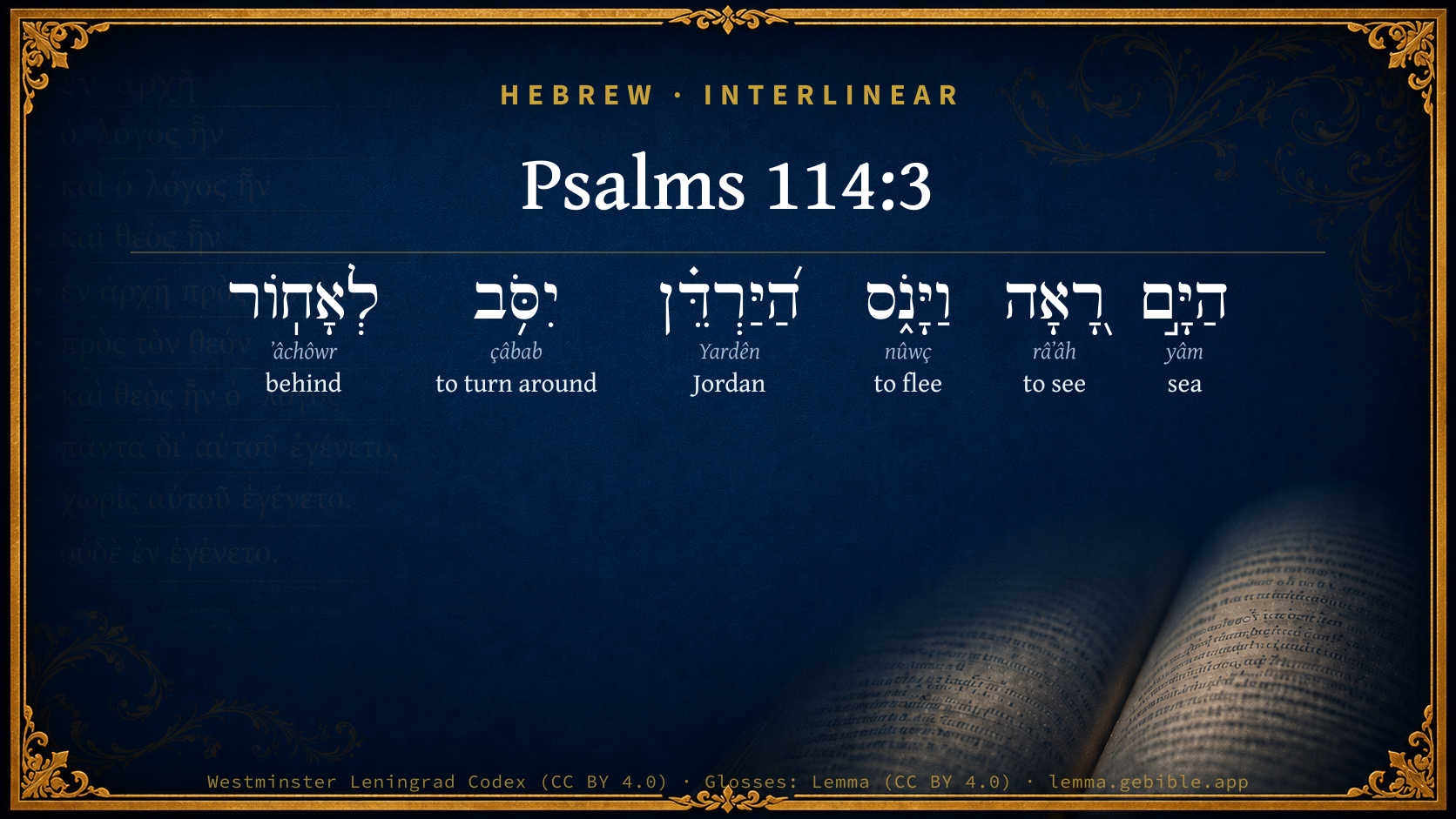
Psalms 114:3

Hebrew (Westminster Leningrad Codex) Psalms 114:3 appears in the Hebrew Old Testament. The text above is from the Westminster Leningrad Codex. Each word links to its Strong’s number, a concise gloss, and parsing drawn from the Open Scriptures Hebrew Bible morphology. Click any word for its full Brown-Driver-Briggs (BDB) entry.
Download image
Cite this verse

Psalms 114:3 (World English Bible). Public Domain. Lemma interlinear Bible study tool, https://lemma.gebible.app/v/psalms/114/3.

Show BibTeX & RIS
BibTeX
RIS
English Translation
The sea saw it, and fled. The Jordan was driven back.
World English Bible · Public Domain
Download a study sheet

One document with this verse’s original text, its word-by-word gloss line, the meaning frame, cross-references with their text, attributed commentary, and full source and license credits — printable, and it pastes into notes with its structure intact.

This verse Autodidact and up

Study sheet (.html) Plain text (.txt)

A passage Seminary Student

Up to 50 verses in one chapter. A passage sheet keeps up to 6 commentary sources and 12 cross-references per verse, in the order this page ranks them, and says so on the sheet whenever that leaves anything out. Ask for a single verse and you get the Autodidact verse sheet above.

Everything on this page stays free to read, with no account — the sheet is a download of what is already on screen, not access to it.

Want to remove ads? Support Godless Engineer
Compare translations 3

The same verse in 3 English versions, stacked beneath the original-language interlinear above. Click any original word for its lexicon entry.

Each is an independent rendering of the whole verse — the interlinear is not word-aligned to these translations.

Highlighted words mark where these versions differ — a whole-verse word diff, not a word-by-word alignment.

  • World English Bible Public Domain
    The sea saw it, and fled. The Jordan was driven back.
  • King James Version Public Domain
    The sea saw it, and fled: Jordan was driven back.
  • unfoldingWord Literal Text CC BY-SA 4.0
    The sea looked and fled; the Jordan turned backward.

unfoldingWord Literal Text — © unfoldingWord, licensed CC BY-SA 4.0. Word-aligned USFM3 via Door43 (git.door43.org/unfoldingWord/en_ult).

Versions to compare (up to 4)

3 of 4 selected

Show all 18 translations

Every available English version of this verse, each an independent rendering of the whole verse.

  • World English Bible Public Domain
    The sea saw it, and fled. The Jordan was driven back.
  • Berean Standard Bible Public Domain
    The sea observed and fled; the Jordan turned back;
  • Majority Standard Bible Public Domain
    The sea observed and fled; the Jordan turned back;
  • King James Version Public Domain
    The sea saw it, and fled: Jordan was driven back.
  • American Standard Version (1901) Public Domain
    The sea saw it, and fled; The Jordan was driven back.
  • Revised Version (1885) Public Domain
    The sea saw it, and fled; Jordan was driven back.
  • Geneva Bible (1599) Public Domain
    The Sea sawe it and fled: Iorden was turned backe.
  • Douay-Rheims (1899) Public Domain
    The sea saw and fled: Jordan was turned back.
  • Young's Literal Translation Public Domain
    The sea hath seen, and fleeth, The Jordan turneth backward.
  • Literal Standard Version CC BY-SA 4.0
    The sea has seen, and flees, || The Jordan turns backward.
  • Unlocked Literal Bible CC BY-SA 4.0
    The sea looked and fled; the Jordan turned back.
  • unfoldingWord Literal Text CC BY-SA 4.0
    The sea looked and fled; the Jordan turned backward.
  • Darby Bible Public Domain
    The sea saw it and fled, the Jordan turned back;
  • World Messianic Bible Public Domain
    The sea saw it, and fled. The Jordan was driven back.
  • Webster's Bible Public Domain
    The sea saw it, and fled: Jordan was driven back.
  • Free Bible Version CC BY-SA 4.0
    The Red Sea saw them and ran away; the Jordan River retreated.
  • Bible in Basic English Public Domain
    The sea saw it, and went in flight; Jordan was turned back.
  • JPS Tanakh (1917) Public Domain
    The sea saw it, and fled; the Jordan turned backward.

Literal Standard Version (2020), Covenant Press — licensed CC BY-SA 4.0. Text via the HelloAO Bible API (eBible.org). Unlocked Literal Bible (unfoldingWord) — licensed CC BY-SA 4.0. Text via the HelloAO Bible API (eBible.org). unfoldingWord Literal Text — © unfoldingWord, licensed CC BY-SA 4.0. Word-aligned USFM3 via Door43 (git.door43.org/unfoldingWord/en_ult). Free Bible Version, Dr. Jonathan Gallagher — licensed CC BY-SA 4.0. Text via the HelloAO Bible API (eBible.org).

Word by word

More ways to search: Search by grammar → Find every occurrence → Compare this word →

Practice this passage: Drill this verse → Learn its vocabulary →

About this verse

These counts appear in no published source. They are computed here, from the morphology-tagged text and Lemma’s own curated glosses. What Lemma adds →

6
words
6
distinct lemmas
Wisdom
section

Shared distinctive vocabulary

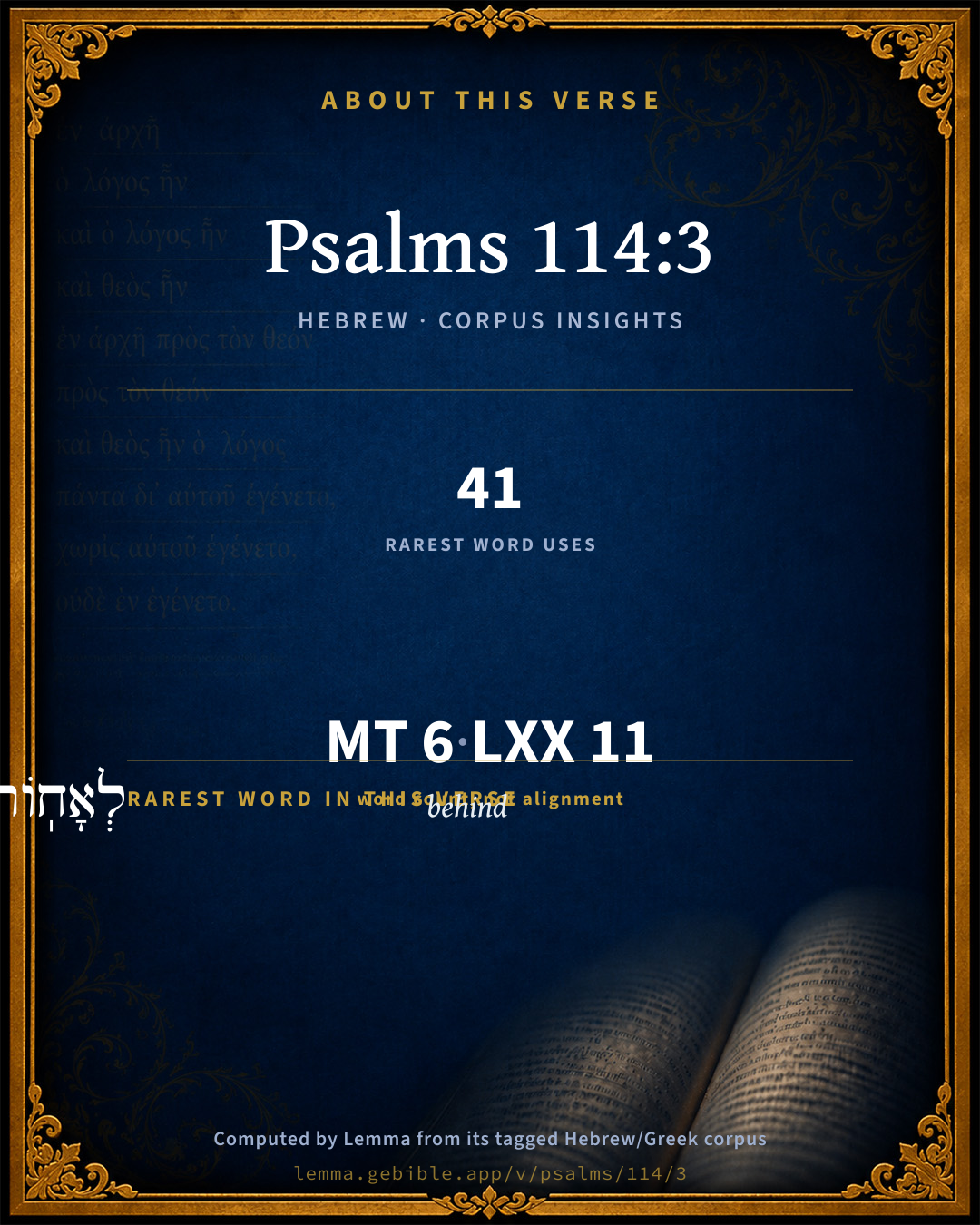
לְאָחֽוֹר behind H268 occurs in 41 verses of the Hebrew Bible. Also found in:

Grammatical profile

  • 3 verbs
  • 3 nouns

Verb forms

  • רָ֭אָה Qal · Perfect
  • וַיָּנֹ֑ס Qal · Sequential Imperfect
  • יִסֹּ֥ב Qal · Imperfect

Hebrew & Septuagint length

In English translation the verse runs 11 words from the Hebrew and 9 from the Septuagint (LXX English) — closely comparable.

A rough comparison of the two English renderings, which tokenize alike — not a word-level alignment.

Word counts can differ between the Hebrew and the Greek without any difference in meaning — e.g. the Hebrew direct-object marker אֵת has no separate Greek word, and Greek often adds the article ὁ.

In the original languages it is 6 Hebrew tokens and 11 Greek tokens — but the two are counted differently (Hebrew bundles its prefixes and suffixes into one token; the Greek is in lemma form), so that isn’t a like-for-like length.

Cross-references

10

Topical passages linked to Psalms 114:3 in the Treasury of Scripture Knowledge — connected by theme and wording, ordered by reader-vote popularity; previews shown in the World English Bible.

  • Exodus 14:21 Moses stretched out his hand over the sea, and Yahweh caused the sea to go back by a strong east wind all the night, and made the sea dry land, and the waters were divided.
  • Psalms 77:16 The waters saw you, God. The waters saw you, and they writhed. The depths also convulsed.
  • Habakkuk 3:8–9 Was Yahweh displeased with the rivers? Was your anger against the rivers, Or your wrath against the sea, That you rode on your horses, On your chariots of salvation?
  • Joshua 3:13–16 It shall come to pass, when the soles of the feet of the priests who bear the ark of Yahweh, the Lord of all the earth, shall rest in the waters of the Jordan, that the waters of the Jordan shall be cut off, even the waters that come down from above; and they shall stand in one heap.
  • Isaiah 63:12 who caused his glorious arm to go at the right hand of Moses? who divided the waters before them, to make himself an everlasting name?
  • Habakkuk 3:15 You trampled the sea with your horses, Churning mighty waters.
  • Exodus 15:8 With the blast of your nostrils the waters were piled up. The floods stood upright as a heap. The deeps were congealed in the heart of the sea.
  • Psalms 74:15 You opened up spring and stream. You dried up mighty rivers.
  • Psalms 104:7 At your rebuke they fled. At the voice of your thunder they hurried away.
  • Psalms 106:9 He rebuked the Red Sea also, and it was dried up; So he led them through the depths, as through a desert.

Cross-references courtesy of OpenBible.info (CC BY 4.0).

Hebrew and Greek witnesses Masoretic Hebrew ↔ Greek Septuagint

The same verse in the two great witnesses to the Old Testament, shown verse-for-verse.

You’re reading Greek Psalm 113 (Hebrew Psalm 114). The Septuagint counts the superscription, so verse numbers can differ from the Hebrew — chapter-level alignment, not verse-by-verse. Numbering follows Rahlfs.

These are two independent witnesses, not word-aligned to each other, and the Septuagint is shown in lemma (dictionary) form.

Hebrew Psalms 114:3 Masoretic · Westminster Leningrad Codex

הַיָּ֣ם רָ֭אָה וַיָּנֹ֑ס הַ֝יַּרְדֵּ֗ן יִסֹּ֥ב לְאָחֽוֹר

The sea saw it, and fled. The Jordan was driven back.

World English Bible · Public Domain

Greek LXX Greek Psalm 113:3 Septuagint · lemma form

ὁ θάλασσα ὁράω καί φεύγω ὁ ιορδάνης στρέφω εἰς ὁ ὀπίσω

The sea saw and fled: Jordan was turned back.

LXX2012 (modern English Septuagint) · Public Domain

Hebrew: Westminster Leningrad Codex (CC BY 4.0). Greek: Septuagint (public domain); English from LXX2012 (modern English Septuagint) (Public Domain). How the Septuagint differs from the Hebrew →

Commentary

Notes on Psalms 114:3 from classic Christian and Jewish commentators (each source and its license shown beneath its notes). The classic Christian expositions comment on the surrounding passage and are grouped to its opening verse, so a note may address several verses; the Jewish commentaries on the Tanakh (Rashi and others) are per-verse, so they appear only where the commentator wrote on this verse.

Lemma curates 59 commentaries, every one of them public domain or Creative Commons licensed, each selected and text-cleaned for this edition rather than reprinted as found. About our sources →

Trapp's Complete Commentary

John Trapp

Psa 114:3 The sea saw [it], and fled: Jordan was driven back.

Ver. 3. The sea saw it, and fled] When God will deliver his people, and perform his promises unto them, nothing shall hinder, but all creatures shall contribute their helps; for they are all his servants, Psa 119:91.

John Trapp, A Commentary or Exposition upon All the Books of the Old and New Testament (1647–1656) — public domain. Text from a community e-Sword module.

The Biblical Illustrator

Joseph S. Exell

Psa_114:3-4

The sea saw it, and fled.

The removal of obstacles

I. Antagonisms are quelled. Wherever the Church has advanced--

1. Sin and Satan have receded. Where it has not been so the Church is to blame. The promise depends on the proper spirit, and the use of proper means.

2. Idolatry has receded. Christianity simply annihilated the classical, Druidical, Saxon, Tartar, and Scandinavian mythologies, the bloody rites of the South Seas, and is now doing the same for the debasing superstitions of Africa and the foul abominations of Hindostan.

3. Infidelity has receded. For all the ancient philosophies she proved an overmatch.

II. Boundaries are removed. Jordan was driven back.

1. Christianity levels all class distinctions. To all castes, Jewish, Roman, Indian, etc., it is a formidable foe. It reduces all mankind to one common level of crying need, for which but one provision has been made.

2. Christianity obliterates all physical barriers. It goes into all the world and preaches the Gospel to every creature. It was not made for home consumption, but is the property of all nations.

3. Christianity fills up all intellectual chasms. No greater remove could possibly be than that between the old philosopher and the common people. Christianity appeals to both. Its truths are The food of the scholar and the refreshment of the slave.

III. Difficulties are overcome. The mountains skipped, etc.

1. All difficulties of nature. Wherever Christianity has appeared the valleys have been exalted, etc. Crooked ways have been made straight. No mountain has been too high, no sea too broad, no continent too wide, for the pioneers and missionaries of the faith.

2. All difficulties of human prejudice. Armies have been levied to extirpate it. Fires have been kindled to burn it. Learning has been accumulated to refute it, but in vain. In conclusion. This history is prophecy. Fulfilled prophecy in some instances. It holds good through the ages. Let the Church in the strength of it redouble her efforts, brighten her hope, perfect her faith, and go on conquering and to conquer. (J. W. Burn.)

.

Psa_115:1-18

The Biblical Illustrator, edited by Joseph S. Exell (c. 1880s–1900s) — public domain. Text from a community e-Sword module.

Joseph Benson's Commentary

Psa 114:3-6. The sea saw it, and fled — Saw that God was present with and among them in an extraordinary manner, and therefore fled; for nothing could have been more awful. Jordan is driven back — At the appearance of the divine glory which conducted them. “Although forty years intervened between the two events here mentioned, yet, as the miracles were of the same nature, they are spoken of together.” The mountains skipped like rams — Horeb and Sinai, two tops of one mountain, and other neighbouring hills and mountains. The same power that fixed the fluid waters, and made them stand still, shook the stable mountains, and made them tremble; for all the powers of nature are at the command and under the control of the God of nature. Mountains and hills are before God but like rams and lambs; even the largest and the most rocky of them are as manageable by him as the sheep are by the shepherd. The trembling of the mountains before Jehovah may shame the stupidity and obduracy of sinners, who are not moved at the discoveries of his glory. What ailed thee, O sea, that thou fleddest? — What was the reason, or for what cause was it, that thou didst, with such precipitation, retire and leave the middle of thy channel dry? Why didst thou, O Jordan, run back toward thy springs? Ye mountains, that ye skipped, &c. — Whence this unusual motion? Why did you leap like affrighted rams or lambs, as if you would have run away from the place where you had so long been fixed?

Joseph Benson's Commentary on the Old and New Testaments (1811–1818) — public domain. Text from a community e-Sword module.

J. A. Alexander on Psalms

Joseph Addison Alexander

3. (Psa 114:3) The sea saw and fled—the Jordan turns back. By supposing the conversive prefix to affect both verbs, we may render the last also as a preterite, turned back. The historical allusion is to Exo 14:21, Jos 3:14-17. At the same time, as seas and rivers are familiar emblems of the world and its nations, the reminiscence is adapted to suggest the hope, that other seas and other rivers may be yet controlled by the same power. See above, on Psa 77:16; Psa 93:3; Psa 107:23.

Joseph Addison Alexander, The Psalms Translated and Explained (1850) — public domain. Text from a community e-Sword module.

Tyndale Open Study Notes

Tyndale Open Resources

114:3-4 hurried out of their way! The waters divided for Israel to escape Egypt (77:17-18; Exod 14). • The Jordan River turned away when Israel arrived to cross over (see Josh 3). • skipped like rams: God’s presence caused the mountains to quake (Exod 19:16-20).

Tyndale Open Study Notes — © Tyndale Open Resources, licensed CC BY-SA 4.0. Text via the HelloAO Bible API.

Adam Clarke's Commentary

Verse 3. The sea saw it, and fled] Mr. Addison has properly observed (see Spect. No. 461) that the author of this Psalm designedly works for effect, in pointing out the miraculous driving back the Red Sea and the river Jordan, and the commotion of the hills and mountains, without mentioning any agent. At last, when the reader sees the sea rapidly retiring from the shore, Jordan retreating to its source, and the mountains and hills running away like a flock of affrighted sheep, that the passage of the Israelites might be every where uninterrupted; then the cause of all is suddenly introduced, and the presence of God in his grandeur solves every difficulty.

Adam Clarke's Commentary on the Bible (1810–1826) — public domain. Text from a community e-Sword/MySword module.

John Calvin's Commentaries

3 The sea saw, and fled He does not enumerate in succession all the miracles which were wrought at that time, but briefly alludes to the sea, which, though a lifeless and senseless element, is yet struck with terror at the power of God. Jordan did the same, and the very mountains shook. It is in a poetical strain that the Psalmist describes the receding of the sea and of the Jordan. The description, however, does not exceed the facts of the case. The sea, in rendering such obedience to its Creator, sanctified his name; and Jordan, by its submission, put honor upon his power; and the mountains, by their quaking, proclaimed how they were overawed at the presence of his dreadful majesty. By these examples it is not meant to celebrate God’s power more than the fatherly care and desire which he manifests for the preservation of the Church; and, accordingly, Israel is very properly distinguished from the sea, the Jordan, and the mountains — there being a very marked difference between the chosen people and the insensate elements.

John Calvin's Commentaries (1540-1563) — public domain. Text from the Calvin Translation Society English edition (1840s-50s) via the Christian Classics Ethereal Library (ccel.org). Calvin's coverage is partial (roughly two-thirds of the Bible); uncommented books and verses are honest gaps, never fabricated. The 19th-century editor's footnotes and remarks are omitted so the notes are faithfully Calvin's own voice.

Ellicott's Commentary for English Readers

(3) Fled.—The Authorised Version weakens the effect by rendering “it was driven back.” (See Jos_3:16.) The scene presented is of the “descending stream” (the words employed seem to have a special reference to that peculiar and most significant name of the “Jordan”) not parted asunder, as we generally fancy, but, as the psalm expresses it, “turned backwards” (Stanley, Jewish Church, i. 229).

A Bible Commentary for English Readers, edited by Charles John Ellicott (1878–1897) — public domain. Text from a community e-Sword module.

The Cambridge Bible for Schools and Colleges

gen. ed. J. J. S. Perowne

3. The sea saw and fled;

The Jordan turned backwards.

In the parallel passages Psa_77:16; Hab_3:10, God is the object of the verb saw. But here the object is significantly left unexpressed. The whole spectacle of Israel’s triumphant Exodus is meant. The Red Sea and the Jordan are personified, and represented as hastening to withdraw the barriers they opposed to Israel’s exit from Egypt and entrance into Canaan. Awestruck Nature recognised and obeyed its Master’s Will.

3, 4. The wonders of the Exodus from Egypt and the Entry into Canaan.

The Cambridge Bible for Schools and Colleges (gen. ed. J. J. S. Perowne; Cambridge University Press, 1878–1918) — public domain. Text from a community e-Sword module.

John Gill's Exposition

The sea saw it, and fled,.... When the Word of the Lord appeared at it, as the Targum in the king's Bible; the Red sea, to which the Israelites came when they went out of Egypt; this saw that Judah was the Lord's holy and peculiar people, and that Israel were the subjects of his kingdom; it saw the presence of the Lord among them; it saw him in the glory of his perfections, and felt his power; see Psa 77:16, at which its waters fled and parted, and stood up as a wall to make way for Israel to pass through as on dry land, Exo 14:21. This was typical of the nations of the Gentile world, comparable to the sea, Dan 7:2, who saw the work of God going on among them under the ministry of the Gospel in the first times of it, whereby multitudes were turned from idols to serve the living God; this they saw and trembled at, and they and their kings fled for fear; see Isa 41:5, and of the stop put to the ocean of sin in a man's heart, and to the torrent of wickedness that breaks out from thence, by powerful and efficacious grace, much more abounding where sin has abounded.

Jordan was driven back; this was done not at the time of the departure of the Israelites from Egypt, but just before their entrance into the land of Canaan, and in order to it; and being an event similar to the former is here mentioned, and done by the power and presence of God; for as soon as the feet of the priests who bore the ark of the Lord, the symbol of the divine Presence, were dipped in the brim of the waters, the waters below were cut off from those above, and stood up on an heap, and all the Israelites passed through on dry ground, Jos 3:13, this was an emblem of death, through which the saints pass to glory, which is abolished by Christ, its sting and curse taken away; which when the saints come to, they find it like Jordan driven back, and have an easy and abundant passage through it; and when on the brink of it, and even in the midst of it, sing, "O death, where is thy sting? O grave, where is thy victory?" Co1 15:55.

John Gill's Exposition of the Whole Bible (1746–1763) — public domain (CC PDM 1.0). Text via the HelloAO Bible API.

Albert Barnes' Notes on the Bible

The sea saw it - The word it is supplied, not very properly, by our translators. It would be more expressive to say, “The sea saw:” that is, The sea - (the Red Sea) - saw the mighty movement - the marshalled hosts - the moving masses - the cattle - the pursuing enemies - the commotion - the agitation - on its usually quiet shores. We are to conceive of the usual calmness of the desert - the waste and lonely solitudes on the banks of the Red Sea - and then all this suddenly broken in upon by vast hosts of men, women, children, and cattle, fleeing in consternation, followed by the embattled strength of Egypt - all rolling on tumultuously to the shore. No wonder that the sea is represented as astonished at this unusual spectacle, and as fleeing in dismay.

And fled - As if affrighted at the approach of such an host, coming so suddenly upon its shores.

Jordan was driven back - Referring to the dividing of the waters of the Jordan when the children of Israel passed over to the promised land. Jos 3:13-17. They also seemed astonished at the approach of the Hebrews, and retired to make a way for them to pass over.

Albert Barnes' Notes on the Bible (1834–1885) — public domain. Text from a community e-Sword/MySword module.

Matthew Poole's English Annotations

Saw it, to wit, this glorious work of God in bringing his people out of Egypt.

Matthew Poole's English Annotations on the Holy Bible (1683–1685) — public domain. Text from a community e-Sword/MySword module.

The Treasury of David

Charles H. Spurgeon

Ver. 3. The sea saw it: to wit this glorious work of God in bringing his people out of Egypt. Matthew Pool.

Ver. 3. The sea saw it. Saw there that "Judah" was "God's sanctuary, ""and Israel his dominion, "and therefore "fled"; for nothing could be more awful. It was this that drove Jordan back, and was an invincible dam to his streams; God was at the head of that people, and therefore they must give way to them, must make room for them, they must retire, contrary to their nature, when God speaks the word. Matthew Henry.

Ver. 3. The sea saw it, and fled.

The waves on either side

Unloose their close embraces, and divide,

And backwards press, as in some solemn show

The crowding people do,

(Though just before no space was seen,)

To let the admired triumph pass between.

The wondering army saw on either hand,

The no less wondering waves like rocks of crystal

stand.

They marched betwixt, and boldly trod

The secret paths of God. Abraham Cowley, 1618-1667.

Ver. 3. Jordan was driven back. And now the glorious day was come when, by a stupendous miracle, Jehovah had determined to show how able he was to remove every obstacle in the way of his people, and to subdue every enemy before their face. By his appointment, the host, amounting probably to two millions and a half of persons (about the same number as had crossed the Red Sea on foot), had removed to the banks of the river three days before, and now in marching array awaited the signal to cross the stream. At any time the passage of the river by such a multitude, with their women and children, their flocks and herds, and all their baggage, would have presented formidable difficulties; but now the channel was filled with a deep and impetuous torrent, which overflowed its banks and spread widely on each side, probably extending nearly a mile in width; while in the very sight of the scene were the Canaanitish hosts, who might be expected to pour out from their gates, and exterminate the invading multitude before they could reach the shore. Yet these difficulties were nothing to Almighty power, and only served to heighten the effect of the stupendous miracle about to be wrought.

By the command of Jehovah, the priests, bearing the ark of the covenant, the sacred symbol of the Divine presence, marched more than half a mile in front of the people, who were forbidden to come any nearer to it. Thus it was manifest that Jehovah needed not protection from Israel, but was their guard and guide, since the unarmed priests feared not to separate themselves from the host, and to venture with the ark into the river in the face of their enemies. And thus the army, standing aloof, had a better opportunity of seeing the wondrous results, and of admiring the mighty power of God exerted on their behalf; for no sooner had the feet of the priests touched the brim of the overflowing river, than the swelling waters receded from them; and not only the broad lower valley, but even the deep bed of the stream was presently emptied of water, and its pebbly bottom became dry. The waters which had been in the channel speedily ran off, and were lost in the Dead Sea; whilst those which would naturally have replaced them from above, were miraculously suspended, and accumulated in a glassy heap far above the city Adam, that is beside Zaretan. These places are supposed to have been at least forty miles above the Dead Sea, and may possibly have been much more; so that nearly the whole channel of the Lower Jordan, from a little below the Lake of Tiberias to the Dead Sea, was dry...What a glorious termination of the long pilgrimage of Israel was this! and how worthy of the power, wisdom, and goodness of their Divine Protector! "The passage of this deep and rapid river, " remarks Dr. Hales, "at the most unfavourable season, was more manifestly miraculous, if possible, than that of the Red Sea; because here was no natural agency whatever employed; no mighty wind to sweep a passage, as in the former case; no reflux of the tide, on which minute philosophers might fasten to depreciate the miracle. It seems, therefore, to have been providentially designed to silence cavils respecting the former; and it was done at noonday, in the face of the sun, and in the presence, we may be sure, of the neighbouring inhabitants, and struck terror into the kings of the Canaanites and Amorites westward of the river." Philip Henry Gosse, in "Sacred Streams, "1877.

Ver. 3. Jordan was driven back. The waters know their Maker: that Jordan which flowed with full streams when Christ went into it to be baptized, now gives way when the same God must pass through it in state: then there was use of his water, now of his sand. I hear no more news of any rod to strike the waters; the presence of the ark of the Lord God, Lord of all the world, is sign enough to these waves, which now, as if a sinew were broken, run back to their issues, and dare not so much as wet the feet of the priests that bare it. How subservient are all the creatures to the God that made them! How glorious a God do we serve; whom all the powers of the heavens and elements are willingly subject unto, and gladly take that nature which he pleaseth to give them. Abraham Wright.

Ver. 3. Jordan was driven back. It was probably at the point near the present southern fords, crossed at the time of the Christian era by a bridge. The river was at its usual state of flood at the spring of the year, so as to fill the whole of the bed, up to the margin of the jungle with which the river banks are lined. On the broken edge of the swollen stream, the band of priests stood with the ark on their shoulders. At the distance of nearly a mile in the rear was the mass of the army. Suddenly the full bed of the Jordan was dried before them. High up the river, "far, far away, ""in Adam, the city which is beside Zaretan, ""as far as the parts of Kirjathjearim" (Jos 3:16), that is, at a distance of thirty miles from the place of the Israelite encampment, the waters there stood which "descended" "from the heights above, "stood and rose up, as if gathered into a water skin; as if in a barrier or heap, as if congealed; and those that "descended" towards the sea of "the desert, "the Salt Sea, "failed and were cut off." Thus the scene presented is of the "descending stream" (the words employed seem to have a special reference to that peculiar and most significant name of the "Jordan"), not parted asunder, as we generally fancy, but, as the Psalm expresses it, "turned backwards"; the whole bed of the river left dry from north to south, through its long windings; the huge stones lying bare here and there, imbedded in the soft bottom; or the shingly pebbles drifted along the course of the channel. Arthur Penrhyn Stanly, in "The History of the Jewish Church, "1870.

Ver. 3. The impenitence of sinners rebuked by the inanimate creation.

Ver. 3. Jordan was driven back, or death overcome.

Psalms 114:4*

Charles H. Spurgeon's The Treasury of David (1869–1885) — public domain. Psalms only. Text from a community e-Sword/MySword module.

Whedon's Commentary on the Bible

Daniel D. Whedon

3. The sea… Jordan— “The dividing of the sea opens, and the dividing of the Jordan closes, the journey through the desert to Canaan.”—Delitzsch. Between these points are grouped rapidly the wonders celebrated in the psalm.

Daniel D. Whedon (gen. ed.), Commentary on the Old and New Testaments (1874–1909) — public domain. Text from a community e-Sword module.

The Pulpit Commentary

The sea saw it, and fled. "The sea" is the Red Sea. It "looked," and saw God leading his people, (Exo_14:19-24) and then at once "fled," and left a dry channel as "a way for the ransomed to pass over." Jordan (literally, the Jordan) was driven back. (comp. Jos_3:13-17) These two marvels "marked respectively the beginning and the end of Israel"s long journey" (Cheyne). They were parallel facts, and are naturally alluded to together. (comp. Hab_3:8)

Vers. 3, 4. Nature made to serve God"s purposes.

These verses are poetical representations of three actual facts which are recorded in the history of God"s people. We may see facts in their bare, bald nakedness, or we may see them with the color on them which poetical genius can put. It may be disputed whether bald history or suggestive poetry is really the truer to nature, just as it may be disputed whether the realistic or the idealistic picture is the truer to life. If nature is to suggest thoughts to men, then men only see Nature aright when they know what she says as well as what she is. The poet tells us what Nature says. In these verses we are made to understand that the sea felt God working in it, and yielded to his touch. Jordan felt God working in it, and stopped its flowing. Sinai felt God working in it, and responded with a trembling of reverence and holy joy. The response of Nature is a lesson for man. God would work in his higher powers and his higher spheres; and his response should be more prompt than the hurrying waves, more complete than the check of the river"s flowing, and more joyous than the trembling and dances of the divinely honored hills. The psalmist was the moral teacher of his times, and had a definite purpose before him in thus recalling the most impressive events of the national history. His point may be thus briefly stated: Nature does respond to God and serve his purposes, and man should.

I NATURE DOES RESPOND TO GOD AND SERVE HIS PURPOSES. This may be illustrated from the usual and the unusual. Pagans peopled the woods and streams and hills with fairies; Wordsworth poetically conceived of Nature as a living being. Religion finds God working out his thought everywhere, and everything responsive to his use. Nature is not God; it is distinct from him. But it is so kin with him that, unhindered, his thought finds expression in it. And so responsive is Nature to God, that it readily yields itself to the unusual, to the miraculous, when these are necessary to God"s purposes. Seas will part, rivers will stop, mountains will tremble, in response to him. "The earth is the Lord"s, and the fullness thereof.

II MAN SHOULD RESPOND TO GOD AND SERVE HIS PURPOSES. He should, because he is a part of Nature, and ought to be in harmony with her. But man is a higher being than any thing or being in Nature a being with a will, a being made in God"s image. It is his willing response, it is his loving and obedient outworking of the Divine purposes, that God asks of restored exiles and of us. R.T.

The Pulpit Commentary (1880–1919), ed. H.D.M. Spence-Jones & Joseph S. Exell — public domain. Text from a community e-Sword module.

unfoldingWord translationNotes

Door43 World Missions Community

The sea looked and fled

The writer speaks of the Sea of Reeds as if it were a person who fled away as Yahweh led the people of Israel through on dry ground. AT: "It was as though the sea looked and fled" (See: Personification)

the Jordan turned back

The writer speaks of the Jordan River as if it were a person who retreated as Yahweh led the people of Israel through on dry ground. AT: "it was as though the Jordan retreated" (See: Personification)

The mountains skipped like rams, the hills skipped like lambs

The writer speaks of the mountains and hills as if they are alive. He is probably speaking of an earthquake when he describes their fear at the presence of Yahweh as if they were jumping like rams and lambs. AT: "It was as if the mountains shook like jumping rams and the hills shook like jumping lambs" (See: Personification and Metaphor)

translationWords

Jordan River

like

ewe

lamb

unfoldingWord translationNotes — © Distant Shores Media and the Door43 World Missions Community, licensed CC BY-SA 4.0. Source: git.door43.org/Door43/en_tn.

Rashi

Rabbi Shlomo Yitzchaki (Rashi)

the Jordan turned backward because all the water of Creation split.

Rashi on the Tanakh — English translations: “The Judaica Press complete Tanach with Rashi, translated by A. J. Rosenberg” (CC BY 4.0); “Pentateuch with Rashi's commentary by M. Rosenbaum and A.M. Silbermann, 1929-1934” (public domain); “The Metsudah Tanach series, Lakewood, N.J” (CC BY 4.0); and “The Book of Joshua, Metsudah Publications, 1997” (CC BY 4.0). Text via Sefaria.

Lesson kit

Teaching starters — assembled from the data on this page, not authored interpretation. Every prompt links to the verse data it draws on. Edit before teaching.

Psalms, in the Wisdom, opens this verse with 6 words (6 distinct Hebrew lemmas). Its most distinctive word is ʼâchôwr (“behind”). A historical commentator’s framing appears above. Read the whole chapter for the surrounding context.

Discussion questions

  1. How does “behind” (ʼâchôwr) shape what this verse is saying?
  2. How does Genesis 49:17, which shares the word «behind», read alongside this verse?
  3. The translations on this page render this verse differently — a whole-verse word diff, not a word-by-word alignment. What might account for the different wordings?
  4. «רָ֭אָה» is a Qal Perfect verb. How does that grammatical form shape the action described?
  5. Compare how Trapp's Complete Commentary and The Biblical Illustrator read this verse. Where do they agree or differ?

Things to notice

Reading settings

Reading text

Shown beneath each verse's original-language words.

Old Testament
Old Testament edition

Read the OT as the Masoretic Hebrew (MT) or the Greek Septuagint (LXX).

English shown for the Greek Septuagint (in the Hebrew ↔ Greek comparison).

Comparing translations? Open the Compare panel on any verse page to stack up to four side by side.