Ezekiel 26:18

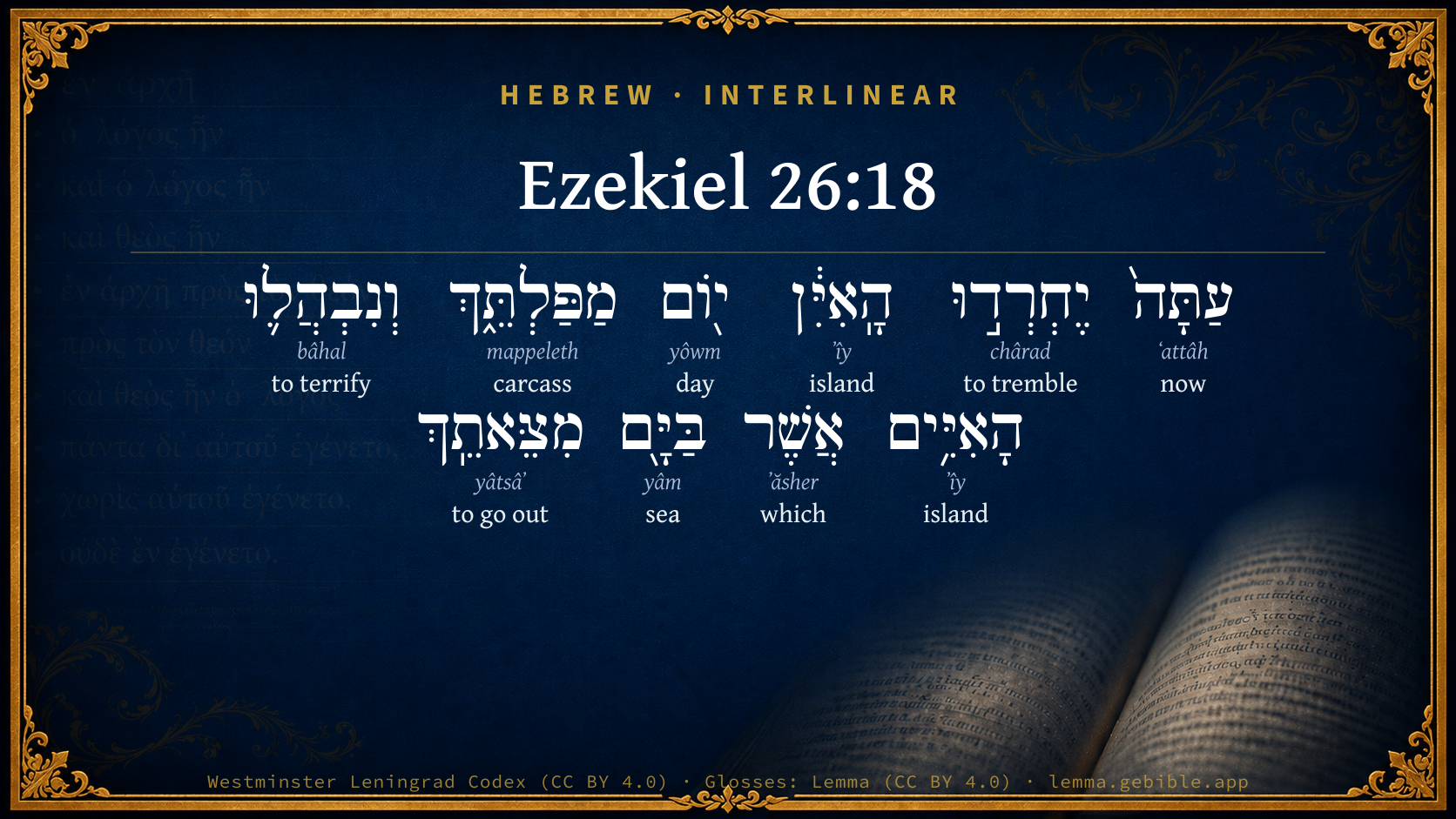
Hebrew (Westminster Leningrad Codex) Ezekiel 26:18 appears in the Hebrew Old Testament. The text above is from the Westminster Leningrad Codex. Each word links to its Strong’s number, a concise gloss, and parsing drawn from the Open Scriptures Hebrew Bible morphology. Click any word for its full Brown-Driver-Briggs (BDB) entry.
Download image
Cite this verse

Ezekiel 26:18 (World English Bible). Public Domain. Lemma interlinear Bible study tool, https://lemma.gebible.app/v/ezekiel/26/18.

Show BibTeX & RIS
BibTeX
RIS
English Translation
Now shall the isles tremble in the day of your fall; yes, the isles that are in the sea shall be dismayed at your departure.
World English Bible · Public Domain
Download a study sheet

One document with this verse’s original text, its word-by-word gloss line, the meaning frame, cross-references with their text, attributed commentary, and full source and license credits — printable, and it pastes into notes with its structure intact.

This verse Autodidact and up

Study sheet (.html) Plain text (.txt)

A passage Seminary Student

Up to 50 verses in one chapter. A passage sheet keeps up to 6 commentary sources and 12 cross-references per verse, in the order this page ranks them, and says so on the sheet whenever that leaves anything out. Ask for a single verse and you get the Autodidact verse sheet above.

Everything on this page stays free to read, with no account — the sheet is a download of what is already on screen, not access to it.

Want to remove ads? Support Godless Engineer
Compare translations 3

The same verse in 3 English versions, stacked beneath the original-language interlinear above. Click any original word for its lexicon entry.

Each is an independent rendering of the whole verse — the interlinear is not word-aligned to these translations.

Highlighted words mark where these versions differ — a whole-verse word diff, not a word-by-word alignment.

  • World English Bible Public Domain
    Now shall the isles tremble in the day of your fall; yes, the isles that are in the sea shall be dismayed at your departure.
  • King James Version Public Domain
    Now shall the isles tremble in the day of thy fall; yea, the isles that are in the sea shall be troubled at thy departure.
  • unfoldingWord Literal Text CC BY-SA 4.0
    Now the coasts tremble on the day of your downfall. The islands in the sea are terrified, because you are no longer in your place.’

unfoldingWord Literal Text — © unfoldingWord, licensed CC BY-SA 4.0. Word-aligned USFM3 via Door43 (git.door43.org/unfoldingWord/en_ult).

Versions to compare (up to 4)

3 of 4 selected

Show all 18 translations

Every available English version of this verse, each an independent rendering of the whole verse.

  • World English Bible Public Domain
    Now shall the isles tremble in the day of your fall; yes, the isles that are in the sea shall be dismayed at your departure.
  • Berean Standard Bible Public Domain
    Now the coastlands tremble on the day of your downfall; the islands in the sea are dismayed by your demise.”’
  • Majority Standard Bible Public Domain
    Now the coastlands tremble on the day of your downfall; the islands in the sea are dismayed by your demise.”’
  • King James Version Public Domain
    Now shall the isles tremble in the day of thy fall; yea, the isles that are in the sea shall be troubled at thy departure.
  • American Standard Version (1901) Public Domain
    Now shall the isles tremble in the day of thy fall; yea, the isles that are in the sea shall be dismayed at thy departure.
  • Revised Version (1885) Public Domain
    Now shall the isles tremble in the day of thy fall; yea, the isles that are in the sea shall be dismayed at thy departure.
  • Geneva Bible (1599) Public Domain
    Nowe shall the yles be astonished in the day of thy fall: yea, the yles that are in the sea, shall be troubled at thy departure.
  • Douay-Rheims (1899) Public Domain
    Now shall the ships be astonished in the day of thy terror: and the islands in the sea shall be troubled because no one cometh out of thee.
  • Young's Literal Translation Public Domain
    Now they tremble, is it not the day of thy fall? Troubled have been the isles that `are' in the sea, at thine outgoing.
  • Literal Standard Version CC BY-SA 4.0
    Now the islands tremble [on the] day of your fall; The islands that [are] in the sea have been troubled at your outgoing.”
  • Unlocked Literal Bible CC BY-SA 4.0
    Now the coasts tremble on the day of your downfall. The islands in the sea are terrified, because you are no longer in your place.'
  • unfoldingWord Literal Text CC BY-SA 4.0
    Now the coasts tremble on the day of your downfall. The islands in the sea are terrified, because you are no longer in your place.’
  • Darby Bible Public Domain
    Now shall the isles tremble in the day of thy fall; and the isles that are in the sea shall be troubled at thy departure.
  • World Messianic Bible Public Domain
    Now the islands will tremble in the day of your fall. Yes, the islands that are in the sea will be dismayed at your departure.’
  • Webster's Bible Public Domain
    Now shall the isles tremble in the day of thy fall; yes, the isles that are in the sea shall be disturbed at thy departure.
  • Free Bible Version CC BY-SA 4.0
    Now the people of the coastlands tremble at your defeat, while those in the islands of the sea are horrified at your downfall.’
  • Bible in Basic English Public Domain
    Now the sea-lands will be shaking in the day of your fall; and all the ships on the sea will be overcome with fear at your going.
  • JPS Tanakh (1917) Public Domain
    Now shall the isles tremble in the day of thy fall; yea, the isles that are in the sea shall be affrighted at thy going out.

Literal Standard Version (2020), Covenant Press — licensed CC BY-SA 4.0. Text via the HelloAO Bible API (eBible.org). Unlocked Literal Bible (unfoldingWord) — licensed CC BY-SA 4.0. Text via the HelloAO Bible API (eBible.org). unfoldingWord Literal Text — © unfoldingWord, licensed CC BY-SA 4.0. Word-aligned USFM3 via Door43 (git.door43.org/unfoldingWord/en_ult). Free Bible Version, Dr. Jonathan Gallagher — licensed CC BY-SA 4.0. Text via the HelloAO Bible API (eBible.org).

Word by word

More ways to search: Search by grammar → Find every occurrence → Compare this word →

Practice this passage: Drill this verse → Learn its vocabulary →

מַפַּלְתֵּ֑ךְ
mappeleth
H4658
“carcass · your”
Noun, Common, Feminine, Singular, Construct + Suffix, Personal, 2nd Person, Feminine, Singular
Part of Speech
Noun
Type
Common
Gender
Feminine
Number
Singular
State
Construct
Full BDB Definition

Origin: from H5307

TWOT: 1392e

carcass, ruin, overthrow - carcass - ruin, overthrow
  1. עַתָּה֙ ʻattâh H6258 “now” Adverb
  2. יֶחְרְד֣וּ chârad H2729 “to tremble” Verb, Qal, Imperfect, 3rd Person, Masculine, Plural
  3. הָֽאִיִּ֔ן ʼîy H339 “the · islands” Particle, Definite Article + Noun, Common, Masculine, Plural, Absolute
  4. י֖וֹם yôwm H3117 “day of” Noun, Common, Masculine, Singular, Construct
  5. וְנִבְהֲל֛וּ bâhal H926 “and · to terrify” Conjunction + Verb, Niphal, Sequential Perfect, 3rd Person, Common, Plural
  6. הָאִיִּ֥ים ʼîy H339 “the · islands” Particle, Definite Article + Noun, Common, Masculine, Plural, Absolute
  7. אֲשֶׁר ʼăsher H834 “which” Particle, Relative
  8. בַּיָּ֖ם yâm H3220 “in/at the · sea” Preposition, Determined + Noun, Common, Masculine, Singular, Absolute
  9. מִצֵּאתֵֽךְ yâtsâʼ H3318 “from · to go out · you” Preposition + Verb, Qal, Infinitive Construct + Suffix, Personal, 2nd Person, Feminine, Singular

About this verse

These counts appear in no published source. They are computed here, from the morphology-tagged text and Lemma’s own curated glosses. What Lemma adds →

10
words
9
distinct lemmas
Prophets
section

Notable vocabulary

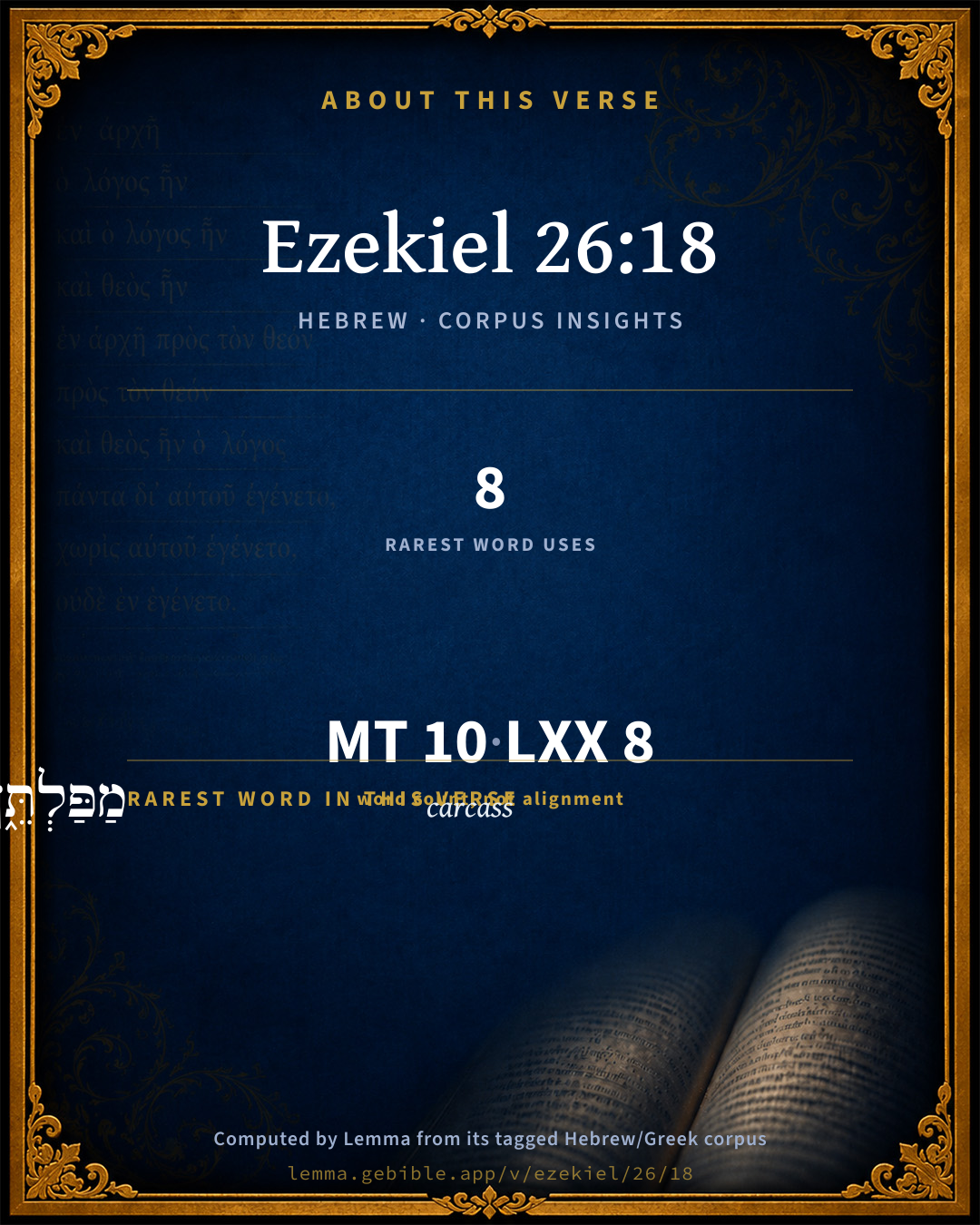
The rarest word here is מַפַּלְתֵּ֑ךְ carcass H4658 — appearing just 8 times in the whole Hebrew Bible.

Shared distinctive vocabulary

מַפַּלְתֵּ֑ךְ carcass H4658 occurs in 8 verses of the Hebrew Bible. Also found in:

Grammatical profile

  • 3 verbs
  • 5 nouns
  • 1 adverb
  • 1 particle

Verb forms

  • יֶחְרְד֣וּ Qal · Imperfect
  • וְנִבְהֲל֛וּ Niphal · Sequential Perfect
  • מִצֵּאתֵֽךְ Qal · Infinitive Construct

Repetition

A word recurs within this verse — often emphatic in Hebrew:

  • הָֽאִיִּ֔ן island H339 ×2

Hebrew & Septuagint length

In English translation the verse runs 25 words from the Hebrew and 12 from the Septuagint (LXX English) — the Septuagint runs noticeably shorter here. See the side-by-side →

A rough comparison of the two English renderings, which tokenize alike — not a word-level alignment.

Word counts can differ between the Hebrew and the Greek without any difference in meaning — e.g. the Hebrew direct-object marker אֵת has no separate Greek word, and Greek often adds the article ὁ.

In the original languages it is 10 Hebrew tokens and 8 Greek tokens — but the two are counted differently (Hebrew bundles its prefixes and suffixes into one token; the Greek is in lemma form), so that isn’t a like-for-like length.

Cross-references

6

Topical passages linked to Ezekiel 26:18 in the Treasury of Scripture Knowledge — connected by theme and wording, ordered by reader-vote popularity; previews shown in the World English Bible.

  • Isaiah 23:5–7 When the report comes to Egypt, they shall be sorely pained at the report of Tyre.
  • Ezekiel 26:15 Thus says the Lord Yahweh to Tyre: shall not the isles shake at the sound of your fall, when the wounded groan, when the slaughter is made in the midst of you?
  • Isaiah 23:10–12 Pass through your land as the Nile, daughter of Tarshish; there is no restraint any more.
  • Isaiah 41:5 The isles have seen, and fear; the ends of the earth tremble; they draw near, and come.
  • Ezekiel 27:28–30 At the sound of the cry of your pilots the suburbs shall shake.
  • Ezekiel 27:35 All the inhabitants of the isles are astonished at you, and their kings are horribly afraid; they are troubled in their face.

Cross-references courtesy of OpenBible.info (CC BY 4.0).

Hebrew and Greek witnesses Masoretic Hebrew ↔ Greek Septuagint

The same verse in the two great witnesses to the Old Testament, shown verse-for-verse.

Here the Septuagint runs noticeably shorter than the Hebrew — LXX2012 (modern English Septuagint) 12 words vs World English Bible 25. A rough length comparison of the two English translations, not a word-level alignment — read both below.

These are two independent witnesses, not word-aligned to each other, and the Septuagint is shown in lemma (dictionary) form.

Hebrew Ezekiel 26:18 Masoretic · Westminster Leningrad Codex

עַתָּה֙ יֶחְרְד֣וּ הָֽאִיִּ֔ן י֖וֹם מַפַּלְתֵּ֑ךְ וְנִבְהֲל֛וּ הָאִיִּ֥ים אֲשֶׁר בַּיָּ֖ם מִצֵּאתֵֽךְ

Now shall the isles tremble in the day of your fall; yes, the isles that are in the sea shall be dismayed at your departure.

World English Bible · Public Domain

Greek LXX Ezekiel 26:18 Septuagint · lemma form

καί φοβέω ὁ νήσος ἀπό ἡμέρα πτῶσις σύ

And the isles shall be alarmed at the day of your fall.

LXX2012 (modern English Septuagint) · Public Domain

On this verse, The Cambridge Bible for Schools and Colleges discusses the Septuagint’s reading. Read the note in Commentary ↓

Hebrew: Westminster Leningrad Codex (CC BY 4.0). Greek: Septuagint (public domain); English from LXX2012 (modern English Septuagint) (Public Domain). How the Septuagint differs from the Hebrew →

Targum (Aramaic paraphrase)

1

The Targum is the ancient Jewish Aramaic paraphrase of the Hebrew Scriptures — an interpretive translation, not the Hebrew text itself. Onkelos (literal) and Pseudo-Jonathan (expansive) render the Torah, and Jonathan the Prophets. Coverage is partial: where no permissively-licensed English translation exists for a verse, only the Aramaic is shown. This is verse-level text, not a word-by-word alignment to the Hebrew.

  1. Targum Jonathan Prophets (Joshua–Malachi)
    כְּעַן יְזוּעוּן פַּרְוְרַיָא בְּיוֹם מַפְּלַת קְטִילָךְ וְיִתְבָּהֲלוּן נַגְוָתָא דִי בְיַמָא בְּמִפַּק גָלוּתִיךְ:

    (no public-domain English translation for this verse)

    Targum Jonathan — Aramaic: “Mikraot Gedolot” (public domain). English: “Sefaria Community Translation” (CC0 1.0 (public-domain dedication)); “London "Chaldee Paraphrase," 1871” (public domain). Text via Sefaria.

Commentary

Notes on Ezekiel 26:18 from classic Christian and Jewish commentators (each source and its license shown beneath its notes). The classic Christian expositions comment on the surrounding passage and are grouped to its opening verse, so a note may address several verses; the Jewish commentaries on the Tanakh (Rashi and others) are per-verse, so they appear only where the commentator wrote on this verse.

Lemma curates 59 commentaries, every one of them public domain or Creative Commons licensed, each selected and text-cleaned for this edition rather than reprinted as found. About our sources →

The Cambridge Bible for Schools and Colleges

gen. ed. J. J. S. Perowne

18. the isles] See on Eze_26:15. The form of plur. nowhere else occurs, and appears to be adopted in order to gain a parallelism to “isles” (ordinary form) in the next clause. The phrase “at thy departure,” lit. outgoing is strange; but might have a parallel Psa_144:14.

The elegy seems confined to Eze_26:17, but probably through explanatory amplifications that have crept into the text, Eze_26:18 has also been drawn into it. LXX. reads in a shorter form:

18. And the isles shall be terrified—at the day of thy fall.

Eze_26:18 can hardly refer to the memory of Tyre’s fall, but to the fall itself, Eze_27:27 (Eze_32:10), which being represented as future, is unsuitable to the dirge in the mouth of the princes. The verse hardly belongs to the dirge but forms the transition to the next strophe, Eze_26:19-21. In the phrase “all her inhabitants” it seems necessary with A.V. (Ew.) to refer “her” to the sea, or with Corn. to alter the pronoun in order to gain this sense.

The Cambridge Bible for Schools and Colleges (gen. ed. J. J. S. Perowne; Cambridge University Press, 1878–1918) — public domain. Text from a community e-Sword module.

Trapp's Complete Commentary

John Trapp

Eze 26:18 Now shall the isles tremble in the day of thy fall; yea, the isles that [are] in the sea shall be troubled at thy departure.

Ver. 18. Now shall the isles tremble.] And seeing thy shipwreck, they shall look better to their tackling. Alterius perditio tua sit cautio. {a}

At thy departure.] Into captivity. Or, Tuus exitus, hoc est, tuum exitium.

{a} Isidor.

John Trapp, A Commentary or Exposition upon All the Books of the Old and New Testament (1647–1656) — public domain. Text from a community e-Sword module.

Jamieson, Fausset & Brown

Robert Jamieson, A. R. Fausset & David Brown

thy departure-- Isa 23:6, Isa 23:12 predicts that the Tyrians, in consequence of the siege, should pass over the Mediterranean to the lands bordering on it ("Chittim," "Tarshish," &c.). So Ezekiel here. Accordingly JEROME says that he read in Assyrian histories that, "when the Tyrians saw no hope of escaping, they fled to Carthage or some islands of the Ionian and Ægean Seas" [BISHOP NEWTON]. (See on Eze 29:18). GROTIUS explains "departure," that is, "in the day when hostages shall be carried away from thee to Babylon." The parallelism to "thy fall" makes me think "departure" must mean "thy end" in general, but with an included allusion to the "departure" of most of her people to her colonies at the fall of the city.

Jamieson, Fausset & Brown — Commentary Critical and Explanatory on the Whole Bible (1871) — public domain (CC PDM 1.0). Text via the HelloAO Bible API.

Ellicott's Commentary for English Readers

(18) The isles tremble.—“Isles” here, as elsewhere, includes coasts. It must be remembered how numerous the colonies of Phœnicia were. They had been established in Cyprus. Rhodes, Malta, Spain, Sicily, Sardinia, the Balearic Islands, and Africa. In some of these there were several colonies, as Utica and Carthage in Africa, Gades (Cadiz), Kalpe (Gibraltar), and Malaka (Malaga) in Spain. All of these looked up to Tyre as their mother-city, and received from her their high priests. Even Carthage, the greatest of them, sent yearly presents to the Tyrian Hercules.

A Bible Commentary for English Readers, edited by Charles John Ellicott (1878–1897) — public domain. Text from a community e-Sword module.

John Gill's Exposition

Now shall the isles tremble in the day of thy fall,.... The isles near unto it, the isles of the Mediterranean sea; the inhabitants of them, the merchants who from thence traded with Tyre, the seafaring men of those places; partly on account of losses sustained hereby, and partly through fear of the same calamities coming upon themselves; see Rev 18:11, yea, the isles that are in the sea shall be troubled at thy departure; as at the cry of the wounded, and the number of the slain; so on account of those that should be carried away captive by the Babylonians; as well as at the departure of those that should be obliged to fly to other colonies, Isa 23:6, so that, upon one account or another, it shall be entirely stripped of its inhabitants.

, so that, upon one account or another, it shall be entirely stripped of its inhabitants.

Ezekiel 26:19

eze 26:19

eze 26:19

eze 26:19For thus saith the Lord God,.... Both to the terror of Tyre, and for the comfort of his people:

when I shall make thee a desolate city, like the cities that are not inhabited; whose trade is ruined, whose inhabitants are destroyed, and whose walls are broken down, and become a mere waste and desert; where no person or anything of value are to be seen:

when I shall bring up the deep upon thee, and the great waters shall cover thee: the waters of the sea shall rush in and overflow the city, the walls of it being broken down; just as the old world, and the cities of it, were overflowed with the deluge, to which the allusion may be; whether this was literally accomplished on Tyre is not certain; perhaps it is to be taken in a figurative sense, and to be understood of the large army of the Chaldeans that should come up against it, and overpower it. So the Targum,

"when I shall bring up against them an army of people, who are many as the waters of the deep, and many people shall cover thee; see Rev 17:15.''

John Gill's Exposition of the Whole Bible (1746–1763) — public domain (CC PDM 1.0). Text via the HelloAO Bible API.

Haydock's Catholic Bible Commentary

Because. Hebrew, "at thy departure." (Calmet) --- Septuagint, "into captivity." (St. Jerome)

George Leo Haydock (1774–1849), Haydock's Catholic Family Bible and Commentary, 1859 edition — public domain. Excludes Psalms (Douay-Rheims chapter numbering differs from Protestant) and Deuterocanonical books (Catholic canon only).

Matthew Poole's English Annotations

The isles; or ships; so it might be rendered; whether one or other, it is the fixing for the men, as isles for islanders, or ships for mariners.

Tremble in the day of thy fall; apprehending that nothing can stand if Tyre fall, and that they are in danger too.

In the sea; at great distance, and farther from land.

Troubled; grieved and perplexed.

At thy departure; leaving thy ancient dwelling, which from eldest ages thy people had enjoyed with liberty, to go into captivity.

Matthew Poole's English Annotations on the Holy Bible (1683–1685) — public domain. Text from a community e-Sword/MySword module.

Whedon's Commentary on the Bible

Daniel D. Whedon

18. Troubled — They mourn her downfall, either because she had not been oppressive in her commercial policy (Plumptre) or, more probably, because they feared a similar fate.

Daniel D. Whedon (gen. ed.), Commentary on the Old and New Testaments (1874–1909) — public domain. Text from a community e-Sword module.

The Pulpit Commentary

It is noticeable that the commercial policy of Tyre is not represented as having been oppressive. The isles do not exult in their deliverance, but mourn over the captured city whose commerce had contributed to their prosperity. The "terror" of Ver. 17 is rather the impression of awe and wonder made on all who came to it.

The Pulpit Commentary (1880–1919), ed. H.D.M. Spence-Jones & Joseph S. Exell — public domain. Text from a community e-Sword module.

John Wesley's Explanatory Notes

In the sea - At a great distance, and farther from land. Departure - Leaving thy ancient dwelling, to go into captivity.

John Wesley, Explanatory Notes Upon the Whole Bible (1754–1765) — public domain. Text via the GEBible commentary corpus.

Rashi

Rabbi Shlomo Yitzchaki (Rashi)

the isles [Heb. הָאִיִן,] like הָאִייִם.

by your departure by your departure into exile.

Rashi on the Tanakh — English translations: “The Judaica Press complete Tanach with Rashi, translated by A. J. Rosenberg” (CC BY 4.0); “Pentateuch with Rashi's commentary by M. Rosenbaum and A.M. Silbermann, 1929-1934” (public domain); “The Metsudah Tanach series, Lakewood, N.J” (CC BY 4.0); and “The Book of Joshua, Metsudah Publications, 1997” (CC BY 4.0). Text via Sefaria.

Lesson kit

Teaching starters — assembled from the data on this page, not authored interpretation. Every prompt links to the verse data it draws on. Edit before teaching.

Ezekiel, in the Prophets, opens this verse with 10 words (9 distinct Hebrew lemmas). Its most distinctive word is mappeleth (“carcass”). The Greek Septuagint runs shorter here. A historical commentator’s framing appears above. Read the whole chapter for the surrounding context.

Discussion questions

  1. What does “carcass” (mappeleth) contribute to the verse as a whole?
  2. Judges 14:8 shares the word «carcass» with this verse. How do the two illuminate each other?
  3. “island” occurs 2× in this one verse. What is the effect of the repetition?
  4. Compared with the Hebrew, the Septuagint runs shorter here. What questions does that raise?
  5. These translations render this verse differently. What is at stake in choosing one wording over another?
  6. The verb «יֶחְרְד֣וּ» is Qal Imperfect. How does its form color the action?
  7. Reading how The Cambridge Bible for Schools and Colleges and Trapp's Complete Commentary read this verse, where do the two commentators agree and where do they part?

Things to notice

Reading settings

Reading text

Shown beneath each verse's original-language words.

Old Testament
Old Testament edition

Read the OT as the Masoretic Hebrew (MT) or the Greek Septuagint (LXX).

English shown for the Greek Septuagint (in the Hebrew ↔ Greek comparison).

Comparing translations? Open the Compare panel on any verse page to stack up to four side by side.