
Joshua 19:34

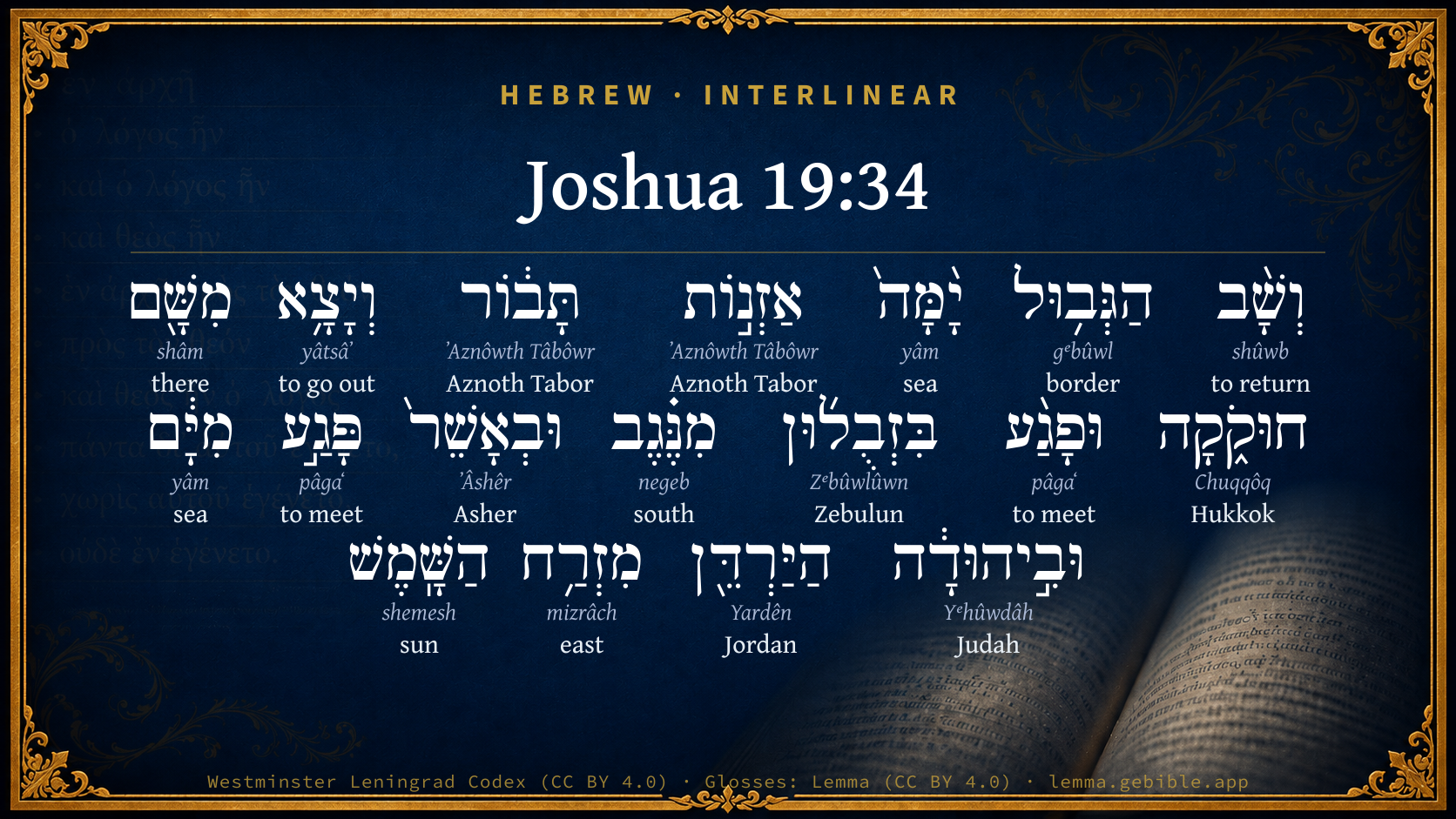
Hebrew (Westminster Leningrad Codex) Joshua 19:34 appears in the Hebrew Old Testament. The text above is from the Westminster Leningrad Codex. Each word links to its Strong’s number, a concise gloss, and parsing drawn from the Open Scriptures Hebrew Bible morphology. Click any word for its full Brown-Driver-Briggs (BDB) entry.
Download image
Cite this verse

Joshua 19:34 (World English Bible). Public Domain. Lemma interlinear Bible study tool, https://lemma.gebible.app/v/joshua/19/34.

Show BibTeX & RIS
BibTeX
RIS
English Translation
and the border turned westward to Aznoth Tabor, and went out from there to Hukkok; and it reached to Zebulun on the south, and reached to Asher on the west, and to Judah at the Jordan toward the sunrise.
World English Bible · Public Domain
Highlights
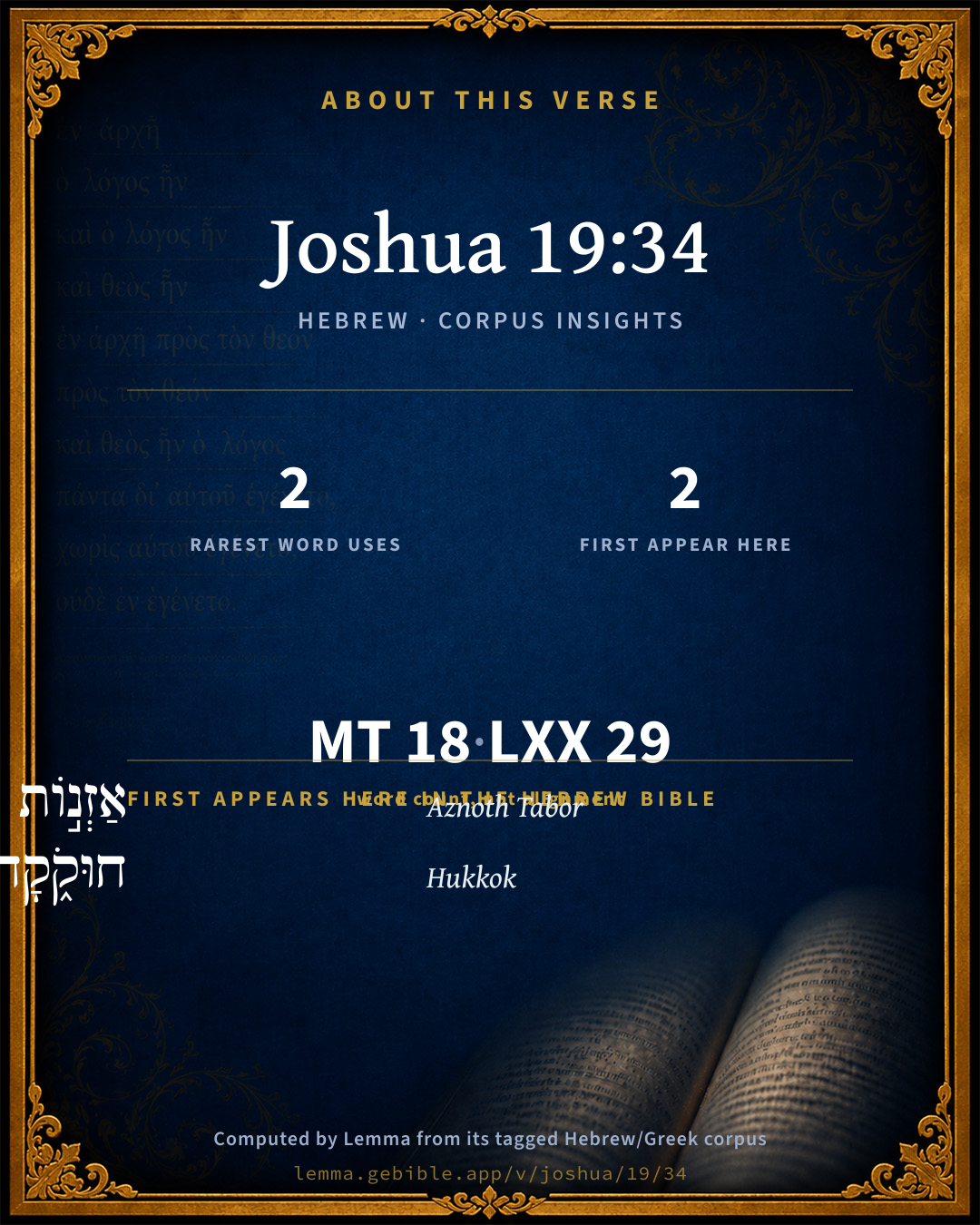
  • 2 first appearances in the Hebrew Bible
Full analysis ↓
Download a study sheet

One document with this verse’s original text, its word-by-word gloss line, the meaning frame, cross-references with their text, attributed commentary, and full source and license credits — printable, and it pastes into notes with its structure intact.

This verse Autodidact and up

Study sheet (.html) Plain text (.txt)

A passage Seminary Student

Up to 50 verses in one chapter. A passage sheet keeps up to 6 commentary sources and 12 cross-references per verse, in the order this page ranks them, and says so on the sheet whenever that leaves anything out. Ask for a single verse and you get the Autodidact verse sheet above.

Everything on this page stays free to read, with no account — the sheet is a download of what is already on screen, not access to it.

Want to remove ads? Support Godless Engineer
Compare translations 3

The same verse in 3 English versions, stacked beneath the original-language interlinear above. Click any original word for its lexicon entry.

Each is an independent rendering of the whole verse — the interlinear is not word-aligned to these translations.

Highlighted words mark where these versions differ — a whole-verse word diff, not a word-by-word alignment.

  • World English Bible Public Domain
    and the border turned westward to Aznoth Tabor, and went out from there to Hukkok; and it reached to Zebulun on the south, and reached to Asher on the west, and to Judah at the Jordan toward the sunrise.
  • King James Version Public Domain
    And then the coast turneth westward to Aznothtabor, and goeth out from thence to Hukkok, and reacheth to Zebulun on the south side, and reacheth to Asher on the west side, and to Judah upon Jordan toward the sunrising.
  • unfoldingWord Literal Text CC BY-SA 4.0
    And the border turned seaward Aznoth Tabor and went out from there Hukkoh. And it met with Zebulun from the south, and it met with Asher from the sea and with Judah the Jordan the rising of the sun.

unfoldingWord Literal Text — © unfoldingWord, licensed CC BY-SA 4.0. Word-aligned USFM3 via Door43 (git.door43.org/unfoldingWord/en_ult).

Versions to compare (up to 4)

3 of 4 selected

Show all 18 translations

Every available English version of this verse, each an independent rendering of the whole verse.

  • World English Bible Public Domain
    and the border turned westward to Aznoth Tabor, and went out from there to Hukkok; and it reached to Zebulun on the south, and reached to Asher on the west, and to Judah at the Jordan toward the sunrise.
  • Berean Standard Bible Public Domain
    Then the border turned westward to Aznoth-tabor and ran from there to Hukkok, touching Zebulun on the south side, Asher on the west, and Judah at the Jordan on the east.
  • Majority Standard Bible Public Domain
    Then the border turned westward to Aznoth-tabor and ran from there to Hukkok, touching Zebulun on the south side, Asher on the west, and Judah at the Jordan on the east.
  • King James Version Public Domain
    And then the coast turneth westward to Aznothtabor, and goeth out from thence to Hukkok, and reacheth to Zebulun on the south side, and reacheth to Asher on the west side, and to Judah upon Jordan toward the sunrising.
  • American Standard Version (1901) Public Domain
    and the border turned westward to Aznoth-tabor, and went out from thence to Hukkok; and it reached to Zebulun on the south, and reached to Asher on the west, and to Judah at the Jordan toward the sunrising.
  • Revised Version (1885) Public Domain
    and the border turned westward to Aznoth-tabor, and went out from thence to Hukkok; and it reached to Zebulun on the south, and reached to Asher on the west, and to Judah at Jordan toward the sunrising.
  • Geneva Bible (1599) Public Domain
    So this coast turneth Westwarde to Aznoth-tabor, and goeth out from thence to Hukkok, and reacheth to Zebulun on the Southside, and goeth to Asher on the Westside, and to Iudah by Iorden toward the sunne rising.
  • Douay-Rheims (1899) Public Domain
    And the border returneth westward to Azanotthabor, and goeth out from thence to Hucuca, and passeth along to Zabulon southward, and to Aser westward, and to Juda upon the Jordan towards the rising of the sun.
  • Young's Literal Translation Public Domain
    and the border hath turned back westward `to' Aznoth-Tabor, and gone out thence to Hukkok, and touched against Zebulun on the south, and against Asher it hath touched on the west, and against Judah `at' the Jordan, at the sun-rising;
  • Literal Standard Version CC BY-SA 4.0
    and the border has turned back westward [to] Aznoth-Tabor, and gone out there to Hukkok, and touched against Zebulun on the south, and it has touched against Asher on the west, and against Judah [at] the Jordan, at the sun-rising;
  • Unlocked Literal Bible CC BY-SA 4.0
    The border turned westward to Aznoth Tabor and went on to Hukkok; it touched Zebulun on the south, and reached to Asher on the west and Judah on the east at the Jordan River.
  • unfoldingWord Literal Text CC BY-SA 4.0
    And the border turned seaward Aznoth Tabor and went out from there Hukkoh. And it met with Zebulun from the south, and it met with Asher from the sea and with Judah the Jordan the rising of the sun.
  • Darby Bible Public Domain
    and the border turned westwards to Aznoth-Tabor, and went out from thence to Hukkok, and reached to Zebulun on the south, and reached to Asher on the west, and to Judah upon Jordan towards the sun-rising.
  • World Messianic Bible Public Domain
    The border turned westward to Aznoth Tabor, and went out from there to Hukkok. It reached to Zebulun on the south, and reached to Asher on the west, and to Judah at the Jordan toward the sunrise.
  • Webster's Bible Public Domain
    And then the border turneth westward to Aznoth-tabor, and goeth out from thence to Hukkok, and reacheth to Zebulun on the south side, and reacheth to Asher on the west side, and to Judah upon Jordan towards the sun-rising.
  • Free Bible Version CC BY-SA 4.0
    Then the boundary headed west to Aznoth-tabor, and on to Hukkok. It reached the land of Zebulun on the south, the land of Asher on the west, and the Jordan on the east.
  • Bible in Basic English Public Domain
    And turning west to Aznoth-tabor, the limit goes out from there to Hukkok, stretching to Zebulun on the south, and Asher on the west, and Judah at Jordan on the east.
  • JPS Tanakh (1917) Public Domain
    And the border turned westward to Aznoth-tabor, and went out from thence to Hukok; and it reached to Zebulun on the south, and reached to Asher on the west, and to Judah at the Jordan toward the sunrising.

Literal Standard Version (2020), Covenant Press — licensed CC BY-SA 4.0. Text via the HelloAO Bible API (eBible.org). Unlocked Literal Bible (unfoldingWord) — licensed CC BY-SA 4.0. Text via the HelloAO Bible API (eBible.org). unfoldingWord Literal Text — © unfoldingWord, licensed CC BY-SA 4.0. Word-aligned USFM3 via Door43 (git.door43.org/unfoldingWord/en_ult). Free Bible Version, Dr. Jonathan Gallagher — licensed CC BY-SA 4.0. Text via the HelloAO Bible API (eBible.org).

Word by word

More ways to search: Search by grammar → Find every occurrence → Compare this word →

Practice this passage: Drill this verse → Learn its vocabulary →

אַזְנ֣וֹת
ʼAznôwth Tâbôwr
H243
“Aznoth Tabor”
Noun, Proper
Part of Speech
Noun
Type
Proper
Full BDB Definition

Origin: from H238 and H8396

TWOT: None

Aznoth Tabor = "peaks of Tabor" - a pair of hills on Naphtali's border
  1. וְשָׁ֨ב shûwb H7725 “and · to return” Conjunction + Verb, Qal, Perfect, 3rd Person, Masculine, Singular
  2. הַגְּב֥וּל gᵉbûwl H1366 “the · border” Particle, Definite Article + Noun, Common, Masculine, Singular, Absolute
  3. יָ֨מָּה֙ yâm H3220 “sea · toward” Noun, Common, Masculine, Singular, Absolute + Suffix, Demonstrative
  4. תָּב֔וֹר ʼAznôwth Tâbôwr H243 “Aznoth Tabor” Noun, Proper
  5. וְיָצָ֥א yâtsâʼ H3318 “and · to go out” Conjunction + Verb, Qal, Perfect, 3rd Person, Masculine, Singular
  6. מִשָּׁ֖ם shâm H8033 “from · there” Preposition + Adverb
  7. חוּקֹ֑קָה Chuqqôq H2712 “Hukkok · toward” Noun, Proper + Suffix, Demonstrative
  8. וּפָגַ֨ע pâgaʻ H6293 “and · to meet” Conjunction + Verb, Qal, Perfect, 3rd Person, Masculine, Singular
  9. בִּזְבֻל֜וּן Zᵉbûwlûwn H2074 “in/at · Zebulun” Preposition + Noun, Proper
  10. מִנֶּ֗גֶב negeb H5045 “from · south” Preposition + Noun, Common, Masculine, Singular, Absolute
  11. וּבְאָשֵׁר֙ ʼÂshêr H836 “and · in/at · Asher” Conjunction + Preposition + Noun, Proper
  12. פָּגַ֣ע pâgaʻ H6293 “to meet” Verb, Qal, Perfect, 3rd Person, Masculine, Singular
  13. מִיָּ֔ם yâm H3220 “from · sea” Preposition + Noun, Common, Masculine, Singular, Absolute
  14. וּבִ֣יהוּדָ֔ה Yᵉhûwdâh H3063 “and · in/at · Judah” Conjunction + Preposition + Noun, Proper
  15. הַיַּרְדֵּ֖ן Yardên H3383 “the · Jordan” Particle, Definite Article + Noun, Proper
  16. מִזְרַ֥ח mizrâch H4217 “east of” Noun, Common, Masculine, Singular, Construct
  17. הַשָּֽׁמֶשׁ shemesh H8121 “the · sun” Particle, Definite Article + Noun, Common, Both, Singular, Absolute

About this verse

These counts appear in no published source. They are computed here, from the morphology-tagged text and Lemma’s own curated glosses. What Lemma adds →

18
words
15
distinct lemmas
Historical
section

Notable vocabulary

The rarest word here is אַזְנ֣וֹת Aznoth Tabor H243 — appearing just 2 times in the whole Hebrew Bible.

First appearance in Scripture

These words make their first canonical appearance in the Hebrew Bible here:

  • אַזְנ֣וֹת Aznoth Tabor H243
  • חוּקֹ֑קָה Hukkok H2712

Grammatical profile

  • 4 verbs
  • 13 nouns
  • 1 adverb

Verb forms

  • וְשָׁ֨ב Qal · Perfect
  • וְיָצָ֥א Qal · Perfect
  • וּפָגַ֨ע Qal · Perfect
  • פָּגַ֣ע Qal · Perfect

Repetition

Words recur within this verse — often emphatic in Hebrew:

  • יָ֨מָּה֙ sea H3220 ×2
  • אַזְנ֣וֹת Aznoth Tabor H243 ×2
  • וּפָגַ֨ע to meet H6293 ×2

Hebrew & Septuagint length

In English translation the verse runs 39 words from the Hebrew and 30 from the Septuagint (LXX English) — closely comparable.

A rough comparison of the two English renderings, which tokenize alike — not a word-level alignment.

Word counts can differ between the Hebrew and the Greek without any difference in meaning — e.g. the Hebrew direct-object marker אֵת has no separate Greek word, and Greek often adds the article ὁ.

In the original languages it is 18 Hebrew tokens and 29 Greek tokens — but the two are counted differently (Hebrew bundles its prefixes and suffixes into one token; the Greek is in lemma form), so that isn’t a like-for-like length.

Cross-references

3

Topical passages linked to Joshua 19:34 in the Treasury of Scripture Knowledge — connected by theme and wording, ordered by reader-vote popularity; previews shown in the World English Bible.

  • Deuteronomy 33:23 Of Naphtali he said, Naphtali, satisfied with favor, Full with the blessing of Yahweh, Possess you the west and the south.
  • Joshua 19:12 and it turned from Sarid eastward toward the sunrise to the border of Chisloth Tabor; and it went out to Daberath, and went up to Japhia;
  • Joshua 19:22 and the border reached to Tabor, and Shahazumah, and Beth-shemesh; and the goings out of their border were at the Jordan: sixteen cities with their villages.

Cross-references courtesy of OpenBible.info (CC BY 4.0).

Hebrew and Greek witnesses Masoretic Hebrew ↔ Greek Septuagint

The same verse in the two great witnesses to the Old Testament, shown verse-for-verse.

These are two independent witnesses, not word-aligned to each other, and the Septuagint is shown in lemma (dictionary) form.

Hebrew Joshua 19:34 Masoretic · Westminster Leningrad Codex

וְשָׁ֨ב הַגְּב֥וּל יָ֨מָּה֙ אַזְנ֣וֹת תָּב֔וֹר וְיָצָ֥א מִשָּׁ֖ם חוּקֹ֑קָה וּפָגַ֨ע בִּזְבֻל֜וּן מִנֶּ֗גֶב וּבְאָשֵׁר֙ פָּגַ֣ע מִיָּ֔ם וּבִ֣יהוּדָ֔ה הַיַּרְדֵּ֖ן מִזְרַ֥ח הַשָּֽׁמֶשׁ

and the border turned westward to Aznoth Tabor, and went out from there to Hukkok; and it reached to Zebulun on the south, and reached to Asher on the west, and to Judah at the Jordan toward the sunrise.

World English Bible · Public Domain

Greek LXX Joshua 19:34 Septuagint · lemma form

καί ἐπιστρέφω ὁ ὅριον ἐπί θάλασσα εναθ θαβωρ καί διαἔρχομαι ἐκεῖθεν ιακανα καί συνἅπτω ὁ ζαβουλων ἀπό νότος καί ασηρ συνἅπτω κατά θάλασσα καί ὁ ἰορδάνης ἀπό ἀνατολή ἥλιος

And the coasts will return westward by Athabor, and will go out thence to Jacana, and will border on Zabulon southward, and Aser will join it westward, and Jordan eastward.

LXX2012 (modern English Septuagint) · Public Domain

On this verse, Adam Clarke's Commentary discusses the Septuagint’s reading. Read the note in Commentary ↓

Hebrew: Westminster Leningrad Codex (CC BY 4.0). Greek: Septuagint (public domain); English from LXX2012 (modern English Septuagint) (Public Domain). How the Septuagint differs from the Hebrew →

Targum (Aramaic paraphrase)

1

The Targum is the ancient Jewish Aramaic paraphrase of the Hebrew Scriptures — an interpretive translation, not the Hebrew text itself. Onkelos (literal) and Pseudo-Jonathan (expansive) render the Torah, and Jonathan the Prophets. Coverage is partial: where no permissively-licensed English translation exists for a verse, only the Aramaic is shown. This is verse-level text, not a word-by-word alignment to the Hebrew.

  1. Targum Jonathan Prophets (Joshua–Malachi)
    וְתַב תְּחוּמָא לְיַמָא לְאַזְנוֹת תָּבוֹר וּנְפַק מִתַּמָן לְחֻקֹקָה וּמְעָרַע בִּזְבוּלֻן מִדָרוֹמָא וּבְאָשֵׁר יְעָרַע מִמַעֲרָבָא וּבִיהוּדָה יַרְדְנָא מַדְנַח שִׁמְשָׁא:

    (no public-domain English translation for this verse)

    Targum Jonathan — Aramaic: “Mikraot Gedolot” (public domain). English: “Sefaria Community Translation” (CC0 1.0 (public-domain dedication)); “London "Chaldee Paraphrase," 1871” (public domain). Text via Sefaria.

Commentary

Notes on Joshua 19:34 from classic Christian and Jewish commentators (each source and its license shown beneath its notes). The classic Christian expositions comment on the surrounding passage and are grouped to its opening verse, so a note may address several verses; the Jewish commentaries on the Tanakh (Rashi and others) are per-verse, so they appear only where the commentator wrote on this verse.

Lemma curates 59 commentaries, every one of them public domain or Creative Commons licensed, each selected and text-cleaned for this edition rather than reprinted as found. About our sources →

Joseph Benson's Commentary

Jos 19:34-35. And to Judah upon Jordan — It was not near Judah, there being several tribes between them. Therefore the meaning is, this tribe had a communication with that of Judah, by means of the river Jordan. So the word upon, in our translation, ought to be interpreted. This river afforded them the convenience of carrying merchandises to Judah, or bringing them from thence. And thus, some think, the prophecy of Moses was accomplished, (Deu 33:23.) Possess thou the west and the south; which doth not signify that they had any land in the south; but that they trafficked with that country by the means of Jordan. Chinnereth — Whence the lake of Cinnereth, or Genesareth, received its name. Geneser signifies the gardens of princes; and here were fine gardens, and a kind of paradise. The Jews say the name Cinnereth was taken from its fruits, which were as sweet to the taste as the cinnor, or harp, to the ear.

Joseph Benson's Commentary on the Old and New Testaments (1811–1818) — public domain. Text from a community e-Sword module.

Geneva Bible (1599)

Geneva Bible translators

Or, even unto Jordan.

Geneva Bible (1599) marginal notes — public domain. Text via Bolls.life.

Jamieson, Fausset & Brown

Robert Jamieson, A. R. Fausset & David Brown

Aznoth-tabor--on the east of Tabor towards the Jordan, for the border ran thence to Hukkok, touching upon that of Zebulun; and as the territory of Zebulun did not extend as far as the Jordan, Aznoth-tabor and Hukkok must have been border towns on the line which separated Naphtali from Issachar.

to Judah upon Jordan toward the sunrising--The sixty cities, Havoth-jair, which were on the eastern side of the Jordan, opposite Naphtali, were reckoned as belonging to Judah, because Jair, their possessor, was a descendant of Judah (1Ch. 2:4-22) [KEIL].

Jamieson, Fausset & Brown — Commentary Critical and Explanatory on the Whole Bible (1871) — public domain (CC PDM 1.0). Text via the HelloAO Bible API.

Adam Clarke's Commentary

Verse 34. And to Judah upon Jordan] It is certain that the tribe of Naphtali did not border on the east upon Judah, for there were several tribes betwixt them. Some think that as these two tribes were bounded by Jordan on the east, they might be considered as in some sort conjoined, because of the easy passage to each other by means of the river; but this might be said of several other tribes as well as of these. There is considerable difficulty in the text as it now stands; but if, with the Septuagint, we omit Judah, the difficulty vanishes, and the passage is plain: but this omission is supported by no MS. hitherto discovered. It is however very probable that some change has taken place in the words of the text, וביהודה הירדן ubihudah haiyarden, "and by Judah upon Jordan." Houbigant, who terms them verba sine re ac sententia, "words without sense or meaning," proposes, instead of them, to read ובגדות הירדן ubigdoth haiyarden, "and by the banks of Jordan;" a word which is used Jos 3:15, and which here makes a very good sense.

Adam Clarke's Commentary on the Bible (1810–1826) — public domain. Text from a community e-Sword/MySword module.

Ellicott's Commentary for English Readers

(34) Hukkok (Yakûk, sheet 6), in the same region as the above, but a little further north, near the northeast boundary of Zebulun. Of Judah upon Jordan we can say nothing with certainty.

A Bible Commentary for English Readers, edited by Charles John Ellicott (1878–1897) — public domain. Text from a community e-Sword module.

The Cambridge Bible for Schools and Colleges

gen. ed. J. J. S. Perowne

34. and then the coast turneth] From the Jordan on the east, the southern border of Naphtali turned westward to Aznoth-tabor, not identified, but probably a border town on the line which separated this tribe from Issachar, and “struck,” or coincided with, Zebulun on the south and Asher on the west. The site of Hukkok is unknown.

Judah upon Jordan] So our Version renders it, following the Vulgate, Et in Juda ad Jordanem. Others, following the Masoretic punctuation, would put a colon at Judah, so that it would run, “and Judah; the Jordan was toward the sunrising” i.e. the eastern boundary of the tribe. The word Judah here has been explained by the fact that the sixty cities, Havoth-jair (Num_32:41), which were on the eastern side of Jordan opposite to Naphtali, were reckoned as belonging to Judah, because Jair their founder was descended on the father’s side from Judah through Hezron. Comp. 1Ch_2:21-24. Others would identify it with a village el-Jehidijeh, marked on Dr Smith’s map, north of Tibrin, but this is not satisfactory.

The Cambridge Bible for Schools and Colleges (gen. ed. J. J. S. Perowne; Cambridge University Press, 1878–1918) — public domain. Text from a community e-Sword module.

John Gill's Exposition

And the fenced cities are Ziddim,.... The later name of Ziddim, according to the Talmud (i), was Cepharchitiya, or the village of wheat, perhaps from the large quantity or goodness of wheat there:

Zer is called by Jerom (k) Sor, and interpreted Tyre, the metropolis of Phoenicia, very wrongly, and, in the tribe of Naphtali:

and Hammath probably was built by the youngest son of Canaan, Gen 10:18; or had its name in memory of him; it lay to the north of the land of Israel; see Num 34:8,

Rakkath, and Chinnereth; Rakkath according to the Jewish writers (l) is the same with Tiberias, as Chinnereth with Gennesaret, from whence the lake or sea of Tiberias, and the country and lake of Gennesaret, had their names, often mentioned in the New Testament. Gennesaret was a most delicious and fruitful spot, and fulfilled the prophecy of Moses, Deu 33:23; concerning Naphtali.

(i) Ut supra. (T. Hieros. Megillah, fol. 70. 1.) (k) De loc. Heb. fol. 95. A. (l) T. Hieros. ut supra. (Megillah, fol. 70. 1.)

John Gill's Exposition of the Whole Bible (1746–1763) — public domain (CC PDM 1.0). Text via the HelloAO Bible API.

Albert Barnes' Notes on the Bible

Aznoth-tabor - This place (“ears of Tabor”) was no doubt in the neighborhood of Mount Tabor - probably on the eastern slope; and Hukkok on the western slope.

To Judah upon Jordan - i. e. to the “Havoth-jair” Num 32:41, which were on the opposite side of Jordan. Jair, from whom these towns or villages were named, traced his ancestry in the male line through Hezron to Judah Num 27:1; and it is likely that he was assisted by large numbers of his kinsmen of that tribe in his rapid conquest of Bashan. Hence, the Havoth-jair were, in all likelihood, largely colonised by Judahites, especially perhaps that portion of them nearest the Jordan. Thus, that part of the river and its valley adjacent to these settlements was spoken of as “Judah upon Jordan,” or more literally “Judah of the Jordan” (compare Num 22:1).

Albert Barnes' Notes on the Bible (1834–1885) — public domain. Text from a community e-Sword/MySword module.

Haydock's Catholic Bible Commentary

Juda was in possession of the southern parts of the Jordan, as Nephthali had the northern, so that by means of navigation they might enjoy the riches (Calmet) of each other, and of the other tribes. (Haydock) (Deuteronomy xxxiii. 23.) --- Septuagint do not read Juda, which forms all the difficulty, as five tribes lay between these two. They have "and the Jordan is towards the rising sun." (Calmet) --- Grabe inserts, with a star, "to Juda, the Jordan," &c., intimating that to Juda, was not a part of the Septuagint version.

George Leo Haydock (1774–1849), Haydock's Catholic Family Bible and Commentary, 1859 edition — public domain. Excludes Psalms (Douay-Rheims chapter numbering differs from Protestant) and Deuterocanonical books (Catholic canon only).

Matthew Poole's English Annotations

Westward: this is unquestionably the southern border described from east to west.

To Judah, upon Jordan.

Quest. How can this be, when there were divers tribes between this and Judah, all which reached to Jordan?

Answ. He doth not say of Judah, as he doth of Zebulun and Asher, that it reacheth to it; but, as it seems, purposely leaves out that word which he had used in both the former branches, lest it should be understood of a local reaching to it, or being contiguous with it, which was not true; and that he might signify that he meant this clause in another sense, to wit, that it did in some sort go or reach to, or converse with Judah by Jordan. And so this may be here added, to show the accomplishment of that famous and obscure prophecy, That Naphtali, though he should be planted in the utmost border of the land, on the north-east, yet he should possess the riches of the west and south, Deu 33:23, i.e. of those tribes which were at a great distance from him westward and southward; and this he should do by way of commerce with them by their famous river Jordan, which he did not only touch in a small part, as some of the other tribes did, but lay all along it for a good space together, even from the very fountain unto the sea of Gennesaret. Some think that this is verified by that royalty of this river, which they suppose God gave to the tribe of Judah, which extended as far as Naphtali.

Matthew Poole's English Annotations on the Holy Bible (1683–1685) — public domain. Text from a community e-Sword/MySword module.

Whedon's Commentary on the Bible

Daniel D. Whedon

34. Turneth westward — Probably in a southwesterly direction. [Hukkok is recognised by Robinson and others in the modern Yakuk, a village six or seven miles northwest from the Sea of Galilee.

Zebulun on the south… Asher on the west — This is merely giving the boundaries in general terms.

And to Judah upon the Jordan — This is a faulty translation. And to Judah belongs to the previous sentence, which describes the western border. Literally, It touched Asher on the west and at Judah. Judah was evidently a city on the western border, perhaps at Jehudiyah, marked on Van de Velde’s map east of Tyre and a few miles north of Tibnin. The rest of the verse forms a distinct sentence:

Jordan toward the sunrising — That is, the Jordan formed the eastern boundary.

Daniel D. Whedon (gen. ed.), Commentary on the Old and New Testaments (1874–1909) — public domain. Text from a community e-Sword module.

The Pulpit Commentary

And then the coast turneth westward. Here the words are literally translated without any confusion between the west and the sea, nor any misapprehension of the meaning of the word bsn. Reacheth. This is the same word translated skirteth above, ver. 11, note. We have it here clearly stated that Naphtali was bordered on the south by Zebulun, on the west by Asher, and on the east by "Judah upon Jordan." To Judah. These words have caused great trouble to translators and expositors for 2, 000 years. The LXX omits them altogether, rendering, "and the Jordan to the eastward." The Masorites, by inserting a disjunctive accent between them and the words that follow, would have us render, "and to Judah: Jordan towards the sun rising," or, "is towards the sunrising," a rendering which gives no reasonable sense. They unquestionably form part of the text, since no version but the LXX omits them. A suggestion of Von Raumer"s has found favour that the cities called Havoth Jair, which were on the eastern side of Jordan, opposite the inheritance of Naphtali, are meant. Jair was a descendant of Judah by the father"s side, through Hezron. So Ritter, 4:338. (see 1Ch_2:21-23) It would seem that the principle of female inheritance, having once been admitted in the tribe of Manasseh, was found capable of further extension. But to the majority of the Israelites this settlement would no doubt be regarded as an offshoot of the tribe of Judah.

The Pulpit Commentary (1880–1919), ed. H.D.M. Spence-Jones & Joseph S. Exell — public domain. Text from a community e-Sword module.

Lesson kit

Teaching starters — assembled from the data on this page, not authored interpretation. Every prompt links to the verse data it draws on. Edit before teaching.

Joshua, in the Historical, opens this verse with 18 words (15 distinct Hebrew lemmas). Its most distinctive word is ʼAznôwth Tâbôwr (“Aznoth Tabor”). A historical commentator’s framing appears above. Read the whole chapter for the surrounding context.

Discussion questions

  1. How does “Aznoth Tabor” (ʼAznôwth Tâbôwr) shape what this verse is saying?
  2. 2 words make their first appearance in Scripture here. What does this debut establish?
  3. How does Deuteronomy 33:23, which shares this passage’s theme, read alongside this verse?
  4. What does the repetition of “sea” (2× in this one verse) do in this verse?
  5. The translations on this page render this verse differently — a whole-verse word diff, not a word-by-word alignment. What might account for the different wordings?
  6. «וְשָׁ֨ב» is a Qal Perfect verb. How does that grammatical form shape the action described?
  7. Compare how Joseph Benson's Commentary and Geneva Bible (1599) read this verse. Where do they agree or differ?

Things to notice

Reading settings

Reading text

Shown beneath each verse's original-language words.

Old Testament
Old Testament edition

Read the OT as the Masoretic Hebrew (MT) or the Greek Septuagint (LXX).

English shown for the Greek Septuagint (in the Hebrew ↔ Greek comparison).

Comparing translations? Open the Compare panel on any verse page to stack up to four side by side.