
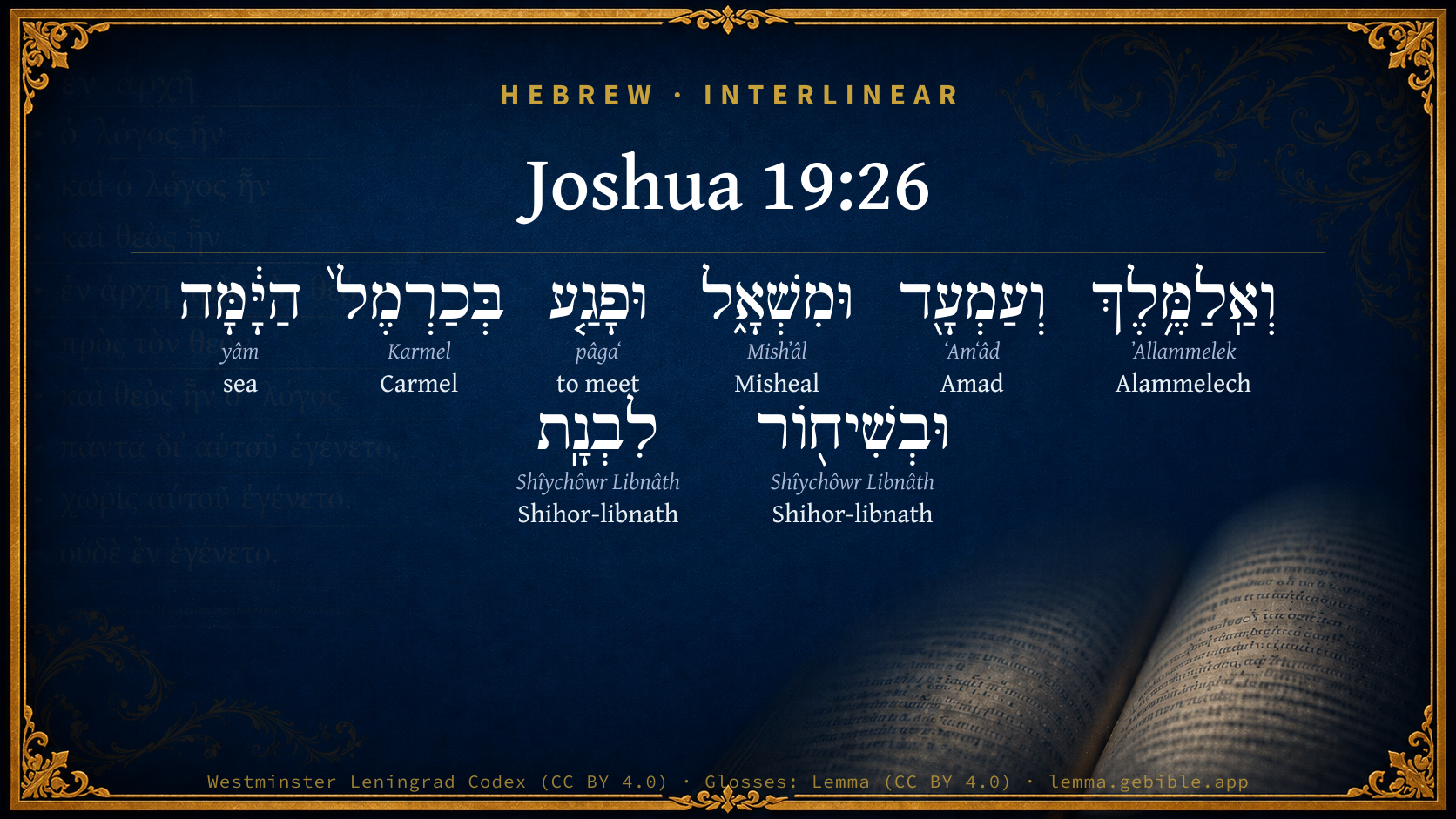
Joshua 19:26

Hebrew (Westminster Leningrad Codex) Joshua 19:26 appears in the Hebrew Old Testament. The text above is from the Westminster Leningrad Codex. Each word links to its Strong’s number, a concise gloss, and parsing drawn from the Open Scriptures Hebrew Bible morphology. Click any word for its full Brown-Driver-Briggs (BDB) entry.
Download image
Cite this verse

Joshua 19:26 (World English Bible). Public Domain. Lemma interlinear Bible study tool, https://lemma.gebible.app/v/joshua/19/26.

Show BibTeX & RIS
BibTeX
RIS
English Translation
and Allammelech, and Amad, and Mishal; and it reached to Carmel westward, and to Shihorlibnath;
World English Bible · Public Domain
Highlights
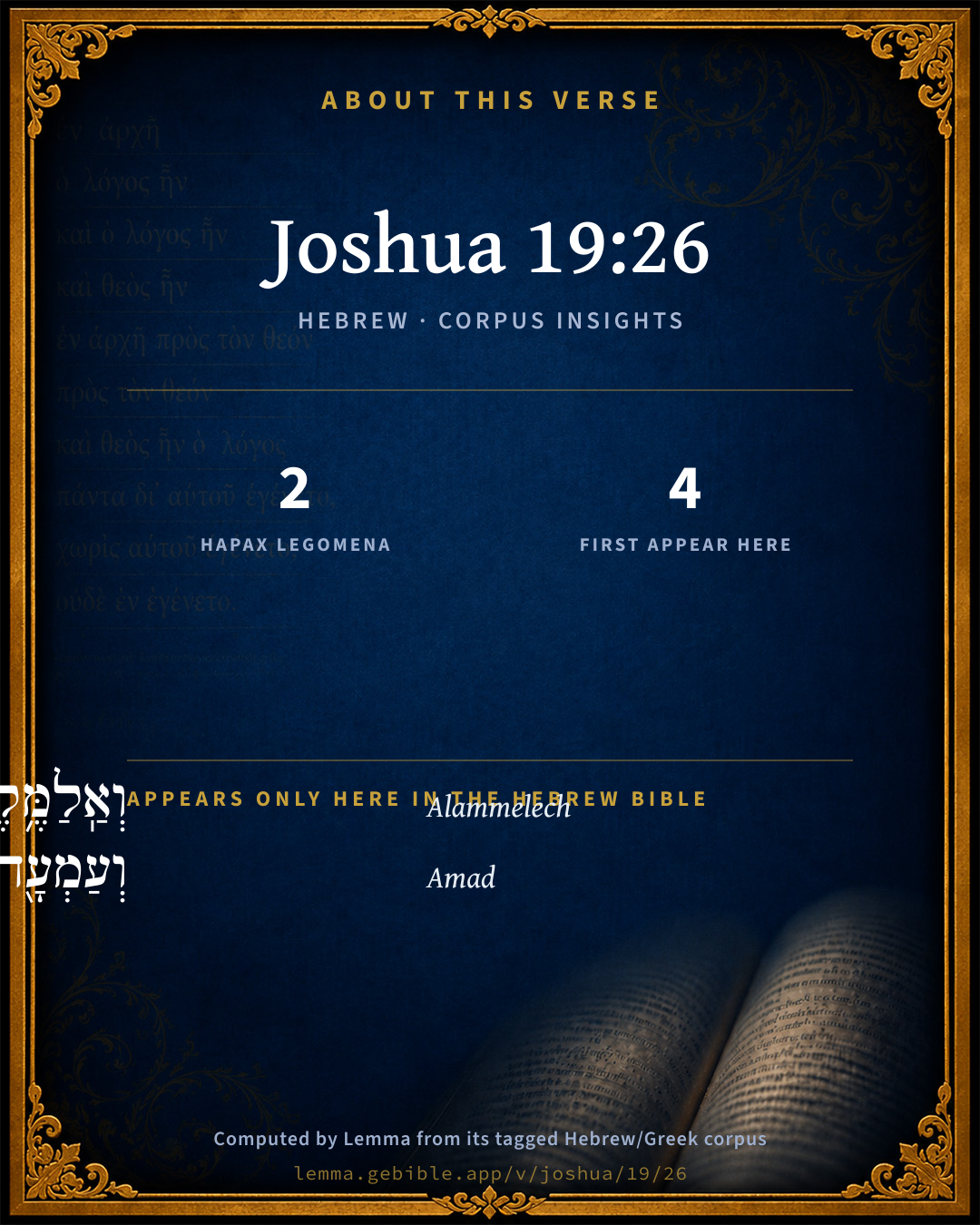
  • 2 hapax legomena — only here in the Hebrew Bible
  • 4 first appearances in the Hebrew Bible
Full analysis ↓
Download a study sheet

One document with this verse’s original text, its word-by-word gloss line, the meaning frame, cross-references with their text, attributed commentary, and full source and license credits — printable, and it pastes into notes with its structure intact.

This verse Autodidact and up

Study sheet (.html) Plain text (.txt)

A passage Seminary Student

Up to 50 verses in one chapter. A passage sheet keeps up to 6 commentary sources and 12 cross-references per verse, in the order this page ranks them, and says so on the sheet whenever that leaves anything out. Ask for a single verse and you get the Autodidact verse sheet above.

Everything on this page stays free to read, with no account — the sheet is a download of what is already on screen, not access to it.

Want to remove ads? Support Godless Engineer
Compare translations 3

The same verse in 3 English versions, stacked beneath the original-language interlinear above. Click any original word for its lexicon entry.

Each is an independent rendering of the whole verse — the interlinear is not word-aligned to these translations.

Highlighted words mark where these versions differ — a whole-verse word diff, not a word-by-word alignment.

  • World English Bible Public Domain
    and Allammelech, and Amad, and Mishal; and it reached to Carmel westward, and to Shihorlibnath;
  • King James Version Public Domain
    And Alammelech, and Amad, and Misheal; and reacheth to Carmel westward, and to Shihorlibnath;
  • unfoldingWord Literal Text CC BY-SA 4.0
    and Allammelek and Amad and Mishall. And it met with Carmel seaward and with Shihor Libnath.

unfoldingWord Literal Text — © unfoldingWord, licensed CC BY-SA 4.0. Word-aligned USFM3 via Door43 (git.door43.org/unfoldingWord/en_ult).

Versions to compare (up to 4)

3 of 4 selected

Show all 18 translations

Every available English version of this verse, each an independent rendering of the whole verse.

  • World English Bible Public Domain
    and Allammelech, and Amad, and Mishal; and it reached to Carmel westward, and to Shihorlibnath;
  • Berean Standard Bible Public Domain
    Allammelech, Amad, and Mishal. On the west the border touched Carmel and Shihor-libnath,
  • Majority Standard Bible Public Domain
    Allammelech, Amad, and Mishal. On the west the border touched Carmel and Shihor-libnath,
  • King James Version Public Domain
    And Alammelech, and Amad, and Misheal; and reacheth to Carmel westward, and to Shihorlibnath;
  • American Standard Version (1901) Public Domain
    and Allammelech, and Amad, and Mishal; and it reached to Carmel westward, and to Shihor-libnath;
  • Revised Version (1885) Public Domain
    and Allammelech, and Amad, and Mishal; and it reached to Carmel westward, and to Shihor-libnath;
  • Geneva Bible (1599) Public Domain
    And Alammelech, and Amad, and Misheal, and came to Carmel Westward, and to Shihor Libnath,
  • Douay-Rheims (1899) Public Domain
    And Elmelech and Amaad and Messal: and it reacheth to Carmel by the sea and Sihor and Labanath,
  • Young's Literal Translation Public Domain
    and Alammelech, and Amad, and Misheal; and it toucheth against Carmel westward, and against Shihor-Libnath;
  • Literal Standard Version CC BY-SA 4.0
    and Alammelech, and Amad, and Misheal; and it touches against Carmel westward, and against Shihor-Libnath;
  • Unlocked Literal Bible CC BY-SA 4.0
    Allammelek, Amad, and Mishall. On the west the boundary extended to Carmel and Shihor Libnath.
  • unfoldingWord Literal Text CC BY-SA 4.0
    and Allammelek and Amad and Mishall. And it met with Carmel seaward and with Shihor Libnath.
  • Darby Bible Public Domain
    and Allammelech, and Amead, and Mishal; and [the border] reached to Carmel westwards, and to Shihor-libnath,
  • World Messianic Bible Public Domain
    Allammelech, Amad, Mishal. It reached to Carmel westward, and to Shihorlibnath.
  • Webster's Bible Public Domain
    And Alammelech, and Amad, and Misheal; and reacheth to Carmel westward, and to Shihor-libnath;
  • Free Bible Version CC BY-SA 4.0
    Allammelech, Amad, and Mishal. Their boundary reached Carmel and Shihor-libnat in the west.
  • Bible in Basic English Public Domain
    And Alammelech and Amad and Mishal, stretching to Carmel on the west and Shihor-libnath;
  • JPS Tanakh (1917) Public Domain
    and Allam-melech, and Amad, and Mishal; and it reached to Carmel westward, and to Shihor-libnath.

Literal Standard Version (2020), Covenant Press — licensed CC BY-SA 4.0. Text via the HelloAO Bible API (eBible.org). Unlocked Literal Bible (unfoldingWord) — licensed CC BY-SA 4.0. Text via the HelloAO Bible API (eBible.org). unfoldingWord Literal Text — © unfoldingWord, licensed CC BY-SA 4.0. Word-aligned USFM3 via Door43 (git.door43.org/unfoldingWord/en_ult). Free Bible Version, Dr. Jonathan Gallagher — licensed CC BY-SA 4.0. Text via the HelloAO Bible API (eBible.org).

Word by word

More ways to search: Search by grammar → Find every occurrence → Compare this word →

Practice this passage: Drill this verse → Learn its vocabulary →

About this verse

These counts appear in no published source. They are computed here, from the morphology-tagged text and Lemma’s own curated glosses. What Lemma adds →

8
words
7
distinct lemmas
Historical
section

Notable vocabulary

2 hapax legomena — words that appear only here in the entire Hebrew Bible:

  • וְאַֽלַמֶּ֥לֶךְ Alammelech H487
  • וְעַמְעָ֖ד Amad H6008

First appearance in Scripture

These words make their first canonical appearance in the Hebrew Bible here:

  • וְאַֽלַמֶּ֥לֶךְ Alammelech H487
  • וְעַמְעָ֖ד Amad H6008
  • וּמִשְׁאָ֑ל Misheal H4861
  • וּבְשִׁיח֖וֹר Shihor-libnath H7884

Shared distinctive vocabulary

וּמִשְׁאָ֑ל Misheal H4861 occurs in 2 verses of the Hebrew Bible. Also found in:

Grammatical profile

  • 1 verb
  • 7 nouns

Verb forms

  • וּפָגַ֤ע Qal · Perfect

Repetition

A word recurs within this verse — often emphatic in Hebrew:

  • וּבְשִׁיח֖וֹר Shihor-libnath H7884 ×2

Hebrew & Septuagint length

In English translation the verse runs 15 words from the Hebrew and 19 from the Septuagint (LXX English) — closely comparable.

A rough comparison of the two English renderings, which tokenize alike — not a word-level alignment.

Word counts can differ between the Hebrew and the Greek without any difference in meaning — e.g. the Hebrew direct-object marker אֵת has no separate Greek word, and Greek often adds the article ὁ.

Cross-references

10

Topical passages linked to Joshua 19:26 in the Treasury of Scripture Knowledge — connected by theme and wording, ordered by reader-vote popularity; previews shown in the World English Bible.

  • 1 Kings 18:20 So Ahab sent to all the children of Israel, and gathered the prophets together to Mount Carmel.
  • 1 Kings 18:42 So Ahab went up to eat and to drink. Elijah went up to the top of Carmel; and he bowed himself down on the earth, and put his face between his knees.
  • Song of Solomon 7:5 Your head on you is like Carmel, The hair of your head like purple; The king is held captive in its tresses.
  • Isaiah 33:9 The land mourns and languishes; Lebanon is confounded and withers away; Sharon is like a desert; and Bashan and Carmel shake off [their leaves].
  • Joshua 21:30 Out of the tribe of Asher, Mishal with its suburbs, Abdon with its suburbs,
  • 1 Samuel 15:12 Samuel rose early to meet Saul in the morning; and it was told Samuel, saying, Saul came to Carmel, and, behold, he set him up a monument, and turned, and passed on, and went down to Gilgal.
  • 1 Chronicles 6:74 and out of the tribe of Asher, Mashal with its suburbs, and Abdon with its suburbs,
  • Isaiah 35:2 It shall blossom abundantly, and rejoice even with joy and singing; the glory of Lebanon shall be given to it, the excellency of Carmel and Sharon: they shall see the glory of Yahweh, the excellency of our God.
  • Isaiah 37:24 By your servants have you defied the Lord, and have said, With the multitude of my chariots am I come up to the height of the mountains, to the innermost parts of Lebanon; and I will cut down the tall cedars of it, and the choice fir trees of it; and I will enter into its farthest height, the forest of its fruitful field;
  • Jeremiah 46:18 As I live, says the King, whose name is Yahweh of Hosts, surely like Tabor among the mountains, and like Carmel by the sea, so shall he come.

Cross-references courtesy of OpenBible.info (CC BY 4.0).

Hebrew and Greek witnesses Masoretic Hebrew ↔ Greek Septuagint

The same verse in the two great witnesses to the Old Testament, shown verse-for-verse.

These are two independent witnesses, not word-aligned to each other, and the Septuagint is shown in lemma (dictionary) form.

Hebrew Joshua 19:26 Masoretic · Westminster Leningrad Codex

וְאַֽלַמֶּ֥לֶךְ וְעַמְעָ֖ד וּמִשְׁאָ֑ל וּפָגַ֤ע בְּכַרְמֶל֙ הַיָּ֔מָּה וּבְשִׁיח֖וֹר לִבְנָֽת

and Allammelech, and Amad, and Mishal; and it reached to Carmel westward, and to Shihorlibnath;

World English Bible · Public Domain

Greek LXX Joshua 19:26 Septuagint · lemma form

καί ελιμελεκ καί αμιηλ καί μαασα καί συνἅπτω ὁ κάρμηλος κατά θάλασσα καί ὁ σιων καί λαβαναθ

and Elimelech, and Amiel, and Maasa, and the lot will border on Carmel westward, and on Sion, and Labanath.

LXX2012 (modern English Septuagint) · Public Domain

Hebrew: Westminster Leningrad Codex (CC BY 4.0). Greek: Septuagint (public domain); English from LXX2012 (modern English Septuagint) (Public Domain). How the Septuagint differs from the Hebrew →

Targum (Aramaic paraphrase)

1

The Targum is the ancient Jewish Aramaic paraphrase of the Hebrew Scriptures — an interpretive translation, not the Hebrew text itself. Onkelos (literal) and Pseudo-Jonathan (expansive) render the Torah, and Jonathan the Prophets. Coverage is partial: where no permissively-licensed English translation exists for a verse, only the Aramaic is shown. This is verse-level text, not a word-by-word alignment to the Hebrew.

  1. Targum Jonathan Prophets (Joshua–Malachi)
    וְאַלַמֶלֶךְ וְעַמְעָד וּמִשְׁאָל וּמְעָרַע בְּכַרְמְלָא לְיַמָא וּבְשִׁיחוֹר לִבְנָת:

    (no public-domain English translation for this verse)

    Targum Jonathan — Aramaic: “Mikraot Gedolot” (public domain). English: “Sefaria Community Translation” (CC0 1.0 (public-domain dedication)); “London "Chaldee Paraphrase," 1871” (public domain). Text via Sefaria.

Commentary

Notes on Joshua 19:26 from classic Christian and Jewish commentators (each source and its license shown beneath its notes). The classic Christian expositions comment on the surrounding passage and are grouped to its opening verse, so a note may address several verses; the Jewish commentaries on the Tanakh (Rashi and others) are per-verse, so they appear only where the commentator wrote on this verse.

Lemma curates 59 commentaries, every one of them public domain or Creative Commons licensed, each selected and text-cleaned for this edition rather than reprinted as found. About our sources →

Joseph Benson's Commentary

Jos 19:26. Carmel westward — Or, Carmel by the sea, to distinguish it from Carmel in the tribe of Judah. This was a place of eminent fruitfulness, agreeably to the prophecy concerning Asher, Gen 49:20.

Joseph Benson's Commentary on the Old and New Testaments (1811–1818) — public domain. Text from a community e-Sword module.

Jamieson, Fausset & Brown

Robert Jamieson, A. R. Fausset & David Brown

to Carmel . . . and to Shihor-libnath--that is, the "black" or "muddy river"; probably the Nahr Belka, below Dor (Tantoura); for that town belonged to Asher (Jos 17:10). Thence the boundary line turned eastward to Beth-dagon, a town at the junction of Zebulun and Naphtali, and ran northwards as far as Cabul, with other towns, among which is mentioned (Jos 19:28) "great Zidon," so called on account of its being even then the flourishing metropolis of the Phœnicians. Though included in the inheritance of Asher, this town was never possessed by them (Jdg 1:31).

Jamieson, Fausset & Brown — Commentary Critical and Explanatory on the Whole Bible (1871) — public domain (CC PDM 1.0). Text via the HelloAO Bible API.

Adam Clarke's Commentary

Verse 26. Carmel] The vineyard of God; a place greatly celebrated in Scripture, and especially for the miracles of Elijah; see 1Kg 18:19-40. The mountain of Carmel was so very fruitful as to pass into a proverb. There was another Carmel in the tribe of Judah, (see Jos 15:55), but this, in the tribe of Asher, was situated about one hundred and twenty furlongs south from Ptolemais, on the edge of the Mediterranean Sea. Calmet observes that there was, in the time of Vespasian, a temple on this mountain, dedicated to a god of the same name. There was a convent, and a religious order known by the name of Carmelites, established on this mountain in honour of Elijah: the time of the foundation of this order is greatly disputed. Some pretend that it was established by Elijah himself; while others, with more probability, fix it in A.D. 1180 or 1181, under the pontificate of Pope Alexander III.

Adam Clarke's Commentary on the Bible (1810–1826) — public domain. Text from a community e-Sword/MySword module.

The Cambridge Bible for Schools and Colleges

gen. ed. J. J. S. Perowne

26. Alammelech, and Amad, are at present unknown. Misheal has been identified with Misalli at the northern extremity of the plain of Sharon.

and reacheth to Carmel] This boundary struck Carmel on the west and Shihor-libnath, somewhere to the south of that range.

Shihor-libnath] Not, as some have supposed, the Belus, which falls into the Mediterranean near to Acre or Ptolemais, but south of Carmel, and probably the Nahr Zerka, or “Crocodile Brook,” which rises in the Carmel range, and flows into the Mediterranean just above Cæsarea. For the existence of crocodiles still in the Zerka, see Macgregor’s Rob Roy on the Jordan, p. 387, who also found a crocodile in the Kishon, which is only about 20 miles north of the Zerka, pp. 400–403. “I suspect,” writes Dr Thomson, “that long ages ago, some Egyptians, accustomed to worship this ugly creature, settled here (Cæsarea), and brought their gods with them. Once here, they would not easily be exterminated; for no better place could be desired by them than this vast jungle and impracticable swamp.” See Land and the Book, p. 497.

The Cambridge Bible for Schools and Colleges (gen. ed. J. J. S. Perowne; Cambridge University Press, 1878–1918) — public domain. Text from a community e-Sword module.

John Gill's Exposition

And turneth towards the sunrising,.... Or eastward:

to Bethdagon; there was a city of this name in the tribe of Judah; see Gill on Jos 15:41. Dagon, being a god of the Phoenicians, had temples built for him in various places in Canaan:

and reacheth to Zebulun; not the tribe of Zebulun, but a city so called, the same Josephus (o) calls a strong city of Galilee, which had the name of Men, perhaps from the populousness of it, and separated Ptolemais from Judea:

and to the valley of Jiphthahel; see Jos 19:14,

toward the north side of Bethemek; of Bethemek no mention is made elsewhere: perhaps here was an idol temple before dedicated to the god of the valleys; see Kg1 20:28,

and Neiel; which the Greek version calls Inael, of which Jerom says (p), it is a certain village called Betoaenea, fifteen miles from Caesarea, situated on a mountain to the east, on which are said to be wholesome baths:

and goeth out to Cabul on the left hand; not the land of Cabul, Kg1 9:13; but a city, which Josephus (q) calls a village on the borders of Ptolemais. The Jews (r) speak of a city of this name, destroyed because of contentions in it.

(o) De Bello Jud. l. 2. c. 18. sect. 9. (p) De loc. Heb. fol. 88. I. (q) Vita ejus, sect. 43. (r) Echa Rabbati, fol. 75. 4.

John Gill's Exposition of the Whole Bible (1746–1763) — public domain (CC PDM 1.0). Text via the HelloAO Bible API.

Haydock's Catholic Bible Commentary

Carmel, so famous for the miracles of Elias, 3 Kings xviii. 20. Josephus (Jewish Wars ii. 17,) places it 120 stadia south of Ptolemais. This range of mountains extended northward through the tribes of Issachar and of Zabulon. Pliny ([Natural History?] v. 17,) speaks of a promontory and of a town of this name. Here also the god Carmel was adored, having an altar, but no temple or image, as the ancients had decreed. Nec simulacrum Deo aut templum, (sic tradidere majores) ara tantum et reverentia. (Tacitus, Hist. ii. 78.) --- Vespasian consulted the priest Basilides. Carmel means "the vineyard of the Lord," or the excellent vineyard, &c. It was so rich and beautiful as to become proverbial. The spouse compares the head of his beloved to Carmel, chap. vii. 5. Isaias (xxxii. 15,) foretels that the deserts shall be equal to Carmel. It was covered with wood and fruit. (St. Jerome in Isaias x. 18., and Jeremias iv. 26.) The city, which was built upon this mountain, and which Pliny calls by the same name, was formerly styled Ecbatana. The oracle had denounced to Cambyses that he should die at Ecbatana, and he concluded that the city of Media was meant; but it was "that of Syria," says Herodotus, (iii. 64,) where he died. --- Labanath. Hebrew leaves out the conjunction. --- Sihor means a "troubled" river, (chap. xiii. 3,) or brook, which probably ran near the white promontory mentioned by Pliny, (v. 19,) near Tyre. Labanath signifies "white."

George Leo Haydock (1774–1849), Haydock's Catholic Family Bible and Commentary, 1859 edition — public domain. Excludes Psalms (Douay-Rheims chapter numbering differs from Protestant) and Deuterocanonical books (Catholic canon only).

Matthew Poole's English Annotations

Carmel westward, or, Carmel by the sea, to distinguish it from that Carmel in the tribe of Judah, 1Sa 25:2. This was a place of eminent fruitfulness, Isa 33:9; 35:2; 37:24, agreeable to the prophecy concerning Asher, Gen 49:20; Deu 33:24.

Matthew Poole's English Annotations on the Holy Bible (1683–1685) — public domain. Text from a community e-Sword/MySword module.

The Pulpit Commentary

Reacheth. Literally, toucheth, i.e. skirteth, as in vers. 11 and 22. So in the next verse, with regard to Zebulun. The term appears to be the invariable one when a district, not a particular place, is spoken of. To Carmel westward. The Carmel range appears to have been included in the tribe of Asher. For we read (Jos_17:10, Jos_17:11) that Asher met Manasseh on the north, whence we conclude that it must have cut off Issachar from the sea, and that as Dor was among the towns which Manasseh held within the territory of Issachar and Asher, it must therefore have been within the boundaries of the latter. Shihor-libnath. For Shihor, see Jos_13:3. Libnath, which signifies white or shining, has been supposed by some to mean the glassy river, from its calm, unbroken flow, though this appears improbable, since Shihor means turbid. It is far more probable that the current was rendered turbid by a quantity of chalk or limestone which it carried along in its course, and hence the name "muddy white." Keil thinks it to be the Nahr-el-Zerka, or crocodile river, of Pliny, in which Beland, Von Raumer, Knobel, and Rosenmuller agree with him. But when he proceeds to argue that this river, being blue, "might answer both to shihor, black, and libnath, white," he takes a flight in which it is impossible to follow him. Gesenius, from the glazed appearance of burnt brick or tiles ( l"banah), conjectures, that it may be the Belus, or "glass river," so called, however, in ancient times because the fine sand on its banks enabled the manufacture of glass to be carried on here. But this, emptying itself into the sea near Acre, has been thought to be too far north. Vandevelde, however, one of the latest authorities, as well as Mr. Conder, is inclined to agree with Gesenius. The difficulty of this identification consists in the fact that Carmel and Dor (Jos_17:11) are said to have been in Asher. (see note on Jos_17:10) The Nahr-el-Zerka has not been found by recent explorers to contain crocodiles, but it has been thought possible that they have hitherto eluded observation. Kenrick, however ("Phoenicia," p. 24), thinks that as crocodilus originally meant a lizard, the lacertus Niloticus is meant, the river being, in his opinion, too shallow in summa to be the haunt of the crocodile proper (see also Tristram, "Land of Israel." p. 103, who believes it possible that the crocodile may be found there, though no specimen has as yet been produced). The Zerkais described in Palestine Exploration Fund Quarterly Paper, January, 1874, as "a torpid stream flowing through fetid marshes, in which reeds, canes, and the stunted papyrus grow." When it is added, "and where alone in Palestine the crocodile is found," no evidence is given in favour of the statement. It empties itself into the sea between Dor and Caesarea, a few miles north of the latter.

The Pulpit Commentary (1880–1919), ed. H.D.M. Spence-Jones & Joseph S. Exell — public domain. Text from a community e-Sword module.

John Wesley's Explanatory Notes

Carmel west-ward - Or, Carmel by the sea, to distinguish it from Carmel in the tribe of Judah. This was a place of eminent fruitfulness, agreeable to the prophecy concerning Asher, Gen. xlix, 20.

John Wesley, Explanatory Notes Upon the Whole Bible (1754–1765) — public domain. Text via the GEBible commentary corpus.

Lesson kit

Teaching starters — assembled from the data on this page, not authored interpretation. Every prompt links to the verse data it draws on. Edit before teaching.

Joshua, in the Historical, opens this verse with 8 words (7 distinct Hebrew lemmas). Its most distinctive word is ʼAllammelek (“Alammelech”). A historical commentator’s framing appears above. Read the whole chapter for the surrounding context.

Discussion questions

  1. How does “Alammelech” (ʼAllammelek) shape what this verse is saying?
  2. This verse holds 2 words here found nowhere else in the Hebrew Bible. What might the rare words draw attention to?
  3. 4 words here appear for the first time in Scripture. What is being introduced at this debut?
  4. Joshua 21:30 shares the word «Misheal» with this verse. How do the two illuminate each other?
  5. “Shihor-libnath” occurs 2× in this one verse. What is the effect of the repetition?
  6. These translations render this verse differently. What is at stake in choosing one wording over another?
  7. The verb «וּפָגַ֤ע» is Qal Perfect. How does its form color the action?
  8. Reading how Joseph Benson's Commentary and Jamieson, Fausset & Brown read this verse, where do the two commentators agree and where do they part?

Things to notice

  • 2 words in this verse appear nowhere else in the Hebrew Bible.
  • 4 words make their first canonical appearance in Scripture here.
  • These translations choose different wording for 14 words in this verse.
  • “Shihor-libnath” occurs 2× in this single verse.
  • 7 distinct Hebrew lemmas span 8 words in this verse.

Reading settings

Reading text

Shown beneath each verse's original-language words.

Old Testament
Old Testament edition

Read the OT as the Masoretic Hebrew (MT) or the Greek Septuagint (LXX).

English shown for the Greek Septuagint (in the Hebrew ↔ Greek comparison).

Comparing translations? Open the Compare panel on any verse page to stack up to four side by side.