1 Kings 9:27

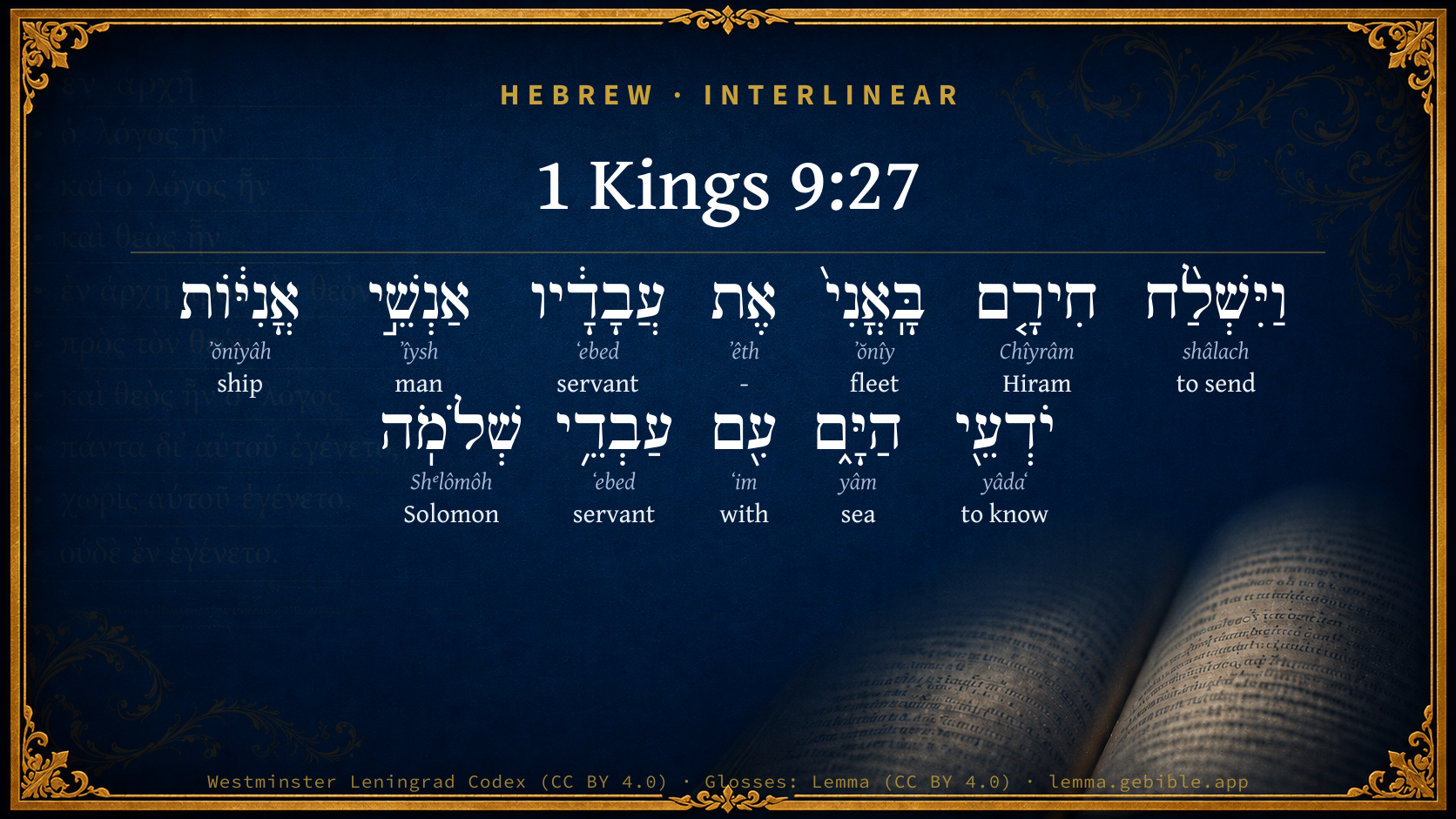
Hebrew (Westminster Leningrad Codex) 1 Kings 9:27 appears in the Hebrew Old Testament. The text above is from the Westminster Leningrad Codex. Each word links to its Strong’s number, a concise gloss, and parsing drawn from the Open Scriptures Hebrew Bible morphology. Click any word for its full Brown-Driver-Briggs (BDB) entry.
Download image
Cite this verse

1 Kings 9:27 (World English Bible). Public Domain. Lemma interlinear Bible study tool, https://lemma.gebible.app/v/1-kings/9/27.

Show BibTeX & RIS
BibTeX
RIS
English Translation
Hiram sent in the navy his servants, sailors who had knowledge of the sea, with the servants of Solomon.
World English Bible · Public Domain
Download a study sheet

One document with this verse’s original text, its word-by-word gloss line, the meaning frame, cross-references with their text, attributed commentary, and full source and license credits — printable, and it pastes into notes with its structure intact.

This verse Autodidact and up

Study sheet (.html) Plain text (.txt)

A passage Seminary Student

Up to 50 verses in one chapter. A passage sheet keeps up to 6 commentary sources and 12 cross-references per verse, in the order this page ranks them, and says so on the sheet whenever that leaves anything out. Ask for a single verse and you get the Autodidact verse sheet above.

Everything on this page stays free to read, with no account — the sheet is a download of what is already on screen, not access to it.

Want to remove ads? Support Godless Engineer
Compare translations 3

The same verse in 3 English versions, stacked beneath the original-language interlinear above. Click any original word for its lexicon entry.

Each is an independent rendering of the whole verse — the interlinear is not word-aligned to these translations.

Highlighted words mark where these versions differ — a whole-verse word diff, not a word-by-word alignment.

  • World English Bible Public Domain
    Hiram sent in the navy his servants, sailors who had knowledge of the sea, with the servants of Solomon.
  • King James Version Public Domain
    And Hiram sent in the navy his servants, shipmen that had knowledge of the sea, with the servants of Solomon.
  • unfoldingWord Literal Text CC BY-SA 4.0
    And Hiram sent his servants in the fleet, men of ships, knowers of the sea, with the servants of Solomon.

unfoldingWord Literal Text — © unfoldingWord, licensed CC BY-SA 4.0. Word-aligned USFM3 via Door43 (git.door43.org/unfoldingWord/en_ult).

Versions to compare (up to 4)

3 of 4 selected

Show all 18 translations

Every available English version of this verse, each an independent rendering of the whole verse.

  • World English Bible Public Domain
    Hiram sent in the navy his servants, sailors who had knowledge of the sea, with the servants of Solomon.
  • Berean Standard Bible Public Domain
    And Hiram sent his servants, men who knew the sea, to serve in the fleet with Solomon’s servants.
  • Majority Standard Bible Public Domain
    And Hiram sent his servants, sailors who knew the sea, to serve in the fleet with Solomon’s servants.
  • King James Version Public Domain
    And Hiram sent in the navy his servants, shipmen that had knowledge of the sea, with the servants of Solomon.
  • American Standard Version (1901) Public Domain
    And Hiram sent in the navy his servants, shipmen that had knowledge of the sea, with the servants of Solomon.
  • Revised Version (1885) Public Domain
    And Hiram sent in the navy his servants, shipmen that had knowledge of the sea, with the servants of Solomon.
  • Geneva Bible (1599) Public Domain
    And Hiram sent with the nauie his seruats, that were mariners, and had knowledge of the sea, with the seruants of Salomon.
  • Douay-Rheims (1899) Public Domain
    And Hiram sent his servants in the fleet, sailors that had knowledge of the sea, with the servants of Solomon.
  • Young's Literal Translation Public Domain
    And Hiram sendeth in the navy his servants, shipmen knowing the sea, with servants of Solomon,
  • Literal Standard Version CC BY-SA 4.0
    And Hiram sends his servants in the navy, shipmen knowing the sea, with servants of Solomon,
  • Unlocked Literal Bible CC BY-SA 4.0
    Hiram sent servants to Solomon's fleet, sailors who were familiar with the sea, with Solomon's own servants.
  • unfoldingWord Literal Text CC BY-SA 4.0
    And Hiram sent his servants in the fleet, men of ships, knowers of the sea, with the servants of Solomon.
  • Darby Bible Public Domain
    And Hiram sent in the fleet his servants, shipmen that had knowledge of the sea, with the servants of Solomon;
  • World Messianic Bible Public Domain
    Hiram sent in the fleet his servants, sailors who had knowledge of the sea, with the servants of Solomon.
  • Webster's Bible Public Domain
    And Hiram sent in the navy his servants, shipmen that had knowledge of the sea, with the servants of Solomon.
  • Free Bible Version CC BY-SA 4.0
    Hiram sent his sailors who knew the sea to serve in the fleet with Solomon's men.
  • Bible in Basic English Public Domain
    Hiram sent his servants, who were experienced seamen, in the sea-force with Solomon's men.
  • JPS Tanakh (1917) Public Domain
    And Hiram sent in the navy his servants, shipmen that had knowledge of the sea, with the servants of Solomon.

Literal Standard Version (2020), Covenant Press — licensed CC BY-SA 4.0. Text via the HelloAO Bible API (eBible.org). Unlocked Literal Bible (unfoldingWord) — licensed CC BY-SA 4.0. Text via the HelloAO Bible API (eBible.org). unfoldingWord Literal Text — © unfoldingWord, licensed CC BY-SA 4.0. Word-aligned USFM3 via Door43 (git.door43.org/unfoldingWord/en_ult). Free Bible Version, Dr. Jonathan Gallagher — licensed CC BY-SA 4.0. Text via the HelloAO Bible API (eBible.org).

Word by word

More ways to search: Search by grammar → Find every occurrence → Compare this word →

Practice this passage: Drill this verse → Learn its vocabulary →

בָּֽאֳנִי֙
ʼŏnîy
H590
“in/at · fleet”
Preposition + Noun, Common, Both, Singular, Absolute
Part of Speech
Preposition + Noun
Type
Common
Gender
Both
Number
Singular
State
Absolute
Full BDB Definition

Origin: probably from H579 (in the sense of conveyance)

TWOT: 125a , b

fleet, ships
  1. וַיִּשְׁלַ֨ח shâlach H7971 “and · to send” Conjunction + Verb, Qal, Sequential Imperfect, 3rd Person, Masculine, Singular
  2. חִירָ֤ם Chîyrâm H2438 “Hiram” Noun, Proper
  3. אֶת ʼêth H853 “-” Particle, Direct Object
  4. עֲבָדָ֔יו ʻebed H5650 “servants · his” Noun, Common, Masculine, Plural, Construct + Suffix, Personal, 3rd Person, Masculine, Singular
  5. אַנְשֵׁ֣י ʼîysh H376 “men of” Noun, Common, Masculine, Plural, Construct
  6. אֳנִיּ֔וֹת ʼŏnîyâh H591 “ships” Noun, Common, Feminine, Plural, Absolute
  7. יֹדְעֵ֖י yâdaʻ H3045 “knowing” Verb, Qal, Participle Active, Masculine, Plural, Construct
  8. הַיָּ֑ם yâm H3220 “the · sea” Particle, Definite Article + Noun, Common, Masculine, Singular, Absolute
  9. עִ֖ם ʻim H5973 “with” Preposition
  10. עַבְדֵ֥י ʻebed H5650 “servants of” Noun, Common, Masculine, Plural, Construct
  11. שְׁלֹמֹֽה Shᵉlômôh H8010 “Solomon” Noun, Proper

About this verse

These counts appear in no published source. They are computed here, from the morphology-tagged text and Lemma’s own curated glosses. What Lemma adds →

12
words
11
distinct lemmas
Historical
section

Notable vocabulary

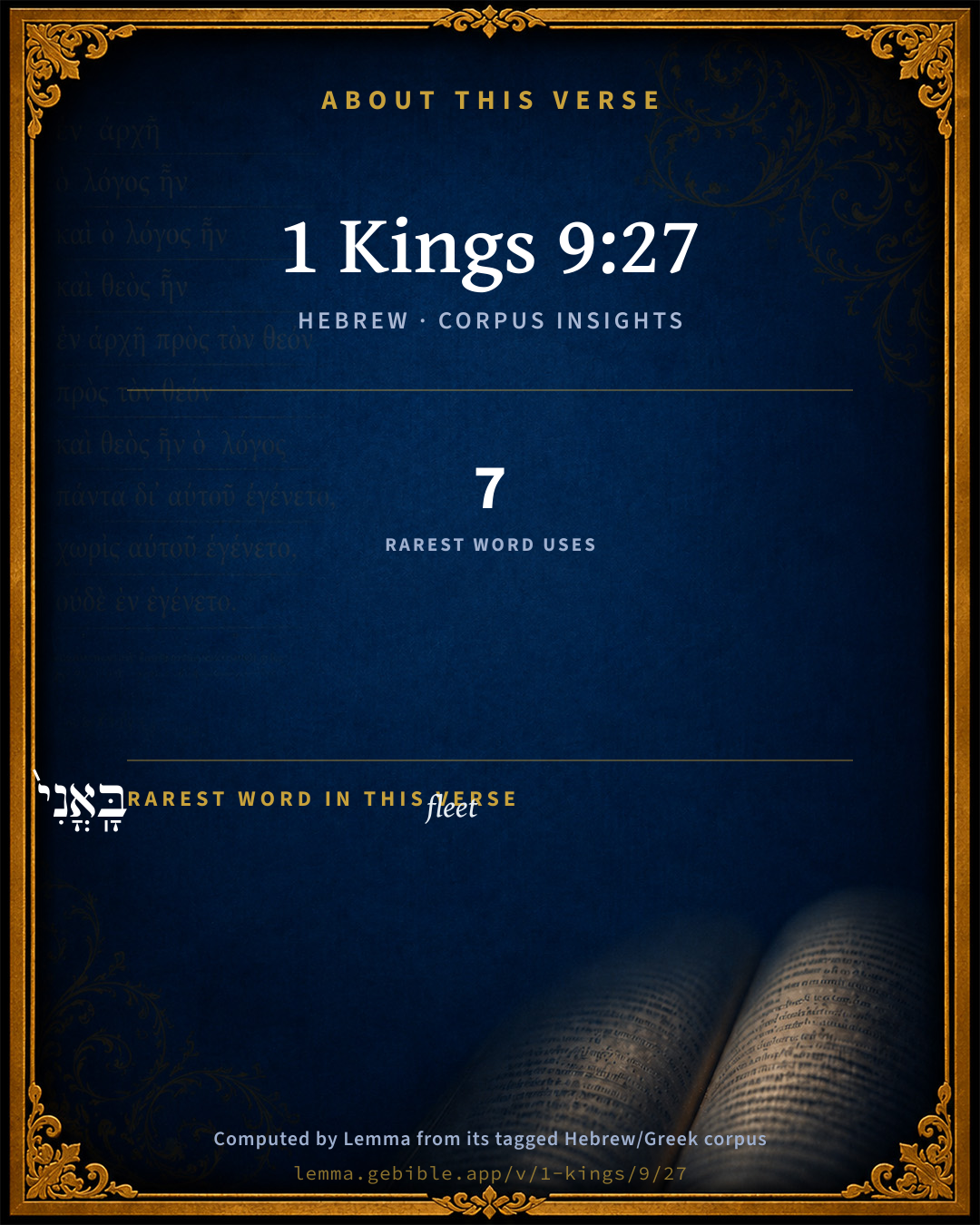
The rarest word here is בָּֽאֳנִי֙ fleet H590 — appearing just 7 times in the whole Hebrew Bible.

Shared distinctive vocabulary

בָּֽאֳנִי֙ fleet H590 occurs in 5 verses of the Hebrew Bible. Also found in:

Grammatical profile

  • 2 verbs
  • 8 nouns
  • 1 preposition
  • 1 particle

Verb forms

  • וַיִּשְׁלַ֨ח Qal · Sequential Imperfect
  • יֹדְעֵ֖י Qal · Participle Active

Repetition

A word recurs within this verse — often emphatic in Hebrew:

  • עֲבָדָ֔יו servant H5650 ×2

Hebrew & Septuagint length

In English translation the verse runs 19 words from the Hebrew and 24 from the Septuagint (LXX English) — closely comparable.

A rough comparison of the two English renderings, which tokenize alike — not a word-level alignment.

Word counts can differ between the Hebrew and the Greek without any difference in meaning — e.g. the Hebrew direct-object marker אֵת has no separate Greek word, and Greek often adds the article ὁ.

Cross-references

5

Topical passages linked to 1 Kings 9:27 in the Treasury of Scripture Knowledge — connected by theme and wording, ordered by reader-vote popularity; previews shown in the World English Bible.

  • 1 Kings 5:6 Now therefore command you that they cut me cedar trees out of Lebanon; and my servants shall be with your servants; and I will give you hire for your servants according to all that you shall say: for you know that there is not among us any who knows how to cut timber like the Sidonians.
  • 1 Kings 5:9 My servants shall bring them down from Lebanon to the sea; and I will make them into rafts to go by sea to the place that you shall appoint me, and will cause them to be broken up there, and you shall receive them; and you shall accomplish my desire, in giving food for my household.
  • 1 Kings 10:11 The navy also of Hiram, that brought gold from Ophir, brought in from Ophir great plenty of almug trees and precious stones.
  • 1 Kings 22:49 Then said Ahaziah the son of Ahab to Jehoshaphat, Let my servants go with your servants in the ships. But Jehoshaphat would not.
  • 2 Chronicles 20:36–37 and he joined himself with him to make ships to go to Tarshish; and they made the ships in Ezion Geber.

Cross-references courtesy of OpenBible.info (CC BY 4.0).

Hebrew and Greek witnesses Masoretic Hebrew ↔ Greek Septuagint

The same verse in the two great witnesses to the Old Testament, shown verse-for-verse.

These are two independent witnesses, not word-aligned to each other, and the Septuagint is shown in lemma (dictionary) form.

Hebrew 1 Kings 9:27 Masoretic · Westminster Leningrad Codex

וַיִּשְׁלַ֨ח חִירָ֤ם בָּֽאֳנִי֙ אֶת עֲבָדָ֔יו אַנְשֵׁ֣י אֳנִיּ֔וֹת יֹדְעֵ֖י הַיָּ֑ם עִ֖ם עַבְדֵ֥י שְׁלֹמֹֽה

Hiram sent in the navy his servants, sailors who had knowledge of the sea, with the servants of Solomon.

World English Bible · Public Domain

Greek LXX 1 Kings 9:27 Septuagint · lemma form
And Chiram sent in the ship together with the servants of Solomon servants of his own, mariners to row, men acquainted with the sea.

LXX2012 (modern English Septuagint) · Public Domain

Hebrew: Westminster Leningrad Codex (CC BY 4.0). Greek: Septuagint (public domain); English from LXX2012 (modern English Septuagint) (Public Domain). How the Septuagint differs from the Hebrew →

Targum (Aramaic paraphrase)

1

The Targum is the ancient Jewish Aramaic paraphrase of the Hebrew Scriptures — an interpretive translation, not the Hebrew text itself. Onkelos (literal) and Pseudo-Jonathan (expansive) render the Torah, and Jonathan the Prophets. Coverage is partial: where no permissively-licensed English translation exists for a verse, only the Aramaic is shown. This is verse-level text, not a word-by-word alignment to the Hebrew.

  1. Targum Jonathan Prophets (Joshua–Malachi)
    וּשְׁדַר חִירָם בִּסְפִינָתָא יַת עַבְדוֹהִי גַבְרִין סַפָנִין דְאוּמָנִין לְדַבָּרָא בְּיַמָא עִם עַבְדֵי שְׁלֹמֹה:

    (no public-domain English translation for this verse)

    Targum Jonathan — Aramaic: “Mikraot Gedolot” (public domain). English: “Sefaria Community Translation” (CC0 1.0 (public-domain dedication)); “London "Chaldee Paraphrase," 1871” (public domain). Text via Sefaria.

Commentary

Notes on 1 Kings 9:27 from classic Christian and Jewish commentators (each source and its license shown beneath its notes). The classic Christian expositions comment on the surrounding passage and are grouped to its opening verse, so a note may address several verses; the Jewish commentaries on the Tanakh (Rashi and others) are per-verse, so they appear only where the commentator wrote on this verse.

Lemma curates 59 commentaries, every one of them public domain or Creative Commons licensed, each selected and text-cleaned for this edition rather than reprinted as found. About our sources →

Trapp's Complete Commentary

John Trapp

1Ki 9:27 And Hiram sent in the navy his servants, shipmen that had knowledge of the sea, with the servants of Solomon.

Ver. 27. Shipmen that had knowledge of the sea.] The Tyrians and Phoenicians were famous all the world over for their great skill in navigation. Of the Hollanders, one saith, Peterent caelum navibus Belgae, si navibus peti posset. The Low-country men are brave seamen; and that the English are no less, our recent conflicts with them and our great achievements in the western parts have proclaimed.

John Trapp, A Commentary or Exposition upon All the Books of the Old and New Testament (1647–1656) — public domain. Text from a community e-Sword module.

Ellicott's Commentary for English Readers

(27) Shipmen that had knowledge of the sea.—The Tyrians were known far and wide as the great sailors both of the Mediterranean and the seas beyond it, till they were rivalled and superseded by their own colonists in Carthage and by the Greeks. How greatly their seamanship, their commerce, and their civilisation impressed the imagination of Israel, is shown in the magnificent chapters of Ezekiel on the fate of Tyre (Ezekiel 26-28). The Israelites, on the contrary, had but little care for the sea, and little knowledge of seamanship. The coast line of Palestine is but scantily furnished with harbours; and even at the height of their power they were content to use the maritime skill of the Tyrians, without encroaching upon their commerce or attempting to seize their famous ports. This was natural; for their call to be a peculiar and separate people was absolutely incompatible with maritime enterprise and commerce. Even in this attempt at maritime expedition under Tyrian guidance, Solomon’s action was, as in other points, exceptional, departing from Israelite tradition; and we hear of no similar enterprise, except in the age of Ahab and Jehoshaphat, when the intermarriage of the royal houses of Israel and Phœnicia renewed the close connection with Tyre (1Ki_22:48; 2Ch_20:35). We observe, accordingly, that the sea is mostly regarded in the Old Testament in its terrible power of wave and storm, restrained from destroying only by the Almighty hand of God; and even the one psalm (Psa_107:23-31), which describes the seafarer’s experience, dwells with awe on “God’s wonders in the deep.” In the description of the glory of “the new heaven and earth” of the hereafter, it is declared with emphasis that “there was no more sea” (Rev_21:1).

A Bible Commentary for English Readers, edited by Charles John Ellicott (1878–1897) — public domain. Text from a community e-Sword module.

The Cambridge Bible for Schools and Colleges

gen. ed. J. J. S. Perowne

27. that had knowledge of the sea] For which knowledge in ancient times the Phœnicians were the most famous people.

The Cambridge Bible for Schools and Colleges (gen. ed. J. J. S. Perowne; Cambridge University Press, 1878–1918) — public domain. Text from a community e-Sword module.

Albert Barnes' Notes on the Bible

Shipmen - See 1Ki 5:6 note. With respect to the acquaintance of the Phoenicians with this particular sea, it may be observed that they are not unlikely to have had trading settlements there, as they had in the Persian Gulf, even at this early period. The commerce with Ophir was probably an established trade, previously either in their hands or in those of the Egyptians, when Solomon determined to have a share in it. The Egyptians had navigated the other arm of the Red Sea, and perhaps its lower parts, from a much more ancient period.

Albert Barnes' Notes on the Bible (1834–1885) — public domain. Text from a community e-Sword/MySword module.

Haydock's Catholic Bible Commentary

Fleet, from Tyre, (Calmet) or from the island of the same name, in the Red Sea. (Grotius)

George Leo Haydock (1774–1849), Haydock's Catholic Family Bible and Commentary, 1859 edition — public domain. Excludes Psalms (Douay-Rheims chapter numbering differs from Protestant) and Deuterocanonical books (Catholic canon only).

Matthew Poole's English Annotations

The Tyrians were famous for

knowledge of the sea. He sent also ships to join with Solomon’s, 2Ch 8:18; not from Tyre, the famous city of Phoenicia, which was in the midland sea, from whence he could not sail to the Red Sea without fetching a vast compass; but from an island in the Red Sea, called Tyre, because it was a colony of the Tyrians, as Strabo notes.

Matthew Poole's English Annotations on the Holy Bible (1683–1685) — public domain. Text from a community e-Sword/MySword module.

Whedon's Commentary on the Bible

Daniel D. Whedon

27. Shipmen that had knowledge of the sea — Skilled in navigation. The Phenicians were the earliest and boldest navigators of antiquity. See the tribute to Tyrian wisdom and success in Eze_28:1-5.

Daniel D. Whedon (gen. ed.), Commentary on the Old and New Testaments (1874–1909) — public domain. Text from a community e-Sword module.

The Pulpit Commentary

And Hiram sent in the navy his servants, shipmen that had knowledge of the sea with the servants of Solomon. The chronicler states (2Ch_8:18) that he sent ships as well as servants, and it has been thought that ships were transported, in parts or entire, by land across the Isthmus of Suez, and there are certainly instances on record of the land transport of fleets. (Keil reminds us that Alexander the Great, according to Arrian, had snips transported in pieces from Phoenicia to the Euphrates, and that, according to Thucydides (Bell. Pelop. 4:8) the Peloponnesians conveyed 60 ships from Corcyra across the Leucadian Isthmus, etc.) But this, especially when the state of engineering science, etc., among the Hebrews is taken into account, is hardly to be thought of. It is quite possible, however, that timber for shipbuilding was floated on the Mediterranean down to the river of Egypt, or some such place, and then transported either to Suez or to Akaba. Probably all that the chronicler means is that Hiram provided the materials and had the ships built. The Israelites, having hitherto had no fleet, and little or no experience of the sea, were unable to construct ships for themselves. And the Tyrians may have seen in the construction of a fleet for eastern voyages, an opening for the extension of their own maritime trade. Possibly in the first voyages Tyriaus and Jews were copartners.

The Pulpit Commentary (1880–1919), ed. H.D.M. Spence-Jones & Joseph S. Exell — public domain. Text from a community e-Sword module.

John Wesley's Explanatory Notes

Knowledge of the sea - For which the Tyrians were famous. He sent also ships to join with Solomon's, not from Tyre, the city of Phoenicia; but from an island in the Red-sea, called Tyre, because it was a colony of the Tyrians, as Strabo notes.

John Wesley, Explanatory Notes Upon the Whole Bible (1754–1765) — public domain. Text via the GEBible commentary corpus.

Lesson kit

Teaching starters — assembled from the data on this page, not authored interpretation. Every prompt links to the verse data it draws on. Edit before teaching.

1 Kings, in the Historical, opens this verse with 12 words (11 distinct Hebrew lemmas). Its most distinctive word is ʼŏnîy (“fleet”). A historical commentator’s framing appears above. Read the whole chapter for the surrounding context.

Discussion questions

  1. How does “fleet” (ʼŏnîy) shape what this verse is saying?
  2. How does 1 Kings 9:26, which shares the word «fleet», read alongside this verse?
  3. What does the repetition of “servant” (2× in this one verse) do in this verse?
  4. The translations on this page render this verse differently — a whole-verse word diff, not a word-by-word alignment. What might account for the different wordings?
  5. «וַיִּשְׁלַ֨ח» is a Qal Sequential Imperfect verb. How does that grammatical form shape the action described?
  6. Compare how Trapp's Complete Commentary and Ellicott's Commentary for English Readers read this verse. Where do they agree or differ?

Things to notice

Reading settings

Reading text

Shown beneath each verse's original-language words.

Old Testament
Old Testament edition

Read the OT as the Masoretic Hebrew (MT) or the Greek Septuagint (LXX).

English shown for the Greek Septuagint (in the Hebrew ↔ Greek comparison).

Comparing translations? Open the Compare panel on any verse page to stack up to four side by side.