Isaiah 49:12

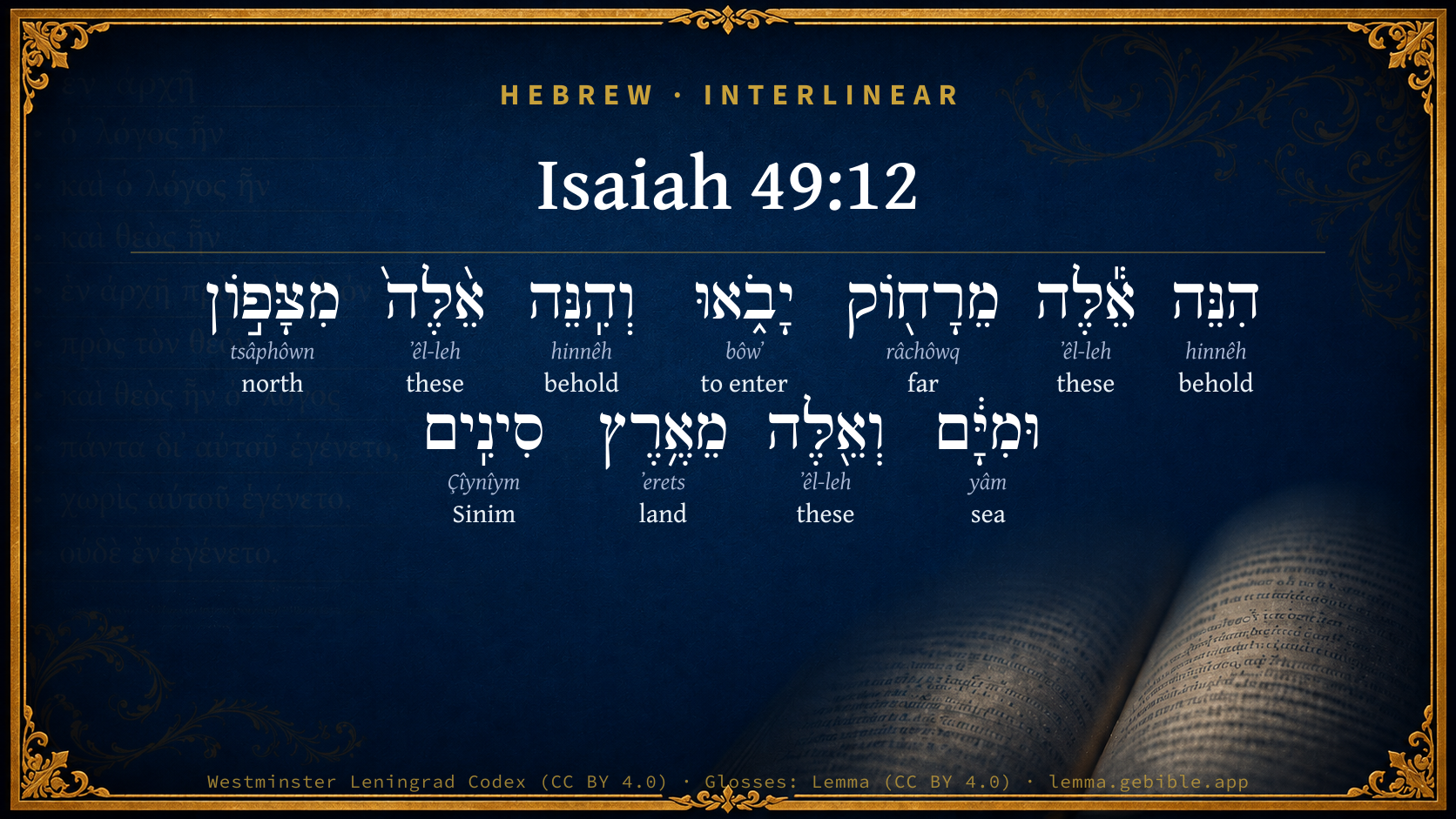
Hebrew (Westminster Leningrad Codex) Isaiah 49:12 appears in the Hebrew Old Testament. The text above is from the Westminster Leningrad Codex. Each word links to its Strong’s number, a concise gloss, and parsing drawn from the Open Scriptures Hebrew Bible morphology. Click any word for its full Brown-Driver-Briggs (BDB) entry.
Download image
Cite this verse

Isaiah 49:12 (World English Bible). Public Domain. Lemma interlinear Bible study tool, https://lemma.gebible.app/v/isaiah/49/12.

Show BibTeX & RIS
BibTeX
RIS
English Translation
Behold, these shall come from far; and, behold, these from the north and from the west; and these from the land of Sinim.
World English Bible · Public Domain
Highlights
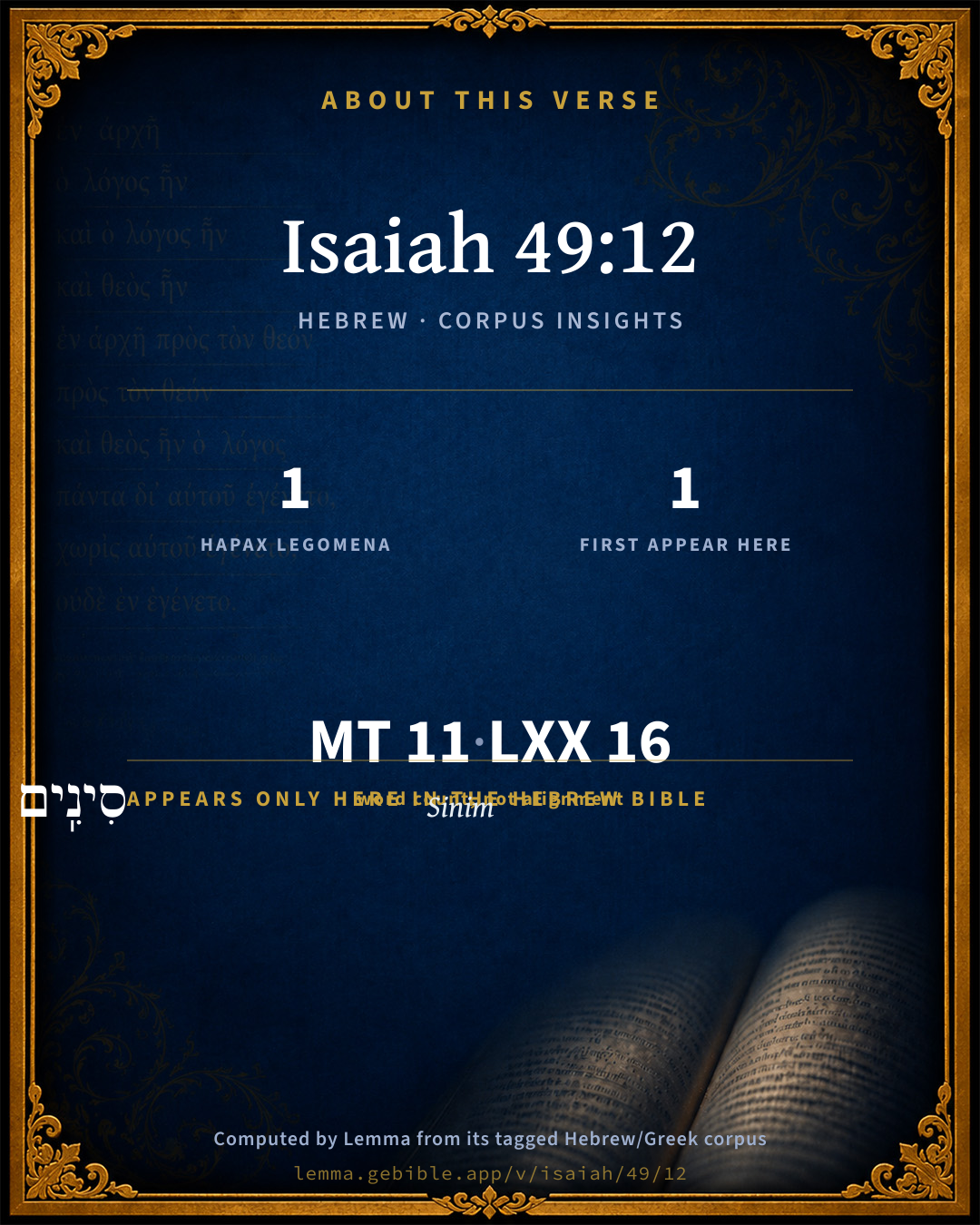
  • 1 hapax legomenon — only here in the Hebrew Bible
  • 1 first appearance in the Hebrew Bible
Full analysis ↓
Download a study sheet

One document with this verse’s original text, its word-by-word gloss line, the meaning frame, cross-references with their text, attributed commentary, and full source and license credits — printable, and it pastes into notes with its structure intact.

This verse Autodidact and up

Study sheet (.html) Plain text (.txt)

A passage Seminary Student

Up to 50 verses in one chapter. A passage sheet keeps up to 6 commentary sources and 12 cross-references per verse, in the order this page ranks them, and says so on the sheet whenever that leaves anything out. Ask for a single verse and you get the Autodidact verse sheet above.

Everything on this page stays free to read, with no account — the sheet is a download of what is already on screen, not access to it.

Want to remove ads? Support Godless Engineer
Compare translations 3

The same verse in 3 English versions, stacked beneath the original-language interlinear above. Click any original word for its lexicon entry.

Each is an independent rendering of the whole verse — the interlinear is not word-aligned to these translations.

Highlighted words mark where these versions differ — a whole-verse word diff, not a word-by-word alignment.

  • World English Bible Public Domain
    Behold, these shall come from far; and, behold, these from the north and from the west; and these from the land of Sinim.
  • King James Version Public Domain
    Behold, these shall come from far: and, lo, these from the north and from the west; and these from the land of Sinim.
  • unfoldingWord Literal Text CC BY-SA 4.0
    Behold, these will come from far away, and behold, these from the north and from the sea, and these from the land of Sinim.” q1

unfoldingWord Literal Text — © unfoldingWord, licensed CC BY-SA 4.0. Word-aligned USFM3 via Door43 (git.door43.org/unfoldingWord/en_ult).

Versions to compare (up to 4)

3 of 4 selected

Show all 18 translations

Every available English version of this verse, each an independent rendering of the whole verse.

  • World English Bible Public Domain
    Behold, these shall come from far; and, behold, these from the north and from the west; and these from the land of Sinim.
  • Berean Standard Bible Public Domain
    Behold, they will come from far away, from the north and from the west, and from the land of Aswan.”
  • Majority Standard Bible Public Domain
    Behold, they will come from far away, from the north and from the west, and from the land of Aswan.”
  • King James Version Public Domain
    Behold, these shall come from far: and, lo, these from the north and from the west; and these from the land of Sinim.
  • American Standard Version (1901) Public Domain
    Lo, these shall come from far; and, lo, these from the north and from the west; and these from the land of Sinim.
  • Revised Version (1885) Public Domain
    Lo, these shall come from far: and, lo, these from the north and from the west; and these from the land of Sinim.
  • Geneva Bible (1599) Public Domain
    Beholde, these shall come from farre: and loe, these from the North and from the West, and these from the land of Sinim.
  • Douay-Rheims (1899) Public Domain
    Behold these shall come from afar, and behold these from the north and from the sea, and these from the south country.
  • Young's Literal Translation Public Domain
    Lo, these from afar come in, And lo, these from the north, and from the sea, And these from the land of Sinim.
  • Literal Standard Version CC BY-SA 4.0
    Behold, these come in from afar, || And behold, these from the north, and from the sea, || And these from the land of Sinim.”
  • Unlocked Literal Bible CC BY-SA 4.0
    Look, these will come from far away, some from the north and the west; and others from the land of Sinim.
  • unfoldingWord Literal Text CC BY-SA 4.0
    Behold, these will come from far away, and behold, these from the north and from the sea, and these from the land of Sinim.” q1
  • Darby Bible Public Domain
    Behold, these shall come from afar; and behold, these from the north and from the west; and these from the land of Sinim.
  • World Messianic Bible Public Domain
    Behold, these shall come from afar, and behold, these from the north and from the west, and these from the land of Sinim.”
  • Webster's Bible Public Domain
    Behold, these shall come from far: and lo, these from the north and from the west; and these from the land of Sinim.
  • Free Bible Version CC BY-SA 4.0
    Look at these people coming from far away! Look at these people coming from the north, and from the west, and from Upper Egypt.
  • Bible in Basic English Public Domain
    See, these are coming from far; and these from the north and the west; and these from the land of Sinim.
  • JPS Tanakh (1917) Public Domain
    Behold, these shall come from far; and, lo, these from the north and from the west, and these from the land of Sinim.

Literal Standard Version (2020), Covenant Press — licensed CC BY-SA 4.0. Text via the HelloAO Bible API (eBible.org). Unlocked Literal Bible (unfoldingWord) — licensed CC BY-SA 4.0. Text via the HelloAO Bible API (eBible.org). unfoldingWord Literal Text — © unfoldingWord, licensed CC BY-SA 4.0. Word-aligned USFM3 via Door43 (git.door43.org/unfoldingWord/en_ult). Free Bible Version, Dr. Jonathan Gallagher — licensed CC BY-SA 4.0. Text via the HelloAO Bible API (eBible.org).

Word by word

More ways to search: Search by grammar → Find every occurrence → Compare this word →

Practice this passage: Drill this verse → Learn its vocabulary →

סִינִֽים
Çîynîym
H5515
“Sinim”
Noun, Proper
Part of Speech
Noun
Type
Proper
Full BDB Definition

Origin: of an otherwise unknown name

TWOT: None

Sinim = "thorns" - a people living at the extremity of the known world; may be identified with the inhabitants of southern China
  1. הִנֵּה hinnêh H2009 “behold” Particle, Demonstrative
  2. אֵ֕לֶּה ʼêl-leh H428 “these” Pronoun, Demonstrative, Common, Plural
  3. מֵרָח֖וֹק râchôwq H7350 “from · far” Preposition + Adjective, Adjective, Masculine, Singular, Absolute
  4. יָבֹ֑אוּ bôwʼ H935 “to enter” Verb, Qal, Imperfect, 3rd Person, Masculine, Plural
  5. וְהִֽנֵּה hinnêh H2009 “and · behold” Conjunction + Particle, Demonstrative
  6. אֵ֨לֶּה֙ ʼêl-leh H428 “these” Pronoun, Demonstrative, Common, Plural
  7. מִצָּפ֣וֹן tsâphôwn H6828 “from · north” Preposition + Noun, Common, Feminine, Singular, Absolute
  8. וּמִיָּ֔ם yâm H3220 “and · from · sea” Conjunction + Preposition + Noun, Common, Masculine, Singular, Absolute
  9. וְאֵ֖לֶּה ʼêl-leh H428 “and · these” Conjunction + Pronoun, Demonstrative, Common, Plural
  10. מֵאֶ֥רֶץ ʼerets H776 “from · land of” Preposition + Noun, Common, Both, Singular, Construct

About this verse

These counts appear in no published source. They are computed here, from the morphology-tagged text and Lemma’s own curated glosses. What Lemma adds →

11
words
8
distinct lemmas
Prophets
section

Notable vocabulary

1 hapax legomenon — a word that appears only here in the entire Hebrew Bible:

  • סִינִֽים Sinim H5515

First appearance in Scripture

This word makes its first canonical appearance in the Hebrew Bible here:

  • סִינִֽים Sinim H5515

Grammatical profile

  • 1 verb
  • 4 nouns
  • 1 adjective
  • 3 pronouns
  • 2 particles

Verb forms

  • יָבֹ֑אוּ Qal · Imperfect

Repetition

Words recur within this verse — often emphatic in Hebrew:

  • הִנֵּה behold H2009 ×2
  • אֵ֕לֶּה these H428 ×3

Hebrew & Septuagint length

In English translation the verse runs 23 words from the Hebrew and 22 from the Septuagint (LXX English) — closely comparable.

A rough comparison of the two English renderings, which tokenize alike — not a word-level alignment.

Word counts can differ between the Hebrew and the Greek without any difference in meaning — e.g. the Hebrew direct-object marker אֵת has no separate Greek word, and Greek often adds the article ὁ.

In the original languages it is 11 Hebrew tokens and 16 Greek tokens — but the two are counted differently (Hebrew bundles its prefixes and suffixes into one token; the Greek is in lemma form), so that isn’t a like-for-like length.

Cross-references

15

Topical passages linked to Isaiah 49:12 in the Treasury of Scripture Knowledge — connected by theme and wording, ordered by reader-vote popularity; previews shown in the World English Bible.

  • Isaiah 43:5–6 Don't be afraid; for I am with you: I will bring your seed from the east, and gather you from the west;
  • Psalms 22:27 All the ends of the earth shall remember and turn to Yahweh. All the relatives of the nations shall worship before you.
  • Psalms 72:10–11 The kings of Tarshish and of the isles will bring tribute. The kings of Sheba and Seba shall offer gifts.
  • Psalms 72:17 His name endures forever. His name continues as long as the sun. Men shall be blessed by him. All nations will call him blessed.
  • Isaiah 2:2–3 It shall happen in the latter days, that the mountain of Yahweh's house shall be established on the top of the mountains, And shall be raised above the hills; And all nations shall flow to it.
  • Isaiah 11:10–11 It shall happen in that day, that the root of Jesse, who stands for an ensign of the peoples, to him shall the nations seek; and his resting-place shall be glorious.
  • Isaiah 60:9–14 Surely the isles shall wait for me, and the ships of Tarshish first, to bring your sons from far, their silver and their gold with them, for the name of Yahweh your God, and for the Holy One of Israel, because he has glorified you.
  • Isaiah 66:19–20 I will set a sign among them, and I will send such as escape of them to the nations, to Tarshish, Pul, and Lud, who draw the bow, to Tubal and Javan, to the isles afar off, who have not heard my fame, neither have seen my glory; and they shall declare my glory among the nations.
  • Micah 4:2 Many nations will go and say, "Come, and let us go up to the mountain of Yahweh, And to the house of the God of Jacob; And he will teach us of his ways, And we will walk in his paths." For out of Zion will go forth the law, And the word of Yahweh from Jerusalem;
  • Zechariah 2:11 Many nations shall join themselves to Yahweh in that day, and shall be my people; and I will dwell in the midst of you, and you shall know that Yahweh of Hosts has sent me to you.
  • Zechariah 8:20–23 Thus says Yahweh of Hosts: "Many peoples, and the inhabitants of many cities will yet come;
  • Matthew 8:11 I tell you that many will come from the east and the west, and will sit down with Abraham, Isaac, and Jacob in the Kingdom of Heaven,
  • Luke 13:29 They will come from the east, west, north, and south, and will sit down in the Kingdom of God.
  • Revelation 7:9 After these things I looked, and behold, a great multitude, which no man could number, out of every nation and of all tribes, peoples, and languages, standing before the throne and before the Lamb, dressed in white robes, with palm branches in their hands.
  • Revelation 11:15 The seventh angel sounded, and great voices in heaven followed, saying, "The kingdom of the world has become the Kingdom of our Lord, and of his Christ. He will reign forever and ever!"

Cross-references courtesy of OpenBible.info (CC BY 4.0).

Hebrew and Greek witnesses Masoretic Hebrew ↔ Greek Septuagint

The same verse in the two great witnesses to the Old Testament, shown verse-for-verse.

These are two independent witnesses, not word-aligned to each other, and the Septuagint is shown in lemma (dictionary) form.

Hebrew Isaiah 49:12 Masoretic · Westminster Leningrad Codex

הִנֵּה אֵ֕לֶּה מֵרָח֖וֹק יָבֹ֑אוּ וְהִֽנֵּה אֵ֨לֶּה֙ מִצָּפ֣וֹן וּמִיָּ֔ם וְאֵ֖לֶּה מֵאֶ֥רֶץ סִינִֽים

Behold, these shall come from far; and, behold, these from the north and from the west; and these from the land of Sinim.

World English Bible · Public Domain

Greek LXX Isaiah 49:12 Septuagint · lemma form

ἰδού οὗτος πόρρωθεν ἔρχομαι οὗτος ἀπό βορέας καί οὗτος ἀπό θάλασσα ἄλλος δέ ἐκ γῆ πέρσης

Behold, these shall come from far: and these from the north and the west, and others from the land of the Persians.

LXX2012 (modern English Septuagint) · Public Domain

On this verse, John Gill's Exposition discusses the Septuagint’s reading. Read the note in Commentary ↓

Hebrew: Westminster Leningrad Codex (CC BY 4.0). Greek: Septuagint (public domain); English from LXX2012 (modern English Septuagint) (Public Domain). How the Septuagint differs from the Hebrew →

Targum (Aramaic paraphrase)

1

The Targum is the ancient Jewish Aramaic paraphrase of the Hebrew Scriptures — an interpretive translation, not the Hebrew text itself. Onkelos (literal) and Pseudo-Jonathan (expansive) render the Torah, and Jonathan the Prophets. Coverage is partial: where no permissively-licensed English translation exists for a verse, only the Aramaic is shown. This is verse-level text, not a word-by-word alignment to the Hebrew.

  1. Targum Jonathan Prophets (Joshua–Malachi)
    הָא אִלֵין מֵרָחִיק יֵיתוֹן וְהָא אִלֵין מִצִפּוּנָא וּמִמַעֲרְבָא וְאִלֵין מֵאֲרַע דָרוֹמָא:

    Behold, these shall come from far: and, lo, these from the North and from the West, and these from the land of the South.

    Targum Jonathan — Aramaic: “Mikraot Gedolot” (public domain). English: “Sefaria Community Translation” (CC0 1.0 (public-domain dedication)); “London "Chaldee Paraphrase," 1871” (public domain). Text via Sefaria.

Commentary

Notes on Isaiah 49:12 from classic Christian and Jewish commentators (each source and its license shown beneath its notes). The classic Christian expositions comment on the surrounding passage and are grouped to its opening verse, so a note may address several verses; the Jewish commentaries on the Tanakh (Rashi and others) are per-verse, so they appear only where the commentator wrote on this verse.

Lemma curates 59 commentaries, every one of them public domain or Creative Commons licensed, each selected and text-cleaned for this edition rather than reprinted as found. About our sources →

Trapp's Complete Commentary

John Trapp

Isa 49:12 Behold, these shall come from far: and, lo, these from the north and from the west; and these from the land of Sinim.

Ver. 12. Behold, these shall come from far.] The Jews from all parts, whither they have been dispersed, the elect from all quarters of the earth. {Mat 8:11} {See Trapp on "Mat 8:11"}

And these from the land of Sinim.] Or, Of the Sinites - that is, of the Chinese, saith Junius and others, whom the Greek geographers call Sinois, a very populous nation. Botterus saith that there are reckoned seventy millions of men, which are more than are to be found in all Europe; and who knows but many of those of the ten tribes of Israel are there? {a}

{a} Arias Mont., Osorius, A Lapide, Mr Cotton.

John Trapp, A Commentary or Exposition upon All the Books of the Old and New Testament (1647–1656) — public domain. Text from a community e-Sword module.

The Biblical Illustrator

Joseph S. Exell

Isa_49:12

Behold, these shall come from far

Gathered from afar

Whatever bearing this prophecy may have had upon the time of Isaiah, or the time immediately after him, it has an important bearing on the time of the Messiah, and the course of His kingdom.

The sentiment is that the redeemed Church of Christ shall come from every part of the earth. This sentiment is in accordance with--

I. THE GENIUS OF THE GOSPEL.

II. THE SPIRIT OF PROPHECY.

III. THE COURSE OF EVENTS. Conclusion--

1. This subject recognises the brotherhood of man.

2. It imposes a stupendous obligation on the Church. (J. Rawlinson.)

The land of Sinim

The land of Sinim

As coming after the reference to the west, it is naturally looked for in the far east, and so has very generally been understood of the Chinese. The common designation of China among nations of South Asia outside of China is Tsin, and in the form of Sin this name had been introduced among the Arabians and Syrians. It is also observed that the Chinese dynasty of Tsin began to reign about B.C. 255. For ten centuries before Christ the Chinese had commercial relations with the west. (J. Macpherson, M. A.)

The land of Sinim

(the Sinites):--The last word is a hopeless enigma As the only proper name in the verse the writer must have had some special reason for mentioning it; and the only reason that can be plausibly imagined is that Sinim lay on the utmost limit of his geographical horizon. This would exclude two suggested identifications:

(1) the Canaanite Sinites of Gen_10:17, and

(2) Sin (Pelusium), on the nearest border of Egypt. (Prof. J. Skinner, D. D.)

The Biblical Illustrator, edited by Joseph S. Exell (c. 1880s–1900s) — public domain. Text from a community e-Sword module.

Joseph Benson's Commentary

Isa 49:12-13. Behold, these shall come from far — My people shall be gathered from the most remote parts of the earth. He speaks here, and in many other places, of the conversion of the Gentiles, with allusion to that work of gathering and bringing back the Jews from all parts where they were dispersed, into their own land. And these from the land of Sinim — Either of the Sinites, as they are called, Gen 10:17, who dwelt about the wilderness; or of Sin, a famous city of Egypt, which may be put for all Egypt, and that for all southern parts. And so he here mentions the several quarters of the world where the generality of the Jews were dispersed; the north, which is everywhere named as the chief place of their banishment and dispersion, as Jer 16:15; and Jer 31:8, and elsewhere; the west, the western countries and islands; and the south. Sing, O heavens, &c. — See note on Isa 44:23. For the Lord hath comforted his people — God hath now sent the long-desired consolation of Israel.

Joseph Benson's Commentary on the Old and New Testaments (1811–1818) — public domain. Text from a community e-Sword module.

The Preacher's Complete Homiletical Commentary

Joseph S. Exell (gen. ed.)

GATHERED FROM AFAR

(Missionary Sermon.)

Isa_49:12. Behold there shall come from far, &c.

Whatever bearing this prophecy may have had upon the time of Isaiah, or the time immediately after him, it has an important bearing on the time of the Messiah and the course of His kingdom. The prophet sees multitudes coming into that kingdom from every quarter of the globe. Taking his position in Palestine, he mentions the north and west by name; the far country may be regarded as the south, beginning with Egypt, and running down to Southern Africa; while the east runs through Persia and India to China, which many expositors consider identical with Sinim.

The sentiment of the text is that the redeemed Church of Christ shall come from every part of the earth.

I. This sentiment is in accordance with the genius of the gospel

The gospel is in the world. It exerts an immense influence over the best portions of the human race; whose excellence, indeed, is directly owing to its influence. What is its nature? It is the manifestation of God’s love to man. It is not a mere declaration of the Divine existence and character, nor a mere exposition of human nature and its obligations. It. is a revelation of the Divine character in its relations to man. It unfolds the way in which God deals with human sinfulness. Instead of sweeping it away by sweeping man away, He provides salvation from sin and its doom. That provision consists in the incarnation of the Son of God’ who has obeyed the law and endured its curse for man. The good news is the proclamation of God’s forgiving mercy to as many as believe in Him, repenting of their sins; and the further proclamation that all needful influences and help will be supplied by the Holy Spirit for their complete regeneration and purification.

Now this is not a story likely to be concealed in the hearts of those who happen to know it. It is of such a nature that those who know it and have acted upon it instinctively desire to communicate it to others. Why?

1. Because it is true.

2. Because it redounds to the honour of its chief Personage, whom they have learned to love with supreme devotedness.

3. Because it is closely connected with the interests and destinies of the human race. Their participation of its blessing, their falling under its influence, has brought them into sympathy with the love of God to man, which, like a spark from the central fire of love, has fallen on their susceptibility and set it aflame. Men need the gospel, in life and in death; and the gospel inspires its recipients with the benevolence which cannot rest until the blessing has been universally received. Nor is it conceivable that He who provided the gospel should not desire men to avail themselves of its provisions; having prepared a home for the wanderers, He desires them to come into it.

II. This sentiment is in accordance with the spirit of prophecy

There is a marked difference between the Christian and Jewish dispensations. The Jews, with a narrow strip of territory, were separated from the nations. Their religion was intimately associated with their national life and being. It was given to them; adapted to them. No wonder that they became possessed of the idea that God never meant to bring other nations into His Church; that therefore they never sought the conversion of the heathen, nor welcomed the idea when it was propounded.

Yet in their own Scriptures there was abundant evidence that the time would come when God would both welcome and seek the heathen. Intimations in the earlier Scriptures. Isaiah prolific of passages. He dwells on the idea, delights in it as if he had already caught the spirit of that Gospel time whose advent he was inspired to predict. Our Lord distinctly enunciates the idea in terms almost similar to those of the text (Mat_8:11; Mat_24:14). Paul anticipates the coming in of the fulness of the Gentiles. His labours were conducted with that view. The assumption is everywhere that in the great future the gospel shall be universally prevalent.

III. This sentiment is in accordance with the course of events

Has the genius of the Gospel vindicated itself? Have the predictions of its attracting the heathen been verified? Take the history of the Church from the earliest time to the present. Its course has been one of steady advancement towards the point at which the predictions of its extension will be fully accomplished. During the apostolic age, although to a less extent than subsequently, the Gospel travelled north and south and east and west of Palestine. Beginning with a very small handful of Jews under persecution, before three hundred years were over it had made itself so felt that the Emperor of Rome found it his advantage to adopt it publicly. Through the centuries since, it has gradually covered a larger area. And the text is now in course of fulfilment. With a map in your hand, survey the parts of the earth in which the Gospel has been preached. You will find that it has planted its foot in every quarter, and that its converts are gathered from almost every land. China must not be overlooked. It is probably specially mentioned here. Christian missionaries of various names are attracting numbers of that multitudinous and remarkable people. As the completed fulfilment of the prophecy, there will be in heaven “a multitude which no man can number, of all nations, and kindreds, and people, and tongues, who will stand before the throne and before the Lamb.”

Two points may be mentioned as suggested by this subject:—

1. It recognises the brotherhood of man. For the purposes of this prophecy, every man must be regarded as belonging to one great family, equally capable of and needing redemption. God has put the highest honour on human nature by giving His dearest and best. Let not the most degraded be supposed beyond our reach. 2. It imposes a stupendous obligation on the Church. God works by means. Are we doing all in our power to help those who are labouring among the heathen?—J. Rawlinson.

CHINA FOR CHRIST

Isa_49:12. Behold these shall come from … the land of Sinim.

Most commentators are agreed that this refers to China. “The Arabians and other Asiatics called China Sin or Tchin; the Chinese had no special name for themselves, but either adopted that of the reigning dynasty or some high-sounding titles. This view of ‘Sinim’ suits the context which requires a people to be meant ‘from far,’ and distinct from those ‘from the north and from the west’ ” (Gesenius).

In these words we have a promise of the conversion of China, the spiritual needs and claims of which the Churches of Christendom will do well to consider most prayerfully. Observe—

1. The population, extent, and religion of China, &c. Next to the Russian Empire, the Chinese Empire, including Mantchuria, Mon golia, and Thibet, is in extent of territory the largest in the world. China itself is one-third the size of Europe, seven times the size of France, and is equal to eleven of Great Britain and Ireland. The population is estimated at 400,000,000—twenty-two times the population of England; or more than one hundred and thirty times that of Scot land. Were all the subjects of the court of Pekin to march past a spectator at the rate of thirty miles a day, they would move on and on, day after day, week after week, month after month; and more than twenty-three and a half years would elapse before the last individual had passed by.

The number is inconceivable—the view is appalling. The daily mortality of China is 33,000! Think of it—a mortality which in less than three months exceeds the whole population of London;—which in a year and a half exceeds the total number of the inhabitants of England. The thought is overwhelming.

The State Religion is founded on the ethical and political maxims of the sage Confucius. His writings ignore the existence of a God and a future state, consisting mainly in the advocacy of what is expedient and useful and proper, &c. Various species of idolatry prevail—Taouism, Buddhism, ancestral worship, &c.

2. We cannot say that the amazing population of China has been altogether neglected by the Christian people of Europe and America. For some years the London Missionary Society, hoping against hope, and exhibiting a perseverance worthy of all imitation, sustained the only Mission in China, begun by the honoured Morrison in 1807. China can never again be isolated as heretofore. We have long prayed that China might be “open” to evangelical effort. Prayer has been answered; “the fields are white to the harvest,” but as yet “the labourers are few,” and bear no proportion to the magnitude even of the initiatory work which remains to be accomplished.

3. Among the obstacles which oppose themselves to Christian missions in China, may be mentioned—

(1.) The theocratic assumption of the imperial government.

(2.) The ignorance, immorality, conceit, and superstitiousness of the population.

(3.) The system of ancestral worship—a plausible custom, but one which is a most unequivocal form of idolatry, &c.

(4.) Sundry superstitions.

(5.) The opium traffic, which has created a most power [n] prejudice against us among the best men in the country. A Wesleyan missionary, writing home (in 1884) said, “It would interest the supporters of our society if they could hear the various objections the Chinese make on the one hand against abandoning old customs, and on the other, against becoming Christians. To give just one specimen of each kind. At the close of a service held some weeks ago at Fatshan, and when the congregation were requested to ask any questions they might wish on the address just delivered, or on the new religion generally, one man maintained very strongly that it would be wrong in him not to worship idols, for his parents had worshipped them before him. He must do as they did, or be unfilial. This reasoning (if such it may be called) was easily disposed of, but not to his satisfaction, for he still held to his point. Another man seemed, however, annoyed that nothing stronger could be urged against the Gospel, and, leaning forward, he touched the man—who was so afraid of being unfilial—on the shoulder, and said, ‘You will do no good arguing that way. I tell you what to do, you just ask the foreigner, Where does the opium come from?’ And with that he ran out of the chapel, and we saw him no more. Whether he thought he had really vanguished us, or he was afraid of being vanquished, I don’t know. I suppose his reasoning was something like this: ‘opium is from abroad, and is injurious; the Gospel is from abroad, and it is, ergo, injurious.’ Or, ‘The Gospel is not much good, or it would keep foreigners from hurting China; and if it has not made them good, why do they bring it here?’ Opium, the impure lives of foreigners, and brandy, are the staple objections against the Gospel, when none can be found against its doctrines and morals. If opium could be got rid of, and the lives of Europeans and Americans were at all in accordance with the Bible, I am persuaded that our work would make greater progress. But as it is, opium (grown in British territory) is eating out the very life of the nation, physically and morally, among both high and low, and the ungodly lives of foreigners cause the adorable name of Jesus to be every day blasphemed among the heathen.”

4. There are some advantages on the other hand. The press is a powerful instrument; and the circulation of the Scriptures and other books is furthered by the cheapness of printing and paper, so that the entire Bible can be sold for less than a shilling, and the New Testament for fourpence. One cheering sign of the times is the organised opposition to missionary teaching which has recently appeared; a proof that the new opinions are beginning to move the apparently inert masses of the Chinese population.

5. The ultimate conversion of China’s teeming millions to Christ. Unprecedented opportunities now offer for Christian enterprise. Success has attended the labours of the past—upwards of 20,000 Chinese are now in Christian communion in Protestant Churches. A vast preparatory work has been done in a much wider circle, opening the way for the missionary reaper. Many fields are white already unto harvest. Let the Churches of Christendom obey the imperative command of their Lord. “Go ye,” &c., and the stupendous work shall be accomplished in due time, for “Thus saith the Lord, behold, these shall come from the land of Sinim.” Blessed be God, they are coming and shall come, until the word of promise is completely fulfilled.

“Faith, mighty faith. the promise sees,

And looks to that alone;

Laughs at impossibilities,

And cries. It shall be done!”

—Alfred Tucker.

The Preacher's Complete Homiletical Commentary (gen. ed. Joseph S. Exell; Funk & Wagnalls, c. 1892) — public domain (pre-1929). A full-Bible homiletical/sermon-outline anthology covering 65 of 66 books (2 John is absent from the source module). Text from a community e-Sword module.

J. A. Alexander on Isaiah

Joseph Addison Alexander

“Behold, these from afar shall come; and behold, these from the north and from the sea, and these from the land of Sinim.” There is not the least doubt as to the literal translation of this verse; and yet it has been a famous subject of discordant expositions, all of which turn upon the question, what is meant by the land of Sinim? In addition to the authors usually cited, respect will here be had to an interesting monograph, by an American Missionary in China, originally published in the Chinese Repository, and republished in this country under the title of The Land of Sinim, or an exposition, of Isa 49:12, together with a brief account of the Jews and Christians in China. (Philadelphia, 1845.) It is well said by this writer, that the verse before us is the central point of the prophetical discourse, of which it forms a part; inasmuch as it embodies the great promise, which in various forms is exhibited before and afterwards. This relation of the text to the context is important, because it creates a presumption in favor of the widest meaning which can be put upon the terms of the prediction, and against a restricted local application. A preliminary question, not devoid of exegetical importance, is the question with respect to the mutual relation of the clauses. The doubtful point is, whether the first clause is a single item in an enumeration of particulars, or a generic statement, comprehending the specific statements of the other clause. Almost all interpreters assume the former ground and understand the verse as naming or distinguishing the four points of the compass. But the other supposition is ingeniously maintained by the Missionary in China, who makes the first clause a general prediction that converts shall come from the remotest nations, and the other an explanation of this vague expression, as including the north, the west, and the land of Sinim. Upon this construction of the sentence, which is certainly plausible and striking, it may be observed, in the first place, that it is not necessary for the end at which the author seems to aim in urging it. This end appears to be the securing of some proof that the specifications of the second clause relate to distant countries. But this conclusion is almost as obvious, if not entirely so, upon the other supposition; for if one of the four quarters is denoted by the phrase ‘from afar’, the idea necessarily suggested is that all the other points enumerated are remote likewise. The same thing would moreover be sufficiently apparent from the whole drift of the context as relating not to proximate or local changes but to vast and universal ones. Nothing is gained, therefore, even for the author’s own opinion, by the admission of this new construction. Another observation is, that the authority on which he seems to rest its claims is inconclusive, namely, that of the Hebrew accents. He states the testimony thus afforded much too strongly, when he speaks of "a full stop" after the clause ‘from afar they shall come’, and points the verse accordingly. The accent which occurs here, as a general rule, indicates the pause not at the end but in the middle of a sentence or complete proposition. It is therefore prima facie proof that the sentence is incomplete; and although there may be numerous exceptions, it cannot possibly demonstrate that the first clause does not form a part of the same series of particulars which is concluded in the second. That the first clause frequently contains what may be logically called an essential portion of the second, any reader may convince himself by the most cursory inspection of the book before us; and for two decisive examples in this very chapter, he has only to examine the fifth and seventh verses, where the substitution of a "full stop" would destroy the sense. But even if the testimony of the accents were still more explicit and decisive than it is, their comparatively recent date and their mixed relation to rhythmical or musical as well as to grammatical and logical distinctions make it always proper to subject their decision to the requisitions of the text and context in themselves considered. Notwithstanding the great value of the masoretic accents as an aid to interpretation, the appeal must after all be to the obvious meaning of the words, or in default of this to analogy and usage. The accents leave us therefore perfectly at liberty to look upon the mutual relation of the clauses as an open question, by inquiring whether there is any valid reason for departing from the ancient and customary supposition that the four points of the compass, or at least four quarters or directions, are distinctly mentioned. This leads me, in the third place, to observe that the objection which the Missionary makes to this hypothesis, apart from the question of accentuation, is an insufficient one. He objects to the explanation of the phrase ‘from afar’ as meaning from the east (and the same objection would by parity of reasoning apply to the explanation of it as denoting from the south), that afar does not mean the east, and is not elsewhere used to denote it. But it is not said that afar means the cast, but simply that it here supplies its place. If any one, in numbering the points of the compass, should, instead of a complete enumeration, say the north, south, east, and so on, his obvious meaning could not well be rendered doubtful by denying that ‘and so on’ ever means the west. It is not the words themselves, but the place which they occupy, and their relation to the rest of the sentence, that suggests rather than expresses the idea. So here, the north, the west, the land of Sinim, and afar, may denote the four points of the compass, although not so explicitly as in the case supposed, because in that before us we have not merely one doubtful point, but two, if not three; and also because the one most dubious (from afar) is not at the end like ‘and so on’, but at the beginning. Still it seems most natural, when four distinct local designations are given, one of which is certainly, another almost certainly, and a third most probably, indicative of particular quarters or directions, to conclude that the fourth is so used likewise, however vague it may be in itself, and however situated in the sentence. The presumption thus created is confirmed by the fact that the hypothesis of only three divisions admits that the whole earth was meant to be included; and it thus becomes a question, which is most agreeable to general usage, and to that of Scripture in particular, a threefold or a fourfold distribution of the earth in such connections? If the latter, then analogy is strongly in favor of the common supposition that the first clause is not co-extensive with the other, but contains the first of four particulars enumerated. Over and above this argument derived from the usual distinction of four points or quarters, there is another furnished by the usage of the pronoun ‘these’, when repeated so as to express a distributive idea. In all such cases, ‘these and these’ means ‘some and others’; nor is there probably a single instance in which the first ‘these’ comprehends the whole, while the others divide it into parts. This would be just as foreign from the Hebrew idiom as it is from ours to say, ‘Some live in Europe, some in France, some in Holland,’ when we mean that some live in Holland, some in France, and all in Europe. From all this it seems to follow that the verse most probably contains the customary distribution of the earth or heavens into four great quarters, and that one of these is designated by the phrase ‘from afar’. Which one is so described can only be determined by determining the true sense of the other three. The Missionary in China is therefore perfectly correct in setting aside all arguments against his own opinion founded on the supposition that ‘from afar’ must mean the south or, the east. The expression is so vague that it must be determined by the others, and cannot therefore be employed to determine them, without reasoning in a vicious circle. This serves to show that the question after all is of no great exegetical importance, since in either case the same conclusion may be reached It is always best, however, to adhere to the more obvious and usual construction of a passage, in the absence of decisive reasons for departing from it. Assuming then that four points are mentioned, and that the first (from afar) can only be determined by determining the others, let us now attempt to do so. One of these (the north) is undisputed; for although interpreters may differ as to its precise bounds and extent, its relative position is unquestionably fixed by the usage of the Hebrew word. Another term is ‘yam’, which strictly means the sea, but is often used for west, because on that side Palestine is naturally bounded by the Mediterranean. The geographical import of the term is to be decided by the predominant usage, which determines it to mean the west, and so it is explained both by the oldest and the latest writers. Having two points thus determined, we are sure that the two which remain must be the east and south; and as we have already seen that ‘from afar’ from its vagueness must receive, but cannot give, light, we have now to ascertain, if possible, in which of these directions lay the land of Sinim. The discrepancy of the versions as to these concluding words is remarkable, and shows the doubt in which the subject was involved at a very early period. Dismissing these gratuitous conjectures, we may now confine ourselves for those interpretations which have some foundation or appearance of it either in philology or history. Among these may be mentioned, first, the supposition that the land of Sinim is the country of the Sinites spoken of in Gen 10:17 and 1Ch 1:15. But why should a Canaanitish tribe of no importance, and which nowhere reappears in history, be here made to represent one of the four quarters of the globe? This question becomes still more difficult to answer when it is added that the Sinites must have been immediately adjacent to the land of Israel, and on the north side which is separately mentioned. Others understand the Land of Sinim to be the wilderness of Sin or the peninsula of Sinai, and some even identify these with the country of the Canaanitish Sinites. To this opinion the decisive objection is not the one which the Missionary in China draws from the difference of name and from the plural form Sinim. That there were not two deserts of Sin, proves no more in this case than the assertion that there were not two Hermons proves against the application of the plural Hermonim to that mountain in Psa 42:7. If a mountain might be so called, why not a desert? Or if Hermonim means Hermonites, why may not Sinim mean Sinites? This question is especially appropriate, because the author gives no explanation of the plural form, upon his own hypothesis. But although this objection is invalid, the other which the author urges is conclusive, namely, that Sinai and the wilderness of Sin were too near and too limited to be employed in this connection. Another explanation founded on analogy of names is that the land of Sinim is the land of Egypt, so called from Syene, or from Sin, (i.e., Pelusium, mentioned under that name by Ezekiel (Eze 30:15-16)). Here again it seems unfair to argue, with the Missionary in China, from the plural form of the Hebrew name; for if, as he observes, it is merely fanciful to refer it to the old geographical distinction of Upper and Lower Egypt, is it not more than fanciful to refer it to China where there is no such distinction to account for it at all? If it be said, that Sinim means the Chinese, it may just as easily be said that it means the Egyptians. There is no force therefore in the argument from this peculiarity in form, any more than in the argument which the Missionary in China himself admits to be here inapplicable, that Egypt was not sufficiently important to be made the representative of one great quarter. As little weight attaches to his argument that this interpretation of the name would make the distribution too unequal; for as he adjusts the limits of the north and even of the land of Sinim at discretion, there is no sufficient reason why the same thing might not be done with Sinim if it did mean Egypt. The really decisive ground, assumed by the same writer, is that Egypt, notwithstanding its extent and historical importance, was too near at hand to suit the context, which requires a remote land to be here meant, whether ‘from afar’ be taken as a general description or as a distinct specification. Another strong objection is that no cause can be shown from analogy or otherwise, for the designation of this well-known country, in this one place only, by a name derived from one of its cities, and that not of the first rank. The only remaining explanation, which will be referred to, is that the land of Sinim is China. An objection to this interpretation has been drawn from its resemblance to an etymological conceit founded merely on an assonance of names. But in modern times it has been generally adopted not only by the most distinguished writers on Isaiah, but by the most eminent comparative philologists, who have investigated the question as one of historical and literary interest. The only plausible objections which are still urged against it may be reduced to two. The first is that China was unknown to the Jews at the date of the prophecy. To this it may be answered, first, that no one who believes in the inspiration of the prophets, can refuse to admit the possibility of such a prediction, even if the fact were so; and secondly, that in all probability China was known to the Jews at a very early period. The rashness of asserting a negative in such cases has been clearly proved by the modern discovery of porcelain vessels with Chinese inscriptions in the monuments of Thebes. But it is still objected, that the name Sinim is not that used by the Chinese themselves, nor by other nations until long after the date of this prophecy, it having been derived from a family which did not ascend the throne until about 246 years before the birth of Christ. It is remarkable how readily this date in Chinese history is taken for granted as undoubtedly correct by those who wish to use it for an argument, although it rests upon a dark and dubious tradition of a distant unknown country; although the very text before us makes it doubtful; although the universal prevalence of the name Sin, Chin, or Jin, throughout western and southern Asia from time immemorial presupposes an antiquity still more remote; and although Chinese historians themselves record that the family from which the name derives its origin, for ages before it ruled the empire ruled a province or kingdom on the western frontier, whence the name might easily have been extended to the western nations. There are in fact few cases of a name being more extensively or longer prevalent than that of China, the very form which it exhibits in the Sanscrit, the mother language of southern Asia. That the Chinese themselves have never used it, although acquainted with it, is nothing to the purpose. A Hebrew writer would of course use the name familiar in the west of Asia. This universal name is allowed to be essentially identical with Sin by the highest philological authorities. There is therefore no conclusive force in either of the arguments advanced against this explanation of the name. As positive reasons on the other side, besides the main one drawn from the coincidence of name, may be mentioned the agreement of so many different and independent writers, and the appropriateness of the explanation to the context. Under the first head may be classed precisely those philologists whose peculiar studies best entitle them to speak with authority on such a point, and those German commentators on Isaiah, who are most accustomed to differ among themselves and with the older writers, especially where anything is likely to be added by a proposed interpretation to the strength of revelation or rather to the clearness of its evidences. Prejudice and interest would certainly have led this class of writers to oppose rather than favor a hypothesis which tends to identify the subject of this prophecy with China, the great object of missionary effort at the present day. The other confirmation is afforded by the suitableness of the sense thus evolved to the connection. If the land of Sinim meant the wilderness of Sin or even Egypt, it, would be difficult if not impossible to give a satisfactory solution of its singular position here as one of the great quarters or divisions of the world. But if it mean China, that extreme limit of the eastern world, that hive of nations, supposed to comprehend a third part of the human race, the enigma explains itself. Even to us there would be nothing unintelligible or absurd, however strange or novel, in the combination, north, west, south, and China. On the whole, then, a hypothesis which solves all difficulties, satisfies the claims of philology and history, unites the suffrages of the most independent schools and parties, fully meets the requisitions of the text and context, and opens a glorious field of expectation and of effort to the church, may be safely regarded as the true one. For an interesting view of the extent to which the promise has already been fulfilled, and of the encouragements to hope and pray for its entire consummation, the reader is referred to the little book, of which we have so frequently made mention, although our citations have been necessarily confined to the first or expository chapter, the remaining four being occupied with the fulfillment of the prophecy.

Joseph Addison Alexander, The Prophecies of Isaiah (1846–1847; New York: Scribner, 1870–1878) — public domain. Text from a community e-Sword module.

Tyndale Open Study Notes

Tyndale Open Resources

49:12 The remnant would come from the north (i.e., from Babylon and Persia), from the west by sea, and from as far south as Egypt.

Tyndale Open Study Notes — © Tyndale Open Resources, licensed CC BY-SA 4.0. Text via the HelloAO Bible API.

Geneva Bible (1599)

Geneva Bible translators

Meaning, the South country, so that Christ shall deliver his from all the parts of the world.

Geneva Bible (1599) marginal notes — public domain. Text via Bolls.life.

Jamieson, Fausset & Brown

Robert Jamieson, A. R. Fausset & David Brown

Sinim--The Arabians and other Asiatics called China Sin, or Tchin; the Chinese had no special name for themselves, but either adopted that of the reigning dynasty or some high-sounding titles. This view of "Sinim" suits the context which requires a people to be meant "from far," and distinct from those "from the north and from the west" [GESENIUS].

Jamieson, Fausset & Brown — Commentary Critical and Explanatory on the Whole Bible (1871) — public domain (CC PDM 1.0). Text via the HelloAO Bible API.

Adam Clarke's Commentary

Verse 12. Behold, these shall come from far] "Babylon was far and east, ממזרח mimmizrach, (non sic Vett.,) Sinim, Pelusians, to the south."-SECKER.

The land of Sinim.] Prof. Doederlein thought of Syene, the southern limit of Egypt, but does not abide by it. Michaelis thinks it is right, and promises to give his reasons for so thinking in the second part of his Spicilegium Geographiae Hebraeorum Exterae. See Biblioth. Oriental. Part xi. p. 176.

סין sin signifies a bush, and סינים sinim, bushes, woods, &c. Probably this means that the land where several of the lost Jews dwell is a woodland. The ten tribes are gone, no one knows whither. On the slave coast in Africa, some Jewish rites appear among the people, and all the males are circumcised. The whole of this land, as it appears from the coast, may be emphatically called ארץ שינים erets sinim, the land of bushes, as it is all covered with woods as far as the eye can reach. Many of the Indians in North America, which is also a woodland, have a great profusion of rites, apparently in their basis Jewish. Is it not possible that the descendants of the ten lost tribes are among those in America, or among those in Africa, whom European nations think they have a right to enslave? It is of those lost tribes that the twenty-first verse speaks: "And these, where had they been?"

Adam Clarke's Commentary on the Bible (1810–1826) — public domain. Text from a community e-Sword/MySword module.

Ellicott's Commentary for English Readers

(12) From the west.—Literally, from the sea, which commonly has this meaning. In Psa_107:3, however, it clearly stands for the south, and is probably used in that sense here. In this case “from far” stands for the south, probably for the distant Ethiopia, where Jewish exiles had already found their way (Zep_3:10).

From the land of Sinim.—The region thus named is clearly the ultima Thule of the prophet’s horizon, and this excludes the “Sinites” of Canaan (Gen_10:17), and the Sin (Pelusium) of Egypt. Modern scholars are almost unanimous in making it refer to the Chinese. Phœnician or Babylonian commerce may have made that people known, at least by name, to the prophet. Recent Chinese researches have brought to light traditions that in B.C. 2353 (and again in B.C. 1110) a people came from a strange western land, bringing with them a tortoise, on the shell of which was a history of the world, in strange characters “like tadpoles.” It is inferred that this was a cuneiform inscription, and the theory has been recently maintained that this was the origin of the present Chinese mode of writing. (See Cheyne’s “Excursus,” 2 p. 20, and an elaborate article on “China and Assyria” in the Quarterly Review for October, 1882.) Porcelain with Chinese characters has been found, it may be added, in the ruins of the Egyptian Thebes (Wilkinson, Ancient Egyptians, 1st ser., iii. 106-109). All recent discoveries tend to the conclusion that the commerce of the great ancient monarchies was wider than scholars of the sixteenth century imagined. The actual immigration of Jews into China is believed to have taken place about B.C. 200 (Delitzsch in loc).

A Bible Commentary for English Readers, edited by Charles John Ellicott (1878–1897) — public domain. Text from a community e-Sword module.

The Cambridge Bible for Schools and Colleges

gen. ed. J. J. S. Perowne

12. The return of exiles from the most distant parts of the earth.

these from the land of Sinim (the Sinites)] The last word is a hopeless enigma. As the only proper name in the verse the writer must have had some special reason for mentioning it; and the only reason that can be plausibly imagined is that Sinim lay on the utmost limit of his geographical horizon. This would exclude two suggested identifications: (1) the Canaanite Sinites of Gen_10:17, and (2) Sin (Pelusium) on the nearest border of Egypt. Again, from the fact that “north” and “west” have been already mentioned we may reasonably infer that the Sinim must be looked for either in the far East or the far South. The former is the view of most commentators, who find in Sinim the name China (properly “the Chinese”). If the prophecy had been written four or five centuries later this hypothesis would be more plausible than it is. The word might be the same as the Arabic and Syriac name for China (צין), although there is a difference in the first consonant which would excite misgivings. But it is generally considered that this name is derived from that of the Tsin-dynasty, which dates from 255 b.c.; it could not therefore have reached the West in the time of the Exile. The numerous attempts to find an older Chinese origin of the word are merely wasted ingenuity. Moreover, it is inconceivable that Jewish captives had been transported to China at so early a period; and speculations about the possibility of intercourse between the Chinese and Western Asia hardly touch the question. The Sinim are located in the South by the Targ. and Vulg., which render “a Southern land”; also by Cheyne, who, in his latest work, revives a suggestion of J. D. Michaelis that Syene is meant (reading סְוֵנִים for סינים).

The Cambridge Bible for Schools and Colleges (gen. ed. J. J. S. Perowne; Cambridge University Press, 1878–1918) — public domain. Text from a community e-Sword module.

John Gill's Exposition

Behold, these shall come from far,.... This is a prophecy of the conversion of the Jews, or of the Gentiles, or of both, in the latter day, in the several parts of the world; who shall come to Christ, and to his churches, and join in fellowship with them: the allusion is to the return of the Jews from their captivity in Babylon, and from all other parts at that time; some are said to come "from far", from the east, as it is generally interpreted, from the several eastern nations, as Persia, Judea lying west from them, on the western or Mediterranean sea:

and, lo, these from the north; from Media, as some; or rather from Babylon, which lay north of Judea:

and from the west; or "from the sea"; the Mediterranean sea, and the countries beyond it, which lie west of Judea:

and these from the land of Sinim. The Targum and Vulgate Latin version render it, from the land of the south, with which Jarchi and Kimchi agree, where dwelt the Sinites, which were of the children of Canaan, Gen 10:17, as the latter observes; and where were the wilderness of Sin, and mountain of Sinai, according to the observation of Jerom. Aben Ezra thinks Egypt is meant, which lay south of Judea, and conjectures that Sinai, a place in it, is designed; perhaps Sin, as others are of opinion, called "the strength of Egypt", Eze 30:15, the same city the Greeks called Pelusium; and R. Saadiah, in Kimchi, supposes it is here intended, which is most likely; the Pelusiotae are meant. Manasseh ben Israel (g) will have it that the Chinese are intended: China is indeed called, by Ptolemy (h), the country of the Sinites; and if this is designed, which is not probable, it cannot be so called from the family of Cina, as Martinius (i) thinks, since that family was not in being till two or three hundred years after this prophecy; and, if it concerns them, it will have its accomplishment, when the kingdoms of this world shall become Christ's, Rev 11:15 compare with this Mat 8:12 yea, they are said to have received the Gospel, in the first times of it, by the means of the apostles, Thomas, or Bartholomew (k). The Septuagint version renders it, "from the land of the Persians"; and the Arabic version, "from the land of Persia"; and the Syriac version, "from the sea of Senjam".

(g) Spes Israelis, p. 48. (h) Geograph. l. 7. c. 3. (i) Hist. Sinic. p. 195. (k) Vid Fabricii Lux Evangelii, p. 652, 653.

John Gill's Exposition of the Whole Bible (1746–1763) — public domain (CC PDM 1.0). Text via the HelloAO Bible API.

Albert Barnes' Notes on the Bible

Behold, these shall come from far - That is, one part shall come from a distant land, and another from the north and west. This is a statement of the fulfillment of the promise made to him Isa 49:6-7, that he should be for a light to the Gentiles, and that kings and princes should rise up and honor him. The words ‘from far,’ denote a distant land, without specifying the particular direction from which they would come. The most distant nations should embrace his religion, and submit to him. Lowth and Seeker understand it of Babylon; Grotius of the East, that is, Persia, and the other countries east of Judea. But it more properly denotes any distant country; and the sense is, that converts should be made from the most distant lands.

And lo, these - Another portion.

From the north - The regions north of Palestine.

And from the west - Hebrew, ‘From the sea;’ that is, the Mediterranean. This word is commonly used to denote the west. The western countries known to the Hebrews were some of the islands of that sea, and a few of the maritime regions. The idea here in general is, that those regions would furnish many who would embrace the true religion. If it be understood as referring to the Messiah, and the accession to his kingdom among the Gentiles, it is needless to say that the prediction has been already strikingly fulfilled. Christianity soon spread to the west of Palestine, and the countries in Europe have been thus far the principal seat of its influence and power. It has since spread still further to the west; and, from a western world unknown to Isaiah, million have come and acknowledged the Messiah as their Redeemer.

And these - Another portion, carrying out the idea that they were to come from every part of the world.

From the land of Sinim - There have been many different opinions in regard to the ‘land of Sinim.’ The name ‘Sinim’ (סינים siyniym) occurs nowhere else in the Bible, and of course it is not easy to determine what country is meant. It is evident that it is some remote country, and it is remarkable that it is the only land specified here by name. Some, it is said, should come from far, some from the north, others from the west, and another portion from the country here specifically mentioned. Jerome understands it of the south in general - Isti de terra Australi. The Septuagint understands it as denoting Persia - Ἄλλοι δὲ ἐκ γῆς Περσῶν alloi di ek gēs Persōn. The Chaldee also interprets it as Jerome has done, of the south. The Syriac has not translated it, but retained the name Sinim. The Arabic coincides with the Septuagint, and renders it, ‘From the land of Persia.’ Grotius supposes that it means the region of Sinim to the south of Palestine, and Vitringa also coincides with this opinion.

Bochart supposes that it means the same as Sin or Syene, that is, Pelusium, a city of Egypt; and that it is used to denote Egypt, as Pelusium was a principal city in Egypt. In Eze 30:15, Sin or Pelusium (margin) is mentioned as ‘the strength of Egypt.’ Gesenius supposes that it refers to the Chinese, and that the country here referred to is Sina or China. ‘This very ancient and celebrated people,’ says he, ‘was known to the Arabians and Syrians by the name Sin, Tein, Tshini; and a Hebrew writer might well have heard of them, especially if sojourning in Babylon, the metropolis as it were of all Asia. This name appears to have been given to the Chinese by the other Asiatics; for the Chinese themselves do not employ it, and seem indeed to be destitute of any ancient domestic name, either adopting the names of the reigning dynasties, or ostentatiously assuming high-sounding titles, as “people of the empire in the center of the world.” ‘The Rev. Peter Parker, M. D., missionary to China, remarked in an address delivered in Philadelphia, that ‘the Chinese have been known from time immemorial by the name Tschin. Tschin means a Chinaman.’ When they first received this appellation, cannot be determined, nor is the reason of its being given to them now known.

As there is remarkable permanency in the names as well as in the customs of the East, it is possible that they may have had it from the commencement of their history. If so, there is no improbability in supposing that the name was known to the Jews in the time of Isaiah. Solomon had opened a considerable commerce with the East. For this he had built Palmyra, or Tadmor, and caravans passed constantly toward Palestine and Tyre, conveying the rich productions of India. The country of Tschin or Sinim may be easily supposed to have been often referred to by the foreign merchants as a land of great extent and riches, and it is not impossible that even at that early day a part of the merchandise conveyed to the west might have come from that land. It is not necessary to suppose that the Hebrews in the time of Isaiah had any very extensive or clear views of that country; but all that is necessary to be supposed is that they conceived of the nation as lying far in the east, and as abounding in wealth, sufficiently so to entitle it to the pre-eminency which it now has in the enumeration of the nations that would be blessed by the gospel.

If this be the correct interpretation - and I have on a re-examination come to this opinion, though a different view was given in the first edition of these Notes - then the passage furnishes an interesting prediction respecting the future conversion of the largest kingdom of the world. It may be added, that this is the only place where that country is referred to in the Bible, and there may be some plausibility in the supposition that while so many other nations, far inferior in numbers and importance, are mentioned by name, one so vast as this would not wholly be omitted by the Spirit of Inspiration.

Albert Barnes' Notes on the Bible (1834–1885) — public domain. Text from a community e-Sword/MySword module.

Haydock's Catholic Bible Commentary

South. Hebrew Sinim; (Haydock) China, (St. Jerome) or rather Sin, or Pelusium, and Sinai, in Egypt and Arabia. Septuagint, "Persians." (Calmet)

George Leo Haydock (1774–1849), Haydock's Catholic Family Bible and Commentary, 1859 edition — public domain. Excludes Psalms (Douay-Rheims chapter numbering differs from Protestant) and Deuterocanonical books (Catholic canon only).

Matthew Poole's English Annotations

These shall come from far; my people shall be called and gathered even from the most remote parts of the earth. He speaks here, and in many other places, of the conversion of the Gentiles, with allusion to that work of gathering and bringing back the Jews from all parts where they were dispersed into their own land.

From the north and from the west; from the several parts of the world; which are here synecdochically expressed, as they are in many other places.

From the land of Sinim; either of the Sinites, as they are called, Gen 10:17, who dwelt about the wilderness of Sin, which was southward from Judea; or of Sin, a famous city of Egypt, called the strength of Egypt, which may be synecdochically put for all Egypt, and that for all southern parts. And so he here mentions the several quarters of the world, where the generality of the Jews were dispersed; the north, which is every where named as the chief place of their banishment and dispersion, as Jer 16:15; 31:8, and elsewhere; the west, the western countries and islands; and the south.

Matthew Poole's English Annotations on the Holy Bible (1683–1685) — public domain. Text from a community e-Sword/MySword module.

Whedon's Commentary on the Bible

Daniel D. Whedon

12. From far — He brings them from every quarter on their way to the heavenly Jerusalem. With fair reason these words are supposed to mean, from the South — symbolized in the queen of Sheba; from the north and west — Asia Minor and Europe, the chief nursery, for long ages, of the Christian Church.

And these from the land of Sinim — Was this the name of any country east? Very difficult to answer. The Septuagint renders it Persia — γη περσιων — a good authority against the Vulgate, which renders it “south.” This is scarcely probable, unless by the “south” is meant the southern parts of the great eastern regions. Without detailing the argument by Gesenius that China us intended in the word סינימ, Sinim, a conclusion adopted by Alexander also after a thorough sifting of the subject, also by other distinguished scholars — Ewald excepted — we may likewise here rest (?) till other more learned philology shall differently determine the case. “Sinim,” hence, is China; at least its westernmost borders, or a name given to the eastern-most parts of the world known to Semitic people in Isaiah’s times, perhaps as far back as 800 B.C.

Daniel D. Whedon (gen. ed.), Commentary on the Old and New Testaments (1874–1909) — public domain. Text from a community e-Sword module.

The Pulpit Commentary

These shall come from far. The nations shall flow in from all sides to the Redeemer"s kingdom. (Isa_2:2 Isa_11:10 Isa_60:1-5, etc.) They shall come from the north and from the west; literally, from the north and from the sea, which generally means "the west," but which, in one enumeration of the points of the compass, (Psa_107:3) is certainly "the south." They shall also come from the land of Sinim by which most recent interpreters understand China. But it is highly improbable that an ethnic name which was not known to the Greeks till the time of Ptolemy (A.D. 120) should have recoiled Palestine by B.C. 700. And if "the sea" means "the south" in the preceding clause, the Sinim may be these of Phoenicia, (Gen_10:17) who were among the furthest inhabitants of Asia towards the west. In any case, the reference is, not to the dispersed Jews, but to the remote Gentiles, who would pass from all quarters lute the kingdom of the Redeemer.

The Pulpit Commentary (1880–1919), ed. H.D.M. Spence-Jones & Joseph S. Exell — public domain. Text from a community e-Sword module.

John Wesley's Explanatory Notes

These - My people shall be gathered from the most remote parts of the earth. He speaks here, and in many other places, of the conversion of the Gentiles, with allusion to that work of gathering, and bringing back the Jews from all parts where they were dispersed, into their own land. Sinim - Either of the Sinites as they are called, Gen. x, 17, who dwelt about the wilderness. Or of Sin, a famous city of Egypt, which may be put for all Egypt, and that for all southern parts.

John Wesley, Explanatory Notes Upon the Whole Bible (1754–1765) — public domain. Text via the GEBible commentary corpus.

Scofield Reference Notes

C. I. Scofield

Sinim

The word is supposed to refer to a people of the far East, perhaps the Chinese.

The Scofield Reference Bible (1917 edition), notes by C. I. Scofield — public domain. Text from a community e-Sword module.

unfoldingWord translationNotes

Door43 World Missions Community

the land of Sinim

The location of this place is uncertain, but it may refer to a region in the southern part of Egypt. (See: How to Translate Names)

Sing, heavens, and be joyful, earth; break into singing, you mountains!

Isaiah turns his attention from the people of Israel and speaks to the heavens, earth, and mountains as if they were people. (See: Apostrophe and Personification)

translationWords

heaven

joy

earth

Yahweh

comfort

people of God

compassion

afflicted

unfoldingWord translationNotes — © Distant Shores Media and the Door43 World Missions Community, licensed CC BY-SA 4.0. Source: git.door43.org/Door43/en_tn.

Rashi

Rabbi Shlomo Yitzchaki (Rashi)

from the land of Sinim [Jonathan renders:] from the southland.

Rashi on the Tanakh — English translations: “The Judaica Press complete Tanach with Rashi, translated by A. J. Rosenberg” (CC BY 4.0); “Pentateuch with Rashi's commentary by M. Rosenbaum and A.M. Silbermann, 1929-1934” (public domain); “The Metsudah Tanach series, Lakewood, N.J” (CC BY 4.0); and “The Book of Joshua, Metsudah Publications, 1997” (CC BY 4.0). Text via Sefaria.

Ibn Ezra

Rabbi Abraham ibn Ezra

From far, from the east.

From the north, from Babylon.

From the west. From Assyria. Comp. Ezr. 6:22.

מארץ סינים From the land of Sinim. A land near Egypt. The name סינים is perhaps connected with סנה bush.

Ibn Ezra on the Tanakh — English translations: “Sefaria Community Translation” (CC0 1.0 (public-domain dedication)); “Yalkut, Sifsei Chachomim Chumash, Metsudah Publications, 2009” (CC BY 4.0); and “Commentary of Ibn Ezra on Isaiah - trans. by M. Friedlander, 1873” (public domain). Text via Sefaria.

Lesson kit

Teaching starters — assembled from the data on this page, not authored interpretation. Every prompt links to the verse data it draws on. Edit before teaching.

Isaiah, in the Prophets, opens this verse with 11 words (8 distinct Hebrew lemmas). Its most distinctive word is Çîynîym (“Sinim”). A historical commentator’s framing appears above. Read the whole chapter for the surrounding context.

Discussion questions

  1. The word Çîynîym carries the sense “Sinim.” How does it shape the verse?
  2. 1 word here appears nowhere else in the Hebrew Bible. Why might the author reach for such rare wording?
  3. This is the first place “Sinim” appears in Scripture (first appears here). What does its debut here establish?
  4. How does Isaiah 43:5–6, which shares this passage’s theme, read alongside this verse?
  5. What does the repetition of “behold” (2× in this one verse) do in this verse?
  6. These translations render this verse differently. What is at stake in choosing one wording over another?
  7. «יָבֹ֑אוּ» is a Qal Imperfect verb. How does that grammatical form shape the action described?
  8. Compare how Trapp's Complete Commentary and The Biblical Illustrator read this verse. Where do they agree or differ?

Things to notice

  • 1 word in this verse appears nowhere else in the Hebrew Bible.
  • 1 word makes its first canonical appearance in Scripture here.
  • This verse counts 11 Hebrew ↔ 16 Greek words.
  • These translations choose different wording for 7 words in this verse.
  • “behold” occurs 2× in this single verse.

Reading settings

Reading text

Shown beneath each verse's original-language words.

Old Testament
Old Testament edition

Read the OT as the Masoretic Hebrew (MT) or the Greek Septuagint (LXX).

English shown for the Greek Septuagint (in the Hebrew ↔ Greek comparison).

Comparing translations? Open the Compare panel on any verse page to stack up to four side by side.