Deuteronomy 33:23

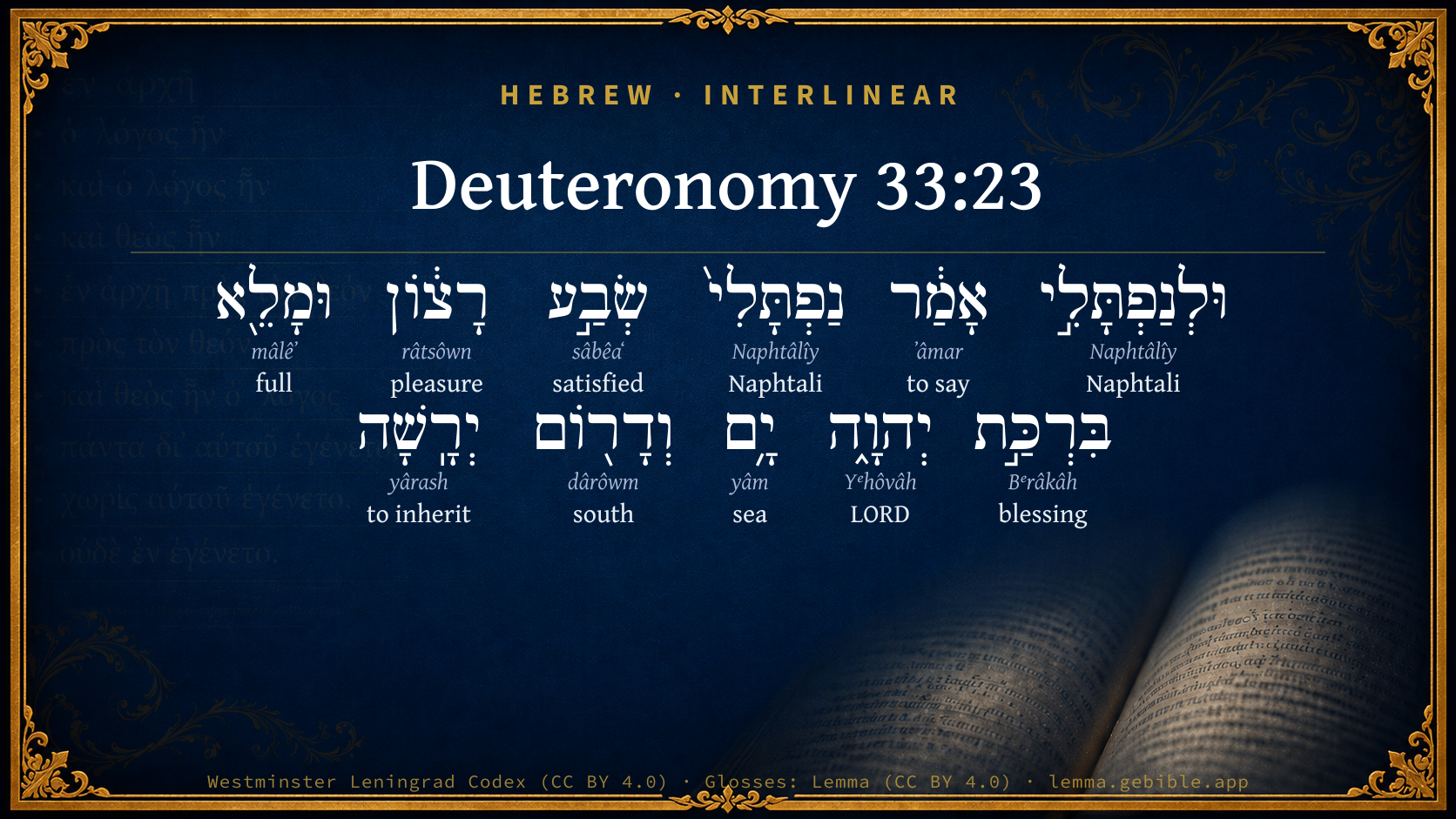
Hebrew (Westminster Leningrad Codex) Deuteronomy 33:23 appears in the Hebrew Old Testament. The text above is from the Westminster Leningrad Codex. Each word links to its Strong’s number, a concise gloss, and parsing drawn from the Open Scriptures Hebrew Bible morphology. Click any word for its full Brown-Driver-Briggs (BDB) entry.
Download image
Cite this verse

Deuteronomy 33:23 (World English Bible). Public Domain. Lemma interlinear Bible study tool, https://lemma.gebible.app/v/deuteronomy/33/23.

Show BibTeX & RIS
BibTeX
RIS
English Translation
Of Naphtali he said, Naphtali, satisfied with favor, Full with the blessing of Yahweh, Possess you the west and the south.
World English Bible · Public Domain
Highlights Full analysis ↓
Download a study sheet

One document with this verse’s original text, its word-by-word gloss line, the meaning frame, cross-references with their text, attributed commentary, and full source and license credits — printable, and it pastes into notes with its structure intact.

This verse Autodidact and up

Study sheet (.html) Plain text (.txt)

A passage Seminary Student

Up to 50 verses in one chapter. A passage sheet keeps up to 6 commentary sources and 12 cross-references per verse, in the order this page ranks them, and says so on the sheet whenever that leaves anything out. Ask for a single verse and you get the Autodidact verse sheet above.

Everything on this page stays free to read, with no account — the sheet is a download of what is already on screen, not access to it.

Want to remove ads? Support Godless Engineer
Compare translations 3

The same verse in 3 English versions, stacked beneath the original-language interlinear above. Click any original word for its lexicon entry.

Each is an independent rendering of the whole verse — the interlinear is not word-aligned to these translations.

Highlighted words mark where these versions differ — a whole-verse word diff, not a word-by-word alignment.

  • World English Bible Public Domain
    Of Naphtali he said, Naphtali, satisfied with favor, Full with the blessing of Yahweh, Possess you the west and the south.
  • King James Version Public Domain
    And of Naphtali he said, O Naphtali, satisfied with favor, and full with the blessing of the LORD: possess thou the west and the south.
  • unfoldingWord Literal Text CC BY-SA 4.0
    And to Naphtali, he said, “Naphtali, satisfied favor, and full of the blessing of Yahweh, the west and the south, you will possess.”

unfoldingWord Literal Text — © unfoldingWord, licensed CC BY-SA 4.0. Word-aligned USFM3 via Door43 (git.door43.org/unfoldingWord/en_ult).

Versions to compare (up to 4)

3 of 4 selected

Show all 18 translations

Every available English version of this verse, each an independent rendering of the whole verse.

  • World English Bible Public Domain
    Of Naphtali he said, Naphtali, satisfied with favor, Full with the blessing of Yahweh, Possess you the west and the south.
  • Berean Standard Bible Public Domain
    Concerning Naphtali he said: “Naphtali is abounding with favor, full of the blessing of the LORD; he shall take possession of the sea and the south.”
  • Majority Standard Bible Public Domain
    Concerning Naphtali he said: “Naphtali is abounding with favor, full of the blessing of the LORD; he shall take possession of the sea and the south.”
  • King James Version Public Domain
    And of Naphtali he said, O Naphtali, satisfied with favor, and full with the blessing of the LORD: possess thou the west and the south.
  • American Standard Version (1901) Public Domain
    And of Naphtali he said, O Naphtali, satisfied with favor, And full with the blessing of Jehovah, Possess thou the west and the south.
  • Revised Version (1885) Public Domain
    And of Naphtali he said, O Naphtali, satisfied with favour, And full with the blessing of the LORD: Possess thou the west and the south.
  • Geneva Bible (1599) Public Domain
    Also of Naphtali he sayd, O Naphtali, satisfied with fauour, and filled with the blessing of the Lord, possesse the West and the South.
  • Douay-Rheims (1899) Public Domain
    And to Nephtali he said: Nephtali shall enjoy abundance, and shall be full of the blessings of the Lord: he shall possess the sea and the south.
  • Young's Literal Translation Public Domain
    And of Naphtali he said: -- O Naphtali, satisfied with pleasure, And full of the blessing of Jehovah, West and south possess thou.
  • Literal Standard Version CC BY-SA 4.0
    And of Naphtali he said: O Naphtali, satisfied with pleasure, || And full of the blessing of YHWH, || Possess [the] west and [the] south.
  • Unlocked Literal Bible CC BY-SA 4.0
    About Naphtali, Moses said: Naphtali, satisfied with favor, and full of the blessing of Yahweh, take possession of the land to the west and south.
  • unfoldingWord Literal Text CC BY-SA 4.0
    And to Naphtali, he said, “Naphtali, satisfied favor, and full of the blessing of Yahweh, the west and the south, you will possess.”
  • Darby Bible Public Domain
    And of Naphtali he said, Naphtali, satisfied with favour, And full of the blessing of Jehovah, Possess thou the west and the south.
  • World Messianic Bible Public Domain
    About Naphtali he said, “Naphtali, satisfied with favor, full of the LORD’s blessing, Possess the west and the south.”
  • Webster's Bible Public Domain
    And of Naphtali he said, O Naphtali, satisfied with favor, and full with the blessing of the LORD: possess thou the west and the south.
  • Free Bible Version CC BY-SA 4.0
    To Naphtali he said: “Naphtali is really favored, full of the Lord's blessing. He shall take over the land to the west and south.”
  • Bible in Basic English Public Domain
    And of Naphtali he said, O Naphtali, made glad with grace and full of the blessing of the Lord: the sea and its fishes will be his.
  • JPS Tanakh (1917) Public Domain
    And of Naphtali he said: O Naphtali, satisfied with favour, and full with the blessing of the LORD: possess thou the sea and the south.

Literal Standard Version (2020), Covenant Press — licensed CC BY-SA 4.0. Text via the HelloAO Bible API (eBible.org). Unlocked Literal Bible (unfoldingWord) — licensed CC BY-SA 4.0. Text via the HelloAO Bible API (eBible.org). unfoldingWord Literal Text — © unfoldingWord, licensed CC BY-SA 4.0. Word-aligned USFM3 via Door43 (git.door43.org/unfoldingWord/en_ult). Free Bible Version, Dr. Jonathan Gallagher — licensed CC BY-SA 4.0. Text via the HelloAO Bible API (eBible.org).

Word by word

More ways to search: Search by grammar → Find every occurrence → Compare this word →

Practice this passage: Drill this verse → Learn its vocabulary →

שְׂבַ֣ע
sâbêaʻ
H7649
“satisfied of”
Adjective, Adjective, Masculine, Singular, Construct
Part of Speech
Adjective
Type
Adjective
Gender
Masculine
Number
Singular
State
Construct
Full BDB Definition

Origin: from H7646

TWOT: 2231d

sated, satisfied, surfeited - sated, abounding, satisfied - surfeited (bad sense)
  1. וּלְנַפְתָּלִ֣י Naphtâlîy H5321 “and · to/for · Naphtali” Conjunction + Preposition + Noun, Proper
  2. אָמַ֔ר ʼâmar H559 “to say” Verb, Qal, Perfect, 3rd Person, Masculine, Singular
  3. נַפְתָּלִי֙ Naphtâlîy H5321 “Naphtali” Noun, Proper
  4. רָצ֔וֹן râtsôwn H7522 “pleasure” Noun, Common, Masculine, Singular, Absolute
  5. וּמָלֵ֖א mâlêʼ H4392 “and · full” Conjunction + Adjective, Adjective, Masculine, Singular, Absolute
  6. בִּרְכַּ֣ת Bᵉrâkâh H1293 “blessing of” Noun, Common, Feminine, Singular, Construct
  7. יְהוָ֑ה Yᵉhôvâh H3068 “LORD” Noun, Proper
  8. יָ֥ם yâm H3220 “sea” Noun, Common, Masculine, Singular, Absolute
  9. וְדָר֖וֹם dârôwm H1864 “and · south” Conjunction + Noun, Common, Masculine, Singular, Absolute
  10. יְרָֽשָׁה yârash H3423 “inherit” Verb, Qal, Imperative, 2nd Person, Masculine, Singular + Suffix, h

About this verse

These counts appear in no published source. They are computed here, from the morphology-tagged text and Lemma’s own curated glosses. What Lemma adds →

11
words
10
distinct lemmas
Pentateuch
section

Notable vocabulary

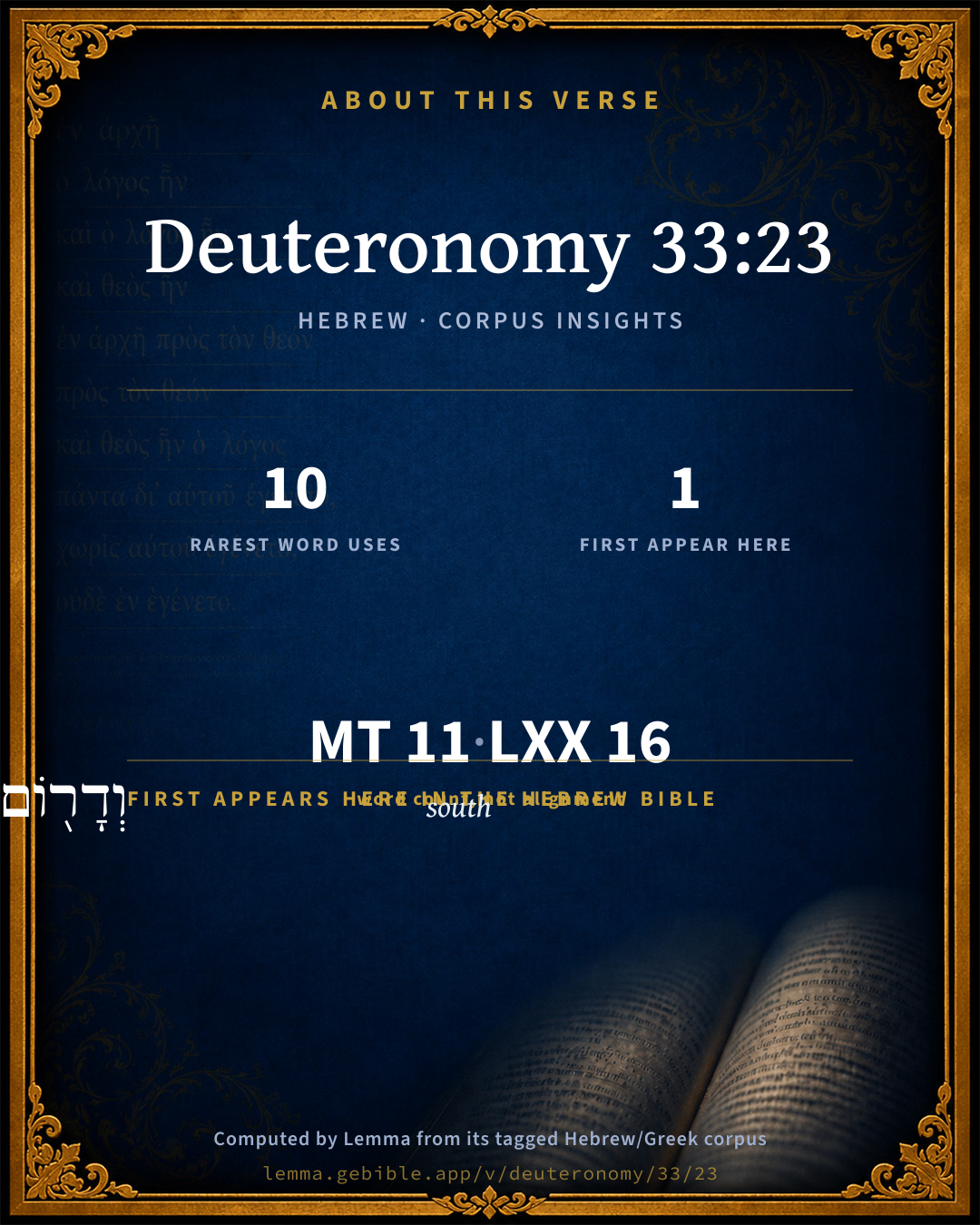
The rarest word here is שְׂבַ֣ע satisfied H7649 — appearing just 10 times in the whole Hebrew Bible.

First appearance in Scripture

This word makes its first canonical appearance in the Hebrew Bible here:

  • וְדָר֖וֹם south H1864

Shared distinctive vocabulary

שְׂבַ֣ע satisfied H7649 occurs in 10 verses of the Hebrew Bible. Also found in:

Grammatical profile

  • 2 verbs
  • 7 nouns
  • 2 adjectives

Verb forms

  • אָמַ֔ר Qal · Perfect
  • יְרָֽשָׁה Qal · Imperative

Repetition

A word recurs within this verse — often emphatic in Hebrew:

  • וּלְנַפְתָּלִ֣י Naphtali H5321 ×2

Hebrew & Septuagint length

In English translation the verse runs 21 words from the Hebrew and 30 from the Septuagint (LXX English) — the Septuagint runs noticeably longer here. See the side-by-side →

A rough comparison of the two English renderings, which tokenize alike — not a word-level alignment.

Word counts can differ between the Hebrew and the Greek without any difference in meaning — e.g. the Hebrew direct-object marker אֵת has no separate Greek word, and Greek often adds the article ὁ.

In the original languages it is 11 Hebrew tokens and 16 Greek tokens — but the two are counted differently (Hebrew bundles its prefixes and suffixes into one token; the Greek is in lemma form), so that isn’t a like-for-like length.

Cross-references

9

Topical passages linked to Deuteronomy 33:23 in the Treasury of Scripture Knowledge — connected by theme and wording, ordered by reader-vote popularity; previews shown in the World English Bible.

  • Genesis 49:21 "Naphtali is a doe set free, Who bears beautiful fawns.
  • Psalms 36:8 They shall be abundantly satisfied with the abundance of your house. You will make them drink of the river of your pleasures.
  • Jeremiah 31:14 I will satiate the soul of the priests with fatness, and my people shall be satisfied with my goodness, says Yahweh.
  • Matthew 4:16 The people who sat in darkness saw a great light, To those who sat in the region and shadow of death, To them light has dawned."
  • Matthew 4:13 Leaving Nazareth, he came and lived in Capernaum, which is by the sea, in the region of Zebulun and Naphtali,
  • Psalms 90:14 Satisfy us in the morning with your loving kindness, That we may rejoice and be glad all our days.
  • Joshua 19:32–39 The sixth lot came out for the children of Naphtali, even for the children of Naphtali according to their families.
  • Isaiah 9:1–2 But there shall be no gloom to her who was in anguish. In the former time he brought into contempt the land of Zebulun and the land of Naphtali; but in the latter time has he made it glorious, by the way of the sea, beyond the Jordan, Galilee of the nations.
  • Matthew 11:28 "Come to me, all you who labor and are heavily burdened, and I will give you rest.

Cross-references courtesy of OpenBible.info (CC BY 4.0).

Hebrew and Greek witnesses Masoretic Hebrew ↔ Greek Septuagint

The same verse in the two great witnesses to the Old Testament, shown verse-for-verse.

Here the Septuagint runs noticeably longer than the Hebrew — LXX2012 (modern English Septuagint) 30 words vs World English Bible 21. A rough length comparison of the two English translations, not a word-level alignment — read both below.

These are two independent witnesses, not word-aligned to each other, and the Septuagint is shown in lemma (dictionary) form.

Hebrew Deuteronomy 33:23 Masoretic · Westminster Leningrad Codex

וּלְנַפְתָּלִ֣י אָמַ֔ר נַפְתָּלִי֙ שְׂבַ֣ע רָצ֔וֹן וּמָלֵ֖א בִּרְכַּ֣ת יְהוָ֑ה יָ֥ם וְדָר֖וֹם יְרָֽשָׁה

Of Naphtali he said, Naphtali, satisfied with favor, Full with the blessing of Yahweh, Possess you the west and the south.

World English Bible · Public Domain

Greek LXX Deuteronomy 33:23 Septuagint · lemma form

καί ὁ νεφθαλι εἶπον νεφθαλι πλησμονή δεκτός καί ἐνπίμπλημι εὐλογία παρά κύριος θάλασσα καί λίψ κληρονομέω

And to Nephthali he said, Nephthali has the fulness of good things; and let him be filled with blessing from the Lord: he shall inherit the west and the south.

LXX2012 (modern English Septuagint) · Public Domain

On this verse, The Cambridge Bible for Schools and Colleges discusses the Septuagint’s reading. Read the note in Commentary ↓

Hebrew: Westminster Leningrad Codex (CC BY 4.0). Greek: Septuagint (public domain); English from LXX2012 (modern English Septuagint) (Public Domain). How the Septuagint differs from the Hebrew →

Targum (Aramaic paraphrase)

2

The Targum is the ancient Jewish Aramaic paraphrase of the Hebrew Scriptures — an interpretive translation, not the Hebrew text itself. Onkelos (literal) and Pseudo-Jonathan (expansive) render the Torah, and Jonathan the Prophets. Coverage is partial: where no permissively-licensed English translation exists for a verse, only the Aramaic is shown. This is verse-level text, not a word-by-word alignment to the Hebrew.

  1. Targum Onkelos Torah (Genesis–Deuteronomy)
    וּלְנַפְתָּלִי אֲמַר נַפְתָּלִי שְׂבַע רַעֲוָא וּמְלֵי בִּרְכָן מִן קֳדָם יְיָ מַעֲרָב יָם גִנוֹסַר וְדָרוֹמָא יֵרָת

    (no public-domain English translation for this verse)

    Targum Onkelos — Aramaic: “Onkelos Genesis” (public domain); “Onkelos Exodus” (public domain); “Onkelos Leviticus” (public domain); “Onkelos Numbers” (public domain); “Onkelos Deuteronomy” (public domain). English: “Sefaria Community Translation” (CC0 1.0 (public-domain dedication)); “J.W. Etheridge. The Targums of Onkelos and Jonathan Ben Uzziel on the Pentateuch. London: Longmans, Green, 1862” (public domain). Text via Sefaria.

  2. Targum Pseudo-Jonathan Torah (Genesis–Deuteronomy)
    וּלְשִׁבְטָא דְנַפְתָּלִי בְּרִיךְ משֶׁה נְבִיָא דַיְיָ וַאֲמַר נַפְתָּלִי שְבַע רַעֲוָא וְחָדֵי בְּנוּנֵי יַמָא דִי נְפָלוּ בְּחוּלְקֵיהּ וּמְלֵי בִּרְכָאָן מִן פֵּירֵי דְבִקְעַת גִינוּסַר דְאִתְיְהִיבוּ לֵיהּ מִן קֳדָם יְיָ יַמָא דְסוּפְנֵי וְיַמָא דִטְבֶרְיָא יֵירָת

    And Mosheh the prophet of the Lord blessed the tribe of Naphtali, and said: {Naphtali is satisfied with favour, and hath delight in the fishes of the sea which falleth within his portion; and he will be replete with blessings in the fruits of the vale of Genesareth which hath been given him from the Lord; he shall inherit the water of Sopheni, and the sea of Tebaria.}

    Targum Pseudo-Jonathan — Aramaic: “Targum Jonathan on Genesis” (public domain); “Targum Jonathan on Exodus” (public domain); “Targum Jonathan on Leviticus” (public domain); “Targum Jonathan on Numbers” (public domain); “Targum Jonathan on Deuteronomy” (public domain). English: “The Targum of Jonathan ben Uzziel, trans. J. W. Etheridge, London, 1862” (public domain). Text via Sefaria.

Commentary

Notes on Deuteronomy 33:23 from classic Christian and Jewish commentators (each source and its license shown beneath its notes). The classic Christian expositions comment on the surrounding passage and are grouped to its opening verse, so a note may address several verses; the Jewish commentaries on the Tanakh (Rashi and others) are per-verse, so they appear only where the commentator wrote on this verse.

Lemma curates 59 commentaries, every one of them public domain or Creative Commons licensed, each selected and text-cleaned for this edition rather than reprinted as found. About our sources →

Trapp's Complete Commentary

John Trapp

Deu 33:23 And of Naphtali he said, O Naphtali, satisfied with favour, and full with the blessing of the LORD: possess thou the west and the south.

Ver. 23. Satisfied with favour, and full, &c.] Fulness of blessing is then only a mercy, when the soul of a man is satisfied with favour: when from a full table and a cup running over, a man can comfortably infer with David, "Surely goodness and mercy shall follow me all the days of my life, and I shall dwell in the house of the Lord for ever." {Psa 23:6} One may have outward things by God’s providence, and not out of his favour. Esau had the like blessing as Jacob, but not with a "God give thee the dew of heaven," as he. {Gen 27:28} Or, God may give temporals to wicked men, to furnish their indictment out of them; as Joseph put his cup into their sack to pick a quarrel with them, and to lay theft to them.

John Trapp, A Commentary or Exposition upon All the Books of the Old and New Testament (1647–1656) — public domain. Text from a community e-Sword module.

The Biblical Illustrator

Joseph S. Exell

Deu_33:23

And of Naphtali he said.

Naphtali

It may seem to anyone who looks upon a map of Canaan as divided amongst the tribes, that this definition of locality is far enough from corresponding with the facts. Simeons lot would better answer to the description here, for he did occupy the southwest corner of the Promised Land; whilst Naphtalis territory was in the extreme north, and had another tribe, Asher, on its western border. Hence it is probable that the Hebrew word translated west should have here another meaning which very frequently belongs to it, and should be rendered sea, referring to the well-known sea of Chinnereth, or Gennesaret. This interpretation would agree very happily with the actual boundaries of Naphtali upon the map; for by far the greater portion of this famous lake belonged to the tribe, and its southern border stretched in a right line westward from the sea until it met the frontier of Ashers lot. The most ancient Jewish interpreters adopt this explanation of the blessing, and point out how well the appearance and resources of Naphtalis portion justify the enthusiastic language of congratulation which Moses has employed. In the days when they wrote, the plain of Gennesaret and the great inland district of Galilee which stretched northward to the roots of Lebanon, were the most populous and flourishing parts of Palestine. The first fruits were brought to the temple at Jerusalem from Mount Naphtali before they were ripe for gathering anywhere else; so that the men of this tribe were always the first to receive the benediction of Jehovahs priests upon each new harvest. Solomon drew from this same region the largest supplies of food for the expensive entertainment of his court; and in Davids time, Naphtali, with Zebuluns aid, was able to feast all Israel abundantly for three days with stores which they brought up to Hebron on asses, and on camels, and on mules, and on oxen. This was an ample fulfilment in temporal things of the blessing which Moses pronounced upon the tribe. But there is a passage in Isaiah (Isa_9:1-2; comp. Mat_4:1) which seems to intimate that there was a hidden spiritual reference in the lavish outpouring of favour from the Lord of which Naphtali is here assured. The first fruits of Messiahs ministry were to be vouchsafed to this same highly-favoured region, a city of which, Capernaum, was indeed chosen by the Lord Jesus as His dwelling place for one whole acceptable year. Too little, indeed, did the men of Galilee understand their high privilege; and though they might have been satiated with the spiritual blessings which were thus brought to their door, they suffered the day of visitation to pass by them unused. Therefore the failure of their blessing in its highest sense serves now as a warning to the men who have received still better promises from God through Christ. Many of these are ready to boast that they are full, and that they reign as kings, being rich, and increased with goods, and in need of nothing; yet is there only one substantial ground on which to build these confident professions. In Christ are hid all treasures of spiritual blessing. He who has Christ is more than satisfied, but he who rejects Christ, or who lets Christ dwell near him unrecognised and unappropriated in His great salvation, is empty and beggared, though all riches of corn and wine may be increased to him (1Co_3:21-23; 1Co_4:8; Rev_3:17-20). (T. G. Rooke, B. A.)

The Biblical Illustrator, edited by Joseph S. Exell (c. 1880s–1900s) — public domain. Text from a community e-Sword module.

Joseph Benson's Commentary

Deu 33:23. Satisfied with favour — With the favour of God. That only is the favour that satisfies the soul. They are happy indeed that have the favour of God; and they shall have it that place their satisfaction in it. And full with the blessing of the Lord — Not only with corn, wine, and oil, the fruit of the blessing, but with the blessing itself, the grace of God, according to his promise and covenant. Possess thou the west and the south — Or, the sea and the south, as the Hebrew word is; not the midland sea, and the south of Canaan. For, according to Josephus, with whom all the Jewish writers agree, this tribe possessed the east and the north of the country, in Upper Galilee; but the sea of Gennesaret, or Tiberias, which was its border on one side, and the south from the last-mentioned tribe, namely, that of Dan.

Joseph Benson's Commentary on the Old and New Testaments (1811–1818) — public domain. Text from a community e-Sword module.

Tyndale Open Study Notes

Tyndale Open Resources

33:23 Naphtali was the younger of two sons of Jacob by Rachel’s servant Bilhah (Gen 30:7-8). The name means something like “my struggle.” • the west and the south (or southward to the sea): The Hebrew word (yam) can mean either “west” or “sea.” This phrase might refer to the region this tribe settled in near the Sea of Galilee (see Matt 4:12-17), known for its fishing and farming.

Tyndale Open Study Notes — © Tyndale Open Resources, licensed CC BY-SA 4.0. Text via the HelloAO Bible API.

Geneva Bible (1599)

Geneva Bible translators

Meaning, near the sea.

Geneva Bible (1599) marginal notes — public domain. Text via Bolls.life.

Jamieson, Fausset & Brown

Robert Jamieson, A. R. Fausset & David Brown

of Naphtali he said--The pleasant and fertile territory of this tribe lay to "the west," on the borders of lakes Merom and Chinnereth, and to "the south" of the northern Danites.

Jamieson, Fausset & Brown — Commentary Critical and Explanatory on the Whole Bible (1871) — public domain (CC PDM 1.0). Text via the HelloAO Bible API.

Adam Clarke's Commentary

Verse 23. O Naphtali, satisfied with favour] Though this may refer to the very great fertility of the country that fell to this tribe, yet certainly something more is intended. Scarcely any of the tribes was more particularly favoured by the wondrous mercy and kindness of God, than this and the tribe of Zebulun. The light of the glorious Gospel of Christ shone brightly here, Mt 4:13; Mt 4:15-16. Christ's chief residence was at Capernaum in this tribe, Mt 9:1; Mr 2:1; and this city, through Christ's constant residence, and the mighty miracles he wrought in it, is represented as being exalted unto heaven, Mt 11:23. And it is generally allowed that the apostles were principally of the tribe of Naphtali, who were to possess the west and the south-to dispense the Gospel through all the other tribes. The word yam, which we here translate west, literally signifies the sea, and probably refers to the sea of Gennesareth, which was in this tribe.

Adam Clarke's Commentary on the Bible (1810–1826) — public domain. Text from a community e-Sword/MySword module.

The Cambridge Bible for Schools and Colleges

gen. ed. J. J. S. Perowne

23. as thou hast freely vowed unto the Lord thy God] LXX to God.

which thou hast promised, etc.] Attached awkwardly to preceding, and probably a gloss.

24, 25 (25, 26). Of Use at Need of Others’ Corn and Fruits. Grapes may be eaten on the spot but none carried away; ears of corn may be plucked with the hand but no sickle shall be used.—Sg. with neighbour (not brother). LXX transposes the two vv. Peculiar to D; cp. Deu_24:19-21. The Pharisees flagrantly contradicted not only the spirit of this law, but its very letter, by interpreting plucking as reaping, and because this was work (Deu_33:13) they held it unlawful on the Sabbath (Mat_12:1 ff., Mar_2:23 f., Luk_6:1 ff.).—The licence sanctioned here is frequently taken in Syria to-day, and the refusal to grant it regarded as impiety; for Arabia see Doughty, Ar. Des. i. 520 f., ii. 152.

23 And of Naphtali he said:

Naphtali sated with favour,

And full of the blessing of the Lord,

Sea and South shall he hold.

23. The first two lines reflect the extraordinary fertility of mount Naphtali (Jos_20:7) i.e. Upper Galilee between the Lake on the E. and the territory of Asher on the W., ‘an undulating tableland arable and everywhere tilled, with swelling hills … covered with shrubs and trees’ (Robinson); along with the still more exuberantly fertile plain of Gennesaret (HGHL, 417–421, 446 f. with citations in proof from Josephus, etc.).

satisfied with favour] Cp. Psa_145:16.

the sea] Not the Mediterranean (Sam. the West) but the sea of Kinnéreth, Deu_3:17.

the south] Heb. Darom (so Sam.), a late poetic word, Eze_40:27 f., Job_37:17, LXX λιβά, the S.W. wind, a happy conjecture, for no wind brings more moisture to Mount Naphtali. Geddes: South because Naphtali’s land lay S. of that of Dan; Graf and Dillm. the hot land in the deep trench of the Jordan valley and upon the Lake where the vegetation is tropical. Driver: ‘so styled it seems partly in contrast to the main possessions of the tribe (which were farther N.), partly with allusion to the sunny warmth which prevails there’; Berth. emends, ‘the sea and the way of the sea’ (derek yam), cp. Isa. 8:23.

hold thou] So Heb. Sam. LXX read he shall hold.

The Cambridge Bible for Schools and Colleges (gen. ed. J. J. S. Perowne; Cambridge University Press, 1878–1918) — public domain. Text from a community e-Sword module.

John Gill's Exposition

And of Asher he said,.... The tribe of Asher, as the Targums of Jonathan and Jerusalem:

let Asher be blessed with children; with large numbers, as it appears this tribe was, having in it 53,400 men of war, Num 26:47. It was esteemed a great blessing to have many children, Psa 128:3; or "above the children"; above or more than the rest of the children of Jacob; see Luk 2:36; Jarchi observes, that he had seen, in a book called Siphri, that there was none in all the tribes blessed with children as Asher, but not known how:

let him be acceptable to his brethren; either for his excellent bread, and royal dainties, Gen 49:20; or for the goodness of his olives and oil, and for the brass and iron found in this tribe, as follows; or, as some say, because of his children, his daughters being very beautiful:

and let him dip his foot in oil; have such plenty of it, that if he would he might dip or wash his feet in it; and it was usual not only to anoint the head, but the feet (f) also, with oil, Luk 7:46.

(f) "Vidimus etiam vestigia pedum tingi", Plin. Nat. Hist. l. 13. c. 3. Vid. Dalecamp. Not. in ib.

John Gill's Exposition of the Whole Bible (1746–1763) — public domain (CC PDM 1.0). Text via the HelloAO Bible API.

Albert Barnes' Notes on the Bible

Satisfied with favor - Compare Gen 49:21 and note.

The west and the south - i. e., taking the words as referring not to geographical position but to natural characteristics, “the sea and the sunny district.” The possession of Naphtali included nearly the whole west coast of the Sea of Galilee, the Lake of Merom, the modern Bahr el Hulch, and the well watered district near the springs of Jordan. It contained some of the grandest scenery and some of the most fertile land in Palestine. Josephus speaks of the shore of Gennesaret as “an earthly paradise;” and Porter describes it as “the garden of Palestine.” The modern name for this district, “land of good tidings,” is significant.

Albert Barnes' Notes on the Bible (1834–1885) — public domain. Text from a community e-Sword/MySword module.

Haydock's Catholic Bible Commentary

The sea. The lake of Genesareth. (Challoner) --- South. That lake forms the southern extremity of the tribe of Nephthali. (Haydock) --- The Mediterranean, and the countries south of Palestine, are commonly understood in this manner, but they cannot be understood here. (Calmet) --- By means of their neighbours of Tyre and Sidon, (Menochius) and of Zabulon, who lay on the west, (Haydock) they would be supplied with all the luxuries of the sea and of the south. (Menochius)

George Leo Haydock (1774–1849), Haydock's Catholic Family Bible and Commentary, 1859 edition — public domain. Excludes Psalms (Douay-Rheims chapter numbering differs from Protestant) and Deuterocanonical books (Catholic canon only).

Matthew Poole's English Annotations

With favour; either,

1. With God’s favour, as it follows; or,

2. With men’s favour or good-will, his carriage being peaceable, courteous, and obliging, as is intimated, Gen 49:21, according to the common translation: see the notes there.

Full with the blessing of the Lord, i.e. seated in a pleasant, and fertile, and happy soil; such as Galilee (in which their share lay) eminently was, as Josephus and others report.

The west and the south, or, the sea and the south. This is not to be understood of the places, that his lot should fall there, for he was rather in the east and north of the land; but of the pleasures and commodities of the west, or of the sea, which were conveyed to him from his neighbour Zebulun; and of the south, i.e. from the southern tribes and parts of Canaan, which were brought to him down the river Jordan, and both sorts of commodities were given him in exchange for the fruits of his rich soil, which he had in great abundance.

Matthew Poole's English Annotations on the Holy Bible (1683–1685) — public domain. Text from a community e-Sword/MySword module.

Whedon's Commentary on the Bible

Daniel D. Whedon

23. O Naphtali, satisfied with favour — In the blessing of Jacob, Naphtali is compared to a gazelle. Here Moses speaks of the tribe as having favour with Jehovah. Josephus says of his heritage that it is rich in land for tillage and pasturage. It is everywhere tilled, no part being allowed to lie idle, and it is everywhere productive.

Full with the blessing of the Lord — The territory of this tribe bordered on the lakes Gennesaret and Merom, and extended to the sources of the Jordan. Modern travellers describe it as the most beautiful and fertile portion of Palestine. The depression of the land bordering on Lake Gennesaret makes it productive of tropical fruits — the fruits of the south.

Daniel D. Whedon (gen. ed.), Commentary on the Old and New Testaments (1874–1909) — public domain. Text from a community e-Sword module.

The Pulpit Commentary

In Jacob"s blessing, Naphtali appears invested with the attributes of freedom, gracefulness, and graciousness; here Moses assures that tribe of the Divine grace and blessing, and promises to it prosperity and felicity. Possess thou the west and the south. The word rendered "west" here ( properly means sea, and came to signify "west" from the fact of the Mediterranean, or Great Sea, lying to the west of Palestine. The proper meaning of the word is to be retained here. As the territory of Naphtali lay in the north of Canaan, and was far from the sea, the blessing here pronounced upon him must be understood generally of prosperity and felicity. He was to possess riches as of the sea, and genial and fructifying warmth as of the south.

Naphtali"s goodly choice.

Naphtali"s position was in the north of Canaan, and had its southern border adjacent to the sea of Galilee. A large proportion of our Lord"s ministrations were bestowed on the inhabitants within this district. Obviously the heads of this tribe in Moses" day aspired after the best possessions.

I WE OBSERVE HERE THE BEST HUMAN AMBITION, "Satisfied with favor." It is scarcely conjecture that imports into Moses" words the meaning, "the favor of God;" for in the next clause he mentions distinctly the "blessing of the Lord." No other favor can satisfy save the "favor of Jehovah." This is all-sufficient an ocean, in which the soul of man can bathe itself with amplest delight. This phrase, "the favor, or grace, of God," includes everything which God can supply for human need. In it is embraced light, pardon, Divine friendship, purity, peace, strength, liberty, rest. A comprehensive prayer is this, "Oh, satisfy me early with thy mercy!

II WE NOTE THE BEST AMBITION SATISFIED. "Full with the blessing of the Lord." We often desire inferior good, and desire in vain. The love of God is too deep and wise to indulge our foolish requests. But when we ask for highest good, and desire it earnestly, we never fail to obtain. What man ever sued for grace and was sent empty away? No; God"s chief complaint is that we come too seldom, and ask too little at his hands. Still he says to us, "Open thy mouth wide, and I will fill it." The possession and wise use of God"s grace enlarges our capacity to receive. It is a cure for all murmuring and discontent.

III WE SEE HOW, WITH THE HIGHEST BLESSING, GOD GIVES THE LOWER UNASKED. Naphtali desired to be satisfied with the Divine favor; and a voice was commissioned to say, "Possess thou the sea and the south." It is a recognized method of God"s procedure that when men ask for spiritual riches, God grants both spiritual and temporal good. In Gibeah, God appeared to Solomon, and proposed to him, "Ask what I shall give thee;" and when Solomon craved to possess the gift of wisdom, his generous God assured him that not only should wisdom be his, but things he had not asked-even unprecedented riches and honor. To the same effect, our Lord affirmed, "Seek ye first the kingdom of God, and his righteousness, and all other (needed) things shall be added unto you." He is" able to do for us exceeding abundantly above all that we can ask or think. D.

The Pulpit Commentary (1880–1919), ed. H.D.M. Spence-Jones & Joseph S. Exell — public domain. Text from a community e-Sword module.

John Wesley's Explanatory Notes

Satisfied with favour - With the favour of God. That only is the favour that satisfies the soul. They are happy indeed that have the favour of God; and they shall have it, that place their satisfaction in it. And full with the blessing of the Lord - Not Only with corn, wine and oil, the fruit of the blessing, but with the blessing itself, the grace of God, according to his promise and covenant. Possess thou the west and the south - Or, the sea and the south. This is not to be understood of the place, that his lot should fall there, for he was rather in the east and north of the land; but of the pleasures and commodities of the west or of the sea, which were conveyed to him from his neighbour Zebulun; and of the south, that is, from the southern tribes and parts of Canaan, which were brought to him down the river Jordan, and both sorts of commodities were given him in exchange for the fruitful rich soil which he had in great abundance.

John Wesley, Explanatory Notes Upon the Whole Bible (1754–1765) — public domain. Text via the GEBible commentary corpus.

Keil & Delitzsch

C. F. Keil & F. Delitzsch

Naphtali. - "O Naphtali, satisfied with favour, and full of the blessing of Jehovah; of sea and south shall he take possession." If the gracefulness of Naphtali is set forth in the blessing of Jacob, by comparing it to a gazelle, here Moses assures the same tribe of satisfaction with the favour and blessing of God, and promises it the possession of the sea and of the south, i.e., an inheritance which should combine the advantages of the sea - a healthy sea-breeze - with the grateful warmth of the south. This blessing is expressed in far too general terms for it to be possible to interpret it historically, as relating to the natural characteristics of the inheritance of the Naphtalites in Canaan, or to regard it as based upon them, apart altogether from the fact, that the territory of Naphtali was situated in the north-east of Canaan, and reached as far as the sea of Galilee, and that it was for the most part mountainous, though it was a very fertile hill-country (Jos 19:32-39). ירשׁה is a very unique form of the imperative, though this does not warrant an alteration of the text.

Keil & Delitzsch — Biblical Commentary on the Old Testament (1861–1891) — public domain (CC PDM 1.0). Text via the HelloAO Bible API. (Old Testament only.)

unfoldingWord translationNotes

Door43 World Missions Community

General Information:

Moses continues to bless the tribes of Israel; the blessings are short poems. He speaks of the descendants of Naphtali as if they were one man. (See: Parallelism)

satisfied with favor

Yahweh being pleased with Naphtali is spoken of as if "favor" were food that Naphtali ate until he was no longer hungry. AT: "who has all the good things he desires because Yahweh is pleased with him" (See: Metaphor)

full of the blessing of Yahweh

Blessings are spoken of as if they were food that Naphtali ate until he could hold no more. AT: "whom Yahweh has blessed so that he has all he needs"

take possession

Moses speaks as if the tribe of Naphtali is one man, so these words are singular. (See: Forms of You)

the land to the west and south

This refers to the land around Lake Galilee. The full meaning of this statement may be made explicit. (See: Assumed Knowledge and Implicit Information)

translationWords

Naphtali

favor

bless

possess

unfoldingWord translationNotes — © Distant Shores Media and the Door43 World Missions Community, licensed CC BY-SA 4.0. Source: git.door43.org/Door43/en_tn.

Rashi

Rabbi Shlomo Yitzchaki (Rashi)

שבע רצון [NAPHTALI IS] SATISFIED WITH DESIRE — it means that his land was full of everything that its inhabitants could desire.

ים ודרום ירשה POSSESS THOU THE WEST (lit., the sea) AND THE SOUTH — The sea of Kinneret fell to his portion and he received on its south a ropes length of fishing-coast for spreading out his nets and meshes (Bava Kamma 81:2; cf. Sifrei Devarim 355:17).

ירשה — This word it a form of the imperative, as is the verb in (Deuteronomy 1:21), “Go up and take possession (רַשׁ)”. The accent that is penultimate, on the ר, proves this. Just as in the case of the ordinary imperative forms of the verbs, סלח, ידע, לקח, שמע, when one adds a ה at the end the accent will be penultimate, viz.,סלחה, ידעה, לקחה, שמעה, here also ירשה is an imperative form. In the Massora Magna we find it included in an alphabetical register of imperative forms the accent of which is on the penultima (next to the last syllable).

Rashi on the Tanakh — English translations: “The Judaica Press complete Tanach with Rashi, translated by A. J. Rosenberg” (CC BY 4.0); “Pentateuch with Rashi's commentary by M. Rosenbaum and A.M. Silbermann, 1929-1934” (public domain); “The Metsudah Tanach series, Lakewood, N.J” (CC BY 4.0); and “The Book of Joshua, Metsudah Publications, 1997” (CC BY 4.0). Text via Sefaria.

Ramban (Nachmanides)

Rabbi Moshe ben Nachman (Ramban / Nachmanides)

O NAPHTALI, SATISFIED WITH FAVOR. “[This means] that his land satisfied every desire of its inhabitants.” This is Rashi’s language. The correct interpretation is that it is connected with the Glorious Name [mentioned later in the verse: and full with the blessing of ‘the Eternal’], the verse stating that “Naphtali is satisfied and full of the Will of the Glorious Name and His blessing.” But in the Midrash of Rabbi Nechunya ben Hakanah the Rabbis commented on this verse: “Rabbi Amora said: What is the meaning of this verse, And full with the blessing of the Eternal; ‘yerashah’ (possess thou) the sea and the south? Thus said Moses: If you will walk in my statutes you will inherit the World to Come which is likened to the sea, as it is said, and broader than the sea, and this world which is likened to the south, as it is said, for that thou hast set me in the land of the ‘negev’ [that is, a dry land], and is rendered by the Targum: ‘the southern land.’ And why is it written yerashah [‘possess thou’ — in the feminine], it should have said yerash [in the masculine]? Because even the Holy One, blessed be He, is included [in Naphtali’s inheritance], for the word yerashah consists of two words: resh Y-ah (possess G-d). To what may this be compared? To a king who had two treasures [i.e., the two worlds], and set one of them aside. At the end of many days he said to his son, ‘Take the contents of these two treasures.’ The son said, ‘Perhaps he will not give me the one he set aside.’ Thereupon the father said, to him, ‘Take everything.’ It is this which is written ‘yerashah’ (possess thou) the sea and the south — Y-ah resh. Everything is given you — if only you keep His ways!” They have further said: “And full with the blessing of the Eternal; possess thou the sea and the south. The ‘sea’ is an allusion to the Torah alone, as it is said, and broader than the sea,” and [so they continue] the entire Midrash there. If so, the secret of the verse is as follows: “Naphtali is satisfied with the favor saturated by the blessing of the Eternal, which is ‘the sea’ combined in all [and comprised] of all.” It is similar to what Scripture states, All the rivers run into the sea, this being “the house of the King.” This is like the parable of those who seek to see the king and ask, “Where is the house of the king?” Then [after finding the house] they ask, “Where is the king?” And even this world which is parched and dry of the favor [of G-d in comparison to the World to Come], Naphtali will inherit with Y-ah [as the word yerashah — resh Y-ah — indicates]. The student learned in the mysteries of the Cabala will understand.

Ramban (Nachmanides) on the Tanakh — English translation: “Commentary on the Torah by Ramban (Nachmanides). Translated and annotated by Charles B. Chavel. New York, Shilo Pub. House, 1971-1976” (CC BY 4.0). Text via Sefaria.

Lesson kit

Teaching starters — assembled from the data on this page, not authored interpretation. Every prompt links to the verse data it draws on. Edit before teaching.

Deuteronomy, in the Pentateuch, opens this verse with 11 words (10 distinct Hebrew lemmas). Its most distinctive word is sâbêaʻ (“satisfied”). The Greek Septuagint runs longer here. A historical commentator’s framing appears above. Read the whole chapter for the surrounding context.

Discussion questions

  1. What does “satisfied” (sâbêaʻ) contribute to the verse as a whole?
  2. The word “south” first appears here in Scripture. What is being introduced at this debut?
  3. Genesis 25:8 shares the word «satisfied» with this verse. How do the two illuminate each other?
  4. “Naphtali” occurs 2× in this one verse. What is the effect of the repetition?
  5. Compared with the Hebrew, the Septuagint runs longer here. What questions does that raise?
  6. These translations render this verse differently. What is at stake in choosing one wording over another?
  7. The verb «אָמַ֔ר» is Qal Perfect. How does its form color the action?
  8. Reading how Trapp's Complete Commentary and The Biblical Illustrator read this verse, where do the two commentators agree and where do they part?

Things to notice

Reading settings

Reading text

Shown beneath each verse's original-language words.

Old Testament
Old Testament edition

Read the OT as the Masoretic Hebrew (MT) or the Greek Septuagint (LXX).

English shown for the Greek Septuagint (in the Hebrew ↔ Greek comparison).

Comparing translations? Open the Compare panel on any verse page to stack up to four side by side.