
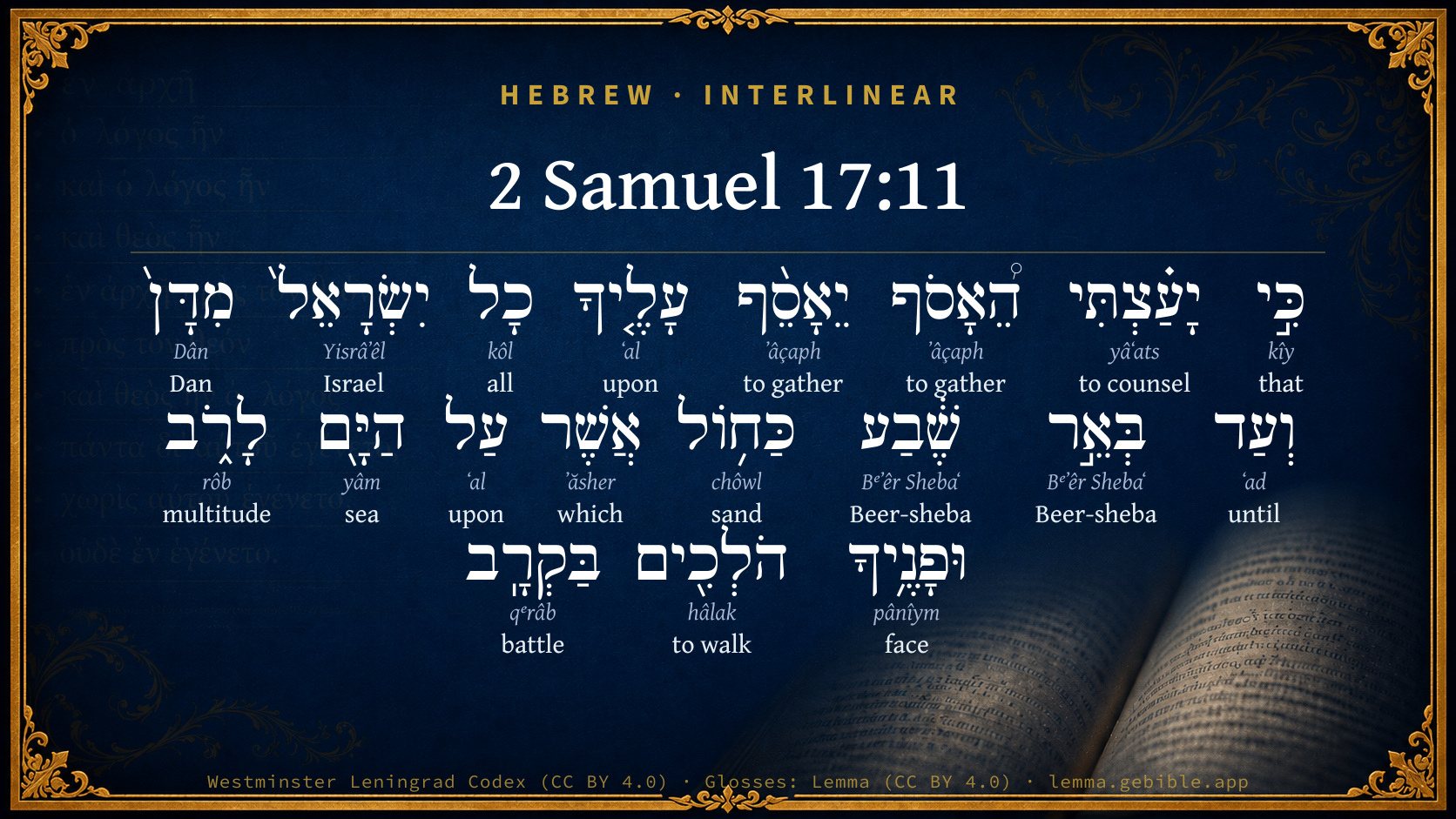
2 Samuel 17:11

Hebrew (Westminster Leningrad Codex) 2 Samuel 17:11 appears in the Hebrew Old Testament. The text above is from the Westminster Leningrad Codex. Each word links to its Strong’s number, a concise gloss, and parsing drawn from the Open Scriptures Hebrew Bible morphology. Click any word for its full Brown-Driver-Briggs (BDB) entry.
Download image
Cite this verse

2 Samuel 17:11 (World English Bible). Public Domain. Lemma interlinear Bible study tool, https://lemma.gebible.app/v/2-samuel/17/11.

Show BibTeX & RIS
BibTeX
RIS
English Translation
But I counsel that all Israel be gathered together to you, from Dan even to Beersheba, as the sand that is by the sea for multitude; and that you go to battle in your own person.
World English Bible · Public Domain
Highlights
  • 1 first appearance in the Hebrew Bible
Full analysis ↓
Download a study sheet

One document with this verse’s original text, its word-by-word gloss line, the meaning frame, cross-references with their text, attributed commentary, and full source and license credits — printable, and it pastes into notes with its structure intact.

This verse Autodidact and up

Study sheet (.html) Plain text (.txt)

A passage Seminary Student

Up to 50 verses in one chapter. A passage sheet keeps up to 6 commentary sources and 12 cross-references per verse, in the order this page ranks them, and says so on the sheet whenever that leaves anything out. Ask for a single verse and you get the Autodidact verse sheet above.

Everything on this page stays free to read, with no account — the sheet is a download of what is already on screen, not access to it.

Want to remove ads? Support Godless Engineer
Compare translations 3

The same verse in 3 English versions, stacked beneath the original-language interlinear above. Click any original word for its lexicon entry.

Each is an independent rendering of the whole verse — the interlinear is not word-aligned to these translations.

Highlighted words mark where these versions differ — a whole-verse word diff, not a word-by-word alignment.

  • World English Bible Public Domain
    But I counsel that all Israel be gathered together to you, from Dan even to Beersheba, as the sand that is by the sea for multitude; and that you go to battle in your own person.
  • King James Version Public Domain
    Therefore I counsel that all Israel be generally gathered unto thee, from Dan even to Beersheba, as the sand that is by the sea for multitude; and that thou go to battle in thine own person.
  • unfoldingWord Literal Text CC BY-SA 4.0
    Therefore I counsel, being gathered, all of Israel shall be gathered to you, from Dan and to Beersheba, like the sand that by the sea for multitude. And your face shall be going into the battle.

unfoldingWord Literal Text — © unfoldingWord, licensed CC BY-SA 4.0. Word-aligned USFM3 via Door43 (git.door43.org/unfoldingWord/en_ult).

Versions to compare (up to 4)

3 of 4 selected

Show all 18 translations

Every available English version of this verse, each an independent rendering of the whole verse.

  • World English Bible Public Domain
    But I counsel that all Israel be gathered together to you, from Dan even to Beersheba, as the sand that is by the sea for multitude; and that you go to battle in your own person.
  • Berean Standard Bible Public Domain
    Instead, I advise that all Israel from Dan to Beersheba—a multitude like the sand on the seashore—be gathered to you, and that you yourself lead them into battle.
  • Majority Standard Bible Public Domain
    Instead, I advise that all Israel from Dan to Beersheba—a multitude like the sand on the seashore—be gathered to you, and that you yourself lead them into battle.
  • King James Version Public Domain
    Therefore I counsel that all Israel be generally gathered unto thee, from Dan even to Beersheba, as the sand that is by the sea for multitude; and that thou go to battle in thine own person.
  • American Standard Version (1901) Public Domain
    But I counsel that all Israel be gathered together unto thee, from Dan even to Beer-sheba, as the sand that is by the sea for multitude; and that thou go to battle in thine own person.
  • Revised Version (1885) Public Domain
    But I counsel that all Israel be gathered together unto thee, from Dan even to Beer-sheba, as the sand that is by the sea for multitude; and that thou go to battle in thine own person.
  • Geneva Bible (1599) Public Domain
    Therefore my counsell is, that all Israel be gathered vnto thee, from Dan euen to Beer-sheba as the sand of the sea in nomber, and that thou goe to battell in thine owne person.
  • Douay-Rheims (1899) Public Domain
    But this seemeth to me to be good counsel: Let all Israel be gathered to thee, from Dan to Bersabee, as the sand of the sea which cannot be numbered: and thou shalt be in the midst of them.
  • Young's Literal Translation Public Domain
    `So that I have counselled: Let all Israel be diligently gathered unto thee, from Dan even unto Beer-Sheba, as the sand that `is' by the sea for multitude, and thou thyself art going in the midst;
  • Literal Standard Version CC BY-SA 4.0
    So that I have counseled: let all Israel be diligently gathered to you, from Dan even to Beer-Sheba, as the sand that [is] by the sea for multitude, and you yourself are going in the midst;
  • Unlocked Literal Bible CC BY-SA 4.0
    So I advise you that all Israel should be gathered together to you, from Dan to Beersheba, as numerous as the sands that are by the sea, and that you go to battle in person.
  • unfoldingWord Literal Text CC BY-SA 4.0
    Therefore I counsel, being gathered, all of Israel shall be gathered to you, from Dan and to Beersheba, like the sand that by the sea for multitude. And your face shall be going into the battle.
  • Darby Bible Public Domain
    But I counsel that all Israel be speedily gathered to thee, from Dan even to Beer-sheba, as the sand that is by the sea for multitude; and that thou go to battle in thine own person.
  • World Messianic Bible Public Domain
    But I counsel that all Israel be gathered together to you, from Dan even to Beersheba, as the sand that is by the sea for multitude; and that you go to battle in your own person.
  • Webster's Bible Public Domain
    Therefore I counsel that all Israel should be generally gathered to thee, from Dan even to Beer-sheba, as the sand that is by the sea for multitude; and that thou shouldst go to battle in thy own person.
  • Free Bible Version CC BY-SA 4.0
    My recommendation is that you call up the entire Israelite army from Dan to Beersheba—an army as numerous as the sand on the seashore! Once they've assembled, then you yourself lead them into battle!
  • Bible in Basic English Public Domain
    But my suggestion is that all Israel, from Dan as far as Beer-sheba, comes together to you, a great army like the sands of the sea in number; and that you yourself go out among them.
  • JPS Tanakh (1917) Public Domain
    But I counsel that all Israel be gathered together unto thee, from Dan even to Beer-sheba, as the sand that is by the sea for multitude; and that thou go to battle in thine own person.

Literal Standard Version (2020), Covenant Press — licensed CC BY-SA 4.0. Text via the HelloAO Bible API (eBible.org). Unlocked Literal Bible (unfoldingWord) — licensed CC BY-SA 4.0. Text via the HelloAO Bible API (eBible.org). unfoldingWord Literal Text — © unfoldingWord, licensed CC BY-SA 4.0. Word-aligned USFM3 via Door43 (git.door43.org/unfoldingWord/en_ult). Free Bible Version, Dr. Jonathan Gallagher — licensed CC BY-SA 4.0. Text via the HelloAO Bible API (eBible.org).

Word by word

More ways to search: Search by grammar → Find every occurrence → Compare this word →

Practice this passage: Drill this verse → Learn its vocabulary →

בַּקְרָֽב
qᵉrâb
H7128
“in/at the · battle”
Preposition, Determined + Noun, Common, Masculine, Singular, Absolute
Part of Speech
Preposition + Noun
Type
Common
Gender
Masculine
Number
Singular
State
Absolute
Full BDB Definition

Origin: from H7126

TWOT: 2063b

battle, war
  1. כִּ֣י kîy H3588 “that” Conjunction
  2. יָעַ֗צְתִּי yâʻats H3289 “to counsel” Verb, Qal, Perfect, 1st Person, Common, Singular
  3. הֵ֠אָסֹף ʼâçaph H622 “to gather” Verb, Niphal, Infinitive Absolute
  4. יֵאָסֵ֨ף ʼâçaph H622 “to gather” Verb, Niphal, Imperfect, 3rd Person, Masculine, Singular
  5. עָלֶ֤יךָ ʻal H5921 “upon · you” Preposition + Suffix, Personal, 2nd Person, Masculine, Singular
  6. כָל kôl H3605 “all of” Noun, Common, Masculine, Singular, Construct
  7. יִשְׂרָאֵל֙ Yisrâʼêl H3478 “Israel” Noun, Proper
  8. מִדָּן֙ Dân H1835 “from · Dan” Preposition + Noun, Proper
  9. וְעַד ʻad H5704 “and · until” Conjunction + Preposition
  10. בְּאֵ֣ר Bᵉʼêr Shebaʻ H884 “Beer-sheba” Noun, Proper
  11. שֶׁ֔בַע Bᵉʼêr Shebaʻ H884 “Beer-sheba” Adjective, Cardinal number, Feminine, Singular, Absolute
  12. כַּח֥וֹל chôwl H2344 “like/as the · sand” Preposition, Determined + Noun, Common, Masculine, Singular, Absolute
  13. אֲשֶׁר ʼăsher H834 “which” Particle, Relative
  14. עַל ʻal H5921 “upon” Preposition
  15. הַיָּ֖ם yâm H3220 “the · sea” Particle, Definite Article + Noun, Common, Masculine, Singular, Absolute
  16. לָרֹ֑ב rôb H7230 “to/for · multitude” Preposition + Noun, Common, Both, Singular, Absolute
  17. וּפָנֶ֥יךָ pânîym H6440 “and · face(s) · your” Conjunction + Noun, Common, Both, Plural, Construct + Suffix, Personal, 2nd Person, Masculine, Singular
  18. הֹלְכִ֖ים hâlak H1980 “walking” Verb, Qal, Participle Active, Masculine, Plural, Absolute

About this verse

These counts appear in no published source. They are computed here, from the morphology-tagged text and Lemma’s own curated glosses. What Lemma adds →

19
words
16
distinct lemmas
Historical
section

Notable vocabulary

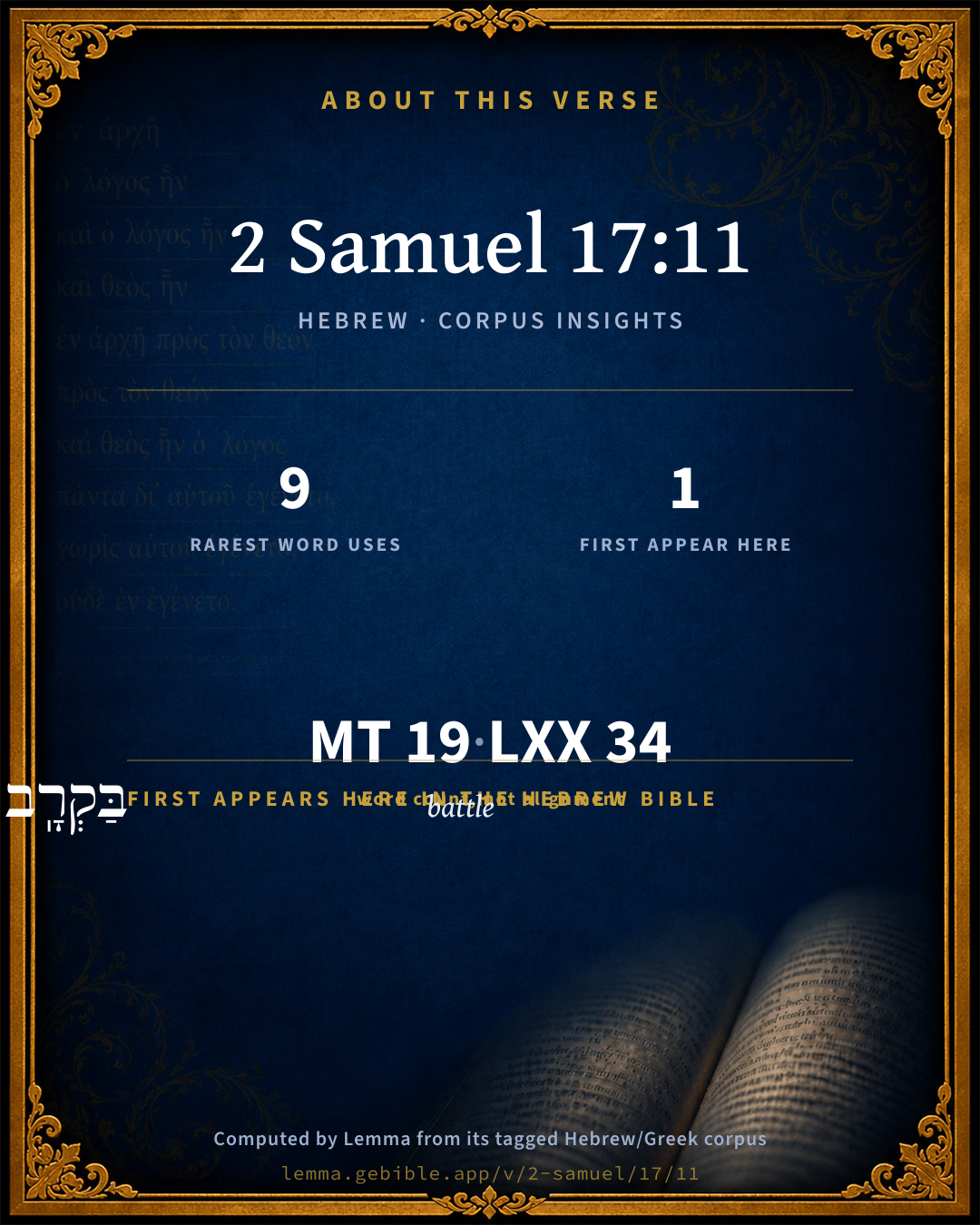
The rarest word here is בַּקְרָֽב battle H7128 — appearing just 9 times in the whole Hebrew Bible.

First appearance in Scripture

This word makes its first canonical appearance in the Hebrew Bible here:

  • בַּקְרָֽב battle H7128

Shared distinctive vocabulary

בַּקְרָֽב battle H7128 occurs in 9 verses of the Hebrew Bible. Also found in:

Grammatical profile

  • 4 verbs
  • 9 nouns
  • 1 adjective
  • 3 prepositions
  • 1 conjunction
  • 1 particle

Verb forms

  • יָעַ֗צְתִּי Qal · Perfect
  • הֵ֠אָסֹף Niphal · Infinitive Absolute
  • יֵאָסֵ֨ף Niphal · Imperfect
  • הֹלְכִ֖ים Qal · Participle Active

Repetition

Words recur within this verse — often emphatic in Hebrew:

  • הֵ֠אָסֹף to gather H622 ×2
  • עָלֶ֤יךָ upon H5921 ×2
  • בְּאֵ֣ר Beer-sheba H884 ×2

Hebrew & Septuagint length

In English translation the verse runs 36 words from the Hebrew and 40 from the Septuagint (LXX English) — closely comparable.

A rough comparison of the two English renderings, which tokenize alike — not a word-level alignment.

Word counts can differ between the Hebrew and the Greek without any difference in meaning — e.g. the Hebrew direct-object marker אֵת has no separate Greek word, and Greek often adds the article ὁ.

In the original languages it is 19 Hebrew tokens and 34 Greek tokens — but the two are counted differently (Hebrew bundles its prefixes and suffixes into one token; the Greek is in lemma form), so that isn’t a like-for-like length.

Cross-references

10

Topical passages linked to 2 Samuel 17:11 in the Treasury of Scripture Knowledge — connected by theme and wording, ordered by reader-vote popularity; previews shown in the World English Bible.

  • Genesis 22:17 that in blessing I will bless you, and in multiplying I will multiply your seed as the stars of the heavens, and as the sand which is on the seashore. Your seed will possess the gate of his enemies.
  • Joshua 11:4 They went out, they and all their hosts with them, much people, even as the sand that is on the sea-shore in multitude, with horses and chariots very many.
  • Judges 20:1 Then all the children of Israel went out, and the congregation was assembled as one man, from Dan even to Beersheba, with the land of Gilead, to Yahweh at Mizpah.
  • Psalms 9:16 Yahweh has made himself known. He has executed judgment. The wicked is snared by the work of his own hands. Meditation. Selah.
  • Genesis 13:16 I will make your offspring as the dust of the earth, so that if a man can number the dust of the earth, then your seed may also be numbered.
  • 2 Samuel 12:28 Now therefore gather the rest of the people together, and encamp against the city, and take it; lest I take the city, and it be called after my name.
  • 2 Samuel 24:2 The king said to Joab the captain of the host, who was with him, Go now back and forth through all the tribes of Israel, from Dan even to Beersheba, and number you the people, that I may know the sum of the people.
  • 1 Kings 4:20 Judah and Israel were many as the sand which is by the sea in multitude, eating and drinking and making merry.
  • 1 Kings 20:10 Ben Hadad sent to him, and said, The gods do so to me, and more also, if the dust of Samaria shall suffice for handfuls for all the people who follow me.
  • Psalms 7:15–16 He has dug a hole, And has fallen into the pit which he made.

Cross-references courtesy of OpenBible.info (CC BY 4.0).

Hebrew and Greek witnesses Masoretic Hebrew ↔ Greek Septuagint

The same verse in the two great witnesses to the Old Testament, shown verse-for-verse.

These are two independent witnesses, not word-aligned to each other, and the Septuagint is shown in lemma (dictionary) form.

Hebrew 2 Samuel 17:11 Masoretic · Westminster Leningrad Codex

כִּ֣י יָעַ֗צְתִּי הֵ֠אָסֹף יֵאָסֵ֨ף עָלֶ֤יךָ כָל יִשְׂרָאֵל֙ מִדָּן֙ וְעַד בְּאֵ֣ר שֶׁ֔בַע כַּח֥וֹל אֲשֶׁר עַל הַיָּ֖ם לָרֹ֑ב וּפָנֶ֥יךָ הֹלְכִ֖ים בַּקְרָֽב

But I counsel that all Israel be gathered together to you, from Dan even to Beersheba, as the sand that is by the sea for multitude; and that you go to battle in your own person.

World English Bible · Public Domain

Greek LXX 2 Samuel 17:11 Septuagint · lemma form

ὅτι οὕτως συνβουλεύω ἐγώ συνβουλεύω καί συνἄγω συνἄγω ἐπί σύ πᾶς ἰσραήλ ἀπό δαν καί ἕως βηρσαβεε ὡς ὁ ἄμμος ὁ ἐπί ὁ θάλασσα εἰς πλῆθος καί ὁ πρόσωπον σύ πορεύομαι ἐν μέσος αὐτός

For thus I have surely given counsel, that all Israel be generally gathered to you from Dan even to Bersabee, as the sand that is upon the sea-shore for multitude: and that your presence go in the midst of them.

LXX2012 (modern English Septuagint) · Public Domain

Hebrew: Westminster Leningrad Codex (CC BY 4.0). Greek: Septuagint (public domain); English from LXX2012 (modern English Septuagint) (Public Domain). How the Septuagint differs from the Hebrew →

Targum (Aramaic paraphrase)

1

The Targum is the ancient Jewish Aramaic paraphrase of the Hebrew Scriptures — an interpretive translation, not the Hebrew text itself. Onkelos (literal) and Pseudo-Jonathan (expansive) render the Torah, and Jonathan the Prophets. Coverage is partial: where no permissively-licensed English translation exists for a verse, only the Aramaic is shown. This is verse-level text, not a word-by-word alignment to the Hebrew.

  1. Targum Jonathan Prophets (Joshua–Malachi)
    אֲרֵי מְלָכִית אִתְכַּנָשָׁא יִתְכַּנְשׁוּן עֲלָךְ כָּל יִשְׂרָאֵל מִדָן וְעַד בְּאֵר שֶׁבַע כְּחָלָא דִי עַל יַמָא לִסְגֵי וְאַתְּ תְּהֵי אֱזֵיל בְּרֵישׁ כּוּלָנָא:

    (no public-domain English translation for this verse)

    Targum Jonathan — Aramaic: “Mikraot Gedolot” (public domain). English: “Sefaria Community Translation” (CC0 1.0 (public-domain dedication)); “London "Chaldee Paraphrase," 1871” (public domain). Text via Sefaria.

Commentary

Notes on 2 Samuel 17:11 from classic Christian and Jewish commentators (each source and its license shown beneath its notes). The classic Christian expositions comment on the surrounding passage and are grouped to its opening verse, so a note may address several verses; the Jewish commentaries on the Tanakh (Rashi and others) are per-verse, so they appear only where the commentator wrote on this verse.

Lemma curates 59 commentaries, every one of them public domain or Creative Commons licensed, each selected and text-cleaned for this edition rather than reprinted as found. About our sources →

Trapp's Complete Commentary

John Trapp

2Sa 17:11 Therefore I counsel that all Israel be generally gathered unto thee, from Dan even to Beersheba, as the sand that [is] by the sea for multitude; and that thou go to battle in thine own person.

Ver. 11. Therefore I counsel that all Israel, &c.] This was crafty counsel, well fitted to Absalom’s ambitious humour: viz., that he should raise so great an army as was possible, and then have the heading and leading of them himself, that the honour of the victory might be ascribed to him, and not to any deputy. It is reported of Sigismund, the young king of Hungary, that beholding the greatness of his army, in his great jollity, hearing of the coming of the Turks, he should proudly say, What need we to fear the Turks, who need not at all to fear the falling of the heavens; which if they should fall, yet were we able with our spears and halberds to hold them up from failing upon us! But what was the issue? This vainglorious prince shortly after received a notable overthrow, many of his army being slain, and himself hardly escaping with his life in a little boat, like another Xerxes. {a} The young man Absalom, deceived by Hushai’s counsel, and brought into the sublime dotage of a fool’s paradise, sped not so well, but well enough for such a stigmatical Belialist.

{a} Turk. Hist., 206.

John Trapp, A Commentary or Exposition upon All the Books of the Old and New Testament (1647–1656) — public domain. Text from a community e-Sword module.

Joseph Benson's Commentary

2Sa 17:11. Therefore I counsel that all Israel be generally gathered unto thee — As Ahithophel proposed all imaginable advantage to the evil cause he was engaged in, from expedition, upon the principle mentioned by Tacitus, that nothing determines civil discords so happily as despatch, Hushai, on the contrary, laid himself out to protract and to delay. His design was to gain David more time, that he might increase his army and make better preparation for the battle; and that the present heat of the people for Absalom might be cooled, and they might at last bethink themselves of their duty to David, and return to their former allegiance. For delay, as the same Tacitus observes, gives ill men time to repent, and the good to unite; with a view, therefore, to gain this delay, his advice to Absalom was, that he should wait till he had collected a far larger and more complete army. That all Israel be generally gathered unto thee, from Dan even to Beer-sheba — An army made up of the bravest men of all the tribes, to which every thing must yield; and thereby to make sure though slow work. And that thou go to battle in thine own person — Intimating that his presence would put life and courage into his soldiers, who would be ambitious to show their skill and courage in defending his person, when they knew that all their actions were observed by him, who had the distribution of rewards and punishments in his hands; and intimating that the glory of the victory belonged to him alone, and that no body should pretend to rob him of it. “And whereas it was urged by Ahithophel, that he would smite the king only, as if all Absalom’s ends were to be attained by his death, Hushai intimates that the death of competitors was as necessary as that of the king, at least, the death of him who was divinely designed for the throne. And, therefore, he adds, that they should come upon David, where he could not be concealed, and whence he could not escape, nor any one of those that were with him.”

Joseph Benson's Commentary on the Old and New Testaments (1811–1818) — public domain. Text from a community e-Sword module.

Tyndale Open Study Notes

Tyndale Open Resources

17:11 The nationwide military conscription from . . . Dan to Beersheba (the northern and southern limits of Israel) was intended to produce an overwhelmingly superior fighting force.

Tyndale Open Study Notes — © Tyndale Open Resources, licensed CC BY-SA 4.0. Text via the HelloAO Bible API.

Ellicott's Commentary for English Readers

(11) I counsel that all Israel.—Hushai had before him a difficult task. He had not only to “make the worse appear the better reason,” but to do this in face of the counsel of a man very famous for his wisdom and devoted to the interests of Absalom, while his own fidelity had but just now been called in question. He accomplishes his task successfully by emphasising all the possible hazards and contingencies of the plan recommended by Ahithophel, and by proposing, on the other hand, a plan attended with no risk, on the supposition that the great mass of Israel already were, and would continue to be, on Absalom’s side, a supposition which; with delicate flattery, he assumes as true.

A Bible Commentary for English Readers, edited by Charles John Ellicott (1878–1897) — public domain. Text from a community e-Sword module.

The Cambridge Bible for Schools and Colleges

gen. ed. J. J. S. Perowne

11. be generally gathered] Generally = ‘as a whole’: as we might say, “that there be a general gathering of all Israel.”

from Dan even to Beer-sheba] See note on 1Sa_3:20.

the sand, &c.] A common figure for an innumerable multitude. Cp. Gen_22:17; Gen_41:49; 1Sa_13:5; Psa_78:27; &c.

and that thou go, &c.] Or, and that thy presence go in the midst of them; as the Sept., Vulg., and other versions read instead of to the battle.

The Cambridge Bible for Schools and Colleges (gen. ed. J. J. S. Perowne; Cambridge University Press, 1878–1918) — public domain. Text from a community e-Sword module.

John Gill's Exposition

So shall we come upon him in some place where he shall be found,.... For such a numerous army, which would be spread abroad, could not well fail of finding him out, let him be in what lurking place he would; whereas he might lie concealed, and escape so small a number as twelve thousand men:

and we will light upon him as the dew falleth upon the ground; whose drops are innumerable, and cover all the ground where they fall; and the phrase not only expresses their numbers, but the irresistible force they should come with, and the manner, secretly, unawares, opportunely; the Romans had a sort of soldiers, called from the dew "rorarii", who carried light armour, and fought first in the battle, from whence they had their name, because dew falls before it rains (n):

and of him, and of all the men that are with him, there shall not be left so much as one; so that for the future Absalom would sit easy upon the throne, there being none left to molest him.

(n) Valtrinus de Milit. Roman. l. 3. c. 3.

John Gill's Exposition of the Whole Bible (1746–1763) — public domain (CC PDM 1.0). Text via the HelloAO Bible API.

Haydock's Catholic Bible Commentary

Of them, their general. Hebrew, "and thy face shall go to battle," Exodus xxiii. 14.

George Leo Haydock (1774–1849), Haydock's Catholic Family Bible and Commentary, 1859 edition — public domain. Excludes Psalms (Douay-Rheims chapter numbering differs from Protestant) and Deuterocanonical books (Catholic canon only).

Matthew Poole's English Annotations

His pretence was, that they might have a far greater army, and make sure though slow work; his design was to gain David more time, that he might increase his army, and make better provisions for the battle; and that the present heat of the people might be cooled, and they might at last bethink themselves of their duty to David, and return to their former allegiance.

That thou go to battle in thine own person; for thy presence will put more life and courage into all thy soldiers, who will be ambitious to show their utmost skill and courage in defending thy person and cause, when they know that all their actions are observed by him who hath the distribution of rewards and punishments in his hands. So mayst thou also give counsel as occasion offers, and encourage thy men to kill David, which otherwise they may possibly be afraid to do. Besides, the glory of the victory will be wholly thine, which now Ahithophel seeks to get to himself.

Matthew Poole's English Annotations on the Holy Bible (1683–1685) — public domain. Text from a community e-Sword/MySword module.

The Pulpit Commentary

And that thou go to battle in thine own person; literally, and that thy presence go to the battle. The versions have preserved a much better reading, "And that thy presence go in the midst of them."

The Pulpit Commentary (1880–1919), ed. H.D.M. Spence-Jones & Joseph S. Exell — public domain. Text from a community e-Sword module.

John Wesley's Explanatory Notes

I counsel - His pretense was, that they might make sure, though slow work: his design was to gain David time, that he might increase his army, and make better provision for the battle; and that the present heat of the people might be cooled, and they might bethink themselves of their duty, and return to their allegiance. Thou - For thy presence will put life and courage into thy soldiers, who will be ambitious to shew their skill and courage in defending thy person, when they know that all their actions are observed by him who hath the distribution of rewards and punishments in his hands. Besides, the glory of the victory will be wholly thine, which now Ahithophel seeks to get to himself.

John Wesley, Explanatory Notes Upon the Whole Bible (1754–1765) — public domain. Text via the GEBible commentary corpus.

Keil & Delitzsch

C. F. Keil & F. Delitzsch

"Yea (כּי, profecto), I advise: let all Israel be gathered round thee from Dan to Beersheba (see at Jdg 20:1), numerous as the sand by the sea; and thou thyself go into the war." פניך, thy person, i.e., thou thyself be marching. The plural הלכים is used because of פניך. For בּ הלך, to enter into anything, see Kg1 19:4; Isa 45:16; Isa 46:2. קרב, war, the early translators have confounded with קרב.

Keil & Delitzsch — Biblical Commentary on the Old Testament (1861–1891) — public domain (CC PDM 1.0). Text via the HelloAO Bible API. (Old Testament only.)

unfoldingWord translationNotes

Door43 World Missions Community

that all Israel should be gathered together to you

This can be stated in active form. Also, here "all Israel" represents only the Israelite soldiers. AT: "that you should gather together all of the Israelite soldiers" (See: Active or Passive and Synecdoche)

from Dan to Beersheba

This phrase means from the northern border of Israel to the southern border. AT: "from the whole nation of Israel" (See: Merism)

as numerous as the sands that are by the sea

This is an exaggeration where all the grains of sand on a beach are compared to the number of Israelite soldiers. AT: "so many that they can barely be counted" (See: Hyperbole and Generalization and Simile)

that you go to battle in person

The phrase "in person" means to go yourself and not send someone else instead. AT: "then lead them yourself into battle" (See: Idiom)

come on him

This means to purposefully go to where he is and then to attack. (See: Idiom)

we will cover him as the dew falls on the ground

Absalom's army is described as covering David's army like the dew covers the ground in the morning. AT: "we will overwhelm and completely defeat David's army" (See: Simile)

dew

the fog or misty cloud of water that can fall onto the ground during the night, covering the ground and leaving it wet in the morning

We will not leave even one of his men ... alive

This negative sentence is used for emphasis and can be stated in a positive form. AT: "We will kill every one of his men" (See: Litotes)

him himself

Both these words refer to David. AT: "David himself" (See: Reflexive Pronouns)

translationWords

advice

Israel

Dan

Beersheba

life

unfoldingWord translationNotes — © Distant Shores Media and the Door43 World Missions Community, licensed CC BY-SA 4.0. Source: git.door43.org/Door43/en_tn.

Rashi

Rabbi Shlomo Yitzchaki (Rashi)

But I advise [as follows:] Because this is my advice.

And you yourself should go to war. At the head. [Yonoson translates:] "And then you should go at the head of everybody."

Rashi on the Tanakh — English translations: “The Judaica Press complete Tanach with Rashi, translated by A. J. Rosenberg” (CC BY 4.0); “Pentateuch with Rashi's commentary by M. Rosenbaum and A.M. Silbermann, 1929-1934” (public domain); “The Metsudah Tanach series, Lakewood, N.J” (CC BY 4.0); and “The Book of Joshua, Metsudah Publications, 1997” (CC BY 4.0). Text via Sefaria.

Lesson kit

Teaching starters — assembled from the data on this page, not authored interpretation. Every prompt links to the verse data it draws on. Edit before teaching.

2 Samuel, in the Historical, opens this verse with 19 words (16 distinct Hebrew lemmas). Its most distinctive word is qᵉrâb (“battle”). A historical commentator’s framing appears above. Read the whole chapter for the surrounding context.

Discussion questions

  1. How does “battle” (qᵉrâb) shape what this verse is saying?
  2. This is the first place “battle” appears in Scripture (first appears here). What does its debut here establish?
  3. How does Job 38:23, which shares the word «battle», read alongside this verse?
  4. What does the repetition of “to gather” (2× in this one verse) do in this verse?
  5. These translations render this verse differently. What is at stake in choosing one wording over another?
  6. «יָעַ֗צְתִּי» is a Qal Perfect verb. How does that grammatical form shape the action described?
  7. Compare how Trapp's Complete Commentary and Joseph Benson's Commentary read this verse. Where do they agree or differ?

Things to notice

Reading settings

Reading text

Shown beneath each verse's original-language words.

Old Testament
Old Testament edition

Read the OT as the Masoretic Hebrew (MT) or the Greek Septuagint (LXX).

English shown for the Greek Septuagint (in the Hebrew ↔ Greek comparison).

Comparing translations? Open the Compare panel on any verse page to stack up to four side by side.