Judges 5:17

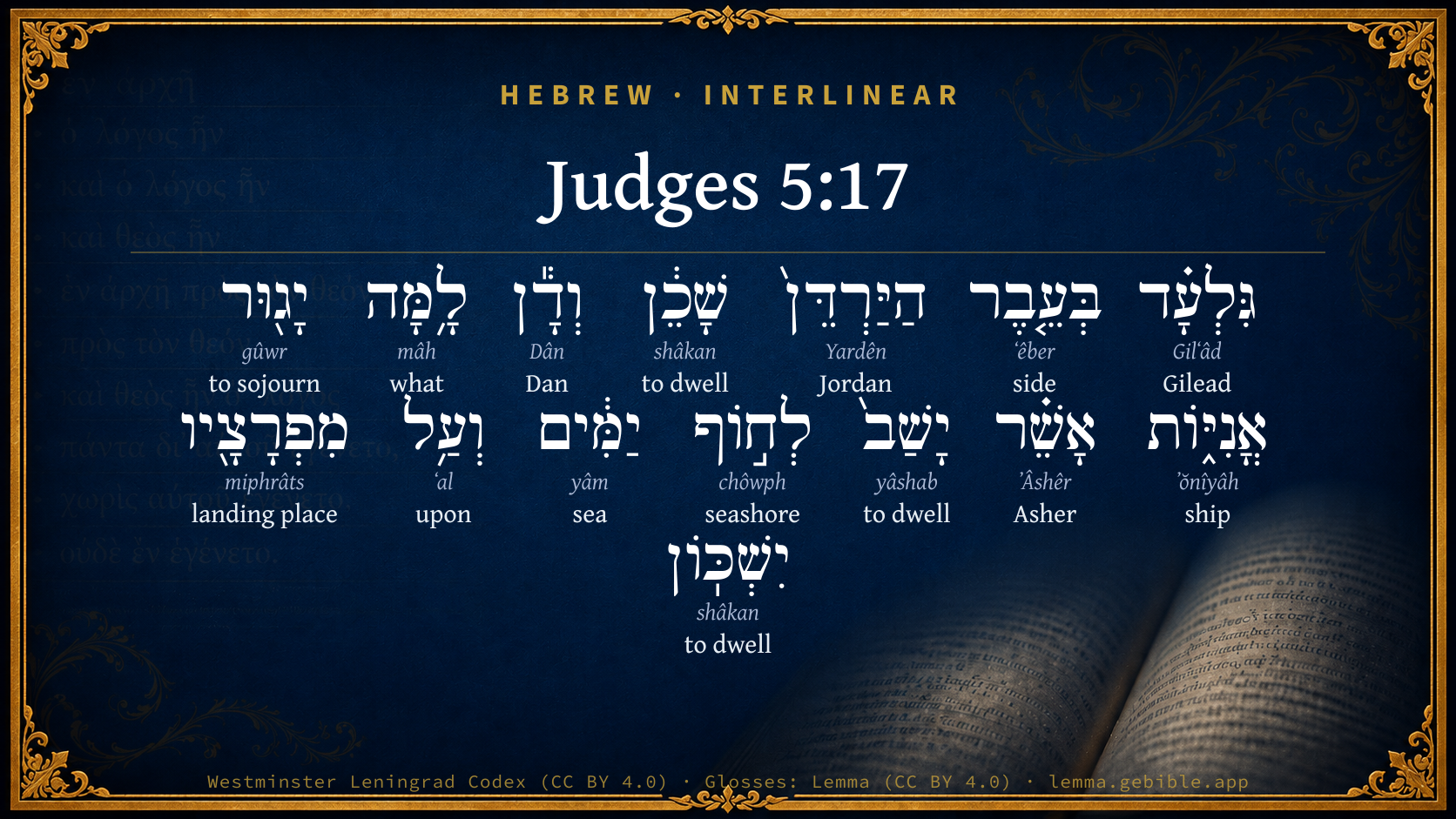
Hebrew (Westminster Leningrad Codex) Judges 5:17 appears in the Hebrew Old Testament. The text above is from the Westminster Leningrad Codex. Each word links to its Strong’s number, a concise gloss, and parsing drawn from the Open Scriptures Hebrew Bible morphology. Click any word for its full Brown-Driver-Briggs (BDB) entry.
Download image
Cite this verse

Judges 5:17 (World English Bible). Public Domain. Lemma interlinear Bible study tool, https://lemma.gebible.app/v/judges/5/17.

Show BibTeX & RIS
BibTeX
RIS
English Translation
Gilead abode beyond the Jordan: Dan, why did he remain in ships? Asher sat still at the haven of the sea, Abode by his creeks.
World English Bible · Public Domain
Highlights
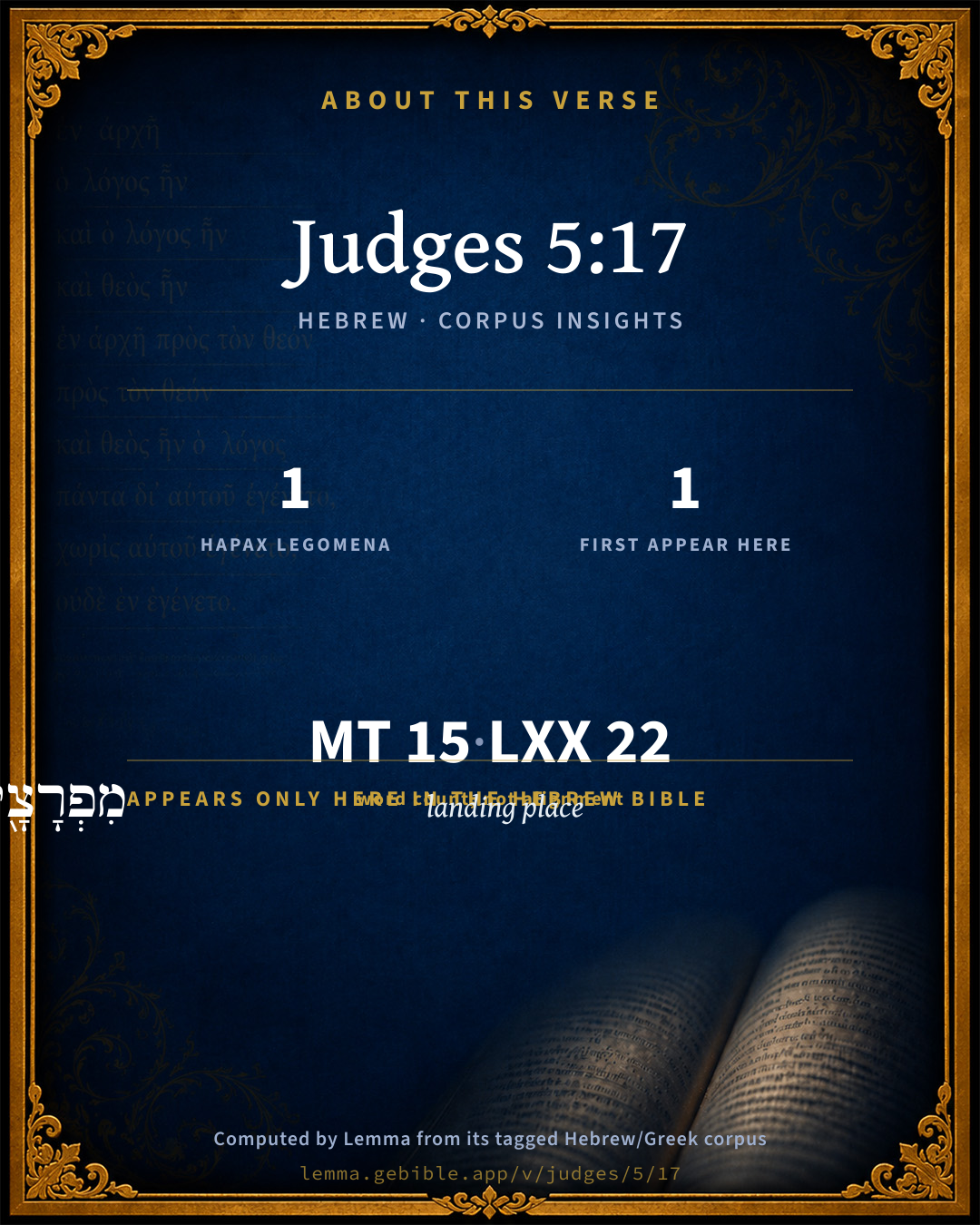
  • 1 hapax legomenon — only here in the Hebrew Bible
  • 1 first appearance in the Hebrew Bible
Full analysis ↓
Download a study sheet

One document with this verse’s original text, its word-by-word gloss line, the meaning frame, cross-references with their text, attributed commentary, and full source and license credits — printable, and it pastes into notes with its structure intact.

This verse Autodidact and up

Study sheet (.html) Plain text (.txt)

A passage Seminary Student

Up to 50 verses in one chapter. A passage sheet keeps up to 6 commentary sources and 12 cross-references per verse, in the order this page ranks them, and says so on the sheet whenever that leaves anything out. Ask for a single verse and you get the Autodidact verse sheet above.

Everything on this page stays free to read, with no account — the sheet is a download of what is already on screen, not access to it.

Want to remove ads? Support Godless Engineer
Compare translations 3

The same verse in 3 English versions, stacked beneath the original-language interlinear above. Click any original word for its lexicon entry.

Each is an independent rendering of the whole verse — the interlinear is not word-aligned to these translations.

Highlighted words mark where these versions differ — a whole-verse word diff, not a word-by-word alignment.

  • World English Bible Public Domain
    Gilead abode beyond the Jordan: Dan, why did he remain in ships? Asher sat still at the haven of the sea, Abode by his creeks.
  • King James Version Public Domain
    Gilead abode beyond Jordan: and why did Dan remain in ships? Asher continued on the sea shore, and abode in his breaches.
  • unfoldingWord Literal Text CC BY-SA 4.0
    Gilead stayed beyond the Jordan, and Dan, why did he sojourn ships? Asher remained at the coast of the seas, and he stayed among his harbors.

unfoldingWord Literal Text — © unfoldingWord, licensed CC BY-SA 4.0. Word-aligned USFM3 via Door43 (git.door43.org/unfoldingWord/en_ult).

Versions to compare (up to 4)

3 of 4 selected

Show all 18 translations

Every available English version of this verse, each an independent rendering of the whole verse.

  • World English Bible Public Domain
    Gilead abode beyond the Jordan: Dan, why did he remain in ships? Asher sat still at the haven of the sea, Abode by his creeks.
  • Berean Standard Bible Public Domain
    Gilead remained beyond the Jordan. Dan, why did you linger by the ships? Asher stayed at the coast and remained in his harbors.
  • Majority Standard Bible Public Domain
    Gilead remained beyond the Jordan. Dan, why did you linger by the ships? Asher stayed at the coast and remained in his harbors.
  • King James Version Public Domain
    Gilead abode beyond Jordan: and why did Dan remain in ships? Asher continued on the sea shore, and abode in his breaches.
  • American Standard Version (1901) Public Domain
    Gilead abode beyond the Jordan: And Dan, why did he remain in ships? Asher sat still at the haven of the sea, And abode by his creeks.
  • Revised Version (1885) Public Domain
    Gilead abode beyond Jordan: and Dan, why did he remain in ships? Asher sat still at the haven of the sea, and abode by his creeks.
  • Geneva Bible (1599) Public Domain
    Gilead abode beyonde Iorden: and why doeth Dan remayne in shippes? Asher sate on the sea shoare, and taryed in his decayed places.
  • Douay-Rheims (1899) Public Domain
    Galaad rested beyond the Jordan, and Dan applied himself to ships: Aser dwelt on the sea shore, and abode in the havens.
  • Young's Literal Translation Public Domain
    Gilead beyond the Jordan did tabernacle, And Dan -- why doth he sojourn `in' ships? Asher hath abode at the haven of the seas, And by his creeks doth tabernacle.
  • Literal Standard Version CC BY-SA 4.0
    Gilead dwelt beyond the Jordan, || And why does Dan sojourn [in] ships? Asher has abided at the haven of the seas, || And dwells by his creeks.
  • Unlocked Literal Bible CC BY-SA 4.0
    Gilead stayed on the other side of the Jordan; and Dan, why did he wander about on ships? Asher remained on the coast and lived close to his harbors.
  • unfoldingWord Literal Text CC BY-SA 4.0
    Gilead stayed beyond the Jordan, and Dan, why did he sojourn ships? Asher remained at the coast of the seas, and he stayed among his harbors.
  • Darby Bible Public Domain
    Gilead stayed beyond the Jordan; and Dan, why did he abide with the ships? Asher sat still at the coast of the sea, settling down by his landings.
  • World Messianic Bible Public Domain
    Gilead lived beyond the Jordan. Why did Dan remain in ships? Asher sat still at the haven of the sea, and lived by his creeks.
  • Webster's Bible Public Domain
    Gilead abode beyond Jordan: and why did Dan remain in ships? Asher continued on the sea-shore, and abode in his breaches.
  • Free Bible Version CC BY-SA 4.0
    Gilead remained on the other side of Jordan. Dan stayed with his ships. Asher sat still on the seacoast, not moving from his ports.
  • Bible in Basic English Public Domain
    Gilead was living over Jordan; and Dan was waiting in his ships; Asher kept in his place by the sea's edge, living by his inlets.
  • JPS Tanakh (1917) Public Domain
    Gilead abode beyond the Jordan; and Dan, why doth he sojourn by the ships? Asher dwelt at the shore of the sea, and abideth by its bays.

Literal Standard Version (2020), Covenant Press — licensed CC BY-SA 4.0. Text via the HelloAO Bible API (eBible.org). Unlocked Literal Bible (unfoldingWord) — licensed CC BY-SA 4.0. Text via the HelloAO Bible API (eBible.org). unfoldingWord Literal Text — © unfoldingWord, licensed CC BY-SA 4.0. Word-aligned USFM3 via Door43 (git.door43.org/unfoldingWord/en_ult). Free Bible Version, Dr. Jonathan Gallagher — licensed CC BY-SA 4.0. Text via the HelloAO Bible API (eBible.org).

Word by word

More ways to search: Search by grammar → Find every occurrence → Compare this word →

Practice this passage: Drill this verse → Learn its vocabulary →

מִפְרָצָ֖יו
miphrâts
H4664
“landing places · his”
Noun, Common, Masculine, Plural, Construct + Suffix, Personal, 3rd Person, Masculine, Singular
Part of Speech
Noun
Type
Common
Gender
Masculine
Number
Plural
State
Construct
Full BDB Definition

Origin: from H6555

TWOT: 1827a

landing place
  1. גִּלְעָ֗ד Gilʻâd H1568 “Gilead” Noun, Proper
  2. בְּעֵ֤בֶר ʻêber H5676 “in/at · side of” Preposition + Noun, Common, Masculine, Singular, Construct
  3. הַיַּרְדֵּן֙ Yardên H3383 “the · Jordan” Particle, Definite Article + Noun, Proper
  4. שָׁכֵ֔ן shâkan H7931 “to dwell” Verb, Qal, Perfect, 3rd Person, Masculine, Singular
  5. וְדָ֕ן Dân H1835 “and · Dan” Conjunction + Noun, Proper
  6. לָ֥מָּה mâh H4100 “to/for · what” Preposition + Particle, Interrogative
  7. יָג֖וּר gûwr H1481 “to sojourn” Verb, Qal, Imperfect, 3rd Person, Masculine, Singular
  8. אֳנִיּ֑וֹת ʼŏnîyâh H591 “ships” Noun, Common, Feminine, Plural, Absolute
  9. אָשֵׁ֗ר ʼÂshêr H836 “Asher” Noun, Proper
  10. יָשַׁב֙ yâshab H3427 “to dwell” Verb, Qal, Perfect, 3rd Person, Masculine, Singular
  11. לְח֣וֹף chôwph H2348 “to/for · seashore of” Preposition + Noun, Common, Masculine, Singular, Construct
  12. יַמִּ֔ים yâm H3220 “seas” Noun, Common, Masculine, Plural, Absolute
  13. וְעַ֥ל ʻal H5921 “and · upon” Conjunction + Preposition
  14. יִשְׁכּֽוֹן shâkan H7931 “to dwell” Verb, Qal, Imperfect, 3rd Person, Masculine, Singular

About this verse

These counts appear in no published source. They are computed here, from the morphology-tagged text and Lemma’s own curated glosses. What Lemma adds →

15
words
14
distinct lemmas
Historical
section

Notable vocabulary

1 hapax legomenon — a word that appears only here in the entire Hebrew Bible:

  • מִפְרָצָ֖יו landing place H4664

First appearance in Scripture

This word makes its first canonical appearance in the Hebrew Bible here:

  • מִפְרָצָ֖יו landing place H4664

Shared distinctive vocabulary

לְח֣וֹף seashore H2348 occurs in 6 verses of the Hebrew Bible. Also found in:

Grammatical profile

  • 4 verbs
  • 9 nouns
  • 1 preposition
  • 1 particle

Verb forms

  • שָׁכֵ֔ן Qal · Perfect
  • יָג֖וּר Qal · Imperfect
  • יָשַׁב֙ Qal · Perfect
  • יִשְׁכּֽוֹן Qal · Imperfect

Repetition

A word recurs within this verse — often emphatic in Hebrew:

  • שָׁכֵ֔ן to dwell H7931 ×2

Hebrew & Septuagint length

In English translation the verse runs 25 words from the Hebrew and 33 from the Septuagint (LXX English) — closely comparable.

A rough comparison of the two English renderings, which tokenize alike — not a word-level alignment.

Word counts can differ between the Hebrew and the Greek without any difference in meaning — e.g. the Hebrew direct-object marker אֵת has no separate Greek word, and Greek often adds the article ὁ.

In the original languages it is 15 Hebrew tokens and 22 Greek tokens — but the two are counted differently (Hebrew bundles its prefixes and suffixes into one token; the Greek is in lemma form), so that isn’t a like-for-like length.

Cross-references

3

Topical passages linked to Judges 5:17 in the Treasury of Scripture Knowledge — connected by theme and wording, ordered by reader-vote popularity; previews shown in the World English Bible.

  • Joshua 13:25 Their border was Jazer, and all the cities of Gilead, and half the land of the children of Ammon, to Aroer that is before Rabbah;
  • Joshua 13:31 and half Gilead, and Ashtaroth, and Edrei, the cities of the kingdom of Og in Bashan, were for the children of Machir the son of Manasseh, even for the half of the children of Machir according to their families.
  • Joshua 19:24–31 The fifth lot came out for the tribe of the children of Asher according to their families.

Cross-references courtesy of OpenBible.info (CC BY 4.0).

Hebrew and Greek witnesses Masoretic Hebrew ↔ Greek Septuagint

The same verse in the two great witnesses to the Old Testament, shown verse-for-verse.

These are two independent witnesses, not word-aligned to each other, and the Septuagint is shown in lemma (dictionary) form.

Hebrew Judges 5:17 Masoretic · Westminster Leningrad Codex

גִּלְעָ֗ד בְּעֵ֤בֶר הַיַּרְדֵּן֙ שָׁכֵ֔ן וְדָ֕ן לָ֥מָּה יָג֖וּר אֳנִיּ֑וֹת אָשֵׁ֗ר יָשַׁב֙ לְח֣וֹף יַמִּ֔ים וְעַ֥ל מִפְרָצָ֖יו יִשְׁכּֽוֹן

Gilead abode beyond the Jordan: Dan, why did he remain in ships? Asher sat still at the haven of the sea, Abode by his creeks.

World English Bible · Public Domain

Greek LXX Judges 5:17 Septuagint · lemma form

γαλαάδ ἐν ὁ πέραν ὁ ἰορδάνης σκηνόω καί δαν εἰς τίς παραοἰκέω πλοῖον ασηρ καταἵζω παράλιος θάλασσα καί ἐπί διέξοδος αὐτός σκηνόω

Galaad is on the other side of Jordan where he pitched his tents; and why does Dan remain in ships? Aser sat down on the sea-coasts, and he will tabernacle at his ports.

LXX2012 (modern English Septuagint) · Public Domain

On this verse, Ellicott's Commentary for English Readers discusses the Septuagint’s reading. Read the note in Commentary ↓

Hebrew: Westminster Leningrad Codex (CC BY 4.0). Greek: Septuagint (public domain); English from LXX2012 (modern English Septuagint) (Public Domain). How the Septuagint differs from the Hebrew →

Targum (Aramaic paraphrase)

1

The Targum is the ancient Jewish Aramaic paraphrase of the Hebrew Scriptures — an interpretive translation, not the Hebrew text itself. Onkelos (literal) and Pseudo-Jonathan (expansive) render the Torah, and Jonathan the Prophets. Coverage is partial: where no permissively-licensed English translation exists for a verse, only the Aramaic is shown. This is verse-level text, not a word-by-word alignment to the Hebrew.

  1. Targum Jonathan Prophets (Joshua–Malachi)
    דְבֵית גִלְעָד בְּעִבְרָא דְיַרְדְנָא שָׁרָן וּדְבֵית דָן גָזוּ עָבְרוּ יַרְדְנָא וְשַׁוִיאוּ נִכְסֵיהוֹן בִּסְפִינָן דְבֵית אָשֵׁר עַל סְפַר יַמַיָא שְׁרוֹ קִרְוֵי עַמְמַיָא דְפַּגָרוּ תָּבוּ וּבָנְיָן וִיתִיבוּ בְהוֹן:

    (no public-domain English translation for this verse)

    Targum Jonathan — Aramaic: “Mikraot Gedolot” (public domain). English: “Sefaria Community Translation” (CC0 1.0 (public-domain dedication)); “London "Chaldee Paraphrase," 1871” (public domain). Text via Sefaria.

Commentary

Notes on Judges 5:17 from classic Christian and Jewish commentators (each source and its license shown beneath its notes). The classic Christian expositions comment on the surrounding passage and are grouped to its opening verse, so a note may address several verses; the Jewish commentaries on the Tanakh (Rashi and others) are per-verse, so they appear only where the commentator wrote on this verse.

Lemma curates 59 commentaries, every one of them public domain or Creative Commons licensed, each selected and text-cleaned for this edition rather than reprinted as found. About our sources →

Trapp's Complete Commentary

John Trapp

Jdg 5:17 Gilead abode beyond Jordan: and why did Dan remain in ships? Asher continued on the sea shore, and abode in his breaches.

Ver. 17. Gilead abode beyond Jordan,] i.e., Gad and the other half tribe of Manasseh, the degenerate offspring of valiant Machir.

And why did Dan remain in ships? &c.] All these are worthily shamed and shented, though they were not without some sorry pleas and pretences. The labouring Church must be some way helped, if it be but by our prayers: precando saepe plus efficitur quam praeliando. Great is the power of prayer.

John Trapp, A Commentary or Exposition upon All the Books of the Old and New Testament (1647–1656) — public domain. Text from a community e-Sword module.

Joseph Benson's Commentary

Jdg 5:17. Gilead abode, &c. — Or, why did Gilead abide? Gilead was divided between the children of Machir and the tribe of Gad, Jos 13:24-31. The children of Machir came down to the battle, and therefore the tribe of Gad can only be meant here, the land of Gilead being put for the inhabitants of it. Beyond Jordan — In their own portions, and did not come over Jordan to the help of the Lord, and of his people, as they ought to have done. Why did Dan remain in ships? — Their coast being near the sea, they were wholly intent on their merchandise, and therefore did not join in this land expedition. Asher continued on the sea-shore — Where their lot lay. Abode in his breaches — Either in his creeks and small havens, where vessels lay to go out to sea, or in their broken and craggy rocks and caves.

Joseph Benson's Commentary on the Old and New Testaments (1811–1818) — public domain. Text from a community e-Sword module.

Geneva Bible (1599)

Geneva Bible translators

Either by beating of the sea, or by mining.

She reproveth all them that came not to help their brethren in their necessity.

Geneva Bible (1599) marginal notes — public domain. Text via Bolls.life.

Jamieson, Fausset & Brown

Robert Jamieson, A. R. Fausset & David Brown

Gilead abode beyond Jordan--that is, Both Gad and the eastern half to Manasseh chose to dwell at ease in their Havoth-jair, or "villages of tents," while Dan and Asher, both maritime tribes, continued with their ships and in their "breaches" ("havens"). The mention of these craven tribes (Jdg 5:18) is concluded with a fresh burst of commendation on Zebulun and Naphtali.

Jamieson, Fausset & Brown — Commentary Critical and Explanatory on the Whole Bible (1871) — public domain (CC PDM 1.0). Text via the HelloAO Bible API.

Adam Clarke's Commentary

Verse 17. Gilead abode beyond Jordan] That is, the Gadites, who had their lot in those parts, and could not well come to the aid of their brethren at a short summons. But the words of Deborah imply a criminal neglect on the part of the Danites; they were intent upon their traffic, and trusted in their ships. Joppa was one of their sea-ports.

Asher continued on the seashore] The lot of Asher extended along the Mediterranean Sea; and being contiguous to Zebulun and Naphtali, they might have easily succoured their brethren; but they had the pretence that their posts were unguarded, and they abode in their breaches, in order to defend them.

Adam Clarke's Commentary on the Bible (1810–1826) — public domain. Text from a community e-Sword/MySword module.

Ellicott's Commentary for English Readers

(17) Gilead abode beyond Jordan.—Gilead was the son of Machir, and grandson of Manasseh. The name is here probably meant to include Gad, as well as the half-tribe of Manasseh. The word “abode” means “stayed quietly” (Psa_16:9), and is rendered qniesce-bat in the Vulgate.

Why did Dan remain in ships?—The sudden question is very picturesque. The other rendering, “Why did Dan fear the ships (of the enemy)? “is untenable. The possession of Joppa. one of the few seaports of Palestine, naturally influenced the pursuits of the tribe (Jos_19:46; 2Ch_2:16; Ezr_3:7); but whether they are here reproached for absorption in commerce, or for cowardice in taking refuge in their ships, is uncertain. The word rendered “remain” often involves a notion of “alarm” (Deu_32:27). If the Danite migration (Judges 18) had by this time occurred, it is almost impossible that they should not have rendered some assistance to the revolt of the northern tribes. The fact that it is not here alluded to shows the extremely early date at which this narrative must be placed.

Asher continued on the sea shore.—Aslier was the other great maritime tribe (Jos_19:28-29). The word “continued” is, literally, “sat.”

Abode in his breaches.—The word rendered “breaches” is, literally, “clefts,” or “fissures.” The Chaldee curiously paraphrases it by “rebuilt and ¡ dwelt in the cities which the Gentiles destroyed.” Le Clerc renders it, “Sits in his precipitous rocks,” referring it to that part of the coast known as “the Ladder of Tyre;” and this is perhaps meant by the diakopas of the LXX. (Cod. Alex.). The Vulgate renders, in portibus. Probably the “creeks” of the margin of our Bibles is the correct rendering.

A Bible Commentary for English Readers, edited by Charles John Ellicott (1878–1897) — public domain. Text from a community e-Sword module.

John Gill's Exposition

Gilead abode beyond Jordan,.... A country which lay on the other side Jordan, and was given by Moses, half of it to the tribes of Reuben and Gad, and the other half to the half tribe of Manasseh, Deu 3:12 and being here distinguished from Reuben, it seems that not only that tribe, but also the tribe of Gad, and the half tribe of Manasseh, on that side Jordan, came not to the help of Israel; but abode where they were, attending their flocks and herds, and preferring their own private profit to the public good; yet as Gilead was given to Machir, Deu 3:15 and some are said to come out from thence to serve in this expedition, Jdg 5:14 some read the words, as Kimchi observes, with an interrogation, "did Gilead abide beyond Jordan?" no, he did not; though his situation was beyond it, as well as Reuben's, yet he did not continue there, but came over to help his brethren; and so this is introduced to upbraid Reuben, and leave him without excuse, since he could as well have left his flocks as Gilead did, and come over to the help of his brethren as well as he:

and why did Dan remain in ships? the Danites inhabiting Joppa, and other places bordering on the Mediterranean sea, attended their navigation and merchandise; and which they chose rather to do, than to appear in the field of battle in the behalf of their brethren; judging this to be a sufficient excuse, though the question put implies the contrary; according to the Targum, they were meditating a flight, and put their goods into ships to flee with them, should Sisera get the day:

Asher continued on the sea shore; on the shore of the Mediterranean sea, attending traffic and business, and did not concern themselves at all in this war:

and abode in his trenches; in his towns and cities, the walls of which had been broken down by the Canaanites, and remained unrepaired, nor were they suffered to repair them; and therefore excused themselves on this account from engaging in the war, being obliged to stay at home to keep and defend their cities; which were in such a ruinous and weak condition, that the enemy might enter at any time: some render it, "in their creeks" (i) bays and havens where they had much shipping, and which required their attendance.

(i) "in portubus", V. L. "ad sinus suos", some in Vatablus.

John Gill's Exposition of the Whole Bible (1746–1763) — public domain (CC PDM 1.0). Text via the HelloAO Bible API.

Albert Barnes' Notes on the Bible

The land of Gilead, on the east of Jordan, was divided between Gad and the half tribe of Manasseh, who are both comprehended here. Joppa was in the territory of Dan Jos 19:46, and was in later times the sea-port for Jerusalem.

His breaches - Rather havens; i. e. the creeks and bays and river-months by which their coast was broken. Jos 19:29.

Albert Barnes' Notes on the Bible (1834–1885) — public domain. Text from a community e-Sword/MySword module.

Haydock's Catholic Bible Commentary

Galaad was inhabited by the tribes of Gad and Manasses; and took no part in this war. (Calmet) --- Dan. Hebrew, "Why did not Dan remain in ships?" Debbora now rebukes those who lived on the west side of the Jordan, as well as those on the east. Dan might think himself remote enough from the kingdom of Jabin. But Aser dwelt very near, yet durst not make any attempt to throw off the yoke. --- Havens. Hebrew, "Breaches." He had, perhaps, suffered much already, (Haydock) and preferred to remain quiet, even in his half-ruined cities, before engaging in the perilous attempt of his brethren. (Calmet) --- He was too much taken up with commerce, to pay any attention to the oracles of the Lord. Grabe’s Septuagint, "Aser....pitched his tents upon his cavities, or the broken ground of it," the sea shore, which is commonly intersected with a variety of rivulets amid the cliffs. (Haydock)

George Leo Haydock (1774–1849), Haydock's Catholic Family Bible and Commentary, 1859 edition — public domain. Excludes Psalms (Douay-Rheims chapter numbering differs from Protestant) and Deuterocanonical books (Catholic canon only).

Matthew Poole's English Annotations

Gilead is sometimes taken more largely, for all the land of the Israelites beyond Jordan, as Num 32:1,26,29. So it is not here taken, because Gilead is here distinguished from Reuben and his land. Sometimes it is taken more strictly for that part of the land beyond Jordan which fell to the half tribe of Manasseh, as Num 32:39,40; Deu 3:15; Jos 17:1. And sometimes both for that part of Manasseh’s, and for Gad’s portion, as Jos 13:24,25,29-31. And so it seems to be understood here; and the land Gilead is here put for the people or inhabitants of it, Gad and Manasseh.

Beyond Jordan, in their own portions, and did not come over Jordan to the help of the Lord, and of his people, as they ought to have done.

Dan, whose coast was near the sea, was wholly intent upon his merchandise and shipping, as the great instrument both of his riches and safety; and therefore would not join in this land expedition.

On the sea-shore, where their lot lay.

In his breaches; either, first, In the creeks of the sea, whether in design to save themselves by ships in case of danger, as Dan also intended; or upon pretence of repairing the breaches made by the sea into their country. Or, secondly, In their broken and craggy rocks and caves therein, in which they thought to secure themselves.

Matthew Poole's English Annotations on the Holy Bible (1683–1685) — public domain. Text from a community e-Sword/MySword module.

Whedon's Commentary on the Bible

Daniel D. Whedon

17. Gilead — The name of the grandson of Manasseh is here used poetically for the half tribe of Manasseh that dwelt on the east of the Jordan. Compare note on Jdg_5:14. Those eastern tribes heeded not the summons of Deborah.

Dan… ships — The portion of Dan took in the port of Joppa, (Jos_19:46,) and the Danites who dwelt there, and at other places near or on the coast, doubtless interested themselves with the commerce of the Phenicians. Hence the allusion to their dwelling in ships.

Asher — For the location of this tribe, see on Jos_19:24-31.

Daniel D. Whedon (gen. ed.), Commentary on the Old and New Testaments (1874–1909) — public domain. Text from a community e-Sword module.

The Pulpit Commentary

In ships. The celebrated hat. hour of Joppa, (Jon_1:3) now Jaffa, was in the tribe of Dan. His breaches. The creeks and bays where they kept their fishing. boats.

The Pulpit Commentary (1880–1919), ed. H.D.M. Spence-Jones & Joseph S. Exell — public domain. Text from a community e-Sword module.

John Wesley's Explanatory Notes

Governors - Either civil governors, princes and great persons, who were as ready to hazard themselves, as the meanest: or military officers, valiant and expert commanders, such as some of Machir's posterity are noted to have been. Writer - That is, even the Scribes, who gave themselves to study and writing, whereby they were exempted from military service, did voluntarily enter into this service.

John Wesley, Explanatory Notes Upon the Whole Bible (1754–1765) — public domain. Text via the GEBible commentary corpus.

Keil & Delitzsch

C. F. Keil & F. Delitzsch

Gilead, Dan, and Asher took no part at all. By Gilead, the tribes of Gad and half Manasseh are intended. The use of the term הגּלעד to denote the whole of the territory of the Israelites on the east of the Jordan probably gave occasion to this, although גלעד (without the article) does not refer to the land even here, but refers primarily to the grandson of Manasseh, as the representative of his family which dwelt in Gilead. (For further remarks, see at Jdg 5:14.) Dan also did not let the national movement disturb it in its earthly trade and commerce. גּוּר, to keep one's self in a place, is construed here with the accusative of the place, as in Psa 120:5. The territory of Dan included the port of Joppa (see at Jos 19:46), where the Danites probably carried on a trade with the Phoenicians. Asher also in his land upon the coast did not allow himself to be disturbed from his rest, to join in the common war of its nation. ימּים חוף is used, as in Gen 49:13, for the shore of the Mediterranean Sea. מפרצים, ἁπ. λεγ., literally a rent, and hence applied to a bay, as an incision made in the sea-shore.

Keil & Delitzsch — Biblical Commentary on the Old Testament (1861–1891) — public domain (CC PDM 1.0). Text via the HelloAO Bible API. (Old Testament only.)

unfoldingWord translationNotes

Door43 World Missions Community

Gilead stayed

Here "Gilead" the men from Gilead who should have gone to fight in battle. AT: "The men of Gilead stayed" (See: Metonymy)

the other side of the Jordan

This refers to the east side of the Jordan. (See: Assumed Knowledge and Implicit Information)

Dan, why did he wander about on ships?

This question is asked to express anger because the people of the tribe of Dan would not fight for Israel. AT: "the men of Dan should not have remained on their ships!" or "the people of the tribe of Dan did not help us in the battle. Instead they were wandering around on the sea in ships!" (See: Rhetorical Question and Assumed Knowledge and Implicit Information)

Dan, why did he

Here "Dan" represents the men from Dan who should have gone to fight in battle. AT: "the men of Dan, why did they" (See: Metonymy)

wander about on ships

The tribe of Dan was located near the Mediterranean sea. They sailed on the sea to make money through trade and fishing. (See: Assumed Knowledge and Implicit Information)

Asher remained on the coast and lived close to his harbors

The full meaning of this statement can be made explicit. AT: "The people of the tribe of Asher also failed to help us, they just remained on the coast near their harbors" (See: Assumed Knowledge and Implicit Information)

Asher remained

Here "Asher" represents the men who should have gone to fight in battle. AT: "The men of Asher remained" (See: Metonymy)

harbors

places at the seacoast with deeper water where ships were kept

Naphtali, also

You can make clear the understood information. AT: "Naphtali was a tribe who would also risk their lives to the point of death" (See: Ellipsis)

translationWords

Gilead

Jordan River

Dan

Asher

Zebulun

tribe

die

Naphtali

unfoldingWord translationNotes — © Distant Shores Media and the Door43 World Missions Community, licensed CC BY-SA 4.0. Source: git.door43.org/Door43/en_tn.

Rashi

Rabbi Shlomo Yitzchaki (Rashi)

Is ensconced beyond the Yardein and never arrived at the battle front. Similarly, Dan hoarded his money into sea vessels, poised to escape.

At his exposures. To defend his exposed territory.

Rashi on the Tanakh — English translations: “The Judaica Press complete Tanach with Rashi, translated by A. J. Rosenberg” (CC BY 4.0); “Pentateuch with Rashi's commentary by M. Rosenbaum and A.M. Silbermann, 1929-1934” (public domain); “The Metsudah Tanach series, Lakewood, N.J” (CC BY 4.0); and “The Book of Joshua, Metsudah Publications, 1997” (CC BY 4.0). Text via Sefaria.

Radak

Rabbi David Kimhi (Radak)

And likewise,

Gilead who dwelt beyond the Jordan and did not come to the war. And one should wonder: And did not Makhir say that he was coming to the war? And Makhir was the father of of Gilead. So the Gilead (region) went to the House of Makhir, as it stated (Numbers 32:40), "And he gave the Gilead to Makhir, the son of Menashe." But it can be explained that that which it said, Gilead dwelt beyond the Jordan, was about the House of Yair, the son of Menashe, as his portion was also in the land of Gilead, as it stated (Numbers 32:41), "And Yair, the son of Menashe, went and conquered their villages." And it can further be explained that what it stated, that Gilead dwelt beyond the Jordan, is by way of a question. And it is saying it to Reuven - why did you sit in your house and not come to the war: Gilead did like you and settled on the other side of the Jordan. Did he not tremble and come to help in Israel's war? So why did you not do so? And even though you are from the other side of the Jordan, is he not also from the other side of the Jordan? But it can also be explained with the same idea as this understanding, not by way of a question. That is to say, does not Gilead also dwell on the other side of the Jordan like you and his portion and inheritance is there? Nevertheless, he crossed over and came to the help of Israel. But you, why did you not do this?

And Dan, why did he linger by the ships: It is not speaking about ships of the sea, since his portion was not on the sea. For Zevulun's portion was there, as it states (Genesis 49:13), "Zevulun will dwell upon the shore of the seas." And even though it is written about his portion (Yehoshua 19:26), "across from Yafo" - nevertheless, Yafo was not in his portion. Rather it is river boats, meaning to say that he crossed the Jordan and fled out of fear of the enemy and took his possessions across the Jordan. And so did Yonatan translate (in the Targum), "they swiftly crossed the Jordan, etc."

Asher remained at the seacoast: Since his portion and his lot were there, as it is written (Joshua 19:26), "and it reaches the Carmel towards the sea." And it stated (Joshua 19:29), "and then its boundaries towards the sea, to Mechebel towards Achziv."

And dwelt at his breaches: He dwelt at the breached places in his cities, due to the fear of the enemies. Hence he will not come to the war, so that he will not leave his unwalled towns alone (undefended). And Yonatan (in the Targum) translated, "the towns of nations, etc.."

Radak on the Tanakh — English translations: “Sefaria Community Translation” (CC0 1.0 (public-domain dedication)); “Eliyahu Munk, HaChut Hameshulash” (CC BY 4.0); “Rabbi Mike Feuer, Jerusalem Anthology” (CC BY 4.0); and “R. David Kimhi on the first book of Psalms, Translated by R.G. Finch, London, 1919” (public domain). Text via Sefaria.

Lesson kit

Teaching starters — assembled from the data on this page, not authored interpretation. Every prompt links to the verse data it draws on. Edit before teaching.

Judges, in the Historical, opens this verse with 15 words (14 distinct Hebrew lemmas). Its most distinctive word is miphrâts (“landing place”). A historical commentator’s framing appears above. Read the whole chapter for the surrounding context.

Discussion questions

  1. What does “landing place” (miphrâts) contribute to the verse as a whole?
  2. 1 word here appears nowhere else in the Hebrew Bible. Why might the author reach for such rare wording?
  3. This is the first place “landing place” appears in Scripture (first appears here). What does its debut here establish?
  4. How does Genesis 49:13, which shares the word «seashore», read alongside this verse?
  5. What does the repetition of “to dwell” (2× in this one verse) do in this verse?
  6. These translations render this verse differently. What is at stake in choosing one wording over another?
  7. «שָׁכֵ֔ן» is a Qal Perfect verb. How does that grammatical form shape the action described?
  8. Compare how Trapp's Complete Commentary and Joseph Benson's Commentary read this verse. Where do they agree or differ?

Things to notice

  • 1 word in this verse appears nowhere else in the Hebrew Bible.
  • 1 word makes its first canonical appearance in Scripture here.
  • This verse counts 15 Hebrew ↔ 22 Greek words.
  • These translations choose different wording for 17 words in this verse.
  • “to dwell” occurs 2× in this single verse.

Reading settings

Reading text

Shown beneath each verse's original-language words.

Old Testament
Old Testament edition

Read the OT as the Masoretic Hebrew (MT) or the Greek Septuagint (LXX).

English shown for the Greek Septuagint (in the Hebrew ↔ Greek comparison).

Comparing translations? Open the Compare panel on any verse page to stack up to four side by side.