
Joshua 24:6

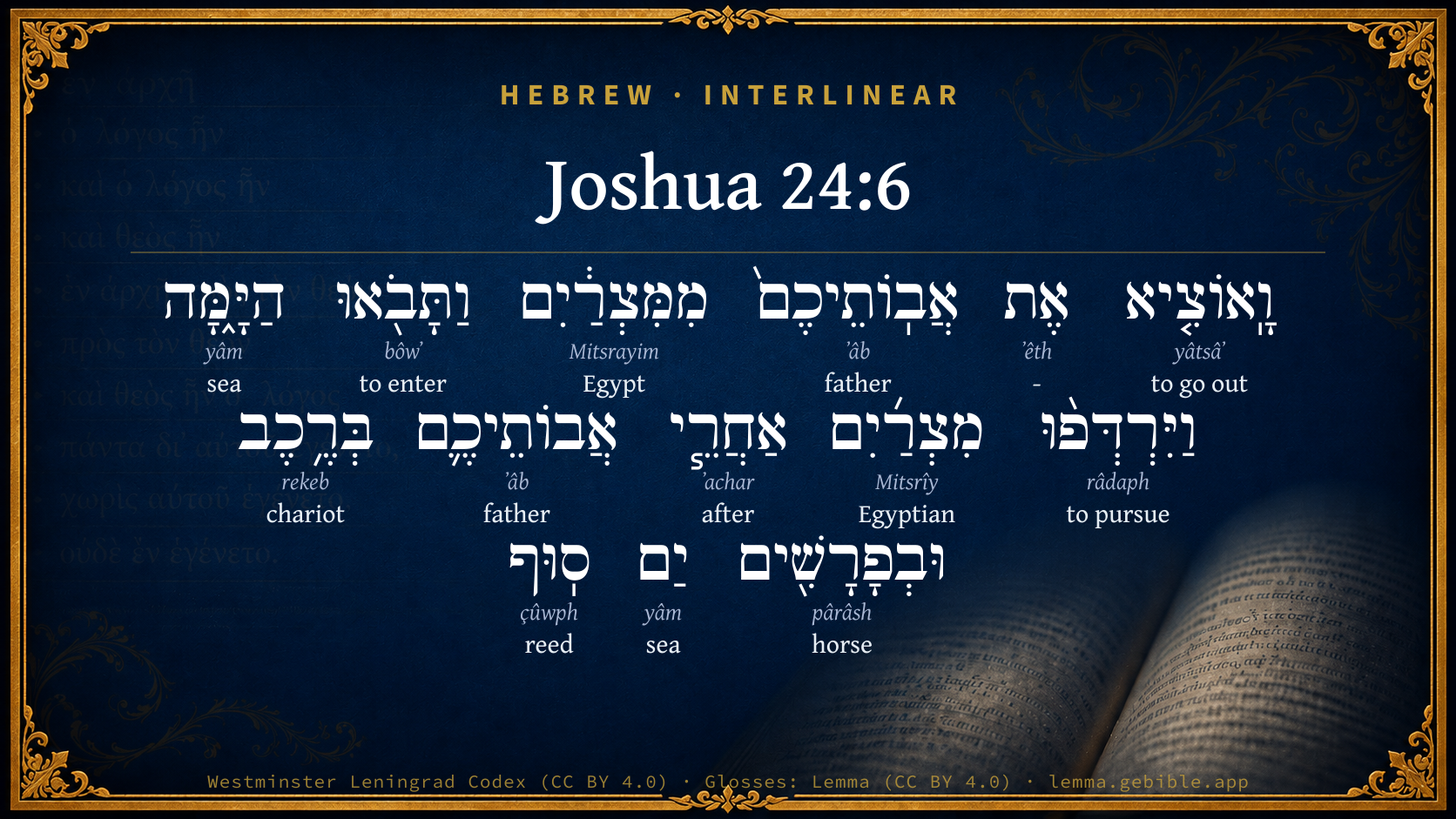
Hebrew (Westminster Leningrad Codex) Joshua 24:6 appears in the Hebrew Old Testament. The text above is from the Westminster Leningrad Codex. Each word links to its Strong’s number, a concise gloss, and parsing drawn from the Open Scriptures Hebrew Bible morphology. Click any word for its full Brown-Driver-Briggs (BDB) entry.
Download image
Cite this verse

Joshua 24:6 (World English Bible). Public Domain. Lemma interlinear Bible study tool, https://lemma.gebible.app/v/joshua/24/6.

Show BibTeX & RIS
BibTeX
RIS
English Translation
I brought your fathers out of Egypt: and you came to the sea; and the Egyptians pursued after your fathers with chariots and with horsemen to the Red Sea.
World English Bible · Public Domain
Download a study sheet

One document with this verse’s original text, its word-by-word gloss line, the meaning frame, cross-references with their text, attributed commentary, and full source and license credits — printable, and it pastes into notes with its structure intact.

This verse Autodidact and up

Study sheet (.html) Plain text (.txt)

A passage Seminary Student

Up to 50 verses in one chapter. A passage sheet keeps up to 6 commentary sources and 12 cross-references per verse, in the order this page ranks them, and says so on the sheet whenever that leaves anything out. Ask for a single verse and you get the Autodidact verse sheet above.

Everything on this page stays free to read, with no account — the sheet is a download of what is already on screen, not access to it.

Want to remove ads? Support Godless Engineer
Compare translations 3

The same verse in 3 English versions, stacked beneath the original-language interlinear above. Click any original word for its lexicon entry.

Each is an independent rendering of the whole verse — the interlinear is not word-aligned to these translations.

Highlighted words mark where these versions differ — a whole-verse word diff, not a word-by-word alignment.

  • World English Bible Public Domain
    I brought your fathers out of Egypt: and you came to the sea; and the Egyptians pursued after your fathers with chariots and with horsemen to the Red Sea.
  • King James Version Public Domain
    And I brought your fathers out of Egypt: and ye came unto the sea; and the Egyptians pursued after your fathers with chariots and horsemen unto the Red sea.
  • unfoldingWord Literal Text CC BY-SA 4.0
    And I brought your fathers out from Egypt, and you came to the sea. And Egypt chased after your fathers with chariot and horsemen to the Sea of Reeds.

unfoldingWord Literal Text — © unfoldingWord, licensed CC BY-SA 4.0. Word-aligned USFM3 via Door43 (git.door43.org/unfoldingWord/en_ult).

Versions to compare (up to 4)

3 of 4 selected

Show all 18 translations

Every available English version of this verse, each an independent rendering of the whole verse.

  • World English Bible Public Domain
    I brought your fathers out of Egypt: and you came to the sea; and the Egyptians pursued after your fathers with chariots and with horsemen to the Red Sea.
  • Berean Standard Bible Public Domain
    When I brought your fathers out of Egypt and you reached the Red Sea, the Egyptians pursued them with chariots and horsemen as far as the Red Sea.
  • Majority Standard Bible Public Domain
    When I brought your fathers out of Egypt and you reached the Red Sea, the Egyptians pursued them with chariots and horsemen as far as the Red Sea.
  • King James Version Public Domain
    And I brought your fathers out of Egypt: and ye came unto the sea; and the Egyptians pursued after your fathers with chariots and horsemen unto the Red sea.
  • American Standard Version (1901) Public Domain
    And I brought your fathers out of Egypt: and ye came unto the sea; and the Egyptians pursued after your fathers with chariots and with horsemen unto the Red Sea.
  • Revised Version (1885) Public Domain
    And I brought your fathers out of Egypt: and ye came unto the sea; and the Egyptians pursued after your fathers with chariots and with horsemen unto the Red Sea.
  • Geneva Bible (1599) Public Domain
    So I brought your fathers out of Egypt, and ye came vnto the Sea, and the Egyptians pursued after your fathers with charets and horsemen vnto the red sea.
  • Douay-Rheims (1899) Public Domain
    And I brought you and your fathers out of Egypt, and you came to the sea: and the Egyptians pursued your fathers with chariots and horsemen, as far as the Red Sea.
  • Young's Literal Translation Public Domain
    And I bring out your fathers from Egypt, and ye go into the sea, and the Egyptians pursue after your fathers, with chariot and with horsemen, to the Red Sea;
  • Literal Standard Version CC BY-SA 4.0
    And I bring out your fathers from Egypt, and you go to the sea, and the Egyptians pursue after your fathers, with chariot and with horsemen, to the Red Sea;
  • Unlocked Literal Bible CC BY-SA 4.0
    I brought your ancestors out of Egypt, and you came to the sea. The Egyptians pursued them with chariots and horsemen as far as the Sea of Reeds.
  • unfoldingWord Literal Text CC BY-SA 4.0
    And I brought your fathers out from Egypt, and you came to the sea. And Egypt chased after your fathers with chariot and horsemen to the Sea of Reeds.
  • Darby Bible Public Domain
    And I brought your fathers out of Egypt, and ye came unto the sea; and the Egyptians pursued after your fathers with chariots and horsemen unto the Red sea.
  • World Messianic Bible Public Domain
    I brought your fathers out of Egypt: and you came to the sea. The Egyptians pursued your fathers with chariots and with horsemen to the Sea of Suf.
  • Webster's Bible Public Domain
    And I brought your fathers out of Egypt: and ye came to the sea; and the Egyptians pursued after your fathers with chariots and horsemen to the Red sea.
  • Free Bible Version CC BY-SA 4.0
    Yes, I brought your forefathers out, but when you arrived at the Red Sea the Egyptians were chasing after your forefathers with chariots and horsemen.
  • Bible in Basic English Public Domain
    I took your fathers out of Egypt: and you came to the Red Sea; and the Egyptians came after your fathers to the Red Sea, with their war-carriages and their horsemen.
  • JPS Tanakh (1917) Public Domain
    And I brought your fathers out of Egypt; and ye came unto the sea; and the Egyptians pursued after your fathers with chariots and with horsemen unto the Red Sea.

Literal Standard Version (2020), Covenant Press — licensed CC BY-SA 4.0. Text via the HelloAO Bible API (eBible.org). Unlocked Literal Bible (unfoldingWord) — licensed CC BY-SA 4.0. Text via the HelloAO Bible API (eBible.org). unfoldingWord Literal Text — © unfoldingWord, licensed CC BY-SA 4.0. Word-aligned USFM3 via Door43 (git.door43.org/unfoldingWord/en_ult). Free Bible Version, Dr. Jonathan Gallagher — licensed CC BY-SA 4.0. Text via the HelloAO Bible API (eBible.org).

Word by word

More ways to search: Search by grammar → Find every occurrence → Compare this word →

Practice this passage: Drill this verse → Learn its vocabulary →

סֽוּף
çûwph
H5488
“reed”
Noun, Common, Masculine, Singular, Absolute
Part of Speech
Noun
Type
Common
Gender
Masculine
Number
Singular
State
Absolute
Full BDB Definition

Origin: probably of Egyptian origin

TWOT: 1479

reed, rush, water plant - rushes - sea of rushes - of Red Sea - of arms of Red Sea - of Gulf of Suez - of sea from straits to Gulf of Akaba
  1. וָֽאוֹצִ֤יא yâtsâʼ H3318 “and · to go out” Conjunction + Verb, Hiphil, Sequential Imperfect, 1st Person, Common, Singular
  2. אֶת ʼêth H853 “-” Particle, Direct Object
  3. אֲבֽוֹתֵיכֶם֙ ʼâb H1 “fathers · your” Noun, Common, Masculine, Plural, Construct + Suffix, Personal, 2nd Person, Masculine, Plural
  4. מִמִּצְרַ֔יִם Mitsrayim H4714 “from · Egypt” Preposition + Noun, Proper
  5. וַתָּבֹ֖אוּ bôwʼ H935 “and · to enter” Conjunction + Verb, Qal, Sequential Imperfect, 2nd Person, Masculine, Plural
  6. הַיָּ֑מָּה yâm H3220 “the · sea · toward” Particle, Definite Article + Noun, Common, Masculine, Singular, Absolute + Suffix, Demonstrative
  7. וַיִּרְדְּפ֨וּ râdaph H7291 “and · to pursue” Conjunction + Verb, Qal, Sequential Imperfect, 3rd Person, Masculine, Plural
  8. מִצְרַ֜יִם Mitsrîy H4713 “Egyptian” Noun, Proper
  9. אַחֲרֵ֧י ʼachar H310 “after” Preposition
  10. אֲבוֹתֵיכֶ֛ם ʼâb H1 “fathers · your” Noun, Common, Masculine, Plural, Construct + Suffix, Personal, 2nd Person, Masculine, Plural
  11. בְּרֶ֥כֶב rekeb H7393 “in/at · chariot” Preposition + Noun, Common, Masculine, Singular, Absolute
  12. וּבְפָרָשִׁ֖ים pârâsh H6571 “and · in/at · horses” Conjunction + Preposition + Noun, Common, Masculine, Plural, Absolute
  13. יַם yâm H3220 “sea of” Noun, Common, Masculine, Singular, Construct

About this verse

These counts appear in no published source. They are computed here, from the morphology-tagged text and Lemma’s own curated glosses. What Lemma adds →

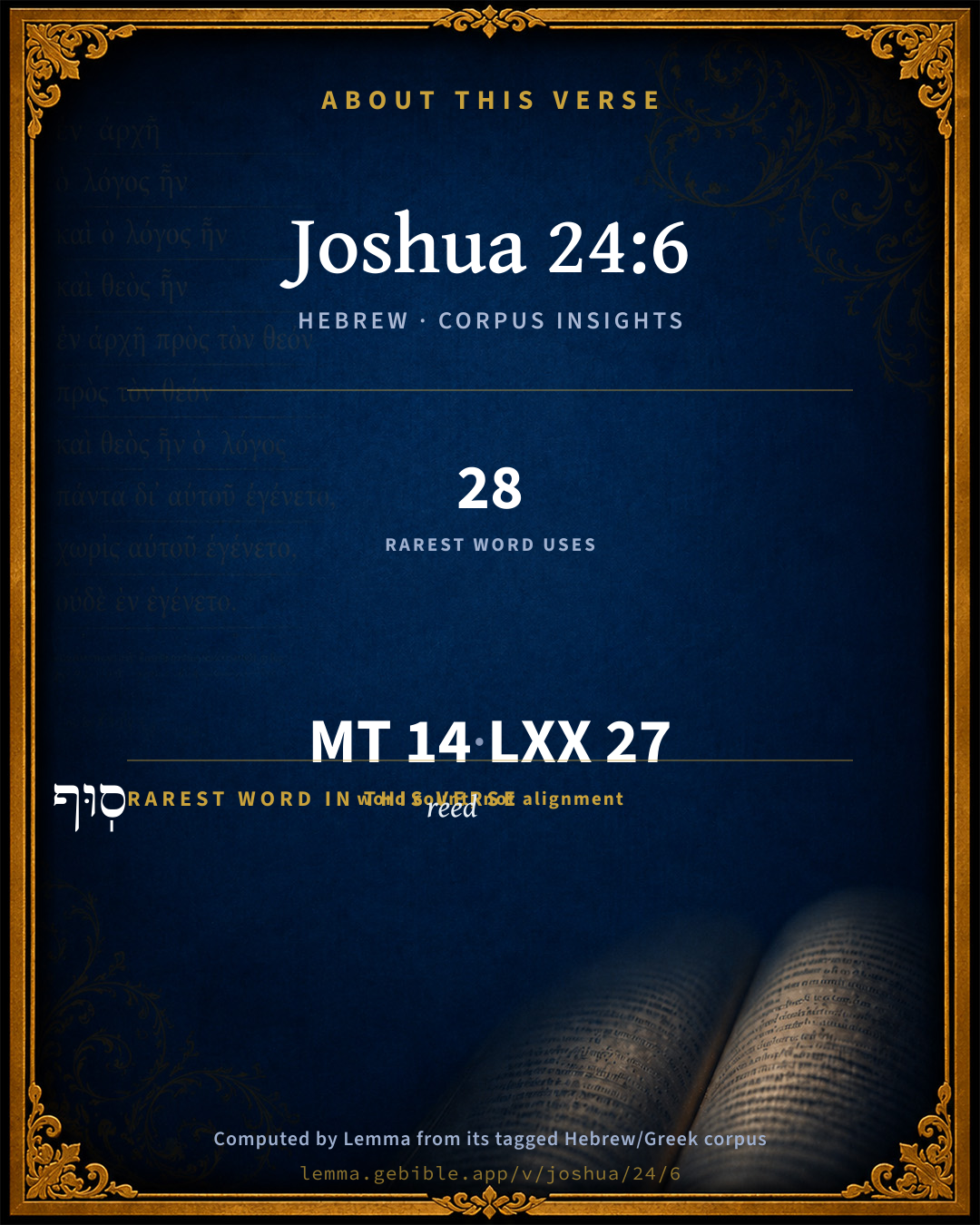
14
words
12
distinct lemmas
Historical
section

Shared distinctive vocabulary

סֽוּף reed H5488 occurs in 28 verses of the Hebrew Bible. Also found in:

Grammatical profile

  • 3 verbs
  • 9 nouns
  • 1 preposition
  • 1 particle

Verb forms

  • וָֽאוֹצִ֤יא Hiphil · Sequential Imperfect
  • וַתָּבֹ֖אוּ Qal · Sequential Imperfect
  • וַיִּרְדְּפ֨וּ Qal · Sequential Imperfect

Repetition

Words recur within this verse — often emphatic in Hebrew:

  • אֲבֽוֹתֵיכֶם֙ father H1 ×2
  • הַיָּ֑מָּה sea H3220 ×2

Hebrew & Septuagint length

In English translation the verse runs 29 words from the Hebrew and 31 from the Septuagint (LXX English) — closely comparable.

A rough comparison of the two English renderings, which tokenize alike — not a word-level alignment.

Word counts can differ between the Hebrew and the Greek without any difference in meaning — e.g. the Hebrew direct-object marker אֵת has no separate Greek word, and Greek often adds the article ὁ.

In the original languages it is 14 Hebrew tokens and 27 Greek tokens — but the two are counted differently (Hebrew bundles its prefixes and suffixes into one token; the Greek is in lemma form), so that isn’t a like-for-like length.

Cross-references

11

Topical passages linked to Joshua 24:6 in the Treasury of Scripture Knowledge — connected by theme and wording, ordered by reader-vote popularity; previews shown in the World English Bible.

  • Acts 7:36 This man led them out, having worked wonders and signs in Egypt, in the Red Sea, and in the wilderness for forty years.
  • Hebrews 11:29 By faith, they passed through the Red sea as on dry land. When the Egyptians tried to do so, they were swallowed up.
  • Exodus 12:37 The children of Israel traveled from Rameses to Succoth, about six hundred thousand on foot who were men, besides children.
  • Exodus 12:51 It happened the same day, that Yahweh brought the children of Israel out of the land of Egypt by their hosts.
  • Exodus 14:1–15 Yahweh spoke to Moses, saying,
  • Nehemiah 9:11 You divided the sea before them, so that they went through the midst of the sea on the dry land; and their pursuers you did cast into the depths, as a stone into the mighty waters.
  • Psalms 77:15–20 You have redeemed your people with your arm, The sons of Jacob and Joseph. Selah.
  • Psalms 78:13 He split the sea, and caused them to pass through; He made the waters stand as a heap.
  • Psalms 136:13–15 To him who divided the Red Sea apart; For his loving kindness endures forever;
  • Isaiah 63:12–13 who caused his glorious arm to go at the right hand of Moses? who divided the waters before them, to make himself an everlasting name?
  • Micah 6:4 For I brought you up out of the land of Egypt, And redeemed you out of the house of bondage. I sent before you Moses, Aaron, and Miriam.

Cross-references courtesy of OpenBible.info (CC BY 4.0).

Hebrew and Greek witnesses Masoretic Hebrew ↔ Greek Septuagint

The same verse in the two great witnesses to the Old Testament, shown verse-for-verse.

These are two independent witnesses, not word-aligned to each other, and the Septuagint is shown in lemma (dictionary) form.

Hebrew Joshua 24:6 Masoretic · Westminster Leningrad Codex

וָֽאוֹצִ֤יא אֶת אֲבֽוֹתֵיכֶם֙ מִמִּצְרַ֔יִם וַתָּבֹ֖אוּ הַיָּ֑מָּה וַיִּרְדְּפ֨וּ מִצְרַ֜יִם אַחֲרֵ֧י אֲבוֹתֵיכֶ֛ם בְּרֶ֥כֶב וּבְפָרָשִׁ֖ים יַם סֽוּף

I brought your fathers out of Egypt: and you came to the sea; and the Egyptians pursued after your fathers with chariots and with horsemen to the Red Sea.

World English Bible · Public Domain

Greek LXX Joshua 24:6 Septuagint · lemma form

ἐκ αἴγυπτος καί εἰςἔρχομαι εἰς ὁ θάλασσα ὁ ἐρυθρός καί καταδιώκω ὁ αἰγύπτιος ὀπίσω ὁ πατήρ σύ ἐν ἅρμα καί ἐν ἵππος εἰς ὁ θάλασσα ὁ ἐρυθρός

And afterwards God brought out our fathers from Egypt, and you⌃ entered into the Red Sea; and the Egyptians pursued after our fathers with chariots and horses into the Red Sea.

LXX2012 (modern English Septuagint) · Public Domain

Hebrew: Westminster Leningrad Codex (CC BY 4.0). Greek: Septuagint (public domain); English from LXX2012 (modern English Septuagint) (Public Domain). How the Septuagint differs from the Hebrew →

Targum (Aramaic paraphrase)

1

The Targum is the ancient Jewish Aramaic paraphrase of the Hebrew Scriptures — an interpretive translation, not the Hebrew text itself. Onkelos (literal) and Pseudo-Jonathan (expansive) render the Torah, and Jonathan the Prophets. Coverage is partial: where no permissively-licensed English translation exists for a verse, only the Aramaic is shown. This is verse-level text, not a word-by-word alignment to the Hebrew.

  1. Targum Jonathan Prophets (Joshua–Malachi)
    וְאַפְקֵית יַת אֲבָהַתְכוֹן מִמִצְרַיִם וַאֲתֵיתוּן לְיַמָא וּרְדָפוּ מִצְרָאֵי בָּתַר אֲבָהַתְכוֹן בִּרְתִיכִין וּבְפָרָשִׁין לְיַמָא דְסוּף:

    (no public-domain English translation for this verse)

    Targum Jonathan — Aramaic: “Mikraot Gedolot” (public domain). English: “Sefaria Community Translation” (CC0 1.0 (public-domain dedication)); “London "Chaldee Paraphrase," 1871” (public domain). Text via Sefaria.

Commentary

Notes on Joshua 24:6 from classic Christian and Jewish commentators (each source and its license shown beneath its notes). The classic Christian expositions comment on the surrounding passage and are grouped to its opening verse, so a note may address several verses; the Jewish commentaries on the Tanakh (Rashi and others) are per-verse, so they appear only where the commentator wrote on this verse.

Lemma curates 59 commentaries, every one of them public domain or Creative Commons licensed, each selected and text-cleaned for this edition rather than reprinted as found. About our sources →

Trapp's Complete Commentary

John Trapp

Jos 24:6 And I brought your fathers out of Egypt: and ye came unto the sea; and the Egyptians pursued after your fathers with chariots and horsemen unto the Red sea.

Ver. 6. Unto the Red Sea.] Yea, into the Red Sea God made them a fair way till they were in the midst, and then overcovered them. {Jos 24:7}

John Trapp, A Commentary or Exposition upon All the Books of the Old and New Testament (1647–1656) — public domain. Text from a community e-Sword module.

Tyndale Open Study Notes

Tyndale Open Resources

24:6 Red Sea: See study note on Exod 13:18.

Tyndale Open Study Notes — © Tyndale Open Resources, licensed CC BY-SA 4.0. Text via the HelloAO Bible API.

The Cambridge Bible for Schools and Colleges

gen. ed. J. J. S. Perowne

6. And I brought your fathers] Comp. Exo_12:37-42; Exo_12:51.

and the Egyptians pursued after your fathers] Astonished that they had not made good their flight into Asia, and deeming them entangled in the land and shut in by the wilderness, the Egyptian monarch directed all his forces, his horses and his chariots, to give chase to the fugitives (Exo_14:9).

The Cambridge Bible for Schools and Colleges (gen. ed. J. J. S. Perowne; Cambridge University Press, 1878–1918) — public domain. Text from a community e-Sword module.

John Gill's Exposition

And I brought your fathers out of Egypt,.... Which more fully expresses the sense of the last clause of Jos 24:5,

and you came unto the sea; which respects some senior persons then present; for, besides Caleb and Joshua, there were many at this time alive who came to and passed through the Red sea, at their coming out of Egypt; for those whose carcasses fell in the wilderness were such as were mere than twenty years of age at their coming out from Egypt, and who were the murmurers in the wilderness; and it may be reasonably supposed, that many of those who were under twenty years of age at that time were now living:

and the Egyptians pursued after your fathers, with chariots and horsemen, into the Red sea; of the number of their chariots and horsemen, see Exo 14:7; with these they pursued the Israelites, not only unto, but into the Red sea, following them into it; the reason of which strange action is given in Jos 24:7.

John Gill's Exposition of the Whole Bible (1746–1763) — public domain (CC PDM 1.0). Text via the HelloAO Bible API.

Haydock's Catholic Bible Commentary

You. Many still survived, and had seen these wonders, as God had only exterminated those who had murmured.

George Leo Haydock (1774–1849), Haydock's Catholic Family Bible and Commentary, 1859 edition — public domain. Excludes Psalms (Douay-Rheims chapter numbering differs from Protestant) and Deuterocanonical books (Catholic canon only).

The Pulpit Commentary

Unto the Red Sea. There is no unto in the original. Perhaps the meaning here is into the midst of, the abruptness with which it is introduced meaning more than that the Israelites arrived at it. But though without the He locale, it may be no more than the accusative of motion towards a place.

The Pulpit Commentary (1880–1919), ed. H.D.M. Spence-Jones & Joseph S. Exell — public domain. Text from a community e-Sword module.

Lesson kit

Teaching starters — assembled from the data on this page, not authored interpretation. Every prompt links to the verse data it draws on. Edit before teaching.

Joshua, in the Historical, opens this verse with 14 words (12 distinct Hebrew lemmas). Its most distinctive word is çûwph (“reed”). A historical commentator’s framing appears above. Read the whole chapter for the surrounding context.

Discussion questions

  1. What does “reed” (çûwph) contribute to the verse as a whole?
  2. Exodus 2:3 shares the word «reed» with this verse. How do the two illuminate each other?
  3. “father” occurs 2× in this one verse. What is the effect of the repetition?
  4. These translations render this verse differently; the difference is in the English rendering, not the original. What questions does that raise?
  5. The verb «וָֽאוֹצִ֤יא» is Hiphil Sequential Imperfect. How does its form color the action?
  6. Reading how Trapp's Complete Commentary and Tyndale Open Study Notes read this verse, where do the two commentators agree and where do they part?

Things to notice

Reading settings

Reading text

Shown beneath each verse's original-language words.

Old Testament
Old Testament edition

Read the OT as the Masoretic Hebrew (MT) or the Greek Septuagint (LXX).

English shown for the Greek Septuagint (in the Hebrew ↔ Greek comparison).

Comparing translations? Open the Compare panel on any verse page to stack up to four side by side.