
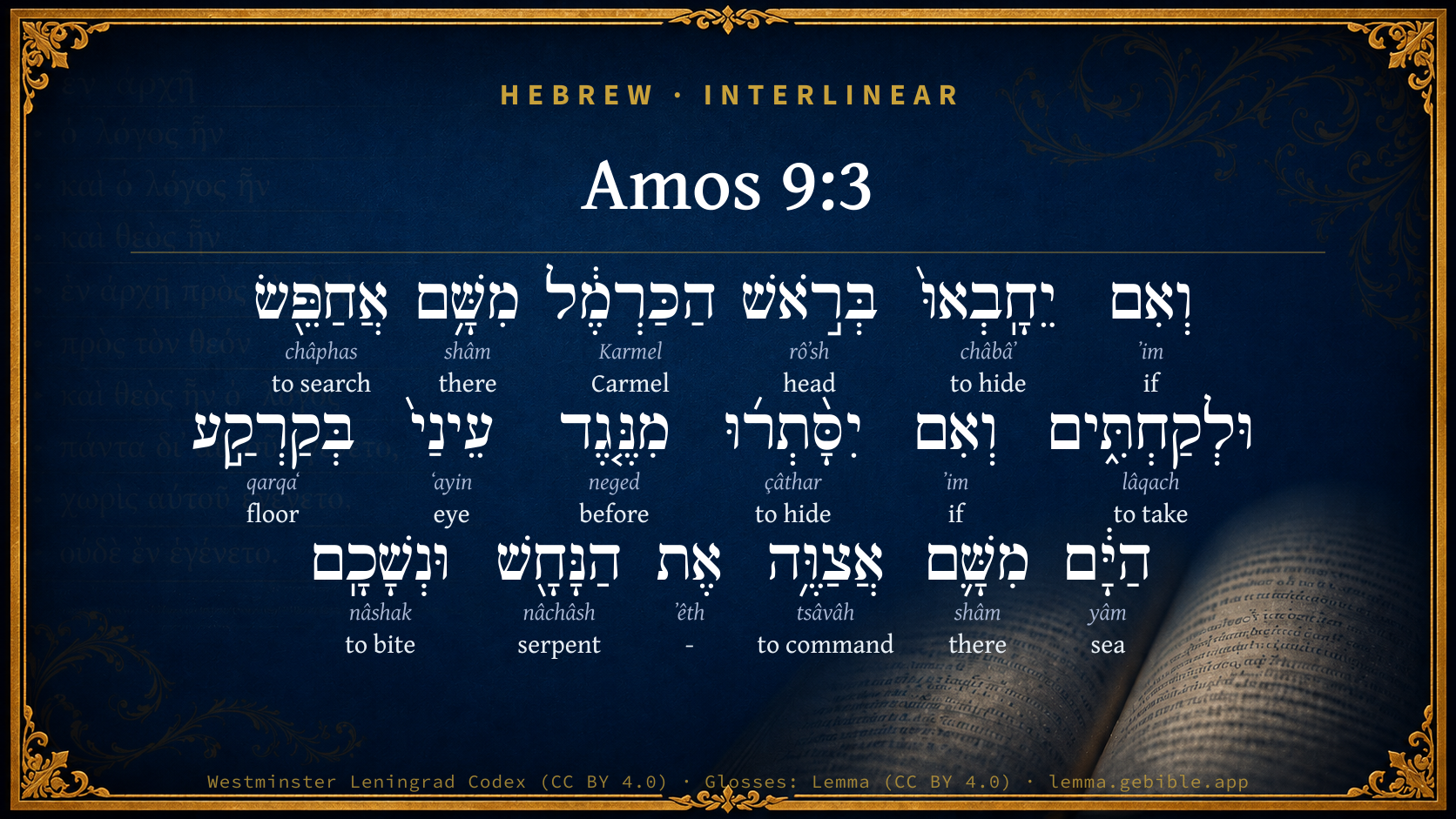
Amos 9:3

Hebrew (Westminster Leningrad Codex) Amos 9:3 appears in the Hebrew Old Testament. The text above is from the Westminster Leningrad Codex. Each word links to its Strong’s number, a concise gloss, and parsing drawn from the Open Scriptures Hebrew Bible morphology. Click any word for its full Brown-Driver-Briggs (BDB) entry.
Download image
Cite this verse

Amos 9:3 (World English Bible). Public Domain. Lemma interlinear Bible study tool, https://lemma.gebible.app/v/amos/9/3.

Show BibTeX & RIS
BibTeX
RIS
English Translation
Though they hide themselves in the top of Carmel, I will search and take them out there; and though they be hid from my sight in the bottom of the sea, there I will command the serpent, and it will bite them.
World English Bible · Public Domain
Download a study sheet

One document with this verse’s original text, its word-by-word gloss line, the meaning frame, cross-references with their text, attributed commentary, and full source and license credits — printable, and it pastes into notes with its structure intact.

This verse Autodidact and up

Study sheet (.html) Plain text (.txt)

A passage Seminary Student

Up to 50 verses in one chapter. A passage sheet keeps up to 6 commentary sources and 12 cross-references per verse, in the order this page ranks them, and says so on the sheet whenever that leaves anything out. Ask for a single verse and you get the Autodidact verse sheet above.

Everything on this page stays free to read, with no account — the sheet is a download of what is already on screen, not access to it.

Want to remove ads? Support Godless Engineer
Compare translations 3

The same verse in 3 English versions, stacked beneath the original-language interlinear above. Click any original word for its lexicon entry.

Each is an independent rendering of the whole verse — the interlinear is not word-aligned to these translations.

Highlighted words mark where these versions differ — a whole-verse word diff, not a word-by-word alignment.

  • World English Bible Public Domain
    Though they hide themselves in the top of Carmel, I will search and take them out there; and though they be hid from my sight in the bottom of the sea, there I will command the serpent, and it will bite them.
  • King James Version Public Domain
    And though they hide themselves in the top of Carmel, I will search and take them out thence; and though they be hid from my sight in the bottom of the sea, thence will I command the serpent, and he shall bite them:
  • unfoldingWord Literal Text CC BY-SA 4.0
    Though they hide on the top of Carmel, there I will search and take them. Though they are hidden from my sight in the bottom of the sea, there will I give orders to the serpent, and it will bite them.

unfoldingWord Literal Text — © unfoldingWord, licensed CC BY-SA 4.0. Word-aligned USFM3 via Door43 (git.door43.org/unfoldingWord/en_ult).

Versions to compare (up to 4)

3 of 4 selected

Show all 18 translations

Every available English version of this verse, each an independent rendering of the whole verse.

  • World English Bible Public Domain
    Though they hide themselves in the top of Carmel, I will search and take them out there; and though they be hid from my sight in the bottom of the sea, there I will command the serpent, and it will bite them.
  • Berean Standard Bible Public Domain
    Though they hide themselves atop Carmel, there I will track them and seize them; and though they hide from Me at the bottom of the sea, there I will command the serpent to bite them.
  • Majority Standard Bible Public Domain
    Though they hide themselves atop Carmel, there I will track them and seize them; and though they hide from Me at the bottom of the sea, there I will command the serpent to bite them.
  • King James Version Public Domain
    And though they hide themselves in the top of Carmel, I will search and take them out thence; and though they be hid from my sight in the bottom of the sea, thence will I command the serpent, and he shall bite them:
  • American Standard Version (1901) Public Domain
    And though they hide themselves in the top of Carmel, I will search and take them out thence; and though they be hid from my sight in the bottom of the sea, thence will I command the serpent, and it shall bite them.
  • Revised Version (1885) Public Domain
    And though they hide themselves in the top of Carmel, I will search and take them out thence; and though they be hid from my sight in the bottom of the sea, thence will I command the serpent, and he shall bite them.
  • Geneva Bible (1599) Public Domain
    And though they hide them selues in the toppe of Carmel, I will search and take them out thence: and though they be hid from my sight in the bottome of the sea, thence will I commande the serpent, and he shall bite them.
  • Douay-Rheims (1899) Public Domain
    And though they be hid in the top of Carmel, I will search and take them away from thence: and though they hide themselves from my eyes in the depth of the sea, there will I command the serpent and he shall bite them.
  • Young's Literal Translation Public Domain
    And if they be hid in the top of Carmel, From thence I search out, and have taken them, And if they be hid from Mine eyes in the bottom of the sea, From thence I command the serpent, And it hath bitten them.
  • Literal Standard Version CC BY-SA 4.0
    And if they are hid in the top of Carmel, || From there I search out, and have taken them, || And if they are hid from My eyes in the bottom of the sea, || From there I command the serpent, || And it has bitten them.
  • Unlocked Literal Bible CC BY-SA 4.0
    Though they hide on the top of Carmel, there I will search and take them. Though they are hidden from my sight in the bottom of the sea, there will I give orders to the serpent, and it will bite them.
  • unfoldingWord Literal Text CC BY-SA 4.0
    Though they hide on the top of Carmel, there I will search and take them. Though they are hidden from my sight in the bottom of the sea, there will I give orders to the serpent, and it will bite them.
  • Darby Bible Public Domain
    and though they hide themselves on the top of Carmel, I will search and take them out thence; and though they be hid from my sight in the bottom of the sea, there will I command the serpent, and it shall bite them;
  • World Messianic Bible Public Domain
    Though they hide themselves in the top of Carmel, I will search and take them out from there; and though they be hidden from my sight in the bottom of the sea, there I will command the serpent, and it will bite them.
  • Webster's Bible Public Domain
    And though they hide themselves in the top of Carmel, I will search and take them out thence; and though they are hid from my sight in the bottom of the sea, thence will I command the serpent, and he shall bite them:
  • Free Bible Version CC BY-SA 4.0
    Even if they hide themselves at the top of Mount Carmel, I will search for them and catch them. Even if they hide from me at the bottom of the sea, I will command the sea serpent to bite them.
  • Bible in Basic English Public Domain
    Though they take cover on the top of Carmel, I will go in search of them and get them out; though they keep themselves from my eyes in the bed of the sea, I will give orders to the great snake there and he will give them a bite:
  • JPS Tanakh (1917) Public Domain
    And though they hide themselves in the top of Carmel, I will search and take them out thence; and though they be hid from My sight in the bottom of the sea, thence will I command the serpent, and he shall bite them.

Literal Standard Version (2020), Covenant Press — licensed CC BY-SA 4.0. Text via the HelloAO Bible API (eBible.org). Unlocked Literal Bible (unfoldingWord) — licensed CC BY-SA 4.0. Text via the HelloAO Bible API (eBible.org). unfoldingWord Literal Text — © unfoldingWord, licensed CC BY-SA 4.0. Word-aligned USFM3 via Door43 (git.door43.org/unfoldingWord/en_ult). Free Bible Version, Dr. Jonathan Gallagher — licensed CC BY-SA 4.0. Text via the HelloAO Bible API (eBible.org).

Word by word

More ways to search: Search by grammar → Find every occurrence → Compare this word →

Practice this passage: Drill this verse → Learn its vocabulary →

בְּקַרְקַ֣ע
qarqaʻ
H7172
“in/at · floor of”
Preposition + Noun, Common, Masculine, Singular, Construct
Part of Speech
Preposition + Noun
Type
Common
Gender
Masculine
Number
Singular
State
Construct
Full BDB Definition

Origin: from H7167

TWOT: 2076

floor, bottom
  1. וְאִם ʼim H518 “and · if” Conjunction + Conjunction
  2. יֵחָֽבְאוּ֙ châbâʼ H2244 “to hide” Verb, Niphal, Imperfect, 3rd Person, Masculine, Plural
  3. בְּרֹ֣אשׁ rôʼsh H7218 “in/at · head of” Preposition + Noun, Common, Masculine, Singular, Construct
  4. הַכַּרְמֶ֔ל Karmel H3760 “the · Carmel” Particle, Definite Article + Noun, Proper
  5. מִשָּׁ֥ם shâm H8033 “from · there” Preposition + Adverb
  6. אֲחַפֵּ֖שׂ châphas H2664 “to search” Verb, Piel, Imperfect, 1st Person, Common, Singular
  7. וּלְקַחְתִּ֑ים lâqach H3947 “and · to take · them” Conjunction + Verb, Qal, Perfect, 1st Person, Common, Singular + Suffix, Personal, 3rd Person, Masculine, Plural
  8. וְאִם ʼim H518 “and · if” Conjunction + Conjunction
  9. יִסָּ֨תְר֜וּ çâthar H5641 “to hide” Verb, Niphal, Imperfect, 3rd Person, Masculine, Plural
  10. מִנֶּ֤גֶד neged H5048 “from · before” Preposition + Preposition
  11. עֵינַי֙ ʻayin H5869 “eyes · my” Noun, Common, Both, Dual, Construct + Suffix, Personal, 1st Person, Common, Singular
  12. הַיָּ֔ם yâm H3220 “the · sea” Particle, Definite Article + Noun, Common, Masculine, Singular, Absolute
  13. מִשָּׁ֛ם shâm H8033 “from · there” Preposition + Adverb
  14. אֲצַוֶּ֥ה tsâvâh H6680 “to command” Verb, Piel, Imperfect, 1st Person, Common, Singular
  15. אֶת ʼêth H853 “-” Particle, Direct Object
  16. הַנָּחָ֖שׁ nâchâsh H5175 “the · serpent” Particle, Definite Article + Noun, Common, Masculine, Singular, Absolute
  17. וּנְשָׁכָֽם nâshak H5391 “and · to bite · them” Conjunction + Verb, Qal, Perfect, 3rd Person, Masculine, Singular + Suffix, Personal, 3rd Person, Masculine, Plural

About this verse

These counts appear in no published source. They are computed here, from the morphology-tagged text and Lemma’s own curated glosses. What Lemma adds →

18
words
16
distinct lemmas
Prophets
section

Notable vocabulary

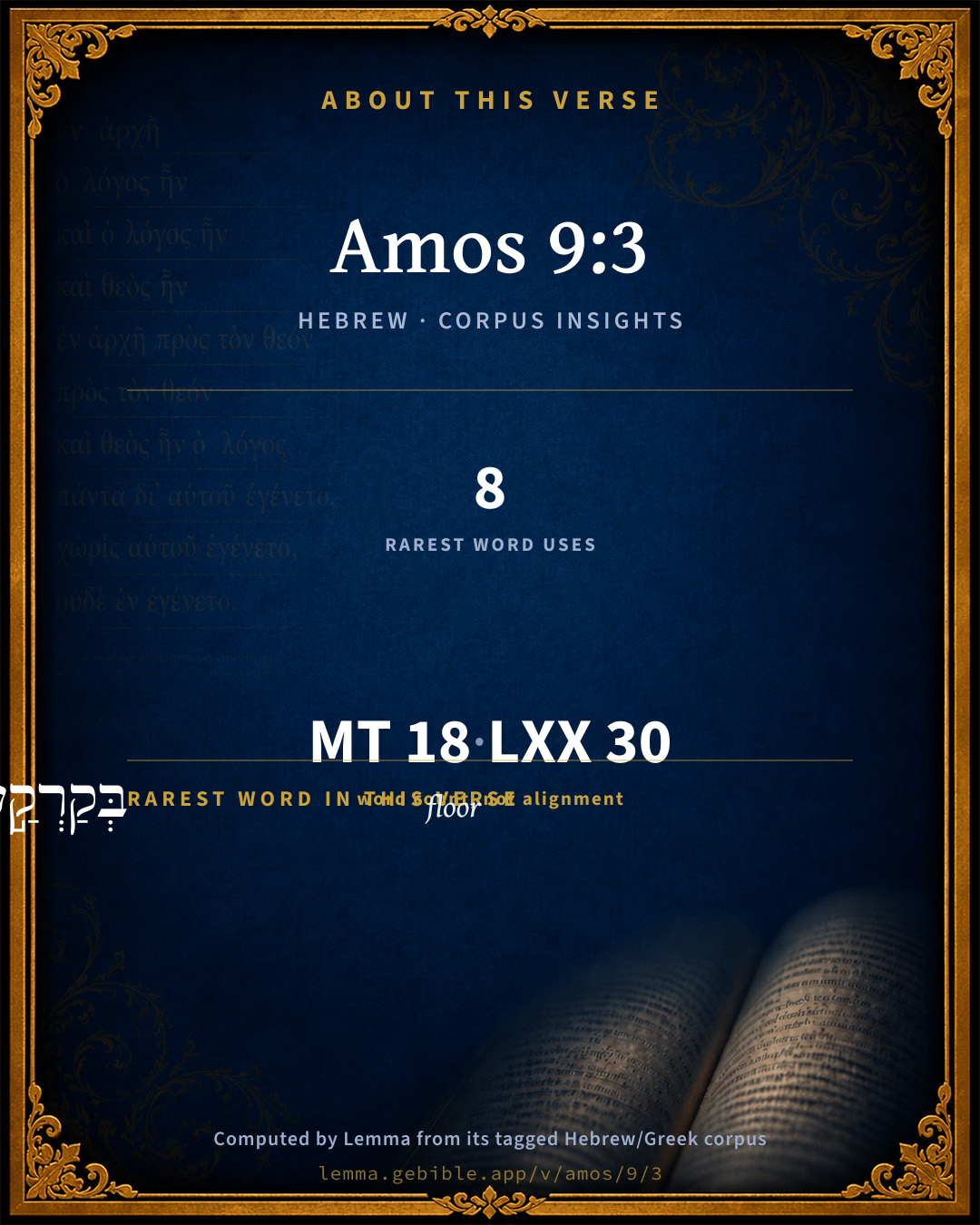
The rarest word here is בְּקַרְקַ֣ע floor H7172 — appearing just 8 times in the whole Hebrew Bible.

Shared distinctive vocabulary

בְּקַרְקַ֣ע floor H7172 occurs in 6 verses of the Hebrew Bible. Also found in:

Grammatical profile

  • 6 verbs
  • 6 nouns
  • 1 preposition
  • 2 conjunctions
  • 2 adverbs
  • 1 particle

Verb forms

  • יֵחָֽבְאוּ֙ Niphal · Imperfect
  • אֲחַפֵּ֖שׂ Piel · Imperfect
  • וּלְקַחְתִּ֑ים Qal · Perfect
  • יִסָּ֨תְר֜וּ Niphal · Imperfect
  • אֲצַוֶּ֥ה Piel · Imperfect
  • וּנְשָׁכָֽם Qal · Perfect

Repetition

Words recur within this verse — often emphatic in Hebrew:

  • מִשָּׁ֥ם there H8033 ×2
  • וְאִם if H518 ×2

Hebrew & Septuagint length

In English translation the verse runs 42 words from the Hebrew and 44 from the Septuagint (LXX English) — closely comparable.

A rough comparison of the two English renderings, which tokenize alike — not a word-level alignment.

Word counts can differ between the Hebrew and the Greek without any difference in meaning — e.g. the Hebrew direct-object marker אֵת has no separate Greek word, and Greek often adds the article ὁ.

In the original languages it is 18 Hebrew tokens and 30 Greek tokens — but the two are counted differently (Hebrew bundles its prefixes and suffixes into one token; the Greek is in lemma form), so that isn’t a like-for-like length.

Cross-references

6

Topical passages linked to Amos 9:3 in the Treasury of Scripture Knowledge — connected by theme and wording, ordered by reader-vote popularity; previews shown in the World English Bible.

  • Jeremiah 16:16 Behold, I will send for many fishermen, says Yahweh, and they shall fish them up; and afterward I will send for many hunters, and they shall hunt them from every mountain, and from every hill, and out of the clefts of the rocks.
  • Job 34:22 There is no darkness, nor thick gloom, Where the workers of iniquity may hide themselves.
  • Isaiah 27:1 In that day Yahweh with his hard and great and strong sword will punish leviathan the swift serpent, and leviathan the crooked serpent; and he will kill the monster that is in the sea.
  • Jeremiah 23:23–24 Am I a God at hand, says Yahweh, and not a God afar off?
  • Psalms 139:9–11 If I take the wings of the dawn, And settle in the uttermost parts of the sea;
  • Amos 1:2 He said: "Yahweh will roar from Zion, And utter his voice from Jerusalem; And the pastures of the shepherds will mourn, And the top of Carmel will wither."

Cross-references courtesy of OpenBible.info (CC BY 4.0).

Hebrew and Greek witnesses Masoretic Hebrew ↔ Greek Septuagint

The same verse in the two great witnesses to the Old Testament, shown verse-for-verse.

These are two independent witnesses, not word-aligned to each other, and the Septuagint is shown in lemma (dictionary) form.

Hebrew Amos 9:3 Masoretic · Westminster Leningrad Codex

וְאִם יֵחָֽבְאוּ֙ בְּרֹ֣אשׁ הַכַּרְמֶ֔ל מִשָּׁ֥ם אֲחַפֵּ֖שׂ וּלְקַחְתִּ֑ים וְאִם יִסָּ֨תְר֜וּ מִנֶּ֤גֶד עֵינַי֙ בְּקַרְקַ֣ע הַיָּ֔ם מִשָּׁ֛ם אֲצַוֶּ֥ה אֶת הַנָּחָ֖שׁ וּנְשָׁכָֽם

Though they hide themselves in the top of Carmel, I will search and take them out there; and though they be hid from my sight in the bottom of the sea, there I will command the serpent, and it will bite them.

World English Bible · Public Domain

Greek LXX Amos 9:3 Septuagint · lemma form

ἐάν ἐνκρύπτω εἰς ὁ κορυφή ὁ καρμήλος ἐκεῖθεν ἐκἐρευνάω καί λαμβάνω αὐτός καί ἐάν καταδύω ἐκ ὀφθαλμός ἐγώ εἰς ὁ βάθος ὁ θάλασσα ἐκεῖ ἐντελέω ὁ δράκων καί δάκνω αὐτός

If they hide themselves in the top of Carmel, thence will I search them out and take them; and if they should go down from my presence into the depths of the sea, there will I command the serpent, and he shall bite them.

LXX2012 (modern English Septuagint) · Public Domain

Hebrew: Westminster Leningrad Codex (CC BY 4.0). Greek: Septuagint (public domain); English from LXX2012 (modern English Septuagint) (Public Domain). How the Septuagint differs from the Hebrew →

Targum (Aramaic paraphrase)

1

The Targum is the ancient Jewish Aramaic paraphrase of the Hebrew Scriptures — an interpretive translation, not the Hebrew text itself. Onkelos (literal) and Pseudo-Jonathan (expansive) render the Torah, and Jonathan the Prophets. Coverage is partial: where no permissively-licensed English translation exists for a verse, only the Aramaic is shown. This is verse-level text, not a word-by-word alignment to the Hebrew.

  1. Targum Jonathan Prophets (Joshua–Malachi)
    וְאִם יְדַמוּן לְאִטַמְרָא בְּרֵישֵׁי מִגְדְלֵי כְרַכַּיָא מִתַּמָן אַפְקֵיד בְּלוֹשִׁין וְיִבְלְשׁוֹנוּנוּן וְאִם יִטַמְרוּן מִן קֳדָם מֵימְרִי בְנִיסֵי יַמָא מִתַּמָן אַפְקֵיד יַת עַמְמַיָא דְתַקִיפִין כְּחִוְיָא וְיִקְטְלוּנוּנוּן:

    (no public-domain English translation for this verse)

    Targum Jonathan — Aramaic: “Mikraot Gedolot” (public domain). English: “Sefaria Community Translation” (CC0 1.0 (public-domain dedication)); “London "Chaldee Paraphrase," 1871” (public domain). Text via Sefaria.

Commentary

Notes on Amos 9:3 from classic Christian and Jewish commentators (each source and its license shown beneath its notes). The classic Christian expositions comment on the surrounding passage and are grouped to its opening verse, so a note may address several verses; the Jewish commentaries on the Tanakh (Rashi and others) are per-verse, so they appear only where the commentator wrote on this verse.

Lemma curates 59 commentaries, every one of them public domain or Creative Commons licensed, each selected and text-cleaned for this edition rather than reprinted as found. About our sources →

Trapp's Complete Commentary

John Trapp

Amo 9:3 And though they hide themselves in the top of Carmel, I will search and take them out thence; and though they be hid from my sight in the bottom of the sea, thence will I command the serpent, and he shall bite them:

Ver. 3. And though they hide themselves in the top of Carmel] In densis silvis, inter spelaea ferarum. In the thick woods among the dens of the wild beasts. Lawful enough it is in some cases to hide, as David did often and Elias, and Christ, and Paul, 2Co 11:32-33, and Athanasius, and various other saints. Tertullian was too rigid in condemning all kind of hiding in evil times. But to hide from God, who searcheth Jerusalem with lights, and to whom the darkness and the light are both alike, Psa 139:12, to whom obscura clarent, muta respondent, silentium confitetur, this is base and bootless. Carmel shall not cover them, nor any other startinghole secure them from Divine justice. The poor Jews were pulled by the Romans out of privies and other underground places, where they had hid themselves, as Josephus writeth; and so were those Samaritans served by the Assyrians, who ferreted them out, and slaughtered them.

And though they be hid from my sight] As they think, but that cannot be; for he (like the optic virtue in the eye) sees all and is seen of none.

In the bottom of the sea] Which, how deep and troublesome soever, is to God a sea of glass like unto crystal, Rev 4:6 : corpus diaphanum, a pervious, clear, transparent body such as he sees through, and hath the sole command of.

Thence will I command the serpent] For therre is that crooked serpent leviathan, Isa 27:1, there are also creeping things innumerable Psa 104:26, to arrest wicked men as rebels and traitors to the highest majesty, and to drag them down to the bottom of bell. All elements and creatures shall draw upon them, as servants will do upon such as assault their lord Rebellisque facta est, quia homo numini, creatura homini, as Austin truly and trimly avoucheth.

John Trapp, A Commentary or Exposition upon All the Books of the Old and New Testament (1647–1656) — public domain. Text from a community e-Sword module.

Tyndale Open Study Notes

Tyndale Open Resources

9:3 Though Mount Carmel is not the highest mountain in the region, its lofty grandeur often represents the beauty and richness of the land. • sea serpent: In the ancient Near East, the sea was a symbol of chaos, often pitted against the national god (cp. Pss 74:14; 89:10; 104:26). However, the biblical text does not grant divine status to the sea monster (“Leviathan,” also called “Rahab”; Ps 89:9-10) but sees it as subject to the Lord’s command and judgment (Isa 27:1). Here, Amos portrays God’s sovereign power to summon the sea serpent to his service.

Tyndale Open Study Notes — © Tyndale Open Resources, licensed CC BY-SA 4.0. Text via the HelloAO Bible API.

Geneva Bible (1599)

Geneva Bible translators

He showeth that God will declare himself enemy unto them in all places, and that his elements and all creatures shall be enemies to destroy them.

Geneva Bible (1599) marginal notes — public domain. Text via Bolls.life.

Jamieson, Fausset & Brown

Robert Jamieson, A. R. Fausset & David Brown

Carmel--where the forests, and, on the west side, the caves, furnished hiding-places (Amo 1:2; Jdg 6:2; Sa1 13:6).

the sea--the Mediterranean, which flows at the foot of Mount Carmel; forming a strong antithesis to it.

command the serpent--the sea-serpent, a term used for any great water monster (Isa 27:1). The symbol of cruel and oppressive kings (Psa 74:13-14).

Jamieson, Fausset & Brown — Commentary Critical and Explanatory on the Whole Bible (1871) — public domain (CC PDM 1.0). Text via the HelloAO Bible API.

Adam Clarke's Commentary

Verse 3. Though they hide themselves] All these are metaphorical expressions, to show the impossibility of escape.

Adam Clarke's Commentary on the Bible (1810–1826) — public domain. Text from a community e-Sword/MySword module.

John Calvin's Commentaries

Now as to what he says, I will command the serpent to bite them, some understand by נחש, nuchesh, not a serpent on hand, but the whale, or some other marine animal, as the leviathan, which is mentioned in Scripture; and we may learn from other parts of Scripture that “nachash” means not only a serpent, but also a whale or some animal living in the sea. In a word, God intimates, that he would be armed everywhere, whenever he should resolve to punish his adversaries, and that in all elements are means in readiness, by which he can destroy the wicked, who seek to escape from his hand.

John Calvin's Commentaries (1540-1563) — public domain. Text from the Calvin Translation Society English edition (1840s-50s) via the Christian Classics Ethereal Library (ccel.org). Calvin's coverage is partial (roughly two-thirds of the Bible); uncommented books and verses are honest gaps, never fabricated. The 19th-century editor's footnotes and remarks are omitted so the notes are faithfully Calvin's own voice.

Ellicott's Commentary for English Readers

(3) Serpent.—On this expression, i.e., the “waterserpent,” comp. Isa_27:1.

A Bible Commentary for English Readers, edited by Charles John Ellicott (1878–1897) — public domain. Text from a community e-Sword module.

The Cambridge Bible for Schools and Colleges

gen. ed. J. J. S. Perowne

3. Two other examples of remote or inaccessible hiding-places, similarly contrasted; Carmel, rising abruptly out of the sea, and the depths of the ocean which it overhangs. Carmel was in two ways a hiding-place: (1) As usual in limestone formations, it abounds in caves—said by some to be more than 2000 in number—often of great length, with narrow entrances, and extremely tortuous. These caves are “so close to each other that a pursuer would not discern into which the fugitive had vanished; so serpentine within, that ‘ten steps apart,’ says a traveler[198], ‘we could hear each others’ voices, but could not see each other’ ” (Pusey). (2) The summit of Carmel, about 1800 ft. above the sea, is thickly wooded (see the descriptions quoted on ch. Amo_1:2; and comp. Mic_7:14); in the first cent. a.d., according to Strabo (xvi. 2. 28), its forests were the retreat of robbers. Carmel, projecting into the sea, would be the last hiding-place in the land: if a fugitive found no safety there, he could seek it next only in the sea. But even the sea, as the next clause says, should afford no safety for these Israelites.

[198] Schulz, Leitung des Höchsten, v. 186; Paulus, Reisen, vii. 43.

the serpent] In warm tropical regions, highly venomous marine serpents (Hydropidae) are found in the sea (see particulars in Cantor, Zoological Transactions, ii. pp. 303 ff., referred to by Dr Pusey). They are not, however, known in the Mediterranean; and the reference is more probably to an imaginary monster, supposed by the Hebrews to have its home at the bottom of the ocean, and to be at the disposal of the Almighty.

The Cambridge Bible for Schools and Colleges (gen. ed. J. J. S. Perowne; Cambridge University Press, 1878–1918) — public domain. Text from a community e-Sword module.

John Gill's Exposition

And though they hide themselves in the top of Carmel,.... One of the highest mountains in the land of Israel; in the woods upon it, and caves in it:

I will search and take them out from thence: by directing their enemies where to find them: so the Targum,

"if they think to be hid in the tops of the towers of castles, thither will I command the searchers, and they shall search them:''

and though they be hid from my sight in the bottom of the sea; get into ships, going by sea to distant parts; or make their escape to isles upon the sea afar off, where they may think themselves safe:

thence will I command the serpent, and he shall bite them; the dragon that is in the sea, Isa 27:1; the great whale in the sea, or the leviathan, so Aben Ezra, Kimchi, and Ben Melech; and is that kind of whale which is called the "Zygaena", as Bochart (w) thinks; and which he, from various writers, describes as very monstrous, horrible, and terrible, having five rows of teeth, and very numerous; and which not only devours other large fishes, but men swimming it meets with; and, having such teeth, with great propriety may be said to bite. It appears from hence that there are sea serpents, as well as land ones, to which the allusion is. Erich Pantoppidan, the present bishop of Bergen (x), speaks of a "see ormen", or sea snake, in the northern seas, which he describes as very monstrous and very terrible to seafaring men, being of seven or eight folds, each fold a fathom distant; nay, of the length of a cable, a hundred fathom, or six hundred English feet; yea, of one as thick as a pipe of wine, with twenty five folds. Some such terrible creature is here respected, though figuratively understood, and designs some crafty, powerful, and cruel enemy. The Targum paraphrases it, though hid

"in the isles of the sea, thither will I command the people strong like serpents, and they shall kill them;''

see Psa 139:9.

(w) Hierozoic. par. 2. l. 5. c. 13. p. 747. (x) Natural History of Norway, par. 2. p. 198, 199, 207.

John Gill's Exposition of the Whole Bible (1746–1763) — public domain (CC PDM 1.0). Text via the HelloAO Bible API.

Albert Barnes' Notes on the Bible

He had contrasted heaven and hell, as places impossible for man to reach; as I David says, “If I ascend into heaven, Thou art there: If l make my bed in hell, behold Thee” Psa 139:8. Now, of places in a manner accessible, he contrasts Mount Carmel, which rises abruptly out of the sea, with depths of that ocean which it overhangs. Carmel was in two ways a hiding place.

1) Through its caves (some say 1,000 , some 2,000) with which it is perforated, whose entrance sometimes scarcely admits a single man; so close to each other, that a pursuer would not discern into which the fugitive had vanished; so serpentine within, that, “10 steps apart,” says a traveler , “we could hear each others’ voices, but could not see each other.” : “Carmel is perforated by a hundredfold greater or lesser clefts. Even in the garb of loveliness and richness, the majestic Mount, by its clefts, caves, and rocky battlements, excites in the wanderer who sees them for the first time, a feeling of mingled wonder and fear. A whole army of enemies, as of nature’s terrors, could hide themselves in these rock-clefts.”

2) Its summit, about 1800 feet above the sea , “is covered with pines and oaks, and lower down with olive and laurel trees” . These forests furnished hiding places to robberhordes at the time of our Lord. In those caves, Elijah probably at times was hidden from the persecution of Ahab and Jezebel. It seems to be spoken of as his abode 1Ki 18:19, as also one resort of Elishas 2Ki 2:25; 2Ki 4:25. Carmel, as the western extremity of the land, projecting into the sea, was the last place which a fugitive would reach. If he found no safety there, there was none in his whole land. Nor was there by sea;

And though they be hid - (rather, “hide themselves”) from My sight in the bottom of the sea, thence will I command the serpent The sea too has its deadly serpents. Their classes are few; the individuals in those classes are much more numerous than those of the land-serpents . Their shoals have furnished to sailors tokens of approaching land . Their chief abode, as traced in modern times, is between the Tropics .

The ancients knew of them perhaps in the Persian gulf or perhaps the Red Sea . All are “highly venomous” and “very ferocious.” : “The virulence of their venom is equal to that of the “most” pernicious land-serpents.” All things, with their will or without it through animal instinct, as the serpent, or their savage passions, as the Assyrian, fulfill the will of God. As, at His command, the fish whom He had prepared, swallowed Jonah, for his preservation, so, at His “command, the serpent” should come forth from the recesses of the sea to the sinner’s greater suffering.

Albert Barnes' Notes on the Bible (1834–1885) — public domain. Text from a community e-Sword/MySword module.

Haydock's Catholic Bible Commentary

Top, in woods, or caverns. --- Serpent. Fishes and sea monsters are so called.

George Leo Haydock (1774–1849), Haydock's Catholic Family Bible and Commentary, 1859 edition — public domain. Excludes Psalms (Douay-Rheims chapter numbering differs from Protestant) and Deuterocanonical books (Catholic canon only).

Matthew Poole's English Annotations

Though they hide themselves in the top of Carmel; one high woody mountain, shelter and hiding-place for wild beasts, by a figure put for all the rest; if they think to be safe where wild beasts find a refuge, they are deceived,

I will search and take them out thence; I will, saith God, hunt them out, and take them.

Though they be hid from my sight in the bottom of the sea: this is an irony like brutish atheists, they think to hide themselves in the bottom of the sea.

Thence will I command the serpent, crocodile or shark some sea monster, and he shall bite them; devour them. Miserable Israel, to whom nor sea, nor mountains, nor heaven, nor hell will afford a hiding-place!

Matthew Poole's English Annotations on the Holy Bible (1683–1685) — public domain. Text from a community e-Sword/MySword module.

The Pulpit Commentary

The top of Carmel. Among the woods and thickets. There are no eaves on the summit of Carmel. "Amos tolls us that in his day the top of it was a place to hide in; nor has it changed its character in this respect ... I would not have been prompted to place "the top of Carmel" third in such a series of hiding places, yet I can fully appreciate the comparison from my own experience. Ascending from the south, we followed a wild, narrow wady overhung by trees, bushes, and tangled creepers, through which my guide thought we could get up to the top; but it became absolutely impracticable, and we were obliged to find our way back again. And even after we reached the summit, it was so rough and broken in some places, and the thorn bushes so thickset and sharp, that our clothes were torn and our hands and faces severely lacerated; nor could I see my guide at times ten steps ahead of me. From such biblical intimations, we may believe that Carmel was not very thickly inhabited" (Thomson, "The Land and the Book," Central Palestine, p. 237, etc.). Other writers speak of the occurrence of caves and deep valleys in the Carmel range. In the bottom of the sea. Both this and heaven (ver. 2) are impracticable hiding places, and are used poetically to show the absolute impossibility of escape. Serpent (nachash, elsewhere called leviathan and tannin, Isa_27:1) some kind of seamonster supposed to be venomous. Dr. Pusey mentions that certain poisonous hydrophidae are found in the Indian and Pacific Oceans. and may probably infest the Red Sea and the Persian Gulf.

The Pulpit Commentary (1880–1919), ed. H.D.M. Spence-Jones & Joseph S. Exell — public domain. Text from a community e-Sword module.

John Wesley's Explanatory Notes

The serpent - The crocodile or shark.

John Wesley, Explanatory Notes Upon the Whole Bible (1754–1765) — public domain. Text via the GEBible commentary corpus.

unfoldingWord translationNotes

Door43 World Missions Community

Though they hide on the top of Carmel ... Though they are hidden from my sight in the bottom of the sea

Yahweh gives an exaggerated image of the people fleeing to the top of mount Carmel or to the bottom of the sea to escape being killed. Here "top of Carmel" and "bottom of the sea" are a merism that represents all places. AT: "Even if they were to hide on the top of Carmel ... Even if they tried to go the bottom sea, thinking that I could not see them" (See: Hyperbole and Generalization and Merism)

serpent

an unknown fierce sea animal, not the snake in the garden of Eden and not a common snake

Though they go into captivity, driven by their enemies before them

This can be stated in active form. AT: "Though enemies capture them and force them to go to a foreign land" (See: Active or Passive)

there will I give orders to the sword, and it will kill them

Here "sword" represents their enemies. AT: "there I will cause their enemies to kill them" (See: Metonymy)

I will keep my eyes on them for harm and not for good

Here "eyes" represents seeing. The phrase "keep my eyes on them" is an idiom that means to watch closely. AT: "I will watch closely and make sure only bad things happen to them and not good things" (See: Metonymy and Idiom)

translationWords

Carmel

captive

unfoldingWord translationNotes — © Distant Shores Media and the Door43 World Missions Community, licensed CC BY-SA 4.0. Source: git.door43.org/Door43/en_tn.

Rashi

Rabbi Shlomo Yitzchaki (Rashi)

at the peak of Carmel—At the top of the towers of the fortifed cities. [from Jonathan]

from there I will search [them out]—From there I will appoint searchers, and they will search them out. [from Jonathan]

in the land of the sea Heb. בְּקַרְקַע הַיָּם. [Jonathan renders:] בְּנִיסֵי יַמָּא, in the islands of the sea.

I will command the serpent—Jonathan renders: peoples as strong as a serpent.

Rashi on the Tanakh — English translations: “The Judaica Press complete Tanach with Rashi, translated by A. J. Rosenberg” (CC BY 4.0); “Pentateuch with Rashi's commentary by M. Rosenbaum and A.M. Silbermann, 1929-1934” (public domain); “The Metsudah Tanach series, Lakewood, N.J” (CC BY 4.0); and “The Book of Joshua, Metsudah Publications, 1997” (CC BY 4.0). Text via Sefaria.

Lesson kit

Teaching starters — assembled from the data on this page, not authored interpretation. Every prompt links to the verse data it draws on. Edit before teaching.

Amos, in the Prophets, opens this verse with 18 words (16 distinct Hebrew lemmas). Its most distinctive word is qarqaʻ (“floor”). A historical commentator’s framing appears above. Read the whole chapter for the surrounding context.

Discussion questions

  1. The word qarqaʻ carries the sense “floor.” How does it shape the verse?
  2. Numbers 5:17 shares the word «floor» with this verse. How do the two illuminate each other?
  3. “there” occurs 2× in this one verse. What is the effect of the repetition?
  4. These translations render this verse differently; the difference is in the English rendering, not the original. What questions does that raise?
  5. The verb «יֵחָֽבְאוּ֙» is Niphal Imperfect. How does its form color the action?
  6. Reading how Trapp's Complete Commentary and Tyndale Open Study Notes read this verse, where do the two commentators agree and where do they part?

Things to notice

Reading settings

Reading text

Shown beneath each verse's original-language words.

Old Testament
Old Testament edition

Read the OT as the Masoretic Hebrew (MT) or the Greek Septuagint (LXX).

English shown for the Greek Septuagint (in the Hebrew ↔ Greek comparison).

Comparing translations? Open the Compare panel on any verse page to stack up to four side by side.