Amos 8:12

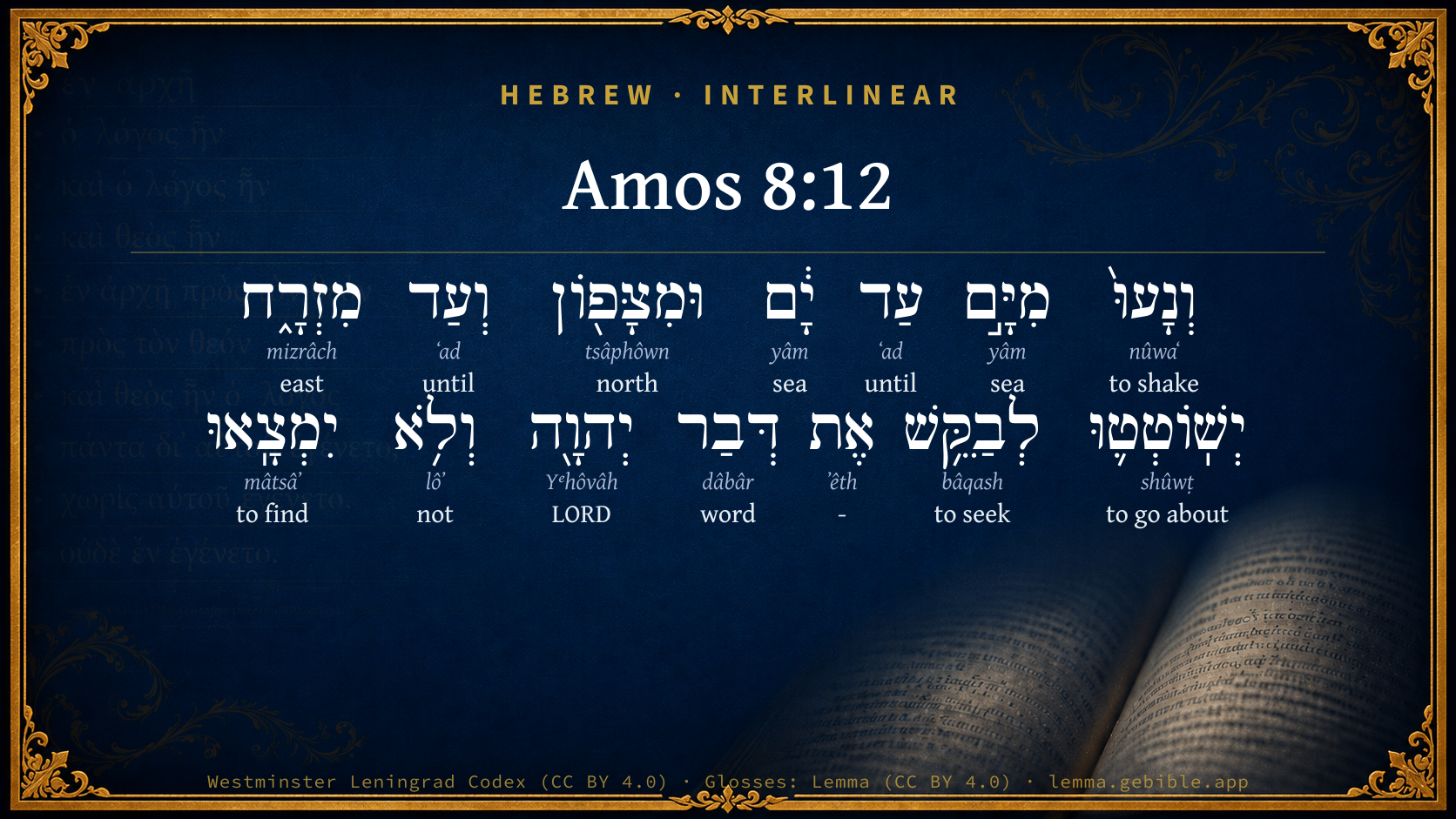
Hebrew (Westminster Leningrad Codex) Amos 8:12 appears in the Hebrew Old Testament. The text above is from the Westminster Leningrad Codex. Each word links to its Strong’s number, a concise gloss, and parsing drawn from the Open Scriptures Hebrew Bible morphology. Click any word for its full Brown-Driver-Briggs (BDB) entry.
Download image
Cite this verse

Amos 8:12 (World English Bible). Public Domain. Lemma interlinear Bible study tool, https://lemma.gebible.app/v/amos/8/12.

Show BibTeX & RIS
BibTeX
RIS
English Translation
They will wander from sea to sea, And from the north even to the east; They will run back and forth to seek the word of Yahweh, And will not find it.
World English Bible · Public Domain
Download a study sheet

One document with this verse’s original text, its word-by-word gloss line, the meaning frame, cross-references with their text, attributed commentary, and full source and license credits — printable, and it pastes into notes with its structure intact.

This verse Autodidact and up

Study sheet (.html) Plain text (.txt)

A passage Seminary Student

Up to 50 verses in one chapter. A passage sheet keeps up to 6 commentary sources and 12 cross-references per verse, in the order this page ranks them, and says so on the sheet whenever that leaves anything out. Ask for a single verse and you get the Autodidact verse sheet above.

Everything on this page stays free to read, with no account — the sheet is a download of what is already on screen, not access to it.

Want to remove ads? Support Godless Engineer
Compare translations 3

The same verse in 3 English versions, stacked beneath the original-language interlinear above. Click any original word for its lexicon entry.

Each is an independent rendering of the whole verse — the interlinear is not word-aligned to these translations.

Highlighted words mark where these versions differ — a whole-verse word diff, not a word-by-word alignment.

  • World English Bible Public Domain
    They will wander from sea to sea, And from the north even to the east; They will run back and forth to seek the word of Yahweh, And will not find it.
  • King James Version Public Domain
    And they shall wander from sea to sea, and from the north even to the east, they shall run to and fro to seek the word of the LORD, and shall not find it.
  • unfoldingWord Literal Text CC BY-SA 4.0
    They will stagger from sea to sea; they will run from the north to the east to seek the word of Yahweh, but they will not find it.

unfoldingWord Literal Text — © unfoldingWord, licensed CC BY-SA 4.0. Word-aligned USFM3 via Door43 (git.door43.org/unfoldingWord/en_ult).

Versions to compare (up to 4)

3 of 4 selected

Show all 18 translations

Every available English version of this verse, each an independent rendering of the whole verse.

  • World English Bible Public Domain
    They will wander from sea to sea, And from the north even to the east; They will run back and forth to seek the word of Yahweh, And will not find it.
  • Berean Standard Bible Public Domain
    People will stagger from sea to sea and roam from north to east, seeking the word of the LORD, but they will not find it.
  • Majority Standard Bible Public Domain
    People will stagger from sea to sea and roam from north to east, seeking the word of the LORD, but they will not find it.
  • King James Version Public Domain
    And they shall wander from sea to sea, and from the north even to the east, they shall run to and fro to seek the word of the LORD, and shall not find it.
  • American Standard Version (1901) Public Domain
    And they shall wander from sea to sea, and from the north even to the east; they shall run to and fro to seek the word of Jehovah, and shall not find it.
  • Revised Version (1885) Public Domain
    And they shall wander from sea to sea, and from the north even to the east; they shall run to and fro to seek the word of the LORD, and shall not find it.
  • Geneva Bible (1599) Public Domain
    And they shall wander from sea to sea, and from the North euen vnto the East shall they run to and from to seeke the worde of the Lord, and shall not finde it.
  • Douay-Rheims (1899) Public Domain
    And they shall move from sea to sea, and from the north to the east: they shall go about seeking the word of the Lord, and shall not find it.
  • Young's Literal Translation Public Domain
    And they have wandered from sea unto sea, And from north even unto east, They go to and fro to seek the word of Jehovah, And they do not find.
  • Literal Standard Version CC BY-SA 4.0
    And they have wandered from sea to sea, || And from north even to east, || They go to and fro to seek the word of YHWH, || And they do not find [it].
  • Unlocked Literal Bible CC BY-SA 4.0
    They will stagger from sea to sea; they will run from the north to the east to seek the word of Yahweh, but they will not find it.
  • unfoldingWord Literal Text CC BY-SA 4.0
    They will stagger from sea to sea; they will run from the north to the east to seek the word of Yahweh, but they will not find it.
  • Darby Bible Public Domain
    And they shall wander from sea to sea, and from the north to the east; they shall run to and fro to seek the word of Jehovah, and shall not find it.
  • World Messianic Bible Public Domain
    They will wander from sea to sea, and from the north even to the east; they will run back and forth to seek the LORD’s word, and will not find it.
  • Webster's Bible Public Domain
    And they shall wander from sea to sea, and from the north even to the east, they shall run to and fro to seek the word of the LORD, and shall not find it.
  • Free Bible Version CC BY-SA 4.0
    People will wander from sea to sea, from north to east, running to and fro searching for the word of the Lord, but they will not find it.
  • Bible in Basic English Public Domain
    And they will go wandering from sea to sea, and from the north even to the east, running here and there in search of the word of the Lord, and they will not get it.
  • JPS Tanakh (1917) Public Domain
    And they shall wander from sea to sea, and from the north even to the east; they shall run to and fro to seek the word of the LORD, and shall not find it.

Literal Standard Version (2020), Covenant Press — licensed CC BY-SA 4.0. Text via the HelloAO Bible API (eBible.org). Unlocked Literal Bible (unfoldingWord) — licensed CC BY-SA 4.0. Text via the HelloAO Bible API (eBible.org). unfoldingWord Literal Text — © unfoldingWord, licensed CC BY-SA 4.0. Word-aligned USFM3 via Door43 (git.door43.org/unfoldingWord/en_ult). Free Bible Version, Dr. Jonathan Gallagher — licensed CC BY-SA 4.0. Text via the HelloAO Bible API (eBible.org).

Word by word

More ways to search: Search by grammar → Find every occurrence → Compare this word →

Practice this passage: Drill this verse → Learn its vocabulary →

יְשֽׁוֹטְט֛וּ
shûwṭ
H7751
“to go about”
Verb, Polel, Imperfect, 3rd Person, Masculine, Plural
Part of Speech
Verb
Stem
Polel
Form
Imperfect
Person
3rd Person
Gender
Masculine
Number
Plural
Full BDB Definition

Origin: a primitive root

TWOT: 2344 , 2344d

to go, go or rove about, go to and fro - (Qal) to go or rove about - (Polel) to go to and fro, go eagerly or quickly to and fro - (Hithpolel) to run to and fro - to row
  1. וְנָעוּ֙ nûwaʻ H5128 “and · to shake” Conjunction + Verb, Qal, Sequential Perfect, 3rd Person, Common, Plural
  2. מִיָּ֣ם yâm H3220 “from · sea” Preposition + Noun, Common, Masculine, Singular, Absolute
  3. עַד ʻad H5704 “until” Preposition
  4. יָ֔ם yâm H3220 “sea” Noun, Common, Masculine, Singular, Absolute
  5. וּמִצָּפ֖וֹן tsâphôwn H6828 “and · from · north” Conjunction + Preposition + Noun, Common, Feminine, Singular, Absolute
  6. וְעַד ʻad H5704 “and · until” Conjunction + Preposition
  7. מִזְרָ֑ח mizrâch H4217 “east” Noun, Common, Masculine, Singular, Absolute
  8. לְבַקֵּ֥שׁ bâqash H1245 “to seek” Preposition + Verb, Piel, Infinitive Construct
  9. אֶת ʼêth H853 “-” Particle, Direct Object
  10. דְּבַר dâbâr H1697 “word of” Noun, Common, Masculine, Singular, Construct
  11. יְהוָ֖ה Yᵉhôvâh H3068 “LORD” Noun, Proper
  12. וְלֹ֥א lôʼ H3808 “and · not” Conjunction + Particle, Negative
  13. יִמְצָֽאוּ mâtsâʼ H4672 “to find” Verb, Qal, Imperfect, 3rd Person, Masculine, Plural

About this verse

These counts appear in no published source. They are computed here, from the morphology-tagged text and Lemma’s own curated glosses. What Lemma adds →

14
words
12
distinct lemmas
Prophets
section

Notable vocabulary

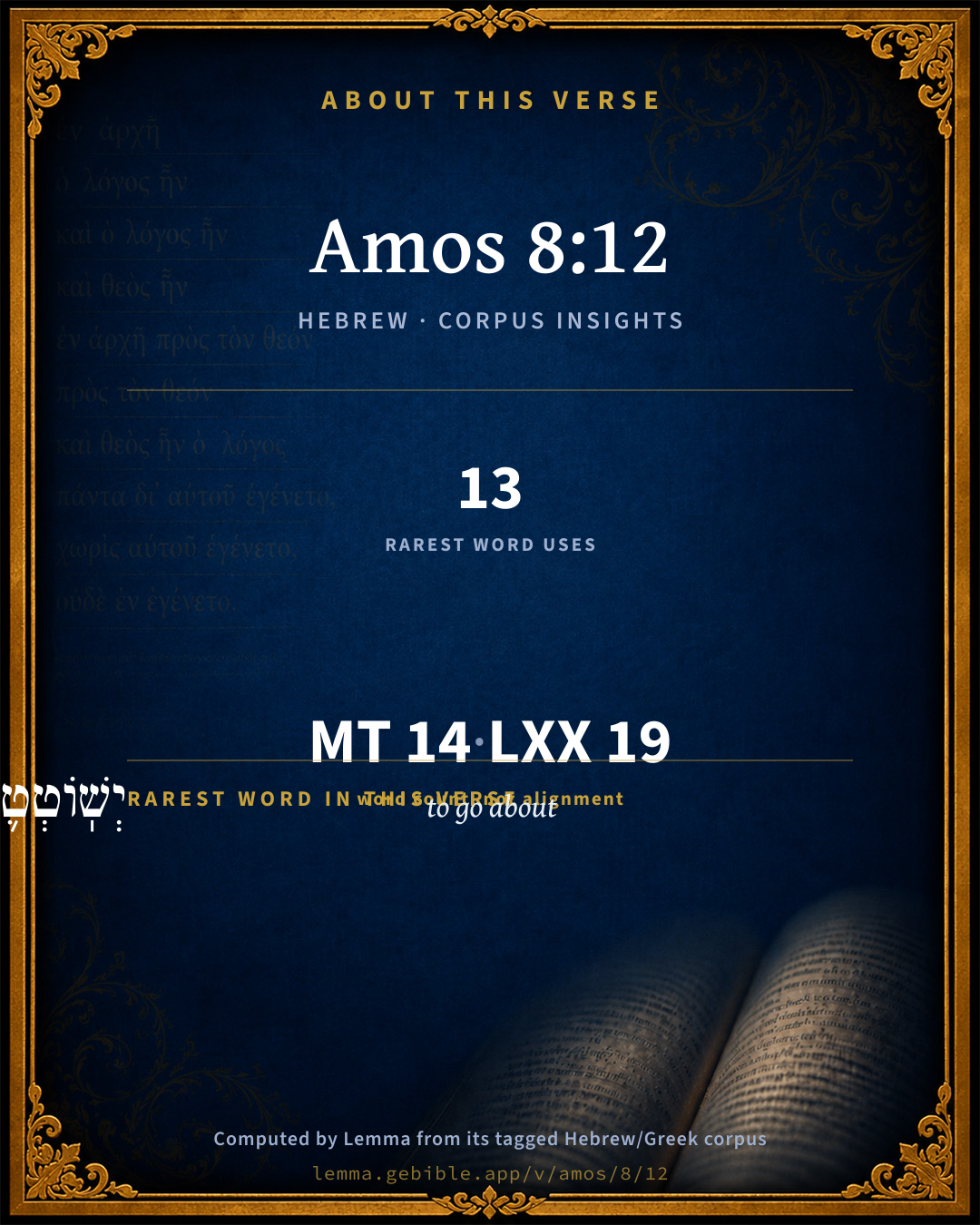
The rarest word here is יְשֽׁוֹטְט֛וּ to go about H7751 — appearing just 13 times in the whole Hebrew Bible.

Shared distinctive vocabulary

יְשֽׁוֹטְט֛וּ to go about H7751 occurs in 13 verses of the Hebrew Bible. Also found in:

Grammatical profile

  • 4 verbs
  • 6 nouns
  • 2 prepositions
  • 2 particles

Verb forms

  • וְנָעוּ֙ Qal · Sequential Perfect
  • יְשֽׁוֹטְט֛וּ Polel · Imperfect
  • לְבַקֵּ֥שׁ Piel · Infinitive Construct
  • יִמְצָֽאוּ Qal · Imperfect

Repetition

Words recur within this verse — often emphatic in Hebrew:

  • מִיָּ֣ם sea H3220 ×2
  • עַד until H5704 ×2

Hebrew & Septuagint length

In English translation the verse runs 32 words from the Hebrew and 35 from the Septuagint (LXX English) — closely comparable.

A rough comparison of the two English renderings, which tokenize alike — not a word-level alignment.

Word counts can differ between the Hebrew and the Greek without any difference in meaning — e.g. the Hebrew direct-object marker אֵת has no separate Greek word, and Greek often adds the article ὁ.

In the original languages it is 14 Hebrew tokens and 19 Greek tokens — but the two are counted differently (Hebrew bundles its prefixes and suffixes into one token; the Greek is in lemma form), so that isn’t a like-for-like length.

Cross-references

7

Topical passages linked to Amos 8:12 in the Treasury of Scripture Knowledge — connected by theme and wording, ordered by reader-vote popularity; previews shown in the World English Bible.

  • Romans 11:7–10 What then? That which Israel seeks for, that he didn't obtain, but the chosen ones obtained it, and the rest were hardened.
  • Proverbs 14:6 A scoffer seeks wisdom, and doesn't find it, But knowledge comes easily to a discerning person.
  • Daniel 12:4 But you, Daniel, shut up the words, and seal the book, even to the time of the end: many shall run back and forth, and knowledge shall be increased."
  • Matthew 12:30 "He who is not with me is against me, and he who doesn't gather with me, scatters.
  • Matthew 24:23–26 "Then if any man tells you, 'Behold, here is the Christ,' or, 'There,' don't believe it.
  • 2 Timothy 3:6–7 For of these are those who creep into houses, and take captive gullible women loaded down with sins, led away by various lusts,
  • Romans 9:31–33 but Israel, following after a law of righteousness, didn't arrive at the law of righteousness.

Cross-references courtesy of OpenBible.info (CC BY 4.0).

Hebrew and Greek witnesses Masoretic Hebrew ↔ Greek Septuagint

The same verse in the two great witnesses to the Old Testament, shown verse-for-verse.

These are two independent witnesses, not word-aligned to each other, and the Septuagint is shown in lemma (dictionary) form.

Hebrew Amos 8:12 Masoretic · Westminster Leningrad Codex

וְנָעוּ֙ מִיָּ֣ם עַד יָ֔ם וּמִצָּפ֖וֹן וְעַד מִזְרָ֑ח יְשֽׁוֹטְט֛וּ לְבַקֵּ֥שׁ אֶת דְּבַר יְהוָ֖ה וְלֹ֥א יִמְצָֽאוּ

They will wander from sea to sea, And from the north even to the east; They will run back and forth to seek the word of Yahweh, And will not find it.

World English Bible · Public Domain

Greek LXX Amos 8:12 Septuagint · lemma form

καί σαλεύω ὕδωρ ἕως θάλασσα καί ἀπό βορέας ἕως ἀνατολή περιτρέχω ζητέω ὁ λόγος κύριος καί οὐ μή εὑρίσκω

And the waters shall be troubled from sea to sea, and from the north to the east shall men run hither and there, seeking the word of the Lord, and they shall not find it.

LXX2012 (modern English Septuagint) · Public Domain

On this verse, The Pulpit Commentary discusses the Septuagint’s reading. Read the note in Commentary ↓

Hebrew: Westminster Leningrad Codex (CC BY 4.0). Greek: Septuagint (public domain); English from LXX2012 (modern English Septuagint) (Public Domain). How the Septuagint differs from the Hebrew →

Targum (Aramaic paraphrase)

1

The Targum is the ancient Jewish Aramaic paraphrase of the Hebrew Scriptures — an interpretive translation, not the Hebrew text itself. Onkelos (literal) and Pseudo-Jonathan (expansive) render the Torah, and Jonathan the Prophets. Coverage is partial: where no permissively-licensed English translation exists for a verse, only the Aramaic is shown. This is verse-level text, not a word-by-word alignment to the Hebrew.

  1. Targum Jonathan Prophets (Joshua–Malachi)
    וְיִשְׁתַּלְהוֹן מִיָמָא עַד מַעַרְבָא וּמִצִפוּנָא עַד מְדִינְחָא יַהֲכוּן לְמִתְבַּע אוּלְפַן מִן קֳדָם יְיָ וְלָא יִשְׁכְּחוּן:

    (no public-domain English translation for this verse)

    Targum Jonathan — Aramaic: “Mikraot Gedolot” (public domain). English: “Sefaria Community Translation” (CC0 1.0 (public-domain dedication)); “London "Chaldee Paraphrase," 1871” (public domain). Text via Sefaria.

Commentary

Notes on Amos 8:12 from classic Christian and Jewish commentators (each source and its license shown beneath its notes). The classic Christian expositions comment on the surrounding passage and are grouped to its opening verse, so a note may address several verses; the Jewish commentaries on the Tanakh (Rashi and others) are per-verse, so they appear only where the commentator wrote on this verse.

Lemma curates 59 commentaries, every one of them public domain or Creative Commons licensed, each selected and text-cleaned for this edition rather than reprinted as found. About our sources →

Trapp's Complete Commentary

John Trapp

Amo 8:12 And they shall wander from sea to sea, and from the north even to the east, they shall run to and fro to seek the word of the LORD, and shall not find [it].

Ver. 12. And they shall wander from sea to sea] Trouble themselves to no purpose, take pains (as Esau did for venison, but lost his labour), run to all coasts and quarters to seek the word of the Lord.

And shall not find it] And why? they despised it when it was in their power; they rejected the counsel of God against themselves, with those lawyers, Luk 7:30. He would have gathered them, but they would not be gathered; he would have purged them, but they would not be purged, Eze 24:13-14, they are therefore miserable by their own election; as Saul was, who slighted Samuel while he was alive, and would have been fully glad of his counsel when he was dead. He that would not once worship God in Samuel worships at length Samuel in Satan; and no marvel. Satan was now become his refuge, and preacheth his funeral; his Urim now was darkness, his prophet a ghost: O woeful condition! But what should a parent do when the child loathes and spills his victuals? snatch it from him, and lay it out of his reach. Samaria felt this more severe famine, when carried captive especially; so did Jerusalem, after Malachi, whose prophecy the Jews fitly call Chathimath Chazon, the sealing up of vision. Bath Chol, or the echo from heaven, they had now and then after this time, Mat 3:17 Joh 12:28; they had also the writings of Moses and the prophets interpreted after a sort by the Scribes and Pharisees, whom (while they sat close in Moses’ chair, and kept it warm) men were bound to hear, Mat 23:2-3, which because Dives did not, he suffered hunger and thirst in hell for ever, Luk 16:24. And had he been granted the liberty of hearing again upon earth but one more sermon, how far would not he gladly have gone for it! and how, as for life, would he have listened to it! But this could not possibly be, for out of hell there is no redemption, Psa 49:8-9, and when the night of death once comes men can work no more. Night is a time not of doing work, but of receiving wages; up therefore and be doing, while it is yet day, Joh 12:35-36. "Seek ye the Lord while he may be found," Isa 55:6, seek him seasonably, seek him seriously: "Then shall ye seek me, and find me, when ye shall search for me with all your heart," Jer 29:13. That was a dismal doom that our Saviour passed upon those stiffnecked Jews and uncircumcised in hearts and ears (as St Stephen rightly styles them, Act 7:51), that were as good at resisting the Holy Ghost as ever their fathers had been before them. "Ye shall seek me, and yet shall die in your sins: whither I go ye cannot come," Joh 8:21. Ye shall wander up and down for meat, making a noise like a hungry dog, and grudge that ye be not satisfied, Psa 59:14-15. Do not the miserable Jews do so all the world over to this day, expecting their Messiah? quem tantis ululatibus exposcunt, throwing open their windows to behold him, and praying for the rebuilding of their temple, thus (Buxtorf. Synag. Jud. cap. 13), Templum tuum brevi, valde cito, valde cito, in diebus nostris citissime, nunc aedifica templum tuum brevi: Merciful God, great God, bountiful God, beautiful God, sweet God, mighty God, thou God of the Jews, now build thy temple, do it shortly, suddenly, quickly, very quickly, very quickly, very quickly, even in our days now, this day before the next, &c. Ah, poor creatures! they would not, when time was, know in that their day the things which belonged to their peace; therefore to this day they are hid from their eyes, and wrath is come upon them to the utmost, Luk 19:42. Alterius perditio tun sit caudio, Let their harms be our warning, not to stand out the day of grace, not to surfeit of the word, lest we suffer a famine of it; not to retain the snuffs of our sins, lest they dim our candlestick; a removal whereof, except we repent, may be as certainly foreseen and foretold as if visions and letters were sent us from heaven, as once to Ephesus telling them so, Rev 2:5. And indeed it hath been the opinion, and is still the fear of some not unconsiderable divines, that Antichrist, before his abolition, shall once again overflow the whole face of the West, and suppress the whole Protestant Churches. Now if ever this come to pass (as justly we may fear it will), what may we thank but our detestable lukewarmness and loathing of the heavenly manna, our not receiving the love of the truth, that we might be saved? for which cause, if God shall send us strong delusions, even the efficacy of error, that we should believe a lie, 2Th 2:10-11, that being infatuated we should be seduced, and being seduced be damned, as Austin glosseth that text, whom can we blame for it?

John Trapp, A Commentary or Exposition upon All the Books of the Old and New Testament (1647–1656) — public domain. Text from a community e-Sword module.

Joseph Benson's Commentary

Amo 8:12-13. And they shall wander from sea to sea — From the sea of Tiberias to the great sea, from one border of the country to another. And from the north even to the east — The prophet omits naming the south, because the idolaters, to whom he directs his discourse, would choose to inquire anywhere rather than of the true prophets of the Lord, who dwelt in the tribe of Judah, which was situated to the south of the ten tribes. They shall run to and fro, to seek the word of the Lord — To inquire if there be any prophet, any prophecy, any message from God, any divine direction what course to take in their distress — any encouragement to expect deliverance from their calamities, and happier times. In that day shall the fair virgins, &c. — They who are in the bloom of their youth and in the strength of their age, shall faint, and be dispirited like those that want necessary refreshment.

Joseph Benson's Commentary on the Old and New Testaments (1811–1818) — public domain. Text from a community e-Sword module.

Tyndale Open Study Notes

Tyndale Open Resources

8:12 from border to border: The natural boundaries of Israel were from sea to sea: the Mediterranean Sea on the west and the Dead Sea on the east. The other borders are simply called the north and the east.

Tyndale Open Study Notes — © Tyndale Open Resources, licensed CC BY-SA 4.0. Text via the HelloAO Bible API.

Geneva Bible (1599)

Geneva Bible translators

Whereby he showeth that they shall not only perish in body, but also in soul for lack of God’s word, which is the food thereof.

Geneva Bible (1599) marginal notes — public domain. Text via Bolls.life.

Jamieson, Fausset & Brown

Robert Jamieson, A. R. Fausset & David Brown

they shall wander from sea to sea--that is, from the Dead Sea to the Mediterranean, from east to west.

from . . . north . . . to . . . east--where we might expect "from north to south." But so alienated was Israel from Judah, that no Israelite even then would think of repairing southward, that is, to Jerusalem for religious information. The circuit is traced as in Num 34:3, &c., except that the south is omitted. Their "seeking the word of the Lord" would not be from a sincere desire to obey God, but under the pressure of punishment.

Jamieson, Fausset & Brown — Commentary Critical and Explanatory on the Whole Bible (1871) — public domain (CC PDM 1.0). Text via the HelloAO Bible API.

Adam Clarke's Commentary

Verse 12. They shall wander front sea to sea] From the Mediterranean to the Dead Sea or from west to east, and from north to south, to seek the word of the Lord; to find a prophet, or any person authorized by God to show them the end of their calamities. In this state they shall continue, because they have rejected Him who is the bread of life.

Adam Clarke's Commentary on the Bible (1810–1826) — public domain. Text from a community e-Sword/MySword module.

John Calvin's Commentaries

But it may be here asked, Why does he say that they should be so famished as to run here and there, and wander from sea to sea, from the south even to the east, since this ought to be counted as one of God’s favors; for what more grievous thing can happen to us, than that the Lord should render us stupid and unconcerned? But when we are touched with some desire for sound doctrine, it evidently appears that there is some religion in us; we are not destitute of the Spirit of God, though destitute of the outward medium: and then comes what Christ says,

‘Knock, and it shall be opened to you; seek, and ye shall find,’ (Matthew 7:7)

Therefore this denunciation of the Prophet seems not, it is said, so severe and dreadful. But we must observe, that the Prophet does not speak here strictly of famine, as though he said, that the Israelites would feel the want of God’s word, that they would really look for it, that they would sincerely seek it, but that they would perceive by the punishment itself, that nothing is more to be dreaded than to be deprived of the spiritual food of the soul. An example of this is found in Esau: when he saw that he had lost his birth-right, he cried and howled. He did not do this either from a right feeling, or because he had returned to a sound mind; but he was urged on by despair only: and then he sent forth lamentations and howlings, as though he were a wild beast. An anxiety like this is what the Prophet describes here. We hence learn, that the reprobate, when they see themselves deprived of God’s favors, are not really moved, so that they repent, but only feel strong agonies, so that they torment themselves without any benefit, and do not turn themselves to God.

What then is this to seek? We must notice what he said before — that they shall wander from sea to sea, and then, that they shall run here and there. When the faithful perceive any token of God’s wrath, they immediately conclude and clearly see, that there is no remedy but to retake themselves directly to God: but the ungodly, what do they do? They disquiet themselves, and make a great noise. It is then this empty and false feeling of which the Prophet speaks. Now then the question is answered. But we must at the same time observe, what the best way is to recover the favor of God, when we are deprived of it; and it is this, — to consider our state, and to return to him under a due consciousness of God’s judgment, and to seek to be reconciled to him. Thus will he restore what he has taken away. But if our obstinacy be like that of the Israelites, God will deprive us of his benefits, and not only those which are necessary to support our present life, but also of the spiritual food of the soul: then in vain will our howlings rend the air, for he will not give us an upright spirit to return to him; but we shall in vain bite the bridle, we shall in vain torment ourselves: for he will not suffer us to come where we ought, that is, he will not lead us to true repentance nor to a genuine calling on him, but we shall pine away in our evils without any remedy.

John Calvin's Commentaries (1540-1563) — public domain. Text from the Calvin Translation Society English edition (1840s-50s) via the Christian Classics Ethereal Library (ccel.org). Calvin's coverage is partial (roughly two-thirds of the Bible); uncommented books and verses are honest gaps, never fabricated. The 19th-century editor's footnotes and remarks are omitted so the notes are faithfully Calvin's own voice.

Ellicott's Commentary for English Readers

(12) They shall wander from sea to sea . . .—Stagger and reel from east to west to find one seer who knows the mind of the Lord: they shall not find one. The reference to the east here has an instructive parallel in Isa_2:6, where the house of Jacob is enounced as being “full of the east.” Probably Delitzsch is right in interpreting the east there to mean Arabia as inclusive of the whole tract from the Sinaitic peninsula to the banks of the Euphrates. The north would mean Phœnicia and Aram. From these districts the distracted superstitious Hebrew sought vain help in idolatrous forms of divination.

A Bible Commentary for English Readers, edited by Charles John Ellicott (1878–1897) — public domain. Text from a community e-Sword module.

The Cambridge Bible for Schools and Colleges

gen. ed. J. J. S. Perowne

12. wander] go tottering (comp. on Amo_4:8), with allusion to the uncertain gait of persons partly (Amo_8:13) exhausted, and partly bewildered, not knowing where to find what they are in search of (cf. Lam_4:15).

from sea to sea] i.e. from the Dead Sea, the S. limit of the kingdom of Israel (2Ki_14:25), to the Mediterranean, its western boundary.

and from the north even to the sun-rising] returning thus to the point from which they started, and so completing the circuit of the land.

to seek the word of Jehovah] The expression may be illustrated from 1Ki_22:5 (Jehoshaphat) “Inquire, I pray thee, first of the word of Jehovah,” Amo_8:7 “Is there not here besides a prophet of Jehovah that we might inquire of him?” (similarly 2Ki_3:11); from the phrase “the word of Jehovah is with” such and such a prophet, 2Ki_3:12, Jer_27:18; and from the question put by Zedekiah in his anxiety to Jeremiah (Jer_37:17) “Is there a word from Jehovah?”

and shall not find it] Cf. 1Sa_28:6 (of Saul); Eze_7:26.

The Cambridge Bible for Schools and Colleges (gen. ed. J. J. S. Perowne; Cambridge University Press, 1878–1918) — public domain. Text from a community e-Sword module.

John Gill's Exposition

And they shall wander from sea to sea,.... From the sea of Tiberias, or Galilee; or from the Dead sea, the lake Asphaltites; or from the Red sea, which was to the south of the land of Israel, to the great sea, which is to the west, as Aben Ezra: so the Targum,

"from the sea to the west;''

that is, to the Mediterranean sea:

and from the north even to the east; proceeding from the south to the west, they shall turn from thence to the north, and so to the east, which describes the borders of the land of Canaan, Num 34:3; and the sense is, that

they shall go to and fro; throughout the whole land, and all over it,

to seek the word of the Lord; not the written word, but the interpretation of it; doctrine from before the Lord, as the Targum; the preaching of the word, or ministers to instruct them in it; or the word of prophecy, and prophets to tell them when it would be better times, and how long their present distress should last:

and shall not find it; there should be no ministry, no preaching, no prophesying; as never since among the ten tribes, so it has been the case of the Jews, the two tribes, upon the rejection of the Messiah; the Gospel was taken from them; no tidings could they hear of the Messiah, though they ran to and fro to find him, it being told them Lo, here, and Lo, there; see Joh 7:34.

John Gill's Exposition of the Whole Bible (1746–1763) — public domain (CC PDM 1.0). Text via the HelloAO Bible API.

Albert Barnes' Notes on the Bible

They shall wander - Literally, “reel.” The word is used of the reeling of drunkards, of the swaying to and fro of trees in the wind, of the quivering of the lips of one agitated, and then of the unsteady seeking of persons bewildered, looking for what they know not where to find. “From sea to sea,” from the sea of Galilee to the Mediterranean, that is, from east to west, “and from the north even to the sunrising,” round again to the east, from where their search had begun, where light should be, and was not. It may be, that Amos refers to the description of the land by Moses, adapting it to the then separate condition of Ephraim, “your south border shall be from the extremity of the Salt Sea (Dead Sea) eastward - and the goings out of it shall be at the sea, and for the western border ye shall have the great sea for a border. And this shall be your north border - and the border shall descend and shall reach to the side of the sea of Chinnereth eastward” Num 34:3-12. Amos does not mention “the south,” because “there” alone, where they might have found, where the true worship of God was, they did not seek. Had they sought God in Judah, instead of seeking to aggrandize themselves by its subdual, Tiglath-pileser would probably never have come against them. One expedition only in the seventeen years of his reign was directed westward , and that was at the petition of Ahaz.

The principle of God’s dealings, that, in certain conditions of a sinful people, He will withdraw His word, is instanced in Israel, not limited to it. God says to Ezekiel, “I will make thy tongue cleave to the roof of thy mouth, and thou shalt be dumb; and shalt not be to them a reprover, for it is a rebellious house” Eze 3:26; and Ezekiel says, “Destruction shall come upon destruction, and rumor shall be upon rumor, and they shall seek a vision from the prophet, and the law shall perish from the priest and counsel from the ancients” Eze 7:26. : “God turns away from them, and checks the grace of prophecy. For since they neglected His law, He on His side, stays the prophetic gift. “And the word was precious in those days, there was no open vision,” that is, God did not speak to them through the prophets; He breathed not upon them the Spirit through which they spake. He did not appear to them, but is silent and hidden. There was silence, enmity between God and man.”

Albert Barnes' Notes on the Bible (1834–1885) — public domain. Text from a community e-Sword/MySword module.

Haydock's Catholic Bible Commentary

Sea to sea: from west to south, or to the ocean; in whatever part of the world they may be. (Calmet)

George Leo Haydock (1774–1849), Haydock's Catholic Family Bible and Commentary, 1859 edition — public domain. Excludes Psalms (Douay-Rheims chapter numbering differs from Protestant) and Deuterocanonical books (Catholic canon only).

Matthew Poole's English Annotations

They shall wander from sea to sea; search all places for a prophet or a preacher from the Syrian or Midland Sea to that of Tiberias, to the Dead Sea, and to the Red Sea.

From the north even to the east; that mountainous tract whither persecuted Elijah fled, and perhaps other prophets in like circumstances retired; proverbially, they shall search all corners for a prophet.

They shall run to and fro; shall diligently and speedily, on every report that a prophet is, on hearsays, in such or such a place, hasten thither, as Ahab in his search for Elijah, 1Ki 18:10.

To seek the word of the Lord; hoping to hear some good news of an end of their miseries from God by a prophet.

And shall not find it; they persecuted and slew such as foretold the beginning of this misery, and now it is come they shall neither hear the news nor see the hopes of an end. God did tell them it would be utter ruin, and no prophet of God can tell them any better news.

Matthew Poole's English Annotations on the Holy Bible (1683–1685) — public domain. Text from a community e-Sword/MySword module.

The Pulpit Commentary

They shall wander; literally, they shall reel. The verse implies the eagerness of their unsatisfied desire, which seeks everywhere for the revelation which for their sin is denied them. From sea to sea. This expression is taken, by Keil and others, to mean here "all the world over," Psa_72:8; Mic_7:12; Zec_9:10; but it is probably used by the prophet in a more restricted sense, as it would not be natural for him to refer in the first place to the seeking of the words of God beyond the limits of the Holy Land. Therefore "from sea to sea" means from the Sea of Galilee or the Dead Sea to the Mediterranean; and from the north even to the east from the north round again to the east, the south not being mentioned, because there alone was the true worship of God to be found, and they refused to seek it there (Pusey) Of course, according to the wide scope taken by prophecy, which is not exhausted by one fulfilment, we may see hero the fate of the Jews to the present time hopelessly seeking Messiah and the Word of God, never finding that which they once recklessly rejected. By some error the LXX render, Saleuqhsontai udata ajposshv k.t.l., unless they mean, "They shall be tossed as waters," etc.

The Pulpit Commentary (1880–1919), ed. H.D.M. Spence-Jones & Joseph S. Exell — public domain. Text from a community e-Sword module.

John Wesley's Explanatory Notes

Shall wander - Search all places for a prophet or preacher, from the Mid-land sea to the dead sea, they shall search all corners for a prophet.

John Wesley, Explanatory Notes Upon the Whole Bible (1754–1765) — public domain. Text via the GEBible commentary corpus.

Lesson kit

Teaching starters — assembled from the data on this page, not authored interpretation. Every prompt links to the verse data it draws on. Edit before teaching.

Amos, in the Prophets, opens this verse with 14 words (12 distinct Hebrew lemmas). Its most distinctive word is shûwṭ (“to go about”). A historical commentator’s framing appears above. Read the whole chapter for the surrounding context.

Discussion questions

  1. The word shûwṭ carries the sense “to go about.” How does it shape the verse?
  2. How does Numbers 11:8, which shares the word «to go about», read alongside this verse?
  3. What does the repetition of “sea” (2× in this one verse) do in this verse?
  4. These translations render this verse differently. What is at stake in choosing one wording over another?
  5. «וְנָעוּ֙» is a Qal Sequential Perfect verb. How does that grammatical form shape the action described?
  6. Compare how Trapp's Complete Commentary and Joseph Benson's Commentary read this verse. Where do they agree or differ?

Things to notice

Reading settings

Reading text

Shown beneath each verse's original-language words.

Old Testament
Old Testament edition

Read the OT as the Masoretic Hebrew (MT) or the Greek Septuagint (LXX).

English shown for the Greek Septuagint (in the Hebrew ↔ Greek comparison).

Comparing translations? Open the Compare panel on any verse page to stack up to four side by side.