Exodus 14:26

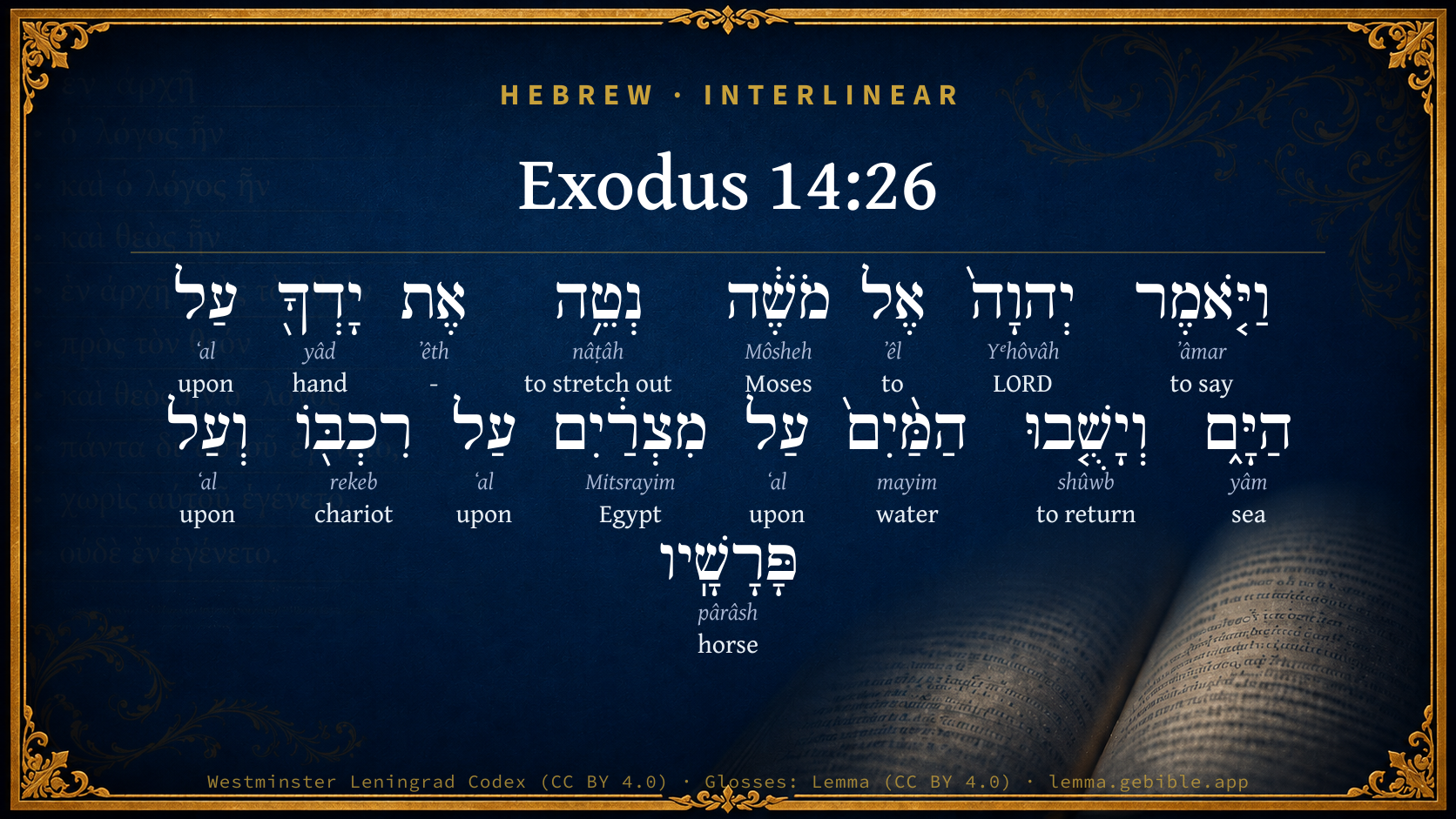
Hebrew (Westminster Leningrad Codex) Exodus 14:26 appears in the Hebrew Old Testament. The text above is from the Westminster Leningrad Codex. Each word links to its Strong’s number, a concise gloss, and parsing drawn from the Open Scriptures Hebrew Bible morphology. Click any word for its full Brown-Driver-Briggs (BDB) entry.
Download image
Cite this verse

Exodus 14:26 (World English Bible). Public Domain. Lemma interlinear Bible study tool, https://lemma.gebible.app/v/exodus/14/26.

Show BibTeX & RIS
BibTeX
RIS
English Translation
Yahweh said to Moses, "Stretch out your hand over the sea, that the waters may come again on the Egyptians, on their chariots, and on their horsemen."
World English Bible · Public Domain
Download a study sheet

One document with this verse’s original text, its word-by-word gloss line, the meaning frame, cross-references with their text, attributed commentary, and full source and license credits — printable, and it pastes into notes with its structure intact.

This verse Autodidact and up

Study sheet (.html) Plain text (.txt)

A passage Seminary Student

Up to 50 verses in one chapter. A passage sheet keeps up to 6 commentary sources and 12 cross-references per verse, in the order this page ranks them, and says so on the sheet whenever that leaves anything out. Ask for a single verse and you get the Autodidact verse sheet above.

Everything on this page stays free to read, with no account — the sheet is a download of what is already on screen, not access to it.

Want to remove ads? Support Godless Engineer
Compare translations 3

The same verse in 3 English versions, stacked beneath the original-language interlinear above. Click any original word for its lexicon entry.

Each is an independent rendering of the whole verse — the interlinear is not word-aligned to these translations.

Highlighted words mark where these versions differ — a whole-verse word diff, not a word-by-word alignment.

  • World English Bible Public Domain
    Yahweh said to Moses, "Stretch out your hand over the sea, that the waters may come again on the Egyptians, on their chariots, and on their horsemen."
  • King James Version Public Domain
    And the LORD said unto Moses, Stretch out thine hand over the sea, that the waters may come again upon the Egyptians, upon their chariots, and upon their horsemen.
  • unfoldingWord Literal Text CC BY-SA 4.0
    And Yahweh said to Moses, “Reach out your hand over the sea, and the waters will return on the Egyptians, on his chariots, and on his horsemen.”

unfoldingWord Literal Text — © unfoldingWord, licensed CC BY-SA 4.0. Word-aligned USFM3 via Door43 (git.door43.org/unfoldingWord/en_ult).

Versions to compare (up to 4)

3 of 4 selected

Show all 18 translations

Every available English version of this verse, each an independent rendering of the whole verse.

  • World English Bible Public Domain
    Yahweh said to Moses, "Stretch out your hand over the sea, that the waters may come again on the Egyptians, on their chariots, and on their horsemen."
  • Berean Standard Bible Public Domain
    Then the LORD said to Moses, “Stretch out your hand over the sea, so that the waters may flow back over the Egyptians and their chariots and horsemen.”
  • Majority Standard Bible Public Domain
    Then the LORD said to Moses, “Stretch out your hand over the sea, so that the waters may flow back over the Egyptians and their chariots and horsemen.”
  • King James Version Public Domain
    And the LORD said unto Moses, Stretch out thine hand over the sea, that the waters may come again upon the Egyptians, upon their chariots, and upon their horsemen.
  • American Standard Version (1901) Public Domain
    And Jehovah said unto Moses, Stretch out thy hand over the sea, that the waters may come again upon the Egyptians, upon their chariots, and upon their horsemen.
  • Revised Version (1885) Public Domain
    And the LORD said unto Moses, Stretch out thine hand over the sea, that the waters may come again upon the Egyptians, upon their chariots, and upon their horsemen.
  • Geneva Bible (1599) Public Domain
    Then the Lord sayde to Moses, Stretche thine hand vpon the Sea, that the waters may returne vpon the Egyptians, vpon their charets and vpon their horsemen.
  • Douay-Rheims (1899) Public Domain
    And the Lord said to Moses: Stretch forth they hand over the sea, that the waters may come again upon the Egyptians, upon their chariots and horsemen.
  • Young's Literal Translation Public Domain
    And Jehovah saith unto Moses, `Stretch out thy hand toward the sea, and the waters turn back on the Egyptians, on their chariots, and on their horsemen.'
  • Literal Standard Version CC BY-SA 4.0
    And YHWH says to Moses, “Stretch out your hand toward the sea, and the waters turn back on the Egyptians, on their chariots, and on their horsemen.”
  • Unlocked Literal Bible CC BY-SA 4.0
    Yahweh said to Moses, “Reach out with your hand over the sea so that the waters may come back onto the Egyptians, their chariots, and their horsemen.”
  • unfoldingWord Literal Text CC BY-SA 4.0
    And Yahweh said to Moses, “Reach out your hand over the sea, and the waters will return on the Egyptians, on his chariots, and on his horsemen.”
  • Darby Bible Public Domain
    And Jehovah said to Moses, Stretch out thy hand over the sea, that the waters may return upon the Egyptians, upon their chariots and upon their horsemen.
  • World Messianic Bible Public Domain
    The LORD said to Moses, “Stretch out your hand over the sea, that the waters may come again on the Egyptians, on their chariots, and on their horsemen.”
  • Webster's Bible Public Domain
    And the LORD said to Moses, Stretch out thy hand over the sea, that the waters may come again upon the Egyptians, upon their chariots, and upon their horsemen.
  • Free Bible Version CC BY-SA 4.0
    Then the Lord told Moses, “Hold out your hand over the sea, so that the water will pour back over the Egyptians and their chariots and horsemen.”
  • Bible in Basic English Public Domain
    And the Lord said to Moses, Let your hand be stretched out over the sea, and the waters will come back again on the Egyptians, and on their war-carriages and on their horsemen.
  • JPS Tanakh (1917) Public Domain
    And the LORD said unto Moses: 'Stretch out thy hand over the sea, that the waters may come back upon the Egyptians, upon their chariots, and upon their horsemen.'

Literal Standard Version (2020), Covenant Press — licensed CC BY-SA 4.0. Text via the HelloAO Bible API (eBible.org). Unlocked Literal Bible (unfoldingWord) — licensed CC BY-SA 4.0. Text via the HelloAO Bible API (eBible.org). unfoldingWord Literal Text — © unfoldingWord, licensed CC BY-SA 4.0. Word-aligned USFM3 via Door43 (git.door43.org/unfoldingWord/en_ult). Free Bible Version, Dr. Jonathan Gallagher — licensed CC BY-SA 4.0. Text via the HelloAO Bible API (eBible.org).

Word by word

More ways to search: Search by grammar → Find every occurrence → Compare this word →

Practice this passage: Drill this verse → Learn its vocabulary →

פָּרָשָֽׁיו
pârâsh
H6571
“horses · his”
Noun, Common, Masculine, Plural, Construct + Suffix, Personal, 3rd Person, Masculine, Singular
Part of Speech
Noun
Type
Common
Gender
Masculine
Number
Plural
State
Construct
Full BDB Definition

Origin: from H6567

TWOT: 1836a

horse, steed, warhorse - horseman
  1. וַיֹּ֤אמֶר ʼâmar H559 “and · to say” Conjunction + Verb, Qal, Sequential Imperfect, 3rd Person, Masculine, Singular
  2. יְהוָה֙ Yᵉhôvâh H3068 “LORD” Noun, Proper
  3. אֶל ʼêl H413 “to” Preposition
  4. מֹשֶׁ֔ה Môsheh H4872 “Moses” Noun, Proper
  5. נְטֵ֥ה nâṭâh H5186 “stretch out” Verb, Qal, Imperative, 2nd Person, Masculine, Singular
  6. אֶת ʼêth H853 “-” Particle, Direct Object
  7. יָדְךָ֖ yâd H3027 “hand · your” Noun, Common, Both, Singular, Construct + Suffix, Personal, 2nd Person, Masculine, Singular
  8. עַל ʻal H5921 “upon” Preposition
  9. הַיָּ֑ם yâm H3220 “the · sea” Particle, Definite Article + Noun, Common, Masculine, Singular, Absolute
  10. וְיָשֻׁ֤בוּ shûwb H7725 “and · to return” Conjunction + Verb, Qal, Jussive, 3rd Person, Masculine, Plural
  11. הַמַּ֨יִם֙ mayim H4325 “the · water(s)” Particle, Definite Article + Noun, Common, Masculine, Plural, Absolute
  12. עַל ʻal H5921 “upon” Preposition
  13. מִצְרַ֔יִם Mitsrayim H4714 “Egypt” Noun, Proper
  14. עַל ʻal H5921 “upon” Preposition
  15. רִכְבּ֖וֹ rekeb H7393 “chariot · his” Noun, Common, Masculine, Singular, Construct + Suffix, Personal, 3rd Person, Masculine, Singular
  16. וְעַל ʻal H5921 “and · upon” Conjunction + Preposition

About this verse

These counts appear in no published source. They are computed here, from the morphology-tagged text and Lemma’s own curated glosses. What Lemma adds →

17
words
14
distinct lemmas
Pentateuch
section

Shared distinctive vocabulary

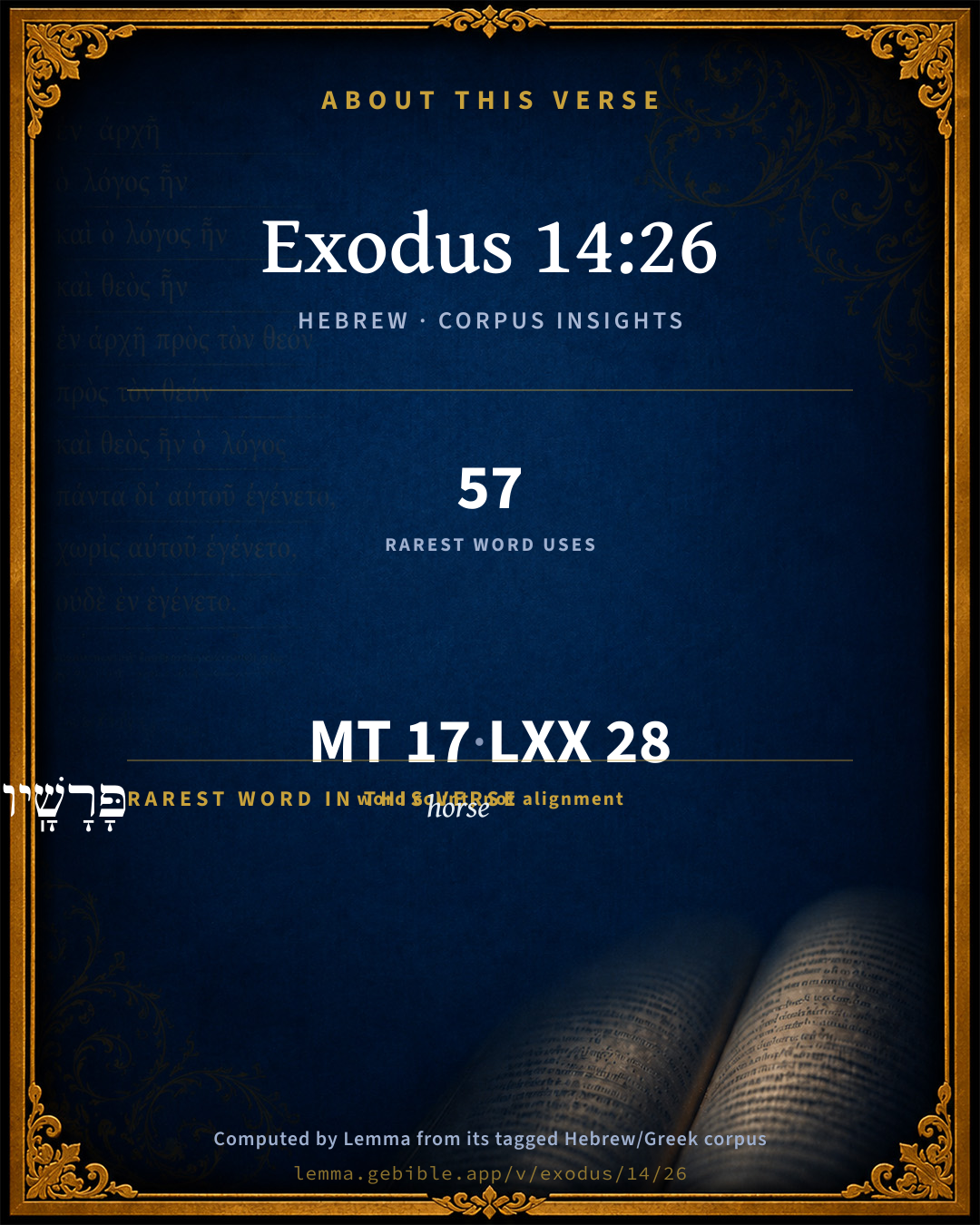
פָּרָשָֽׁיו horse H6571 occurs in 54 verses of the Hebrew Bible. Also found in:

Grammatical profile

  • 3 verbs
  • 8 nouns
  • 5 prepositions
  • 1 particle

Verb forms

  • וַיֹּ֤אמֶר Qal · Sequential Imperfect
  • נְטֵ֥ה Qal · Imperative
  • וְיָשֻׁ֤בוּ Qal · Jussive

Repetition

A word recurs within this verse — often emphatic in Hebrew:

Hebrew & Septuagint length

In English translation the verse runs 27 words from the Hebrew and 37 from the Septuagint (LXX English) — closely comparable.

A rough comparison of the two English renderings, which tokenize alike — not a word-level alignment.

Word counts can differ between the Hebrew and the Greek without any difference in meaning — e.g. the Hebrew direct-object marker אֵת has no separate Greek word, and Greek often adds the article ὁ.

In the original languages it is 17 Hebrew tokens and 28 Greek tokens — but the two are counted differently (Hebrew bundles its prefixes and suffixes into one token; the Greek is in lemma form), so that isn’t a like-for-like length.

Cross-references

9

Topical passages linked to Exodus 14:26 in the Treasury of Scripture Knowledge — connected by theme and wording, ordered by reader-vote popularity; previews shown in the World English Bible.

  • Exodus 14:16 Lift up your rod, and stretch out your hand over the sea, and divide it: and the children of Israel shall go into the midst of the sea on dry ground.
  • Exodus 8:5 Yahweh said to Moses, "Tell Aaron, 'Stretch forth your hand with your rod over the rivers, over the streams, and over the pools, and cause frogs to come up on the land of Egypt.'"
  • Exodus 1:22 Pharaoh charged all his people, saying, "You shall cast every son who is born into the river, and every daughter you shall save alive."
  • Exodus 7:19 Yahweh said to Moses, "Tell Aaron, 'Take your rod, and stretch out your hand over the waters of Egypt, over their rivers, over their streams, and over their pools, and over all their ponds of water, that they may become blood; and there shall be blood throughout all the land of Egypt, both in vessels of wood and in vessels of stone.'"
  • Judges 1:6–7 But Adoni-bezek fled; and they pursued after him, and caught him, and cut off his thumbs and his great toes.
  • Matthew 7:2 For with whatever judgment you judge, you will be judged; and with whatever measure you measure, it will be measured to you.
  • Matthew 8:27 The men marveled, saying, "What kind of man is this, that even the wind and the sea obey him?"
  • James 2:13 For judgment is without mercy to him who has shown no mercy. Mercy triumphs over judgment.
  • Revelation 16:6 For they poured out the blood of the saints and the prophets, and you have given them blood to drink. They deserve this."

Cross-references courtesy of OpenBible.info (CC BY 4.0).

Hebrew and Greek witnesses Masoretic Hebrew ↔ Greek Septuagint

The same verse in the two great witnesses to the Old Testament, shown verse-for-verse.

These are two independent witnesses, not word-aligned to each other, and the Septuagint is shown in lemma (dictionary) form.

Hebrew Exodus 14:26 Masoretic · Westminster Leningrad Codex

וַיֹּ֤אמֶר יְהוָה֙ אֶל מֹשֶׁ֔ה נְטֵ֥ה אֶת יָדְךָ֖ עַל הַיָּ֑ם וְיָשֻׁ֤בוּ הַמַּ֨יִם֙ עַל מִצְרַ֔יִם עַל רִכְבּ֖וֹ וְעַל פָּרָשָֽׁיו

Yahweh said to Moses, "Stretch out your hand over the sea, that the waters may come again on the Egyptians, on their chariots, and on their horsemen."

World English Bible · Public Domain

Greek LXX Exodus 14:26 Septuagint · lemma form

εἶπον δέ κύριος πρός μωυσῆς ἐκτείνω ὁ χείρ σύ ἐπί ὁ θάλασσα καί ἀπο καταἵστημι ὁ ὕδωρ καί ἐπικαλύπτω ὁ αἰγύπτιος ἐπί τε ὁ ἅρμα καί ὁ ἀναβάτης

And the Lord said to Moses, Stretch forth your hand over the sea, and let the water be turned back to its place, and let it cover the Egyptians coming both upon the chariots and the riders.

LXX2012 (modern English Septuagint) · Public Domain

Hebrew: Westminster Leningrad Codex (CC BY 4.0). Greek: Septuagint (public domain); English from LXX2012 (modern English Septuagint) (Public Domain). How the Septuagint differs from the Hebrew →

Targum (Aramaic paraphrase)

2

The Targum is the ancient Jewish Aramaic paraphrase of the Hebrew Scriptures — an interpretive translation, not the Hebrew text itself. Onkelos (literal) and Pseudo-Jonathan (expansive) render the Torah, and Jonathan the Prophets. Coverage is partial: where no permissively-licensed English translation exists for a verse, only the Aramaic is shown. This is verse-level text, not a word-by-word alignment to the Hebrew.

  1. Targum Onkelos Torah (Genesis–Deuteronomy)
    וַאֲמַר יְיָ לְמשֶׁה אֲרֵים יָת יְדָךְ עַל יַמָא וִיתוּבוּן מַיָא עַל מִצְרָאֵי עַל רְתִכֵּיהוֹן וְעַל פָּרָשֵׁיהוֹן:

    (no public-domain English translation for this verse)

    Targum Onkelos — Aramaic: “Onkelos Genesis” (public domain); “Onkelos Exodus” (public domain); “Onkelos Leviticus” (public domain); “Onkelos Numbers” (public domain); “Onkelos Deuteronomy” (public domain). English: “Sefaria Community Translation” (CC0 1.0 (public-domain dedication)); “J.W. Etheridge. The Targums of Onkelos and Jonathan Ben Uzziel on the Pentateuch. London: Longmans, Green, 1862” (public domain). Text via Sefaria.

  2. Targum Pseudo-Jonathan Torah (Genesis–Deuteronomy)
    וַאֲמַר יְיָ לְמשֶׁה אַרְכַן יַת יְדָךְ עַל יַמָא וִיתוּבוּן מָאִין עַל מִצְרָאֵי עַל רְתִיכֵהוֹן וְעַל פָּרָשֵׁיהוֹן

    And the Lord said to Mosheh, Stretch forth thy hand over the sea, that the waters may return upon the Mizraee, upon their chariots and upon their horsemen.

    Targum Pseudo-Jonathan — Aramaic: “Targum Jonathan on Genesis” (public domain); “Targum Jonathan on Exodus” (public domain); “Targum Jonathan on Leviticus” (public domain); “Targum Jonathan on Numbers” (public domain); “Targum Jonathan on Deuteronomy” (public domain). English: “The Targum of Jonathan ben Uzziel, trans. J. W. Etheridge, London, 1862” (public domain). Text via Sefaria.

Commentary

Notes on Exodus 14:26 from classic Christian and Jewish commentators (each source and its license shown beneath its notes). The classic Christian expositions comment on the surrounding passage and are grouped to its opening verse, so a note may address several verses; the Jewish commentaries on the Tanakh (Rashi and others) are per-verse, so they appear only where the commentator wrote on this verse.

Lemma curates 59 commentaries, every one of them public domain or Creative Commons licensed, each selected and text-cleaned for this edition rather than reprinted as found. About our sources →

Trapp's Complete Commentary

John Trapp

Exo 14:26 And the LORD said unto Moses, Stretch out thine hand over the sea, that the waters may come again upon the Egyptians, upon their chariots, and upon their horsemen.

Ver. 26. That the waters may come again.] By wind that God sent. {Exo 15:10} "The winds blow, the waters flow." {Psa 147:18}

John Trapp, A Commentary or Exposition upon All the Books of the Old and New Testament (1647–1656) — public domain. Text from a community e-Sword module.

Joseph Benson's Commentary

Exo 14:26. And the Lord said unto Moses, Stretch out thy hand over the sea — And give a signal to the waters to close again, as before upon the word of command they had opened to the right and the left. He did so, and immediately the waters returned to their place, and overwhelmed all the host of the Egyptians. Pharaoh and his servants, that had hardened one another in sin, now fell together, and not one escaped. An ancient tradition saith, that Pharaoh’s magicians, Jannes and Jambres, perished with the rest. Now God got him honour upon Pharaoh, a rebel to God, and a slave to his own barbarous passions; perfectly lost to humanity, virtue, and all true honour; here he lies buried in the deep, a perpetual monument of divine justice: here he went down to the pit, though he was the terror of the mighty in the land of the living.

Joseph Benson's Commentary on the Old and New Testaments (1811–1818) — public domain. Text from a community e-Sword module.

Ellicott's Commentary for English Readers

(26) And the Lord said.—Or, The Lord had said. Probably the command was given as soon as the Israelites were safe across. It would take some hours for the north-west wind to bring back the waters of the Bitter Lakes.

A Bible Commentary for English Readers, edited by Charles John Ellicott (1878–1897) — public domain. Text from a community e-Sword module.

The Cambridge Bible for Schools and Colleges

gen. ed. J. J. S. Perowne

26, 27a. The sequel in P to v. 23. The waters are to return, as they were divided (v. 21a, c), at the signal given by Moses’ hand.

26. come again] come back; the word rendered ‘returned’ in vv. 27, 28. ‘Again’ in EVV., as in Old English generally, often means back.

27b. and the sea returned, &c.] By the cessation of the E. wind (v. 21b); or, if Exo_15:10 is to be pressed, by a contrary wind beginning.

to its wonted flow] The marg. is right: lit. to its perennial state. The word signifies properly everflowing (Amo_5:20 RVm., Psa_74:15 RVm., Deu_21:6 RV.); but its meaning was lost by the Jews; and as it occurs in many passages in which the rend. mighty, or strong, strength, would satisfy the context, the Jews interpreted it by these words, and hence the usual rendering of it in AV. The true meaning of the word was not recovered till in the 18th cent. Arabic began to be studied and compared with Hebrew, when Albert Schultens pointed out that the root in Arabic was used of a stream, and signified to be perennial, ever-flowing. Cf. the writer’s note on Amo_5:24; and Lex. p. 450b.

appeared] Heb. turned (to approach): an idiom, expression, occurring also Jdg_19:26, Psa_46:5, and, with ‘evening’ for ‘morning’, Gen_24:63, Deu_23:11.

and the Egyptians, &c.] The Heb. is more forcible: and (= as) the Egyptians were fleeing against it.

shook off] The marg. is again right, ‘overthrew’ being a paraphrase: see Neh_5:13, where ‘overthrow’ for ‘shake out’ would obviously be impossible. Cf. the allusion in Psa_136:15 RVm. (the same word). (In Exo_15:7 the Heb. word is different.)

28a. The continuation of v. 27a in P, just as v. 21c is the continuation of v. 21a.

The Cambridge Bible for Schools and Colleges (gen. ed. J. J. S. Perowne; Cambridge University Press, 1878–1918) — public domain. Text from a community e-Sword module.

John Gill's Exposition

And the Lord said unto Moses,.... Out of the pillar of fire and of the cloud, when the Egyptians were in all the confusion before described, and about to make the best of their way back again:

Stretch out thine hand over the sea; with his rod in it, by which all the wonders were wrought, and particularly by which the sea had been divided, and now it must be used to a different purpose:

that the waters may come again upon the Egyptians, upon their chariots, and upon their horsemen; the waters which stood upright as a wall, on the right and left, might be no longer kept in such a position, but fall down upon the Egyptians, their chariots and horsemen, being higher than they.

John Gill's Exposition of the Whole Bible (1746–1763) — public domain (CC PDM 1.0). Text via the HelloAO Bible API.

Albert Barnes' Notes on the Bible

That the waters may come - A sudden cessation of the wind, possibly coinciding with a spring tide (it was full moon) would immediately convert the low flat sand-banks first into a quicksand, and then into a mass of waters, in a time far less than would suffice for the escape of a single chariot, or horseman loaded with heavy corslet.

Albert Barnes' Notes on the Bible (1834–1885) — public domain. Text from a community e-Sword/MySword module.

The Pulpit Commentary

Vers. 26, 27. And the Lord said. God here interposed a new difficulty. Moses was instructed to stretch out his rod once more, and undo his former work. At the appointed sign, the east wind ceased to blow, and the waters of the Bitter Lakes, no longer driven to the north-west by its force, flowed back with something of a reflux, while at the same time, the tide having turned, the Red Sea waves came rushing on at unwonted speed. In vain the Egyptians fled. They were met by the advancing floods, which poured in on either side, overwhelming and covering up all those who had entered on the dangerous path.

The Pulpit Commentary (1880–1919), ed. H.D.M. Spence-Jones & Joseph S. Exell — public domain. Text from a community e-Sword module.

John Wesley's Explanatory Notes

And the Lord said unto Moses, Stretch out thy hand over the sea - And give a signal to the waters to close again, as before upon the word of command they had opened to the right and the left. He did so, and immediately the waters returned to their place, and overwhelmed all the host of the Egyptians. Pharaoh and his servants, that had hardened one another in sin, now fell together, and not one escaped. An ancient tradition saith, That Pharaoh's magicians Jannes and Jambres perished with the rest. Now God got him honour upon Pharaoh, a rebel to God, and a slave to his own barbarous passions; perfectly lost to humanity, virtue, and all true honour; here be lies buried in the deep, a perpetual monument of divine justice: here he went down to the pit, though he was the terror of the mighty in the land of the living.

John Wesley, Explanatory Notes Upon the Whole Bible (1754–1765) — public domain. Text via the GEBible commentary corpus.

Keil & Delitzsch

C. F. Keil & F. Delitzsch

Then God directed Moses to stretch out his staff again over the sea, and the sea came back with the turning of the morning (when the morning turned, or approached) to its position (איתן perennitas, the lasting or permanent position), and the Egyptians were flying to meet it. "When the east wind which divided the sea ceased to blow, the sea from the north and south began to flow together on the western side;" whereupon, to judge from Exo 15:10, the wind began immediately to blow from the west, and drove the waves in the face of the flying Egyptians. "And thus Jehovah shook the Egyptians (i.e., plunged them into the greatest confusion) in the midst of the sea," so that Pharaoh's chariots and horsemen, to the very last man, were buried in the waves.

Keil & Delitzsch — Biblical Commentary on the Old Testament (1861–1891) — public domain (CC PDM 1.0). Text via the HelloAO Bible API. (Old Testament only.)

unfoldingWord translationNotes

Door43 World Missions Community

Yahweh said to Moses, "Reach out with your hand ... and their horsemen."

This can be stated as an indirect quote. AT: "Yahweh told Moses to reach out with his hand over the sea so that the waters would come back onto the Egyptians, their chariots, and their horsemen."

come back onto

"fall on"

The Egyptians fled into the sea

Since the sea was closing in on top of the Egyptians, instead of escaping, they were actually running right into the water.

Yahweh drove the Egyptians

"Yahweh pushed the Egyptians" or "Yahweh threw the Egyptians"

translationWords

Yahweh

unfoldingWord translationNotes — © Distant Shores Media and the Door43 World Missions Community, licensed CC BY-SA 4.0. Source: git.door43.org/Door43/en_tn.

Rashi

Rabbi Shlomo Yitzchaki (Rashi)

וישבו המים means THE WATERS that were standing erect as a wall SHALL RETURN to their places and form a cover over the Egyptians.

Rashi on the Tanakh — English translations: “The Judaica Press complete Tanach with Rashi, translated by A. J. Rosenberg” (CC BY 4.0); “Pentateuch with Rashi's commentary by M. Rosenbaum and A.M. Silbermann, 1929-1934” (public domain); “The Metsudah Tanach series, Lakewood, N.J” (CC BY 4.0); and “The Book of Joshua, Metsudah Publications, 1997” (CC BY 4.0). Text via Sefaria.

Lesson kit

Teaching starters — assembled from the data on this page, not authored interpretation. Every prompt links to the verse data it draws on. Edit before teaching.

Exodus, in the Pentateuch, opens this verse with 17 words (14 distinct Hebrew lemmas). Its most distinctive word is pârâsh (“horse”). A historical commentator’s framing appears above. Read the whole chapter for the surrounding context.

Discussion questions

  1. How does “horse” (pârâsh) shape what this verse is saying?
  2. How does Genesis 50:9, which shares the word «horse», read alongside this verse?
  3. What does the repetition of “upon” (4× in this one verse) do in this verse?
  4. These translations render this verse differently. What is at stake in choosing one wording over another?
  5. «וַיֹּ֤אמֶר» is a Qal Sequential Imperfect verb. How does that grammatical form shape the action described?
  6. Compare how Trapp's Complete Commentary and Joseph Benson's Commentary read this verse. Where do they agree or differ?

Things to notice

Reading settings

Reading text

Shown beneath each verse's original-language words.

Old Testament
Old Testament edition

Read the OT as the Masoretic Hebrew (MT) or the Greek Septuagint (LXX).

English shown for the Greek Septuagint (in the Hebrew ↔ Greek comparison).

Comparing translations? Open the Compare panel on any verse page to stack up to four side by side.