1 Kings 4:29

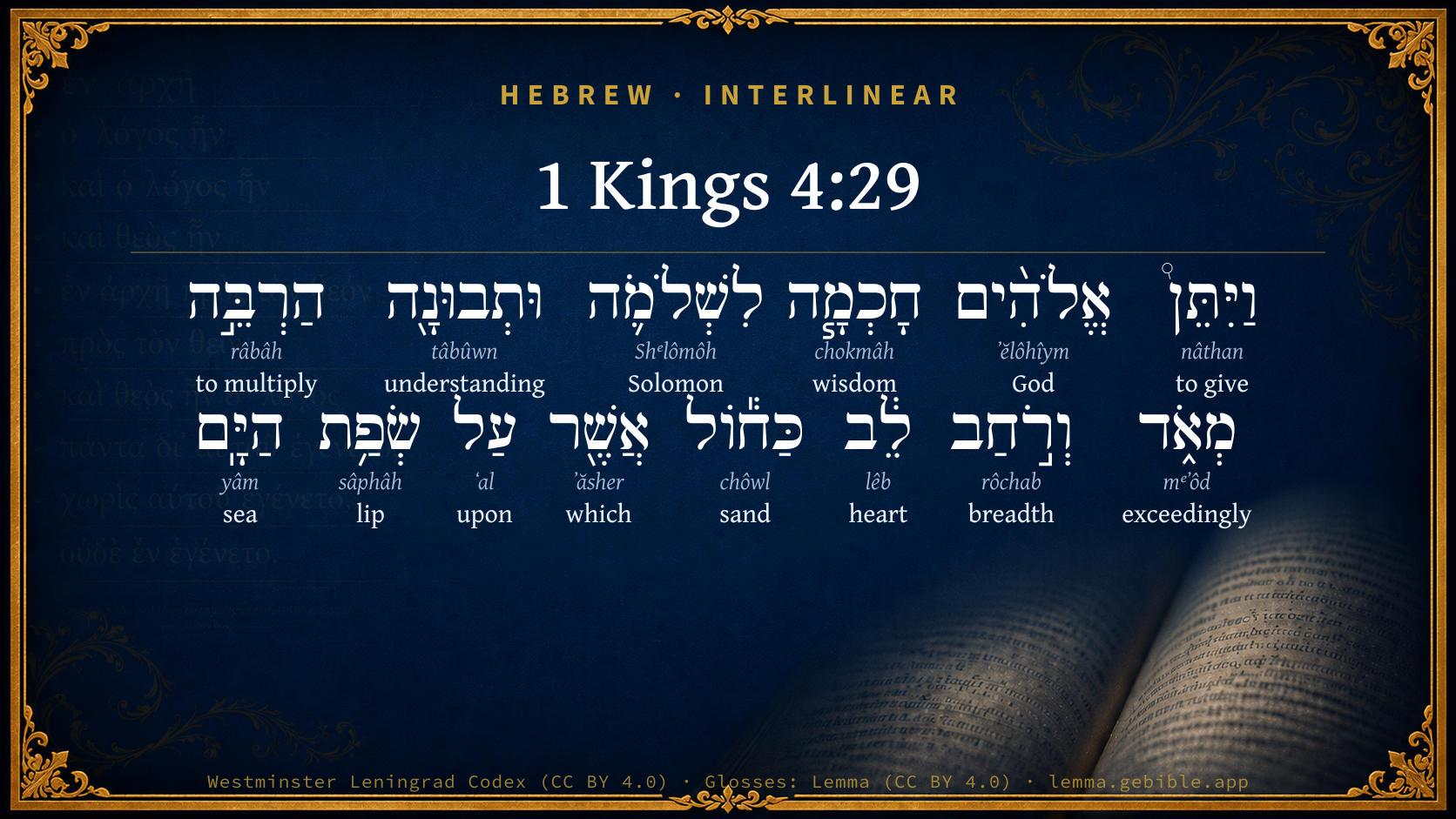
Hebrew (Westminster Leningrad Codex) 1 Kings 4:29 appears in the Hebrew Old Testament. The text above is from the Westminster Leningrad Codex. Each word links to its Strong’s number, a concise gloss, and parsing drawn from the Open Scriptures Hebrew Bible morphology. Click any word for its full Brown-Driver-Briggs (BDB) entry.
Download image
Cite this verse

1 Kings 4:29 (World English Bible). Public Domain. Lemma interlinear Bible study tool, https://lemma.gebible.app/v/1-kings/4/29.

Show BibTeX & RIS
BibTeX
RIS
English Translation
God gave Solomon wisdom and understanding exceeding much, and very great understanding, even as the sand that is on the sea-shore.
World English Bible · Public Domain
Download a study sheet

One document with this verse’s original text, its word-by-word gloss line, the meaning frame, cross-references with their text, attributed commentary, and full source and license credits — printable, and it pastes into notes with its structure intact.

This verse Autodidact and up

Study sheet (.html) Plain text (.txt)

A passage Seminary Student

Up to 50 verses in one chapter. A passage sheet keeps up to 6 commentary sources and 12 cross-references per verse, in the order this page ranks them, and says so on the sheet whenever that leaves anything out. Ask for a single verse and you get the Autodidact verse sheet above.

Everything on this page stays free to read, with no account — the sheet is a download of what is already on screen, not access to it.

Want to remove ads? Support Godless Engineer
Compare translations 3

The same verse in 3 English versions, stacked beneath the original-language interlinear above. Click any original word for its lexicon entry.

Each is an independent rendering of the whole verse — the interlinear is not word-aligned to these translations.

Highlighted words mark where these versions differ — a whole-verse word diff, not a word-by-word alignment.

  • World English Bible Public Domain
    God gave Solomon wisdom and understanding exceeding much, and very great understanding, even as the sand that is on the sea-shore.
  • King James Version Public Domain
    And God gave Solomon wisdom and understanding exceeding much, and largeness of heart, even as the sand that is on the sea shore.
  • unfoldingWord Literal Text CC BY-SA 4.0
    And God gave wisdom to Solomon and very much understanding and breadth of heart like the sand that on the shore of the sea.

unfoldingWord Literal Text — © unfoldingWord, licensed CC BY-SA 4.0. Word-aligned USFM3 via Door43 (git.door43.org/unfoldingWord/en_ult).

Versions to compare (up to 4)

3 of 4 selected

Show all 18 translations

Every available English version of this verse, each an independent rendering of the whole verse.

  • World English Bible Public Domain
    God gave Solomon wisdom and understanding exceeding much, and very great understanding, even as the sand that is on the sea-shore.
  • Berean Standard Bible Public Domain
    And God gave Solomon wisdom, exceedingly deep insight, and understanding beyond measure, like the sand on the seashore.
  • Majority Standard Bible Public Domain
    And God gave Solomon wisdom, exceedingly deep insight, and understanding beyond measure, like the sand on the seashore.
  • King James Version Public Domain
    And God gave Solomon wisdom and understanding exceeding much, and largeness of heart, even as the sand that is on the sea shore.
  • American Standard Version (1901) Public Domain
    And God gave Solomon wisdom and understanding exceeding much, and largeness of heart, even as the sand that is on the sea-shore.
  • Revised Version (1885) Public Domain
    And God gave Solomon wisdom and understanding exceeding much, and largeness of heart, even as the sand that is on the sea shore.
  • Geneva Bible (1599) Public Domain
    And God gaue Salomon wisdome and vnderstanding exceeding much, and a large heart, euen as the sand that is on the sea shore,
  • Douay-Rheims (1899) Public Domain
    And God gave to Solomon wisdom and understanding exceeding much, and largeness of heart as the sand that is on the sea shore.
  • Young's Literal Translation Public Domain
    And God giveth wisdom to Solomon, and understanding, very much, and breadth of heart, as the sand that `is' on the edge of the sea;
  • Literal Standard Version CC BY-SA 4.0
    And God gives very much wisdom and understanding to Solomon, and breadth of heart, as the sand that [is] on the edge of the sea;
  • Unlocked Literal Bible CC BY-SA 4.0
    God gave Solomon great wisdom and understanding, and wideness of understanding like the sand on the seashore.
  • unfoldingWord Literal Text CC BY-SA 4.0
    And God gave wisdom to Solomon and very much understanding and breadth of heart like the sand that on the shore of the sea.
  • Darby Bible Public Domain
    And God gave Solomon wisdom and very great understanding and largeness of heart, even as the sand that is on the sea-shore.
  • World Messianic Bible Public Domain
    God gave Solomon abundant wisdom, understanding, and breadth of mind like the sand that is on the seashore.
  • Webster's Bible Public Domain
    And God gave Solomon great wisdom and understanding, and largeness of heart, even as the sand that is on the sea-shore.
  • Free Bible Version CC BY-SA 4.0
    God gave to Solomon wisdom, very great discernment, and understanding as extensive as the sand on the seashore.
  • Bible in Basic English Public Domain
    And God gave Solomon a great store of wisdom and good sense, and a mind of wide range, as wide as the sand by the seaside.
  • JPS Tanakh (1917) Public Domain
    (5-9) And God gave Solomon wisdom and understanding exceeding much, and largeness of heart, even as the sand that is on the sea-shore.

Literal Standard Version (2020), Covenant Press — licensed CC BY-SA 4.0. Text via the HelloAO Bible API (eBible.org). Unlocked Literal Bible (unfoldingWord) — licensed CC BY-SA 4.0. Text via the HelloAO Bible API (eBible.org). unfoldingWord Literal Text — © unfoldingWord, licensed CC BY-SA 4.0. Word-aligned USFM3 via Door43 (git.door43.org/unfoldingWord/en_ult). Free Bible Version, Dr. Jonathan Gallagher — licensed CC BY-SA 4.0. Text via the HelloAO Bible API (eBible.org).

Word by word

More ways to search: Search by grammar → Find every occurrence → Compare this word →

Practice this passage: Drill this verse → Learn its vocabulary →

כַּח֕וֹל
chôwl
H2344
“like/as the · sand”
Preposition, Determined + Noun, Common, Masculine, Singular, Absolute
Part of Speech
Preposition + Noun
Type
Common
Gender
Masculine
Number
Singular
State
Absolute
Full BDB Definition

Origin: from H2342

TWOT: 623a

sand
  1. וַיִּתֵּן֩ nâthan H5414 “and · to give” Conjunction + Verb, Qal, Sequential Imperfect, 3rd Person, Masculine, Singular
  2. אֱלֹהִ֨ים ʼĕlôhîym H430 “God(s)” Noun, Common, Masculine, Plural, Absolute
  3. חָכְמָ֧ה chokmâh H2451 “wisdom” Noun, Common, Feminine, Singular, Absolute
  4. לִשְׁלֹמֹ֛ה Shᵉlômôh H8010 “to/for · Solomon” Preposition + Noun, Proper
  5. וּתְבוּנָ֖ה tâbûwn H8394 “and · understanding” Conjunction + Noun, Common, Feminine, Singular, Absolute
  6. הַרְבֵּ֣ה râbâh H7235 “to multiply” Verb, Hiphil, Infinitive Absolute
  7. מְאֹ֑ד mᵉʼôd H3966 “exceedingly” Adverb
  8. וְרֹ֣חַב rôchab H7341 “and · breadth of” Conjunction + Noun, Common, Masculine, Singular, Construct
  9. לֵ֔ב lêb H3820 “heart” Noun, Common, Masculine, Singular, Absolute
  10. אֲשֶׁ֖ר ʼăsher H834 “which” Particle, Relative
  11. עַל ʻal H5921 “upon” Preposition
  12. שְׂפַ֥ת sâphâh H8193 “lip of” Noun, Common, Feminine, Singular, Construct
  13. הַיָּֽם yâm H3220 “the · sea” Particle, Definite Article + Noun, Common, Masculine, Singular, Absolute

About this verse

These counts appear in no published source. They are computed here, from the morphology-tagged text and Lemma’s own curated glosses. What Lemma adds →

14
words
14
distinct lemmas
Historical
section

Notable vocabulary

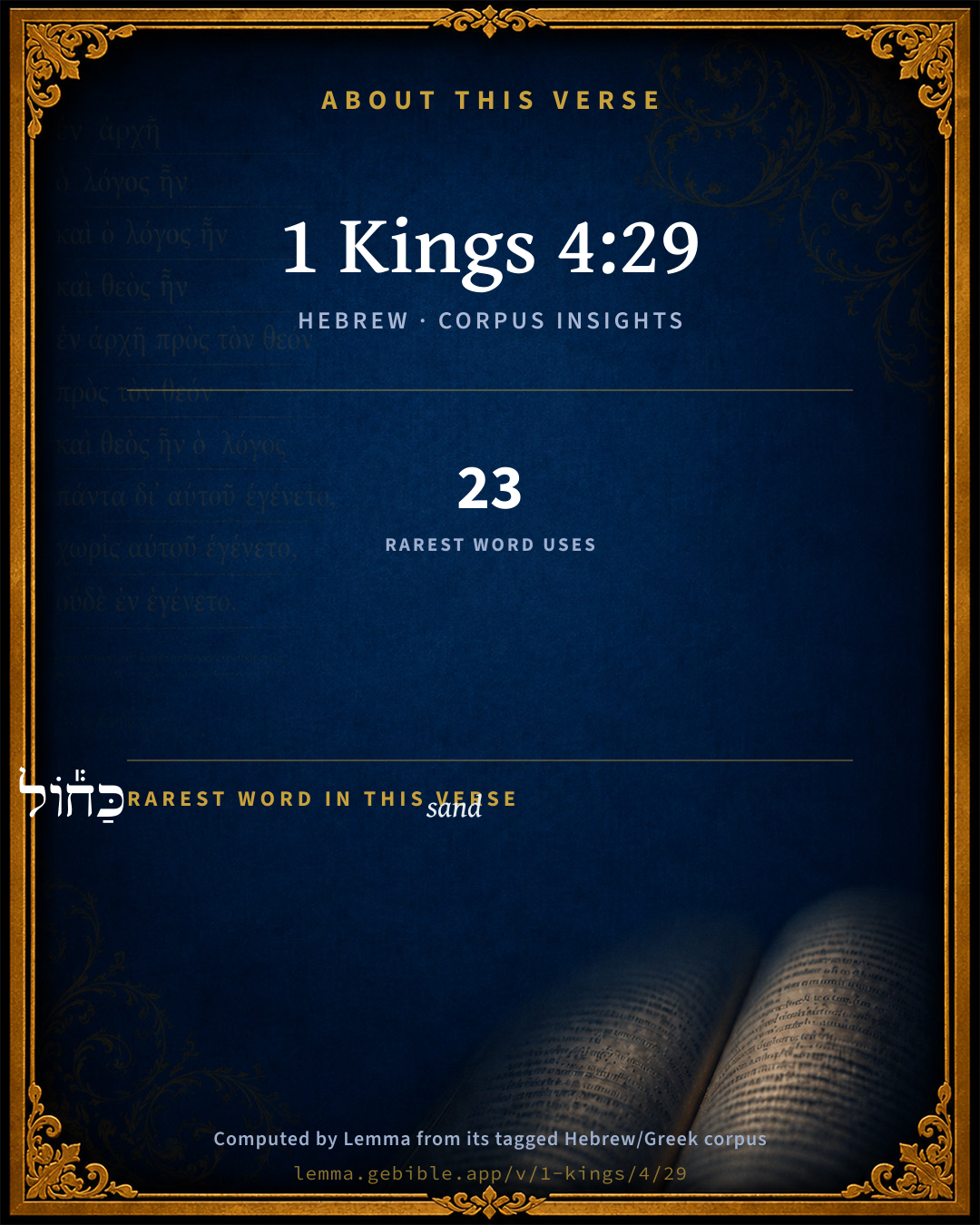
The rarest word here is כַּח֕וֹל sand H2344 — appearing just 23 times in the whole Hebrew Bible.

Shared distinctive vocabulary

כַּח֕וֹל sand H2344 occurs in 23 verses of the Hebrew Bible. Also found in:

Grammatical profile

  • 2 verbs
  • 9 nouns
  • 1 preposition
  • 1 adverb
  • 1 particle

Verb forms

  • וַיִּתֵּן֩ Qal · Sequential Imperfect
  • הַרְבֵּ֣ה Hiphil · Infinitive Absolute

Hebrew & Septuagint length

In English translation the verse runs 21 words from the Hebrew and 21 from the Septuagint (LXX English) — the same length.

A rough comparison of the two English renderings, which tokenize alike — not a word-level alignment.

Word counts can differ between the Hebrew and the Greek without any difference in meaning — e.g. the Hebrew direct-object marker אֵת has no separate Greek word, and Greek often adds the article ὁ.

Cross-references

17

Topical passages linked to 1 Kings 4:29 in the Treasury of Scripture Knowledge — connected by theme and wording, ordered by reader-vote popularity; previews shown in the World English Bible.

  • 1 Kings 3:12 behold, I have done according to your word: behold, I have given you a wise and an understanding heart; so that there has been none like you before you, neither after you shall any arise like you.
  • James 3:17 But the wisdom that is from above is first pure, then peaceful, gentle, reasonable, full of mercy and good fruits, without partiality, and without hypocrisy.
  • 1 Kings 4:20 Judah and Israel were many as the sand which is by the sea in multitude, eating and drinking and making merry.
  • Ecclesiastes 2:26 For to the man who pleases him, God gives wisdom, knowledge, and joy; but to the sinner he gives travail, to gather and to heap up, that he may give to him who pleases God. This also is vanity and a chasing after wind.
  • James 1:5 But if any of you lacks wisdom, let him ask of God, who gives to all liberally and without reproach; and it will be given to him.
  • James 1:17 Every good gift and every perfect gift is from above, coming down from the Father of lights, with whom can be no variation, nor turning shadow.
  • 2 Chronicles 1:10–12 Give me now wisdom and knowledge, that I may go out and come in before this people; for who can judge this your people, that is so great?
  • Proverbs 2:6 For Yahweh gives wisdom. Out of his mouth comes knowledge and understanding.
  • Isaiah 60:5 Then you shall see and be radiant, and your heart shall thrill and be enlarged; because the abundance of the sea shall be turned to you, the wealth of the nations shall come to you.
  • Genesis 41:49 Joseph laid up grain as the sand of the sea, very much, until he stopped counting, for it was without number.
  • 1 Kings 3:28 All Israel heard of the judgment which the king had judged; and they feared the king: for they saw that the wisdom of God was in him, to do justice.
  • Psalms 119:34 Give me understanding, and I will keep your law. Yes, I will obey it with my whole heart.
  • Jeremiah 33:22 As the host of the sky can't be numbered, neither the sand of the sea measured; so will I multiply the seed of David my servant, and the Levites who minister to me.
  • Ecclesiastes 1:16 I said to myself, "Behold, I have obtained for myself great wisdom above all who were before me in Jerusalem. Yes, my heart has had great experience of wisdom and knowledge."
  • Judges 7:12 The Midianites and the Amalekites and all the children of the east lay along in the valley like locusts for multitude; and their camels were without number, as the sand which is on the sea-shore for multitude.
  • 1 Kings 10:23–24 So king Solomon exceeded all the kings of the earth in riches and in wisdom.
  • Habakkuk 1:9 All of them come for violence. Their hordes face the desert. He gathers prisoners like sand.

Cross-references courtesy of OpenBible.info (CC BY 4.0).

Hebrew and Greek witnesses Masoretic Hebrew ↔ Greek Septuagint

The same verse in the two great witnesses to the Old Testament, shown verse-for-verse.

These are two independent witnesses, not word-aligned to each other, and the Septuagint is shown in lemma (dictionary) form.

Hebrew 1 Kings 4:29 Masoretic · Westminster Leningrad Codex

וַיִּתֵּן֩ אֱלֹהִ֨ים חָכְמָ֧ה לִשְׁלֹמֹ֛ה וּתְבוּנָ֖ה הַרְבֵּ֣ה מְאֹ֑ד וְרֹ֣חַב לֵ֔ב כַּח֕וֹל אֲשֶׁ֖ר עַל שְׂפַ֥ת הַיָּֽם

God gave Solomon wisdom and understanding exceeding much, and very great understanding, even as the sand that is on the sea-shore.

World English Bible · Public Domain

Greek LXX 1 Kings 4:29 Septuagint · lemma form
And the Lord gave understanding to Solomon, and very much wisdom, and enlargement of heart, as the sand on the seashore.

LXX2012 (modern English Septuagint) · Public Domain

Hebrew: Westminster Leningrad Codex (CC BY 4.0). Greek: Septuagint (public domain); English from LXX2012 (modern English Septuagint) (Public Domain). How the Septuagint differs from the Hebrew →

Commentary

Notes on 1 Kings 4:29 from classic Christian and Jewish commentators (each source and its license shown beneath its notes). The classic Christian expositions comment on the surrounding passage and are grouped to its opening verse, so a note may address several verses; the Jewish commentaries on the Tanakh (Rashi and others) are per-verse, so they appear only where the commentator wrote on this verse.

Lemma curates 59 commentaries, every one of them public domain or Creative Commons licensed, each selected and text-cleaned for this edition rather than reprinted as found. About our sources →

Matthew Henry's Commentary

Solomon's wisdom was more his glory than his wealth, and here we have a general account of it.

I. The fountain of his wisdom: God gave it him, Kg1 4:29. He owns it himself. Pro 2:6, The Lord giveth wisdom. He gives the powers of reason (Job 38:36), preserves and improves them. The ordinary advances of them are owing to his providence, the sanctification of them to his grace, and this extraordinary pitch at which they arrived in Solomon to a special grant of his favour to him in answer to prayer.

II. The fulness of it: He had wisdom and understanding, exceeding much, great knowledge of distant countries and the histories of former times, a quickness of thought, strength of memory, and clearness of judgment, such as never any man had. It is called largeness of heart; for the heart is often put for the intellectual powers. He had a vast compass of knowledge, could take things entire, and had an admirable faculty of laying things together. Some, by his largeness of heart, understand his courage and boldness, and that great assurance with which he delivered his dictates and determinations. Or it may be meant of his disposition to do good with his knowledge. He was very free and communicative, had the gift of utterance as well as wisdom, was as free of his learning as he was of his meat, and grudged neither to any that were about him. Note, It is very desirable that those who have large gifts of any kind should have large hearts to use them for the good of others; and this is from the hand of God, Ecc 2:24. He shall enlarge the heart, Psa 119:32. The greatness of Solomon's wisdom is illustrated by comparison. Chaldea and Egypt were nations famous for learning; thence the Greeks borrowed theirs; but the greatest scholars of these nations came short of Solomon, Kg1 4:30. If nature excels art, much more does grace. The knowledge which God gives by special favour goes beyond that which man gets by his own labour. Some wise men there were in Solomon's time, who were in great repute, particularly Heman, and others who were Levites, and employed by David in the temple-music, Ch1 15:19. Heman was his seer in the word of God, Ch1 25:5. Chalcol and Darda were own brothers, and they also were noted for learning and wisdom. But Solomon excelled them all (Kg1 4:30), he out-did them and confounded them; his counsel was much more valuable.

III. The fame of it. It was talked of in all nations round about. His great wealth and glory made his wisdom much more illustrious, and have him those opportunities of showing it which those cannot have that live in poverty and obscurity. The jewel of wisdom may receive great advantage by the setting of it.

IV. The fruits of it; by these the tree is known: he did not bury his talent, but showed his wisdom,

1. In his compositions. Those in divinity, written by divine inspiration, are not mentioned here, for they are extant, and will remain to the world's end monuments of his wisdom, and are, as other parts of scripture, of use to make us wise unto salvation. But, besides these, it appears by what he spoke, or dictated to be written from him, (1.) That he was a moralist, and a man of great prudence, for he spoke 3000 proverbs, wise sayings, apophthegms, of admirable use for the conduct of human life. The world is much governed by proverbs, and was never better furnished with useful ones than by Solomon. Whether those proverbs of Solomon that we have were any part of the 3000 is uncertain. (2.) That he was a poet and a man of great wit: His songs were 1005, of which one only is extant, because that only was divinely inspired, which is therefore called his Song of songs. His wise instructions were communicated by proverbs, that they might be familiar to those whom he designed to teach and ready on all occasions, and by songs, that they might be pleasant and move the affections. (3.) That he was a natural philosopher, and a man of great learning and insight into the mysteries of nature. From his own and others' observations and experience, he wrote both of plants and animals (Kg1 4:33), descriptions of their natures and qualities, and (some think) of the medicinal use of them.

2. In his conversation. There came persons from all parts, who were more inquisitive after knowledge than their neighbours, to hear the wisdom of Solomon, Kg1 4:34. Kings that had heard of it sent their ambassadors to hear it and to bring them instructions from it. Solomon's court was the staple of learning, and the rendezvous of philosophers, that is, the lovers of wisdom, who all came to light their candle at his lamp and to borrow from him. Let those who magnify the modern learning above that of the ancients produce such a treasure of knowledge any where in these latter ages as that was which Solomon was master of; yet this puts an honour upon human learning, that Solomon was praised for it, and recommends it to the great men of the earth, as well worthy their diligent search. But,

Lastly, Solomon was, herein, a type of Christ, in whom are hidden all the treasures of wisdom and knowledge, and hidden for use; for he is made of God to us wisdom.

Matthew Henry's Commentary on the Whole Bible (1708–1710) — public domain (CC PDM 1.0). Text via the HelloAO Bible API.

Jamieson, Fausset & Brown

Robert Jamieson, A. R. Fausset & David Brown

HIS WISDOM. (Kg1 4:29-34)

God gave Solomon wisdom and understanding exceeding much, and largeness of heart--that is, high powers of mind, great capacity for receieving, as well as aptitude for communicating knowledge.

Jamieson, Fausset & Brown — Commentary Critical and Explanatory on the Whole Bible (1871) — public domain (CC PDM 1.0). Text via the HelloAO Bible API.

Trapp's Complete Commentary

John Trapp

1Ki 4:29 And God gave Solomon wisdom and understanding exceeding much, and largeness of heart, even as the sand that [is] on the sea shore.

Ver. 29. Even as the sand which is on the seashore.] Which as it taketh up a great deal of ground, and comprehendeth many grains, so did Solomon’s heart innumerable notions, etiam minutissima quaeque: he had even a sea of knowledge within him, and might, better than Jerome, he said to know all that was knowable. Nihil enim ipsum penitus fugit: omnia perfecte novit, as one said of Albertus Magnus; he was skilful in everything: he was a very gulf of learning, as a late writer saith of Bishop Andrews; Omnium sclentiarum doctrinarumque area et emporium, as another saith of Abulensis, a closet or market of all sciences and learning. Think the same of Solomon.

John Trapp, A Commentary or Exposition upon All the Books of the Old and New Testament (1647–1656) — public domain. Text from a community e-Sword module.

The Biblical Illustrator

Joseph S. Exell

1Ki_4:29

Largeness of heart, even as the sand that is on the seashore.

Grains of sand

The image is very expressive. On the coast both of Palestine and Egypt--the regions with which the Bible writers were most familiar--the sand is unusually abundant. All the way from the delta of the Nile to the most northern point of Syria, a vast sandy tract, penetrating inland here and there from the shore-line fringes the Mediterranean, and separates between the green cultivated fields and the blue waters of the sea. The floor of the desert, which encompasses the Holy Land on the south and east, although usually composed of other materials, has nevertheless in a few places large belts of deep sand drifts, like those which may be seen on the western bank of the Nile. Let the traveller stand on the seashore near Gaza, where, far as the eye can reach north and south, the tawny sand-hills swell and shoal as if imitating the rolling of the waves. Let him take up a handful of the sand and try to count its grains as they trickle through his fingers, and he will give up the task in despair ere he has counted a twentieth part. Let him try to imagine how many handfuls there are in even one heap beside him, and his imagination will be speedily overpowered. And if he endeavours further to form some conception of the quantity that makes up the shore of a single bay, or the floor of a single desert, the mind utterly collapses under the unequal burden. In analysing it more closely, the image indicates not only the vast but also the varied range of Solomons wisdom; not only the quantity but also the quality of the largeness of his heart. Nothing, at first sight, looks more uniform and monotonous than a heap of sand. It seems barren and uninteresting to the last degree; and yet examine carefully a small portion of the sand, and you will be struck with the immense variety which it contains. No two particles are the same in Size, shape, colour, or mineral character. No two grains have perhaps the same origin or the same history. A handful of sand is, in fact, a geological museum, composed of the remains of different rocks worn off or ground down by different agencies and at different periods. One grain has come from the granite rocks that almost throttle the Nile at the first cataract, out of which the earliest monuments of Egypt were carved--perhaps has itself formed part of some statue or obelisk that was old before history began. Another grain has been ground down from the marble hills of Greece that have yielded the precious material in which, by the sculptors skill, the gods have come down to the earth in the likeness of men. A third has been disintegrated from the volcanic stone which the earliest builders of Italy have plied into their gigantic walls and massive tombs. Some of the particles have been washed down by streams from the precipices of the Alps or Apennines; others have been carried by the wind from the eruptions of Vesuvius and Etna; and others still have been ground from the dark northern headlands, those Sphinxes of the ocean against which the waves of the Atlantic--fugitives, all white and reeking, flying from some monster of the deep--hurl themselves with frantic fear. Frost and fire, glacier on mountain crest, and iceberg on Arctic shore, all these have been at work for untold ages to produce the individual grains of the handful of sand. We read in these sand-dunes, as distinctly as we see the tracks of ancient animals on the surface of sandstone slabs taken from the quarry, the evidence of many of the changes through which our earth has passed. We see in them the relics of old continents that have vanished completely--the sole memorials of ancient seas that seem mythical to all but the geologist. The earth is but a gigantic sand-glass for the computation of geological time, in which the sands are falling unremittingly; and which after long ages is turned upside down to expend what it has gained, and to gain what it has expended. Like this sand on the seashore, in its wonderful variety, was the largeness of heart which God bestowed upon Solomon; as a heap of sand, abundance of interest and enjoyment; a largeness of heart which would invest with its own charm the most desert place and the most familiar object--to which nothing that God had made would be common or unclean. Throughout the life of Solomon we see how richly he possessed this Divine gift; how wide was his culture--how deep was his interest in the world around him. God is willing to grant to every human being, in a degree proportioned to his nature and circumstances, what He bestowed upon Solomon. He has placed us in a large and wealthy place. He has given to us the whole creation for our inheritance, and made us the heirs of all the ages. The whole universe tends towards man as its centre and highest point. It finds in him its end and interpreter. Nature is translated in his mind into thought. All the sciences are only the humanising of the things of earth. We name and classify and study plants, and animals, and stones, and thus give our own life to them, and raise them by this association into fit companions for ourselves. The uses of the objects of nature are only their human relations. And all this is because God made the earth to be co-ordinate with man, and in its own degree humane. And just as He feeds our bodies with the treasures of every land and every sea, that we may have a wide and vigorous life, participant of all variety; so He wishes to feed our souls with intellectual food derived from all the objects which He has made, that we may interpret the mute symbolism of earth and sea and sky, and offer in rational conscious form, as the prests of creation, the silent, unconscious worship of nature. As the sand is formed on the seashore, so is the enlargement of heart, which is said to resemble it, acquired. Not in the quiet sheltered waters of the bay, by gentle process, is the sand deposited. It speaks of storm, of waste, and change. Its gain has come through loss. The sorrow or suffering that seems so useless and vain, contending with the hard rocky cause of it, fretting and fuming among the trying restraints of life is, as it were, removing from them lessons of faith, and patience, and love, which afterwards, when the sorrow has subsided and the suffering has become tranquil, will enrich and beautify the whole life. So is it with all enlargements both in the natural and human worlds; the increase in one direction is the result of decrease in a another, as the seashore acquires its sand by a process of continental disintegration. Gods chastisements, which seem to limit our joys and to make our life poorer and meaner, are in reality designed to enlarge our hearts and to widen the bounds of our being. And so, throughout the history of Christendom, we find that communities tempted selfishly to confine to themselves their special blessings have been compelled, by external shocks and internal sufferings, to enlarge their bounds and make others partakers with them of their privileges. New ages of larger liberty, of wider vision, of purer faith, of more just and loving relationships between man and man, have been ushered in through periods of terror and pain! The hearts of men everywhere have been enlarged through their fears; and the storms and strifes of the world have been the pains of progress--the birth-pangs of grander liberties. The framework of Society, like the framework of Nature, is broken up from time to time, that out of the wreck may be formed the shore-line that limits the encroachments of evil, and the dry land of truth that lifts the level of life nearer heaven. The sand on the seashore is composed of small particles. It is vast in the aggregate, but the grains are individually minute; and so the largeness of heart, which resembles it, is made up of the fulfilment of little duties and the adorning of little occasions as they arise. The largeness of the Christians heart is shown, not only by the comprehensiveness of its range of regard, but also by the minuteness of its interests and sympathies. His piety is proved, not by his conduct on great and exciting occasions, but by his conduct in ordinary circumstances. It requires less grace in reality to be a martyr for Christ on a public stage than to be kind and considerate in the familiar intercourse of domestic life, or to maintain a guileless integrity in the ordinary transactions of business. The Christianity that is faithful in that which is least is a more difficult Christianity than that which glows and triumphs on grand occasions. Little love can perform great actions; but it requires great love to present like little children small offerings--and to devote every moment and task of our life to God. A largeness of heart which thus attends to the smallest details of piety--to the little things in which love most powerfully shows itself, which recognises God habitually, and seeks constant opportunities to please Him, will never be oppressed with listlessness and ennui. Without this enlargement of heart we cannot appreciate the broad wide world of God s salvation. Without an enlargement of heart to place us, as it were, on higher ground, from whence our view can take in more and more of Gods universe, our life will be centred in the mere spark that animates the body. We need that the grace of God should do for our hearts what the microscope does for our eyes--enlarging our vision so as to see new beauty and wonder in the most familiar objects. We have had moments when we obtained fleeting glimpses of this joy. (H. Macmillan, D. D.)

The Biblical Illustrator, edited by Joseph S. Exell (c. 1880s–1900s) — public domain. Text from a community e-Sword module.

Joseph Benson's Commentary

1Ki 4:29-30. God gave Solomon wisdom and understanding exceeding much — Knowledge of a great variety of things, and prudence in the administration of the government. And largeness of heart — Vastness of understanding, or a very comprehensive mind, capable of receiving the knowledge of all things, both divine and human. As the sand that is on the sea-shore — As the sand there encloses a vast body of waters, so his mind contained an ocean of knowledge, as the Lord Bacon somewhere speaks. The wisdom of all the children of the east country — The Chaldeans, Persians, and Arabians, who all lay eastward from Canaan, and were famous in ancient times for their wisdom and learning, the Arabians especially, as appears from the book of Job. And, in after ages, Porphyry reports that Pythagoras travelled into this country to improve himself in learning. And all the wisdom of Egypt — Which country was celebrated for wisdom in Moses’s time, as appears from Act 7:22; and, in after times, Macrobius calls Egypt the mother of arts. Indeed, such was their skill in arts and sciences, that they despised the Greeks as children in knowledge.

Joseph Benson's Commentary on the Old and New Testaments (1811–1818) — public domain. Text from a community e-Sword module.

The Preacher's Complete Homiletical Commentary

Joseph S. Exell (gen. ed.)

CRITICAL AND EXPLANATORY NOTES.—

1Ki_4:29. Wisdom and understanding exceeding much—High powers of mind, and sharpness of perception. Largeness of heart—רֹחַב לֵב amplitude of soul, capacity for receiving and communicating knowledge; for the “heart” with the Hebrews stood for capacities of the soul.

1Ki_4:30. Children of the East Country—Arabians, Chaldeans, and Persians (Gen_25:6). Opposite these in the West was Egypt, whose fame for wisdom was throughout the ancient world (Isa_19:11; Act_7:22).

1Ki_4:31. Ethan, the Ezrahite—Of the Levitical family of Merari (1Ch_6:14); president of the music in David’s tabernacle (1Ch_15:17-19), and composer of Psalms 89. Heman—A chief of the tabernacle musicians, and the king’s seer (1Ch_25:6), a son of Joel. Chalcol and Darda, sons of Machol—Unknown. The Rabbinical book Seder Olam says, “These were prophets that prophesied in Egypt,” but all is uncertain.

1Ki_4:32. Proverbs—מָשָׁל denotes epigrammatic sentences, pithy and witty sayings holding moral sentiments and wise observations on human life and character. Songs—Of these we possess only Psalms 72, 132, probably 127, and the Canticles. How few of these lavish creations of his capacious mind survive the destructive work of Time! The Koran praises him us conversant with the languages of men and demons, birds and ants, with all of whom he had intercourse. The whole of the occult learning in the East is still associated with his name.

HOMILETICS OF 1Ki_4:29-34

THE UNIQUE WISDOM OF SOLOMON

I. It was vast in its range and profound in its insight (1Ki_4:29). The terms of this verse indicate that Solomon was gifted as a man of profound thought, of deep understanding, with vast powers of judgment, and a broad and diversified experience. Largeness of heart is intended to convey the idea of great intellectual capacity. In Scripture the heart is often used for the intellect. The expression, as the sand that is on the sea shore, was proverbial in reference to numerical multitude (Gen_22:17; Gen_32:12; Gen_41:49; Jos_11:4; Jdg_7:12; 1Sa_13:5; 2Sa_17:11; 1Ki_4:20; Psa_78:27). It is used here to denote the amplitude and multiplicity of the knowledge and wisdom of Israel’s greatest king. It was said of a certain great man that he was a very gulph of learning; of another, that he was a closet or market of all sciences and learning; of another, that he was skilful in everything; and of a fourth, that he might be said to know all that was knowable. All these eulogies might be fitly applied to Solomon. His wisdom was not only vast in extent, but, like the sea-sand, minute and accurate in detail. As the sand upon the sea-shore, observes Lord Bacon, incloses a great body of water, so Solomon’s mind contained an ocean of knowledge. Intellectual endowments are better than wealth (Pro_3:13-14), better than long life (ib. 1Ki_3:2), better than the uncertain prizes of worldly honour (ib. 1Ki_3:16). But there is a wisdom deeper, vaster, and more satisfying than that of Solomon’s, and which can be learned only at the feet of Him who is greater than Solomon, and “in whom are hid all the treasures of wisdom and knowledge.” The mere child of faith is wiser than the most profoundly intellectual unbeliever. The wisdom of Solomon gave no peace to his restless mind, did not prolong his days, and did not prevent his falling into grievous sins. But the wisdom that is from above is first pure, then peaceable, &c. (Jas_3:17). The life of man is short; but the glory that blooms upon it—the outburst and glitter of intellectual genius—is shorter still. But they that be wise—wise in the truest and highest sense—are invested with an undying and celestial radiance—“they shine as the brightness of the firmament and as the stars for ever and ever.”

II. It surpassed the wisdom of the best known philosophers (1Ki_4:30-31). The East is the cradle of the sciences, and in Solomon’s day was the only part of the world famous for wisdom. The children of the East country would embrace the Chaldeans and Arabians, both of whom were distinguished for scientific research, and as the authors of sage and sententious utterances, which became proverbial. The wisdom of Egypt held a high position in the ancient world, and was varied and extensive in its character. It included magic, geometry, medicine, astronomy, architecture, and a dreamy mystic philosophy, of which metempsychosis was the main principle. The Egyptians despised the Greeks as only children in knowledge: and, indeed, the Greak learning only commenced four hundred years after the era of Solomon. It is not certain whether the philospers mentioned in 1Ki_4:31 were contemporaries of Solomon, or men of a more ancient time, whose fame for wisdom was still celebrated. When compared with the best known philosophers of his own and all former time, Solomon is declared to be supreme in wisdom. The knowledge which is divinely bestowed is superior to that which is acquired as the result of human labour: grace is more potent than art. To possess a wealth of wisdom involves a solemn responsibility. Woe be to that man who prostitutes God-given talent to base and ignoble purposes! The abuse of wisdom will only make the transgressor more exquisitely alive to the misery he draws upon himself. True wisdom exalts the possessor, and blesses the race.

III. It enriched the practical and poetic literature of the ages (1Ki_4:32). Of these three thousand proverbs a very valuable though a comparatively small portion remains in the book of Proverbs, and, perhaps, also in Ecclesiastes. The remark that he spake these proverbs may imply that they were not all written, or actually recorded, and so far from being preserved only by oral tradition, they either became gradually lost, or their authorship became uncertain. Being the son of the greatest of human lyrists, the sweet psalmist of Israel, Solomon naturally inherited the gift of poetry and song. Of the thousand and five songs, there now remain, probably, the 72. and 127. Psalms, and the Canticles, though the authorship of the latter is a controverted question. But though most of the proverbs and songs of Solomon are lost to us, their silent influences, flowing through unseen channels, may have greatly affected both the ancient and modern literature of the East, and may still be studied in the apocryphal books of Ecclesiasticus and the Wisdom of Solomon.—Whedon. The man who adds one really good book to the already wealthy literature of the world is a benefactor to mankind. When preferment was offered to Thomas Aquinas, he was wont to sigh and say, “I would rather have Chrysostom’s Comment on Matthew.” A pure and healthy literature is a mighty force in shaping individual and public opinion, in consolidating moral character, in defining and directing the career of a nation, in exposing time-honoured fallacies, and in promoting the highest ends of truth and righteousness. On the other hand, who can estimate the pernicious influence of a single bad book? It is lamentable to observe how the loftiest genius is employed in teaching downright immorality, and shattering the faith of man in the supreme good. Truth is sacrificed for effect, and purity for a temporary bubble reputation. The monetary gain of a vile book soon vanishes, but the mischief remains long after the cunning hand of the writer has turned to dust. Many would have sacrificed all they possessed to be able to undo the evil their own pens produced.

IV. It embraced a minute acquaintance with the principal subjects of natural history (1Ki_4:33). This is the first idea of a complete system of natural history as far as it includes the animal and vegetable kingdoms; and Solomon was probably the first natural philosopher in the world. His knowledge ranged from the most gigantic trees to the humblest plant; from mammoths to insects. The writings of Solomon bear evidence of his keen appreciation of the beauties of nature, and of the habit of minute observation and sage reflection. His extended commerce with other nations afforded him ample opportunity for becoming acquainted with rare and varied specimens of plants and animals. His discourse would consist not simply in scientific description and analysis, but in tracing evidences of Divine skill and power. Unlike some inflated scientists of the present day, his profound knowledge of the mysteries of nature did not obscure, but brighten and expand, his conceptions of the Divine. Irenaeus observes that Solomon expounded psychologically the wisdom of God which is manifest in creation. And Josephus states, “He spake a parable upon every sort of tree, from the hyssop to the cedar; and in like manner, also, about beasts and all sorts of living creatures, whether upon the earth, in the seas, or in the air; for he was not unacquainted with any of their natures, nor omitted inquiries about them, but described them all like a philosopher, and demonstrated his exquisite knowledge of their several properties.” It is the function of science to interpret nature; and the record of its triumphs in recent years reads like the pages of a thrilling romance. But alongside the growth and expansion of science there has grown up an unhealthy and dangerous scepticism. This has been more especially evident when one branch of the great family of the sciences has been the exclusive object of study, for then the flow of thought becomes narrowed in its channel, the range of vision limited, and the harmony of truth, which lies not so much in one thing as it pervades all, is seriously disturbed. The sublime object of all true science is to interpret and illustrate the highest truth, and aid the anxious inquirer in its attainment. There is something overpoweringly affecting in contemplating a gifted human soul, baffled in its unaided search after truth, and drifting, ever drifting, like a lonely raft on a shoreless sea. The invariable result of the kind of scepticism which certain doctrines of modern science has helped to create is to plunge the mind into greater doubts than those from which it professes to liberate; but it is the office of a genuine philosophy—a Christianized science—to bring the light that dispels the gloom and guides the distraught inquirer into hallowed rest and peace.

V. It acquired a universal reputation. “His fame was in all nations round about” (1Ki_4:31; 1Ki_4:34). Solomon was the Aristotle of the Jewish nation; but his fame excelled that of the Grecian sage, and is to-day familiar with thousands to whom the name of Aristotle is unknown. Solomon not only continued to be the type and model of all wisdom to his own people, but in the East is so regarded to the present day. The Koran praises him as knowing the languages of men and demons, of birds and ants, with all of which, it is said, he held intercourse. The Turks still possess a work of seventy folio volumes which is called the Book of Solomon. The occult wisdom of the East is still connected with his name. His court was a centre round which gathered the great and learned of all nations, who were attracted either by curiosity, or with a desire to add to their stores of wisdom (1Ki_4:34). It is not always the good fortune of the wise to attain a wide-spread popularity. The highly talented often pine in obscurity (Ecc_9:13-16). Messiah is the embodiment of a wisdom infinitely surpassing that of Solomon (Pro_8:22-23; Col_2:3). His reputation is the most exalted, and is imperishable (Php_2:9; Psa_72:17); they who would be wise unto salvation must come to Him (1Co_1:30). The perpetuity and blessedness of true wisdom are best ensured by imparting it to others.

LESSONS.—

1. We are again reminded that superior wisdom is the gift of God (1Ki_4:29).

2. Uncommon abilities increase the responsibility to use them with uncommon diligence for the glory of the Donor.

3. The wisdom of the few should be diffused for the instruction of the many.

4. He who it wise unto salvation, and wise to win souls, acquires an undying reputation.

GERM NOTES ON THE VERSES

1Ki_4:29-34. The wisdom of Solomon.

1. Its Divine origin (1Ki_4:29).

2. Its vastness (1Ki_4:29).

3. Its superlative excellency (1Ki_4:30-31).

4. Its marvellous productiveness (1Ki_4:32).

5. Its practical utility (1Ki_4:33).

6. Its irresistible attractiveness (1Ki_4:34).

—Solomon a type of Christ

1. As the child of promise.

2. As consecrated to the regal office.

3. Though ready to spare, as finally destroying every obstinate rebel against his government.

4. In the tranquillity and equity of his reign.

5. As the builder of the Temple of the Lord.

6. As possessed of extraordinary Wisdom

7. As attracting all ranks to resort to him (Psa_45:12; Psa_60:6).—Robinson.

1Ki_4:29. Not every one receives from God an equal measure of spiritual endowment, but every one is obliged with the gift he has received to dispose of it faithfully, and not allow it to be fallow (Luk_12:48; Mat_25:14-29). In the possession of high spiritual endowment, and of much knowledge, man is in danger of overestimating himself, of becoming proud and haughty; hence the highly gifted Solomon himself says, “Trust in the Lord,” &c. (Pro_3:5-6).—Lange.

1Ki_4:30-31. The responsibility of intellectual greatness.

1. Intellectual greatness should be distinguished by eminent goodness.

2. Is exposed to many subtle temptations.

3. Is powerful in exerting a beneficent or malevolent influence upon the age.

4. Is all the more lamentable in its fall.

1Ki_4:30. Heathen wisdom, great as it may be in earthly things, understands nothing of divine, heavenly things, and is therefore far below the wisdom whose beginning is the fear of the personal, living God, who has revealed Himself in His Word. This wisdom alone yields true, good, and abiding fruit (Jas_3:15-17).—Lange.

1Ki_4:31. With the accession of Solomon a new world of thought was opened to the Israelites. The curtain which divided them from the surrounding nations was suddenly rent asunder. The wonders of Egypt, the commerce of Tyre, the romance of Arabia—nay, it is even possible, the Homeric age of Greece—became visible. Of this, the first and most obvious result was the growth of architecture. But the general effects on the whole mind of the people must have been greater still. A new direction seems to have been given to Israelite thought. Prophets and psalmists retire into the background, and their place is taken by the new power called by the name of “Wisdom.” Its two conspicuous examples are the wisdom of Egypt and the wisdom of the Children of the East—that is, of the Idumæan Arabs. Four renowned sages appear as its exponents: Ethan the Ezrahite, and Heman, and Chalcol, and Darda, the sons of Mahol. It would almost seem as if a kind of college had been founded for this special purpose—a house of wisdom on seven pillars. A class of men sprang up, distinct both from priest and prophet, under the name of “the wise.” Their teaching, their manner of life, was unlike that of either of those two powerful orders. The thing and the name had been almost unknown before. In a restricted sense, the word had been used of the Danite architects of the Tabernacle, and in a somewhat larger sense of two or three remarkable persons in David’s reign. But from this time forward the word occurs in the sacred writings at least three hundred times. What it was will best be perceived by seeing it in its greatest representative. A change must have come over the nation, any way, through the new world which he opened. But it was fixed and magnified by finding such a mind to receive it. His wisdom excelled the wisdom of any one of his time. From his early years its germs had been recognized.—Stanley.

1Ki_4:32-33. A pure literature.

1. Embalms the best thoughts of the wise and good of all times and all lands.

2. Is of unspeakable value in the formation of moral character.

3. Deals with every phase of scientific truth.

4. Should be widely disseminated.—The glory which is obtained in the world through bad books is shame and disgrace before Him who demands account of every idle word.

1Ki_4:32. It is, we might say, an accident that the Proverbs of Solomon are not called the “Parables,” and that the teachings of the New Testament are called the “Parables,” and not the “Proverbs,” of the Gospels. The illustrations from natural objects, the selection of the homelier instead of the grander of these, are not derived from the prophets or from the psalmists, but from the wise naturalist, “who spake of trees, and beasts, and fowls, and creeping things, and fishes, of the singing birds, of the budding fig tree, of the fragrant vine.” The teaching of Solomon is the sanctification of common sense in the Old Testament, and to that sanctification the final seal is set by the adoption of the same style and thought in the New Testament by Him who, with His apostles, taught in “Solomon’s porch,” and expressly compared His wisdom to the wisdom which gathered the nations round Solomon of old.—Stanley.

1Ki_4:33. Far better would it befit lords and princes to find their enjoyment in study rather than to seek satisfaction in dramas, plays, and in immoderate drinking. A man may be able to speak of all possible things, and at the same time be without wisdom, for this does not consist in varied knowledge and wide-spread acquirements, but in recognition of the truth which purifies the heart and sanctifies the will. Observation and investigation of nature is only of the right kind and fraught with blessing when it leads to the confessions of Psa_104:24; Psa_92:6-7.—Starke.

—Solomon was, at least in one great branch, the founder, the only representative, not merely of Hebrew wisdom, but of Hebrew science. As Alexander’s conquests had supplied the materials for the first natural history of Greece, so Solomon’s commerce did the like for the first natural history of Israel. He spake of trees from the highest to the lowest, “from the spreading cedar of Lebanon to the slender caper-plant that springs out of the crevice of the wall.” He spake also of beasts, and of fowls, and of creeping things, and of fishes. We must look at him as the first great naturalist of the world, in the midst of the strange animals—the apes, the peacocks—which he had collected from India; in the garden, among the copious springs of Etham, or in the bed of the deep ravine beneath the wall of his newly erected temple, where, doubtless, was to be seen the transplanted cedar, superseding the humble sycamore of Palestine; the paradise of rare plants, gathered from far and near; “pomegranates with pleasant fruits, camphire with spikenard, spikenard and saffron, calermus and cinnamon, with all trees of frankincense, myrrh and aloes, with all the chief spices.”—Stanley.

1Ki_4:34. The fascination of learning.

1. Appeals to the inquisitive instinct of man.

2. Stimulates its votary to still higher achievements.

3. Creates and strengthens a community of sympathy among minds of varying capacity.

4. Elevates the successful competitor to a pinnacle of enduring fame.

—To Solomon came from all nations people to hearken to his wisdom; but to Him who is greater than Solomon the wise men of to-day will not listen (1Co_1:19-21). How many travel over land and sea to seek gold and silver, but stir neither hand nor foot to find the wisdom and knowledge of the truth which lie close at hand, and are better than gold and silver (Pro_8:11; Pro_24:14; Job_28:18)!—Lange.

The Preacher's Complete Homiletical Commentary (gen. ed. Joseph S. Exell; Funk & Wagnalls, c. 1892) — public domain (pre-1929). A full-Bible homiletical/sermon-outline anthology covering 65 of 66 books (2 John is absent from the source module). Text from a community e-Sword module.

Keil & Delitzsch

C. F. Keil & F. Delitzsch

Solomon's Wisdom. - Kg1 4:29. According to His promise in Kg1 3:12, God gave Solomon wisdom and very much insight and לב רחב, "breadth of heart," i.e., a comprehensive understanding, as sand by the sea-shore, - a proverbial expression for an innumerable multitude, or great abundance (cf. Kg1 4:20; Gen 41:49; Jos 11:4, etc.). חכמה signifies rather practical wisdom, ability to decide what is the judicious and useful course to pursue; תּבוּנה, rather keenness of understanding to arrive at the correct solution of difficult and complicated problems; לב רחב, mental capacity to embrace the most diverse departments of knowledge.

Kg1 4:30

His wisdom was greater than the wisdom of all the sons of the East, and all the wisdom of the Egyptians. קרם בּני (sons of the East) are generally the Arabian tribes dwelling in the east of Canaan, who spread as far as to the Euphrates (cf. Jdg 6:3, Jdg 6:33; Jdg 7:12; Jdg 8:10; Job 1:3; Isa 11:14, etc.). Hence we find קרם ארץ used in Gen 25:6 to denote Arabia in the widest sense, on the east and south-east of Palestine; whereas in Gen 29:1 קרם בּני ארץ signifies the land beyond the Euphrates, viz., Mesopotamia, and in Num 23:7, קרם הררי, the mountains of Mesopotamia. Consequently by "the sons of the East" we are to understand here primarily the Arabians, who were celebrated for their gnomic wisdom, more especially the Sabaeans (see at 1 Kings 10), including the Idumaeans, particularly the Temanites (Jer 49:7; Oba 1:8); but also, as כּל requires, the Chaldaeans, who were celebrated both for their astronomy and astrology. "All the wisdom of the Egyptians," because the wisdom of the Egyptians, which was so greatly renowned as almost to have become proverbial (cf. Isa 19:11; Isa 31:2, and Act 7:22; Joseph. Ant. viii. 2, 5; Herod. ii. 160), extended over the most diverse branches of knowledge, such as geometry, arithmetic, astronomy, and astrology (Diod. Sic. i. 73 and 81), and as their skill in the preparation of ointments from vegetable and animal sources, and their extensive acquaintance with medicine, clearly prove, embraced natural science as well, in which Solomon, according to Kg1 4:33, was very learned.

Kg1 4:31

"He was wiser than all men (of his time), than Ethan the Ezrachite and Heman, Chalcol and Darda, the sons of Machol." These four persons are most probably the same as the "sons of Zerach" (Ethan, Heman, Calcol, and Dara) mentioned in Ch1 2:6, since the names perfectly agree, with the exception of דּרע for דּרדּע, where the difference is no doubt attributable to a copyist's error; although, as the name does not occur again, it cannot be decided whether Dara or Darda is the correct form. Heman and Ethan are also called Ezrachites (האזרחי) in Psa 88:1 and Psa 89:1; and אזרחי is another form of זרחי, the name of the family of Zerach the son of Judah (Num 26:13, Num 26:20), lengthened by א prosthet. But they were both Levites - Heman a Korahite of the line of Kohath and a grandson of Samuel (Ch1 6:18-19), and Ethan a Merarite (Ch1 6:29-32; Ch1 15:17) and the president of the Levitical vocal choirs in the time of David (Ch1 15:19); and Heman was also "the king's seer in the words of God" (Ch1 25:5). Their Levitical descent is not at variance with the epithet Ezrachite. For as the Levite in Jdg 17:7 is spoken of as belonging to the family of Judah, because he dwelt in Bethlehem of Judah, and as Samuel's father, Elkanah the Levite, is called an Ephraimite in Sa1 1:1, because in his civil capacity he was incorporated into the tribe of Ephraim, so Heman and Ethan are called Ezrachites because they were incorporated into the Judaean family of Zerach. It by no means follows from Ch1 2:6 that they were lineal descendants of Zerach. The whole character of the genealogical fragment contained in Ch1 2:6. shows very clearly that it does not give the lineal posterity of Zerach with genealogical exactness, but that certain persons and households of that family who had gained historical renown are grouped together without any more precise account of their lineal descent. Calcol and Darda (or Dara) are never met with again. It is no doubt to these two that the expression מחול בּני refers, though it cannot be determined whether מחול is a proper name or an appellative noun. In support of the appellative meaning, "sons of the dance," in the sense of sacras choreas ducendi periti, Hiller (in the Onomast. p. 872) appeals to Ecc 12:4, "daughters of song." - "And his name was," i.e., he was celebrated, "among all the nations round about" (cf. Kg1 10:1, Kg1 10:23-24).

Kg1 4:32

"He spoke three thousand proverbs, and there were a thousand and five of his songs." Of these proverbs we possess a comparatively small portion in the book of Proverbs, probably a selection of the best of his proverbs; but of the songs, besides the Song of Songs, we have only two psalms, viz., Ps 72 and Psa 127:1-5, which have his name, and justly bear it.

Kg1 4:33

"And he spoke of trees, from the cedar on Lebanon to the hyssop which grows upon the wall." The cedar and hyssop are placed in antithesis, the former as the largest and most glorious of trees, the latter as the smallest and most insignificant of plants, to embrace the whole of the vegetable kingdom. Thenius maintains that by אזוב we are not to understand the true hyssop, nor the Wohlgemuth or Dosten (ὀρίγανον), according to the ordinary view (see at Exo 12:22), because they are neither of them such small plants as we should expect in an antithesis to the cedar, but "one of the wall-mosses growing in tufts, more especially the orthotrichum saxatile (Oken), which forms a miniature hyssop with its lancet-shaped leaves, and from its extreme minuteness furnishes a perfect antithesis to the cedar." There is much to favour this view, since we can easily imagine that the Hebrews may have reckoned a moss, which resembled the hyssop in its leaves, as being itself a species of hyssop. - "And of beasts and birds, of creeping things and fishes;" the four principal classes into which the Hebrews divided the animal kingdom. Speaking of plants and animals presupposes observations and researches in natural science, or botanical and zoological studies.

Kg1 4:34

The widespread fame of his wisdom brought many strangers to Jerusalem, and all the more because of its rarity at that time, especially among princes. The coming of the queen of Sheba to Jerusalem (1 Kings 10) furnishes a historical proof of this.

(Note: Greatly as the fame of Solomon's wisdom is extolled in these verses, it was far outdone in subsequent times. Even Josephus has considerably adorned the biblical accounts in his Antiqq. viii. 2, 5. He makes Solomon the author not only of 1005 βιβλία περὶ ᾠδῶν καὶ μελῶν, and 300 βίβλους παραβολῶν καὶ εἰκόνων, but also of magical books with marvellous contents. Compare the extracts from Eupolemus in Eusebii praep. Ev. ix. 31ff., the remnants of Solomon's apocryphal writings in Fabricii Cod. apocr. V. T. i. pp. 914ff. and 1014f., the collection of the Talmudical Sagas in Othonis Lex. rabb. philol. pp. 668f., and G. Weil, bibl. Legenden der Mussulmnner, pp. 225-279. According to the Koran (Sure xxvii. Kg1 4:17.), Solomon understood the languages not only of men and demons, but also of birds and ants. The Turkish literature contains a "Book of Solomon," Suleimanname, consisting of seventy volumes, from which v. Hammer (Rosenl, i. p. 147ff.) has given extracts.)

Keil & Delitzsch — Biblical Commentary on the Old Testament (1861–1891) — public domain (CC PDM 1.0). Text via the HelloAO Bible API. (Old Testament only.)

Tyndale Open Study Notes

Tyndale Open Resources

4:29-30 wise men of the East: Babylon was well-known for wise men. Yet Solomon’s God-given wisdom (3:9, 12, 28; Prov 1:7; Eccl 12:13) exceeded them all (1 Kgs 4:34).

Tyndale Open Study Notes — © Tyndale Open Resources, licensed CC BY-SA 4.0. Text via the HelloAO Bible API.

Geneva Bible (1599)

Geneva Bible translators

Meaning, great understanding and able to comprehend all things.

Geneva Bible (1599) marginal notes — public domain. Text via Bolls.life.

Adam Clarke's Commentary

Verse 29. God gave Solomon wisdom, &c.] He gave him a capacious mind, and furnished him with extraordinary assistance to cultivate it.

Even as the sand that is on the sea-shore.] Lord Bacon observes on this: "As the sand on the sea-shore encloses a great body of waters, so Solomon's mind contained an ocean of knowledge." This is a happy and correct illustration.

Adam Clarke's Commentary on the Bible (1810–1826) — public domain. Text from a community e-Sword/MySword module.

Ellicott's Commentary for English Readers

(29) Wisdom and understanding . . . and largeness of heart.—In this passage, “understanding,” which is high intellectual power, and “largeness of heart,” which is clearly capacity of knowledge, boundless as “the sand on the sea-shore,” are both distinguished from the higher gift of wisdom, to which they are but means—the one being the capacity of wisdom within, the other the education of that capacity from without, (a) Wisdom, in the true sense in which it is used in Scripture (especially in the Books of Proverbs and Ecclesiastes), is properly the attribute of God, and then, by His gifts of revelation and inspiration, reflected in man. The “wisdom of God” (see, for example, Proverbs 8) is, in relation to man, His Divine purpose in the creation and government of the world, which all things work out. The “wisdom of man” is the knowledge of the true end and object of his own being—which if he fulfil not, it were better for him not to have been born—whether that object be called happiness or perfection. For such knowledge the Book of Ecclesiastes describes a vain search. Such knowledge, as found already, is embodied in the Proverbs; sometimes in the lowest sense of knowledge of what will conduce to our own happiness; sometimes in the higher knowledge of what will best serve man; most often in the supreme knowledge, how we may best do God’s will and show forth His glory. (b) But, since the purpose of our own being cannot be discovered, if our life be regarded as isolated from the history of the world and from its great design, this wisdom in man is regarded as possible, only when he has some glimpse of the wisdom of God, as manifested to man in His visible Providence, in His declared law, and His special revelation to the soul. Hence, “the fear of the Lord” is its “beginning;” and faith in God is the supplement of its necessary imperfection. (c)It will be obvious that, even so considered, this desire for wisdom is more self-contained and self-conscious than “the thirst for God, even the living God,” in which the soul of the Psalmist expresses absolute dependence on God. If the sense of the need of God’s revelation and of the necessity of faith beyond knowledge be lost, then this consciousness of wisdom may well become a self-idolatry, in which the mind prides itself on having pierced to the secret of being, holds that by such knowledge it becomes superior to ordinary law and duty, and delights in philosophical contemplation, rather than in active energy and religious devotion.

A Bible Commentary for English Readers, edited by Charles John Ellicott (1878–1897) — public domain. Text from a community e-Sword module.

The Cambridge Bible for Schools and Colleges

gen. ed. J. J. S. Perowne

29–34. The wisdom and fame of Solomon (Not in Chronicles)

29. largeness of heart] By this is meant a comprehensive powerful mind capable of grasping the knowledge of many and difficult subjects; poetry, philosophy, natural history in its various branches; he was master of them all.

as the sand that is on the sea shore] The proverbial expression for greatness of every kind. See above 1Ki_4:20.

The Cambridge Bible for Schools and Colleges (gen. ed. J. J. S. Perowne; Cambridge University Press, 1878–1918) — public domain. Text from a community e-Sword module.

John Gill's Exposition

And he spake three thousand proverbs,.... Wise sayings, short and pithy sentences, instructive in morality and civil life; these were not written as the book of Proverbs, but spoken only, and were taken from his lips, and spread by those that heard them for the use of others, but in process of time were lost; whereas the above book, being written under divine inspiration, is preserved: and

his songs were a thousand and five; some things that were useful to improve the minds and morals of men he delivered in verse, to make them more pleasant and agreeable, that they might be the more easily received and retained in memory; but of all his songs, the most: excellent is the book of Canticles, called "the Song of Songs", being divine and spiritual, and dictated by the inspiration of the Spirit of God: he was both a moral philosopher and poet, as well as a botanist and naturalist, and well-skilled in medicine, as the following words suggest, Kg1 4:33.

John Gill's Exposition of the Whole Bible (1746–1763) — public domain (CC PDM 1.0). Text via the HelloAO Bible API.

Albert Barnes' Notes on the Bible

Largeness of heart - What we call “great capacity.” The expression which follows is common in reference to numerical multitude 1Ki 4:20, but its use here to express mere amplitude or greatness is unique.

Albert Barnes' Notes on the Bible (1834–1885) — public domain. Text from a community e-Sword/MySword module.

Haydock's Catholic Bible Commentary

Hart; magnanimity, which pride often attempts to imitate, and is therefore designated by the same expression, Proverbs xxi. 4. The genius of Solomon was also most penetrating and comprehensive. (Calmet) --- Ænomaus thus addresses Apollo, "Thou who knowest, both the number of the sands and the extent of the sea---who understandest the dumb, and hearest the man who has not spoken." (Eusebius, præp. v. 34.) (Haydock)

George Leo Haydock (1774–1849), Haydock's Catholic Family Bible and Commentary, 1859 edition — public domain. Excludes Psalms (Douay-Rheims chapter numbering differs from Protestant) and Deuterocanonical books (Catholic canon only).

Matthew Poole's English Annotations

Largeness of heart, i.e. either, first, Magnanimity, or generosity, and greatness of spirit, whereby he was disposed and emboldened to undertake great things. But this seems not so well to suit with the following resemblance. Or rather, secondly, Vastness of understanding; a most comprehensive knowledge of all things, both Divine and human; for this wisdom is the thing for which he is here commended, both in the foregoing and following words.

Even as the sand that is on the sea-shore; which cannot be numbered or measured; and which, though it be so vast and comprehensive, yet consists of the smallest parts: and so it may note that Solomon’s wisdom was both vast, reaching to all things; and most accurate, searching and discerning every small thing.

Matthew Poole's English Annotations on the Holy Bible (1683–1685) — public domain. Text from a community e-Sword/MySword module.

Whedon's Commentary on the Bible

Daniel D. Whedon

29. Largeness of heart — The heart, in Scripture, is the innermost center of man’s natural condition and life. It is the seat of desires, of love, of hatred. It thinks, perceives, understands, deliberates, judges; and thus becomes the storehouse of all that is seen, heard of, or experienced. Compare Luk_1:66 and references. So Solomon became a man of profound thought, of deep understanding, with vast powers of judgment, and a broad and diversified experience.

As the sand — A proverbial expression denoting the multiplicity and fulness of his knowledge and wisdom.

Daniel D. Whedon (gen. ed.), Commentary on the Old and New Testaments (1874–1909) — public domain. Text from a community e-Sword module.

The Pulpit Commentary

And God gave Solomon in fulfilment of the promise of chap. 3:12 wisdom and understanding hmkj wisdom, knowledge; hnWbT, discernment, penetration. The historian, after describing the prosperity of the realm, proceeds to speak of the personal endowments of its head and largeness of heart exceeding much the Easterns speak of the heart where we should talk of head or intellect (1Ki_3:9, 12 10:24. Cf. Mat_15:19; ; Heb_4:12) The "large heart" is the ingenium capax, as Thenius. These different words indicate the variety and scope of his talents, in agreement with ver. 33 as the sand that is on the seashore. Same expression in Gen_22:17 Gen_32:12 Gen_41:49; Jos_11:4; Jud_1:7:12, etc.

The Pulpit Commentary (1880–1919), ed. H.D.M. Spence-Jones & Joseph S. Exell — public domain. Text from a community e-Sword module.

John Wesley's Explanatory Notes

Largeness of heart - Vastness of understanding, a most comprehensive knowledge of all things both Divine and human.

John Wesley, Explanatory Notes Upon the Whole Bible (1754–1765) — public domain. Text via the GEBible commentary corpus.

Kretzmann's Popular Commentary

Paul E. Kretzmann

Solomon’s Wisdom

v. 29. And God, according to His promise, 1Ki 3:12, gave Solomon wisdom and understanding exceeding much and largeness of heart, sharpness of insight to comprehend conditions and to realize their relationship to others, even as the sand that is on the seashore, a description of an innumerable multitude.

v. 30. And Solomon’s wisdom excelled the wisdom of all the children of the East country, the Arabians, known for their shrewd judgment of men and circumstances, and all the wisdom of Egypt, whose learning at that time was proverbial.

v. 31. For ha was wiser than all men, as God had promised him, 1Ki 3:12; than Ethan the Ezrahite, and Heman and Chalcol and Darda, the sons of Mahol, 1Ch 2:6, men celebrated for their knowledge of poetry and music and for their general learning; and his fame was in all nations round about. Cf 1Ki 10:1-23.

v. 32. And he spake three thousand proverbs, of which the Book of Proverbs offers a selection; and his songs were a thousand and five, those which have been preserved being Psalms 72, Psalms 127, and the Song of Solomon.

v. 33. And he spake of trees, his was not merely a spiritual knowledge, but he also had a remarkable understanding of the kingdom of nature, from the cedar-tree that is in Lebanon, known for its stately beauty, even unto the hyssop that springeth out of the wall, hardly more than a shrub. He spake also of beasts, of the entire animal kingdom, and of fowl, and of creeping things, and of fishes, the division of animals into these four classes being then accepted.

v. 34. And there came of all people to hear the wisdom of Solomon, from all kings of the earth which had heard of his wisdom; they sent ambassadors to do him homage and to receive more certain information about him. To this day all the wisdom and secret learning of the Orient is connected with Solomon’s name. Note: Christ, of whom Solomon is a type, is still greater and more remarkable in every way than this extraordinary king. He is the true King of Peace, and the gifts which He presents to His subjects are spiritual blessings in heavenly places. His is a wisdom from on high, from the bosom of the Father, which will last throughout eternity

Paul E. Kretzmann, Popular Commentary of the Bible (1921–1924) — public domain. Text from a community e-Sword module.

unfoldingWord translationNotes

Door43 World Missions Community

God gave Solomon great wisdom and understanding

The abstract nouns "wisdom" and "understanding" can be translated as verbs. God giving him these things means that God enabled him to have these qualities. AT: "God enabled Solomon to be wise and to understand many things" (See: Abstract Nouns and Idiom)

wideness of understanding like the sand on the seashore

Solomon was able to understand many things about many different subjects. The abstract noun "wideness" can be translated as an adjective. AT: "Solomon was able to understand many things about a wide range of subjects" (See: Simile)

Solomon's wisdom exceeded the wisdom of all the people

"Solomon was wiser than all the wise people"

the people of the east

This refers to people from countries east of Israel such as Arabia and Mesopotamia.

Ethan ... Heman ... Kalkol ... Darda ... Mahol

men's names (See: How to Translate Names)

translationWords

Solomon

wise

people group

Egypt

nation

unfoldingWord translationNotes — © Distant Shores Media and the Door43 World Missions Community, licensed CC BY-SA 4.0. Source: git.door43.org/Door43/en_tn.

Lesson kit

Teaching starters — assembled from the data on this page, not authored interpretation. Every prompt links to the verse data it draws on. Edit before teaching.

1 Kings, in the Historical, opens this verse with 14 words (14 distinct Hebrew lemmas). Its most distinctive word is chôwl (“sand”). A historical commentator’s framing appears above. Read the whole chapter for the surrounding context.

Discussion questions

  1. The word chôwl carries the sense “sand.” How does it shape the verse?
  2. Genesis 22:17 shares the word «sand» with this verse. How do the two illuminate each other?
  3. These translations render this verse differently; the difference is in the English rendering, not the original. What questions does that raise?
  4. The verb «וַיִּתֵּן֩» is Qal Sequential Imperfect. How does its form color the action?
  5. Reading how Matthew Henry's Commentary and Jamieson, Fausset & Brown read this verse, where do the two commentators agree and where do they part?

Things to notice

Reading settings

Reading text

Shown beneath each verse's original-language words.

Old Testament
Old Testament edition

Read the OT as the Masoretic Hebrew (MT) or the Greek Septuagint (LXX).

English shown for the Greek Septuagint (in the Hebrew ↔ Greek comparison).

Comparing translations? Open the Compare panel on any verse page to stack up to four side by side.