Joshua 15:4

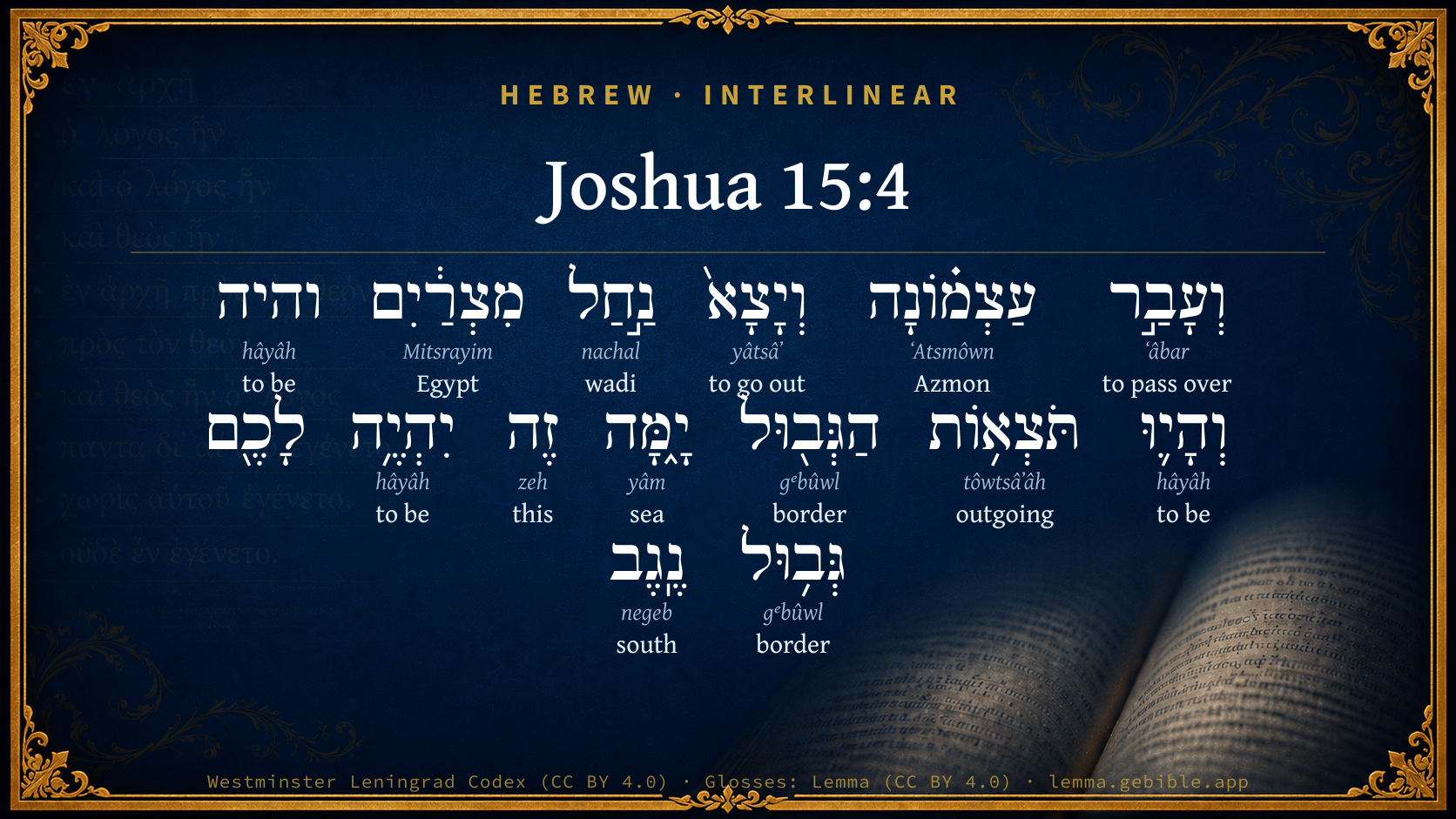
Hebrew (Westminster Leningrad Codex) Joshua 15:4 appears in the Hebrew Old Testament. The text above is from the Westminster Leningrad Codex. Each word links to its Strong’s number, a concise gloss, and parsing drawn from the Open Scriptures Hebrew Bible morphology. Click any word for its full Brown-Driver-Briggs (BDB) entry.
Download image
Cite this verse

Joshua 15:4 (World English Bible). Public Domain. Lemma interlinear Bible study tool, https://lemma.gebible.app/v/joshua/15/4.

Show BibTeX & RIS
BibTeX
RIS
English Translation
and it passed along to Azmon, and went out at the brook of Egypt; and the goings out of the border were at the sea: this shall be your south border.
World English Bible · Public Domain
Download a study sheet

One document with this verse’s original text, its word-by-word gloss line, the meaning frame, cross-references with their text, attributed commentary, and full source and license credits — printable, and it pastes into notes with its structure intact.

This verse Autodidact and up

Study sheet (.html) Plain text (.txt)

A passage Seminary Student

Up to 50 verses in one chapter. A passage sheet keeps up to 6 commentary sources and 12 cross-references per verse, in the order this page ranks them, and says so on the sheet whenever that leaves anything out. Ask for a single verse and you get the Autodidact verse sheet above.

Everything on this page stays free to read, with no account — the sheet is a download of what is already on screen, not access to it.

Want to remove ads? Support Godless Engineer
Compare translations 3

The same verse in 3 English versions, stacked beneath the original-language interlinear above. Click any original word for its lexicon entry.

Each is an independent rendering of the whole verse — the interlinear is not word-aligned to these translations.

Highlighted words mark where these versions differ — a whole-verse word diff, not a word-by-word alignment.

  • World English Bible Public Domain
    and it passed along to Azmon, and went out at the brook of Egypt; and the goings out of the border were at the sea: this shall be your south border.
  • King James Version Public Domain
    From thence it passed toward Azmon, and went out unto the river of Egypt; and the goings out of that coast were at the sea: this shall be your south coast.
  • unfoldingWord Literal Text CC BY-SA 4.0
    And it passed over to Azmon, then it went out the wadi of Egypt, and the goings out of the border seaward. This will be for you the border of the south.

unfoldingWord Literal Text — © unfoldingWord, licensed CC BY-SA 4.0. Word-aligned USFM3 via Door43 (git.door43.org/unfoldingWord/en_ult).

Versions to compare (up to 4)

3 of 4 selected

Show all 18 translations

Every available English version of this verse, each an independent rendering of the whole verse.

  • World English Bible Public Domain
    and it passed along to Azmon, and went out at the brook of Egypt; and the goings out of the border were at the sea: this shall be your south border.
  • Berean Standard Bible Public Domain
    It proceeded to Azmon, joined the Brook of Egypt, and ended at the Sea. This was their southern border.
  • Majority Standard Bible Public Domain
    It proceeded to Azmon, joined the Brook of Egypt, and ended at the Sea. This was their southern border.
  • King James Version Public Domain
    From thence it passed toward Azmon, and went out unto the river of Egypt; and the goings out of that coast were at the sea: this shall be your south coast.
  • American Standard Version (1901) Public Domain
    and it passed along to Azmon, and went out at the brook of Egypt; and the goings out of the border were at the sea: this shall be your south border.
  • Revised Version (1885) Public Domain
    and it passed along to Azmon, and went out at the brook of Egypt; and the goings out of the border were at the sea: this shall be your south border.
  • Geneva Bible (1599) Public Domain
    From thence went it along to Azmon, and reached vnto the riuer of Egypt, and the end of that coast was on the Westside: this shall be your South coast.
  • Douay-Rheims (1899) Public Domain
    And from thence passing along into Asemona, and reaching the torrent of Egypt: and the bounds thereof shall be the great sea, this shall be the limit of the south coast.
  • Young's Literal Translation Public Domain
    and passed over `to' Azmon, and gone out `at' the brook of Egypt, and the outgoings of the border have been at the sea; this is to you the south border.
  • Literal Standard Version CC BY-SA 4.0
    and passed over [to] Azmon, and gone out [at] the Brook of Egypt, and the outgoings of the border have been at the sea; this is the south border to you.
  • Unlocked Literal Bible CC BY-SA 4.0
    It passed along to Azmon, went by the brook of Egypt, and came to its end at the sea. This was their south boundary.
  • unfoldingWord Literal Text CC BY-SA 4.0
    And it passed over to Azmon, then it went out the wadi of Egypt, and the goings out of the border seaward. This will be for you the border of the south.
  • Darby Bible Public Domain
    and passed on to Azmon, and went out by the torrent of Egypt; and the border ended at the sea. That shall be your border southward.
  • World Messianic Bible Public Domain
    and it passed along to Azmon, went out at the brook of Egypt; and the border ended at the sea. This shall be your south border.
  • Webster's Bible Public Domain
    From thence it passed towards Azmon, and went out to the river of Egypt; and the limits of that border were at the sea: this shall be your south limit.
  • Free Bible Version CC BY-SA 4.0
    passing through Azmon and out to the Wadi of Egypt, ending at the sea. This was their southern border.
  • Bible in Basic English Public Domain
    Then on to Azmon, ending at the stream of Egypt: and the end of the limit is at the sea; this will be your limit on the south.
  • JPS Tanakh (1917) Public Domain
    And it passed along to Azmon, and went out at the Brook of Egypt; and the goings out of the border were at the sea; this shall be your south border.

Literal Standard Version (2020), Covenant Press — licensed CC BY-SA 4.0. Text via the HelloAO Bible API (eBible.org). Unlocked Literal Bible (unfoldingWord) — licensed CC BY-SA 4.0. Text via the HelloAO Bible API (eBible.org). unfoldingWord Literal Text — © unfoldingWord, licensed CC BY-SA 4.0. Word-aligned USFM3 via Door43 (git.door43.org/unfoldingWord/en_ult). Free Bible Version, Dr. Jonathan Gallagher — licensed CC BY-SA 4.0. Text via the HelloAO Bible API (eBible.org).

Word by word

More ways to search: Search by grammar → Find every occurrence → Compare this word →

Practice this passage: Drill this verse → Learn its vocabulary →

עַצְמ֗וֹנָה
ʻAtsmôwn
H6111
“Azmon · toward”
Noun, Proper + Suffix, Demonstrative
Part of Speech
Noun
Type
Proper
Full BDB Definition

Origin: from H6107

TWOT: None

Azmon = "strong" - a place on the extreme southern border of Canaan
  1. וְעָבַ֣ר ʻâbar H5674 “and · to pass over” Conjunction + Verb, Qal, Perfect, 3rd Person, Masculine, Singular
  2. וְיָצָא֙ yâtsâʼ H3318 “and · to go out” Conjunction + Verb, Qal, Perfect, 3rd Person, Masculine, Singular
  3. נַ֣חַל nachal H5158 “wadi of” Noun, Common, Masculine, Singular, Construct
  4. מִצְרַ֔יִם Mitsrayim H4714 “Egypt” Noun, Proper
  5. והיה hâyâh H1961 “and · to be” Conjunction + Verb, Qal, Perfect, 3rd Person, Masculine, Singular
  6. וְהָי֛וּ hâyâh H1961 “and · to be” Conjunction + Verb, Qal, Perfect, 3rd Person, Common, Plural
  7. תֹּצְא֥וֹת tôwtsâʼâh H8444 “outgoings of” Noun, Common, Feminine, Plural, Construct
  8. הַגְּב֖וּל gᵉbûwl H1366 “the · border” Particle, Definite Article + Noun, Common, Masculine, Singular, Absolute
  9. יָ֑מָּה yâm H3220 “sea · toward” Noun, Common, Masculine, Singular, Absolute + Suffix, Demonstrative
  10. זֶה zeh H2088 “this” Pronoun, Demonstrative, Masculine, Singular
  11. יִהְיֶ֥ה hâyâh H1961 “to be” Verb, Qal, Imperfect, 3rd Person, Masculine, Singular
  12. גְּב֥וּל gᵉbûwl H1366 “border of” Noun, Common, Masculine, Singular, Construct
  13. נֶֽגֶב negeb H5045 “south” Noun, Common, Masculine, Singular, Absolute

About this verse

These counts appear in no published source. They are computed here, from the morphology-tagged text and Lemma’s own curated glosses. What Lemma adds →

15
words
11
distinct lemmas
Historical
section

Notable vocabulary

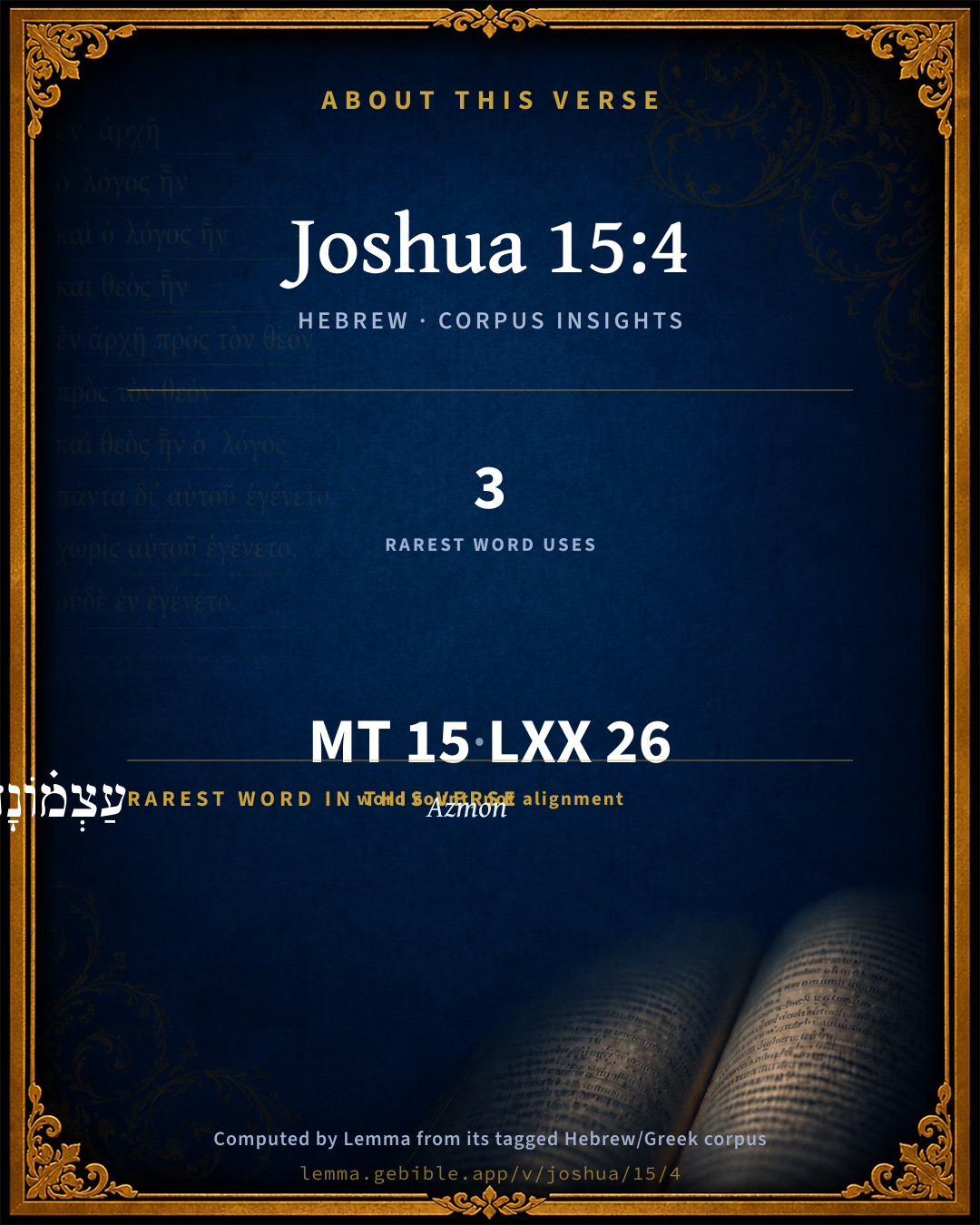
The rarest word here is עַצְמ֗וֹנָה Azmon H6111 — appearing just 3 times in the whole Hebrew Bible.

Shared distinctive vocabulary

עַצְמ֗וֹנָה Azmon H6111 occurs in 3 verses of the Hebrew Bible. Also found in:

Grammatical profile

  • 5 verbs
  • 8 nouns
  • 1 pronoun
  • 1 preposition

Verb forms

  • וְעָבַ֣ר Qal · Perfect
  • וְיָצָא֙ Qal · Perfect
  • והיה Qal · Perfect
  • וְהָי֛וּ Qal · Perfect
  • יִהְיֶ֥ה Qal · Imperfect

Repetition

Words recur within this verse — often emphatic in Hebrew:

  • והיה to be H1961 ×3
  • הַגְּב֖וּל border H1366 ×2

Hebrew & Septuagint length

In English translation the verse runs 31 words from the Hebrew and 29 from the Septuagint (LXX English) — closely comparable.

A rough comparison of the two English renderings, which tokenize alike — not a word-level alignment.

Word counts can differ between the Hebrew and the Greek without any difference in meaning — e.g. the Hebrew direct-object marker אֵת has no separate Greek word, and Greek often adds the article ὁ.

In the original languages it is 15 Hebrew tokens and 26 Greek tokens — but the two are counted differently (Hebrew bundles its prefixes and suffixes into one token; the Greek is in lemma form), so that isn’t a like-for-like length.

Cross-references

4

Topical passages linked to Joshua 15:4 in the Treasury of Scripture Knowledge — connected by theme and wording, ordered by reader-vote popularity; previews shown in the World English Bible.

  • Numbers 34:5 and the border shall turn about from Azmon to the brook of Egypt, and the goings out of it shall be at the sea.
  • Joshua 13:3 from the Shihor, which is before Egypt, even to the border of Ekron northward, [which] is reckoned to the Canaanites; the five lords of the Philistines; the Gazites, and the Ashdodites, the Ashkelonites, the Gittites, and the Ekronites; also the Avvim,
  • Exodus 23:31 I will set your border from the Red Sea even to the sea of the Philistines, and from the wilderness to the River; for I will deliver the inhabitants of the land into your hand, and you shall drive them out before you.
  • Genesis 15:18 In that day Yahweh made a covenant with Abram, saying, "To your seed have I given this land, from the river of Egypt to the great river, the river Euphrates:

Cross-references courtesy of OpenBible.info (CC BY 4.0).

Hebrew and Greek witnesses Masoretic Hebrew ↔ Greek Septuagint

The same verse in the two great witnesses to the Old Testament, shown verse-for-verse.

These are two independent witnesses, not word-aligned to each other, and the Septuagint is shown in lemma (dictionary) form.

Hebrew Joshua 15:4 Masoretic · Westminster Leningrad Codex

וְעָבַ֣ר עַצְמ֗וֹנָה וְיָצָא֙ נַ֣חַל מִצְרַ֔יִם והיה וְהָי֛וּ תֹּצְא֥וֹת הַגְּב֖וּל יָ֑מָּה זֶה יִהְיֶ֥ה לָכֶ֖ם גְּב֥וּל נֶֽגֶב

and it passed along to Azmon, and went out at the brook of Egypt; and the goings out of the border were at the sea: this shall be your south border.

World English Bible · Public Domain

Greek LXX Joshua 15:4 Septuagint · lemma form

καί πορεύομαι ἐπί ασεμωνα καί δια ἐκβάλλω ἕως φάραγξ αἴγυπτος καί εἰμί αὐτός ὁ διέξοδος ὁ ὅριον ἐπί ὁ θάλασσα οὗτος εἰμί αὐτός ὅριον ἀπό λίψ

And they go out to Selmona, and issue at the valley of Egypt; and the termination of its boundaries shall be at the sea: these are their boundaries southward.

LXX2012 (modern English Septuagint) · Public Domain

Hebrew: Westminster Leningrad Codex (CC BY 4.0). Greek: Septuagint (public domain); English from LXX2012 (modern English Septuagint) (Public Domain). How the Septuagint differs from the Hebrew →

Targum (Aramaic paraphrase)

1

The Targum is the ancient Jewish Aramaic paraphrase of the Hebrew Scriptures — an interpretive translation, not the Hebrew text itself. Onkelos (literal) and Pseudo-Jonathan (expansive) render the Torah, and Jonathan the Prophets. Coverage is partial: where no permissively-licensed English translation exists for a verse, only the Aramaic is shown. This is verse-level text, not a word-by-word alignment to the Hebrew.

  1. Targum Jonathan Prophets (Joshua–Malachi)
    וַעֲבַר לְעַצְמוֹן וְנָפֵק לְנַחְלָא דְמִצְרַיִם וַהֲווֹ מַפְקָנוֹהִי דִתְחוּמָא לְמַעֲרָבָה דֵין יְהֵא לְכוֹן תְּחוּם דָרוֹמָא:

    (no public-domain English translation for this verse)

    Targum Jonathan — Aramaic: “Mikraot Gedolot” (public domain). English: “Sefaria Community Translation” (CC0 1.0 (public-domain dedication)); “London "Chaldee Paraphrase," 1871” (public domain). Text via Sefaria.

Commentary

Notes on Joshua 15:4 from classic Christian and Jewish commentators (each source and its license shown beneath its notes). The classic Christian expositions comment on the surrounding passage and are grouped to its opening verse, so a note may address several verses; the Jewish commentaries on the Tanakh (Rashi and others) are per-verse, so they appear only where the commentator wrote on this verse.

Lemma curates 59 commentaries, every one of them public domain or Creative Commons licensed, each selected and text-cleaned for this edition rather than reprinted as found. About our sources →

Trapp's Complete Commentary

John Trapp

Jos 15:4 [From thence] it passed toward Azmon, and went out unto the river of Egypt; and the goings out of that coast were at the sea: this shall be your south coast.

Ver. 4. This shall be your south coast.] It is God that "determineth the times before appointed, and the bounds of our habitations"; {Act 17:26} the walls of his people’s houses are continually before him. {Isa 49:16}

John Trapp, A Commentary or Exposition upon All the Books of the Old and New Testament (1647–1656) — public domain. Text from a community e-Sword module.

Adam Clarke's Commentary

Verse 4. Toward Azmon] This was the last city they possessed toward Egypt.

The river of Egypt] The most eastern branch of the river Nile. See Clarke on Jos 13:3. But there is much reason to doubt whether any branch of the Nile be meant, and whether the promised land extended to that river. On this subject it is impossible to decide either way.

Adam Clarke's Commentary on the Bible (1810–1826) — public domain. Text from a community e-Sword/MySword module.

Ellicott's Commentary for English Readers

(4) This shall be your south coast.—This phrase does not seem to fit in with the language of the rest of the passage. But it is extremely like a reminiscence of the language of Moses in Num_34:3; Num_34:6; Num_34:9; Num_34:12. “This book of the law shall not depart out of thy mouth” was the instruction to Joshua, and in describing the border of Judah, he is really describing also the southern border of all Israel; and he does it throughout in language very like that of Moses in Numbers 34. But Moses wrote it in the second person and in the future tense throughout; Joshua wrote it in the third person and in the past tense, with this one exception, in which he seems to have unconsciously adopted the phraseology of the lawgiver instead of the historian.

A Bible Commentary for English Readers, edited by Charles John Ellicott (1878–1897) — public domain. Text from a community e-Sword module.

John Gill's Exposition

From thence it passed towards Azmon, and went out unto the river of Egypt,.... In like manner is this coast described, Num 34:5; it is called by Jerom (x) Asemona, and said to be a city in the desert, to the south of Judah, dividing Egypt, and the lot of the tribe of Judah, leading to the sea:

and the outgoings of that coast were at the sea; the Mediterranean sea; or to the west, as the Targum; this was the utmost border of the tribe of Judah this way:

this shall be your south coast; of the lot that fell to the tribe of Judah.

(x) De loc. Heb. fol. 87. K.

John Gill's Exposition of the Whole Bible (1746–1763) — public domain (CC PDM 1.0). Text via the HelloAO Bible API.

Haydock's Catholic Bible Commentary

Asemona, which lies nearest to the river of Egypt of all the cities of Juda, Numbers xxxiv. 4., chap. xiii. 3.

George Leo Haydock (1774–1849), Haydock's Catholic Family Bible and Commentary, 1859 edition — public domain. Excludes Psalms (Douay-Rheims chapter numbering differs from Protestant) and Deuterocanonical books (Catholic canon only).

Whedon's Commentary on the Bible

Daniel D. Whedon

4. Azmon is also unknown.

River of Egypt — Wady-el-Arish. See note Jos_13:3.

At the sea — The Mediterranean Sea.

Daniel D. Whedon (gen. ed.), Commentary on the Old and New Testaments (1874–1909) — public domain. Text from a community e-Sword module.

The Pulpit Commentary

The river of Egypt. (see above, Jos_13:3) "Westward, as far as Egypt, there is a sandy, salt, barren, unfruitful, and uninhabitable waste" (Knobel). The land, he adds, is better near Gaza, but near the sea it is still pure waste. And the goings out of that coast were at the sea. The word coast, derived through the French from the Latin costa, signifies, like it, a side. It is now used only of the border formed by the sea, but at an earlier period it had a wider signification. The Hebrew word is translated "border" in ver. 1. The meaning is that the boundary line of Judah ran as far as the sea. This shall be your south coast. Or, this shall be to you the southern boundary. The historian here quotes the directions given to Moses in Nu 34, with the evident intention of pointing out that the south border of the children of Israel coincided with that of the tribe of Judah.

The Pulpit Commentary (1880–1919), ed. H.D.M. Spence-Jones & Joseph S. Exell — public domain. Text from a community e-Sword module.

Rashi

Rabbi Shlomo Yitzchaki (Rashi)

Extended. The end of the border was at the Great Sea, which is the western border of all of Eretz Yisroel. Thus the boundary of Yehudah occupies the entire length of Eretz Yisroel from east to west and is located in the south of Eretz Yisroel.

Rashi on the Tanakh — English translations: “The Judaica Press complete Tanach with Rashi, translated by A. J. Rosenberg” (CC BY 4.0); “Pentateuch with Rashi's commentary by M. Rosenbaum and A.M. Silbermann, 1929-1934” (public domain); “The Metsudah Tanach series, Lakewood, N.J” (CC BY 4.0); and “The Book of Joshua, Metsudah Publications, 1997” (CC BY 4.0). Text via Sefaria.

Lesson kit

Teaching starters — assembled from the data on this page, not authored interpretation. Every prompt links to the verse data it draws on. Edit before teaching.

Joshua, in the Historical, opens this verse with 15 words (11 distinct Hebrew lemmas). Its most distinctive word is ʻAtsmôwn (“Azmon”). A historical commentator’s framing appears above. Read the whole chapter for the surrounding context.

Discussion questions

  1. How does “Azmon” (ʻAtsmôwn) shape what this verse is saying?
  2. Numbers 34:4 shares the word «Azmon» with this verse. How do the two illuminate each other?
  3. “to be” occurs 3× in this one verse. What is the effect of the repetition?
  4. These translations render this verse differently; the difference is in the English rendering, not the original. What questions does that raise?
  5. The verb «וְעָבַ֣ר» is Qal Perfect. How does its form color the action?
  6. Reading how Trapp's Complete Commentary and Adam Clarke's Commentary read this verse, where do the two commentators agree and where do they part?

Things to notice

Reading settings

Reading text

Shown beneath each verse's original-language words.

Old Testament
Old Testament edition

Read the OT as the Masoretic Hebrew (MT) or the Greek Septuagint (LXX).

English shown for the Greek Septuagint (in the Hebrew ↔ Greek comparison).

Comparing translations? Open the Compare panel on any verse page to stack up to four side by side.