
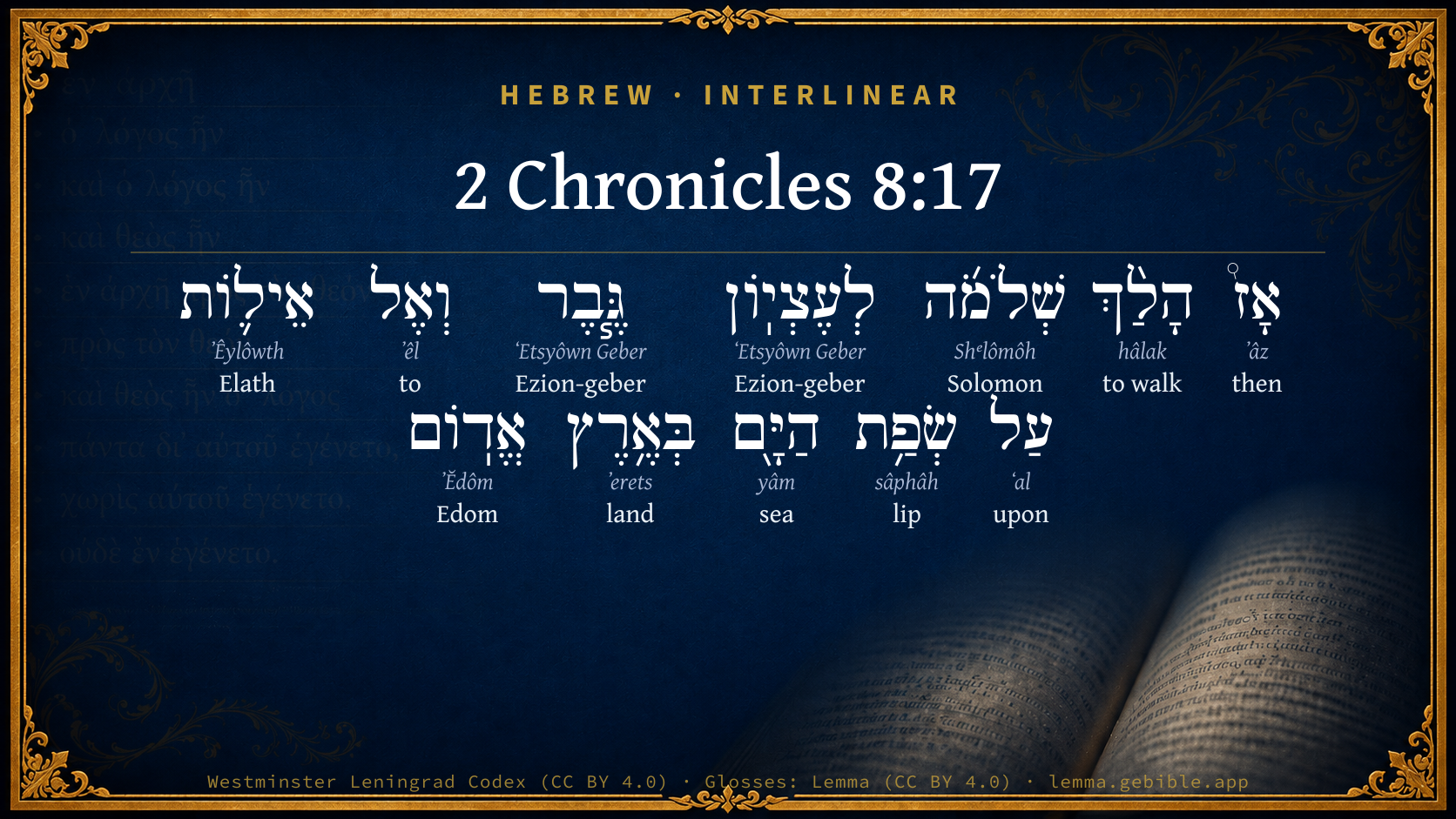
2 Chronicles 8:17

Hebrew (Westminster Leningrad Codex) 2 Chronicles 8:17 appears in the Hebrew Old Testament. The text above is from the Westminster Leningrad Codex. Each word links to its Strong’s number, a concise gloss, and parsing drawn from the Open Scriptures Hebrew Bible morphology. Click any word for its full Brown-Driver-Briggs (BDB) entry.
Download image
Cite this verse

2 Chronicles 8:17 (World English Bible). Public Domain. Lemma interlinear Bible study tool, https://lemma.gebible.app/v/2-chronicles/8/17.

Show BibTeX & RIS
BibTeX
RIS
English Translation
Then went Solomon to Ezion Geber, and to Eloth, on the seashore in the land of Edom.
World English Bible · Public Domain
Download a study sheet

One document with this verse’s original text, its word-by-word gloss line, the meaning frame, cross-references with their text, attributed commentary, and full source and license credits — printable, and it pastes into notes with its structure intact.

This verse Autodidact and up

Study sheet (.html) Plain text (.txt)

A passage Seminary Student

Up to 50 verses in one chapter. A passage sheet keeps up to 6 commentary sources and 12 cross-references per verse, in the order this page ranks them, and says so on the sheet whenever that leaves anything out. Ask for a single verse and you get the Autodidact verse sheet above.

Everything on this page stays free to read, with no account — the sheet is a download of what is already on screen, not access to it.

Want to remove ads? Support Godless Engineer
Compare translations 3

The same verse in 3 English versions, stacked beneath the original-language interlinear above. Click any original word for its lexicon entry.

Each is an independent rendering of the whole verse — the interlinear is not word-aligned to these translations.

Highlighted words mark where these versions differ — a whole-verse word diff, not a word-by-word alignment.

  • World English Bible Public Domain
    Then went Solomon to Ezion Geber, and to Eloth, on the seashore in the land of Edom.
  • King James Version Public Domain
    Then went Solomon to Eziongeber, and to Eloth, at the sea side in the land of Edom.
  • unfoldingWord Literal Text CC BY-SA 4.0
    Then Solomon went to Ezion Geber and to Eloth on the edge of the sea, in the land of Edom.

unfoldingWord Literal Text — © unfoldingWord, licensed CC BY-SA 4.0. Word-aligned USFM3 via Door43 (git.door43.org/unfoldingWord/en_ult).

Versions to compare (up to 4)

3 of 4 selected

Show all 18 translations

Every available English version of this verse, each an independent rendering of the whole verse.

  • World English Bible Public Domain
    Then went Solomon to Ezion Geber, and to Eloth, on the seashore in the land of Edom.
  • Berean Standard Bible Public Domain
    Then Solomon went to Ezion-geber and to Eloth on the coast of Edom.
  • Majority Standard Bible Public Domain
    Then Solomon went to Ezion-geber and to Eloth on the coast of Edom.
  • King James Version Public Domain
    Then went Solomon to Eziongeber, and to Eloth, at the sea side in the land of Edom.
  • American Standard Version (1901) Public Domain
    Then went Solomon to Ezion-geber, and to Eloth, on the seashore in the land of Edom.
  • Revised Version (1885) Public Domain
    Then went Solomon to Ezion-geber, and to Eloth, on the sea shore in the land of Edom.
  • Geneva Bible (1599) Public Domain
    Then went Salomon to Ezion-geber, and to Eloth by the sea side in the lande of Edom.
  • Douay-Rheims (1899) Public Domain
    Then Solomon went to Asiongaber, and to Ailath, on the coast of the Red Sea, which is in the land of Edom.
  • Young's Literal Translation Public Domain
    Then hath Solomon gone to Ezion-Geber, and unto Elath, on the border of the sea, in the land of Edom;
  • Literal Standard Version CC BY-SA 4.0
    Then Solomon has gone to Ezion-Geber, and to Elath, on the border of the sea, in the land of Edom;
  • Unlocked Literal Bible CC BY-SA 4.0
    Then Solomon went to Ezion Geber and then to Elath on the coast, in the land of Edom.
  • unfoldingWord Literal Text CC BY-SA 4.0
    Then Solomon went to Ezion Geber and to Eloth on the edge of the sea, in the land of Edom.
  • Darby Bible Public Domain
    Then went Solomon to Ezion-geber, and to Eloth, on the seashore in the land of Edom.
  • World Messianic Bible Public Domain
    Then Solomon went to Ezion Geber and to Eloth, on the seashore in the land of Edom.
  • Webster's Bible Public Domain
    Then went Solomon to Ezion-geber, and to Eloth, at the sea side in the land of Edom.
  • Free Bible Version CC BY-SA 4.0
    After this Solomon went to Ezion-geber and to Eloth on the coast of the land of Edom.
  • Bible in Basic English Public Domain
    Then Solomon went to Ezion-geber and to Eloth by the sea in the land of Edom.
  • JPS Tanakh (1917) Public Domain
    Then went Solomon to Ezion-geber, and to Eloth, on the sea-shore in the land of Edom.

Literal Standard Version (2020), Covenant Press — licensed CC BY-SA 4.0. Text via the HelloAO Bible API (eBible.org). Unlocked Literal Bible (unfoldingWord) — licensed CC BY-SA 4.0. Text via the HelloAO Bible API (eBible.org). unfoldingWord Literal Text — © unfoldingWord, licensed CC BY-SA 4.0. Word-aligned USFM3 via Door43 (git.door43.org/unfoldingWord/en_ult). Free Bible Version, Dr. Jonathan Gallagher — licensed CC BY-SA 4.0. Text via the HelloAO Bible API (eBible.org).

Word by word

More ways to search: Search by grammar → Find every occurrence → Compare this word →

Practice this passage: Drill this verse → Learn its vocabulary →

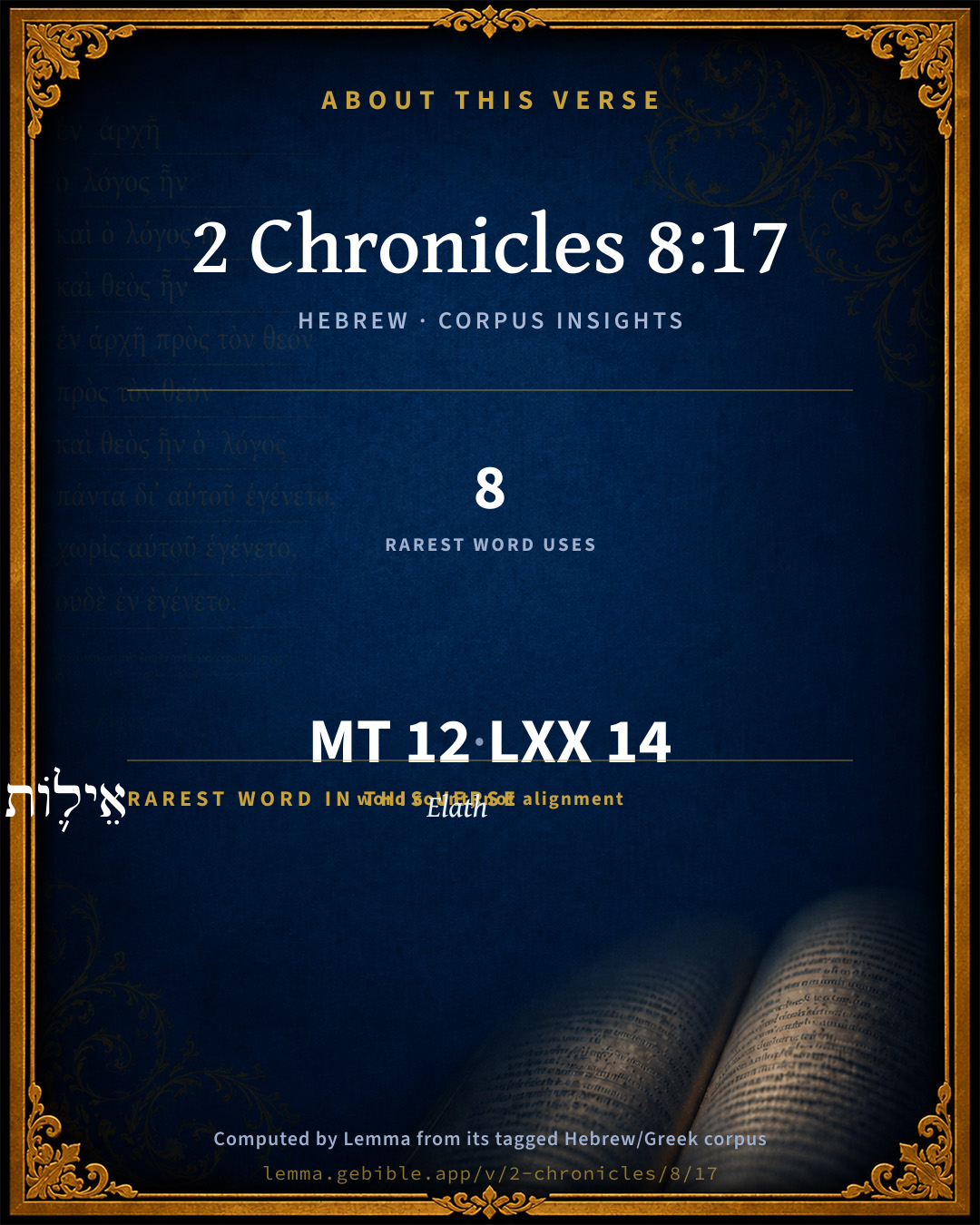
About this verse

These counts appear in no published source. They are computed here, from the morphology-tagged text and Lemma’s own curated glosses. What Lemma adds →

12
words
11
distinct lemmas
Historical
section

Notable vocabulary

The rarest word here is אֵיל֛וֹת Elath H359 — appearing just 8 times in the whole Hebrew Bible.

Shared distinctive vocabulary

אֵיל֛וֹת Elath H359 occurs in 6 verses of the Hebrew Bible. Also found in:

Grammatical profile

  • 1 verb
  • 8 nouns
  • 2 prepositions
  • 1 adverb

Verb forms

  • הָלַ֨ךְ Qal · Perfect

Repetition

A word recurs within this verse — often emphatic in Hebrew:

  • לְעֶצְיֽוֹן Ezion-geber H6100 ×2

Hebrew & Septuagint length

In English translation the verse runs 17 words from the Hebrew and 17 from the Septuagint (LXX English) — the same length.

A rough comparison of the two English renderings, which tokenize alike — not a word-level alignment.

Word counts can differ between the Hebrew and the Greek without any difference in meaning — e.g. the Hebrew direct-object marker אֵת has no separate Greek word, and Greek often adds the article ὁ.

In the original languages it is 12 Hebrew tokens and 14 Greek tokens — but the two are counted differently (Hebrew bundles its prefixes and suffixes into one token; the Greek is in lemma form), so that isn’t a like-for-like length.

Cross-references

7

Topical passages linked to 2 Chronicles 8:17 in the Treasury of Scripture Knowledge — connected by theme and wording, ordered by reader-vote popularity; previews shown in the World English Bible.

  • 2 Kings 14:22 He built Elath, and restored it to Judah, after that the king slept with his fathers.
  • Deuteronomy 2:8 So we passed by from our brothers the children of Esau, who dwell in Seir, from the way of the Arabah from Elath and from Ezion Geber. We turned and passed by the way of the wilderness of Moab.
  • Numbers 33:35 They traveled from Abronah, and encamped in Ezion Geber.
  • 1 Kings 9:26–27 King Solomon made a navy of ships in Ezion Geber, which is beside Eloth, on the shore of the Red Sea, in the land of Edom.
  • 1 Kings 22:48 Jehoshaphat made ships of Tarshish to go to Ophir for gold: but they didn't go; for the ships were broken at Ezion Geber.
  • 2 Kings 16:6 At that time Rezin king of Syria recovered Elath to Syria, and drove the Jews from Elath; and the Syrians came to Elath, and lived there, to this day.
  • 2 Chronicles 20:36 and he joined himself with him to make ships to go to Tarshish; and they made the ships in Ezion Geber.

Cross-references courtesy of OpenBible.info (CC BY 4.0).

Hebrew and Greek witnesses Masoretic Hebrew ↔ Greek Septuagint

The same verse in the two great witnesses to the Old Testament, shown verse-for-verse.

These are two independent witnesses, not word-aligned to each other, and the Septuagint is shown in lemma (dictionary) form.

Hebrew 2 Chronicles 8:17 Masoretic · Westminster Leningrad Codex

אָז֩ הָלַ֨ךְ שְׁלֹמֹ֜ה לְעֶצְיֽוֹן גֶּ֧בֶר וְאֶל אֵיל֛וֹת עַל שְׂפַ֥ת הַיָּ֖ם בְּאֶ֥רֶץ אֱדֽוֹם

Then went Solomon to Ezion Geber, and to Eloth, on the seashore in the land of Edom.

World English Bible · Public Domain

Greek LXX 2 Chronicles 8:17 Septuagint · lemma form

τότε οἴχομαι σαλωμών εἰς γασιωνγαβερ καί εἰς ὁ αιλαθ ὁ παραθαλάσσιος ἐν γῆ ιδουμαία

Then Solomon went to Gasion Gaber, and to Aelath near the sea in the land of Idumea.

LXX2012 (modern English Septuagint) · Public Domain

Hebrew: Westminster Leningrad Codex (CC BY 4.0). Greek: Septuagint (public domain); English from LXX2012 (modern English Septuagint) (Public Domain). How the Septuagint differs from the Hebrew →

Commentary

Notes on 2 Chronicles 8:17 from classic Christian and Jewish commentators (each source and its license shown beneath its notes). The classic Christian expositions comment on the surrounding passage and are grouped to its opening verse, so a note may address several verses; the Jewish commentaries on the Tanakh (Rashi and others) are per-verse, so they appear only where the commentator wrote on this verse.

Lemma curates 59 commentaries, every one of them public domain or Creative Commons licensed, each selected and text-cleaned for this edition rather than reprinted as found. About our sources →

Ellicott's Commentary for English Readers

(d) THE VOYAGE TO OPHIR (2Ch_8:17-18).

Comp. 1Ki_9:26-28.

(17) Then (’âz).—After the completion of the Temple.

Went Solomon to Ezion-geber, and to Eloth.—Syr., “Ezion-geber, a city which is over against Eloth.” 1Ki_9:26 reads, “And a fleet did king Solomon make at Ezion-geber, which is near Eloth.”

The sea.—Kings, the Red Sea. So Vulg. The words of our text do not necessarily imply a personal visit on the part of Solomon. He sent his shipwrights to the Idumean port.

A Bible Commentary for English Readers, edited by Charles John Ellicott (1878–1897) — public domain. Text from a community e-Sword module.

Trapp's Complete Commentary

John Trapp

2Ch 8:17 Then went Solomon to Eziongeber, and to Eloth, at the sea side in the land of Edom.

Ver. 17. To Eziongeber.] A haven of the Red Sea, called by Josephus Berenice, by Jerome Essia; Eloth is also called Elath, {Deu 2:8} and at this day Elana, unde sinus Elaniticus.

Four hundred and fifty talents.] Thirty of them seem to go for the charges of the voyage. Compare 1Ki 9:28.

John Trapp, A Commentary or Exposition upon All the Books of the Old and New Testament (1647–1656) — public domain. Text from a community e-Sword module.

Tyndale Open Study Notes

Tyndale Open Resources

8:17-18 By discussing Solomon’s activities at his kingdom’s most northern and southern borders, the Chronicler shows the extent of Solomon’s empire. Solomon controlled ports on the Red Sea that provided for international trade to the south. • Hiram was a valuable ally; his people, the Phoenicians of Tyre, had extensive trade networks and were expert mariners, helping Solomon trade with Ophir. • Ophir is traditionally thought to be in southwest Arabia (see Gen 10:28-29).

Tyndale Open Study Notes — © Tyndale Open Resources, licensed CC BY-SA 4.0. Text via the HelloAO Bible API.

Geneva Bible (1599)

Geneva Bible translators

Meaning, the red Sea.

Geneva Bible (1599) marginal notes — public domain. Text via Bolls.life.

Jamieson, Fausset & Brown

Robert Jamieson, A. R. Fausset & David Brown

Then went Solomon to Ezion-geber, and to Eloth--These two maritime ports were situated at the eastern gulf of the Red Sea, now called the Gulf of Akaba. Eloth is seen in the modern Akaba, Ezion-geber in El Gudyan [ROBINSON]. Solomon, determined to cultivate the arts of peace, was sagacious enough to perceive that his kingdom could become great and glorious only by encouraging a spirit of commercial enterprise among his subjects; and, accordingly, with that in mind he made a contract with Huram for ships and seamen to instruct his people in navigation.

Jamieson, Fausset & Brown — Commentary Critical and Explanatory on the Whole Bible (1871) — public domain (CC PDM 1.0). Text via the HelloAO Bible API.

Adam Clarke's Commentary

Verse 17. Then went Solomon to Ezion-geber] See the notes on 1Kg 9:26-28, for conjectures concerning Ezion-geber and Ophir.

Adam Clarke's Commentary on the Bible (1810–1826) — public domain. Text from a community e-Sword/MySword module.

The Cambridge Bible for Schools and Colleges

gen. ed. J. J. S. Perowne

17, 18 (= 1Ki_9:26-28). Solomon’s Fleet

17. to Ezion-geber, and to Eloth] In 1 Kin. Ezion-geber which is beside Eloth on the shore of the Red Sea. Strictly speaking it was at the head of the Gulf of Akaba, the eastern arm of the Red Sea. Cp. 2Ch_20:36 (R.V.) and Deu_2:8.

The Cambridge Bible for Schools and Colleges (gen. ed. J. J. S. Perowne; Cambridge University Press, 1878–1918) — public domain. Text from a community e-Sword module.

Haydock's Catholic Bible Commentary

Asiongaber, which was called Bernice, (Josephus, [Antiquities?] viii. 2.) and now Suez. (Tirinus)

George Leo Haydock (1774–1849), Haydock's Catholic Family Bible and Commentary, 1859 edition — public domain. Excludes Psalms (Douay-Rheims chapter numbering differs from Protestant) and Deuterocanonical books (Catholic canon only).

Matthew Poole's English Annotations

Of this and the next verse, See Poole "1Ki 9:26", &c.

Matthew Poole's English Annotations on the Holy Bible (1683–1685) — public domain. Text from a community e-Sword/MySword module.

The Pulpit Commentary

Ezion-geber Eloth. Parallel, 1Ki_9:26, which describes the former of these ports as "beside" the latter, "on the Red Sea," i.e. at the extremity of the eastern gulf of the Red Sea, called the Elanitic Gulf by Greeks and Romans, but now the Gulf of Akabah (Num_33:35-37; Deu_2:8; 2Sa_8:14; 1Ki_22:48; 2Ki_14:22 2Ki_16:6; 2Ch_20:36, 2Ch_20:37) David"s conquest of Edom was the occasion of its coming into the possession of Israel.

Vers. 17, 18.

The first merchant-ships.

I To WHOM THEY BELONGED.

1. Solomon who constructed a navy of ships. (1Ki_9:26) The first mention of ship-building by the Israelites. An advance in civilization, it is doubtful whether this was in harmony with the calling of the Israelites as a theocratic people, whose business it was to keep themselves distinct from other nations.

2. Hiram who sent the Israelitish monarch ships by the hands of his servants. Either Hiram sent to Eloth ship-carpenters, who built ships for Solomon (Bahr), or he built ships at Tyre, and sent them by the hands of sailors to join in Solomon"s expedition (Bertheau). If the latter, they must either have rounded the continent of Africa (Bertheau), or been carried by land transport across the Isthmus of Suez (Keil). The former would not have been impossible had the circumnavigation of Africa been at that time known. This, however, is doubtful, as Herodotus (4:42) mentions Pharaoh Necho of the twenty-sixth dynasty (B.C. 612) as the first to prove that Africa was entirely surrounded by water, with the exception of the small isthmus connecting it with Asia. This he did by sending Phoenician seamen in ships from the Arabian Gulf to seek their way to Egypt through the Pillars of Hercules and the Mediterranean Sea. Hence the latter method was more probably adopted for conveying Hiram"s ships to the Gulf of Arabia a method of transporting vessels known to the ancients. Herodotus (vii. 24) states that, while Xerxes cut a passage through the Isthmus of Mount Athos, he need not have done so, since without difficulty he might have carried his ships across the land. Thucydides (4:8) mentions that in this way the Peloponnesians conveyed eighty ships across the Leucadia-isthmus. (For additional examples, see Exposition.)

II THE PORT WHENCE THEY SAILED.

1. Ezion-geber, a camping-station on the desert march of Israel (Num_33:35; Deu_2:8) afterwards the place where Jehoshaphat"s ships were wrecked. (1Ki_22:48) When the town was built is unknown. Its name imports "the backbone of a man" (Gesenius); the Greeks called it Berenice (Josephus, "Ant.," 8:6. 4).

2. Near Eloth, the Ailane of Josephus, the Ailath of the Greeks, and the Elana of the Romans, the modern Akaba, on the eastern bay of the Gulf of Akabah. Whether Ezion-geber was also on the east side of the gulf or on the west is uncertain, as no trace of it now exists.

3. On the shore of the Red Sea. The Yam Suf was the eastern arm of the Arabian Gulf, or the Gulf of Akabah. At the present day navigation is perilous in the vicinity of Elath in consequence of the sharp and rocky coast and the easily excited storms.

4. In the land of Edom. Mount Seir, Edom, Idumaea, the Mount of Esau (Deu_2:5; Joe_3:19; Isa_24:5 Oba_1:21) in the Assyrian inscriptions, Udumu or Udumi (Schrader, "Die Keilinsehriften," p. 149); a desolate region extending from the head of the Elanitic Gulf to the foot of the Dead Sea, described by Robinson as "a rolling desert, the surface of which was in general loose gravel and stones, everywhere furrowed and torn with the beds of torrents now and then a lone shrub of the ghudah being almost the only trace of vegetation" ("Biblical Researches," 2:502, 551).

III THE SAILORS BY WHOM THEY WERE MANNED. Servants of Hiram, who had knowledge of the sea. The Phoenicians the earliest navigators of the ocean. An inscription of Queen Hatasu, of the eighteenth Egyptian dynasty, queen regnant first with Thothmes II and afterwards with Thothmes III, has preserved a record of the construction by that royal lady of a navy on the Red Sea, and of a voyage of discovery to the land of Arabia in vessels manned by Phoenician seamen (Brugsch, "Egypt," 1:351, etc.; "Records of the Past," 10:11, etc.).

IV THE COUNTRY TO WHICH THEY STEERED. Ophir. By eminent authorities (Lassen, Ritter, Bertheau) located in India, this gold-producing region was probably in Arabia (Knobel, Keil, Ewald, Bahr) the land of Pun, to which the ships of Hatasu sailed for costly treasures.

V THE CARGO WITH WHICH THEY RETURNED.

1. Gold. Whether the four hundred and fifty talents were the cargo of one voyage or of all the voyages cannot be determined. Reckoning a talent at sterling, the amount would be or nearly two and a half millions. This precious metal was amongst the treasures fetched from the land of Pun by Hatasu"s fleet.

2. Precious stones. Learnt from a later statement. (2Ch_9:10) These also were obtainable in the land of Pun.

3. Algum trees. . (2Ch_9:10) What these were is unknown; probably they corresponded with the balsam-wood or "incense trees" brought from Pun by Hatasu"s ships. It was manifestly rare and costly, as Solomon made of it "terraces to the house of the Lord and the king"s palace, as well as harps and psalteries for singers;" "and there were none such seen before in the land of Judah." So said Hatasu"s scribes of her cargo. "Never has such a convoy been made like this one by any king since the creation of the world.

Learn:

1. Man"s dominion over nature he can affront the perils of the sea.

2. The advantages (from a secular point of view) of navigation inincreasing the world"s wealth and comfort, in extending man"s knowledge and power, and in binding the nations into a mutually dependent and helpful brotherhood.

3. The dangers (from a spiritual point of view) of foreign exploration, infostering the lust of conquest and possession, and in bringing God"s people into contact with heathen nations. W.

The Pulpit Commentary (1880–1919), ed. H.D.M. Spence-Jones & Joseph S. Exell — public domain. Text from a community e-Sword module.

Keil & Delitzsch

C. F. Keil & F. Delitzsch

Voyage to Ophir. Cf. Kg1 9:26-28, and the commentary on that passage, where we have discussed the divergences of our narrative, and have also come to the conclusion that Ophir is not to be sought in India, but in Southern Arabia. By אז the date of this voyage is made to fall in the period after the building of the temple and the palace, i.e., in the second half of Solomon's reign.

Keil & Delitzsch — Biblical Commentary on the Old Testament (1861–1891) — public domain (CC PDM 1.0). Text via the HelloAO Bible API. (Old Testament only.)

unfoldingWord translationNotes

Door43 World Missions Community

Ezion Geber and then to Elath on the coast

These are towns along the Sea of Reeds. They had ports where people who had ships could stop. AT: "the towns of Ezion Geber and Elath, on the coast of the Sea of Reeds" (See: How to Translate Names and Assumed Knowledge and Implicit Information)

Ophir

This is the name of a place. Its location is not known. (See: How to Translate Names)

450 talents of gold

"four hundred and fifty talents of gold." You may convert this to a modern measure. AT: "about sixteen thousand kilograms of gold" or "about fifteen metric tons of gold" (See: Numbers and Biblical Weight)

translationWords

Edom

command

servant

gold

unfoldingWord translationNotes — © Distant Shores Media and the Door43 World Missions Community, licensed CC BY-SA 4.0. Source: git.door43.org/Door43/en_tn.

Lesson kit

Teaching starters — assembled from the data on this page, not authored interpretation. Every prompt links to the verse data it draws on. Edit before teaching.

2 Chronicles, in the Historical, opens this verse with 12 words (11 distinct Hebrew lemmas). Its most distinctive word is ʼÊylôwth (“Elath”). A historical commentator’s framing appears above. Read the whole chapter for the surrounding context.

Discussion questions

  1. What does “Elath” (ʼÊylôwth) contribute to the verse as a whole?
  2. Deuteronomy 2:8 shares the word «Elath» with this verse. How do the two illuminate each other?
  3. “Ezion-geber” occurs 2× in this one verse. What is the effect of the repetition?
  4. These translations render this verse differently. What is at stake in choosing one wording over another?
  5. The verb «הָלַ֨ךְ» is Qal Perfect. How does its form color the action?
  6. Reading how Ellicott's Commentary for English Readers and Trapp's Complete Commentary read this verse, where do the two commentators agree and where do they part?

Things to notice

Reading settings

Reading text

Shown beneath each verse's original-language words.

Old Testament
Old Testament edition

Read the OT as the Masoretic Hebrew (MT) or the Greek Septuagint (LXX).

English shown for the Greek Septuagint (in the Hebrew ↔ Greek comparison).

Comparing translations? Open the Compare panel on any verse page to stack up to four side by side.