
Exodus 14:21

Hebrew (Westminster Leningrad Codex) Exodus 14:21 appears in the Hebrew Old Testament. The text above is from the Westminster Leningrad Codex. Each word links to its Strong’s number, a concise gloss, and parsing drawn from the Open Scriptures Hebrew Bible morphology. Click any word for its full Brown-Driver-Briggs (BDB) entry.
Download image
Cite this verse

Exodus 14:21 (World English Bible). Public Domain. Lemma interlinear Bible study tool, https://lemma.gebible.app/v/exodus/14/21.

Show BibTeX & RIS
BibTeX
RIS
English Translation
Moses stretched out his hand over the sea, and Yahweh caused the sea to go back by a strong east wind all the night, and made the sea dry land, and the waters were divided.
World English Bible · Public Domain
Download a study sheet

One document with this verse’s original text, its word-by-word gloss line, the meaning frame, cross-references with their text, attributed commentary, and full source and license credits — printable, and it pastes into notes with its structure intact.

This verse Autodidact and up

Study sheet (.html) Plain text (.txt)

A passage Seminary Student

Up to 50 verses in one chapter. A passage sheet keeps up to 6 commentary sources and 12 cross-references per verse, in the order this page ranks them, and says so on the sheet whenever that leaves anything out. Ask for a single verse and you get the Autodidact verse sheet above.

Everything on this page stays free to read, with no account — the sheet is a download of what is already on screen, not access to it.

Want to remove ads? Support Godless Engineer
Compare translations 3

The same verse in 3 English versions, stacked beneath the original-language interlinear above. Click any original word for its lexicon entry.

Each is an independent rendering of the whole verse — the interlinear is not word-aligned to these translations.

Highlighted words mark where these versions differ — a whole-verse word diff, not a word-by-word alignment.

  • World English Bible Public Domain
    Moses stretched out his hand over the sea, and Yahweh caused the sea to go back by a strong east wind all the night, and made the sea dry land, and the waters were divided.
  • King James Version Public Domain
    And Moses stretched out his hand over the sea; and the LORD caused the sea to go back by a strong east wind all that night, and made the sea dry land, and the waters were divided.
  • unfoldingWord Literal Text CC BY-SA 4.0
    And Moses reached out his hand over the sea. And Yahweh drove the sea by a strong east wind all night and made the sea into dry land. And the waters were divided.

unfoldingWord Literal Text — © unfoldingWord, licensed CC BY-SA 4.0. Word-aligned USFM3 via Door43 (git.door43.org/unfoldingWord/en_ult).

Versions to compare (up to 4)

3 of 4 selected

Show all 18 translations

Every available English version of this verse, each an independent rendering of the whole verse.

  • World English Bible Public Domain
    Moses stretched out his hand over the sea, and Yahweh caused the sea to go back by a strong east wind all the night, and made the sea dry land, and the waters were divided.
  • Berean Standard Bible Public Domain
    Then Moses stretched out his hand over the sea, and all that night the LORD drove back the sea with a strong east wind that turned it into dry land. So the waters were divided,
  • Majority Standard Bible Public Domain
    Then Moses stretched out his hand over the sea, and all that night the LORD drove back the sea with a strong east wind that turned it into dry land. So the waters were divided,
  • King James Version Public Domain
    And Moses stretched out his hand over the sea; and the LORD caused the sea to go back by a strong east wind all that night, and made the sea dry land, and the waters were divided.
  • American Standard Version (1901) Public Domain
    And Moses stretched out his hand over the sea; and Jehovah caused the sea to go `back' by a strong east wind all the night, and made the sea dry land, and the waters were divided.
  • Revised Version (1885) Public Domain
    And Moses stretched out his hand over the sea; and the LORD caused the sea to go back by a strong east wind all the night, and made the sea dry land, and the waters were divided.
  • Geneva Bible (1599) Public Domain
    And Moses stretched forth his hande vpon the Sea, and the Lord caused the sea to runne backe by a strong East winde all the night, and made the Sea dry land: for the waters were deuided.
  • Douay-Rheims (1899) Public Domain
    And when Moses had stretched forth his hand over the sea, the Lord took it away by a strong and burning wind blowing all the night, and turned it into dry ground: and the water was divided.
  • Young's Literal Translation Public Domain
    And Moses stretcheth out his hand towards the sea, and Jehovah causeth the sea to go on by a strong east wind all the night, and maketh the sea become dry ground, and the waters are cleaved,
  • Literal Standard Version CC BY-SA 4.0
    And Moses stretches out his hand toward the sea, and YHWH causes the sea to go on by a strong east wind all the night, and makes the sea become dry ground, and the waters are cleaved,
  • Unlocked Literal Bible CC BY-SA 4.0
    Moses reached out with his hand over the sea. Yahweh drove the sea back by a strong east wind all that night and made the sea into dry land. In this way the waters were divided.
  • unfoldingWord Literal Text CC BY-SA 4.0
    And Moses reached out his hand over the sea. And Yahweh drove the sea by a strong east wind all night and made the sea into dry land. And the waters were divided.
  • Darby Bible Public Domain
    And Moses stretched out his hand over the sea; and Jehovah made the sea go [back] by a strong east wind all the night, and made the sea dry [land], and the waters were divided.
  • World Messianic Bible Public Domain
    Moses stretched out his hand over the sea, and the LORD caused the sea to go back by a strong east wind all night, and made the sea dry land, and the waters were divided.
  • Webster's Bible Public Domain
    And Moses stretched out his hand over the sea, and the LORD caused the sea to go back by a strong east wind all that night, and made the sea dry land, and the waters were divided.
  • Free Bible Version CC BY-SA 4.0
    Then Moses held out his hand over the sea, and all through the night the Lord forced the sea back with a strong east wind, and turned the bottom of the sea into dry land. So the water was divided,
  • Bible in Basic English Public Domain
    And when Moses' hand was stretched out over the sea, the Lord with a strong east wind made the sea go back all night, and the waters were parted in two and the sea became dry land.
  • JPS Tanakh (1917) Public Domain
    And Moses stretched out his hand over the sea; and the LORD caused the sea to go back by a strong east wind all the night, and made the sea dry land, and the waters were divided.

Literal Standard Version (2020), Covenant Press — licensed CC BY-SA 4.0. Text via the HelloAO Bible API (eBible.org). Unlocked Literal Bible (unfoldingWord) — licensed CC BY-SA 4.0. Text via the HelloAO Bible API (eBible.org). unfoldingWord Literal Text — © unfoldingWord, licensed CC BY-SA 4.0. Word-aligned USFM3 via Door43 (git.door43.org/unfoldingWord/en_ult). Free Bible Version, Dr. Jonathan Gallagher — licensed CC BY-SA 4.0. Text via the HelloAO Bible API (eBible.org).

Word by word

More ways to search: Search by grammar → Find every occurrence → Compare this word →

Practice this passage: Drill this verse → Learn its vocabulary →

לֶחָרָבָ֑ה
chârâbâh
H2724
“to/for the · dry land”
Preposition, Determined + Noun, Common, Feminine, Singular, Absolute
Part of Speech
Preposition + Noun
Type
Common
Gender
Feminine
Number
Singular
State
Absolute
Full BDB Definition

Origin: from H2720

TWOT: 731e

dry land, dry ground
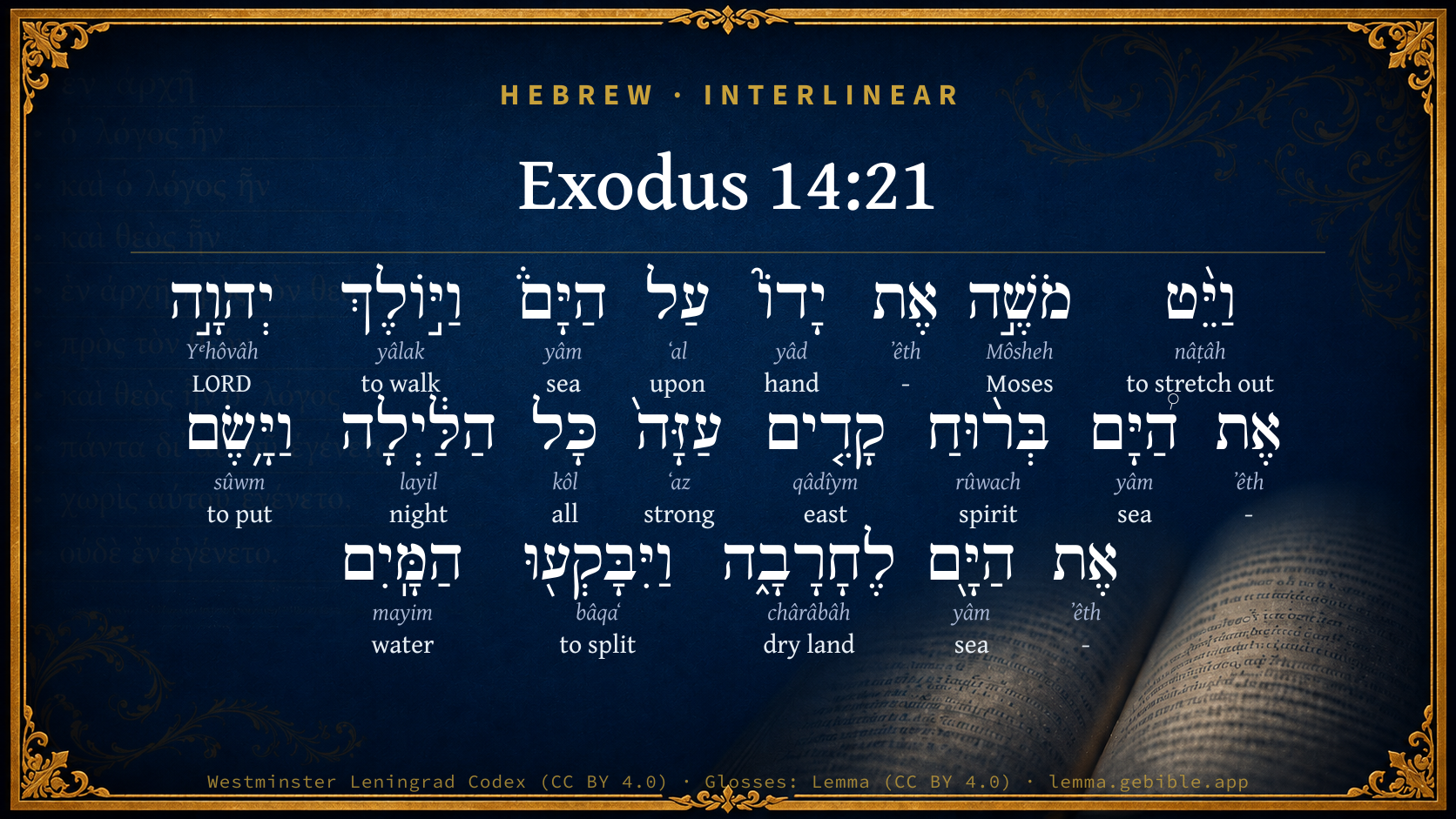
  1. וַיֵּ֨ט nâṭâh H5186 “and · to stretch out” Conjunction + Verb, Qal, Sequential Imperfect, 3rd Person, Masculine, Singular
  2. מֹשֶׁ֣ה Môsheh H4872 “Moses” Noun, Proper
  3. אֶת ʼêth H853 “-” Particle, Direct Object
  4. יָדוֹ֮ yâd H3027 “hand · his” Noun, Common, Both, Singular, Construct + Suffix, Personal, 3rd Person, Masculine, Singular
  5. עַל ʻal H5921 “upon” Preposition
  6. הַיָּם֒ yâm H3220 “the · sea” Particle, Definite Article + Noun, Common, Masculine, Singular, Absolute
  7. וַיּ֣וֹלֶךְ yâlak H3212 “and · to walk” Conjunction + Verb, Hiphil, Sequential Imperfect, 3rd Person, Masculine, Singular
  8. יְהוָ֣ה Yᵉhôvâh H3068 “LORD” Noun, Proper
  9. אֶת ʼêth H853 “-” Particle, Direct Object
  10. הַ֠יָּם yâm H3220 “the · sea” Particle, Definite Article + Noun, Common, Masculine, Singular, Absolute
  11. בְּר֨וּחַ rûwach H7307 “in/at · spirit of” Preposition + Noun, Common, Both, Singular, Construct
  12. קָדִ֤ים qâdîym H6921 “east” Noun, Common, Masculine, Singular, Absolute
  13. עַזָּה֙ ʻaz H5794 “strong” Adjective, Adjective, Feminine, Singular, Absolute
  14. כָּל kôl H3605 “all of” Noun, Common, Masculine, Singular, Construct
  15. הַלַּ֔יְלָה layil H3915 “the · night” Particle, Definite Article + Noun, Common, Masculine, Singular, Absolute
  16. וַיָּ֥שֶׂם sûwm H7760 “and · to put” Conjunction + Verb, Qal, Sequential Imperfect, 3rd Person, Masculine, Singular
  17. אֶת ʼêth H853 “-” Particle, Direct Object
  18. הַיָּ֖ם yâm H3220 “the · sea” Particle, Definite Article + Noun, Common, Masculine, Singular, Absolute
  19. וַיִּבָּקְע֖וּ bâqaʻ H1234 “and · to split” Conjunction + Verb, Niphal, Sequential Imperfect, 3rd Person, Masculine, Plural
  20. הַמָּֽיִם mayim H4325 “the · water(s)” Particle, Definite Article + Noun, Common, Masculine, Plural, Absolute

About this verse

These counts appear in no published source. They are computed here, from the morphology-tagged text and Lemma’s own curated glosses. What Lemma adds →

21
words
17
distinct lemmas
Pentateuch
section

Notable vocabulary

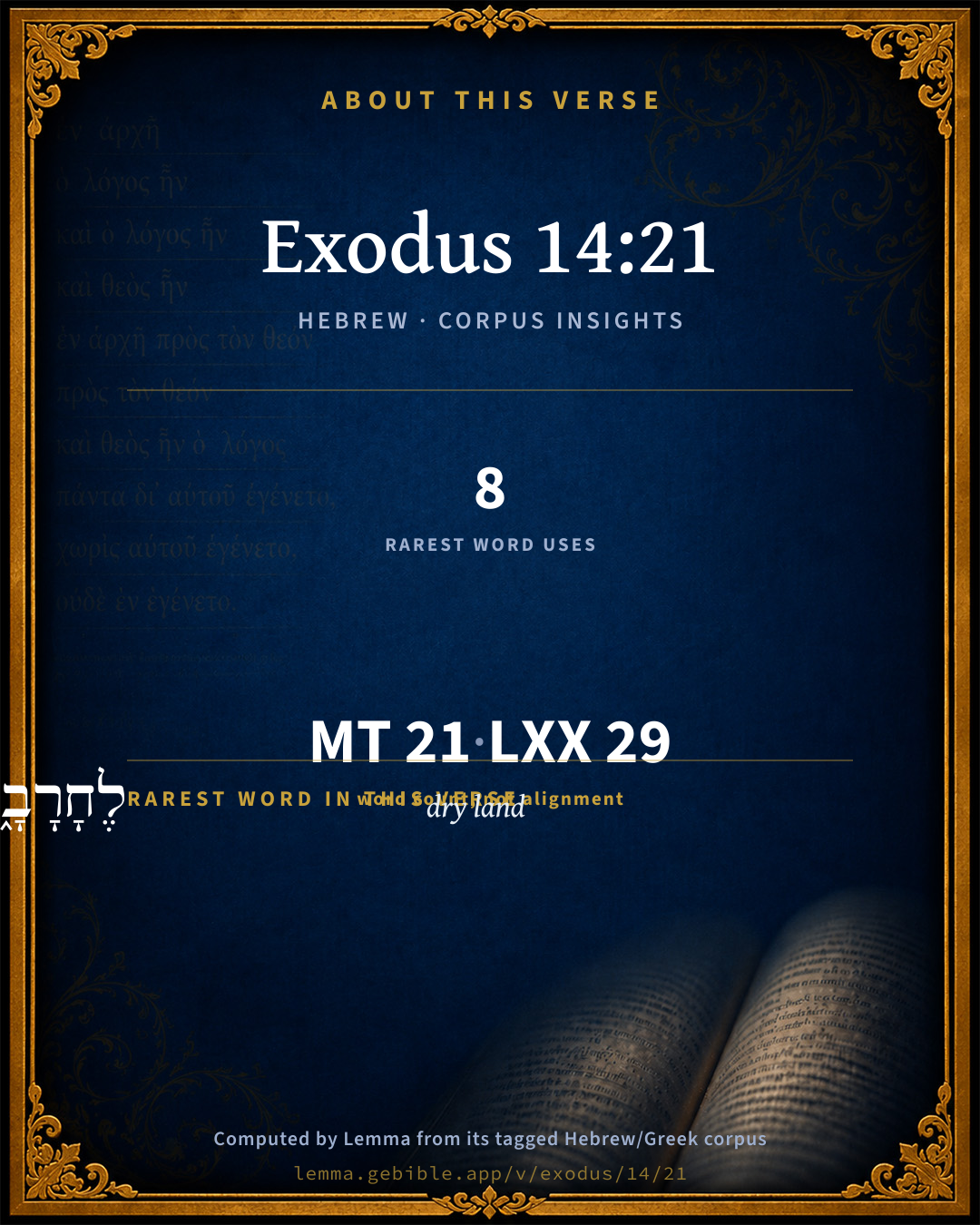
The rarest word here is לֶחָרָבָ֑ה dry land H2724 — appearing just 8 times in the whole Hebrew Bible.

Shared distinctive vocabulary

לֶחָרָבָ֑ה dry land H2724 occurs in 7 verses of the Hebrew Bible. Also found in:

Grammatical profile

  • 4 verbs
  • 12 nouns
  • 1 adjective
  • 1 preposition
  • 3 particles

Verb forms

  • וַיֵּ֨ט Qal · Sequential Imperfect
  • וַיּ֣וֹלֶךְ Hiphil · Sequential Imperfect
  • וַיָּ֥שֶׂם Qal · Sequential Imperfect
  • וַיִּבָּקְע֖וּ Niphal · Sequential Imperfect

Repetition

A word recurs within this verse — often emphatic in Hebrew:

  • הַיָּם֒ sea H3220 ×3

Hebrew & Septuagint length

In English translation the verse runs 35 words from the Hebrew and 34 from the Septuagint (LXX English) — closely comparable.

A rough comparison of the two English renderings, which tokenize alike — not a word-level alignment.

Word counts can differ between the Hebrew and the Greek without any difference in meaning — e.g. the Hebrew direct-object marker אֵת has no separate Greek word, and Greek often adds the article ὁ.

In the original languages it is 21 Hebrew tokens and 29 Greek tokens — but the two are counted differently (Hebrew bundles its prefixes and suffixes into one token; the Greek is in lemma form), so that isn’t a like-for-like length.

Cross-references

15

Topical passages linked to Exodus 14:21 in the Treasury of Scripture Knowledge — connected by theme and wording, ordered by reader-vote popularity; previews shown in the World English Bible.

  • Isaiah 63:12 who caused his glorious arm to go at the right hand of Moses? who divided the waters before them, to make himself an everlasting name?
  • Exodus 15:8 With the blast of your nostrils the waters were piled up. The floods stood upright as a heap. The deeps were congealed in the heart of the sea.
  • Psalms 66:6 He turned the sea into dry land. They went through the river on foot. There, we rejoiced in him.
  • Nehemiah 9:11 You divided the sea before them, so that they went through the midst of the sea on the dry land; and their pursuers you did cast into the depths, as a stone into the mighty waters.
  • Joshua 4:23 For Yahweh your God dried up the waters of the Jordan from before you, until you were passed over, as Yahweh your God did to the Red Sea, which he dried up from before us, until we were passed over;
  • Psalms 74:13 You divided the sea by your strength. You broke the heads of the sea monsters in the waters.
  • Psalms 78:13 He split the sea, and caused them to pass through; He made the waters stand as a heap.
  • Isaiah 51:10 Isn't it you who dried up the sea, the waters of the great deep; who made the depths of the sea a way for the redeemed to pass over?
  • Exodus 14:16 Lift up your rod, and stretch out your hand over the sea, and divide it: and the children of Israel shall go into the midst of the sea on dry ground.
  • Psalms 136:13 To him who divided the Red Sea apart; For his loving kindness endures forever;
  • Job 26:12 He stirs up the sea with his power, And by his understanding he strikes through Rahab.
  • Psalms 106:7–10 Our fathers didn't understand your wonders in Egypt. They didn't remember the multitude of your loving kindnesses, But were rebellious at the sea, even at the Red Sea.
  • Psalms 114:3–5 The sea saw it, and fled. The Jordan was driven back.
  • Isaiah 51:15 For I am Yahweh your God, who stirs up the sea, so that the waves of it roar: Yahweh of Hosts is his name.
  • Joshua 3:13–16 It shall come to pass, when the soles of the feet of the priests who bear the ark of Yahweh, the Lord of all the earth, shall rest in the waters of the Jordan, that the waters of the Jordan shall be cut off, even the waters that come down from above; and they shall stand in one heap.

Cross-references courtesy of OpenBible.info (CC BY 4.0).

Hebrew and Greek witnesses Masoretic Hebrew ↔ Greek Septuagint

The same verse in the two great witnesses to the Old Testament, shown verse-for-verse.

These are two independent witnesses, not word-aligned to each other, and the Septuagint is shown in lemma (dictionary) form.

Hebrew Exodus 14:21 Masoretic · Westminster Leningrad Codex

וַיֵּ֨ט מֹשֶׁ֣ה אֶת יָדוֹ֮ עַל הַיָּם֒ וַיּ֣וֹלֶךְ יְהוָ֣ה אֶת הַ֠יָּם בְּר֨וּחַ קָדִ֤ים עַזָּה֙ כָּל הַלַּ֔יְלָה וַיָּ֥שֶׂם אֶת הַיָּ֖ם לֶחָרָבָ֑ה וַיִּבָּקְע֖וּ הַמָּֽיִם

Moses stretched out his hand over the sea, and Yahweh caused the sea to go back by a strong east wind all the night, and made the sea dry land, and the waters were divided.

World English Bible · Public Domain

Greek LXX Exodus 14:21 Septuagint · lemma form

ἐκτείνω δέ μωυσῆς ὁ χείρ ἐπί ὁ θάλασσα καί ὑποἄγω κύριος ὁ θάλασσα ἐν ἄνεμος νότος βίαιος ὅλος ὁ νύξ καί ποιέω ὁ θάλασσα ξηρός καί σχίζω ὁ ὕδωρ

And Moses stretched forth his hand over the sea, and the Lord carried back the sea with a strong south wind all the night, and made the sea dry, and the water was divided.

LXX2012 (modern English Septuagint) · Public Domain

On this verse, John Gill's Exposition discusses the Septuagint’s reading. Read the note in Commentary ↓

Hebrew: Westminster Leningrad Codex (CC BY 4.0). Greek: Septuagint (public domain); English from LXX2012 (modern English Septuagint) (Public Domain). How the Septuagint differs from the Hebrew →

Targum (Aramaic paraphrase)

2

The Targum is the ancient Jewish Aramaic paraphrase of the Hebrew Scriptures — an interpretive translation, not the Hebrew text itself. Onkelos (literal) and Pseudo-Jonathan (expansive) render the Torah, and Jonathan the Prophets. Coverage is partial: where no permissively-licensed English translation exists for a verse, only the Aramaic is shown. This is verse-level text, not a word-by-word alignment to the Hebrew.

  1. Targum Onkelos Torah (Genesis–Deuteronomy)
    וַאֲרֵים משֶׁה יָת יְדֵהּ עַל יַמָּא וְדַבַּר יְיָ יָת יַמָּא בְּרוּחַ קִדוּמָא תַקִיף כָּל לֵילְיָא וְשַׁוִי יָת יַמָּא לְיַבֶּשְׁתָּא וְאִתְבְּזָעוּ מַיָּא:

    (no public-domain English translation for this verse)

    Targum Onkelos — Aramaic: “Onkelos Genesis” (public domain); “Onkelos Exodus” (public domain); “Onkelos Leviticus” (public domain); “Onkelos Numbers” (public domain); “Onkelos Deuteronomy” (public domain). English: “Sefaria Community Translation” (CC0 1.0 (public-domain dedication)); “J.W. Etheridge. The Targums of Onkelos and Jonathan Ben Uzziel on the Pentateuch. London: Longmans, Green, 1862” (public domain). Text via Sefaria.

  2. Targum Pseudo-Jonathan Torah (Genesis–Deuteronomy)
    וְאַרְכִין משֶׁה יַת יְדֵיהּ עַל יַמָא בְּחוּטְרָא רַבָּא וְיַקִירָא דְּאִיתְבְּרִי מִן שֵׁירוּיָא וּבֵיהּ חָקִיק וּמְפָרֵשׁ שְׁמָא רַבָּא וְיַקִּירָא וְעִישַרְתֵּי אַתְוָותָא דִי מְחָא יַת מִצְרָאֵי וּתְלַת אַבְהַת עַלְמָא וְשִׁית אִימְהָתָא וּתְרֵיסַר שִׁבְטוֹי דְיַעֲקב וּמִן יַד דְּבַר יְיָ יַת יַמָא בְּרוּחַ קִידוּמָא תַקִיף כָּל לֵילְיָא וְשַׁוִי יַת יַמָא נְגִיבָא וְאִתְבְּזָעוּ מַיָא לִתְרֵיסַר בְּזִיעַן כָּל קְבֵיל תְּרֵיסַר שִׁבְטוֹי דְיַעֲקב

    And Mosheh stretched out his hand over the sea, with the great and glorious rod which was created at the beginning, and on which were engraven and set forth the Great and Glorious Name, and the ten signs which had smitten the Mizraee, and the three fathers of the world, and the six mothers, and the twelve tribes of Jakob: and straightway the Lord brought a vehement east wind upon the sea all night, and made the sea dry; and divided the waters into twelve divisions according to the twelve tribes of Jacob.

    Targum Pseudo-Jonathan — Aramaic: “Targum Jonathan on Genesis” (public domain); “Targum Jonathan on Exodus” (public domain); “Targum Jonathan on Leviticus” (public domain); “Targum Jonathan on Numbers” (public domain); “Targum Jonathan on Deuteronomy” (public domain). English: “The Targum of Jonathan ben Uzziel, trans. J. W. Etheridge, London, 1862” (public domain). Text via Sefaria.

Commentary

Notes on Exodus 14:21 from classic Christian and Jewish commentators (each source and its license shown beneath its notes). The classic Christian expositions comment on the surrounding passage and are grouped to its opening verse, so a note may address several verses; the Jewish commentaries on the Tanakh (Rashi and others) are per-verse, so they appear only where the commentator wrote on this verse.

Lemma curates 59 commentaries, every one of them public domain or Creative Commons licensed, each selected and text-cleaned for this edition rather than reprinted as found. About our sources →

Matthew Henry's Commentary

We have here the history of that work of wonder which is so often mentioned both in the Old and New Testament, the dividing of the Red Sea before the children of Israel. It was the terror of the Canaanites (Jos 2:9, Jos 2:10), the praise and triumph of the Israelites, Psa 114:3; Psa 106:9; Psa 136:13, Psa 136:14. It was a type of baptism, Co1 10:1, Co1 10:2. Israel's passage through it was typical of the conversion of souls (Isa 11:15), and the Egyptians' perdition in it was typical of the final ruin of all impenitent sinners, Rev 20:14. Here we have,

I. An instance of God's almighty power in the kingdom of nature, in dividing the sea, and opening a passage through the waters. It was a bay, or gulf, or arm of the sea, two or three leagues over, which was divided, Exo 14:21. The instituted sign made use of was Moses's stretching out his hand over it, to signify that it was done in answer to his prayer, for the confirmation of his mission, and in favour to the people whom he led. The natural sign was a strong east wind, signifying that it was done by the power of God, whom the winds and the seas obey. If there be any passage in the book of Job which has reference to the miracles wrought for Israel's deliverance out of Egypt, it is that in Job 26:12, He divideth the sea with his power, and by his understanding he smileth through Rahab (so the word is), that is, Egypt. Note, God can bring his people through the greatest difficulties, and force a way where he does not find it. The God of nature has not tied himself to its laws, but, when he pleases, dispenses with them, and then the fire does not burn, nor the water flow.

II. An instance of his wonderful favour to his Israel. They went through the sea to the opposite shore, for I cannot suppose, with some, that they fetched a compass, and came out again on the same side, Exo 14:22. They walked upon dry land in the midst of the sea, Exo 14:29. And the pillar of cloud, that glory of the Lord, being their rearward (Isa 58:8), that the Egyptians might not charge them in the flank, the waters were a wall to them (it is twice mentioned) on their right hand and on their left. Moses and Aaron, it is probable, ventured first into this untrodden path, and then all Israel after them; and this march through the paths of the great waters would make their march afterwards, through the wilderness, less formidable. Those who had followed God through the sea needed not to fear following him whithersoever he led them. This march through the sea was in the night, and not a moon-shiny night, for it was seven days after the full moon, so that they had no light but what they had from the pillar of cloud and fire. This made it the more awful; but where God leads us he will light us; while we follow his conduct, we shall not want his comforts.

This was done, and recorded, in order to encourage God's people in all ages to trust in him in the greatest straits. What cannot he do who did this? What will not he do for those hat fear and love him who did this for these murmuring unbelieving Israelis, who yet were beloved for their fathers' sake, and for the sake of a remnant among them? We find the saints, long afterwards, making themselves sharers in the triumphs of this march (Psa 66:6): They went through the flood on foot; there did we rejoice in him: and see how this work of wonder is improved, Psa 77:11, Psa 77:16, Psa 77:19.

III. An instance of his just and righteous wrath upon his and his people's enemies, the Egyptians. Observe here, 1. How they were infatuated. In the heat of their pursuit, they went after the Israelites into the midst of the sea, Exo 14:23. "Why," thought they, "may not we venture where Israel did?" Once or twice the magicians of Egypt had done what Moses did, with their enchantments; Pharaoh remembered this, but forgot how they were nonplussed at last. They were more advantageously provided with chariots and horses, while the Israelites were on foot. Pharaoh had said, I know not the Lord; and by this it appeared he did not, else he would not have ventured thus. None so bold as those that are blind. Rage against Israel made them thus daring and inconsiderate: they had long hardened their own hearts; and now God hardened them to their ruin, and hid from their eyes the things that belonged to their peace and safety. Surely in vain is the net spread in the sight of any bird (Pro 1:17); yet so blind where the Egyptians that they hastened to the snare, Pro 7:23. Note, The ruin of sinners is brought on by their own presumption, which hurries them headlong into the pit. They are self-destroyers. 2. How they were troubled and perplexed, Exo 14:24, Exo 14:25. For some hours they marched through the divided waters as safely and triumphantly as Israel did, not doubting but, that, in a little time, they should gain their point. But, in the morning watch, the Lord looked upon the host of the Egyptians, and troubled them. Something or other they saw or heard from the pillar of cloud and fire which put them into great consternation, and gave them an apprehension of their ruin before it was brought upon them. Now it appeared that the triumphing of the wicked is short, and that God has ways to frighten sinners into despair, before he plunges them into destruction. He cuts off the spirit of princes, and is terrible to the kings of the earth. (1.) They had hectored and boasted as if the day were their own; but now they were troubled and dismayed, struck with a panic-fear. (2.) They had driven furiously; but now they drove heavily, and found themselves plugged and embarrassed at every step; the way grew deep, their hearts grew sad, their wheels dropped off, and the axle-trees failed. Thus can God check the violence of those that are in pursuit of his people. (3.) They had been flying upon the back of Israel, as the hawk upon the trembling dove; but now they cried, Let us flee from the face of Israel, which had become to them like a torch of fire in a sheaf, Zac 12:6. Israel has now, all of a sudden, become as much a terror to them as they had been to Israel. They might have let Israel alone and would not; now they would flee from the face of Israel and cannot. Men will not be convinced, till it is too late, that those who meddle with God's people meddle to their own hurt; when the Lord shall come with ten thousands of his saints, to execute judgment, the mighty men will in vain seek to shelter themselves under rocks and mountains from the face of Israel and Israel's King, Rev 6:15. Compare with this story, Job 27:20, etc. 3. How they were all drowned. As soon as ever the children of Israel had got safely to the shore, Moses was ordered to stretch out his hand over the sea, and thereby give a signal to the waters to close again, as before, upon he word of command, they had opened to the right and the left, Exo 14:29. He did so, and immediately the waters returned to their place, and overwhelmed all the host of the Egyptians, Exo 14:27, Exo 14:28. Pharaoh and his servants, who had hardened one another in sin, now fell together, and not one escaped. An ancient tradition says that Pharaoh's magicians, Jannes and Jambres, perished with the rest, as Balaam with the Midianites whom he had seduced, Num 31:8. And now, (1.) God avenged upon the Egyptians the blood of the firstborn whom they had drowned: and the principal is repaid with interest, it is recompensed double, full-grown Egyptians for newborn Israelites; thus the Lord is righteous, and precious is his people's blood in his sight, Psa 72:14. (2.) God reckoned with Pharaoh for all his proud and insolent conduct towards Moses his ambassador. Mocking the messengers of the Lord, and playing the fool with them, bring ruin without remedy. Now God got him honour upon Pharaoh, looking upon that proud man, and abasing him, Job 40:12. Come and see the desolations he made, and write it, not in water, but with an iron pen in the rock for ever. Here lies that bloody tyrant who bade defiance to his Maker, to his demands, threatenings, and judgments; a rebel to God, and a slave to his own barbarous passions; perfectly lost to humanity, virtue, and all true honour; here he lies, buried in the deep, a perpetual monument of divine justice. Here he went down to the pit, though he was the terror of the mighty in the land of the living. This is Pharaoh and all his multitude, Eze 31:18.

IV. Here is the notice which the Israelites took of this wonderful work which God wrought for them, and the good impressions which it made upon them for the present.

1. They saw the Egyptians dead upon the sands, Exo 14:30. Providence so ordered it that the next tide threw up the dead bodies, (1.) For the greater disgrace of the Egyptians. Now the beasts and birds of prey were called to eat the flesh of the captains and mighty men, Rev 19:17, Rev 19:18. The Egyptians were very nice and curious in embalming and preserving the bodies of their great men, but here the utmost contempt is poured upon all the grandees of Egypt; see how they lie, heaps upon heaps, as dung upon the face of the earth. (2.) For the greater triumph of the Israelites, and to affect them the more with their deliverance; for the eye affects the heart. See Isa 66:24, They shall go forth, and look upon the carcases of the men that have transgressed against me. Probably they stripped the slain and, having borrowed jewels of their neighbours before, which (the Egyptians having by this hostile pursuit of them broken their faith with them) henceforward they were not under any obligation to restore, they now got arms from them, which, some think, they were not before provided with. Thus, when God broke the heads of Leviathan in pieces, he gave him to be meat to the people inhabiting the wilderness, Psa 74:14.

2. The sight of this great work greatly affected them, and now they feared the Lord, and believed the Lord, and his servant Moses, Exo 14:31. Now they were ashamed of their distrusts and murmurings, and, in the good mind they were in, they would never again despair of help from Heaven, no, not in the greatest straits; they would never again quarrel with Moses, nor talk of returning to Egypt. They were now baptized unto Moses in the sea, Co1 10:2. This great work which God wrought for them by the ministry of Moses bound them effectually to follow his directions, under God. This confirmed their faith in the promises that were yet to be fulfilled; and, being brought thus triumphantly out of Egypt, they did not doubt that they should be in Canaan shortly, having such a God to trust to, and such a mediator between them and him. O that there had been such a heart in them as now there seemed to be! Sensible mercies, when they are fresh, make sensible impressions; but with many these impressions soon wear off: while they see God's works, and feel the benefit of them, they fear him and trust in him; but they soon forget his works, and then they slight him. How well were it for us if we were always in as good a frame as we are in sometimes!

Matthew Henry's Commentary on the Whole Bible (1708–1710) — public domain (CC PDM 1.0). Text via the HelloAO Bible API.

Trapp's Complete Commentary

John Trapp

Exo 14:21 And Moses stretched out his hand over the sea; and the LORD caused the sea to go [back] by a strong east wind all that night, and made the sea dry [land], and the waters were divided.

Ver. 21. And Moses stretched out his hand.] Of that pseudo-Moses that cozened many credulous Jews of Crete into the midst of the sea, anno 434, see Funceius’s Chron. at that year.

And the waters were divided.] So was that torrent of fire, if Aristotle {a} may be believed, that ran from Etna, consuming the country, and yet parted itself; making a kind of a lane for those that ventured to rescue their aged parents.

{a} De Mundo, cap. 6.

John Trapp, A Commentary or Exposition upon All the Books of the Old and New Testament (1647–1656) — public domain. Text from a community e-Sword module.

Joseph Benson's Commentary

Exo 14:21-22. And Moses stretched out his hand, &c. — We have here the history of that work of wonder which is so often mentioned both in the Old and New Testaments. An instance of God’s almighty power in dividing the sea, and opening a passage through the waters. It was a bay, or gulf, or arm of the sea, two or three leagues over. The God of nature has not tied himself to its laws, but when he pleases dispenseth with them, and then the fire doth not burn, nor the water flow. They went through the sea to the opposite shore; they walked upon dry land in the midst of the sea; and the pillar of cloud being their rearward, the waters were a wall to them on their right hand, and on their left — Moses and Aaron, it is likely, ventured first into this untrodden path, and then all Israel after them; and this march through the paths of the great waters would make their march afterward through the wilderness less formidable. This march through the sea was in the night, and not a moonshine night, for it was seven days after the full moon, so that they had no light but what they had from the pillar of fire. This made it the more awful; but where God leads us, he will light us; while we follow his conduct we shall not want his comforts.

Joseph Benson's Commentary on the Old and New Testaments (1811–1818) — public domain. Text from a community e-Sword module.

Jamieson, Fausset & Brown

Robert Jamieson, A. R. Fausset & David Brown

Moses stretched out his hand, &c.--The waving of the rod was of great importance on this occasion to give public attestation in the presence of the assembled Israelites, both to the character of Moses and the divine mission with which he was charged.

the Lord caused . . . a strong east wind all that night--Suppose a mere ebb tide caused by the wind, raising the water to a great height on one side, still as there was not only "dry land," but, according to the tenor of the sacred narrative, a wall on the right hand and on the left [Exo 14:22], it would be impossible on the hypothesis of such a natural cause to rear the wall on the other. The idea of divine interposition, therefore, is imperative; and, assuming the passage to have been made at Mount Attakah, or at the mouth of Wady Tawarik, an east wind would cut the sea in that line. The Hebrew word kedem, however, rendered in our translation, "east," means, in its primary signification, previous; so that this verse might, perhaps, be rendered, "the Lord caused the sea to go back by a strong previous wind all that night"; a rendering which would remove the difficulty of supposing the host of Israel marched over on the sand, in the teeth of a rushing column of wind, strong enough to heap up the waters as a wall on each side of a dry path, and give the intelligible narrative of divine interference.

Jamieson, Fausset & Brown — Commentary Critical and Explanatory on the Whole Bible (1871) — public domain (CC PDM 1.0). Text via the HelloAO Bible API.

Adam Clarke's Commentary

Verse 21. The Lord caused the sea to go back] That part of the sea over which the Israelites passed was, according to Mr. Bruce and other travellers, about four leagues across, and therefore might easily be crossed in one night. In the dividing of the sea two agents appear to be employed, though the effect produced can be attributed to neither. By stretching out the rod the waters were divided; by the blowing of the vehement, ardent, east wind, the bed of the sea was dried. It has been observed, that in the place where the Israelites are supposed to have passed, the water is about fourteen fathoms or twenty-eight yards deep: had the wind mentioned here been strong enough, naturally speaking, to have divided the waters, it must have blown in one narrow track, and continued blowing in the direction in which the Israelites passed; and a wind sufficient to have raised a mass of water twenty-eight yards deep and twelve miles in length, out of its bed, would necessarily have blown the whole six hundred thousand men away, and utterly destroyed them and their cattle. I therefore conclude that the east wind, which was ever remarked as a parching, burning wind, was used after the division of the waters, merely to dry the bottom, and render it passable. For an account of the hot drying winds in the east, See Clarke on Ge 8:1. God ever puts the highest honour on his instrument, Nature; and where it can act, he ever employs it. No natural agent could divide these waters, and cause them to stand as a wall upon the right hand and upon the left; therefore God did it by his own sovereign power. When the waters were thus divided, there was no need of a miracle to dry the bed of the sea and make it passable; therefore the strong desiccating east wind was brought, which soon accomplished this object. In this light I suppose the text should be understood.

Adam Clarke's Commentary on the Bible (1810–1826) — public domain. Text from a community e-Sword/MySword module.

Ellicott's Commentary for English Readers

(21) The Lord caused the sea to go back by a strong east wind.—By “a strong east wind” we are at liberty to understand one blowing from any point between N.Ë. and S.E. If we imagine the Bitter Lakes joined to the Red Sea by a narrow and shallow channel, and a south-east wind blowing strongly up this channel, we can easily conceive that the water in the Bitter Lakes might be driven northward, and’ held there, while the natural action of the ebb tide withdrew the Red Sea water to the southward. A portion of the channel might in this way have been left dry, and have so continued until the wind changed and the tide began to flow. It is true that Scripture does not speak of the ebb and flow of the tide, since in them there was nothing unusual; but an Egyptian tradition distinctly stated that “Moses waited for the ebb tide in order to lead the Israelites across.” (Artipanus, ap. Euseb. Prœp. Ev., 9:27.) Whether the whole effect was purely natural, or whether (as in so many other cases) Goa used the force of nature so far as it could go, and further supernaturally increased its force, we are not told, and may form what opinion we please.

The waters were divided.—The waters of the Bitter Lakes were for a time separated completely from those of the Red Sea. By gradual elevation and desiccation the channel over which the Israelites passed has probably now become dry land.

A Bible Commentary for English Readers, edited by Charles John Ellicott (1878–1897) — public domain. Text from a community e-Sword module.

The Cambridge Bible for Schools and Colleges

gen. ed. J. J. S. Perowne

21, 22. The sea is divided; and the Israelites enter into it.

21a (P). stretched out his hand] v. 16a.

21b (J). to go back] The Heb. is simply, to go along.

east wind] In our ignorance of the exact topography of the place at which the crossing took place, it is difficult to be certain what precisely was the effect of the E. wind. A strictly E. wind would be directly in the face of the advancing Israelites: so probably a NE. wind is to be thought of, such as at a shallow ford might cooperate with an ebb tide in keeping a passage clear (cf. DB. i. 802b). See further p. 124 ff.

21c. and the waters were divided] The immediate sequel of v. 21a in P: cf. v. 16b ‘stretch out thine hand over the sea, and divide it.’ In P there is no thought of any wind: the waters divide automatically at the signal given by Moses.

The Cambridge Bible for Schools and Colleges (gen. ed. J. J. S. Perowne; Cambridge University Press, 1878–1918) — public domain. Text from a community e-Sword module.

John Gill's Exposition

And Moses stretched out his hand over the sea,.... With his rod in it, as he was directed to, Exo 14:16. What the poet says (z) of Bacchus is more true of Moses, whose rod had been lift up upon the rivers Egypt, and now upon the Red sea:

and the Lord caused the sea to go back by a strong east wind all that night; and the direction of the Red sea being nearly, if not altogether, north and south, it was in a proper situation to be wrought upon and divided by an easterly wind; though the Septuagint version renders it a strong south wind. No wind of itself, without the exertion and continuance of almighty power, in a miraculous way, could have so thrown the waves of the sea on heaps, and retained them so long, that such a vast number of people should pass through it as on dry land; though this was an instrument Jehovah made use of, and that both to divide the waters of the sea, and to dry and harden the bottom of it, and make it fit for travelling, as follows:

and made the sea dry land; or made the bottom of it dry, so that it could be trod and walked upon with ease, without sinking in, sticking fast, or slipping about, which was very extraordinary:

and the waters were divided; or "after the waters were divided" (a); for they were first divided before the sea could be made dry. The Targum of Jonathan says, the waters were divided into twelve parts, answerable to the twelve tribes of Israel, and the same is observed by other Jewish writers (b), grounded upon a passage in Psa 136:13 and suppose that each tribe took its particular path.

(z) "Tu flectis amnes, tu mare barbarum--" Horat. Carmin. l. 2. Ode 19. (a) "quum diffidisset se aqua illius", Piscator; so seems to be used in ch. xvi. 20. (b) Pirke Eliezer, c. 42. Targum Jon. & Hieros. in Deut. i. 1. Jarchi, Kimchi, and Arama in Psal. cxxxvi. 13.

John Gill's Exposition of the Whole Bible (1746–1763) — public domain (CC PDM 1.0). Text via the HelloAO Bible API.

Albert Barnes' Notes on the Bible

A strong east wind - The agency by which the object effected was natural (compare Exo 15:8 note): and the conditions of the narrative are satisfied by the hypothesis, that the passage took place near Suez.

The waters were divided - i. e. there was a complete separation between the water of the gulf and the water to the north of Kolsum.

Albert Barnes' Notes on the Bible (1834–1885) — public domain. Text from a community e-Sword/MySword module.

Haydock's Catholic Bible Commentary

Wind. This served to dry up the sandy channel of the Red Sea, which was mixed with mud and weeds. It blew from the east, Kodim, or from Arabia. --- Divided, some say into 12 parts or divisions, Psalm cxxxv. 13. But the words of the psalmist may be verified by the sea opening a spacious passage, such as was requisite for so many millions to travel through, (Haydock) e.g. a distance of perhaps 18 miles, in so short a space of time. Silara Adrichomius thinks the breadth of the division would not be less than nine miles.

George Leo Haydock (1774–1849), Haydock's Catholic Family Bible and Commentary, 1859 edition — public domain. Excludes Psalms (Douay-Rheims chapter numbering differs from Protestant) and Deuterocanonical books (Catholic canon only).

Matthew Poole's English Annotations

A strong east wind; a proper instrument both to divide that sea, which lay north and south, and to dry and harden the mud at the bottom of the sea, that the Israelites might walk upon it. See Gen 8:13; Exo 15:8. Yet the wind could never have done so great a work, especially not so speedily, if there had not been a higher, even a Divine hand to manage and improve it.

The waters were divided, so largely, that a great number of the Israelites might march in one rank, and the whole number might go a good way in it in the time here mentioned.

Matthew Poole's English Annotations on the Holy Bible (1683–1685) — public domain. Text from a community e-Sword/MySword module.

Whedon's Commentary on the Bible

Daniel D. Whedon

21, 22. And the Lord caused the sea to go back by a strong east wind all that night — Here, as in the history of the plagues, natural causes are declared to have been supernaturally used. A northeast wind, which would be called “an east wind” in Hebrew, would tend to drive the water out of the narrow bay towards the southwest, and if transpiring at the time of an ebb tide, might be strong enough to blow the channel dry. If there were shoals or flats at the place of crossing, as there now are near Suez, and deeper water to the north, as there now is, a pathway might thus be made across the Gulf, leaving deep water above and below. It will be noticed that this was soon after the full moon of the vernal equinox, when there would be a very low ebb and a very high flood, and that the tide rises from five to seven feet opposite Suez, and from eight to nine feet when aided by strong winds, returning with unusual suddenness and power after the ebb. (See Introductory remarks.) The Hebrew and heathen traditions of this wonderful deliverance all make it probable that all these natural causes were employed to answer the prayer of Moses. In Moses’ song of triumph the waters are said to have been “gathered together” by the “blast of the nostrils” of Jehovah. He also sang, “Thou didst blow with thy wind, the sea covered them,” (Exo_15:8; Exo_15:10;) thus assigning the return as well as the division of the waters to the agency of the wind. So in many places God is said to have “dried up the waters of the Red Sea,” as if by wind. Jos_2:10; Psa_66:6; Psa_106:9. [Different minds will assign different degrees of the supernatural to the transaction. But, (1.) The movements of Israel by divine orders were prescribed, and to these the blowings of the wind were precisely timed, measured, and even changed from east to west. (2.) The two armies were long in such proximity that Israel could have easily been destroyed had not Pharaoh been deterred and blinded by the “pillar.” (3.) The ordinary tidal action of the sea must have been better known to Pharaoh and his generals than to Israel. That the whole should have been so executed as to save all Israel and destroy all the Egyptians is… unaccountable on merely natural assumptions. See note on Jos_10:12.]

The waters were a wall unto them on their right hand, and on their left — That is, they were a defense, not necessarily perpendicular cliffs, as they are often pictured. God could make the water stand in precipices if he should so choose, and such a conception is more impressive to the imagination; but it is certain that the language of the text may mean simply that the water was a protection on the right and on the left flanks of the hosts. Thus in Nahum, (Nah_3:8,) No (Thebes) is said to have the sea (the broad Nile) for a rampart and wall; that is, a defense, a protection against enemies. It is true that in poetical passages the waters are said to have stood “as a heap;” Exo_15:8; Psa_78:13; but so they are also, in the same style, said to have been “congealed in the heart of the sea;” and the peaks of the trembling Horeb are said to have “skipped like rams,” and the “little hills like lambs.” Psa_114:4. Of course these expressions are not to be literally and prosaically interpreted. Yet it will be noticed that upon our view the waters were heaped up by the wind, though we do not believe that they stood in parallel precipices. But see note on Jos_3:13.

Daniel D. Whedon (gen. ed.), Commentary on the Old and New Testaments (1874–1909) — public domain. Text from a community e-Sword module.

The Pulpit Commentary

Moses stretched out his hand. As commanded by God (ver. 16). Compare the somewhat similar action of Elijah and Elisha, when they divided the Jordan. (2Ki_2:8, 2Ki_2:14) The Lord caused the sea to go back by a strong east wind. The LXX translate a strong south wind" (ejn ajnemw notw biaiw); but the Hebrew kadim is certainly east rather than south. It is not, however, east" in the sense of due east, but would include all the range of the compass between N.E. and S.E. If we suppose the Bitter Lakes to have been joined to the Red Sea by a narrow and shallow channel, the action of a south-east wind, by driving the water of the Lakes northward, may have easily produced the effect described in the text. A simultaneous ebb of the lower gulf would have further facilitated the passage. The waters were divided. Water remained in the upper extremity of the Gulf, now the site of the Bitter Lakes, and also, of course, below Suez. The portion of the sea dried up lay probably between the present southern extremity of the Bitter Lakes and Suez. By the gradual elevation and desiccation of the region, it has passed into permanent dry land.

The Pulpit Commentary (1880–1919), ed. H.D.M. Spence-Jones & Joseph S. Exell — public domain. Text from a community e-Sword module.

John Wesley's Explanatory Notes

We have here the history of that work of wonder which is so often mentioned both in the Old and New Testament. An instance of God's almighty power in dividing the sea, and opening a passage through the waters. It was a bay, or gulf, or arm of the sea, two or three leagues over. The God of nature has not tied himself to its laws, but when he pleases dispenseth with them, and then the fire doth not burn, nor the water flow. They went through the sea to the opposite shore; they walked upon dry land in the midst of the sea; and the pillar of cloud being their rereward, the waters were a wall to them on their right hand, and on their left. Moses and Aaron it is likely ventured first, into this untrodden path, and then all Israel after them; and this march through the paths of the great waters would make their march afterwards through the wilderness less formidable. This march through the sea was in the night, and not a moon-shine night, for it was seven days after the full moon, so that they had no light but what they had from the pillar of fire. This made it the more awful, but where God leads us, he will light us; while we follow his conduct we shall not want his comforts.

John Wesley, Explanatory Notes Upon the Whole Bible (1754–1765) — public domain. Text via the GEBible commentary corpus.

Keil & Delitzsch

C. F. Keil & F. Delitzsch

When Moses stretched out his hand with the staff (Exo 14:16) over the sea, "Jehovah made the water go (flow away) by a strong east wind the whole night, and made the sea into dry (ground), and the water split itself" (i.e., divided by flowing northward and southward); "and the Israelites went in the midst of the sea (where the water had been driven away by the wind) in the dry, and the water was a wall (i.e., a protection formed by the damming up of the water) on the right and on the left." קדים, the east wind, which may apply either to the south-east or north-east, as the Hebrew has special terms for the four quarters only. Whether the wind blew directly from the east, or somewhat from the south-east or north-east, cannot be determined, as we do not know the exact spot where the passage was made. in any case, the division of the water in both directions could only have been effected by an east wind; and although even now the ebb is strengthened by a north-east wind, as Tischendorf says, and the flood is driven so much to the south by a strong north-west wind that the gulf can be ridden through, and even forded on foot, to the north of Suez (v. Schub. Reise ii. p. 269), and "as a rule the rise and fall of the water in the Arabian Gulf is nowhere so dependent upon the wind as it is at Suez" (Wellsted, Arab. ii. 41, 42), the drying of the sea as here described cannot be accounted for by an ebb strengthened by the east wind, because the water is all driven southwards in the ebb, and not sent in two opposite directions. Such a division could only be produced by a wind sent by God, and working with omnipotent force, in connection with which the natural phenomenon of the ebb may no doubt have exerted a subordinate influence.

(Note: But as the ebb at Suez leaves the shallow parts of the gulf so far dry, when a strong wind is blowing, that it is possible to cross over them, we may understand how the legend could have arisen among the Ichthyophagi of that neighbourhood (Diod. Sic. 3, 39) and even the inhabitants of Memphis (Euseb. praep. ev. 9, 27), that the Israelites took advantage of a strong ebb, and how modern writers like Clericus have tried to show that the passage through the sea may be so accounted for.)

The passage was effected in the night, through the whole of which the wind was blowing, and in the morning watch (between three and six o'clock, Exo 14:24) it was finished.

As to the possibility of a whole nation crossing with their flocks, Robinson concludes that this might have been accomplished within the period of an extraordinary ebb, which lasted three, or at the most four hours, and was strengthened by the influence of a miraculous wind. "As the Israelites," he observes, "numbered more than two millions of persons, besides flocks and herds, they would of course be able to pass but slowly. If the part left dry were broad enough to enable them to cross in a body one thousand abreast, which would require a space of more than half a mile in breadth (and is perhaps the largest supposition admissible), still the column would be more than two thousand persons in depth, and in all probability could not have extended less than two miles. It would then have occupied at least an hour in passing over its own length, or in entering the sea; and deducting this from the largest time intervening, before the Egyptians also have entered the sea, there will remain only time enough, under the circumstances, for the body of the Israelites to have passed, at the most, over a space of three or four miles." (Researches in Palestine, vol. i. p. 84.)

But as the dividing of the water cannot be accounted for by an extraordinary ebb, even though miraculously strengthened, we have no occasion to limit the time allowed for the crossing to the ordinary period of an ebb. If God sent the wind, which divided the water and laid the bottom dry, as soon as night set in, the crossing might have begun at nine o'clock in the evening, if not before, and lasted till four of five o'clock in the morning (see Exo 14:27). By this extension of the time we gain enough for the flocks, which Robinson has left out of his calculation. The Egyptians naturally followed close upon the Israelites, from whom they were only divided by the pillar of cloud and fire; and when the rear of the Israelites had reached the opposite shore, they were in the midst of the sea. And in the morning watch Jehovah cast a look upon them in the pillar of cloud and fire, and threw their army into confusion (Exo 14:24). The breadth of the gulf at the point in question cannot be precisely determined. At the narrowest point above Suez, it is only two-thirds of a mile in breadth, or, according to Niebuhr, 3450 feet; but it was probably broader formerly, and even now is so farther up, opposite to Tell Kolzum (Rob. i. pp. 84 and 70). The place where the Israelites crossed must have been broader, otherwise the Egyptian army, with more than six hundred chariots and many horsemen, could not have been in the sea and perished there when the water returned. - "And Jehovah looked at the army of the Egyptians in (with) the pillar of cloud and fire, and troubled it." This look of Jehovah is to be regarded as the appearance of fire suddenly bursting forth from the pillar of cloud that was turned towards the Egyptians, which threw the Egyptian army into alarm and confusion, and not as "a storm with thunder and lightning," as Josephus and even Rosenmller assume, on the ground of Psa 78:18-19, though without noticing the fact that the psalmist has merely given a poetical version of the event, and intends to show "how all the powers of nature entered the service of the majestic revelation of Jehovah, when He judged Egypt and set Israel free" (Delitzsch). The fiery look of Jehovah was a much more stupendous phenomenon than a storm; hence its effect was incomparably grander, viz., a state of confusion in which the wheels of the chariots were broken off from the axles, and the Egyptians were therefore impeded in their efforts to escape.

Keil & Delitzsch — Biblical Commentary on the Old Testament (1861–1891) — public domain (CC PDM 1.0). Text via the HelloAO Bible API. (Old Testament only.)

unfoldingWord translationNotes

Door43 World Missions Community

east wind

An east wind originates in the east and blows towards the west.

east

where the sun rises

the waters were divided

This can be stated in active form. AT: "Yahweh divided the waters" (See: Active or Passive)

on their right hand and on their left

"on each side of them" or "on both sides of them"

translationWords

water

hand

unfoldingWord translationNotes — © Distant Shores Media and the Door43 World Missions Community, licensed CC BY-SA 4.0. Source: git.door43.org/Door43/en_tn.

Rashi

Rabbi Shlomo Yitzchaki (Rashi)

ברוח קדים עזה BY A POWERFUL EAST WIND — i. e. by the east wind which is the most powerful of the winds. This is the wind by which the Holy One, blessed be He, exacts punishment from the wicked, as it is said, (Jeremiah 18:17) “I will scatter them as with an east wind”; (Hosea 13:15) “An east wind shall come, the wind of the Lord”; (Ezekiel 27:26) “The east wind hath broken thee in the heart of the sea”; (Isaiah 27:8) “He hath removed her with His rough blast in the day of the east wind” (cf. Mekhilta).

ויבקעו המים AND THE WATERS WERE DIVIDED — all the waters in the world (Mekhilta).

Rashi on the Tanakh — English translations: “The Judaica Press complete Tanach with Rashi, translated by A. J. Rosenberg” (CC BY 4.0); “Pentateuch with Rashi's commentary by M. Rosenbaum and A.M. Silbermann, 1929-1934” (public domain); “The Metsudah Tanach series, Lakewood, N.J” (CC BY 4.0); and “The Book of Joshua, Metsudah Publications, 1997” (CC BY 4.0). Text via Sefaria.

Ramban (Nachmanides)

Rabbi Moshe ben Nachman (Ramban / Nachmanides)

AND MOSES STRETCHED OUT HIS HAND OVER THE SEA; AND THE ETERNAL CAUSED THE SEA TO GO BACK BY A STRONG EAST WIND ALL THE NIGHT. It was His will, may He be blessed, to divide the sea by a strong drying wind, making it appear as if the wind dried the sea, something like that which is written, An east wind shall come, the wind of the Eternal coming up from the wilderness, and his spring shall become dry, and his fountain shall be dried up. He thus caused the Egyptians to err and then destroyed them, etc. Ramban interprets it in the sense of mashgi (He causes to err.) A similar usage of this verse appears in Rashi above, Verse 2. The source of this rendition of the verse is in the Mechilta, ibid. for because of this, they thought that perhaps it was the wind which made the sea into dry land, but that it was not the power of G-d that did this for the sake of Israel. Although the wind does not split the sea into sections, they paid no attention even to this and they followed after the Israelites into the sea out of their desire to harm them. This is the intent of the expressions: and I will harden Pharaoh’s heart; and they shall go in after them. He hardened their hearts [so that each one] would say: “I will pursue my enemies and I will overtake them in the sea, and there is none that can deliver out of my hand.” They did not remember now [what they themselves had said], for the Eternal fighteth for them against the Egyptians.

Ramban (Nachmanides) on the Tanakh — English translation: “Commentary on the Torah by Ramban (Nachmanides). Translated and annotated by Charles B. Chavel. New York, Shilo Pub. House, 1971-1976” (CC BY 4.0). Text via Sefaria.

Lesson kit

Teaching starters — assembled from the data on this page, not authored interpretation. Every prompt links to the verse data it draws on. Edit before teaching.

Exodus, in the Pentateuch, opens this verse with 21 words (17 distinct Hebrew lemmas). Its most distinctive word is chârâbâh (“dry land”). A historical commentator’s framing appears above. Read the whole chapter for the surrounding context.

Discussion questions

  1. The word chârâbâh carries the sense “dry land.” How does it shape the verse?
  2. Genesis 7:22 shares the word «dry land» with this verse. How do the two illuminate each other?
  3. “sea” occurs 3× in this one verse. What is the effect of the repetition?
  4. The translations on this page render this verse differently — a whole-verse word diff, not a word-by-word alignment. What might account for the different wordings?
  5. The verb «וַיֵּ֨ט» is Qal Sequential Imperfect. How does its form color the action?
  6. Reading how Matthew Henry's Commentary and Trapp's Complete Commentary read this verse, where do the two commentators agree and where do they part?

Things to notice

Reading settings

Reading text

Shown beneath each verse's original-language words.

Old Testament
Old Testament edition

Read the OT as the Masoretic Hebrew (MT) or the Greek Septuagint (LXX).

English shown for the Greek Septuagint (in the Hebrew ↔ Greek comparison).

Comparing translations? Open the Compare panel on any verse page to stack up to four side by side.