Numbers 2:18

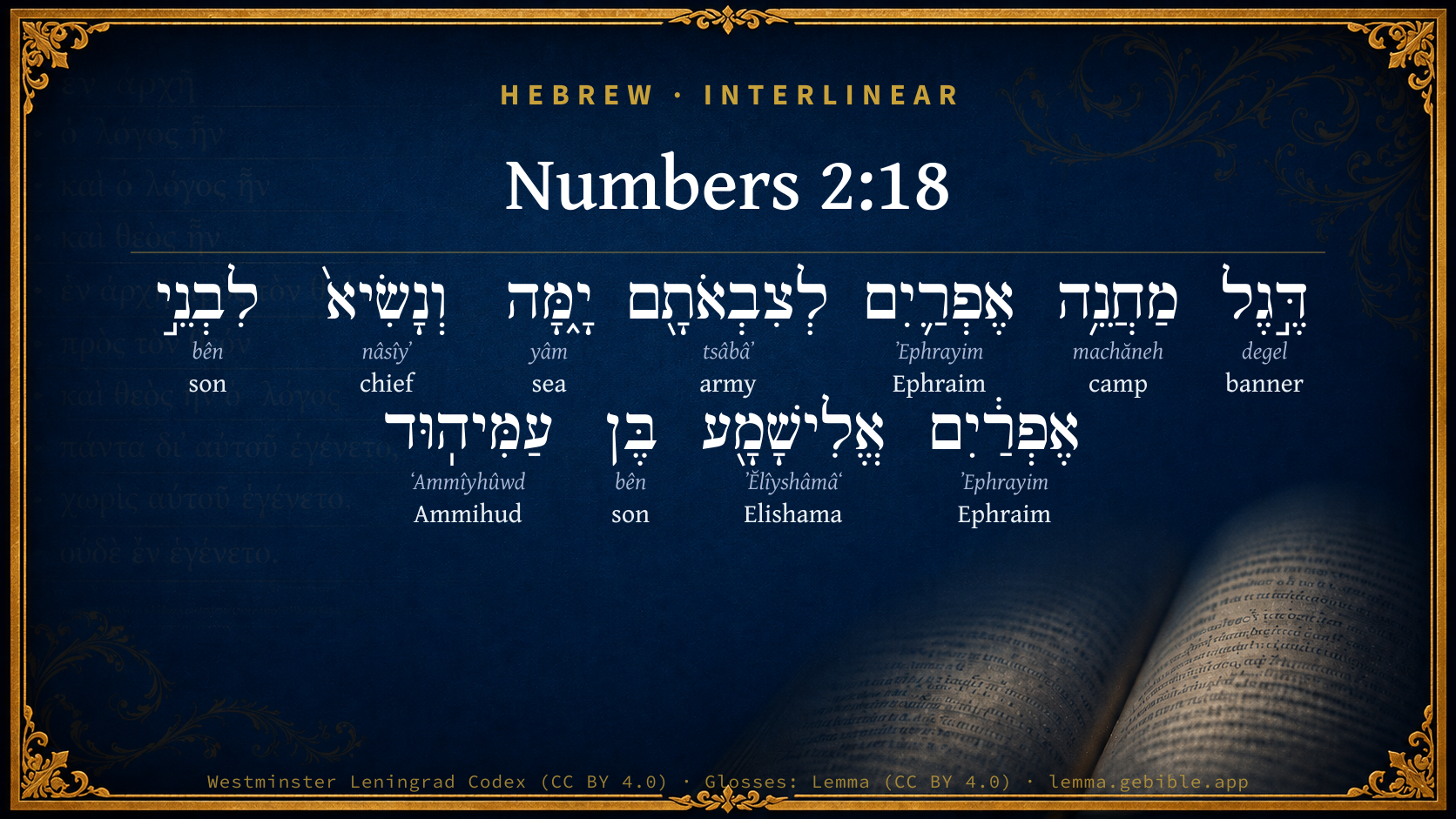
Hebrew (Westminster Leningrad Codex) Numbers 2:18 appears in the Hebrew Old Testament. The text above is from the Westminster Leningrad Codex. Each word links to its Strong’s number, a concise gloss, and parsing drawn from the Open Scriptures Hebrew Bible morphology. Click any word for its full Brown-Driver-Briggs (BDB) entry.
Download image
Cite this verse

Numbers 2:18 (World English Bible). Public Domain. Lemma interlinear Bible study tool, https://lemma.gebible.app/v/numbers/2/18.

Show BibTeX & RIS
BibTeX
RIS
English Translation
"On the west side shall be the standard of the camp of Ephraim according to their divisions: and the prince of the children of Ephraim shall be Elishama the son of Ammihud.
World English Bible · Public Domain
Download a study sheet

One document with this verse’s original text, its word-by-word gloss line, the meaning frame, cross-references with their text, attributed commentary, and full source and license credits — printable, and it pastes into notes with its structure intact.

This verse Autodidact and up

Study sheet (.html) Plain text (.txt)

A passage Seminary Student

Up to 50 verses in one chapter. A passage sheet keeps up to 6 commentary sources and 12 cross-references per verse, in the order this page ranks them, and says so on the sheet whenever that leaves anything out. Ask for a single verse and you get the Autodidact verse sheet above.

Everything on this page stays free to read, with no account — the sheet is a download of what is already on screen, not access to it.

Want to remove ads? Support Godless Engineer
Compare translations 3

The same verse in 3 English versions, stacked beneath the original-language interlinear above. Click any original word for its lexicon entry.

Each is an independent rendering of the whole verse — the interlinear is not word-aligned to these translations.

Highlighted words mark where these versions differ — a whole-verse word diff, not a word-by-word alignment.

  • World English Bible Public Domain
    "On the west side shall be the standard of the camp of Ephraim according to their divisions: and the prince of the children of Ephraim shall be Elishama the son of Ammihud.
  • King James Version Public Domain
    On the west side shall be the standard of the camp of Ephraim according to their armies: and the captain of the sons of Ephraim shall be Elishama the son of Ammihud.
  • unfoldingWord Literal Text CC BY-SA 4.0
    The banner of the camp of Ephraim according to their armies to the west, and the leader of the sons of Ephraim Elishama, the son of Ammihud,

unfoldingWord Literal Text — © unfoldingWord, licensed CC BY-SA 4.0. Word-aligned USFM3 via Door43 (git.door43.org/unfoldingWord/en_ult).

Versions to compare (up to 4)

3 of 4 selected

Show all 18 translations

Every available English version of this verse, each an independent rendering of the whole verse.

  • World English Bible Public Domain
    "On the west side shall be the standard of the camp of Ephraim according to their divisions: and the prince of the children of Ephraim shall be Elishama the son of Ammihud.
  • Berean Standard Bible Public Domain
    On the west side, the divisions of Ephraim are to camp under their standard: The leader of the Ephraimites is Elishama son of Ammihud,
  • Majority Standard Bible Public Domain
    On the west side, the divisions of Ephraim are to camp under their standard: The leader of the Ephraimites is Elishama son of Ammihud,
  • King James Version Public Domain
    On the west side shall be the standard of the camp of Ephraim according to their armies: and the captain of the sons of Ephraim shall be Elishama the son of Ammihud.
  • American Standard Version (1901) Public Domain
    On the west side shall be the standard of the camp of Ephraim according to their hosts: and the prince of the children of Ephraim shall be Elishama the son of Ammihud.
  • Revised Version (1885) Public Domain
    On the west side shall be the standard of the camp of Ephraim according to their hosts: and the prince of the children of Ephraim shall be Elishama the son of Ammihud.
  • Geneva Bible (1599) Public Domain
    The standerd of the campe of Ephraim shalbe toward the west according to their armies: and ye captaine ouer the sonnes of Ephraim shall be Elishama the sonne of Ammihud:
  • Douay-Rheims (1899) Public Domain
    On the west side shall be the camp of the sons of Ephraim, whose prince was Elisama, the son of Ammiud.
  • Young's Literal Translation Public Domain
    The standard of the camp of Ephraim, by their hosts, `is' westward; and the prince of the sons of Ephraim `is' Elishama son of Ammihud;
  • Literal Standard Version CC BY-SA 4.0
    The standard of the camp of Ephraim, by their hosts, [is] westward; and the prince of the sons of Ephraim [is] Elishama son of Ammihud;
  • Unlocked Literal Bible CC BY-SA 4.0
    The divisions of the camp of Ephraim under their standard. The leader of the people of Ephraim is Elishama son of Ammihud.
  • unfoldingWord Literal Text CC BY-SA 4.0
    The banner of the camp of Ephraim according to their armies to the west, and the leader of the sons of Ephraim Elishama, the son of Ammihud,
  • Darby Bible Public Domain
    The standard of the camp of Ephraim according to their hosts shall be westward; and the prince of the sons of Ephraim shall be Elishama the son of Ammihud;
  • World Messianic Bible Public Domain
    “On the west side shall be the standard of the camp of Ephraim according to their divisions. The prince of the children of Ephraim shall be Elishama the son of Ammihud.
  • Webster's Bible Public Domain
    On the west side shall be the standard of the camp of Ephraim, according to their armies: and the captain of the sons of Ephraim shall be Elishama the son of Ammihud.
  • Free Bible Version CC BY-SA 4.0
    The tribal division of Ephraim is to camp under their flag on the west side. Their leader is Elishama, son of Ammihud,
  • Bible in Basic English Public Domain
    On the west side will be the flag of the children of Ephraim, with Elishama, the son of Ammihud, as their chief.
  • JPS Tanakh (1917) Public Domain
    On the west side shall be the standard of the camp of Ephraim according to their hosts; the prince of the children of Ephraim being Elishama the son of Ammihud,

Literal Standard Version (2020), Covenant Press — licensed CC BY-SA 4.0. Text via the HelloAO Bible API (eBible.org). Unlocked Literal Bible (unfoldingWord) — licensed CC BY-SA 4.0. Text via the HelloAO Bible API (eBible.org). unfoldingWord Literal Text — © unfoldingWord, licensed CC BY-SA 4.0. Word-aligned USFM3 via Door43 (git.door43.org/unfoldingWord/en_ult). Free Bible Version, Dr. Jonathan Gallagher — licensed CC BY-SA 4.0. Text via the HelloAO Bible API (eBible.org).

Word by word

More ways to search: Search by grammar → Find every occurrence → Compare this word →

Practice this passage: Drill this verse → Learn its vocabulary →

עַמִּיהֽוּד
ʻAmmîyhûwd
H5989
“Ammihud”
Noun, Proper
Part of Speech
Noun
Type
Proper
Full BDB Definition

Origin: from H5971 and H1935

TWOT: None

Ammihud = "my kinsman is majesty" - an Ephraimite, father of Elishama, the chief of the tribe at the time of the exodus - a Simeonite, father of Shemuel - father of Pedahel, prince of the tribe of Naphtali - father of king Talmai of Geshur - a descendant of Judah through his son Pharez
  1. דֶּ֣גֶל degel H1714 “banner of” Noun, Common, Masculine, Singular, Construct
  2. מַחֲנֵ֥ה machăneh H4264 “camp of” Noun, Common, Both, Singular, Construct
  3. אֶפְרַ֛יִם ʼEphrayim H669 “Ephraim” Noun, Proper
  4. לְצִבְאֹתָ֖ם tsâbâʼ H6635 “to/for · armies · their” Preposition + Noun, Common, Both, Plural, Construct + Suffix, Personal, 3rd Person, Masculine, Plural
  5. יָ֑מָּה yâm H3220 “sea · toward” Noun, Common, Masculine, Singular, Absolute + Suffix, Demonstrative
  6. וְנָשִׂיא֙ nâsîyʼ H5387 “and · chief” Conjunction + Noun, Common, Masculine, Singular, Absolute
  7. לִבְנֵ֣י bên H1121 “to/for · sons of” Preposition + Noun, Common, Masculine, Plural, Construct
  8. אֶפְרַ֔יִם ʼEphrayim H669 “Ephraim” Noun, Proper
  9. אֱלִישָׁמָ֖ע ʼĔlîyshâmâʻ H476 “Elishama” Noun, Proper
  10. בֶּן bên H1121 “son of” Noun, Common, Masculine, Singular, Construct

About this verse

These counts appear in no published source. They are computed here, from the morphology-tagged text and Lemma’s own curated glosses. What Lemma adds →

11
words
9
distinct lemmas
Pentateuch
section

Notable vocabulary

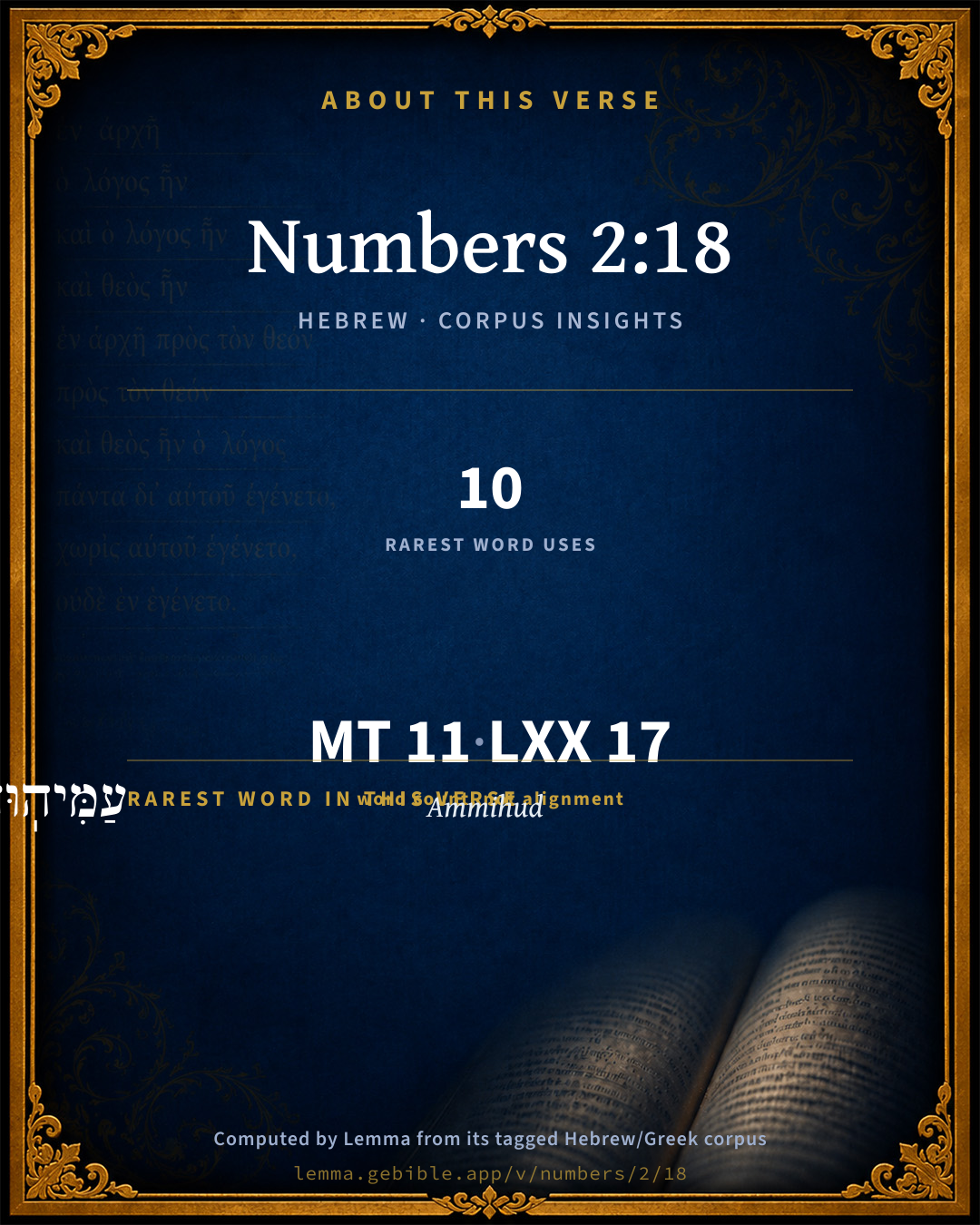
The rarest word here is עַמִּיהֽוּד Ammihud H5989 — appearing just 10 times in the whole Hebrew Bible.

Shared distinctive vocabulary

עַמִּיהֽוּד Ammihud H5989 occurs in 10 verses of the Hebrew Bible. Also found in:

Grammatical profile

  • 11 nouns

Repetition

Words recur within this verse — often emphatic in Hebrew:

  • אֶפְרַ֛יִם Ephraim H669 ×2
  • לִבְנֵ֣י son H1121 ×2

Hebrew & Septuagint length

In English translation the verse runs 32 words from the Hebrew and 28 from the Septuagint (LXX English) — closely comparable.

A rough comparison of the two English renderings, which tokenize alike — not a word-level alignment.

Word counts can differ between the Hebrew and the Greek without any difference in meaning — e.g. the Hebrew direct-object marker אֵת has no separate Greek word, and Greek often adds the article ὁ.

In the original languages it is 11 Hebrew tokens and 17 Greek tokens — but the two are counted differently (Hebrew bundles its prefixes and suffixes into one token; the Greek is in lemma form), so that isn’t a like-for-like length.

Cross-references

11

Topical passages linked to Numbers 2:18 in the Treasury of Scripture Knowledge — connected by theme and wording, ordered by reader-vote popularity; previews shown in the World English Bible.

  • Numbers 1:10 Of the children of Joseph: Of Ephraim: Elishama the son of Ammihud. Of Manasseh: Gamaliel the son of Pedahzur.
  • Numbers 10:22 The standard of the camp of the children of Ephraim set forward according to their hosts: and over his host was Elishama the son of Ammihud.
  • Genesis 48:14–20 Israel stretched out his right hand, and laid it on Ephraim's head, who was the younger, and his left hand on Manasseh's head, guiding his hands knowingly, for Manasseh was the firstborn.
  • Genesis 48:5 Now your two sons, who were born to you in the land of Egypt before I came to you into Egypt, are mine; Ephraim and Manasseh, even as Reuben and Simeon, will be mine.
  • Numbers 1:32 Of the children of Joseph, of the children of Ephraim, their generations, by thir families, by their fathers' houses, according to the number of the names, from twenty years old and upward, all who were able to go out to war;
  • Numbers 7:48 On the seventh day Elishama the son of Ammihud, prince of the children of Ephraim
  • Numbers 7:53 and for the sacrifice of peace offerings, two oxen, five rams, five male goats, and five male lambs a year old. This was the offering of Elishama the son of Ammihud.
  • Deuteronomy 33:17 The firstborn of his herd, majesty is his; His horns are the horns of the wild-ox: With them he shall push the peoples all of them, [even] the ends of the earth: They are the ten thousands of Ephraim, They are the thousands of Manasseh.
  • 1 Chronicles 7:26–27 Ladan his son, Ammihud his son, Elishama his son,
  • Psalms 80:1–2 Hear us, Shepherd of Israel, You who lead Joseph like a flock, You who sit above the cherubim, shine forth.
  • Jeremiah 31:18–20 I have surely heard Ephraim bemoaning himself [thus], You have chastised me, and I was chastised, as a calf unaccustomed [to the yoke]: turn you me, and I shall be turned; for you are Yahweh my God.

Cross-references courtesy of OpenBible.info (CC BY 4.0).

Hebrew and Greek witnesses Masoretic Hebrew ↔ Greek Septuagint

The same verse in the two great witnesses to the Old Testament, shown verse-for-verse.

These are two independent witnesses, not word-aligned to each other, and the Septuagint is shown in lemma (dictionary) form.

Hebrew Numbers 2:18 Masoretic · Westminster Leningrad Codex

דֶּ֣גֶל מַחֲנֵ֥ה אֶפְרַ֛יִם לְצִבְאֹתָ֖ם יָ֑מָּה וְנָשִׂיא֙ לִבְנֵ֣י אֶפְרַ֔יִם אֱלִישָׁמָ֖ע בֶּן עַמִּיהֽוּד

"On the west side shall be the standard of the camp of Ephraim according to their divisions: and the prince of the children of Ephraim shall be Elishama the son of Ammihud.

World English Bible · Public Domain

Greek LXX Numbers 2:18 Septuagint · lemma form

τάγμα παρεμβολή ἐφράιμ παρά θάλασσα σύν δύναμις αὐτός καί ὁ ἄρχων ὁ υἱός ἐφράιμ ελισαμα υἱός εμιουδ

The station of the camp of Ephraim shall be westward with their forces, and the head of the children of Ephraim shall be Elisama the son of Emiud.

LXX2012 (modern English Septuagint) · Public Domain

Hebrew: Westminster Leningrad Codex (CC BY 4.0). Greek: Septuagint (public domain); English from LXX2012 (modern English Septuagint) (Public Domain). How the Septuagint differs from the Hebrew →

Targum (Aramaic paraphrase)

2

The Targum is the ancient Jewish Aramaic paraphrase of the Hebrew Scriptures — an interpretive translation, not the Hebrew text itself. Onkelos (literal) and Pseudo-Jonathan (expansive) render the Torah, and Jonathan the Prophets. Coverage is partial: where no permissively-licensed English translation exists for a verse, only the Aramaic is shown. This is verse-level text, not a word-by-word alignment to the Hebrew.

  1. Targum Onkelos Torah (Genesis–Deuteronomy)
    טֵּקַס מַשְׁרִית אֶפְרַיִם לְחֵילֵיהוֹן מַעַרְבָא וְרַבָּא לִבְנֵי אֶפְרַיִם אֱלִישָׁמָע בַּר עַמִיהוּד

    (no public-domain English translation for this verse)

    Targum Onkelos — Aramaic: “Onkelos Genesis” (public domain); “Onkelos Exodus” (public domain); “Onkelos Leviticus” (public domain); “Onkelos Numbers” (public domain); “Onkelos Deuteronomy” (public domain). English: “Sefaria Community Translation” (CC0 1.0 (public-domain dedication)); “J.W. Etheridge. The Targums of Onkelos and Jonathan Ben Uzziel on the Pentateuch. London: Longmans, Green, 1862” (public domain). Text via Sefaria.

  2. Targum Pseudo-Jonathan Torah (Genesis–Deuteronomy)
    טֵיקַס מַשִׁרְיַית אֶפְרַיִם לְחֵילֵיהוֹן מַעַרְבָא יִשְׁרוּן וּמַשִׁירְיַתְהוֹן בְאַרְבַּעְתֵּי מִילִין מְרַבְּעַן וְטִיקְסֵיהּ הֲוָה מִמֵילַת תְּלַת גְוָונִין כָּל קְבֵיל תְּלַת מַרְגַלְיָיתָא דִבְחוּשְׁנָא קַנְכִּירִין טַרְקִין וְעֵינְעֵיגַל וּבֵיהּ חָקִיק וּמְפָרָשׁ שְׁמָהַת תְּלַת שִׁבְטַיָא אֶפְרַיִם וּמְנַשֶׁה וּבִנְיָמִין וּבִמְצִיעוּתֵיהּ כְּתִיב וַעֲנָנָא דַיְיָ עֲלֵיהוֹן בִּימָמָא בְּמַטְלֵיהוֹן מִן מַשְׁרִיתָא וּבֵיהּ הֲוָה חָקִיק צוּרַת רִיבָא וְרַבָּא דַהֲוָה מְמַנֵי עַל חֵילְוַת שִׁבְטָא דִבְנֵי אֶפְרַיִם אֱלִישָׁמָע בַּר עַמִיהוּד

    The camp of Ephraim by the standard of their hosts shall pitch on the west; their camp spreadeth over four miles; and their standard is of silk of three colours, corresponding with the precious stones in the breastplate, ligure, agate, and amethyst; and upon it expressed and set forth the names of the three tribes, Ephraim, Menasheh and Benjamin, having written in the midst, And the Cloud of the Lord was over them, in the going forward of the host; and upon it was set forth the figure of a young man. And the Rabba set over the tribe of Ephraim, Elishama bar Ammihud;

    Targum Pseudo-Jonathan — Aramaic: “Targum Jonathan on Genesis” (public domain); “Targum Jonathan on Exodus” (public domain); “Targum Jonathan on Leviticus” (public domain); “Targum Jonathan on Numbers” (public domain); “Targum Jonathan on Deuteronomy” (public domain). English: “The Targum of Jonathan ben Uzziel, trans. J. W. Etheridge, London, 1862” (public domain). Text via Sefaria.

Commentary

Notes on Numbers 2:18 from classic Christian and Jewish commentators (each source and its license shown beneath its notes). The classic Christian expositions comment on the surrounding passage and are grouped to its opening verse, so a note may address several verses; the Jewish commentaries on the Tanakh (Rashi and others) are per-verse, so they appear only where the commentator wrote on this verse.

Lemma curates 59 commentaries, every one of them public domain or Creative Commons licensed, each selected and text-cleaned for this edition rather than reprinted as found. About our sources →

Joseph Benson's Commentary

Num 2:18. Ephraim — Who is here preferred before his brother, according to the prophecy, Gen 48:19-20.

Joseph Benson's Commentary on the Old and New Testaments (1811–1818) — public domain. Text from a community e-Sword module.

Tyndale Open Study Notes

Tyndale Open Resources

2:18-24 The tribes of Ephraim, Manasseh, and Benjamin marched behind the Tabernacle and the Levites.

Tyndale Open Study Notes — © Tyndale Open Resources, licensed CC BY-SA 4.0. Text via the HelloAO Bible API.

Geneva Bible (1599)

Geneva Bible translators

Because Ephraim and Manasseh supplied the place of Joseph their father, they are taken to be Rachel’s children, so they and Benjamin make the third standard.

Geneva Bible (1599) marginal notes — public domain. Text via Bolls.life.

John Gill's Exposition

On the west side shall be the standard of the camp of Ephraim, according to their armies,.... It was in the rear or behind, consisting of his tribe, and of the tribes of Manasseh and Benjamin, divided into several companies, and extended four miles, as the above Targum. The Jewish writers say (l), that Joseph's stone is the onyx or sardonyx, and his flag was coloured very black, and on it were figured for the two princes, Ephraim and Manasseh, Egypt, because they were born in Egypt; and upon the flag of Ephraim was figured an ox, because of what is said in Deu 33:17; and on the flag of the tribe of Manasseh was figured an unicorn, because of what is said in the same place. Benjamin's stone was the jasper, and his flag was coloured like to twelve colours, and on it was figured a wolf, because of what is said Gen 49:27,

and the captain of the sons of Ephraim shall be Elishama the son of Ammihud; of whom see Num 1:10.

(l) Bemidbar Rabba, ut supra. (sect. 2. fol. 178. 2.)

John Gill's Exposition of the Whole Bible (1746–1763) — public domain (CC PDM 1.0). Text via the HelloAO Bible API.

Matthew Poole's English Annotations

Ephraim is here preferred before his brother, according to the prophecy, Gen 48:19,20.

Matthew Poole's English Annotations on the Holy Bible (1683–1685) — public domain. Text from a community e-Sword/MySword module.

Whedon's Commentary on the Bible

Daniel D. Whedon

18. The camp of Ephraim came next, on the west side of the tabernacle. Here the descendants of Rachel, the tribes of Joseph’s two sons and the tribe of Benjamin, his favourite younger brother, reared their standard. They were near neighbours in Canaan, though the Jordan divided Manasseh. In the days of the monarchy they were intimately associated. “Before Ephraim and Benjamin and Manasseh, stir up thy strength.” Psa_80:2.

Daniel D. Whedon (gen. ed.), Commentary on the Old and New Testaments (1874–1909) — public domain. Text from a community e-Sword module.

John Wesley's Explanatory Notes

Ephraim - Who is here preferred before his brother, according to the prophecy, Gen. xlviii, 19, 20.

John Wesley, Explanatory Notes Upon the Whole Bible (1754–1765) — public domain. Text via the GEBible commentary corpus.

unfoldingWord translationNotes

Door43 World Missions Community

General Information:

Yahweh continues telling Moses where each tribe and its army will camp around the tent of meeting. (See: How to Translate Names and Numbers)

under their standard

The "standards" were four larger groups that the tribes were divided into. Each standard was commanded to camp together. The standards were represented by a banner. See how you translated "standards" in Numbers 2:2.

40,500

"Forty thousand five hundred." This refers to the number of men. AT: "40,500 men" (See: Numbers and Ellipsis)

translationWords

Ephraim

unfoldingWord translationNotes — © Distant Shores Media and the Door43 World Missions Community, licensed CC BY-SA 4.0. Source: git.door43.org/Door43/en_tn.

Lesson kit

Teaching starters — assembled from the data on this page, not authored interpretation. Every prompt links to the verse data it draws on. Edit before teaching.

Numbers, in the Pentateuch, opens this verse with 11 words (9 distinct Hebrew lemmas). Its most distinctive word is ʻAmmîyhûwd (“Ammihud”). A historical commentator’s framing appears above. Read the whole chapter for the surrounding context.

Discussion questions

  1. What does “Ammihud” (ʻAmmîyhûwd) contribute to the verse as a whole?
  2. How does Numbers 1:10, which shares the word «Ammihud», read alongside this verse?
  3. What does the repetition of “Ephraim” (2× in this one verse) do in this verse?
  4. These translations render this verse differently. What is at stake in choosing one wording over another?
  5. Compare how Joseph Benson's Commentary and Tyndale Open Study Notes read this verse. Where do they agree or differ?

Things to notice

Reading settings

Reading text

Shown beneath each verse's original-language words.

Old Testament
Old Testament edition

Read the OT as the Masoretic Hebrew (MT) or the Greek Septuagint (LXX).

English shown for the Greek Septuagint (in the Hebrew ↔ Greek comparison).

Comparing translations? Open the Compare panel on any verse page to stack up to four side by side.