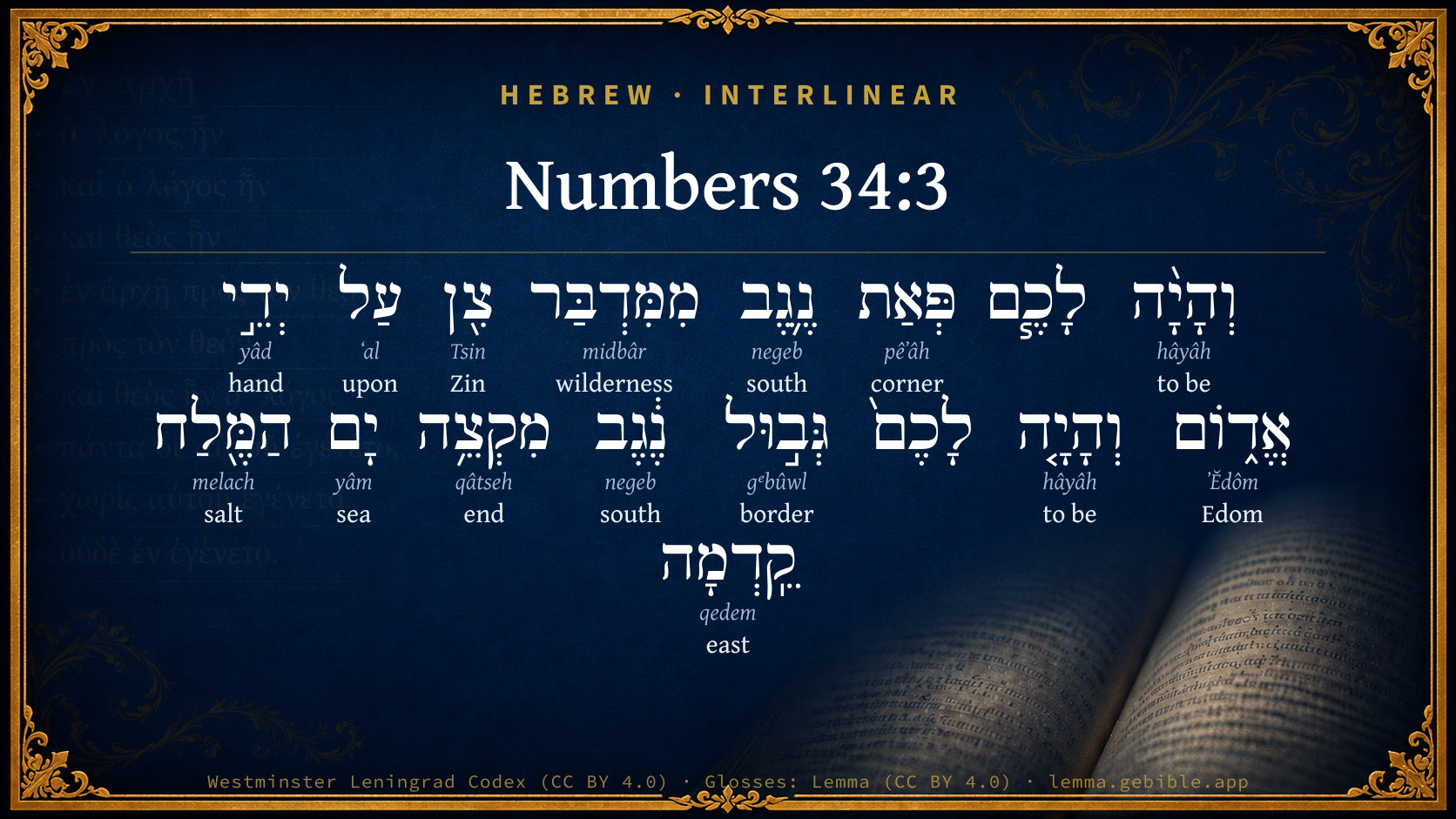
Numbers 34:3

Hebrew (Westminster Leningrad Codex) Numbers 34:3 appears in the Hebrew Old Testament. The text above is from the Westminster Leningrad Codex. Each word links to its Strong’s number, a concise gloss, and parsing drawn from the Open Scriptures Hebrew Bible morphology. Click any word for its full Brown-Driver-Briggs (BDB) entry.
Download image
Cite this verse

Numbers 34:3 (World English Bible). Public Domain. Lemma interlinear Bible study tool, https://lemma.gebible.app/v/numbers/34/3.

Show BibTeX & RIS
BibTeX
RIS
English Translation
then your south quarter shall be from the wilderness of Zin along by the side of Edom, and your south border shall be from the end of the Salt Sea eastward;
World English Bible · Public Domain
Download a study sheet

One document with this verse’s original text, its word-by-word gloss line, the meaning frame, cross-references with their text, attributed commentary, and full source and license credits — printable, and it pastes into notes with its structure intact.

This verse Autodidact and up

Study sheet (.html) Plain text (.txt)

A passage Seminary Student

Up to 50 verses in one chapter. A passage sheet keeps up to 6 commentary sources and 12 cross-references per verse, in the order this page ranks them, and says so on the sheet whenever that leaves anything out. Ask for a single verse and you get the Autodidact verse sheet above.

Everything on this page stays free to read, with no account — the sheet is a download of what is already on screen, not access to it.

Want to remove ads? Support Godless Engineer
Compare translations 3

The same verse in 3 English versions, stacked beneath the original-language interlinear above. Click any original word for its lexicon entry.

Each is an independent rendering of the whole verse — the interlinear is not word-aligned to these translations.

Highlighted words mark where these versions differ — a whole-verse word diff, not a word-by-word alignment.

  • World English Bible Public Domain
    then your south quarter shall be from the wilderness of Zin along by the side of Edom, and your south border shall be from the end of the Salt Sea eastward;
  • King James Version Public Domain
    Then your south quarter shall be from the wilderness of Zin along by the coast of Edom, and your south border shall be the outmost coast of the salt sea eastward:
  • unfoldingWord Literal Text CC BY-SA 4.0
    and the corner of the south will be for you from the wilderness of Zin beside the hands of Edom. And the border of the south will be for you from the end of the Sea of Salt eastward.

unfoldingWord Literal Text — © unfoldingWord, licensed CC BY-SA 4.0. Word-aligned USFM3 via Door43 (git.door43.org/unfoldingWord/en_ult).

Versions to compare (up to 4)

3 of 4 selected

Show all 18 translations

Every available English version of this verse, each an independent rendering of the whole verse.

  • World English Bible Public Domain
    then your south quarter shall be from the wilderness of Zin along by the side of Edom, and your south border shall be from the end of the Salt Sea eastward;
  • Berean Standard Bible Public Domain
    Your southern border will extend from the Wilderness of Zin along the border of Edom. On the east, your southern border will run from the end of the Salt Sea,
  • Majority Standard Bible Public Domain
    Your southern border will extend from the Wilderness of Zin along the border of Edom. On the east, your southern border will run from the end of the Salt Sea,
  • King James Version Public Domain
    Then your south quarter shall be from the wilderness of Zin along by the coast of Edom, and your south border shall be the outmost coast of the salt sea eastward:
  • American Standard Version (1901) Public Domain
    then your south quarter shall be from the wilderness of Zin along by the side of Edom, and your south border shall be from the end of the Salt Sea eastward;
  • Revised Version (1885) Public Domain
    then your south quarter shall be from the wilderness of Zin along by the side of Edom, and your south border shall be from the end of the Salt Sea eastward:
  • Geneva Bible (1599) Public Domain
    And your Southquarter shalbe from the wildernesse of Zin to the borders of Edom: so that your Southquarter shall be from the salt Sea coast Eastwarde:
  • Douay-Rheims (1899) Public Domain
    The south side shall begin from the wilderness of Sin, which is by Edom: and shall have the most salt sea for its furthest limits eastward:
  • Young's Literal Translation Public Domain
    then hath the south quarter been to you from the wilderness of Zin, by the sides of Edom, yea, the south border hath been to you from the extremity of the Salt Sea, eastward;
  • Literal Standard Version CC BY-SA 4.0
    then the south quarter has been to you from the wilderness of Zin, by the sides of Edom, indeed, the south border has been to you from the extremity of the Salt Sea eastward;
  • Unlocked Literal Bible CC BY-SA 4.0
    your southern border will extend from the wilderness of Zin along the border of Edom. The eastern end of the southern border will be on a line that ends at the southern end of the Salt Sea.
  • unfoldingWord Literal Text CC BY-SA 4.0
    and the corner of the south will be for you from the wilderness of Zin beside the hands of Edom. And the border of the south will be for you from the end of the Sea of Salt eastward.
  • Darby Bible Public Domain
    Then your south side shall be from the wilderness of Zin alongside of Edom, and your southern border shall be from the end of the salt sea eastward;
  • World Messianic Bible Public Domain
    then your south quarter shall be from the wilderness of Zin along by the side of Edom, and your south border shall be from the end of the Salt Sea eastward.
  • Webster's Bible Public Domain
    Then your south quarter shall be from the wilderness of Zin along by the border of Edom, and your south border shall be the outmost coast of the salt sea eastward:
  • Free Bible Version CC BY-SA 4.0
    The southern extent of your country will be from the Desert of Zin along the border of Edom. Your southern border will run east from the end of the Dead Sea,
  • Bible in Basic English Public Domain
    Then your south quarter will be from the waste land of Zin by the side of Edom, and your limit on the south will be from the east end of the Salt Sea,
  • JPS Tanakh (1917) Public Domain
    Thus your south side shall be from the wilderness of Zin close by the side of Edom, and your south border shall begin at the end of the Salt Sea eastward;

Literal Standard Version (2020), Covenant Press — licensed CC BY-SA 4.0. Text via the HelloAO Bible API (eBible.org). Unlocked Literal Bible (unfoldingWord) — licensed CC BY-SA 4.0. Text via the HelloAO Bible API (eBible.org). unfoldingWord Literal Text — © unfoldingWord, licensed CC BY-SA 4.0. Word-aligned USFM3 via Door43 (git.door43.org/unfoldingWord/en_ult). Free Bible Version, Dr. Jonathan Gallagher — licensed CC BY-SA 4.0. Text via the HelloAO Bible API (eBible.org).

Word by word

More ways to search: Search by grammar → Find every occurrence → Compare this word →

Practice this passage: Drill this verse → Learn its vocabulary →

צִ֖ן
Tsin
H6790
“Zin”
Noun, Proper
Part of Speech
Noun
Type
Proper
Full BDB Definition

Origin: from an unused root meaning to prick

TWOT: None

Zin = "flat" - name given to a portion of the desert tract between the Dead Sea and Arabah on the east in which Kadesh-barnea was located
  1. וְהָיָ֨ה hâyâh H1961 “and · to be” Conjunction + Verb, Qal, Sequential Perfect, 3rd Person, Masculine, Singular
  2. פְּאַת pêʼâh H6285 “corner of” Noun, Common, Feminine, Singular, Construct
  3. נֶ֛גֶב negeb H5045 “south” Noun, Common, Masculine, Singular, Absolute
  4. מִמִּדְבַּר midbâr H4057 “from · wilderness of” Preposition + Noun, Common, Masculine, Singular, Construct
  5. עַל ʻal H5921 “upon” Preposition
  6. יְדֵ֣י yâd H3027 “hands of” Noun, Common, Both, Dual, Construct
  7. אֱד֑וֹם ʼĔdôm H123 “Edom” Noun, Proper
  8. וְהָיָ֤ה hâyâh H1961 “and · to be” Conjunction + Verb, Qal, Sequential Perfect, 3rd Person, Masculine, Singular
  9. גְּב֣וּל gᵉbûwl H1366 “border of” Noun, Common, Masculine, Singular, Construct
  10. נֶ֔גֶב negeb H5045 “south” Noun, Common, Masculine, Singular, Absolute
  11. מִקְצֵ֥ה qâtseh H7097 “from · end of” Preposition + Noun, Common, Both, Singular, Construct
  12. יָם yâm H3220 “sea of” Noun, Common, Masculine, Singular, Construct
  13. הַמֶּ֖לַח melach H4417 “the · salt” Particle, Definite Article + Noun, Common, Masculine, Singular, Absolute
  14. קֵֽדְמָה qedem H6924 “east · toward” Noun, Common, Masculine, Singular, Absolute + Suffix, Demonstrative

About this verse

These counts appear in no published source. They are computed here, from the morphology-tagged text and Lemma’s own curated glosses. What Lemma adds →

17
words
13
distinct lemmas
Pentateuch
section

Notable vocabulary

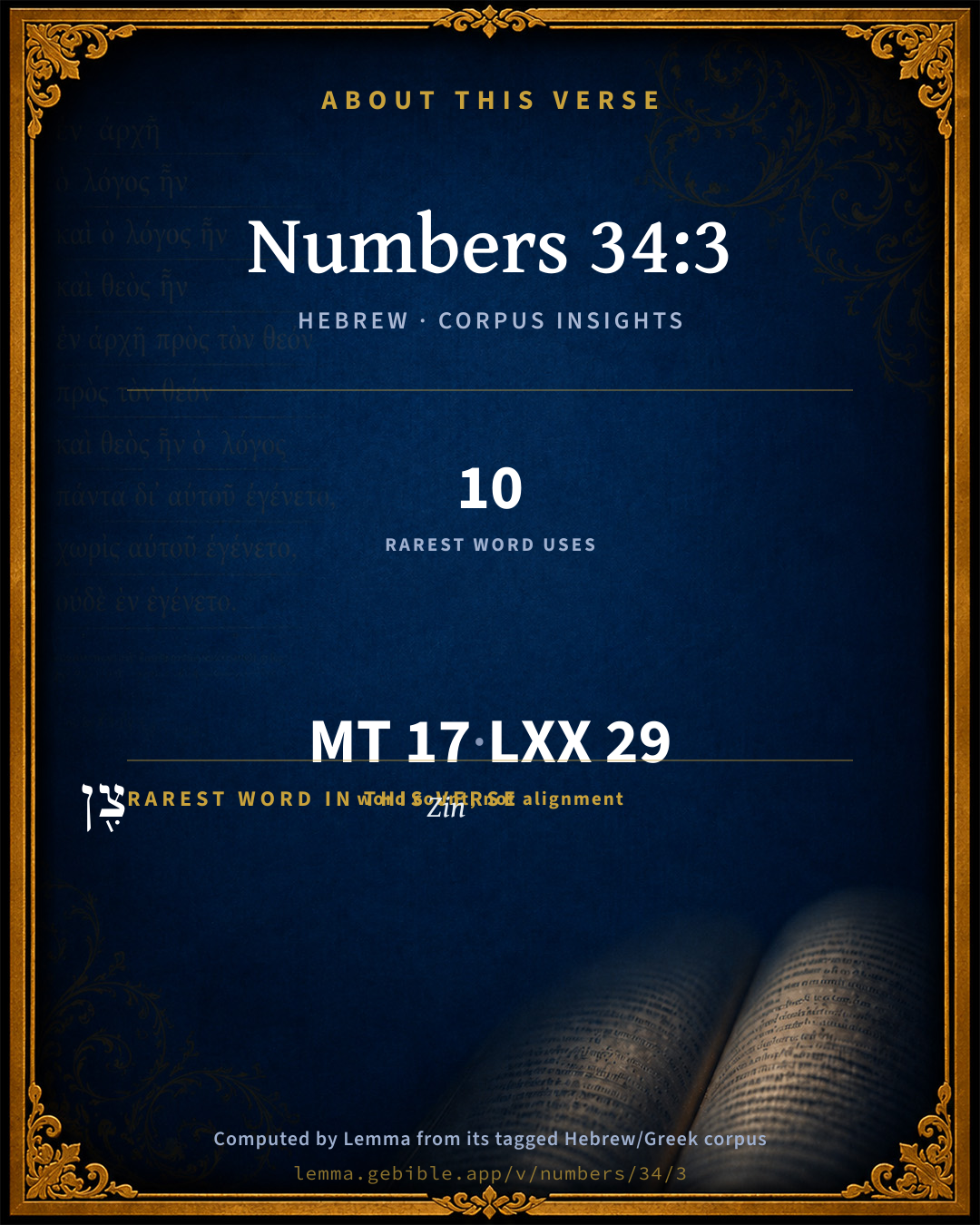
The rarest word here is צִ֖ן Zin H6790 — appearing just 10 times in the whole Hebrew Bible.

Shared distinctive vocabulary

צִ֖ן Zin H6790 occurs in 9 verses of the Hebrew Bible. Also found in:

Grammatical profile

  • 2 verbs
  • 12 nouns
  • 3 prepositions

Verb forms

  • וְהָיָ֨ה Qal · Sequential Perfect
  • וְהָיָ֤ה Qal · Sequential Perfect

Repetition

Words recur within this verse — often emphatic in Hebrew:

  • וְהָיָ֨ה to be H1961 ×2
  • נֶ֛גֶב south H5045 ×2

Hebrew & Septuagint length

In English translation the verse runs 31 words from the Hebrew and 30 from the Septuagint (LXX English) — closely comparable.

A rough comparison of the two English renderings, which tokenize alike — not a word-level alignment.

Word counts can differ between the Hebrew and the Greek without any difference in meaning — e.g. the Hebrew direct-object marker אֵת has no separate Greek word, and Greek often adds the article ὁ.

In the original languages it is 17 Hebrew tokens and 29 Greek tokens — but the two are counted differently (Hebrew bundles its prefixes and suffixes into one token; the Greek is in lemma form), so that isn’t a like-for-like length.

Cross-references

7

Topical passages linked to Numbers 34:3 in the Treasury of Scripture Knowledge — connected by theme and wording, ordered by reader-vote popularity; previews shown in the World English Bible.

  • Genesis 14:3 All these joined together in the valley of Siddim (the same is the Salt Sea).
  • Ezekiel 47:13 Thus says the Lord Yahweh: This shall be the border, by which you shall divide the land for inheritance according to the twelve tribes of Israel: Joseph [shall have two] portions.
  • Exodus 23:31 I will set your border from the Red Sea even to the sea of the Philistines, and from the wilderness to the River; for I will deliver the inhabitants of the land into your hand, and you shall drive them out before you.
  • Joshua 3:16 that the waters which came down from above stood, and rose up in one heap, a great way off, at Adam, the city that is beside Zarethan; and those that went down toward the sea of the Arabah, even the Salt Sea, were wholly cut off: and the people passed over right against Jericho.
  • Joshua 15:1–12 The lot for the tribe of the children of Judah according to their families was to the border of Edom, even to the wilderness of Zin southward, at the uttermost part of the south.
  • Ezekiel 47:8 Then said he to me, These waters issue forth toward the eastern region, and shall go down into the Arabah; and they shall go toward the sea; into the sea [shall the waters go] which were made to issue forth; and the waters shall be healed.
  • Ezekiel 47:18–23 The east side, between Hauran and Damascus and Gilead, and the land of Israel, shall be the Jordan; from the [north] border to the east sea shall you measure. This is the east side.

Cross-references courtesy of OpenBible.info (CC BY 4.0).

Hebrew and Greek witnesses Masoretic Hebrew ↔ Greek Septuagint

The same verse in the two great witnesses to the Old Testament, shown verse-for-verse.

These are two independent witnesses, not word-aligned to each other, and the Septuagint is shown in lemma (dictionary) form.

Hebrew Numbers 34:3 Masoretic · Westminster Leningrad Codex

וְהָיָ֨ה לָכֶ֧ם פְּאַת נֶ֛גֶב מִמִּדְבַּר צִ֖ן עַל יְדֵ֣י אֱד֑וֹם וְהָיָ֤ה לָכֶם֙ גְּב֣וּל נֶ֔גֶב מִקְצֵ֥ה יָם הַמֶּ֖לַח קֵֽדְמָה

then your south quarter shall be from the wilderness of Zin along by the side of Edom, and your south border shall be from the end of the Salt Sea eastward;

World English Bible · Public Domain

Greek LXX Numbers 34:3 Septuagint · lemma form

καί εἰμί σύ ὁ κλίτος ὁ πρός λίψ ἀπό ἔρημος σιν ἕως ἔχω εδωμ καί εἰμί σύ ὁ ὅριον πρός λίψ ἀπό μέρος ὁ θάλασσα ὁ ἁλυκός ἀπό ἀνατολή

And your southern side shall be from the wilderness of Sin to the border of Edom, and your border southward shall extend on the side of the salt sea eastward.

LXX2012 (modern English Septuagint) · Public Domain

On this verse, Keil & Delitzsch discusses the Septuagint’s reading. Read the note in Commentary ↓

Hebrew: Westminster Leningrad Codex (CC BY 4.0). Greek: Septuagint (public domain); English from LXX2012 (modern English Septuagint) (Public Domain). How the Septuagint differs from the Hebrew →

Targum (Aramaic paraphrase)

2

The Targum is the ancient Jewish Aramaic paraphrase of the Hebrew Scriptures — an interpretive translation, not the Hebrew text itself. Onkelos (literal) and Pseudo-Jonathan (expansive) render the Torah, and Jonathan the Prophets. Coverage is partial: where no permissively-licensed English translation exists for a verse, only the Aramaic is shown. This is verse-level text, not a word-by-word alignment to the Hebrew.

  1. Targum Onkelos Torah (Genesis–Deuteronomy)
    וִיהֵי לְכוֹן רוּחַ דָרוֹמָא מִמַדְבְּרָא דְצִן עַל תְּחוּמֵי אֱדוֹם וִיהֵי לְכוֹן תְּחוּם דָרוֹמָא מִסְיָפֵי יַמָא דְמִלְחָא קִדוּמָא

    (no public-domain English translation for this verse)

    Targum Onkelos — Aramaic: “Onkelos Genesis” (public domain); “Onkelos Exodus” (public domain); “Onkelos Leviticus” (public domain); “Onkelos Numbers” (public domain); “Onkelos Deuteronomy” (public domain). English: “Sefaria Community Translation” (CC0 1.0 (public-domain dedication)); “J.W. Etheridge. The Targums of Onkelos and Jonathan Ben Uzziel on the Pentateuch. London: Longmans, Green, 1862” (public domain). Text via Sefaria.

  2. Targum Pseudo-Jonathan Torah (Genesis–Deuteronomy)
    וְיֶהֱוֵי לְכוֹן תְּחוּם דָרוֹמָא מִן מַדְבְּרָא דְצִינֵי טַוָר פַּרְזְלָא עַל תְּחוּמֵי אֱדוֹם וְיֶהֱוֵי תְּחוּם דָרוֹמָא מִן סְיָפֵי יַמָא דְמִלְחָא מַדִינְחָא

    Your south border (shall be) from the Wilderness of Palms, by the iron mountain, at the confines of Edom, even the south border at the extremities of the Sea of Salt, eastward.

    Targum Pseudo-Jonathan — Aramaic: “Targum Jonathan on Genesis” (public domain); “Targum Jonathan on Exodus” (public domain); “Targum Jonathan on Leviticus” (public domain); “Targum Jonathan on Numbers” (public domain); “Targum Jonathan on Deuteronomy” (public domain). English: “The Targum of Jonathan ben Uzziel, trans. J. W. Etheridge, London, 1862” (public domain). Text via Sefaria.

Commentary

Notes on Numbers 34:3 from classic Christian and Jewish commentators (each source and its license shown beneath its notes). The classic Christian expositions comment on the surrounding passage and are grouped to its opening verse, so a note may address several verses; the Jewish commentaries on the Tanakh (Rashi and others) are per-verse, so they appear only where the commentator wrote on this verse.

Lemma curates 59 commentaries, every one of them public domain or Creative Commons licensed, each selected and text-cleaned for this edition rather than reprinted as found. About our sources →

Trapp's Complete Commentary

John Trapp

Num 34:3 Then your south quarter shall be from the wilderness of Zin along by the coast of Edom, and your south border shall be the outmost coast of the salt sea eastward:

Ver. 3. Then your south quarter shall be.] Judea was not above two hundred miles long, and fifty miles broad; not near the half of England by much, but far more fertile, called, therefore, Sumen totius orbis. And yet England is, for good cause, counted the western granary; the garden of God, whose valleys are like Eden, whose hills are as Lebanon, whose springs are as Pisgah, whose rivers are as Jordan, whose walls is the ocean, whose defence is the Lord Jehovah. {a}

{a} Speed’s Hist.

John Trapp, A Commentary or Exposition upon All the Books of the Old and New Testament (1647–1656) — public domain. Text from a community e-Sword module.

Joseph Benson's Commentary

Num 34:3. Your south quarter — Which is here described from east to west by divers windings and turnings, by reason of the mountains and rivers. Though Canaan itself was a pleasant land, as it is termed Dan 8:9, yet it butted upon wildernesses and seas, and was surrounded with divers melancholy prospects. And thus the vineyard of the church is compassed on all hands with the desert of this world, which serves as a foil to it, to make it appear the more amiable and desirable. Many of the borders of Canaan, however, were its defences and fortifications, and rendered the access of its enemies more difficult. The utmost coast of the salt sea — So called from the salt and sulphureous taste of its waters; and termed also the Dead sea, because no creature, it appears, will live in it, on account of its excessive saltness, or rather bituminous quality. “It contains,” says Volney, “neither animal nor vegetable life. We see no verdure on its banks, nor are fish to be found within its waters.” This was part of the border of the Israelites, that it might be a constant warning to them to take heed of those sins which had been the ruin of Sodom: yet the iniquity of Sodom was afterward found in Israel; (Eze 16:49;) for which Canaan was made, though not a salt sea, as Sodom, yet a barren soil, and continues such to this day. Eastward — That is, at the eastern part of that sea, where the eastern and southern borders of the land met. Thus Moses determines the boundary of Canaan, on the south, to be Idumaea and the deserts of Arabia.

Joseph Benson's Commentary on the Old and New Testaments (1811–1818) — public domain. Text from a community e-Sword module.

Keil & Delitzsch

C. F. Keil & F. Delitzsch

The southern boundary is the same as that given in Jos 15:2-4 as the boundary of the territory of the tribe of Judah. We have first the general description, "The south side shall be to you from the desert of Zin on the sides of Edom onwards," i.e., the land was to extend towards the south as far as the desert of Zin on the sides of Edom. על־ידי, "on the sides," differs in this respect from על־יד, "on the side" (Exo 2:5; Jos 15:46; Sa2 15:2), that the latter is used to designate contact at a single point or along a short line; the former, contact for a long distance or throughout the whole extent (= כּל־יד, Deu 2:37). "On the sides of Edom" signifies, therefore, that the desert of Zin stretched along the side of Edom, and Canaan was separated from Edom by the desert of Zin. From this it follows still further, that Edom in this passage is not the mountains of Edom, which had their western boundary on the Arabah, but the country to the south of the desert of Zin or Wady Murreh, viz., the mountain land of the Azazimeh, which still bears the name of Seir or Serr among the Arabs (see Seetzen and Rowland in Ritter's Erdk. xiv. pp. 840 and 1087). The statement in Jos 15:1 also agrees with this, viz., that Judah's inheritance was "to the territory of Edom, the desert of Zin towards the south," according to which the desert of Zin was also to divide the territory of Edom from that of the tribe of Judah (see the remarks on Num 14:45). With Num 34:3 the more minute description of the southern boundary line commences: "The south border shall be from the end of the Salt Sea eastward," i.e., start from "the tongue which turns to the south" (Jos 15:2), from the southern point of the Dead Sea, where there is now a salt marsh with the salt mountain at the south-west border of the lake. "And turn to the south side (מנּגב) of the ascent of Akrabbim" (ascensus scorpionum), i.e., hardly "the steep pass of es Sufah, 1434 feet in height, which leads in a south-westerly direction from the Dead Sea along the northern side of Wady Fikreh, a wady three-quarters of an hour's journey in breadth, and over which the road from Petra to Heshbon passes,"

(Note: See Robinson, vol. ii. pp. 587, 591; and v. Schubert, ii. pp. 443, 447ff.)

as Knobel maintains; for the expression נסב (turn), in Num 34:4, according to which the southern border turned at the height of Akrabbim, that is to say, did not go any farther in the direction from N.E. to S.W. than from the southern extremity of the Salt Sea to this point, and was then continued in a straight line from east to west, is not at all applicable to the position of this pass, since there would be no bend whatever in the boundary line at the pass of es Sufah, if it ran from the Arabah through Wady Fikreh, and so across to Kadesh. The "height of Akrabbim," from which the country round was afterwards called Akrabattine, Akrabatene (1 Macc. 5:4; Josephus, Ant. 12:8, 1),

(Note: It must be distinguished, however, from the Akrabatta mentioned by Josephus in his Wars of the Jews (iii. 3, 5), the modern Akrabeh in central Palestine (Rob. Bibl. Res. p. 296), and from the toparchy Akrabattene mentioned in Josephus (Wars of the Jews, ii. 12, 4; 20, 4; 22, 2), which was named after this place.)

is most probably the lofty row of "white cliffs" of sixty or eighty feet in height, which run obliquely across the Arabah at a distance of about eight miles below the Dead Sea and, as seen from the south-west point of the Dead Sea, appear to shut in the Ghor, and which form the dividing line between the two sides of the great valley, which is called el Ghor on one side, and el Araba on the other (Robinson, ii. 489, 494, 502). Consequently it was not the Wady Fikreh, but a wady which opened into the Arabah somewhat farther to the south, possibly the southern branch of the Wady Murreh itself, which formed the actual boundary.

"And shall pass over to Zin" (i.e., the desert of Zin, the great Wady Murreh, see at Num 14:21), "and its going forth shall be to the south of Kadesh-barnea," at the western extremity of the desert of Zin (see at Num 20:16). From this point the boundary went farther out (יצא) "to Hazar-Addar, and over (עבר) to Azmon." According to Jos 15:3-4, it went to the south of Kadesh-barnea over (עבר) to Hezron, and ascended (עלה) to Addar, and then turned to Karkaa, and went over to Azmon. Consequently Hazar-Addar corresponds to Hezron and Addar (in Joshua); probably the two places were so close to each other that they could be joined together. Neither of them has been discovered yet. This also applies to Karkaa and Azmon. The latter name reminds us of the Bedouin tribe Azazimeh, inhabiting the mountains in the southern part of the desert of Zin (Robinson, i. pp. 274, 283, 287; Seetzen, iii. pp. 45, 47). Azmon is probably to be sought for near the Wady el Ain, to the west of the Hebron road, and not far from its entrance into the Wady el Arish; for this is "the river (brook) of Egypt," to which the boundary turned from Azmon, and through which it had "its outgoings at the sea," i.e., terminated at the Mediterranean Sea. The "brook of Egypt," therefore, is frequently spoken of as the southern boundary of the land of Israel (Kg1 8:65; Kg2 24:7; Ch2 7:8, and Isa 27:12, where the lxx express the name by Ῥινοκοροῦρα). Hence the southern boundary ran, throughout its whole length, from the Arabah on the east to the Mediterranean on the west, along valleys which form a natural division, and constitute more or less the boundary line between the desert and the cultivated land.

(Note: On the lofty mountains of Madara, where the Wady Murreh is divided into two wadys (Fikreh and Murreh) which run to the Arabah, v. Schubert observed "some mimosen-trees," with which, as he expresses it, "the vegetation of Arabia took leave of us, as it were, as they were the last that we saw on our road." And Dieterici (Reisebilder, ii. pp. 156-7) describes the mountain ridge at Nakb es Sufah as "the boundary line between the yellow desert and green steppes," and observes still further, that on the other side of the mountain (i.e., northwards) the plain spread out before him in its fresh green dress. "The desert journey was over, the empire of death now lay behind us, and a new life blew towards us from fields covered with green." - In the same way the country between Kadesh and the Hebron road, which has become better known to us through the descriptions of travellers, is described as a natural boundary. Seetzen, in his account of his journey from Hebron to Sinai (iii. p. 47), observes that the mountains of Tih commence at the Wady el Ain (fountain-valley), which takes its name from a fountain that waters thirty date-palms and a few small corn-fields (i.e., Ain el Kuderat, in Robinson, i. p. 280), and describes the country to the south of the small flat Wady el Kdeis (el Kideise), in which many tamarisks grew (i.e., no doubt a wady that comes from Kadesh, from which it derives its name), as a "most dreadful wilderness, which spreads out to an immeasurable extent in all directions, without trees, shrubs, or a single spot of green" (p. 50), although the next day he "found as an unexpected rarity another small field of barley, which might have been an acre in extent" (pp. 52, 53). Robinson (i. pp. 280ff.) also found, upon the route from Sinai to Hebron, more vegetation in the desert between the Wady el Kusaimeh and el Ain than anywhere else before throughout his entire journey; and after passing the Wady el Ain to the west of Kadesh, he "came upon a broad tract of tolerably fertile soil, capable of tillage, and apparently once tilled." Across the whole of this tract of land there were long ranges of low stone walls visible (called "el Muzeirit," "little plantations," by the Arabs), which had probably served at some former time as boundary walls between the cultivated fields. A little farther to the north the Wady es Serm opens into an extended plain, which looked almost like a meadow with its bushes, grass, and small patches of wheat and barley. A few Azazimeh Arabs fed their camels and flocks here. The land all round became more open, and showed broad valleys that were capable of cultivation, and were separated by low and gradually sloping hills. The grass become more frequent in the valleys, and herbs were found upon the hills. "We heard (he says at p. 283) this morning for the first time the songs of many birds, and among them the lark.")

Keil & Delitzsch — Biblical Commentary on the Old Testament (1861–1891) — public domain (CC PDM 1.0). Text via the HelloAO Bible API. (Old Testament only.)

Tyndale Open Study Notes

Tyndale Open Resources

34:3-5 Portions of the southern boundary of Canaan were familiar to Israel from earlier experiences in the wilderness of Zin on the northwestern edge of Edom (see chs 13–14). This southern frontier ran east to west in an arc from the southern end of the Dead Sea to the Mediterranean Sea.

Tyndale Open Study Notes — © Tyndale Open Resources, licensed CC BY-SA 4.0. Text via the HelloAO Bible API.

Jamieson, Fausset & Brown

Robert Jamieson, A. R. Fausset & David Brown

your south quarter--The line which bounded it on the south is the most difficult to trace. According to the best biblical geographers, the leading points here defined are as follows: The southwest angle of the southern boundary should be where the wilderness of Zin touches the border of Edom, so that the southern boundary should extend eastward from the extremity of the Dead Sea, wind around the precipitous ridge of Akrabbim ("scorpions"), thought to be the high and difficult Pass of Safeh, which crosses the stream that flows from the south into the Jordan--that is, the great valley of the Arabah, reaching from the Dead to the Red Sea.

Jamieson, Fausset & Brown — Commentary Critical and Explanatory on the Whole Bible (1871) — public domain (CC PDM 1.0). Text via the HelloAO Bible API.

Adam Clarke's Commentary

Verse 3. The salt sea] The Dead Sea, or lake Asphaltites. See Clarke on Ge 19:25.

Adam Clarke's Commentary on the Bible (1810–1826) — public domain. Text from a community e-Sword/MySword module.

The Cambridge Bible for Schools and Colleges

gen. ed. J. J. S. Perowne

3. your south quarter] your south sida. The word pe’âh frequently occurs in the ideal pictures of Ezekiel (chs. 41–48) always with this meaning. In earlier Heb. it denotes a ‘corner.’

eastward] i.e. on the east. The southern extremity of the Salt Sea is further denned in Jos_15:2.

The Cambridge Bible for Schools and Colleges (gen. ed. J. J. S. Perowne; Cambridge University Press, 1878–1918) — public domain. Text from a community e-Sword module.

John Gill's Exposition

Then your south quarter,.... Or border of the land; which, as Jarchi observes, was from east to west:

shall be from the wilderness of Zin; which is Kadesh, where Miriam died, Num 20:1, and if this Kadesh was Kadeshbarnea, as Dr. Lightfoot seems to have proved (h), from whence the spies were sent, that was clearly on the south of the land of Canaan, for they were bid to go up their way southward, Num 13:17, and so Kadeshbarnea is hereafter mentioned, as being in the southern border: the Targum of Jonathan paraphrases it,"from the wilderness of the palm trees of the mountain of iron;''there is a smaller palm tree, which by Jewish writers is called Zin, of which there were great quantities on a mountain famous for iron mines, in this wilderness, from whence it is thought it had its name; hence we read (i) of palm trees of the mountain of iron, as fit to make the bunch of branches of trees, called the "lulab", carried in the hand on the feast of tabernacles:

along by the coast of Edom; the land of Canaan, to the south, bordered on three countries, Egypt, Edom, and Moab; according to Jarchi, some part of Egypt, the whole land of Edom, and the whole land of Moab; the part of the land of Egypt was in the south west corner of it; the land of Edom by it to the east; and the land of Moab by the land of Edom, at the end of the south to the east:

and your south border shall be the outmost coast of the salt sea eastward; the same that is sometimes called the Dead sea, the sea of Sodom, or the lake Asphaltites, as Heathen writers generally call it.

(h) Works, vol. 2. p. 8, 9. (i) Misn. Succah. c. 3. sect. 1.

John Gill's Exposition of the Whole Bible (1746–1763) — public domain (CC PDM 1.0). Text via the HelloAO Bible API.

Albert Barnes' Notes on the Bible

The southern boundary commenced at the Dead Sea. The broad and desolate valley by which the depressed bed of that sea is protected toward the south, is called the Ghor. A deep narrow glen enters it at its southwest corner; it is called Wady-el-Fikreh, and is continued in the same southwestern direction, under the name of Wady el-Marrah; a wady which loses itself among the hills belonging to “the wilderness of Zin;” and Kadesh-barnea (see Num 13:26 note), which is “in the wilderness of Zin,” will be, as the text implies, the southernmost point of the southern boundary. Thence, if Kadesh be identical with the present Ain el-Weibeh, westward to the river, or brook of Egypt, now Wady el-Arish, is a distance of about seventy miles. In this interval were Hazar-addar and Azmon; the former being perhaps the general name of a district of Hazerim, or nomad hamlets (see Deu 2:23), of which Adder was one: and Azmon, perhaps to be identified with Kesam, the modern Kasaimeh, a group of springs situate in the north of one of the gaps in the ridge, and a short distance west of Ain el-Kudeirat.

(Others consider the boundary line to have followed the Ghor along the Arabah to the south of the Azazimeh mountains, thence to Gadis round the southeast of that mountain, and thence to Wady el-Arish.)

Albert Barnes' Notes on the Bible (1834–1885) — public domain. Text from a community e-Sword/MySword module.

Haydock's Catholic Bible Commentary

The most salt sea. The lake of Sodom, otherwise called the Dead Sea. (Challoner) --- Limits. These are very properly defined in this place, that the Hebrews may know what nations they ought to destroy. (Menochius) --- A line may be drawn from the southern point of the Dead Sea, through Adar, as far as the Nile and the Mediterranean Sea, comprising a part of the desert of Sin, or Zin.

George Leo Haydock (1774–1849), Haydock's Catholic Family Bible and Commentary, 1859 edition — public domain. Excludes Psalms (Douay-Rheims chapter numbering differs from Protestant) and Deuterocanonical books (Catholic canon only).

Matthew Poole's English Annotations

The south quarter is here described from east to west by divers windings and turnings, by reason of the mountains, rivers, &c.

By the coast of Edom, bordering all along upon the Edomites.

The Salt Sea, so called from the salt and sulphurous taste of its waters.

Eastward, i.e. at the eastern part of that sea, where the eastern and southern borders meet.

Matthew Poole's English Annotations on the Holy Bible (1683–1685) — public domain. Text from a community e-Sword/MySword module.

Whedon's Commentary on the Bible

Daniel D. Whedon

3-5. Your south quarter — The southern boundary is the same as that of the tribe of Judah on the south. Jos_15:2-5, notes. The Revised Version gives an improved translation, “the brook of Egypt.” Gen_15:18, note. Edom, here, is not Mount Seir, but the country south of the wilderness of Zin or Wady Murreh, namely, the mountain land of the Azazimeh, which the Arabs still call Seir or Serr.

Daniel D. Whedon (gen. ed.), Commentary on the Old and New Testaments (1874–1909) — public domain. Text from a community e-Sword module.

The Pulpit Commentary

Then your south quarter. Rather, "and your south side." From the wilderness of Zin along by the coast of Edom. This general preliminary definition of the southern frontier marks the "wilderness of Zin" as its chief natural feature, and asserts that this wilderness rested "upon the sides" (ydeyAl) of Edom. The wilderness of gin can scarcely be anything else than the Wady Murreh, with more or less of the barren hills which rise to the south of it, for this wady undoubtedly forms the natural southern boundary of Canaan. All travelers agree both as to the remarkable character of the depression itself and as to the contrast between its northern and southern mountain walls. To the south lies the inhospitable and un-cultivatable desert; to the north the often arid and treeless, but still partially green and habitable, plateau of Southern Palestine. The expression, "on the sides of Edom," can only mean that beyond the Wady Murreh lay territory belonging to Edom, the Mount Seir of Deu_1:2, the Seir of Deu_1:44; it does not seem possible that Edom proper, which lay to the east of the Arabah, and which barely marched at all with the land of Canaan, should be intended here (see on Jos_15:1, and the note on the site of Kadesh). And your south border. This begins a fresh paragraph, in which the southern boundary, already roughly fixed, is described in greater detail. Shall be the utmost coast of the salt sea eastward. Rather, "shall be from the extremity (hxeqmi) of the salt sea eastward". (cf. Jos_15:2) The eastern most point in this boundary was to be fixed at the southernmost extremity of the Salt Sea.

The Pulpit Commentary (1880–1919), ed. H.D.M. Spence-Jones & Joseph S. Exell — public domain. Text from a community e-Sword module.

John Wesley's Explanatory Notes

Your fourth quarter - Which is here described from east to west by divers windings and turnings, by reason of the mountains and rivers. The salt sea - So called from the salt and sulphurous taste of its waters. Eastward - That is, at the eastern part of that sea, where the eastern and southern borders meet.

John Wesley, Explanatory Notes Upon the Whole Bible (1754–1765) — public domain. Text via the GEBible commentary corpus.

Rashi

Rabbi Shlomo Yitzchaki (Rashi)

והיה לכם פאת נגב THE SOUTHERN פאה SHALL BE UNTO YOU — i.e. the south side which extends from east to west (פאה does not here mean “corner”).

ממדבר צין FROM THE WILDERNESS OF ZIN which is next to Edom there begins the south-east comer of the land of the nine tribes. How is this so? Three lands are situated to the south of the Land of Israel, one next to the other; part of the land of Egypt, and the whole land of Edom, and the whole of the land of Moab. The land of Egypt is at the south-west comer, as it is said in this section, (v. 5) that the southern boundary shall pass “from Azmon unto the Brook of Egypt, and the goings out thereof shall be at the sea” (i.e., at the west). Now the Brook of Egypt ran along the whole land of Egypt — as it is said, (Joshua 13:3) “From the Shihor which is before Egypt”, and divided the land of Egypt from the land of Israel. The land of Edom is next to it on its east. The land of Moab is next to the land of Edom at the end of the south side of Palestine at the east (i.e., the south eastern corner). — When Israel came out of Egypt if the Omnipresent had wished to bring about their entry into the Land quickly, he would have led them over the Nile northwards and they would have so come into the Land of Israel; but He did not do so. This is what is stated, (Exodus 13:17) “And God did not lead them by way of the land of the Philistines” who dwelt by the sea in the west of the land of Canaan — just as it is said of the Philistines, (Zephaniah 2:5) “inhabitants of the sea-coast, the nation of the Cherethites”. — However, He did not lead them by that route, but He made them travel round, and brought them out by a southern route into the wilderness. It is that which Ezekiel (Ezekiel 20:35) calls “the wilderness of the peoples”, because several peoples dwelt beside it. Then they proceeded along the south always from the west to the east, until they came to the south of the land of Edom. They asked of the king of Edom that he should permit them to pass by way of his land and to enter the land of Palestine along its (Edom’s) breadth. He, however, refused, and they were compelled to travel along the whole south of Edom until they came to the south of the land of Moab, as it is said, (Judges 11:17) “And also to the king of Moab he sent, but he refused”. Therefore they proceeded along the whole south of Moab unto its very end, and from there they turned their faces to the north until they had gone along its entire eastern boundary along its breadth. Wien they arrived to the end of its eastern side, they came upon the land of Sihon and Og who dwelt at the east of the land of Canaan with the Jordan dividing them (dividing the land of Sihon and Og from Canaan). This is what is stated in the history of Jephthah, (Judges 11:18) “Then he (Israel) went through the wilderness and compassed the land of Edom and the land of Moab and came by the east of the land of Moab”. They subdued the land of Sihon and Og which was on the north of Moab and they approached right up to the Jordan, which was opposite the north-west corner of the land of Moab. It follows therefore that the part of the land of Canaan which was on the west side of the Jordan had its south-east corner next to Edom. (This explains the words והיה לכם פאת נגב … על ידי אדום in our text.)

Rashi on the Tanakh — English translations: “The Judaica Press complete Tanach with Rashi, translated by A. J. Rosenberg” (CC BY 4.0); “Pentateuch with Rashi's commentary by M. Rosenbaum and A.M. Silbermann, 1929-1934” (public domain); “The Metsudah Tanach series, Lakewood, N.J” (CC BY 4.0); and “The Book of Joshua, Metsudah Publications, 1997” (CC BY 4.0). Text via Sefaria.

Lesson kit

Teaching starters — assembled from the data on this page, not authored interpretation. Every prompt links to the verse data it draws on. Edit before teaching.

Numbers, in the Pentateuch, opens this verse with 17 words (13 distinct Hebrew lemmas). Its most distinctive word is Tsin (“Zin”). A historical commentator’s framing appears above. Read the whole chapter for the surrounding context.

Discussion questions

  1. What does “Zin” (Tsin) contribute to the verse as a whole?
  2. Numbers 13:21 shares the word «Zin» with this verse. How do the two illuminate each other?
  3. “to be” occurs 2× in this one verse. What is the effect of the repetition?
  4. These translations render this verse differently. What is at stake in choosing one wording over another?
  5. The verb «וְהָיָ֨ה» is Qal Sequential Perfect. How does its form color the action?
  6. Reading how Trapp's Complete Commentary and Joseph Benson's Commentary read this verse, where do the two commentators agree and where do they part?

Things to notice

Reading settings

Reading text

Shown beneath each verse's original-language words.

Old Testament
Old Testament edition

Read the OT as the Masoretic Hebrew (MT) or the Greek Septuagint (LXX).

English shown for the Greek Septuagint (in the Hebrew ↔ Greek comparison).

Comparing translations? Open the Compare panel on any verse page to stack up to four side by side.