
Psalms 106:9

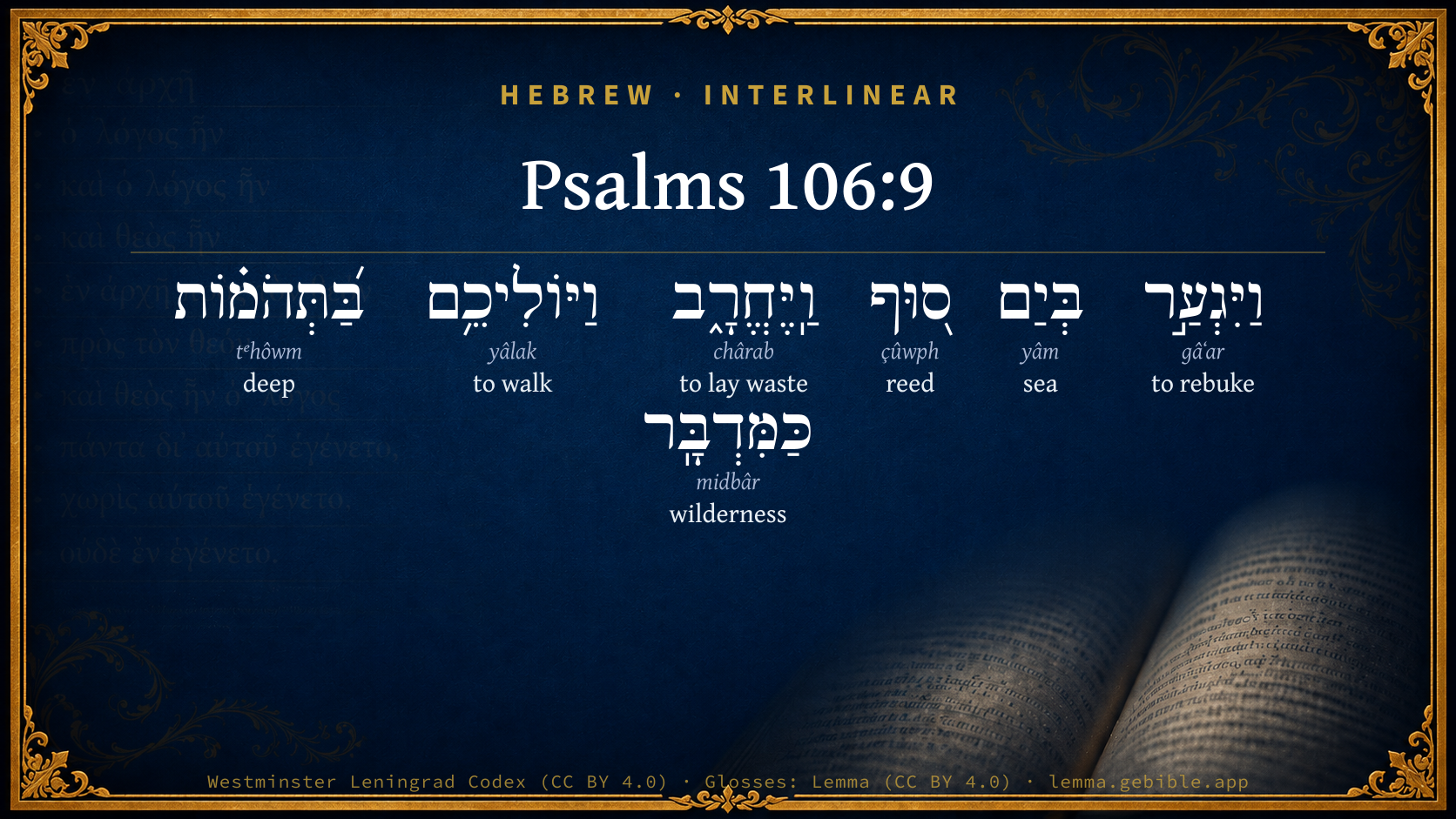
Hebrew (Westminster Leningrad Codex) Psalms 106:9 appears in the Hebrew Old Testament. The text above is from the Westminster Leningrad Codex. Each word links to its Strong’s number, a concise gloss, and parsing drawn from the Open Scriptures Hebrew Bible morphology. Click any word for its full Brown-Driver-Briggs (BDB) entry.
Download image
Cite this verse

Psalms 106:9 (World English Bible). Public Domain. Lemma interlinear Bible study tool, https://lemma.gebible.app/v/psalms/106/9.

Show BibTeX & RIS
BibTeX
RIS
English Translation
He rebuked the Red Sea also, and it was dried up; So he led them through the depths, as through a desert.
World English Bible · Public Domain
Download a study sheet

One document with this verse’s original text, its word-by-word gloss line, the meaning frame, cross-references with their text, attributed commentary, and full source and license credits — printable, and it pastes into notes with its structure intact.

This verse Autodidact and up

Study sheet (.html) Plain text (.txt)

A passage Seminary Student

Up to 50 verses in one chapter. A passage sheet keeps up to 6 commentary sources and 12 cross-references per verse, in the order this page ranks them, and says so on the sheet whenever that leaves anything out. Ask for a single verse and you get the Autodidact verse sheet above.

Everything on this page stays free to read, with no account — the sheet is a download of what is already on screen, not access to it.

Want to remove ads? Support Godless Engineer
Compare translations 3

The same verse in 3 English versions, stacked beneath the original-language interlinear above. Click any original word for its lexicon entry.

Each is an independent rendering of the whole verse — the interlinear is not word-aligned to these translations.

Highlighted words mark where these versions differ — a whole-verse word diff, not a word-by-word alignment.

  • World English Bible Public Domain
    He rebuked the Red Sea also, and it was dried up; So he led them through the depths, as through a desert.
  • King James Version Public Domain
    He rebuked the Red sea also, and it was dried up: so he led them through the depths, as through the wilderness.
  • unfoldingWord Literal Text CC BY-SA 4.0
    He rebuked the Sea of Reeds, and it dried up. Then he led them through the depths, as a desert.

unfoldingWord Literal Text — © unfoldingWord, licensed CC BY-SA 4.0. Word-aligned USFM3 via Door43 (git.door43.org/unfoldingWord/en_ult).

Versions to compare (up to 4)

3 of 4 selected

Show all 18 translations

Every available English version of this verse, each an independent rendering of the whole verse.

  • World English Bible Public Domain
    He rebuked the Red Sea also, and it was dried up; So he led them through the depths, as through a desert.
  • Berean Standard Bible Public Domain
    He rebuked the Red Sea, and it dried up; He led them through the depths as through a desert.
  • Majority Standard Bible Public Domain
    He rebuked the Red Sea, and it dried up; He led them through the depths as through a desert.
  • King James Version Public Domain
    He rebuked the Red sea also, and it was dried up: so he led them through the depths, as through the wilderness.
  • American Standard Version (1901) Public Domain
    He rebuked the Red Sea also, and it was dried up: So he led them through the depths, as through a wilderness.
  • Revised Version (1885) Public Domain
    He rebuked the Red Sea also, and it was dried up: so he led them through the depths, as through a wilderness.
  • Geneva Bible (1599) Public Domain
    And he rebuked the red Sea, and it was dryed vp, and he led them in the deepe, as in the wildernesse.
  • Douay-Rheims (1899) Public Domain
    And he rebuked the Red Sea, and it was dried up: and he led them through the depths, as in a wilderness.
  • Young's Literal Translation Public Domain
    And rebuketh the sea of Suph, and it is dried up, And causeth them to go Through depths as a wilderness.
  • Literal Standard Version CC BY-SA 4.0
    And rebukes the Sea of Suph, and it is dried up, || And causes them to go || Through depths as a wilderness.
  • Unlocked Literal Bible CC BY-SA 4.0
    He rebuked the Sea of Reeds, and it dried up. Then he led them through the depths, as through a wilderness.
  • unfoldingWord Literal Text CC BY-SA 4.0
    He rebuked the Sea of Reeds, and it dried up. Then he led them through the depths, as a desert.
  • Darby Bible Public Domain
    And he rebuked the Red Sea, and it dried up; and he led them through the deeps as through a wilderness.
  • World Messianic Bible Public Domain
    He rebuked the Sea of Suf also, and it was dried up; so he led them through the depths, as through a desert.
  • Webster's Bible Public Domain
    He rebuked the Red sea also, and it was dried up: so he led them through the depths, as through the wilderness.
  • Free Bible Version CC BY-SA 4.0
    He gave his order to the Red Sea, and it dried up. He led his people across the seabed as if it were a desert.
  • Bible in Basic English Public Domain
    By his word the Red Sea was made dry: and he took them through the deep waters as through the waste land.
  • JPS Tanakh (1917) Public Domain
    And He rebuked the Red Sea, and it was dried up; and He led them through the depths, as through a wilderness.

Literal Standard Version (2020), Covenant Press — licensed CC BY-SA 4.0. Text via the HelloAO Bible API (eBible.org). Unlocked Literal Bible (unfoldingWord) — licensed CC BY-SA 4.0. Text via the HelloAO Bible API (eBible.org). unfoldingWord Literal Text — © unfoldingWord, licensed CC BY-SA 4.0. Word-aligned USFM3 via Door43 (git.door43.org/unfoldingWord/en_ult). Free Bible Version, Dr. Jonathan Gallagher — licensed CC BY-SA 4.0. Text via the HelloAO Bible API (eBible.org).

Word by word

More ways to search: Search by grammar → Find every occurrence → Compare this word →

Practice this passage: Drill this verse → Learn its vocabulary →

וַיִּגְעַ֣ר
gâʻar
H1605
“and · to rebuke”
Conjunction + Verb, Qal, Sequential Imperfect, 3rd Person, Masculine, Singular
Part of Speech
Conjunction + Verb
Stem
Qal
Form
Sequential Imperfect
Person
3rd Person
Gender
Masculine
Number
Singular
Full BDB Definition

Origin: a primitive root

TWOT: 370

(Qal) to rebuke, reprove, corrupt
  1. בְּיַם yâm H3220 “in/at · sea of” Preposition + Noun, Common, Masculine, Singular, Construct
  2. ס֭וּף çûwph H5488 “reed” Noun, Common, Masculine, Singular, Absolute
  3. וַֽיֶּחֱרָ֑ב chârab H2717 “and · to lay waste” Conjunction + Verb, Qal, Sequential Imperfect, 3rd Person, Masculine, Singular
  4. וַיּוֹלִיכֵ֥ם yâlak H3212 “and · to walk · them” Conjunction + Verb, Hiphil, Sequential Imperfect, 3rd Person, Masculine, Singular + Suffix, Personal, 3rd Person, Masculine, Plural
  5. בַּ֝תְּהֹמ֗וֹת tᵉhôwm H8415 “in/at the · depths” Preposition, Determined + Noun, Common, Both, Plural, Absolute
  6. כַּמִּדְבָּֽר midbâr H4057 “like/as the · wilderness” Preposition, Determined + Noun, Common, Masculine, Singular, Absolute

About this verse

These counts appear in no published source. They are computed here, from the morphology-tagged text and Lemma’s own curated glosses. What Lemma adds →

7
words
7
distinct lemmas
Wisdom
section

Notable vocabulary

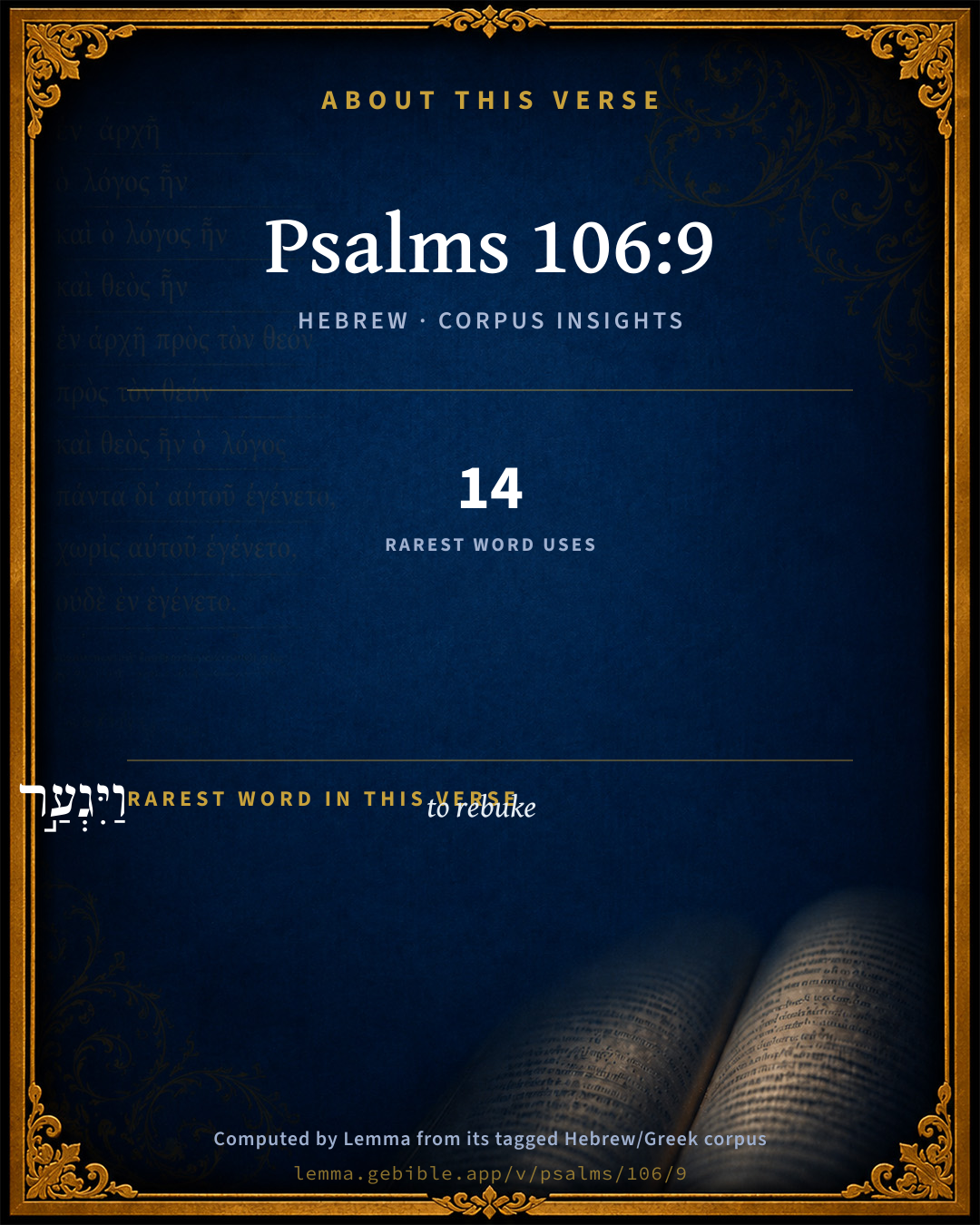
The rarest word here is וַיִּגְעַ֣ר to rebuke H1605 — appearing just 14 times in the whole Hebrew Bible.

Shared distinctive vocabulary

וַיִּגְעַ֣ר to rebuke H1605 occurs in 13 verses of the Hebrew Bible. Also found in:

Grammatical profile

  • 3 verbs
  • 4 nouns

Verb forms

  • וַיִּגְעַ֣ר Qal · Sequential Imperfect
  • וַֽיֶּחֱרָ֑ב Qal · Sequential Imperfect
  • וַיּוֹלִיכֵ֥ם Hiphil · Sequential Imperfect

Hebrew & Septuagint length

In English translation the verse runs 22 words from the Hebrew and 22 from the Septuagint (LXX English) — the same length.

A rough comparison of the two English renderings, which tokenize alike — not a word-level alignment.

Word counts can differ between the Hebrew and the Greek without any difference in meaning — e.g. the Hebrew direct-object marker אֵת has no separate Greek word, and Greek often adds the article ὁ.

Cross-references

16

Topical passages linked to Psalms 106:9 in the Treasury of Scripture Knowledge — connected by theme and wording, ordered by reader-vote popularity; previews shown in the World English Bible.

  • Psalms 18:15 Then the channels of waters appeared, The foundations of the world were laid bare at your rebuke, Yahweh, At the blast of the breath of your nostrils.
  • Psalms 78:13 He split the sea, and caused them to pass through; He made the waters stand as a heap.
  • Isaiah 51:10 Isn't it you who dried up the sea, the waters of the great deep; who made the depths of the sea a way for the redeemed to pass over?
  • Isaiah 63:11–14 Then he remembered the days of old, Moses [and] his people, [saying], Where is he who brought them up out of the sea with the shepherds of his flock? where is he who put his holy Spirit in the midst of them?
  • Nahum 1:4 He rebukes the sea, and makes it dry, and dries up all the rivers. Bashan languishes, and Carmel; and the flower of Lebanon languishes.
  • Exodus 14:21–22 Moses stretched out his hand over the sea, and Yahweh caused the sea to go back by a strong east wind all the night, and made the sea dry land, and the waters were divided.
  • Exodus 14:27–29 Moses stretched out his hand over the sea, and the sea returned to its strength when the morning appeared; and the Egyptians fled against it. Yahweh overthrew the Egyptians in the midst of the sea.
  • Nehemiah 9:11 You divided the sea before them, so that they went through the midst of the sea on the dry land; and their pursuers you did cast into the depths, as a stone into the mighty waters.
  • Psalms 66:6 He turned the sea into dry land. They went through the river on foot. There, we rejoiced in him.
  • Psalms 77:19–20 Your way was through the sea; Your paths through the great waters. Your footsteps were not known.
  • Psalms 136:13–16 To him who divided the Red Sea apart; For his loving kindness endures forever;
  • Psalms 78:52–53 But he led forth his own people like sheep, And guided them in the wilderness like a flock.
  • Psalms 114:3–7 The sea saw it, and fled. The Jordan was driven back.
  • Isaiah 50:2 Why, when I came, was there no man? when I called, was there none to answer? Is my hand shortened at all, that it can't redeem? or have I no power to deliver? Behold, at my rebuke I dry up the sea, I make the rivers a wilderness: their fish stink, because there is no water, and die for thirst.
  • Isaiah 11:14–16 They shall fly down on the shoulder of the Philistines on the west; together shall they despoil the children of the east: they shall put forth their hand on Edom and Moab; and the children of Ammon shall obey them.
  • Matthew 8:26 He said to them, "Why are you fearful, oh you of little faith?" Then he got up, rebuked the wind and the sea, and there was a great calm.

Cross-references courtesy of OpenBible.info (CC BY 4.0).

Hebrew and Greek witnesses Masoretic Hebrew ↔ Greek Septuagint

The same verse in the two great witnesses to the Old Testament, shown verse-for-verse.

You’re reading Greek Psalm 105 (Hebrew Psalm 106). The Septuagint counts the superscription, so verse numbers can differ from the Hebrew — chapter-level alignment, not verse-by-verse. Numbering follows Rahlfs.

These are two independent witnesses, not word-aligned to each other, and the Septuagint is shown in lemma (dictionary) form.

Hebrew Psalms 106:9 Masoretic · Westminster Leningrad Codex

וַיִּגְעַ֣ר בְּיַם ס֭וּף וַֽיֶּחֱרָ֑ב וַיּוֹלִיכֵ֥ם בַּ֝תְּהֹמ֗וֹת כַּמִּדְבָּֽר

He rebuked the Red Sea also, and it was dried up; So he led them through the depths, as through a desert.

World English Bible · Public Domain

Greek LXX Greek Psalm 105:9 Septuagint · lemma form

καί ἐπιτιμάω ὁ ἐρυθρός θάλασσα καί ξηραίνω καί ὁδηγέω αὐτός ἐν ἄβυσσος ὡς ἐν ἔρημος

And he rebuked the Red Sea, and it was dried up: so he led them through the deep as through the wilderness.

LXX2012 (modern English Septuagint) · Public Domain

Hebrew: Westminster Leningrad Codex (CC BY 4.0). Greek: Septuagint (public domain); English from LXX2012 (modern English Septuagint) (Public Domain). How the Septuagint differs from the Hebrew →

Commentary

Notes on Psalms 106:9 from classic Christian and Jewish commentators (each source and its license shown beneath its notes). The classic Christian expositions comment on the surrounding passage and are grouped to its opening verse, so a note may address several verses; the Jewish commentaries on the Tanakh (Rashi and others) are per-verse, so they appear only where the commentator wrote on this verse.

Lemma curates 59 commentaries, every one of them public domain or Creative Commons licensed, each selected and text-cleaned for this edition rather than reprinted as found. About our sources →

Trapp's Complete Commentary

John Trapp

Psa 106:9 He rebuked the Red sea also, and it was dried up: so he led them through the depths, as through the wilderness.

Ver. 9. He rebuked the Red Sea also] Ingentia beneficia, flagitia, supplicia, as appeareth in the subsequent verses.

So he led them through the depths] Inter duas aquarum congeries, between two mountains of waters, which stood on each hand of them as a wall, and made a lane. Every main affliction is our Red Sea; which while it threateneth to swallow us up, preserveth us.

John Trapp, A Commentary or Exposition upon All the Books of the Old and New Testament (1647–1656) — public domain. Text from a community e-Sword module.

The Biblical Illustrator

Joseph S. Exell

Psa_106:9

He rebuked the:Red Sea also.

Israel at the Red Sea

No doubt the children of Israel supposed that now all was over; the Egyptians had sent them away, entreating them to depart, and loading them with riches. They said within themselves, We shall now march to Canaan at once; there will be no more dangers, no more trials. Not quite so speedily, says God; the time is not arrived yet for you to rest. It is true I have delivered you from Egypt; but there is much you have to learn before you will be prepared to dwell in Canaan. Therefore I shall lead you about, and instruct you, and teach you.

I. The children of Israel just now had three difficulties--three exceeding great dangers. And so I believe that every heir of heaven, within a very short period after the time of his deliverance, will meet with the same.

1. The first they had was a great trial sent by God Himself. There was the Red Sea in the front of them. Now, it was not an enemy that put the sea there; it was God Himself. We may therefore think, that the Red Sea represents some great and trying providence, which the Lord will be sure to place in the path of every new-born child; in order to try his faith, and to test the sincerity of his trust in God.

2. Then the children of Israel had a second difficulty. They would not have cared about the Red Sea a single atom, if they had not been terrified by the Egyptians who were behind them. These are the representatives of those sins of ours which we thought were clean dead and gone. The pangs after we come out of Egypt are at times even more painful than those we feel in the house of bondage; and there is usually a time of trial a little while after the new birth, which is even more terrible and awful than the previous agony of the soul, though not usually so protracted.

3. But there was a third difficulty, which perhaps wrought them more misery than either of the other two; these poor children of Israel had such faint hearts. They no sooner saw the Egyptians than they began to cry out; and when they beheld the Red Sea before them, they murmured against their Deliverer. A faint heart is the worst foe a Christian can have; whilst he keeps his faith firm, whilst the anchor is fixed deep in the rock, he never need fear the storm; but when the hand of faith is palsied, or the eye of faith is dim, it will go hard with us.

II. But, thanks be to God I the children of Israel had three helps. Oh! child of God, dost thou discern this mystery? Whenever thou hast three trials, thou wilt always have three promises; and if thou hadst forty afflictions, thou wouldst have forty measures of grace.

1. The first help they had was Providence. Providence put the Red Sea there, and piled the rocks on either hand, while providence represented by the fiery cloudy pillar had led them to its shore, and conducted them into the defile, and now the same pillar of providence came to their assistance. They had not come thither undirected, and therefore they should not be left unprotected, for the same cloudy pillar which led them there came behind them to protect them. Cheer up, then, heir of grace! What is thy trial? Has providence brought it upon thee? If so, unerring wisdom will deliver thee from it.

2. Again: the children of Israel had another refuge, in the fact that they knew that they were the covenant people of God, and that, though they were in difficulties, God had brought them there, and therefore God was bound in honour to bring them out of that trouble into which He had brought them. Well, says the child of God, I know I am in a strait, but this one thing I also know, that I did not come out of Egypt by myself--I know that He brought me out; I know that I did not escape by my own power, or slay my first-born sins myself--I know that He did it; and though I fled from the tyrant--I know that He made my feet mighty for travel, for there was not one feeble in all our tribes; I know that though I am at the Red Sea, I did not run there uncalled, but He bade me go there, and therefore I give to the winds my fears; for if He hath led me here into this difficulty, He will lead me out, and lead me through.

3. The third refuge which the children of Israel had was in a man; and neither of the two others, without that, would have been of any avail. It was the man Moses. He did everything for them. Thy greatest refuge, O child of God! in all thy trials, is in a man: not in Moses, but in Jesus; not in the servant, but in the master. He is interceding for thee, unseen and unheard by thee, even as Moses did for the children of Israel. Look! on yonder rock of heaven He stands, cross in hand, even as Moses with his rod. Cry to Him, for with that uplifted cross He will cleave a path for thee, and guide thee through the sea; He will make those hoary floods, which had been friends for ever, stand asunder like foes. Call to Him, and He will make thee a way in the midst of the ocean, and a path through the pathless sea.

III. God had a design in it. And here, also, we wish you to regard with attention what Gods design is, in leading the Christian into exceeding great trials in the early part of his life. They were all baptized, says the apostle, unto Moses, in the cloud and in the sea. Gods design in bringing His people into trouble, and raising all their sins at their heels, is to give them a thorough baptism into His service, consecrating them for ever to Himself. I mean by baptism this morning, not the rite, but what baptism represents. Baptism signifies dedication to God--initiation into Gods service. It is not when we are first converted that we so fully dedicate ourselves to God, as afterwards, when some great Red Sea rolls before us. (C. H. Spurgeon.)

The Biblical Illustrator, edited by Joseph S. Exell (c. 1880s–1900s) — public domain. Text from a community e-Sword module.

J. A. Alexander on Psalms

Joseph Addison Alexander

9. (Psa 106:9) And he rebuked the Red Sea and it dried up, and ihe made them go through the deeps like the desert. This is merely a specification of the general statement in the preceding verse. The divine intervention here commemorated was the more remarkable because it took place on the very spot where they first rebelled, as mentioned in Psa 106:7. Though they disobeyed him at the Red Sea, he nevertheless dried the Red Sea, i.e. as much of it as was required to furnish them a passage. Rebuked, as in Psa 104:7. Like the desert, as in the desert, i.e. in a level and extensive plain, without obstruction or unevenness. See my note on Isa 63:13, where the same comparison is used.

Joseph Addison Alexander, The Psalms Translated and Explained (1850) — public domain. Text from a community e-Sword module.

Tyndale Open Study Notes

Tyndale Open Resources

106:9 Red Sea: See Exod 14:15-31.

Tyndale Open Study Notes — © Tyndale Open Resources, licensed CC BY-SA 4.0. Text via the HelloAO Bible API.

Adam Clarke's Commentary

Verse 9. He rebuked the Red Sea] In the descriptions of the psalmist every thing has life. The sea is an animated being, behaves itself proudly, is rebuked, and retires in confusion.

Adam Clarke's Commentary on the Bible (1810–1826) — public domain. Text from a community e-Sword/MySword module.

The Cambridge Bible for Schools and Colleges

gen. ed. J. J. S. Perowne

9. He rebuked &c.] Cp. Psa_104:7; Isa_50:2; Nah_1:4.

so he led them &c.] Apparently a reminiscence of Isa_63:13 : cp. Isa_51:10.

as through a wilderness] I.e. on dry ground, Exo_14:22. But R.V. marg. may be right in rendering pasture-land, suggesting the metaphor of a flock, Psa_77:20.

The Cambridge Bible for Schools and Colleges (gen. ed. J. J. S. Perowne; Cambridge University Press, 1878–1918) — public domain. Text from a community e-Sword module.

John Gill's Exposition

He rebuked the Red sea also, and it was dried up,.... By sending a strong east wind, which drove the waters back, and made the sea a dry land, Exo 14:21.

So he led them through the depths; that is, the deep waters of the sea, which were cast up as an heap, and stood as a wall on each side, through which they passed.

As through the wilderness; or rather, "as on a plain"; for a passage through a wilderness where no roads are, and many obstructions be, is not easy; and so it is manifestly to be understood in Isa 63:13, where Jarchi and Kimchi interpret it a plain and smooth ground, a champaign country; and so the word is used for a plain, in opposition to mountains, in Jer 9:10, and then the sense is, that God led them through the sea, being dried up, as if they were led through a plain and open country, where was nothing to obstruct their march; an emblem of baptism, Co1 10:1, and of the passage of the people of God through this world; See Gill on Psa 78:13.

John Gill's Exposition of the Whole Bible (1746–1763) — public domain (CC PDM 1.0). Text via the HelloAO Bible API.

Albert Barnes' Notes on the Bible

He rebuked the Red Sea also - The word rendered “rebuke” commonly means to chide - as when one is angry with another for having done wrong. Here it is evidently a poetic term, meaning that he spake “as if” he were angry; or “as if” the Red Sea did wrong in presenting an obstacle or obstruction to the passage of his people. Compare Exo 14:21-22,

So he led them through the depths - Through what had been the abyss; what had seemed to be depths, being covered with water.

As through the wilderness - As through a desert or dry place; as he afterward led them through the wilderness. The waters parted asunder, and made a way for them.

Albert Barnes' Notes on the Bible (1834–1885) — public domain. Text from a community e-Sword/MySword module.

Matthew Poole's English Annotations

As securely as if they had walked upon the dry land.

Matthew Poole's English Annotations on the Holy Bible (1683–1685) — public domain. Text from a community e-Sword/MySword module.

The Treasury of David

Charles H. Spurgeon

Ver. 9. He rebuked the Red sea also, and it was dried up. A word did it. The sea heard his voice and obeyed. How many rebukes of God are lost upon us! Are we not more unmanageable than the ocean? God did, as it were, chide the sea, and say, "Wherefore dost thou stop the way of my people? Their path to Canaan lies through thy channel, how dare you hinder them?" The sea perceived its Master and his seed royal, and made way at once.

So he led them through the depths, as through the wilderness. As if it had been the dry floor of the desert the tribes passed over the bottom of the gulf; nor was their passage venturesome, for HE bade them go;nor dangerous, for He led them. We also have under divine protection passed through many trials and afflictions, and with the Lord as our guide we have experienced no fear and endured no perils. We have been led through the deeps as through the wilderness.

Ver. 9. He rebuked the Red sea also, and it was dried up. A poetical expression, signifying that the Red Sea retired at God's command, just as a slave would fly from his master's presence on being severely rebuked. Robert Bellarmine.

Ver. 9. He rebuked. We do not read that any voice was sent forth from heaven to rebuke the sea; but he hath called the Divine Power by which this was effected, a rebuke, unless indeed any one may choose to say, that the sea was secretly rebuked, so that the waters might hear, and yet men could not. The power by which God acts is very abstruse and mysterious, a power by which he causeth that even things devoid of sense instantly obey at his will. Augustine.

Ver. 9. Wilderness. Midbar; a broad expanse of poor dry land, suited for sheep walks (like our South Downs, or Salisbury Plain). Compare Isa 43:13. William Kay.

Ver. 9. Israel at the Red Sea. See "Spurgeon's Sermons", No. 72.

1. Israel's three difficulties.

(a) The Red Sea in front of them. This was not put there

by an enemy; but by God himself. The Red Sea

represents some great and trying providence placed in

the path of every newborn child of God, to try his

faith, and the sincerity of his trust in God.

b) The Egyptians behind them, the representatives of the sins which we thought were dead and gone. (c) The third difficulty was faint hearts within them.

2. Israel's three helps.

(a) Providence.

(b) Their knowledge that they were the covenant people of

God.

(c) The man, Moses. So the believer's hope and help is

in the God man Christ Jesus.

3. God's grand design in it. To give them a thorough baptism into his service, consecrating them for ever to himself (1Co 1-2).

Ver. 9. (second clause). Dangerous and difficult paths rendered safe and easy by God's leadership.

Psalms 106:10*

Charles H. Spurgeon's The Treasury of David (1869–1885) — public domain. Psalms only. Text from a community e-Sword/MySword module.

Whedon's Commentary on the Bible

Daniel D. Whedon

9. Rebuked the Red sea—See note on Psa_104:7.

Through the depths—Through the cavernous and rocky bed of the Red sea, as if it were an open country. Exodus 14; Isa_51:10

Daniel D. Whedon (gen. ed.), Commentary on the Old and New Testaments (1874–1909) — public domain. Text from a community e-Sword module.

The Pulpit Commentary

He rebuked the Red Sea also (comp. Psa_104:7, "At thy rebuke they i.e. the waters fled;" see also Isa_50:2 Nah_1:4) The Hebrew poets constantly represent God"s dealings with inanimate nature in terms proper to his dealings with his rational creatures, thus personifying material things. And it was dried up. (see Exo_14:21, Exo_14:22) So he led them through the depths, as through the wilderness. (comp. Isa_63:13) Midbar, the word translated "wilderness," is properly a smooth stretch of down, very level, and suited for sheep walks.

The Pulpit Commentary (1880–1919), ed. H.D.M. Spence-Jones & Joseph S. Exell — public domain. Text from a community e-Sword module.

John Wesley's Explanatory Notes

Led them - As securely as if they had walked upon the dry land.

John Wesley, Explanatory Notes Upon the Whole Bible (1754–1765) — public domain. Text via the GEBible commentary corpus.

Rashi

Rabbi Shlomo Yitzchaki (Rashi)

and He led them in the depths in the desert The Sea of Reeds was in the desert, for it is written (Exod. 14:13): “the desert has closed upon them, etc.”; (Exod. 3:18): “three days’ journey in the desert.”

Rashi on the Tanakh — English translations: “The Judaica Press complete Tanach with Rashi, translated by A. J. Rosenberg” (CC BY 4.0); “Pentateuch with Rashi's commentary by M. Rosenbaum and A.M. Silbermann, 1929-1934” (public domain); “The Metsudah Tanach series, Lakewood, N.J” (CC BY 4.0); and “The Book of Joshua, Metsudah Publications, 1997” (CC BY 4.0). Text via Sefaria.

Lesson kit

Teaching starters — assembled from the data on this page, not authored interpretation. Every prompt links to the verse data it draws on. Edit before teaching.

Psalms, in the Wisdom, opens this verse with 7 words (7 distinct Hebrew lemmas). Its most distinctive word is gâʻar (“to rebuke”). A historical commentator’s framing appears above. Read the whole chapter for the surrounding context.

Discussion questions

  1. The word gâʻar carries the sense “to rebuke.” How does it shape the verse?
  2. Genesis 37:10 shares the word «to rebuke» with this verse. How do the two illuminate each other?
  3. The translations on this page render this verse differently — a whole-verse word diff, not a word-by-word alignment. What might account for the different wordings?
  4. The verb «וַיִּגְעַ֣ר» is Qal Sequential Imperfect. How does its form color the action?
  5. Reading how Trapp's Complete Commentary and The Biblical Illustrator read this verse, where do the two commentators agree and where do they part?

Things to notice

Reading settings

Reading text

Shown beneath each verse's original-language words.

Old Testament
Old Testament edition

Read the OT as the Masoretic Hebrew (MT) or the Greek Septuagint (LXX).

English shown for the Greek Septuagint (in the Hebrew ↔ Greek comparison).

Comparing translations? Open the Compare panel on any verse page to stack up to four side by side.