
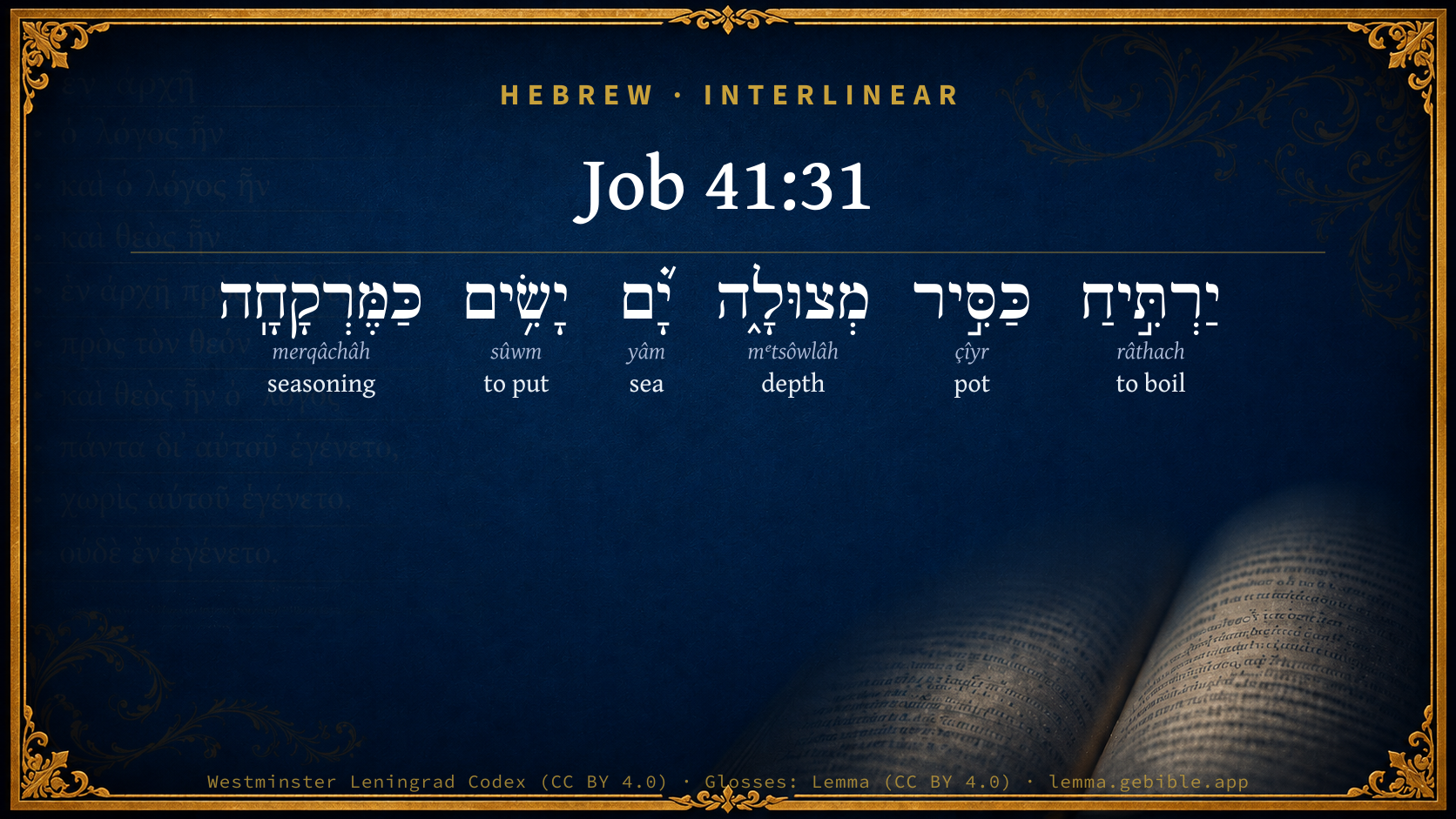
Job 41:31

Hebrew (Westminster Leningrad Codex) Job 41:31 appears in the Hebrew Old Testament. The text above is from the Westminster Leningrad Codex. Each word links to its Strong’s number, a concise gloss, and parsing drawn from the Open Scriptures Hebrew Bible morphology. Click any word for its full Brown-Driver-Briggs (BDB) entry.
Download image
Cite this verse

Job 41:31 (World English Bible). Public Domain. Lemma interlinear Bible study tool, https://lemma.gebible.app/v/job/41/31.

Show BibTeX & RIS
BibTeX
RIS
English Translation
He makes the deep to boil like a pot. He makes the sea like a pot of ointment.
World English Bible · Public Domain
Highlights
  • 1 first appearance in the Hebrew Bible
Full analysis ↓
Download a study sheet

One document with this verse’s original text, its word-by-word gloss line, the meaning frame, cross-references with their text, attributed commentary, and full source and license credits — printable, and it pastes into notes with its structure intact.

This verse Autodidact and up

Study sheet (.html) Plain text (.txt)

A passage Seminary Student

Up to 50 verses in one chapter. A passage sheet keeps up to 6 commentary sources and 12 cross-references per verse, in the order this page ranks them, and says so on the sheet whenever that leaves anything out. Ask for a single verse and you get the Autodidact verse sheet above.

Everything on this page stays free to read, with no account — the sheet is a download of what is already on screen, not access to it.

Want to remove ads? Support Godless Engineer
Compare translations 3

The same verse in 3 English versions, stacked beneath the original-language interlinear above. Click any original word for its lexicon entry.

Each is an independent rendering of the whole verse — the interlinear is not word-aligned to these translations.

Highlighted words mark where these versions differ — a whole-verse word diff, not a word-by-word alignment.

  • World English Bible Public Domain
    He makes the deep to boil like a pot. He makes the sea like a pot of ointment.
  • King James Version Public Domain
    He maketh the deep to boil like a pot: he maketh the sea like a pot of ointment.
  • unfoldingWord Literal Text CC BY-SA 4.0
    It makes the deep boil like a pot; it makes the sea like an ointment pot.

unfoldingWord Literal Text — © unfoldingWord, licensed CC BY-SA 4.0. Word-aligned USFM3 via Door43 (git.door43.org/unfoldingWord/en_ult).

Versions to compare (up to 4)

3 of 4 selected

Show all 14 translations

Every available English version of this verse, each an independent rendering of the whole verse.

  • World English Bible Public Domain
    He makes the deep to boil like a pot. He makes the sea like a pot of ointment.
  • Berean Standard Bible Public Domain
    He makes the depths seethe like a cauldron; he makes the sea like a jar of ointment.
  • Majority Standard Bible Public Domain
    He makes the depths seethe like a cauldron; he makes the sea like a jar of ointment.
  • King James Version Public Domain
    He maketh the deep to boil like a pot: he maketh the sea like a pot of ointment.
  • American Standard Version (1901) Public Domain
    He maketh the deep to boil like a pot: He maketh the sea like a pot of ointment.
  • Revised Version (1885) Public Domain
    He maketh the deep to boil like a pot: he maketh the sea like ointment.
  • Young's Literal Translation Public Domain
    He causeth to boil as a pot the deep, The sea he maketh as a pot of ointment.
  • Literal Standard Version CC BY-SA 4.0
    He causes the deep to boil as a pot, || He makes the sea as a pot of ointment.
  • Unlocked Literal Bible CC BY-SA 4.0
    He makes the deep to foam up like a pot of boiling water; he makes the sea like a pot of ointment.
  • unfoldingWord Literal Text CC BY-SA 4.0
    It makes the deep boil like a pot; it makes the sea like an ointment pot.
  • Darby Bible Public Domain
    He maketh the deep to boil like a pot; he maketh the sea like a pot of ointment;
  • World Messianic Bible Public Domain
    He makes the deep to boil like a pot. He makes the sea like a pot of ointment.
  • Free Bible Version CC BY-SA 4.0
    It churns up the sea like water in a boiling pot, like a steaming bowl when ointment is mixed.
  • JPS Tanakh (1917) Public Domain
    (41-23) He maketh the deep to boil like a pot; he maketh the sea like a seething mixture.

Literal Standard Version (2020), Covenant Press — licensed CC BY-SA 4.0. Text via the HelloAO Bible API (eBible.org). Unlocked Literal Bible (unfoldingWord) — licensed CC BY-SA 4.0. Text via the HelloAO Bible API (eBible.org). unfoldingWord Literal Text — © unfoldingWord, licensed CC BY-SA 4.0. Word-aligned USFM3 via Door43 (git.door43.org/unfoldingWord/en_ult). Free Bible Version, Dr. Jonathan Gallagher — licensed CC BY-SA 4.0. Text via the HelloAO Bible API (eBible.org).

Word by word

More ways to search: Search by grammar → Find every occurrence → Compare this word →

Practice this passage: Drill this verse → Learn its vocabulary →

About this verse

These counts appear in no published source. They are computed here, from the morphology-tagged text and Lemma’s own curated glosses. What Lemma adds →

6
words
6
distinct lemmas
Wisdom
section

Notable vocabulary

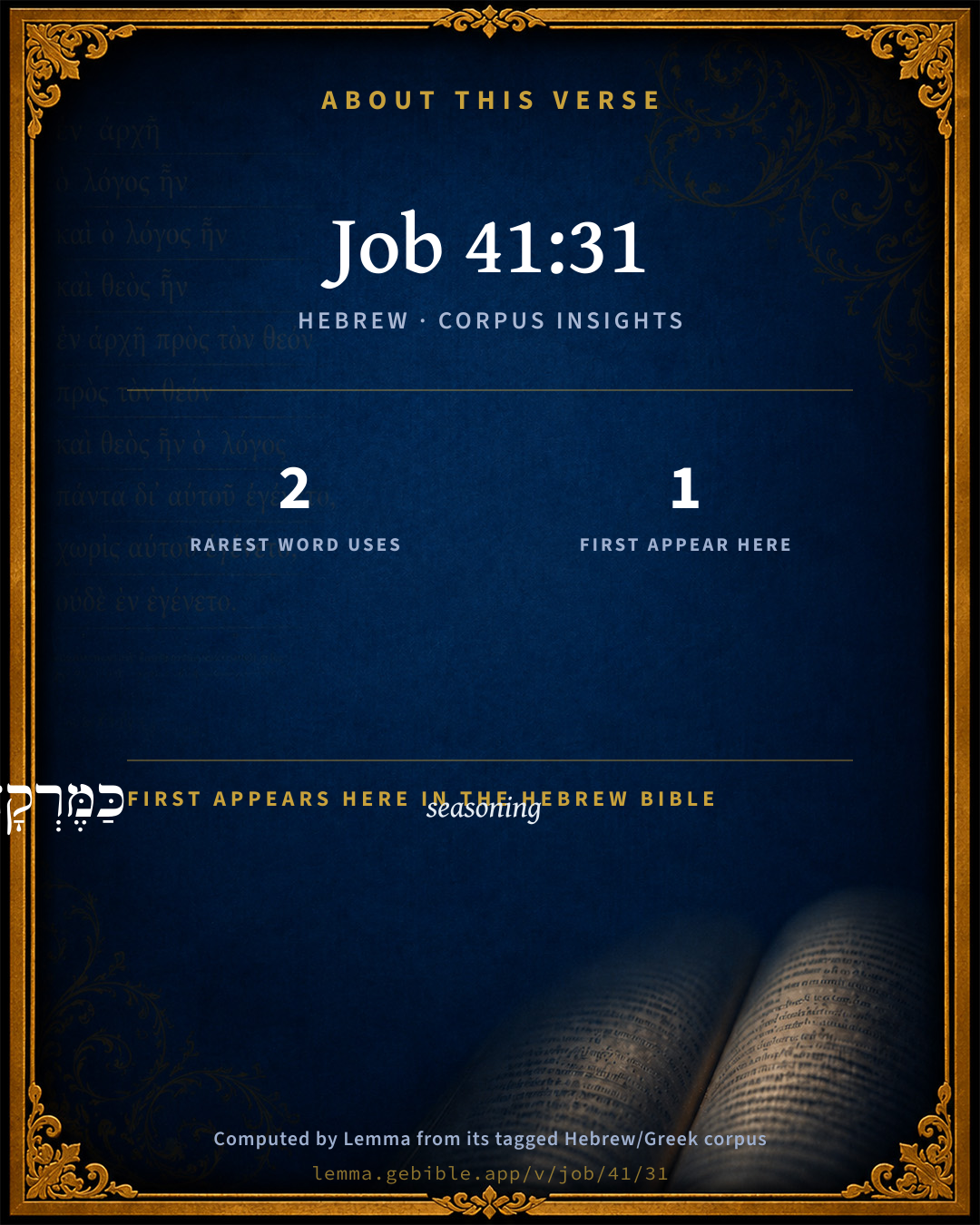
The rarest word here is כַּמֶּרְקָחָֽה seasoning H4841 — appearing just 2 times in the whole Hebrew Bible.

First appearance in Scripture

This word makes its first canonical appearance in the Hebrew Bible here:

  • כַּמֶּרְקָחָֽה seasoning H4841

Shared distinctive vocabulary

כַּמֶּרְקָחָֽה seasoning H4841 occurs in 2 verses of the Hebrew Bible. Also found in:

Grammatical profile

  • 2 verbs
  • 4 nouns

Verb forms

  • יַרְתִּ֣יחַ Hiphil · Imperfect
  • יָשִׂ֥ים Qal · Imperfect
Hebrew and Greek witnesses Masoretic Hebrew ↔ Greek Septuagint

The same verse in the two great witnesses to the Old Testament, shown verse-for-verse.

These are two independent witnesses, not word-aligned to each other, and the Septuagint is shown in lemma (dictionary) form.

Hebrew Job 41:31 Masoretic · Westminster Leningrad Codex

יַרְתִּ֣יחַ כַּסִּ֣יר מְצוּלָ֑ה יָ֝֗ם יָשִׂ֥ים כַּמֶּרְקָחָֽה

He makes the deep to boil like a pot. He makes the sea like a pot of ointment.

World English Bible · Public Domain

Hebrew: Westminster Leningrad Codex (CC BY 4.0). Greek: Septuagint (public domain); English from a public-domain English Septuagint. How the Septuagint differs from the Hebrew →

Commentary

Notes on Job 41:31 from classic Christian and Jewish commentators (each source and its license shown beneath its notes). The classic Christian expositions comment on the surrounding passage and are grouped to its opening verse, so a note may address several verses; the Jewish commentaries on the Tanakh (Rashi and others) are per-verse, so they appear only where the commentator wrote on this verse.

Lemma curates 59 commentaries, every one of them public domain or Creative Commons licensed, each selected and text-cleaned for this edition rather than reprinted as found. About our sources →

Trapp's Complete Commentary

John Trapp

Job 41:31 He maketh the deep to boil like a pot: he maketh the sea like a pot of ointment.

Ver. 31. He maketh the deep to boil like a pot] He troubleth the whole ocean, he maketh a mighty commotion in the sea, when he rolls himself therein upward and downward, and casts up water on high through a certain conveyance that he hath in his head (Plin. lib. ix. c. 3, 6).

He maketh the sea like a pot of ointment] Turning it into a team, like the scum of a boiling pot. Beza rendereth it thus, He maketh the sea like a mortar, wherein colours are beaten; that is, the whirling of the water is like unto a quern, that is turned round of the painter, to temper his colours.

John Trapp, A Commentary or Exposition upon All the Books of the Old and New Testament (1647–1656) — public domain. Text from a community e-Sword module.

Joseph Benson's Commentary

Job 41:31-32. He maketh the deep — The deep waters; to boil like a pot — To swell, and foam, and froth, by his strong and vehement motion, as any liquor does when it is boiled in a pot, especially boiling ointment. The sea — Either the great sea, the proper place of the whale, Psa 104:25, or the great river Nile, which is called a sea, both in Scripture, as Isa 11:15, and in other authors, as Euphrates is called the sea of Babylon, Isa 21:1; Jer 51:36. Lakes also are most frequently called seas, both in the Old and New Testament; and in such lakes the crocodiles are, as well as in the Nile. He maketh a path to shine after him — Houbigant renders the text, He leaves behind him a shining path; that is, the way in which he moves appears shining and conspicuous, as when a ship sails, and leaves a visible path behind it, which in the night appears to shine. One would think the deep to be hoary — It is so covered with froth and foam that it looks as if it were grown old, and become hoary.

Joseph Benson's Commentary on the Old and New Testaments (1811–1818) — public domain. Text from a community e-Sword module.

Jamieson, Fausset & Brown

Robert Jamieson, A. R. Fausset & David Brown

Whenever he moves.

sea--the Nile (Isa 19:5; Nah 3:8).

pot of ointment--the vessel in which it is mixed. Appropriate to the crocodile, which emits a musky smell.

Jamieson, Fausset & Brown — Commentary Critical and Explanatory on the Whole Bible (1871) — public domain (CC PDM 1.0). Text via the HelloAO Bible API.

Adam Clarke's Commentary

Verse 31. He maketh the deep to boil like a pot] This is occasioned by strongly agitating the waters at or near the bottom; and the froth which arises to the top from this agitation may have the appearance of ointment. But several travellers say that the crocodile has a very strong scent of musk, and that he even imparts this smell to the water through which he passes, and therefore the text may be taken literally. This property of the crocodile has been noticed by several writers.

Adam Clarke's Commentary on the Bible (1810–1826) — public domain. Text from a community e-Sword/MySword module.

Ellicott's Commentary for English Readers

(31) The sea—i.e., not necessarily the salt water, for the Nile is still called the sea by the Arabs, and so with many other large rivers. Example, the “sea-wall” of the Thames below Gravesend.

A Bible Commentary for English Readers, edited by Charles John Ellicott (1878–1897) — public domain. Text from a community e-Sword module.

The Cambridge Bible for Schools and Colleges

gen. ed. J. J. S. Perowne

31. The commotion he raises in the deep.

The second clause of the verse hardly refers to fermentation in the pot of ointment, but rather to the foaming mixture of ingredients.

The Cambridge Bible for Schools and Colleges (gen. ed. J. J. S. Perowne; Cambridge University Press, 1878–1918) — public domain. Text from a community e-Sword module.

John Gill's Exposition

He maketh a path to shine after him,.... Upon the sea, by raising a white from upon it, through its vehement motion as it passes along, or by the spermaceti it casts out and leaves behind it. It is said (s) that whales will cut and plough the sea in such a manner, as to leave a shining glittering path behind them, the length of a German mile, which is three of ours;

one would think the deep to be hoary; to be old and grey headed, or white like the hair of the head of an old man, a figure often used of the sea by poets (t); and hence "Nereus" (u), which is the sea, is said to be an old man, because the froth in the waves of it looks like white hair.

(s) Vid. Scheuchzer. ibid. (vol. 4.) p. 853. (t) , Homer. Iliad. 1. v. 350. , Iliad. 4. v. 248. "incanuit unda", Catullus. (u) Phurnutus de Natura Deorum, p. 63.

John Gill's Exposition of the Whole Bible (1746–1763) — public domain (CC PDM 1.0). Text via the HelloAO Bible API.

Albert Barnes' Notes on the Bible

He maketh the deep to boil like a pot - In his rapid motion through it. The word “deep” (מצולה metsôlâh) may refer to any deep place - either of the sea, of a river, or of mire, Psa 69:2. It is applied to the depths of the sea, Jon 2:3; Mic 7:19; but there is nothing in the word that will prevent its application to a large river like the Nile - the usual abode of the crocodile.

He maketh the sea - The word “sea” (ים yâm) is often applied to a large river, like the Nile or the Euphrates; see the notes at Isa 19:5.

Like a pot of ointment - When it is mixed, or stirred together. Bochart supposes that there is an allusion here to the smell of musk, which it is said the crocodile has, and by which the waters through which he passes seem to be perfumed. But the allusion seems rather to be merely to the fact that the deep is agitated by him when he passes through it, as if it were stirred from the bottom like a pot of ointment.

Albert Barnes' Notes on the Bible (1834–1885) — public domain. Text from a community e-Sword/MySword module.

Matthew Poole's English Annotations

The deep; the deep waters, or the sea, which is called the deep, Psa 107:24; Jon 2:3, as it is explained in the next clause.

To boil like a pot; to swell, and foam, and froth by his strong and vehement motion, as any liquor doth when it is boiled in a pot.

The sea; either the great sea, the proper place of the whale, Psa 104:25; or the great river Nilus, which is called a sea, both in Scripture, as Isa 11:15, and in other authors, (of which see my Latin Synopsis,) as Euphrates is called the sea of Babylon, Isa 21:1; Jer 51:36; or lakes or pools, which are most frequently called seas, both in the Old and New Testament, as every one knows. And in such lakes the crocodiles are no less than in Nilus, as it is attested by Herodotus, and Strabo, and others.

Like a pot of ointment: this clause seems to be added very emphatically, to intimate that this leviathan causeth not only a vehement commotion, but also a great fragrancy in the sea or waters where it is; which, though it was not observed by the ancients, yet is unanimously affirmed by later authors upon their own knowledge and experience, that it casts a perfume like musk; of which see the names and words of the authors in my Latin Synopsis.

Matthew Poole's English Annotations on the Holy Bible (1683–1685) — public domain. Text from a community e-Sword/MySword module.

Whedon's Commentary on the Bible

Daniel D. Whedon

31. The sea — The Arabs still call the Nile bahr, a sea.

Pot of ointment — This figure rests, as some suppose, upon the strong, musk-like odour emitted by the crocodile. “There is a follicle, of the bigness of a hazel nut, under the shoulders of the old crocodiles; this contains a thick matter which smells like musk. The Egyptians are very anxious to get this when they kill a crocodile, it being a perfume much esteemed by the grandees.” — HASSELQUIST, Travels, page 215. The preparation of perfumes, in ancient times, evidently involved the process of boiling. Wilkinson’s statement, that ointment (found in an alabaster vase) two or three thousand years old still retained its odour, seems to indicate a lost art. (Ancient Egyptians, i, p. 34.) A scene which Dr. Livingstone describes gives a curious insight into the habits of the crocodile, and forcibly illustrates this and the following verse: “The corpse of a boy floated past the ship; a monstrous crocodile rushed at it with the speed of a greyhound, caught it, and shook it as a terrier dog does a rat. Others dashed at the prey, each with his powerful tail causing the water to churn and froth as he ferociously tore off a piece. In a few seconds it was all gone.” — Zambesi, p. 477.

Daniel D. Whedon (gen. ed.), Commentary on the Old and New Testaments (1874–1909) — public domain. Text from a community e-Sword module.

The Pulpit Commentary

He maketh the deep to boil like a pot. The rush of the crocodile through the water of the stream or pool in which he dwells causes a stir and a commotion which is forcibly compared to the boiling of water in a caldron. He maketh the sea like a pot of ointment. It is generally allowed that by "the sea" here is meant the Nile, as in Isa_18:2 Isa_19:5; and Nah_3:8. The swirl of the Nile, as the crocodile makes his rush, is like the heaving of a pot of boiling oil or ointment

The Pulpit Commentary (1880–1919), ed. H.D.M. Spence-Jones & Joseph S. Exell — public domain. Text from a community e-Sword module.

John Wesley's Explanatory Notes

Boil - To swell, and foam, and froth by his strong and vehement motion, as any liquor does when it is boiled in a pot, especially boiling ointment. The sea - The great river Nile, is called a sea, both in scripture, as Isaiah xi, 15, and in other authors, as Euphrates is called the sea of Babylon, Isaiah xxi, 1 Jer. li, 36. Lakes also are most frequently called seas both in the Old and New Testament: and in such lakes the crocodiles are as well as in the Nile.

John Wesley, Explanatory Notes Upon the Whole Bible (1754–1765) — public domain. Text via the GEBible commentary corpus.

unfoldingWord translationNotes

Door43 World Missions Community

He makes the deep to foam up like a pot of boiling water

"As he passes through the water, he leaves a trail of bubbles behind him, like the bubbling of boiling water in a pot"

He

The word "he" refers to Leviathan.

he makes the sea like a pot of ointment

The ointment in a pot is cloudy if someone shakes it, and the sea is muddy when Leviathan swims in it. (See: Simile)

one would think the deep had gray hair

This is because the bubbles in his wake are white.

unfoldingWord translationNotes — © Distant Shores Media and the Door43 World Missions Community, licensed CC BY-SA 4.0. Source: git.door43.org/Door43/en_tn.

Lesson kit

Teaching starters — assembled from the data on this page, not authored interpretation. Every prompt links to the verse data it draws on. Edit before teaching.

Job, in the Wisdom, opens this verse with 6 words (6 distinct Hebrew lemmas). Its most distinctive word is merqâchâh (“seasoning”). A historical commentator’s framing appears above. Read the whole chapter for the surrounding context.

Discussion questions

  1. The word merqâchâh carries the sense “seasoning.” How does it shape the verse?
  2. The word “seasoning” first appears here in Scripture. What is being introduced at this debut?
  3. Ezekiel 24:10 shares the word «seasoning» with this verse. How do the two illuminate each other?
  4. These translations render this verse differently; the difference is in the English rendering, not the original. What questions does that raise?
  5. The verb «יַרְתִּ֣יחַ» is Hiphil Imperfect. How does its form color the action?
  6. Reading how Trapp's Complete Commentary and Joseph Benson's Commentary read this verse, where do the two commentators agree and where do they part?

Things to notice

  • 1 word makes its first canonical appearance in Scripture here.
  • These translations choose different wording for 2 words in this verse.
  • 6 distinct Hebrew lemmas span 6 words in this verse.

Reading settings

Reading text

Shown beneath each verse's original-language words.

Old Testament
Old Testament edition

Read the OT as the Masoretic Hebrew (MT) or the Greek Septuagint (LXX).

English shown for the Greek Septuagint (in the Hebrew ↔ Greek comparison).

Comparing translations? Open the Compare panel on any verse page to stack up to four side by side.