
Psalms 33:7

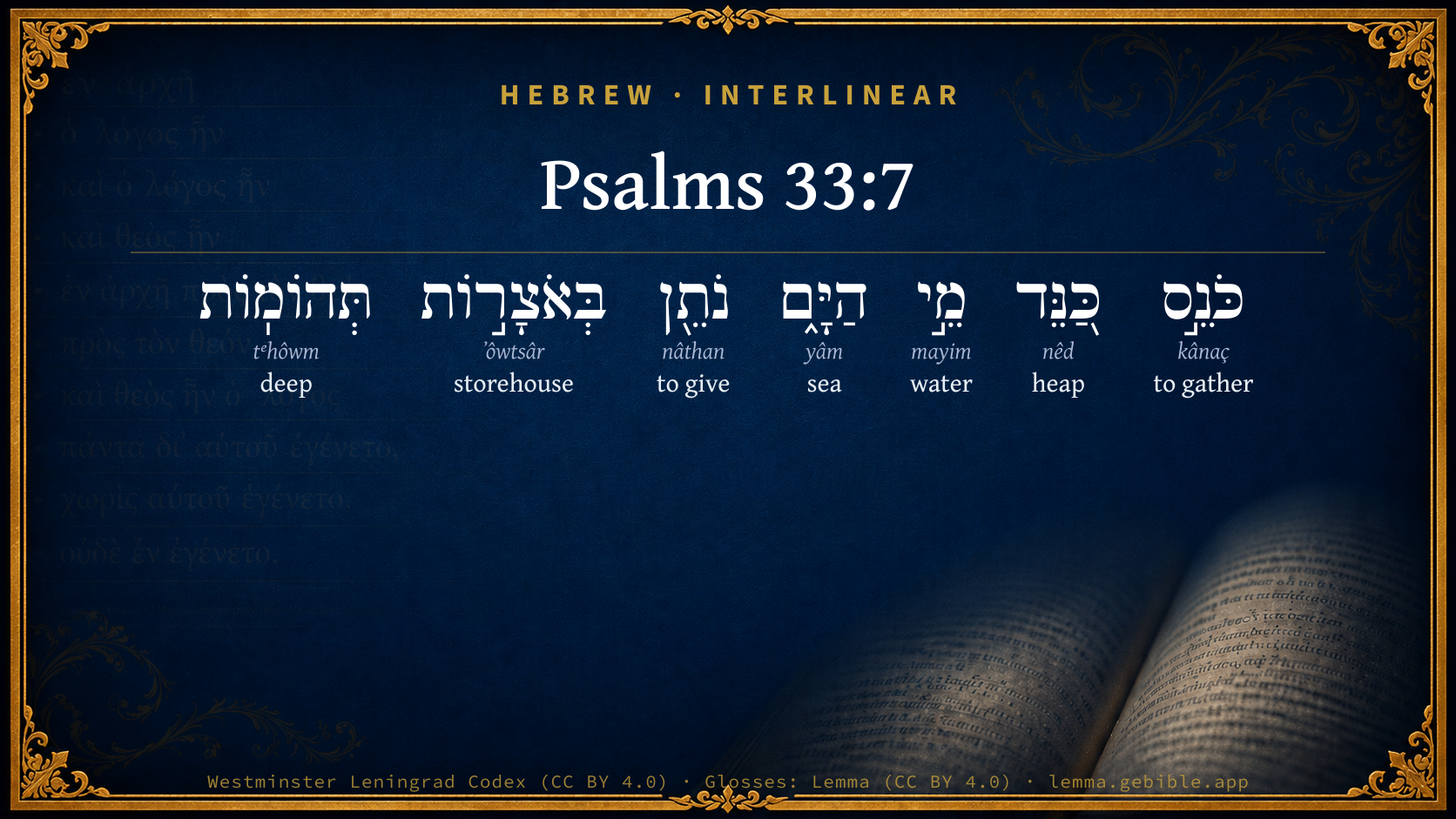
Hebrew (Westminster Leningrad Codex) Psalms 33:7 appears in the Hebrew Old Testament. The text above is from the Westminster Leningrad Codex. Each word links to its Strong’s number, a concise gloss, and parsing drawn from the Open Scriptures Hebrew Bible morphology. Click any word for its full Brown-Driver-Briggs (BDB) entry.
Download image
Cite this verse

Psalms 33:7 (World English Bible). Public Domain. Lemma interlinear Bible study tool, https://lemma.gebible.app/v/psalms/33/7.

Show BibTeX & RIS
BibTeX
RIS
English Translation
He gathers the waters of the sea together as a heap. He lays up the deeps in storehouses.
World English Bible · Public Domain
Download a study sheet

One document with this verse’s original text, its word-by-word gloss line, the meaning frame, cross-references with their text, attributed commentary, and full source and license credits — printable, and it pastes into notes with its structure intact.

This verse Autodidact and up

Study sheet (.html) Plain text (.txt)

A passage Seminary Student

Up to 50 verses in one chapter. A passage sheet keeps up to 6 commentary sources and 12 cross-references per verse, in the order this page ranks them, and says so on the sheet whenever that leaves anything out. Ask for a single verse and you get the Autodidact verse sheet above.

Everything on this page stays free to read, with no account — the sheet is a download of what is already on screen, not access to it.

Want to remove ads? Support Godless Engineer
Compare translations 3

The same verse in 3 English versions, stacked beneath the original-language interlinear above. Click any original word for its lexicon entry.

Each is an independent rendering of the whole verse — the interlinear is not word-aligned to these translations.

Highlighted words mark where these versions differ — a whole-verse word diff, not a word-by-word alignment.

  • World English Bible Public Domain
    He gathers the waters of the sea together as a heap. He lays up the deeps in storehouses.
  • King James Version Public Domain
    He gathereth the waters of the sea together as an heap: he layeth up the depth in storehouses.
  • unfoldingWord Literal Text CC BY-SA 4.0
    Gathering the waters of the sea like a heap; putting the deeps into storehouses,

unfoldingWord Literal Text — © unfoldingWord, licensed CC BY-SA 4.0. Word-aligned USFM3 via Door43 (git.door43.org/unfoldingWord/en_ult).

Versions to compare (up to 4)

3 of 4 selected

Show all 18 translations

Every available English version of this verse, each an independent rendering of the whole verse.

  • World English Bible Public Domain
    He gathers the waters of the sea together as a heap. He lays up the deeps in storehouses.
  • Berean Standard Bible Public Domain
    He piles up the waters of the sea; He puts the depths into storehouses.
  • Majority Standard Bible Public Domain
    He piles up the waters of the sea; He puts the depths into storehouses.
  • King James Version Public Domain
    He gathereth the waters of the sea together as an heap: he layeth up the depth in storehouses.
  • American Standard Version (1901) Public Domain
    He gathereth the waters of the sea together as a heap: He layeth up the deeps in store-houses.
  • Revised Version (1885) Public Domain
    He gathereth the waters of the sea together as an heap: he layeth up the deeps in storehouses.
  • Geneva Bible (1599) Public Domain
    He gathereth the waters of the sea together as vpon an heape, and layeth vp the depths in his treasures.
  • Douay-Rheims (1899) Public Domain
    Gathering together the waters of the sea, as in a vessel; laying up the depths in storehouses.
  • Young's Literal Translation Public Domain
    Gathering as a heap the waters of the sea, Putting in treasuries the depths.
  • Literal Standard Version CC BY-SA 4.0
    Gathering the waters of the sea as a heap, || Putting the depths in treasuries.
  • Unlocked Literal Bible CC BY-SA 4.0
    He gathers the waters of the sea together like a heap; he puts the oceans in storehouses.
  • unfoldingWord Literal Text CC BY-SA 4.0
    Gathering the waters of the sea like a heap; putting the deeps into storehouses,
  • Darby Bible Public Domain
    He gathereth the waters of the sea together as a heap; he layeth up the deeps in storehouses.
  • World Messianic Bible Public Domain
    He gathers the waters of the sea together as a heap. He lays up the deeps in storehouses.
  • Webster's Bible Public Domain
    He gathereth the waters of the sea together as a heap: he layeth up the depth in store-houses.
  • Free Bible Version CC BY-SA 4.0
    He gathers the waters of the sea together, he keeps the ocean depths in store.
  • Bible in Basic English Public Domain
    He makes the waters of the sea come together in a mass; he keeps the deep seas in store-houses.
  • JPS Tanakh (1917) Public Domain
    He gathereth the waters of the sea together as a heap; He layeth up the deeps in storehouses.

Literal Standard Version (2020), Covenant Press — licensed CC BY-SA 4.0. Text via the HelloAO Bible API (eBible.org). Unlocked Literal Bible (unfoldingWord) — licensed CC BY-SA 4.0. Text via the HelloAO Bible API (eBible.org). unfoldingWord Literal Text — © unfoldingWord, licensed CC BY-SA 4.0. Word-aligned USFM3 via Door43 (git.door43.org/unfoldingWord/en_ult). Free Bible Version, Dr. Jonathan Gallagher — licensed CC BY-SA 4.0. Text via the HelloAO Bible API (eBible.org).

Word by word

More ways to search: Search by grammar → Find every occurrence → Compare this word →

Practice this passage: Drill this verse → Learn its vocabulary →

About this verse

These counts appear in no published source. They are computed here, from the morphology-tagged text and Lemma’s own curated glosses. What Lemma adds →

7
words
7
distinct lemmas
Wisdom
section

Notable vocabulary

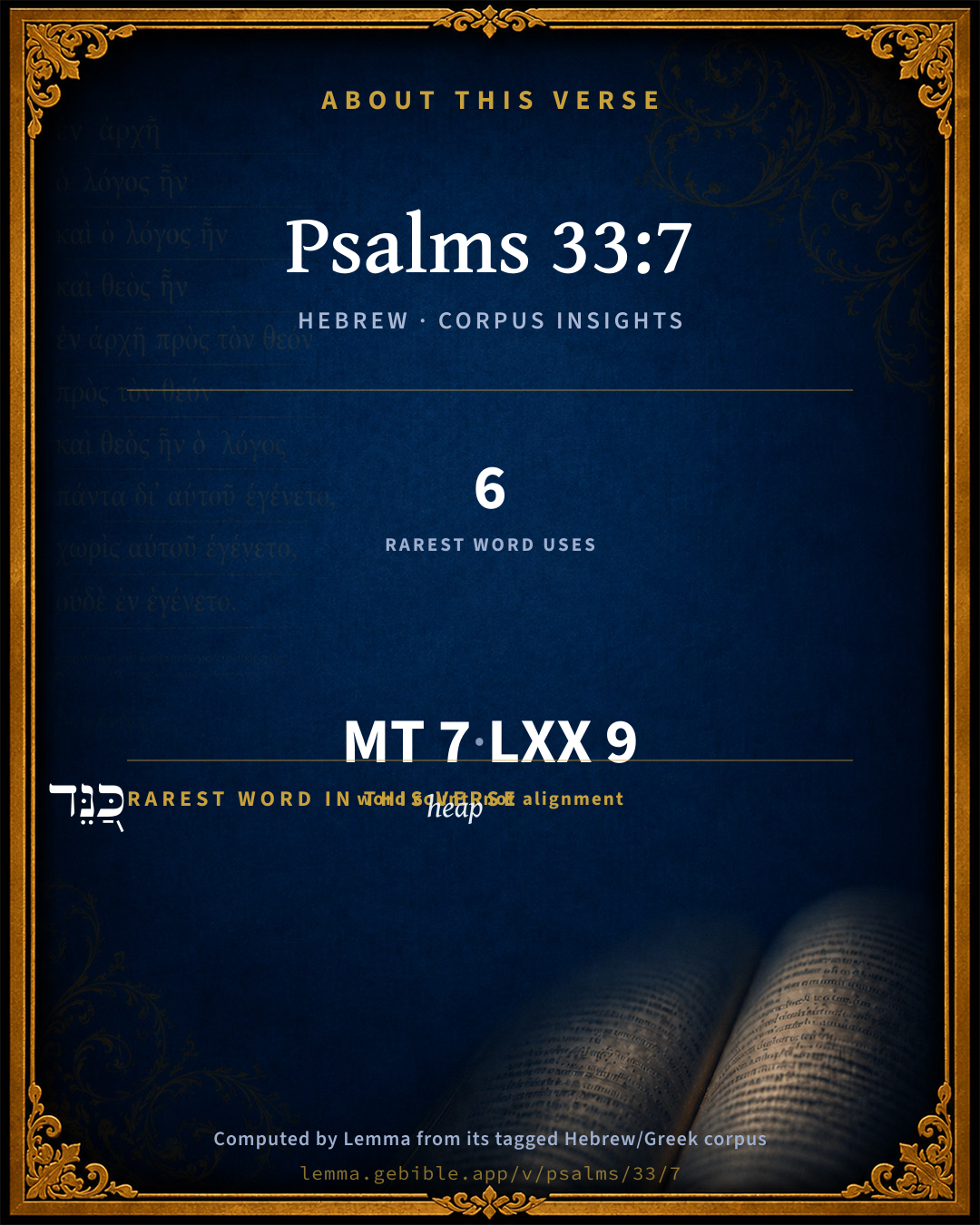
The rarest word here is כַּ֭נֵּד heap H5067 — appearing just 6 times in the whole Hebrew Bible.

Shared distinctive vocabulary

כַּ֭נֵּד heap H5067 occurs in 6 verses of the Hebrew Bible. Also found in:

Grammatical profile

  • 2 verbs
  • 5 nouns

Verb forms

  • כֹּנֵ֣ס Qal · Participle Active
  • נֹתֵ֖ן Qal · Participle Active

Hebrew & Septuagint length

In English translation the verse runs 18 words from the Hebrew and 18 from the Septuagint (LXX English) — the same length.

A rough comparison of the two English renderings, which tokenize alike — not a word-level alignment.

Word counts can differ between the Hebrew and the Greek without any difference in meaning — e.g. the Hebrew direct-object marker אֵת has no separate Greek word, and Greek often adds the article ὁ.

In the original languages it is 7 Hebrew tokens and 9 Greek tokens — but the two are counted differently (Hebrew bundles its prefixes and suffixes into one token; the Greek is in lemma form), so that isn’t a like-for-like length.

Cross-references

11

Topical passages linked to Psalms 33:7 in the Treasury of Scripture Knowledge — connected by theme and wording, ordered by reader-vote popularity; previews shown in the World English Bible.

  • Exodus 15:8 With the blast of your nostrils the waters were piled up. The floods stood upright as a heap. The deeps were congealed in the heart of the sea.
  • Joshua 3:16 that the waters which came down from above stood, and rose up in one heap, a great way off, at Adam, the city that is beside Zarethan; and those that went down toward the sea of the Arabah, even the Salt Sea, were wholly cut off: and the people passed over right against Jericho.
  • Joshua 3:13 It shall come to pass, when the soles of the feet of the priests who bear the ark of Yahweh, the Lord of all the earth, shall rest in the waters of the Jordan, that the waters of the Jordan shall be cut off, even the waters that come down from above; and they shall stand in one heap.
  • Genesis 1:9–10 God said, "Let the waters under the sky be gathered together to one place, and let the dry land appear," and it was so.
  • Psalms 104:6–9 You covered it with the deep as with a cloak. The waters stood above the mountains.
  • Habakkuk 3:15 You trampled the sea with your horses, Churning mighty waters.
  • Job 26:10 He has described a boundary on the surface of the waters, And to the confines of light and darkness.
  • Job 38:8–11 "Or who shut up the sea with doors, When it broke forth from the womb,
  • Proverbs 8:29 When he gave to the sea its boundary, That the waters should not violate his commandment, When he marked out the foundations of the earth;
  • Jeremiah 5:22 Don't you fear me? says Yahweh: won't you tremble at my presence, who have placed the sand for the bound of the sea, by a perpetual decree, that it can't pass it? and though the waves of it toss themselves, yet they can't prevail; though they roar, yet they can't pass over it.
  • Psalms 78:13 He split the sea, and caused them to pass through; He made the waters stand as a heap.

Cross-references courtesy of OpenBible.info (CC BY 4.0).

Hebrew and Greek witnesses Masoretic Hebrew ↔ Greek Septuagint

The same verse in the two great witnesses to the Old Testament, shown verse-for-verse.

You’re reading Greek Psalm 32 (Hebrew Psalm 33). The Septuagint counts the superscription, so verse numbers can differ from the Hebrew — chapter-level alignment, not verse-by-verse. Numbering follows Rahlfs.

These are two independent witnesses, not word-aligned to each other, and the Septuagint is shown in lemma (dictionary) form.

Hebrew Psalms 33:7 Masoretic · Westminster Leningrad Codex

כֹּנֵ֣ס כַּ֭נֵּד מֵ֣י הַיָּ֑ם נֹתֵ֖ן בְּאֹצָר֣וֹת תְּהוֹמֽוֹת

He gathers the waters of the sea together as a heap. He lays up the deeps in storehouses.

World English Bible · Public Domain

Greek LXX Greek Psalm 32:7 Septuagint · lemma form

συνἄγω ὡς ἀσκός ὕδωρ θάλασσα τίθημι ἐν θησαυρός ἄβυσσος

Who gathers the waters of the sea as in a bottle; who lays up the deeps in treasuries.

LXX2012 (modern English Septuagint) · Public Domain

On this verse, Ellicott's Commentary for English Readers discusses the Septuagint’s reading. Read the note in Commentary ↓

Hebrew: Westminster Leningrad Codex (CC BY 4.0). Greek: Septuagint (public domain); English from LXX2012 (modern English Septuagint) (Public Domain). How the Septuagint differs from the Hebrew →

Commentary

Notes on Psalms 33:7 from classic Christian and Jewish commentators (each source and its license shown beneath its notes). The classic Christian expositions comment on the surrounding passage and are grouped to its opening verse, so a note may address several verses; the Jewish commentaries on the Tanakh (Rashi and others) are per-verse, so they appear only where the commentator wrote on this verse.

Lemma curates 59 commentaries, every one of them public domain or Creative Commons licensed, each selected and text-cleaned for this edition rather than reprinted as found. About our sources →

Trapp's Complete Commentary

John Trapp

Psa 33:7 He gathereth the waters of the sea together as an heap: he layeth up the depth in storehouses.

Ver. 7. He gathereth the waters of the sea together] Confining them to their concave, to the pit he digged for them. Ecce altera misericordia, saith Kimchi here, Behold another mercy; without the which the earth would be unhabitable, unless by fishes only; because the waters would cover the earth.

As an heap] This showeth that the sea is higher than the earth. Sailors observe, that their ships move faster to the shore than from it, whereof what other reason can be given but the height of the waters above the land?

He layeth up the depth in storehouses] In his treasuries; that is, he secretly hideth them, and limiteth them to a certain place (that they overwhelm not the earth) by his almighty power, Jer 5:22 Job 38:16. See there.

John Trapp, A Commentary or Exposition upon All the Books of the Old and New Testament (1647–1656) — public domain. Text from a community e-Sword module.

Joseph Benson's Commentary

Psa 33:7. He gathereth the waters — Or, gathered, for he seems to speak of the first creation when this was done, Genesis 1. Or, he alludes to the passage of the Israelites through the Red sea, when the waters were as a wall unto them on the right hand and on the left. As a heap — By which expression he leads our thoughts to that great work of God by which the sea, which is specifically lighter than the earth, and by the common laws of gravitation, should rise above and overflow it, is yet kept within proper bounds; which is often mentioned in Scripture as an immediate effect of God’s overruling power and providence. To this may be added that the adjusting the proportion of the tides, so that they rise no higher to the prejudice of the lower grounds, is another remarkable instance of God’s especial providence. He layeth up the depth in store-houses — That is, either in the clouds, or in the bowels of the earth, whence he can draw them forth when he sees fit. Dr. Waterland renders this clause, He layeth them up in the store-houses of the deep.

Joseph Benson's Commentary on the Old and New Testaments (1811–1818) — public domain. Text from a community e-Sword module.

J. A. Alexander on Psalms

Joseph Addison Alexander

7. (Psa 33:7) Gathering as a heap the waters of the sea, putting in storehouses the depths. The participle represents it is an act still continued, and affording a perpetual evidence of God's almighty power, which is just as necessary now as on the first day of creation, to prevent the earth from being totally submerged. —As a heap. Dealing with fluids as if they were solids, with an obvious allusion to Exo 15:8. See also Jos 3:13-16, Psa 78:13. —Putting, literally giving, storing, depositing.—Depths, masses of water. The main point of the description is God's handling these vast liquid masses, as men handle solid substances of moderate dimensions, heaping the waves up and storing them away, as men might do with stones or wheat.

Joseph Addison Alexander, The Psalms Translated and Explained (1850) — public domain. Text from a community e-Sword module.

Tyndale Open Study Notes

Tyndale Open Resources

33:7 The nations surrounding Israel thought that the sea had divine power, but it is under God’s control, within boundaries that he set (see 104:8-10).

Tyndale Open Study Notes — © Tyndale Open Resources, licensed CC BY-SA 4.0. Text via the HelloAO Bible API.

Geneva Bible (1599)

Geneva Bible translators

By the creation of the heavens and beautiful ornament with the gathering also of the waters, he setteth forth the power of God, that all creatures might fear him.

Geneva Bible (1599) marginal notes — public domain. Text via Bolls.life.

Adam Clarke's Commentary

Verse 7. He gathereth the waters of the sea together] He separated the water from the earth and, while the latter was collected into continents, islands, mountains, hills, and valleys, the former was collected into one place, and called seas; and by his all-controlling power and providence the waters have been retained in their place, so that they have not returned to drown the earth: and he has so adapted the solar and lunar influence exerted on the waters, that the tides are only raised to certain heights, so that they cannot overflow the shores, nor become dissipated in the atmospheric regions. In this one economy there is a whole circle of science. The quantity of matter in the sun, moon, and in the earth, are all adjusted to each other in this astonishing provision: the course of the moon, and the diurnal and annual revolutions of the earth, are all concerned here; and so concerned, that it requires some of the nicest of the Newtonian calculations to ascertain the laws by which the whole is affected.

Adam Clarke's Commentary on the Bible (1810–1826) — public domain. Text from a community e-Sword/MySword module.

John Calvin's Commentaries

7. He gathered together the waters of the sea as into a heap. In Genesis 1:9 we read, “God said, Let the waters under the heavens be gathered together into one place, and let the dry land appear: and it was so.” The Psalmist here probably has a reference to that passage, as in the 9th verse there is evidently an imitation of the style in which God is described in the first chapter of Genesis as performing the work of creation.

In the second part of the verse, he seems to repeat the same idea, but with amplification. God not only confines the immense mass of waters in the seas, but also hides them, by a mysterious and incomprehensible power, in the very bowels of the earth. Whoever will compare the elements among themselves, will reckon it contrary to nature that the bottomless depths, or the immeasurable gulfs of waters, whose native tendency is rather to overwhelm the earth, should lie hid under it. That so many hollow channels and gulfs, accordingly, should not swallow up the earth every moment, affords another magnificent display of divine power; for although now and then some cities and fields are engulfed, yet the body of the earth is preserved in its place.

John Calvin's Commentaries (1540-1563) — public domain. Text from the Calvin Translation Society English edition (1840s-50s) via the Christian Classics Ethereal Library (ccel.org). Calvin's coverage is partial (roughly two-thirds of the Bible); uncommented books and verses are honest gaps, never fabricated. The 19th-century editor's footnotes and remarks are omitted so the notes are faithfully Calvin's own voice.

Ellicott's Commentary for English Readers

(7) As an heap.—The image explains itself (so we speak of waves “mountains high “) without reference to the passage either of the Red Sea or the Jordan. Still less is there a comparison to heaps of corn, some think, since storehouses in the next clause are not necessarily barns, but reservoirs. But the LXX., Vulg., and all ancient interpreters read nôd (“a skin”), instead of nêd (“a heap”), and make the reference to the rain, the clouds being considered as bottles. With this comp. Job_38:37.

A Bible Commentary for English Readers, edited by Charles John Ellicott (1878–1897) — public domain. Text from a community e-Sword module.

The Cambridge Bible for Schools and Colleges

gen. ed. J. J. S. Perowne

7. The separation of land and water (Gen_1:9-10). The present tense (gathereth … layeth up) expresses the continued action of maintenance as well as the original creation. The comparison as an heap probably refers to the appearance of the sea from the shore, and may have been derived from Exo_15:8; cp. Jos_3:13; Jos_3:16; Psa_78:13.

But all the Ancient Versions render as in a bottle, reading nôd for nçd. To the infinite power of the Creator the bed of the sea is but as the water-skin which a man carries with him for a journey. See Isa_40:12; Isa_40:15. Cp. “the pitchers of heaven” (Job_38:37).

the depth] Better as R.V., the deeps: the vast masses of water stored away in subterranean abysses (Gen_7:11; Psa_78:15). So we read of the storehouses of the wind (Psa_135:7 = Jer_10:13), of the snow and hail (Job_38:22).

The Cambridge Bible for Schools and Colleges (gen. ed. J. J. S. Perowne; Cambridge University Press, 1878–1918) — public domain. Text from a community e-Sword module.

John Gill's Exposition

He gathereth the waters of the sea together as an heap,.... Which was done on the third day of the creation, by means of which the dry land appeared, Gen 1:9; when the waters of the sea were piled up as an heap, and stood higher than the earth, as they now do; and which is a wonderful instance of the power and providence of God, to bound them, and preserve the earth from being overflowed by them, Job 38:9;

he layeth up the depth in storehouses; that is, large quantities of water, for which he has his treasure houses, as for the wind, hail and snow, Psa 135:7; and these are the clouds of heaven above, and the fountains of the great deep below, which the Lord opens and stops at his pleasure; see Gen 7:11.

John Gill's Exposition of the Whole Bible (1746–1763) — public domain (CC PDM 1.0). Text via the HelloAO Bible API.

Albert Barnes' Notes on the Bible

He gathereth the waters of the sea together as an heap - The Hebrew word here rendered “gathereth” is a participle; “gathering.” The design is to represent this as a continuous act; an act not merely of the original creation, but constantly occurring. The reference is to the power by which the waters are gathered and kept together; the continual power which prevents their overspreading the earth. The word rendered “heap” - נד nêd - means properly a heap or “mound,” and is applied to the waves of the sea heaped up together like mounds. Compare Jos 3:13, Jos 3:16; Exo 15:8 : Psa 78:13. He collected those waters, and kept them in their places, as if they were solid matter. This denotes the absolute control which God has over the waters, and is thus a most striking illustration of his power.

He layeth up the depth in storehouses - The abysses; the deep waters; the masses of water. He places them where he pleases; he disposes of them as the farmer his grain, or the rich man his treasures. The caverns of the ocean - the ocean-beds - are thus vast reservoirs or treasure-houses for the reception of the waters which God has chosen to deposit there. All this is proof of his amazing power, and all this lays a proper foundation for praise. Occasions for gratitude to him may be found in every world that he has made; in every object that has come from his hand; and nothing more “obviously” suggests this than his wondrous power over the waters of the ocean - collecting them, restraining them, controlling them, as he pleases.

Albert Barnes' Notes on the Bible (1834–1885) — public domain. Text from a community e-Sword/MySword module.

Matthew Poole's English Annotations

He gathereth; or, gathered; for he speaks of the first creation, when this was done, Ge 1.

As an heap; by which expression he brings to our minds this great work of God, that the sea, which is lighter and higher than earth, is yet confined within its bounds, that it might not overflow the earth.

In storehouses; either in the clouds, or in the bowels of the earth; whence he can draw them forth when he sees fit.

Matthew Poole's English Annotations on the Holy Bible (1683–1685) — public domain. Text from a community e-Sword/MySword module.

The Treasury of David

Charles H. Spurgeon

Ver. 7. He gathereth the waters of the sea together as an heap. The waters were once scattered like corn strewn upon a threshing floor: they are now collected in one spot as an heap. Who else could have gathered them into one channel but their great Lord, at whose bidding the waters fled away? The miracle of the Red Sea is repeated in nature day by day, for the sea which now invades the shore under the impulse of sun and moon, would soon devour the land if bounds were not maintained by the divine decree. He layeth up the depth in storehouses. The depths of the main are God's great cellars and storerooms for the tempestuous element. Vast reservoirs of water are secreted in the bowels of the earth, from which issue our springs and wells of water. What a merciful provision for a pressing need? May not the text also refer to the clouds, and the magazines of hail, and snow, and rain, those treasures of merciful wealth for the fields of earth? These aqueous masses are not piled away as in lumber rooms, but in storehouses for future beneficial use. Abundant tenderness is seen in the foresight of our heavenly Joseph, whose granaries are already filled against earth's time of need. These stores might have been, as once they were, the ammunition of vengeance, they are now a part of the commissariat of mercy.

Ver. 7. He gathereth the waters of the sea together as an heap, etc. "God called the gathering together of the waters, seas." Ge 1:10. This unstable element must, like all other elements, be put under law, and confined within bounds, that there might be a habitable earth for man and all the creatures around him. Thus the psalmist sings, He gathereth the waters of the sea together as an heap: he layeth up the depth in storehouses. The boundary was such as to cause his servants to wonder. They looked from the shore, as we do, and under the influence of a well known law, the billows in their heaving swells, seemed as if they would, as if they did, touch the sky itself; and as if they were so much higher than the shore, that they were in danger of leaving their basin and stretching over the land. Just such an impression, we with all our science, popularly hold. The prophets thus looked as we do, and under the same kind of feeling. How wonderful, they thought, is all this! A low barrier of sand is made Jehovah's agent for bounding the deep. "The Lord hath placed the sand for the bound of the sea by a perpetual decree, that it cannot pass it: and though the waves thereof toss themselves, yet they not prevail; though they roar, yet can they not pass over it." Jer 5:22. John Duns, D.D., in "Science and Christian Thought, "1868.

Ver. 7. The waters of the sea. Of all objects that I have ever seen, there is none which affect my imagination so much as the sea or ocean. I cannot see the heavings of this prodigious bulk of waters, even in a calm, without a very pleasing astonishment; but when it is worked up in a tempest, so that the horizon on every side is nothing but foaming billows and floating mountains, it is impossible to describe the agreeable horror that rises from such a prospect. A troubled ocean, to a man who sails upon it, is, I think, the biggest object that he can see in motion, and consequently gives his imagination one of the highest kinds of pleasure that can arise from greatness. I must confess it is impossible for me to survey this world of fluid matter without thinking on the hand that first poured it out, and made a proper channel for its reception. Such an object naturally raises in my thoughts the idea of an Almighty Being, and convinces me of his existence as much as a metaphysical demonstration. The imagination prompts the understanding, and by the greatness of the sensible object, produces in it the idea of a Being who is neither circumscribed by time nor space. Spectator.

Ver. 7. As a heap. Dealing with fluids as if they were solids, with an obvious allusion to Ex 15:8. Depths, masses of water. The main point of the description is God's handling these vast liquid masses, as men handle solid substances of moderate dimensions, heaping the waves up, and storing them away, as men might do with stones or wheat. J. A. Alexander.

Ver. 7. The vast masses of waters which had hitherto covered the entire surface of the globe, was on the third day of creation brought within narrower compass, and large tracts of the submerged earth reclaimed and rendered habitable ground...The waters were, for the most part, congregated together in one vast body, instead of being universally diffused over the face of the earth. This is the state of things which we now contemplate; the various great seas and oceans constituting in fact but one body of water called in different regions by different names, as the Atlantic, Pacific, Indian, Southern, etc., oceans. George Bush, on Ge 1:9.

Ver. 7. God's control of destructive and reconstructive agencies.

Ver. 7. The storehouses of the Great Husbandman.

Psalms 33:8*

Charles H. Spurgeon's The Treasury of David (1869–1885) — public domain. Psalms only. Text from a community e-Sword/MySword module.

Whedon's Commentary on the Bible

Daniel D. Whedon

7. Gathereth the waters—This verse is a rehearsal of Gen_1:9.

Heap—The allusion is to Exo_15:8. It is still a wonder that the ocean is confined to its bed.

Daniel D. Whedon (gen. ed.), Commentary on the Old and New Testaments (1874–1909) — public domain. Text from a community e-Sword module.

The Pulpit Commentary

He gathereth the waters of the sea together as a heap. An allusion to Gen_1:8, but with a glance also at Exo_15:8 and Jos_3:13-16; as if the original gathering, and continued retention, of the sea in one convex mass were as great a proof of omnipotence as the miracles related in those passages. Nes (sne), "a heap" occurs only in the places cited, here, and in Psa_78:13. He layeth up the depth in storehouses; literally, the deeps. The waters of the great deep are regarded as stored up by the Almighty in the huge cavities of the ocean bed for his own use, to be employed at some time or other in carrying out his purposes. (comp. Gen_7:11 and Job_38:22, Job_38:23)

The Pulpit Commentary (1880–1919), ed. H.D.M. Spence-Jones & Joseph S. Exell — public domain. Text from a community e-Sword module.

John Wesley's Explanatory Notes

Store-houses - Either in the clouds, or in the bowels of the earth.

John Wesley, Explanatory Notes Upon the Whole Bible (1754–1765) — public domain. Text via the GEBible commentary corpus.

unfoldingWord translationNotes

Door43 World Missions Community

General Information:

Each verse consists of two lines that have very similar meanings. (See: Parallelism)

like a heap

"like behind a dam." The writer describes the creation of the sea as if God piles up all the waters together. (See: Simile)

he puts the oceans in storehouses

The writer describes the creation of the oceans as if God put them in a storehouse. AT: "he puts the oceans in their place, just like a man puts grain in a storehouse" (See: Metaphor)

Let the whole earth

This refers to the people on the earth. AT: "Let everyone on earth" (See: Metonymy)

stand in awe of him

Here "stand in awe" is an idiom that means "be in awe." AT: "honor him" (See: Idiom)

stood in place

Here "stood in place" is an idiom that means "was created." AT: "started to exist" (See: Idiom)

translationWords

water

storehouse

fear

awe

command

unfoldingWord translationNotes — © Distant Shores Media and the Door43 World Missions Community, licensed CC BY-SA 4.0. Source: git.door43.org/Door43/en_tn.

Rashi

Rabbi Shlomo Yitzchaki (Rashi)

as a mound Heb. כנד, an expression of height, and so did Onkelos render (Exod. 15:8): נצבו כמו נד, they stood up like a wall, and so did Menachem (p. 121, missing) explain it. נד and נאד do not have the same meaning.

He puts the deeps into treasuries under the earth.

Rashi on the Tanakh — English translations: “The Judaica Press complete Tanach with Rashi, translated by A. J. Rosenberg” (CC BY 4.0); “Pentateuch with Rashi's commentary by M. Rosenbaum and A.M. Silbermann, 1929-1934” (public domain); “The Metsudah Tanach series, Lakewood, N.J” (CC BY 4.0); and “The Book of Joshua, Metsudah Publications, 1997” (CC BY 4.0). Text via Sefaria.

Lesson kit

Teaching starters — assembled from the data on this page, not authored interpretation. Every prompt links to the verse data it draws on. Edit before teaching.

Psalms, in the Wisdom, opens this verse with 7 words (7 distinct Hebrew lemmas). Its most distinctive word is nêd (“heap”). A historical commentator’s framing appears above. Read the whole chapter for the surrounding context.

Discussion questions

  1. How does “heap” (nêd) shape what this verse is saying?
  2. How does Exodus 15:8, which shares the word «heap», read alongside this verse?
  3. These translations render this verse differently; the difference is in the English rendering, not the original. What questions does that raise?
  4. «כֹּנֵ֣ס» is a Qal Participle Active verb. How does that grammatical form shape the action described?
  5. Compare how Trapp's Complete Commentary and Joseph Benson's Commentary read this verse. Where do they agree or differ?

Things to notice

Reading settings

Reading text

Shown beneath each verse's original-language words.

Old Testament
Old Testament edition

Read the OT as the Masoretic Hebrew (MT) or the Greek Septuagint (LXX).

English shown for the Greek Septuagint (in the Hebrew ↔ Greek comparison).

Comparing translations? Open the Compare panel on any verse page to stack up to four side by side.