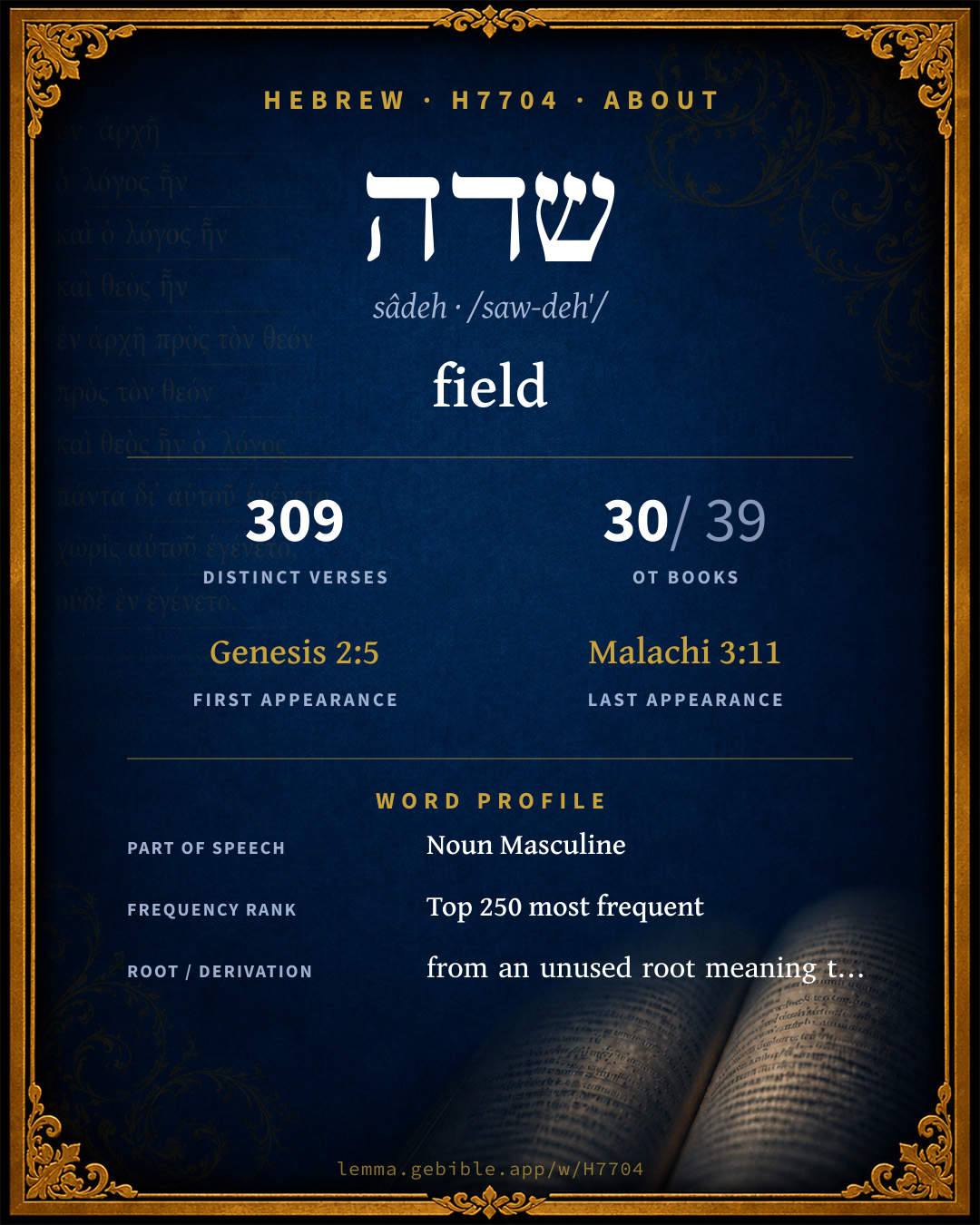
שָׂדֶה
field
‘field’ is one of 5 main senses fuller range ↓
Full lexicon entry — Brown-Driver-Briggs (BDB)
From Brown-Driver-Briggs (BDB)
Where this word appears
See every Absolute-state word in the Hebrew Bible →
Grammar key — what these labels mean
Part of speech
- Noun
- A naming word — a person, place, thing, or idea.
Noun type
- Common
- A common noun — a general class of person, place, or thing (“king,” “city,” “water”), not a specific name.
State
- Absolute
- The independent form of a noun, not bound to a following word.
- Construct
- A noun bound to a following noun in a possessive / “of” relationship (the construct chain).
Gender
- Masculine
- Grammatically masculine.
Number
- Singular
- One.
- Plural
- More than one (in Hebrew, generally three or more).
Grammatical forms
- Noun, Common, Masculine, Singular, Absolute 241 times (72%)
- Noun, Common, Masculine, Singular, Construct 65 times (19%)
- Noun, Common, Masculine, Plural, Construct 21 times (6%)
- Noun, Common, Masculine, Plural, Absolute 7 times (2%)
Parsed forms decoded from the imported morphology (morphhb / Westminster Leningrad Codex — WLC text public domain, morphhb tagging CC BY 4.0), counted across 334 parsed occurrences — not distinct verses.
Page 1 of 2 — showing verses 1–200 of 309 distinct verses where H7704 appears, across 30 books. Click any verse to open its interlinear word-by-word view. Verse text shown in the World English Bible for context — . Each verse’s Hebrew form is shown with its reference; the English is not keyword-highlighted, since the data carries no word-level English alignment. Use “Compare translations” on any verse to read it across multiple English versions. This concordance covers the Hebrew Bible; Septuagint (Greek Old Testament) occurrences are not indexed here.
Genesis 43 verses
- Genesis 2:5 הַ/שָּׂדֶ֗ה הַ/שָּׂדֶ֖ה ptcl def.art + n c ms ptcl def.art + n c ms No plant of the field was yet in the earth, and no herb of the field had yet sprung up; for Yahweh God had not caused it to rain on the earth. There was not a man to till the ground,
- Genesis 2:19 הַ/שָּׂדֶה֙ ptcl def.art + n c ms Out of the ground Yahweh God formed every animal of the field, and every bird of the sky, and brought them to the man to see what he would call them. Whatever the man called every living creature, that was its name.
- Genesis 2:20 הַ/שָּׂדֶ֑ה ptcl def.art + n c ms The man gave names to all cattle, and to the birds of the sky, and to every animal of the field; but for man there was not found a helper suitable for him.
- Genesis 3:1 הַ/שָּׂדֶ֔ה ptcl def.art + n c ms Now the serpent was more subtle than any animal of the field which Yahweh God had made. He said to the woman, "Yes, has God said, 'You shall not eat of any tree of the garden?'"
- Genesis 3:14 הַ/שָּׂדֶ֑ה ptcl def.art + n c ms Yahweh God said to the serpent, "Because you have done this, cursed are you above all cattle, and above every animal of the field. On your belly shall you go, and you shall eat dust all the days of your life.
- Genesis 3:18 הַ/שָּׂדֶֽה ptcl def.art + n c ms Thorns also and thistles will it bring forth to you; and you will eat the herb of the field.
- Genesis 4:8 בַּ/שָּׂדֶ֔ה prep det + n c ms Cain said to Abel, his brother, "Let's go into the field." It happened, when they were in the field, that Cain rose up against Abel, his brother, and killed him.
- Genesis 14:7 שְׂדֵ֖ה n c ms cs They returned, and came to En-mishpat (the same is Kadesh), and struck all the country of the Amalekites, and also the Amorites, that lived in Hazazon Tamar.
- Genesis 23:9 שָׂדֵ֑/הוּ n c ms cs + sfx pers 3ms that he may give me the cave of Machpelah, which he has, which is in the end of his field. For the full price let him give it to me in the midst of you for a possession of a burying-place."
- Genesis 23:11 הַ/שָּׂדֶה֙ ptcl def.art + n c ms "No, my lord, hear me. I give you the field, and I give you the cave that is in it. In the presence of the children of my people I give it to you. Bury your dead."
- Genesis 23:13 הַ/שָּׂדֶה֙ ptcl def.art + n c ms He spoke to Ephron in the audience of the people of the land, saying, "But if you will, please hear me. I will give the price of the field. Take it from me, and I will bury my dead there."
- Genesis 23:17 שְׂדֵ֣ה הַ/שָּׂדֶה֙ בַּ/שָּׂדֶ֔ה n c ms cs ptcl def.art + n c ms prep det + n c ms So the field of Ephron, which was in Machpelah, which was before Mamre, the field, the cave which was therein, and all the trees that were in the field, that were in all the border of it round about, were made sure
- Genesis 23:19 שְׂדֵ֧ה n c ms cs After this, Abraham buried Sarah his wife in the cave of the field of Machpelah before Mamre (the same is Hebron), in the land of Canaan.
- Genesis 23:20 הַ/שָּׂדֶ֜ה ptcl def.art + n c ms The field, and the cave that is therein, were made sure to Abraham for a possession of a burying place by the children of Heth.
- Genesis 24:63 בַּ/שָּׂדֶ֖ה prep det + n c ms Isaac went out to meditate in the field at the evening. He lifted up his eyes, and saw, and, behold, there were camels coming.
- Genesis 24:65 בַּ/שָּׂדֶה֙ prep det + n c ms She said to the servant, "Who is the man who is walking in the field to meet us?" The servant said, "It is my master." She took her veil, and covered herself.
- Genesis 25:9 שְׂדֵ֞ה n c ms cs Isaac and Ishmael, his sons, buried him in the cave of Machpelah, in the field of Ephron, the son of Zohar the Hittite, which is before Mamre,
- Genesis 25:10 הַ/שָּׂדֶ֛ה ptcl def.art + n c ms the field which Abraham purchased of the children of Heth. There was Abraham buried, with Sarah his wife.
- Genesis 25:27 שָׂדֶ֑ה n c ms The boys grew. Esau was a skillful hunter, a man of the field. Jacob was a quiet man, living in tents.
- Genesis 25:29 הַ/שָּׂדֶ֖ה ptcl def.art + n c ms Jacob boiled stew. Esau came in from the field, and he was famished.
- Genesis 27:3 הַ/שָּׂדֶ֔ה ptcl def.art + n c ms Now therefore, please take your weapons, your quiver and your bow, and go out to the field, and take me venison.
- Genesis 27:5 הַ/שָּׂדֶ֔ה ptcl def.art + n c ms Rebekah heard when Isaac spoke to Esau his son. Esau went to the field to hunt for venison, and to bring it.
- Genesis 27:27 שָׂדֶ֔ה n c ms He came near, and kissed him. He smelled the smell of his clothing, and blessed him, and said, "Behold, the smell of my son Is as the smell of a field which Yahweh has blessed.
- Genesis 29:2 בַּ/שָּׂדֶ֗ה prep det + n c ms He looked, and behold, a well in the field, and, behold, three flocks of sheep lying there by it. For out of that well they watered the flocks. The stone on the well's mouth was great.
- Genesis 30:14 בַּ/שָּׂדֶ֔ה prep det + n c ms Reuben went in the days of wheat harvest, and found mandrakes in the field, and brought them to his mother, Leah. Then Rachel said to Leah, "Please give me some of your son's mandrakes."
- Genesis 30:16 הַ/שָּׂדֶה֮ ptcl def.art + n c ms Jacob came from the field in the evening, and Leah went out to meet him, and said, "You must come in to me; for I have surely hired you with my son's mandrakes." He lay with her that night.
- Genesis 31:4 הַ/שָּׂדֶ֖ה ptcl def.art + n c ms Jacob sent and called Rachel and Leah to the field to his flock,
- Genesis 32:3 שְׂדֵ֥ה n c ms cs Jacob sent messengers in front of him to Esau, his brother, to the land of Seir, the field of Edom.
- Genesis 33:19 הַ/שָּׂדֶ֗ה ptcl def.art + n c ms He bought the parcel of ground, where he had spread his tent, at the hand of the children of Hamor, Shechem's father, for one hundred pieces of money.
- Genesis 34:5 בַּ/שָּׂדֶ֑ה prep det + n c ms Now Jacob heard that he had defiled Dinah, his daughter; and his sons were with his cattle in the field. Jacob held his peace until they came.
- Genesis 34:7 הַ/שָּׂדֶה֙ ptcl def.art + n c ms The sons of Jacob came in from the field when they heard it. The men were grieved, and they were very angry, because he had done folly in Israel in lying with Jacob's daughter; which thing ought not to be done.
- Genesis 34:28 בַּ/שָּׂדֶ֖ה prep det + n c ms They took their flocks, their herds, their donkeys, that which was in the city, that which was in the field;
- Genesis 36:35 בִּ/שְׂדֵ֣ה prep + n c ms cs Husham died, and Hadad, the son of Bedad, who struck Midian in the field of Moab, reigned in his place. The name of his city was Avith.
- Genesis 37:7 הַ/שָּׂדֶ֔ה ptcl def.art + n c ms for, behold, we were binding sheaves in the field, and behold, my sheaf arose and also stood upright; and behold, your sheaves came around, and bowed down to my sheaf."
- Genesis 37:15 בַּ/שָּׂדֶ֑ה prep det + n c ms A certain man found him, and behold, he was wandering in the field: and the man asked him, saying, "What are you looking for?"
- Genesis 39:5 וּ/בַ/שָּׂדֶֽה conj + prep det + n c ms It happened from the time that he made him overseer in his house, and over all that he had, that Yahweh blessed the Egyptian's house for Joseph's sake; and the blessing of Yahweh was on all that he had, in the house and in the field.
- Genesis 41:48 שְׂדֵה n c ms cs He gathered up all the food of the seven years which were in the land of Egypt, and laid up the food in the cities: the food of the field, which was round about every city, he laid up in the same.
- Genesis 47:20 שָׂדֵ֔/הוּ n c ms cs + sfx pers 3ms So Joseph bought all the land of Egypt for Pharaoh, for the Egyptians sold every man his field, because the famine was severe on them, and the land became Pharaoh's.
- Genesis 47:24 הַ/שָּׂדֶ֧ה ptcl def.art + n c ms It will happen at the harvests, that you shall give a fifth to Pharaoh, and four parts will be your own, for seed of the field, for your food, for them of your households, and for food for your little ones."
- Genesis 49:29 בִּ/שְׂדֵ֖ה prep + n c ms cs He charged them, and said to them, "I am to be gathered to my people. Bury me with my fathers in the cave that is in the field of Ephron the Hittite,
- Genesis 49:30 בִּ/שְׂדֵ֧ה הַ/שָּׂדֶ֗ה prep + n c ms cs ptcl def.art + n c ms in the cave that is in the field of Machpelah, which is before Mamre, in the land of Canaan, which Abraham bought with the field from Ephron the Hittite as a burial place.
- Genesis 49:32 הַ/שָּׂדֶ֛ה ptcl def.art + n c ms the field and the cave that is therein, which was purchased from the children of Heth."
- Genesis 50:13 שְׂדֵ֣ה הַ/שָּׂדֶ֜ה n c ms cs ptcl def.art + n c ms for his sons carried him into the land of Canaan, and buried him in the cave of the field of Machpelah, which Abraham bought with the field, for a possession of a burying-place, from Ephron the Hittite, before Mamre.
Exodus 16 verses
- Exodus 1:14 בַּ/שָּׂדֶ֑ה prep det + n c ms and they made their lives bitter with hard service, in mortar and in brick, and in all manner of service in the field, all their service, in which they ruthlessly made them serve.
- Exodus 8:13 הַ/שָּׂדֹֽת ptcl def.art + n c mp Yahweh did according to the word of Moses, and the frogs died out of the houses, out of the courts, and out of the fields.
- Exodus 9:3 בַּ/שָּׂדֶ֔ה prep det + n c ms behold, the hand of Yahweh is on your cattle which are in the field, on the horses, on the donkeys, on the camels, on the herds, and on the flocks with a very grievous pestilence.
- Exodus 9:19 בַּ/שָּׂדֶ֑ה בַ/שָּׂדֶ֗ה prep det + n c ms prep det + n c ms Now therefore command that all of your cattle and all that you have in the field be brought into shelter. Every man and animal that is found in the field, and isn't brought home, the hail shall come down on them, and they shall die."'"
- Exodus 9:21 בַּ/שָּׂדֶֽה prep det + n c ms Whoever didn't regard the word of Yahweh left his servants and his cattle in the field.
- Exodus 9:22 הַ/שָּׂדֶ֖ה ptcl def.art + n c ms Yahweh said to Moses, "Stretch forth your hand toward the sky, that there may be hail in all the land of Egypt, on man, and on animal, and on every herb of the field, throughout the land of Egypt."
- Exodus 9:25 בַּ/שָּׂדֶ֔ה הַ/שָּׂדֶה֙ הַ/שָּׂדֶ֖ה prep det + n c ms ptcl def.art + n c ms ptcl def.art + n c ms The hail struck throughout all the land of Egypt all that was in the field, both man and animal; and the hail struck every herb of the field, and broke every tree of the field.
- Exodus 10:5 הַ/שָּׂדֶֽה ptcl def.art + n c ms and they shall cover the surface of the earth, so that one won't be able to see the earth. They shall eat the residue of that which has escaped, which remains to you from the hail, and shall eat every tree which grows for you out of the field.
- Exodus 10:15 הַ/שָּׂדֶ֖ה ptcl def.art + n c ms For they covered the surface of the whole earth, so that the land was darkened, and they ate every herb of the land, and all the fruit of the trees which the hail had left. There remained nothing green, either tree or herb of the field, through all the land of Egypt.
- Exodus 16:25 בַּ/שָּׂדֶֽה prep det + n c ms Moses said, "Eat that today, for today is a Sabbath to Yahweh. Today you shall not find it in the field.
- Exodus 22:5 שָׂדֶ֣ה בִּ/שְׂדֵ֣ה שָׂדֵ֛/הוּ n c ms prep + n c ms cs n c ms cs + sfx pers 3ms "If a man causes a field or vineyard to be eaten, and lets his animal loose, and it grazes in another man's field, he shall make restitution from the best of his own field, and from the best of his own vineyard.
- Exodus 22:6 הַ/שָּׂדֶ֑ה ptcl def.art + n c ms "If fire breaks out, and catches in thorns so that the shocks of grain, or the standing grain, or the field are consumed; he who kindled the fire shall surely make restitution.
- Exodus 22:31 בַּ/שָּׂדֶ֤ה prep det + n c ms "You shall be holy men to me, therefore you shall not eat any flesh that is torn by animals in the field. You shall cast it to the dogs.
- Exodus 23:11 הַ/שָּׂדֶ֑ה ptcl def.art + n c ms but the seventh year you shall let it rest and lie fallow, that the poor of your people may eat; and what they leave the animal of the field shall eat. In like manner you shall deal with your vineyard and with your olive grove.
- Exodus 23:16 בַּ/שָּׂדֶ֑ה הַ/שָּׂדֶֽה prep det + n c ms ptcl def.art + n c ms And the feast of harvest, the first fruits of your labors, which you sow in the field: and the feast of harvest, at the end of the year, when you gather in your labors out of the field.
- Exodus 23:29 הַ/שָּׂדֶֽה ptcl def.art + n c ms I will not drive them out from before you in one year, lest the land become desolate, and the animals of the field multiply against you.
Leviticus 22 verses
- Leviticus 14:7 הַ/שָּׂדֶֽה ptcl def.art + n c ms He shall sprinkle on him who is to be cleansed from the leprosy seven times, and shall pronounce him clean, and shall let the living bird go into the open field.
- Leviticus 14:53 הַ/שָּׂדֶ֑ה ptcl def.art + n c ms but he shall let the living bird go out of the city into the open field. So shall he make atonement for the house; and it shall be clean."
- Leviticus 17:5 הַ/שָּׂדֶה֒ ptcl def.art + n c ms This is to the end that the children of Israel may bring their sacrifices, which they sacrifice in the open field, that they may bring them to Yahweh, to the door of the Tent of Meeting, to the priest, and sacrifice them for sacrifices of peace offerings to Yahweh.
- Leviticus 19:9 שָׂדְ/ךָ֖ n c ms cs + sfx pers 2ms "'When you reap the harvest of your land, you shall not wholly reap the corners of your field, neither shall you gather the gleanings of your harvest.
- Leviticus 19:19 שָׂדְ/ךָ֖ n c ms cs + sfx pers 2ms "'You shall keep my statutes. "'You shall not crossbreed different kinds of animals. "'you shall not sow your field with two kinds of seed; "'neither shall there come upon on you a garment made of two kinds of material.
- Leviticus 23:22 שָֽׂדְ/ךָ֙ n c ms cs + sfx pers 2ms "'When you reap the harvest of your land, you shall not wholly reap into the corners of your field, neither shall you gather the gleanings of your harvest: you shall leave them for the poor, and for the foreigner. I am Yahweh your God.'"
- Leviticus 25:3 שָׂדֶ֔/ךָ n c ms cs + sfx pers 2ms Six years you shall sow your field, and six years you shall prune your vineyard, and gather in its fruits;
- Leviticus 25:4 שָֽׂדְ/ךָ֙ n c ms cs + sfx pers 2ms but in the seventh year there shall be a Sabbath of solemn rest for the land, a Sabbath to Yahweh. You shall not sow your field or prune your vineyard.
- Leviticus 25:12 הַ֨/שָּׂדֶ֔ה ptcl def.art + n c ms For it is a jubilee; it shall be holy to you. You shall eat of its increase out of the field.
- Leviticus 25:31 שְׂדֵ֥ה n c ms cs But the houses of the villages which have no wall round about them shall be reckoned with the fields of the country: they may be redeemed, and they shall be released in the Jubilee.
- Leviticus 25:34 וּֽ/שְׂדֵ֛ה conj + n c ms cs But the field of the suburbs of their cities may not be sold; for it is their perpetual possession.
- Leviticus 26:4 הַ/שָּׂדֶ֖ה ptcl def.art + n c ms then I will give you your rains in their season, and the land shall yield its increase, and the trees of the field shall yield their fruit.
- Leviticus 26:22 הַ/שָּׂדֶה֙ ptcl def.art + n c ms I will send the wild animals among you, which will rob you of your children, destroy your cattle, and make you few in number; and your roads will become desolate.
- Leviticus 27:16 מִ/שְּׂדֵ֣ה prep + n c ms cs "'If a man dedicates to Yahweh part of the field of his possession, then your valuation shall be according to the seed for it: the sowing of a homer of barley shall be valued at fifty shekels of silver.
- Leviticus 27:17 שָׂדֵ֑/הוּ n c ms cs + sfx pers 3ms If he dedicates his field from the Year of Jubilee, according to your valuation it shall stand.
- Leviticus 27:18 שָׂדֵ/הוּ֒ n c ms cs + sfx pers 3ms But if he dedicates his field after the Jubilee, then the priest shall reckon to him the money according to the years that remain to the Year of Jubilee; and an abatement shall be made from your valuation.
- Leviticus 27:19 הַ/שָּׂדֶ֔ה ptcl def.art + n c ms If he who dedicated the field will indeed redeem it, then he shall add the fifth part of the money of your valuation to it, and it shall remain his.
- Leviticus 27:20 הַ/שָּׂדֶ֔ה הַ/שָּׂדֶ֖ה ptcl def.art + n c ms ptcl def.art + n c ms If he will not redeem the field, or if he has sold the field to another man, it shall not be redeemed any more;
- Leviticus 27:21 הַ/שָּׂדֶ֜ה כִּ/שְׂדֵ֣ה ptcl def.art + n c ms prep + n c ms cs but the field, when it goes out in the Jubilee, shall be holy to Yahweh, as a field devoted; it shall be owned by the priests.
- Leviticus 27:22 שְׂדֵ֣ה מִ/שְּׂדֵ֣ה n c ms cs prep + n c ms cs "'If he dedicates to Yahweh a field which he has bought, which is not of the field of his possession,
- Leviticus 27:24 הַ/שָּׂדֶ֔ה ptcl def.art + n c ms In the Year of Jubilee the field shall return to him from whom it was bought, even to him to whom the possession of the land belongs.
- Leviticus 27:28 וּ/מִ/שְּׂדֵ֣ה conj + prep + n c ms cs "'Notwithstanding, no devoted thing, that a man shall devote to Yahweh of all that he has, whether of man or animal, or of the field of his possession, shall be sold or redeemed: every devoted thing is most holy to Yahweh.
Numbers 8 verses
- Numbers 16:14 שָׂדֶ֣ה n c ms Moreover you haven't brought us into a land flowing with milk and honey, nor given us inheritance of fields and vineyards: will you put out the eyes of these men? we won't come up.
- Numbers 19:16 הַ/שָּׂדֶ֗ה ptcl def.art + n c ms Whoever in the open field touches one who is slain with a sword, or a dead body, or a bone of a man, or a grave, shall be unclean seven days.
- Numbers 20:17 בְּ/שָׂדֶ֣ה prep + n c ms Please let us pass through your land: we will not pass through field or through vineyard, neither will we drink of the water of the wells: we will go along the king's highway; we will not turn aside to the right hand nor to the left, until we have passed your border.
- Numbers 21:20 בִּ/שְׂדֵ֣ה prep + n c ms cs and from Bamoth to the valley that is in the field of Moab, to the top of Pisgah, which looks down on the desert.
- Numbers 21:22 בְּ/שָׂדֶ֣ה prep + n c ms Let me pass through your land: we will not turn aside into field, or into vineyard; we will not drink of the water of the wells: we will go by the king's highway, until we have passed your border.
- Numbers 22:4 הַ/שָּׂדֶ֑ה ptcl def.art + n c ms Moab said to the elders of Midian, Now will this multitude lick up all that is round about us, as the ox licks up the grass of the field. Balak the son of Zippor was king of Moab at that time.
- Numbers 22:23 בַּ/שָּׂדֶ֑ה prep det + n c ms The donkey saw the angel of Yahweh standing in the way, with his sword drawn in his hand; and the donkey turned aside out of the way, and went into the field: and Balaam struck the donkey, to turn her into the way.
- Numbers 23:14 שְׂדֵ֣ה n c ms cs He took him into the field of Zophim, to the top of Pisgah, and built seven altars, and offered up a bull and a ram on every altar.
Deuteronomy 13 verses
- Deuteronomy 5:21 שָׂדֵ֜/הוּ n c ms cs + sfx pers 3ms "Neither shall you covet your neighbor's wife; neither shall you desire your neighbor's house, his field, or his man-servant, or his maid-servant, his ox, or his donkey, or anything that is your neighbor's."
- Deuteronomy 7:22 הַ/שָּׂדֶֽה ptcl def.art + n c ms Yahweh your God will cast out those nations before you by little and little: you may not consume them at once, lest the animals of the field increase on you.
- Deuteronomy 11:15 בְּ/שָׂדְ/ךָ֖ prep + n c ms cs + sfx pers 2ms I will give grass in your fields for your cattle, and you shall eat and be full.
- Deuteronomy 14:22 הַ/שָּׂדֶ֖ה ptcl def.art + n c ms You shall surely tithe all the increase of your seed, that which comes forth from the field year by year.
- Deuteronomy 20:19 הַ/שָּׂדֶ֔ה ptcl def.art + n c ms When you shall besiege a city a long time, in making war against it to take it, you shall not destroy the trees of it by wielding an axe against them; for you may eat of them, and you shall not cut them down; for is the tree of the field man, that it should be besieged of you?
- Deuteronomy 21:1 בַּ/שָּׂדֶ֑ה prep det + n c ms If one be found slain in the land which Yahweh your God gives you to possess it, lying in the field, and it isn't known who has struck him;
- Deuteronomy 22:25 בַּ/שָּׂדֶ֞ה prep det + n c ms But if the man find the lady who is pledged to be married in the field, and the man force her, and lie with her; then the man only who lay with her shall die:
- Deuteronomy 22:27 בַ/שָּׂדֶ֖ה prep det + n c ms for he found her in the field, the pledged to be married lady cried, and there was none to save her.
- Deuteronomy 24:19 בְ/שָׂדֶ֜/ךָ בַּ/שָּׂדֶ֗ה prep + n c ms cs + sfx pers 2ms prep det + n c ms When you reap your harvest in your field, and have forgot a sheaf in the field, you shall not go again to get it: it shall be for the foreigner, for the fatherless, and for the widow; that Yahweh your God may bless you in all the work of your hands.
- Deuteronomy 28:3 בַּ/שָּׂדֶֽה prep det + n c ms Blessed shall you be in the city, and blessed shall you be in the field.
- Deuteronomy 28:16 בַּ/שָּׂדֶֽה prep det + n c ms Cursed shall you be in the city, and cursed shall you be in the field.
- Deuteronomy 28:38 הַ/שָּׂדֶ֑ה ptcl def.art + n c ms You shall carry much seed out into the field, and shall gather little in; for the locust shall consume it.
- Deuteronomy 32:13 שָׂדָ֑י n c ms He made him ride on the high places of the earth, He ate the increase of the field; He made him to suck honey out of the rock, Oil out of the flinty rock;
Joshua 4 verses
- Joshua 8:24 בַּ/שָּׂדֶ֗ה prep det + n c ms It happened, when Israel had made an end of killing all the inhabitants of Ai in the field, in the wilderness in which they pursued them, and they were all fallen by the edge of the sword, until they were consumed, that all Israel returned to Ai, and struck it with the edge of the sword.
- Joshua 15:18 שָׂדֶ֔ה n c ms It happened, when she came [to him], that she moved him to ask of her father a field: and she alighted from off her donkey; and Caleb said, What would you?
- Joshua 21:12 שְׂדֵ֥ה n c ms cs But the fields of the city, and the villages of it, gave they to Caleb the son of Jephunneh for his possession.
- Joshua 24:32 הַ/שָּׂדֶ֗ה ptcl def.art + n c ms The bones of Joseph, which the children of Israel brought up out of Egypt, buried they in Shechem, in the parcel of ground which Jacob bought of the sons of Hamor the father of Shechem for a hundred pieces of money: and they became the inheritance of the children of Joseph.
Judges 12 verses
- Judges 1:14 הַ/שָּׂדֶ֔ה ptcl def.art + n c ms It happened, when she came [to him], that she moved him to ask of her father a field: and she alighted from off her donkey; and Caleb said to her, What would you?
- Judges 5:4 מִ/שְּׂדֵ֣ה prep + n c ms cs Yahweh, when you went forth out of Seir, When you marched out of the field of Edom, The earth trembled, the sky also dropped, Yes, the clouds dropped water.
- Judges 5:18 שָׂדֶֽה n c ms Zebulun was a people that jeopardized their lives to the death, Naphtali, on the high places of the field.
- Judges 9:27 הַ/שָּׂדֶ֜ה ptcl def.art + n c ms They went out into the field, and gathered their vineyards, and trod [the grapes], and held festival, and went into the house of their god, and did eat and drink, and cursed Abimelech.
- Judges 9:32 בַּ/שָּׂדֶֽה prep det + n c ms Now therefore, up by night, you and the people who are with you, and lie in wait in the field:
- Judges 9:42 הַ/שָּׂדֶ֑ה ptcl def.art + n c ms It happened on the next day, that the people went out into the field; and they told Abimelech.
- Judges 9:43 בַּ/שָּׂדֶ֑ה prep det + n c ms He took the people, and divided them into three companies, and laid wait in the field; and he looked, and, behold, the people came forth out of the city; He rose up against them, and struck them.
- Judges 9:44 בַּ/שָּׂדֶ֖ה prep det + n c ms Abimelech, and the companies that were with him, rushed forward, and stood in the entrance of the gate of the city: and the two companies rushed on all who were in the field, and struck them.
- Judges 13:9 בַּ/שָּׂדֶ֔ה prep det + n c ms God listened to the voice of Manoah; and the angel of God came again to the woman as she sat in the field: but Manoah, her husband, wasn't with her.
- Judges 19:16 הַ/שָּׂדֶה֙ ptcl def.art + n c ms Behold, there came an old man from his work out of the field at even: now the man was of the hill-country of Ephraim, and he sojourned in Gibeah; but the men of the place were Benjamites.
- Judges 20:6 שְׂדֵ֖ה n c ms cs I took my concubine, and cut her in pieces, and sent her throughout all the country of the inheritance of Israel; for they have committed lewdness and folly in Israel.
- Judges 20:31 בַּ/שָּׂדֶ֔ה prep det + n c ms The children of Benjamin went out against the people, and were drawn away from the city; and they began to strike and kill of the people, as at other times, in the highways, of which one goes up to Bethel, and the other to Gibeah, in the field, about thirty men of Israel.
Ruth 13 verses
- Ruth 1:1 בִּ/שְׂדֵ֣י prep + n c mp cs It happened in the days when the judges judged, that there was a famine in the land. A certain man of Bethlehem Judah went to sojourn in the country of Moab, he, and his wife, and his two sons.
- Ruth 1:2 שְׂדֵי n c mp cs The name of the man was Elimelech, and the name of his wife Naomi, and the name of his two sons Mahlon and Chilion, Ephrathites of Bethlehem Judah. They came into the country of Moab, and continued there.
- Ruth 1:6 מִ/שְּׂדֵ֣י בִּ/שְׂדֵ֣ה prep + n c mp cs prep + n c ms cs Then she arose with her daughters-in-law, that she might return from the country of Moab: for she had heard in the country of Moab how that Yahweh had visited his people in giving them bread.
- Ruth 1:22 מִ/שְּׂדֵ֣י prep + n c mp cs So Naomi returned, and Ruth the Moabitess, her daughter-in-law, with her, who returned out of the country of Moab: and they came to Bethlehem in the beginning of barley harvest.
- Ruth 2:2 הַ/שָּׂדֶה֙ ptcl def.art + n c ms Ruth the Moabitess said to Naomi, Let me now go to the field, and glean among the ears of grain after him in whose sight I shall find favor. She said to her, Go, my daughter.
- Ruth 2:3 בַּ/שָּׂדֶ֔ה הַ/שָּׂדֶה֙ prep det + n c ms ptcl def.art + n c ms She went, and came and gleaned in the field after the reapers: and she happened to come to the portion of the field belonging to Boaz, who was of the family of Elimelech.
- Ruth 2:6 מִ/שְּׂדֵ֥ה prep + n c ms cs The servant who was set over the reapers answered, It is the Moabite lady who came back with Naomi out of the country of Moab:
- Ruth 2:8 בְּ/שָׂדֶ֣ה prep + n c ms Then said Boaz to Ruth, Don't you hear, my daughter? Don't go to glean in another field, neither pass from hence, but abide here fast by my maidens.
- Ruth 2:9 בַּ/שָּׂדֶ֤ה prep + n c ms Let your eyes be on the field that they reap, and go after them: haven't I charged the young men that they shall not touch you? and when you are thirsty, go to the vessels, and drink of that which the young men have drawn.
- Ruth 2:17 בַּ/שָּׂדֶ֖ה prep det + n c ms So she gleaned in the field until even; and she beat out that which she had gleaned, and it was about an ephah of barley.
- Ruth 2:22 בְּ/שָׂדֶ֥ה prep + n c ms Naomi said to Ruth her daughter-in-law, It is good, my daughter, that you go out with his maidens, and that they not meet you in any other field.
- Ruth 4:3 הַ/שָּׂדֶ֔ה מִ/שְּׂדֵ֥ה ptcl def.art + n c ms prep + n c ms cs He said to the near kinsman, Naomi, who has come back out of the country of Moab, is selling the parcel of land, which was our brother Elimelech's:
- Ruth 4:5 הַ/שָּׂדֶ֖ה ptcl def.art + n c ms Then said Boaz, What day you buy the field of the hand of Naomi, you must buy it also of Ruth the Moabitess, the wife of the dead, to raise up the name of the dead on his inheritance.
1 Samuel 21 verses
- 1 Samuel 4:2 בַּ/שָּׂדֶ֔ה prep det + n c ms The Philistines put themselves in array against Israel: and when they joined battle, Israel was struck before the Philistines; and they killed of the army in the field about four thousand men.
- 1 Samuel 6:1 בִּ/שְׂדֵ֥ה prep + n c ms cs The ark of Yahweh was in the country of the Philistines seven months.
- 1 Samuel 6:14 שְׂדֵ֨ה n c ms cs The cart came into the field of Joshua the Beth-shemite, and stood there, where there was a great stone: and they split the wood of the cart, and offered up the cattle for a burnt offering to Yahweh.
- 1 Samuel 6:18 בִּ/שְׂדֵ֥ה prep + n c ms cs and the golden mice, according to the number of all the cities of the Philistines belonging to the five lords, both of fortified cities and of country villages, even to the great stone, whereon they set down the ark of Yahweh, [which stone remains] to this day in the field of Joshua the Beth-shemite.
- 1 Samuel 8:14 שְׂ֠דֽוֹתֵי/כֶם n c mp cs + sfx pers 2mp He will take your fields, and your vineyards, and your olive groves, even the best of them, and give them to his servants.
- 1 Samuel 11:5 הַ/שָּׂדֶ֔ה ptcl def.art + n c ms Behold, Saul came following the oxen out of the field; and Saul said, What ails the people that they weep? They told him the words of the men of Jabesh.
- 1 Samuel 14:14 שָׂדֶֽה n c ms That first slaughter, which Jonathan and his armor bearer made, was about twenty men, within as it were half a furrow's length in an acre of land.
- 1 Samuel 14:15 בַ/שָּׂדֶה֙ prep det + n c ms There was a trembling in the camp, in the field, and among all the people; the garrison, and the spoilers, they also trembled; and the earth quaked: so there was an exceeding great trembling.
- 1 Samuel 14:25 הַ/שָּׂדֶֽה ptcl def.art + n c ms All the people came into the forest; and there was honey on the ground.
- 1 Samuel 17:44 הַ/שָּׂדֶֽה ptcl def.art + n c ms The Philistine said to David, Come to me, and I will give your flesh to the birds of the sky, and to the animals of the field.
- 1 Samuel 19:3 בַּ/שָּׂדֶה֙ prep det + n c ms and I will go out and stand beside my father in the field where you are, and I will commune with my father of you; and if I see anything, I will tell you.
- 1 Samuel 20:5 בַ/שָּׂדֶ֔ה prep det + n c ms David said to Jonathan, Behold, tomorrow is the new moon, and I should not fail to sit with the king at meat: but let me go, that I may hide myself in the field to the third day at evening.
- 1 Samuel 20:11 הַ/שָּׂדֶ֑ה הַ/שָּׂדֶֽה ptcl def.art + n c ms ptcl def.art + n c ms Jonathan said to David, Come, and let us go out into the field. They went out both of them into the field.
- 1 Samuel 20:24 בַּ/שָּׂדֶ֑ה prep det + n c ms So David hid himself in the field: and when the new moon was come, the king sat him down to eat food.
- 1 Samuel 20:35 הַ/שָּׂדֶ֖ה ptcl def.art + n c ms It happened in the morning, that Jonathan went out into the field at the time appointed with David, and a little boy with him.
- 1 Samuel 22:7 שָׂד֣וֹת n c mp Saul said to his servants who stood about him, Hear now, you Benjamites; will the son of Jesse give everyone of you fields and vineyards, will he make you all captains of thousands and captains of hundreds,
- 1 Samuel 25:15 בַּ/שָּׂדֶֽה prep det + n c ms But the men were very good to us, and we were not hurt, neither missed we anything, as long as we went with them, when we were in the fields:
- 1 Samuel 27:5 הַ/שָּׂדֶ֖ה ptcl def.art + n c ms David said to Achish, If now I have found favor in your eyes, let them give me a place in one of the cities in the country, that I may dwell there: for why should your servant dwell in the royal city with you?
- 1 Samuel 27:7 בִּ/שְׂדֵ֣ה prep + n c ms cs The number of the days that David lived in the country of the Philistines was a full year and four months.
- 1 Samuel 27:11 בִּ/שְׂדֵ֥ה prep + n c ms cs David saved neither man nor woman alive, to bring them to Gath, saying, Lest they should tell of us, saying, So did David, and so has been his manner all the while he has lived in the country of the Philistines.
- 1 Samuel 30:11 בַּ/שָּׂדֶ֔ה prep det + n c ms They found an Egyptian in the field, and brought him to David, and gave him bread, and he ate; and they gave him water to drink.
2 Samuel 13 verses
- 2 Samuel 1:21 וּ/שְׂדֵ֣י conj + n c mp cs You mountains of Gilboa, Let there be no dew nor rain on you, neither fields of offerings: For there the shield of the mighty was vilely cast away, The shield of Saul, not anointed with oil.
- 2 Samuel 2:18 בַּ/שָּׂדֶֽה prep det + n c ms The three sons of Zeruiah were there, Joab, and Abishai, and Asahel: and Asahel was as light of foot as a wild gazelle.
- 2 Samuel 9:7 שְׂדֵ֖ה n c ms cs David said to him, "Don't be afraid of him; for I will surely show you kindness for Jonathan your father's sake, and will restore you all the land of Saul your father; and you shall eat bread at my table continually."
- 2 Samuel 10:8 בַּ/שָּׂדֶֽה prep det + n c ms The children of Ammon came out, and put the battle in array at the entrance of the gate: and the Syrians of Zobah and of Rehob, and the men of Tob and Maacah, were by themselves in the field.
- 2 Samuel 11:11 הַ/שָּׂדֶה֙ ptcl def.art + n c ms Uriah said to David, The ark, and Israel, and Judah, abide in booths; and my lord Joab, and the servants of my lord, are encamped in the open field; shall I then go into my house, to eat and to drink, and to lie with my wife? as you live, and as your soul lives, I will not do this thing.
- 2 Samuel 11:23 הַ/שָּׂדֶ֑ה ptcl def.art + n c ms The messenger said to David, The men prevailed against us, and came out to us into the field, and we were on them even to the entrance of the gate.
- 2 Samuel 14:6 בַּ/שָּׂדֶ֔ה prep det + n c ms Your handmaid had two sons, and they two strove together in the field, and there was none to part them, but the one struck the other, and killed him.
- 2 Samuel 17:8 בַּ/שָּׂדֶ֑ה prep det + n c ms Hushai said moreover, You know your father and his men, that they are mighty men, and they are fierce in their minds, as a bear robbed of her cubs in the field; and your father is a man of war, and will not lodge with the people.
- 2 Samuel 18:6 הַ/שָּׂדֶ֖ה ptcl def.art + n c ms So the people went out into the field against Israel: and the battle was in the forest of Ephraim.
- 2 Samuel 19:29 הַ/שָּׂדֶֽה ptcl def.art + n c ms The king said to him, Why speak you any more of your matters? I say, You and Ziba divide the land.
- 2 Samuel 20:12 הַ/שָּׂדֶה֙ ptcl def.art + n c ms Amasa lay wallowing in his blood in the midst of the highway. When the man saw that all the people stood still, he carried Amasa out of the highway into the field, and cast a garment over him, when he saw that everyone who came by him stood still.
- 2 Samuel 21:10 הַ/שָּׂדֶ֖ה ptcl def.art + n c ms Rizpah the daughter of Aiah took sackcloth, and spread it for her on the rock, from the beginning of harvest until water was poured on them from the sky; and she allowed neither the birds of the sky to rest on them by day, nor the animals of the field by night.
- 2 Samuel 23:11 הַ/שָּׂדֶה֙ ptcl def.art + n c ms After him was Shammah the son of Agee a Hararite. The Philistines were gathered together into a troop, where was a plot of ground full of lentils; and the people fled from the Philistines.
1 Kings 5 verses
- 1 Kings 2:26 שָׂדֶ֔י/ךָ n c mp cs + sfx pers 2ms To Abiathar the priest said the king, Get you to Anathoth, to your own fields; for you are worthy of death: but I will not at this time put you to death, because you bear the ark of the Lord Yahweh before David my father, and because you were afflicted in all in which my father was afflicted.
- 1 Kings 11:29 בַּ/שָּׂדֶֽה prep det + n c ms It happened at that time, when Jeroboam went out of Jerusalem, that the prophet Ahijah the Shilonite found him in the way; now [Ahijah] had clad himself with a new garment; and they two were alone in the field.
- 1 Kings 14:11 בַּ/שָּׂדֶ֔ה prep det + n c ms Him who dies of Jeroboam in the city shall the dogs eat; and him who dies in the field shall the birds of the sky eat: for Yahweh has spoken it.
- 1 Kings 16:4 בַּ/שָּׂדֶ֔ה prep det + n c ms Him who dies of Baasha in the city shall the dogs eat; and him who dies of his in the field shall the birds of the sky eat.
- 1 Kings 21:24 בַּ/שָּׂדֶ֔ה prep det + n c ms Him who dies of Ahab in the city the dogs shall eat; and him who dies in the field shall the birds of the sky eat.
2 Kings 10 verses
- 2 Kings 4:39 הַ/שָּׂדֶה֮ שָׂדֶ֔ה שָׂדֶ֖ה ptcl def.art + n c ms n c ms n c ms One went out into the field to gather herbs, and found a wild vine, and gathered of it wild gourds his lap full, and came and shred them into the pot of stew; for they didn't recognize them.
- 2 Kings 7:12 ב/ה/שדה בַ/שָּׂדֶה֙ prep + ptcl def.art + n c ms prep det + n c ms The king arose in the night, and said to his servants, I will now show you what the Syrians have done to us. They know that we are hungry; therefore are they gone out of the camp to hide themselves in the field, saying, When they come out of the city, we shall take them alive, and get into the city.
- 2 Kings 8:3 שָׂדָֽ/הּ n c ms cs + sfx pers 3fs It happened at the seven years' end, that the woman returned out of the land of the Philistines: and she went forth to cry to the king for her house and for her land.
- 2 Kings 8:5 שָׂדָ֑/הּ n c ms cs + sfx pers 3fs It happened, as he was telling the king how he had restored to life him who was dead, that behold, the woman, whose son he had restored to life, cried to the king for her house and for her land. Gehazi said, My lord, O king, this is the woman, and this is her son, whom Elisha restored to life.
- 2 Kings 8:6 הַ/שָּׂדֶ֔ה ptcl def.art + n c ms When the king asked the woman, she told him. So the king appointed to her a certain officer, saying, Restore all that was hers, and all the fruits of the field since the day that she left the land, even until now.
- 2 Kings 9:25 שְׂדֵ֖ה n c ms cs Then said [Jehu] to Bidkar his captain, Take up, and cast him in the portion of the field of Naboth the Jezreelite; for remember how that, when I and you rode together after Ahab his father, Yahweh laid this burden on him:
- 2 Kings 9:37 הַ/שָּׂדֶ֖ה ptcl def.art + n c ms and the body of Jezebel shall be as dung on the face of the field in the portion of Jezreel, so that they shall not say, This is Jezebel.
- 2 Kings 14:9 הַ/שָּׂדֶה֙ ptcl def.art + n c ms Jehoash the king of Israel sent to Amaziah king of Judah, saying, The thistle that was in Lebanon sent to the cedar that was in Lebanon, saying, Give your daughter to my son as wife: and there passed by a wild animal that was in Lebanon, and trod down the thistle.
- 2 Kings 18:17 שְׂדֵ֥ה n c ms cs The king of Assyria sent Tartan and Rabsaris and Rabshakeh from Lachish to king Hezekiah with a great army to Jerusalem. They went up and came to Jerusalem. When they were come up, they came and stood by the conduit of the upper pool, which is in the highway of the fuller's field.
- 2 Kings 19:26 שָׂדֶה֙ n c ms Therefore their inhabitants were of small power, they were dismayed and confounded; they were as the grass of the field, and as the green herb, as the grass on the housetops, and as grain blasted before it is grown up.
1 Chronicles 8 verses
- 1 Chronicles 1:46 בִּ/שְׂדֵ֣ה prep + n c ms cs Husham died, and Hadad the son of Bedad, who struck Midian in the field of Moab, reigned in his place; and the name of his city was Avith.
- 1 Chronicles 6:56 שְׂדֵ֥ה n c ms cs but the fields of the city, and the villages of it, they gave to Caleb the son of Jephunneh.
- 1 Chronicles 8:8 בִּ/שְׂדֵ֣ה prep + n c ms cs Shaharaim became the father of children in the field of Moab, after he had sent them away; Hushim and Baara were his wives.
- 1 Chronicles 11:13 הַ/שָּׂדֶ֖ה ptcl def.art + n c ms He was with David at Pasdammim, and there the Philistines were gathered together to battle, where was a plot of ground full of barley; and the people fled from before the Philistines.
- 1 Chronicles 16:32 הַ/שָּׂדֶ֖ה ptcl def.art + n c ms Let the sea roar, and the fullness of it; Let the field exult, and all that is therein;
- 1 Chronicles 19:9 בַּ/שָּׂדֶֽה prep det + n c ms The children of Ammon came out, and put the battle in array at the gate of the city: and the kings who had come were by themselves in the field.
- 1 Chronicles 27:25 בַּ/שָּׂדֶ֞ה prep det + n c ms Over the king's treasures was Azmaveth the son of Adiel: and over the treasures in the fields, in the cities, and in the villages, and in the towers, was Jonathan the son of Uzziah:
- 1 Chronicles 27:26 הַ/שָּׂדֶ֔ה ptcl def.art + n c ms Over those who did the work of the field for tillage of the ground was Ezri the son of Chelub:
2 Chronicles 4 verses
- 2 Chronicles 25:18 הַ/שָּׂדֶה֙ ptcl def.art + n c ms Joash king of Israel sent to Amaziah king of Judah, saying, The thistle that was in Lebanon sent to the cedar that was in Lebanon, saying, Give your daughter to my son as wife: and there passed by a wild animal that was in Lebanon, and trod down the thistle.
- 2 Chronicles 26:23 בִּ/שְׂדֵ֤ה prep + n c ms cs So Uzziah slept with his fathers; and they buried him with his fathers in the field of burial which belonged to the kings; for they said, He is a leper: and Jotham his son reigned in his place.
- 2 Chronicles 31:5 שָׂדֶ֑ה n c ms As soon as the commandment came abroad, the children of Israel gave in abundance the first fruits of grain, new wine, and oil, and honey, and of all the increase of the field; and the tithe of all things brought they in abundantly.
- 2 Chronicles 31:19 בִּ/שְׂדֵ֨י prep + n c mp cs Also for the sons of Aaron the priests, who were in the fields of the suburbs of their cities, in every city, there were men who were mentioned by name, to give portions to all the males among the priests, and to all who were reckoned by genealogy among the Levites.
Nehemiah 10 verses
- Nehemiah 5:3 שְׂדֹתֵ֛י/נוּ n c mp cs + sfx pers 1cp Some also there were that said, We are mortgaging our fields, and our vineyards, and our houses: let us get grain, because of the dearth.
- Nehemiah 5:4 שְׂדֹתֵ֖י/נוּ n c mp cs + sfx pers 1cp There were also that said, We have borrowed money for the king's tribute [on] our fields and our vineyards.
- Nehemiah 5:5 וּ/שְׂדֹתֵ֥י/נוּ conj + n c mp cs + sfx pers 1cp Yet now our flesh is as the flesh of our brothers, our children as their children: and, behold, we bring into bondage our sons and our daughters to be servants, and some of our daughters are brought into bondage [already]: neither is it in our power to help it; for other men have our fields and our vineyards.
- Nehemiah 5:11 שְׂדֹתֵי/הֶ֛ם n c mp cs + sfx pers 3mp Please restore to them, even this day, their fields, their vineyards, their olive groves, and their houses, also the hundredth part of the money, and of the grain, the new wine, and the oil, that you exact of them.
- Nehemiah 5:16 וְ/שָׂדֶ֖ה conj + n c ms Yes, also I continued in the work of this wall, neither bought we any land: and all my servants were gathered there to the work.
- Nehemiah 11:25 בִּ/שְׂדֹתָ֑/ם prep + n c mp cs + sfx pers 3mp As for the villages, with their fields, some of the children of Judah lived in Kiriath Arba and the towns of it, and in Dibon and the towns of it, and in Jekabzeel and the villages of it,
- Nehemiah 11:30 וּ/שְׂדֹתֶ֔י/הָ conj + n c mp cs + sfx pers 3fs Zanoah, Adullam, and their villages, Lachish and the fields of it, Azekah and the towns of it. So they encamped from Beersheba to the valley of Hinnom.
- Nehemiah 12:29 וּ/מִ/שְּׂד֥וֹת conj + prep + n c mp cs also from Beth Gilgal, and out of the fields of Geba and Azmaveth: for the singers had built them villages round about Jerusalem.
About this entry
At a glance — auto-summarized from this page’s data, not written by a person. Every figure links to its source below. This summary describes the numbers; it doesn’t interpret them.
שדה (sâdeh) is a Hebrew noun most often rendered “field.” Not a single-sense word: explore its full sense range. The Hebrew Bible uses it across 309 verses — common. It first appears in Genesis 2:5. Sharing its root, it stands alongside שדמה, שדיאור and שדים. The sections below give every sense, occurrence, and version rendering.
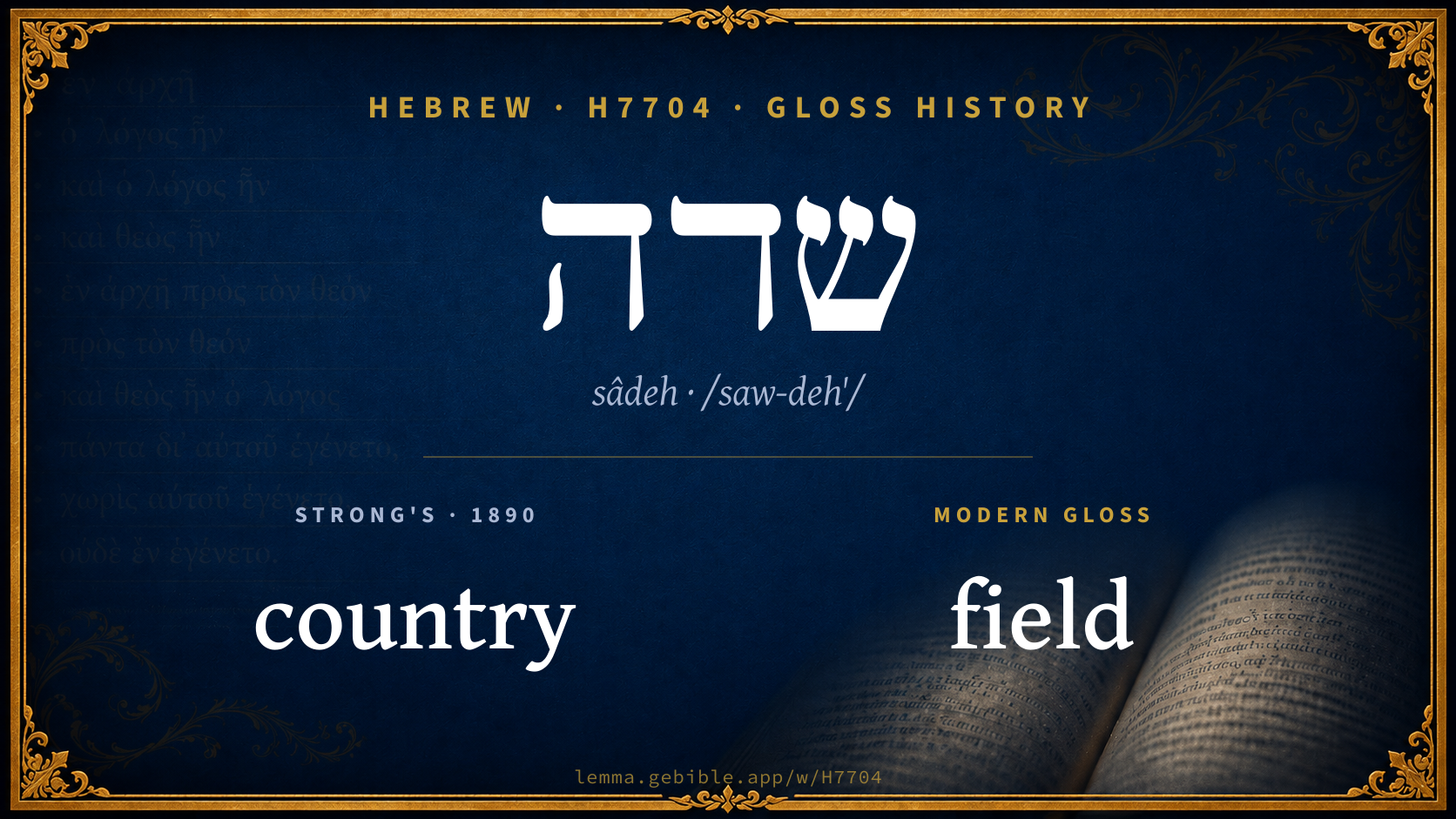
Gloss history
Strong's 1890 vs modern scholarship
About this word
Strong's H7704 catalogs a Hebrew word from the Hebrew Old Testament.
These counts are not copied from any lexicon or concordance. They are computed here, from the morphology-tagged Hebrew Old Testament. What Lemma adds →
- 309
- distinct verses
- The word appears in 309 distinct verses.
- 30 / 39
- OT books
- The word appears in 30 of 39 Old Testament books.
- #147
- by frequency
- Top 250 most frequent Hebrew words (rank 147 of 8,640 Hebrew words by occurrence).
View all 309 occurrences in the concordance →
By section of the Old Testament
By traditional corpus
Conventional, traditional groupings — biblical authorship is debated, so this is a traditional corpus grouping, not an authorship claim. Each share is this word’s portion of its verses in that division of the Hebrew canon. Each figure is a share of the word’s 309 distinct verses.
- Prophets (Nevi'im) 148 verses · 48%
- Torah (Pentateuch) 102 verses · 33%
- Writings (Ketuvim) 59 verses · 19%
How translations render this word
Counts come from each version’s own published word-to-Strong’s tagging or interlinear alignment — an approximate guide to how each version renders this word, not a word-level alignment the data otherwise carries. Because each total is that version’s own tagged count, the per-version totals vary from one another and need not match the appearance or distinct-verse counts above. These counts may also differ from a printed concordance because Lemma counts each distinctly tagged rendering and does not collapse phrase taggings into a single head-word total. This is a fixed set of word-tagged versions (KJV, ASV, BSB, ULT) and does not change with the reading translation you choose elsewhere. Each version’s license is shown beside its name below (and on Sources).
BDB lists this Strong’s number as 2 distinct words (homographs). Each count above pools all of them and is not split by sense — see the Senses section below. A low-frequency rendering may belong to a different one of those words, not the primary meaning.
- King James Version†: Field 214×, Fields 35×, Country 12×
- American Standard Version†: Field 204×, Fields 23×, Country 9×
- Berean Standard Bible†: Field 176×, Fields 50×, Land 18×
- unfoldingWord Literal Text†: Field 221×, Field of 35×, Fields 34×
King James Version Public Domain
Renders H7704 across 333† tagged occurrences — most commonly:
Plus 46 renderings that appear only once — usually multi-word phrases or single function words the recovered tagging swept in, not distinct renderings.
American Standard Version Public Domain
Renders H7704 across 331† tagged occurrences — most commonly:
Plus other, less common renderings. Plus 59 renderings that appear only once — usually multi-word phrases or single function words the recovered tagging swept in, not distinct renderings.
Berean Standard Bible Public Domain
Renders H7704 across 317† tagged occurrences — most commonly:
Plus other, less common renderings. Plus 28 renderings that appear only once — usually multi-word phrases or single function words the recovered tagging swept in, not distinct renderings. Not rendered by a distinct English word in 15 further occurrences.
unfoldingWord Literal Text CC BY-SA 4.0
Renders H7704 across 330† tagged occurrences — most commonly:
Plus 16 renderings that appear only once — usually multi-word phrases or single function words the recovered tagging swept in, not distinct renderings.
19 senses and sub-senses in the full BDB
What do BDB’s symbols mean?
BDB uses these scholarly abbreviations:
| Symbol | Meaning |
|---|---|
| 𝔊 | the Septuagint (the ancient Greek translation, LXX) |
| 𝔙 | the Vulgate (the Latin translation) |
| 𝔖 | the Syriac version (the Peshitta) |
| 𝔗 | the Targum (the Aramaic translation) |
| ψ | the Psalms |
| √ | root (the underlying root or stem) |
| ‖ | parallel passage (a synonymous or contrasted parallel) |
| † | the dagger: every passage where the word occurs is cited |
The 19 senses and sub-senses the full Brown-Driver-Briggs lexicon distinguishes for this word, in lexicon order (not ranked by frequency), with BDB’s own verbatim wording and sub-sense lettering. Shown in Hebrew script with BDB’s own scholarly abbreviations. The condensed entry is in the Lexicon Entry tab. See also the Forms in the corpus table below.
שדה I
- 1. cultivated field 12:12, also 10:4 (si vera l., but v. Now), yielding food Dt 32:13 La 4:9; שֹׁמְרֵי שׂ׳ Je 4:17 keepers, watchmen, of a field. e.g. Hosea 12:12
- 2. home of wild beasts: בְּהֵמוֹת שׂ׳ ψ 8:8 Jo 2:22, חַיְתוֹ שׂ׳ Is 56:9 ψ 104:11, זִיז שׂ׳ 50:11; 80:14. e.g. Psalms 8:8
- 3. plain, opp. mt., Je 18:14 (but dub., Co Du שִׂרְיֹן). e.g. Jeremiah 18:14
- 4. land, opp. sea, ψ 96:12 (cf. שָׂדֶה 3; ‖ תֵּבֵל ψ 98:7). e.g. Psalms 96:12
שדה II
- 1. open field, country:
- a. pasture-land Gn 29:2; 30:16; Ex 9:3 (all J), Dt 11:15; 1 S 11:5 + 10 times J, JE. e.g. Genesis 29:2
- b. unfrequented Gn 24:63, 65, exposed to violence 4:8 (J), 2 S 14:6; Dt 21:1; 22:25, 27, to wild beasts Ex 22:30 (E), Ez 33:27. e.g. Genesis 24:63
- c. specif. home of beasts: 2 S 17:8; Je 14:5; especially phr. חַיַּת הַשּׂ׳ Gn 2:19, 20; 3:1, 14 (all J) of beasts in gen., and, of wild beasts, Ex 23:11, 29 (E), Ho 2:14, 20; 4:3; 13:8; Dt 7:22; Lv 26:22 (H), Jb 5:23 (‖ חַיַּת הָאָרֶץ), + 16 times; בֶּהֱמַת הַשּׂ׳ 1 S 17:44 cf. Jo 1:20; אַיְלוֹת הַשּׂ׳ Ct 2:7; 3:5, cf. הַצְּבָיִם אֲשֶׁר בַּשּׂ׳ 2 S 2:18; hunting-ground Gn 25:29; 27:3, 5 (all JE), cf. אִישׁ שׂ׳ 25:27 (JE; ‖ אִישׁ יֹדֵעַ צַיִד). e.g. 2 Samuel 17:8
- d. yielding plants and trees: Gn 25:27 (JE), 30:14 (J), Ex 10:5 (JE), 2 K 4:39; Ez 21:2; 39:10; especially phr. עֵשֶׂב הַשּׂ׳ Gn 2:5; 3:18 (both J), + 6 times + ע׳ בַּשּׂ׳ Zc 10:1; שִׂיחַ הַשּׂ׳ Gn 2:5, גֶּפֶן שׂ׳ 2 K 4:39, פַּקֻּעֹת שׂ׳ v 39, צִיץ הַשּׂ׳ Is 40:15 ψ 103:15, צֶמַח הַשּׂ׳ Ez 16:7; עֵץ חַשּׂ׳ (4 times עֲצֵי) Ex 9:25 (JE), Dt 20:19; Lv 26:4 (H) Is 55:12 + 8 times; 2 S 1:21 v. תְּרוּמָה, √ רום. e.g. Genesis 25:27
- e. stony, אַבְנֵי הַשּׂ׳ Jb 5:23. e.g. Job 5:23
- f. open country, outside of walled city Ju 9:32, 42, 43, 44; 19:16; 1 S 19:3; 20:5, 11(×2), 24, 35; 2 K 7:12 Mi 4:10; as battle-ground Jos 8:24 (J), 2 S 10:8 = 1 Ch 19:9; 2 S 11:23; 18:6, outside of military camp 1 S 4:2; 14:15; opp. city (in formula) 1 K 14:11; 16:4; 21:24; Je 14:18; Ez 7:15; שְׂדֵה אֶרֶץ Lv 25:31; as site of small town, country-town 1 S 27:5 (opp. royal city), cf. 1 Ch 27:25; of high places, גְּבָעוֹת בַּשּׂ׳ Je 13:27; quite gen., 1 S 30:11; Je 40:7, 13; including road Ju 20:31; 1 K 11:29; Je 6:25; disting. from road Nu 22:23 (JE), 2 S 20:12; outside houses and courtyards Ex 8:9 (P), 1 S 25:15; בַּשּׂ׳ nearly = outdoors Ex 1:14 (P), Ju 13:9; of surface of country or ground, בַּשּׂ׳ Ex 16:25 (JE); = עַל־פְּנֵי הַמִּדְבָּר v 14), cf. 1 S 14:25; so עַל־פְּנֵי הַשּׂ׳ (אֶל) 2 K 9:37; Je 9:22; Ez 29:5 (‖ הַמִּדְבָּ֫רָה), 32:4; 39:5; sample phr. opp. house, comfort, etc., 2 S 11:11; Ez 16:5, opp. city Lv 14:7, 53, opp. tent Nu 19:16 (all P), opp. tent of meeting Lv 17:5 (H). e.g. Judges 9:32
- g. = expanse of country, opp. mt., in phr. מְרוֹמֵי שׂ׳ Ju 5:18; הֲרָרִי בַּשּׂ׳ Je 17:3 (of Jerus.) is dub.; cf. לְעִי הַשּׂ׳ Mi 1:6 (Je 18:14 v. שָׂדַי). e.g. Judges 5:18
- 2. definite portion of ground, field, land:
- a. cultivated ground Gn 37:7 (E), 47:24 (J; זֶרַע הַשָּׂדֶה), Ex 22:4(×3), 5 (E), Lv 27:16, 17 (P), Mi 3:12 (in sim.) Ru 2:2 + 47 times, + שְׂדֵי תְרוּמוֹת 2 S 1:21, שׂ׳־זָ֑רַע Ez 17:5, שָׂדֶה טוֹב v 8 good soil. e.g. Genesis 37:7
- b. as private property, Mi 2:2, 4; Is 5:8(×2); Gn 47:20 (J), 23:9, 11, 13 (P) + 50 times, + 2 Ch 26:23 (as burial-place); also חֶלְקַת (הַ)שּׂ׳, v. חֶלְקָה; and שׂ׳ צֹפִים, v. צפה. e.g. Micah 2:2
- c. city-land, adjacent to city (town) and subject to its control: Gn 41:48 (E), Lv 25:34 (P), Jos 21:12 (P) = 1 Ch 6:41; Ne 11:25; 30; 12:39, 44; specif. of Zoan ψ 78:12, 43. e.g. Genesis 41:48
- d. territory of nation, tribe: Gn 32:4; Nu 21:20 (both JE), Ju 5:4; Ru 1:1, 2; Gn 14:7 + 13 times + שְׂדֵה נַחֲלַת יִשׂ׳ Ju 20:6. e.g. Genesis 32:4
- e. personal estate of king, 2 S 9:7; 19:30. e.g. 2 Samuel 9:7
- 3. land, opp. sea, 1 Ch 16:32 (opp. הַיָּם; = שָׂדַי ψ 96:12), perhaps also mainland Ez 26:6, 8 (Co Krae Toy al.; not Sm). e.g. 1 Chronicles 16:32
Senses from the full Brown-Driver-Briggs lexicon (Brown, Driver, Briggs; Oxford 1906 — public domain), digitized via Sefaria, supplemented by the OpenScriptures HebrewLexicon (CC BY 4.0). Full attribution on Sources.
Word origin
I. n.m. ψ 96:12 field, land (rare orig. form of שָׂדֶה (q.v. infr.), only poet.);—abs. שׂ׳ Je 4:17, שָׂדָ֑י Ho 10:4 +;—
I. n.m. Lv 27:24 id. (ordinary contr. form Ges§ 84 a f);—abs. שׂ׳ Gn 2:5(×2) +; cstr. שְׂדֵה 14:7 +; sf. שָׂדִי Je 32:7, 8, שָֽׂדְךָ Dt 11:15 +, שָׂדֶ֑ךָ 24:19 Lv 25:3, etc.; pl. שָׂדוֹת 1 S 22:7 +, cstr. שְׂדוֹת Ne 12:29; also שְׂדֵי 2 S 1:21; Is 32:12; Ru 1:1 + 8 times (some might be sg. = שְׂדֵה cf. BaZMG xiii (1888), 351 SS Buhl; note, e.g. שְׂדֵי Ru 1:6a, = שְׂדֵה v b; 4:3; but v. Köii. 1, 77); sf. שְׂדֹתֶיהָ Ne 11:30, etc.; also שָׂדֶיךָ 1 K 2:26, שָׂדֵינוּ Mi 2:4;—
— Brown-Driver-Briggs (Oxford 1906, public domain), digitized via Sefaria, supplemented by the OpenScriptures HebrewLexicon (CC BY 4.0). See Sources.
Origin: from an unused root meaning to spread out
Jastrow Dictionary
A second Hebrew/Aramaic lexicon for comparison, covering Aramaic and post-biblical (Talmudic, Targumic, Midrashic) usage that the biblical-Hebrew BDB does not. Matched by lemma rather than by Strong’s number, so a lemma may carry more than one Jastrow headword (shown separately below), and the entries cover usage well beyond the Bible.
שֵׁדָה
- , pl. שֵׁדוֹת, v. שֵׁד.
שִׁדָּה
- , v. שִׁידָּה
שָׂדֶה
- c. (b. h.; cmp. שָׂדַד; v. Del. Assyr. Handw. s. v. šid(d) u, p. 64
- 2. tract of land, field. Shebi. I, 1, a. fr. שְׂדֵה האילן a cultivated field in which trees grow, opp. שְׂ׳ הלבן, v. לָבָן. Sifra B’ḥuck., Par. 4, ch. XI (ref. to Lev. XXVII, 21) מגיד שהש׳ קרוי לשון זכר וכ׳ this proves that sadeh is of masculine gender in the sacred (Biblical) language. Arakh. VIII, 1 המקדיש את שָׂדֵהוּ if a man consecrates his field. Ib. VII, 5 הלוקח … כשְׂ׳ אחוזה if a man bought a field of his father, and his father died, and after this he consecrated it, it is legally treated as an inherited field (Lev. XXVII, 16), contrad. to שְׂ׳ מקנה a purchased field (ib. 22); a. fr.—Keth. I, 6, a. e. נסתחפה שדהו, שָׂדְךָ, v. סָחַף.—Tosef. Shebi. VI, 21 ירקות סָדֶה ed. Zuck. (Var. ש׳) vegetable growing in the field (in the Sabbatical year).—Pl. שָׂדוֹת. Arakh. IX, 5 כל שהוא … חוץ מן הש׳ whatever is within a city wall is legally the same as houses, except fields. Ib. 7; a. fr. e.g. Leviticus 27:21
A Dictionary of the Targumim, the Talmud Babli and Yerushalmi, and the Midrashic Literature (Marcus Jastrow; London, Luzac, 1903) — Public Domain. Digitized via Sefaria. Digitized via Sefaria. Full attribution on Sources.
Forms in the corpus
The 113 distinct written forms H7704 takes in the Hebrew Bible, most frequent first — each parse links to that state’s occurrences in the concordance. Hebrew forms include their vowel points and cantillation, so a single lemma takes many written forms.
The 60 most common forms are shown; 53 rarer forms follow in the full concordance.
Same root — word family
Other BDB entries built from the same root as H7704, grouped by Strong’s listed origin. These share a root / origin per the lexicon — not necessarily a shared meaning. Each links to that word’s own entry.
Derived from this word
Proper names from this root
People and places named from this root — a name, not an additional meaning of the word.
Compare all same-root words → 2 of the same-root words are proper names (people or places). They share a root, not necessarily a meaning.
Septuagint verse parallels
This word appears in 289 verses that also exist in the Greek Old Testament (Septuagint), out of the 309 Hebrew verses it occurs in. You can read those verses in Greek by switching the Old Testament edition to the Septuagint.
Read these verses in the Septuagint
- Genesis 2:5
- Exodus 1:14
- Leviticus 14:7
- Numbers 16:14
- Deuteronomy 5:21
- Joshua 8:24
- Judges 1:14
- Ruth 1:1
- 1 Samuel 4:2
- 2 Samuel 1:21
- 1 Kings 2:26
- 2 Kings 4:39
This is a verse-level parallel only — the same verses exist in both the Hebrew and Greek Old Testaments. No word-level Hebrew↔Greek correspondence is claimed: the data carries no such alignment, so no Greek word is shown as this Hebrew word’s translation. Coverage is not total — the Septuagint omits the deuterocanon and renumbers the Psalms, so some Hebrew verses have no direct Greek parallel.