
Psalms 96:12

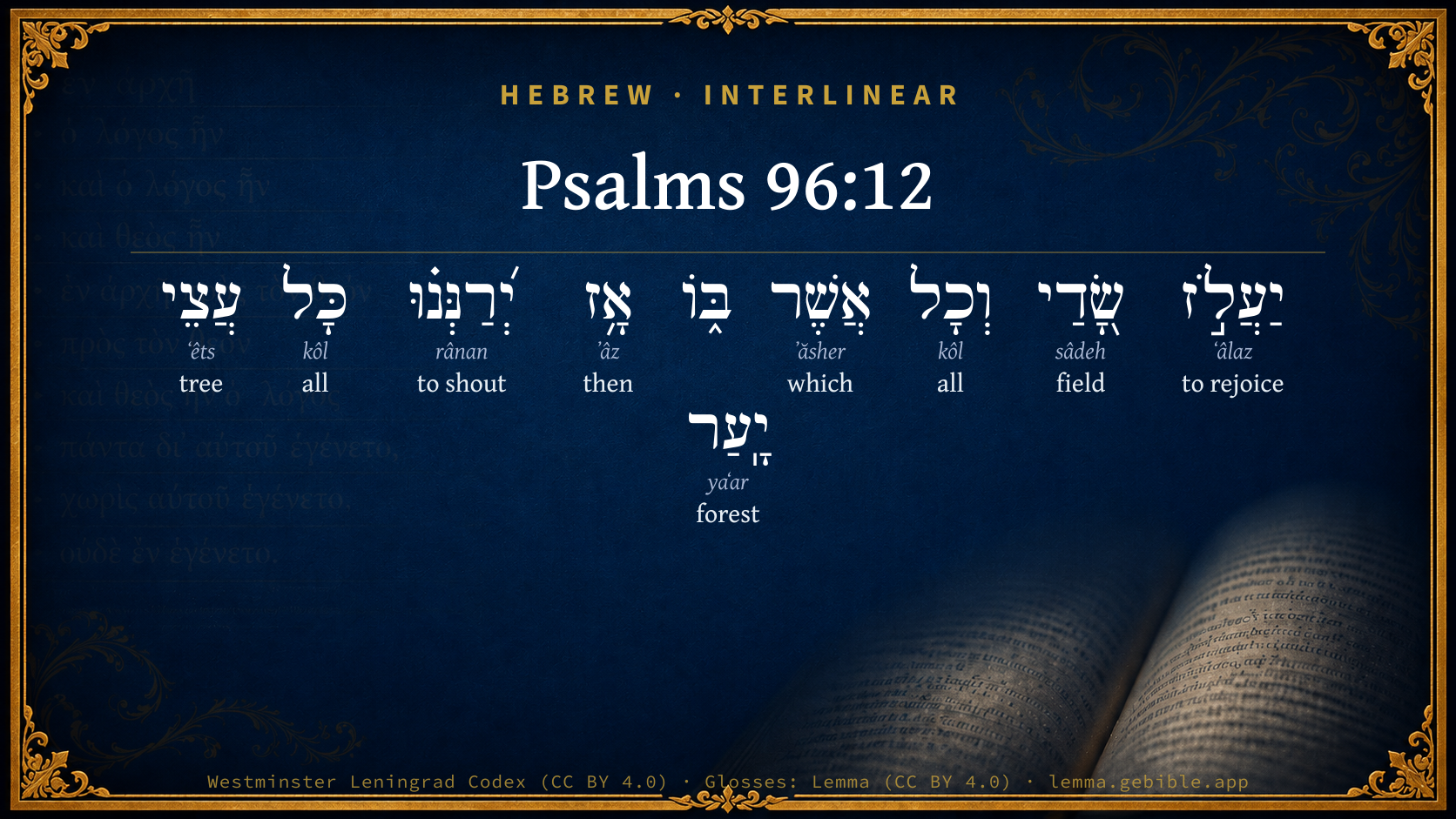
Hebrew (Westminster Leningrad Codex) Psalms 96:12 appears in the Hebrew Old Testament. The text above is from the Westminster Leningrad Codex. Each word links to its Strong’s number, a concise gloss, and parsing drawn from the Open Scriptures Hebrew Bible morphology. Click any word for its full Brown-Driver-Briggs (BDB) entry.
Download image
Cite this verse

Psalms 96:12 (World English Bible). Public Domain. Lemma interlinear Bible study tool, https://lemma.gebible.app/v/psalms/96/12.

Show BibTeX & RIS
BibTeX
RIS
English Translation
Let the field and all that is in it exult! Then all the trees of the woods shall sing for joy
World English Bible · Public Domain
Download a study sheet

One document with this verse’s original text, its word-by-word gloss line, the meaning frame, cross-references with their text, attributed commentary, and full source and license credits — printable, and it pastes into notes with its structure intact.

This verse Autodidact and up

Study sheet (.html) Plain text (.txt)

A passage Seminary Student

Up to 50 verses in one chapter. A passage sheet keeps up to 6 commentary sources and 12 cross-references per verse, in the order this page ranks them, and says so on the sheet whenever that leaves anything out. Ask for a single verse and you get the Autodidact verse sheet above.

Everything on this page stays free to read, with no account — the sheet is a download of what is already on screen, not access to it.

Want to remove ads? Support Godless Engineer
Compare translations 3

The same verse in 3 English versions, stacked beneath the original-language interlinear above. Click any original word for its lexicon entry.

Each is an independent rendering of the whole verse — the interlinear is not word-aligned to these translations.

Highlighted words mark where these versions differ — a whole-verse word diff, not a word-by-word alignment.

  • World English Bible Public Domain
    Let the field and all that is in it exult! Then all the trees of the woods shall sing for joy
  • King James Version Public Domain
    Let the field be joyful, and all that is therein: then shall all the trees of the wood rejoice
  • unfoldingWord Literal Text CC BY-SA 4.0
    Let the fields rejoice and all that is in them. Then let all the trees in the forest shout for joy

unfoldingWord Literal Text — © unfoldingWord, licensed CC BY-SA 4.0. Word-aligned USFM3 via Door43 (git.door43.org/unfoldingWord/en_ult).

Versions to compare (up to 4)

3 of 4 selected

Show all 18 translations

Every available English version of this verse, each an independent rendering of the whole verse.

  • World English Bible Public Domain
    Let the field and all that is in it exult! Then all the trees of the woods shall sing for joy
  • Berean Standard Bible Public Domain
    Let the fields exult, and all that is in them. Then all the trees of the forest will sing for joy
  • Majority Standard Bible Public Domain
    Let the fields exult, and all that is in them. Then all the trees of the forest will sing for joy
  • King James Version Public Domain
    Let the field be joyful, and all that is therein: then shall all the trees of the wood rejoice
  • American Standard Version (1901) Public Domain
    Let the field exult, and all that is therein; Then shall all the trees of the wood sing for joy
  • Revised Version (1885) Public Domain
    Let the field exult, and all that is therein; then shall all the trees of the wood sing for joy;
  • Geneva Bible (1599) Public Domain
    Let the field be ioyfull, and all that is in it: let all the trees of the wood then reioyce
  • Douay-Rheims (1899) Public Domain
    the fields and all things that are in them shall be joyful. Then shall all the trees of the woods rejoice
  • Young's Literal Translation Public Domain
    The field exulteth, and all that `is' in it, Then sing do all trees of the forest,
  • Literal Standard Version CC BY-SA 4.0
    The field exults, and all that [is] in it, || Then all trees of the forest sing,
  • Unlocked Literal Bible CC BY-SA 4.0
    Let the fields rejoice and all that is in them. Then let all the trees in the forest shout for joy
  • unfoldingWord Literal Text CC BY-SA 4.0
    Let the fields rejoice and all that is in them. Then let all the trees in the forest shout for joy
  • Darby Bible Public Domain
    Let the field exult and all that is therein. Then shall all the trees of the forest sing for joy,
  • World Messianic Bible Public Domain
    Let the field and all that is in it exult! Then all the trees of the woods shall sing for joy
  • Webster's Bible Public Domain
    Let the field be joyful, and all that is in it: then shall all the trees of the wood rejoice before the LORD:
  • Free Bible Version CC BY-SA 4.0
    Let the fields and everything there celebrate; let all the trees in the forest sing for joy.
  • Bible in Basic English Public Domain
    Let the field be glad, and everything which is in it; yes, let all the trees of the wood be sounding with joy,
  • JPS Tanakh (1917) Public Domain
    Let the field exult; and all that is therein; then shall all the trees of the wood sing for joy;

Literal Standard Version (2020), Covenant Press — licensed CC BY-SA 4.0. Text via the HelloAO Bible API (eBible.org). Unlocked Literal Bible (unfoldingWord) — licensed CC BY-SA 4.0. Text via the HelloAO Bible API (eBible.org). unfoldingWord Literal Text — © unfoldingWord, licensed CC BY-SA 4.0. Word-aligned USFM3 via Door43 (git.door43.org/unfoldingWord/en_ult). Free Bible Version, Dr. Jonathan Gallagher — licensed CC BY-SA 4.0. Text via the HelloAO Bible API (eBible.org).

Word by word

More ways to search: Search by grammar → Find every occurrence → Compare this word →

Practice this passage: Drill this verse → Learn its vocabulary →

About this verse

These counts appear in no published source. They are computed here, from the morphology-tagged text and Lemma’s own curated glosses. What Lemma adds →

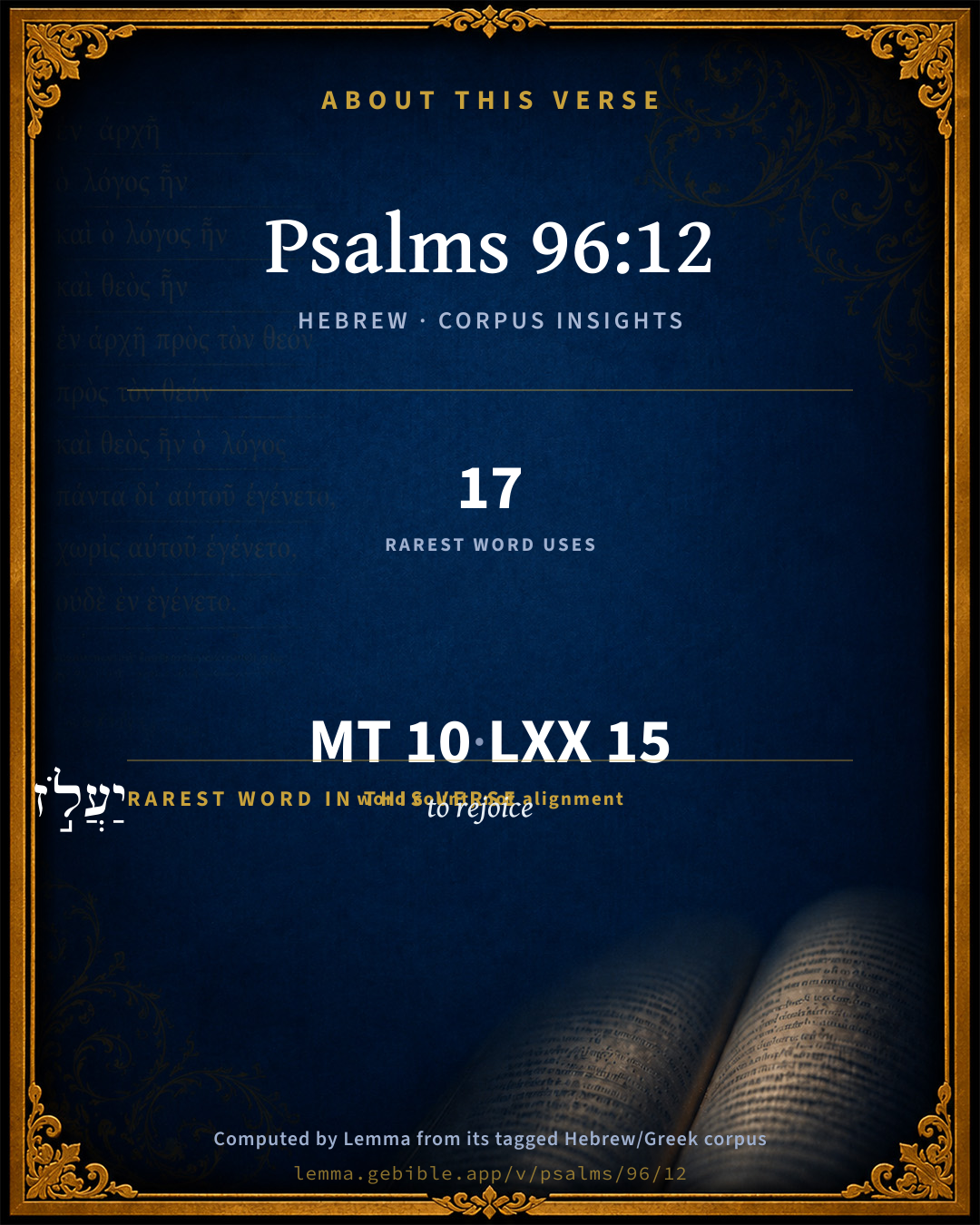
10
words
8
distinct lemmas
Wisdom
section

Notable vocabulary

The rarest word here is יַעֲלֹ֣ז to rejoice H5937 — appearing just 17 times in the whole Hebrew Bible.

Shared distinctive vocabulary

יַעֲלֹ֣ז to rejoice H5937 occurs in 16 verses of the Hebrew Bible. Also found in:

Grammatical profile

  • 2 verbs
  • 5 nouns
  • 1 preposition
  • 1 adverb
  • 1 particle

Verb forms

  • יַעֲלֹ֣ז Qal · Imperfect
  • יְ֝רַנְּנ֗וּ Piel · Imperfect

Repetition

A word recurs within this verse — often emphatic in Hebrew:

  • וְכָל all H3605 ×2

Hebrew & Septuagint length

In English translation the verse runs 21 words from the Hebrew and 24 from the Septuagint (LXX English) — closely comparable.

A rough comparison of the two English renderings, which tokenize alike — not a word-level alignment.

Word counts can differ between the Hebrew and the Greek without any difference in meaning — e.g. the Hebrew direct-object marker אֵת has no separate Greek word, and Greek often adds the article ὁ.

In the original languages it is 10 Hebrew tokens and 15 Greek tokens — but the two are counted differently (Hebrew bundles its prefixes and suffixes into one token; the Greek is in lemma form), so that isn’t a like-for-like length.

Cross-references

5

Topical passages linked to Psalms 96:12 in the Treasury of Scripture Knowledge — connected by theme and wording, ordered by reader-vote popularity; previews shown in the World English Bible.

  • Isaiah 55:12–13 For you shall go out with joy, and be led forth with peace: the mountains and the hills shall break forth before you into singing; and all the trees of the fields shall clap their hands.
  • Isaiah 35:1 The wilderness and the dry land shall be glad; and the desert shall rejoice, and blossom as the rose.
  • Isaiah 42:10–11 Sing to Yahweh a new song, and his praise from the end of the earth; you who go down to the sea, and all that is therein, the isles, and the inhabitants of it.
  • Isaiah 44:23 Sing, you heavens, for Yahweh has done it; shout, you lower parts of the earth; break forth into singing, you mountains, O forest, and every tree therein: for Yahweh has redeemed Jacob, and will glorify himself in Israel.
  • Psalms 65:12–13 The wilderness grasslands overflow. The hills are clothed with gladness.

Cross-references courtesy of OpenBible.info (CC BY 4.0).

Hebrew and Greek witnesses Masoretic Hebrew ↔ Greek Septuagint

The same verse in the two great witnesses to the Old Testament, shown verse-for-verse.

You’re reading Greek Psalm 95 (Hebrew Psalm 96). The Septuagint counts the superscription, so verse numbers can differ from the Hebrew — chapter-level alignment, not verse-by-verse. Numbering follows Rahlfs.

These are two independent witnesses, not word-aligned to each other, and the Septuagint is shown in lemma (dictionary) form.

Hebrew Psalms 96:12 Masoretic · Westminster Leningrad Codex

יַעֲלֹ֣ז שָׂ֭דַי וְכָל אֲשֶׁר בּ֑וֹ אָ֥ז יְ֝רַנְּנ֗וּ כָּל עֲצֵי יָֽעַר

Let the field and all that is in it exult! Then all the trees of the woods shall sing for joy

World English Bible · Public Domain

Greek LXX Greek Psalm 95:12 Septuagint · lemma form

χαίρω ὁ πεδίον καί πᾶς ὁ ἐν αὐτός τότε ἀγαλλιάομαι πᾶς ὁ ξύλον ὁ δρυμός

The plains shall rejoice, and all things in them: then shall all the trees of the wood exult before the presence of the Lord:

LXX2012 (modern English Septuagint) · Public Domain

Hebrew: Westminster Leningrad Codex (CC BY 4.0). Greek: Septuagint (public domain); English from LXX2012 (modern English Septuagint) (Public Domain). How the Septuagint differs from the Hebrew →

Commentary

Notes on Psalms 96:12 from classic Christian and Jewish commentators (each source and its license shown beneath its notes). The classic Christian expositions comment on the surrounding passage and are grouped to its opening verse, so a note may address several verses; the Jewish commentaries on the Tanakh (Rashi and others) are per-verse, so they appear only where the commentator wrote on this verse.

Lemma curates 59 commentaries, every one of them public domain or Creative Commons licensed, each selected and text-cleaned for this edition rather than reprinted as found. About our sources →

Trapp's Complete Commentary

John Trapp

Psa 96:12 Let the field be joyful, and all that [is] therein: then shall all the trees of the wood rejoice

Ver. 12. Let the field be joyful, &c.] And so give check to the hardness of man’s heart, not at all affected with those benefits by Christ, wherein they are far more concerned than these insensible creatures; which yet have lain bedridden, as it were, ever since man’s fall, and earnestly wait for the manifestation of the sons of God, Rom 8:19.

John Trapp, A Commentary or Exposition upon All the Books of the Old and New Testament (1647–1656) — public domain. Text from a community e-Sword module.

J. A. Alexander on Psalms

Joseph Addison Alexander

12. (Psa 96:12) Let the field exult, and all that (is) in it ; then shall sing for joy all trees of the wood (or forest). The strict sense of the future, which was latent in the preceding verse, here, by a beautiful transition, reasserts itself. See below, on Psa 126:2, and compare Isa 24:5-6. The field is the cultivated and productive portion of the earth. All that is in it, with particular reference to its productions. Sing for joy is the translation of a single verb in Hebrew. See above, on Psa 95:1. The parallel passage (1Ch 16:32-33) has precisely the same sense, but with two slight variations in the words, a less familiar form being substituted in one case, and a more familiar form in the other.

Joseph Addison Alexander, The Psalms Translated and Explained (1850) — public domain. Text from a community e-Sword module.

Tyndale Open Study Notes

Tyndale Open Resources

96:12 All of nature will experience renewal in God’s presence (65:13; 72:6, 16; Isa 44:23; 55:12; Rom 8:21-22).

Tyndale Open Study Notes — © Tyndale Open Resources, licensed CC BY-SA 4.0. Text via the HelloAO Bible API.

Geneva Bible (1599)

Geneva Bible translators

If the insensible creatures shall have cause to rejoice, when God appeareth, much more we, from whom he hath taken malediction and sin.

Geneva Bible (1599) marginal notes — public domain. Text via Bolls.life.

Adam Clarke's Commentary

Verse 12. Thou sal glad al the trese of woddes. - Thou, that is in another Iyfe. Trese of woddes. - Synful men that were fyrst withouten frut, and sithen taken into God's temple.

Adam Clarke's Commentary on the Bible (1810–1826) — public domain. Text from a community e-Sword/MySword module.

Ellicott's Commentary for English Readers

(12) Then shall all the trees . . .—Comp.—

“His praise, ye winds that from four quarters blow,

Breathe soft or loud, and wave your tops ye pines,

With every plant in sign of worship wave.”—MILTON.

A Bible Commentary for English Readers, edited by Charles John Ellicott (1878–1897) — public domain. Text from a community e-Sword module.

The Cambridge Bible for Schools and Colleges

gen. ed. J. J. S. Perowne

12. be joyful … rejoice] Exult … sing for joy (R.V.). Then is significant: in that age when the Divine kingdom is universally established.

The Cambridge Bible for Schools and Colleges (gen. ed. J. J. S. Perowne; Cambridge University Press, 1878–1918) — public domain. Text from a community e-Sword module.

John Gill's Exposition

Let the field be joyful, and all that is therein,.... Not the field of the world, but of the church, separated from others by distinguishing grace; the peculiar property of Christ, cultivated and manured by his Spirit and grace, and abounding with the fruits and flowers thereof; of a wilderness becoming a fruitful field, and for that reason should rejoice, even with joy and singing, Isa 35:1,

then shall all the trees of the wood rejoice; the sons of God, so called, Sol 2:3, who, though like such, in their nature state, barren and unfruitful, yet, being ingrafted into Christ, become trees of righteousness; and so have reason to rejoice at their root in Christ, their stability by him, and fruitfulness through him: Jarchi interprets this of all the governors of the people; see Eze 17:24, all this, indeed, by a prosopopoeia, may be understood of inanimate creatures; the heavens, earth, and sea, fields, woods, and trees, rejoicing, if they could, and in their way, at such great and wonderful appearances in the Gentile world; see Isa 44:23. Aben Ezra interprets all this of the heavens giving dew, the earth its increase, and the field its fruit; all which is rejoicing.

John Gill's Exposition of the Whole Bible (1746–1763) — public domain (CC PDM 1.0). Text via the HelloAO Bible API.

Albert Barnes' Notes on the Bible

Let the field be joyful ... - This is taken - with the change of a single letter, not affecting the sense - from 1Ch 16:32-33. It is a call on the fields - the cultivated portions of the earth - to rejoice in the reign of God. As if conscious of the beauty with which he clothes them, and of the happiness which they confer on man in their beauty and in the abundance of their productions, they are called on to praise God.

Then shall all the trees of the wood rejoice - The forests - the oaks, the cedars, the pines, that wave with so much majesty. If they were conscious of their own magnificence and beauty - if they could see how much wisdom and goodness God has lavished on them, in their forms, their branches, their leaves, their flowers, their fruit - if they could know how much they are made to accomplish in rendering the world beautiful, and in contributing to the happiness of man - if they understood what a bare, bleak, cold, desert world this would be but for them, they, too, would have abundant occasion for praise and joy.

Albert Barnes' Notes on the Bible (1834–1885) — public domain. Text from a community e-Sword/MySword module.

The Treasury of David

Charles H. Spurgeon

Ver. 12. Let the field be joyful, and all that is therein. Let the cultivated plains praise the Lord. Peace enables their owners to plough and sow and reap, without fear of the rapine of invaders, and therefore in glad notes they applaud him whose empire is peace. Both men, and creatures that graze the plain, and the crops themselves are represented as swelling the praises of Jehovah, and the figure is both bold and warranted, for the day shall come when every inhabited rood of ground shall yield its song, and every farmstead shall contain a church.

Then shall all the trees of the wood rejoice. He does not say, let them rejoice, but they shall do so. The faith of the psalmist turns itself from the expression of desire to the fully assured prediction of the event. Groves have in old times stood shuddering at the horrid orgies which have been performed within their shade, the time shall come when they shall sing for joy because of the holy worship, the sounds of which they shall hear. The bush is the stronghold of savage men and robbers, but it shall be sanctified to retirement and devotion. Perhaps the psalmist was thinking of the birds; so Keble must have supposed, for he versifies the passage thus

"Field exults and meadow fair,

With each bud and blossom there,

In the lonely woodlands now

Chants aloud each rusting bough."

Ver. 12. Let the fields be joyful, etc. Let the husbandmen, and the shepherds, and all that dwell in the fields leap for joy; and the woodmen and foresters shout for joy, to see the happy day approaching; when all the idols that are worshipped there shall be thrown down together with their groves. Symon Patrick.

Ver. 12. Rejoice. The verb wgr expresses the vibratory motion, either of a dancer's feet, or of a singer's lip. Samuel Horsley.

Ver. 12. The trees of the wood.

His praise, ye winds, that from four quarters blow,

Breathe soft or loud; and wave your tops, ye Pines,

With every plant, in sign of worship wave. John Milton.

Ver. 12-13. He cometh, etc.

It chanced upon the merry, merry Christmas eve,

I went sighing past the church across the moorland dreary

"Oh! never sin and want and woe this earth will leave,

And the bells but mock the wailing round, they sing so

cheery.

How long O Lord! how long before thou come again?

Still in cellar, and in garret, and on moorland dreary

The orphans moan, and widows weep, and poor men toil in

vain,

Till earth is sick of hope deferred, though Christmas bells

be cheery."

Then arose a joyous clamour from the wild fowl on the mere,

Beneath the stars, across the snow, like clear bells

ringing.

And a voice within cried. "Listen! Christmas carols even

here!

Though thou be dumb, yet over their work the stars and

snows are singing.

Blind! I live, I love, I reign: and all the nations

through

With the thunder of my judgments even now are ringing;

Do thou fulfil thy work but as yon wild fowl do,

Thou wilt heed no less the wailing, yet hear through it

angels singing." Charles Kingsley, 1858.

Psalms 96:13*

Charles H. Spurgeon's The Treasury of David (1869–1885) — public domain. Psalms only. Text from a community e-Sword/MySword module.

The Pulpit Commentary

Let the field be joyful; i.e. "the cultivated ground." And all that is therein. Its vines, its olives, its other fruits, and its harvests. Then shall all the trees of the wood rejoice before the Lord. Lebanon and Bashan shall rejoice equally with Carmel and Sharon. The whole earth shall "break forth into singing". (see Isa_44:23)

The Pulpit Commentary (1880–1919), ed. H.D.M. Spence-Jones & Joseph S. Exell — public domain. Text from a community e-Sword module.

Keil & Delitzsch

C. F. Keil & F. Delitzsch

The chronicler changes שׂדי into the prosaic השּׂדה, and כל־עצי־יעל with the omission of the כל into עצי היּער. The psalmist on his part follows the model of Isaiah, who makes the trees of the wood exult and clap their hands, Psa 55:12; Psa 44:23. The אז, which points into this festive time of all creatures which begins with Jahve's coming, is as in Isa 35:5. Instead of לפני, "before," the chronicler has the מלּפני so familiar to him, by which the joy is denoted as being occasioned by Jahve's appearing. The lines Psa 96:13 sound very much like Psa 9:9. The chronicler has abridged Psa 96:13, by hurrying on to the mosaic-work portion taken from Ps 105. The poet at the close glances from the ideal past into the future. The twofold בּא is a participle, Ew. 200. Being come to judgment, after He has judged and sifted, executing punishment, Jahve will govern in the righteousness of mercy and in faithfulness to the promises.

Keil & Delitzsch — Biblical Commentary on the Old Testament (1861–1891) — public domain (CC PDM 1.0). Text via the HelloAO Bible API. (Old Testament only.)

Rashi

Rabbi Shlomo Yitzchaki (Rashi)

all the forest trees All the rulers of the nations.

Rashi on the Tanakh — English translations: “The Judaica Press complete Tanach with Rashi, translated by A. J. Rosenberg” (CC BY 4.0); “Pentateuch with Rashi's commentary by M. Rosenbaum and A.M. Silbermann, 1929-1934” (public domain); “The Metsudah Tanach series, Lakewood, N.J” (CC BY 4.0); and “The Book of Joshua, Metsudah Publications, 1997” (CC BY 4.0). Text via Sefaria.

Lesson kit

Teaching starters — assembled from the data on this page, not authored interpretation. Every prompt links to the verse data it draws on. Edit before teaching.

Psalms, in the Wisdom, opens this verse with 10 words (8 distinct Hebrew lemmas). Its most distinctive word is ʻâlaz (“to rejoice”). A historical commentator’s framing appears above. Read the whole chapter for the surrounding context.

Discussion questions

  1. The word ʻâlaz carries the sense “to rejoice.” How does it shape the verse?
  2. 2 Samuel 1:20 shares the word «to rejoice» with this verse. How do the two illuminate each other?
  3. “all” occurs 2× in this one verse. What is the effect of the repetition?
  4. These translations render this verse differently. What is at stake in choosing one wording over another?
  5. The verb «יַעֲלֹ֣ז» is Qal Imperfect. How does its form color the action?
  6. Reading how Trapp's Complete Commentary and J. A. Alexander on Psalms read this verse, where do the two commentators agree and where do they part?

Things to notice

Reading settings

Reading text

Shown beneath each verse's original-language words.

Old Testament
Old Testament edition

Read the OT as the Masoretic Hebrew (MT) or the Greek Septuagint (LXX).

English shown for the Greek Septuagint (in the Hebrew ↔ Greek comparison).

Comparing translations? Open the Compare panel on any verse page to stack up to four side by side.