
Genesis 25:9

Hebrew (Westminster Leningrad Codex) Genesis 25:9 appears in the Hebrew Old Testament. The text above is from the Westminster Leningrad Codex. Each word links to its Strong’s number, a concise gloss, and parsing drawn from the Open Scriptures Hebrew Bible morphology. Click any word for its full Brown-Driver-Briggs (BDB) entry.
Download image
Cite this verse

Genesis 25:9 (World English Bible). Public Domain. Lemma interlinear Bible study tool, https://lemma.gebible.app/v/genesis/25/9.

Show BibTeX & RIS
BibTeX
RIS
English Translation
Isaac and Ishmael, his sons, buried him in the cave of Machpelah, in the field of Ephron, the son of Zohar the Hittite, which is before Mamre,
World English Bible · Public Domain
Download a study sheet

One document with this verse’s original text, its word-by-word gloss line, the meaning frame, cross-references with their text, attributed commentary, and full source and license credits — printable, and it pastes into notes with its structure intact.

This verse Autodidact and up

Study sheet (.html) Plain text (.txt)

A passage Seminary Student

Up to 50 verses in one chapter. A passage sheet keeps up to 6 commentary sources and 12 cross-references per verse, in the order this page ranks them, and says so on the sheet whenever that leaves anything out. Ask for a single verse and you get the Autodidact verse sheet above.

Everything on this page stays free to read, with no account — the sheet is a download of what is already on screen, not access to it.

Want to remove ads? Support Godless Engineer
Compare translations 3

The same verse in 3 English versions, stacked beneath the original-language interlinear above. Click any original word for its lexicon entry.

Each is an independent rendering of the whole verse — the interlinear is not word-aligned to these translations.

Highlighted words mark where these versions differ — a whole-verse word diff, not a word-by-word alignment.

  • World English Bible Public Domain
    Isaac and Ishmael, his sons, buried him in the cave of Machpelah, in the field of Ephron, the son of Zohar the Hittite, which is before Mamre,
  • King James Version Public Domain
    And his sons Isaac and Ishmael buried him in the cave of Machpelah, in the field of Ephron the son of Zohar the Hittite, which is before Mamre;
  • unfoldingWord Literal Text CC BY-SA 4.0
    Then Isaac and Ishmael his sons buried him in the cave of Machpelah, in the field of Ephron the son of Zohar the Hittite, which before Mamre,

unfoldingWord Literal Text — © unfoldingWord, licensed CC BY-SA 4.0. Word-aligned USFM3 via Door43 (git.door43.org/unfoldingWord/en_ult).

Versions to compare (up to 4)

3 of 4 selected

Show all 18 translations

Every available English version of this verse, each an independent rendering of the whole verse.

  • World English Bible Public Domain
    Isaac and Ishmael, his sons, buried him in the cave of Machpelah, in the field of Ephron, the son of Zohar the Hittite, which is before Mamre,
  • Berean Standard Bible Public Domain
    His sons Isaac and Ishmael buried him in the cave of Machpelah near Mamre, in the field of Ephron son of Zohar the Hittite.
  • Majority Standard Bible Public Domain
    His sons Isaac and Ishmael buried him in the cave of Machpelah near Mamre, in the field of Ephron son of Zohar the Hittite.
  • King James Version Public Domain
    And his sons Isaac and Ishmael buried him in the cave of Machpelah, in the field of Ephron the son of Zohar the Hittite, which is before Mamre;
  • American Standard Version (1901) Public Domain
    And Isaac and Ishmael his sons buried him in the cave of Machpelah, in the field of Ephron the son of Zohar the Hittite, which is before Mamre.
  • Revised Version (1885) Public Domain
    And Isaac and Ishmael his sons buried him in the cave of Machpelah, in the field of Ephron the son of Zohar the Hittite, which is before Mamre;
  • Geneva Bible (1599) Public Domain
    And his sonnes, Izhak and Ishmael buryed him in the caue of Machpelah, in the fielde of Ephron sonne of Zohar the Hittite, before Mamre.
  • Douay-Rheims (1899) Public Domain
    And Isaac and Ismael his sons buried him in the double cave, which was situated in the field of Ephron the son of Seor the Hethite, over against Mambre;
  • Young's Literal Translation Public Domain
    And Isaac and Ishmael his sons bury him at the cave of Machpelah, at the field of Ephron, son of Zoar the Hittite, which `is' before Mamre --
  • Literal Standard Version CC BY-SA 4.0
    And his sons Isaac and Ishmael bury him at the cave of Machpelah, at the field of Ephron, son of Zoar the Hittite, which [is] before Mamre—
  • Unlocked Literal Bible CC BY-SA 4.0
    Isaac and Ishmael, his sons, buried him in the cave of Machpelah, in the field of Ephron son of Zohar the Hittite, which is near Mamre.
  • unfoldingWord Literal Text CC BY-SA 4.0
    Then Isaac and Ishmael his sons buried him in the cave of Machpelah, in the field of Ephron the son of Zohar the Hittite, which before Mamre,
  • Darby Bible Public Domain
    And his sons Isaac and Ishmael buried him in the cave of Machpelah, in the field of Ephron the son of Zohar the Hittite, which was opposite to Mamre --
  • World Messianic Bible Public Domain
    Isaac and Ishmael, his sons, buried him in the cave of Machpelah, in the field of Ephron, the son of Zohar the Hittite, which is near Mamre,
  • Webster's Bible Public Domain
    And his sons Isaac and Ishmael buried him in the cave of Machpelah, in the field of Ephron the son of Zohar the Hittite, which is before Mamre;
  • Free Bible Version CC BY-SA 4.0
    His sons Isaac and Ishmael buried him in the cave of Machpelah near Mamre, in the field that had belonged to Ephron, son of Zohar, the Hittite.
  • Bible in Basic English Public Domain
    And Isaac and Ishmael, his sons, put him to rest in the hollow rock of Machpelah, in the field of Ephron, the son of Zohar the Hittite, near Mamre;
  • JPS Tanakh (1917) Public Domain
    And Isaac and Ishmael his sons buried him in the cave of Machpelah, in the field of Ephron the son of Zohar the Hittite, which is before Mamre;

Literal Standard Version (2020), Covenant Press — licensed CC BY-SA 4.0. Text via the HelloAO Bible API (eBible.org). Unlocked Literal Bible (unfoldingWord) — licensed CC BY-SA 4.0. Text via the HelloAO Bible API (eBible.org). unfoldingWord Literal Text — © unfoldingWord, licensed CC BY-SA 4.0. Word-aligned USFM3 via Door43 (git.door43.org/unfoldingWord/en_ult). Free Bible Version, Dr. Jonathan Gallagher — licensed CC BY-SA 4.0. Text via the HelloAO Bible API (eBible.org).

Word by word

More ways to search: Search by grammar → Find every occurrence → Compare this word →

Practice this passage: Drill this verse → Learn its vocabulary →

צֹ֨חַר֙
Tsôchar
H6714
“Zohar”
Noun, Proper
Part of Speech
Noun
Type
Proper
Full BDB Definition

Origin: from the same as H6713

TWOT: None

Zohar = "tawny" - a Judaite, son of Ashur by wife Helah - father of Ephron the Hittite - one of the sons of Simeon; also 'Zerah'
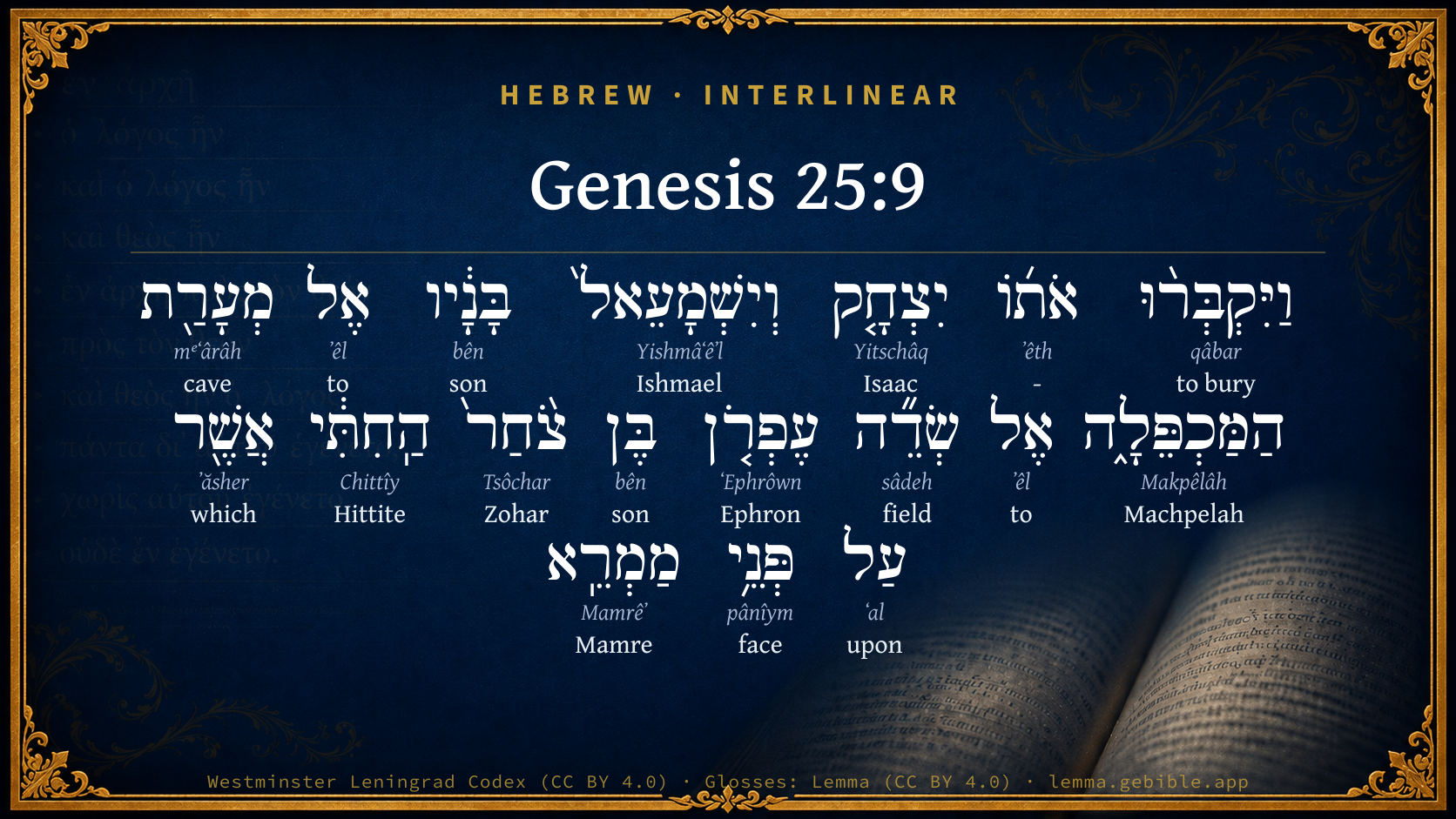
  1. וַיִּקְבְּר֨וּ qâbar H6912 “and · to bury” Conjunction + Verb, Qal, Sequential Imperfect, 3rd Person, Masculine, Plural
  2. אֹת֜וֹ ʼêth H853 “- · him” Particle, Direct Object + Suffix, Personal, 3rd Person, Masculine, Singular
  3. יִצְחָ֤ק Yitschâq H3327 “Isaac” Noun, Proper
  4. וְיִשְׁמָעֵאל֙ Yishmâʻêʼl H3458 “and · Ishmael” Conjunction + Noun, Proper
  5. בָּנָ֔יו bên H1121 “sons · his” Noun, Common, Masculine, Plural, Construct + Suffix, Personal, 3rd Person, Masculine, Singular
  6. אֶל ʼêl H413 “to” Preposition
  7. מְעָרַ֖ת mᵉʻârâh H4631 “cave of” Noun, Common, Feminine, Singular, Construct
  8. הַמַּכְפֵּלָ֑ה Makpêlâh H4375 “the · Machpelah” Particle, Definite Article + Noun, Proper
  9. אֶל ʼêl H413 “to” Preposition
  10. שְׂדֵ֞ה sâdeh H7704 “field of” Noun, Common, Masculine, Singular, Construct
  11. עֶפְרֹ֤ן ʻEphrôwn H6085 “Ephron” Noun, Proper
  12. בֶּן bên H1121 “son of” Noun, Common, Masculine, Singular, Construct
  13. הַֽחִתִּ֔י Chittîy H2850 “the · Hittite” Particle, Definite Article + Noun, Gentilic, Masculine, Singular, Absolute
  14. אֲשֶׁ֖ר ʼăsher H834 “which” Particle, Relative
  15. עַל ʻal H5921 “upon” Preposition
  16. פְּנֵ֥י pânîym H6440 “face(s) of” Noun, Common, Both, Plural, Construct
  17. מַמְרֵֽא Mamrêʼ H4471 “Mamre” Noun, Proper

About this verse

These counts appear in no published source. They are computed here, from the morphology-tagged text and Lemma’s own curated glosses. What Lemma adds →

18
words
16
distinct lemmas
Pentateuch
section

Notable vocabulary

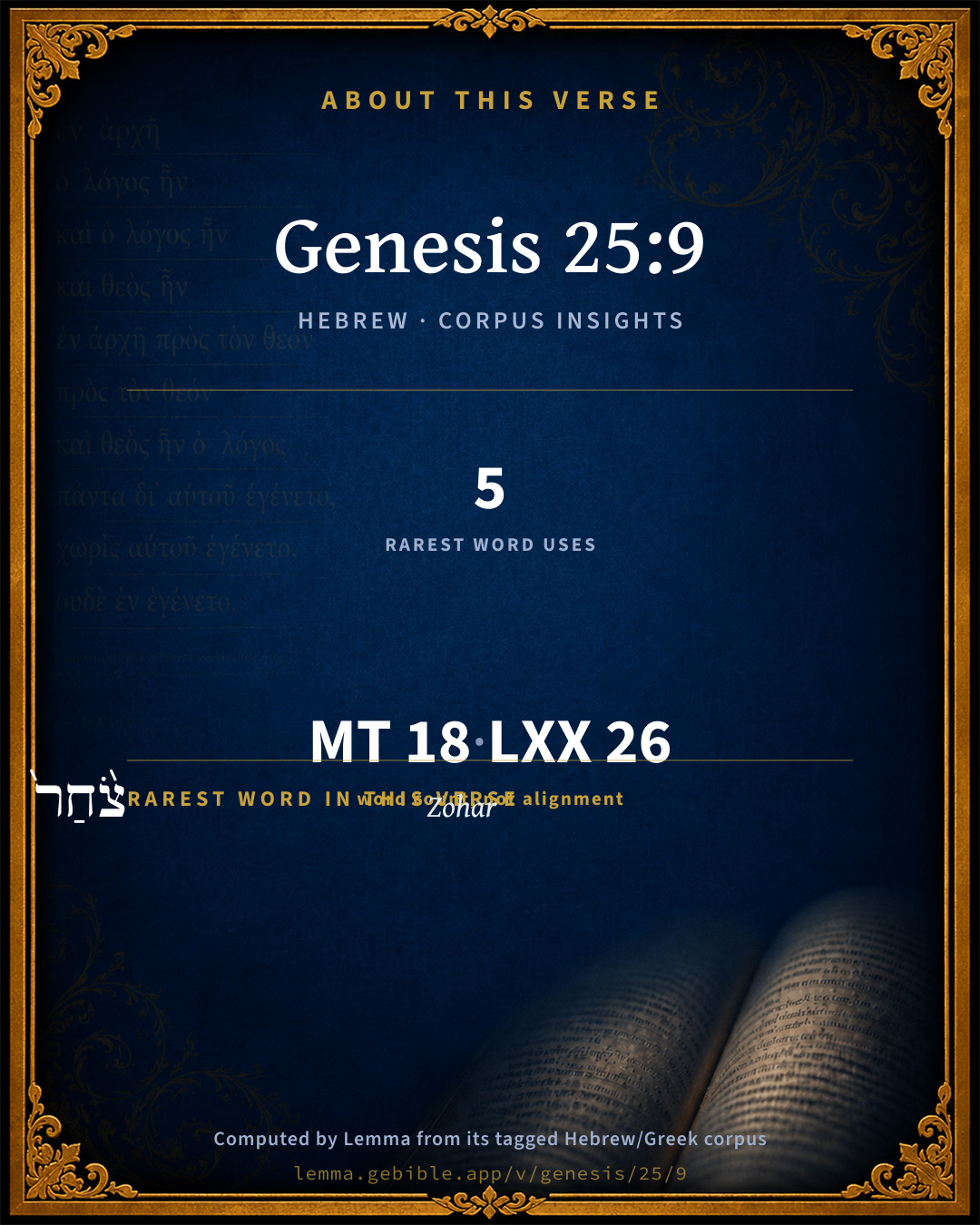
The rarest word here is צֹ֨חַר֙ Zohar H6714 — appearing just 5 times in the whole Hebrew Bible.

Shared distinctive vocabulary

צֹ֨חַר֙ Zohar H6714 occurs in 5 verses of the Hebrew Bible. Also found in:

Grammatical profile

  • 1 verb
  • 12 nouns
  • 3 prepositions
  • 2 particles

Verb forms

  • וַיִּקְבְּר֨וּ Qal · Sequential Imperfect

Repetition

Words recur within this verse — often emphatic in Hebrew:

  • בָּנָ֔יו son H1121 ×2
  • אֶל to H413 ×2

Hebrew & Septuagint length

In English translation the verse runs 27 words from the Hebrew and 28 from the Septuagint (LXX English) — closely comparable.

A rough comparison of the two English renderings, which tokenize alike — not a word-level alignment.

Word counts can differ between the Hebrew and the Greek without any difference in meaning — e.g. the Hebrew direct-object marker אֵת has no separate Greek word, and Greek often adds the article ὁ.

In the original languages it is 18 Hebrew tokens and 26 Greek tokens — but the two are counted differently (Hebrew bundles its prefixes and suffixes into one token; the Greek is in lemma form), so that isn’t a like-for-like length.

Cross-references

5

Topical passages linked to Genesis 25:9 in the Treasury of Scripture Knowledge — connected by theme and wording, ordered by reader-vote popularity; previews shown in the World English Bible.

  • Genesis 50:13 for his sons carried him into the land of Canaan, and buried him in the cave of the field of Machpelah, which Abraham bought with the field, for a possession of a burying-place, from Ephron the Hittite, before Mamre.
  • Genesis 35:29 Isaac gave up the spirit, and died, and was gathered to his people, old and full of days. Esau and Jacob, his sons, buried him.
  • Genesis 21:9–10 Sarah saw the son of Hagar the Egyptian, whom she had borne to Abraham, mocking.
  • Genesis 49:29–30 He charged them, and said to them, "I am to be gathered to my people. Bury me with my fathers in the cave that is in the field of Ephron the Hittite,
  • Genesis 23:9–20 that he may give me the cave of Machpelah, which he has, which is in the end of his field. For the full price let him give it to me in the midst of you for a possession of a burying-place."

Cross-references courtesy of OpenBible.info (CC BY 4.0).

Hebrew and Greek witnesses Masoretic Hebrew ↔ Greek Septuagint

The same verse in the two great witnesses to the Old Testament, shown verse-for-verse.

These are two independent witnesses, not word-aligned to each other, and the Septuagint is shown in lemma (dictionary) form.

Hebrew Genesis 25:9 Masoretic · Westminster Leningrad Codex

וַיִּקְבְּר֨וּ אֹת֜וֹ יִצְחָ֤ק וְיִשְׁמָעֵאל֙ בָּנָ֔יו אֶל מְעָרַ֖ת הַמַּכְפֵּלָ֑ה אֶל שְׂדֵ֞ה עֶפְרֹ֤ן בֶּן צֹ֨חַר֙ הַֽחִתִּ֔י אֲשֶׁ֖ר עַל פְּנֵ֥י מַמְרֵֽא

Isaac and Ishmael, his sons, buried him in the cave of Machpelah, in the field of Ephron, the son of Zohar the Hittite, which is before Mamre,

World English Bible · Public Domain

Greek LXX Genesis 25:9 Septuagint · lemma form

καί θάπτω αὐτός ισαακ καί ισμαηλ ὁ υἱός αὐτός εἰς ὁ σπήλαιον ὁ διπλοῦς εἰς ὁ ἀγρός εφρων ὁ σααρ ὁ χετταῖος ὅς εἰμί ἀπέναντι μαμβρη

And Isaac and Ismael his sons buried him in the double cave, in the field of Ephron the son of Saar the Chettite, which is over against Mambre:

LXX2012 (modern English Septuagint) · Public Domain

Hebrew: Westminster Leningrad Codex (CC BY 4.0). Greek: Septuagint (public domain); English from LXX2012 (modern English Septuagint) (Public Domain). How the Septuagint differs from the Hebrew →

Targum (Aramaic paraphrase)

2

The Targum is the ancient Jewish Aramaic paraphrase of the Hebrew Scriptures — an interpretive translation, not the Hebrew text itself. Onkelos (literal) and Pseudo-Jonathan (expansive) render the Torah, and Jonathan the Prophets. Coverage is partial: where no permissively-licensed English translation exists for a verse, only the Aramaic is shown. This is verse-level text, not a word-by-word alignment to the Hebrew.

  1. Targum Onkelos Torah (Genesis–Deuteronomy)
    וּקְבָרוּ יָתֵהּ יִצְחָק וְיִשְׁמָעֵאל בְּנוֹהִי בִּמְעָרַת כָּפֶלְתָּא בַּחֲקַל עֶפְרוֹן בַּר צֹחַר חִתָּאָה דִּי עַל אַפֵּי מַמְרֵא

    (no public-domain English translation for this verse)

    Targum Onkelos — Aramaic: “Onkelos Genesis” (public domain); “Onkelos Exodus” (public domain); “Onkelos Leviticus” (public domain); “Onkelos Numbers” (public domain); “Onkelos Deuteronomy” (public domain). English: “Sefaria Community Translation” (CC0 1.0 (public-domain dedication)); “J.W. Etheridge. The Targums of Onkelos and Jonathan Ben Uzziel on the Pentateuch. London: Longmans, Green, 1862” (public domain). Text via Sefaria.

  2. Targum Pseudo-Jonathan Torah (Genesis–Deuteronomy)
    וּקְבָרוּ יָתֵיהּ יִצְחָק וְיִשְׁמָעֵאל בְּנוֹי לִמְעָרַת כָּפֵילְתָּא לַחֲקַל עֶפְרוֹן בַּר צוֹחַר חִיתָּאָה דְעַל אַנְפֵּי מַמְרֵא

    And Izhak and Ishmael his sons buried him in the double cavern, at the field of Ephran bar Zochar, the Hittite, which is before Mamre;

    Targum Pseudo-Jonathan — Aramaic: “Targum Jonathan on Genesis” (public domain); “Targum Jonathan on Exodus” (public domain); “Targum Jonathan on Leviticus” (public domain); “Targum Jonathan on Numbers” (public domain); “Targum Jonathan on Deuteronomy” (public domain). English: “The Targum of Jonathan ben Uzziel, trans. J. W. Etheridge, London, 1862” (public domain). Text via Sefaria.

Commentary

Notes on Genesis 25:9 from classic Christian and Jewish commentators (each source and its license shown beneath its notes). The classic Christian expositions comment on the surrounding passage and are grouped to its opening verse, so a note may address several verses; the Jewish commentaries on the Tanakh (Rashi and others) are per-verse, so they appear only where the commentator wrote on this verse.

Lemma curates 59 commentaries, every one of them public domain or Creative Commons licensed, each selected and text-cleaned for this edition rather than reprinted as found. About our sources →

Trapp's Complete Commentary

John Trapp

Gen 25:9 And his sons Isaac and Ishmael buried him in the cave of Machpelah, in the field of Ephron the son of Zohar the Hittite, which [is] before Mamre;

Ver. 9. And his sons Isaac and Ishmael, &c.] It is like that Abraham, a little afore his death, sent for his two sons and reconciled them. This joining with Isaac in the burying of Abraham, some take for an argument of his repentance; whereunto also they add, that his whole lifetime is recorded in Holy Scripture, which cannot be showed of any reprobate, and that he is said, when he died, to be gathered to his fathers.

Which is beside Mamre.] Where, seventy-six years before, he had entertained the Lord Christ, and heard from his mouth the promise of the Messiah. Wherefore, in remembrance of that most amiable apparition, and for love and honour of the divine promise there uttered, he would there be buried, in full hope of a glorious resurrection; and that his posterity might take notice that he even died upon the promise. As that brave Roman captain {a} told his soldiers, that if they could not conquer Britain, yet they would get possession of it by laying their bones in it.

{a} Xiphilinus.

John Trapp, A Commentary or Exposition upon All the Books of the Old and New Testament (1647–1656) — public domain. Text from a community e-Sword module.

Jamieson, Fausset & Brown

Robert Jamieson, A. R. Fausset & David Brown

his sons . . . buried him--Death often puts an end to strife, reconciles those who have been alienated, and brings rival relations, as in this instance, to mingle tears over a father's grave.

Jamieson, Fausset & Brown — Commentary Critical and Explanatory on the Whole Bible (1871) — public domain (CC PDM 1.0). Text via the HelloAO Bible API.

Adam Clarke's Commentary

Verse 9. His sons Isaac and Ishmael buried him] Though Ishmael and his mother had been expelled from Abraham's family on the account of Isaac, yet, as he was under the same obligation to a most loving affectionate father as his brother Isaac, if any personal feuds remained, they agreed to bury them on this occasion, that both might dutifully join in doing the last offices to a parent who was an honour to them and to human nature: and, considering the rejection of Ishmael from the inheritance, this transaction shows his character in an amiable point of view; for though he was a wild man, (see Ge 16:12,) yet this appellation appears to be more characteristic of his habits of life than of his disposition.

For the character of Abraham see the conclusion of this chapter. See Clarke on Ge 25:34.

Adam Clarke's Commentary on the Bible (1810–1826) — public domain. Text from a community e-Sword/MySword module.

John Calvin's Commentaries

9. And his sons Isaac and Ishmael buried him. Hence it appears, that although Ishmael had long ago been dismissed, he was not utterly alienated from his father, because he performed the office of a son in celebrating the obsequies of his deceased parent. Ishmael, rather than the other sons did this, as being nearer.

John Calvin's Commentaries (1540-1563) — public domain. Text from the Calvin Translation Society English edition (1840s-50s) via the Christian Classics Ethereal Library (ccel.org). Calvin's coverage is partial (roughly two-thirds of the Bible); uncommented books and verses are honest gaps, never fabricated. The 19th-century editor's footnotes and remarks are omitted so the notes are faithfully Calvin's own voice.

Ellicott's Commentary for English Readers

(9) His sons Isaac and Ishmael.—Isaac was now seventy-five years of age, and Ishmael eighty-nine, and the two old men, with their enmity long over, metas friends at their father’s burial. While Keturah’s sons were apparently sent far away into Arabia, Ishmael at Paran (Gen_21:21) would be at no very great distance from the well Lahai-roi, which was Isaac’s favourite residence.

A Bible Commentary for English Readers, edited by Charles John Ellicott (1878–1897) — public domain. Text from a community e-Sword module.

The Cambridge Bible for Schools and Colleges

gen. ed. J. J. S. Perowne

9. Isaac and Ishmael] The two sons are mentioned once more together, as paying the last tribute of honour to their father. The banishment of Ishmael, recorded by E in 21, was not apparently included in the narrative of P, which avoids the notice of anything derogatory to the patriarchs.

in the cave of Machpelah, &c.] Isaac and Ishmael bury their father in the burial-place where he had laid Sarah his wife to rest. Cf. Gen_23:17-20.

The Cambridge Bible for Schools and Colleges (gen. ed. J. J. S. Perowne; Cambridge University Press, 1878–1918) — public domain. Text from a community e-Sword module.

John Gill's Exposition

And his sons Isaac and Ishmael buried him in the cave of Machpelah,.... Isaac, though the younger brother, is set first, because he was born of the lawful wife of Abraham, the free woman, whereas Ishmael was born of a concubine and a bondwoman; Isaac was heir not only to Abraham's temporal estate, but of the promise made concerning the Messiah, (not so Ishmael,) and was on all accounts the greater man. It appears from hence, that, though them had been a quarrel between Ishmael and Isaac, and the latter had been persecuted by the former, yet the difference was now made up, and they were reconciled, at least they agreed in this act of showing their last respect to their father; and that, though Ishmael had been expelled his father's house, yet he was not at any great distance from him, and there was a correspondence between him and his father; nor was he forgotten by him, as is clear from Gen 25:6; and he retained a filial affection for him; and Jarchi from hence concludes, that he was a penitent and a good man. The place where these two brothers buried their father was the cave of Machpelah:

in the field of Ephron, the son of Zohar the Hittite, which is before Mamre; see Gen 23:8; wherefore very false is the tradition of the Mahometans (g), that Abraham's sepulchre is at Mecca, which they, now show, and stands about twelve paces from the temple there, enclosed with iron rails.

(g) Pitt's Account of the Religion of the Mahometans, c. 7. p. 93.

John Gill's Exposition of the Whole Bible (1746–1763) — public domain (CC PDM 1.0). Text via the HelloAO Bible API.

Matthew Poole's English Annotations

Ishmael, though banished from his father’s house, lived in a place not very far from him; and as no doubt he received many favours from his father after his departure, which is implied here, Gen 25:6, though it be not mentioned elsewhere; so it is probable that he had a true respect and affection to his father, which he here expresseth.

Matthew Poole's English Annotations on the Holy Bible (1683–1685) — public domain. Text from a community e-Sword/MySword module.

Whedon's Commentary on the Bible

Daniel D. Whedon

9. Isaac and Ishmael buried him — There is something touching in this statement. No wrongs, or bitterness, or antipathy of the past, prevent their union in a common sorrow over their great father. So at a later date Esau and Jacob, similarly estranged, come together to bury their father, Isaac. Gen_35:29. The sons of Keturah, now, perhaps, far scattered, and less attached to Abraham than Ishmael and Isaac, are not mentioned here.

Machpelah — See on Gen_23:9.

Daniel D. Whedon (gen. ed.), Commentary on the Old and New Testaments (1874–1909) — public domain. Text from a community e-Sword module.

John Wesley's Explanatory Notes

Here is nothing recorded of the pomp or ceremony of his funeral; only we are told, his sons Isaac and Ishmael buried him - It was the last office of respect they had to pay to their good father. Some distance there had formerly been between Isaac and Ishmael, but it seems either Abraham had himself brought them together while he lived, or at least his death reconciled them. They buried him, in his own burying-place which he had purchased and in which he had buried Sarah. Those that in life have been very dear to each other, may not only innocently, but laudably, desire to be buried together, that, in their deaths, they may not be divided, and in token of their hopes of rising together.

John Wesley, Explanatory Notes Upon the Whole Bible (1754–1765) — public domain. Text via the GEBible commentary corpus.

Keil & Delitzsch

C. F. Keil & F. Delitzsch

The burial of the patriarch in the cave of Machpelah was attended to by Isaac and Ishmael; since the latter, although excluded from the blessings of the covenant, was acknowledged by God as the son of Abraham by a distinct blessing (Gen 17:20), and was thus elevated above the sons of Keturah.

Keil & Delitzsch — Biblical Commentary on the Old Testament (1861–1891) — public domain (CC PDM 1.0). Text via the HelloAO Bible API. (Old Testament only.)

unfoldingWord translationNotes

Door43 World Missions Community

the cave of Machpelah, in the field of Ephron

Ephron owned a field in Machpelah and the cave that was in that field. Abraham bought the field from Ephron.

Machpelah

Machpelah was the name of an area or region. See how you translated this in Genesis 23:9. (See: How to Translate Names)

Ephron ... Zohar

These are names of men. See how you translated these men's names in Genesis 23:8. (See: How to Translate Names)

which is near Mamre

Machpela was near Mamre.

Mamre

This was another name for the city of Hebron. It may have been named after Mamre, the friend of Abraham who lived there. See how you translated this place name in Genesis 23:17. (See: How to Translate Names)

This field Abraham had bought

"Abraham had bought this field"

sons of Heth

"the descendants of Heth" or "the Hittites." See how you translated this in Genesis 23:5.

Abraham was buried

This can be stated in active form. AT: "They buried Abraham" (See: Active or Passive)

his son

"Abraham's son"

Beer Lahai Roi

This name means "the well of the living one who sees me." See how you translated this place name in Genesis 16:14. (See: How to Translate Names)

translationWords

Isaac

Ishmael

bury

Hittite

Abraham

Sarah

God

bless

unfoldingWord translationNotes — © Distant Shores Media and the Door43 World Missions Community, licensed CC BY-SA 4.0. Source: git.door43.org/Door43/en_tn.

Rashi

Rabbi Shlomo Yitzchaki (Rashi)

יצחק וישמעאל ISAAC AND ISHMAEL — From this we gather that Ishmael repented of his evil ways (cf.Bava Batra 16b) and yielded the precedence to Isaac. This is what is meant by the “good old age” mentioned in connection with Abraham (Genesis Rabbah 38:12).

Rashi on the Tanakh — English translations: “The Judaica Press complete Tanach with Rashi, translated by A. J. Rosenberg” (CC BY 4.0); “Pentateuch with Rashi's commentary by M. Rosenbaum and A.M. Silbermann, 1929-1934” (public domain); “The Metsudah Tanach series, Lakewood, N.J” (CC BY 4.0); and “The Book of Joshua, Metsudah Publications, 1997” (CC BY 4.0). Text via Sefaria.

Ramban (Nachmanides)

Rabbi Moshe ben Nachman (Ramban / Nachmanides)

AND HIS SONS ISAAC AND ISHMAEL BURIED HIM. In the language of Bereshith Rabbah, “Here the son of the handmaid bestowed respect upon the son of the mistress” [since he yielded precedence to Isaac].

Ramban (Nachmanides) on the Tanakh — English translation: “Commentary on the Torah by Ramban (Nachmanides). Translated and annotated by Charles B. Chavel. New York, Shilo Pub. House, 1971-1976” (CC BY 4.0). Text via Sefaria.

Radak

Rabbi David Kimhi (Radak)

ויקברו אותו יצחק וישמעאל בניו, seeing they were more honoured than his other sons and had been more beloved by him. This is why they took upon them themselves the procedures connected with their father’s burial even though the sons of Keturah were also in this region. Alternately, Avraham had already sent those sons away during his lifetime so that only Yitzchok and Ishmael remained in the region.

'אל מרת המכפלה אל שדה וגו, the expression אל מערת is equivalent to the word במערת “in the cave of.” We find a similar expression in Exodus 25,21 concerning the Holy Ark. There are many more examples of this formulation.

על פני ממרא, we have explained this term already on 23,17.

Radak on the Tanakh — English translations: “Sefaria Community Translation” (CC0 1.0 (public-domain dedication)); “Eliyahu Munk, HaChut Hameshulash” (CC BY 4.0); “Rabbi Mike Feuer, Jerusalem Anthology” (CC BY 4.0); and “R. David Kimhi on the first book of Psalms, Translated by R.G. Finch, London, 1919” (public domain). Text via Sefaria.

Lesson kit

Teaching starters — assembled from the data on this page, not authored interpretation. Every prompt links to the verse data it draws on. Edit before teaching.

Genesis, in the Pentateuch, opens this verse with 18 words (16 distinct Hebrew lemmas). Its most distinctive word is Tsôchar (“Zohar”). A historical commentator’s framing appears above. Read the whole chapter for the surrounding context.

Discussion questions

  1. The word Tsôchar carries the sense “Zohar.” How does it shape the verse?
  2. Genesis 23:8 shares the word «Zohar» with this verse. How do the two illuminate each other?
  3. “son” occurs 2× in this one verse. What is the effect of the repetition?
  4. The verb «וַיִּקְבְּר֨וּ» is Qal Sequential Imperfect. How does its form color the action?
  5. Reading how Trapp's Complete Commentary and Jamieson, Fausset & Brown read this verse, where do the two commentators agree and where do they part?

Things to notice

Reading settings

Reading text

Shown beneath each verse's original-language words.

Old Testament
Old Testament edition

Read the OT as the Masoretic Hebrew (MT) or the Greek Septuagint (LXX).

English shown for the Greek Septuagint (in the Hebrew ↔ Greek comparison).

Comparing translations? Open the Compare panel on any verse page to stack up to four side by side.