
Numbers 20:17

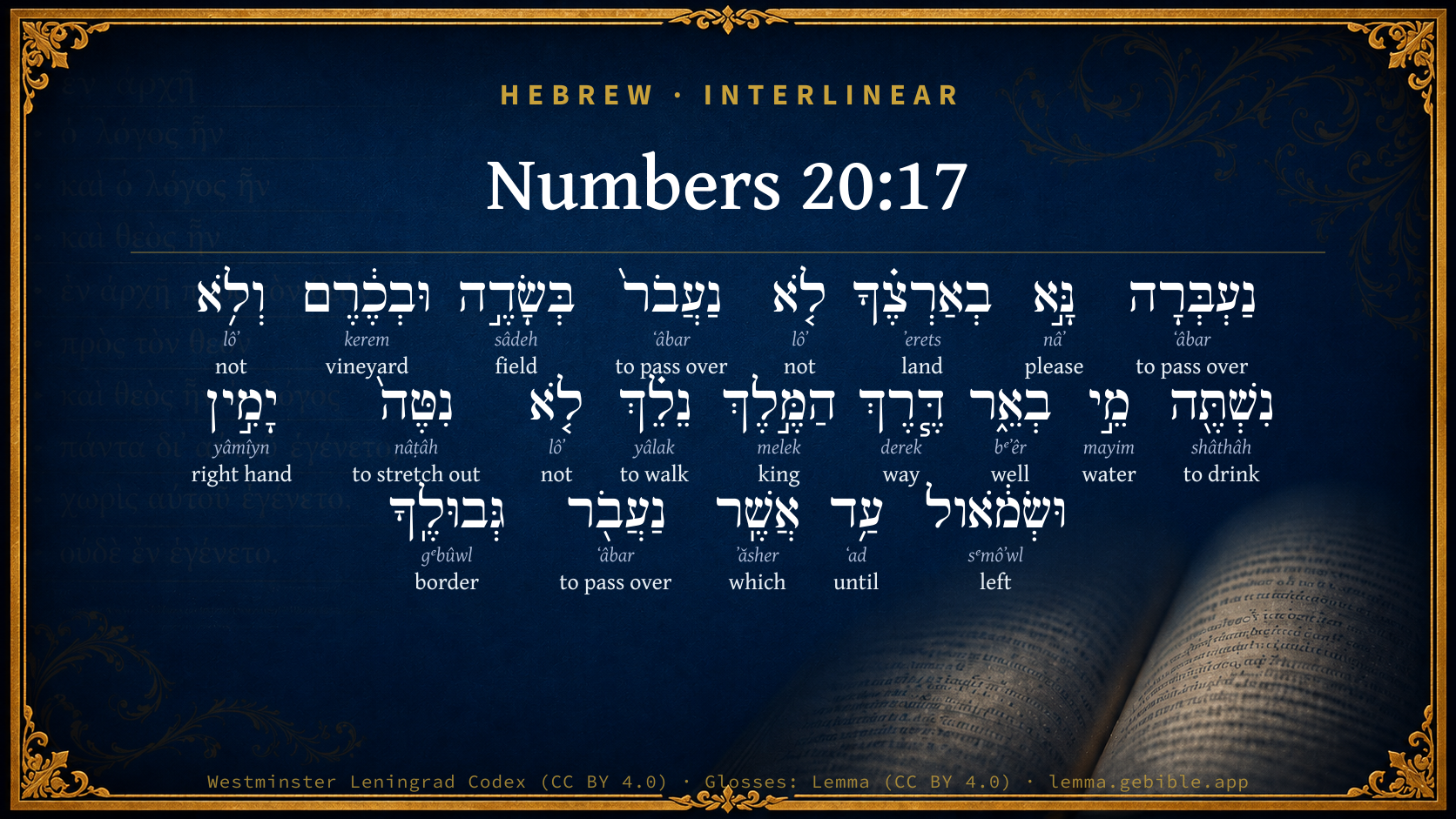
Hebrew (Westminster Leningrad Codex) Numbers 20:17 appears in the Hebrew Old Testament. The text above is from the Westminster Leningrad Codex. Each word links to its Strong’s number, a concise gloss, and parsing drawn from the Open Scriptures Hebrew Bible morphology. Click any word for its full Brown-Driver-Briggs (BDB) entry.
Download image
Cite this verse

Numbers 20:17 (World English Bible). Public Domain. Lemma interlinear Bible study tool, https://lemma.gebible.app/v/numbers/20/17.

Show BibTeX & RIS
BibTeX
RIS
English Translation
Please let us pass through your land: we will not pass through field or through vineyard, neither will we drink of the water of the wells: we will go along the king's highway; we will not turn aside to the right hand nor to the left, until we have passed your border.
World English Bible · Public Domain
Download a study sheet

One document with this verse’s original text, its word-by-word gloss line, the meaning frame, cross-references with their text, attributed commentary, and full source and license credits — printable, and it pastes into notes with its structure intact.

This verse Autodidact and up

Study sheet (.html) Plain text (.txt)

A passage Seminary Student

Up to 50 verses in one chapter. A passage sheet keeps up to 6 commentary sources and 12 cross-references per verse, in the order this page ranks them, and says so on the sheet whenever that leaves anything out. Ask for a single verse and you get the Autodidact verse sheet above.

Everything on this page stays free to read, with no account — the sheet is a download of what is already on screen, not access to it.

Want to remove ads? Support Godless Engineer
Compare translations 3

The same verse in 3 English versions, stacked beneath the original-language interlinear above. Click any original word for its lexicon entry.

Each is an independent rendering of the whole verse — the interlinear is not word-aligned to these translations.

Highlighted words mark where these versions differ — a whole-verse word diff, not a word-by-word alignment.

  • World English Bible Public Domain
    Please let us pass through your land: we will not pass through field or through vineyard, neither will we drink of the water of the wells: we will go along the king's highway; we will not turn aside to the right hand nor to the left, until we have passed your border.
  • King James Version Public Domain
    Let us pass, I pray thee, through thy country: we will not pass through the fields, or through the vineyards, neither will we drink of the water of the wells: we will go by the king's high way, we will not turn to the right hand nor to the left, until we have passed thy borders.
  • unfoldingWord Literal Text CC BY-SA 4.0
    Please let us pass over in your land. We will not pass over in a field or in a vineyard, and we will not drink water of a well. We will go on the way of the king. We will not turn aside right or left until when we have passed over your border.’”

unfoldingWord Literal Text — © unfoldingWord, licensed CC BY-SA 4.0. Word-aligned USFM3 via Door43 (git.door43.org/unfoldingWord/en_ult).

Versions to compare (up to 4)

3 of 4 selected

Show all 18 translations

Every available English version of this verse, each an independent rendering of the whole verse.

  • World English Bible Public Domain
    Please let us pass through your land: we will not pass through field or through vineyard, neither will we drink of the water of the wells: we will go along the king's highway; we will not turn aside to the right hand nor to the left, until we have passed your border.
  • Berean Standard Bible Public Domain
    Please let us pass through your land. We will not cut through any field or vineyard, or drink water from any well. We will stay on the King’s Highway; we will not turn to the right or to the left until we have passed through your territory.”
  • Majority Standard Bible Public Domain
    Please let us pass through your land. We will not go through any field or vineyard, or drink water from any well. We will stay on the King’s Highway; we will not turn to the right or to the left until we have passed through your territory.”
  • King James Version Public Domain
    Let us pass, I pray thee, through thy country: we will not pass through the fields, or through the vineyards, neither will we drink of the water of the wells: we will go by the king's high way, we will not turn to the right hand nor to the left, until we have passed thy borders.
  • American Standard Version (1901) Public Domain
    Let us pass, I pray thee, through thy land: we will not pass through field or through vineyard, neither will we drink of the water of the wells: we will go along the king's highway; we will not turn aside to the right hand nor to the left, until we have passed thy border.
  • Revised Version (1885) Public Domain
    let us pass, I pray thee, through thy land: we will not pass through field or through vineyard, neither will we drink of the water of the wells: we will go along the king’s high way, we will not turn aside to the right hand nor to the left, until we have passed thy border.
  • Geneva Bible (1599) Public Domain
    I pray thee that we may passe through thy countrey: we will not goe through the fieldes nor the vineyardes, neither will we drinke of the water of the welles: we will goe by the kings way, and neither turne vnto the right hand nor to the left, vntill we be past thy borders.
  • Douay-Rheims (1899) Public Domain
    And we beseech thee that we may have leave to pass through thy country. We will not go through the fields, nor through the vineyards, we will not drink the waters of thy wells, but we will go by the common highway, neither turning aside to the right hand, nor to the left, till we are past thy borders.
  • Young's Literal Translation Public Domain
    Let us pass over, we pray thee, through thy land; we pass not over through a field, or through a vineyard, nor do we drink waters of a well; the way of the king we go, we turn not aside -- right or left -- till that we pass over thy border.'
  • Literal Standard Version CC BY-SA 4.0
    Please let us pass over through your land; we do not pass over through a field or through a vineyard, nor do we drink waters of a well; we go the way of the king, we do not turn aside [to] the right or left until we pass over your border.”
  • Unlocked Literal Bible CC BY-SA 4.0
    I am asking you to let us pass through your land. We will not pass through field or vineyard, nor will we drink the water in your wells. We will go along the king's highway. We will not turn aside to the right hand or to the left until we have passed your border.”
  • unfoldingWord Literal Text CC BY-SA 4.0
    Please let us pass over in your land. We will not pass over in a field or in a vineyard, and we will not drink water of a well. We will go on the way of the king. We will not turn aside right or left until when we have passed over your border.’”
  • Darby Bible Public Domain
    Let us pass, I pray thee, through thy country; we will not pass through fields, or through vineyards, neither will we drink water out of the wells: we will go by the king's road; we will not turn to the right hand nor to the left, until we have passed thy border.
  • World Messianic Bible Public Domain
    “Please let us pass through your land. We will not pass through field or through vineyard, neither will we drink from the water of the wells. We will go along the king’s highway. We will not turn away to the right hand nor to the left, until we have passed your border.”
  • Webster's Bible Public Domain
    Let us pass, I pray thee, through thy country: we will not pass through the fields, or through the vineyards, neither will we drink of the water of the wells: we will go by the king's high-way, we will not turn to the right hand nor to the left, until we have passed thy borders.
  • Free Bible Version CC BY-SA 4.0
    Please allow us to travel through your country. We won't cross any of your fields or vineyards, or drink water from any of your wells. We will stay on the King's Highway; we won't turn off either to the right or to the left until we have passed through your country.”
  • Bible in Basic English Public Domain
    Let us now go through your land: we will not go into field or vine-garden, or take the water of the springs; we will go by the highway, not turning to the right or to the left, till we have gone past the limits of your land.
  • JPS Tanakh (1917) Public Domain
    Let us pass, I pray thee, through thy land; we will not pass through field or through vineyard, neither will we drink of the water of the wells; we will go along the king's highway, we will not turn aside to the right hand nor to the left, until we have passed thy border.'

Literal Standard Version (2020), Covenant Press — licensed CC BY-SA 4.0. Text via the HelloAO Bible API (eBible.org). Unlocked Literal Bible (unfoldingWord) — licensed CC BY-SA 4.0. Text via the HelloAO Bible API (eBible.org). unfoldingWord Literal Text — © unfoldingWord, licensed CC BY-SA 4.0. Word-aligned USFM3 via Door43 (git.door43.org/unfoldingWord/en_ult). Free Bible Version, Dr. Jonathan Gallagher — licensed CC BY-SA 4.0. Text via the HelloAO Bible API (eBible.org).

Word by word

More ways to search: Search by grammar → Find every occurrence → Compare this word →

Practice this passage: Drill this verse → Learn its vocabulary →

בְאֵ֑ר
bᵉʼêr
H875
“well”
Noun, Common, Feminine, Singular, Absolute
Part of Speech
Noun
Type
Common
Gender
Feminine
Number
Singular
State
Absolute
Full BDB Definition

Origin: from H874

TWOT: 194a

well, pit, spring
  1. נַעְבְּרָה ʻâbar H5674 “to pass over” Verb, Qal, Cohortative, 1st Person, Common, Plural
  2. נָּ֣א nâʼ H4994 “please” Particle, Interjection
  3. בְאַרְצֶ֗ךָ ʼerets H776 “in/at · land · your” Preposition + Noun, Common, Both, Singular, Construct + Suffix, Personal, 2nd Person, Masculine, Singular
  4. לֹ֤א lôʼ H3808 “not” Particle, Negative
  5. נַעֲבֹר֙ ʻâbar H5674 “to pass over” Verb, Qal, Imperfect, 1st Person, Common, Plural
  6. בְּשָׂדֶ֣ה sâdeh H7704 “in/at · field” Preposition + Noun, Common, Masculine, Singular, Absolute
  7. וּבְכֶ֔רֶם kerem H3754 “and · in/at · vineyard” Conjunction + Preposition + Noun, Common, Both, Singular, Absolute
  8. וְלֹ֥א lôʼ H3808 “and · not” Conjunction + Particle, Negative
  9. נִשְׁתֶּ֖ה shâthâh H8354 “to drink” Verb, Qal, Imperfect, 1st Person, Common, Plural
  10. מֵ֣י mayim H4325 “water(s) of” Noun, Common, Masculine, Plural, Construct
  11. דֶּ֧רֶךְ derek H1870 “way of” Noun, Common, Both, Singular, Construct
  12. הַמֶּ֣לֶךְ melek H4428 “the · king” Particle, Definite Article + Noun, Common, Masculine, Singular, Absolute
  13. נֵלֵ֗ךְ yâlak H3212 “to walk” Verb, Qal, Imperfect, 1st Person, Common, Plural
  14. לֹ֤א lôʼ H3808 “not” Particle, Negative
  15. נִטֶּה֙ nâṭâh H5186 “to stretch out” Verb, Qal, Imperfect, 1st Person, Common, Plural
  16. יָמִ֣ין yâmîyn H3225 “right hand” Noun, Common, Feminine, Singular, Absolute
  17. וּשְׂמֹ֔אול sᵉmôʼwl H8040 “and · left” Conjunction + Noun, Common, Masculine, Singular, Absolute
  18. עַ֥ד ʻad H5704 “until” Preposition
  19. אֲשֶֽׁר ʼăsher H834 “which” Particle, Relative
  20. נַעֲבֹ֖ר ʻâbar H5674 “to pass over” Verb, Qal, Imperfect, 1st Person, Common, Plural
  21. גְּבוּלֶֽךָ gᵉbûwl H1366 “border · your” Noun, Common, Masculine, Singular, Construct + Suffix, Personal, 2nd Person, Masculine, Singular

About this verse

These counts appear in no published source. They are computed here, from the morphology-tagged text and Lemma’s own curated glosses. What Lemma adds →

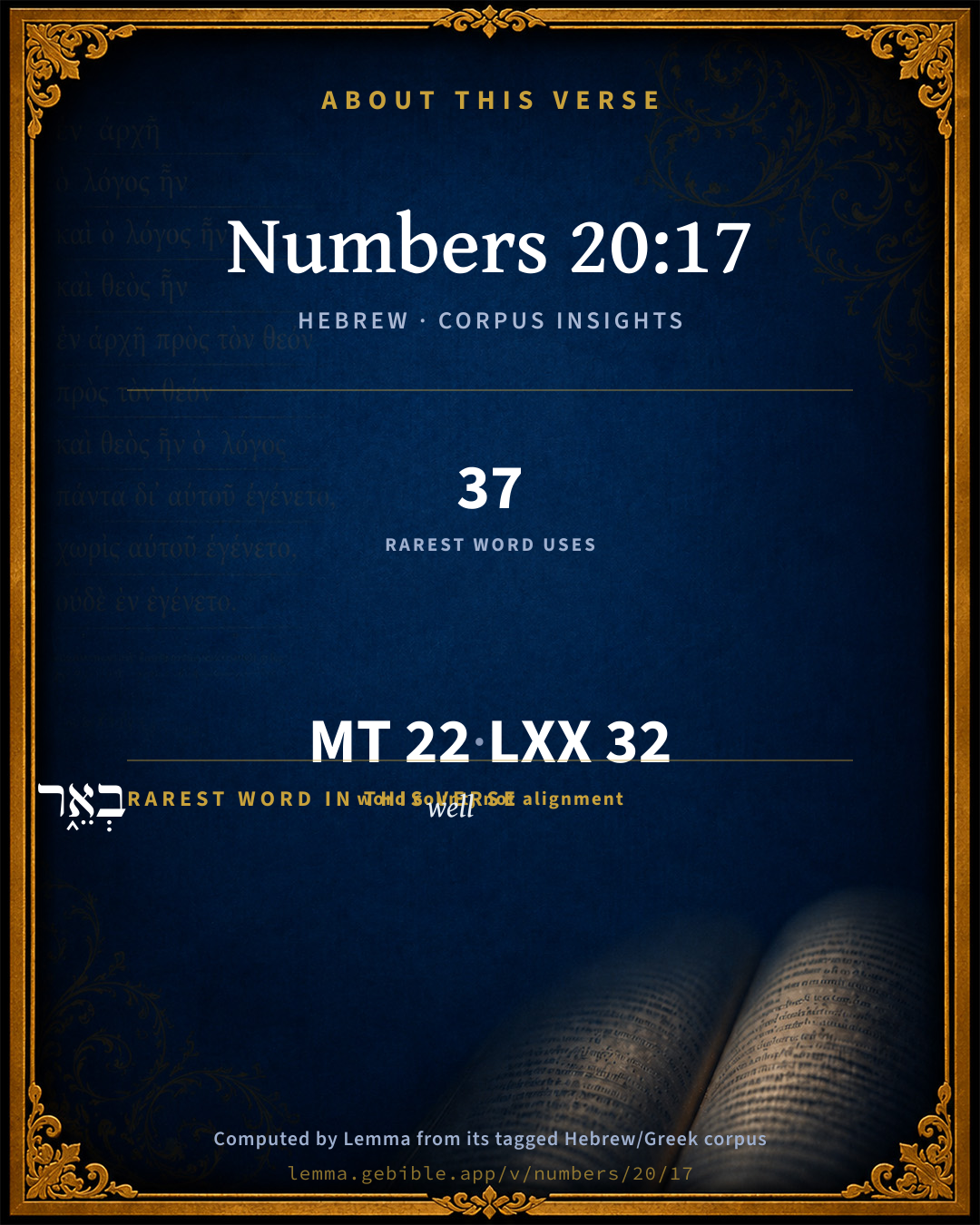
22
words
18
distinct lemmas
Pentateuch
section

Shared distinctive vocabulary

בְאֵ֑ר well H875 occurs in 33 verses of the Hebrew Bible. Also found in:

Grammatical profile

  • 6 verbs
  • 10 nouns
  • 1 preposition
  • 5 particles

Verb forms

  • נַעְבְּרָה Qal · Cohortative
  • נַעֲבֹר֙ Qal · Imperfect
  • נִשְׁתֶּ֖ה Qal · Imperfect
  • נֵלֵ֗ךְ Qal · Imperfect
  • נִטֶּה֙ Qal · Imperfect
  • נַעֲבֹ֖ר Qal · Imperfect

Repetition

Words recur within this verse — often emphatic in Hebrew:

  • נַעְבְּרָה to pass over H5674 ×3
  • לֹ֤א not H3808 ×3

Hebrew & Septuagint length

In English translation the verse runs 52 words from the Hebrew and 52 from the Septuagint (LXX English) — the same length.

A rough comparison of the two English renderings, which tokenize alike — not a word-level alignment.

Word counts can differ between the Hebrew and the Greek without any difference in meaning — e.g. the Hebrew direct-object marker אֵת has no separate Greek word, and Greek often adds the article ὁ.

In the original languages it is 22 Hebrew tokens and 32 Greek tokens — but the two are counted differently (Hebrew bundles its prefixes and suffixes into one token; the Greek is in lemma form), so that isn’t a like-for-like length.

Cross-references

5

Topical passages linked to Numbers 20:17 in the Treasury of Scripture Knowledge — connected by theme and wording, ordered by reader-vote popularity; previews shown in the World English Bible.

  • Deuteronomy 2:27 Let me pass through your land: I will go along by the highway, I will turn neither to the right hand nor to the left.
  • Numbers 21:1 The Canaanite, the king of Arad, who lived in the South, heard tell that Israel came by the way of Atharim; and he fought against Israel, and took some of them captive.
  • Numbers 21:22–24 Let me pass through your land: we will not turn aside into field, or into vineyard; we will not drink of the water of the wells: we will go by the king's highway, until we have passed your border.
  • Deuteronomy 2:1–4 Then we turned, and took our journey into the wilderness by the way to the Red Sea, as Yahweh spoke to me; and we compassed Mount Seir many days.
  • Deuteronomy 2:29 as the children of Esau who dwell in Seir, and the Moabites who dwell in Ar, did to me; until I shall pass over the Jordan into the land which Yahweh our God gives us.

Cross-references courtesy of OpenBible.info (CC BY 4.0).

Hebrew and Greek witnesses Masoretic Hebrew ↔ Greek Septuagint

The same verse in the two great witnesses to the Old Testament, shown verse-for-verse.

These are two independent witnesses, not word-aligned to each other, and the Septuagint is shown in lemma (dictionary) form.

Hebrew Numbers 20:17 Masoretic · Westminster Leningrad Codex

נַעְבְּרָה נָּ֣א בְאַרְצֶ֗ךָ לֹ֤א נַעֲבֹר֙ בְּשָׂדֶ֣ה וּבְכֶ֔רֶם וְלֹ֥א נִשְׁתֶּ֖ה מֵ֣י בְאֵ֑ר דֶּ֧רֶךְ הַמֶּ֣לֶךְ נֵלֵ֗ךְ לֹ֤א נִטֶּה֙ יָמִ֣ין וּשְׂמֹ֔אול עַ֥ד אֲשֶֽׁר נַעֲבֹ֖ר גְּבוּלֶֽךָ

Please let us pass through your land: we will not pass through field or through vineyard, neither will we drink of the water of the wells: we will go along the king's highway; we will not turn aside to the right hand nor to the left, until we have passed your border.

World English Bible · Public Domain

Greek LXX Numbers 20:17 Septuagint · lemma form

παραἔρχομαι διά ὁ γῆ σύ οὐ διαἔρχομαι διά ἀγρός οὐδέ διά ἀμπελών οὐδέ πίνω ὕδωρ ἐκ λάκκος σύ ὁδός βασιλικός πορεύομαι οὐ ἐκκλίνω δεξιός οὐδέ εὐώνυμος ἕως ἄν παραἔρχομαι ὁ ὅριον σύ

We will pass through your land: we will not go through the fields, nor through the vineyards, nor will we drink water out of your cistern: we will go by the king's highway; we will not turn aside to the right hand or to the left, until we have passed your borders.

LXX2012 (modern English Septuagint) · Public Domain

Hebrew: Westminster Leningrad Codex (CC BY 4.0). Greek: Septuagint (public domain); English from LXX2012 (modern English Septuagint) (Public Domain). How the Septuagint differs from the Hebrew →

Targum (Aramaic paraphrase)

2

The Targum is the ancient Jewish Aramaic paraphrase of the Hebrew Scriptures — an interpretive translation, not the Hebrew text itself. Onkelos (literal) and Pseudo-Jonathan (expansive) render the Torah, and Jonathan the Prophets. Coverage is partial: where no permissively-licensed English translation exists for a verse, only the Aramaic is shown. This is verse-level text, not a word-by-word alignment to the Hebrew.

  1. Targum Onkelos Torah (Genesis–Deuteronomy)
    נְעִיבַּר כְּעַן בְּאַרְעָךְ לָא נְעִיבֵּר בַּחֲקַל וּבִכְרָם וְלָא נִשְׁתֵּי מֵי גוֹב בְּאֹרַח מַלְכָּא נֵיזֵיל לָא נִסְטֵּי לְיַמִינָא וְלִשְׂמָאלָא עַד דִנְעִיבַּר תְּחוּמָךְ

    (no public-domain English translation for this verse)

    Targum Onkelos — Aramaic: “Onkelos Genesis” (public domain); “Onkelos Exodus” (public domain); “Onkelos Leviticus” (public domain); “Onkelos Numbers” (public domain); “Onkelos Deuteronomy” (public domain). English: “Sefaria Community Translation” (CC0 1.0 (public-domain dedication)); “J.W. Etheridge. The Targums of Onkelos and Jonathan Ben Uzziel on the Pentateuch. London: Longmans, Green, 1862” (public domain). Text via Sefaria.

  2. Targum Pseudo-Jonathan Torah (Genesis–Deuteronomy)
    נְעִיבַר כְּדוֹן בְּאַרְעָךְ לָא נְשַׁרְגְנָא בְּתוּלַן וְלָא נְאַנְנַס אֲרִיסַן וְלָא נִבְעוֹל נְשֵׁי גוּבְרִין בְּאוֹרַח מַלְכָּא דְבִשְׁמַיָא נֵיזֵיל וְלָא נִסְטֵי לְיַמִינָא וְלִשְמָאלָא לְהַנְזָקָא בִּשְׁבִילֵי רְשׁוּתָא עַד דִנְעִיבַּר תְּחוּמָךְ

    Let us now pass through thy land: we will not seduce virgins, nor carry off the betrothed, nor commit adultery: on the king's highway, under the heavens, we will go forward, and turn not to the right or to the left, to do any injury in the public way while we pass through thy border.

    Targum Pseudo-Jonathan — Aramaic: “Targum Jonathan on Genesis” (public domain); “Targum Jonathan on Exodus” (public domain); “Targum Jonathan on Leviticus” (public domain); “Targum Jonathan on Numbers” (public domain); “Targum Jonathan on Deuteronomy” (public domain). English: “The Targum of Jonathan ben Uzziel, trans. J. W. Etheridge, London, 1862” (public domain). Text via Sefaria.

Commentary

Notes on Numbers 20:17 from classic Christian and Jewish commentators (each source and its license shown beneath its notes). The classic Christian expositions comment on the surrounding passage and are grouped to its opening verse, so a note may address several verses; the Jewish commentaries on the Tanakh (Rashi and others) are per-verse, so they appear only where the commentator wrote on this verse.

Lemma curates 59 commentaries, every one of them public domain or Creative Commons licensed, each selected and text-cleaned for this edition rather than reprinted as found. About our sources →

Trapp's Complete Commentary

John Trapp

Num 20:17 Let us pass, I pray thee, through thy country: we will not pass through the fields, or through the vineyards, neither will we drink [of] the water of the wells: we will go by the king’s [high] way, we will not turn to the right hand nor to the left, until we have passed thy borders.

Ver. 17. We will not pass.] So should a Christian bespeak the world. Let us pass through thy country; we will neither touch nor taste of thy cares, but go by the king’s highway, that good old way that God hath scored out unto us, until we arrive at the key of Canaan, at the kingdom of heaven.

John Trapp, A Commentary or Exposition upon All the Books of the Old and New Testament (1647–1656) — public domain. Text from a community e-Sword module.

The Biblical Illustrator

Joseph S. Exell

Num_20:17

We will go by the kings highway.

The kings highway

They meant that, however tempting was the fruit of the fields, however fascinating the byways, however inviting the sparkling water in the wells might seem, they would keep to the bard-beaten thoroughfares that ran north and south of the country, by which travellers had passed in ages now gone by. Now, without doubt, such words have a spiritual and typical meaning.

I. Of the nation at large. Israel pronounced them unanimously as a nation, and we, as the English nation, may well re-echo them after all these hundreds of years. And it is well for us to bear in mind that whole nations must stand up for God as well as individuals. Numbers can never make a sin less grievous.

II. They are words, too, that may be hoped for from the mouth of the church. God is essentially a God of :law and order. The Church must go by the Kings highway.

III. But as with the nation and with the Church, so with the individual, they are words that are appropriate in the mouth--

1. Of the young Christian, starting off on lifes journey, just going into the world. Happy, aye thrice happy, he who, with dogged determination, says, We will go by the Kings highway.

2. So, too, they are suited especially to the penitent. He, too, must look into the future and resolve to go by the Kings highway. And here we must pause to notice that the individual highway consists--

(1) Of morals. We must take the code of Gods commandments, showing our duty to God and man, and walk in the way of Gods commandments.

(2) Of faith. Ethics alone are not sufficient; there must be a firm basis of Church doctrine, something on which the soul of man may lean for comfort in distress.

IV. Lastly, we are not alone in our efforts to go by the Kings highway; we are cheered by the examples of all the saints whose names are written in the Lambs Book of Life. In conclusion, I would add that the Kings highway leads to the city of the Great King. (W. O. Parish.)

The Biblical Illustrator, edited by Joseph S. Exell (c. 1880s–1900s) — public domain. Text from a community e-Sword module.

Joseph Benson's Commentary

Num 20:17. The wells — Or pits, which any of you have digged for your private use, not without paying for it, Num 20:19; but only of the water of common rivers, which are free to all passengers. No man’s property ought to be invaded, under colour of religion. Dominion is founded in providence, not in grace.

Joseph Benson's Commentary on the Old and New Testaments (1811–1818) — public domain. Text from a community e-Sword module.

Tyndale Open Study Notes

Tyndale Open Resources

20:17 We won’t even drink water from your wells: Edom is very dry; food and water were too scarce to provide for this substantial number of Hebrew immigrants. • We will stay on the king’s road: The “King’s Highway” (also 21:22) is well known in the Old Testament, though its exact route is not certain. As its name indicates, this route was maintained for official purposes, including the movement of troops and trade. Along this trail, travelers could find settlements, food, and water between the Red Sea and Damascus. The route remained important into Roman and even modern times. This royal road contrasted with a much less hospitable route farther to the east called the Desert Highway.

Tyndale Open Study Notes — © Tyndale Open Resources, licensed CC BY-SA 4.0. Text via the HelloAO Bible API.

Geneva Bible (1599)

Geneva Bible translators

Or, highway.

Geneva Bible (1599) marginal notes — public domain. Text via Bolls.life.

Jamieson, Fausset & Brown

Robert Jamieson, A. R. Fausset & David Brown

we will go by the king's highway--probably Wady-el-Ghuweir [ROBERTS], through which ran one of the great lines of road, constructed for commercial caravans, as well as for the progress of armies. The engineering necessary for carrying them over marshes or mountains, and the care requisite for protecting them from the shifting sands, led to their being under the special care of the state. Hence the expression, "the king's highway," which is of great antiquity.

Jamieson, Fausset & Brown — Commentary Critical and Explanatory on the Whole Bible (1871) — public domain (CC PDM 1.0). Text via the HelloAO Bible API.

Adam Clarke's Commentary

Verse 17. We will go by the king's high-way] This is the first time this phrase occurs; it appears to have been a public road made by the king's authority at the expense of the state.

Adam Clarke's Commentary on the Bible (1810–1826) — public domain. Text from a community e-Sword/MySword module.

Ellicott's Commentary for English Readers

(17) We will go by the king’s highway.—It is supposed that this military road led through the broad Wady el Ghuweir, which is celebrated for its excellent pasture and its numerous springs. (See Keil in loc.)

A Bible Commentary for English Readers, edited by Charles John Ellicott (1878–1897) — public domain. Text from a community e-Sword module.

The Cambridge Bible for Schools and Colleges

gen. ed. J. J. S. Perowne

17. the king’s way] A main trade-route through the country. In modern Palestine such a route is known by the name of darb es-sulṭân or ‘Sultan’s way.’

The Cambridge Bible for Schools and Colleges (gen. ed. J. J. S. Perowne; Cambridge University Press, 1878–1918) — public domain. Text from a community e-Sword module.

John Gill's Exposition

And Edom said unto him,.... The king of Edom replied to Israel, represented by the messengers sent in their name:

thou shall not pass by me; through my country:

lest I come out against thee with the sword; or with those that use the sword, as the Targums of Onkelos and Jonathan; that is, with an army of soldiers with their drawn swords in their hands, to slay them as enemies.

John Gill's Exposition of the Whole Bible (1746–1763) — public domain (CC PDM 1.0). Text via the HelloAO Bible API.

Matthew Poole's English Annotations

Wells, or pits, which any of you have digged for your private use, to wit, without paying for it, Num 20:19; Deu 2:6; but only of the waters of common rivers, which are free to all passengers, and will not be prejudicial to thee.

Matthew Poole's English Annotations on the Holy Bible (1683–1685) — public domain. Text from a community e-Sword/MySword module.

Whedon's Commentary on the Bible

Daniel D. Whedon

17. Not pass through… fields… vineyards — The promises made in this verse were specific commands given by Jehovah. The Edomites were exempted from conquest or annoyance by Israel on his journey because they are “your brethren, the children of Esau.” The command also was, “Distress not the Moabites,” because they are “the children of Lot,” more distant kindred of Israel. See Deu_2:4-6; Deu_2:9; Gen_19:36-37.

Water of the wells — Wells or cisterns are of great value in a country where man and beast are dependent during the greater part of the year upon the reservoirs filled in the rainy season. Hence the charge, given in Deuteronomy, “Ye shall also buy water of them for money, that ye may drink.” This sounds strangely in the ears of the Western nations. Still more surprising is the lament of captive Israel, “We have drunken our water for money,” paid to foreign despots who have seized our wells and cisterns. Lam_5:4.

Daniel D. Whedon (gen. ed.), Commentary on the Old and New Testaments (1874–1909) — public domain. Text from a community e-Sword module.

The Pulpit Commentary

Let us pass, I pray thee, through thy country. Moses desired to march through Seir eastwards and northeastwards, so as to reach the country beyond Jordan. If the northern portion of the wilderness of Paran was at this time held by the king of Edom, it would be through this region that Israel would first seek to make their way from Kadesh to the Arabah; thence the broad and easy pass of the Wady Ghuweir would lead them through Mount Seir (properly so called) to the plains of Moab. Through the fields, or through the vineyards. These words attest the change for the worse in the condition of these regions. Even in the Wady Ghuweir, although springs and pasturage are abundant, fields and vineyards hardly exist. Neither will we drink, i.e., as appears from verse 19, without obtaining leave and making payment. By the king"s highway. The state road used for military purposes.

The Pulpit Commentary (1880–1919), ed. H.D.M. Spence-Jones & Joseph S. Exell — public domain. Text from a community e-Sword module.

John Wesley's Explanatory Notes

The wells - Or, pits, which any of you have digged for your private use, not without paying for it, ver. 19, but only of the waters of common rivers, which are free to all passengers. No man's property ought to be invaded, under colour of religion. Dominion is founded in providence, not in Grace.

John Wesley, Explanatory Notes Upon the Whole Bible (1754–1765) — public domain. Text via the GEBible commentary corpus.

unfoldingWord translationNotes

Door43 World Missions Community

Connecting Statement:

The messengers continue speaking to the king of Edom.

We will not turn aside to the right hand or to the left

Here "turn aside" represents leaving the road. AT: "We will not leave the road in any direction" (See: Metonymy)

the king's highway

This is the main road that connects Damascus in the north to the Gulf of Aqabah in the south.

translationWords

vineyard

cistern

turn

hand

unfoldingWord translationNotes — © Distant Shores Media and the Door43 World Missions Community, licensed CC BY-SA 4.0. Source: git.door43.org/Door43/en_tn.

Rashi

Rabbi Shlomo Yitzchaki (Rashi)

נעברה נא בארצך LET US PASS, I PRAY THEE, THROUGH THY COUNTRY — You have no right to lay claim to the land of Israel as an inheritance, just the same as you have not paid the debt (see Rashi v. 14); render us therefore a little assistance by permitting us to pass through your land.

ולא נשתה מי באר NEITHER WILL WE DRINK OF THE WATER OF THE SPRINGS — He should have said “water of the cisterns (בורות)”; but this was what Moses meant to say: Although we have manna to eat, and a well of which to drink, (that which followed them through the wilderness), we will not drink of it, but we will buy food and water from you to your advantage. From here we may learn a rule for a guest (one lodging in an inn): although he has in his possession something to eat, he should yet purchase something from the local tradesman in order to benefit his host (Midrash Tanchuma, Chukat 12).

דרך המלך נלך וגו׳ WE WILL KEEP TO THE KING’S HIGHWAY etc. — we will muzzle our cattle, and so they will not turn aside into the fields on this side or that to eat (Midrash Tanchuma, Chukat 12).

Rashi on the Tanakh — English translations: “The Judaica Press complete Tanach with Rashi, translated by A. J. Rosenberg” (CC BY 4.0); “Pentateuch with Rashi's commentary by M. Rosenbaum and A.M. Silbermann, 1929-1934” (public domain); “The Metsudah Tanach series, Lakewood, N.J” (CC BY 4.0); and “The Book of Joshua, Metsudah Publications, 1997” (CC BY 4.0). Text via Sefaria.

Sforno

Rabbi Ovadia Sforno

The king’s road. We will travel on that road which the king commands us to travel on, as is accustomed with every king: They allow passage to an army of their allies, by sending a guide with them, so that the soldiers will not harm the residents of the land as they pass through.

Sforno on the Tanakh — English translation: “Yalkut, Sifsei Chachomim Chumash, Metsudah Publications, 2009” (CC BY 4.0). Text via Sefaria.

Ibn Ezra

Rabbi Abraham ibn Ezra

We will not pass through any field or vineyard so as not to destroy them, and we will not even drink from your well water.

We will travel by the king’s road. It could be explained: The road upon which the king travels. Or an alternative explanation: We will travel on the road that the king commands, and this refers to the king of Edom.

Ibn Ezra on the Tanakh — English translations: “Sefaria Community Translation” (CC0 1.0 (public-domain dedication)); “Yalkut, Sifsei Chachomim Chumash, Metsudah Publications, 2009” (CC BY 4.0); and “Commentary of Ibn Ezra on Isaiah - trans. by M. Friedlander, 1873” (public domain). Text via Sefaria.

Lesson kit

Teaching starters — assembled from the data on this page, not authored interpretation. Every prompt links to the verse data it draws on. Edit before teaching.

Numbers, in the Pentateuch, opens this verse with 22 words (18 distinct Hebrew lemmas). Its most distinctive word is bᵉʼêr (“well”). A historical commentator’s framing appears above. Read the whole chapter for the surrounding context.

Discussion questions

  1. What does “well” (bᵉʼêr) contribute to the verse as a whole?
  2. Genesis 14:10 shares the word «well» with this verse. How do the two illuminate each other?
  3. “to pass over” occurs 3× in this one verse. What is the effect of the repetition?
  4. These translations render this verse differently. What is at stake in choosing one wording over another?
  5. The verb «נַעְבְּרָה» is Qal Cohortative. How does its form color the action?
  6. Reading how Trapp's Complete Commentary and The Biblical Illustrator read this verse, where do the two commentators agree and where do they part?

Things to notice

Reading settings

Reading text

Shown beneath each verse's original-language words.

Old Testament
Old Testament edition

Read the OT as the Masoretic Hebrew (MT) or the Greek Septuagint (LXX).

English shown for the Greek Septuagint (in the Hebrew ↔ Greek comparison).

Comparing translations? Open the Compare panel on any verse page to stack up to four side by side.