
1 Chronicles 19:9

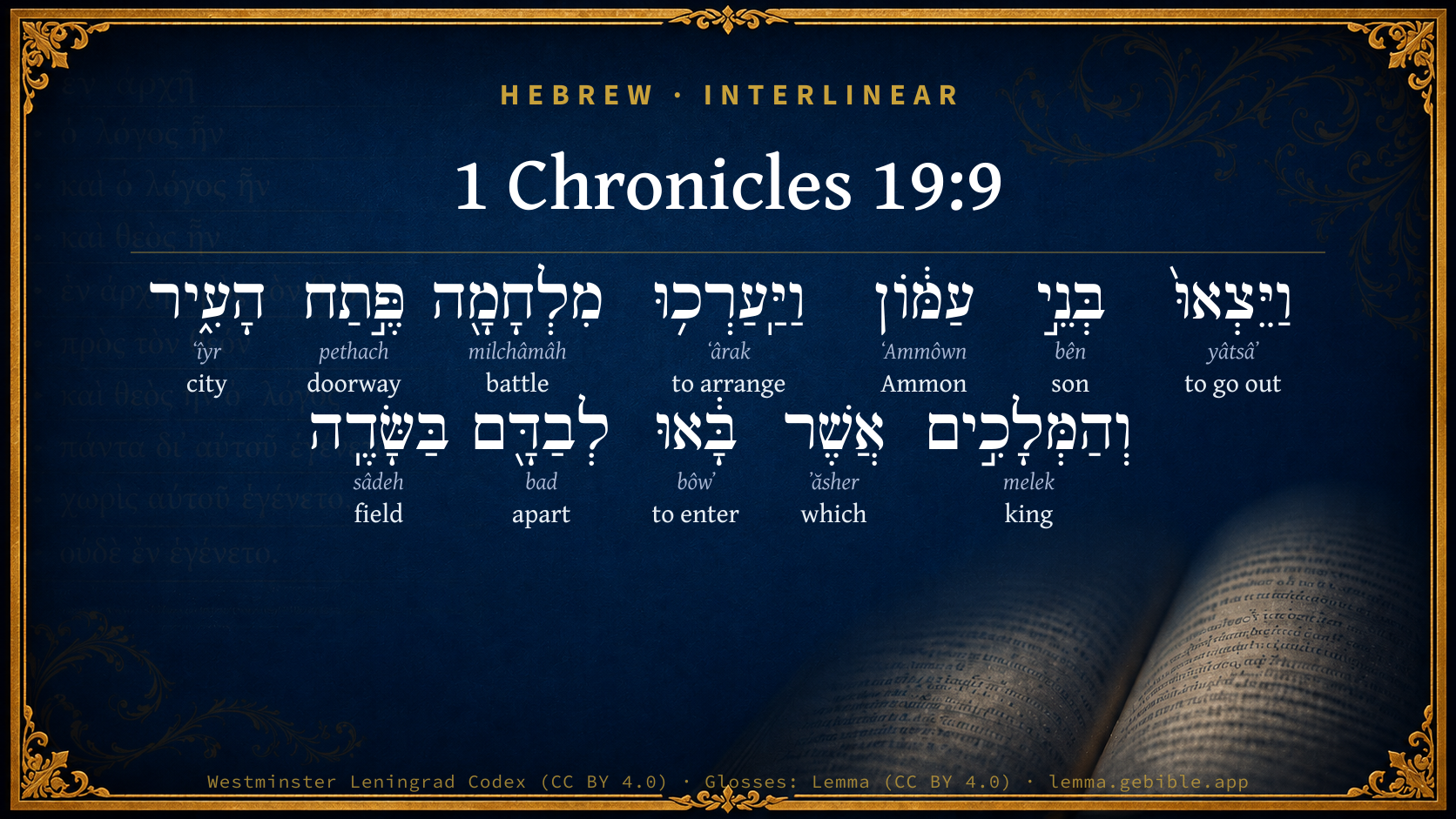
Hebrew (Westminster Leningrad Codex) 1 Chronicles 19:9 appears in the Hebrew Old Testament. The text above is from the Westminster Leningrad Codex. Each word links to its Strong’s number, a concise gloss, and parsing drawn from the Open Scriptures Hebrew Bible morphology. Click any word for its full Brown-Driver-Briggs (BDB) entry.
Download image
Cite this verse

1 Chronicles 19:9 (World English Bible). Public Domain. Lemma interlinear Bible study tool, https://lemma.gebible.app/v/1-chronicles/19/9.

Show BibTeX & RIS
BibTeX
RIS
English Translation
The children of Ammon came out, and put the battle in array at the gate of the city: and the kings who had come were by themselves in the field.
World English Bible · Public Domain
Download a study sheet

One document with this verse’s original text, its word-by-word gloss line, the meaning frame, cross-references with their text, attributed commentary, and full source and license credits — printable, and it pastes into notes with its structure intact.

This verse Autodidact and up

Study sheet (.html) Plain text (.txt)

A passage Seminary Student

Up to 50 verses in one chapter. A passage sheet keeps up to 6 commentary sources and 12 cross-references per verse, in the order this page ranks them, and says so on the sheet whenever that leaves anything out. Ask for a single verse and you get the Autodidact verse sheet above.

Everything on this page stays free to read, with no account — the sheet is a download of what is already on screen, not access to it.

Want to remove ads? Support Godless Engineer
Compare translations 3

The same verse in 3 English versions, stacked beneath the original-language interlinear above. Click any original word for its lexicon entry.

Each is an independent rendering of the whole verse — the interlinear is not word-aligned to these translations.

Highlighted words mark where these versions differ — a whole-verse word diff, not a word-by-word alignment.

  • World English Bible Public Domain
    The children of Ammon came out, and put the battle in array at the gate of the city: and the kings who had come were by themselves in the field.
  • King James Version Public Domain
    And the children of Ammon came out, and put the battle in array before the gate of the city: and the kings that were come were by themselves in the field.
  • unfoldingWord Literal Text CC BY-SA 4.0
    And the sons of Ammon came out, and they arrayed battle the entrance of the city. And the kings who came by themselves in the field.

unfoldingWord Literal Text — © unfoldingWord, licensed CC BY-SA 4.0. Word-aligned USFM3 via Door43 (git.door43.org/unfoldingWord/en_ult).

Versions to compare (up to 4)

3 of 4 selected

Show all 18 translations

Every available English version of this verse, each an independent rendering of the whole verse.

  • World English Bible Public Domain
    The children of Ammon came out, and put the battle in array at the gate of the city: and the kings who had come were by themselves in the field.
  • Berean Standard Bible Public Domain
    The Ammonites marched out and arrayed themselves for battle at the entrance to the city, while the kings who had come stayed by themselves in the open country.
  • Majority Standard Bible Public Domain
    The Ammonites marched out and arrayed themselves for battle at the entrance to the city, while the kings who had come stayed by themselves in the open country.
  • King James Version Public Domain
    And the children of Ammon came out, and put the battle in array before the gate of the city: and the kings that were come were by themselves in the field.
  • American Standard Version (1901) Public Domain
    And the children of Ammon came out, and put the battle in array at the gate of the city: and the kings that were come were by themselves in the field.
  • Revised Version (1885) Public Domain
    And the children of Ammon came out, and put the battle in array at the gate of the city: and the kings that were come were by themselves in the field.
  • Geneva Bible (1599) Public Domain
    And the children of Ammon came out, and set their battell in aray at the gate of the citie. And the Kings that were come, were by them selues in the fielde.
  • Douay-Rheims (1899) Public Domain
    And the children of Ammon came out and put their army in array before the gate of the city: and the kings, that were come to their aid, stood apart in the field.
  • Young's Literal Translation Public Domain
    and the sons of Ammon come out and set battle in array at the opening of the city, and the kings who have come `are' by themselves in the field.
  • Literal Standard Version CC BY-SA 4.0
    and the sons of Ammon come out and set in array [for] battle at the opening of the city, and the kings who have come [are] by themselves in the field.
  • Unlocked Literal Bible CC BY-SA 4.0
    The people of Ammon came out and lined up for battle at the city gate, while the kings who had come were by themselves in the field.
  • unfoldingWord Literal Text CC BY-SA 4.0
    And the sons of Ammon came out, and they arrayed battle the entrance of the city. And the kings who came by themselves in the field.
  • Darby Bible Public Domain
    And the children of Ammon came out, and put the battle in array at the entrance of the city; and the kings that had come were by themselves on the field.
  • World Messianic Bible Public Domain
    The children of Ammon came out, and put the battle in array at the gate of the city; and the kings who had come were by themselves in the field.
  • Webster's Bible Public Domain
    And the children of Ammon came out, and put the battle in array before the gate of the city: and the kings that had come were by themselves in the field.
  • Free Bible Version CC BY-SA 4.0
    The Ammonites set up their battle lines near the town entrance, while the other kings who had joined them took up positions in the open fields.
  • Bible in Basic English Public Domain
    So the children of Ammon came out and put their forces in position on the way into the town; and the kings who had come were stationed by themselves in the field.
  • JPS Tanakh (1917) Public Domain
    And the children of Ammon came out and put the battle in array at the gate of the city; and the kings that were come were by themselves in the field.

Literal Standard Version (2020), Covenant Press — licensed CC BY-SA 4.0. Text via the HelloAO Bible API (eBible.org). Unlocked Literal Bible (unfoldingWord) — licensed CC BY-SA 4.0. Text via the HelloAO Bible API (eBible.org). unfoldingWord Literal Text — © unfoldingWord, licensed CC BY-SA 4.0. Word-aligned USFM3 via Door43 (git.door43.org/unfoldingWord/en_ult). Free Bible Version, Dr. Jonathan Gallagher — licensed CC BY-SA 4.0. Text via the HelloAO Bible API (eBible.org).

Word by word

More ways to search: Search by grammar → Find every occurrence → Compare this word →

Practice this passage: Drill this verse → Learn its vocabulary →

וַיַּֽעַרְכ֥וּ
ʻârak
H6186
“and · to arrange”
Conjunction + Verb, Qal, Sequential Imperfect, 3rd Person, Masculine, Plural
Part of Speech
Conjunction + Verb
Stem
Qal
Form
Sequential Imperfect
Person
3rd Person
Gender
Masculine
Number
Plural
Full BDB Definition

Origin: a primitive root

TWOT: 1694

to arrange, set or put or lay in order, set in array, prepare, order, ordain, handle, furnish, esteem, equal, direct, compare - (Qal) - to arrange or set or lay in order, arrange, state in order, set forth (a legal case), set in place - to compare, be comparable - (Hiphil) to value, tax
  1. וַיֵּצְאוּ֙ yâtsâʼ H3318 “and · to go out” Conjunction + Verb, Qal, Sequential Imperfect, 3rd Person, Masculine, Plural
  2. בְּנֵ֣י bên H1121 “sons of” Noun, Common, Masculine, Plural, Construct
  3. עַמּ֔וֹן ʻAmmôwn H5983 “Ammon” Noun, Proper
  4. מִלְחָמָ֖ה milchâmâh H4421 “battle” Noun, Common, Feminine, Singular, Absolute
  5. פֶּ֣תַח pethach H6607 “doorway of” Noun, Common, Masculine, Singular, Construct
  6. הָעִ֑יר ʻîyr H5892 “the · city” Particle, Definite Article + Noun, Common, Feminine, Singular, Absolute
  7. וְהַמְּלָכִ֣ים melek H4428 “and · the · kings” Conjunction + Particle, Definite Article + Noun, Common, Masculine, Plural, Absolute
  8. אֲשֶׁר ʼăsher H834 “which” Particle, Relative
  9. בָּ֔אוּ bôwʼ H935 “to enter” Verb, Qal, Perfect, 3rd Person, Common, Plural
  10. לְבַדָּ֖ם bad H905 “to/for · apart · their” Preposition + Noun, Common, Masculine, Singular, Construct + Suffix, Personal, 3rd Person, Masculine, Plural
  11. בַּשָּׂדֶֽה sâdeh H7704 “in/at the · field” Preposition, Determined + Noun, Common, Masculine, Singular, Absolute

About this verse

These counts appear in no published source. They are computed here, from the morphology-tagged text and Lemma’s own curated glosses. What Lemma adds →

12
words
12
distinct lemmas
Historical
section

Grammatical profile

  • 3 verbs
  • 8 nouns
  • 1 particle

Verb forms

  • וַיֵּצְאוּ֙ Qal · Sequential Imperfect
  • וַיַּֽעַרְכ֥וּ Qal · Sequential Imperfect
  • בָּ֔אוּ Qal · Perfect

Hebrew & Septuagint length

In English translation the verse runs 30 words from the Hebrew and 33 from the Septuagint (LXX English) — closely comparable.

A rough comparison of the two English renderings, which tokenize alike — not a word-level alignment.

Word counts can differ between the Hebrew and the Greek without any difference in meaning — e.g. the Hebrew direct-object marker אֵת has no separate Greek word, and Greek often adds the article ὁ.

Cross-references

10

Topical passages linked to 1 Chronicles 19:9 in the Treasury of Scripture Knowledge — connected by theme and wording, ordered by reader-vote popularity; previews shown in the World English Bible.

  • 1 Samuel 17:2 Saul and the men of Israel were gathered together, and encamped in the valley of Elah, and set the battle in array against the Philistines.
  • 2 Samuel 10:8 The children of Ammon came out, and put the battle in array at the entrance of the gate: and the Syrians of Zobah and of Rehob, and the men of Tob and Maacah, were by themselves in the field.
  • 2 Samuel 18:4 The king said to them, What seems you best I will do. The king stood by the gate-side, and all the people went out by hundreds and by thousands.
  • 1 Kings 20:1 Ben Hadad the king of Syria gathered all his host together; and there were thirty-two kings with him, and horses and chariots: and he went up and besieged Samaria, and fought against it.
  • 1 Kings 20:24 Do this thing: take the kings away, every man out of his place, and put captains in their room;
  • 2 Chronicles 13:3 Abijah joined battle with an army of valiant men of war, even four hundred thousand chosen men: and Jeroboam set the battle in array against him with eight hundred thousand chosen men, who were mighty men of valor.
  • 2 Chronicles 14:10 Then Asa went out to meet him, and they set the battle in array in the valley of Zephathah at Mareshah.
  • Isaiah 28:6 and a spirit of justice to him who sits in judgment, and strength to those who turn back the battle at the gate.
  • Jeremiah 50:42 They lay hold on bow and spear; they are cruel, and have no mercy; their voice roars like the sea; and they ride on horses, everyone set in array, as a man to the battle, against you, daughter of Babylon.
  • Joel 2:5 Like the noise of chariots on the tops of the mountains do they leap, Like the noise of a flame of fire that devours the stubble, As a strong people set in battle array.

Cross-references courtesy of OpenBible.info (CC BY 4.0).

Hebrew and Greek witnesses Masoretic Hebrew ↔ Greek Septuagint

The same verse in the two great witnesses to the Old Testament, shown verse-for-verse.

These are two independent witnesses, not word-aligned to each other, and the Septuagint is shown in lemma (dictionary) form.

Hebrew 1 Chronicles 19:9 Masoretic · Westminster Leningrad Codex

וַיֵּצְאוּ֙ בְּנֵ֣י עַמּ֔וֹן וַיַּֽעַרְכ֥וּ מִלְחָמָ֖ה פֶּ֣תַח הָעִ֑יר וְהַמְּלָכִ֣ים אֲשֶׁר בָּ֔אוּ לְבַדָּ֖ם בַּשָּׂדֶֽה

The children of Ammon came out, and put the battle in array at the gate of the city: and the kings who had come were by themselves in the field.

World English Bible · Public Domain

Greek LXX 1 Chronicles 19:9 Septuagint · lemma form

καί ἐκἔρχομαι ὁ υἱός αμμων καί παρατάσσω εἰς πόλεμος παρά ὁ πυλών ὁ πόλις καί ὁ βασιλεύς ὁ ἔρχομαι παρα ἐνβάλλω κατά ἑαυτοῦ ἐν ὁ πεδίον

And the children of Ammon came forth, and set themselves in array for battle by the gate of the city: and the kings that were come forth encamped by themselves in the plain.

LXX2012 (modern English Septuagint) · Public Domain

Hebrew: Westminster Leningrad Codex (CC BY 4.0). Greek: Septuagint (public domain); English from LXX2012 (modern English Septuagint) (Public Domain). How the Septuagint differs from the Hebrew →

Commentary

Notes on 1 Chronicles 19:9 from classic Christian and Jewish commentators (each source and its license shown beneath its notes). The classic Christian expositions comment on the surrounding passage and are grouped to its opening verse, so a note may address several verses; the Jewish commentaries on the Tanakh (Rashi and others) are per-verse, so they appear only where the commentator wrote on this verse.

Lemma curates 59 commentaries, every one of them public domain or Creative Commons licensed, each selected and text-cleaned for this edition rather than reprinted as found. About our sources →

Tyndale Open Study Notes

Tyndale Open Resources

19:9-13 The enemy armies drew their battle lines strategically; the Ammonites positioned themselves so that the city of Medeba could serve as a refuge, while the Israelites also had to deal with a second offensive from the Arameans. Joab divided his forces to fight on both fronts from a central rallying point.

Tyndale Open Study Notes — © Tyndale Open Resources, licensed CC BY-SA 4.0. Text via the HelloAO Bible API.

Jamieson, Fausset & Brown

Robert Jamieson, A. R. Fausset & David Brown

children of Ammon . . . put the battle in array before the gate of the city--that is, outside the walls of Medeba, a frontier town on the Arnon.

the kings that were come were by themselves in the field--The Israelitish army being thus beset by the Ammonites in front, and by the Syrian auxiliaries behind, Joab resolved to attack the latter (the more numerous and formidable host), while he directed his brother Abishai, with a suitable detachment, to attack the Ammonites. Joab's address before the engagement displays the faith and piety that became a commander of the Hebrew people. The mercenaries being defeated, the courage of the Ammonites failed; so that, taking flight, they entrenched themselves within the fortified walls.

Jamieson, Fausset & Brown — Commentary Critical and Explanatory on the Whole Bible (1871) — public domain (CC PDM 1.0). Text via the HelloAO Bible API.

Ellicott's Commentary for English Readers

(9) Before the gate of the city.—Literally, in the outlet of the city. Samuel has “in the outlet of the gate.” The city appears to have been Medeba (1Ch_19:7).

And the kings that were come.—Samuel repeats the names: “And Aram-zobah and Rehob, and the men of Tôb and Maachah.”

Were.—Rather, put the battle in array (to be supplied from the former sentence).

In the field.—In the open country, or plain (mîshôr) of Medeba (Jos_13:9; Jos_13:16), where there was room for the movements of cavalry and chariots.

A Bible Commentary for English Readers, edited by Charles John Ellicott (1878–1897) — public domain. Text from a community e-Sword module.

The Pulpit Commentary

The kings. Compare this and ver. 19 with ver. 19 of the parallel chapter, and also with ver. 8. (2Sa_10:19, 2Sa_10:8)

The Pulpit Commentary (1880–1919), ed. H.D.M. Spence-Jones & Joseph S. Exell — public domain. Text from a community e-Sword module.

Rashi

Rabbi Shlomo Yitzchaki (Rashi)

were by themselves in the field They divided their armies into two battle arrays: the children of Ammon were in one array at the entrance of the city against all Israel, and the kings who were with them in the second array were by themselves in the field behind Israel.

Rashi on the Tanakh — English translations: “The Judaica Press complete Tanach with Rashi, translated by A. J. Rosenberg” (CC BY 4.0); “Pentateuch with Rashi's commentary by M. Rosenbaum and A.M. Silbermann, 1929-1934” (public domain); “The Metsudah Tanach series, Lakewood, N.J” (CC BY 4.0); and “The Book of Joshua, Metsudah Publications, 1997” (CC BY 4.0). Text via Sefaria.

Lesson kit

Teaching starters — assembled from the data on this page, not authored interpretation. Every prompt links to the verse data it draws on. Edit before teaching.

1 Chronicles, in the Historical, opens this verse with 12 words (12 distinct Hebrew lemmas). Its most distinctive word is ʻârak (“to arrange”). A historical commentator’s framing appears above. Read the whole chapter for the surrounding context.

Discussion questions

  1. How does “to arrange” (ʻârak) shape what this verse is saying?
  2. 1 Samuel 17:2 shares this passage’s theme. How do the two illuminate each other?
  3. These translations render this verse differently; the difference is in the English rendering, not the original. What questions does that raise?
  4. The verb «וַיֵּצְאוּ֙» is Qal Sequential Imperfect. How does its form color the action?
  5. Reading how Tyndale Open Study Notes and Jamieson, Fausset & Brown read this verse, where do the two commentators agree and where do they part?

Things to notice

Reading settings

Reading text

Shown beneath each verse's original-language words.

Old Testament
Old Testament edition

Read the OT as the Masoretic Hebrew (MT) or the Greek Septuagint (LXX).

English shown for the Greek Septuagint (in the Hebrew ↔ Greek comparison).

Comparing translations? Open the Compare panel on any verse page to stack up to four side by side.