
Numbers 22:4

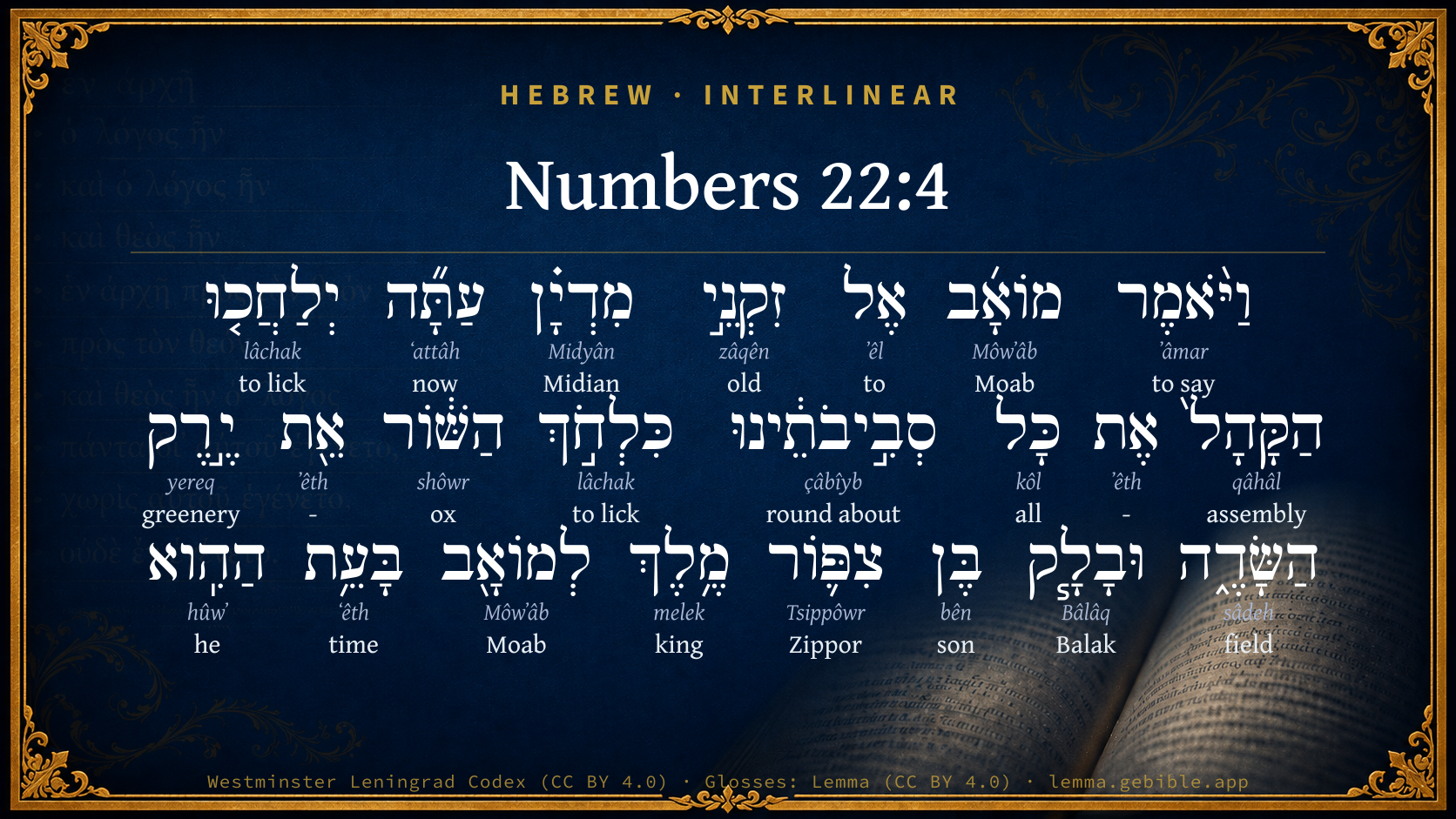
Hebrew (Westminster Leningrad Codex) Numbers 22:4 appears in the Hebrew Old Testament. The text above is from the Westminster Leningrad Codex. Each word links to its Strong’s number, a concise gloss, and parsing drawn from the Open Scriptures Hebrew Bible morphology. Click any word for its full Brown-Driver-Briggs (BDB) entry.
Download image
Cite this verse

Numbers 22:4 (World English Bible). Public Domain. Lemma interlinear Bible study tool, https://lemma.gebible.app/v/numbers/22/4.

Show BibTeX & RIS
BibTeX
RIS
English Translation
Moab said to the elders of Midian, Now will this multitude lick up all that is round about us, as the ox licks up the grass of the field. Balak the son of Zippor was king of Moab at that time.
World English Bible · Public Domain
Highlights
  • 1 first appearance in the Hebrew Bible
Full analysis ↓
Download a study sheet

One document with this verse’s original text, its word-by-word gloss line, the meaning frame, cross-references with their text, attributed commentary, and full source and license credits — printable, and it pastes into notes with its structure intact.

This verse Autodidact and up

Study sheet (.html) Plain text (.txt)

A passage Seminary Student

Up to 50 verses in one chapter. A passage sheet keeps up to 6 commentary sources and 12 cross-references per verse, in the order this page ranks them, and says so on the sheet whenever that leaves anything out. Ask for a single verse and you get the Autodidact verse sheet above.

Everything on this page stays free to read, with no account — the sheet is a download of what is already on screen, not access to it.

Want to remove ads? Support Godless Engineer
Compare translations 3

The same verse in 3 English versions, stacked beneath the original-language interlinear above. Click any original word for its lexicon entry.

Each is an independent rendering of the whole verse — the interlinear is not word-aligned to these translations.

Highlighted words mark where these versions differ — a whole-verse word diff, not a word-by-word alignment.

  • World English Bible Public Domain
    Moab said to the elders of Midian, Now will this multitude lick up all that is round about us, as the ox licks up the grass of the field. Balak the son of Zippor was king of Moab at that time.
  • King James Version Public Domain
    And Moab said unto the elders of Midian, Now shall this company lick up all that are round about us, as the ox licketh up the grass of the field. And Balak the son of Zippor was king of the Moabites at that time.
  • unfoldingWord Literal Text CC BY-SA 4.0
    And Moab said to the elders of Midian, “Now the assembly will lick up all of our surroundings, as the ox licks up the green of the field.” And Balak the son of Zippor king of Moab at that time.

unfoldingWord Literal Text — © unfoldingWord, licensed CC BY-SA 4.0. Word-aligned USFM3 via Door43 (git.door43.org/unfoldingWord/en_ult).

Versions to compare (up to 4)

3 of 4 selected

Show all 18 translations

Every available English version of this verse, each an independent rendering of the whole verse.

  • World English Bible Public Domain
    Moab said to the elders of Midian, Now will this multitude lick up all that is round about us, as the ox licks up the grass of the field. Balak the son of Zippor was king of Moab at that time.
  • Berean Standard Bible Public Domain
    So the Moabites said to the elders of Midian, “This horde will devour everything around us, as an ox licks up the grass of the field.” Since Balak son of Zippor was king of Moab at that time,
  • Majority Standard Bible Public Domain
    So the Moabites said to the elders of Midian, “This horde will devour everything around us, as an ox licks up the grass of the field.” Since Balak son of Zippor was king of Moab at that time,
  • King James Version Public Domain
    And Moab said unto the elders of Midian, Now shall this company lick up all that are round about us, as the ox licketh up the grass of the field. And Balak the son of Zippor was king of the Moabites at that time.
  • American Standard Version (1901) Public Domain
    And Moab said unto the elders of Midian, Now will this multitude lick up all that is round about us, as the ox licketh up the grass of the field. And Balak the son of Zippor was king of Moab at that time.
  • Revised Version (1885) Public Domain
    And Moab said unto the elders of Midian, Now shall this multitude lick up all that is round about us, as the ox licketh up the grass of the field. And Balak the son of Zippor was king of Moab at that time.
  • Geneva Bible (1599) Public Domain
    Therfore Moab said vnto the Elders of Midian, Nowe shall this multitude licke vp all that are round about vs, as an oxe licketh vp ye grasse of the fielde: and Balak the sonne of Zippor was King of the Moabites at that time.
  • Douay-Rheims (1899) Public Domain
    He said to the elders of Madian: So will this people destroy all that dwell in our borders, as the ox is wont to eat the grass to the very roots. Now he was at that time king in Moab.
  • Young's Literal Translation Public Domain
    and Moab saith unto the elders of Midian, `Now doth the assembly lick up all that is round about us, as the ox licketh up the green thing of the field.' And Balak son of Zippor `is' king of Moab at that time,
  • Literal Standard Version CC BY-SA 4.0
    and Moab says to [the] elderly of Midian, “Now the assembly licks up all that is around us, as the ox licks up the green thing of the field.” And Balak son of Zippor [is] king of Moab at that time,
  • Unlocked Literal Bible CC BY-SA 4.0
    The king of Moab said to the elders of Midian, “This multitude will eat up all that is around us as an ox eats up the grass in a field.” Now Balak son of Zippor was king of Moab at that time.
  • unfoldingWord Literal Text CC BY-SA 4.0
    And Moab said to the elders of Midian, “Now the assembly will lick up all of our surroundings, as the ox licks up the green of the field.” And Balak the son of Zippor king of Moab at that time.
  • Darby Bible Public Domain
    And Moab said to the elders of Midian, Now will this company lick up all that is round about us, as an ox licks up the green herb of the field. Now Balak the son of Zippor was king of Moab at that time.
  • World Messianic Bible Public Domain
    Moab said to the elders of Midian, “Now this multitude will lick up all that is around us, as the ox licks up the grass of the field.” Balak the son of Zippor was king of Moab at that time.
  • Webster's Bible Public Domain
    And Moab said to the elders of Midian, Now shall this company lick up all that are around us, as the ox licketh up the grass of the field. And Balak the son of Zippor was king of the Moabites at that time.
  • Free Bible Version CC BY-SA 4.0
    and told the leaders of Midian, “This horde will eat up everything we have, just like an ox eats up grass in the field!” (Balak son of Zippor, was king of Moab at that time.)
  • Bible in Basic English Public Domain
    Then Moab said to the responsible men of Midian, It is clear that this great people will be the destruction of everything round us, making a meal of us as the ox does of the grass of the field. At that time Balak, the son of Zippor, was king of Moab.
  • JPS Tanakh (1917) Public Domain
    And Moab said unto the elders of Midian: 'Now will this multitude lick up all that is round about us, as the ox licketh up the grass of the field.' — And Balak the son of Zippor was king of Moab at that time. —

Literal Standard Version (2020), Covenant Press — licensed CC BY-SA 4.0. Text via the HelloAO Bible API (eBible.org). Unlocked Literal Bible (unfoldingWord) — licensed CC BY-SA 4.0. Text via the HelloAO Bible API (eBible.org). unfoldingWord Literal Text — © unfoldingWord, licensed CC BY-SA 4.0. Word-aligned USFM3 via Door43 (git.door43.org/unfoldingWord/en_ult). Free Bible Version, Dr. Jonathan Gallagher — licensed CC BY-SA 4.0. Text via the HelloAO Bible API (eBible.org).

Word by word

More ways to search: Search by grammar → Find every occurrence → Compare this word →

Practice this passage: Drill this verse → Learn its vocabulary →

יְלַחֲכ֤וּ
lâchak
H3897
“to lick”
Verb, Piel, Imperfect, 3rd Person, Masculine, Plural
Part of Speech
Verb
Stem
Piel
Form
Imperfect
Person
3rd Person
Gender
Masculine
Number
Plural
Full BDB Definition

Origin: a primitive root

TWOT: 1103

to lick, lick up - (Qal) to lick up - (Piel) to lick up
  1. וַיֹּ֨אמֶר ʼâmar H559 “and · to say” Conjunction + Verb, Qal, Sequential Imperfect, 3rd Person, Masculine, Singular
  2. מוֹאָ֜ב Môwʼâb H4124 “Moab” Noun, Proper
  3. אֶל ʼêl H413 “to” Preposition
  4. זִקְנֵ֣י zâqên H2205 “old of” Adjective, Adjective, Masculine, Plural, Construct
  5. מִדְיָ֗ן Midyân H4080 “Midian” Noun, Proper
  6. עַתָּ֞ה ʻattâh H6258 “now” Adverb
  7. הַקָּהָל֙ qâhâl H6951 “the · assembly” Particle, Definite Article + Noun, Common, Masculine, Singular, Absolute
  8. אֶת ʼêth H853 “-” Particle, Direct Object
  9. כָּל kôl H3605 “all of” Noun, Common, Masculine, Singular, Construct
  10. סְבִ֣יבֹתֵ֔ינוּ çâbîyb H5439 “surroundings · our” Noun, Common, Both, Plural, Construct + Suffix, Personal, 1st Person, Common, Plural
  11. כִּלְחֹ֣ךְ lâchak H3897 “like/as · to lick” Preposition + Verb, Qal, Infinitive Construct
  12. הַשּׁ֔וֹר shôwr H7794 “the · ox” Particle, Definite Article + Noun, Common, Masculine, Singular, Absolute
  13. אֵ֖ת ʼêth H853 “-” Particle, Direct Object
  14. יֶ֣רֶק yereq H3418 “greenery of” Noun, Common, Masculine, Singular, Construct
  15. הַשָּׂדֶ֑ה sâdeh H7704 “the · field” Particle, Definite Article + Noun, Common, Masculine, Singular, Absolute
  16. וּבָלָ֧ק Bâlâq H1111 “and · Balak” Conjunction + Noun, Proper
  17. בֶּן bên H1121 “son of” Noun, Common, Masculine, Singular, Construct
  18. צִפּ֛וֹר Tsippôwr H6834 “Zippor” Noun, Proper
  19. מֶ֥לֶךְ melek H4428 “king” Noun, Common, Masculine, Singular, Absolute
  20. לְמוֹאָ֖ב Môwʼâb H4124 “to/for · Moab” Preposition + Noun, Proper
  21. בָּעֵ֥ת ʻêth H6256 “in/at the · time” Preposition, Determined + Noun, Common, Both, Singular, Absolute
  22. הַהִֽוא hûwʼ H1931 “the · he” Particle, Definite Article + Pronoun, Personal, 3rd Person, Feminine, Singular

About this verse

These counts appear in no published source. They are computed here, from the morphology-tagged text and Lemma’s own curated glosses. What Lemma adds →

23
words
20
distinct lemmas
Pentateuch
section

Notable vocabulary

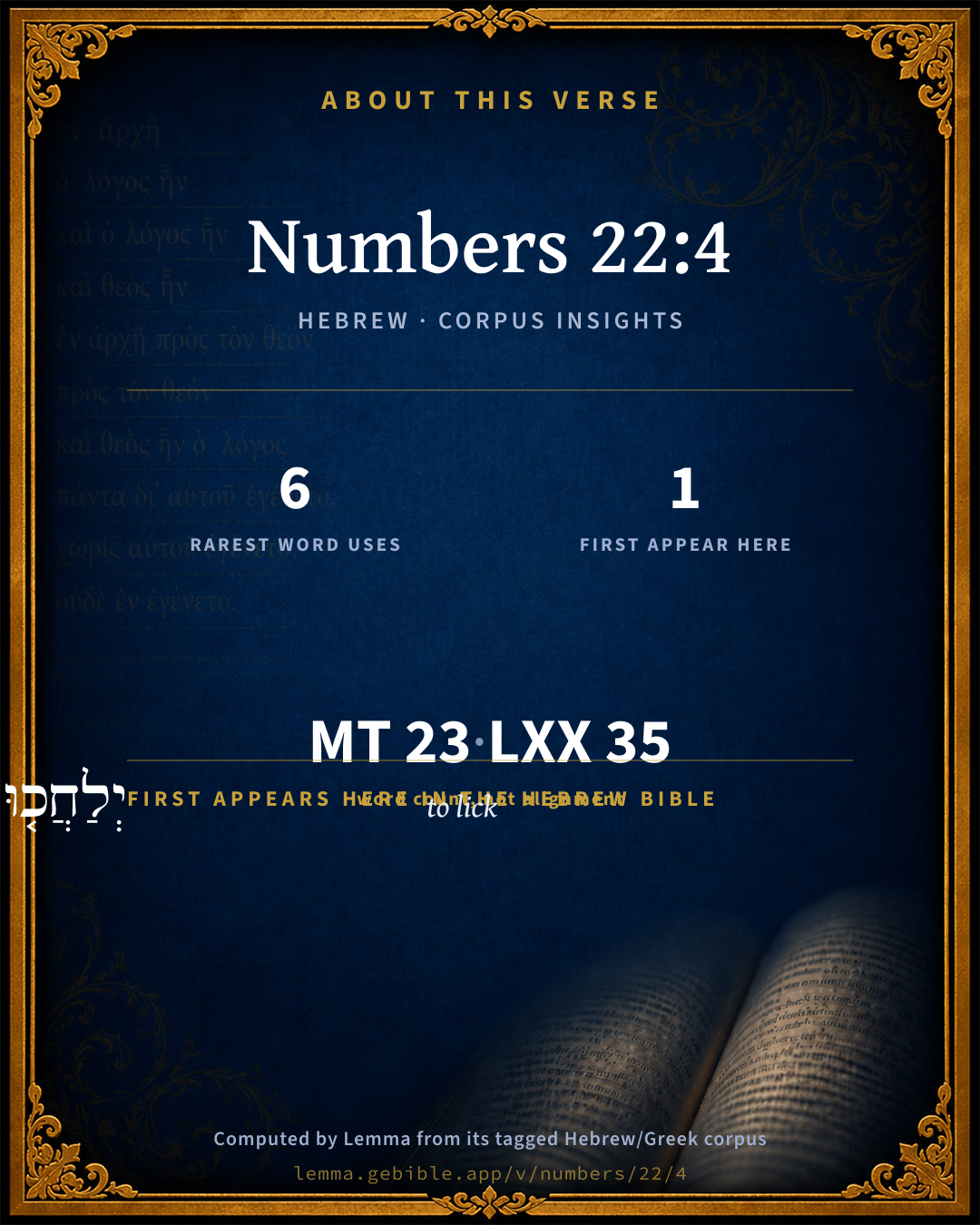
The rarest word here is יְלַחֲכ֤וּ to lick H3897 — appearing just 6 times in the whole Hebrew Bible.

First appearance in Scripture

This word makes its first canonical appearance in the Hebrew Bible here:

  • יְלַחֲכ֤וּ to lick H3897

Shared distinctive vocabulary

יְלַחֲכ֤וּ to lick H3897 occurs in 5 verses of the Hebrew Bible. Also found in:

Grammatical profile

  • 3 verbs
  • 14 nouns
  • 1 adjective
  • 1 pronoun
  • 1 preposition
  • 1 adverb
  • 2 particles

Verb forms

  • וַיֹּ֨אמֶר Qal · Sequential Imperfect
  • יְלַחֲכ֤וּ Piel · Imperfect
  • כִּלְחֹ֣ךְ Qal · Infinitive Construct

Repetition

Words recur within this verse — often emphatic in Hebrew:

  • מוֹאָ֜ב Moab H4124 ×2
  • יְלַחֲכ֤וּ to lick H3897 ×2

Hebrew & Septuagint length

In English translation the verse runs 41 words from the Hebrew and 43 from the Septuagint (LXX English) — closely comparable.

A rough comparison of the two English renderings, which tokenize alike — not a word-level alignment.

Word counts can differ between the Hebrew and the Greek without any difference in meaning — e.g. the Hebrew direct-object marker אֵת has no separate Greek word, and Greek often adds the article ὁ.

In the original languages it is 23 Hebrew tokens and 35 Greek tokens — but the two are counted differently (Hebrew bundles its prefixes and suffixes into one token; the Greek is in lemma form), so that isn’t a like-for-like length.

Cross-references

8

Topical passages linked to Numbers 22:4 in the Treasury of Scripture Knowledge — connected by theme and wording, ordered by reader-vote popularity; previews shown in the World English Bible.

  • Numbers 25:15–18 The name of the Midianite woman who was slain was Cozbi, the daughter of Zur; he was head of the people of a fathers' house in Midian.
  • Numbers 31:8 They killed the kings of Midian with the rest of their slain: Evi, and Rekem, and Zur, and Hur, and Reba, the five kings of Midian: Balaam also the son of Beor they killed with the sword.
  • Numbers 22:2 Balak the son of Zippor saw all that Israel had done to the Amorites.
  • Numbers 22:7 The elders of Moab and the elders of Midian departed with the rewards of divination in their hand; and they came to Balaam, and spoke to him the words of Balak.
  • Numbers 24:17 I see him, but not now; I see him, but not near: There shall come forth a star out of Jacob, A scepter shall rise out of Israel, Shall strike through the corners of Moab, Break down all the sons of tumult.
  • Joshua 13:21–22 and all the cities of the plain, and all the kingdom of Sihon king of the Amorites, who reigned in Heshbon, whom Moses struck with the chiefs of Midian, Evi, and Rekem, and Zur, and Hur, and Reba, the princes of Sihon, who lived in the land.
  • Judges 11:25 Now are you anything better than Balak the son of Zippor, king of Moab? did he ever strive against Israel, or did he ever fight against them?
  • Jeremiah 48:38 On all the housetops of Moab and in the streets of it there is lamentation every where; for I have broken Moab like a vessel in which none delights, says Yahweh.

Cross-references courtesy of OpenBible.info (CC BY 4.0).

Hebrew and Greek witnesses Masoretic Hebrew ↔ Greek Septuagint

The same verse in the two great witnesses to the Old Testament, shown verse-for-verse.

These are two independent witnesses, not word-aligned to each other, and the Septuagint is shown in lemma (dictionary) form.

Hebrew Numbers 22:4 Masoretic · Westminster Leningrad Codex

וַיֹּ֨אמֶר מוֹאָ֜ב אֶל זִקְנֵ֣י מִדְיָ֗ן עַתָּ֞ה יְלַחֲכ֤וּ הַקָּהָל֙ אֶת כָּל סְבִ֣יבֹתֵ֔ינוּ כִּלְחֹ֣ךְ הַשּׁ֔וֹר אֵ֖ת יֶ֣רֶק הַשָּׂדֶ֑ה וּבָלָ֧ק בֶּן צִפּ֛וֹר מֶ֥לֶךְ לְמוֹאָ֖ב בָּעֵ֥ת הַהִֽוא

Moab said to the elders of Midian, Now will this multitude lick up all that is round about us, as the ox licks up the grass of the field. Balak the son of Zippor was king of Moab at that time.

World English Bible · Public Domain

Greek LXX Numbers 22:4 Septuagint · lemma form

καί εἶπον μωαβ ὁ γερουσία μαδιαμ νῦν ἐκλείχω ὁ συναγωγή οὗτος πᾶς ὁ κύκλος ἐγώ ὡς ἐκλείχω ὁ μόσχος ὁ χλωρός ἐκ ὁ πεδίον καί βαλακ υἱός σεπφωρ βασιλεύς μωαβ εἰμί κατά ὁ καιρός ἐκεῖνος

And Moab said to the elders of Madiam, Now shall this assembly lick up all that are round about us, as a calf would lick up the green herbs of the field:—and Balac son of Sepphor was king of Moab at that time.

LXX2012 (modern English Septuagint) · Public Domain

Hebrew: Westminster Leningrad Codex (CC BY 4.0). Greek: Septuagint (public domain); English from LXX2012 (modern English Septuagint) (Public Domain). How the Septuagint differs from the Hebrew →

Targum (Aramaic paraphrase)

2

The Targum is the ancient Jewish Aramaic paraphrase of the Hebrew Scriptures — an interpretive translation, not the Hebrew text itself. Onkelos (literal) and Pseudo-Jonathan (expansive) render the Torah, and Jonathan the Prophets. Coverage is partial: where no permissively-licensed English translation exists for a verse, only the Aramaic is shown. This is verse-level text, not a word-by-word alignment to the Hebrew.

  1. Targum Onkelos Torah (Genesis–Deuteronomy)
    וַאֲמַר מוֹאָב לְסָבֵי מִדְיָן כְּעַן יְשֵׁיצוּן קְהָלָא יָת כָּל סַחֲרָנָנָא כְּמָא דִמְלַחֵיךְ תּוֹרָא יָת יְרוֹקָא דְחַקְלָא וּבָלָק בַּר צִפּוֹר מַלְכָּא לְמוֹאָב בְּעִידָנָה הַהִיא

    (no public-domain English translation for this verse)

    Targum Onkelos — Aramaic: “Onkelos Genesis” (public domain); “Onkelos Exodus” (public domain); “Onkelos Leviticus” (public domain); “Onkelos Numbers” (public domain); “Onkelos Deuteronomy” (public domain). English: “Sefaria Community Translation” (CC0 1.0 (public-domain dedication)); “J.W. Etheridge. The Targums of Onkelos and Jonathan Ben Uzziel on the Pentateuch. London: Longmans, Green, 1862” (public domain). Text via Sefaria.

  2. Targum Pseudo-Jonathan Torah (Genesis–Deuteronomy)
    וַאֲמַר מוֹאֲבָאֵי לְסָבֵי מִדְיָנָאֵי אֲרוּם עַמָא חַד וּמָלְכוּ חַד הֲווֹן עַד הַהוּא יוֹמָא כְּדוּן יְשֵׁיצוּן קְהָלָא יַת כָּל חָזְרָנוּתָא הֵיכְמָא דְמִבְעֵי תוֹרָא יַת עִיסְבָּא דְחַקְלָא וּבָלָק בַּר צִפּוֹר מִדְיָנָאָה מַלְכָּא לְמוֹאָב בְּעִידָנָא הַהִיא וְלָא בְּעִידָנָא חוֹרָנָא דְהָכִין הֲוָה תְנָאָה בֵּינַתְהוֹן לְמֶהֱוֵי מַלְכִין לְפִרְקִין מֵאִילַךְ וְאִילַךְ

    And they said to the elders of the Midianee, for the people had been one and the kingdom one unto that day: Now will this congregation consume all that is about them, as the ox eateth up the grass of the field. And Balak bar Zippor, a Midianite, was the king of Moab at that time; without (a Midianite) being such at another time; for so was the tradition among them, to have kings from this people and from that, by turns.

    Targum Pseudo-Jonathan — Aramaic: “Targum Jonathan on Genesis” (public domain); “Targum Jonathan on Exodus” (public domain); “Targum Jonathan on Leviticus” (public domain); “Targum Jonathan on Numbers” (public domain); “Targum Jonathan on Deuteronomy” (public domain). English: “The Targum of Jonathan ben Uzziel, trans. J. W. Etheridge, London, 1862” (public domain). Text via Sefaria.

Commentary

Notes on Numbers 22:4 from classic Christian and Jewish commentators (each source and its license shown beneath its notes). The classic Christian expositions comment on the surrounding passage and are grouped to its opening verse, so a note may address several verses; the Jewish commentaries on the Tanakh (Rashi and others) are per-verse, so they appear only where the commentator wrote on this verse.

Lemma curates 59 commentaries, every one of them public domain or Creative Commons licensed, each selected and text-cleaned for this edition rather than reprinted as found. About our sources →

Trapp's Complete Commentary

John Trapp

Num 22:4 And Moab said unto the elders of Midian, Now shall this company lick up all [that are] round about us, as the ox licketh up the grass of the field. And Balak the son of Zippor [was] king of the Moabites at that time.

Ver. 4. Unto the elders of Midian.] Their neighbours and confederates. These are called the dukes of Sihon, as having been subdued by his tyranny, whereof Israel had now freed them, and meant them no hurt. {Num 31:8 Jos 13:21}

And Balak the son of Zippor.] A politic and potent prince, {Mic 6:5} not more valiant than vigilant, ingeniose nequam, wittily wicked.

John Trapp, A Commentary or Exposition upon All the Books of the Old and New Testament (1647–1656) — public domain. Text from a community e-Sword module.

Joseph Benson's Commentary

Num 22:4. The elders — Called the kings of Midian, Num 31:8; and princes of Midian, Jos 13:21; who, though divided into their kingdoms, yet were now united upon the approach of the Israelites, their common enemy, and being, as it seems, a potent and crafty people, and neighbours to the Moabites, these seek confederacy with them. We read of Midianites near mount Sinai, Exo 2:3.; which seem to have been a colony of this people, that went out to seek new quarters, as the manner of those times was; but the body of that people were seated in those parts. Lick up — That is, consume and utterly destroy, in which sense the fire is said to lick up the water and sacrifices, 1Ki 18:38; all that are round about us — All our people, who live in the country adjoining to each city, where the princes reside. A lively metaphor to signify the facility with which the Israelites should conquer them without a timely opposition, and likewise what a universal desolation they should make.

Joseph Benson's Commentary on the Old and New Testaments (1811–1818) — public domain. Text from a community e-Sword module.

Tyndale Open Study Notes

Tyndale Open Resources

22:4 Midian: This desert people was descended from Abraham (Gen 25:1-2; Exod 2:15-16). Their alliance with Moab was the beginning of their conflicts with Israel (Num 22:7; see 25:6, 14-18; 31:2-10; Judg 6–8).

Tyndale Open Study Notes — © Tyndale Open Resources, licensed CC BY-SA 4.0. Text via the HelloAO Bible API.

Geneva Bible (1599)

Geneva Bible translators

Which were the heads and governors.

Geneva Bible (1599) marginal notes — public domain. Text via Bolls.life.

Jamieson, Fausset & Brown

Robert Jamieson, A. R. Fausset & David Brown

elders of Midian--called kings (Num 31:8) and princes (Jos 13:21). The Midianites, a distinct people on the southern frontier of Moab, united with them as confederates against Israel, their common enemy.

Jamieson, Fausset & Brown — Commentary Critical and Explanatory on the Whole Bible (1871) — public domain (CC PDM 1.0). Text via the HelloAO Bible API.

Ellicott's Commentary for English Readers

(4) And Moab said unto the elders of Midian.—It has been thought that Balak was a Midianite. who had been imposed upon the Moabites as their king by their Amoritish conquerors. (Comp. Num_21:26.) The concluding words of the verse may be understood as denoting a recent change in the dynasty.

As the ox licketh up the grass of the field.—The comparison is one which well accords with the occupation of the Moabites as a pastoral people.

A Bible Commentary for English Readers, edited by Charles John Ellicott (1878–1897) — public domain. Text from a community e-Sword module.

The Cambridge Bible for Schools and Colleges

gen. ed. J. J. S. Perowne

4. And Moab said] The people are represented in the person of their king.

the elders of Midian] They are mentioned, in this story, only here and in Num_22:7. The Midianites may be supposed to have made common cause with the Moabites in fear of the formidable enemy. But if so, it is surprising that they are not named in Balaam’s utterances in ch. 24. Behind the present narrative there may lie some unknown tradition in J which formed the basis of P’s narrative in 31:161 [Note: Notice that Midian is geographically connected with the territory of Moab in Gen_36:35 (J).] . Or perhaps, as some think, a late compiler has here introduced the Midianites in view of Num_31:16.

And Balak … at that time] In Num_22:2 E has already mentioned Balak as a well-known person.

The Cambridge Bible for Schools and Colleges (gen. ed. J. J. S. Perowne; Cambridge University Press, 1878–1918) — public domain. Text from a community e-Sword module.

John Gill's Exposition

He sent messengers therefore unto Balaam the son of Beor,.... In consequence of the consultation held by the king of Moab with the elders of Midian; and very probably through a motion of theirs, and by advice they gave, Balak dispatched messengers of both people to the person here described by his name and parentage; but who he was is not easy to say: the Jews sometimes make him to be a magician in Pharaoh's court, at the time when Moses was born (z), which is not probable; and it is still more improbable that he should be Laban the Syrian, as the Targum of Jonathan here, and the Targum on Ch1 1:44 though others say (a) he was the son of Beor, the son of Laban, and so was the grandson of Laban; and with as little probability is he said to be Elihu, that answered Job according to a tradition of the Jews, mentioned by Jerom (b); nor is there any reason to believe that he was ever a good man, and a true prophet of the Lord; he is expressly said to be a diviner or a soothsayer, Jos 13:22, a sort of men abhorred of God, and not to be suffered to be among his people, Deu 18:10 but were of great credit and esteem among the Heathens, for their pretensions to foretell things to come, or to discover lost goods, and the like; and by their enchantments to drive away evils, or bring on curses, for which Balaam was famous: and therefore, by the advice of the Midianites, Balak sent for him

to Pethor, which is by the river of the land of the children of his people; the land of his people, of his birth or habitation, was Aram or Syria, Num 23:7 that is, Aram Naharaim, which lay between the two rivers Tigris and Euphrates, or what is sometimes called Mesopotamia, as is clear from Deu 23:4, and the river of that land, which was eminently so called, is the river Euphrates, as the Targum of Jonathan expresses it here, and by that river was Pethor, where Balaam now lived; and is by some thought to be the same with the Pacoria of Ptolemy (c), which was by that river: the messengers were sent

to call him: to invite him to Balak's court:

saying, behold, there is a people come out from Egypt; Balak speaks of them, as if he knew not who they were, only that they were come from Egypt, and were seeking a new habitation to settle in, and so were in danger from them, lest they should invade his country, and settle there:

behold, they cover the face of the earth; not the face of the whole earth, unless an hyperbolical expression is supposed, to set forth the greatness of their numbers; but a large part of the earth, all within sight almost, even the plains of Moab:

and they abide over against me; were very near him, lay encamped before his country, and his metropolis, and so he thought himself in great danger, and threatened with an invasion, as the pitching of their tents so near made him surmise.

(z) Dibre Hayamim Shekmoaseh, fol. 3. 2. (a) Shalshalet Hakabala, fol. 7. 2. (b) Quaest. "see Traditiones" in Gen. fol. 69. D. (c) Geograph. l. 5. c. 18.

John Gill's Exposition of the Whole Bible (1746–1763) — public domain (CC PDM 1.0). Text via the HelloAO Bible API.

Haydock's Catholic Bible Commentary

Elders of Madian, who dwelt also upon the Arnon, towards the lake of Sodom. These Madianites were a different people from those who inhabited the country to the east of the Red Sea. (St. Jerome) --- They were not governed by kings, but by an aristocracy, or senate of princes. (Haydock)

George Leo Haydock (1774–1849), Haydock's Catholic Family Bible and Commentary, 1859 edition — public domain. Excludes Psalms (Douay-Rheims chapter numbering differs from Protestant) and Deuterocanonical books (Catholic canon only).

Matthew Poole's English Annotations

The elders of Midian, called the kings of Midian, Num 31:8, and princes of Midian, Jos 13:21; who though divided into their kingdoms, yet were now unified upon the approach of the Israelites their common enemy; and being, as it seems, a potent and crafty people, and neighbours to the Moabites, these seek confederacy with them. We read of Midianites near Mount Sinai, Exo 2; Exo 3, which seem to have been a part or colony of this people that went out to seek new quarters, as the manner of those times was, but the body of that people were seated in those parts, as is evident from many scriptures.

Lick up, i.e. consume and utterly destroy, in which sense the fire is said to lick up the water and sacrifices, 1Ki 18:38. The meaning is, we can expect no mercy from them, they will utterly root us out as they did the Amorites, if we do not make a stout and timely opposition.

All that are round about us, i.e. all our people, who lived in the country and territory adjoining to each city, where the princes resided.

Matthew Poole's English Annotations on the Holy Bible (1683–1685) — public domain. Text from a community e-Sword/MySword module.

Whedon's Commentary on the Bible

Daniel D. Whedon

4. Elders of Midian — Greek, “The senate of Madiam.” From the absence of any mention of a king of Midian at this time we infer that the people were governed by the body of elders or princes, and that they were so closely allied to Moab as to have but one king. See Num_22:2, note. It is impossible for geographers to lay down the boundaries of the Midianites. It is certain that they dwelt on the western shore of the AElanitic Gulf, east of Horeb, and that they stretched northward along the eastern frontier of the tribes of Israel east of the Jordan.

Lick up all — This expressive metaphor, still common in the East, was very natural to a pastoral people. Balak wished to arouse the fears of Midian and to secure their aid in the scheme of destroying Israel, not by an alliance of arms but of influence in securing the destructive agency of the renowned Mesopotamian soothsayer.

Daniel D. Whedon (gen. ed.), Commentary on the Old and New Testaments (1874–1909) — public domain. Text from a community e-Sword module.

The Pulpit Commentary

Moab said unto the elders of Midian. The Midianites were descended from Abraham and Keturah, (Gen_25:2, Gen_25:4) and were thus more nearly of kin to Israel than to Moab. They lived a semi-nomadic life on the steppes to the east of Moab and Ammon, (cf. Gen_36:35) supporting themselves partly by grazing, and partly by the caravan trade. (Gen_37:28) Their institutions were no doubt patriarchal, like those of the modern Bedawin, and the "elders" were the sheiks of their tribes. As the ox licketh up the grass of the field. The strong, scythe-like sweep of the ox"s tongue was a simile admirable in itself, and most suitable to pastoral Moab and Midian.

The Pulpit Commentary (1880–1919), ed. H.D.M. Spence-Jones & Joseph S. Exell — public domain. Text from a community e-Sword module.

John Wesley's Explanatory Notes

The elders - Called the kings of Midian, chap. xxxi, 8, and princes of Midian, Josh. xiii, 21, who though divided into their kingdoms yet were now united upon the approach of the Israelites their common enemy, and being, as it seems, a potent and crafty people, and neighbours to the Moabites, these seek confederacy with them. We read of Midianites near Mount Sinai, Exod. ii, and iii, which seem to have been a colony of this people, that went out to seek new quarters, as the manner of those times was, but the body of that people were seated in those parts. Lick up - That is, consume and utterly destroy, in which sense the fire is said to lick up the water and sacrifices, 1 Kings xviii, 38. All that are round about us - All our people, who live in the country adjoining to each city, where the princes reside.

John Wesley, Explanatory Notes Upon the Whole Bible (1754–1765) — public domain. Text via the GEBible commentary corpus.

Rashi

Rabbi Shlomo Yitzchaki (Rashi)

אל זקני מדין AND MOAB SAID] TO THE ELDERS OF MIDIAN But did not these (Moab and Midian) always hate one another, just as is stated, (Genesis 36:35) “who had smitten Midian in the country of Moab”, from which it is evident that Midian had come against Moab in war? But out of fear of Israel they now made peace between themselves (Midrash Tanchuma, Balak 3; cf. Sanhedrin 105a). And what induced Moab to take counsel of Midian? When they saw that Israel was victorious in a supernatural manner they said: the leader of these people grew up in Midian; let us ask them what is his chief characteristic. They replied to them; “His power lies only in his mouth (in prayer)”. Whereupon they said: “Then we must come against them with a man whose power lies in his mouth” (Midrash Tanchuma, Balak 3).

כלחך השור AS THE OX LICKETH — they used this comparison because whatever piece of ground the ox licks has no blessing left in it (cf. Shabbat 140b, 141a; Midrash Tanchuma, Balak 3).

בעת ההוא [BALAK WAS KING OF MOAB] AT THAT TIME — at that time: he was not really entitled to the kingdom; he was actually one of the Midianite princes, but when Sihon died they (the Moabites) appointed him as king over them to meet the needs of the time (Midrash Tanchuma, Balak 4).

Rashi on the Tanakh — English translations: “The Judaica Press complete Tanach with Rashi, translated by A. J. Rosenberg” (CC BY 4.0); “Pentateuch with Rashi's commentary by M. Rosenbaum and A.M. Silbermann, 1929-1934” (public domain); “The Metsudah Tanach series, Lakewood, N.J” (CC BY 4.0); and “The Book of Joshua, Metsudah Publications, 1997” (CC BY 4.0). Text via Sefaria.

Ramban (Nachmanides)

Rabbi Moshe ben Nachman (Ramban / Nachmanides)

THE ELDERS OF MIDIAN. Rabbi Abraham ibn Ezra commented that “it is possible that the five kings of Midian (further, 31:8). It is thus with the five “kings” of Midian [who are here in Verse 4 called “elders”] that Moab took counsel with, but not with the elders of Midian mentioned in Verse 7, who were lords not “kings.” Ramban will refute this interpretation of Ibn Ezra. were the elders.” But if so, [the expression] and the elders of Moab and ‘the elders of Midian’ departed [further on in Verse 7] does not refer to the [same] “elders of Midian” mentioned at the beginning [here in Verse 4: And Moab said unto ‘the elders of Midian’] since kings would not have gone to him [Balaam on such a mission] and [“the elders” mentioned in Verse 7 must perforce have been] princes, as is [expressly] written, [but not “kings”]. Furthermore, according to the opinion of our Rabbis 7. who said [that the reason why Moab turned for assistance to Midian, their traditional enemy, was because they said]: “The leader of these people [the Israelites] grew up in Midian; [let us ask them about his characteristics]” — it would have been fitting for the Moabites to send [the delegation] to the elders of Midian, not to the kings or the people, for it was the elders who would know Moses’ nature.It appears to me that originally there were kings in Midian, but Sihon the king of the Amorites had fought against the former king of Moab, and taken all his land out of his hand, even unto the Arnon. He [also] fought against the children of Ammon and took [part] of their land, just as the Ammonite king said to Jephthah, Because Israel took away my land, when he came up out of Egypt, and Jephthah replied to him that they had taken it from Sihon., Verses 15-23. In [the Book of] Joshua it is [also] written, And their border was Jazer, and all the cities of Gilead, and half the land of the children of Ammon, unto Aroer; and Sihon furthermore fought against the kings of Midian and conquered their land, and made them his servants bringing tribute and took the crowns off their heads, depriving them of the splendor of royalty, and he allowed them to remain as judges of the land of Midian under his authority. Therefore [although as Ibn Ezra says, they were indeed once kings of Midian], they are called ‘the elders’ of Midian, similar in expression to [she shall go up] to the gate unto ‘the elders’ [which means “the judges”]. A proof for this [that the kings of Midian were appointed judges — “elders” — by Sihon] is the verse in [the Book of] Joshua: and all the kingdoms of Sihon king of the Amorites, who reigned in Heshbon, whom Moses smote with the chiefs of Midian, Eri, and Rekem, and Zur, and Hur, and Reba, ‘the princes of Sihon,’ that dwelt in the land, had now become the princes of Sihon. thus indicating that [the land of Midian arid its chiefs were] under the suzerainty of Sihon. The meaning then, of [the phrase] and the kings of Midian. is “the former kings of Midian,” just as it says: the chiefs of Midian … the princes of Sihon. had now become the princes of Sihon. Similarly it says [of Zur, one of the five people mentioned as a king of Midian], (further, 31:8). It is thus with the five “kings” of Midian [who are here in Verse 4 called “elders”] that Moab took counsel with, but not with the elders of Midian mentioned in Verse 7, who were lords not “kings.” Ramban will refute this interpretation of Ibn Ezra. he was the head of the people of ‘a fathers’ house in Midian,’, 25:15. but he was no longer king. Or it may be that the reason [for the use of the phrase] the kings of Midian. is that they had regained their royal status at that time.But I do not know a reason for that which Scripture says, and Balak the son of Zippor was king of Moab at that time, when it could have said [concisely] at the beginning, And Balak the son of Zippor, “king of Moab,” saw all that Israel had done to the Amorites. Perhaps Balak was a mightly man of valor, very famous for the acts of his power and of his might, and therefore Scripture mentioned that although Moab had a powerful king at that time, who was courageous among the mighty, they nonetheless were afraid and were overcome with dread because of the children of Israel. That is why Jephthah said [to the king of Ammon], And now art thou any thing better than Balak the son of Zippor, king of Moab?, for one does not frighten a king except by [mentioning the defeat of another] king who was greatly feared.It is possible that since Moab [at that time] did not have a king, the people stood in great fear because of the children of Israel, therefore they did two things: they sent to the elders of Midian saying, ‘Now will this people lick up etc.,’ and they appointed this man [Balak] as their king on the advice of Midian, and afterwards they all sent [a deputation] to Balaam at the command of the king. This is the meaning of [the expression] at that time [and Balak the son of Zippor was king of Moab ‘at that time’], namely [at the time that] they took counsel about the problem of Israel, and sent the messengers to Balaam. The meaning, then, of And Balak saw, is that he [Balak] who was one of the princes of Moab, and a mighty man of valor, took action in this matter and said to Moab, “Come, let us deal wisely with [this] people,” and they thereupon appointed him king on the advice of Midian. In the Midrash Bamidbar Sinai Rabbah I have seen [the following text, corroborating the above interpretation]: “And Balak the son of Zippor was king of Moab at that time. But was he not originally [merely] ‘a prince,’ as it is said, Evi, and Rekem, and Zur, and Hur, and Reba [the princes of Sihon]? But [we must say] that when Sihon was killed, at that time they appointed him king over them, the exigencies of the moment causing his [appointment as king, although he was not of the royal family].”

Ramban (Nachmanides) on the Tanakh — English translation: “Commentary on the Torah by Ramban (Nachmanides). Translated and annotated by Charles B. Chavel. New York, Shilo Pub. House, 1971-1976” (CC BY 4.0). Text via Sefaria.

Lesson kit

Teaching starters — assembled from the data on this page, not authored interpretation. Every prompt links to the verse data it draws on. Edit before teaching.

Numbers, in the Pentateuch, opens this verse with 23 words (20 distinct Hebrew lemmas). Its most distinctive word is lâchak (“to lick”). A historical commentator’s framing appears above. Read the whole chapter for the surrounding context.

Discussion questions

  1. What does “to lick” (lâchak) contribute to the verse as a whole?
  2. The word “to lick” first appears here in Scripture. What is being introduced at this debut?
  3. 1 Kings 18:38 shares the word «to lick» with this verse. How do the two illuminate each other?
  4. “Moab” occurs 2× in this one verse. What is the effect of the repetition?
  5. These translations render this verse differently; the difference is in the English rendering, not the original. What questions does that raise?
  6. The verb «וַיֹּ֨אמֶר» is Qal Sequential Imperfect. How does its form color the action?
  7. Reading how Trapp's Complete Commentary and Joseph Benson's Commentary read this verse, where do the two commentators agree and where do they part?

Things to notice

Reading settings

Reading text

Shown beneath each verse's original-language words.

Old Testament
Old Testament edition

Read the OT as the Masoretic Hebrew (MT) or the Greek Septuagint (LXX).

English shown for the Greek Septuagint (in the Hebrew ↔ Greek comparison).

Comparing translations? Open the Compare panel on any verse page to stack up to four side by side.