
1 Samuel 6:18

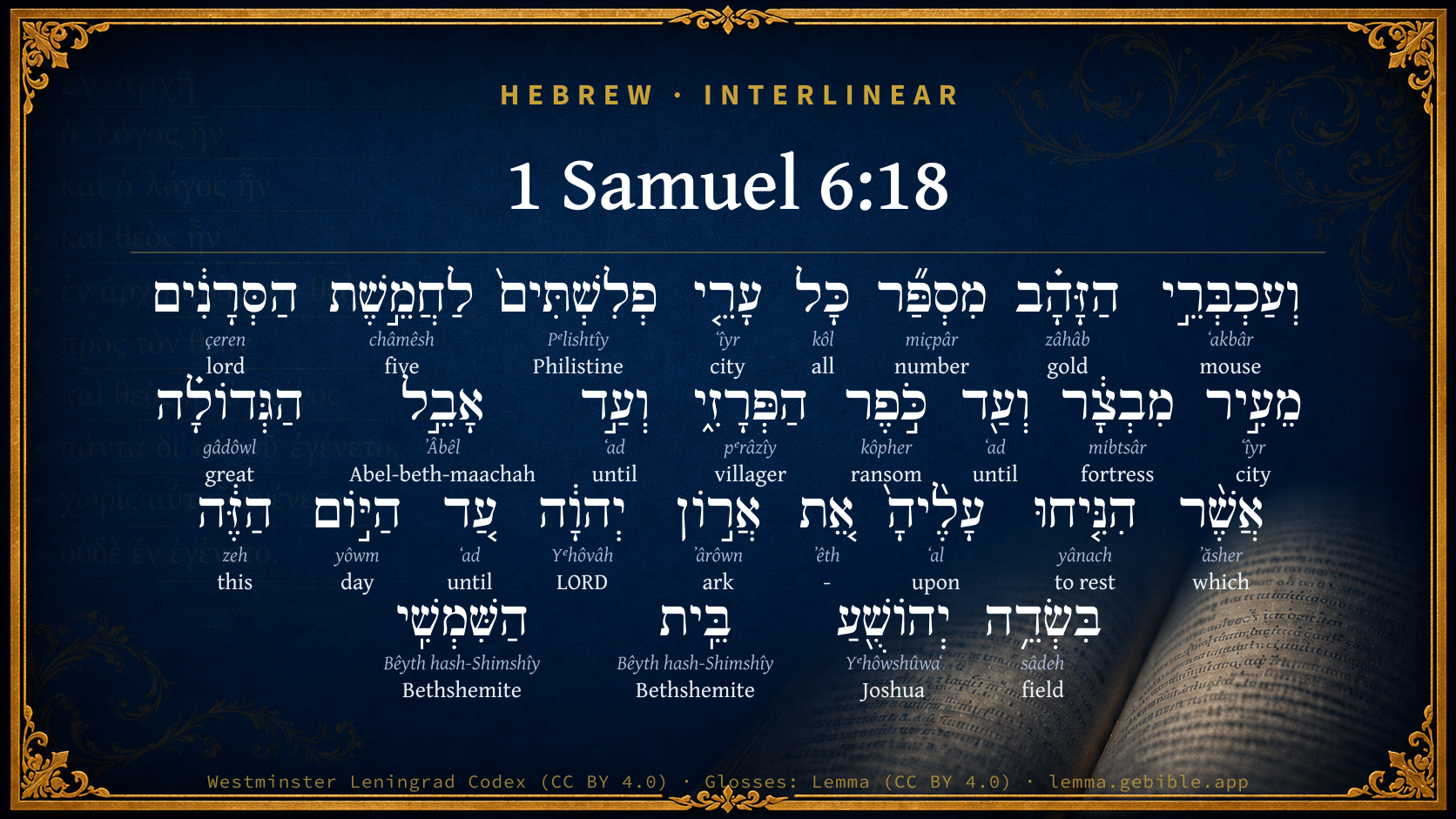
Hebrew (Westminster Leningrad Codex) 1 Samuel 6:18 appears in the Hebrew Old Testament. The text above is from the Westminster Leningrad Codex. Each word links to its Strong’s number, a concise gloss, and parsing drawn from the Open Scriptures Hebrew Bible morphology. Click any word for its full Brown-Driver-Briggs (BDB) entry.
Download image
Cite this verse

1 Samuel 6:18 (World English Bible). Public Domain. Lemma interlinear Bible study tool, https://lemma.gebible.app/v/1-samuel/6/18.

Show BibTeX & RIS
BibTeX
RIS
English Translation
and the golden mice, according to the number of all the cities of the Philistines belonging to the five lords, both of fortified cities and of country villages, even to the great stone, whereon they set down the ark of Yahweh, [which stone remains] to this day in the field of Joshua the Beth-shemite.
World English Bible · Public Domain
Highlights
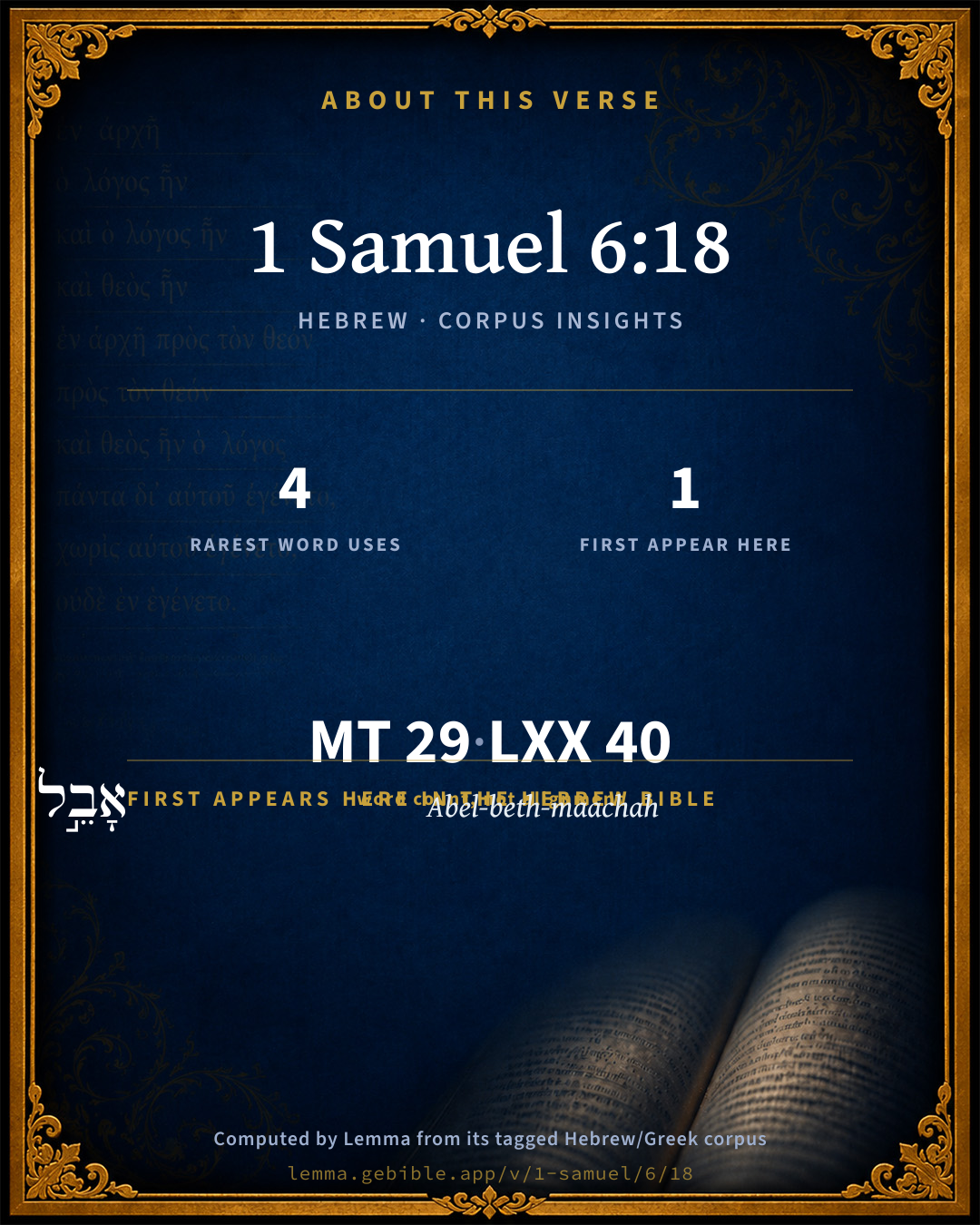
  • 1 first appearance in the Hebrew Bible
Full analysis ↓
Download a study sheet

One document with this verse’s original text, its word-by-word gloss line, the meaning frame, cross-references with their text, attributed commentary, and full source and license credits — printable, and it pastes into notes with its structure intact.

This verse Autodidact and up

Study sheet (.html) Plain text (.txt)

A passage Seminary Student

Up to 50 verses in one chapter. A passage sheet keeps up to 6 commentary sources and 12 cross-references per verse, in the order this page ranks them, and says so on the sheet whenever that leaves anything out. Ask for a single verse and you get the Autodidact verse sheet above.

Everything on this page stays free to read, with no account — the sheet is a download of what is already on screen, not access to it.

Want to remove ads? Support Godless Engineer
Compare translations 3

The same verse in 3 English versions, stacked beneath the original-language interlinear above. Click any original word for its lexicon entry.

Each is an independent rendering of the whole verse — the interlinear is not word-aligned to these translations.

Highlighted words mark where these versions differ — a whole-verse word diff, not a word-by-word alignment.

  • World English Bible Public Domain
    and the golden mice, according to the number of all the cities of the Philistines belonging to the five lords, both of fortified cities and of country villages, even to the great stone, whereon they set down the ark of Yahweh, [which stone remains] to this day in the field of Joshua the Beth-shemite.
  • King James Version Public Domain
    And the golden mice, according to the number of all the cities of the Philistines belonging to the five lords, both of fenced cities, and of country villages, even unto the great stone of Abel, whereon they set down the ark of the LORD: which stone remaineth unto this day in the field of Joshua, the Bethshemite.
  • unfoldingWord Literal Text CC BY-SA 4.0
    And the mice of gold from the number of all of the cities of the Philistines to the five lords, from the city of fortification and to the village of the countryside and to the great Abel, on which they rested the Box of Yahweh. in the field of Joshua the Bethshemite to this day.

unfoldingWord Literal Text — © unfoldingWord, licensed CC BY-SA 4.0. Word-aligned USFM3 via Door43 (git.door43.org/unfoldingWord/en_ult).

Versions to compare (up to 4)

3 of 4 selected

Show all 18 translations

Every available English version of this verse, each an independent rendering of the whole verse.

  • World English Bible Public Domain
    and the golden mice, according to the number of all the cities of the Philistines belonging to the five lords, both of fortified cities and of country villages, even to the great stone, whereon they set down the ark of Yahweh, [which stone remains] to this day in the field of Joshua the Beth-shemite.
  • Berean Standard Bible Public Domain
    The number of gold rats also corresponded to the number of Philistine cities belonging to the five rulers—the fortified cities and their outlying villages. And the large rock on which they placed the ark of the LORD stands to this day in the field of Joshua of Beth-shemesh.
  • Majority Standard Bible Public Domain
    The number of gold rats also corresponded to the number of Philistine cities belonging to the five rulers—the fortified cities and their outlying villages. And the large rock on which they placed the ark of the LORD stands to this day in the field of Joshua of Beth-shemesh.
  • King James Version Public Domain
    And the golden mice, according to the number of all the cities of the Philistines belonging to the five lords, both of fenced cities, and of country villages, even unto the great stone of Abel, whereon they set down the ark of the LORD: which stone remaineth unto this day in the field of Joshua, the Bethshemite.
  • American Standard Version (1901) Public Domain
    and the golden mice, according to the number of all the cities of the Philistines belonging to the five lords, both of fortified cities and of country villages, even unto the great stone, whereon they set down the ark of Jehovah, `which stone remaineth' unto this day in the field of Joshua the Beth-shemite.
  • Revised Version (1885) Public Domain
    and the golden mice, according to the number of all the cities of the Philistines belonging to the five lords, both of fenced cities and of country villages: even unto the great stone, whereon they set down the ark of the LORD, which stone remaineth unto this day in the field of Joshua the Beth-shemite.
  • Geneva Bible (1599) Public Domain
    And golden mise, according to the number of all the cities of the Philistims, belonging to the fiue princes, both of walled townes, and of townes vnwalled, vnto the great stone of Abel, whereon they set the Arke of the Lord: which stone remaineth vnto this day in the fielde of Ioshua the Beth-shemite.
  • Douay-Rheims (1899) Public Domain
    And the golden mice according to the number of the cities of the Philistines, of the five provinces, from the fenced city to the village that was without wall, and to the great Abel (the stone) whereon they set down the ark of the Lord, which was till that day in the field of Josue the Bethsamite.
  • Young's Literal Translation Public Domain
    and the golden mice -- the number of all the cities of the Philistines -- for the five princes, from the fenced city even unto the hamlet of the villages, even unto the great meadow on which they placed the ark of Jehovah -- `are' unto this day in the field of Joshua the Beth-Shemeshite.
  • Literal Standard Version CC BY-SA 4.0
    and the golden muroids—the number of all the cities of the Philistines, for the five princes, from the fortified city even to a village of the open place, and to the great stone [[or great meadow]] on which they placed the Ark of YHWH—[are] in the field of Joshua the Beth-Shemeshite to this day.
  • Unlocked Literal Bible CC BY-SA 4.0
    The golden mice were the same in number as the number of all the cities of the Philistines belonging to the five rulers, both fortified cities and country villages. The great stone, beside which they set down the ark of Yahweh, remains a witness to this day in the field of Joshua the Bethshemite.
  • unfoldingWord Literal Text CC BY-SA 4.0
    And the mice of gold from the number of all of the cities of the Philistines to the five lords, from the city of fortification and to the village of the countryside and to the great Abel, on which they rested the Box of Yahweh. in the field of Joshua the Bethshemite to this day.
  • Darby Bible Public Domain
    and the golden mice, [according to] the number of all the cities of the Philistines belonging to the five lords, both fortified cities and villages of the peasantry; [and they brought them] as far as the great [stone of] Abel, whereon they set down the ark of Jehovah, [which] is to this day in the field of Joshua the Beth-shemeshite.
  • World Messianic Bible Public Domain
    and the golden mice, according to the number of all the cities of the Philistines belonging to the five lords, both of fortified cities and of country villages, even to the great stone on which they set down the LORD’s ark. That stone remains to this day in the field of Joshua of Beth Shemesh.
  • Webster's Bible Public Domain
    And the golden mice, according to the number of all the cities of the Philistines belonging to the five lords, both of fortified cities, and of country villages, even to the great stone of Abel, on which they set down the ark of the LORD: which stone remaineth to this day in the field of Joshua the Beth-shemite.
  • Free Bible Version CC BY-SA 4.0
    The gold rats represented the number of Philistine towns of the five rulers—the fortified towns and their surrounding villages. The large rock on which they placed the Ark of the Lord still stands to this day in the field of Joshua of Beth-shemesh as a witness to what happened there.
  • Bible in Basic English Public Domain
    And the gold mice, one for every town of the Philistines, the property of the five lords, walled towns as well as country places: and the great stone where they put the ark of the Lord is still in the field of Joshua the Beth-shemite to this day.
  • JPS Tanakh (1917) Public Domain
    and the golden mice, according to the number of all the cities of the Philistines belonging to the five lords, both of fortified cities and of country villages, even unto Abel by the great stone, whereon they set down the ark of the LORD, which stone remaineth unto this day in the field of Joshua the Beth-shemite.

Literal Standard Version (2020), Covenant Press — licensed CC BY-SA 4.0. Text via the HelloAO Bible API (eBible.org). Unlocked Literal Bible (unfoldingWord) — licensed CC BY-SA 4.0. Text via the HelloAO Bible API (eBible.org). unfoldingWord Literal Text — © unfoldingWord, licensed CC BY-SA 4.0. Word-aligned USFM3 via Door43 (git.door43.org/unfoldingWord/en_ult). Free Bible Version, Dr. Jonathan Gallagher — licensed CC BY-SA 4.0. Text via the HelloAO Bible API (eBible.org).

Word by word

More ways to search: Search by grammar → Find every occurrence → Compare this word →

Practice this passage: Drill this verse → Learn its vocabulary →

הַפְּרָזִ֑י
pᵉrâzîy
H6521
“the · villager”
Particle, Definite Article + Noun, Common, Masculine, Singular, Absolute
Part of Speech
Particle + Noun
Type
Common
Gender
Masculine
Number
Singular
State
Absolute
Full BDB Definition

Origin: from H6519

TWOT: 1812c

villager, rural dweller, hamlet-dweller - (TWOT) open region
  1. וְעַכְבְּרֵ֣י ʻakbâr H5909 “and · mice of” Conjunction + Noun, Common, Masculine, Plural, Construct
  2. הַזָּהָ֗ב zâhâb H2091 “the · gold” Particle, Definite Article + Noun, Common, Masculine, Singular, Absolute
  3. מִסְפַּ֞ר miçpâr H4557 “number of” Noun, Common, Masculine, Singular, Construct
  4. כָּל kôl H3605 “all of” Noun, Common, Masculine, Singular, Construct
  5. עָרֵ֤י ʻîyr H5892 “cities of” Noun, Common, Feminine, Plural, Construct
  6. פְלִשְׁתִּים֙ Pᵉlishtîy H6430 “Philistines” Noun, Gentilic, Masculine, Plural, Absolute
  7. לַחֲמֵ֣שֶׁת châmêsh H2568 “to/for the · five” Preposition, Determined + Adjective, Cardinal number, Masculine, Singular, Construct
  8. הַסְּרָנִ֔ים çeren H5633 “the · lords” Particle, Definite Article + Noun, Common, Masculine, Plural, Absolute
  9. מֵעִ֣יר ʻîyr H5892 “from · city of” Preposition + Noun, Common, Feminine, Singular, Construct
  10. מִבְצָ֔ר mibtsâr H4013 “fortress” Noun, Common, Masculine, Singular, Absolute
  11. וְעַ֖ד ʻad H5704 “and · until” Conjunction + Preposition
  12. כֹּ֣פֶר kôpher H3724 “ransom of” Noun, Common, Masculine, Singular, Construct
  13. וְעַ֣ד ʻad H5704 “and · until” Conjunction + Preposition
  14. אָבֵ֣ל ʼÂbêl H59 “Abel-beth-maachah” Noun, Proper
  15. הַגְּדוֹלָ֗ה gâdôwl H1419 “the · great” Particle, Definite Article + Adjective, Adjective, Feminine, Singular, Absolute
  16. אֲשֶׁ֨ר ʼăsher H834 “which” Particle, Relative
  17. הִנִּ֤יחוּ yânach H3240 “to rest” Verb, Hiphil, Perfect, 3rd Person, Common, Plural
  18. עָלֶ֨יהָ֙ ʻal H5921 “upon · her” Preposition + Suffix, Personal, 3rd Person, Feminine, Singular
  19. אֵ֚ת ʼêth H853 “-” Particle, Direct Object
  20. אֲר֣וֹן ʼârôwn H727 “ark of” Noun, Common, Both, Singular, Construct
  21. יְהוָ֔ה Yᵉhôvâh H3068 “LORD” Noun, Proper
  22. עַ֚ד ʻad H5704 “until” Preposition
  23. הַיּ֣וֹם yôwm H3117 “the · day” Particle, Definite Article + Noun, Common, Masculine, Singular, Absolute
  24. הַזֶּ֔ה zeh H2088 “the · this” Particle, Definite Article + Pronoun, Demonstrative, Masculine, Singular
  25. בִּשְׂדֵ֥ה sâdeh H7704 “in/at · field of” Preposition + Noun, Common, Masculine, Singular, Construct
  26. יְהוֹשֻׁ֖עַ Yᵉhôwshûwaʻ H3091 “Joshua” Noun, Proper
  27. בֵּֽית Bêyth hash-Shimshîy H1030 “Bethshemite” Noun, Gentilic, Masculine, Singular, Absolute
  28. הַשִּׁמְשִֽׁי Bêyth hash-Shimshîy H1030 “Bethshemite” Noun, Gentilic, Masculine, Singular, Absolute

About this verse

These counts appear in no published source. They are computed here, from the morphology-tagged text and Lemma’s own curated glosses. What Lemma adds →

29
words
25
distinct lemmas
Historical
section

Notable vocabulary

The rarest word here is הַפְּרָזִ֑י villager H6521 — appearing just 4 times in the whole Hebrew Bible.

First appearance in Scripture

This word makes its first canonical appearance in the Hebrew Bible here:

  • אָבֵ֣ל Abel-beth-maachah H59

Shared distinctive vocabulary

הַפְּרָזִ֑י villager H6521 occurs in 3 verses of the Hebrew Bible. Also found in:

Grammatical profile

  • 1 verb
  • 19 nouns
  • 2 adjectives
  • 1 pronoun
  • 4 prepositions
  • 2 particles

Verb forms

  • הִנִּ֤יחוּ Hiphil · Perfect

Repetition

Words recur within this verse — often emphatic in Hebrew:

  • וְעַ֖ד until H5704 ×3
  • עָרֵ֤י city H5892 ×2
  • בֵּֽית Bethshemite H1030 ×2

Hebrew & Septuagint length

In English translation the verse runs 54 words from the Hebrew and 56 from the Septuagint (LXX English) — closely comparable.

A rough comparison of the two English renderings, which tokenize alike — not a word-level alignment.

Word counts can differ between the Hebrew and the Greek without any difference in meaning — e.g. the Hebrew direct-object marker אֵת has no separate Greek word, and Greek often adds the article ὁ.

In the original languages it is 29 Hebrew tokens and 40 Greek tokens — but the two are counted differently (Hebrew bundles its prefixes and suffixes into one token; the Greek is in lemma form), so that isn’t a like-for-like length.

Cross-references

3

Topical passages linked to 1 Samuel 6:18 in the Treasury of Scripture Knowledge — connected by theme and wording, ordered by reader-vote popularity; previews shown in the World English Bible.

  • Deuteronomy 3:5 All these were cities fortified with high walls, gates, and bars; besides the unwalled towns a great many.
  • Joshua 13:3 from the Shihor, which is before Egypt, even to the border of Ekron northward, [which] is reckoned to the Canaanites; the five lords of the Philistines; the Gazites, and the Ashdodites, the Ashkelonites, the Gittites, and the Ekronites; also the Avvim,
  • 1 Samuel 6:14–16 The cart came into the field of Joshua the Beth-shemite, and stood there, where there was a great stone: and they split the wood of the cart, and offered up the cattle for a burnt offering to Yahweh.

Cross-references courtesy of OpenBible.info (CC BY 4.0).

Hebrew and Greek witnesses Masoretic Hebrew ↔ Greek Septuagint

The same verse in the two great witnesses to the Old Testament, shown verse-for-verse.

These are two independent witnesses, not word-aligned to each other, and the Septuagint is shown in lemma (dictionary) form.

Hebrew 1 Samuel 6:18 Masoretic · Westminster Leningrad Codex

וְעַכְבְּרֵ֣י הַזָּהָ֗ב מִסְפַּ֞ר כָּל עָרֵ֤י פְלִשְׁתִּים֙ לַחֲמֵ֣שֶׁת הַסְּרָנִ֔ים מֵעִ֣יר מִבְצָ֔ר וְעַ֖ד כֹּ֣פֶר הַפְּרָזִ֑י וְעַ֣ד אָבֵ֣ל הַגְּדוֹלָ֗ה אֲשֶׁ֨ר הִנִּ֤יחוּ עָלֶ֨יהָ֙ אֵ֚ת אֲר֣וֹן יְהוָ֔ה עַ֚ד הַיּ֣וֹם הַזֶּ֔ה בִּשְׂדֵ֥ה יְהוֹשֻׁ֖עַ בֵּֽית הַשִּׁמְשִֽׁי

and the golden mice, according to the number of all the cities of the Philistines belonging to the five lords, both of fortified cities and of country villages, even to the great stone, whereon they set down the ark of Yahweh, [which stone remains] to this day in the field of Joshua the Beth-shemite.

World English Bible · Public Domain

Greek LXX 1 Samuel 6:18 Septuagint · lemma form

καί μῦς ὁ χρυσοῦς κατά ἀριθμός πᾶς πόλις ὁ ἀλλόφυλος ὁ πέντε σατράπης ἐκ πόλις στερέω καί ἕως κώμη ὁ φερεζαίου καί ἕως λίθος ὁ μέγας ὅς ἐπιτίθημι ἐπί αὐτός ὁ κιβωτός διαθήκη κύριος ὁ ἐν ἀγρός ωσηε ὁ βαιθσαμυσίτος

And the golden mice according to the number of all the cities of the Philistines, belonging to the five lords, from the fenced city to the village of the Pherezite, and to the great stone, on which they placed the ark of the covenant of the Lord, that was in the field of Osee the Baethsamysite.

LXX2012 (modern English Septuagint) · Public Domain

On this verse, Ellicott's Commentary for English Readers discusses the Septuagint’s reading. Read the note in Commentary ↓

Hebrew: Westminster Leningrad Codex (CC BY 4.0). Greek: Septuagint (public domain); English from LXX2012 (modern English Septuagint) (Public Domain). How the Septuagint differs from the Hebrew →

Targum (Aramaic paraphrase)

1

The Targum is the ancient Jewish Aramaic paraphrase of the Hebrew Scriptures — an interpretive translation, not the Hebrew text itself. Onkelos (literal) and Pseudo-Jonathan (expansive) render the Torah, and Jonathan the Prophets. Coverage is partial: where no permissively-licensed English translation exists for a verse, only the Aramaic is shown. This is verse-level text, not a word-by-word alignment to the Hebrew.

  1. Targum Jonathan Prophets (Joshua–Malachi)
    וְעַכְבְּרֵי דַהֲבָא מִנְיַן כָּל קִרְוֵי פְלִשְׁתָּאֵי לְחַמְשָׁא טוּרְנַיָא מִקִירְוִין כְּרִיכָן וְעַד קִירְוֵי פַצְחַיָא וְעַד אַבְנָא רַבְּתָא דַאֲחִיתוּ עֲלָהּ יַת אֲרוֹנָא דַייָ עַד יוֹמָא הָדֵין הָא הִיא בַּחֲקַל יְהוֹשֻׁעַ דְמִבֵּית שֶׁמֶשׁ:

    (no public-domain English translation for this verse)

    Targum Jonathan — Aramaic: “Mikraot Gedolot” (public domain). English: “Sefaria Community Translation” (CC0 1.0 (public-domain dedication)); “London "Chaldee Paraphrase," 1871” (public domain). Text via Sefaria.

Commentary

Notes on 1 Samuel 6:18 from classic Christian and Jewish commentators (each source and its license shown beneath its notes). The classic Christian expositions comment on the surrounding passage and are grouped to its opening verse, so a note may address several verses; the Jewish commentaries on the Tanakh (Rashi and others) are per-verse, so they appear only where the commentator wrote on this verse.

Lemma curates 59 commentaries, every one of them public domain or Creative Commons licensed, each selected and text-cleaned for this edition rather than reprinted as found. About our sources →

Trapp's Complete Commentary

John Trapp

1Sa 6:18 And the golden mice, [according to] the number of all the cities of the Philistines [belonging] to the five lords, [both] of fenced cities, and of country villages, even unto the great [stone of] Abel, whereon they set down the ark of the LORD: [which stone remaineth] unto this day in the field of Joshua, the Bethshemite.

Ver. 18. Both of fenced cities.] So that the golden mice seem to have been many more than the emerods.

Unto the great stone of Abel,] i.e., Of grief, so called from the great slaughter there made. {1Sa 6:19} See Gen 50:11.

John Trapp, A Commentary or Exposition upon All the Books of the Old and New Testament (1647–1656) — public domain. Text from a community e-Sword module.

Joseph Benson's Commentary

1Sa 6:18. Both of fenced cities and country villages — This is added, either to show, that under the name of the five cities were comprehended all the villages and territories belonging to them, in whose name, and at whose charge, these presents were made; or to express the difference between this and the former present, the emerods being only five, according to the five cities mentioned 1Sa 6:17; the cities, perhaps, being chiefly afflicted with that disorder; and the mice being many more, according to the number of all the cities and villages, as here expressed. Abel — This is mentioned as the utmost border of the Philistines’ territory, to which the plague of mice extended. And this place is here called Abel by anticipation, from the great mourning mentioned in the following verse. It is desirable to see the ark in its habitation, in all the circumstances of solemnity. But it is better to have it on a great stone, and in the fields of the wood, than to be without it. The intrinsic grandeur of divine ordinances ought not to be diminished in our eyes, by the meanness and poverty of the place where they are administered.

Joseph Benson's Commentary on the Old and New Testaments (1811–1818) — public domain. Text from a community e-Sword module.

Geneva Bible (1599)

Geneva Bible translators

Or, the plaint, or lamentation.

Geneva Bible (1599) marginal notes — public domain. Text via Bolls.life.

Jamieson, Fausset & Brown

Robert Jamieson, A. R. Fausset & David Brown

unto the great stone of Abel--Abel, or Aben, means "stone," so that without resorting to italics, the reading should be, "the great stone."

Jamieson, Fausset & Brown — Commentary Critical and Explanatory on the Whole Bible (1871) — public domain (CC PDM 1.0). Text via the HelloAO Bible API.

Adam Clarke's Commentary

Verse 18. And the golden mice] The desolation that had been made through the land by these animals had excited a general concern; and it appears from the text, that all the cities of the Philistines, as well fended as without walls, sent a golden mouse as a trespass-offering.

Remaineth unto this day] Some think the ark is intended, which continued on the stone of Abel for some considerable time after it was placed there; and that the memoranda from which this book was afterwards compiled, were made before it was removed: but it is not likely that it remained any time exposed in the open field. Therefore it is most natural to suppose that it is the stone of Abel which is here intended; and so our translators have understood the place, and have used supplementary words to express this sentiment: "Which stone remaineth unto this day."

Adam Clarke's Commentary on the Bible (1810–1826) — public domain. Text from a community e-Sword/MySword module.

Ellicott's Commentary for English Readers

(18)And the golden mice.—We have here a far greater number of “golden mice” mentioned as being offered in expiation than appear specified in the directions of the priests and diviners (1Sa_6:4). The truth was that whilst the human sickness was confined to the five cities, the plague of field mice no doubt extended over the whole country. The inhabitants of all the villages were anxious to do their part to propitiate the insulted Hebrew God, and to get rid of the plague which was devastating their fields and vineyards; hence this large offering, so much in excess of what was suggested by the diviners.

The great stone of Abel.—The LXX. Version reads here, “And this great stone on which they placed the Ark of Jehovah, which is in the field of Joshua the Beth-shemite, is a witness unto this day.” With this reading the Chaldee Targum substantially agrees. The Hebrew text here is hopelessly corrupt; the copies which the Greek translators and the Chaldee Targumist apparently had before them, instead of the word “Avel” (Abel), which signifies mourning, read the word ãven, a stone, and the punctuation of v’ad, “and unto,” in the last clause was evidently (v’ed), “and a witness.” If the reading Avel be the true one (“even unto the great Avel”), then the conjecture of R. D. Kimchi is probably right, that this stone was known as the Great Avel (or Abel), “the great mourning,” owing to the terrible judicial calamity, related in the next three verses (1Sa_6:19-21), which happened there. With this slight change a very good sense is obtained.

A Bible Commentary for English Readers, edited by Charles John Ellicott (1878–1897) — public domain. Text from a community e-Sword module.

John Gill's Exposition

And the golden mice, according to the number of all the cities of the Philistines belonging to the five lords,.... That is, as many golden mice as there were cities under the jurisdiction of the five lords, which are the same before mentioned:

both of fenced cities and of country villages; walled and unwalled towns; it seems by this, as it was but reasonable it should be, that the several villages adjacent and belonging to the five principal cities contributed their part towards the expense of the five golden emerods, and five golden mice, since they were afflicted both in their persons, and especially in their fields, as well as those in the cities; though Kimchi and others think that the country villages sent each of them a golden emerod, and a golden mouse, fearing the presents of the five cities would not serve for them; and therefore, though the priests and diviners only ordered five of each, according to the number of the principal cities, yet they of themselves sent more: all the country villages that reached

even unto the great stone of Abel; the Targum is,"unto the great stone'';and so the Septuagint version, reading Eben instead of Ebal; or "lamed" is put for "nun", as "nun" for "lamed", Neh 13:7. The Vulgate Latin version is unto great Abel, taking it for a city, as does Procopius Gazaeus, who calls it the great city Abel, through which they carried the ark of the Lord; so Jerom (y), who takes it to be the same with Bethshemesh, called Abel because of the mourning in it for the men of Bethshemesh after slain; or to distinguish it from another Abel is called "great", Sa2 20:15 but it seems plainly to be the same with the great stone, Sa1 6:14, here called Eben Gedolah, here Abel Gedolah, by the change of a letter, having its latter name by anticipation from the great mourning hereafter made, next mentioned:

whereon they set down the ark of the Lord; when it was taken out of the cart, as also the coffer in which were the presents, Sa1 6:15,

which: stone remaineth unto this day in the field of Joshua the Bethshemite: the supplement, which stone remaineth, seems necessary, lest it should be thought the ark remained there unto the time of the writing this book, which was not true, for it was soon after this fetched to Kirjathjearim; but the stone remained, and might be seen; and posterity in following times were told that was the stone on which the ark was put when it returned to Israel.

(y) Trad. Heb. ut supra. (Hieron. Trad. Heb. in lib. Reg. fol. 75. D.)

John Gill's Exposition of the Whole Bible (1746–1763) — public domain (CC PDM 1.0). Text via the HelloAO Bible API.

Albert Barnes' Notes on the Bible

The great stone of Abel ... - Probably so called from the “lamentation” described in 1Sa 6:19.

Albert Barnes' Notes on the Bible (1834–1885) — public domain. Text from a community e-Sword/MySword module.

Haydock's Catholic Bible Commentary

Abel. A stone or rock, on which the Jews say Abraham had offered sacrifice; (St. Jerome, Trad. T.[Tirinus?]) Hebrew, "or mourning," was so called afterwards, on account of so many being slain; (Menochius) so the place, to which the Egyptians accompanied the remains of Jacob, was styled "Abol," the mourning of Egypt, Genesis l. 11. (Haydock) --- The Septuagint read Abon, "the stone." All the towns belonging to the Philistines, as far as this place, sent each their golden images, or contributed towards those which were presented by the five lords. --- Which, ark, according to the Vulgate, though some would explain it of the stone. The ark might remain here for some time, and would probably have continued longer, if the people had not been so much afflicted. In the mean time, this record may have been written, as it was afterwards inserted in this book. (Calmet) --- Which, though of the feminine gender, is referred to stone, because Abol is of that description, (Menochius) and we find several such allusions to the Hebrew in our version. Protestants, "unto the great stone of Abel, whereon they set down the ark of the Lord, which stone remaineth unto this day," &c. (Haydock; Vatable, &c.) --- Others think that the ark remained there till it was removed to Cariathiarim, chap. vii. 1. Malvenda says, the memory of the transaction was fresh till the author wrote; while others maintain, that the golden figures continued with the ark till that time. (Calmet) --- The Roman Septuagint omits the words till this day; and reads, "where they placed upon it (the stone) the ark....upon the stone in the field," &c. Then with the Alexandrian copy, and Procopius, &c., it subjoins 19. "And the sons of Jechonias did not approve, among the men of Bethsames, that they saw the ark of the Lord, and he slew of them 70 men, and 50,000 of the people." Theodoret suspects that they were more impious than the rest. But we might as well say that they shewed more (Calmet) reverence, as we may explain slew them, to denote the two curious citizens, (Haydock) if any dependence could be had on this addition. (Calmet)

George Leo Haydock (1774–1849), Haydock's Catholic Family Bible and Commentary, 1859 edition — public domain. Excludes Psalms (Douay-Rheims chapter numbering differs from Protestant) and Deuterocanonical books (Catholic canon only).

Matthew Poole's English Annotations

Both of fenced cities, and of country villages: this is added for explication of that foregoing phrase,

all the cities; either to show that under the name of the five cities were comprehended all the villages and territories belonging to them, in whose name and at whose charge these presents were made; or to express the difference between this and the former present, the emerods being only five, according to thee five cities mentioned 1Sa 6:17, because it may seem the cities only, or principally, were pestered with that disease; and the mice being many more, according to

the number of all the cities, as is here expressed; the word city being taken generally so, as to include, not only fenced cities, but also the country villages, as is here added, and the fields belonging to them, these being the parts where the mice did most mischief.

The great stone of Abel; which is mentioned as the utmost border of the Philistines’ territory to which the plague of mice did extend; the word stone being easily understood out of 1Sa 6:14, where this great stone is expressly mentioned, as the place on which the ark was set which is also here repeated in the following words. And this place is here called

Abel, by anticipation, from the great mourning mentioned in the following verse.

Matthew Poole's English Annotations on the Holy Bible (1683–1685) — public domain. Text from a community e-Sword/MySword module.

Whedon's Commentary on the Bible

Daniel D. Whedon

18. Both of fenced cities, and of country villages — From which it appears that many more images of the mice were sent than of the boils.

Perhaps the plague of mice had marred the whole land, while that of boils was confined to the places where the ark had been. This statement is not a contradiction of 1Sa_6:4, as Thenius asserts, but additional information which the writer paused not there to record.

Even unto the great stone of Abel — ועד אבל, and unto Abel. Instead of אבל, Abel, two codices of Kennicott and one of De Rossi read אבן, a stone, as in 1Sa_6:14-15, and this reading is sustained by the Septuagint and Chaldaic versions, and is most probably the true one. If, now, we simply change the pointing of עד, unto, to עד, a witness, we relieve the latter part of this verse of all the obscurity that clings to it in the English version. Thus amended it reads: And a witness is the great stone whereon they set down the ark of the Lord unto this day, in the field of Joshua, the Beth-shemite; that is, the stone is a witness unto this day of the facts related in 1Sa_6:14-18. This construction has the sanction of Thenius and Keil.

Daniel D. Whedon (gen. ed.), Commentary on the Old and New Testaments (1874–1909) — public domain. Text from a community e-Sword module.

John Wesley's Explanatory Notes

Villages - This is added for explication of that foregoing phrase, all the cities; either to shew, that under the name of the five cities were comprehended all the villages and territories belonging to them, in whose name, and at whose charge these presents were made; or to express the difference between this and the former present, the emerods being only five, according to the five cities mentioned, ver. 17, because it may seem, the cities only, or principally, were pestered with that disease; and the mice being many more according to the number of all the cities, as is here expressed: the word city being taken generally so, as to include not only fenced cities, but also the country villages, and the fields belonging to them. Abel - This is mentioned as the utmost border of the Philistines territory, to which the plague of mice extended. And this place is here called Abel, by anticipation from the great mourning mentioned in the following verse. It is desirable, to see the ark in its habitation, in all the circumstances of solemnity. But it is better to have it on a great stone, and in the fields of the wood, than to be without it. The intrinsic grandeur of divine ordinances ought not to be diminished in our eyes, by the meanness and poverty of the place, where they are administered.

John Wesley, Explanatory Notes Upon the Whole Bible (1754–1765) — public domain. Text via the GEBible commentary corpus.

Rashi

Rabbi Shlomo Yitzchaki (Rashi)

Open village. A village without a wall.

The large rock. This is the large rock previously mentioned, for the 'ל' comes in place of the 'נ' [in the word 'אָבֵל'], similar to 'נִשְׁכָּה' instead of 'לִשְׁכָּה' [chamber], in the book of Nechemyah. And because they experienced mourning there, they called it 'אָבֵל'.

Rashi on the Tanakh — English translations: “The Judaica Press complete Tanach with Rashi, translated by A. J. Rosenberg” (CC BY 4.0); “Pentateuch with Rashi's commentary by M. Rosenbaum and A.M. Silbermann, 1929-1934” (public domain); “The Metsudah Tanach series, Lakewood, N.J” (CC BY 4.0); and “The Book of Joshua, Metsudah Publications, 1997” (CC BY 4.0). Text via Sefaria.

Lesson kit

Teaching starters — assembled from the data on this page, not authored interpretation. Every prompt links to the verse data it draws on. Edit before teaching.

1 Samuel, in the Historical, opens this verse with 29 words (25 distinct Hebrew lemmas). Its most distinctive word is pᵉrâzîy (“villager”). A historical commentator’s framing appears above. Read the whole chapter for the surrounding context.

Discussion questions

  1. The word pᵉrâzîy carries the sense “villager.” How does it shape the verse?
  2. This is the first place “Abel-beth-maachah” appears in Scripture (first appears here). What does its debut here establish?
  3. How does Deuteronomy 3:5, which shares the word «villager», read alongside this verse?
  4. What does the repetition of “until” (3× in this one verse) do in this verse?
  5. These translations render this verse differently. What is at stake in choosing one wording over another?
  6. «הִנִּ֤יחוּ» is a Hiphil Perfect verb. How does that grammatical form shape the action described?
  7. Compare how Trapp's Complete Commentary and Joseph Benson's Commentary read this verse. Where do they agree or differ?

Things to notice

Reading settings

Reading text

Shown beneath each verse's original-language words.

Old Testament
Old Testament edition

Read the OT as the Masoretic Hebrew (MT) or the Greek Septuagint (LXX).

English shown for the Greek Septuagint (in the Hebrew ↔ Greek comparison).

Comparing translations? Open the Compare panel on any verse page to stack up to four side by side.