Leviticus 25:4

Hebrew (Westminster Leningrad Codex) Leviticus 25:4 appears in the Hebrew Old Testament. The text above is from the Westminster Leningrad Codex. Each word links to its Strong’s number, a concise gloss, and parsing drawn from the Open Scriptures Hebrew Bible morphology. Click any word for its full Brown-Driver-Briggs (BDB) entry.
Download image
Cite this verse

Leviticus 25:4 (World English Bible). Public Domain. Lemma interlinear Bible study tool, https://lemma.gebible.app/v/leviticus/25/4.

Show BibTeX & RIS
BibTeX
RIS
English Translation
but in the seventh year there shall be a Sabbath of solemn rest for the land, a Sabbath to Yahweh. You shall not sow your field or prune your vineyard.
World English Bible · Public Domain
Download a study sheet

One document with this verse’s original text, its word-by-word gloss line, the meaning frame, cross-references with their text, attributed commentary, and full source and license credits — printable, and it pastes into notes with its structure intact.

This verse Autodidact and up

Study sheet (.html) Plain text (.txt)

A passage Seminary Student

Up to 50 verses in one chapter. A passage sheet keeps up to 6 commentary sources and 12 cross-references per verse, in the order this page ranks them, and says so on the sheet whenever that leaves anything out. Ask for a single verse and you get the Autodidact verse sheet above.

Everything on this page stays free to read, with no account — the sheet is a download of what is already on screen, not access to it.

Want to remove ads? Support Godless Engineer
Compare translations 3

The same verse in 3 English versions, stacked beneath the original-language interlinear above. Click any original word for its lexicon entry.

Each is an independent rendering of the whole verse — the interlinear is not word-aligned to these translations.

Highlighted words mark where these versions differ — a whole-verse word diff, not a word-by-word alignment.

  • World English Bible Public Domain
    but in the seventh year there shall be a Sabbath of solemn rest for the land, a Sabbath to Yahweh. You shall not sow your field or prune your vineyard.
  • King James Version Public Domain
    But in the seventh year shall be a sabbath of rest unto the land, a sabbath for the LORD: thou shalt neither sow thy field, nor prune thy vineyard.
  • unfoldingWord Literal Text CC BY-SA 4.0
    But in the seventh year there shall be a sabbath of sabbaths for the land, a sabbath to Yahweh. Your field you shall not sow, and your vineyard you shall not prune.

unfoldingWord Literal Text — © unfoldingWord, licensed CC BY-SA 4.0. Word-aligned USFM3 via Door43 (git.door43.org/unfoldingWord/en_ult).

Versions to compare (up to 4)

3 of 4 selected

Show all 18 translations

Every available English version of this verse, each an independent rendering of the whole verse.

  • World English Bible Public Domain
    but in the seventh year there shall be a Sabbath of solemn rest for the land, a Sabbath to Yahweh. You shall not sow your field or prune your vineyard.
  • Berean Standard Bible Public Domain
    But in the seventh year there shall be a Sabbath of complete rest for the land—a Sabbath to the LORD. You are not to sow your field or prune your vineyard.
  • Majority Standard Bible Public Domain
    But in the seventh year there shall be a Sabbath of complete rest for the land—a Sabbath to the LORD. You are not to sow your field or prune your vineyard.
  • King James Version Public Domain
    But in the seventh year shall be a sabbath of rest unto the land, a sabbath for the LORD: thou shalt neither sow thy field, nor prune thy vineyard.
  • American Standard Version (1901) Public Domain
    but in the seventh year shall be a sabbath of solemn rest for the land, a sabbath unto Jehovah: thou shalt neither sow thy field, nor prune thy vineyard.
  • Revised Version (1885) Public Domain
    but in the seventh year shall be a sabbath of solemn rest for the land, a sabbath unto the LORD: thou shalt neither sow thy field, nor prune thy vineyard.
  • Geneva Bible (1599) Public Domain
    But the seuenth yeere shalbe a Sabbath of rest vnto the lande: it shall be the Lordes Sabbath: thou shalt neither sowe thy fielde, nor cut thy vineyarde.
  • Douay-Rheims (1899) Public Domain
    But in the seventh year there shall be a sabbath to the land, of the resting of the Lord: thou shalt not sow thy field, nor prune thy vineyard.
  • Young's Literal Translation Public Domain
    and in the seventh year a sabbath of rest is to the land, a sabbath to Jehovah; thy field thou dost not sow, and thy vineyard thou dost not prune;
  • Literal Standard Version CC BY-SA 4.0
    and in the seventh year is a Sabbath of rest for the land, a Sabbath to YHWH; you do not sow your field, and you do not prune your vineyard;
  • Unlocked Literal Bible CC BY-SA 4.0
    But in the seventh year, a Sabbath of solemn rest for the land must be observed, a Sabbath for Yahweh. You must not plant your field or prune your vineyard.
  • unfoldingWord Literal Text CC BY-SA 4.0
    But in the seventh year there shall be a sabbath of sabbaths for the land, a sabbath to Yahweh. Your field you shall not sow, and your vineyard you shall not prune.
  • Darby Bible Public Domain
    but in the seventh year shall be a sabbath of rest for the land, a sabbath to Jehovah. Thy field shalt thou not sow, and thy vineyard shalt thou not prune.
  • World Messianic Bible Public Domain
    but in the seventh year there shall be a Sabbath of solemn rest for the land, a Sabbath to the LORD. You shall not sow your field or prune your vineyard.
  • Webster's Bible Public Domain
    But in the seventh year shall be a sabbath of rest to the land, a sabbath for the LORD: thou shalt neither sow thy field, nor prune thy vineyard.
  • Free Bible Version CC BY-SA 4.0
    But the seventh year is to be a Sabbath of complete rest for the land, a Sabbath in honor of the Lord. Don't plant your fields or care for your vineyards.
  • Bible in Basic English Public Domain
    But let the seventh year be a Sabbath of rest for the land, a Sabbath to the Lord; do not put seed into your land or have your vines cut.
  • JPS Tanakh (1917) Public Domain
    But in the seventh year shall be a sabbath of solemn rest for the land, a sabbath unto the LORD; thou shalt neither sow thy field, nor prune thy vineyard.

Literal Standard Version (2020), Covenant Press — licensed CC BY-SA 4.0. Text via the HelloAO Bible API (eBible.org). Unlocked Literal Bible (unfoldingWord) — licensed CC BY-SA 4.0. Text via the HelloAO Bible API (eBible.org). unfoldingWord Literal Text — © unfoldingWord, licensed CC BY-SA 4.0. Word-aligned USFM3 via Door43 (git.door43.org/unfoldingWord/en_ult). Free Bible Version, Dr. Jonathan Gallagher — licensed CC BY-SA 4.0. Text via the HelloAO Bible API (eBible.org).

Word by word

More ways to search: Search by grammar → Find every occurrence → Compare this word →

Practice this passage: Drill this verse → Learn its vocabulary →

תִזְמֹֽר
zâmar
H2168
“to prune”
Verb, Qal, Imperfect, 2nd Person, Masculine, Singular
Part of Speech
Verb
Stem
Qal
Form
Imperfect
Person
2nd Person
Gender
Masculine
Number
Singular
Full BDB Definition

Origin: a primitive root [compare H2167 , H5568 , H6785 ]

TWOT: 559

to trim, prune - (Qal) to trim, prune - (Niphal) to be pruned
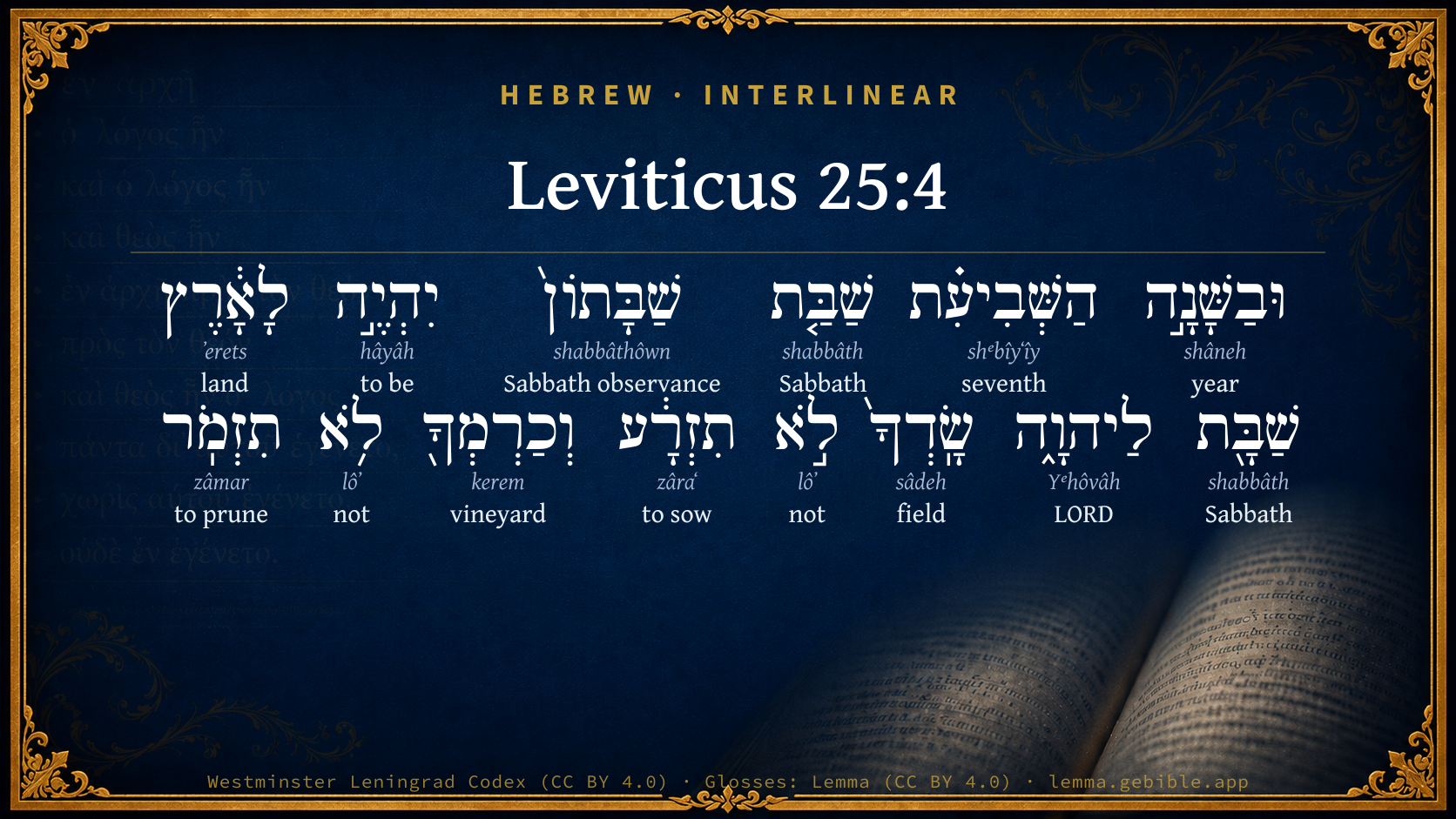
  1. וּבַשָּׁנָ֣ה shâneh H8141 “and · in/at the · year” Conjunction + Preposition, Determined + Noun, Common, Feminine, Singular, Absolute
  2. הַשְּׁבִיעִ֗ת shᵉbîyʻîy H7637 “the · seventh” Particle, Definite Article + Adjective, Ordinal number, Feminine, Singular, Absolute
  3. שַׁבַּ֤ת shabbâth H7676 “Sabbath of” Noun, Common, Both, Singular, Construct
  4. שַׁבָּתוֹן֙ shabbâthôwn H7677 “Sabbath observance” Noun, Common, Masculine, Singular, Absolute
  5. יִהְיֶ֣ה hâyâh H1961 “to be” Verb, Qal, Imperfect, 3rd Person, Masculine, Singular
  6. לָאָ֔רֶץ ʼerets H776 “to/for the · land” Preposition, Determined + Noun, Common, Both, Singular, Absolute
  7. שַׁבָּ֖ת shabbâth H7676 “Sabbath” Noun, Common, Both, Singular, Absolute
  8. לַיהוָ֑ה Yᵉhôvâh H3068 “to/for · LORD” Preposition + Noun, Proper
  9. שָֽׂדְךָ֙ sâdeh H7704 “field · your” Noun, Common, Masculine, Singular, Construct + Suffix, Personal, 2nd Person, Masculine, Singular
  10. לֹ֣א lôʼ H3808 “not” Particle, Negative
  11. תִזְרָ֔ע zâraʻ H2232 “to sow” Verb, Qal, Imperfect, 2nd Person, Masculine, Singular
  12. וְכַרְמְךָ֖ kerem H3754 “and · vineyard · your” Conjunction + Noun, Common, Both, Singular, Construct + Suffix, Personal, 2nd Person, Masculine, Singular
  13. לֹ֥א lôʼ H3808 “not” Particle, Negative

About this verse

These counts appear in no published source. They are computed here, from the morphology-tagged text and Lemma’s own curated glosses. What Lemma adds →

14
words
12
distinct lemmas
Pentateuch
section

Notable vocabulary

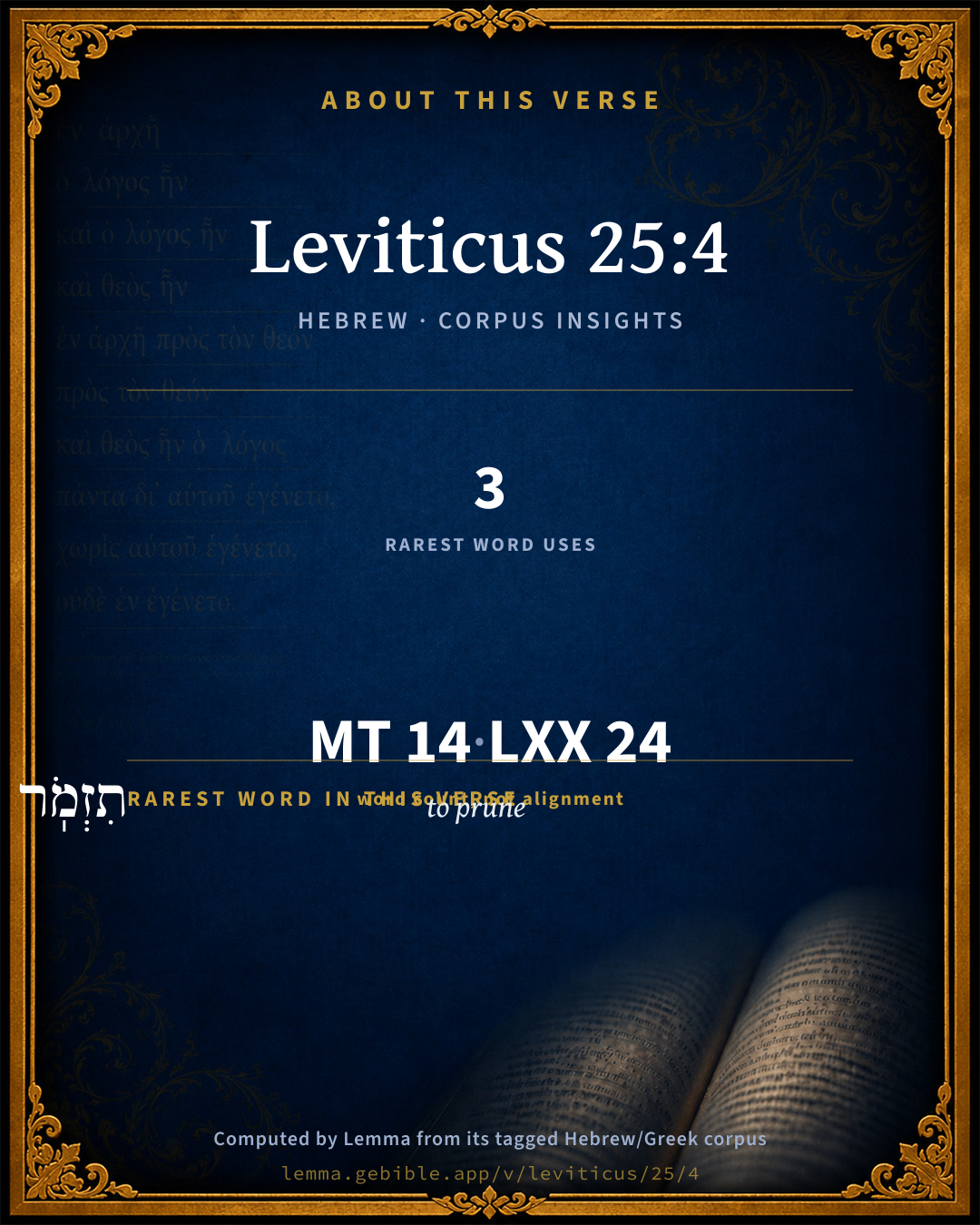
The rarest word here is תִזְמֹֽר to prune H2168 — appearing just 3 times in the whole Hebrew Bible.

Shared distinctive vocabulary

תִזְמֹֽר to prune H2168 occurs in 3 verses of the Hebrew Bible. Also found in:

Grammatical profile

  • 3 verbs
  • 8 nouns
  • 1 adjective
  • 2 particles

Verb forms

  • יִהְיֶ֣ה Qal · Imperfect
  • תִזְרָ֔ע Qal · Imperfect
  • תִזְמֹֽר Qal · Imperfect

Repetition

Words recur within this verse — often emphatic in Hebrew:

  • שַׁבַּ֤ת Sabbath H7676 ×2
  • לֹ֣א not H3808 ×2

Hebrew & Septuagint length

In English translation the verse runs 30 words from the Hebrew and 35 from the Septuagint (LXX English) — closely comparable.

A rough comparison of the two English renderings, which tokenize alike — not a word-level alignment.

Word counts can differ between the Hebrew and the Greek without any difference in meaning — e.g. the Hebrew direct-object marker אֵת has no separate Greek word, and Greek often adds the article ὁ.

In the original languages it is 14 Hebrew tokens and 24 Greek tokens — but the two are counted differently (Hebrew bundles its prefixes and suffixes into one token; the Greek is in lemma form), so that isn’t a like-for-like length.

Cross-references

5

Topical passages linked to Leviticus 25:4 in the Treasury of Scripture Knowledge — connected by theme and wording, ordered by reader-vote popularity; previews shown in the World English Bible.

  • Leviticus 25:20–23 If you said, "What shall we eat the seventh year? Behold, we shall not sow, nor gather in our increase;"
  • 2 Chronicles 36:21 to fulfill the word of Yahweh by the mouth of Jeremiah, until the land had enjoyed its Sabbaths: [for] as long as it lay desolate it kept Sabbath, to fulfill seventy years.
  • Exodus 23:10–11 "For six years you shall sow your land, and shall gather in its increase,
  • Leviticus 26:34–35 Then the land will enjoy its sabbaths as long as it lies desolate and you are in your enemies' land. Even then the land will rest and enjoy its sabbaths.
  • Leviticus 26:43 The land also will be left by them, and will enjoy its sabbaths while it lies desolate without them: and they will accept the punishment of their iniquity; because, even because they rejected my ordinances, and their soul abhorred my statutes.

Cross-references courtesy of OpenBible.info (CC BY 4.0).

Hebrew and Greek witnesses Masoretic Hebrew ↔ Greek Septuagint

The same verse in the two great witnesses to the Old Testament, shown verse-for-verse.

These are two independent witnesses, not word-aligned to each other, and the Septuagint is shown in lemma (dictionary) form.

Hebrew Leviticus 25:4 Masoretic · Westminster Leningrad Codex

וּבַשָּׁנָ֣ה הַשְּׁבִיעִ֗ת שַׁבַּ֤ת שַׁבָּתוֹן֙ יִהְיֶ֣ה לָאָ֔רֶץ שַׁבָּ֖ת לַיהוָ֑ה שָֽׂדְךָ֙ לֹ֣א תִזְרָ֔ע וְכַרְמְךָ֖ לֹ֥א תִזְמֹֽר

but in the seventh year there shall be a Sabbath of solemn rest for the land, a Sabbath to Yahweh. You shall not sow your field or prune your vineyard.

World English Bible · Public Domain

Greek LXX Leviticus 25:4 Septuagint · lemma form

ὁ δέ ἔτος ὁ ἕβδομος σάββατον ἀνάπαυσις εἰμί ὁ γῆ σάββατον ὁ κύριος ὁ ἀγρός σύ οὐ σπείρω καί ὁ ἄμπελος σύ οὐ τέμνω

But in the seventh year shall be a sabbath, it shall be a rest to the land, a sabbath to the Lord: you shall not sow your field, and you shall not prune your vine.

LXX2012 (modern English Septuagint) · Public Domain

Hebrew: Westminster Leningrad Codex (CC BY 4.0). Greek: Septuagint (public domain); English from LXX2012 (modern English Septuagint) (Public Domain). How the Septuagint differs from the Hebrew →

Targum (Aramaic paraphrase)

2

The Targum is the ancient Jewish Aramaic paraphrase of the Hebrew Scriptures — an interpretive translation, not the Hebrew text itself. Onkelos (literal) and Pseudo-Jonathan (expansive) render the Torah, and Jonathan the Prophets. Coverage is partial: where no permissively-licensed English translation exists for a verse, only the Aramaic is shown. This is verse-level text, not a word-by-word alignment to the Hebrew.

  1. Targum Onkelos Torah (Genesis–Deuteronomy)
    וּבְשַׁתָּא שְׁבִיעֲתָא נְיַח שְׁמִטְתָא יְהֵי לְאַרְעָא דְתַשְׁמֵט קֳדָם יְיָ חַקְלָךְ לָא תִזְרַע וְכַרְמָךְ לָא תִכְסָח

    (no public-domain English translation for this verse)

    Targum Onkelos — Aramaic: “Onkelos Genesis” (public domain); “Onkelos Exodus” (public domain); “Onkelos Leviticus” (public domain); “Onkelos Numbers” (public domain); “Onkelos Deuteronomy” (public domain). English: “Sefaria Community Translation” (CC0 1.0 (public-domain dedication)); “J.W. Etheridge. The Targums of Onkelos and Jonathan Ben Uzziel on the Pentateuch. London: Longmans, Green, 1862” (public domain). Text via Sefaria.

  2. Targum Pseudo-Jonathan Torah (Genesis–Deuteronomy)
    וּבְשַׁתָּא שְׁבִיעֲתָא נְיַיח דִשְׁמִיטְתָא יְהֵי לְאַרְעָא דִי תַשְׁמֵט קֳדָם יְיָ חַקְלֵיכוֹן לָא תִזְרְעוּן וְכַרְמֵיכוֹן לָא תִנְזְרוּן

    but in the seventh year there shall be a rest of remission to the earth, that she may rest before the Lord; you shall not sow your fields, nor prune your vineyards.

    Targum Pseudo-Jonathan — Aramaic: “Targum Jonathan on Genesis” (public domain); “Targum Jonathan on Exodus” (public domain); “Targum Jonathan on Leviticus” (public domain); “Targum Jonathan on Numbers” (public domain); “Targum Jonathan on Deuteronomy” (public domain). English: “The Targum of Jonathan ben Uzziel, trans. J. W. Etheridge, London, 1862” (public domain). Text via Sefaria.

Commentary

Notes on Leviticus 25:4 from classic Christian and Jewish commentators (each source and its license shown beneath its notes). The classic Christian expositions comment on the surrounding passage and are grouped to its opening verse, so a note may address several verses; the Jewish commentaries on the Tanakh (Rashi and others) are per-verse, so they appear only where the commentator wrote on this verse.

Lemma curates 59 commentaries, every one of them public domain or Creative Commons licensed, each selected and text-cleaned for this edition rather than reprinted as found. About our sources →

Trapp's Complete Commentary

John Trapp

Lev 25:4 But in the seventh year shall be a sabbath of rest unto the land, a sabbath for the LORD: thou shalt neither sow thy field, nor prune thy vineyard.

Ver. 4. A Sabbath of rest unto the land.] This and the jubilee year shadowed our eternal rest. {Col 2:16-17 Heb 4:9} (l.) Every seventh day they rested from their labours. (2.) Every seventh year the ground rested. (3.) Every seventh seventh (as some reckon it) was the jubilean Sabbath: at which time all debts were remitted, prisoners released, mortgages restored to the right inheritors. The great and eternal Sabbath comprehends all these. How then should we breathe after it, and even go forth to meet it, as the Jews do their weekly Sabbath, beginning it an hour sooner than the law required? and this they called their Sabbatulum, or little Sabbath.

John Trapp, A Commentary or Exposition upon All the Books of the Old and New Testament (1647–1656) — public domain. Text from a community e-Sword module.

Joseph Benson's Commentary

Lev 25:4-5. A sabbath of rest to the land — They were neither to do any work about it, nor expect any harvest from it. All yearly labours were to be intermitted in the seventh year, as much as daily labours on the seventh day. Of its own accord — From the grains that fell out of the ears the last reaping time. Thou shalt not reap — That is, as thy own peculiarly, but only so as others may reap it with thee, for present food. Undressed — Not cut off by thee, but suffered to grow for the use of the poor. Proselytes and servants, rich and poor, had all an equal privilege: one man’s beast was to graze as freely as another’s; all were to live at rest and enjoy the comforts of this law, the merciful appointment of Heaven. It is a year of rest unto the land — This seems to have been one purpose of the institution, that the land might lie fallow, in order to recruit its strength.

Joseph Benson's Commentary on the Old and New Testaments (1811–1818) — public domain. Text from a community e-Sword module.

Tyndale Open Study Notes

Tyndale Open Resources

25:4 land must have a Sabbath year: The principle behind the Sabbath (see study note on 19:30) was that God rested and therefore man rests. Here the principle was extended to the land.

Tyndale Open Study Notes — © Tyndale Open Resources, licensed CC BY-SA 4.0. Text via the HelloAO Bible API.

Ellicott's Commentary for English Readers

(4) The seventh year shall be a sabbath of rest.—Literally, the seventh year shall be a rest of solemn resting, or a sabbath of sabbaths. For the import of this phrase see Note on Lev_16:31. Like the weekly sabbath, the seventh year is to be the Lord’s sabbath. The soil is therefore to have a perfect rest.

Thou shalt neither sow thy field.—What constitutes cultivation, and how much of labour was regarded as transgressing this law, may be seen from the following canons which obtained during the second Temple. No one was allowed to plant trees in the sabbatical year, nor to cut off dried-up branches, to break off withered leaves, to smoke under the plants in order to kill the insects, nor to besmear the unripe fruit with any kind of soil in order to protect them, &c. Any one who committed one of these things received the prescribed number of stripes. As much land, however, might be cultivated as was required for the payment of taxes as well as for growing the barley required for the omer or wave sheaf at the Passover, and wheat for the two wave-loaves at Pentecost.

A Bible Commentary for English Readers, edited by Charles John Ellicott (1878–1897) — public domain. Text from a community e-Sword module.

John Gill's Exposition

But in the seventh year shall be a sabbath of rest unto the land,.... From all tillage of it, from planting and cultivating any sort of trees in it; and even from digging pits, ditches; and caves, as say the Jewish writers (m): and this was typical of that rest which believers enter into under the Gospel dispensation, and of the rest in the new Jerusalem state, and especially in the ultimate glory; not only from the labours of the body, but of the mind, through sin, Satan, doubts and fears, and through conflicts with various enemies, and when even all spiritual labours and services will be at an end but that of praise:

a sabbath for the Lord; for his honour and glory, to ascertain his property in the land, to show the power of his providence, and display his goodness in his care of all creatures, without any means used by them:

thou shalt neither sow thy field nor prune thy vineyard; under which are comprehended all acts of agriculture, which respect the cultivation of vines, olives, figs, and, according to the Misnah (n), there were some instruments which it was not lawful to sell to an artificer in the seventh year, such as a plough, with all belonging to it, a yoke, a fan, a spade, but he may sell him a scythe, or a sickle, or a cart, and all its instruments; and which the commentators (o) interpret of one that is suspected of working in that year; the house of Shammai say, an heifer that ploughed might not be sold that year.

(m) Torat Cohenim apud Yalkut, ut supra. (par. 1. fol. 191. 1.) (n) Sheviith, c. 5. sect. 6. (o) Maimon. & Bartenora in ib.

John Gill's Exposition of the Whole Bible (1746–1763) — public domain (CC PDM 1.0). Text via the HelloAO Bible API.

Albert Barnes' Notes on the Bible

A sabbath of rest - See Lev 23:3 note. The express prohibition of sowing and reaping, and of pruning and gathering, affords a presumption in favor of the sabbatical year beginning, like the year of Jubilee Lev 25:9, in the first month of the civil year Lev 23:24, the seventh of the sacred year, when the land was cleared of the crops of the preceding year.

The great material advantage of the institution must have been the increased fertility of the soil from its lying fallow one year out of seven, at a time when neither the rotation of crops nor the art of manuring were understood. It must also have kept up a salutary habit of economy in the storing of grain. Compare Gen 41:48-56. Its great spiritual lesson was that there was no such thing as absolute ownership in the land vested in any man, that the soil was the property of Yahweh, that it was to be held in trust for Him, and not to be abused by overworking, but to be made the most of for the good of every creature which dwelt upon it.

Albert Barnes' Notes on the Bible (1834–1885) — public domain. Text from a community e-Sword/MySword module.

Whedon's Commentary on the Bible

Daniel D. Whedon

4. A sabbath for the Lord — This was Jehovah’s sabbath, because it rested solely on his authority, and not because it was to be devoted to acts of worship, sacrifices, and holy convocations. The ground of this requirement is not revealed. It may have been for the benefit of the soil, which uninterrupted cultivation with little manuring would have exhausted, or it may have had regard to moral ends only.

Neither sow thy field — It is evident that the sabbatical year must have been conterminous with the civil year, when the land was cleared of the crops. The sacred year, beginning seven months earlier, would have been inconvenient to observe as a sabbatical year, inasmuch as there must have been either sowing or reaping, else there would be a loss of the crops of two years.

Daniel D. Whedon (gen. ed.), Commentary on the Old and New Testaments (1874–1909) — public domain. Text from a community e-Sword module.

John Wesley's Explanatory Notes

A sabbath of rest to the land - They were neither to do any work about it, nor expect any harvest from it. All yearly labours were to be intermitted in the seventh year, as much as daily labours on the seventh day.

John Wesley, Explanatory Notes Upon the Whole Bible (1754–1765) — public domain. Text via the GEBible commentary corpus.

Rashi

Rabbi Shlomo Yitzchaki (Rashi)

יהיה לארץ [A SABBATH OF STRICT REST] SHALL BE UNTO THE LAND [or SOIL] — unto the fields and vineyards.

לא תזמר — The word is a denominative verb from זמורה, a branch, and denotes: to do something to the branches: it is used here because one lops off its (the vineyard’s) branches. Its translation in the Targum is thus: לא תכסח, “thou shall not cut off”, and this root has a similar meaning in the Hebrew (Isaiah 33:12) “as thorns cut off (כסוחים)”; (Psalms 80:17) “it is burnt with fire, it is cut down (כסוחה).

Rashi on the Tanakh — English translations: “The Judaica Press complete Tanach with Rashi, translated by A. J. Rosenberg” (CC BY 4.0); “Pentateuch with Rashi's commentary by M. Rosenbaum and A.M. Silbermann, 1929-1934” (public domain); “The Metsudah Tanach series, Lakewood, N.J” (CC BY 4.0); and “The Book of Joshua, Metsudah Publications, 1997” (CC BY 4.0). Text via Sefaria.

Lesson kit

Teaching starters — assembled from the data on this page, not authored interpretation. Every prompt links to the verse data it draws on. Edit before teaching.

Leviticus, in the Pentateuch, opens this verse with 14 words (12 distinct Hebrew lemmas). Its most distinctive word is zâmar (“to prune”). A historical commentator’s framing appears above. Read the whole chapter for the surrounding context.

Discussion questions

  1. The word zâmar carries the sense “to prune.” How does it shape the verse?
  2. How does Leviticus 25:3, which shares the word «to prune», read alongside this verse?
  3. What does the repetition of “Sabbath” (2× in this one verse) do in this verse?
  4. These translations render this verse differently; the difference is in the English rendering, not the original. What questions does that raise?
  5. «יִהְיֶ֣ה» is a Qal Imperfect verb. How does that grammatical form shape the action described?
  6. Compare how Trapp's Complete Commentary and Joseph Benson's Commentary read this verse. Where do they agree or differ?

Things to notice

Reading settings

Reading text

Shown beneath each verse's original-language words.

Old Testament
Old Testament edition

Read the OT as the Masoretic Hebrew (MT) or the Greek Septuagint (LXX).

English shown for the Greek Septuagint (in the Hebrew ↔ Greek comparison).

Comparing translations? Open the Compare panel on any verse page to stack up to four side by side.