
Ezekiel 17:24

Hebrew (Westminster Leningrad Codex) Ezekiel 17:24 appears in the Hebrew Old Testament. The text above is from the Westminster Leningrad Codex. Each word links to its Strong’s number, a concise gloss, and parsing drawn from the Open Scriptures Hebrew Bible morphology. Click any word for its full Brown-Driver-Briggs (BDB) entry.
Download image
Cite this verse

Ezekiel 17:24 (World English Bible). Public Domain. Lemma interlinear Bible study tool, https://lemma.gebible.app/v/ezekiel/17/24.

Show BibTeX & RIS
BibTeX
RIS
English Translation
All the trees of the field shall know that I, Yahweh, have brought down the high tree, have exalted the low tree, have dried up the green tree, and have made the dry tree to flourish; I, Yahweh, have spoken and have done it.
World English Bible · Public Domain
Download a study sheet

One document with this verse’s original text, its word-by-word gloss line, the meaning frame, cross-references with their text, attributed commentary, and full source and license credits — printable, and it pastes into notes with its structure intact.

This verse Autodidact and up

Study sheet (.html) Plain text (.txt)

A passage Seminary Student

Up to 50 verses in one chapter. A passage sheet keeps up to 6 commentary sources and 12 cross-references per verse, in the order this page ranks them, and says so on the sheet whenever that leaves anything out. Ask for a single verse and you get the Autodidact verse sheet above.

Everything on this page stays free to read, with no account — the sheet is a download of what is already on screen, not access to it.

Want to remove ads? Support Godless Engineer
Compare translations 3

The same verse in 3 English versions, stacked beneath the original-language interlinear above. Click any original word for its lexicon entry.

Each is an independent rendering of the whole verse — the interlinear is not word-aligned to these translations.

Highlighted words mark where these versions differ — a whole-verse word diff, not a word-by-word alignment.

  • World English Bible Public Domain
    All the trees of the field shall know that I, Yahweh, have brought down the high tree, have exalted the low tree, have dried up the green tree, and have made the dry tree to flourish; I, Yahweh, have spoken and have done it.
  • King James Version Public Domain
    And all the trees of the field shall know that I the LORD have brought down the high tree, have exalted the low tree, have dried up the green tree, and have made the dry tree to flourish: I the LORD have spoken and have done it.
  • unfoldingWord Literal Text CC BY-SA 4.0
    Then all the trees of the field will know that I am Yahweh. I bring down the high trees and I raise up the low trees. I wither the watered tree and I cause the dried tree to bloom. I am Yahweh, I have declared that this will happen; and I have done it.’”

unfoldingWord Literal Text — © unfoldingWord, licensed CC BY-SA 4.0. Word-aligned USFM3 via Door43 (git.door43.org/unfoldingWord/en_ult).

Versions to compare (up to 4)

3 of 4 selected

Show all 18 translations

Every available English version of this verse, each an independent rendering of the whole verse.

  • World English Bible Public Domain
    All the trees of the field shall know that I, Yahweh, have brought down the high tree, have exalted the low tree, have dried up the green tree, and have made the dry tree to flourish; I, Yahweh, have spoken and have done it.
  • Berean Standard Bible Public Domain
    Then all the trees of the field will know that I am the LORD. I bring the tall tree down and make the low tree tall. I dry up the green tree and make the withered tree flourish. I, the LORD, have spoken, and I have done it.’”
  • Majority Standard Bible Public Domain
    Then all the trees of the field will know that I am the LORD. I bring the tall tree down and make the low tree tall. I dry up the green tree and make the withered tree flourish. I, the LORD, have spoken, and I have done it.’”
  • King James Version Public Domain
    And all the trees of the field shall know that I the LORD have brought down the high tree, have exalted the low tree, have dried up the green tree, and have made the dry tree to flourish: I the LORD have spoken and have done it.
  • American Standard Version (1901) Public Domain
    And all the trees of the field shall know that I, Jehovah, have brought down the high tree, have exalted the low tree, have dried up the green tree, and have made the dry tree to flourish; I, Jehovah, have spoken and have done it.
  • Revised Version (1885) Public Domain
    And all the trees of the field shall know that I the LORD have brought down the high tree, have exalted the low tree, have dried up the green tree, and have made the dry tree to flourish: I the LORD have spoken and have done it.
  • Geneva Bible (1599) Public Domain
    And all the trees of the fielde shall knowe that I the Lord haue brought downe the hie tree, and exalted the lowe tree, that I haue dried vp the greene tree, and made the drie tree to florish: I the Lord haue spoken it, and haue done it.
  • Douay-Rheims (1899) Public Domain
    And all the trees of the country shall know that I the Lord have brought down the high tree, and exalted the low tree: and have dried up the green tree, and have caused the dry tree to flourish. I the Lord have spoken and have done it.
  • Young's Literal Translation Public Domain
    And known have all trees of the field That I, Jehovah, have made low the high tree, I have set on high the low tree, I have dried up the moist tree, And I have caused the dry tree to flourish, I, Jehovah, have spoken, and have done `it'!'
  • Literal Standard Version CC BY-SA 4.0
    And all trees of the field have known || That I, YHWH, have made the high tree low, || I have set the low tree on high, || I have dried up the moist tree, || And I have caused the dry tree to flourish, || I, YHWH, have spoken, and have done [it]!”
  • Unlocked Literal Bible CC BY-SA 4.0
    Then all the trees of the field will know that I am Yahweh. I bring down the high trees and I raise up the low trees. I wither the watered tree and I cause the dried tree to bloom. I am Yahweh, I have declared that this will happen; and I have done it.'”
  • unfoldingWord Literal Text CC BY-SA 4.0
    Then all the trees of the field will know that I am Yahweh. I bring down the high trees and I raise up the low trees. I wither the watered tree and I cause the dried tree to bloom. I am Yahweh, I have declared that this will happen; and I have done it.’”
  • Darby Bible Public Domain
    And all the trees of the field shall know that I Jehovah have brought down the high tree, have exalted the low tree, have dried up the green tree, and made the dry tree to flourish: I Jehovah have spoken, and will do [it].
  • World Messianic Bible Public Domain
    All the trees of the field will know that I, the LORD, have brought down the high tree, have exalted the low tree, have dried up the green tree, and have made the dry tree flourish. “‘I, the LORD, have spoken and have done it.’”
  • Webster's Bible Public Domain
    And all the trees of the field shall know that I the LORD have brought down the high tree, have exalted the low tree, have dried up the green tree, and have made the dry tree to flourish: I the LORD have spoken and have done it.
  • Free Bible Version CC BY-SA 4.0
    All the trees in the countryside will know that I am the Lord. I can bring down the tall and have the low tree grow tall. I can make the green tree dry up, and make the withered tree become green again. I, the Lord, have spoken, and I will do it.”
  • Bible in Basic English Public Domain
    And it will be clear to all the trees of the field that I the Lord have made low the high tree and made high the low tree, drying up the green tree and making the dry tree full of growth; I the Lord have said it and have done it.
  • JPS Tanakh (1917) Public Domain
    And all the trees of the field shall know that I the LORD have brought down the high tree, have exalted the low tree, have dried up the green tree, and have made the dry tree to flourish; I the LORD have spoken and have done it.'

Literal Standard Version (2020), Covenant Press — licensed CC BY-SA 4.0. Text via the HelloAO Bible API (eBible.org). Unlocked Literal Bible (unfoldingWord) — licensed CC BY-SA 4.0. Text via the HelloAO Bible API (eBible.org). unfoldingWord Literal Text — © unfoldingWord, licensed CC BY-SA 4.0. Word-aligned USFM3 via Door43 (git.door43.org/unfoldingWord/en_ult). Free Bible Version, Dr. Jonathan Gallagher — licensed CC BY-SA 4.0. Text via the HelloAO Bible API (eBible.org).

Word by word

More ways to search: Search by grammar → Find every occurrence → Compare this word →

Practice this passage: Drill this verse → Learn its vocabulary →

לָ֔ח
lach
H3892
“moist”
Adjective, Adjective, Masculine, Singular, Absolute
Part of Speech
Adjective
Type
Adjective
Gender
Masculine
Number
Singular
State
Absolute
Full BDB Definition

Origin: from an unused root meaning to be new

TWOT: 1102a

moist, fresh, new - moist, fresh (of plants) - new (of cords, sinews)
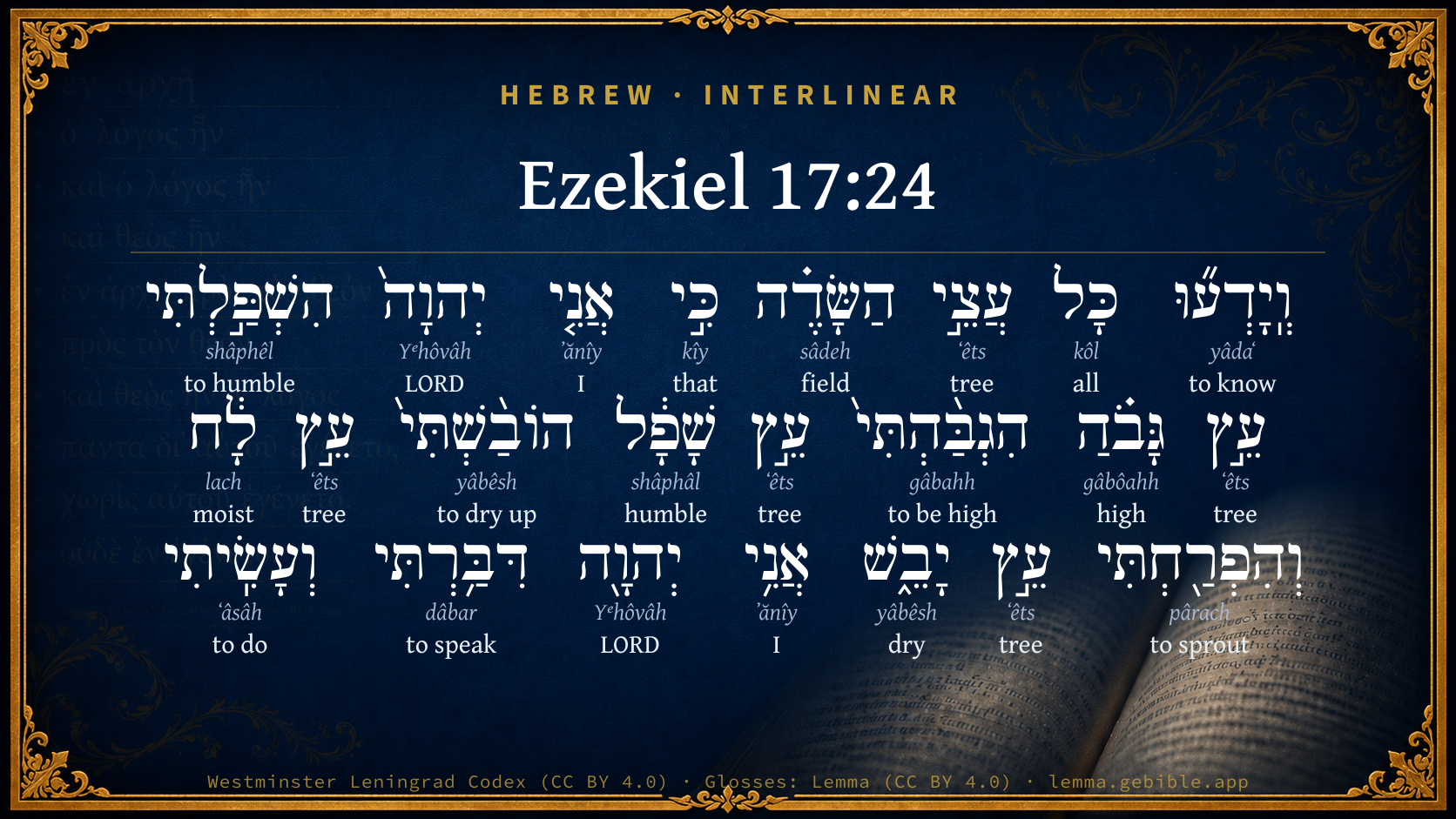
  1. וְֽיָדְע֞וּ yâdaʻ H3045 “and · to know” Conjunction + Verb, Qal, Sequential Perfect, 3rd Person, Common, Plural
  2. כָּל kôl H3605 “all of” Noun, Common, Masculine, Singular, Construct
  3. עֲצֵ֣י ʻêts H6086 “trees of” Noun, Common, Masculine, Plural, Construct
  4. הַשָּׂדֶ֗ה sâdeh H7704 “the · field” Particle, Definite Article + Noun, Common, Masculine, Singular, Absolute
  5. כִּ֣י kîy H3588 “that” Conjunction
  6. אֲנִ֤י ʼănîy H589 “I” Pronoun, Personal, 1st Person, Common, Singular
  7. יְהוָה֙ Yᵉhôvâh H3068 “LORD” Noun, Proper
  8. הִשְׁפַּ֣לְתִּי shâphêl H8213 “to humble” Verb, Hiphil, Perfect, 1st Person, Common, Singular
  9. עֵ֣ץ ʻêts H6086 “tree” Noun, Common, Masculine, Singular, Absolute
  10. גָּבֹ֗הַ gâbôahh H1364 “high” Adjective, Adjective, Masculine, Singular, Absolute
  11. הִגְבַּ֨הְתִּי֙ gâbahh H1361 “to be high” Verb, Hiphil, Perfect, 1st Person, Common, Singular
  12. עֵ֣ץ ʻêts H6086 “tree” Noun, Common, Masculine, Singular, Absolute
  13. שָׁפָ֔ל shâphâl H8217 “humble” Adjective, Adjective, Masculine, Singular, Absolute
  14. הוֹבַ֨שְׁתִּי֙ yâbêsh H3001 “to dry up” Verb, Hiphil, Perfect, 1st Person, Common, Singular
  15. עֵ֣ץ ʻêts H6086 “tree” Noun, Common, Masculine, Singular, Absolute
  16. וְהִפְרַ֖חְתִּי pârach H6524 “and · to sprout” Conjunction + Verb, Hiphil, Perfect, 1st Person, Common, Singular
  17. עֵ֣ץ ʻêts H6086 “tree” Noun, Common, Masculine, Singular, Absolute
  18. יָבֵ֑שׁ yâbêsh H3002 “dry” Adjective, Adjective, Masculine, Singular, Absolute
  19. אֲנִ֥י ʼănîy H589 “I” Pronoun, Personal, 1st Person, Common, Singular
  20. יְהוָ֖ה Yᵉhôvâh H3068 “LORD” Noun, Proper
  21. דִּבַּ֥רְתִּי dâbar H1696 “to speak” Verb, Piel, Perfect, 1st Person, Common, Singular
  22. וְעָשִֽׂיתִי ʻâsâh H6213 “and · to do” Conjunction + Verb, Qal, Sequential Perfect, 1st Person, Common, Singular

About this verse

These counts appear in no published source. They are computed here, from the morphology-tagged text and Lemma’s own curated glosses. What Lemma adds →

23
words
17
distinct lemmas
Prophets
section

Notable vocabulary

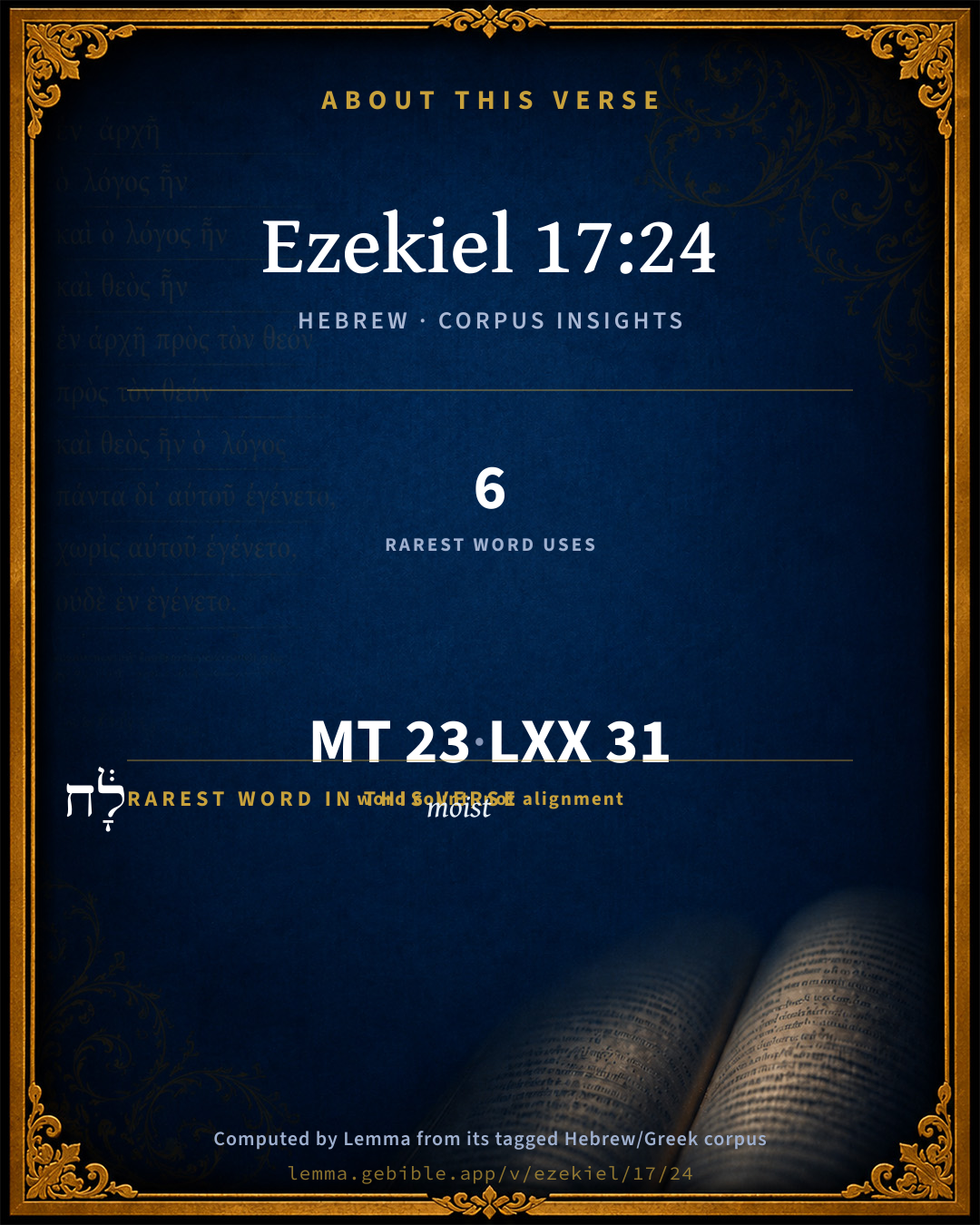
The rarest word here is לָ֔ח moist H3892 — appearing just 6 times in the whole Hebrew Bible.

Shared distinctive vocabulary

לָ֔ח moist H3892 occurs in 6 verses of the Hebrew Bible. Also found in:

Grammatical profile

  • 7 verbs
  • 9 nouns
  • 4 adjectives
  • 2 pronouns
  • 1 conjunction

Verb forms

  • וְֽיָדְע֞וּ Qal · Sequential Perfect
  • הִשְׁפַּ֣לְתִּי Hiphil · Perfect
  • הִגְבַּ֨הְתִּי֙ Hiphil · Perfect
  • הוֹבַ֨שְׁתִּי֙ Hiphil · Perfect
  • וְהִפְרַ֖חְתִּי Hiphil · Perfect
  • דִּבַּ֥רְתִּי Piel · Perfect
  • וְעָשִֽׂיתִי Qal · Sequential Perfect

Repetition

Words recur within this verse — often emphatic in Hebrew:

  • עֲצֵ֣י tree H6086 ×5
  • יְהוָה֙ LORD H3068 ×2
  • אֲנִ֤י I H589 ×2

Hebrew & Septuagint length

In English translation the verse runs 44 words from the Hebrew and 46 from the Septuagint (LXX English) — closely comparable.

A rough comparison of the two English renderings, which tokenize alike — not a word-level alignment.

Word counts can differ between the Hebrew and the Greek without any difference in meaning — e.g. the Hebrew direct-object marker אֵת has no separate Greek word, and Greek often adds the article ὁ.

In the original languages it is 23 Hebrew tokens and 31 Greek tokens — but the two are counted differently (Hebrew bundles its prefixes and suffixes into one token; the Greek is in lemma form), so that isn’t a like-for-like length.

Cross-references

22

Topical passages linked to Ezekiel 17:24 in the Treasury of Scripture Knowledge — connected by theme and wording, ordered by reader-vote popularity; previews shown in the World English Bible.

  • Amos 9:11 In that day I will raise up the tent of David who is fallen, and close up its breaches, and I will raise up its ruins, and I will build it as in the days of old;
  • 1 Corinthians 1:27–28 but God chose the foolish things of the world that he might put to shame those who are wise. God chose the weak things of the world, that he might put to shame the things that are strong;
  • Isaiah 26:5 For he has brought down those who dwell on high, the lofty city: he lays it low, he lays it low even to the ground; he brings it even to the dust.
  • Ezekiel 24:14 I, Yahweh, have spoken it: it shall happen, and I will do it: I will not go back, neither will I spare, neither will I repent; according to your ways, and according to your doings, shall they judge you, says the Lord Yahweh.
  • Luke 1:52–53 He has put down princes from their thrones. And has exalted the lowly.
  • 1 Samuel 2:7–8 Yahweh makes poor, and makes rich: He brings low, he also lifts up.
  • Psalms 75:6–7 For neither from the east, nor from the west, Nor yet from the south, comes exaltation.
  • Isaiah 55:12–13 For you shall go out with joy, and be led forth with peace: the mountains and the hills shall break forth before you into singing; and all the trees of the fields shall clap their hands.
  • Ezekiel 12:25 For I am Yahweh; I will speak, and the word that I shall speak shall be performed; it shall be no more deferred: for in your days, rebellious house, will I speak the word, and will perform it, says the Lord Yahweh.
  • Ezekiel 21:26 thus says the Lord Yahweh: Remove the turban, and take off the crown; this [shall be] no more the same; exalt that which is low, and abase that which is high.
  • Ezekiel 22:14 Can your heart endure, or can your hands be strong, in the days that I shall deal with you? I, Yahweh, have spoken it, and will do it.
  • Job 5:11 So that he sets up on high those who are low, Those who mourn are exalted to safety.
  • Job 40:12 Look on everyone who is proud, and humble him. Crush the wicked in their place.
  • Psalms 89:38 But you have rejected and spurned. You have been angry with your anointed.
  • Psalms 89:45 You have shortened the days of his youth. You have covered him with shame. Selah.
  • Psalms 96:11–12 Let the heavens be glad, and let the earth rejoice. Let the sea roar, and it's fullness!
  • Isaiah 2:13–14 For all the cedars of Lebanon, that are high and lifted up, For all the oaks of Bashan,
  • Isaiah 9:6–7 For to us a child is born, to us a son is given; and the government shall be on his shoulder: and his name shall be called Wonderful, Counselor, Mighty God, Everlasting Father, Prince of Peace.
  • Isaiah 11:1–9 There shall come forth a shoot out of the stock of Jesse, and a branch out of his roots shall bear fruit.
  • Matthew 24:35 Heaven and earth will pass away, but my words will not pass away.
  • Luke 1:33 and he will reign over the house of Jacob forever. There will be no end to his Kingdom."
  • Luke 21:33 Heaven and earth will pass away, but my words will by no means pass away.

Cross-references courtesy of OpenBible.info (CC BY 4.0).

Hebrew and Greek witnesses Masoretic Hebrew ↔ Greek Septuagint

The same verse in the two great witnesses to the Old Testament, shown verse-for-verse.

These are two independent witnesses, not word-aligned to each other, and the Septuagint is shown in lemma (dictionary) form.

Hebrew Ezekiel 17:24 Masoretic · Westminster Leningrad Codex

וְֽיָדְע֞וּ כָּל עֲצֵ֣י הַשָּׂדֶ֗ה כִּ֣י אֲנִ֤י יְהוָה֙ הִשְׁפַּ֣לְתִּי עֵ֣ץ גָּבֹ֗הַ הִגְבַּ֨הְתִּי֙ עֵ֣ץ שָׁפָ֔ל הוֹבַ֨שְׁתִּי֙ עֵ֣ץ לָ֔ח וְהִפְרַ֖חְתִּי עֵ֣ץ יָבֵ֑שׁ אֲנִ֥י יְהוָ֖ה דִּבַּ֥רְתִּי וְעָשִֽׂיתִי

All the trees of the field shall know that I, Yahweh, have brought down the high tree, have exalted the low tree, have dried up the green tree, and have made the dry tree to flourish; I, Yahweh, have spoken and have done it.

World English Bible · Public Domain

Greek LXX Ezekiel 17:24 Septuagint · lemma form

καί γιγνώσκω πᾶς ὁ ξύλον ὁ πεδίον διότι ἐγώ κύριος ὁ ταπεινόω ξύλον ὑψηλός καί ὑψόω ξύλον ταπεινός καί ξηραίνω ξύλον χλωρός καί ἀναθάλλω ξύλον ξηρός ἐγώ κύριος λαλέω καί ποιέω

And all the trees of the field shall know that I am the Lord that bring low the high tree, and exalt the low tree, and wither the green tree, and cause the dry tree to flourish: I the Lord have spoken, and will do it.

LXX2012 (modern English Septuagint) · Public Domain

Hebrew: Westminster Leningrad Codex (CC BY 4.0). Greek: Septuagint (public domain); English from LXX2012 (modern English Septuagint) (Public Domain). How the Septuagint differs from the Hebrew →

Targum (Aramaic paraphrase)

1

The Targum is the ancient Jewish Aramaic paraphrase of the Hebrew Scriptures — an interpretive translation, not the Hebrew text itself. Onkelos (literal) and Pseudo-Jonathan (expansive) render the Torah, and Jonathan the Prophets. Coverage is partial: where no permissively-licensed English translation exists for a verse, only the Aramaic is shown. This is verse-level text, not a word-by-word alignment to the Hebrew.

  1. Targum Jonathan Prophets (Joshua–Malachi)
    וְיֵדְעוּן כָּל מַלְכֵי עַמְמַיָא אֲרֵי אֲנָא יְיָ אַמְאִיכֵית מַלְכוּת דַהֲוַת תַּקִיפָא וְתַקִיפַת מַלְכוּת דַהֲוַת חַלָשָׁא אַמְאִיכֵית מַלְכוּת עַמְמַיָא דַהֲוַת תַּקִיפָא כְּאָעָא רָטִיב וּתְקִיפִית מַלְכוּת בֵּית יִשְׂרָאֵל דַהֲוַת חַלָשָׁא כְּאָעָא יַבִּישׁ אֲנָא יְיָ גְזָרִית בְּמֵימְרִי וַאֲקַיֵם:

    (no public-domain English translation for this verse)

    Targum Jonathan — Aramaic: “Mikraot Gedolot” (public domain). English: “Sefaria Community Translation” (CC0 1.0 (public-domain dedication)); “London "Chaldee Paraphrase," 1871” (public domain). Text via Sefaria.

Commentary

Notes on Ezekiel 17:24 from classic Christian and Jewish commentators (each source and its license shown beneath its notes). The classic Christian expositions comment on the surrounding passage and are grouped to its opening verse, so a note may address several verses; the Jewish commentaries on the Tanakh (Rashi and others) are per-verse, so they appear only where the commentator wrote on this verse.

Lemma curates 59 commentaries, every one of them public domain or Creative Commons licensed, each selected and text-cleaned for this edition rather than reprinted as found. About our sources →

Trapp's Complete Commentary

John Trapp

Eze 17:24 And all the trees of the field shall know that I the LORD have brought down the high tree, have exalted the low tree, have dried up the green tree, and have made the dry tree to flourish: I the LORD have spoken and have done [it].

Ver. 24. And all the trees of the field,] i.e., All men, high and low.

Have brought down.] This God loves to do, as heathens could say.

Have exalted the low.] Lavater thinks our Saviour alluded to this text in that parable {Mat 13:3-8} of the grain of mustard seed.

John Trapp, A Commentary or Exposition upon All the Books of the Old and New Testament (1647–1656) — public domain. Text from a community e-Sword module.

The Biblical Illustrator

Joseph S. Exell

Eze_17:24

And all the trees of the field shall know that I the Lord have brought down the high tree, have exalted the low tree.

The trees of the field and their appointed destiny

The field seems to set forth the visible Church of God; and the trees of the field seem to set forth all the professors of Divine truth, whether they are possessors or not. All these trees of the field shall know a certain truth. Now, what is tiffs certain truth? That the Lord will do a certain work in characters, which He Himself has delineated; and that it shall be visible to the Church of God what He does to those characters.

1. The first character of which the Lord speaks is the high tree; which high tree is to be brought down. That expression--a high tree--seems to bear two significations.

(1) There is the high tree--that is, a nominal professor who is destitute of the fear of God, who has nothing of the grace of God in His soul, but stands in the visible Church of Christ in a profession of godliness whilst he is inwardly devoid of its power. In this wood of trees the first object that catches the eye is the high tree, that soars above them all. You will find this nominal professor in the Church of Christ always ready to come forward; he never hangs back through a sense of his weakness and ignorance; he is never plagued with doubts and fears as to his state before God; he never puts his mouth in the dust from a deep sense of his vileness and baseness before Hint; but let him be present in any company, or on any occasion, he is ready to speak, to exalt himself, and to tower high above the family of God, who are mourning and sighing over the burden of sin, guilt, and corruption, and are suing after the Lords manifestations of favour to their souls. Now the Lord says, All the trees of the field shall know that I the Lord have brought down the high tree. Then this high tree must he brought down; and not merely brought down, but visibly brought down,--brought down in the sight of the trees of the field, laid low in the sight of all who have eyes to see, who have ears to hear, who have minds to understand what Gods dealings are.

(2) But the expression high tree bears another signification. Whence comes the presumption of self-confident professors? Does it not spring from an internal principle of pride in them? And are not all, without exception, possessed of the same deceitful and desperately wicked heart? Then, if the towering confidence of a presumptuous professor springs from innate pride, is there not the Same principle at work in the heart of a living child? But the Lord will never suffer His children to walk in vain confidence; He will never allow them, for a long season together, to stand in false liberty; and therefore He will bring them down. He has but to look upon us with one frown, and He will bruise into nothingness all our presumptuous liberty. He has but to take the veil for a moment off our hearts, and discover to us what we are and discover to us what He is, and we shall fall down before Him, as Isaiah fell when he saw the glory of the Lord in the temple.

2. And now we come to the exalting the low tree. Here we have a striking contrast. The low tree is one who has always the lowest, meanest thoughts concerning himself; who can find in his heart nothing spiritually good; who is continually afraid of presumption; who starts back from every appearance of being more than he really is. Now, this low tree the Lord has promised to exalt. But He will never exalt the low tree in self. The wise man shall not glory in his wisdom, the strong man shall not glory in his strength; but he that glorieth shall glory in this, that he knoweth the Lord. In the Lord shall all the seed of Israel be justified, and shall glory. He that glorieth, let him glory in the Lord. When the low tree, therefore, is exalted, it is by some sweet manifestation of the blood and love of Jesus to his soul; it is by lifting him up out of the mire, and out of the dunghill, and setting him among princes, and making him inherit the throne of glory; it is by Jesus sweetly coming into his heart and conscience, sprinkling it with His atoning blood, bedewing it with the drops of His favour, discovering His glorious righteousness, and binding up every bleeding wound.

3. But consider another tree of which the Lord speaks, and another work which the Lord here promises to do. I the Lord have brought down the high tree, have exalted the low tree, have dried up the green tree. Now, just in the same way as the high tree seems to shadow forth two characters (that is, the presumptuous professor, and a child of God drawn aside by Satans subtlety into presumption), so the green tree seems to set forth both a professor of religion and also a child of God in the warmth of youthful zeal.

4. Oh! what a state it is in which to stand before God--a dry tree! To feel as though there was not a single particle of spiritual sap or heavenly moisture in us; to feel as though we had no religion worth the name; to feel as though we had no real work of the Spirit upon our soul, and no real grace in our heart given by God Himself! Now, to this dry tree the Lord has given a promise. He says this dry tree shall be made to flourish. How He frustrates and disappoints all the expectations of nature! What! to dry up a green tree, and to make a dry tree to flourish! Would not nature say, Oh! the green tree, make it greener still: oh! the dry tree, cut it down, and cast it into the fire! But the Lords ways are not our ways, neither are the Lords thoughts our thoughts; but as the heavens are higher than the earth, so are His ways higher than our ways, and His thoughts than our thoughts. Cut it down! No; make it to flourish! Then the Lords work is made manifest, as much in drying up the green tree as in making the dry tree to flourish. And how does He make the dry tree to flourish? Why, by dropping in His own blessed dew into it; by shedding his own Divine favour into the barren and parched heart; by dropping in some testimony from His own blessed and gracious lips, so as to cause the soul to revive as the vine, and to flourish as the herb; by causing showers of blessing to fall upon the wilderness, and turn it into a standing pool, and so make the rose of Sharon sweetly and blessedly to blossom and flourish therein. (J. C. Philpot.)

To the rescue

Methinks I see a great forest which reaches for many a league. The trees are of divers growths, and of various ages. Some are very lofty. Here a towering cedar, and yonder the storks have made their nests among the tall fir trees. Stout oaks there are that laugh at storms, and elms that will not be twisted with the tempest. See how they rival each other! And there are lowlier trees; some bearing fruit, though scarcely seen, others, like the vine, creeping upon the ground--so obscure they can hardly be observed.

I. Thus saith the Lord, the trees of the field shall know that I the Lord have brought down the high tree. Look over history, and you will see that everything gigantic in stature and colossal in dimensions; whatsoever has been great to human apprehension, grasping at earthly fame, has become an Object for Gods penetrating arrows, and a subject for His withering blight. The Lord of hosts always cuts down the high tree, humiliates the creature that exalts itself, and suffers no flesh to glory in His presence. That is the Law of His government. The question arises, How does it concern us? Doubtless it opens a sad prospect to those who are lifted up with pride, or inflated with self-opinion. Among the seven abominations your order ranks highest. No liar or murderer can claim a preeminence over you in vice so long as the Proverbs stand. Ere long the heel of the Almighty shall be lifted higher than thy haughty head. He will cast thee down, be thy look never so proud; for the Lord hath purposed it to stain the pride of all glory, to bring into contempt all the excellency of the earth. There is, again, an arrogance of mind, of judgment, of opinion, just as ignorant--if not quite so grotesque--as his who dreams that his birth is of higher caste and his blood of richer hue than other men. Humanity in the bulk is the idol of some people; and yonder I see the man who quotes himself as an illustrious specimen. He does not believe in the total depravity of human nature. The Lord will abase thee, whosoever thou mayest be; He will shame thee: the axe is ready to be laid at thy root even now. Thy goodness is not Gods goodness, and thy righteousness is not Christs righteousness; therefore shall the moth consume it, and it shall be eaten away. Or shall it fare better with another class? There is our friend who says, Well, well, I do not believe in forms and ceremonies; but, mark you, I always judge and weigh everything. He estimates himself as all independent thinker; he is bound by no precedents, fettered by no creeds, and considers that he is amenable to no judgment but his own. Strong in his self-assertion, he makes light of the Word of God, and the will of God, while he holds prophets and apostles in little esteem. Ah, well, brother! God is against you, He will make a fool of you one of these days, if you are so wise as to exalt yourself above His revelation. The world shall see your folly. I tell thee, captious questioner, that the Lord will bring thee down.

II. Furthermore the Lord says, I will exalt the low tree. Here is a word of comfort to some who specially need it. The low trees are those poor in spirit who think others better than they are themselves; who, instead of carving their names high, are willing to have them written low, because they feel they have nothing whereof to glory, nought wherein to boast. The low trees are the penitents, those who take their stand afar off with the publican, and say, God be merciful to me, a sinner; you that feel your own weakness to do anything aright. You that feel your ignorance, and are willing to be instructed; you that are modest as children, and ready to sit at the feet of Jesus; you that have been broken in pieces till you feel that a crumb of mercy would be more than you deserve, and are willing to take any dole He is pleased to give--you are the low trees. And you that are despised, who walk in darkness and see no light; slandered for Christs sake, reproached with crimes you never committed; you of whom the world is not worthy, though the world accounts you to be unworthy of its esteem--you are the low trees, and God shall exalt you.

III. The Lord has also declared that He will dry up the green tree. Whether that green tree be high or low it does not matter; if it be green in itself, He will cut it down. Mark you, a man may be as high as heaven; if it is God that makes him high, he will stand; but if he be high in creature strength, and creature merits, and creature glory, he shall be brought down; and a man may be low without merit, if he is merely mean and meagre, paltry and pitiable, not worth a straw. That is not the spirit of lowliness that God blesses. In like manner a man may be green because he is planted by the rivers of Gods living waters, that is healthy enough; but those that are like the green bay tree of the Psalmist, trees growing in their own soil, never transplanted by grace, green in the verdure of worldly prosperity, and taking all their delight in earthly things--those are the trees God will dry up.

IV. Lastly, the Lord makes the dry tree to flourish. How many of Gods people may be fitly compared to a dry tree! They have little joy; they have not got to full assurance. They are afraid to say, My beloved is mine, and I am His. They think they are of no use to the Church; they are half inclined to suspect it was a mistake for them to be baptized, and they were to blame for uniting themselves with the people of God. They come to the assembly of believers, and though they do sing with their lips, the heart cannot sing as it would. There are times, too, when walking home they say, I go where others go, but I get no comfort; if I were really the Lords, should I be thus; if I did trust Christ, should I ever be so languid? If it is of your own bringing about that you are thus dry, I do not offer you any comfort; but if the Holy Spirit has led you to see your weakness, your nothingness, your deadness, then I am glad you have been brought to this pass, for God will cause the dry tree to flourish. When we are weak, then are we strong. (C. H. Spurgeon.)

The advantage of the kingdom of Christ

I. In the carrying on the interest of Christ and the Gospel, God will work wonderful providential alterations. There are three principal seasons of the Lords eminent appearance to carry on the kingdom of Christ and the Gospel, and all attended with dreadful providential alterations; and unto one of these heads may all particular actings be reduced.

1. The first is, the promulgation of the Gospel among the Jews by the Lord Christ Himself and His apostles: what this was attended withal is graphically described (Mat_24:6-7).

2. The second is, in the further carrying on of the Gospel, after the destruction of Jerusalem, throughout the world of the Gentiles, subject then in a great proportion to the Roman Empire.

3. The most signal is, the coming of the Lord Christ to recover His people from antichristian idolatry and oppression; which of all others is and shall be attended with the most astonishing alterations and desolations, pulling down of high trees, and exalting them that are low: thence is that war, described Rev_17:14, and that mighty vengeance poured out by the Lord Christ on the nations, their kings and captains, chap. 19:11 to the end. Now the reasons of this are--

(1) Because amongst all men, where the kingdom of Christ is to be set up, there is something or other possessed, that He alone must and will have; and therefore the Lord giving Jesus Christ but His own inheritance, it must needs be attended with great alterations.

(2) The works that God hath to do in such a season require it: God hath three great works to do in the day of His carrying on the interest of Christ and the Gospel--

(i) He hath great revenges to take.

(ii) He hath great deliverances to work.

(iii) He hath great discoveries to make.

1. Of His own, that they may be purged.

2. Of hypocrites, that they may be discovered.

Use 1.

To discover where dwells that spirit that actuates all the great alterations that have been in these nations.

Use 2.--To magnify the goodness of God, who unto us hath sweetened and seasoned all His dreadful dispensations, and all the alterations in those nations, with this His gracious design running through them all; this is that which puts all their beauty and lustre on them, being outwardly dreadful and horrible.

II. The actings of Gods providence, in carrying on the interest of Christ, are and shall be exceedingly unsuited to the reasonings and expectations of the most of men. Some reasons of this may be given; and--

1. The first is taken from the corruptions of the hearts of men squaring the works of God to their fleshly reasonings, corrupt interests, and principles. They are bold with the wisdom of God, and conclude, thus and thus things ought to be, ordering their thoughts for the most part according to their corrupt and carnal advantages.

2. God chooseth thus to do things above and besides the expectations of men, that His presence, and the presence of the Lord Christ, may be the more conspicuous in the world.

3. God will do it for the hardening of many false empty professors, and others in the world, that the judgments appointed may come upon them to the uttermost. Use.--It serves, then, to discover the vanity of those men who, because the works of God have not been carried on in ways suitable to their reasonings and expectations, do utterly reject them, disown them, and oppose Him in them. Can these men give any one instance, of any one eminent work of God, that He hath brought about by such ways and means as men would rationally allot thereunto, especially in things that are in immediate subserviency to the kingdom of the Lord Christ? (J. Owen, D. D.)

The proud abased and the lowly exalted

Consider the text as exemplified--

I. In the history of Gods providence.

1. The Antediluvians and Noah. They were the high and green trees,--Noah and family, the low and the dry.

2. Pharaoh and the Israelites.

3. Goliath and David.

4. Haman and Mordecai.

II. In the history of the Lord Jesus Christ. The Jews expected the high green tree,--earthly magnificence, worldly power and authority. But Christ fulfilled the sayings of the prophets (Isa_53:1, etc.) In all things He was the opposite of their desires, etc. Hence they killed Him. Yet Christ, the low tree, etc., did God exalt, etc. He hath made Him to flourish, etc. His name shall endure as long as the sun, etc.

III. In the triumphs of the apostolic labours. Look at the persons of the apostles,--plain, illiterate, poor men. Not the high green tree. Not learned, affluent, or influential. Hearken to their message. What is it? Christ crucified. Not a religion of metaphysical subtleties. Not elaborate doctrines or profound dogmas of philosophy. Not a splendid system of pompous ceremony. But the lowly doctrines of the cross. Humility, self-denial, spirituality, etc. And what is the result? The high tree of paganism is brought down. The green tree of Judaism is dried up. The low tree of Christianity is exalted and flourishes, and blesses every known civilised land, etc. (1Co_1:21-29).

IV. In the experience of the haughty, and of the penitential sinner. The man of proud heart, exalted self-esteem, etc. God, I thank thee, etc. The poor publican self-convicted, self-abhorred. He is the dry tree, nothing to trust in, or to plead. God be merciful, etc. Mark the result. God rejects the high tree; He despises his work,--He brings him low. He beholds with approbation the low tree, etc. He goes down to his house justified.

V. In the lives of the high-minded and of the lowly Christian. Pride and self-sufficiency are the great temptations of the human heart. To be something. To do something. To he thought something. To exalt ourselves. How prone we are to this. Well, what, is the result? God knows it will ruin us if not eradicated. We must be brought low in mercy or judgment. He blights the worldly prospects. He reverses the dazzling scene. He sends repeated disappointments. Troops of crosses and troubles. Perhaps keen bereavements. And thus brings down the high tree, dries up the green tree, etc. But behold the low tree, the dry tree. The lowly Christian says, I am nothing. He lives by faith on the Son of God, etc. He abases Himself, etc. He glories in the cross, etc. He makes mention of Christs righteousness, etc. He dwells in the dust. God exalts, blesses, makes fruitful, etc., lifts them up forever. Application--

1. Learn the evil of self-exaltation. Avoid it. Watch against it. Pray against it.

2. Be clothed with humility. What peace, safety, and honour are here.

3. God must have all the glory. See the text; also Dan_6:34. (Anon.)

The Biblical Illustrator, edited by Joseph S. Exell (c. 1880s–1900s) — public domain. Text from a community e-Sword module.

Joseph Benson's Commentary

Eze 17:24. All the trees of the field — All the nations of the world; shall know that I the Lord have brought down the high tree — Have subdued and degraded the enemies of my people; have exalted the low tree — Have advanced my church, and made it flourish; have dried up the green tree, &c. — The same thing expressed in somewhat different words. Although these expressions may partly refer to the overthrow of the mighty Babylonian empire, and the restoration of the Jewish state by their return out of captivity, yet they are so magnificent, that they evidently intend much more than this. The Jewish kingdom did never, after the captivity, arrive at such a pitch of greatness as to give occasion to these magnificent expressions. Some more noble kingdom is undoubtedly here pointed at, namely, the kingdom of Christ, as has been observed above, which will at last be exalted above all the kingdoms of the world, and put an end to them all, while it will continue to all eternity: see Daniel 4:35, 44, and Dan 7:27; Luk 1:33; 1Co 15:24. It is under Christ’s kingdom only that people of all nations, signified here by fowls of every kind, shall be gathered together. And the subjects of that kingdom only have a certain and eternal protection, and a supply of every thing necessary. There is therefore no doubt that this was spoken, in its full sense, of the eternal and all-powerful kingdom to be established in Christ, one of the royal seed of Judah according to the flesh. I the Lord have spoken it, and have done it — The prophets often speak of future events as if they were already accomplished, to assure us that they shall certainly come to pass.

Joseph Benson's Commentary on the Old and New Testaments (1811–1818) — public domain. Text from a community e-Sword module.

Geneva Bible (1599)

Geneva Bible translators

All the world shall know that I have plucked down the proud enemies, and set up my Church which was low and contemned.

Geneva Bible (1599) marginal notes — public domain. Text via Bolls.life.

Jamieson, Fausset & Brown

Robert Jamieson, A. R. Fausset & David Brown

I . . . brought down the high--the very attribute given to God by the virgin mother of Him, under whom this was to be accomplished.

high . . . low tree--that is, princes elevated . . . lowered. All the empires of the world, represented by Babylon, once flourishing ("green"), shall be brought low before the once depressed ("dry"), but then exalted, kingdom of Messiah and His people, the head of whom shall be Israel (Dan 2:44).

Vindication of God's moral government as to His retributive righteousness from the Jewish imputation of injustice, as if they were suffering, not for their own sin, but for that of their fathers. As in the seventeenth chapter he foretold Messiah's happy reign in Jerusalem, so now he warns them that its blessings can be theirs only upon their individually turning to righteousness.

Next: Ezekiel Chapter 18

Jamieson, Fausset & Brown — Commentary Critical and Explanatory on the Whole Bible (1871) — public domain (CC PDM 1.0). Text via the HelloAO Bible API.

Adam Clarke's Commentary

Verse 24. All the trees of the field shall know] All the people of Israel and of Chaldea.

I the Lord have brought down the high tree] Have dethroned Jehoiachin.

Have exalted the low tree] Put Zedekiah, brother of Jehoiachin, in his place.

Have dried up the green tree] Zedekiah, who had numerous children, but who were all slain before his eyes at Riblah.

And have made the dry tree to flourish] Have raised up a rod out of the stem of Jesse, the family of David being then apparently dried up and extinct. This was the promised Messiah, of the increase and government of whose kingdom and peace there shall be no end; upon the throne of David, and upon his kingdom, to order and establish it with judgment and with justice, from henceforth, even for ever. THE ZEAL OF THE LORD OF HOSTS WILL PERFORM THIS.

The high and green tree, says Newcome, refers to Nebuchadnezzar; the low and the dry tree, to the Jews.

Adam Clarke's Commentary on the Bible (1810–1826) — public domain. Text from a community e-Sword/MySword module.

John Calvin's Commentaries

In this verse the Prophet signifies that God’s work would be memorable. For when he says that all trees should feel themselves in God’s hand and power, to raise what was fallen, and to cast down and to prostrate what was elevated, he doubtless expresses no common action. By trees he means all the kings of the earth, and all possessed of any dignity. For he follows up his own metaphor: as he called the kingdom of Christ a tree or cedar which grew from a small twig, so he now speaks metaphorically of kings when he says, that all should take notice; for they shall know that Jehovah brings down the high tree. Ezekiel may here seem to be inconsistent with himself, as I have already noticed, because God said that he would take from a lofty cedar a little twig, which he wished to plant: but he now says that God would raise what was low and abject. But we have dissipated this absurdity, because, from the beginning Christ was in the glory of his Father, and thus, as Micah says, his beginning was from eternity. (Micah 5:2.) This excellency of Christ, therefore, is noticed, because, from the time when God erected David’s throne, he at the same time gave a visible sign of the more excellent kingdom which was then secretly hoped for. For this reason Christ was taken from his lofty place, and since he not only put on the form of a slave, but emptied himself even unto death, (Philippians 2:7,) it is not surprising that the Prophet should say, like a tree cast down. Although, as I have remarked, this sentence is not to be restricted to the person of Christ, but thought to be adapted to his kingdom; that is, to his manner and way of governing: since we know, and it has been lately stated, that the gospel is like a scepter, by which Christ subdues all people, and rules them for himself. Now if we reflect on what the preaching of the gospel was, we shall see, as in a glass, the Prophet’s meaning here, that the low tree was elevated, since no one would have thought, that from such slender beginnings the increase which God afterwards bestowed on it could arise. It follows, then, that the height was wonderful, since it could not be comprehended by the human senses.

Meanwhile he adds, I am he who humbles the lofty tree, which is not only understood of the Jews, but, in my judgment, embraces all the empires and principalities of the world. God, therefore, humbles lofty trees, because, whatever opposes itself to Christ’s kingdom, must necessarily fall; and this is described more at length in Daniel. (Daniel 4.) For although all the empires of the world are founded in Christ, and sustained by his virtue, yet, since earthly kings rise up and desire to lay Christ prostrate, their pride is the reason why Christ’s empire causes their ruin. This contrast, then, must be noticed, that God sets up low trees, or takes them away, and casts down lofty ones, since we are here taught to hope better of the reign of Christ than we can estimate by our senses; since, if we cast our eyes round us, many things meet us which diminish and weaken our hope. For what is the outward appearance of Christ’s kingdom? In truth we shall feel nothing but despair if we judge of Christ’s kingdom by the present state of affairs. But when we see how the gospel creeps along the ground, this passage should come to our minds, that God will raise up the tree that is abject and contemptible. At the same time, let us learn, that the changes which happen and are perceived in the world are to be imputed to the pride of those who are blinded by their own boasting; for kings, as we have said, forget that they are men, and so rebel against God: hence they must of necessity fall. If this is not fulfilled immediately, let us learn patiently to await the effect of this prophecy. Whatever happens, God has so established the kingdom of Christ alone, that it shall last as long as the sun and moon, but the other empires of the world shall vanish away with their own splendor, and their loftiness shall fall although at present they overtop the clouds. I, says Jehovah, have spoken, and I will do it. God here recalls the minds of the faithful to his power, because, from the time the people were dispersed — I speak of the final overthrow of the city and temple — there was no hope of restoration. Since, then, it was difficult to persuade men of what God now pronounces, he brings pointedly forward his own prowess, in order that men, by holding in check their carnal senses, should raise themselves above the world, and wait for the inestimable prowess of God which does not yet appear to them. It now follows —

John Calvin's Commentaries (1540-1563) — public domain. Text from the Calvin Translation Society English edition (1840s-50s) via the Christian Classics Ethereal Library (ccel.org). Calvin's coverage is partial (roughly two-thirds of the Bible); uncommented books and verses are honest gaps, never fabricated. The 19th-century editor's footnotes and remarks are omitted so the notes are faithfully Calvin's own voice.

Ellicott's Commentary for English Readers

(24) All the trees of the field shall know.—As the cedar represents the kingdom of Israel, so the other trees represent all other earthly powers who shall ultimately acknowledge the work of the Lord in the redemption of mankind through His Son.

Have brought down the high tree.—Comp, the song of Hannah (1Sa_2:1-10) and that of the Virgin Mary (Luk_1:52-55). In all alike there is the acknowledgment that all power is from God, and that He, in the working out of His purposes, gives and takes away as to Him seems good. Very precious to His Church of old in its desolation and distress must have been the announcement of this truth, and very precious it is still to all who pray “Thy kingdom come.”

A Bible Commentary for English Readers, edited by Charles John Ellicott (1878–1897) — public domain. Text from a community e-Sword module.

The Cambridge Bible for Schools and Colleges

gen. ed. J. J. S. Perowne

24. As this kingdom is compared to a cedar other kingdoms are likewise called trees; cf. ch. Eze_31:5; Eze_31:8; Eze_31:14; Eze_31:16; Eze_31:18. Kings and kingdoms are hardly distinguished, the kingdom is but the expression of the king. Then all shall know that this great result is the work of Jehovah, who worketh contrary to men’s expectations; who overturneth till he come whose right it is to rule. Cf. 1Sa_2:4-8; Luk_1:51-53.

The Cambridge Bible for Schools and Colleges (gen. ed. J. J. S. Perowne; Cambridge University Press, 1878–1918) — public domain. Text from a community e-Sword module.

Albert Barnes' Notes on the Bible

The trees fo the field - The kingdoms of the world as contrasted with the kingdom of God. The truth here enunciated is a general one. God gives the promise, God fulfils it.

Albert Barnes' Notes on the Bible (1834–1885) — public domain. Text from a community e-Sword/MySword module.

Haydock's Catholic Bible Commentary

High and green denote Sedecias; low and dry Jechonias, who was exalted at Babylon, while his rival was hurled down from his present high estate. The prophets speak of that as past, which God has decreed. See Jeremias xxii. 30. (Calmet)

George Leo Haydock (1774–1849), Haydock's Catholic Family Bible and Commentary, 1859 edition — public domain. Excludes Psalms (Douay-Rheims chapter numbering differs from Protestant) and Deuterocanonical books (Catholic canon only).

Matthew Poole's English Annotations

The trees of the field; the great ones on earth, all considering persons.

Shall know; see and confess.

The high tree; Zedekiah, that would neither hearken to me, my prophets, or to Nebuchadnezzar; or the kingdom of Babylon, which was brought low indeed, when overthrown by Darius and Cyrus.

The low tree; either Jehoiachin’s lineage, or the church, which, from being low, was exalted by the Lord, bending Cyrus to that work of restoring the captivity from Babylon, and building the city and house of God: its meaning is, the advancing the kingdom of Christ, and suppressing the enemies thereof.

Dried up the green tree; the same thing expressed in somewhat different words.

I the Lord have spoken; the power, goodness, and faithfulness of God, who can do what he pleaseth, and will do what he promiseth, is the assurance of the future accomplishment of his word.

Matthew Poole's English Annotations on the Holy Bible (1683–1685) — public domain. Text from a community e-Sword/MySword module.

Whedon's Commentary on the Bible

Daniel D. Whedon

24. And all the trees of the field shall know — The other kingdoms shall be taught Jehovah’s majesty by his exaltation of the feeble and his punishment of the proud (1Sa_2:4-8; Luk_1:51-53).

Daniel D. Whedon (gen. ed.), Commentary on the Old and New Testaments (1874–1909) — public domain. Text from a community e-Sword module.

The Pulpit Commentary

All the trees of the field, etc. As the cedar of Lebanon stands here for the royal house of David, so the other "trees" represent the surrounding nations, who are thought of as witnessing, first the strange prostration, and then the yet stranger resurrection of the house and the might of Judah and Israel. The thought, which reproduces that of 1Sa_2:7, finds an echo in Luk_1:51, Luk_1:52. Another echo of the words may, perhaps, be traced in the "green tree" and the "dry" of Luk_23:31. Here then, also, as in ch. 16., the utterance which begins withjudgment, ends in mercy. Behind the picture of the blind, discrowned king the prophet sees that of the Divine ideal King in the fulness of his majesty and power.

The great reversal.

The great tree is to be cast down and withered, while the lowly growth is to be planted on high, and is to flourish. This was true of Zedekiah and Christ, as of Saul the king and David the shepherd. It is recognized in the Magnificat; (Luk_1:52) for the lowly Mary of Nazareth is honoured, when the great families of Jerusalem are slighted. The principle that it illustrates is pointed out by Christ, who tells us not only the general truth that "the first shall be last, and the last first," but also its moral justification. "Whosoever shall exalt himself shall be abased, and he that shall humble himself shall be exalted". (Mat_23:12)

I THE FACT OF THE GREAT REVERSAL.

1. The humiliation of the great. This takes two forms.

(1) Lowered rank. The great cedar is to be cast down. Shame follows honour.

(2) Exhausted resources. The green tree is dried up. Earthly prosperity is followed by misery, the fulness of resources by penury.

2. The exaltation of the low. This also takes two forms, corresponding to the humiliation.

(1) Higher rank. The low tree is exalted, and the twig becomes a mighty cedar. So the lowly Jesus becomes the great Christ, and the humble servant of God is raised to heavenly glory.

(2) Improved condition. The dry tree flourishes. The once depressed good cause lifts up its head and becomes prosperous. This was seen in the growth and success of early Christianity after the shame of the cross, and the consequent depression of the earthly state of Christ"s disciples. Jesus Christ predicted a similar great reversal in the future judgment of the world.

II THE CAUSE OF THE GREAT REVERSAL.

1. It is attributed to God. He it is who makes great, and he also makes low. The most lofty rank is not above the reach of his terrible hand of justice; the lowest estate is not beneath his condescension. The great sweeper providence embraces all men.

2. It is conditioned by human character. God is not capricious. He does not grudge prosperity to his children. There is no Nemesis threatening human success apart from that of justice against wrong doing. Innocent prosperity is not regarded with disfavour by God. The selfish envy with which the unfortunate are tempted to pursue their more happy brethren can find no justification in the ways of God. On the other hand, present misfortune is not in itself a ground for future favour, though it may be a plea for simple pity and needful mercy. The high are not east down just because they are high, nor are the low exalted solely because they are low. Christ has given us the secret of the great reversal in the passage already quoted, viz. humiliation is to be the punishment of self-seeking, and exaltation is to be the reward of self-sacrifice. That is the great lesson which St. Paul draws from the cross of Christ. (Php_2:4-11)

III THE RECOGNITION OF THE GREAT REVERSAL. "All the trees of the field shall know," etc. God"s providential judgment is public; so will the great judgment be.

1. The shame of the fall of the great cannot be hidden. High reputations have been trampled in the mire.

2. The fame of the exaltation of the low will not be kept secret.

3. These facts contain warning lessons for the proud and self-seeking, and encouragement for the humble and unselfish. They are meant to be noted.

4. They glorify God, who thus shows himself just and good, and mightyagainst the strong.

The sovereignty of the Almighty Ruler.

The Bible abounds in paradox; and this for the simple reason that God does not judge and act as men judge add act. Man looketh upon the outward appearance, whereas God looks upon the heart. In many instances in Scripture history we find the younger preferred to the elder, the insignificant to the imposing. And God deals thus, not only with individuals, but with nations. He raiseth up one, and layeth low another. In the text this principle is apparent in his treatment of Israel. The captives should be restored. Earthly sovereignty might pass away from the house of David, but the Lord and King of men was intended to spring, and did spring, from a stock which seemed dry and dead. The great nations of the East, once so splendid and powerful, have, with their monarchies, passed away. But from Judah sprang the Son of man, who is appointed to reign over the race which he redeemed from sin unto God.

I DIVINE PROVIDENCE IS TO BE RECOGNIZED IN THE ELEVATION AND DEPRESSION OF THE NATIONS. The changes which interest, amaze, and perplex the student of human history are not accidental; they are wrought by laws imposed by the Divine Creator and Ruler of all the earth.

II DIVINE PROVIDENCE IS ESPECIALLY OBSERVABLE IN THE DISAPPOINTMENT OF HUMAN EXPECTATIONS AND THE OVERTURNING OF HUMAN PLANS. It is indeed a common proverb, "Nothing is certain but the unexpected." The fortunes of nations are beyond our prediction. Men admire the high tree; and it is brought low. They despise the low tree; and it is exalted. They predict and expect great things of the green tree; and it is dried up. They account the dry tree as fit only for burning; and lo! it flourishes.

III DIVINE PROVIDENCE IS BY NO MEANS DIRECTED BY UNREASONING CAPRICE. The purposes of God may be hidden from us; but we may be assured that they are all inspired and controlled by infinite reason and flawless righteousness. Nothing occurs among the nations which the Omnipotent does not foresee and permit, which he will not overrule for his glory.

IV DIVINE PROVIDENCE SO ORDERS THE CHANGES AMONG THE NATIONS THAT HONOUR MAY BE TAKEN FROM MAN AND MAY BE ATTRIBUTED TO GOD HIMSELF. He will be glorified by the work of his own hands; and will not give his honour to another. Universal history, when complete, shall be a full and manifest witness to the wisdom and to the benevolence of God. T.

The Pulpit Commentary (1880–1919), ed. H.D.M. Spence-Jones & Joseph S. Exell — public domain. Text from a community e-Sword module.

John Wesley's Explanatory Notes

The trees - The great ones on earth. The high tree - The kingdom of Babylon, which was brought low indeed, when overthrown by Darius and Cyrus.

John Wesley, Explanatory Notes Upon the Whole Bible (1754–1765) — public domain. Text via the GEBible commentary corpus.

unfoldingWord translationNotes

Door43 World Missions Community

General Information:

Yahweh continues to speak about Jerusalem as if the city were a branch that he plants on the mountains of Israel and of other nations as if they were other trees. (See: Metaphor)

Then all the trees of the field will know that I am Yahweh

Yahweh speaks of trees as if they are people who can know about him. The trees represent the nations and the people who live in them. (See: Personification and Metaphor)

I bring down the high trees and I raise up the low trees

"I cut down the tall trees and I cause the little trees to grow"

wither

when a plant dries up and dies.

translationWords

know

Yahweh

raise

declare

unfoldingWord translationNotes — © Distant Shores Media and the Door43 World Missions Community, licensed CC BY-SA 4.0. Source: git.door43.org/Door43/en_tn.

Rashi

Rabbi Shlomo Yitzchaki (Rashi)

I...have lowered the high tree The nations that were ruling over Israel.

I have dried up the green tree Zedekiah and his seed.

and have made the dry tree blossom Jehoiachin, who was exiled without children, will beget Zerubbabel in Babylon, and he will be the governor of Judea, [appointed] to rule.

Rashi on the Tanakh — English translations: “The Judaica Press complete Tanach with Rashi, translated by A. J. Rosenberg” (CC BY 4.0); “Pentateuch with Rashi's commentary by M. Rosenbaum and A.M. Silbermann, 1929-1934” (public domain); “The Metsudah Tanach series, Lakewood, N.J” (CC BY 4.0); and “The Book of Joshua, Metsudah Publications, 1997” (CC BY 4.0). Text via Sefaria.

Lesson kit

Teaching starters — assembled from the data on this page, not authored interpretation. Every prompt links to the verse data it draws on. Edit before teaching.

Ezekiel, in the Prophets, opens this verse with 23 words (17 distinct Hebrew lemmas). Its most distinctive word is lach (“moist”). A historical commentator’s framing appears above. Read the whole chapter for the surrounding context.

Discussion questions

  1. What does “moist” (lach) contribute to the verse as a whole?
  2. How does Genesis 30:37, which shares the word «moist», read alongside this verse?
  3. What does the repetition of “tree” (5× in this one verse) do in this verse?
  4. The translations on this page render this verse differently — a whole-verse word diff, not a word-by-word alignment. What might account for the different wordings?
  5. «וְֽיָדְע֞וּ» is a Qal Sequential Perfect verb. How does that grammatical form shape the action described?
  6. Compare how Trapp's Complete Commentary and The Biblical Illustrator read this verse. Where do they agree or differ?

Things to notice

Reading settings

Reading text

Shown beneath each verse's original-language words.

Old Testament
Old Testament edition

Read the OT as the Masoretic Hebrew (MT) or the Greek Septuagint (LXX).

English shown for the Greek Septuagint (in the Hebrew ↔ Greek comparison).

Comparing translations? Open the Compare panel on any verse page to stack up to four side by side.