
2 Kings 8:5

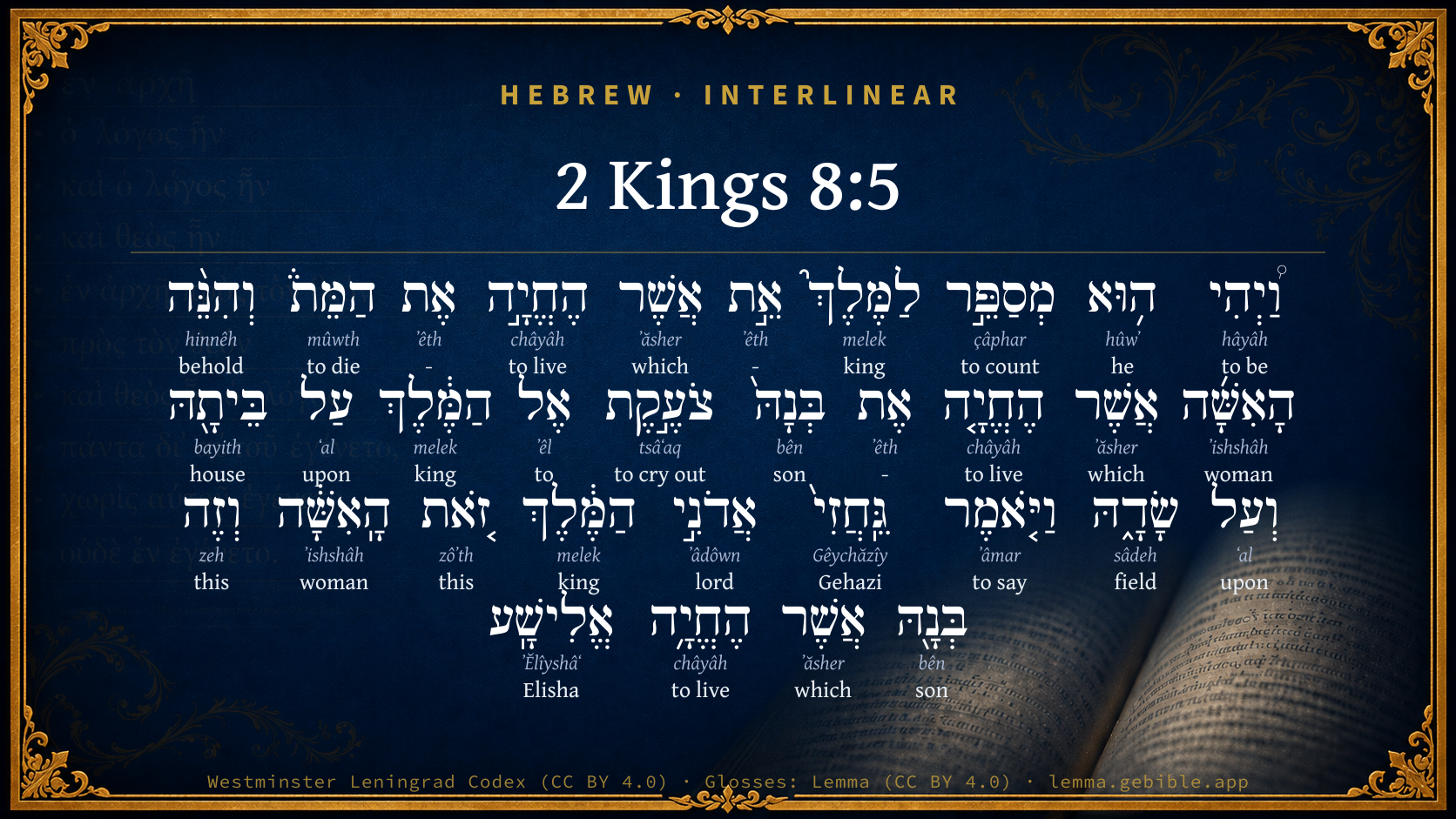
Hebrew (Westminster Leningrad Codex) 2 Kings 8:5 appears in the Hebrew Old Testament. The text above is from the Westminster Leningrad Codex. Each word links to its Strong’s number, a concise gloss, and parsing drawn from the Open Scriptures Hebrew Bible morphology. Click any word for its full Brown-Driver-Briggs (BDB) entry.
Download image
Cite this verse

2 Kings 8:5 (World English Bible). Public Domain. Lemma interlinear Bible study tool, https://lemma.gebible.app/v/2-kings/8/5.

Show BibTeX & RIS
BibTeX
RIS
English Translation
It happened, as he was telling the king how he had restored to life him who was dead, that behold, the woman, whose son he had restored to life, cried to the king for her house and for her land. Gehazi said, My lord, O king, this is the woman, and this is her son, whom Elisha restored to life.
World English Bible · Public Domain
Download a study sheet

One document with this verse’s original text, its word-by-word gloss line, the meaning frame, cross-references with their text, attributed commentary, and full source and license credits — printable, and it pastes into notes with its structure intact.

This verse Autodidact and up

Study sheet (.html) Plain text (.txt)

A passage Seminary Student

Up to 50 verses in one chapter. A passage sheet keeps up to 6 commentary sources and 12 cross-references per verse, in the order this page ranks them, and says so on the sheet whenever that leaves anything out. Ask for a single verse and you get the Autodidact verse sheet above.

Everything on this page stays free to read, with no account — the sheet is a download of what is already on screen, not access to it.

Want to remove ads? Support Godless Engineer
Compare translations 3

The same verse in 3 English versions, stacked beneath the original-language interlinear above. Click any original word for its lexicon entry.

Each is an independent rendering of the whole verse — the interlinear is not word-aligned to these translations.

Highlighted words mark where these versions differ — a whole-verse word diff, not a word-by-word alignment.

  • World English Bible Public Domain
    It happened, as he was telling the king how he had restored to life him who was dead, that behold, the woman, whose son he had restored to life, cried to the king for her house and for her land. Gehazi said, My lord, O king, this is the woman, and this is her son, whom Elisha restored to life.
  • King James Version Public Domain
    And it came to pass, as he was telling the king how he had restored a dead body to life, that, behold, the woman, whose son he had restored to life, cried to the king for her house and for her land. And Gehazi said, My lord, O king, this is the woman, and this is her son, whom Elisha restored to life.
  • unfoldingWord Literal Text CC BY-SA 4.0
    And it happened, he was recounting to the king that he had made the dead live, and behold, the woman whose son he had made live was crying out to the king for her house and for her field. And Gehazi said, “My lord the king, this the woman, and this her son, whom Elisha made live.”

unfoldingWord Literal Text — © unfoldingWord, licensed CC BY-SA 4.0. Word-aligned USFM3 via Door43 (git.door43.org/unfoldingWord/en_ult).

Versions to compare (up to 4)

3 of 4 selected

Show all 18 translations

Every available English version of this verse, each an independent rendering of the whole verse.

  • World English Bible Public Domain
    It happened, as he was telling the king how he had restored to life him who was dead, that behold, the woman, whose son he had restored to life, cried to the king for her house and for her land. Gehazi said, My lord, O king, this is the woman, and this is her son, whom Elisha restored to life.
  • Berean Standard Bible Public Domain
    And Gehazi was telling the king how Elisha had brought the dead back to life. Just then the woman whose son Elisha had revived came to appeal to the king for her house and her land. So Gehazi said, “My lord the king, this is the woman, and this is the son Elisha restored to life.”
  • Majority Standard Bible Public Domain
    And Gehazi was telling the king how Elisha had brought the dead back to life. Just then the woman whose son Elisha had revived came to appeal to the king for her house and her land. So Gehazi said, “My lord the king, this is the woman, and this is the son Elisha restored to life.”
  • King James Version Public Domain
    And it came to pass, as he was telling the king how he had restored a dead body to life, that, behold, the woman, whose son he had restored to life, cried to the king for her house and for her land. And Gehazi said, My lord, O king, this is the woman, and this is her son, whom Elisha restored to life.
  • American Standard Version (1901) Public Domain
    And it came to pass, as he was telling the king how he had restored to life him that was dead, that, behold, the woman, whose son he had restored to life, cried to the king for her house and for her land. And Gehazi said, My lord, O king, this is the woman, and this is her son, whom Elisha restored to life.
  • Revised Version (1885) Public Domain
    And it came to pass, as he was telling the king how he had restored to life him that was dead, that, behold, the woman, whose son he had restored to life, cried to the king for her house and for her land. And Gehazi said, My lord, O king, this is the woman, and this is her son, whom Elisha restored to life.
  • Geneva Bible (1599) Public Domain
    And as he told the King, howe he had restored one dead to life, behold, the woman, whose sonne he had raised to life, called vpon the King for her house and for her land. Then Gehazi sayd, My lorde, O King, this is the woman, and this is her sonne, whom Elisha restored to life.
  • Douay-Rheims (1899) Public Domain
    And when he was telling the king how he had raised one dead to life, the woman appeared, whose son he had restored to life, crying to the king for her house, and her lands. And Giezi said: My lord O king, this is the woman, and this is her son, whom Eliseus raised to life.
  • Young's Literal Translation Public Domain
    And it cometh to pass, he is recounting to the king how he had revived the dead, and lo, the woman whose son he had revived is crying unto the king, for her house and for her field, and Gehazi saith, `My lord, O king, this `is' the woman, and this her son, whom Elisha revived.'
  • Literal Standard Version CC BY-SA 4.0
    And it comes to pass, he is recounting to the king how he had revived the dead, and behold, the woman whose son he had revived is crying to the king for her house and for her field, and Gehazi says, “My lord, O king, this [is] the woman, and this [is] her son, whom Elisha revived.”
  • Unlocked Literal Bible CC BY-SA 4.0
    Then as he was telling the king how Elisha had restored to life the child who was dead, the very woman whose son he had restored to life came to beg the king for her house and land. Gehazi said, “My master, king, this is the woman, and this is her son, whom Elisha restored to life.”
  • unfoldingWord Literal Text CC BY-SA 4.0
    And it happened, he was recounting to the king that he had made the dead live, and behold, the woman whose son he had made live was crying out to the king for her house and for her field. And Gehazi said, “My lord the king, this the woman, and this her son, whom Elisha made live.”
  • Darby Bible Public Domain
    And it came to pass as he was telling the king how he had restored a dead body to life, that behold, the woman whose son he had restored to life cried to the king for her house and for her land. And Gehazi said, My lord, O king, this is the woman, and this is her son, whom Elisha restored to life.
  • World Messianic Bible Public Domain
    As he was telling the king how he had restored to life him who was dead, behold, the woman whose son he had restored to life begged the king for her house and for her land. Gehazi said, “My lord, O king, this is the woman, and this is her son, whom Elisha restored to life.”
  • Webster's Bible Public Domain
    And it came to pass, as he was telling the king how he had restored a dead body to life, that behold, the woman, whose son he had restored to life, cried to the king for her house and for her land. And Gehazi said, My lord, O king, this is the woman, and this is her son, whom Elisha restored to life.
  • Free Bible Version CC BY-SA 4.0
    It so happened that right then Gehazi was telling the king the story of how Elisha had brought the dead boy back to life when his mother arrived to make her appeal to the king for the return of her house and lands. “My lord the king,” Gehazi called out, “this is the woman, and this is her son that Elisha brought back to life.”
  • Bible in Basic English Public Domain
    And while he was giving the king the story of how Elisha had given life to the dead, the woman whose son had come back to life came to the king with a request for her house and her land. And Gehazi said, My lord king, this is the woman and this is her son, whose life Elisha gave back to him.
  • JPS Tanakh (1917) Public Domain
    And it came to pass, as he was telling the king how he had restored to life him that was dead, that, behold, the woman, whose son he had restored to life, cried to the king for her house and for her land. And Gehazi said: 'My lord, O king, this is the woman, and this is her son, whom Elisha restored to life.'

Literal Standard Version (2020), Covenant Press — licensed CC BY-SA 4.0. Text via the HelloAO Bible API (eBible.org). Unlocked Literal Bible (unfoldingWord) — licensed CC BY-SA 4.0. Text via the HelloAO Bible API (eBible.org). unfoldingWord Literal Text — © unfoldingWord, licensed CC BY-SA 4.0. Word-aligned USFM3 via Door43 (git.door43.org/unfoldingWord/en_ult). Free Bible Version, Dr. Jonathan Gallagher — licensed CC BY-SA 4.0. Text via the HelloAO Bible API (eBible.org).

Word by word

More ways to search: Search by grammar → Find every occurrence → Compare this word →

Practice this passage: Drill this verse → Learn its vocabulary →

גֵּֽחֲזִי֙
Gêychăzîy
H1522
“Gehazi”
Noun, Proper
Part of Speech
Noun
Type
Proper
Full BDB Definition

Origin: apparently from H1516 and H2372

TWOT: None

Gehazi = "valley of vision" - the servant of Elisha
  1. וַ֠יְהִי hâyâh H1961 “and · to be” Conjunction + Verb, Qal, Sequential Imperfect, 3rd Person, Masculine, Singular
  2. ה֥וּא hûwʼ H1931 “he” Pronoun, Personal, 3rd Person, Masculine, Singular
  3. מְסַפֵּ֣ר çâphar H5608 “counting” Verb, Piel, Participle Active, Masculine, Singular, Absolute
  4. לַמֶּלֶךְ֮ melek H4428 “to/for the · king” Preposition, Determined + Noun, Common, Masculine, Singular, Absolute
  5. אֵ֣ת ʼêth H853 “-” Particle, Direct Object
  6. אֲשֶׁר ʼăsher H834 “which” Particle, Relative
  7. הֶחֱיָ֣ה châyâh H2421 “to live” Verb, Hiphil, Perfect, 3rd Person, Masculine, Singular
  8. אֶת ʼêth H853 “-” Particle, Direct Object
  9. הַמֵּת֒ mûwth H4191 “the · dying” Particle, Definite Article + Verb, Qal, Participle Active, Masculine, Singular, Absolute
  10. וְהִנֵּ֨ה hinnêh H2009 “and · behold” Conjunction + Particle, Demonstrative
  11. הָאִשָּׁ֜ה ʼishshâh H802 “the · woman” Particle, Definite Article + Noun, Common, Feminine, Singular, Absolute
  12. אֲשֶׁר ʼăsher H834 “which” Particle, Relative
  13. הֶחֱיָ֤ה châyâh H2421 “to live” Verb, Hiphil, Perfect, 3rd Person, Masculine, Singular
  14. אֶת ʼêth H853 “-” Particle, Direct Object
  15. בְּנָהּ֙ bên H1121 “son · her” Noun, Common, Masculine, Singular, Construct + Suffix, Personal, 3rd Person, Feminine, Singular
  16. צֹעֶ֣קֶת tsâʻaq H6817 “crying out” Verb, Qal, Participle Active, Feminine, Singular, Absolute
  17. אֶל ʼêl H413 “to” Preposition
  18. הַמֶּ֔לֶךְ melek H4428 “the · king” Particle, Definite Article + Noun, Common, Masculine, Singular, Absolute
  19. עַל ʻal H5921 “upon” Preposition
  20. בֵּיתָ֖הּ bayith H1004 “house · her” Noun, Common, Masculine, Singular, Construct + Suffix, Personal, 3rd Person, Feminine, Singular
  21. וְעַל ʻal H5921 “and · upon” Conjunction + Preposition
  22. שָׂדָ֑הּ sâdeh H7704 “field · her” Noun, Common, Masculine, Singular, Construct + Suffix, Personal, 3rd Person, Feminine, Singular
  23. וַיֹּ֤אמֶר ʼâmar H559 “and · to say” Conjunction + Verb, Qal, Sequential Imperfect, 3rd Person, Masculine, Singular
  24. אֲדֹנִ֣י ʼâdôwn H113 “lord · my” Noun, Common, Masculine, Singular, Construct + Suffix, Personal, 1st Person, Common, Singular
  25. הַמֶּ֔לֶךְ melek H4428 “the · king” Particle, Definite Article + Noun, Common, Masculine, Singular, Absolute
  26. זֹ֚את zôʼth H2063 “this” Pronoun, Demonstrative, Feminine, Singular
  27. הָֽאִשָּׁ֔ה ʼishshâh H802 “the · woman” Particle, Definite Article + Noun, Common, Feminine, Singular, Absolute
  28. וְזֶה zeh H2088 “and · this” Conjunction + Pronoun, Demonstrative, Masculine, Singular
  29. בְּנָ֖הּ bên H1121 “son · her” Noun, Common, Masculine, Singular, Construct + Suffix, Personal, 3rd Person, Feminine, Singular
  30. אֲשֶׁר ʼăsher H834 “which” Particle, Relative
  31. הֶחֱיָ֥ה châyâh H2421 “to live” Verb, Hiphil, Perfect, 3rd Person, Masculine, Singular
  32. אֱלִישָֽׁע ʼĔlîyshâʻ H477 “Elisha” Noun, Proper

About this verse

These counts appear in no published source. They are computed here, from the morphology-tagged text and Lemma’s own curated glosses. What Lemma adds →

33
words
22
distinct lemmas
Historical
section

Notable vocabulary

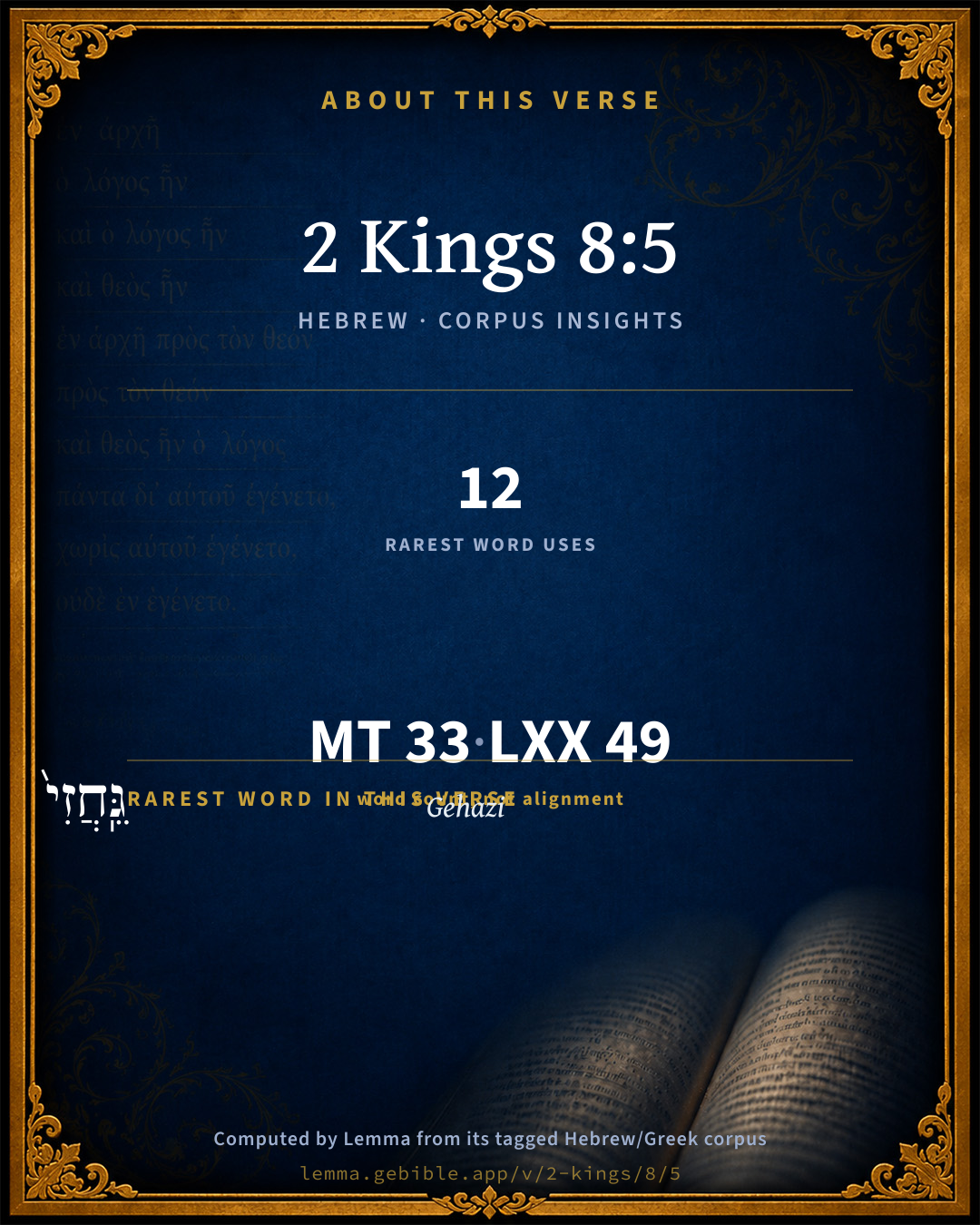
The rarest word here is גֵּֽחֲזִי֙ Gehazi H1522 — appearing just 12 times in the whole Hebrew Bible.

Shared distinctive vocabulary

גֵּֽחֲזִי֙ Gehazi H1522 occurs in 12 verses of the Hebrew Bible. Also found in:

Grammatical profile

  • 8 verbs
  • 12 nouns
  • 3 pronouns
  • 3 prepositions
  • 7 particles

Verb forms

  • וַ֠יְהִי Qal · Sequential Imperfect
  • מְסַפֵּ֣ר Piel · Participle Active
  • הֶחֱיָ֣ה Hiphil · Perfect
  • הַמֵּת֒ Qal · Participle Active
  • הֶחֱיָ֤ה Hiphil · Perfect
  • צֹעֶ֣קֶת Qal · Participle Active
  • וַיֹּ֤אמֶר Qal · Sequential Imperfect
  • הֶחֱיָ֥ה Hiphil · Perfect

Repetition

Words recur within this verse — often emphatic in Hebrew:

  • לַמֶּלֶךְ֮ king H4428 ×3
  • הֶחֱיָ֣ה to live H2421 ×3
  • הָאִשָּׁ֜ה woman H802 ×2
  • בְּנָהּ֙ son H1121 ×2
  • עַל upon H5921 ×2
  • אֲשֶׁר which H834 ×3

Hebrew & Septuagint length

In English translation the verse runs 60 words from the Hebrew and 62 from the Septuagint (LXX English) — closely comparable.

A rough comparison of the two English renderings, which tokenize alike — not a word-level alignment.

Word counts can differ between the Hebrew and the Greek without any difference in meaning — e.g. the Hebrew direct-object marker אֵת has no separate Greek word, and Greek often adds the article ὁ.

In the original languages it is 33 Hebrew tokens and 49 Greek tokens — but the two are counted differently (Hebrew bundles its prefixes and suffixes into one token; the Greek is in lemma form), so that isn’t a like-for-like length.

Cross-references

13

Topical passages linked to 2 Kings 8:5 in the Treasury of Scripture Knowledge — connected by theme and wording, ordered by reader-vote popularity; previews shown in the World English Bible.

  • 2 Kings 4:35 Then he returned, and walked in the house once back and forth; and went up, and stretched himself on him: and the child sneezed seven times, and the child opened his eyes.
  • Matthew 10:29–30 "Aren't two sparrows sold for an assarion? Not one of them falls on the ground apart from your Father's will,
  • Ruth 2:3 She went, and came and gleaned in the field after the reapers: and she happened to come to the portion of the field belonging to Boaz, who was of the family of Elimelech.
  • 1 Samuel 26:17 Saul knew David's voice, and said, Is this your voice, my son David? David said, It is my voice, my lord, O king.
  • 2 Kings 6:26 As the king of Israel was passing by on the wall, there cried a woman to him, saying, Help, my lord, O king.
  • Esther 5:14 Then said Zeresh his wife and all his friends to him, Let a gallows be made fifty cubits high, and in the morning speak you to the king that Mordecai may be hanged thereon: then go you in merrily with the king to the banquet. The thing pleased Haman; and he caused the gallows to be made.
  • Esther 6:11–12 Then took Haman the clothing and the horse, and arrayed Mordecai, and caused him to ride through the street of the city, and proclaimed before him, Thus shall it be done to the man whom the king delights to honor.
  • Psalms 145:1 I will exalt you, my God, the King. I will praise your name forever and ever.
  • Proverbs 16:9 A man's heart plans his course, But Yahweh directs his steps.
  • Ecclesiastes 9:11 I returned, and saw under the sun, that the race is not to the swift, nor the battle to the strong, neither yet bread to the wise, nor yet riches to men of understanding, nor yet favor to men of skill; but time and chance happen to them all.
  • Acts 8:27–40 He arose and went; and behold, there was a man of Ethiopia, a eunuch of great authority under Candace, queen of the Ethiopians, who was over all her treasure, who had come to Jerusalem to worship.
  • Romans 8:31 What then shall we say about these things? If God is for us, who can be against us?
  • 2 Kings 6:12 One of his servants said, No, my lord, O king; but Elisha, the prophet who is in Israel, tells the king of Israel the words that you speak in your bedchamber.

Cross-references courtesy of OpenBible.info (CC BY 4.0).

Hebrew and Greek witnesses Masoretic Hebrew ↔ Greek Septuagint

The same verse in the two great witnesses to the Old Testament, shown verse-for-verse.

These are two independent witnesses, not word-aligned to each other, and the Septuagint is shown in lemma (dictionary) form.

Hebrew 2 Kings 8:5 Masoretic · Westminster Leningrad Codex

וַ֠יְהִי ה֥וּא מְסַפֵּ֣ר לַמֶּלֶךְ֮ אֵ֣ת אֲשֶׁר הֶחֱיָ֣ה אֶת הַמֵּת֒ וְהִנֵּ֨ה הָאִשָּׁ֜ה אֲשֶׁר הֶחֱיָ֤ה אֶת בְּנָהּ֙ צֹעֶ֣קֶת אֶל הַמֶּ֔לֶךְ עַל בֵּיתָ֖הּ וְעַל שָׂדָ֑הּ וַיֹּ֤אמֶר גֵּֽחֲזִי֙ אֲדֹנִ֣י הַמֶּ֔לֶךְ זֹ֚את הָֽאִשָּׁ֔ה וְזֶה בְּנָ֖הּ אֲשֶׁר הֶחֱיָ֥ה אֱלִישָֽׁע

It happened, as he was telling the king how he had restored to life him who was dead, that behold, the woman, whose son he had restored to life, cried to the king for her house and for her land. Gehazi said, My lord, O king, this is the woman, and this is her son, whom Elisha restored to life.

World English Bible · Public Domain

Greek LXX 2 Kings 8:5 Septuagint · lemma form

καί γίγνομαι αὐτός ἐκἡγέομαι ὁ βασιλεύς ὡς ζωπυρέω υἱός θνήσκω καί ἰδού ὁ γυνή ὅς ζωπυρέω ὁ υἱός αὐτός ελισαιε βοάω πρός ὁ βασιλεύς περί ὁ οἶκος ἑαυτοῦ καί περί ὁ ἀγρός ἑαυτοῦ καί εἶπον γιεζι κύριος βασιλεύς οὗτος ὁ γυνή καί οὗτος ὁ υἱός αὐτός ὅς ζωπυρέω ελισαιε

And it came to pass, as he was telling the king how he had restored to life the dead son, behold, the woman whose son Elisaie restored to life came crying to the king for her house and for her lands. And Giezi said, My lord, O king, this is the woman, and this is her son, whom Elisaie restored to life.

LXX2012 (modern English Septuagint) · Public Domain

Hebrew: Westminster Leningrad Codex (CC BY 4.0). Greek: Septuagint (public domain); English from LXX2012 (modern English Septuagint) (Public Domain). How the Septuagint differs from the Hebrew →

Targum (Aramaic paraphrase)

1

The Targum is the ancient Jewish Aramaic paraphrase of the Hebrew Scriptures — an interpretive translation, not the Hebrew text itself. Onkelos (literal) and Pseudo-Jonathan (expansive) render the Torah, and Jonathan the Prophets. Coverage is partial: where no permissively-licensed English translation exists for a verse, only the Aramaic is shown. This is verse-level text, not a word-by-word alignment to the Hebrew.

  1. Targum Jonathan Prophets (Joshua–Malachi)
    וַהֲוָה הוּא מִשְׁתָּעֵי לְמַלְכָּא יַת דְאַחְיֵי יַת מִיתָא וְהָא אִתְּתָא דְאַחְיֵי יַת בְּרָהּ קָבְלָא קֳדָם מַלְכָּא עַל בֵּיתָהּ וְעַל חַקְלָהּ וַאֲמַר גֵחֲזִי רִבּוֹנִי מַלְכָּא דָא אִתְּתָא וְדֵין בְּרָהּ דְאַחְיֵי אֱלִישָׁע:

    (no public-domain English translation for this verse)

    Targum Jonathan — Aramaic: “Mikraot Gedolot” (public domain). English: “Sefaria Community Translation” (CC0 1.0 (public-domain dedication)); “London "Chaldee Paraphrase," 1871” (public domain). Text via Sefaria.

Commentary

Notes on 2 Kings 8:5 from classic Christian and Jewish commentators (each source and its license shown beneath its notes). The classic Christian expositions comment on the surrounding passage and are grouped to its opening verse, so a note may address several verses; the Jewish commentaries on the Tanakh (Rashi and others) are per-verse, so they appear only where the commentator wrote on this verse.

Lemma curates 59 commentaries, every one of them public domain or Creative Commons licensed, each selected and text-cleaned for this edition rather than reprinted as found. About our sources →

Trapp's Complete Commentary

John Trapp

2Ki 8:5 And it came to pass, as he was telling the king how he had restored a dead body to life, that, behold, the woman, whose son he had restored to life, cried to the king for her house and for her land. And Gehazi said, My lord, O king, this [is] the woman, and this [is] her son, whom Elisha restored to life.

Ver. 5. And it came to pass, as he was telling the king.] This telling the king the praises of his severe master so truly, is some argument that he had now repented of that dearly bought lie he once told to Elisha. God maketh our very sins subservient to our salvation; and the horrible sting of Satan to be like a pearl pin to pin upon us the long white robe of Christ, and to dress us with the garment of gladness, as one speaketh.

John Trapp, A Commentary or Exposition upon All the Books of the Old and New Testament (1647–1656) — public domain. Text from a community e-Sword module.

Joseph Benson's Commentary

2Ki 8:5-6. As he was telling the king, &c., the woman cried to the king, &c. — By the order of Providence she came to present her petition, and brought her son with her, in that very instant of time when Gehazi was telling the story of Elisha’s restoring him to life, that the king might be more fully satisfied of the truth of what he related from her own mouth, and that it might make the deeper impression upon him. Providence ought to be carefully observed, and devoutly acknowledged, in ordering the circumstances of events; for sometimes, as here, those that are minute of themselves, prove of great consequence. And when the king asked the woman, she told him — That is, she confirmed what Gehazi had said. Thus did God even force him to believe, what he might have had some colour to question, if he had only had Gehazi’s word for it. So the king appointed, saying, Restore all that was hers — Not only her house and land, but all the profits that had been made of them, and brought into his treasury. This was a high act of justice, and an argument of some goodness left in a bad man.

Joseph Benson's Commentary on the Old and New Testaments (1811–1818) — public domain. Text from a community e-Sword module.

Geneva Bible (1599)

Geneva Bible translators

God’s wonderful providence appeareth in this, that he caused the King to be desirous to hear of him, whom before he contemned, and also hereby prepared an entrance to the poor widow’s suit.

Geneva Bible (1599) marginal notes — public domain. Text via Bolls.life.

Adam Clarke's Commentary

Verse 5. This is the woman, and this is her son, whom Elisha restored to life.] This was a very providential occurrence in behalf of the Shunammite. The relation given by Gehazi was now corroborated by the woman herself; the king was duly affected, and gave immediate orders for the restoration of her land.

Adam Clarke's Commentary on the Bible (1810–1826) — public domain. Text from a community e-Sword/MySword module.

Ellicott's Commentary for English Readers

(5) A dead body.—The dead.

Cried.—Was crying. Literally, the Hebrew runs, And it came to pass, he (emphatic) was telling . . . and behold the woman was crying, &c. The woman came in, and began her prayer to the king, while he was talking with Gehazi about her and her son.

This is her son.—Who was now grown up, and came as his mother’s escort.

A Bible Commentary for English Readers, edited by Charles John Ellicott (1878–1897) — public domain. Text from a community e-Sword module.

The Cambridge Bible for Schools and Colleges

gen. ed. J. J. S. Perowne

5. had restored a dead body to life] R.V. to life him that was dead. This would be among the greatest of the great works of Elisha, and Jehoram’s interest would consequently be at its height.

The Cambridge Bible for Schools and Colleges (gen. ed. J. J. S. Perowne; Cambridge University Press, 1878–1918) — public domain. Text from a community e-Sword module.

John Gill's Exposition

And it came to pass, as he was telling the king how he had restored a dead body to life,.... Which was the Shunammite's son:

that, behold, the woman whose son he had restored to life cried to the king for her house, and for her land; came and presented her petition to the king at that very instant:

and Gehazi said, my lord, O king, this is the woman, and this is her son, whom Elisha restored to life; the very person I am speaking of.

John Gill's Exposition of the Whole Bible (1746–1763) — public domain (CC PDM 1.0). Text via the HelloAO Bible API.

Matthew Poole's English Annotations

The woman was by God’s wonderful and gracious providence brought thither in the most advantageous season.

Matthew Poole's English Annotations on the Holy Bible (1683–1685) — public domain. Text from a community e-Sword/MySword module.

The Pulpit Commentary

And it came to pass, as he was telling the king how he i.e. Elishahad restored a dead Body to life. This was undoubtedly the greatest of all Elisha"s miracles, and Gehazi naturally enlarged upon it. As an eye-witness, (2Ki_4:29-36) he could give all the details. That, behold, the woman, whose son he had restored to life, cried to the king for her house and for her land. The coincidence can scarcely have been accidental. Divine providence so ordered matters that, just when the king"s interest in the woman was most warm, she should appear before him to urge her claim. At another time, Jehoram would, it is probable, have been but slightly moved by her complaint. Under the peculiar circumstances, he was deeply moved, and at once granted the woman the redress for which she asked. And Gehazi said, Wry lord, O king, this is the woman, and this is her son, whom Elisha restored to life. The Shunammite was accompanied by her son, now a boy of at least tea or eleven years old the actual object of Elisha"s miracle. The king"s interest in the woman would be still more roused by this circumstance.

Vers. 7-9. The power of calamity to bend the spirit of the proud.

Benhadad had hitherto been an enemy of Jehovah and his prophets. He had sought Elisha"s life, (2Ki_6:13-20) and, when baffled in his design to seize his person, had made a bold attempt to crush and destroy the whole Israelite nation. But now God had laid his hand upon him; he was prostrated on a sick-bed; and lo! all was altered. The mighty monarch, so lately glorying in his strength, and, in his own opinion, infinitely above any soi-disant prophet, is brought down so low that, on hearing of Elisha"s having come voluntarily to his capital, instead of seizing him, he sends him a humble embassy. Hazael, a high officer of the court, is bidden to "take a present in his hand, and go meet the man of God, and inquire of Jehovah by him Will the king recover from his disease?" The present is a rich one, made by Oriental ostentation to appear even grander than it is in reality. Forty camels bear their burden to the prophet"s door, and bring him "every good thing of Damascus," without let or stint. The great king calls himself Elisha"s son son Benhadad has sent me to thee" (ver. 9). Never was there a more complete reversal of human conditions. The hunted enemy is now felt to be the best friend; is courted, flattered, propitiated both by act and word. The proud king grovels in the dust, is content to be the prophet"s son and servant, does him obeisance morally, and hangs upon his words as those of one with whom are the issues of life and death! And so it is with the proud and mighty generally.

(1) A Pharaoh despises Jehovah, and asks, "Who is the Lord, that I should obey his voice and let Israel go? I know not the Lord, neither will I let Israel go"; (Exo_5:2) but in a little time the same Pharaoh has to rise up in the dead of the night, and to call for Jehovah"s servants, Moses and Aaron, and to entreat them to go forth from among his people, both they and the children of Israel, and go, serve Jehovah, as they had said; also to take their flocks and their herds, as they had said, and to be gone; and to bless him also". (Exo_12:31, Exo_12:32)

(2) An Ahab lets loose the dogs of persecution against the people of God, destroys the prophets of Jehovah, and sells himself to work evil in the sight of the Lord; but, when boldly rebuked and threatened with calamity, all his pride forsakes him, and he rends his clothes, and puts sackcloth upon his flesh, and fasts, and lies in sackcloth, and goes softly. (1Ki_21:27)

(3) A Manasseh turns from God to worship Baal, and does after all the abominations of the heathen, and builds again the high places, and rears up altars for Baal, and uses witchcraft, and sets up a carved image in the house of God, and sheds innocent blood very much till he fills Jerusalem from one end to another, (2Ki_21:16) and does worse than the heathen whom the Lord destroyed before the children of Israel, even causing Isaiah (according to the tradition) to be sawn asunder; but calamity smites him, the captains of the host of the King of Assyria take him, and put hooks in his mouth, and chains upon his limbs, and carry him captive to Babylon to the King of Assyria then all his pride falls away from him like a cast-off garment, and in his affliction he beseeches the Lord his God, and humbles himself greatly before the God of his fathers, and prays to him, and makes supplication, and is forgiven, and thenceforth serves Jehovah. (2Ch_33:11-16) The pastor who has under his charge proud, tyrannical, oppressive persons, who scorn rebuke, and think to ride roughshod over their fellow-men, may wait with a good hope for the hour of sickness or calamity, which sooner or later, unless in the case of sudden death, comes to all. He will find the Benhadad of the sick-room a very different person from the Benhadad of the camp, or of the court, or of the mart, and one much more open to admonition. Hardness, stubbornness, self-reliance, can scarcely survive, when the weakness of decay and the helplessness of acute sickness have supervened. He need not despair, however cruel, oppressive, and injurious to others the man"s earlier life may have been. If a Benhadad could humble himself, if an Ahab could repent and "go softly," if a Manasseh could turn to God and obtain pardon, there must be a possibility of repentance even for the most hardened sinners.

The Pulpit Commentary (1880–1919), ed. H.D.M. Spence-Jones & Joseph S. Exell — public domain. Text from a community e-Sword module.

Keil & Delitzsch

C. F. Keil & F. Delitzsch

While he was relating this, the woman herself came into invoke the help of the king to recover her property, and was pointed out to the king by Gehazi as the very woman of whom he was speaking, which caused the king to be so interested in her favour, that after hearing her complaint he sent a chamberlain with her (saris as in Kg1 22:9), with instructions to procure for her not only the whole of her property, but the produce of the land during her absence. - For עזבה without mappiq, see Ewald, 247, d.

Keil & Delitzsch — Biblical Commentary on the Old Testament (1861–1891) — public domain (CC PDM 1.0). Text via the HelloAO Bible API. (Old Testament only.)

unfoldingWord translationNotes

Door43 World Missions Community

had restored to life the child who was dead

"had caused the child who was dead to become alive again"

for her house and land

While the woman was gone, her home and property were sieged. She is begging for them to be returned to her. The meaning of this can be made clear. AT: "for her home and her property to be returned to her" (See: Assumed Knowledge and Implicit Information)

about her son

This refers to the story of her son dying and Elisha bringing him back to life. The meaning of this statement can be made explicit. AT: "about what had happened to her son" (See: Assumed Knowledge and Implicit Information)

all the harvests of her fields

This metonym refers to the amount of money that the harvests of her fields were worth while she was away. AT: "all the profit from the harvests of her fields" (See: Metonymy)

translationWords

children

die

lord

harvest

unfoldingWord translationNotes — © Distant Shores Media and the Door43 World Missions Community, licensed CC BY-SA 4.0. Source: git.door43.org/Door43/en_tn.

Lesson kit

Teaching starters — assembled from the data on this page, not authored interpretation. Every prompt links to the verse data it draws on. Edit before teaching.

2 Kings, in the Historical, opens this verse with 33 words (22 distinct Hebrew lemmas). Its most distinctive word is Gêychăzîy (“Gehazi”). A historical commentator’s framing appears above. Read the whole chapter for the surrounding context.

Discussion questions

  1. How does “Gehazi” (Gêychăzîy) shape what this verse is saying?
  2. How does 2 Kings 4:12, which shares the word «Gehazi», read alongside this verse?
  3. What does the repetition of “king” (3× in this one verse) do in this verse?
  4. These translations render this verse differently; the difference is in the English rendering, not the original. What questions does that raise?
  5. «וַ֠יְהִי» is a Qal Sequential Imperfect verb. How does that grammatical form shape the action described?
  6. Compare how Trapp's Complete Commentary and Joseph Benson's Commentary read this verse. Where do they agree or differ?

Things to notice

Reading settings

Reading text

Shown beneath each verse's original-language words.

Old Testament
Old Testament edition

Read the OT as the Masoretic Hebrew (MT) or the Greek Septuagint (LXX).

English shown for the Greek Septuagint (in the Hebrew ↔ Greek comparison).

Comparing translations? Open the Compare panel on any verse page to stack up to four side by side.