Leviticus 27:21

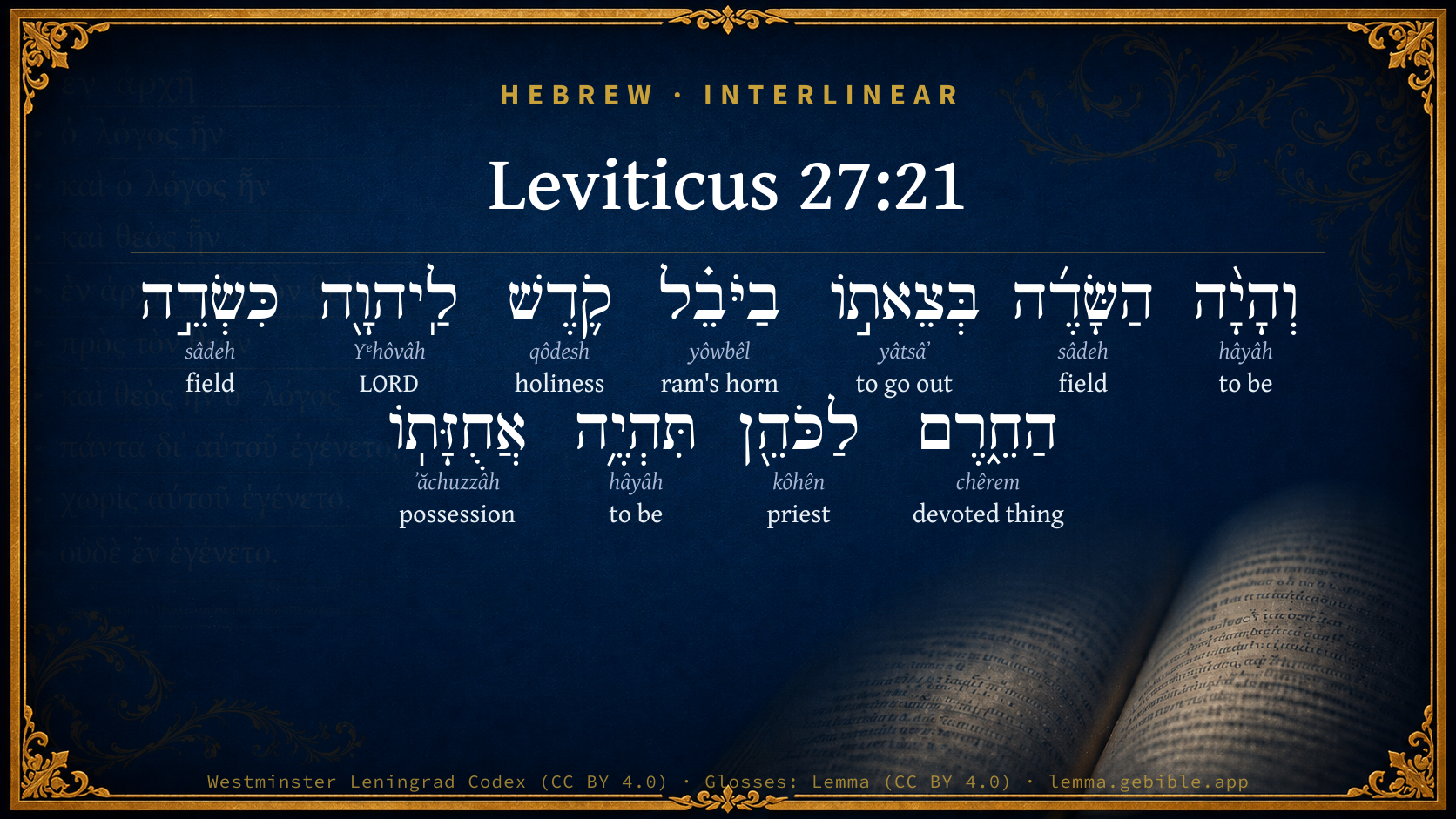
Hebrew (Westminster Leningrad Codex) Leviticus 27:21 appears in the Hebrew Old Testament. The text above is from the Westminster Leningrad Codex. Each word links to its Strong’s number, a concise gloss, and parsing drawn from the Open Scriptures Hebrew Bible morphology. Click any word for its full Brown-Driver-Briggs (BDB) entry.
Download image
Cite this verse

Leviticus 27:21 (World English Bible). Public Domain. Lemma interlinear Bible study tool, https://lemma.gebible.app/v/leviticus/27/21.

Show BibTeX & RIS
BibTeX
RIS
English Translation
but the field, when it goes out in the Jubilee, shall be holy to Yahweh, as a field devoted; it shall be owned by the priests.
World English Bible · Public Domain
Highlights
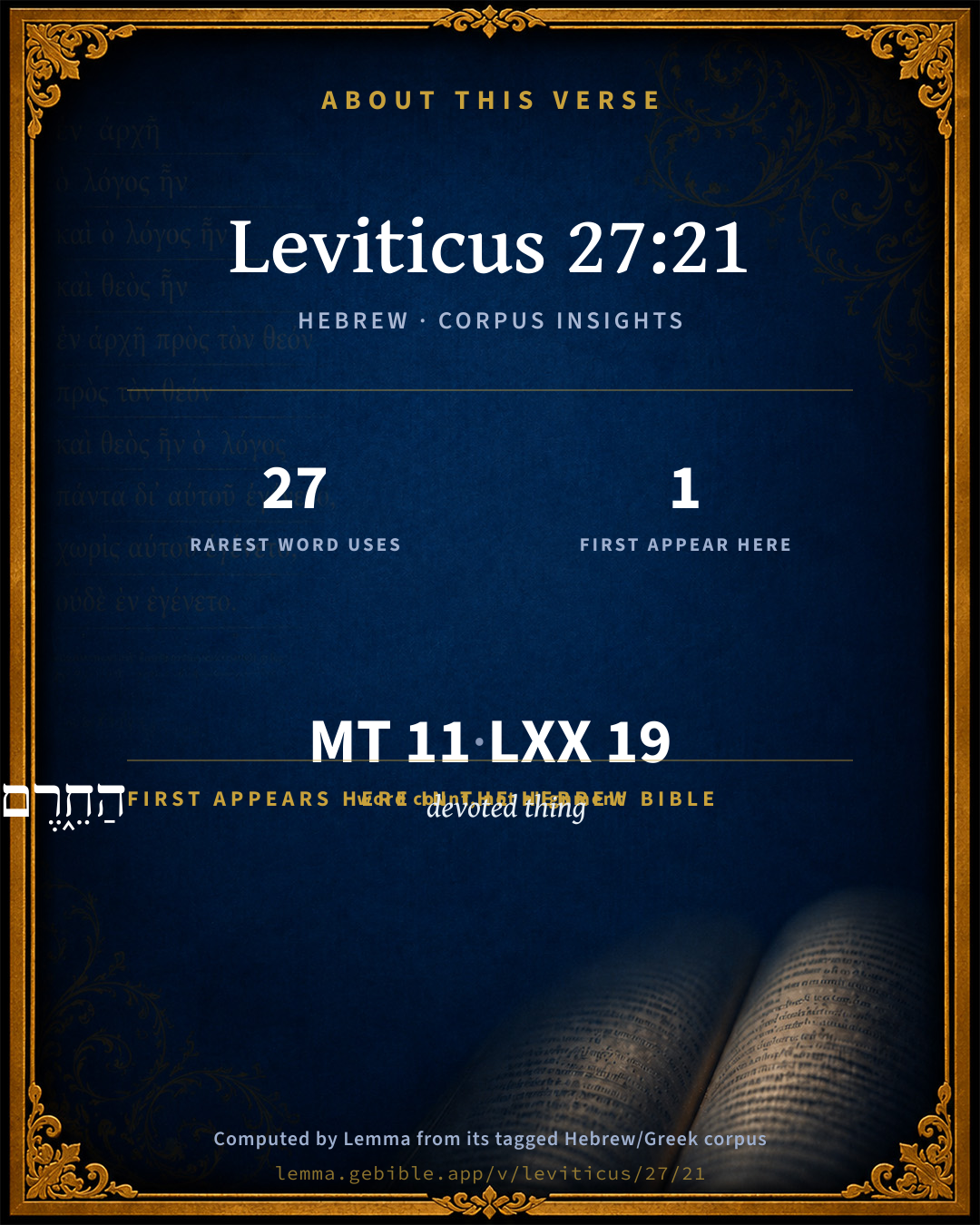
  • 1 first appearance in the Hebrew Bible
Full analysis ↓
Download a study sheet

One document with this verse’s original text, its word-by-word gloss line, the meaning frame, cross-references with their text, attributed commentary, and full source and license credits — printable, and it pastes into notes with its structure intact.

This verse Autodidact and up

Study sheet (.html) Plain text (.txt)

A passage Seminary Student

Up to 50 verses in one chapter. A passage sheet keeps up to 6 commentary sources and 12 cross-references per verse, in the order this page ranks them, and says so on the sheet whenever that leaves anything out. Ask for a single verse and you get the Autodidact verse sheet above.

Everything on this page stays free to read, with no account — the sheet is a download of what is already on screen, not access to it.

Want to remove ads? Support Godless Engineer
Compare translations 3

The same verse in 3 English versions, stacked beneath the original-language interlinear above. Click any original word for its lexicon entry.

Each is an independent rendering of the whole verse — the interlinear is not word-aligned to these translations.

Highlighted words mark where these versions differ — a whole-verse word diff, not a word-by-word alignment.

  • World English Bible Public Domain
    but the field, when it goes out in the Jubilee, shall be holy to Yahweh, as a field devoted; it shall be owned by the priests.
  • King James Version Public Domain
    But the field, when it goeth out in the jubilee, shall be holy unto the LORD, as a field devoted; the possession thereof shall be the priest's.
  • unfoldingWord Literal Text CC BY-SA 4.0
    And the field shall be, in its going out in the Jubilee, holy to Yahweh, as a field of devotion. It shall be to the priest, his possession.

unfoldingWord Literal Text — © unfoldingWord, licensed CC BY-SA 4.0. Word-aligned USFM3 via Door43 (git.door43.org/unfoldingWord/en_ult).

Versions to compare (up to 4)

3 of 4 selected

Show all 18 translations

Every available English version of this verse, each an independent rendering of the whole verse.

  • World English Bible Public Domain
    but the field, when it goes out in the Jubilee, shall be holy to Yahweh, as a field devoted; it shall be owned by the priests.
  • Berean Standard Bible Public Domain
    When the field is released in the Jubilee, it will become holy, like a field devoted to the LORD; it becomes the property of the priests.
  • Majority Standard Bible Public Domain
    When the field is released in the Jubilee, it will become holy, like a field devoted to the LORD; it becomes the property of the priests.
  • King James Version Public Domain
    But the field, when it goeth out in the jubilee, shall be holy unto the LORD, as a field devoted; the possession thereof shall be the priest's.
  • American Standard Version (1901) Public Domain
    but the field, when it goeth out in the jubilee, shall be holy unto Jehovah, as a field devoted; the possession thereof shall be the priest's.
  • Revised Version (1885) Public Domain
    but the field, when it goeth out in the jubile, shall be holy unto the LORD, as a field devoted; the possession thereof shall be the priest’s.
  • Geneva Bible (1599) Public Domain
    But the field shalbe holy to the Lord, whe it goeth out in the Iubile, as a fielde separate from common vses: the possession thereof shall be the Priests.
  • Douay-Rheims (1899) Public Domain
    For when the day of jubilee cometh, it shall be sanctified to the Lord, and as a possession consecrated, pertaineth to the right of the priests.
  • Young's Literal Translation Public Domain
    and the field hath been, in its going out in the jubilee, holy to Jehovah as a field which is devoted; to the priest is its possession.
  • Literal Standard Version CC BY-SA 4.0
    and the field has been, in its going out in the Jubilee, holy to YHWH as a field which is devoted; his possession is for the priest.
  • Unlocked Literal Bible CC BY-SA 4.0
    Instead, the field, when it is released in the year of Jubilee, will be a holy gift to Yahweh, like the field that has been completely given to Yahweh. It will belong to the priest.
  • unfoldingWord Literal Text CC BY-SA 4.0
    And the field shall be, in its going out in the Jubilee, holy to Yahweh, as a field of devotion. It shall be to the priest, his possession.
  • Darby Bible Public Domain
    and the field, when it goeth out in the jubilee, shall be holy to Jehovah, as a field devoted; the possession thereof shall be the priest's.
  • World Messianic Bible Public Domain
    but the field, when it goes out in the Jubilee, shall be holy to the LORD, as a devoted field. It shall be owned by the priests.
  • Webster's Bible Public Domain
    But the field, when it goeth out in the jubilee, shall be holy to the LORD, as a field devoted: the possession of it shall be the priest's.
  • Free Bible Version CC BY-SA 4.0
    When the Jubilee comes, the field will become holy, in the same way as a field devoted to the Lord. It will become the property of the priests.
  • Bible in Basic English Public Domain
    But the field, when it becomes free at the year of Jubilee, will be holy to the Lord, as a field given under oath: it will be the property of the priest.
  • JPS Tanakh (1917) Public Domain
    But the field, when it goeth out in the jubilee, shall be holy unto the LORD, as a field devoted; the possession thereof shall be the priest's.

Literal Standard Version (2020), Covenant Press — licensed CC BY-SA 4.0. Text via the HelloAO Bible API (eBible.org). Unlocked Literal Bible (unfoldingWord) — licensed CC BY-SA 4.0. Text via the HelloAO Bible API (eBible.org). unfoldingWord Literal Text — © unfoldingWord, licensed CC BY-SA 4.0. Word-aligned USFM3 via Door43 (git.door43.org/unfoldingWord/en_ult). Free Bible Version, Dr. Jonathan Gallagher — licensed CC BY-SA 4.0. Text via the HelloAO Bible API (eBible.org).

Word by word

More ways to search: Search by grammar → Find every occurrence → Compare this word →

Practice this passage: Drill this verse → Learn its vocabulary →

בַיֹּבֵ֗ל
yôwbêl
H3104
“in/at the · ram's horn”
Preposition, Determined + Noun, Common, Masculine, Singular, Absolute
Part of Speech
Preposition + Noun
Type
Common
Gender
Masculine
Number
Singular
State
Absolute
Full BDB Definition

Origin: apparently from H2986

TWOT: 835e

ram, ram's horn, trumpet, cornet - ram (only in combination) - ram's horn, trumpet - jubilee year (marked by the blowing of cornets) (metonymy)
  1. וְהָיָ֨ה hâyâh H1961 “and · to be” Conjunction + Verb, Qal, Sequential Perfect, 3rd Person, Masculine, Singular
  2. הַשָּׂדֶ֜ה sâdeh H7704 “the · field” Particle, Definite Article + Noun, Common, Masculine, Singular, Absolute
  3. בְּצֵאת֣וֹ yâtsâʼ H3318 “in/at · to go out · him” Preposition + Verb, Qal, Infinitive Construct + Suffix, Personal, 3rd Person, Masculine, Singular
  4. קֹ֛דֶשׁ qôdesh H6944 “holiness” Noun, Common, Masculine, Singular, Absolute
  5. לַֽיהוָ֖ה Yᵉhôvâh H3068 “to/for · LORD” Preposition + Noun, Proper
  6. כִּשְׂדֵ֣ה sâdeh H7704 “like/as · field of” Preposition + Noun, Common, Masculine, Singular, Construct
  7. הַחֵ֑רֶם chêrem H2764 “the · devoted thing” Particle, Definite Article + Noun, Common, Masculine, Singular, Absolute
  8. לַכֹּהֵ֖ן kôhên H3548 “to/for the · priest” Preposition, Determined + Noun, Common, Masculine, Singular, Absolute
  9. תִּהְיֶ֥ה hâyâh H1961 “to be” Verb, Qal, Imperfect, 3rd Person, Feminine, Singular
  10. אֲחֻזָּתֽוֹ ʼăchuzzâh H272 “possession · his” Noun, Common, Feminine, Singular, Construct + Suffix, Personal, 3rd Person, Masculine, Singular

About this verse

These counts appear in no published source. They are computed here, from the morphology-tagged text and Lemma’s own curated glosses. What Lemma adds →

11
words
9
distinct lemmas
Pentateuch
section

First appearance in Scripture

This word makes its first canonical appearance in the Hebrew Bible here:

  • הַחֵ֑רֶם devoted thing H2764

Shared distinctive vocabulary

בַיֹּבֵ֗ל ram's horn H3104 occurs in 25 verses of the Hebrew Bible. Also found in:

Grammatical profile

  • 3 verbs
  • 8 nouns

Verb forms

  • וְהָיָ֨ה Qal · Sequential Perfect
  • בְּצֵאת֣וֹ Qal · Infinitive Construct
  • תִּהְיֶ֥ה Qal · Imperfect

Repetition

Words recur within this verse — often emphatic in Hebrew:

  • וְהָיָ֨ה to be H1961 ×2
  • הַשָּׂדֶ֜ה field H7704 ×2

Hebrew & Septuagint length

In English translation the verse runs 26 words from the Hebrew and 22 from the Septuagint (LXX English) — closely comparable.

A rough comparison of the two English renderings, which tokenize alike — not a word-level alignment.

Word counts can differ between the Hebrew and the Greek without any difference in meaning — e.g. the Hebrew direct-object marker אֵת has no separate Greek word, and Greek often adds the article ὁ.

In the original languages it is 11 Hebrew tokens and 19 Greek tokens — but the two are counted differently (Hebrew bundles its prefixes and suffixes into one token; the Greek is in lemma form), so that isn’t a like-for-like length.

Cross-references

9

Topical passages linked to Leviticus 27:21 in the Treasury of Scripture Knowledge — connected by theme and wording, ordered by reader-vote popularity; previews shown in the World English Bible.

  • Ezekiel 44:29 They shall eat the meal-offering, and the sin-offering, and the trespass-offering; and every devoted thing in Israel shall be theirs.
  • Numbers 18:14 Everything devoted in Israel shall be yours.
  • Leviticus 25:10 You shall make the fiftieth year holy, and proclaim liberty throughout the land to all its inhabitants. It shall be a jubilee to you; and each of you shall return to his own property, and each of you shall return to his family.
  • Leviticus 25:28 But if he isn't able to get it back for himself, then what he has sold shall remain in the hand of him who has bought it until the Year of Jubilee: and in the Jubilee it shall be released, and he shall return to his propery.
  • Leviticus 25:31 But the houses of the villages which have no wall round about them shall be reckoned with the fields of the country: they may be redeemed, and they shall be released in the Jubilee.
  • Leviticus 27:28–29 "'Notwithstanding, no devoted thing, that a man shall devote to Yahweh of all that he has, whether of man or animal, or of the field of his possession, shall be sold or redeemed: every devoted thing is most holy to Yahweh.
  • Joshua 6:17 The city shall be devoted, even it and all that is therein, to Yahweh: only Rahab the prostitute shall live, she and all who are with her in the house, because she hid the messengers that we sent.
  • Ezra 10:8 and that whoever didn't come within three days, according to the counsel of the princes and the elders, all his substance should be forfeited, and himself separated from the assembly of the captivity.
  • Deuteronomy 13:17 There shall cleave nothing of the devoted thing to your hand; that Yahweh may turn from the fierceness of his anger, and show you mercy, and have compassion on you, and multiply you, as he has sworn to your fathers;

Cross-references courtesy of OpenBible.info (CC BY 4.0).

Hebrew and Greek witnesses Masoretic Hebrew ↔ Greek Septuagint

The same verse in the two great witnesses to the Old Testament, shown verse-for-verse.

These are two independent witnesses, not word-aligned to each other, and the Septuagint is shown in lemma (dictionary) form.

Hebrew Leviticus 27:21 Masoretic · Westminster Leningrad Codex

וְהָיָ֨ה הַשָּׂדֶ֜ה בְּצֵאת֣וֹ בַיֹּבֵ֗ל קֹ֛דֶשׁ לַֽיהוָ֖ה כִּשְׂדֵ֣ה הַחֵ֑רֶם לַכֹּהֵ֖ן תִּהְיֶ֥ה אֲחֻזָּתֽוֹ

but the field, when it goes out in the Jubilee, shall be holy to Yahweh, as a field devoted; it shall be owned by the priests.

World English Bible · Public Domain

Greek LXX Leviticus 27:21 Septuagint · lemma form

ἀλλά εἰμί ὁ ἀγρός ἐκἔρχομαι ὁ ἄφεσις ἅγιος ὁ κύριος ὥσπερ ὁ γῆ ὁ ἀποὁρίζω ὁ ἱερεύς εἰμί κατάσχεσις

But the field shall be holy to the Lord after the release, as separated land; the priest shall have possession of it.

LXX2012 (modern English Septuagint) · Public Domain

Hebrew: Westminster Leningrad Codex (CC BY 4.0). Greek: Septuagint (public domain); English from LXX2012 (modern English Septuagint) (Public Domain). How the Septuagint differs from the Hebrew →

Targum (Aramaic paraphrase)

2

The Targum is the ancient Jewish Aramaic paraphrase of the Hebrew Scriptures — an interpretive translation, not the Hebrew text itself. Onkelos (literal) and Pseudo-Jonathan (expansive) render the Torah, and Jonathan the Prophets. Coverage is partial: where no permissively-licensed English translation exists for a verse, only the Aramaic is shown. This is verse-level text, not a word-by-word alignment to the Hebrew.

  1. Targum Onkelos Torah (Genesis–Deuteronomy)
    וִיהֵי חַקְלָא בְּמִפְּקֵהּ בְּיוֹבֵלָא קוּדְשָׁא קֳדָם יְיָ כַּחֲקַל חֶרְמָא לְכַהֲנָא תְּהֵי אַחֲסַנְתֵּהּ

    (no public-domain English translation for this verse)

    Targum Onkelos — Aramaic: “Onkelos Genesis” (public domain); “Onkelos Exodus” (public domain); “Onkelos Leviticus” (public domain); “Onkelos Numbers” (public domain); “Onkelos Deuteronomy” (public domain). English: “Sefaria Community Translation” (CC0 1.0 (public-domain dedication)); “J.W. Etheridge. The Targums of Onkelos and Jonathan Ben Uzziel on the Pentateuch. London: Longmans, Green, 1862” (public domain). Text via Sefaria.

  2. Targum Pseudo-Jonathan Torah (Genesis–Deuteronomy)
    וִיהֵי חַקְלָא בְּמִפְקֵיהּ בְּיוֹבְלָא קוּדְשָׁא קֳדָם יְיָ הֵי כַחֲקַל אַפְרָשָׁא לְכַהֲנָא תְּהֵי אַחְסַנְתֵּיהּ

    the field, when it goeth out at the Jubela, shall be sacred before the Lord; as a field separated for the priest it shall be his inheritance.

    Targum Pseudo-Jonathan — Aramaic: “Targum Jonathan on Genesis” (public domain); “Targum Jonathan on Exodus” (public domain); “Targum Jonathan on Leviticus” (public domain); “Targum Jonathan on Numbers” (public domain); “Targum Jonathan on Deuteronomy” (public domain). English: “The Targum of Jonathan ben Uzziel, trans. J. W. Etheridge, London, 1862” (public domain). Text via Sefaria.

Commentary

Notes on Leviticus 27:21 from classic Christian and Jewish commentators (each source and its license shown beneath its notes). The classic Christian expositions comment on the surrounding passage and are grouped to its opening verse, so a note may address several verses; the Jewish commentaries on the Tanakh (Rashi and others) are per-verse, so they appear only where the commentator wrote on this verse.

Lemma curates 59 commentaries, every one of them public domain or Creative Commons licensed, each selected and text-cleaned for this edition rather than reprinted as found. About our sources →

Joseph Benson's Commentary

Lev 27:21. When it goeth out — That is, out of the possession of the other man to whom the priest sold it. The possession shall be the priest’s — For his maintenance. Nor is this repugnant to that law, that the priests should have no inheritance in the land, Num 18:20; for that is only spoken of the tribe of Levi in general, in reference to the first division of the land, wherein the Levites were not to have a distinct part of land, as other tribes had; but this does not imply that some particular lands might not be vowed and given to the priests, either for their own benefit, or for the service of the sanctuary.

Joseph Benson's Commentary on the Old and New Testaments (1811–1818) — public domain. Text from a community e-Sword module.

Tyndale Open Study Notes

Tyndale Open Resources

27:21 Year of Jubilee: See 25:8-55. • specially set apart: An acceptable vow devoting something to the Lord made it holy; it could not be redeemed.

Tyndale Open Study Notes — © Tyndale Open Resources, licensed CC BY-SA 4.0. Text via the HelloAO Bible API.

Geneva Bible (1599)

Geneva Bible translators

That is, which dedicate to the Lord with a curse to him that doth turn it to his private use, Num. 21:2; Deut. 13:15; Josh. 9:17.

Geneva Bible (1599) marginal notes — public domain. Text via Bolls.life.

Adam Clarke's Commentary

Verse 21. As a field devoted] It is חרם cherem, a thing so devoted to God as never more to be capable of being redeemed. See Clarke on Le 27:29.

Adam Clarke's Commentary on the Bible (1810–1826) — public domain. Text from a community e-Sword/MySword module.

Ellicott's Commentary for English Readers

(21) But the field, when it goeth out in the jubile.—That is, when it quits the hand of the purchaser, since in jubile every buyer was to part with the land which he bought, (see Lev_25:25-28)—

Shall be holy unto the Lord, as a field devoted.—It shall not revert to the original owner who first vowed it and, after refusing to redeem it, fraudulently sold it, but becomes God’s property, like all devoted or banned things. (See Lev_27:28.) According to the authorities during the second Temple, however, the import of the law laid down in Lev_27:20-21 is as follows :—If the vower of the field does not redeem it before the jubile year, and the field is then still in the possession of the Temple treasurer, who has the control of all the things thus consecrated by vow; or if the Temple treasurer has sold the field to another person who has it in his possession, the original owner or vower can no longer redeem it, but in the year of jubile it reverts either from the Temple treasurer or the purchaser to the priests who are on duty in that year, who add it to their pasture fields. These priests, however, have to pay for it the valuation money.

A Bible Commentary for English Readers, edited by Charles John Ellicott (1878–1897) — public domain. Text from a community e-Sword module.

John Gill's Exposition

And if a man sanctify unto the Lord a field which he hath bought,.... With his own money, of some person in poverty and distress, who was obliged to sell it, and which, according to a former law, returned to the original proprietor in the year of jubilee:

which is not of the fields of his possession; which he has not by inheritance from his fathers. Jarchi observes, there is a difference between a field bought, and a field possessed; for a field bought is not divided to the priests in the year of jubilee, because a man cannot sanctify it but until the year of jubilee; for in the year of jubilee it would go out of his hands, and return to the owner; wherefore if he comes to redeem it, he must redeem it with the price fixed for the field of possession: the Jewish doctors are divided about a field bought of a father by a son, whether it is a field of purchase or of possession (f).

(f) Misn. Eracin, c. 7. sect. 5.

John Gill's Exposition of the Whole Bible (1746–1763) — public domain (CC PDM 1.0). Text via the HelloAO Bible API.

Albert Barnes' Notes on the Bible

Devoted - See Lev 27:28 note.

Albert Barnes' Notes on the Bible (1834–1885) — public domain. Text from a community e-Sword/MySword module.

Haydock's Catholic Bible Commentary

Consecrated. Hebrew, "a field of anathema," devoted and separated from common uses for ever to the Lord. (Haydock) --- Priests. They were bound to sell it from one jubilee to another to some of the same tribe, to which the person, who vowed it, had belonged. (Menochius) --- In the new law, religious people often consecrate themselves and their effects to the service of God; and it would be a sacrilege to alienate them from such pious uses to any thing profane. They are anathema, a deposit of offering to the Lord; while those who violate them, are anathema, accursed. (Haydock) (Tirinus)

George Leo Haydock (1774–1849), Haydock's Catholic Family Bible and Commentary, 1859 edition — public domain. Excludes Psalms (Douay-Rheims chapter numbering differs from Protestant) and Deuterocanonical books (Catholic canon only).

Matthew Poole's English Annotations

When it goeth out, i. e. of the possession of the other man to whom the priest sold it. The priests’, for their maintenance. Nor is this repugnant to that law, that the priests should have no inheritance in the land, Num 18:20; for that is only spoken of them and the whole tribe of Levi in general, and in reference to the first division of the land, wherein the Levites were not to have a distinct part of land, as other tribes had; but this doth not hinder but some particular lands might be vowed and given to the priests, either for their own benefit, or for the service of the sanctuary.

Matthew Poole's English Annotations on the Holy Bible (1683–1685) — public domain. Text from a community e-Sword/MySword module.

John Wesley's Explanatory Notes

When it goeth out - That is, out of the possession of the other man to whom the priest sold it. The possession shall be the priests - For their maintenance. Nor is this repugnant to that law, that the priests should have no inheritance in the land, Num. xviii, 20, for that is only spoken of, the tribe of Levi in general, in reference to the first division of the land, wherein the Levites were not to have a distinct part of land, as other tribes had; but this doth not hinder, but some particular lands might be vowed and given to the priests, either for their own benefit, or for the service of the sanctuary.

John Wesley, Explanatory Notes Upon the Whole Bible (1754–1765) — public domain. Text via the GEBible commentary corpus.

Rashi

Rabbi Shlomo Yitzchaki (Rashi)

והיה השדה בצאתו ביבל BUT THE FIELD, WHEN IT GOETH OUT IN THE JUBILEE from the possession of him who purchased it from the treasurer, just as is the way with other fields in the Jubilee which also go out from the possession of those who purchase them, SHALL BE

קדש לה׳ HOLY UNTO THE LORD; — not that it shall return to the Temple treasury that provides for the Temple repair, into the treasurer’s hand, but, כשדה החרם it shall be AS A FIELD DOOMED, which has to be given to the preists, as it is said, (Numbers 18:14) “Every thing doomed (חרם) in Israel shall be thine” (i. e. Aaron’s to whom this was spoken); this field, too, shall be divided amongst the priests of that “Mishmar” during whose turn the Day of Atonement of the Jubilee-year happens to fall (Arakhin 28b).

Rashi on the Tanakh — English translations: “The Judaica Press complete Tanach with Rashi, translated by A. J. Rosenberg” (CC BY 4.0); “Pentateuch with Rashi's commentary by M. Rosenbaum and A.M. Silbermann, 1929-1934” (public domain); “The Metsudah Tanach series, Lakewood, N.J” (CC BY 4.0); and “The Book of Joshua, Metsudah Publications, 1997” (CC BY 4.0). Text via Sefaria.

Lesson kit

Teaching starters — assembled from the data on this page, not authored interpretation. Every prompt links to the verse data it draws on. Edit before teaching.

Leviticus, in the Pentateuch, opens this verse with 11 words (9 distinct Hebrew lemmas). Its most distinctive word is yôwbêl (“ram's horn”). A historical commentator’s framing appears above. Read the whole chapter for the surrounding context.

Discussion questions

  1. What does “ram's horn” (yôwbêl) contribute to the verse as a whole?
  2. The word “devoted thing” first appears here in Scripture. What is being introduced at this debut?
  3. Exodus 19:13 shares the word «ram's horn» with this verse. How do the two illuminate each other?
  4. “to be” occurs 2× in this one verse. What is the effect of the repetition?
  5. The translations on this page render this verse differently — a whole-verse word diff, not a word-by-word alignment. What might account for the different wordings?
  6. The verb «וְהָיָ֨ה» is Qal Sequential Perfect. How does its form color the action?
  7. Reading how Joseph Benson's Commentary and Tyndale Open Study Notes read this verse, where do the two commentators agree and where do they part?

Things to notice

Reading settings

Reading text

Shown beneath each verse's original-language words.

Old Testament
Old Testament edition

Read the OT as the Masoretic Hebrew (MT) or the Greek Septuagint (LXX).

English shown for the Greek Septuagint (in the Hebrew ↔ Greek comparison).

Comparing translations? Open the Compare panel on any verse page to stack up to four side by side.