Joshua 21:12

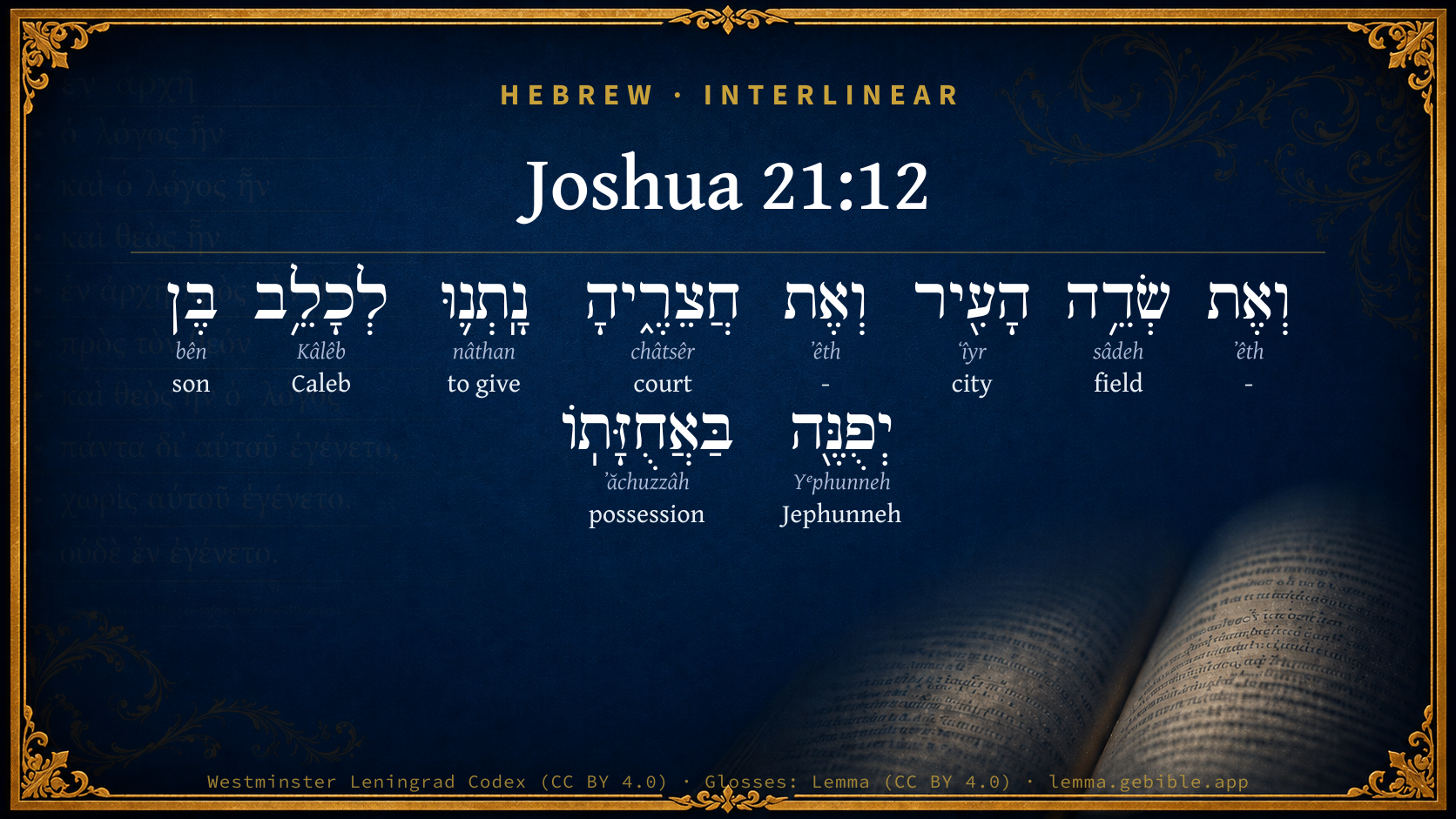
Hebrew (Westminster Leningrad Codex) Joshua 21:12 appears in the Hebrew Old Testament. The text above is from the Westminster Leningrad Codex. Each word links to its Strong’s number, a concise gloss, and parsing drawn from the Open Scriptures Hebrew Bible morphology. Click any word for its full Brown-Driver-Briggs (BDB) entry.
Download image
Cite this verse

Joshua 21:12 (World English Bible). Public Domain. Lemma interlinear Bible study tool, https://lemma.gebible.app/v/joshua/21/12.

Show BibTeX & RIS
BibTeX
RIS
English Translation
But the fields of the city, and the villages of it, gave they to Caleb the son of Jephunneh for his possession.
World English Bible · Public Domain
Download a study sheet

One document with this verse’s original text, its word-by-word gloss line, the meaning frame, cross-references with their text, attributed commentary, and full source and license credits — printable, and it pastes into notes with its structure intact.

This verse Autodidact and up

Study sheet (.html) Plain text (.txt)

A passage Seminary Student

Up to 50 verses in one chapter. A passage sheet keeps up to 6 commentary sources and 12 cross-references per verse, in the order this page ranks them, and says so on the sheet whenever that leaves anything out. Ask for a single verse and you get the Autodidact verse sheet above.

Everything on this page stays free to read, with no account — the sheet is a download of what is already on screen, not access to it.

Want to remove ads? Support Godless Engineer
Compare translations 3

The same verse in 3 English versions, stacked beneath the original-language interlinear above. Click any original word for its lexicon entry.

Each is an independent rendering of the whole verse — the interlinear is not word-aligned to these translations.

Highlighted words mark where these versions differ — a whole-verse word diff, not a word-by-word alignment.

  • World English Bible Public Domain
    But the fields of the city, and the villages of it, gave they to Caleb the son of Jephunneh for his possession.
  • King James Version Public Domain
    But the fields of the city, and the villages thereof, gave they to Caleb the son of Jephunneh for his possession.
  • unfoldingWord Literal Text CC BY-SA 4.0
    But the field of the city and its villages they had given to Caleb, the son of Jephunneh, as his possession.

unfoldingWord Literal Text — © unfoldingWord, licensed CC BY-SA 4.0. Word-aligned USFM3 via Door43 (git.door43.org/unfoldingWord/en_ult).

Versions to compare (up to 4)

3 of 4 selected

Show all 18 translations

Every available English version of this verse, each an independent rendering of the whole verse.

  • World English Bible Public Domain
    But the fields of the city, and the villages of it, gave they to Caleb the son of Jephunneh for his possession.
  • Berean Standard Bible Public Domain
    But they had given the fields and villages around the city to Caleb son of Jephunneh as his possession.
  • Majority Standard Bible Public Domain
    But they had given the fields and villages around the city to Caleb son of Jephunneh as his possession.
  • King James Version Public Domain
    But the fields of the city, and the villages thereof, gave they to Caleb the son of Jephunneh for his possession.
  • American Standard Version (1901) Public Domain
    But the fields of the city, and the villages thereof, gave they to Caleb the son of Jephunneh for his possession.
  • Revised Version (1885) Public Domain
    But the fields of the city, and the villages thereof, gave they to Caleb the son of Jephunneh for his possession.
  • Geneva Bible (1599) Public Domain
    (But the lande of the citie, and the villages thereof, gaue they to Caleb the sonne of Iephunneh to be his possession)
  • Douay-Rheims (1899) Public Domain
    But the fields and the villages thereof he had given to Caleb the son of Jephone for his possession.
  • Young's Literal Translation Public Domain
    and the field of the city and its villages they have given to Caleb son of Jephunneh for his possession.
  • Literal Standard Version CC BY-SA 4.0
    and they have given the field of the city and its villages to Caleb son of Jephunneh for his possession.
  • Unlocked Literal Bible CC BY-SA 4.0
    But the fields of the city, including their villages, were already given to Caleb son of Jephunneh, as his possession.
  • unfoldingWord Literal Text CC BY-SA 4.0
    But the field of the city and its villages they had given to Caleb, the son of Jephunneh, as his possession.
  • Darby Bible Public Domain
    But the fields of the city and the hamlets thereof gave they to Caleb the son of Jephunneh for his possession.
  • World Messianic Bible Public Domain
    But they gave the fields of the city and its villages to Caleb the son of Jephunneh for his possession.
  • Webster's Bible Public Domain
    But the fields of the city, and its villages, they gave to Caleb the son of Jephunneh for his possession.
  • Free Bible Version CC BY-SA 4.0
    But the more distant fields from the town and the villages had been given to Caleb son of Jephunneh to own.
  • Bible in Basic English Public Domain
    But the open country round the town, and its unwalled places, they gave to Caleb, the son of Jephunneh, as his property.
  • JPS Tanakh (1917) Public Domain
    But the fields of the city, and the villages thereof, gave they to Caleb the son of Jephunneh for his possession.

Literal Standard Version (2020), Covenant Press — licensed CC BY-SA 4.0. Text via the HelloAO Bible API (eBible.org). Unlocked Literal Bible (unfoldingWord) — licensed CC BY-SA 4.0. Text via the HelloAO Bible API (eBible.org). unfoldingWord Literal Text — © unfoldingWord, licensed CC BY-SA 4.0. Word-aligned USFM3 via Door43 (git.door43.org/unfoldingWord/en_ult). Free Bible Version, Dr. Jonathan Gallagher — licensed CC BY-SA 4.0. Text via the HelloAO Bible API (eBible.org).

Word by word

More ways to search: Search by grammar → Find every occurrence → Compare this word →

Practice this passage: Drill this verse → Learn its vocabulary →

יְפֻנֶּ֖ה
Yᵉphunneh
H3312
“Jephunneh”
Noun, Proper
Part of Speech
Noun
Type
Proper
Full BDB Definition

Origin: from H6437

TWOT: None

Jephunneh = "He will be facing" - a Kenezite and father of Caleb the spy from the tribe of Judah - son of Jether and descendant of Asher
  1. וְאֶת ʼêth H853 “and · -” Conjunction + Particle, Direct Object
  2. שְׂדֵ֥ה sâdeh H7704 “field of” Noun, Common, Masculine, Singular, Construct
  3. הָעִ֖יר ʻîyr H5892 “the · city” Particle, Definite Article + Noun, Common, Feminine, Singular, Absolute
  4. וְאֶת ʼêth H853 “and · -” Conjunction + Particle, Direct Object
  5. חֲצֵרֶ֑יהָ châtsêr H2691 “courts · her” Noun, Common, Both, Plural, Construct + Suffix, Personal, 3rd Person, Feminine, Singular
  6. נָֽתְנ֛וּ nâthan H5414 “to give” Verb, Qal, Perfect, 3rd Person, Common, Plural
  7. לְכָלֵ֥ב Kâlêb H3612 “to/for · Caleb” Preposition + Noun, Proper
  8. בֶּן bên H1121 “son of” Noun, Common, Masculine, Singular, Construct
  9. בַּאֲחֻזָּתֽוֹ ʼăchuzzâh H272 “in/at · possession · his” Preposition + Noun, Common, Feminine, Singular, Construct + Suffix, Personal, 3rd Person, Masculine, Singular

About this verse

These counts appear in no published source. They are computed here, from the morphology-tagged text and Lemma’s own curated glosses. What Lemma adds →

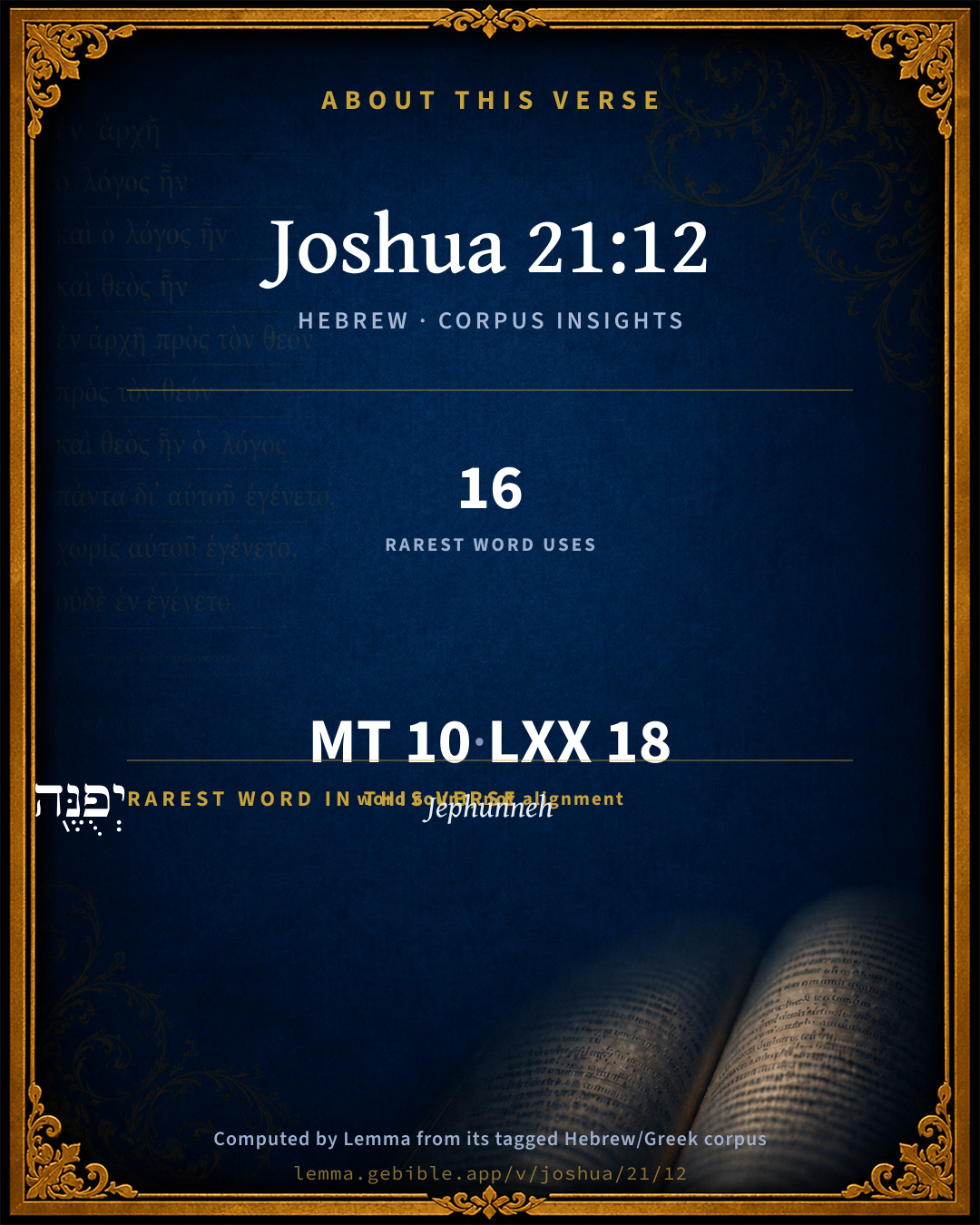
10
words
9
distinct lemmas
Historical
section

Notable vocabulary

The rarest word here is יְפֻנֶּ֖ה Jephunneh H3312 — appearing just 16 times in the whole Hebrew Bible.

Shared distinctive vocabulary

יְפֻנֶּ֖ה Jephunneh H3312 occurs in 16 verses of the Hebrew Bible. Also found in:

Grammatical profile

  • 1 verb
  • 7 nouns
  • 2 particles

Verb forms

  • נָֽתְנ֛וּ Qal · Perfect

Hebrew & Septuagint length

In English translation the verse runs 22 words from the Hebrew and 23 from the Septuagint (LXX English) — closely comparable.

A rough comparison of the two English renderings, which tokenize alike — not a word-level alignment.

Word counts can differ between the Hebrew and the Greek without any difference in meaning — e.g. the Hebrew direct-object marker אֵת has no separate Greek word, and Greek often adds the article ὁ.

In the original languages it is 10 Hebrew tokens and 18 Greek tokens — but the two are counted differently (Hebrew bundles its prefixes and suffixes into one token; the Greek is in lemma form), so that isn’t a like-for-like length.

Cross-references

2

Topical passages linked to Joshua 21:12 in the Treasury of Scripture Knowledge — connected by theme and wording, ordered by reader-vote popularity; previews shown in the World English Bible.

  • Joshua 14:13–15 Joshua blessed him; and he gave Hebron to Caleb the son of Jephunneh for an inheritance.
  • 1 Chronicles 6:55–57 to them they gave Hebron in the land of Judah, and the suburbs of it round about it;

Cross-references courtesy of OpenBible.info (CC BY 4.0).

Hebrew and Greek witnesses Masoretic Hebrew ↔ Greek Septuagint

The same verse in the two great witnesses to the Old Testament, shown verse-for-verse.

These are two independent witnesses, not word-aligned to each other, and the Septuagint is shown in lemma (dictionary) form.

Hebrew Joshua 21:12 Masoretic · Westminster Leningrad Codex

וְאֶת שְׂדֵ֥ה הָעִ֖יר וְאֶת חֲצֵרֶ֑יהָ נָֽתְנ֛וּ לְכָלֵ֥ב בֶּן יְפֻנֶּ֖ה בַּאֲחֻזָּתֽוֹ

But the fields of the city, and the villages of it, gave they to Caleb the son of Jephunneh for his possession.

World English Bible · Public Domain

Greek LXX Joshua 21:12 Septuagint · lemma form

καί ὁ ἀγρός ὁ πόλις καί ὁ κώμη αὐτός δίδωμι ἰησοῦς ὁ υἱός χαλεβ υἱός ιεφοννη ἐν κατάσχεσις

But the lands of the city, and its villages Joshua gave to the sons of Chaleb the son of Jephonne for a possession.

LXX2012 (modern English Septuagint) · Public Domain

Hebrew: Westminster Leningrad Codex (CC BY 4.0). Greek: Septuagint (public domain); English from LXX2012 (modern English Septuagint) (Public Domain). How the Septuagint differs from the Hebrew →

Targum (Aramaic paraphrase)

1

The Targum is the ancient Jewish Aramaic paraphrase of the Hebrew Scriptures — an interpretive translation, not the Hebrew text itself. Onkelos (literal) and Pseudo-Jonathan (expansive) render the Torah, and Jonathan the Prophets. Coverage is partial: where no permissively-licensed English translation exists for a verse, only the Aramaic is shown. This is verse-level text, not a word-by-word alignment to the Hebrew.

  1. Targum Jonathan Prophets (Joshua–Malachi)
    וְיַת חֲקַל קַרְתָּא וְיַת פַּצְחָהָא יְהָבוּ לְכָלֵב בַּר יְפֻנֶה בְּאַחְסַנְתֵּיהּ:

    (no public-domain English translation for this verse)

    Targum Jonathan — Aramaic: “Mikraot Gedolot” (public domain). English: “Sefaria Community Translation” (CC0 1.0 (public-domain dedication)); “London "Chaldee Paraphrase," 1871” (public domain). Text via Sefaria.

Commentary

Notes on Joshua 21:12 from classic Christian and Jewish commentators (each source and its license shown beneath its notes). The classic Christian expositions comment on the surrounding passage and are grouped to its opening verse, so a note may address several verses; the Jewish commentaries on the Tanakh (Rashi and others) are per-verse, so they appear only where the commentator wrote on this verse.

Lemma curates 59 commentaries, every one of them public domain or Creative Commons licensed, each selected and text-cleaned for this edition rather than reprinted as found. About our sources →

Trapp's Complete Commentary

John Trapp

Jos 21:12 But the fields of the city, and the villages thereof, gave they to Caleb the son of Jephunneh for his possession.

Ver. 12. Gave they to Caleb.] Who was glad, no doubt, of the Levites’ so near neighbourhood and good company, to instruct him and his in the law of the Lord, and to exhort them to obedience, which the best are too backward to, and may need monitors and remembrancers. {2Pe 1:12}

John Trapp, A Commentary or Exposition upon All the Books of the Old and New Testament (1647–1656) — public domain. Text from a community e-Sword module.

Joseph Benson's Commentary

Jos 21:12. The fields and villages — That is, all beyond the two thousand cubits expressed Num 35:5. This is here mentioned, not as his peculiar case, but as one eminent instance, to show that it was so in all the rest of the cities here named; that the fields and villages thereof still belonged to the several tribes from whom the cities and their suburbs were taken. It would make the rest of the Israelites more cheerfully resign part of their possessions to the Levites, considering that even Caleb did so, though his possession had been long before promised, and now actually given to him by God’s special command, as a mark of honour and compensation for his long and faithful service.

Joseph Benson's Commentary on the Old and New Testaments (1811–1818) — public domain. Text from a community e-Sword module.

Adam Clarke's Commentary

Verse 12. The fields of the city - gave they to Caleb] This was an exclusive privilege to him and his family, with which the grant to the Levites did not interfere. See Clarke on Jos 14:14.

Adam Clarke's Commentary on the Bible (1810–1826) — public domain. Text from a community e-Sword/MySword module.

The Cambridge Bible for Schools and Colleges

gen. ed. J. J. S. Perowne

12. But the fields of the city] of Hebron and its villages, i.e. the arable land had been already assigned to Caleb (see above ch. Jos_14:13). Whence we may conclude “that the Levites only received as many houses in the cities assigned them, as their numerical strength required, and that it was these which remained in their hands as an inalienable possession.” See Keil’s Commentary.

The Cambridge Bible for Schools and Colleges (gen. ed. J. J. S. Perowne; Cambridge University Press, 1878–1918) — public domain. Text from a community e-Sword module.

John Gill's Exposition

But the fields of the city, and the villages thereof,.... Which lay beyond the two thousand cubits:

gave they to Caleb the son of Jephunneh, for his possession; as Moses had promised, and Joshua had confirmed to him; and now the children of Israel gave them to him, and put him in the possession of, Jos 14:6; and the same is to be observed of all the other cities given to the Levites, that they and their suburbs, extending to such a distance only, were given to them; but the fields and villages, which belonged to them, continued the inheritance of the tribes in which they were.

John Gill's Exposition of the Whole Bible (1746–1763) — public domain (CC PDM 1.0). Text via the HelloAO Bible API.

Haydock's Catholic Bible Commentary

Possession. Only the houses which the priests occupied, were taken from him. (Calmet) --- Caleb enjoyed all the dependencies of Hebron, and took the city, as he would not have been secure while the Chanaanites dwelt there. (Magalian.) --- Serarius thinks that he abandoned the city to the priests, in which he follows Tostat, who supposes that they had to pay tribute to the tribes among whom they lived; and that mines, &c., belonged to the latter. (Menochius)

George Leo Haydock (1774–1849), Haydock's Catholic Family Bible and Commentary, 1859 edition — public domain. Excludes Psalms (Douay-Rheims chapter numbering differs from Protestant) and Deuterocanonical books (Catholic canon only).

Matthew Poole's English Annotations

The fields of the city, i.e. all beyond the 2000 cubits expressed Num 35:5. This is here mentioned, not as his peculiar case, but as one eminent instance, to show that it was so in all the rest of the cities here named; that the fields and villages thereof still belonged to the several tribes from whom the cities and their suburbs were taken; and to make the rest of the Israelites more contentedly and cheerfully resign so great a part of their possessions to the Levites, because even Caleb did so, though his possession had been long before promised, and now actually given to him by God’s special command, as a mark of honour and compensation for his long and faithful service.

Matthew Poole's English Annotations on the Holy Bible (1683–1685) — public domain. Text from a community e-Sword/MySword module.

The Pulpit Commentary

The fields. The original is in the singular. We are not necessarily, therefore, to suppose that the land was mapped out into divisions analogous to our fields. Our word "land" would more accurately represent the meaning of the original, which refers to the arable and pasture land in the neighbourhood of the city, with the agricultural villages or homesteads dotted about it. Keil contends that the Levites only received as many houses within the city as they needed, and that the rest belonged to Caleb. Bahr, moreover ("Symbolik," 2:49), supposed that the Levites dwelt with the other inhabitants of the city, and that the pasture land within the distance of 2, 000 paces from the city was reserved for them, the rest of the land belonging to the inhabitants of the tribe. (see note on Gezer, Jos_10:33) This seems the most probable explanation. The land in general was owned by the descendants of Caleb. But the Levites had certain pastures reserved for them, whither they drove their cattle. (see note on suburbs, Jos_14:4) The special information about Hebron here again is worthy of notice. It is copied by the author of 1 Chronicles in ch. 6.

The Pulpit Commentary (1880–1919), ed. H.D.M. Spence-Jones & Joseph S. Exell — public domain. Text from a community e-Sword module.

John Wesley's Explanatory Notes

The fields and villages - That is, all beyond the two thousand cubits expressed, Num. xxxv, 5. This is here mentioned, not as his peculiar case, but as one eminent instance, to shew, that it was so in all the rest of the cities here named; that the fields and villages thereof still belonged to the several tribes from whom the cities and their suburbs were taken; and to make the rest of the Israelites more cheerfully resign part of their possessions to the Levites, because even Caleb did so, though his possession had been long before promised, and now actually given to him by God's special command, as a mark of honour and compensation for his long and faithful service.

John Wesley, Explanatory Notes Upon the Whole Bible (1754–1765) — public domain. Text via the GEBible commentary corpus.

Lesson kit

Teaching starters — assembled from the data on this page, not authored interpretation. Every prompt links to the verse data it draws on. Edit before teaching.

Joshua, in the Historical, opens this verse with 10 words (9 distinct Hebrew lemmas). Its most distinctive word is Yᵉphunneh (“Jephunneh”). A historical commentator’s framing appears above. Read the whole chapter for the surrounding context.

Discussion questions

  1. The word Yᵉphunneh carries the sense “Jephunneh.” How does it shape the verse?
  2. Numbers 13:6 shares the word «Jephunneh» with this verse. How do the two illuminate each other?
  3. These translations render this verse differently. What is at stake in choosing one wording over another?
  4. The verb «נָֽתְנ֛וּ» is Qal Perfect. How does its form color the action?
  5. Reading how Trapp's Complete Commentary and Joseph Benson's Commentary read this verse, where do the two commentators agree and where do they part?

Things to notice

Reading settings

Reading text

Shown beneath each verse's original-language words.

Old Testament
Old Testament edition

Read the OT as the Masoretic Hebrew (MT) or the Greek Septuagint (LXX).

English shown for the Greek Septuagint (in the Hebrew ↔ Greek comparison).

Comparing translations? Open the Compare panel on any verse page to stack up to four side by side.