Ezekiel 17:5

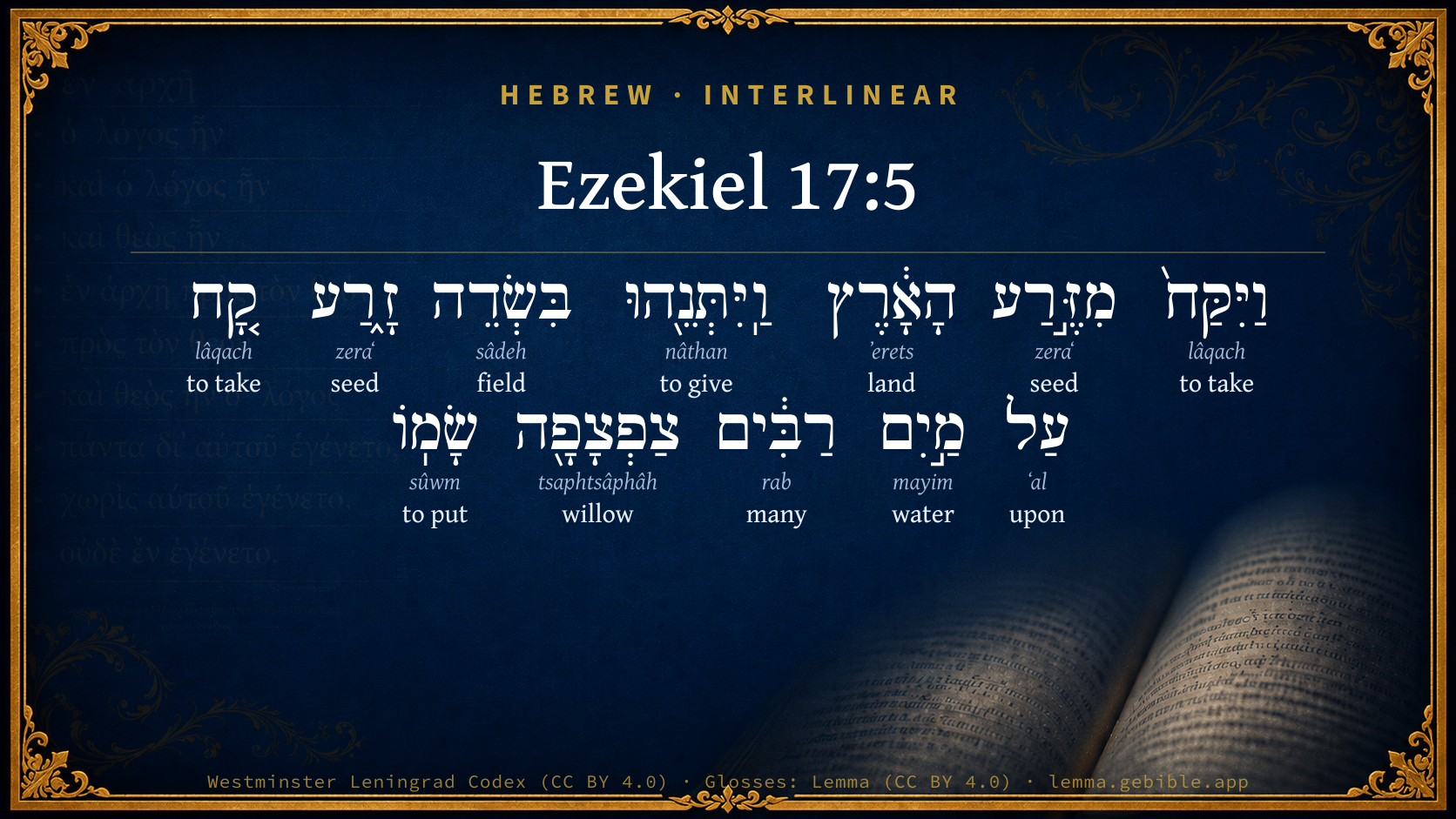
Hebrew (Westminster Leningrad Codex) Ezekiel 17:5 appears in the Hebrew Old Testament. The text above is from the Westminster Leningrad Codex. Each word links to its Strong’s number, a concise gloss, and parsing drawn from the Open Scriptures Hebrew Bible morphology. Click any word for its full Brown-Driver-Briggs (BDB) entry.
Download image
Cite this verse

Ezekiel 17:5 (World English Bible). Public Domain. Lemma interlinear Bible study tool, https://lemma.gebible.app/v/ezekiel/17/5.

Show BibTeX & RIS
BibTeX
RIS
English Translation
He took also of the seed of the land, and planted it in a fruitful soil; he placed it beside many waters; he set it as a willow tree.
World English Bible · Public Domain
Highlights
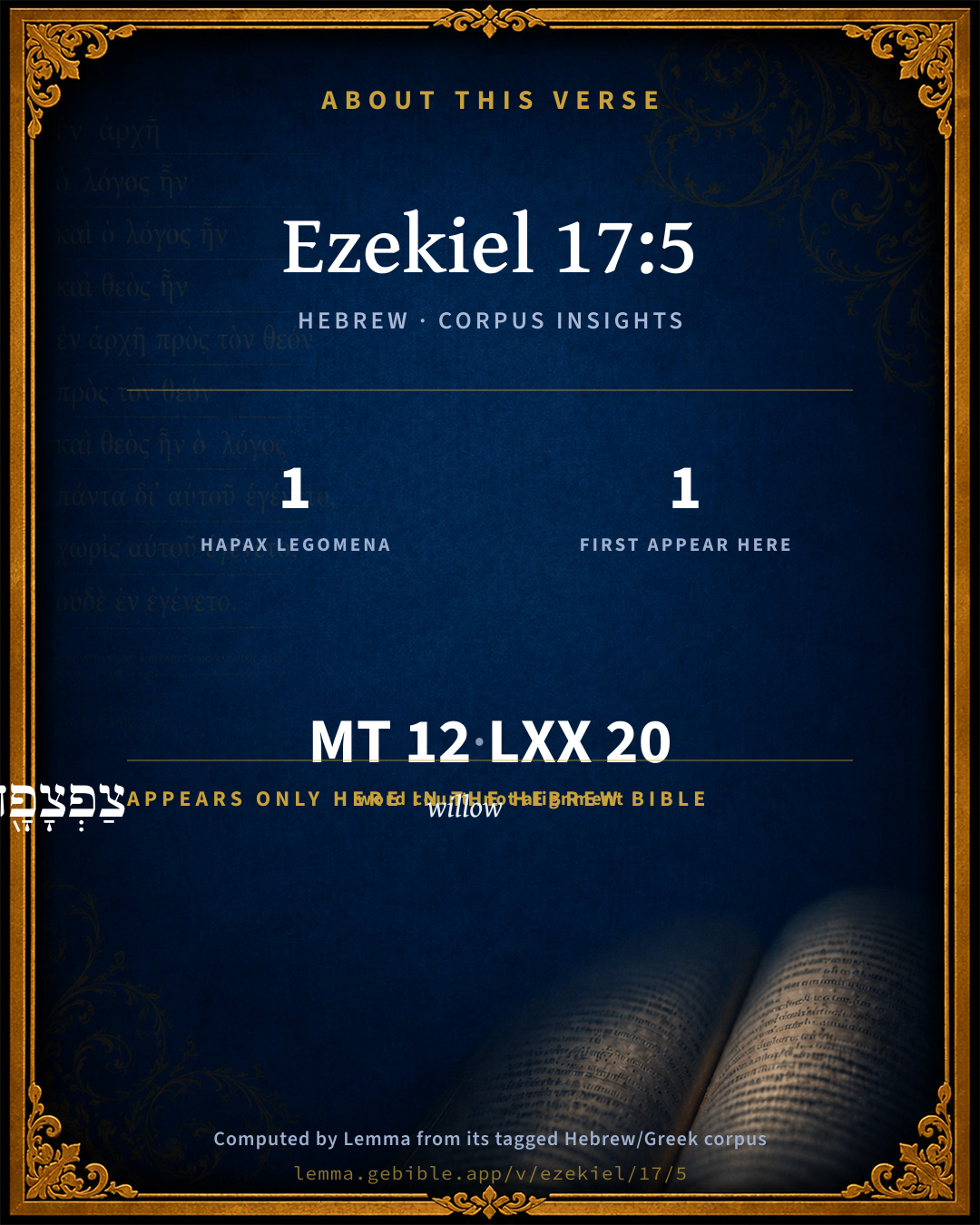
  • 1 hapax legomenon — only here in the Hebrew Bible
  • 1 first appearance in the Hebrew Bible
Full analysis ↓
Download a study sheet

One document with this verse’s original text, its word-by-word gloss line, the meaning frame, cross-references with their text, attributed commentary, and full source and license credits — printable, and it pastes into notes with its structure intact.

This verse Autodidact and up

Study sheet (.html) Plain text (.txt)

A passage Seminary Student

Up to 50 verses in one chapter. A passage sheet keeps up to 6 commentary sources and 12 cross-references per verse, in the order this page ranks them, and says so on the sheet whenever that leaves anything out. Ask for a single verse and you get the Autodidact verse sheet above.

Everything on this page stays free to read, with no account — the sheet is a download of what is already on screen, not access to it.

Want to remove ads? Support Godless Engineer
Compare translations 3

The same verse in 3 English versions, stacked beneath the original-language interlinear above. Click any original word for its lexicon entry.

Each is an independent rendering of the whole verse — the interlinear is not word-aligned to these translations.

Highlighted words mark where these versions differ — a whole-verse word diff, not a word-by-word alignment.

  • World English Bible Public Domain
    He took also of the seed of the land, and planted it in a fruitful soil; he placed it beside many waters; he set it as a willow tree.
  • King James Version Public Domain
    He took also of the seed of the land, and planted it in a fruitful field; he placed it by great waters, and set it as a willow tree.
  • unfoldingWord Literal Text CC BY-SA 4.0
    He also took some seed of the land and planted it in fertile soil. He placed it beside a large body of water like a willow.

unfoldingWord Literal Text — © unfoldingWord, licensed CC BY-SA 4.0. Word-aligned USFM3 via Door43 (git.door43.org/unfoldingWord/en_ult).

Versions to compare (up to 4)

3 of 4 selected

Show all 18 translations

Every available English version of this verse, each an independent rendering of the whole verse.

  • World English Bible Public Domain
    He took also of the seed of the land, and planted it in a fruitful soil; he placed it beside many waters; he set it as a willow tree.
  • Berean Standard Bible Public Domain
    He took some of the seed of the land and planted it in fertile soil; he placed it by abundant waters and set it out like a willow.
  • Majority Standard Bible Public Domain
    He took some of the seed of the land and planted it in fertile soil; he placed it by abundant waters and set it out like a willow.
  • King James Version Public Domain
    He took also of the seed of the land, and planted it in a fruitful field; he placed it by great waters, and set it as a willow tree.
  • American Standard Version (1901) Public Domain
    He took also of the seed of the land, and planted it in a fruitful soil; he placed it beside many waters; he set it as a willow-tree.
  • Revised Version (1885) Public Domain
    He took also of the seed of the land, and planted it in a fruitful soil; he placed it beside many waters; he set it as a willow tree.
  • Geneva Bible (1599) Public Domain
    Hee tooke also of the seede of the lande, and planted it in a fruitfull ground: hee placed it by great waters, and set it as a willowe tree.
  • Douay-Rheims (1899) Public Domain
    And he took of the seed of the land, and put it in the ground for seed, that it might take a firm root over many waters: he planted it on the surface of the earth.
  • Young's Literal Translation Public Domain
    And it taketh of the seed of the land, And doth put it in a field of seed, To take by many waters, In a conspicuous place it hath set it.
  • Literal Standard Version CC BY-SA 4.0
    And he takes of the seed of the land, || And puts it in a field of seed, || He took [it] by many waters, || He has set it in a conspicuous place.
  • Unlocked Literal Bible CC BY-SA 4.0
    He also took some seed of the land and planted it in fertile soil. He placed it beside a large body of water like a willow.
  • unfoldingWord Literal Text CC BY-SA 4.0
    He also took some seed of the land and planted it in fertile soil. He placed it beside a large body of water like a willow.
  • Darby Bible Public Domain
    And he took of the seed of the land, and planted it in a fruitful field; he placed it by great waters, he set it as a willow tree.
  • World Messianic Bible Public Domain
    “‘“He also took some of the seed of the land and planted it in fruitful soil. He placed it beside many waters. He set it as a willow tree.
  • Webster's Bible Public Domain
    He took also of the seed of the land, and planted it in a fruitful field; he placed it by great waters, and set it as a willow tree.
  • Free Bible Version CC BY-SA 4.0
    He took some of the seed of the land and planted it in good soil beside a large river where he could grow it like a willow.
  • Bible in Basic English Public Domain
    And he took some of the seed of the land, planting it in fertile earth, placing it by great waters; he put it in like a willow-tree.
  • JPS Tanakh (1917) Public Domain
    He took also of the seed of the land, and planted it in a fruitful soil; he placed it beside many waters, he set it as a slip.

Literal Standard Version (2020), Covenant Press — licensed CC BY-SA 4.0. Text via the HelloAO Bible API (eBible.org). Unlocked Literal Bible (unfoldingWord) — licensed CC BY-SA 4.0. Text via the HelloAO Bible API (eBible.org). unfoldingWord Literal Text — © unfoldingWord, licensed CC BY-SA 4.0. Word-aligned USFM3 via Door43 (git.door43.org/unfoldingWord/en_ult). Free Bible Version, Dr. Jonathan Gallagher — licensed CC BY-SA 4.0. Text via the HelloAO Bible API (eBible.org).

Word by word

More ways to search: Search by grammar → Find every occurrence → Compare this word →

Practice this passage: Drill this verse → Learn its vocabulary →

צַפְצָפָ֖ה
tsaphtsâphâh
H6851
“willow”
Noun, Common, Feminine, Singular, Absolute
Part of Speech
Noun
Type
Common
Gender
Feminine
Number
Singular
State
Absolute
Full BDB Definition

Origin: from H6687

TWOT: 1957a

a kind of willow, willow tree
  1. וַיִּקַּח֙ lâqach H3947 “and · to take” Conjunction + Verb, Qal, Sequential Imperfect, 3rd Person, Masculine, Singular
  2. מִזֶּ֣רַע zeraʻ H2233 “from · seed of” Preposition + Noun, Common, Masculine, Singular, Construct
  3. הָאָ֔רֶץ ʼerets H776 “the · land” Particle, Definite Article + Noun, Common, Both, Singular, Absolute
  4. וַֽיִּתְּנֵ֖הוּ nâthan H5414 “and · to give · him” Conjunction + Verb, Qal, Sequential Imperfect, 3rd Person, Masculine, Singular + Suffix, Personal, 3rd Person, Masculine, Singular
  5. בִּשְׂדֵה sâdeh H7704 “in/at · field of” Preposition + Noun, Common, Masculine, Singular, Construct
  6. זָ֑רַע zeraʻ H2233 “seed” Noun, Common, Masculine, Singular, Absolute
  7. קָ֚ח lâqach H3947 “to take” Noun, Common, Masculine, Singular, Absolute
  8. עַל ʻal H5921 “upon” Preposition
  9. מַ֣יִם mayim H4325 “water(s)” Noun, Common, Masculine, Plural, Absolute
  10. רַבִּ֔ים rab H7227 “many” Adjective, Adjective, Masculine, Plural, Absolute
  11. שָׂמֽוֹ sûwm H7760 “to put · him” Verb, Qal, Perfect, 3rd Person, Masculine, Singular + Suffix, Personal, 3rd Person, Masculine, Singular

About this verse

These counts appear in no published source. They are computed here, from the morphology-tagged text and Lemma’s own curated glosses. What Lemma adds →

12
words
10
distinct lemmas
Prophets
section

Notable vocabulary

1 hapax legomenon — a word that appears only here in the entire Hebrew Bible:

  • צַפְצָפָ֖ה willow H6851

First appearance in Scripture

This word makes its first canonical appearance in the Hebrew Bible here:

  • צַפְצָפָ֖ה willow H6851

Grammatical profile

  • 3 verbs
  • 7 nouns
  • 1 adjective
  • 1 preposition

Verb forms

  • וַיִּקַּח֙ Qal · Sequential Imperfect
  • וַֽיִּתְּנֵ֖הוּ Qal · Sequential Imperfect
  • שָׂמֽוֹ Qal · Perfect

Repetition

Words recur within this verse — often emphatic in Hebrew:

  • וַיִּקַּח֙ to take H3947 ×2
  • מִזֶּ֣רַע seed H2233 ×2

Hebrew & Septuagint length

In English translation the verse runs 29 words from the Hebrew and 26 from the Septuagint (LXX English) — closely comparable.

A rough comparison of the two English renderings, which tokenize alike — not a word-level alignment.

Word counts can differ between the Hebrew and the Greek without any difference in meaning — e.g. the Hebrew direct-object marker אֵת has no separate Greek word, and Greek often adds the article ὁ.

In the original languages it is 12 Hebrew tokens and 20 Greek tokens — but the two are counted differently (Hebrew bundles its prefixes and suffixes into one token; the Greek is in lemma form), so that isn’t a like-for-like length.

Cross-references

7

Topical passages linked to Ezekiel 17:5 in the Treasury of Scripture Knowledge — connected by theme and wording, ordered by reader-vote popularity; previews shown in the World English Bible.

  • Deuteronomy 8:7–9 For Yahweh your God brings you into a good land, a land of brooks of water, of springs and springs, flowing forth in valleys and hills;
  • Isaiah 44:4 and they shall spring up among the grass, as willows by the watercourses.
  • 2 Kings 24:17 The king of Babylon made Mattaniah, [Jehoiachin's] father's brother, king is his place, and changed his name to Zedekiah.
  • Isaiah 15:7 Therefore the abundance they have gotten, and that which they have laid up, shall they carry away over the brook of the willows.
  • Jeremiah 37:1 Zedekiah the son of Josiah reigned as king, instead of Coniah the son of Jehoiakim, whom Nebuchadrezzar king of Babylon made king in the land of Judah.
  • Ezekiel 17:13 and he took of the seed royal, and made a covenant with him; he also brought him under an oath, and took away the mighty of the land;
  • Ezekiel 19:11–12 It had strong rods for the scepters of those who bore rule, and their stature was exalted among the thick boughs, and they were seen in their height with the multitude of their branches.

Cross-references courtesy of OpenBible.info (CC BY 4.0).

Hebrew and Greek witnesses Masoretic Hebrew ↔ Greek Septuagint

The same verse in the two great witnesses to the Old Testament, shown verse-for-verse.

These are two independent witnesses, not word-aligned to each other, and the Septuagint is shown in lemma (dictionary) form.

Hebrew Ezekiel 17:5 Masoretic · Westminster Leningrad Codex

וַיִּקַּח֙ מִזֶּ֣רַע הָאָ֔רֶץ וַֽיִּתְּנֵ֖הוּ בִּשְׂדֵה זָ֑רַע קָ֚ח עַל מַ֣יִם רַבִּ֔ים צַפְצָפָ֖ה שָׂמֽוֹ

He took also of the seed of the land, and planted it in a fruitful soil; he placed it beside many waters; he set it as a willow tree.

World English Bible · Public Domain

Greek LXX Ezekiel 17:5 Septuagint · lemma form

καί λαμβάνω ἀπό ὁ σπέρμα ὁ γῆ καί δίδωμι αὐτός εἰς ὁ πεδίον φυτόν ἐπί ὕδωρ πολύς ἐπιβλέπω τάσσω αὐτός

And he took of the seed of the land, and sowed it in a field planted by much water; he set it in a conspicuous place.

LXX2012 (modern English Septuagint) · Public Domain

On this verse, The Cambridge Bible for Schools and Colleges discusses the Septuagint’s reading. Read the note in Commentary ↓

Hebrew: Westminster Leningrad Codex (CC BY 4.0). Greek: Septuagint (public domain); English from LXX2012 (modern English Septuagint) (Public Domain). How the Septuagint differs from the Hebrew →

Targum (Aramaic paraphrase)

1

The Targum is the ancient Jewish Aramaic paraphrase of the Hebrew Scriptures — an interpretive translation, not the Hebrew text itself. Onkelos (literal) and Pseudo-Jonathan (expansive) render the Torah, and Jonathan the Prophets. Coverage is partial: where no permissively-licensed English translation exists for a verse, only the Aramaic is shown. This is verse-level text, not a word-by-word alignment to the Hebrew.

  1. Targum Jonathan Prophets (Joshua–Malachi)
    וּנְסִיב מִזַרְעָא דְאַרְעָא וְיַהֲבֵיהּ בַּחֲקַל טַב לְמִזְרַע נִצְבַהּ עַל מַיִין סַגִיאִין גְפַּן נִצְבָא שַׁוְיֵיהּ:

    (no public-domain English translation for this verse)

    Targum Jonathan — Aramaic: “Mikraot Gedolot” (public domain). English: “Sefaria Community Translation” (CC0 1.0 (public-domain dedication)); “London "Chaldee Paraphrase," 1871” (public domain). Text via Sefaria.

Commentary

Notes on Ezekiel 17:5 from classic Christian and Jewish commentators (each source and its license shown beneath its notes). The classic Christian expositions comment on the surrounding passage and are grouped to its opening verse, so a note may address several verses; the Jewish commentaries on the Tanakh (Rashi and others) are per-verse, so they appear only where the commentator wrote on this verse.

Lemma curates 59 commentaries, every one of them public domain or Creative Commons licensed, each selected and text-cleaned for this edition rather than reprinted as found. About our sources →

Trapp's Complete Commentary

John Trapp

Eze 17:5 He took also of the seed of the land, and planted it in a fruitful field; he placed [it] by great waters, [and] set it [as] a willow tree.

Ver. 5. He took also of the seed of the land.] No foreigner, but one of their own country, and of the blood royal too - viz., Zedekiah. This was a great mercy; as that most spitefully done of Attilus, king of Suecia, to make a dog king of the Danes; as did likewise Gunno, king of the Danes, make a dog king of Norway, appointing counsellors to do all things under his title and name.

And planted it in a fruitful field,] i.e., In Judea, that good land - as Rabahakeh also yieldeth it to have been, whatever Strabo saith to the contrary - where Zedekiah might have lived bravely and reigned prosperously, could he but have been content with his condition:

“ At Paris ut vivat regnetque beatus,

Cogi posse negat. ” - Horat., Epist. ii.

He placed it by great waters, and set it as a willow tree.] A well contented person grows up prosperously, as the willows by the water courses.

John Trapp, A Commentary or Exposition upon All the Books of the Old and New Testament (1647–1656) — public domain. Text from a community e-Sword module.

Geneva Bible (1599)

Geneva Bible translators

That is, Zedekiah, who was of the King’s blood and was left at Jerusalem, and made King instead of Jeconiah, 2 Kings 24:17; Jer. 37:1.

Geneva Bible (1599) marginal notes — public domain. Text via Bolls.life.

Jamieson, Fausset & Brown

Robert Jamieson, A. R. Fausset & David Brown

seed of the land--not a foreign production, but one native in the region; a son of the soil, not a foreigner: Zedekiah, uncle of Jehoiachin, of David's family.

in a fruitful field--literally, a "field of seed"; that is, fit for propagating and continuing the seed of the royal family.

as a willow--derived from a Hebrew root, "to overflow," from its fondness for water (Isa 44:4). Judea was "a land of brooks of water and fountains" (Deu 8:7-9; compare Joh 3:23).

Jamieson, Fausset & Brown — Commentary Critical and Explanatory on the Whole Bible (1871) — public domain (CC PDM 1.0). Text via the HelloAO Bible API.

Adam Clarke's Commentary

Verse 5. The seed of the land] Zedekiah, brother of Jehoiachin.

Planted it in a fruitful field] Made him king of Judea in place of his brother.

Placed it by great waters] Put him under the protection of Babylon, situated on the confluence of the Tigris and Euphrates.

And set it as a willow tree] Made him dependent on this city of great waters, as the willow is on humidity.

Adam Clarke's Commentary on the Bible (1810–1826) — public domain. Text from a community e-Sword/MySword module.

John Calvin's Commentaries

After Ezekiel has narrated that Jehoiacin was carried away with his counselors and the flower of the whole people, and was so deprived of his native country as to be without hope of return, he now says, that the eagle took up the seed in Judea, and placed it in a fertile land; for he calls it a land of seed, since it was cultivated and produced fruit abundantly. He says, that the seed was afterwards hidden in the soil, that it grew immediately, and became a luxuriant vine. He says also, that its roots were irrigated, like a willow planted by a river’s bed. The Prophet afterwards explains himself: hence it is sufficient to state briefly what he means. The seed, then, which he here means is Zedekiah, the last king. It is said to have been planted beside the waters; for his condition was tolerable, since the royal name and dignity and wealth was left to him. For although he was tributary, the kindness with which he was treated by Nebuchadnezzar was not to be despised, since, by the right of war, he was able to lead him captive. together with his nephew; for Zedekiah was the uncle of Jeconiah or Jehoiacin. But he said, that this vine, which sprang from a seed or germ, grew so that it was of low stature; the Prophet means by these words, as we shall afterwards see, that Zedekiah was not a king, that he was restrained by a bridle from daring to rebel against the king of Babylon; and hence it is added, that its branches turned towards the eagle, and its roots were under him; but in the next clause Ezekiel announces, that it became a vine which set forth branches, and shot forth boughs, which he repeats again, that Zedekiah’s ingratitude may appear the greater, who, not content with his moderate confinement, perfidiously revolted from the king of Babylon, through reliance on the new treaty, on which we touched yesterday. It now follows —

John Calvin's Commentaries (1540-1563) — public domain. Text from the Calvin Translation Society English edition (1840s-50s) via the Christian Classics Ethereal Library (ccel.org). Calvin's coverage is partial (roughly two-thirds of the Bible); uncommented books and verses are honest gaps, never fabricated. The 19th-century editor's footnotes and remarks are omitted so the notes are faithfully Calvin's own voice.

Ellicott's Commentary for English Readers

(5) Of the seed of the land.—In place of the captive Jehoiachin Nebuchadnezzar did not set over the land an eastern satrap, but appointed a native prince, Zedekiah, the uncle of Jehoiachin. He was “planted,” not like the tall cedar on the mountain, but yet like “a willow tree by great waters” where it might flourish in its degree (see Eze_17:14).

A Bible Commentary for English Readers, edited by Charles John Ellicott (1878–1897) — public domain. Text from a community e-Sword module.

The Cambridge Bible for Schools and Colleges

gen. ed. J. J. S. Perowne

5. Nebuchadnezzar then took Mattaniah, son of Josiah, and made him king under the name of Zedekiah. The “seed of the land” is the native royal house.

he placed it] The unknown form so rendered might be a verb, cf. Hos_11:3. LXX. omits; Ew. conjectures slip, or cutting. The comparison to the willow (the sense is not certain, the word not occurring again) is suggested by the place where it was planted, beside great waters. “Water” is the requisite of every tree in the East, and “great waters” are the favourable conditions granted to Zedekiah. “They that drink water” is a name for trees, ch. Eze_31:16.

The Cambridge Bible for Schools and Colleges (gen. ed. J. J. S. Perowne; Cambridge University Press, 1878–1918) — public domain. Text from a community e-Sword module.

John Gill's Exposition

And it grew,.... King Zedekiah reigned and prospered, and the kingdom flourished under him:

and became a spreading vine of low stature; not so flourishing as it had been heretofore, in former reigns; it did not rise up to a cedar, as it had been, but was like a vine, which, though flourishing, does not rise up high, but runs upon the ground, and is dependent on something else; so the king and kingdom of Judah, though in tolerable circumstances, yet were humble and dependent on the king of Babylon:

whose branches turned towards him; the eagle, Nebuchadnezzar, to whom the people of the Jews were tributary:

and the roots thereof were under him; they were rooted and settled in their own land, yet under the power, and at the dispose, of the Babylonish monarch:

so it became a vine; a flourishing kingdom in some measure, though attended with some degree of weakness and dependence as a vine:

and brought forth branches, and shot forth sprigs; increased in people and in riches; particularly the king had many children, so that there was a prospect of a succession, and of a more flourishing estate, and a continuance of it, Jer 52:10.

John Gill's Exposition of the Whole Bible (1746–1763) — public domain (CC PDM 1.0). Text via the HelloAO Bible API.

Albert Barnes' Notes on the Bible

He took also of the seed of the land - Zedekiah the king’s uncle, not a Babylonian satrap, was made king.

Albert Barnes' Notes on the Bible (1834–1885) — public domain. Text from a community e-Sword/MySword module.

Haydock's Catholic Bible Commentary

Land. Sedecias, whom he made king. (Challoner) --- He was brother of the dethroned king, and have every prospect of reigning long, if he had proved faithful. (Calmet)

George Leo Haydock (1774–1849), Haydock's Catholic Family Bible and Commentary, 1859 edition — public domain. Excludes Psalms (Douay-Rheims chapter numbering differs from Protestant) and Deuterocanonical books (Catholic canon only).

Matthew Poole's English Annotations

Took; chose out one to be king instead of Jehoiachin.

Of the seed of the land; a native, and, which is more, one of the royal family, Mattaniah, whom he called Zedekiah.

Planted it; settled him on the throne of Judah.

A fruitful field; a field fit for such a design, in the land of Judea. The prophet goeth on in his allusion, and explains what he meant, compares this new-made king to a willow, which grows no where so well as in a wet soil, and on banks of great waters.

Matthew Poole's English Annotations on the Holy Bible (1683–1685) — public domain. Text from a community e-Sword/MySword module.

Whedon's Commentary on the Bible

Daniel D. Whedon

5. He took also of the seed of the land, and planted it — It was Nebuchadnezzar who placed Zedekiah upon the throne (2Ch_36:10; 2Ki_24:17; Jer_35:11). The “fruitful field” and “great waters” indicate the beauty and comfort of his Palestinian kingdom (Deu_8:7-9; Deu_11:10-12), while the “as a willow” represents the possibility of its rapid and luxuriant development (Isa_44:4). The cedar sprout was not, as so many expositors seem to think, transformed into a willow tree or grapevine, but it was set close to great waters, as is a willow tree, and took the form of a vine rather than a tree.

Daniel D. Whedon (gen. ed.), Commentary on the Old and New Testaments (1874–1909) — public domain. Text from a community e-Sword module.

The Pulpit Commentary

The seed of the land is Zedekiah, who was made king by Nebuchadnezzar in Jeconiah"s place. The imagery of the willow (the Hebrew word occurs here only) seems suggested by Ezekiel"s surroundings. No tree could stand out in greater contrast to the cedar of Lebanon than the willows which he saw growing by the waters of Babylon. (Psa_137:2, though the word is different) The choice of the willow determined the rest of the imagery, and the fruitful field and the great or "many" (Revised Version) waters represent Judah, possibly with reference to its being in its measure a "land of brooks of waters," of "fountains and depths," of "wheat and barley and wine". (Deu_8:7-9 Deu_11:10-12) The kingdom of Zedekiah, i.e., was left with sufficient elements for material prosperity. That prosperity is indicated in ver. 6 by the fact that the willow became a vine. It was of "low stature," indeed, trailing on the ground. It could not claim the greatness of an independent kingdom. Its branches turned toward the planter (ver. 6); its roots were under him. It acknowledged, that is, Nebuchadnezzar"s suzerainty, and so, had things continued as they were, it might have prospered.

Vers. 5, 6. Prosperity in adversity.

In figurative language Ezekiel describes the position of the remnant permitted by the monarch of Babylon to remain in the land of their fathers, and to pursue their industries in peace under their own rulers, enjoying the protection of the Eastern power. The lowly vine is suffered by the mighty eagle to take root in the soil, to spread, and to bear fruit, unmolested and in a measure prosperous. The prophet is aware of the foolish and treacherous conduct of his countrymen, who, instead of accepting and acquiescing in their lot, are intriguing with. the neighbouring state on the south, hoping that Egypt may come to their aid and deliver them from subjection to Babylon. A more false and foolish policy the helpless remnant could not have adopted; and it was a policy Jehovah, the King of nations, Hid not suffer to be successful. Even in their political adversity it was open to them to enjoy some measure of peace and prosperity. Their plotting was against their own interests, their own well being.

I A NATION"S HUMILIATION IS PERMITTED BY DIVINE PROVIDENCE. God raiseth up one, and setteth down another. It is a foolish and superficial view of political affairs which they take who attribute the rise and fall of nations to chance and accident. The Lord reigneth. There is wisdom and righteousness in his government of the world.

II NATIONAL HUMILIATION SHOULD BE REGARDED AS A PROBATION AND A DISCIPLINE FOR BRIGHTER DAYS. They who see the hand of God in what happens to them will not be slow to believe that there is a purpose in human experience, and that this principle applies to communities as well as to individuals. There are lessons to be learnt in adversity which prosperity cannot teach. Schooled in the "waste, howling wilderness," Israel was made strong to enter and to possess the land of promise. The same principle has operated in the history of our own and of ether nations.

III THE RELATIVE PROSPERITY WHICH IS POSSIBLE EVEN IN HUMILIATION MAY BE CHECKED AND DESTROYED BY SELFISHNESS AND TREACHERY. It was the policy of the remnant patiently to wait for better times; and it was their duty to observe the covenant into which they had entered with Babylon. The discontented vine which sought other patronage was to be plucked up and to wither. Increase of prosperity should not be sought by unlawful and forbidden means.

IV SUBMISSION AND PATIENT IMPROVEMENT OF ADVANTAGES MAY BE THE MEANS OF NATIONAL GOOD. The subject sons of Abraham might not be eminent and majestic as the cedar of Lebanon. But they might he as the fruitful vine, planted in a well placed and well guarded vineyard, which bears abundance of fruit, and does not enjoy its advantages and opportunities in vain. T.

Vers. 5-10. Discontent and its disastrous development.

took also of the seed of the land, and planted it in a fruitful field," etc. Explain the parable as far as is necessary to make application of the text clear.

I THE CONDITION ALLOTTED TO US IN THE DIVINE PROVIDENCE IS GOOD FOR US, AND USUALLY AFFORDS SCOPE FOR PROGRESS. "He took also of the seed of the land, and planted it in a fruitful field," etc. (vers. 5, 8). Zedekiah King of Judah is meant by "the seed of the land." He was set upon the throne by Nebuchadnezzar King of Babylon, and took an oath of fealty to him. In so doing Nebuchadnezzar was the unconscious agent of Divine providence. And the condition in which Zedekiah was placed was a good one, and favourable to progress. But is there forevery one a condition allotted by God? Has he appointed the station and place even of the obscure and feeble? We argue that such is the case, because:

1. The providence of God is universal, including in its vast operations thegreat and the small, the high and the low. Every person and every event is comprehended in the great plan of the Supreme Ruler; Without a plan such as this his providential government could not possibly succeed. And it is both unscriptural and unphilosophical to look upon that government as dealing only with great things. It is unscriptural, as we see from Mat_6:26-30 Mat_10:29-31. And it is unphilosophical. "Must not the smallest links be as necessary for maintaining the continuity as the greatest? Great and little belong to our littleness; but there is no great and little to God.

2. The sacred Scriptures reveal the care of God forevery person not only for the great and noble, but for the obscure and lowly. He distributes to some men one talent, to others five; and he looks for the right employment of the one as well as of the five. In fact, the Most High manifests special interest in the weak and the poor and the unregarded. (cf. 1Co_1:26-29; Jam_2:5)

3. This truth is confirmed by the material creation of God. That creation isone grand whole, to the completeness of which every portion is essential. The system of the universe is, "in fact, so perfect," says Bushnell, "that the loss or displacement of any member would fatally derange the general order. If there were any smallest star in heaven that had no place to fill, that oversight would beget a disturbance which no Leverrier could compute; because it would be a real and eternal, and not merely casual or apparent disorder. One grain more or less of sand would disturb or even fatally disorder the whole scheme of the heavenly motions. So nicely balanced, and so carefully hung, are the worlds, that even the grains of their dust are counted, and their places adjusted to a corresponding nicety. There is nothing included in the gross, or total sum, that could be dispensed with. The same is true in regard to forces that are apparently irregular. Every particle of air is moved by laws of as great precision as the laws of the heavenly bodies, or, indeed, by the same laws; keeping its appointed place, and serving its appointed use....What now shall we say of man? Noblest of all creatures, and closest to God, as he certainly is, are we to say that his Creator has no definite thoughts concerning him, no place prepared for him to fill, no use for him to serve, which is the reason of his existence?" For these reasons we conclude that God has allotted a place and duty for each of us; and that place is best for us. It is that which infinite wisdom and kindness have appointed; and is therefore best suited to the end which God designs in us and for us. And our condition usually, like that of Zedekiah, admits of progress. From the smallest hamlet there is a way to the great metropolis. And the obscurest and meanest lot affords scope for fidelity and diligence and advancement.

II MAN IS PRONE NOW TO BE CONTENT WITH THE POSITION ALLOTTED TO HIM BY DIVINE PROVIDENCE. Zedekiah was not content. The kingdom had actually made some progress under him. "It grew, and became a spreading vine of low stature," etc. (ver. 6). Further progress was possible to him. At the very least, "he might have kept the fragments of the kingdom of Judah together, and maintained for some generations longer the worship of Jehovah." But he and the princes of his court were not content with this. Judah had formerly been an independent and prosperous and powerful kingdom: why should it now be subject to Babylon? Why should they not discover or devise means for recovering their national independence? Thus we are apt to fail as regards contentment. We look at the bright side of our neighbour"s lot in life, and at the dark side of our own, and become dissatisfied and restless. We long for the gifts, the advantages, and the circumstances of others, and in so doing we depreciate the good which we actually possess. We crave freedom from some hindrance or infirmity; we are eager for larger prosperity or speedier progress; we chafe under our restraints, and are impatient for the realization of our wishes, and are heartily discontented with our present circumstances and condition. But, it may be asked, is man to sink into ignoble content, never wishing to increase his attainments, to advance in his character, or to improve his circumstances? Certainly not. Such a state of mind can hardly be called contentment. It is more akin to indolence and slothtfulness; and it leads to stagnation and ruin. The true contentment of man is the contentment of a being created for progress. But such progress should not be based upon discontent with our present condition, and unfaithfulness in our present duties. That man only is fit for a greater position who makes the best use of his present position. "A man proves himself fit to go higher who shows that he is faithful where he is. A man that will not do well in his present place, because he longs to be higher, is fit neither to be where he is nor yet above it; he is already too high, and should be put lower." "Hence it was," as Bushnell says, "that an apostle required his converts to abide each one in that calling wherein he was called; to fill his place till he opens a way, by filling it, to some other; the bondman to fill his house of bondage with love and duty, the labourer to labour, the woman to be a woman, the men to show themselves men, all to acknowledge God"s hand in their lot, and seek to cooperate with that good design which he most assuredly cherishes for them.

III WHEN MAN IS NOT CONTENT WITH THE CONDITION ALLOTTED TO HIM BY DIVINE PROVIDENCE, HE IS PRONE TO USE UNLAWFUL MEASURES TO ALTER THAT CONDITION. Thus did Zedekiah in seeking an alliance with Egypt. "There was also another great eagle with great wings and many feathers," etc. (ver. 7). He had solemnly sworn fealty to Nebuchadnezzar for himself and the people under him. If there was anything in his circumstances or condition which he wished to be altered, he should have applied to Nebuchadnezzar, not to Pharaoh. Yet in his discontent, and incited by his princes, he sought an alliance with the King of Egypt, violated the sacred oath which he had sworn unto the King of Babylon, and rebelled against him. Supposing that rebellion had been successful, instead of the ruinous failure that it was, it would still have been a great wrong, because it would have been achieved by dishonourable and sinful means. Should discontent ever prompt us to use ways and instruments that are not upright and honourable for the altering of our condition, we may be quite sure that that discontent is wicked. When discontent becomes strong and active, we grow impatient of the evolution of the Divine purposes concerning us, and are tempted to break from our submission to the guidance and control of God"s providence, and to take the ordering of our life into our own hands. And if we will take the helm of our life out of God"s hands into our own, he will not compel us to yield to his guidance. Moreover, if we will employ questionable means to accomplish our desires when we cannot realize those desires otherwise, we may do so; but it will be to our own injury.

IV THE USE OF UNLAWFUL MEASURES TO ALTER OUR CONDITION WILL ONLY RENDER THAT CONDITION WORSE. So it was with Zedekiah. "Thus saith the Lord God; Shall it prosper?" etc. (vers. 9, 10). Zedekiah entered into alliance with Egypt, rebelled against Nebuchadnezzar, who came and besieged Jerusalem, and after the people had suffered unutterable miseries by famine and pestilence, the city was taken, the temple was destroyed; Zedekiah, who attempted escape by flight, was captured and brought before the King of Babylon at Riblah, where his sons were slain before his eyes; then his eyes were put out, he was carried captive into Babylon, and died in prison in that land. (Jer_52:1-11) Such was the disastrous development of his discontent. And still, if unchecked, discontent leads to ruinous issues, robbing the life of peace and progress, and conducting it to darkness and failure. If we will take the management of our life out of God"s hands into our own, we shall certainly come into difficulties and trials, and perhaps even into ruin. We have neither knowledge nor wisdom enough to order our lives aright. "The way of man is not in himself: it is not in man that walketh to direct his steps;" "Trust in the Lord with all thine heart, and not upon thine own understanding: in all thy ways acknowledge him, and he shall direct thy paths." "Be not ambitious to do the highest work, the grandest work, but the work God gives you to do be it the meanest service, be it what others call drudgery. You may make it beautiful by the spirit in which you perform it. Strive not after the "many things," but after the "one thing needful;" and remember, every part assigned you by God is a good part be it the servant"s part or the mistress"s, the teacher"s part or the scholar"s, the wife"s part or the maid"s, the part of action or of suffering, of toil or of tears, of speech or of silence." "And be content with such things as ye have: for himself hath said, I will in no wise fail thee, neither will I in any wise forsake thee. W.J.

The Pulpit Commentary (1880–1919), ed. H.D.M. Spence-Jones & Joseph S. Exell — public domain. Text from a community e-Sword module.

John Wesley's Explanatory Notes

The seed - Mattaniah, whom he called Zedekiah. Planted - Settled him on the throne of Judah. As a willow - The prophet compares this new made king to a willow, which grows no where so well as near great waters.

John Wesley, Explanatory Notes Upon the Whole Bible (1754–1765) — public domain. Text via the GEBible commentary corpus.

unfoldingWord translationNotes

Door43 World Missions Community

General Information:

This is a continuation of the parable about the eagle.

He also took

The word "he" is the eagle in the parable.

fertile soil

"good ground"

He placed it beside a large body of water

"the eagle planted the seed in a place where there was a lot of water"

planted it ... like a willow

Willow trees grow in places where there is a lot of water. If the eagle planted the seed like a willow, it means that he planted it in a place with a lot of water. AT: "and planted the seed like one would plant a willow tree by water" (See: Assumed Knowledge and Implicit Information)

Then it sprouted

"Then the seed began to grow into a plant"

a spreading vine low to the ground

"a vine that spreads out on the ground"

Its branches turned toward him

The branches of the vine turned toward the eagle. This means that they began to grow upward towards the sky.

its roots grew under it

Possible meanings are 1) "its roots grew under itself into the ground" or "the roots of the vine grew under the eagle."

So it became a vine

"That is how the vine grew"

produced branches and sent out shoots

"grew branches and spread its shoots"

translationWords

seed

vine

unfoldingWord translationNotes — © Distant Shores Media and the Door43 World Missions Community, licensed CC BY-SA 4.0. Source: git.door43.org/Door43/en_tn.

Rashi

Rabbi Shlomo Yitzchaki (Rashi)

Then he took of the seed of the land Zedekiah his son.

in a fertile field [lit. in a field of seed.] In Jerusalem, in the capital city.

it took [root] beside abundant waters Heb. קַח, it took. It became rooted beside abundant waters, i.e., he gave him greatness and dominion over his surroundings.

a mountain willow he made it Heb. צַפְצָפָה, a species of willow tree which has many branches, saice in Old French, a willow.

Rashi on the Tanakh — English translations: “The Judaica Press complete Tanach with Rashi, translated by A. J. Rosenberg” (CC BY 4.0); “Pentateuch with Rashi's commentary by M. Rosenbaum and A.M. Silbermann, 1929-1934” (public domain); “The Metsudah Tanach series, Lakewood, N.J” (CC BY 4.0); and “The Book of Joshua, Metsudah Publications, 1997” (CC BY 4.0). Text via Sefaria.

Lesson kit

Teaching starters — assembled from the data on this page, not authored interpretation. Every prompt links to the verse data it draws on. Edit before teaching.

Ezekiel, in the Prophets, opens this verse with 12 words (10 distinct Hebrew lemmas). Its most distinctive word is tsaphtsâphâh (“willow”). A historical commentator’s framing appears above. Read the whole chapter for the surrounding context.

Discussion questions

  1. How does “willow” (tsaphtsâphâh) shape what this verse is saying?
  2. This verse holds 1 word here found nowhere else in the Hebrew Bible. What might the rare word draw attention to?
  3. The word “willow” first appears here in Scripture. What is being introduced at this debut?
  4. Deuteronomy 8:7–9 shares this passage’s theme. How do the two illuminate each other?
  5. “to take” occurs 2× in this one verse. What is the effect of the repetition?
  6. These translations render this verse differently. What is at stake in choosing one wording over another?
  7. The verb «וַיִּקַּח֙» is Qal Sequential Imperfect. How does its form color the action?
  8. Reading how Trapp's Complete Commentary and Geneva Bible (1599) read this verse, where do the two commentators agree and where do they part?

Things to notice

  • 1 word in this verse appears nowhere else in the Hebrew Bible.
  • 1 word makes its first canonical appearance in Scripture here.
  • This verse counts 12 Hebrew ↔ 20 Greek words.
  • These translations choose different wording for 15 words in this verse.
  • “to take” occurs 2× in this single verse.

Reading settings

Reading text

Shown beneath each verse's original-language words.

Old Testament
Old Testament edition

Read the OT as the Masoretic Hebrew (MT) or the Greek Septuagint (LXX).

English shown for the Greek Septuagint (in the Hebrew ↔ Greek comparison).

Comparing translations? Open the Compare panel on any verse page to stack up to four side by side.