Deuteronomy 32:13

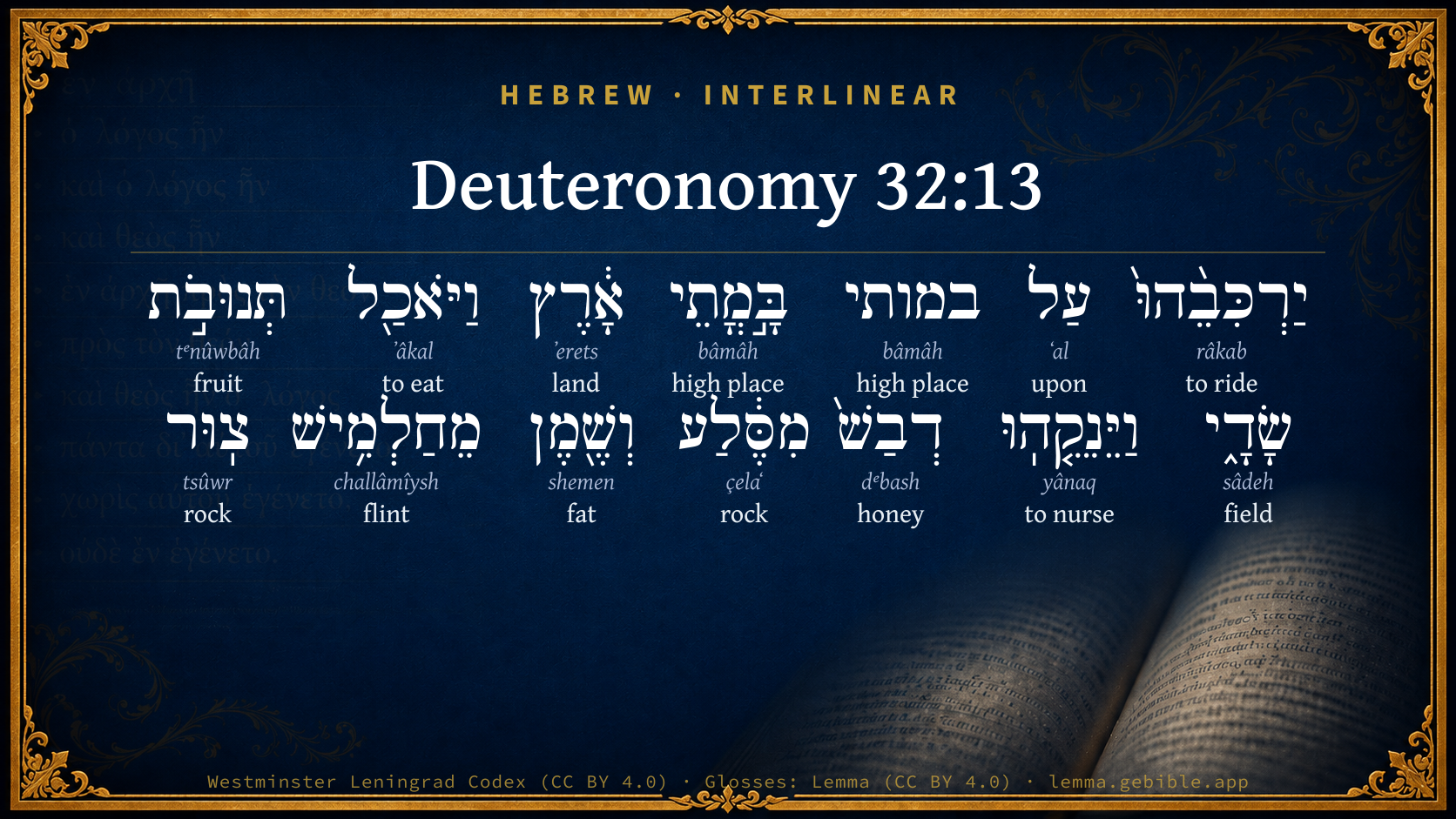
Hebrew (Westminster Leningrad Codex) Deuteronomy 32:13 appears in the Hebrew Old Testament. The text above is from the Westminster Leningrad Codex. Each word links to its Strong’s number, a concise gloss, and parsing drawn from the Open Scriptures Hebrew Bible morphology. Click any word for its full Brown-Driver-Briggs (BDB) entry.
Download image
Cite this verse

Deuteronomy 32:13 (World English Bible). Public Domain. Lemma interlinear Bible study tool, https://lemma.gebible.app/v/deuteronomy/32/13.

Show BibTeX & RIS
BibTeX
RIS
English Translation
He made him ride on the high places of the earth, He ate the increase of the field; He made him to suck honey out of the rock, Oil out of the flinty rock;
World English Bible · Public Domain
Highlights
  • 1 first appearance in the Hebrew Bible
Full analysis ↓
Download a study sheet

One document with this verse’s original text, its word-by-word gloss line, the meaning frame, cross-references with their text, attributed commentary, and full source and license credits — printable, and it pastes into notes with its structure intact.

This verse Autodidact and up

Study sheet (.html) Plain text (.txt)

A passage Seminary Student

Up to 50 verses in one chapter. A passage sheet keeps up to 6 commentary sources and 12 cross-references per verse, in the order this page ranks them, and says so on the sheet whenever that leaves anything out. Ask for a single verse and you get the Autodidact verse sheet above.

Everything on this page stays free to read, with no account — the sheet is a download of what is already on screen, not access to it.

Want to remove ads? Support Godless Engineer
Compare translations 3

The same verse in 3 English versions, stacked beneath the original-language interlinear above. Click any original word for its lexicon entry.

Each is an independent rendering of the whole verse — the interlinear is not word-aligned to these translations.

Highlighted words mark where these versions differ — a whole-verse word diff, not a word-by-word alignment.

  • World English Bible Public Domain
    He made him ride on the high places of the earth, He ate the increase of the field; He made him to suck honey out of the rock, Oil out of the flinty rock;
  • King James Version Public Domain
    He made him ride on the high places of the earth, that he might eat the increase of the fields; and he made him to suck honey out of the rock, and oil out of the flinty rock;
  • unfoldingWord Literal Text CC BY-SA 4.0
    He caused him to ride on heights of the land, and fed the fruits of the field, and he nourished him honey from the crag, and oil from the flinty stone,

unfoldingWord Literal Text — © unfoldingWord, licensed CC BY-SA 4.0. Word-aligned USFM3 via Door43 (git.door43.org/unfoldingWord/en_ult).

Versions to compare (up to 4)

3 of 4 selected

Show all 18 translations

Every available English version of this verse, each an independent rendering of the whole verse.

  • World English Bible Public Domain
    He made him ride on the high places of the earth, He ate the increase of the field; He made him to suck honey out of the rock, Oil out of the flinty rock;
  • Berean Standard Bible Public Domain
    He made him ride on the heights of the land and fed him the produce of the field. He nourished him with honey from the rock and oil from the flinty crag,
  • Majority Standard Bible Public Domain
    He made him ride on the heights of the land and fed him the produce of the field. He nourished him with honey from the rock and oil from the flinty crag,
  • King James Version Public Domain
    He made him ride on the high places of the earth, that he might eat the increase of the fields; and he made him to suck honey out of the rock, and oil out of the flinty rock;
  • American Standard Version (1901) Public Domain
    He made him ride on the high places of the earth, And he did eat the increase of the field; And he made him to suck honey out of the rock, And oil out of the flinty rock;
  • Revised Version (1885) Public Domain
    He made him ride on the high places of the earth, And he did eat the increase of the field; And he made him to suck honey out of the rock, And oil out of the flinty rock;
  • Geneva Bible (1599) Public Domain
    He caryed him vp to the hie places of the earth, that he might eate the fruites of the fieldes, and he caused him to sucke hony out of the stone, and oyle out of the hard rocke:
  • Douay-Rheims (1899) Public Domain
    He set him upon high land: that he might eat the fruits of the fields, that he might suck honey out of the rock, and oil out of the hardest stone,
  • Young's Literal Translation Public Domain
    He maketh him ride on high places of earth, And he eateth increase of the fields, And He maketh him suck honey from a rock, And oil out of the flint of a rock;
  • Literal Standard Version CC BY-SA 4.0
    He makes him ride on high places of earth, || And he eats increase of the fields, || And He makes him suck honey from a rock, || And oil out of the flint of a rock;
  • Unlocked Literal Bible CC BY-SA 4.0
    He made him ride on high places of the land, and he fed him the fruits of the field; he nourished him with honey from the rock, and oil from the flinty crag.
  • unfoldingWord Literal Text CC BY-SA 4.0
    He caused him to ride on heights of the land, and fed the fruits of the field, and he nourished him honey from the crag, and oil from the flinty stone,
  • Darby Bible Public Domain
    He made him ride on the high places of the earth, And he ate the produce of the field; And he made him suck honey out of the crag, And oil out of the flinty rock;
  • World Messianic Bible Public Domain
    He made him ride on the high places of the earth. He ate the increase of the field. He caused him to suck honey out of the rock, oil out of the flinty rock;
  • Webster's Bible Public Domain
    He made him ride on the high places of the earth, that he might eat the increase of the fields; and he made him to suck honey out of the rock, and oil out of the flinty rock;
  • Free Bible Version CC BY-SA 4.0
    The Lord gave you the high country to rule, and fed you with the crops of the field to eat. He sustained you with honey from the rock and olive oil from the flinty crag,
  • Bible in Basic English Public Domain
    He put him on the high places of the earth, his food was the increase of the field; honey he gave him out of the rock and oil out of the hard rock;
  • JPS Tanakh (1917) Public Domain
    He made him ride on the high places of the earth, and he did eat the fruitage of the field; and He made him to suck honey out of the crag, and oil out of the flinty rock;

Literal Standard Version (2020), Covenant Press — licensed CC BY-SA 4.0. Text via the HelloAO Bible API (eBible.org). Unlocked Literal Bible (unfoldingWord) — licensed CC BY-SA 4.0. Text via the HelloAO Bible API (eBible.org). unfoldingWord Literal Text — © unfoldingWord, licensed CC BY-SA 4.0. Word-aligned USFM3 via Door43 (git.door43.org/unfoldingWord/en_ult). Free Bible Version, Dr. Jonathan Gallagher — licensed CC BY-SA 4.0. Text via the HelloAO Bible API (eBible.org).

Word by word

More ways to search: Search by grammar → Find every occurrence → Compare this word →

Practice this passage: Drill this verse → Learn its vocabulary →

תְּנוּבֹ֣ת
tᵉnûwbâh
H8570
“fruits of”
Noun, Common, Feminine, Plural, Construct
Part of Speech
Noun
Type
Common
Gender
Feminine
Number
Plural
State
Construct
Full BDB Definition

Origin: from H5107

TWOT: 1318c

fruit, produce
  1. יַרְכִּבֵ֨הוּ֙ râkab H7392 “to ride · him” Verb, Hiphil, Imperfect, 3rd Person, Masculine, Singular + Suffix, Personal, 3rd Person, Masculine, Singular
  2. עַל ʻal H5921 “upon” Preposition
  3. במותי bâmâh H1116 “high places of” Noun, Common, Feminine, Plural, Construct
  4. בָּ֣מֳתֵי bâmâh H1116 “high places of” Noun, Common, Feminine, Plural, Construct
  5. אָ֔רֶץ ʼerets H776 “land” Noun, Common, Both, Singular, Absolute
  6. וַיֹּאכַ֖ל ʼâkal H398 “and · to eat” Conjunction + Verb, Qal, Sequential Imperfect, 3rd Person, Masculine, Singular
  7. שָׂדָ֑י sâdeh H7704 “field” Noun, Common, Masculine, Singular, Absolute
  8. וַיֵּנִקֵ֤הֽוּ yânaq H3243 “and · to nurse · him” Conjunction + Verb, Hiphil, Sequential Imperfect, 3rd Person, Masculine, Singular + Suffix, Personal, 3rd Person, Masculine, Singular
  9. דְבַשׁ֙ dᵉbash H1706 “honey” Noun, Common, Masculine, Singular, Absolute
  10. מִסֶּ֔לַע çelaʻ H5553 “from · rock” Preposition + Noun, Common, Masculine, Singular, Absolute
  11. וְשֶׁ֖מֶן shemen H8081 “and · fat” Conjunction + Noun, Common, Masculine, Singular, Absolute
  12. מֵחַלְמִ֥ישׁ challâmîysh H2496 “from · flint of” Preposition + Noun, Common, Masculine, Singular, Construct
  13. צֽוּר tsûwr H6697 “rock” Noun, Common, Masculine, Singular, Absolute

About this verse

These counts appear in no published source. They are computed here, from the morphology-tagged text and Lemma’s own curated glosses. What Lemma adds →

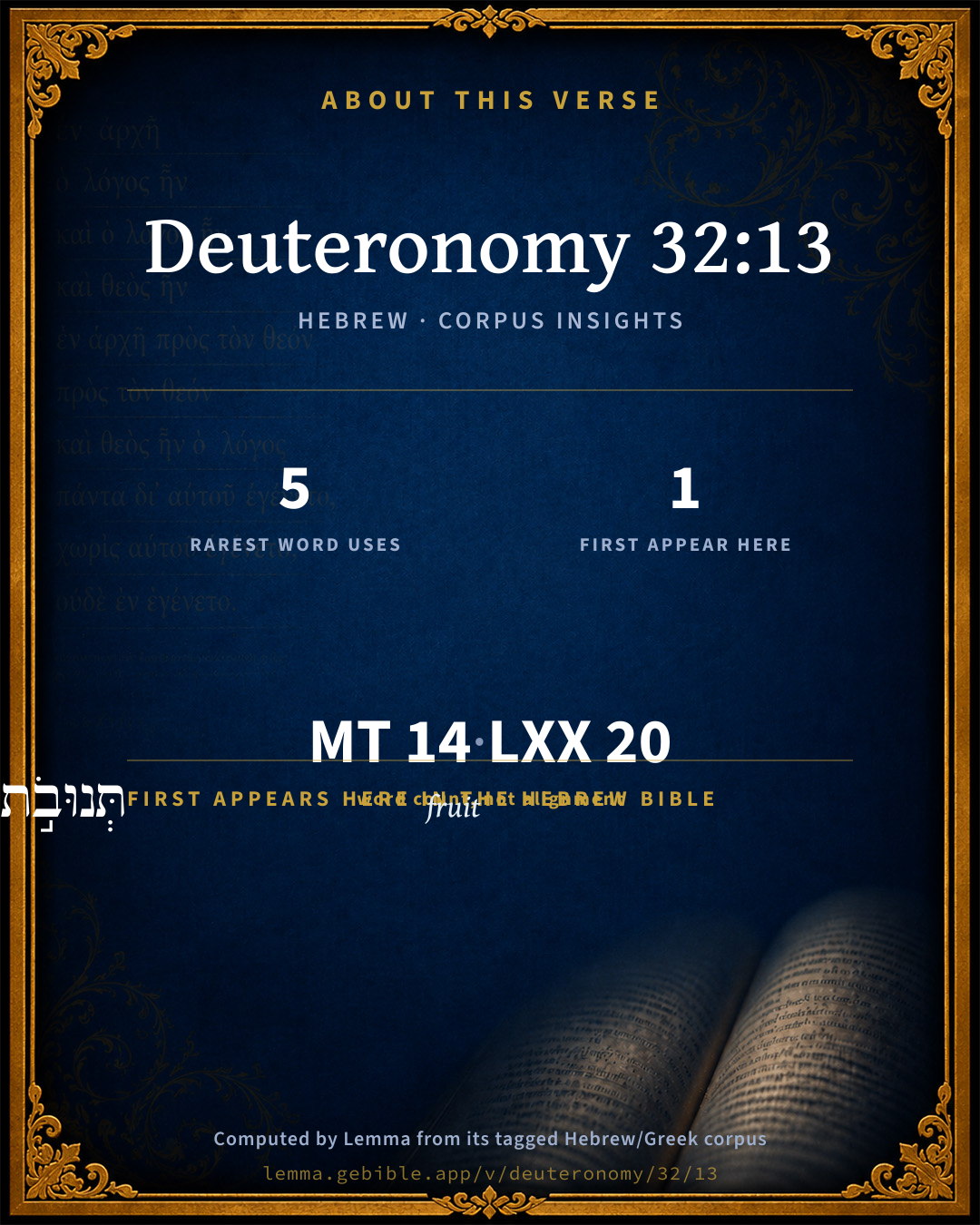
14
words
13
distinct lemmas
Pentateuch
section

Notable vocabulary

The rarest word here is תְּנוּבֹ֣ת fruit H8570 — appearing just 5 times in the whole Hebrew Bible.

First appearance in Scripture

This word makes its first canonical appearance in the Hebrew Bible here:

  • תְּנוּבֹ֣ת fruit H8570

Shared distinctive vocabulary

תְּנוּבֹ֣ת fruit H8570 occurs in 5 verses of the Hebrew Bible. Also found in:

Grammatical profile

  • 3 verbs
  • 10 nouns
  • 1 preposition

Verb forms

  • יַרְכִּבֵ֨הוּ֙ Hiphil · Imperfect
  • וַיֹּאכַ֖ל Qal · Sequential Imperfect
  • וַיֵּנִקֵ֤הֽוּ Hiphil · Sequential Imperfect

Repetition

A word recurs within this verse — often emphatic in Hebrew:

  • במותי high place H1116 ×2

Hebrew & Septuagint length

In English translation the verse runs 34 words from the Hebrew and 33 from the Septuagint (LXX English) — closely comparable.

A rough comparison of the two English renderings, which tokenize alike — not a word-level alignment.

Word counts can differ between the Hebrew and the Greek without any difference in meaning — e.g. the Hebrew direct-object marker אֵת has no separate Greek word, and Greek often adds the article ὁ.

In the original languages it is 14 Hebrew tokens and 20 Greek tokens — but the two are counted differently (Hebrew bundles its prefixes and suffixes into one token; the Greek is in lemma form), so that isn’t a like-for-like length.

Cross-references

8

Topical passages linked to Deuteronomy 32:13 in the Treasury of Scripture Knowledge — connected by theme and wording, ordered by reader-vote popularity; previews shown in the World English Bible.

  • Isaiah 58:14 then shall you delight yourself in Yahweh; and I will make you to ride on the high places of the earth; and I will feed you with the heritage of Jacob your father: for the mouth of Yahweh has spoken it.
  • Job 29:6 When my steps were washed with butter, And the rock poured out streams of oil for me!
  • Psalms 81:16 But he would have also fed them with the finest of the wheat. I will satisfy you with honey out of the rock."
  • Deuteronomy 33:26 There is none like God, Jeshurun, Who rides on the heavens for your help, In his excellency on the skies.
  • Deuteronomy 33:29 Happy are you, Israel: Who is like you, a people saved by Yahweh, The shield of your help, The sword of your excellency! Your enemies shall submit themselves to you; You shall tread on their high places.
  • Ezekiel 36:2 Thus says the Lord Yahweh: Because the enemy has said against you, Aha! and, The ancient high places are ours in possession;
  • Isaiah 48:21 They didn't thirst when he led them through the deserts; he caused the waters to flow out of the rock for them; he split the rock also, and the waters gushed out.
  • Ezekiel 21:17 I will also strike my hands together, and I will cause my wrath to rest: I, Yahweh, have spoken it.

Cross-references courtesy of OpenBible.info (CC BY 4.0).

Hebrew and Greek witnesses Masoretic Hebrew ↔ Greek Septuagint

The same verse in the two great witnesses to the Old Testament, shown verse-for-verse.

These are two independent witnesses, not word-aligned to each other, and the Septuagint is shown in lemma (dictionary) form.

Hebrew Deuteronomy 32:13 Masoretic · Westminster Leningrad Codex

יַרְכִּבֵ֨הוּ֙ עַל במותי בָּ֣מֳתֵי אָ֔רֶץ וַיֹּאכַ֖ל תְּנוּבֹ֣ת שָׂדָ֑י וַיֵּנִקֵ֤הֽוּ דְבַשׁ֙ מִסֶּ֔לַע וְשֶׁ֖מֶן מֵחַלְמִ֥ישׁ צֽוּר

He made him ride on the high places of the earth, He ate the increase of the field; He made him to suck honey out of the rock, Oil out of the flinty rock;

World English Bible · Public Domain

Greek LXX Deuteronomy 32:13 Septuagint · lemma form

ἀναβιβάζω αὐτός ἐπί ὁ ἰσχύς ὁ γῆ ψωμίζω αὐτός γένημα ἀγρός θηλάζω μέλι ἐκ πέτρα καί ἔλαιον ἐκ στερεός πέτρα

He brought them up on the strength of the land; he fed them with the fruits of the fields; they sucked honey out of the rock, and oil out of the solid rock.

LXX2012 (modern English Septuagint) · Public Domain

On this verse, The Cambridge Bible for Schools and Colleges discusses the Septuagint’s reading. Read the note in Commentary ↓

Hebrew: Westminster Leningrad Codex (CC BY 4.0). Greek: Septuagint (public domain); English from LXX2012 (modern English Septuagint) (Public Domain). How the Septuagint differs from the Hebrew →

Targum (Aramaic paraphrase)

2

The Targum is the ancient Jewish Aramaic paraphrase of the Hebrew Scriptures — an interpretive translation, not the Hebrew text itself. Onkelos (literal) and Pseudo-Jonathan (expansive) render the Torah, and Jonathan the Prophets. Coverage is partial: where no permissively-licensed English translation exists for a verse, only the Aramaic is shown. This is verse-level text, not a word-by-word alignment to the Hebrew.

  1. Targum Onkelos Torah (Genesis–Deuteronomy)
    אַשְׁרִנוּן עַל תָּקְפֵּי אַרְעָא וְאוֹכָלִנוּן בִּזַת סָנְאֵיהוֹן וִיהַב לְהוֹן בִּזַת שַׁלִיטֵי קִרְוִין וְנִכְסֵי יָתְבֵי כְּרַכִּין תַּקִיפִין

    (no public-domain English translation for this verse)

    Targum Onkelos — Aramaic: “Onkelos Genesis” (public domain); “Onkelos Exodus” (public domain); “Onkelos Leviticus” (public domain); “Onkelos Numbers” (public domain); “Onkelos Deuteronomy” (public domain). English: “Sefaria Community Translation” (CC0 1.0 (public-domain dedication)); “J.W. Etheridge. The Targums of Onkelos and Jonathan Ben Uzziel on the Pentateuch. London: Longmans, Green, 1862” (public domain). Text via Sefaria.

  2. Targum Pseudo-Jonathan Torah (Genesis–Deuteronomy)
    אַשְׁרִינוּן עַל כַּרְכֵי אַרְעָא דְיִשְרָאֵל וְאַיְיכוֹל יַתְהוֹן תַּפְנוּקֵי עַלְלַת חַקְלָאָה וְאוֹנִיק יַתְהוֹן דוּבְשָׁא מִפֵּירָהָא דְמִתְרַבְיָין עַל כֵּיפִין וּמִשְׁחָא מִזֵיתָהָא וּמְלַבְלְבִין מִטִנְרִין תַּקִיפִין

    He made them to dwell in the strong places of the land of Israel, and gave them to eat of the goodly produce of His field, and nourished them with the honey of its fruits which grow even upon the rocks with the oil of its olive trees, and from branches (growing) out of the rocks.

    Targum Pseudo-Jonathan — Aramaic: “Targum Jonathan on Genesis” (public domain); “Targum Jonathan on Exodus” (public domain); “Targum Jonathan on Leviticus” (public domain); “Targum Jonathan on Numbers” (public domain); “Targum Jonathan on Deuteronomy” (public domain). English: “The Targum of Jonathan ben Uzziel, trans. J. W. Etheridge, London, 1862” (public domain). Text via Sefaria.

Commentary

Notes on Deuteronomy 32:13 from classic Christian and Jewish commentators (each source and its license shown beneath its notes). The classic Christian expositions comment on the surrounding passage and are grouped to its opening verse, so a note may address several verses; the Jewish commentaries on the Tanakh (Rashi and others) are per-verse, so they appear only where the commentator wrote on this verse.

Lemma curates 59 commentaries, every one of them public domain or Creative Commons licensed, each selected and text-cleaned for this edition rather than reprinted as found. About our sources →

Trapp's Complete Commentary

John Trapp

Deu 32:13 He made him ride on the high places of the earth, that he might eat the increase of the fields; and he made him to suck honey out of the rock, and oil out of the flinty rock;

Ver. 13. To suck honey out of the rock.] Water as sweet as honey in that necessity; so doth every worthy receiver by faith at the sacrament; whereas whoso comes thereunto without faith, is like a man, saith Mr Tyndale, that thinks to quench his thirst by sucking the ale bowl.

John Trapp, A Commentary or Exposition upon All the Books of the Old and New Testament (1647–1656) — public domain. Text from a community e-Sword module.

The Biblical Illustrator

Joseph S. Exell

Deu_32:13-14

He made him ride on the high places of the earth.

Gods dealings with His people

Everything about the Jewish people was significant and emphatically prophetic. Canaan itself was a type of the condition both here and hereafter of the disciples of Christ. Whatsoever, therefore, the terms in which the richness of the literal Canaan is described, we may justly suppose that these terms, metaphorically taken, are expressive of the provision made in Christ for His Church, and of the privileges appertaining to those living and trusting in Him, with all the heart, and all the soul, and all the strength. It would seem rather indicated by the text that a great struggle should precede the possession of the rich produce of Canaan. And this we wish you particularly to observe--that riding on the high places of the earth is in order to,--is preparatory to the eating of the increase of the fields; as though that eating were in recompense for the mastery won over the strongholds of the enemy.

I. Christianity, as it was not set up at once in the world, but was left to make its way by slow and painful struggle towards the dominion which it has not yet attained, so is it progressive, and not instantaneous in acquiring empire in individual cases. There maybe no inconsiderable analogy between the history of Christianity in the world and its history in the individual. Christianity when first published made rapid way, as though but few years could elapse ere every false system would vanish before it. But there came interruptions--backsliding, degeneracy, and afterwards repentance and partial reformation. But the consummation is still a thing only of hope, and Christ must re-appear in power and great majesty ere His religion shall prevail in every household and every heart. In like manner, the converted individual devotes himself at first with the greatest ardency to the duties of religion; but after a while, too commonly, the ardency declines, and duties are partially neglected, or languidly performed. Then the man is roused afresh, and labours in bitterness of spirit to recover the ground so unhappily lost. Though on the whole he advances, there remains much languor, and it will not be before the day of the Lord that he will be sanctified, holy in body, soul, and spirit. Nevertheless, the true characteristic of religion in both cases is that of progressiveness, or rather, perhaps we should say, of an inability to be stationary. There is such a thing, according to the apostle, as continuing in infancy, and being fed with milk. There is also such a thing as advancing to manhood, and being fed with meat. This is but another typical representation of what seems suggested in our text, that some merely eat of what the field yields of itself, whilst the richer increase is reserved for such as toil earnestly at cultivating the land. Not, indeed, that the richer truths are wholly different from the others; for Christ must be the staple in all truths to the soul; they are rather the same truths in a more refined and exquisite state prepared for those who have toiled here to secure a portion in the world to come.

II. We now proceed to consider the second part of the prophecy, or promise of our text--for it is either; that which has to do with the obtaining honey from the rock, and oil from the flinty rock. This part, perhaps, goes even further than the first in connecting the blessing with the diligence of those on whom it is conferred. If honey be obtained from the rock, the rock must be climbed; and since it Will not lie on the surface, the clefts or fissures must be carefully explored; so that the promise appears to presuppose labour, and therefore bears out what we have all along argued, that the text belongs peculiarly to those who are working out their salvation with more than ordinary earnestness. But, however it may be supposed that bees might swarm in the clefts of the rock, and thus there might be literally the obtaining honey from the rock, there would seem to be a sort of opposition intended between the thing produced and the place, that produces it. The little apparent likelihood of the rock yielding honey is paralleled by the certainty of the fact that Christ conquered by yielding, and subdued death by dying. And if you take the rock as meaning that typical rock which was smitten by Moses at Horeb, then the promise of honey from the rock may be as much a promise of peculiar privileges to such as are diligent in righteousness, as that of the eating of the increase of the fields, Every believer draws water from the rock, but the honey may be reserved for those who by patient continuance in well doing show forth eminently the praise of Him who bore our sins in His own body on the tree. And there is, indeed, a hidden preciousness in the Saviour, in that Rock of Ages cleft for us, which is appreciated more and more as the believer goes on to acquaintance with Christ, striving to magnify Him in all the actions of his life. It is not merely a general sense of the sufficiency of the atonement which such men obtain--the persuasion that there is provision made by the Mediator for the wants of sinners, even the very chief: they go deeper than this; they find in Christ such stores of consolation, such treasures of wisdom and knowledge, that they are never weary of searching as they are never able to exhaust. Every necessity as it arises is supplied from these stores of Christ; every cloud scattered by His brightness; every desire either satisfied, or satisfaction guaranteed by the unsearchable riches of His work of mediation. And this honey is from the rock--from the clefts of the rock. I must go, as it were, to the wounds of the Saviour if I would obtain this precious and ever multiplying provision. I must be much with Him in the garden and at the cross. Surely we may confidently say, that if there be a fulness and preciousness in the Redeemer, that is ascertained though left unexhausted as His mighty sacrifice is contemplated, and the lessons which it furnishes wrought into practice; if there be this reward to meet constant persevering piety,--that it finds deeper and deeper abundance in the Saviour--a sweetness and a richness in His office which give indescribable emphasis to the Scriptural expression--Chiefest among ten thousand and altogether lovely; and if, moreover, it be Christ as bruised and broken, pierced and riven like a vast mass of stone on which the thunderbolt has fallen, who yields these rich treasures, then it must be true that the soul which hungers and thirsts after righteousness shall not only eat of the increase of the fields, but be permitted to draw honey from the rock, and oil from the flinty rock.

III. This idea is put yet more strongly, you see, in the concluding words of our text--and oil out of the flinty rock; the addition of the word flinty giving a stronger image of rockiness, and therefore making the place less promising for such rich and delicate productions. What is denoted by the metaphor thus interpreted, if not that affliction is made by God to comfort His people; so that when they are brought by His providence into wild and rough places, they are enabled to find there even richer provisions than in verdant and cultivated spots? We need not adduce any lengthened proof that the promise thus interpreted is verified to the very letter in the experience of the Church. The testimony of believers, in every age of the world, has been, that the season of affliction has proved a season of rich communications from above--a season when Gods faithfulness and love have been more realised than they ever were before--a season in which texts of Scripture have assumed new and deeper meaning, and truths hitherto dwelt on only in the head have made their way to the heart, and diffused there a peace passing all understanding.

IV. And perhaps, even yet, our text may not have been fully expounded, for if in its primary application to the Jews it denoted the sustenance to be afforded them in Canaan, as applied to ourselves it may relate to provision laid up for us in heaven, of which Canaan was the type, when God shall have made us ride on the high places of the earth, and exalted us to His kingdom, where the promise before us may be always receiving accomplishment. God shall be always communicating supplies from His own fulness, as age after age of expansion or enlargement passes over the redeemed; and these supplies may still be supplies of honey from the rock. There will be no exhausting of Christ and redemption. Never shall glorified spirits be weary of searching into the mysteries of grace, or consider those mysteries as thoroughly explored. Keep up, if you will, the metaphor of our text. Eternity shall be spent in contemplating and examining the Rock of Ages; every moment shall discover a fresh depth; the clefts in this rock, most strange, but most true, fitting it to bear up the universe, and every fresh cleft yielding fresh stores of honey, satisfying desires which shall but grow with their supply. (H. Melvill, B. D.)

The joy of Israel in the wilderness

The ordinary view of the lot of Israel in the wilderness is that it was one of hardship and of unbroken tribulation. In contesting this view we do not maintain that their lot was one of unmixed happiness. Such is not the state of mankind under any conditions.

1. A large part of their happiness came from the sense of the grandeur of the movement of the Divine providence of which they were the immediate subjects.

2. Another source of their joy came from their liberated condition.

3. Another was the sensible evidence of Gods goodness.

4. Another was from the new phases of natural scenery by which they were constantly saluted.

5. Another was from the abundance and richness of their temporal supplies.

6. Another was their faith in the promises of the covenant.

7. Their social and domestic enjoyments. They had homes; and they knew their children had glorious prospects.

Conclusion--

1. God wants us all to be happy, and always happy. Take stock of your joys.

2. Some of the greatest promises of Gods Word are for the Jew. (B. F. Rawlins, D. D.)

The Biblical Illustrator, edited by Joseph S. Exell (c. 1880s–1900s) — public domain. Text from a community e-Sword module.

Joseph Benson's Commentary

Deu 32:13. He made him ride on the high places — To conquer their strongest holds on the mountains, and their cities fenced with walls of the greatest height and strength: to ride upon being, in the phraseology of Scripture, to subdue and conquer. Or, he put him in possession of a country full of lofty and fruitful mountains, and therefore called the high places of the earth. To suck honey out of the rock — Placed him in a country where honey flowed from the very rocks, the bees making it in the holes thereof, or in the hollow trees that grew upon or among the rocks. Oil out of the flinty rocks — Olive-trees growing and bearing fruit best in rocky or hilly places. The expressions are proverbial, and denote a most fertile land.

Joseph Benson's Commentary on the Old and New Testaments (1811–1818) — public domain. Text from a community e-Sword module.

Geneva Bible (1599)

Geneva Bible translators

That is, abundance of all things even in the very rocks.

Meaning, of the land of Canaan, which was high in respect of Egypt.

Geneva Bible (1599) marginal notes — public domain. Text via Bolls.life.

Jamieson, Fausset & Brown

Robert Jamieson, A. R. Fausset & David Brown

He made him ride on the high places, &c.--All these expressions seem to have peculiar reference to their home in the trans-jordanic territory, that being the extent of Palestine that they had seen at the time when Moses is represented as uttering these words. "The high places" and "the fields" are specially applicable to the tablelands of Gilead as are the allusions to the herds and flocks, the honey of the wild bees which hive in the crevices of the rocks, the oil from the olive as it grew singly or in small clumps on the tops of hills where scarcely anything else would grow, the finest wheat (Psa 81:16; Psa 147:14), and the prolific vintage.

Jamieson, Fausset & Brown — Commentary Critical and Explanatory on the Whole Bible (1871) — public domain (CC PDM 1.0). Text via the HelloAO Bible API.

Adam Clarke's Commentary

Verse 13. He made him ride] ירכבהו yarkibehu, he will cause him to ride. All the verbs here are in the future tense, because this is a prophecy of the prosperity they should possess in the promised land. The Israelites were to ride - exult, on the high places, the mountains and hills of their land, in which they are promised the highest degrees of prosperity; as even the rocky part of the country should be rendered fertile by the peculiar benediction of God.

Suck honey out of the rock, and oil out of the flinty rock] This promise states that even the most barren places in the country should yield an abundance of aromatic flowers, from which the bees should collect honey in abundance; and even the tops of the rocks afford sufficient support for olive trees, from the fruit of which they should extract oil in abundance: and all this should be occasioned by the peculiar blessing of God upon the land.

Adam Clarke's Commentary on the Bible (1810–1826) — public domain. Text from a community e-Sword/MySword module.

The Cambridge Bible for Schools and Colleges

gen. ed. J. J. S. Perowne

13. ride on the heights] Cp. Amo_4:12.

and to eat of the fruit of the hills] So Sam. and LXX for the Heb. he doth eat; hills not fields as in Deu_28:3, Heb. sadai, early form sadeh, in the earlier sense of that word (see on Deu_5:21) as in Jdg_5:4, parallel to heights or high places. Israel’s territory was a highland one.

suckles] With Sam. and Syr. omit and.

honey] The honey of the O.T. is wild, as here, Jdg_14:8 ff., 1Sa_14:25 ff., Psa_81:16; apiculture, a very ancient craft, is not implied till the N.T. speaks of wild honey (Mat_3:4, Mar_1:6). See further Jerus. i. 306 f., E.B. art. ‘Honey,’ and ZDPV. xxxii. 151.

oil of the flinty rock] Lit. the flint of the rock. The olive never yields oil so richly as on limestone terraces and their débris; see Jerus. i. 300.

The Cambridge Bible for Schools and Colleges (gen. ed. J. J. S. Perowne; Cambridge University Press, 1878–1918) — public domain. Text from a community e-Sword module.

John Gill's Exposition

Butter of kine,.... Made of milk, which kine or cows give; Jarchi says, this is the fat that is gathered on the top of milk, he means cream, and which indeed was the butter of the ancients, and is here meant:

and milk of sheep: which they give, though not in such plenty as the kine, yet what is very wholesome and nourishing: the philosopher (b) observes, that sheep give more milk in proportion to the size of their bodies than cows: and Pliny (c) says their milk is sweeter and more nourishing, and the butter made of it is the fattest:

with fat of lambs; or fat lambs, rich and delicious food:

and rams of the breed of Bashan, and goats; a fruitful country abounding with pasturage, where rams and goats of the best sort were and the breed of them was coveted and had in the land of Canaan; the kine of Bashan are mentioned elsewhere, Psa 22:12,

with the fat of kidneys of wheat: that is, the best wheat, the grains are plump and full; and Aben Ezra observes, that a grain of wheat has some likeness to a kidney, see Psa 81:16,

and thou didst drink the pure blood of the grape; wine which comes from the grape, red wine, pure and unmixed, see Gen 40:11; the land of Canaan was a land of vines, and abounded with good wine, Deu 8:8; which the Israelites, when they came into it, drank of in common, who had only drank water in the wilderness, and had but little flesh, and lived on manna, and now abounded with plenty of all good things; all which are observed as instances of divine goodness, and to aggravate their ingratitude in rejecting the Messiah, they then enjoying all these good things, the land being alike fertile and affluent then, as appears from Isa 7:14; Jarchi applies this fruitfulness to the times of Solomon, as the butter of kine, and the kidneys of wheat, Kg1 4:22; and fat of lambs, and the blood of the grape, to the times of the ten tribes, Amo 6:4; but this was the constant fertility of the land, and lasted to the times of the Messiah: now all these may be expressive of the blessings of grace, and the spiritual food of the Gospel: Ainsworth very prettily remarks, that here is both food for babes and for grown persons, butter and milk for the one, and meat for the other, and drink for them both: the plain truths of the Gospel are like butter, soft and easy to be taken in, and like milk, easy of digestion, cooling, nourishing, sweet, and pleasant; the more sublime truths of the Gospel are meat for strong men, signified by the flesh of fat lambs, rams, and goats; which all being used in sacrifices were typical of Christ; as also the finest of wheat is an emblem of him the bread of life, on whom the weakest believer lives by faith; and the drink for both, the wine the blood of the grape, may signify the love of Christ, the Gospel and the truths of it, and the blessings of grace, which come through the everlasting covenant.

(b) Aristot. Problem. sect. 10. qu. 6. (c) Nat. Hist. l. 28. c. 9.

John Gill's Exposition of the Whole Bible (1746–1763) — public domain (CC PDM 1.0). Text via the HelloAO Bible API.

Haydock's Catholic Bible Commentary

High land, in a place of safety, both against the enemy, and the inundations of water. The Nile renders Egypt like one continued sea for about 80 days, in the summer season. (Calmet) --- God had already begun to put the Israelites in possession of the fertile countries east of the Jordan, where there were several high mountains. (Haydock) --- But when this canticle should be recited, in after ages, they would also enjoy the other regions, which had been promised unto them, on the west. Moses speaks, like a prophet, of things to come, as if they were already past. (Menochius) --- Stone. Bees make honey in such places, and olive trees flourish on the side of a hill. Vestiges still remain of the industry with which the Jews have formerly cultivated their territory, supporting the earth with walls (Calmet) when it was in danger of falling down, or of becoming barren, for want of moisture. (Haydock)

George Leo Haydock (1774–1849), Haydock's Catholic Family Bible and Commentary, 1859 edition — public domain. Excludes Psalms (Douay-Rheims chapter numbering differs from Protestant) and Deuterocanonical books (Catholic canon only).

Matthew Poole's English Annotations

On the high places of the earth, i.e. to conquer their strongest holds, which ofttimes are in the mountains, and their cities fenced with walls of greatest height and strength, Deu 1:28; 2:36; 33:29; Isa 58:14. To ride upon in Scripture phrase is to subdue or conquer, as Psa 45:4; 66:12; Rev 6:2; 19:11,14.

To suck honey out of the rock; this being a land flowing with honey, Exo 3:8,17, where the bees made honey even in woods, as 1Sa 14, or in the holes of rocks, or in the trees that grew upon or among rocks.

Oil out of the flinty rock: the olive trees grow and fructify most in rocky or hilly places.

Matthew Poole's English Annotations on the Holy Bible (1683–1685) — public domain. Text from a community e-Sword/MySword module.

Whedon's Commentary on the Bible

Daniel D. Whedon

13. He made him ride on the high places — He who possessed the high places had control. The figure is used to denote the subjugation of the land. Comp. Deu_33:29 : “Them shalt tread upon their high places;” also, Psa_18:33 : “Setteth me upon my high places.”

Daniel D. Whedon (gen. ed.), Commentary on the Old and New Testaments (1874–1909) — public domain. Text from a community e-Sword module.

The Pulpit Commentary

He made him ride on the high places of the earth. To ride over or drive over the heights of a country is figuratively to subjugate and take possession of that country. (cf. Deu_33:29; Isa_58:14) Israel, having subjugated Canaan, could eat of its produce, the increase of the fields, as his own. Honey out of the rock, and oil out of the flinty rock. Canaan abounded in wild bees, which had their hives in crevices of the rock, and in olive trees, which grew on a rocky soil; as is still the case in Palestine.

The Pulpit Commentary (1880–1919), ed. H.D.M. Spence-Jones & Joseph S. Exell — public domain. Text from a community e-Sword module.

John Wesley's Explanatory Notes

The high places - To conquer their strongest holds, which often are in the mountains, and their cities fenced with walls of greatest height and strength. To ride upon, in scripture phrase, is to subdue or conquer. Out of the rock - This being a land flowing with honey, where the bees made honey in the holes of rocks, or in the trees that grew upon or among the rocks. Out of the flinty rocks - The olive-trees grow and bear most fruit in rocky or hilly places.

John Wesley, Explanatory Notes Upon the Whole Bible (1754–1765) — public domain. Text via the GEBible commentary corpus.

unfoldingWord translationNotes

Door43 World Missions Community

General Information:

Moses speaks a poetic song to the people of Israel. (See: Parallelism)

He made him ride on high places of the land

This is an idiom. The word "him" refers to the people of Israel. AT: "Yahweh made them ride on high places of the land" or "Yahweh helped them take and occupy the land" (See: Idiom)

made him ride ... fed him ... nourished him

Moses continues to speak of the Israelites as "Jacob" (Deuteronomy 32:9-10). You may need to translate this as though Moses were speaking of the Israelites as many people. "made our ancestors ride ... fed them ... nourished them" (See: Pronouns)

he fed him the fruits of the field

"he brought him to a land with plenty of crops he could eat"

he nourished him with honey from the rock, and oil from the flinty crag

The land had many wild bees, which produce honey, with hives inside rock holes. There were also many olive trees, which provide oil, and grow on rocks, hills, and mountains.

nourished him with honey

This is like a mother giving her breast to an infant. "allowed him to suck honey" (See: Metaphor)

translationWords

high place

fruit

honey

oil

unfoldingWord translationNotes — © Distant Shores Media and the Door43 World Missions Community, licensed CC BY-SA 4.0. Source: git.door43.org/Door43/en_tn.

Rashi

Rabbi Shlomo Yitzchaki (Rashi)

ירכבהו על במתי ארץ HE MADE HIM RIDE ON THE HIGH PLACES OF THE EARTH — The entire text (vv. 13 and 14) is to be understood metaphorically as the Targum has it (i.e., as referring to Eretz Israel).

ירכבהו וגו׳ HE MADE HIM RIDE [UPON THE HIGH PLACES] — This expression is used because the land of Israel is higher than all other countries (Sifrei Devarim 316:1).

ויאכל תנובת שדי THAT HE MIGHT EAT THE PRODUCE OF THE FIELDS — This refers to the fruits of the land of Israel which are quicker to shoot (נוב) and to ripen than all the fruits of other countries (Sifrei Devarim 316:2).

וינקהו דבש מסלע AND HE MADE HIM SUCK HONEY OUT OF THE ROCK — Indeed it once happened that a man said to his son In Sichnin (a town in Galilee): “Bring me dried figs from the cask”. He went and found the honey flowing over its brim. He said to him, “But this is a vat of honey (not of figs)”. Thereupon he said to him: “Put your hands deep into it and you will bring up figs from it” (Sifrei Devarim 316:3).

במתי ארץ is an expression denoting height.

שדי has the same meaning as שדה, field.

מחלמיש צור (lit., out of the flint of the rock) — The meaning is: the strength and the hardness of the rock. — When it is not connected with the following word (that is, when it is used in the absolute state) it is vowelled חַלָּמִישׁ (as in Deuteronomy 8:15). whilst when it is connected (is in the construct state) it is punctuated חַלְמִישׁ as here.

ושמן מחלמיש צור AND OIL OUT OF THE FLINTY ROCK — this refers to the olives of Giscala (a place in Galilee) (Sifrei Devarim 316:4).

Rashi on the Tanakh — English translations: “The Judaica Press complete Tanach with Rashi, translated by A. J. Rosenberg” (CC BY 4.0); “Pentateuch with Rashi's commentary by M. Rosenbaum and A.M. Silbermann, 1929-1934” (public domain); “The Metsudah Tanach series, Lakewood, N.J” (CC BY 4.0); and “The Book of Joshua, Metsudah Publications, 1997” (CC BY 4.0). Text via Sefaria.

Lesson kit

Teaching starters — assembled from the data on this page, not authored interpretation. Every prompt links to the verse data it draws on. Edit before teaching.

Deuteronomy, in the Pentateuch, opens this verse with 14 words (13 distinct Hebrew lemmas). Its most distinctive word is tᵉnûwbâh (“fruit”). A historical commentator’s framing appears above. Read the whole chapter for the surrounding context.

Discussion questions

  1. How does “fruit” (tᵉnûwbâh) shape what this verse is saying?
  2. The word “fruit” first appears here in Scripture. What is being introduced at this debut?
  3. Judges 9:11 shares the word «fruit» with this verse. How do the two illuminate each other?
  4. “high place” occurs 2× in this one verse. What is the effect of the repetition?
  5. These translations render this verse differently. What is at stake in choosing one wording over another?
  6. The verb «יַרְכִּבֵ֨הוּ֙» is Hiphil Imperfect. How does its form color the action?
  7. Reading how Trapp's Complete Commentary and The Biblical Illustrator read this verse, where do the two commentators agree and where do they part?

Things to notice

Reading settings

Reading text

Shown beneath each verse's original-language words.

Old Testament
Old Testament edition

Read the OT as the Masoretic Hebrew (MT) or the Greek Septuagint (LXX).

English shown for the Greek Septuagint (in the Hebrew ↔ Greek comparison).

Comparing translations? Open the Compare panel on any verse page to stack up to four side by side.